A provider signs their offer letter on a Monday. Their first patient should be six weeks out. Instead it slips to sixteen, because the credentialing file is stuck between a spreadsheet, an email thread, and a fax machine that nobody checks.
That gap is not a scheduling problem. It is lost revenue. Every day a credentialed provider cannot bill is a day of margin that never comes back, and the file that stalls is usually the one waiting on a primary source verification, a missing license copy, or a payer enrollment nobody flagged.
The pressure is not slowing down. The global credentialing software market was valued at USD 1.25 billion in 2024 and is projected to reach USD 4.76 billion by 2033, a compound annual growth rate of 14.4% through 2033, according to DataHorizzon Research (2024). That growth is a direct signal: healthcare teams are done managing provider files by hand.
Manual credentialing breaks in predictable ways. Expirations get missed. Recredentialing dates slip. Sanctions screening happens once and then never again. Provider data lives in four systems that disagree with each other. And when an audit lands, someone spends a weekend rebuilding a paper trail that should have been one click away.
Provider credentialing software fixes the pattern, not just the symptom. It gives credentialing teams a single source of truth for provider data, automates primary source verification, runs continuous monitoring against exclusion lists, and produces audit-ready reporting on demand. The right healthcare credentialing software turns a reactive scramble into a workflow you can actually forecast.
What's inside
This guide compares seven credentialing software tools built for healthcare teams, from enterprise health systems to small independent groups. We picked them based on the criteria that decide whether a credentialing platform earns its place: provider lifecycle coverage (credentialing, enrollment, privileging, recredentialing), automated primary source verification, continuous monitoring and compliance alerts, integration depth with HR, EHR, and billing systems, audit-ready reporting, and how well each scales as provider counts grow.
We wrote this for credentialing managers, provider enrollment teams, compliance leads, and healthcare operations buyers building a shortlist. Every entry states who it fits best, so you can match the tool to your team instead of the other way around.
TL;DR
- Best all-around for enterprise health systems: symplr Provider covers the full provider lifecycle, including credentialing, privileging, enrollment, OPPE, and FPPE, in one platform.
- Best for enterprise credentialing workflow automation: VerityStream (now part of HealthStream) pairs deep credentialing, enrollment, and privileging workflows with centralized provider data.
- Best for modern, workflow-first teams: Medallion brings AI-assisted credentialing and network operations to growth-stage healthcare organizations.
- Best for workforce-management alignment: QGenda Credentialing fits teams that want credentialing and payer enrollment inside a broader operations ecosystem.
- Best for hospital privileging depth: ASM MD-Staff handles provider applications, OPPE, FPPE, and enrollment for hospitals and medical staff offices.
- Best for governance and risk-connected credentialing: RLDatix Credentialing suits organizations that need credentialing tied to quality and risk management.
- Best lightweight option for smaller teams: Expiration Reminder tracks credentials, expirations, and compliance deadlines from $49/month.
What credentialing software is
Credentialing software is a healthcare platform that automates the verification, tracking, and management of provider qualifications across their entire lifecycle: initial credentialing, provider enrollment, privileging, recredentialing, and continuous monitoring. It replaces spreadsheets and paper files with a centralized repository that keeps provider data accurate, current, and audit-ready.
At its core, medical credentialing software confirms that a provider is who they say they are and holds the licenses, certifications, and standing to practice and bill. It automates the slow, error-prone parts of that job and flags problems before they become compliance events.
Core capabilities buyers should expect
- Automated primary source verification: Confirms licenses, board certifications, DEA registrations, and education directly with issuing bodies, not from a photocopy.
- Centralized provider data and document storage: A single source of truth so credentialing, enrollment, and compliance teams work from the same record.
- Expiration tracking and continuous monitoring: Ongoing compliance alerts on licenses, expirations, and sanctions or exclusion list hits between recredentialing cycles.
- Audit-ready reporting and dashboards: On-demand reports that stand up to NCQA, Joint Commission, and payer audits without a manual rebuild.
- Integration with HR, EHR, and billing systems: HRIS integration, EHR integration, and billing system integration so provider data flows instead of getting re-keyed.
Why this category matters now
Manual credentialing carries two costs that compound. The first is revenue leakage: a provider who cannot bill because enrollment stalled represents lost collections every single day. The second is compliance exposure: a missed sanction, an expired license, or a broken audit trail can trigger penalties, denied claims, or worse.
The market reflects the shift. Grand View Research (2023) valued the credentialing software and services market at USD 807.8 million in 2023, projected to reach USD 1.42 billion by 2030. Credential management software has moved from nice-to-have to operational infrastructure, because provider onboarding speed and audit readiness now sit on the same balance sheet.
When to use credentialing software
When manual onboarding is slowing provider growth
As provider volume climbs, spreadsheet-based credentialing stops scaling. Each new hire adds handoffs between recruiting, the medical staff office, enrollment, and compliance, and every handoff is a place a file stalls. Workflow automation removes the duplicate data entry and the "who has it now" confusion, so provider onboarding moves in parallel instead of one desk at a time. The result is a shorter path from signed offer to first billable encounter.
When compliance risk is rising
If you cannot say with confidence which licenses expire next month, or when each provider was last screened against exclusion lists, your risk is already higher than it should be. Continuous monitoring and automated sanctions screening close that gap. Good credentialing software watches licensure tracking, expirations, and recredentialing dates in the background and raises compliance alerts before a lapse becomes a billing or audit problem.
When systems are fragmented
Provider data scattered across HR, the EHR, billing, and a credentialing spreadsheet creates silos that never fully agree. A single source of truth ends the reconciliation work. With HRIS integration, EHR integration, and billing system integration, a change made once propagates everywhere, so enrollment, privileging, and payer records reflect the same reality.
Comparison table
We compared these seven tools on provider lifecycle coverage, verification and monitoring, integration depth, and best-fit organization size. Pricing and ratings below reflect verified public sources; where a vendor keeps pricing behind a sales conversation, we say so rather than guess.
| # | Product | Intent | Key differentiation | Pricing | G2 rating |
|---|---|---|---|---|---|
| 1 | symplr Provider | Enterprise all-in-one provider management | Full lifecycle including privileging, OPPE, FPPE, peer review | Quote-based | Not listed |
| 2 | VerityStream | Enterprise credentialing workflow automation | CredentialStream ecosystem, provider data dashboards | Quote-based (free 30-day trial for Groups) | Not listed |
| 3 | Medallion | Modern credentialing and network operations | AI-assisted workflows, cross-state licensing | Quote-based | 3.6/5 |
| 4 | QGenda Credentialing | Credentialing plus payer enrollment | Fits broader workforce-management ecosystem | Quote-based | Not listed |
| 5 | ASM MD-Staff | Hospital credentialing and privileging | OPPE and FPPE reporting, online applications | Not public | 4.5/5 |
| 6 | RLDatix Credentialing | Governance-connected credentialing | NCQA-certified CVO support, risk management ties | Not public | 3.9/5 |
| 7 | Expiration Reminder | Lightweight credential tracking | Expiration alerts, document storage, low entry price | From $49/month | Not listed |
Use the table to pick a lane: enterprise health systems gravitate to rows 1 through 6, while smaller groups that mainly need reliable expiration tracking should look hard at row 7.
1. symplr Provider
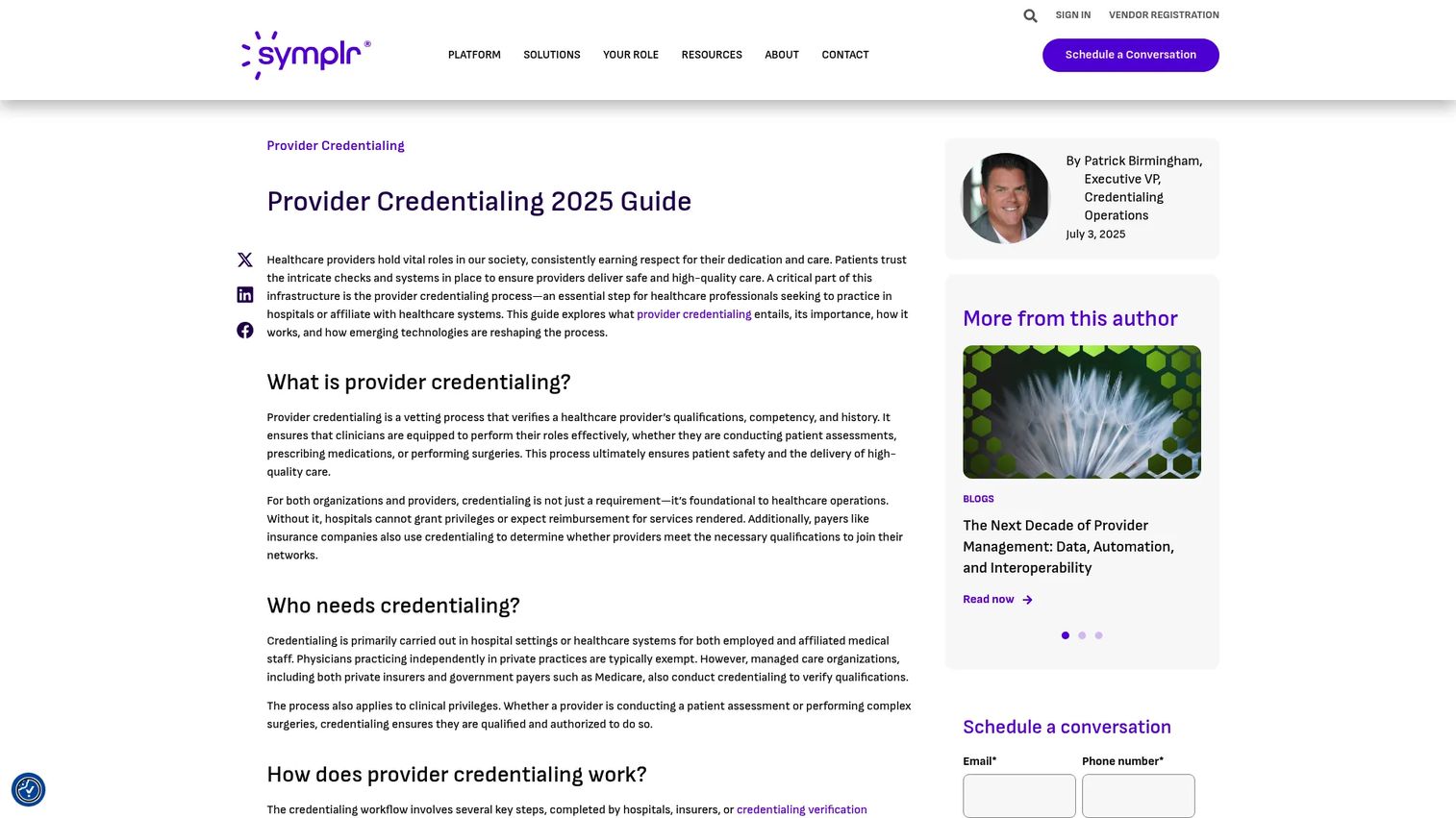
symplr Provider is cloud-based healthcare provider credentialing software built for the full provider lifecycle: onboarding, credentialing, privileging, enrollment, and provider performance workflows. It targets large healthcare systems that need one platform to manage what used to live across several disconnected tools and teams. If your medical staff office, enrollment team, and quality department all touch the same provider record, symplr is designed to be the layer they share.
Best for: Large healthcare systems that need enterprise credentialing and privileging in one platform.
Key strengths
- End-to-end lifecycle management: Handles credentialing, enrollment, privileging, and recredentialing without stitching separate systems together.
- Verification and monitoring built in: Credentialing automation with primary source and regulatory verification, so files move faster and stay defensible.
- Privileging and performance depth: Privileging, OPPE, FPPE, peer review, and provider performance insights in one place for medical staff governance.
Why choose symplr Provider: Choose it when scale and lifecycle depth matter more than a fast, self-serve setup. Enterprise health systems with high provider volume, multiple facilities, and formal privileging and peer review requirements get the most out of a platform that covers every stage rather than just verification.
symplr Provider pricing: symplr does not publish pricing. The product page uses request-a-demo and contact-us CTAs, so expect a quote based on provider volume, facilities, and modules. Budget for an enterprise engagement rather than a self-serve monthly plan.
2. VerityStream
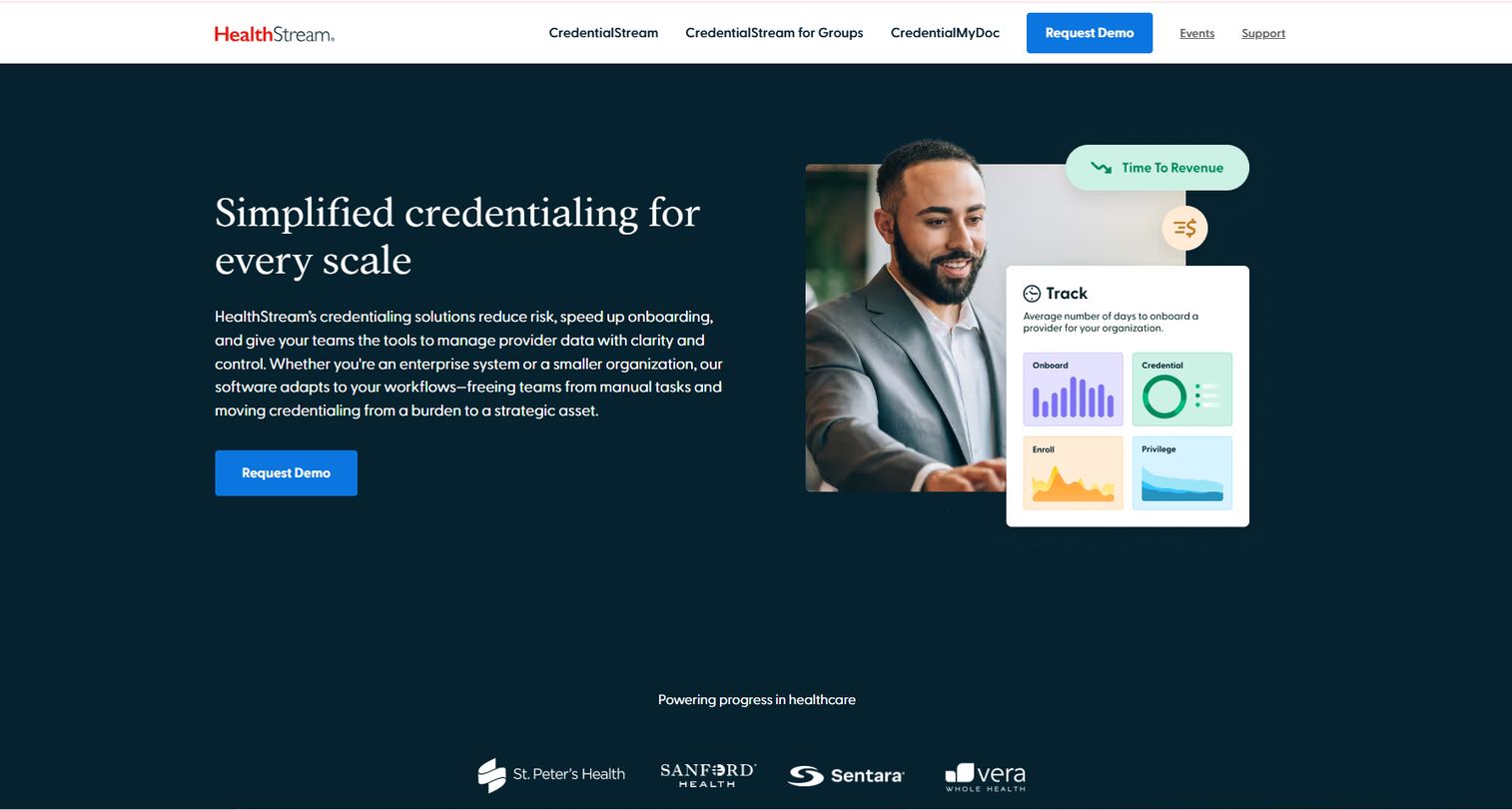
VerityStream, now part of HealthStream, delivers healthcare credentialing, provider enrollment, and privileging through its CredentialStream product family. It centralizes provider data in dashboards and connects across the hStream ecosystem, which appeals to organizations that want credentialing to plug into a broader healthcare data environment rather than stand alone.
Best for: Healthcare organizations that want credentialing and provider enrollment workflows with centralized provider data.
Key strengths
- Full credentialing lifecycle: Credentialing, enrollment, and privileging workflows managed together across the provider journey.
- Centralized provider data: Dashboards give credentialing and enrollment teams a shared, current view of every provider record.
- Ecosystem integration: Connects across the hStream ecosystem and secure APIs, so provider data does not stay trapped in one tool.
Why choose VerityStream: Choose it if you want enterprise-grade credentialing workflow automation and value being inside a larger healthcare data ecosystem. Teams evaluating provider enrollment software alongside credentialing get both in one family of products, with room to grow into monitoring and CVO services.
VerityStream pricing: VerityStream does not publish numeric pricing for its main enterprise products, which use contact-sales pricing. CredentialStream for Groups offers a free 30-day trial, giving smaller groups a way to evaluate before committing. Larger deployments are quoted based on scope.
3. Medallion
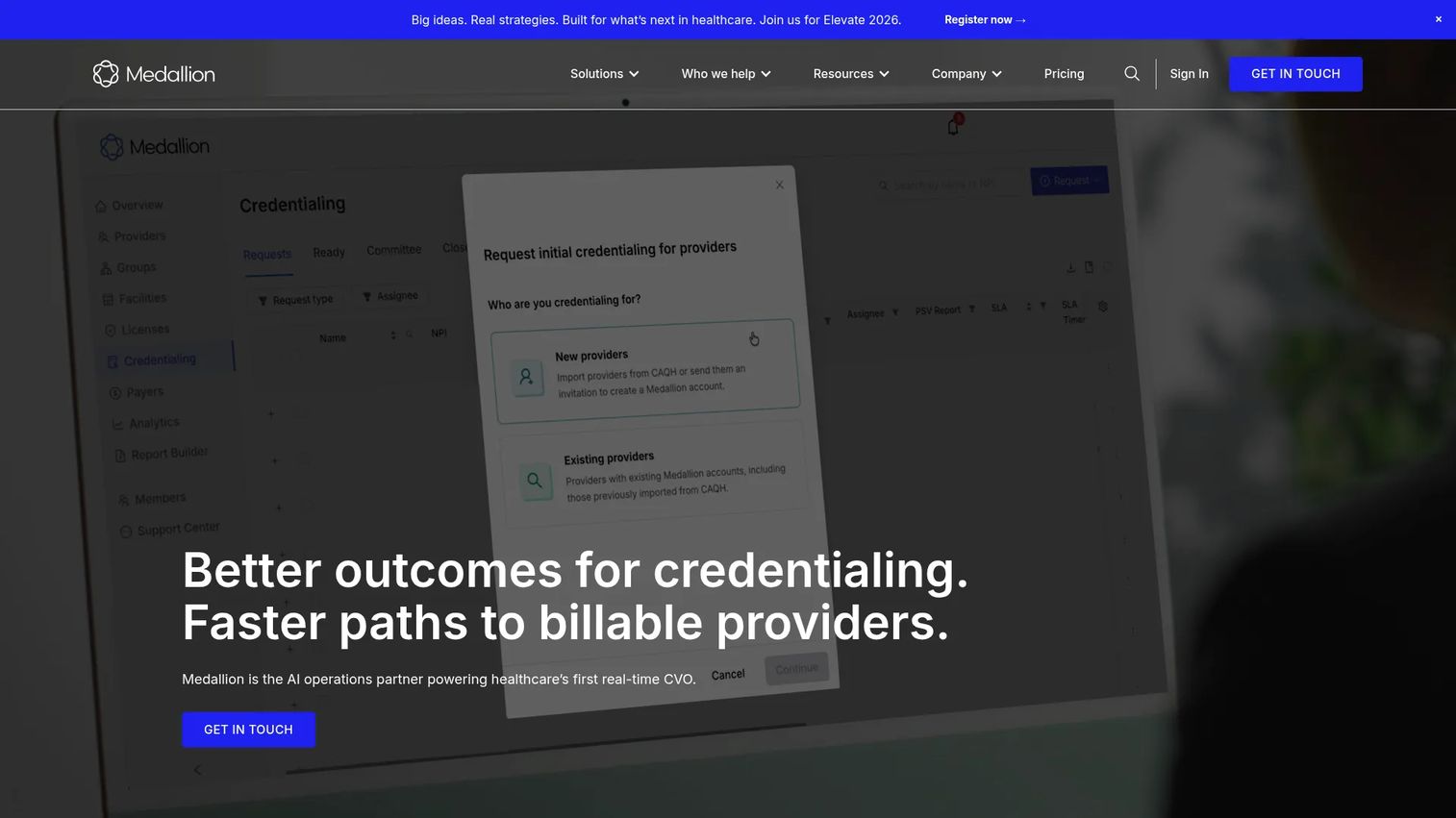
Medallion is a healthcare provider network operations platform covering credentialing, enrollment, monitoring, and related workflows. It leans modern, with AI-powered credentialing and provider workflow automation aimed at teams that find legacy platforms heavy. For growth-stage organizations scaling provider networks quickly, the emphasis on speed and usable workflows is the draw.
Best for: Growth-stage healthcare organizations that need credentialing and network operations automation.
Key strengths
- AI-assisted workflows: AI-powered credentialing and provider workflow automation reduce the manual steps that slow files down.
- Network operations breadth: Provider enrollment, roster management, privileging, cross-state licensing, and continuous monitoring in one platform.
- Provider data management: A central provider data layer keeps records consistent across enrollment, licensing, and monitoring.
Why choose Medallion: Choose it if you are scaling a provider network and want workflow speed without inheriting a decade of legacy UI. Organizations expanding across states benefit from built-in cross-state licensing and monitoring, which are painful to manage manually. Larger, highly regulated health systems may still prefer the privileging and governance depth of enterprise incumbents.
Medallion pricing: Medallion uses quote-based pricing. The pricing page asks visitors to request a personalized quote and does not display public plan prices, so cost scales with provider count and workflow scope. Expect a tailored proposal rather than a published tier.
4. QGenda Credentialing
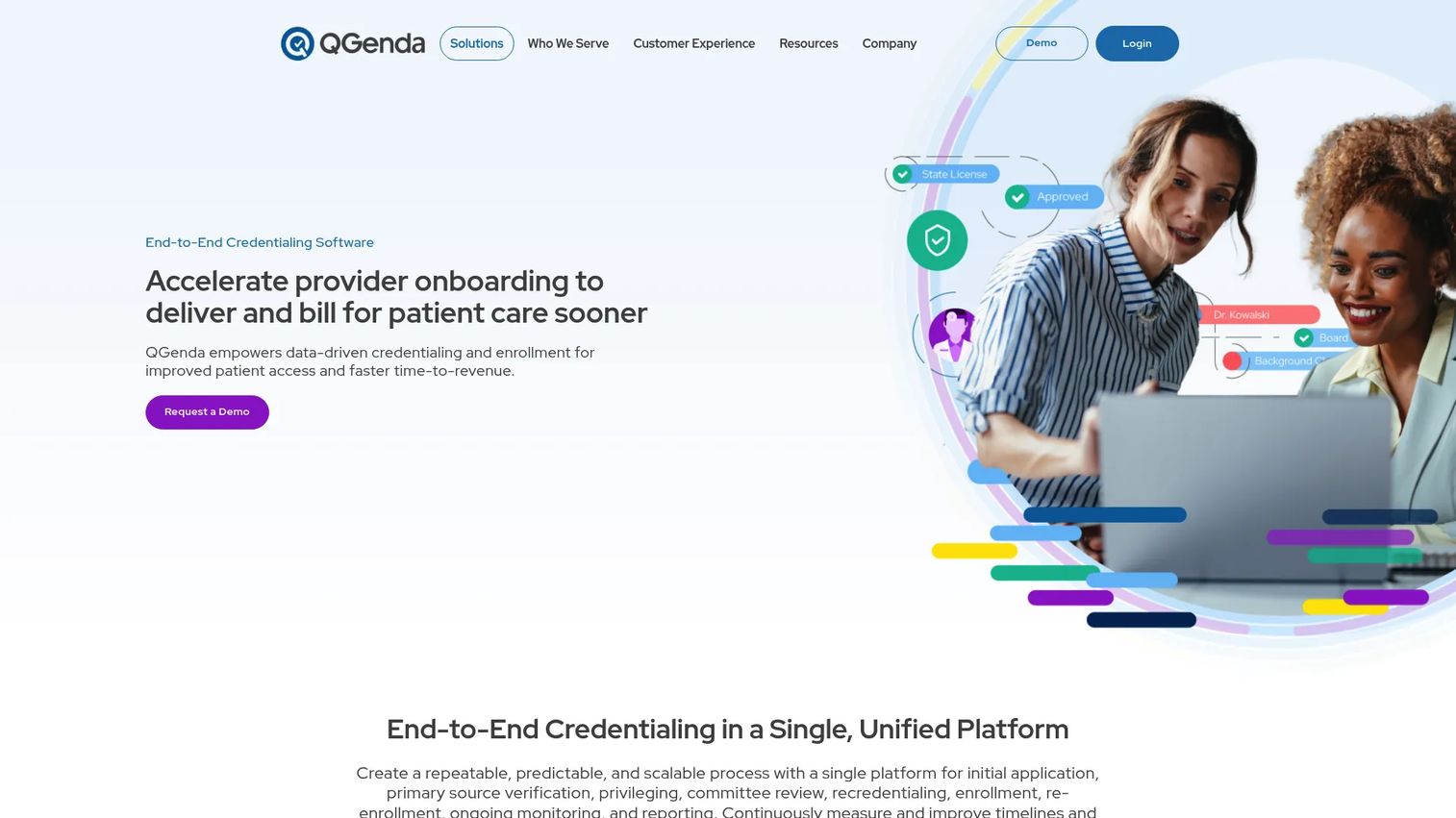
QGenda Credentialing is healthcare credentialing and payer enrollment software built to speed provider onboarding and compliance. It covers the full sequence: initial application, primary source verification, privileging, committee review, recredentialing, enrollment, re-enrollment, and ongoing monitoring. It sits inside QGenda's broader workforce-management ecosystem, which makes it attractive to teams that already coordinate provider scheduling and operations there.
Best for: Healthcare organizations that need end-to-end provider credentialing plus payer enrollment.
Key strengths
- Complete lifecycle coverage: From application and verification through privileging, committee review, recredentialing, and re-enrollment.
- Automated verification and monitoring: Automated primary source verifications and ongoing monitoring keep provider files current between cycles.
- Analytics and configurable workflows: Built-in analytics and workflows you can shape to match how your credentialing team actually operates.
Why choose QGenda Credentialing: Choose it if credentialing needs to align with broader workforce operations, or if payer enrollment depth is a priority alongside credentialing. Teams that value configurable workflows and analytics for audit-ready reporting will find the ecosystem fit compelling.
QGenda Credentialing pricing: QGenda does not publish credentialing pricing on its site; the model is demo and quote based rather than a displayed price. Cost depends on provider volume and which parts of the platform you deploy. Request a quote to size it against your team.
5. ASM MD-Staff
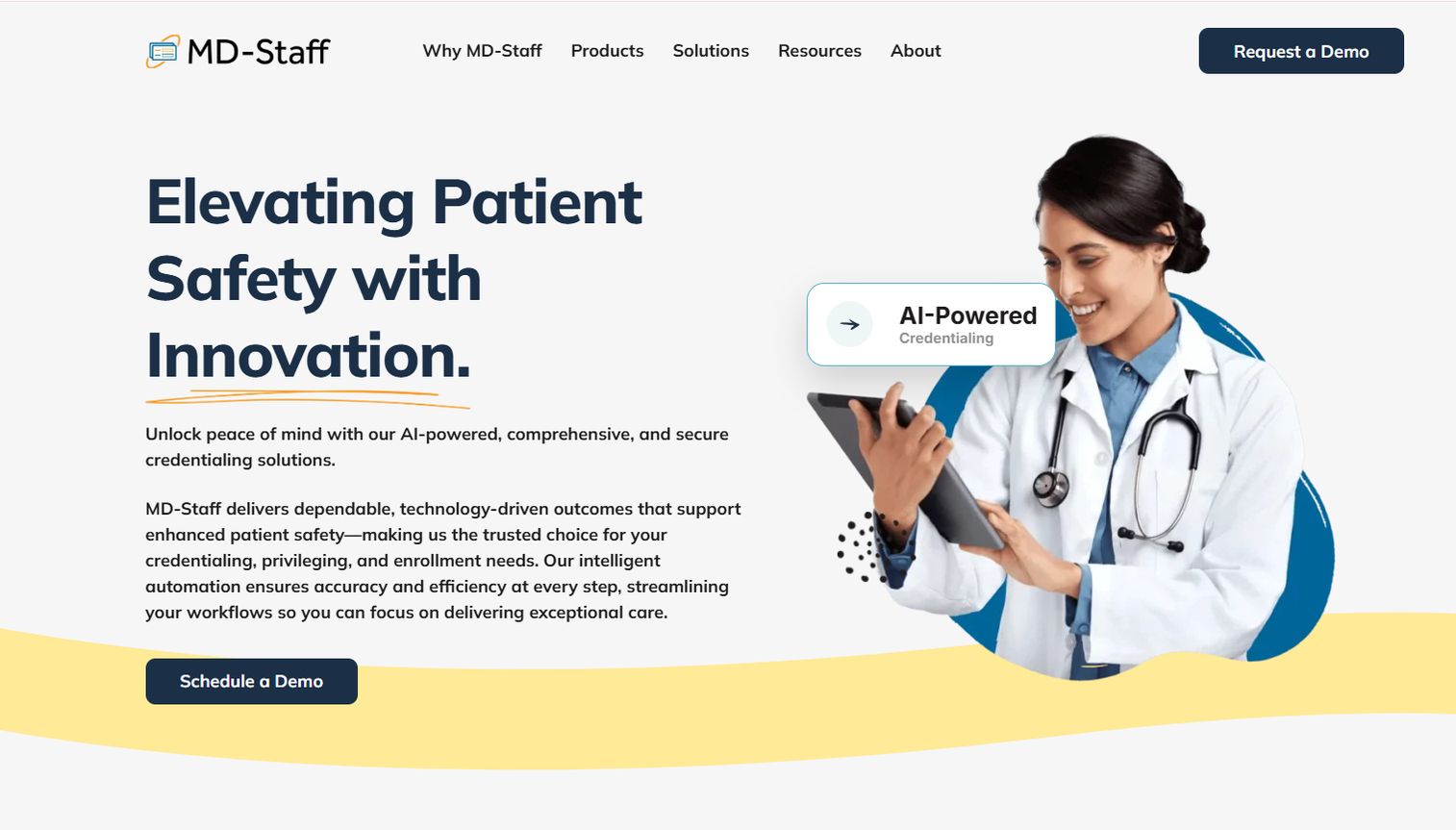
ASM MD-Staff is credentialing software for healthcare organizations, with a strong footprint in hospitals and medical staff offices. It focuses on the workflows those teams run every day: online provider application processing, OPPE and FPPE reporting, and enrollment processing. For hospitals where privileging and medical staff governance are central, that focus is the point.
Best for: Hospitals and medical organizations managing provider credentialing and privileging.
Key strengths
- Online application processing: Providers submit and update applications digitally, cutting the paper chase out of intake.
- OPPE and FPPE reporting: Built-in ongoing and focused professional practice evaluation reporting for medical staff governance.
- Enrollment processing: Handles payer enrollment alongside credentialing so provider files move toward billable status.
Why choose ASM MD-Staff: Choose it if you run a hospital medical staff office where privileging, OPPE, FPPE, and peer review workflows carry as much weight as initial credentialing. It earns a 4.5/5 rating on G2, and its long presence in hospital credentialing makes it a familiar fit for medical staff professionals.
ASM MD-Staff pricing: MD-Staff does not publish public pricing, and no verified price was available from the brand site. Expect a quote-based model sized to your facility and provider count. Contact the vendor to scope a proposal for your organization.
6. RLDatix Credentialing
RLDatix Credentialing delivers healthcare provider credentialing and privileging software and services, positioned inside RLDatix's broader governance, risk, and quality portfolio. That connection is the differentiator: credentialing does not sit alone, it ties into the risk and quality management workflows many health systems already run.
Best for: Healthcare organizations that need credentialing, privileging, and payer enrollment connected to governance and risk management.
Key strengths
- Automated credentialing workflows: Streamlines credentialing and privileging so files move without manual bottlenecks.
- Primary source verification: Built-in primary source verification keeps provider records defensible and audit-ready.
- NCQA-certified CVO support: Credentials verification organization support for teams that want to offload verification with a certified process.
Why choose RLDatix Credentialing: Choose it if you want credentialing wired into a broader risk and quality management approach rather than a standalone tool. Organizations that already think about credentialing as part of enterprise governance get a natural fit. RLDatix holds a 3.9/5 rating on G2 at the seller level.
RLDatix Credentialing pricing: RLDatix does not publish a public pricing page with visible numbers for credentialing, so cost is quote-based. Pricing typically reflects provider volume, services (including CVO), and how much of the governance portfolio you adopt. Request a quote to size it accurately.
7. Expiration Reminder
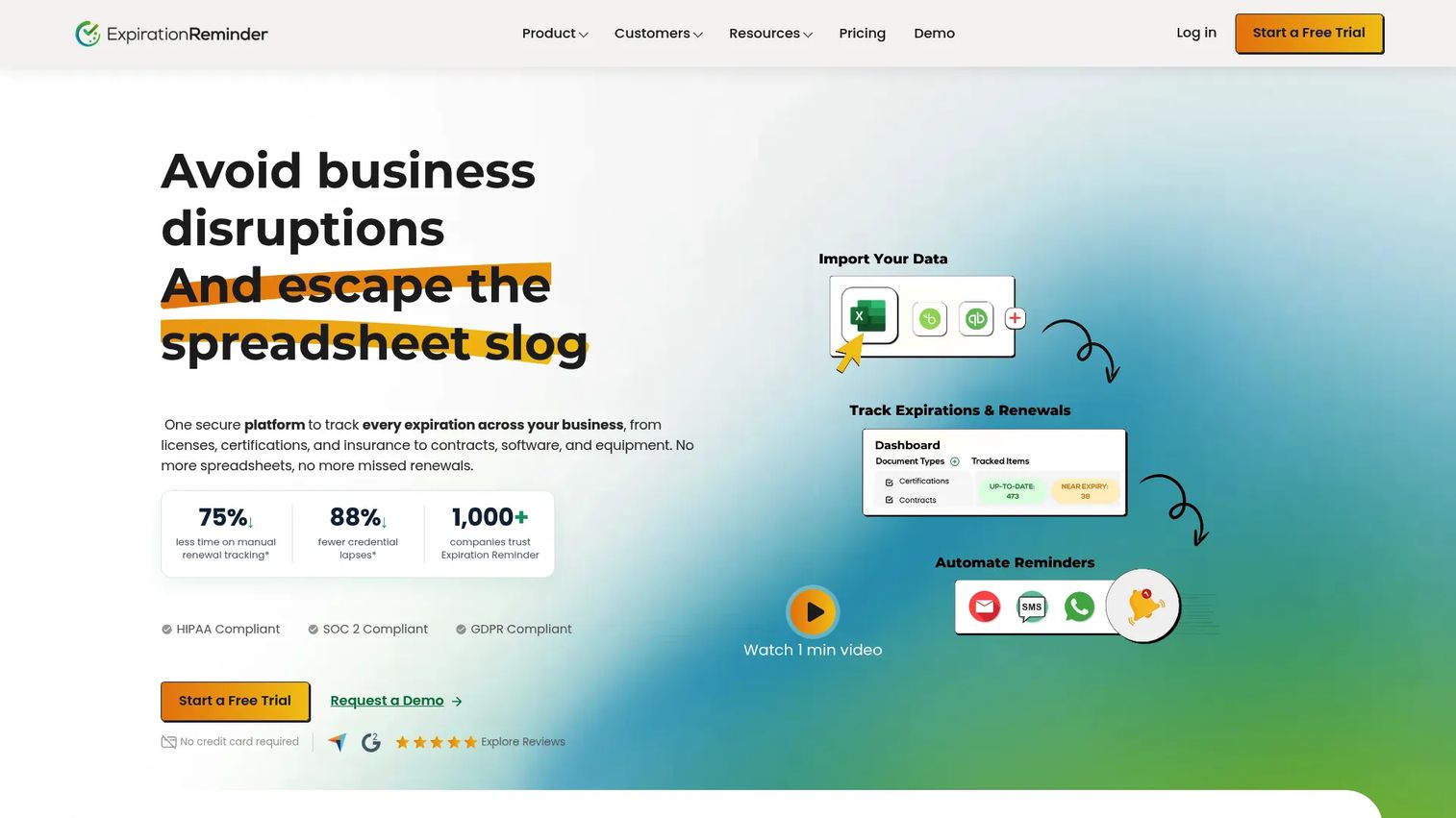
Expiration Reminder is compliance and expiration tracking software for reminders, renewals, and document management. It is not a full enterprise credentialing platform, and that is exactly why it fits a specific buyer: smaller teams that mainly need to track expiring credentials, documents, and compliance deadlines without an enterprise implementation. It handles the tracking layer cleanly and prices it accessibly.
Best for: Smaller teams that need to track expiring credentials, documents, and compliance deadlines.
Key strengths
- Automatic expiration reminders: Alerts fire before licenses, certifications, and documents lapse, so nothing slips through.
- Broad compliance tracking: Tracks expirations across credentials, items, assets, locations, and employees in one centralized repository.
- Document management and e-signatures: Electronic signatures and document storage keep records organized and retrievable.
Why choose Expiration Reminder: Choose it when your primary pain is missed expirations and scattered documents rather than full lifecycle credentialing, enrollment, and privileging. Small groups and lean compliance teams get reliable licensure tracking and compliance alerts at a fraction of enterprise cost. Larger health systems with privileging and OPPE needs will outgrow it.
Expiration Reminder pricing: Expiration Reminder publishes public pricing. Plans start at $49/month for Starter, then $99/month for Professional, $179/month for Business, and $349/month for Enterprise, all billed monthly. A 14-day free trial is available, and custom pricing is offered for larger organizations.
Considerations
Workflow fit
Match the tool to how credentialing actually runs inside your organization. A small group that mainly needs expiration tracking has a very different job than a health system managing privileging, OPPE, and FPPE across facilities. Decide first whether you need simple tracking or full provider lifecycle management, then shortlist accordingly.
Integrations
Verify compatibility with your HR, EHR, and billing systems before you commit. Integration quality matters more than a polished interface, because a credentialing platform that cannot exchange provider data cleanly just creates a new silo. Confirm HRIS integration, EHR integration, and billing system integration work the way your teams need, not just on a feature list.
Compliance and audit visibility
Check the depth of alerting, sanctions screening, expiration workflows, and reporting. You want continuous monitoring against exclusion lists, automatic compliance alerts on licensure and expirations, and audit-ready reporting you can produce on demand. Treat this as a checklist: if you cannot generate an NCQA or payer audit report in minutes, keep looking.
Scalability and support
Assess whether the vendor can support your provider growth, multiple sites, and complex teams over time. Ask about implementation timelines, onboarding, change management, and support responsiveness. A platform that fits today but stalls at double your provider count is a short-term choice with a long-term cost.
Security and permissions
Provider data is sensitive, so role-based access, audit trails, and data governance are non-negotiable. Confirm you can control who sees and edits which records, and that every change is logged. Sort this out before rollout, not after your first security review flags it.
Conclusion
The right credentialing software depends on lifecycle depth, integration fit, and compliance needs. For enterprise health systems that need the full picture, including privileging, OPPE, FPPE, and peer review, symplr Provider and VerityStream lead. Medallion suits growth-stage teams that want modern, AI-assisted workflows and cross-state licensing. QGenda Credentialing fits organizations aligning credentialing with broader workforce operations, ASM MD-Staff serves hospital medical staff offices, and RLDatix Credentialing connects credentialing to governance and risk.
For smaller groups whose main pain is missed expirations and scattered documents, Expiration Reminder delivers reliable tracking without an enterprise commitment.
The practical next step: shortlist two or three tools that match your provider volume and lifecycle needs, then run each against your real workflow. Bring your integration requirements and a sample audit report to every demo. The tool that produces both without a workaround is the one worth buying.
FAQs
Credentialing software automates the verification, tracking, and management of provider qualifications across their lifecycle. It handles primary source verification, provider enrollment, privileging, recredentialing, and continuous monitoring, replacing spreadsheets with a single source of truth that stays audit-ready.
Credentialing verifies that a provider holds valid licenses, certifications, and standing to practice. Provider enrollment software gets that verified provider approved to bill specific payers and health plans. Many platforms, including symplr Provider, VerityStream, and QGenda Credentialing, handle both, because credentialing without enrollment still leaves the provider unable to collect.
Spreadsheets work until provider volume, expirations, and audit requirements outgrow them, which happens faster than most teams expect. If you have missed an expiration, scrambled during an audit, or lost track of a recredentialing date, the manual approach is already costing you. Software adds continuous monitoring, automated verification, and audit-ready reporting that a spreadsheet cannot.
It runs continuous monitoring and sanctions screening against exclusion lists between recredentialing cycles, tracks licensure and expirations, and fires compliance alerts before a lapse becomes a billing or audit problem. It also produces audit-ready reporting on demand, so NCQA, Joint Commission, and payer audits do not require a manual document rebuild.
Confirm HRIS integration, EHR integration, and billing system integration work with your specific systems. Good integrations let provider data flow once and update everywhere, so enrollment, privileging, and billing records agree. Integration depth matters more than interface polish, because a tool that cannot exchange data cleanly just becomes another silo.
For large health systems, symplr Provider and VerityStream lead, because both cover the full provider lifecycle including privileging, OPPE, FPPE, and peer review at enterprise scale. RLDatix Credentialing is strong for systems that want credentialing tied into governance and risk management. All three are quote-based and sized to provider volume and facilities.
Smaller groups that mainly need to track expirations and documents get the most value from Expiration Reminder, which starts at $49/month with a 14-day free trial. VerityStream's CredentialStream for Groups, with a free 30-day trial, and Medallion's modern workflows are also worth evaluating for groups that need more lifecycle depth than pure tracking.
Enterprise platforms do. symplr Provider, VerityStream, ASM MD-Staff, and QGenda Credentialing all support privileging, and several include OPPE, FPPE, and peer review workflows for medical staff governance. Lightweight tools focused on expiration tracking generally do not, so if privileging and peer review matter, shortlist the enterprise options.