
You're scrolling job boards and half the listings say "SDR," the other half say "BDR." The descriptions look almost identical. Or maybe you're a sales leader and your own team can't agree on what the titles mean. Your SDRs do outbound. Your BDRs handle inbound. Another company down the street has it reversed.
The confusion isn't a sign that you're missing something. It's a reflection of how inconsistently companies structure their sales development function. There is no universal standard for sales development titles. Some SaaS companies treat the titles as interchangeable. Others draw a hard line between them.
That inconsistency creates real problems. If you're hiring, you might attract the wrong profile. If you're setting KPIs, you might measure an outbound rep on inbound metrics (or vice versa). If you're building a team, you might create overlapping roles that compete instead of complement.
This guide breaks down the difference between an SDR and a BDR as most SaaS companies define it today. It's written for sales development representatives, business development representatives, sales managers, and founders building pipeline teams. No fluff, no recycled definitions. Actual benchmarks, actual frameworks, actual career paths.
What's inside
- Clear definitions of the SDR and BDR roles, including the inbound vs. outbound SDR distinction
- A side-by-side comparison table with specific metrics and daily activities
- KPI benchmarks for both roles in mid-market SaaS
- Skills comparison and career path options
- A hiring decision matrix tied to company stage and GTM motion
- How modern tooling (interactive demos, self-serve product experiences) is changing both roles
- Common team structure mistakes and how to fix them
TL;DR
- SDR typically focuses on inbound lead qualification and converting marketing-sourced interest into AE meetings. BDR typically focuses on outbound prospecting and generating new pipeline from cold accounts.
- Many companies use the titles interchangeably. The distinction matters most when you're structuring a team, setting KPIs, or hiring.
- The SDR role is speed-and-volume driven. The BDR role is research-and-relationship driven.
- Both roles feed the AE. The handoff quality matters more than the title.
- Modern tools like interactive demos are changing both roles by letting prospects experience the product before committing to a live call.
What is an SDR (sales development representative)?
A sales development representative (SDR) is a top-of-funnel sales role focused on qualifying inbound leads and converting them into meetings for account executives.
That's the most common definition. But it's not the only one.
What does SDR stand for? SDR stands for Sales Development Representative. In sales, the SDR meaning refers to the person responsible for the first conversation with a potential buyer, typically handling the qualification and meeting-booking stage of the funnel.
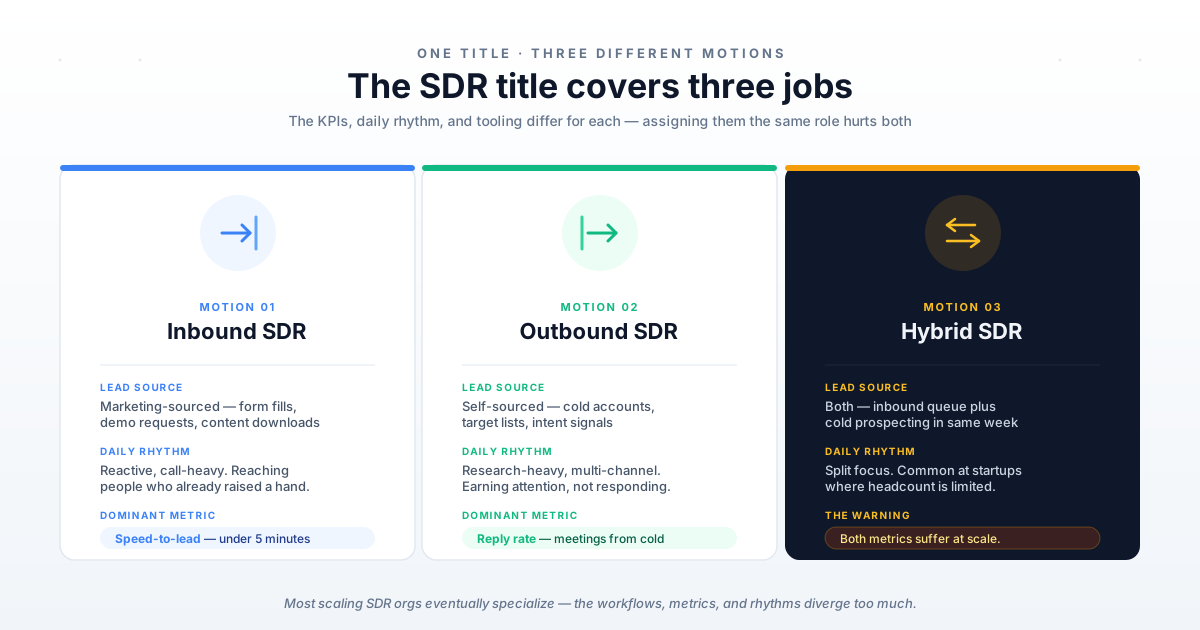
The SDR title actually covers two distinct motions, and the distinction matters for how you set KPIs and coach the role.
Inbound SDRs work marketing-sourced leads: form fills, demo requests, content downloads, free trial signups. Their job is fast qualification and conversion of existing interest into AE meetings. Speed-to-lead is the dominant metric. Days are call-heavy because the work is reaching back out to people who already raised their hand.
Outbound SDRs generate pipeline from cold. They build target lists, run multi-channel sequences, and prospect into accounts that haven't engaged with the company yet. This version of the SDR role looks a lot like what other companies call a BDR. Top-performing outbound SDRs increasingly rely on AI SDR tools to automate list building and initial sequencing.
Most SDR organizations use one of three structures: inbound-only, outbound-only, or hybrid. Hybrid SDRs are common at smaller companies, but split focus often hurts both metrics.
Day-to-day responsibilities of an SDR:
- Qualifying inbound leads against ICP criteria
- Running multi-channel outreach sequences (email, LinkedIn, calls)
- Booking qualified meetings for AEs
- Logging activity and maintaining CRM hygiene
- Collaborating with marketing on lead quality feedback
- Providing field feedback on which messaging and verticals are landing
Typical KPIs: meetings booked, meetings held, SQLs created, lead response time (inbound), reply rate, call connect rate.
A typical SDR in a mid-market SaaS company books 20 to 30 qualified meetings per month, with an average lead response time target of under 5 minutes for inbound leads. Only 7% of companies actually hit that 5-minute benchmark, according to Drift research. The gap between target and reality is where inbound conversion dies.
What is a BDR (business development representative)?
A business development representative (BDR) is a top-of-funnel sales role focused on outbound prospecting, identifying new business opportunities, and generating pipeline from accounts that haven't engaged with the company.
What does BDR stand for? BDR stands for Business Development Representative. To define BDR in a sales context: it's the person who creates pipeline from scratch, rather than qualifying interest that already exists.
The outbound emphasis is the defining characteristic. BDRs typically own cold outreach, account research, target list building, and multi-channel prospecting into net-new accounts. Their job is to break through, not respond fast.
This requires a different daily rhythm than inbound work. Where an inbound SDR's day is reactive and call-heavy, a BDR's day is structured around research, sequencing, and personalization. The sales prospecting methods are deliberate: identify the right account, find the right contact, craft the right angle, then execute across email, LinkedIn, and phone. Many BDRs now leverage outreach software to manage these multi-channel sequences at scale.
Day-to-day responsibilities of a BDR:
- Building and maintaining target account lists aligned to ICP
- Researching accounts using firmographic, technographic, and intent signals
- Running personalized outbound sequences across email, LinkedIn, and phone
- Qualifying prospects through lightweight discovery before handing off to AEs
- Providing field feedback on which messaging and verticals are landing
- Multi-threading into accounts by engaging multiple contacts per company
Typical KPIs: meetings booked from cold outreach, qualified pipeline generated ($), accounts engaged, response rates by channel, opportunities created.
A typical BDR in a mid-market SaaS company generates 12 to 18 qualified meetings per month from outbound, with cold email reply rates averaging 3 to 8% depending on channel and personalization quality. Top performers push reply rates to 8% or higher by investing more time in account research and per-prospect customization.
SDR vs BDR: key differences
This is the section most people came here for. Here's the comparison, then we'll unpack what actually matters.
The real distinction is the lead source, not the funnel stage. Both SDR and BDR roles operate at the top of funnel. Both hand off to AEs. Both sit before the opportunity stage. The difference is where the leads come from. SDRs work leads that marketing generated. BDRs create their own.
Title usage varies by company. This is worth repeating: many SaaS companies use "SDR" for both inbound and outbound. Others use "BDR" as the umbrella term. A 2025 search across job boards shows roughly equal usage of both titles for identical job descriptions. What matters is how the company defines the SDR vs BDR roles internally, not the title on the business card.
Skills overlap significantly. Both roles require strong communication, CRM discipline, and the ability to qualify quickly. BDRs tend to need stronger research and personalization skills. SDRs tend to need faster response reflexes and higher call volume tolerance. We'll cover the skills breakdown in detail below.
The funnel positioning is the same. Both feed the AE. Both sit at the top of the sales funnel stages. The handoff quality matters more than the title. A well-qualified meeting from an SDR and a well-qualified meeting from a BDR look identical to the AE who runs the discovery call.
How SDRs and BDRs work with account executives
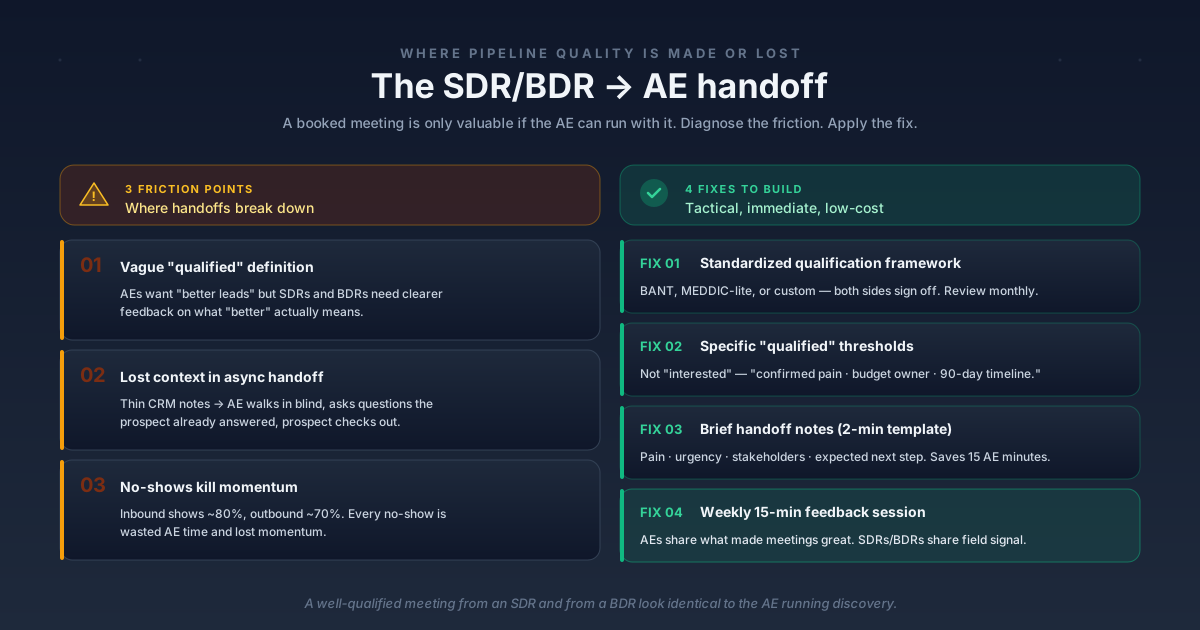
The handoff is where pipeline quality is made or lost. A booked meeting is only valuable if the AE can run with it.
Here's the typical flow: SDR or BDR qualifies the prospect, books the meeting, provides context (pain identified, urgency, stakeholders, ICP fit), and the AE runs discovery and demo. Simple in theory. Messy in practice.
Common friction points in the handoff:
- AEs want "better leads" but SDRs and BDRs need clearer feedback on what "better" means. Without a shared definition of qualified, both sides operate on assumptions.
- Context gets lost when CRM notes are thin or the handoff happens asynchronously. The AE walks into the call blind, asks questions the prospect already answered, and the prospect checks out.
- Meetings get booked but prospects don't show. Show rates for SDR-booked meetings average around 80% for inbound and 70% for outbound. Every no-show is wasted AE time and lost momentum.
How to improve handoffs:
- Standardized lead qualification criteria. Whether you use BANT, MEDDIC-lite, or a custom framework, both the SDR/BDR and the AE need to sign off on what "qualified" means. Write it down. Review it monthly.
- A shared definition of "qualified" with specific thresholds. Not "they seemed interested." Instead: "confirmed pain, identified budget owner, timeline within 90 days, company fits ICP on at least 3 of 4 criteria."
- Brief handoff notes that include: pain identified, urgency level, stakeholders mentioned, and what the prospect expects from the next conversation. This takes 2 minutes and saves the AE 15 minutes of redundant discovery.
- Weekly 15-minute feedback sessions. AEs tell SDRs/BDRs what made a meeting great or what was missing. SDRs/BDRs share what prospects are saying in the field. This loop is where meeting quality improves.
Modern teams are also reducing handoff friction by letting prospects experience the product before the AE call. When an SDR includes an interactive demo in the meeting confirmation email, the AE starts the conversation with a prospect who already has product context, not one who needs everything explained from scratch. Show rates improve because the prospect has already invested time exploring the product.
KPIs and metrics for SDRs vs BDRs
SDR metrics
- Meetings booked vs. meetings held. The gap between these two numbers reveals your no-show rate and qualification quality. If you're booking 25 meetings but only 20 are held, that's a 20% no-show rate worth diagnosing.
- Lead response time. The single most predictive metric for inbound conversion. The "5-minute rule" is the industry benchmark, but only 7% of companies actually respond within 5 minutes. The SDRs who do consistently outperform on conversion.
- SQLs or SALs created. The number of meetings that the AE accepts as qualified. This is the quality check on your quantity.
- Call connect rate and conversation rate. How often you reach a live person, and how often that conversation moves forward.
- Email reply rate. For warm follow-up sequences on inbound leads, 15 to 25% is a typical range.
BDR metrics
- Qualified pipeline generated ($). The dollar value of pipeline your outbound efforts create. This is the metric mature orgs use to measure BDR impact, not just meetings. Tracking this effectively often requires dedicated revenue operations software.
- Accounts engaged and accounts penetrated. How many target accounts you've reached, and how deeply you've gotten into them.
- Meetings booked from cold outreach. The raw volume metric, but always paired with quality indicators.
- Response rates by channel. Cold email reply rates of 3 to 5% are standard; top performers hit 8% or higher. Call connect rates run 5 to 8% on average.
- Multi-threading depth. The number of contacts engaged per account. Single-threaded outbound is fragile. Multi-threaded outbound builds real pipeline.
Shared metrics
- Pipeline influenced and revenue influenced. The metric mature orgs increasingly use for both roles. Did the meetings you booked turn into closed revenue?
- Activity-to-outcome ratios. Touches per meeting booked. This tells you whether your process is efficient or just busy.
- CRM hygiene and data accuracy. Not glamorous. Directly impacts every other metric. Choosing the right CRM software is foundational to getting this right.
Benchmark table
These ranges reflect mid-market SaaS benchmarks based on recent industry data. Your numbers will vary by ACV, segment, and market maturity. The important thing is to track them consistently and benchmark against your own historical performance, not just industry averages.
Skills required for SDRs and BDRs
Two skills stand out as the biggest differentiators between the roles:

Speed (SDR advantage). Inbound SDRs live and die by response time. The ability to pick up the phone within 2 minutes of a form fill is a trainable skill that directly correlates with conversion. Research shows that responding within 5 minutes makes you 100x more likely to connect than waiting 30 minutes. This isn't about talent. It's about discipline and systems.
Research depth (BDR advantage). Outbound BDRs need to find the right account, the right contact, and the right angle before sending a single message. This requires a different kind of discipline than speed. A BDR who sends 100 generic emails will get crushed by one who sends 30 deeply researched, personalized messages. The research-to-outreach ratio is what separates BDRs who hit quota from those who don't.
Career paths for SDRs and BDRs
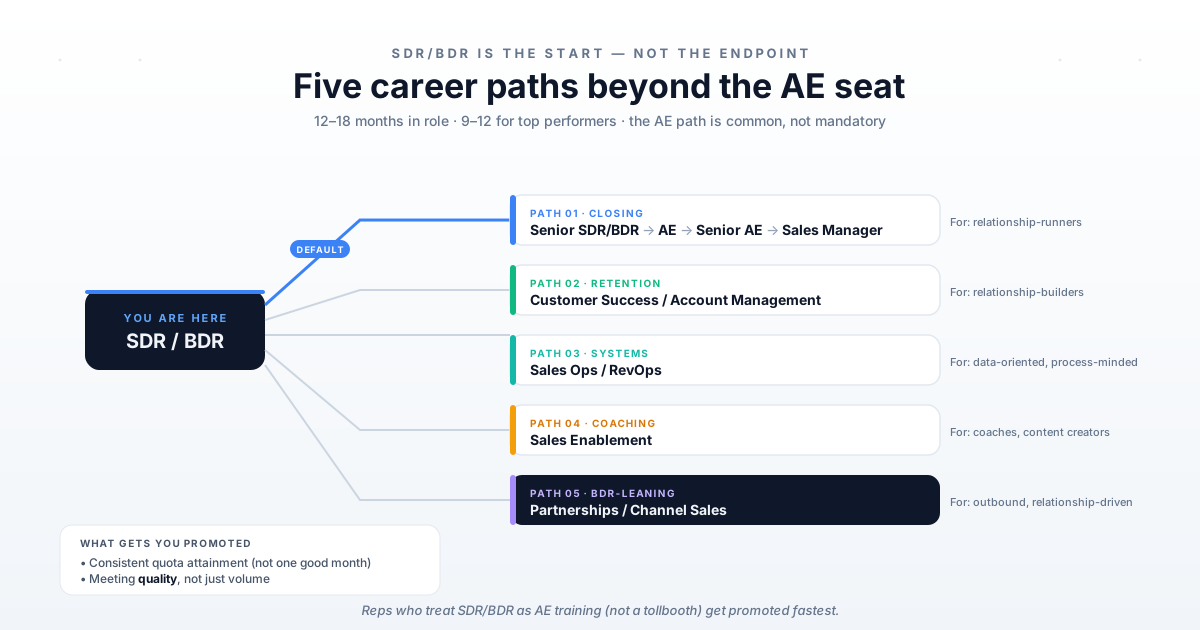
Both roles are entry points into tech sales. The career path is similar but not identical.
Common progression: SDR/BDR → Senior SDR/BDR → Account Executive → Senior AE → Sales Manager/Director
Alternative paths that people don't talk about enough:
- SDR/BDR → Customer Success → Account Management (common for reps who prefer relationship building over new business)
- SDR/BDR → Sales Ops/RevOps (common for reps who are data-oriented and process-minded)
- SDR/BDR → Sales Enablement (common for reps who are strong coaches and content creators)
- BDR → Partnerships/Channel Sales (more common for BDRs due to the outbound, relationship-building skillset)
Timeline benchmarks: Most SDRs and BDRs spend 12 to 18 months in the role before promotion. High performers can move in 9 to 12 months. The promotion criteria typically include: consistent quota attainment (not just one good month), meeting quality (not just quantity), and demonstrated ability to run a discovery call.
What hiring managers look for in the SDR-to-AE promotion:
- Can the SDR run a basic discovery call, not just book the meeting?
- Does the SDR understand the prospect's pain, not just their title and company size?
- Can the SDR handle objections without escalating to the AE?
- Does the SDR influence pipeline, not just meetings?
The reps who get promoted fastest are the ones who treat the SDR or BDR role as AE training, not as a tollbooth they need to pass through. They listen to AE calls, study deal reviews, and ask for feedback on their qualification quality. Sales career progression in SaaS rewards curiosity and ownership, not just activity volume. Investing in sales coaching software can accelerate this development significantly.
When to hire SDRs vs BDRs (a framework for sales leaders)
Most guides tell you to "hire both." That's not helpful when you have budget for one. Here's a framework tied to your actual situation.
Hire SDRs first when...
- You have a working inbound engine (marketing is generating demo requests, content downloads, or free trial signups) and leads are going unworked or response time is slow.
- Your AEs are spending 30% or more of their time qualifying inbound leads instead of closing.
- You're in a PLG or marketing-led GTM motion where speed-to-lead is the primary bottleneck.
Hire BDRs first when...
- Your inbound volume is low or inconsistent and you need to generate pipeline from scratch.
- You're entering a new market, vertical, or segment where you don't have brand awareness.
- Your sales motion is outbound-first and your AEs need a dedicated prospecting function.
Hire both when...
- You have both an inbound engine and an outbound motion, and splitting focus between the two is hurting both metrics.
- Your team is scaling past 3 to 4 AEs and needs dedicated pipeline generation on both sides.
Consider outsourcing when...
- You need to test a new market or segment before committing to a full-time hire.
- You're pre-Series A and can't afford a full SDR/BDR team but need pipeline.
- You need seasonal or burst capacity (event follow-up, product launch outreach).
Decision matrix
How modern tools are changing SDR and BDR roles
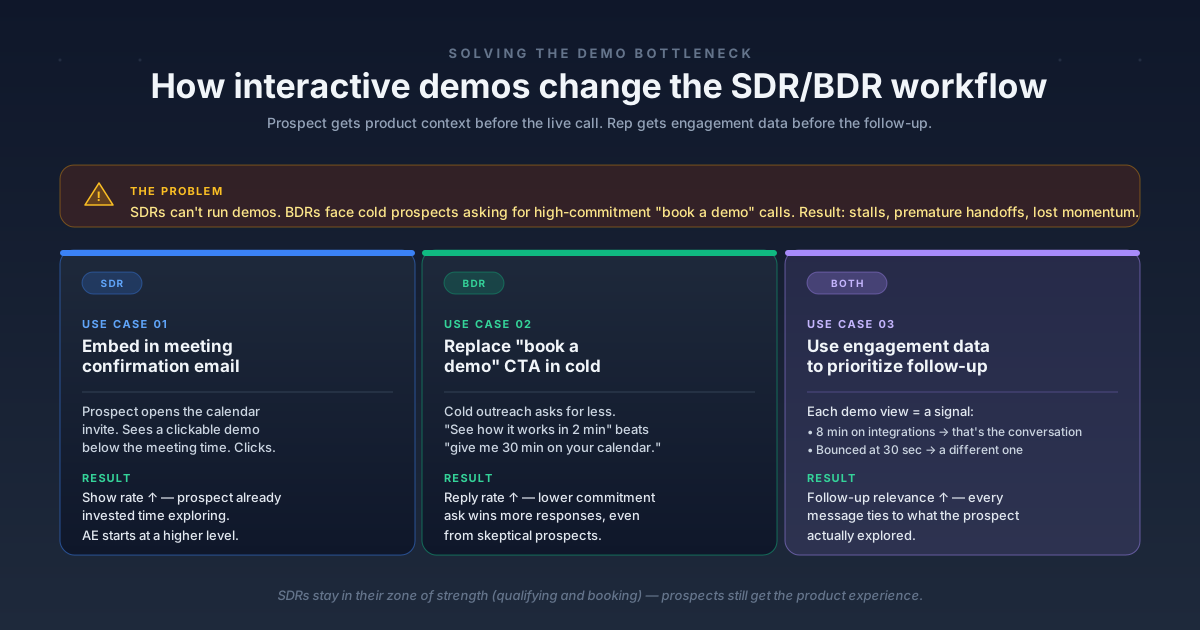
The biggest shift in SDR and BDR work over the past two years isn't AI-generated emails (though that matters). It's the expectation that prospects can experience the product before committing to a live call.
The demo bottleneck problem. SDRs often can't run a demo themselves. When a prospect on the first call says "can you just show me?", the SDR has to stall, hand off prematurely, or lose momentum. BDRs face a version of this in outbound: cold outreach that says "book a demo" asks for a high-commitment action from someone who has no context on the product. The right presales software can eliminate this bottleneck entirely.
How interactive demos change the workflow. Instead of asking prospects to commit to a 30-minute call to see the product, SDRs and BDRs can share a clickable, self-serve product experience in their outreach. The prospect explores the product on their own time. The SDR or BDR gets engagement analytics showing what the prospect clicked on and how long they spent. The AE walks into the first call with a prospect who already has product context.
Specific use cases where this performs best:
- SDRs embed an interactive demo link in the meeting confirmation email. Show rate improves because the prospect has already invested time in the product. The AE starts the conversation at a higher level.
- BDRs include an interactive demo in cold outreach instead of a generic "book a demo" CTA. Response rates increase because the ask is lower commitment: "see how it works in 2 minutes" vs. "give me 30 minutes of your calendar."
- Both roles use engagement analytics from demo views to prioritize follow-up. A prospect who spent 8 minutes exploring the integrations section is a different conversation than one who bounced after 30 seconds. That signal tells you what to talk about on the next call.
Tools like Guideflow let SDRs and BDRs capture product flows in minutes, personalize them per prospect, and track engagement at the session level. The result: prospects get product context before the live call, and reps get intent data that makes every follow-up more relevant.
Common mistakes when structuring SDR and BDR teams
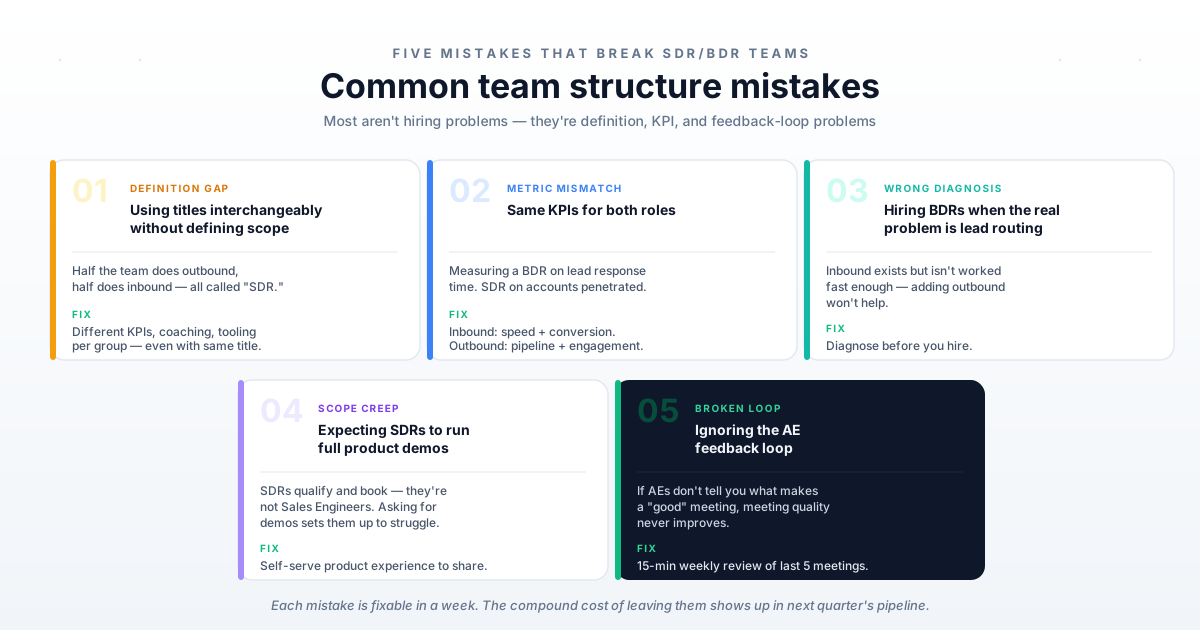
- Using titles interchangeably without defining scope internally. The title doesn't matter. The scope does. If you call everyone "SDR" but half the team does outbound and half does inbound, you need different KPIs, different coaching, and different tooling for each group. Calling them the same thing creates confusion in reporting, compensation, and hiring.
- Setting the same KPIs for both roles. Measuring a BDR on lead response time (an inbound metric) or an SDR on accounts penetrated (an outbound metric) creates misaligned incentives. Match the KPI to the motion. Inbound reps get measured on speed and conversion. Outbound reps get measured on pipeline and engagement depth.
- Hiring BDRs when the real problem is lead routing. If inbound leads exist but aren't being worked fast enough, the fix might be better routing and faster response, not a new outbound hire. Diagnose before you hire.
- Expecting SDRs to run full product demos. SDRs qualify and book. They're not SEs. Asking them to run a 30-minute product walkthrough sets them up to struggle. The fix: give them a self-serve product experience they can share, so prospects get product context without the SDR needing to be a demo expert. The SDR stays in their zone of strength (qualification and booking) while the prospect still gets to see the product.
- Ignoring the AE feedback loop. If AEs don't tell SDRs and BDRs what makes a "good" meeting, meeting quality won't improve. Build a weekly 15-minute feedback session between AEs and SDRs/BDRs. Review the last 5 meetings together. Identify what context was missing and what made the best meetings great.
Conclusion
The SDR vs BDR distinction matters most when you're structuring a team, setting KPIs, or making a hiring decision. The title on the business card matters less than the scope of the role, the lead source it serves, and the metrics it's measured against.
The best SDR and BDR teams in 2026 share three traits: clear role definitions tied to lead source, KPIs that match the motion, and tooling that removes friction from the prospect's evaluation process.
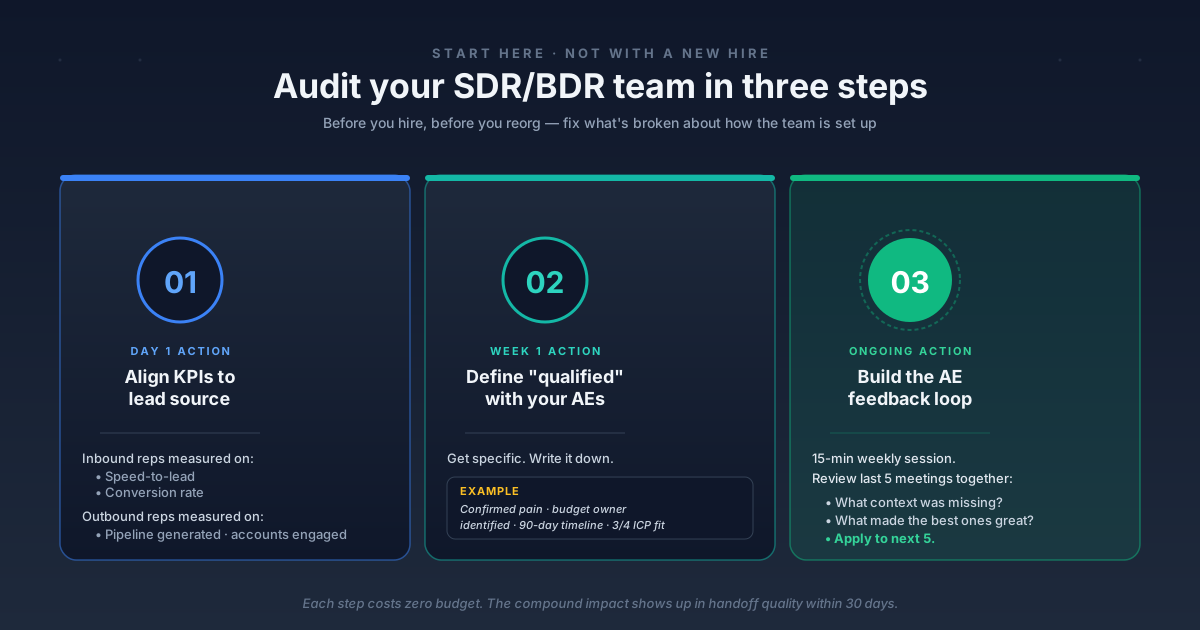
One concrete next step: audit your current team structure. Are your SDRs and BDRs measured on metrics that match their actual motion? If not, start there. Align the KPI to the lead source, define "qualified" with your AEs, and build the feedback loop that makes every meeting better than the last.
Start your journey with Guideflow today!