


You ran a 12-question survey for a launch message test. You got 340 responses. And you learned almost nothing.
Every open-end was one line. "It's good." "Like the pricing." "N/A." You wanted to know why the new positioning landed, which objection still stuck, what almost made them churn. Instead you got a pile of single-word answers and a 1-to-5 score that tells you the what but never the why.
That gap is the whole problem with static forms. They cannot probe. A good interviewer hears a vague answer and asks one more question. A static survey just moves to the next field.
Conversational AI surveys close that gap. They ask adaptive follow-up questions in real time, the way a sharp researcher would, then synthesize the transcripts into themes you can act on. The depth shows up in the data. In one 2025 Conjointly case study, 53% of conversational survey responses ran longer than 100 words, compared to just 5% in a matched open-ended survey.
For a product marketing manager running message testing, win/loss, and launch feedback, that difference is the difference between a quote you can put in a battlecard and a row you delete from a spreadsheet. This guide ranks the 10 conversational AI survey platforms worth your shortlist in 2026.
What's inside
This guide is for product marketers, market researchers, and CX or insights teams who want richer qualitative depth without manually moderating hundreds of interviews. We chose tools that genuinely run conversational, AI-moderated research, not static AI survey generators wearing a chat skin. If you're also evaluating the broader toolkit for discovery work, our roundup of the best user research tools is a useful companion.
We evaluated every platform against four criteria that matter for real research work:
- Adaptive follow-up depth: how intelligently it probes beyond the first answer.
- Data quality and fraud controls: bot detection, human-respondent safeguards, response screening.
- Transcript-to-insight synthesis: automated summaries, theme extraction, exportable transcripts.
- Integrations and pricing transparency: how it connects to your stack and what it actually costs.
TL;DR
Short on time? Here are the decision shortcuts, mapped to who you are and what you need.
- Best for prompt-to-survey speed and broad audiences: Pollfish.
- Best for enterprise XM ecosystems: Qualtrics.
- Best for rigorous product and pricing research: Conjointly.
- Best for agencies and large research operations: Forsta.
- Best for fast consumer insights with built-in panels: Suzy.
- Best for in-product SaaS feedback: 1Flow.
- Best for AI-moderated user interviews: Strella.
Most teams should shortlist two or three, run one small pilot, and compare the verbatim quality against their last static survey.
What conversational AI survey platforms are
A conversational AI survey platform uses AI and natural language processing to run adaptive, chat- or voice-based surveys that ask real-time follow-up questions instead of serving a fixed static form. Rather than marching every respondent through identical questions, it adapts to each previous answer, probes for detail, then synthesizes the responses into structured insight.
The category sits between two older worlds. Traditional survey software is fast and scalable but shallow. Qualitative interviews are deep but slow and expensive to run at volume. Conversational AI surveys aim to deliver qualitative depth at quantitative scale.
Key capabilities to expect:
- Adaptive follow-up questions: real-time probing logic that reacts to what each respondent actually says.
- Qualitative depth at quantitative scale: interview-style richness across hundreds or thousands of respondents.
- Transcript analysis and insight synthesis: automated summaries, theme extraction, and searchable transcripts.
- Data quality and fraud resistance: bot detection, human-respondent safeguards, and open-end review.
- Multimodal input: text chat, and in some tools, voice-to-voice or voice survey formats.
- Integrations: connections to research, analytics, and CRM tools so insight reaches the rest of your stack.
These platforms are distinct from three adjacent things. They are not traditional survey software, which serves a fixed form. They are not generic chatbots, which answer questions rather than ask them with research intent. And they are not AI voice assistants, which handle tasks rather than moderate structured research. The defining trait of a conversational AI survey is moderation: the AI runs the interaction, not just the form.
That distinction matters when you compare them to plain AI survey tools. An ai survey generator helps you build a survey faster from a prompt. A conversational platform moderates the response itself, deciding what to ask next based on what it just heard. Both use survey AI, but only one probes.
When to use a conversational AI survey platform
Not every research question needs adaptive moderation. A quick pulse check or a clean NPS number is fine on a static form. Reach for a conversational AI survey when the why matters as much as the what.
Run message and positioning tests with real depth
A 1-to-5 score tells you a message scored a 4. It does not tell you which phrase made it a 4 instead of a 2. Conversational surveys probe the reaction: what felt credible, what felt like noise, which proof point actually moved them.
That is exactly the signal a PMM needs for win/loss and message testing. You learn the language buyers use, the objection that keeps surfacing, the differentiator that lands. Once research validates the message, teams deliver it through interactive demos and other product experiences, so the validated story reaches buyers at the same depth you tested it. Research sharpens the message; the demo carries it. The same logic applies when you're standardizing how those validated messages reach prospects, which is where product marketing software rounds out the workflow.
Capture launch and adoption feedback at scale
Post-launch, you want more than "did you notice the new feature." You want to know whether adopters understood the value, where they got stuck, and what almost stopped them. Pairing that feedback with product launch software helps you close the loop between what research surfaces and how the next release lands.
Conversational surveys adapt by respondent segment, asking a power user different follow-ups than a first-week trial user. The verbatims that surface are often quotable enough to drop straight into enablement decks and customer stories.
Replace shallow open-ends in CX and product research
Static open-ends are where research goes to die. "Anything else?" gets you "no" or a blank. Respondents satisfice, giving the least effort the form will accept.
Adaptive probing fights that. When someone writes "the onboarding was confusing," the AI asks what specifically confused them, turning a dead-end into a usable insight. If onboarding friction is a recurring theme, our guide to user onboarding software covers the tools that fix it. For market research survey tools and product discovery alike, that is the core upgrade.
The 10 best conversational AI survey platforms compared
The table below ranks the 10 platforms by relevance to genuine conversational AI survey work. Pricing reflects each vendor's published rates as of June 2026; where a vendor gates pricing behind sales, that is noted. G2 ratings reflect each tool's live listing. Use this as a scan, then read the sections that match your shortlist.
| # | Product | Intent | Key use case | Pricing | G2 rating |
|---|---|---|---|---|---|
| 1 | Pollfish | Fast self-serve fielding | Prompt-built surveys to broad and niche panels | From $0.95/response | 4.6/5 |
| 2 | Qualtrics | Enterprise XM | Adaptive feedback inside a full experience suite | From $420/mo; custom | 4.4/5 |
| 3 | Conjointly | Research rigor | Conversational interviews plus conjoint and pricing methods | From $2,895/team/yr | Limited reviews |
| 4 | Forsta | Agency and enterprise scale | NLP follow-ups with anti-bot controls | Custom | 4.2/5 |
| 5 | Suzy | Consumer insights speed | Conversational research with built-in panels | Custom | 4.7/5 |
| 6 | TheySaid | Interview-style depth | One-on-one AI chat interviews at scale | Free; from $49/mo | 4.8/5 |
| 7 | Strella | AI-moderated interviews | Qualitative studies with real-time synthesis | Custom | 5.0/5 |
| 8 | Maze | Product and UX research | AI follow-ups on open responses | Enterprise | 4.5/5 |
| 9 | Aftercare | Adaptive probing add-on | AI follow-ups on existing survey flows | Custom | Limited reviews |
| 10 | 1Flow | In-product feedback | In-app AI surveys with conversational follow-ups | From $150/mo | 3.4/5 |
The 10 best conversational AI survey platforms
1. Pollfish
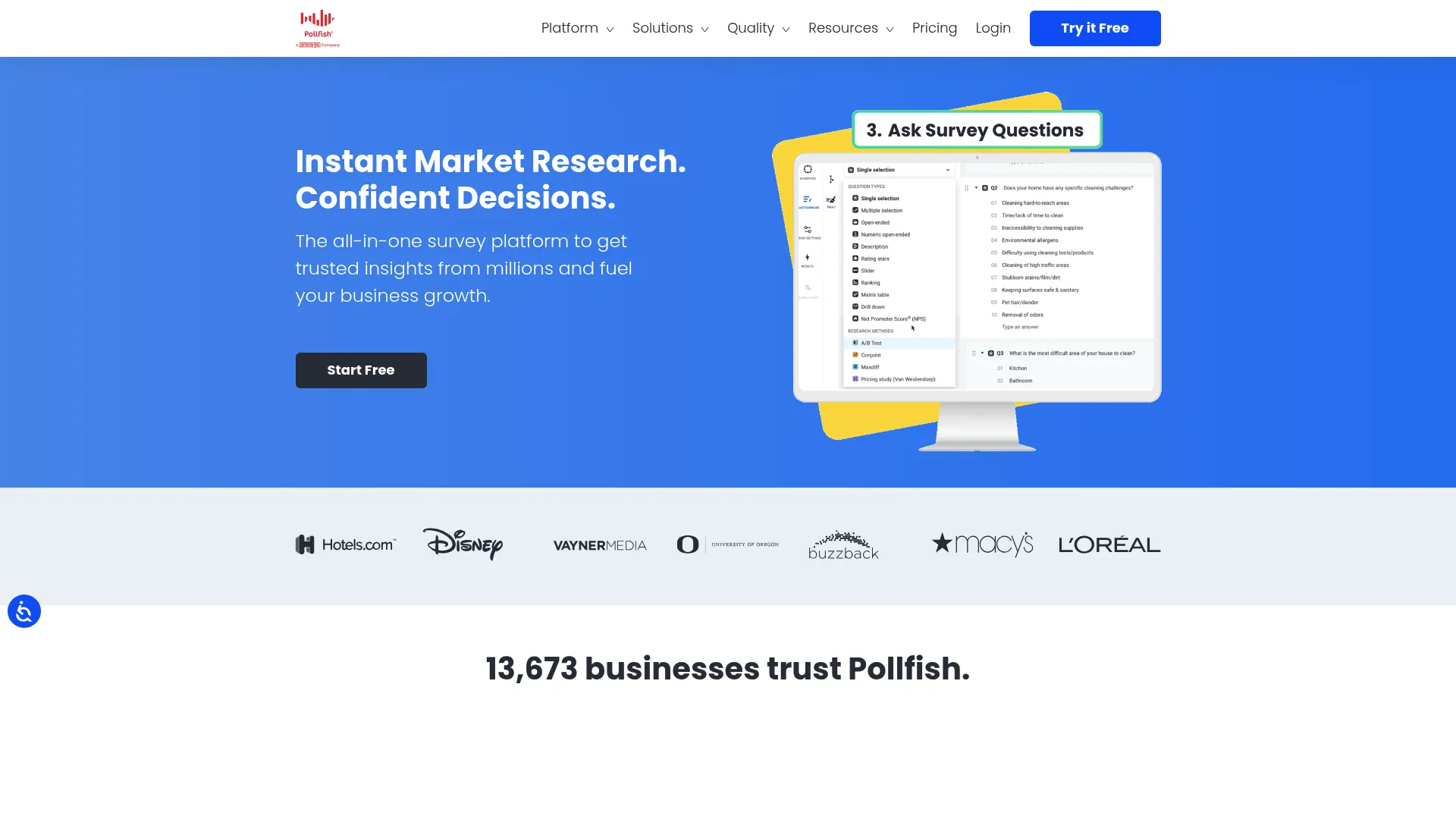
Pollfish is an all-in-one survey platform for getting market research insights from targeted audiences. Its AI builder generates a complete questionnaire from a single prompt, and its conversational AI question type simulates a natural back-and-forth chat with respondents inside an otherwise structured survey. The draw for PMMs is reach: through its parent company's panels, Pollfish provides access to a very large self-serve respondent base across many countries.
Best for: teams that need fast fielding to broad or niche audiences without standing up a panel themselves.
Key strengths
- Prompt-to-survey AI builder: generate a full questionnaire from one prompt, then refine.
- Conversational AI question type: add adaptive chat-style probing inside a standard survey.
- Pay-per-response pricing: transparent per-response cost with real-time visibility before you launch.
Why choose Pollfish: if your bottleneck is getting in front of the right audience fast, Pollfish removes the panel-sourcing problem. The DIY platform suits teams that want to self-serve, while full-service projects exist for teams that would rather hand off design and analysis. It is the speed-and-reach pick rather than the deep-methodology pick.
Pollfish pricing: the DIY platform starts at $0.95 per response, billed pay-per-response. Full-service projects start at $5,000 per project, and Enterprise packages start at a $10,000 annual commitment. The platform is free to join, and you only pay when you launch and collect responses. Pollfish holds a 4.6 out of 5 rating on G2.
2. Qualtrics
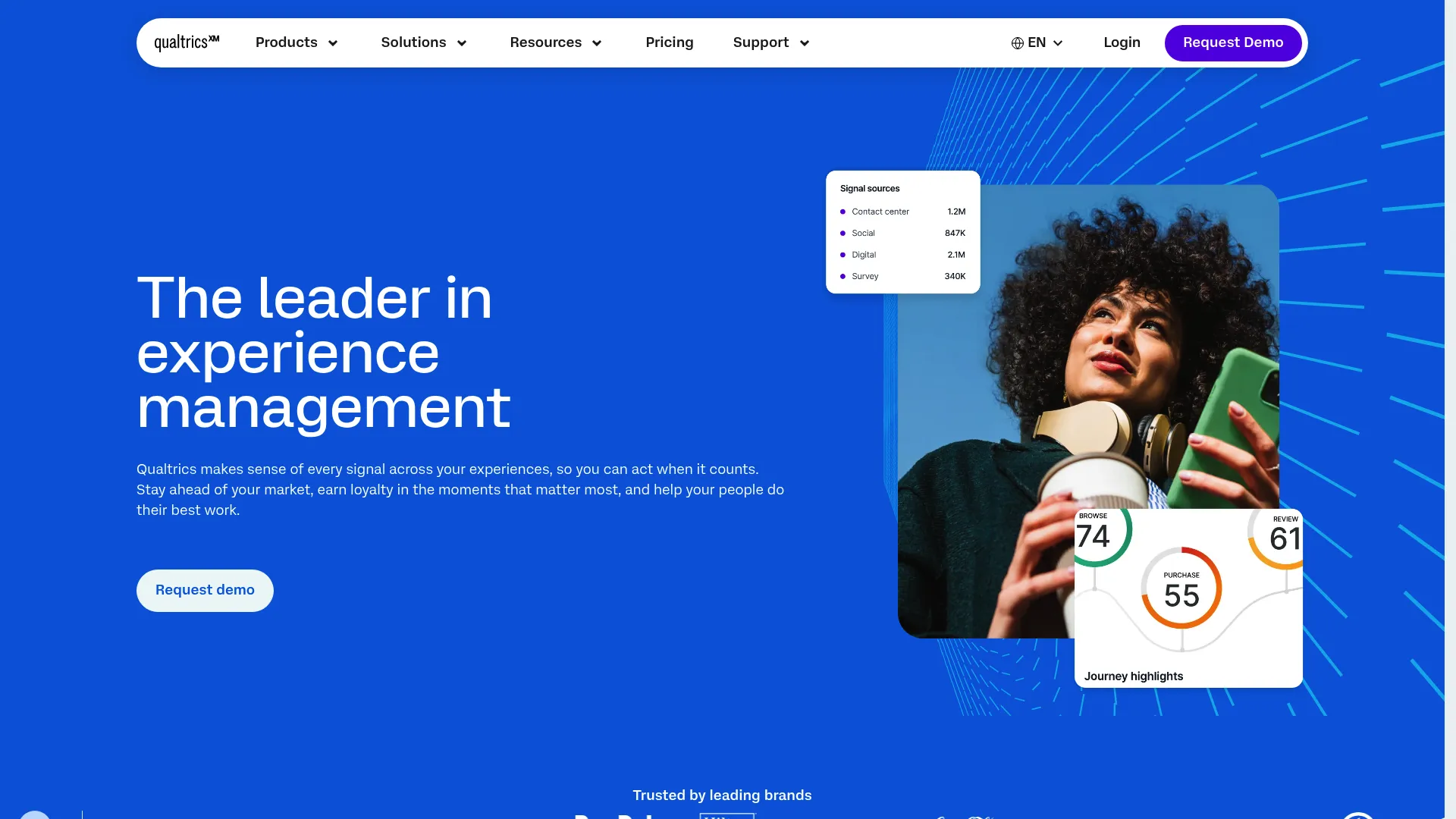
Qualtrics provides experience management software for capturing customer, employee, product, and brand insights. Its conversational feedback uses AI to generate follow-up questions based on what a respondent types into a text-entry field, turning low-quality open-ends into richer data. Text iQ then handles open-end synthesis, surfacing themes, sentiment, and topics across responses.
Best for: enterprise research and CX teams already operating inside an experience management ecosystem.
Key strengths
- Adaptive follow-up questions: AI-generated probes that expand thin text-entry answers.
- Text iQ analysis: automated topic modeling and sentiment across open-ended data.
- Enterprise governance: compliance, security, and governance controls built in for scale.
Why choose Qualtrics: if your organization already runs customer, employee, product, and brand programs on one platform, adding conversational depth without leaving that stack is the practical move. Qualtrics is the heavyweight option, strongest for teams with research operations maturity and the governance requirements that come with scale. Smaller teams may find it more platform than they need.
Qualtrics pricing: Qualtrics offers a free Surveys account with no credit card required. The online Strategic Research plan is $420 USD per month, billed annually at $5,040 for 1,000 responses shared across users. Enterprise Strategic Research uses custom pricing by quote, based on interactions such as survey responses and minutes of video feedback. Qualtrics holds a 4.4 out of 5 rating on G2.
3. Conjointly
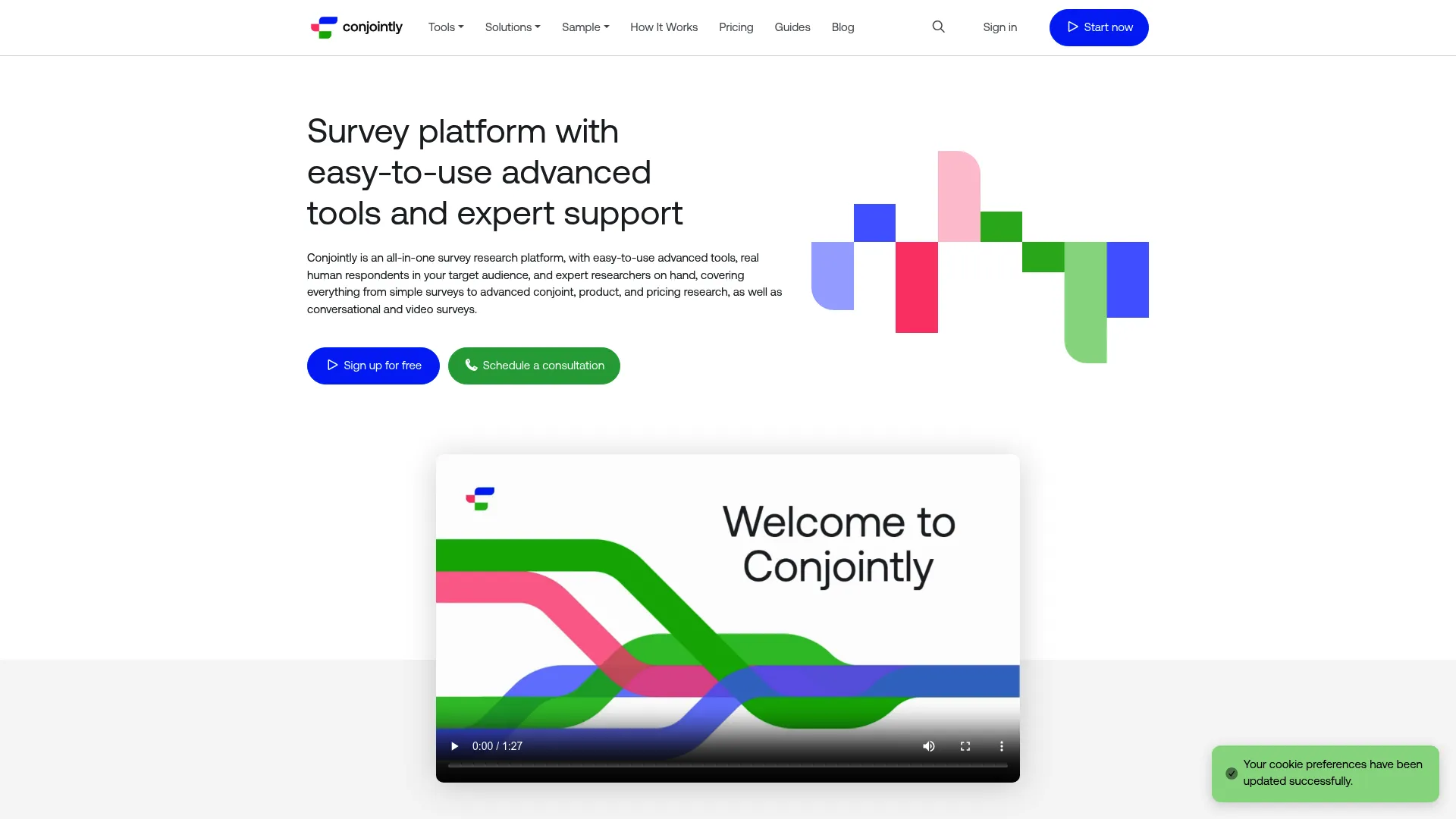
Conjointly is an all-in-one survey research platform covering simple surveys, advanced conjoint, product and pricing research, plus conversational and video surveys. Its conversational surveys engage respondents through one-to-one AI-powered chat interviews that adapt dynamically to previous answers. Deep probe analysis turns free-flowing transcripts into structured, measurable outputs you can export to Excel, and the platform holds ISO 20252:2019 certification for its sampling services with safeguards against survey fraud and bots.
Best for: teams running rigorous product, pricing, and consumer research that need quantitative methods alongside conversational depth.
Key strengths
- Conversational interviews with deep probe: adaptive chat plus transcript-to-structured-output analysis.
- Advanced research methods: conjoint, MaxDiff, Gabor-Granger, Van Westendorp, Kano, and TURF.
- ISO-certified panels and fraud safeguards: ISO 20252:2019 sampling certification and bot protection.
Why choose Conjointly: when methodology rigor matters, Conjointly pairs conversational depth with the quantitative pricing and product methods most platforms lack. That adjacency means you can test a message conversationally and validate willingness-to-pay in the same toolset. If pricing is the question you keep returning to, our roundup of pricing software goes deeper. It is the research-purist pick for teams that care about defensible numbers, not just rich quotes.
Conjointly pricing: the Basic tier is no-cost with no restrictions on the number of surveys, questions, or team members. Professional starts at $2,895 per team per year and adds support plus access to all advanced methods. Ultimate starts at $10,000 per year and adds research support, purchase-order payment, procurement onboarding, and tailored training. Conjointly's G2 listing currently shows limited reviews.
4. Forsta
Forsta is an AI-powered human experience platform spanning customer experience, employee experience, brand experience, and market research. Its Open Assist feature enriches surveys with conversation, adding follow-up prompts to open-ended responses that keep respondents talking. Anti-bot controls fight fraudulent AI answers through sample-provider integrations, and Forsta connects to additional AI tools via API.
Best for: agencies and large research operations that need conversational depth at programmatic scale.
Key strengths
- Open Assist follow-ups: NLP-driven prompts that probe open-ended responses in real time.
- Anti-bot controls: sample-provider integrations that filter fraudulent and AI-generated answers.
- AI text analytics: sentiment, themes, and trend analysis across unstructured feedback.
Why choose Forsta: if you run research as a high-volume operation, across many clients or many programs, Forsta is built for that scale. Its strength is scaling qualitative depth across a quantitative reach without sacrificing data quality. It is the agency-and-enterprise pick, less suited to a one-person team running occasional message tests.
Forsta pricing: Forsta does not publish numeric pricing. Plans are quoted based on program scope, so request a quote tied to your research volume and the experience programs you run. Forsta holds a 4.2 out of 5 rating on G2.
5. Suzy
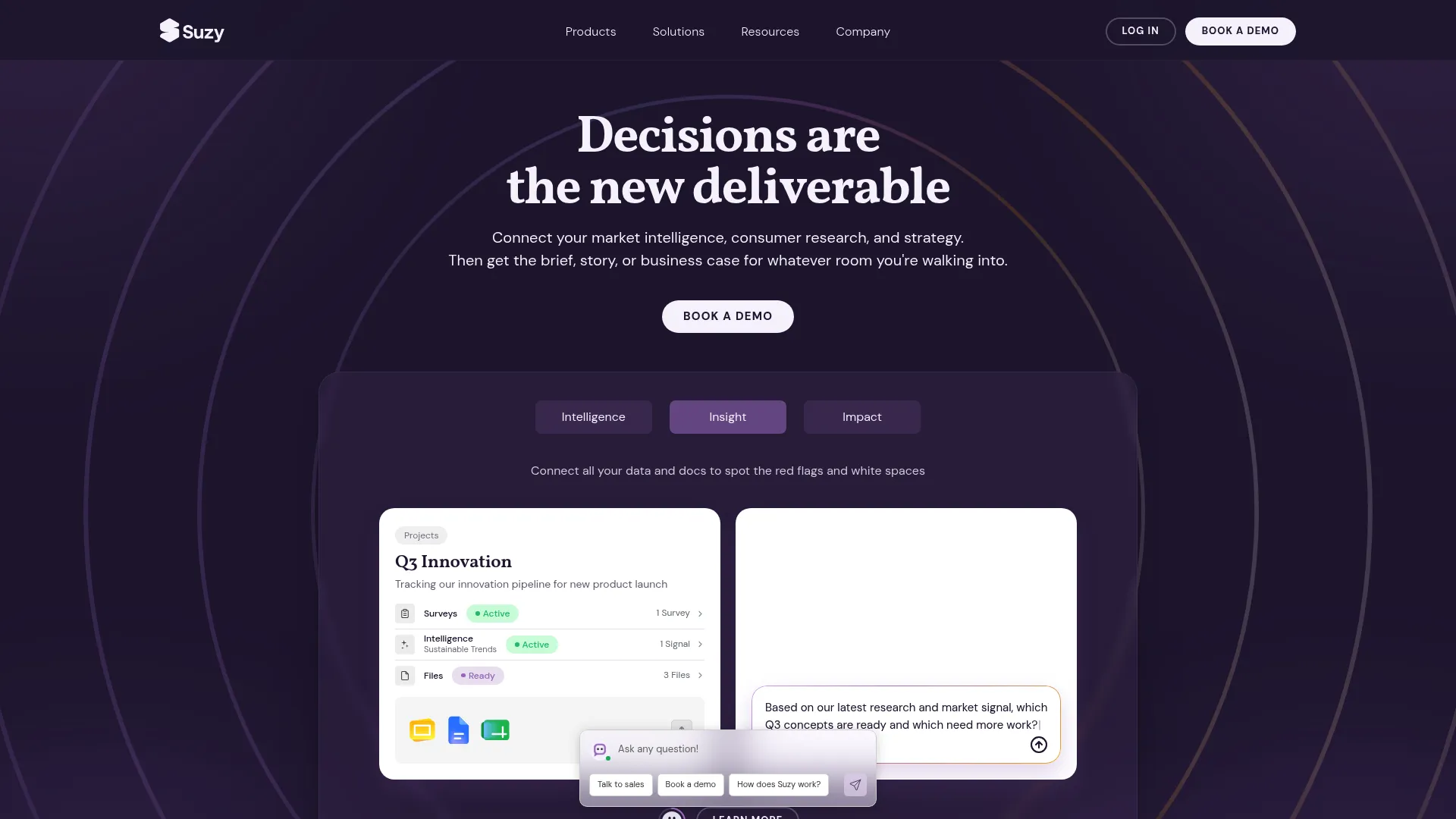
Suzy is a consumer insights and decision engine that connects market intelligence, consumer research, and strategy. Suzy Speaks runs AI-powered conversational surveys that surface authentic insights at scale, while Suzy Live connects quantitative and qualitative research through moderated sessions. The platform offers access to 70+ verified global consumer panels with bot detection and audience quality controls.
Best for: consumer brands and research teams that need fast quantitative and qualitative insights for product, marketing, and strategy decisions.
Key strengths
- Suzy Speaks conversational surveys: AI-moderated, scalable consumer research with adaptive depth.
- Suzy Live and AI-moderated interviews: moderated sessions that bridge quant and qual.
- 70+ verified panels: built-in audiences with bot detection and quality controls.
Why choose Suzy: if you make consumer decisions on a fast cycle and want both the numbers and the verbatims without juggling vendors, Suzy's module suite and built-in audiences keep everything in one place. It is the consumer-insights-speed pick, strongest for brand and product teams. Teams running technical B2B win/loss may find consumer-panel access less relevant.
Suzy pricing: Suzy does not publish pricing on its site and directs prospects to book a demo, so request a quote scoped to your panel and research needs. Suzy holds a 4.7 out of 5 rating on G2.
6. TheySaid
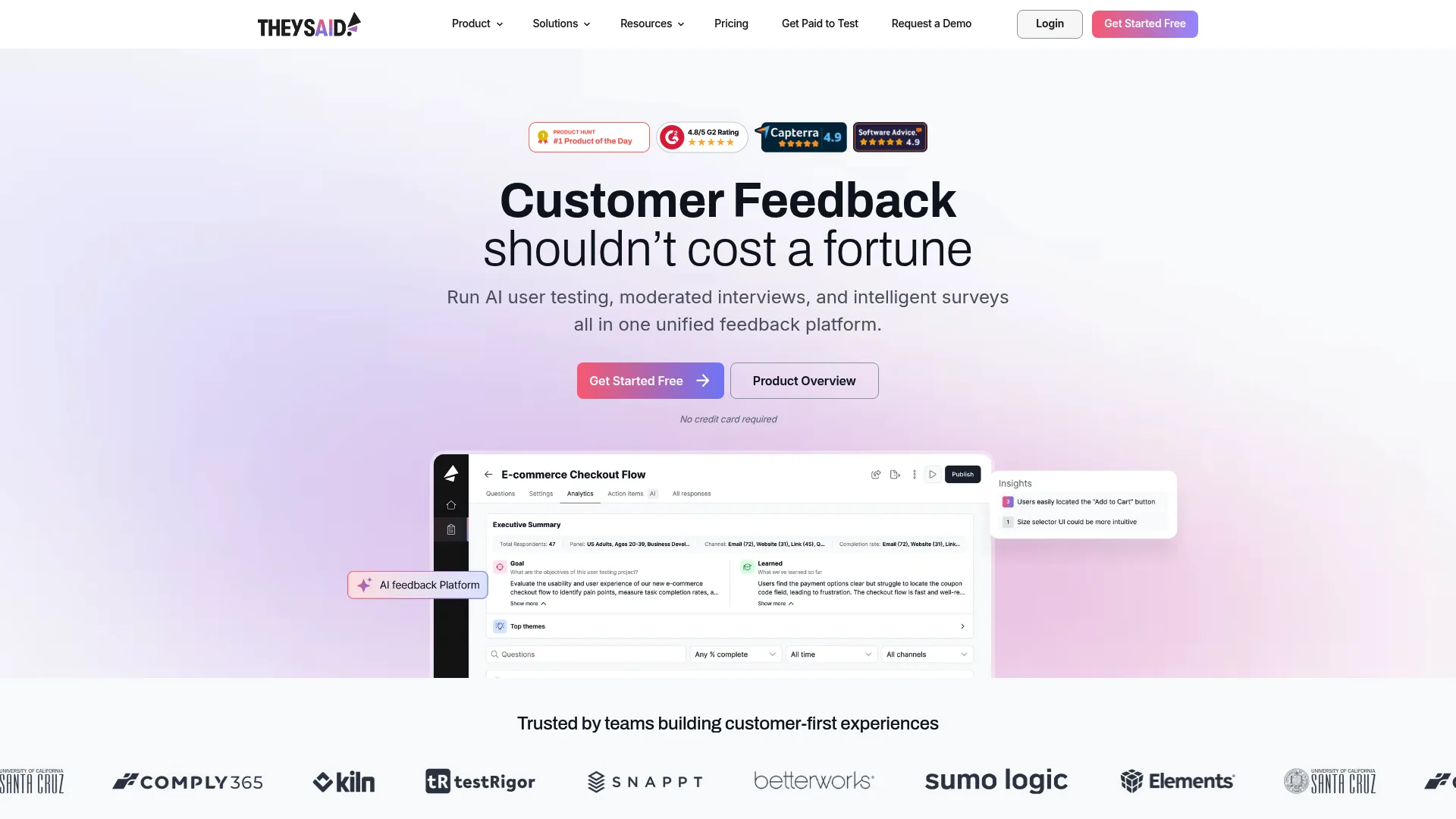
TheySaid is an AI-powered user testing, survey, interview, and polling platform. It conducts hundreds of AI-powered interviews simultaneously, gathering rich qualitative insights at a quantitative scale. AI follow-ups turn ratings into root-cause insights, and every response feeds the same dashboard for synthesis. The positioning is interview-style depth without the manual moderation overhead.
Best for: teams that want one-on-one interview depth at survey scale without scheduling and running each session by hand.
Key strengths
- AI chat interviews at scale: hundreds of simultaneous one-on-one conversations.
- Root-cause follow-ups: AI probes that turn a score into the reason behind it.
- Unified AI analytics: summaries, themes, and actionable insights in one dashboard.
Why choose TheySaid: if your research bottleneck is moderation capacity, TheySaid removes it by running the interviews for you. That suits product, UX, marketing, and sales teams that want qualitative richness but cannot staff dozens of live sessions. It is the interview-depth-without-moderation pick.
TheySaid pricing: the Free plan is $0 per month with one active AI project, 50 monthly responses, and one seat. Essential is $49 per month with 250 monthly responses. Pro is $149 per month with two active projects, 1,000 monthly responses, and five seats. Team starts at $499 per month with more projects, unlimited responses, and multi-team management. TheySaid holds a 4.8 out of 5 rating on G2.
7. Strella
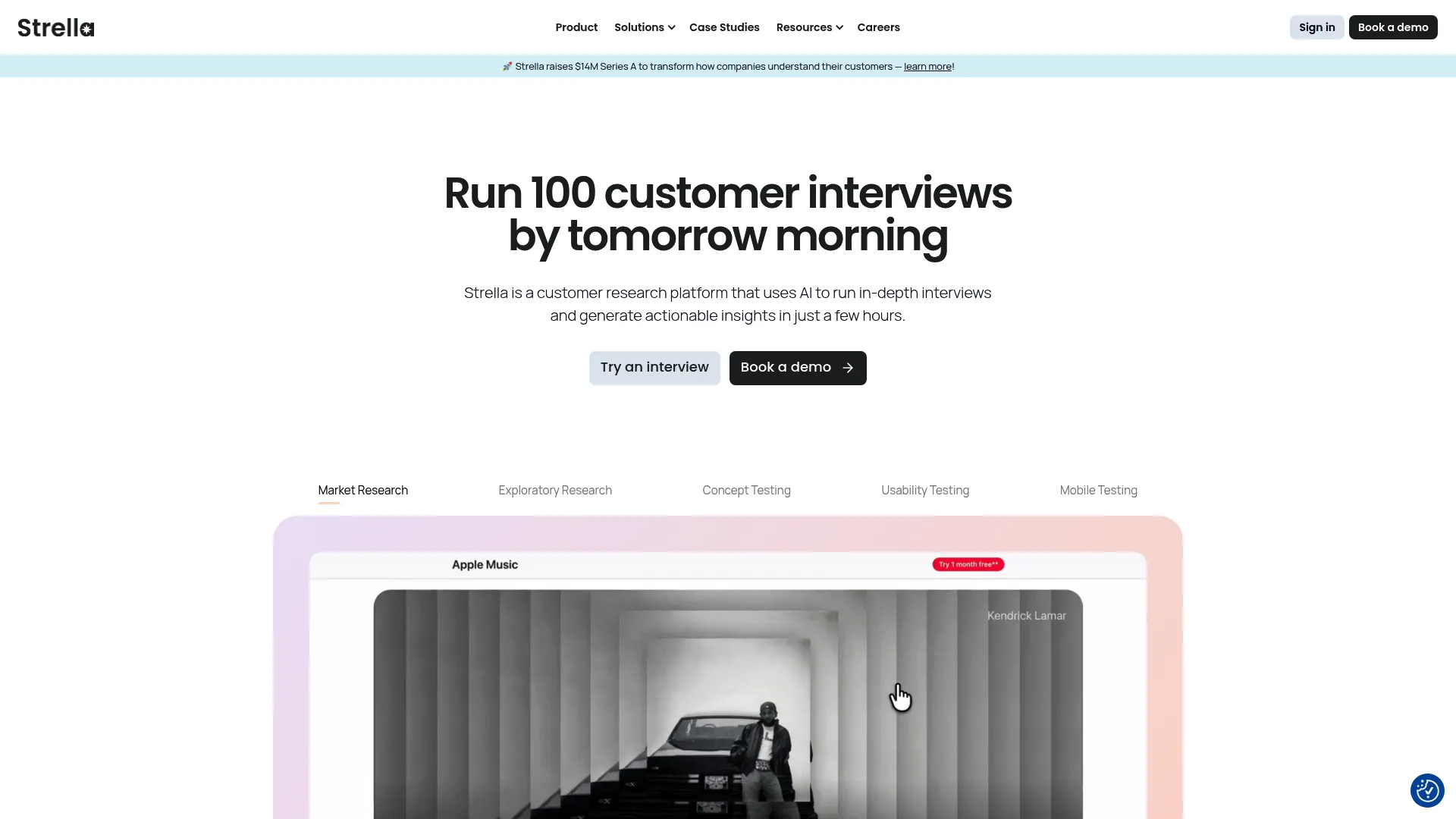
Strella is a customer research platform that uses AI to run in-depth interviews and generate actionable insights in hours, not weeks. It generates unbiased discussion guides, moderates interviews with adaptive follow-up questions, and recruits participants from its own panel. Real-time synthesis produces reports and video highlight reels, and a chat-with-research feature lets you query findings directly.
Best for: UX and product research teams running qualitative studies who need synthesized insight fast.
Key strengths
- AI-moderated interviews: adaptive follow-up questions that probe like a skilled interviewer.
- Real-time synthesis: reporting and highlight reels generated as interviews complete.
- Chat with research: query your study to surface insights and clips on demand.
Why choose Strella: if you live in discovery and usability work and the slow part is synthesis, Strella compresses the cycle from weeks to hours. It is the AI-moderated-interviews pick for teams whose primary job is qualitative research, not broad-panel fielding. With a small but perfect review base so far, it skews toward research-led teams over high-volume consumer work.
Strella pricing: Strella does not publish public pricing, so request a quote scoped to your study volume and recruitment needs. Strella holds a 5.0 out of 5 rating on G2 based on a small number of reviews.
8. Maze
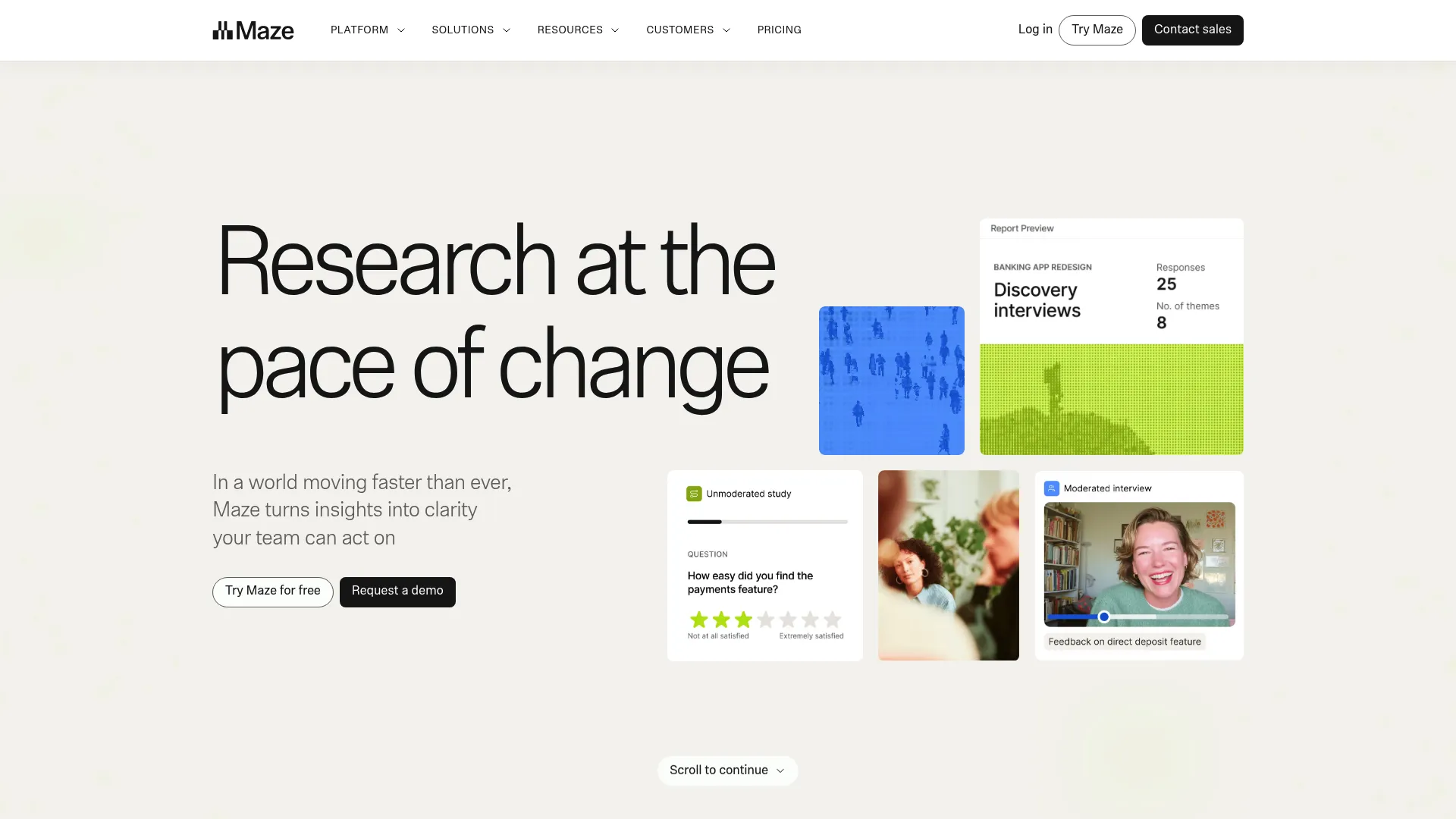
Maze is a user research platform that helps product teams collect and analyze customer insights. On open-question blocks, you can enable follow-up on answers to generate up to three additional AI follow-up questions based on each tester's initial response. Maze records and transcribes sessions, summarizes interviews and open-ended answers, and groups similar responses into themes automatically.
Best for: product and design teams running continuous discovery who want research woven into the product workflow.
Key strengths
- AI follow-ups on open questions: up to three context-aware probes per open response.
- Broad study types: prototype testing, usability studies, surveys, card sorting, and interviews.
- Automated synthesis: transcripts, summaries, clips, and theme grouping out of the box.
Why choose Maze: if your team runs frequent, lightweight studies as part of the design process, Maze fits the cadence and the participant recruitment is built in. It is the product-and-UX pick, strongest for continuous discovery rather than large-scale market research. Teams that lean on these workflows will also want strong product analytics software alongside their research stack. Teams needing advanced panel methods may look elsewhere.
Maze pricing: Maze's pricing page lists capabilities by plan and marks advanced features as Enterprise, but does not display a public subscription price; contact Maze for a quote and confirm current free-trial terms. Maze holds a 4.5 out of 5 rating on G2.
9. Aftercare
Aftercare is an AI-powered survey platform built to ask intelligent follow-up questions and evaluate open-ended responses. A Y Combinator Winter 2024 company, it captures deeper insight through conversational follow-ups, then screens open-ended responses for off-topic, low-effort, nonsense, duplicate, and LLM-generated answers. AI coding generates code frames and categorizes open-ended responses automatically.
Best for: lean teams that want to add adaptive probing and response-quality screening to existing survey flows.
Key strengths
- AI follow-up questions: real-time probing on open-ended responses.
- Response-quality screening: flags off-topic, low-effort, duplicate, and AI-generated answers.
- AI coding: auto-generates code frames and categorizes open-ends.
Why choose Aftercare: if you already field surveys and just want them to probe deeper and stay clean, Aftercare adds that layer without a full platform migration. Its data-quality screening is a standout for teams worried about junk open-ends. It is the lightweight-adaptive-probing pick for smaller research functions.
Aftercare pricing: Aftercare does not publish numeric pricing and asks teams to contact it for a customized plan. API pricing is custom by volume and includes a free trial with white-glove onboarding. A free account allows 30 responses per month with one seat to start sharing a survey.
10. 1Flow
1Flow is an in-app survey and messaging platform for collecting contextual user feedback across web and mobile apps. Its AI generates a fully customized survey in under five seconds, and you can install the survey SDKs in less than 15 minutes. It collects NPS, CSAT, CES, and PMF scores, adds conversational follow-ups, and supports localization in 30+ languages with event- and trait-based targeting.
Best for: product-led and SaaS teams that want in-app feedback with conversational follow-ups at the moment of use.
Key strengths
- AI-generated surveys in seconds: a customized survey built from your needs in under five seconds.
- In-app targeting: event- and user-trait-based triggering for contextual feedback.
- Localization in 30+ languages: auto-shows the right version by device language.
Why choose 1Flow: if you want feedback from users while they are actually in the product, 1Flow's in-app delivery and fast SDK install fit a PLG motion. It is the in-product-feedback pick, strongest for SaaS teams measuring NPS and feature adoption in context. For broad-market research outside your app, a panel-based tool fits better.
1Flow pricing: Basic starts at $150 per month billed annually, with unlimited surveys and messages, web and mobile SDKs, and 10k monthly tracked users. Pro is $600 per month billed annually, removing 1Flow branding and adding advanced integrations, localization, and 50k tracked users. Enterprise is custom with SOC 2 Type 2 compliance and a dedicated account manager. A 14-day free trial is available with no credit card required. 1Flow holds a 3.4 out of 5 rating on G2.
How to choose the right conversational AI survey platform
The right tool depends on what kind of research you run and how much rigor your decisions demand. Work through these five criteria before you commit.
Adaptive follow-up depth
The whole category lives or dies on how well it probes. Test it yourself: give a deliberately vague answer and see whether the follow-up is a generic re-prompt or a context-aware question that builds on what you said. Shallow probing gets you the same thin data as a static form.
Data quality and fraud resistance
Conversational formats invite richer answers, which makes bot and AI-generated responses harder to spot. Look for trust scoring, human-respondent safeguards, sample-provider integrations, and open-end review tools. Aftercare's response screening and Forsta's anti-bot controls are examples of this done deliberately.
Transcript-to-insight synthesis
A transcript you cannot search is a cost, not an asset. Check whether the platform produces automated summaries, extracts themes, and lets you export structured output. Conjointly's deep probe and Strella's real-time synthesis show what strong synthesis looks like in practice.
Panels and reach
Decide whether you bring your own audience or need a built-in panel. If you need reach, evaluate panel size, country coverage, and certifications such as ISO 20252. Pollfish and Suzy lead on built-in audiences; Strella and Maze offer their own panels for research-led teams.
Integrations and pricing transparency
Insight that never leaves the survey tool does not change decisions. Confirm CRM and analytics integrations, then match the pricing model to your cadence. Pay-per-response suits occasional fielding; seat or platform pricing suits continuous programs. Verify public pricing before you assume a budget.
Conclusion
There is no single best conversational AI survey platform, only the best fit for the research you actually run.
For rigorous product and pricing research with defensible numbers, Conjointly is the standout. For fast self-serve fielding to broad audiences, Pollfish wins on reach and transparent per-response cost. Enterprise teams already living in an experience management ecosystem should look hardest at Qualtrics, while agencies running high-volume programs fit Forsta. If you need interview depth without staffing the interviews, TheySaid and Strella deliver AI-moderated conversations at scale. And for in-product SaaS feedback, 1Flow meets users where they are.
The next step is simple. Shortlist two or three tools that match your research cadence, run one small message-test pilot on a real question, and compare the verbatim quality against your last static survey. If the follow-ups surface a quote you would actually put in a battlecard, you have found your tool. Once you've validated the message, you can package it into a live demo that carries the proof straight to buyers. Start that pilot with the platform that best matches your audience and budget from the list above.
FAQs
A conversational AI survey platform uses AI and natural language processing to run adaptive, chat- or voice-based surveys. Instead of serving a fixed static form, it asks real-time follow-up questions based on each respondent's previous answers, then synthesizes the responses into themes and summaries.
An ai survey generator helps you build a static survey faster from a prompt, then serves the same fixed questions to everyone. A conversational platform moderates the interaction, deciding what to ask next based on what the respondent just said. Both use survey AI, but only the conversational format probes adaptively.
Generally yes, when designed well. Adaptive follow-ups fight the satisficing that produces one-word open-ends, so respondents give longer, richer answers. In a 2025 Conjointly case study, 53% of conversational responses ran longer than 100 words, compared to just 5% in a matched open-ended survey.
They combine several safeguards: trust scoring on respondents, human-respondent panels, anti-bot detection through sample-provider integrations, and open-end screening that flags off-topic, duplicate, low-effort, or AI-generated answers. Some, like Conjointly, also hold ISO 20252 certification for their sampling services.
Yes, that is the core value of the category. Structured questions deliver clean quantitative data, while adaptive open-end probing captures qualitative depth, and automated synthesis analyzes both across hundreds or thousands of respondents. You get interview-style richness without manually moderating every session.
Message testing, win/loss, launch feedback, and positioning validation, anywhere the why matters as much as the what. A static score tells you a message landed; a conversational survey tells you which phrase made it land and which objection still sticks, giving you quotes and language you can use in enablement.
Pricing models vary widely. Pay-per-response starts around $0.95 per response on Pollfish; seat or platform plans run from $49 to $600 per month on tools like TheySaid and 1Flow; and rigorous or enterprise platforms such as Conjointly start at $2,895 per team per year, with Qualtrics, Forsta, Suzy, and Strella offering custom enterprise pricing. Several tools, including TheySaid and 1Flow, offer free plans or trials.