ABA practices hit a familiar wall. Spreadsheets handled the first twenty clients. A generic calendar handled scheduling until a BCBA had four overlapping authorizations and a no-show to reschedule simultaneously. Then billing got complicated, payers started requiring specific documentation formats, and the founder realized they were personally reconciling claims every Friday.
The ABA software market reached $1.61 billion in 2025 and is projected to hit $3.34 billion by 2032, growing at 11.0% annually (PMarketResearch, 2026). That growth reflects one thing: Practices that outgrow manual workflows need operating infrastructure, not just a data collection app.
The right applied behavior analysis software connects clinical data collection, scheduling, payer documentation, billing, and reporting into a single operating rhythm. The wrong choice locks you into a migration six months after you needed the system to work.
Which platform can support clinical quality and practice operations without creating another bottleneck?
What's inside
This guide compares 14 applied behavior analysis software platforms for 2026, covering the full clinic workflow from ABA data collection to billing and multi-location reporting.
- Who it's for: ABA clinic founders, clinical directors, operations leaders, finance teams, and multi-location operators
- Selection criteria: Clinical data collection depth, practice management coverage, billing and claims workflows, security controls, and scalability
- Pricing and ratings: Verified against vendor pricing pages and live G2 listings during drafting
- What you'll get: A comparison table, per-tool breakdowns, and a buyer checklist to use before booking demos
TL;DR
- Best for full ABA practice management: Rethink Behavioral Health covers clinical, administrative, workforce, and reporting workflows in one platform
- Best for clinical data collection depth: Motivity offers transparent per-learner pricing and strong data capture workflows
- Best for enterprise and multi-location scale: CentralReach is built for larger ABA organizations with complex operational needs
- Best for newer clinics: Aloha ABA or Passage Health, depending on whether billing or clinical documentation is the sharper bottleneck
- Best for custom workflows: Tadabase builds configurable ABA apps when fixed platforms cannot model your process
- Shortcut for evaluation: Start with the workflow that currently creates the most operational drag, then score tools on migration effort, total first-year cost, and reporting quality
What is applied behavior analysis software?
Applied behavior analysis software helps ABA clinics collect behavioral data, manage treatment documentation, schedule staff, bill payers, track authorizations, and report client progress in one connected system.
ABA software is also called ABA practice management software or ABA therapy software, depending on which workflow it emphasizes. The category ranges from dedicated ABA data collection software focused on behavior measurement and graphing, to full ABA practice management platforms that connect clinical and administrative work.
Core capabilities to evaluate:
- Clinical data collection: Frequency, duration, latency, interval, ABC data, skill acquisition targets, and behavior reduction programs
- ABA graphing software: Automated visualizations for clinical review, supervision, and caregiver updates
- Session documentation: Notes, signatures, treatment plans, and payer-ready records
- ABA scheduling software: Therapist calendars, cancellations, authorization utilization tracking, and service-location management
- ABA billing software: Claim generation, payer rules, denial management, remittance processing, and revenue cycle visibility
- Reporting and analytics: Clinic-level dashboards covering utilization, outcomes, and operational bottlenecks
- Security and compliance: Role-based permissions, audit trails, access controls, and HIPAA-aligned safeguards
- Integrations: Payroll, EHR, clearinghouse, accounting, and communication tools where available
The best tools are not just where RBTs tap data during sessions. They are the operating layer that connects clinical quality, payer documentation, scheduling, and multi-location growth into a system that runs without heroic admin work.
When to use applied behavior analysis software
Standardize clinical data collection
Paper notes and spreadsheets break when multiple BCBAs, RBTs, settings, and clients are involved. ABA software gives teams a consistent method for capturing behavioral measurement data during sessions and reviewing progress without rebuilding graphs manually. When supervision cycles depend on a BCBA downloading a spreadsheet and reformatting it, you've already outgrown your current setup.
Run scheduling and billing from the same operating rhythm
ABA clinics face tight staff capacity, cancellations, authorization limits, payer rules, and documentation requirements that all interact. Software earns its keep when schedule changes, session notes, claims submission, and authorization tracking stay connected. A missed authorization unit that generates a denied claim is a cash flow event, not just an admin error.
Scale a multi-location practice without losing visibility
Leadership needs clean dashboards across locations, clinicians, payers, and programs. Founders and operators should be able to answer "which site has the highest denial rate" or "which BCBA's caseload has the lowest authorization utilization" without a manual data pull. Software turns those questions into a Monday morning routine instead of a Friday afternoon project.
Applied behavior analysis software comparison
Use this table as a shortlist, not a final verdict. ABA software pricing changes with clinic size, module selection, provider count, claims volume, and implementation scope. Verify pricing during demos before committing.
| # | Product | Best for | Key differentiator | Pricing | G2 rating |
|---|---|---|---|---|---|
| 1 | Rethink Behavioral Health | Full ABA practice management | Clinical, admin, workforce, and reporting in one platform | From $20/user/mo | 2.0/5 |
| 2 | Motivity | Clinical data collection and practice management | Transparent per-learner pricing with full workflow coverage | From $24/learner/mo | 3.5/5 |
| 3 | CentralReach | Enterprise and multi-location ABA | Broad ABA and autism care platform for large organizations | Quote-based | 3.7/5 |
| 4 | Passage Health | Growing ABA clinics | Connected data, scheduling, billing, and analytics | Quote-based | N/A |
| 5 | Hi Rasmus | Clinical depth and interdisciplinary teams | Customizable programs, AI session summaries, live supervision | Quote-based | N/A |
| 6 | Ensora Health | Behavioral and therapy practice operations | Multi-product EHR covering mental health and rehab therapy | From $25/mo | 4.4/5 |
| 7 | Raven Health | ABA startups and small-to-midsize clinics | Clear pricing with managed billing option | From $29/learner/mo | N/A |
| 8 | Aloha ABA | Small to midsize ABA practices | Pay-as-you-go with one-month free trial | $29.99/staff/mo | N/A |
| 9 | Tebra | Revenue cycle and practice operations | Full EHR and billing platform for independent practices | From $49/provider/mo | 4.1/5 |
| 10 | Fusion Web Clinic | Pediatric and multi-discipline therapy | Speech, PT, and OT EHR with billing and scheduling | From $25/mo | 4.5/5 |
| 11 | Tadabase | Custom ABA workflow apps | No-code app builder with free tier and flexible plans | Free; from $25/mo paid | 4.9/5 |
| 12 | Catalyst by Therapy Brands | ABA data collection and behavior tracking | Dedicated data capture, graphing, and clinical reporting | Quote-based | 4.4/5 |
| 13 | ABA Team | Outsourced ABA admin and HR operations | HR management, credentialing, and operational consulting | Quote-based | N/A |
| 14 | DataFinch Technologies | Legacy ABA data systems | Now redirects to Ensora Health; legacy Catalyst lineage | See Ensora Health | N/A |
Best 14 applied behavior analysis software tools for 2026
1. Rethink Behavioral Health
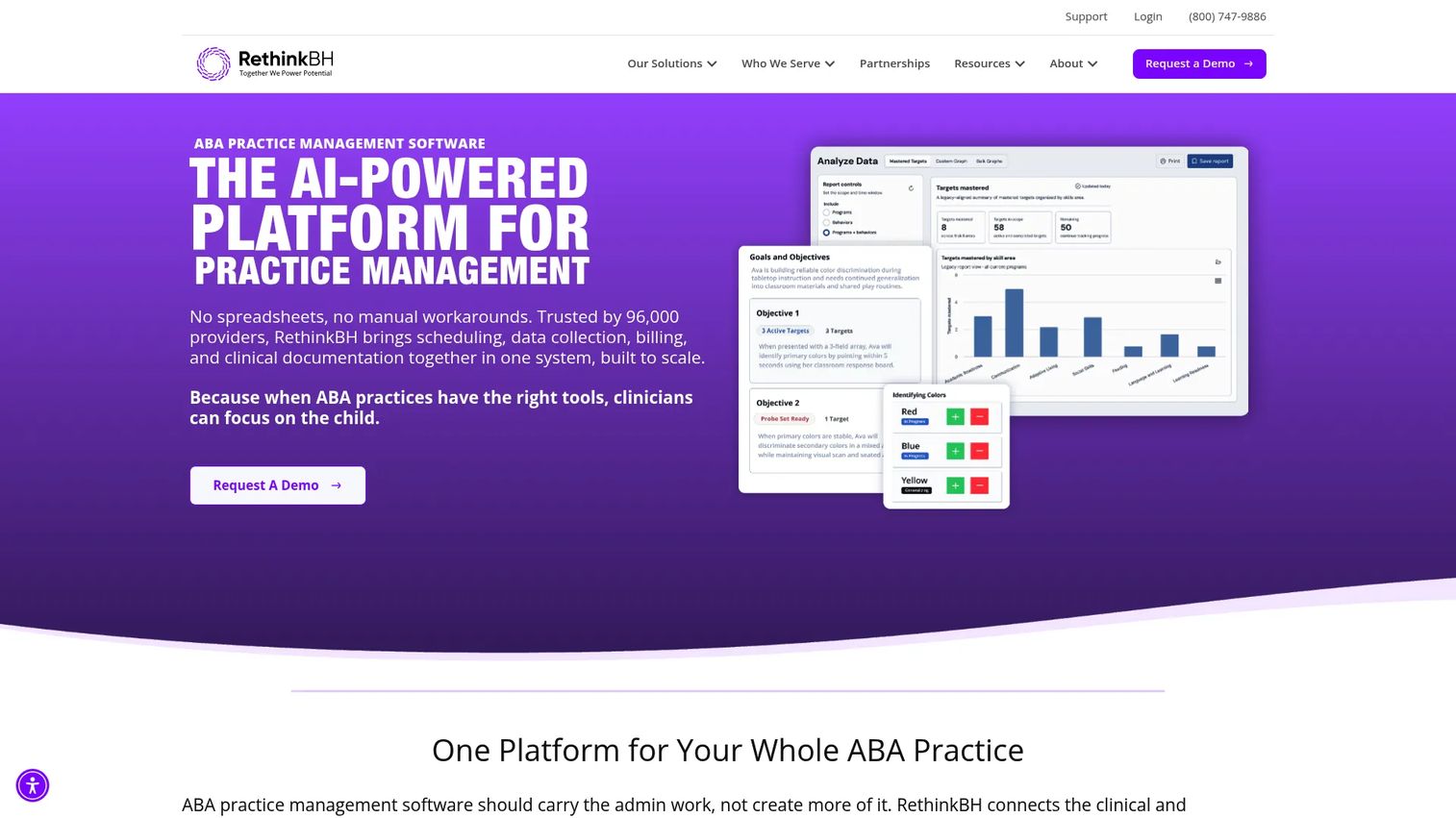
Rethink Behavioral Health is an all-in-one ABA practice management and clinical platform for behavioral health and pediatric therapy providers. It covers clinical data collection, session documentation, scheduling, billing, revenue cycle management, analytics, and staff training in a single system. The platform also includes family and client engagement tools alongside HIPAA-aligned security controls.
Best for: ABA and pediatric behavioral health practices that want clinical, administrative, workforce, and reporting workflows in one platform.
Key features
- Clinical data collection and treatment planning
- ABA session notes with AI assistance
- Scheduling and practice management
- Billing and revenue cycle management
- Staff training and credentialing
- Analytics and reporting dashboards
- Family and client engagement tools
Why choose Rethink Behavioral Health: This fits organizations that want broad operational coverage rather than a point solution. Evaluate implementation effort and module needs carefully before committing, as broader platforms require stronger workflow ownership across clinical, billing, and training teams.
Rethink Behavioral Health pricing: Pricing starts at $20 per user per month, according to the official vendor comparison page. Specific plan tiers are not publicly listed; ask sales about module selection, implementation, and support costs.
G2 rating: 2.0/5 (G2)
2. Motivity
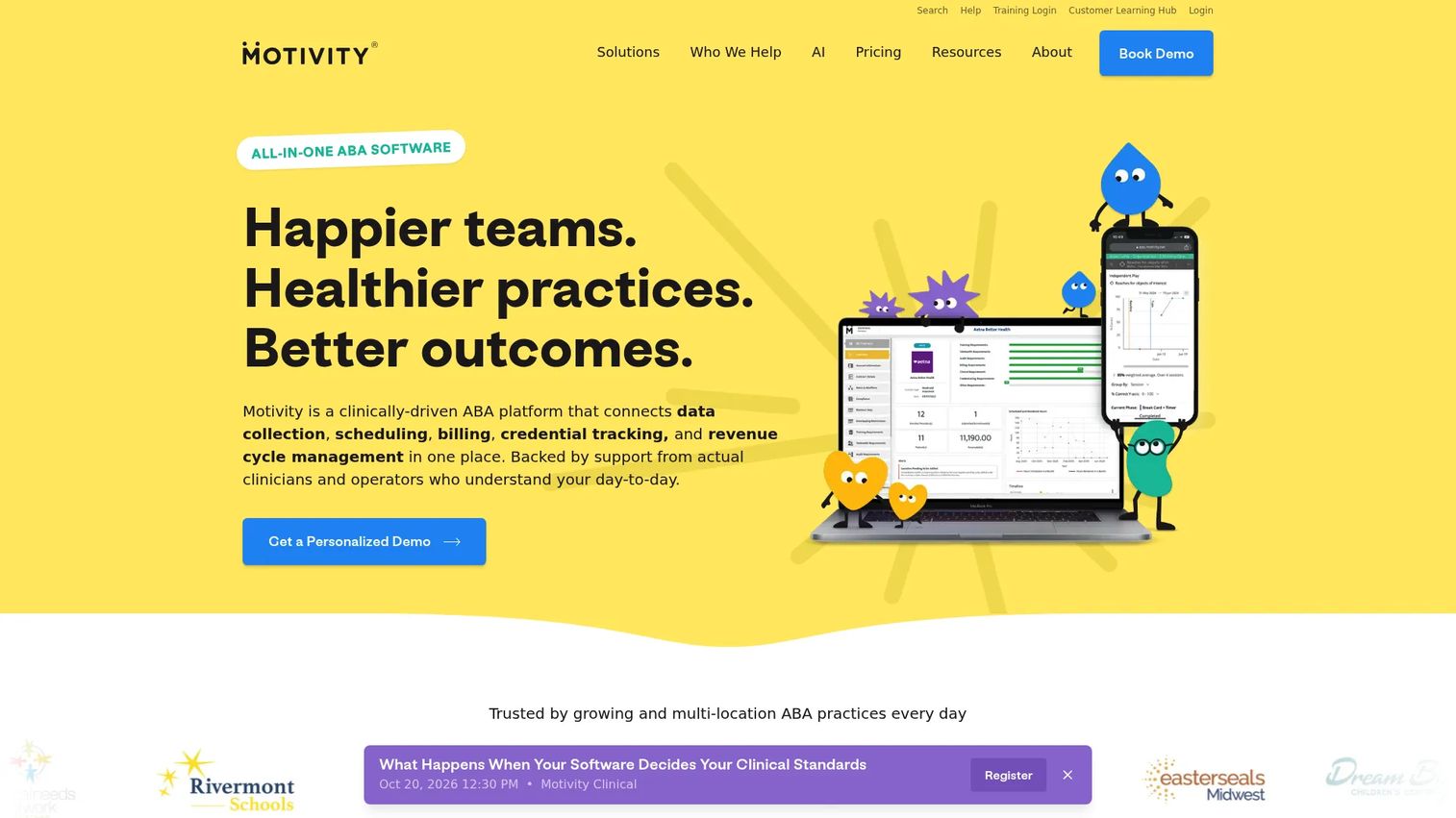
Motivity is an all-in-one ABA software platform covering clinical data collection, practice management, scheduling, billing, credentialing, and revenue cycle workflows. It offers real-time data capture, automated graphing, and more than 1,000 ready-to-use program templates. The platform is device-agnostic and includes mobile apps for session data collection.
Best for: ABA practices where clinical data integrity is the primary bottleneck, and where operations should stay connected to therapy workflows.
Key features
- Real-time ABA data collection with automated graphing
- 1,000+ program templates for treatment planning
- Scheduling, credentialing, and authorization management
- Billing, payroll, and revenue cycle workflows
- Mobile apps with HIPAA-aligned security and multi-factor authentication
Why choose Motivity: Motivity's transparent per-learner pricing makes cost predictable as a clinic scales, which matters when you're building a budget for a new location. For founders, this connects to faster supervision cycles and cleaner decisions without manual data reconstruction.
Motivity pricing: ABA Practice Management starts at $24/learner per month. ABA Data Collection is $26/learner per month. The All-In-One ABA Platform runs $50/learner per month. Enterprise pricing is custom.
G2 rating: 3.5/5 (G2, 4 reviews)
3. CentralReach
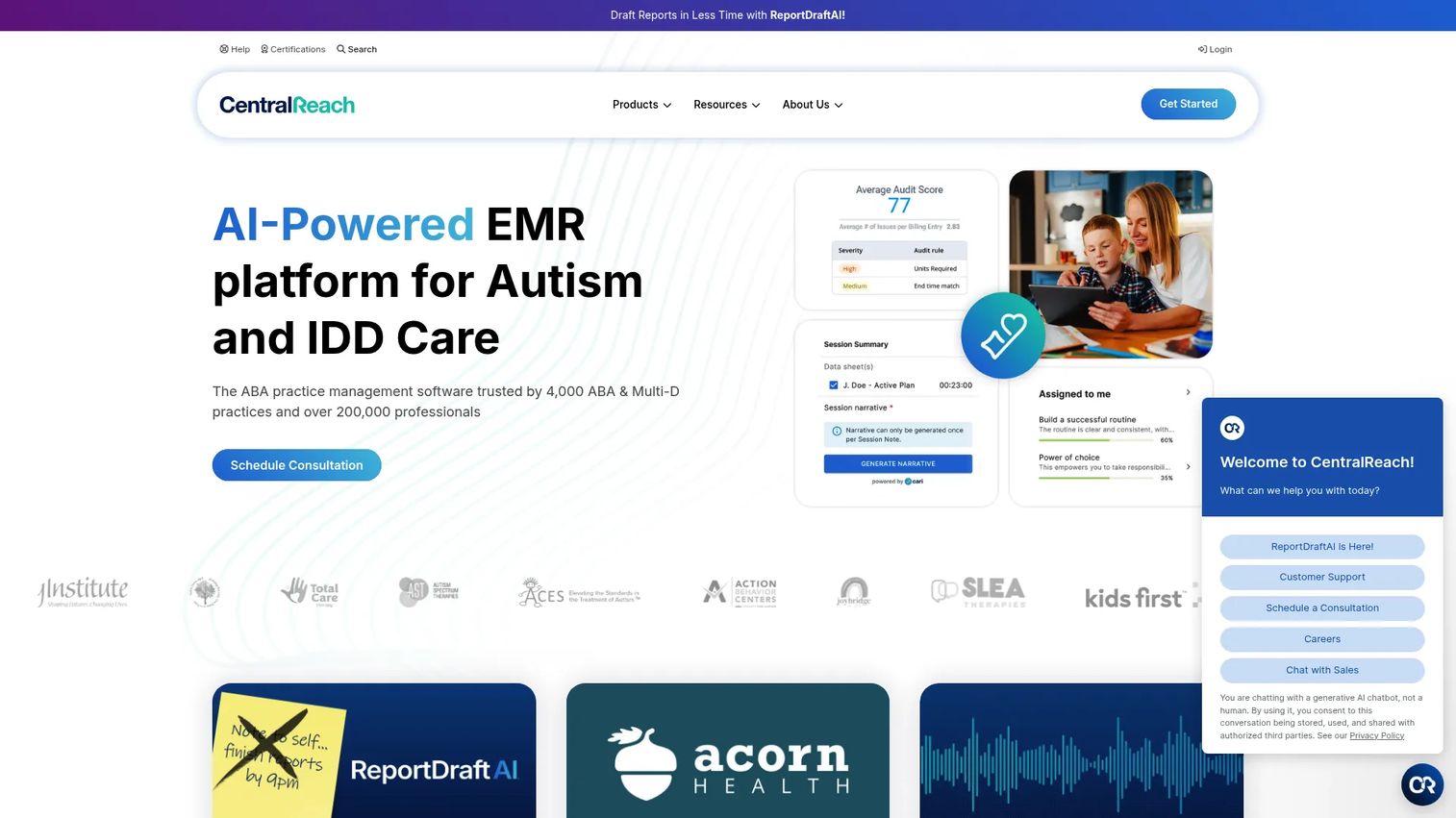
CentralReach is an AI-powered EMR and practice management platform for autism and intellectual and developmental disabilities care. The platform covers scheduling, clinical data collection, insurance billing, claims, analytics, mobile offline data collection, EVV, assessments, caregiver engagement, and staff training. It serves large ABA organizations and multi-location operators that need broad workflow coverage.
Best for: Larger ABA organizations, enterprise groups, and multi-location operators needing a platform that spans clinical, operational, and administrative workflows.
Key features
- Practice management and scheduling
- Clinical data collection and documentation
- Insurance billing, claims, invoicing, and payments
- Mobile offline data collection and EVV
- Assessments, caregiver engagement, and staff training
- Analytics and reporting
Why choose CentralReach: CentralReach is built for scale. Practices running multiple locations with complex payer mixes and workforce management needs will find broader coverage here than in smaller ABA platforms. Note that broad systems require stronger change management and workflow ownership to get value.
CentralReach pricing: Pricing for the main CentralReach platform is handled through sales consultation and is not publicly listed. Ask about location count, provider seats, module selection, implementation, and enterprise services. CR LiftEd school-level implementation is publicly priced at $10 per student per month, billed annually with a minimum of 10 students.
G2 rating: 3.7/5 (G2)
4. Passage Health
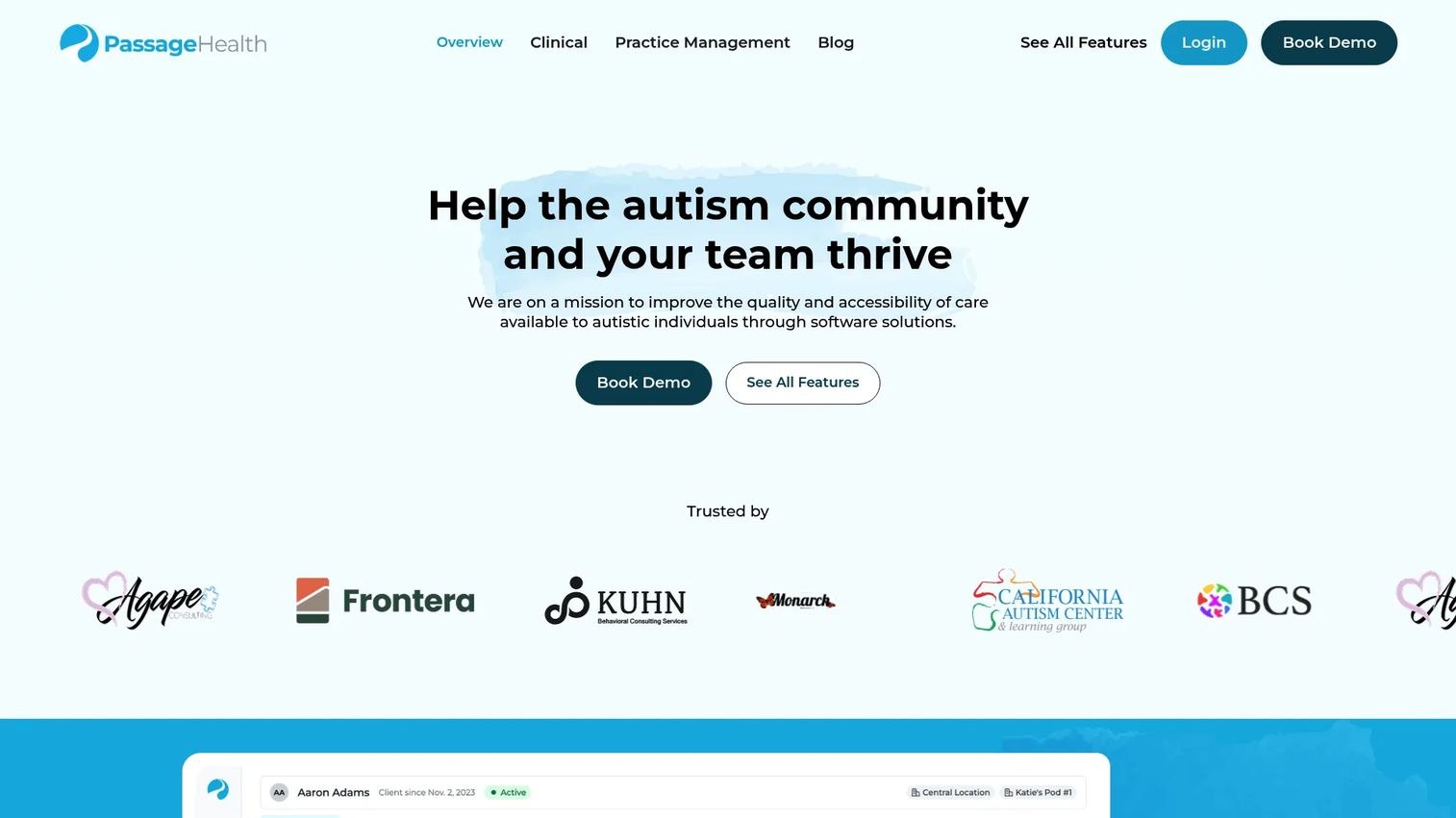
Passage Health is an all-in-one clinical and practice management platform built for ABA practices. It combines mobile data collection with real-time syncing, scheduling and session matching, integrated claims submission, automated graphing, authorization tracking, and HIPAA-compliant document management in a connected workflow.
Best for: Growing ABA clinics that have outgrown spreadsheets and want a modern operating platform covering clinical documentation, scheduling, billing, and analytics.
Key features
- Mobile data collection with real-time syncing
- Scheduling and session matching
- Integrated claims submission and billing
- Automated graphing and analytics
- Authorization tracking
- HIPAA-aligned document management
Why choose Passage Health: This is a good candidate for practices that want clinical and administrative workflows connected from day one. For a founder hiring a new VP of Operations, Passage Health is the kind of platform that can be handed off without requiring the founder to remain in every billing decision.
Passage Health pricing: Pricing is quote-based. Ask sales about implementation timeline, data migration, claims workflows, provider counts, and support model to get an accurate first-year cost.
5. Hi Rasmus
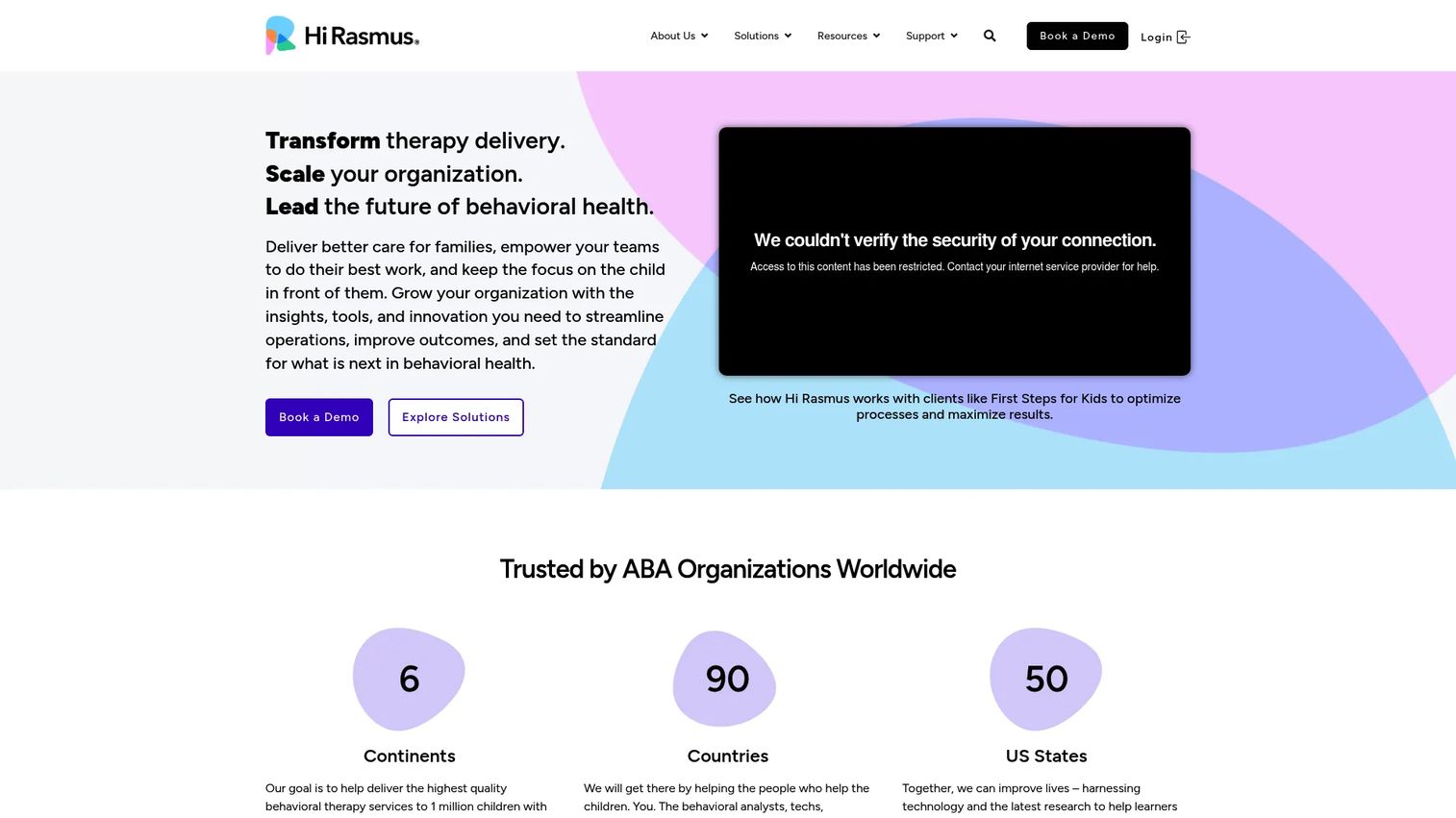
Hi Rasmus is a clinical software platform for ABA and interdisciplinary behavioral health practices. It covers session notes, customizable clinical programs, flexible data collection, treatment planning, audit trails, cross-client reporting, and live supervision with real-time data visibility. AI-enhanced features include session summaries, talk-to-text, and target suggestions.
Best for: ABA providers, behavioral health organizations, and schools needing customizable clinical data collection, supervision workflows, and interdisciplinary team support.
Key features
- Customizable clinical programs, templates, and libraries
- Session notes, data graphs, and cross-client reporting
- Live supervision with real-time data visibility
- AI-enhanced session summaries and target suggestions
- Audit trails and HIPAA-aligned controls
- Integrations with practice management, scheduling, and billing tools
Why choose Hi Rasmus: Hi Rasmus stands out for clinical customization and supervision workflows, particularly for practices that need to configure programs across diverse client populations. Run the mobile data collection workflow during a live demo before evaluating the admin dashboard.
Hi Rasmus pricing: Standard and Premium client licenses are described on the pricing page, along with add-ons for staff profiles, RBT and IBT training, and outcomes reporting. Prices are not displayed; contact the vendor for a quote.
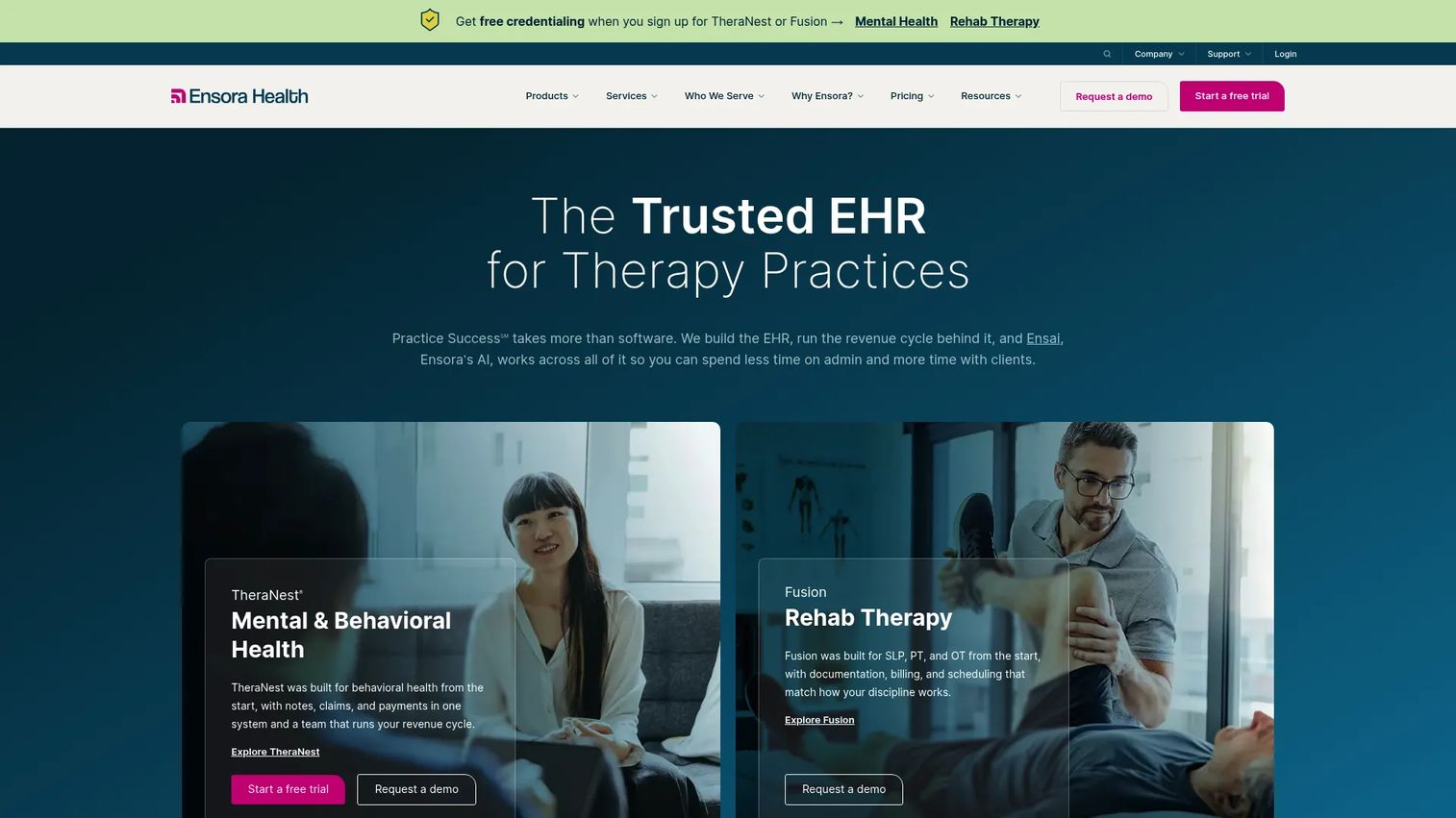
6. Ensora Health
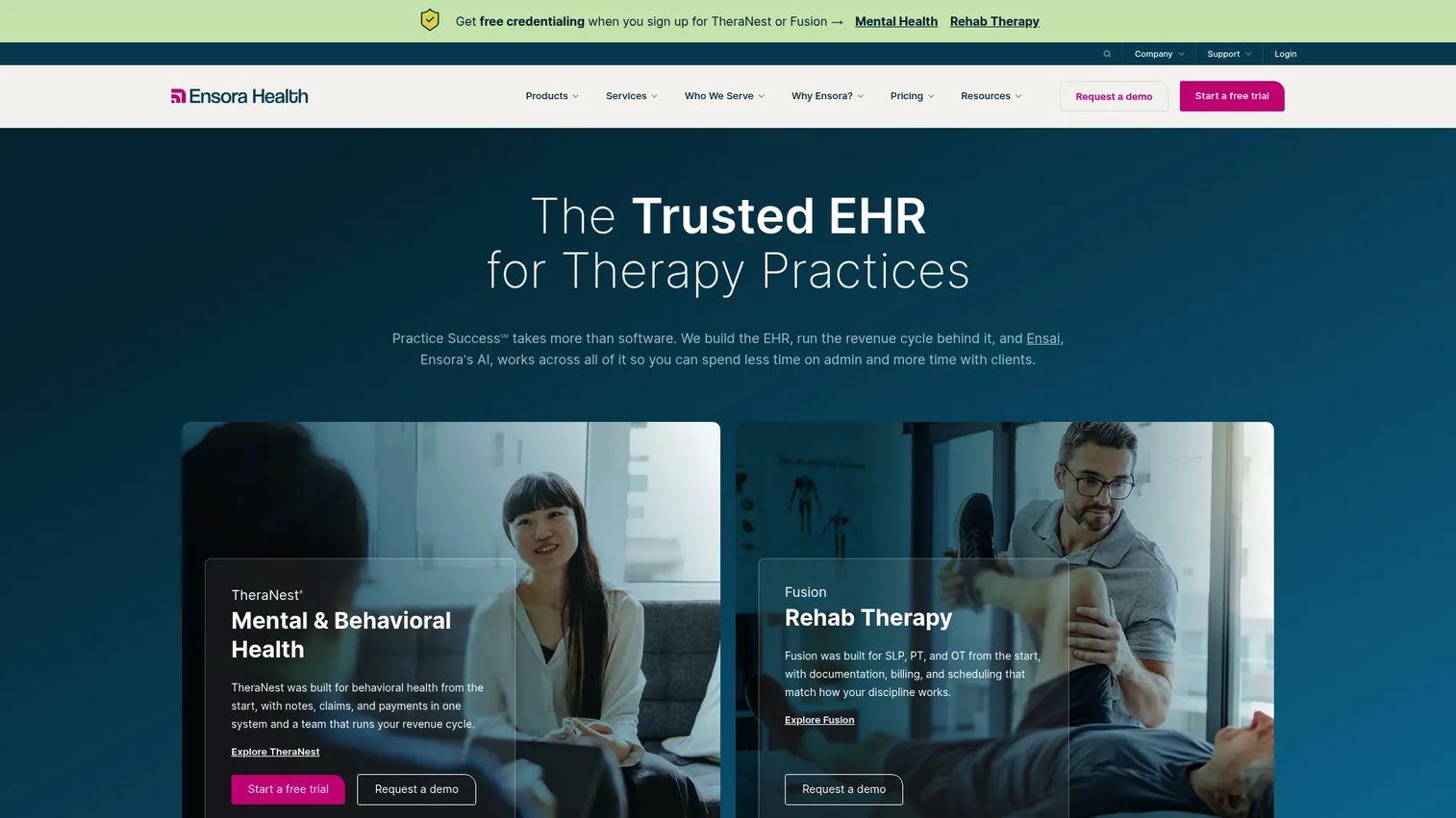
Ensora Health provides EHR, practice management, AI-assisted clinical documentation, billing, e-prescribing, payments, and telehealth for mental health, behavioral health, and rehabilitative therapy practices. Its product suite includes TheraNest for mental and behavioral health and Fusion for speech, physical, and occupational therapy. Ensora RCM handles revenue cycle management on a quote basis.
Best for: Mental health, behavioral health, and multi-discipline therapy practices that need integrated clinical, administrative, and billing workflows.
Key features
- TheraNest mental and behavioral health EHR with scheduling and billing
- Fusion rehab therapy EHR for PT, OT, and speech-language pathology
- AI session note drafts and notes enhancement
- Telehealth, electronic prescribing, and insurance claims
- Revenue cycle management (Ensora RCM)
Why choose Ensora Health: Ensora fits organizations that operate across behavioral and rehabilitative therapy lines rather than ABA-only practices. Evaluate whether its ABA-specific data collection depth matches your clinical measurement requirements before committing.
Ensora Health pricing: TheraNest plans start at $29/therapist per month (Essentials), $59/therapist per month (Advanced), and $89/therapist per month (Premier). Fusion Foundation starts at $25/month. Fusion Essentials is $99/month. Fusion Advanced runs $159 for the first user per month plus $45 per additional user. Ensora RCM is quote-based.
G2 rating: 4.4/5 (G2)
7. Raven Health
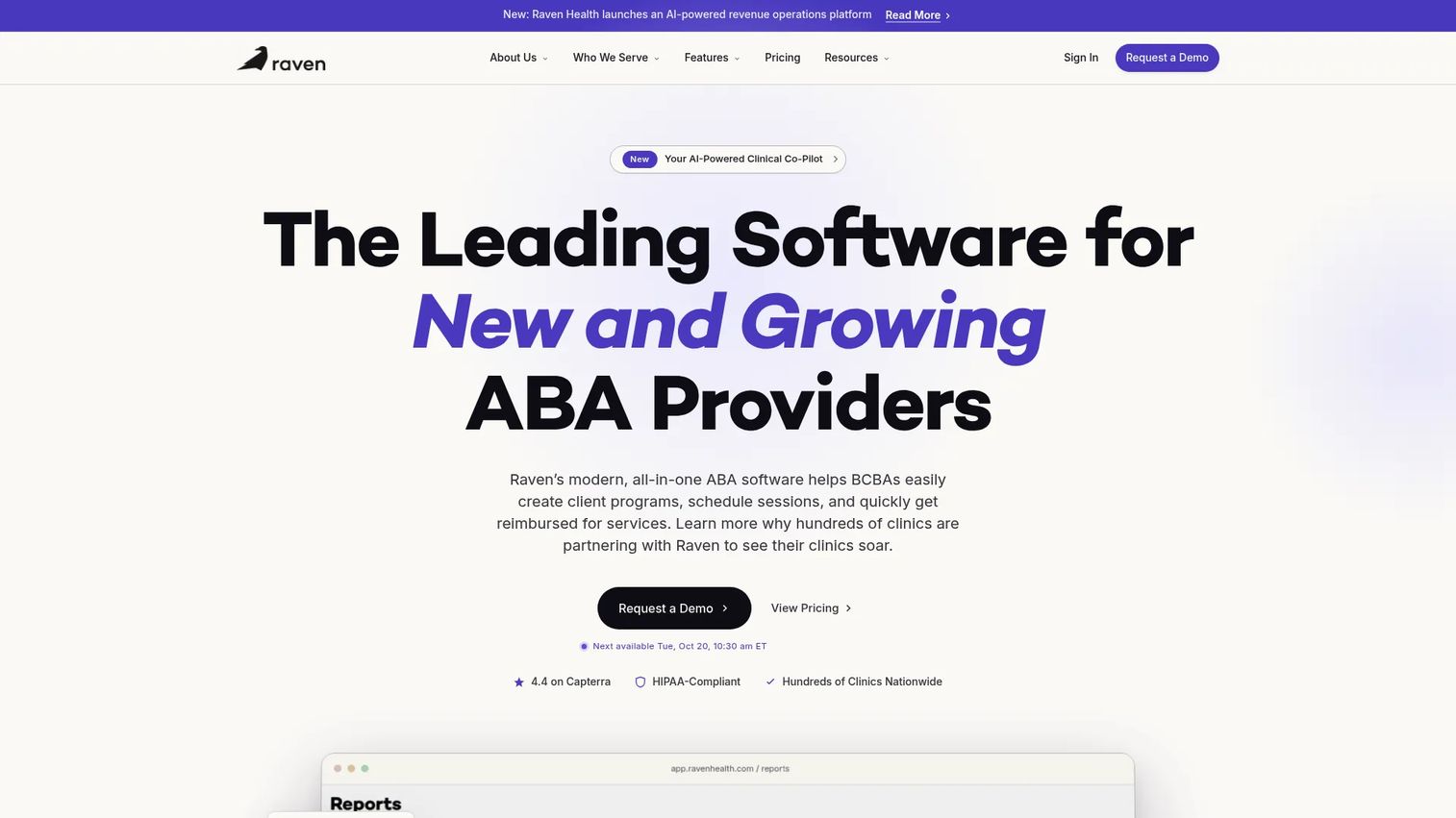
Raven Health is an all-in-one ABA practice management platform covering data collection, scheduling, billing, claims management, progress tracking, reporting, and AI-generated session summaries. It supports real-time and offline ABA data collection and offers three clear pricing paths depending on whether a clinic handles its own billing.
Best for: ABA startups and small-to-midsize clinics needing integrated clinical, scheduling, and billing workflows with predictable pricing.
Key features
- Real-time and offline ABA data collection
- Scheduling and appointment management
- Billing, claims management, and payment processing
- Progress tracking and reporting dashboards
- AI-generated session summaries
Why choose Raven Health: The published pricing structure makes it easier to model cost before a sales conversation. For smaller clinics that do not yet have billing staff, the Premium All-In-One option (which includes managed billing) can reduce the administrative burden during early growth.
Raven Health pricing: The Standalone Software Plan starts at $29/learner per month with an annual commitment and a $500 one-time implementation fee. The Premium All-in-One plan (which includes managed billing) charges 5% of monthly claims paid, billed month-to-month, with the $500 implementation fee currently waived. Self-Billing Package pricing is custom.
8. Aloha ABA
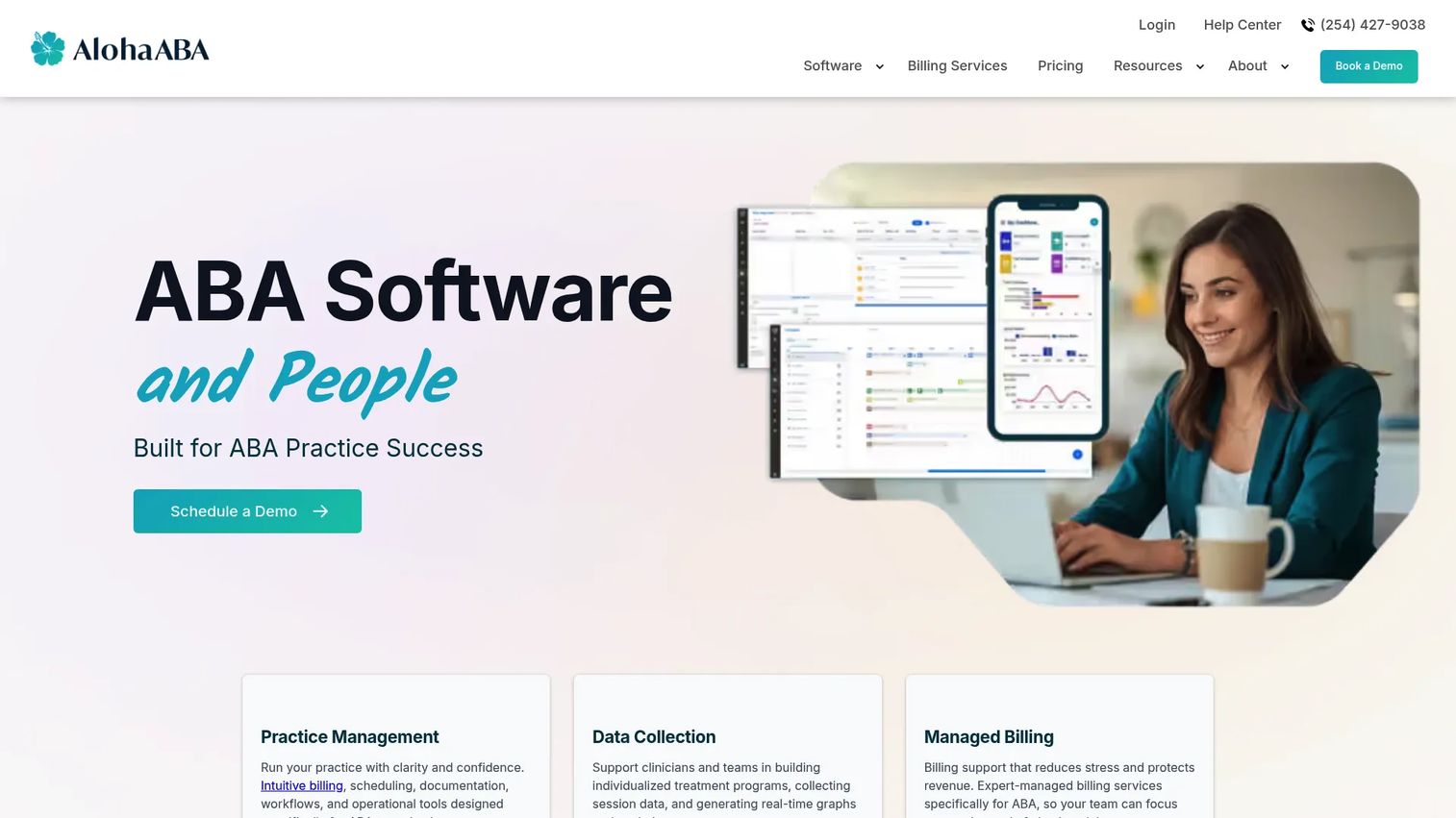
Aloha ABA is practice management software for ABA therapists and behavioral healthcare practitioners. It covers scheduling with authorization linking, staff-client matching, billing, claims management, payroll, accounts receivable, and authorization management. The platform offers a straightforward subscription model without implementation fees or cancellation penalties.
Best for: Small to midsize ABA practices that need centralized scheduling, billing, payroll, and claims workflows without enterprise-level complexity.
Key features
- Scheduling with authorization linking and qualification-based staff-client matching
- Billing and claims management
- Payroll management
- Accounts receivable and authorization management
- Reports and analytics
Why choose Aloha ABA: Aloha's pay-as-you-go model and one-month free trial reduce the risk of committing before the system proves its value. For a smaller clinic, the absence of implementation fees means first-year cost is predictable from day one.
Aloha ABA pricing: The standard subscription is $29.99 per staff member per month, billed monthly. A one-month free trial covers up to five staff and five clients. Plans up to five users are free, and no implementation or cancellation fees apply.
9. Tebra
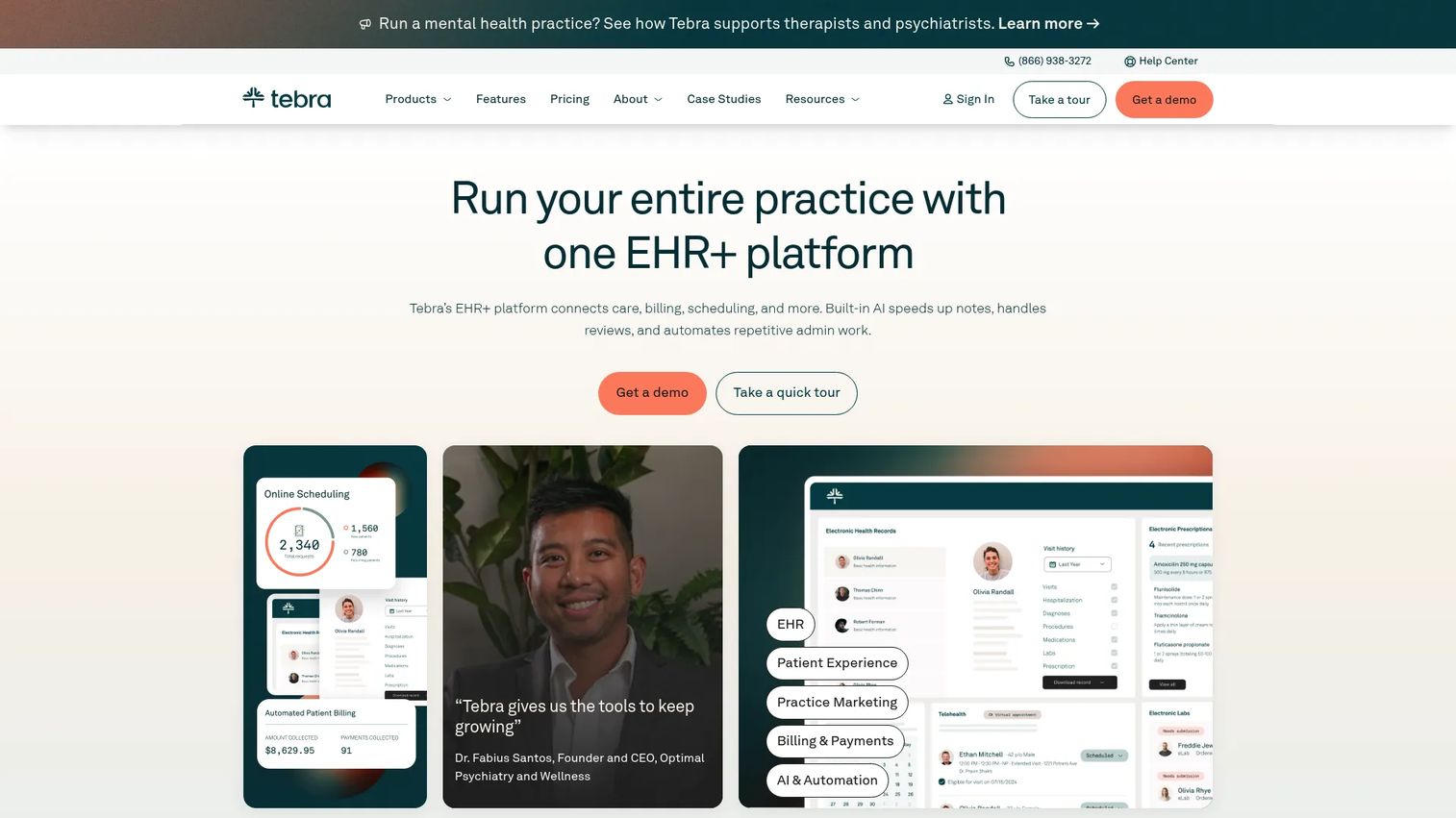
Tebra is an all-in-one EHR and practice management platform for independent healthcare practices, covering clinical documentation, medical billing, claims management, scheduling, telehealth, patient engagement, and practice marketing. Tebra is a general healthcare platform rather than an ABA-specific data collection system, so evaluate it primarily for administrative and revenue cycle workflows.
Best for: ABA or therapy practices where the administrative and billing layer is the primary bottleneck, not ABA-specific clinical data capture.
Key features
- Medical billing and claims management
- EHR and clinical documentation
- Patient scheduling and telehealth
- Payments and patient communications
- Practice marketing and engagement tools
Why choose Tebra: Tebra fits best when revenue cycle efficiency and patient management are the core gaps. Practices that also need ABA-specific graphing, behavioral measurement types, and program management should evaluate a dedicated ABA data collection platform alongside it.
Tebra pricing: Pricing starts at $49/provider per month for non-physician, low-volume configurations. Physician-standard bundles run $599/provider per month (Practice Essentials) or $799/provider per month (Practice Automation). No free trial is available.
G2 rating: 4.1/5 (G2)
10. Fusion Web Clinic
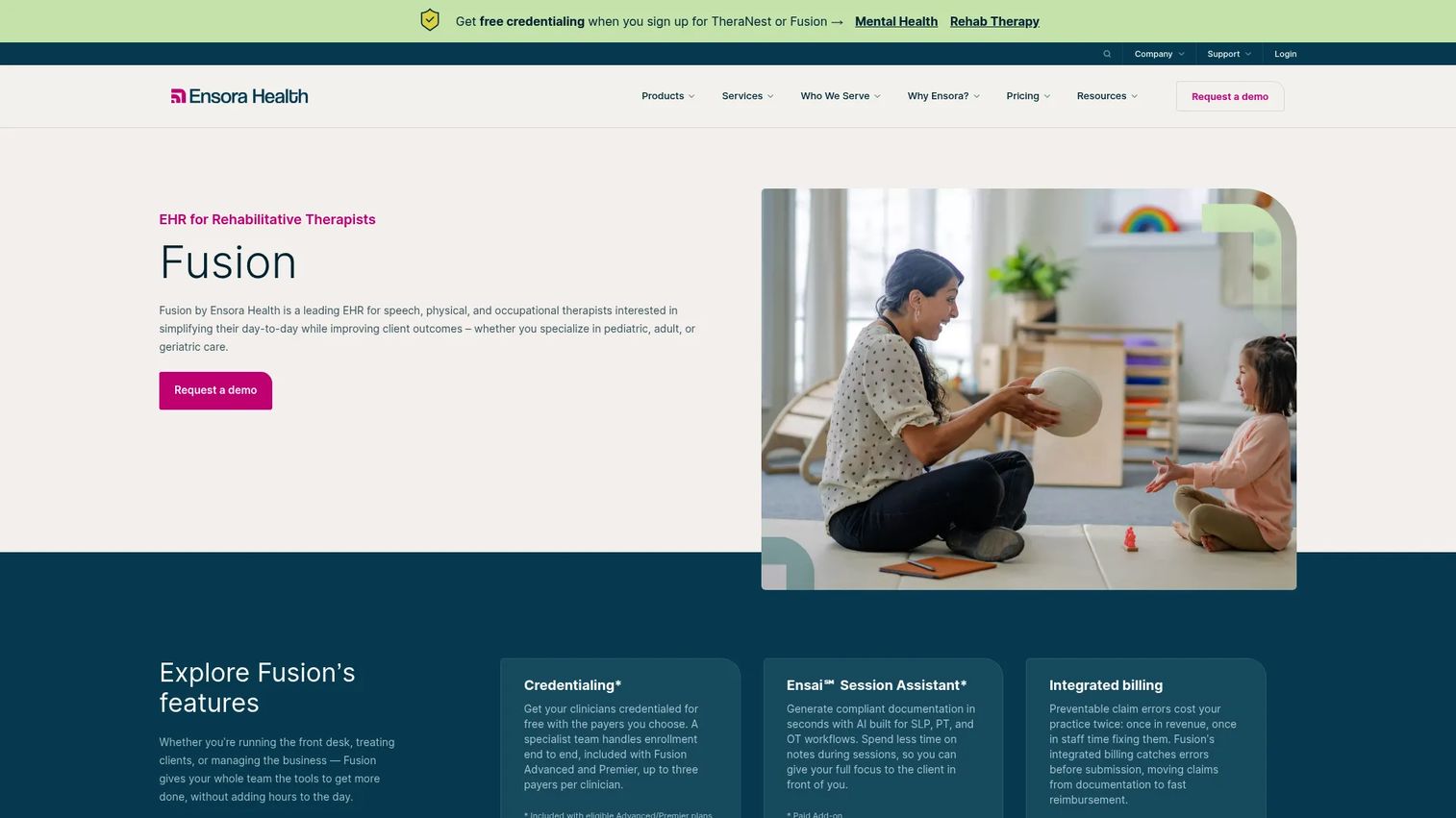
Fusion Web Clinic is now Fusion by Ensora Health, an EHR for speech-language, physical, and occupational therapy practices. It covers scheduling, clinical documentation and goal tracking, integrated billing and insurance claims, a client portal, reporting, telehealth, and home exercise programs.
Best for: Pediatric therapy practices running multiple therapy disciplines that need documentation, billing, and scheduling in one system.
Key features
- Scheduling management
- Clinical documentation and goal tracking
- Integrated billing and insurance claim submission
- Client portal and telehealth
- Reporting and home exercise programs
Why choose Fusion Web Clinic: This is a strong candidate for organizations that offer ABA alongside other pediatric therapy services. Verify whether its ABA-specific data collection depth, including behavioral measurement types and graphing, meets your clinical requirements before selecting it as your primary ABA platform.
Fusion Web Clinic pricing: Foundation starts at $25/month for solo use. Essentials is $99/month. Advanced runs $159 for the first user per month plus $45 per additional user (currently discounted from $159). Premier is $229 for the first user per month plus $75 per additional user (currently discounted from $229). No free tier available.
G2 rating: 4.5/5 (G2)
11. Tadabase
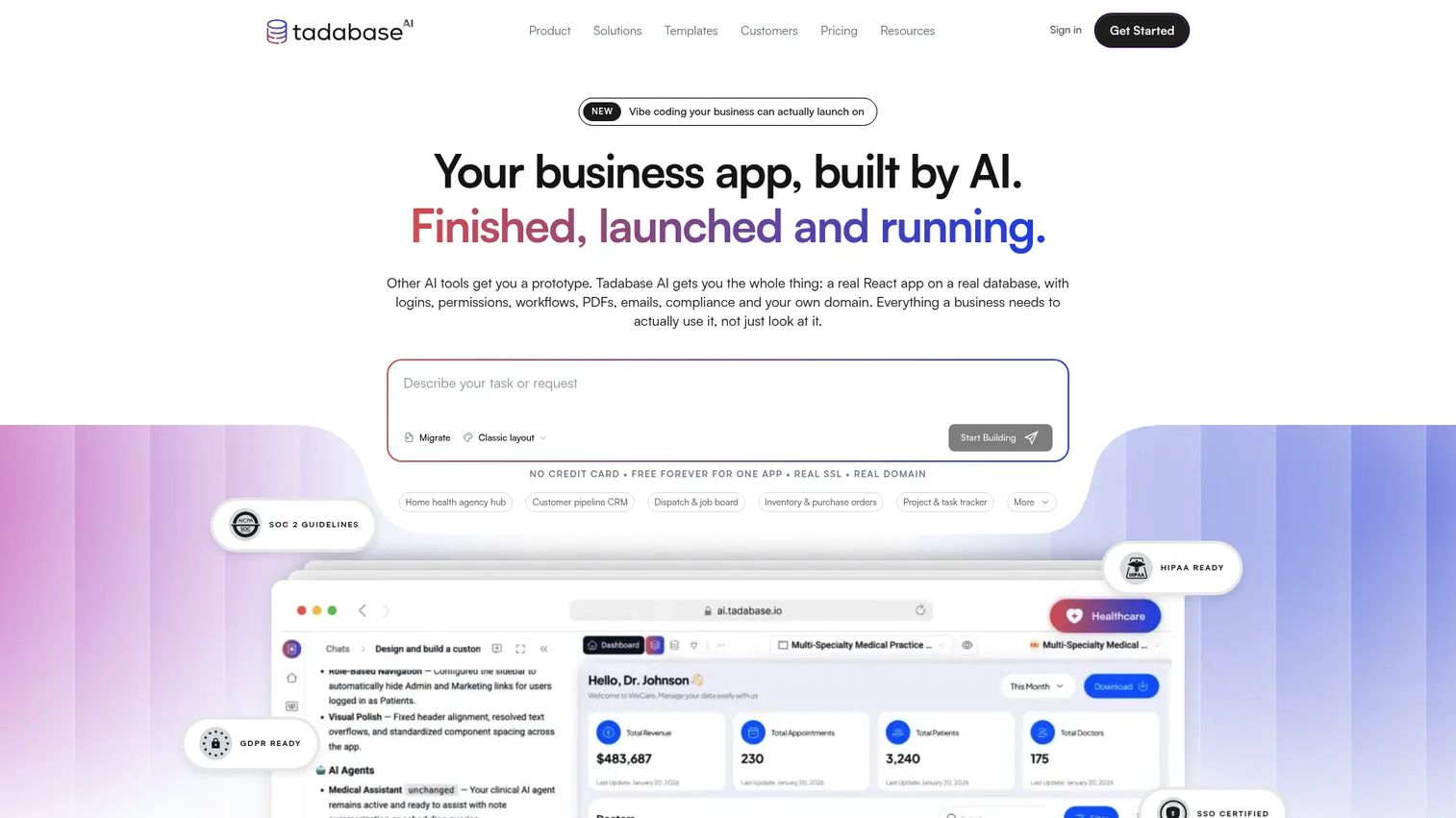
Tadabase is an AI-powered no-code app builder for creating and deploying production business applications with databases, authentication, workflows, hosting, and code export. It is not a purpose-built ABA platform. Instead, it lets teams with internal technical ownership build configurable ABA workflow apps when fixed platforms cannot model their processes.
Best for: Teams with unusual workflows, internal technical ownership, or a need to build custom ABA operations apps that standard platforms cannot accommodate.
Key features
- Chat-driven app generation and cloud database
- Authentication with 2FA, magic links, SSO, and SAML
- Visual workflows, webhooks, schedules, and PDF generation
- Roles and row-level security
- GitHub sync and code export
- AI features for end users (Ask, Analyze, and action agents)
Why choose Tadabase: The flexibility is real, but so is the ownership requirement. Choosing Tadabase means your team designs the data model, builds the workflow, and maintains it as the practice changes. For founders who have a specific process that no ABA platform models correctly, this is worth evaluating seriously.
Tadabase pricing: There is a permanently free tier. The Starter paid plan is $25/month (or $21/month billed annually). Pro is $50/month. Team is $100/month. Business is $250/month. All plans include unlimited end users.
G2 rating: 4.9/5 (G2, 17 reviews)
12. Catalyst by Therapy Brands
Catalyst by Therapy Brands is ABA data collection software for collecting, graphing, reporting, and analyzing behavioral data. G2 currently lists the product as Ensora Data Collection (formerly Catalyst), reflecting its current position within the Therapy Brands and Ensora Health family. The platform covers data collection across devices and locations, automated graphing, customizable curricula, cumulative graphs, SOAP notes, and customizable data collection types.
Best for: ABA practices needing mobile data collection, automated graphing, and behavioral treatment progress analysis.
Key features
- Data collection across devices and locations
- Automated graphing and reporting
- Customizable curricula and program writing
- SOAP notes and daily notes
- Cumulative graphs with condition and trend lines
Why choose Catalyst by Therapy Brands: Catalyst fits clinics where clinical data capture is the main gap and a dedicated behavior data collection tool is preferred over a full practice management platform. Compare its practice management depth against more administrative platforms during your evaluation.
Catalyst by Therapy Brands pricing: Pricing is not publicly listed. Contact the vendor for a quote, and ask about per-learner pricing, implementation, and whether billing and scheduling modules are available separately.
G2 rating: 4.4/5
13. ABA Team
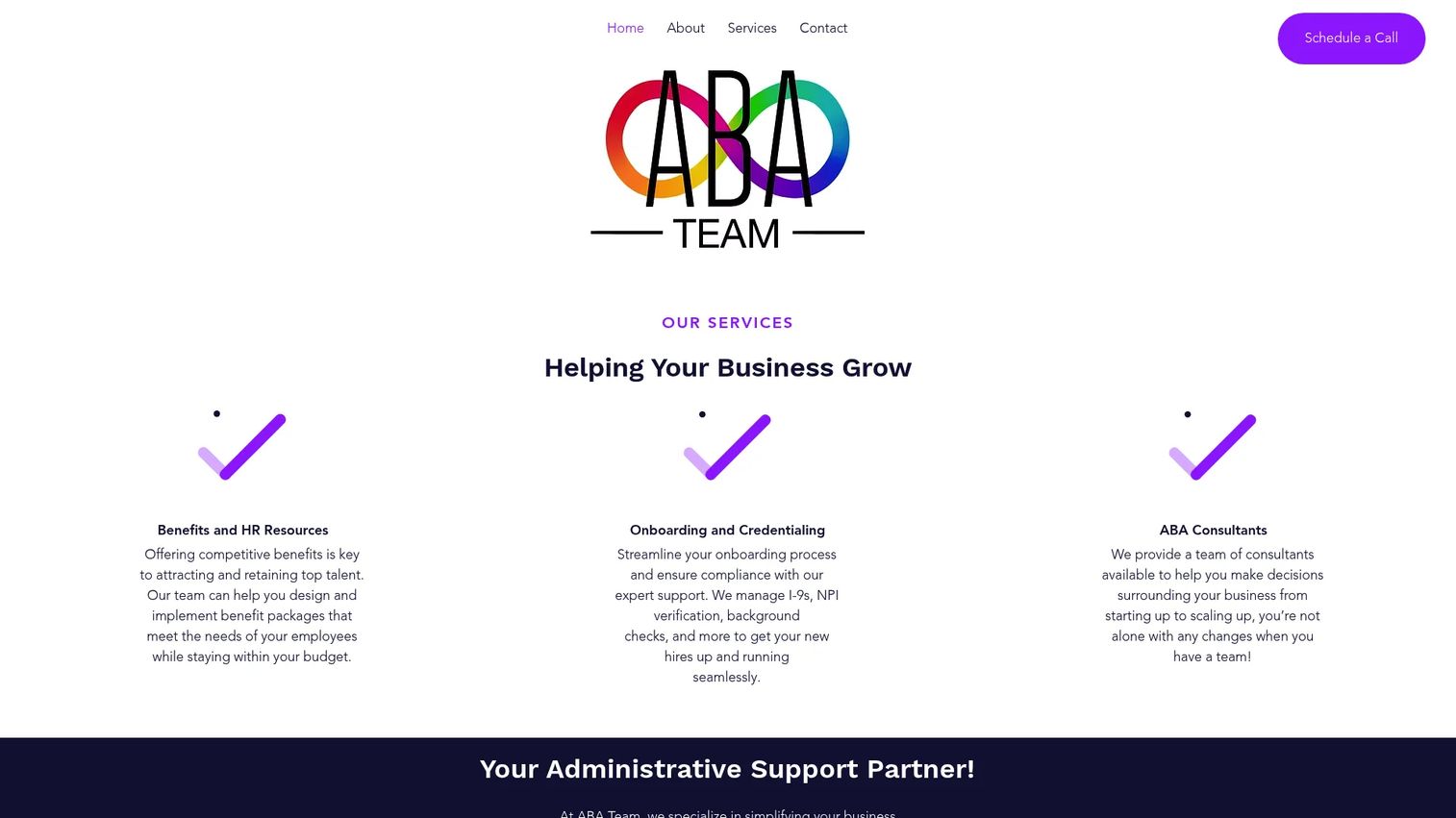
ABA Team provides administrative, HR management, onboarding, credentialing, and consulting services for ABA clinics and businesses. It covers HR management (including benefits, compliance, payroll partnerships, and staffing), onboarding and credentialing (including I-9s, NPI verification, and background checks), and ABA clinic consulting on billing, profitability, trend management, and provider networking.
Best for: ABA clinics seeking outsourced administrative, HR, onboarding, credentialing, or operational consulting support rather than a clinical data collection platform.
Key features
- HR management, benefits, compliance, and payroll partnerships
- Onboarding, credentialing, I-9s, and background checks
- NPI verification and employee credentialing
- ABA clinic consulting and billing support
- Provider networking and trend management
Why choose ABA Team: ABA Team is not a software platform in the same sense as the other tools on this list. It is a services provider for clinics that need HR infrastructure and operational consulting support. Evaluate it when the bottleneck is people operations, credentialing delays, or billing consulting rather than clinical data collection or scheduling software.
ABA Team pricing: Contact the vendor to discuss scope, service lines, and engagement model.
14. DataFinch Technologies
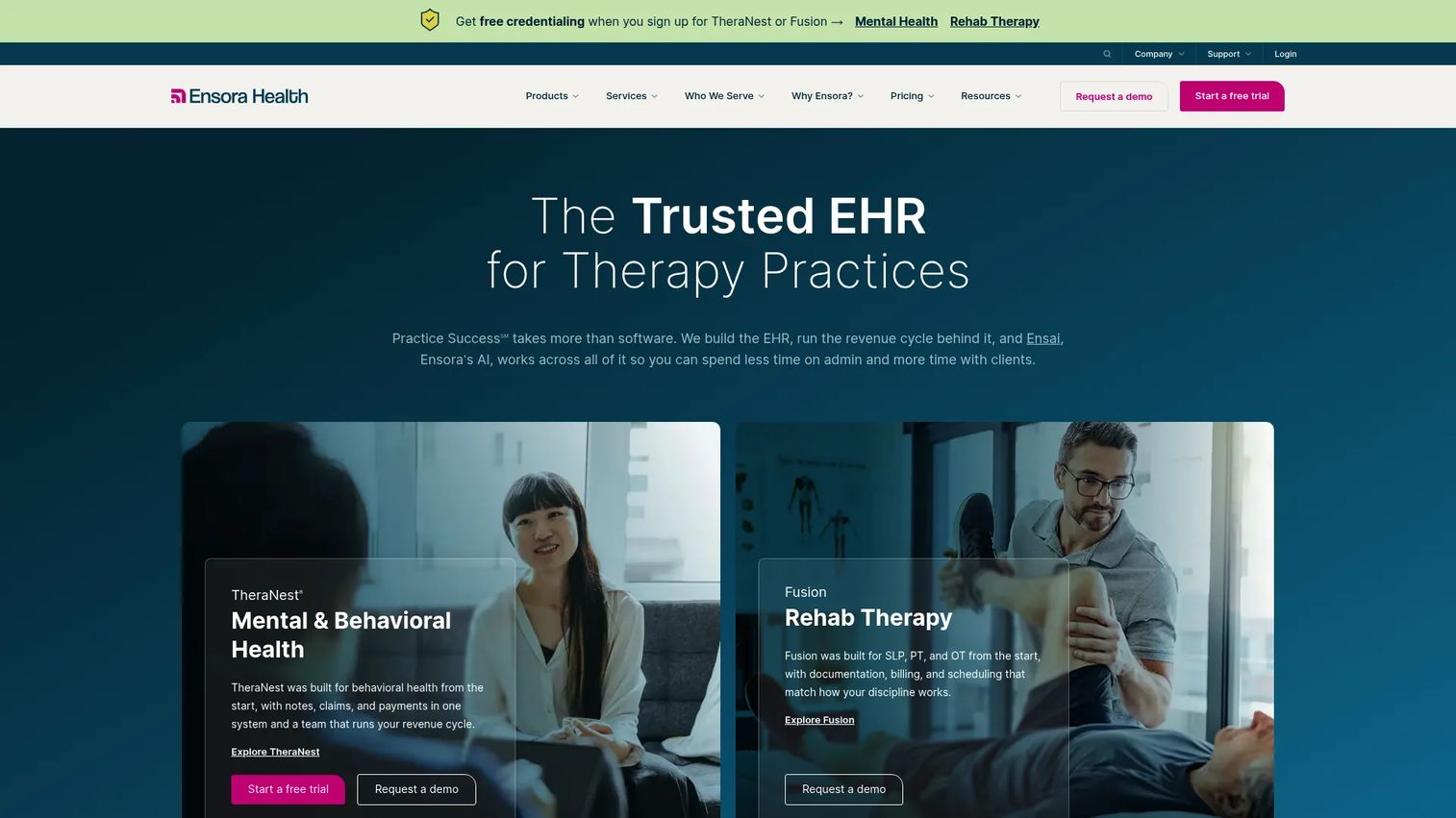
DataFinch Technologies now redirects to Ensora Health. DataFinch was historically associated with Catalyst, a dedicated ABA data collection tool, and its clinical reporting heritage is part of what became the Ensora Data Collection product (formerly Catalyst by Therapy Brands). If you are searching for DataFinch as a current standalone product, the buying path now runs through Ensora Health.
Best for: Teams evaluating ABA data collection systems with a long clinical software history, now accessed through the Ensora Health product family.
Key features
- ABA data collection (now under Ensora Data Collection)
- Behavior tracking and graphing
- Clinical reports and program data
- Legacy Catalyst lineage within the Ensora Health suite
Why choose DataFinch Technologies: If your evaluation started with DataFinch as a vendor name, the current product is Ensora Data Collection (formerly Catalyst). Review that entry and confirm current product scope, pricing, and support directly with Ensora Health before deciding.
DataFinch Technologies pricing: The datafinch.com domain redirects to Ensora Health. Current pricing is available through Ensora Health for TheraNest plans starting at $29/therapist per month and Fusion plans starting at $25/month. Ask about Ensora Data Collection (the former Catalyst product) specifically if that is the ABA data collection tool you are evaluating.
Considerations when choosing applied behavior analysis software
Clinical workflow fit
The software has to work in session, not just on a desktop. Ask whether RBTs can capture frequency, duration, interval, and ABC data quickly on a tablet or phone. Check whether BCBAs can update programs and review graphs without rebuilding data manually.
Billing and payer documentation
Claims accuracy is a cash flow issue, not just an operations issue. Evaluate whether the platform supports authorization tracking, payer-specific claim formats, denial management, and session note documentation that passes payer audits. Leakage here turns practice growth into cash stress.
Mobile and offline usability
Therapy happens in homes, schools, clinics, and community settings. Confirm whether mobile data collection works in the field and whether offline mode functions when connectivity drops. Ask the vendor for a live demo of the mobile workflow under realistic session conditions.
Security and permission controls
ABA platforms handle protected health information. Evaluate role-based permissions, audit logs, access controls, data export controls, and the vendor's approach to HIPAA-aligned safeguards. Be clear that software controls support compliance obligations, but the clinic retains responsibility for its own policies, training, and contracts.
Implementation and migration cost
A cheap monthly subscription can still cost a quarter of operational attention if implementation is poorly scoped. Ask vendors how long migration takes, who owns setup, how staff training is structured, and what historical data can be imported. Factor total first-year cost, not just the monthly rate, into your evaluation.
Conclusion
The right ABA software choice depends on where your practice currently breaks.
For full practice management coverage, start with Rethink Behavioral Health, CentralReach, Passage Health, or Motivity. CentralReach fits multi-location and enterprise operations. Motivity's transparent per-learner pricing makes it easier to model as you add staff and clients.
For ABA data collection as the primary gap, evaluate Motivity, Catalyst by Therapy Brands (via Ensora Health), Hi Rasmus, and Raven Health alongside each other. Each takes a different approach to mobile use, graphing, and program flexibility.
For billing and healthcare admin as the bottleneck, look at Tebra for general practice management and Aloha ABA for a simpler ABA-specific setup. Fusion Web Clinic is strongest when you operate ABA alongside other pediatric therapy services.
For custom workflows where fixed platforms fall short, Tadabase gives you the flexibility to build exactly what your process requires, provided your team has the capacity to own it.
Build a shortlist of three to five tools, run the same demo script with each vendor, and score them against clinical workflow fit, billing accuracy, reporting quality, security controls, and implementation timeline. That process replaces a gut decision with a system your leadership team can defend.
FAQs
Applied behavior analysis software helps ABA providers collect behavioral data, document sessions, manage treatment workflows, schedule staff, bill payers, and report client progress. Some tools focus on ABA data collection and graphing, while others cover full practice management across clinical, administrative, and billing workflows.
ABA data collection software focuses on behavior measurement types such as frequency, duration, latency, interval, and ABC data, alongside graphing, program management, and clinical progress tracking. ABA practice management software adds scheduling, billing, claims submission, authorization tracking, payroll, and broader operational reporting. Many platforms offer both in a single system, while some specialize in one layer.
Prioritize clinical data collection and graphing, session notes, scheduling, billing and claims workflows, authorization tracking, caregiver communication, role-based permissions, and integrations with your clearinghouse and payroll systems. Start by identifying the workflow that currently creates the most operational drag, then score tools against that bottleneck first.
Many ABA platforms include HIPAA-supporting controls such as role-based permissions, audit logs, encryption, and access management. The clinic remains responsible for its own policies, staff training, business associate agreements, and usage practices. Software controls support compliance obligations but do not satisfy them on their own.
Pricing changes based on provider count, client or learner count, module selection, number of locations, claims volume, implementation scope, and support level. Motivity and Raven Health publish per-learner pricing. Aloha ABA charges per staff member. Larger platforms like CentralReach and Passage Health price by quote. Compare total first-year cost, not only the monthly subscription, when evaluating options.
Small clinics should prioritize fast setup, clean scheduling, straightforward billing, and easy data collection. Aloha ABA's pay-as-you-go model with a one-month free trial reduces commitment risk. Raven Health's Standalone Software Plan at $29/learner per month gives a predictable starting point. Evaluate simpler practice management options before committing to enterprise-level systems.
Multi-location practices need strong reporting that rolls up across sites, standardized clinical workflows, role-based permissions, billing visibility across locations, and implementation support that can handle multiple-site onboarding. CentralReach is built for this level of operational complexity. Test how each platform's dashboards consolidate data across clinicians, locations, and payers before deciding.
For core clinical and administrative workflows, yes. Spreadsheets are fragile for session data across multiple RBTs, scheduling changes that ripple into claims, payer documentation that must meet specific format requirements, and multi-location reporting. Spreadsheets may still help with ad hoc analysis, but they are not a sustainable operating layer as a practice grows.