You picked a behavioral health platform. Six months in, claims are bouncing, clinicians are double-charting, and your billing team is manually reconciling ERAs every Friday. The software works. Your operation doesn't.
That's the real cost of the wrong pick. Behavioral health software isn't a feature checklist problem. It's an operating model problem. A tool that fits an outpatient therapy group will buckle under a residential addiction program with 42 CFR Part 2 consent requirements, MAT documentation, and multi-payer claims logic. And the reverse is true too. Enterprise care coordination platforms drown a solo practice in configuration overhead.
The market pressure is real. The global behavioral health software market is projected to grow from $3.44B in 2024 to $20.79B by 2034, a 19.85% CAGR, according to Towards Healthcare (2024). North America accounted for roughly 45% of that revenue in 2024. Translation: more vendors, more noise, more sales decks promising "all-in-one."
This guide cuts through it. We evaluate eight behavioral health EHR software platforms the way an operator would, not a clinician. That means billing reliability, workflow breadth, implementation risk, support quality, and care-setting fit over buzzwords. If you run a scaling behavioral health business and you need clinical documentation, claims and billing, telehealth, and compliance that actually hold up under load, this is your shortlist. For teams also mapping adjacent software categories, our roundups of AI customer service software and AI governance tools cover neighboring decisions.
What's inside
This is a founder-and-operator comparison of the leading behavioral health EHR and practice management platforms for 2026. It covers mental health EMR options for outpatient therapy, addiction treatment software for residential and MAT programs, and integrated care platforms for community mental health and public sector organizations.
We selected and ranked these vendors on four operator-grade criteria: care-setting fit (does the workflow match your model), billing and revenue cycle reliability, compliance depth including 42 CFR Part 2, and implementation plus support quality. Feature count matters less than whether the platform runs your actual business without constant workarounds.
TL;DR
- Best all-in-one ambulatory platform: athenaOne, for practices that want EHR, revenue cycle, and patient engagement on one network-connected system.
- Best comparison-first starting point: Behave Health, for buyers segmenting detox, outpatient, MAT, and residential fit before committing.
- Best for outpatient therapy practices: TherapyNotes, with transparent pricing, tight billing, and low daily friction.
- Best for integrated and public-sector care: Netsmart, for CCBHC, community mental health, and multi-setting coordination.
- Best for addiction treatment centers: Kipu Health, with deep EMR, RCM, and compliance tooling for recovery programs.
- Best for AI-assisted operations: Alleva and Sunwave Health, for treatment centers prioritizing documentation automation and consolidation.
What is behavioral health software?
Behavioral health software is a category of clinical and administrative technology built for mental health, addiction treatment, and behavioral care organizations to manage documentation, scheduling, billing, telehealth, patient engagement, and compliance in one system. It is a specialized form of EHR and practice management software tuned to behavioral health workflows that general medical software handles poorly.
The distinction matters. General EHRs assume episodic medical visits. Behavioral health EHR software assumes recurring therapy, group sessions, treatment plans, outcome measurement over time, and privacy rules like 42 CFR Part 2 that go beyond standard HIPAA.
Core capabilities most behavioral health platforms include:
- Clinical documentation: progress notes, treatment plans, assessments, and templates built for therapy and recovery workflows.
- Scheduling and calendars: recurring appointments, group sessions, and multi-provider coordination.
- Claims and billing: eligibility checks, claim submission, ERAs, and revenue cycle management tuned to behavioral health payers.
- Telehealth for behavioral health: integrated video visits with session documentation.
- Patient portal and engagement: secure messaging, intake forms, appointment reminders, and self-service scheduling.
- Compliance tooling: HIPAA controls, 42 CFR Part 2 consent handling, and audit trails.
- Outcome measurement and reporting: standardized assessments, progress tracking, and operational analytics.
The strongest platforms unify these instead of bolting them together, which is exactly where implementation risk hides. A fragmented stack means duplicate data entry, reconciliation work, and billing leakage.
When to use behavioral health software
Not every organization needs the same depth. Match the tool to the operating reality, not the demo.
Run outpatient therapy without administrative drag
If you operate a solo or group therapy practice, you need scheduling, notes, billing, telehealth, and a patient portal in one place. Depth of RCM matters less than daily ease of use and clean claims. Overbuying enterprise software here creates friction your clinicians will route around.
Manage addiction treatment across levels of care
Detox, residential, PHP, IOP, and MAT programs carry heavier compliance and billing complexity. You need admissions and intake, ASAM-aligned assessments, 42 CFR Part 2 consent handling, eMAR, and revenue cycle support that survives multi-payer claims. Documentation discipline here is a compliance and reimbursement requirement, not a nice-to-have.
Coordinate integrated or public-sector care
Community mental health centers, CCBHCs, and multi-setting organizations need whole-person care coordination, interoperability, data exchange, and outcomes reporting across programs. The buying priority shifts toward integration depth, reporting rigor, and the ability to serve complex populations under public funding rules.
Behavioral health software comparison
Before the deep dives, here's the fast triage. This behavioral health software comparison ranks each platform by primary intent and care-setting fit, with pricing transparency and G2 signal where available.
| # | Product | Intent | Key use case | Pricing | G2 rating |
|---|---|---|---|---|---|
| 1 | athenaOne | All-in-one ambulatory EHR + RCM | Practices wanting EHR, billing, and engagement on one network | Custom / request demo | 3.4/5 |
| 2 | Behave Health | All-in-one behavioral platform | CRM, EHR, RCM, and operations in one system | Custom quote | Not yet rated |
| 3 | TherapyNotes | Outpatient practice management | Scheduling, notes, and billing for therapy practices | From $69/month | Verified positive |
| 4 | Netsmart | Integrated and public-sector care | CCBHC, community mental health, multi-setting coordination | Custom | 3.6/5 |
| 5 | Kipu Health | Addiction treatment platform | EMR, CRM, RCM, and compliance for recovery programs | Custom / consultation | 4.7/5 |
| 6 | Alleva | Behavioral health EMR + operations | All-in-one EMR with telehealth and AI documentation | Custom quote | 4.6/5 |
| 7 | BestNotes | Behavioral health EHR + CRM | Documentation, billing, and CRM for BH and addiction | From $58/user/mo | 4.1/5 |
| 8 | Sunwave Health | Integrated BH platform | EMR, CRM, RCM, and AI-assisted docs for treatment centers | Custom / contact | 5.0/5 |
Pricing transparency varies widely. Outpatient-focused tools like TherapyNotes and BestNotes publish per-user rates. Enterprise and treatment-center platforms lean sales-led. Treat "custom pricing" as a signal to pressure-test contract terms, implementation fees, and seat minimums early.
1. athenaOne

athenaOne is athenahealth's AI-native ambulatory platform that combines EHR, practice management, medical billing, and patient engagement in one cloud system. For behavioral health teams that want broad workflow coverage plus a connected national network, it's the strongest all-in-one option on this list. The platform emphasizes more complete patient charts, specialty-specific workflows, and automation that supports documentation and billing without a bolt-on stack.
Best for: Ambulatory behavioral health practices that want EHR, revenue cycle management, and patient engagement unified on a single network-connected platform.
Key strengths
- Integrated EHR plus RCM: clinical documentation, practice management, and medical billing run on one system, cutting reconciliation work.
- AI-native automation: documentation, billing, and workflow support reduce manual clicks across the day.
- Network-connected care: the athenahealth network surfaces patient data and coordination signals other point tools miss.
Why choose athenaOne: If your priority is consolidating clinical, billing, and engagement onto one platform rather than stitching together vendors, athenaOne earns the look. It fits practices running PHP and IOP workflows that need reliable claims and billing alongside patient engagement, and the cloud delivery means automatic updates without IT overhead. The trade-off is scale. This is enterprise-grade infrastructure, so smaller practices should weigh whether they'll use the breadth.
athenaOne pricing: athenahealth does not publish a public numeric price for athenaOne. Pricing is described as tailored, and the vendor directs buyers to request a demo for a quote. There is no advertised free tier. Its G2 rating sits at 3.4/5. Budget for a discovery and pricing conversation rather than a self-serve signup, and press on implementation timelines and revenue cycle terms during that call.
2. Behave Health
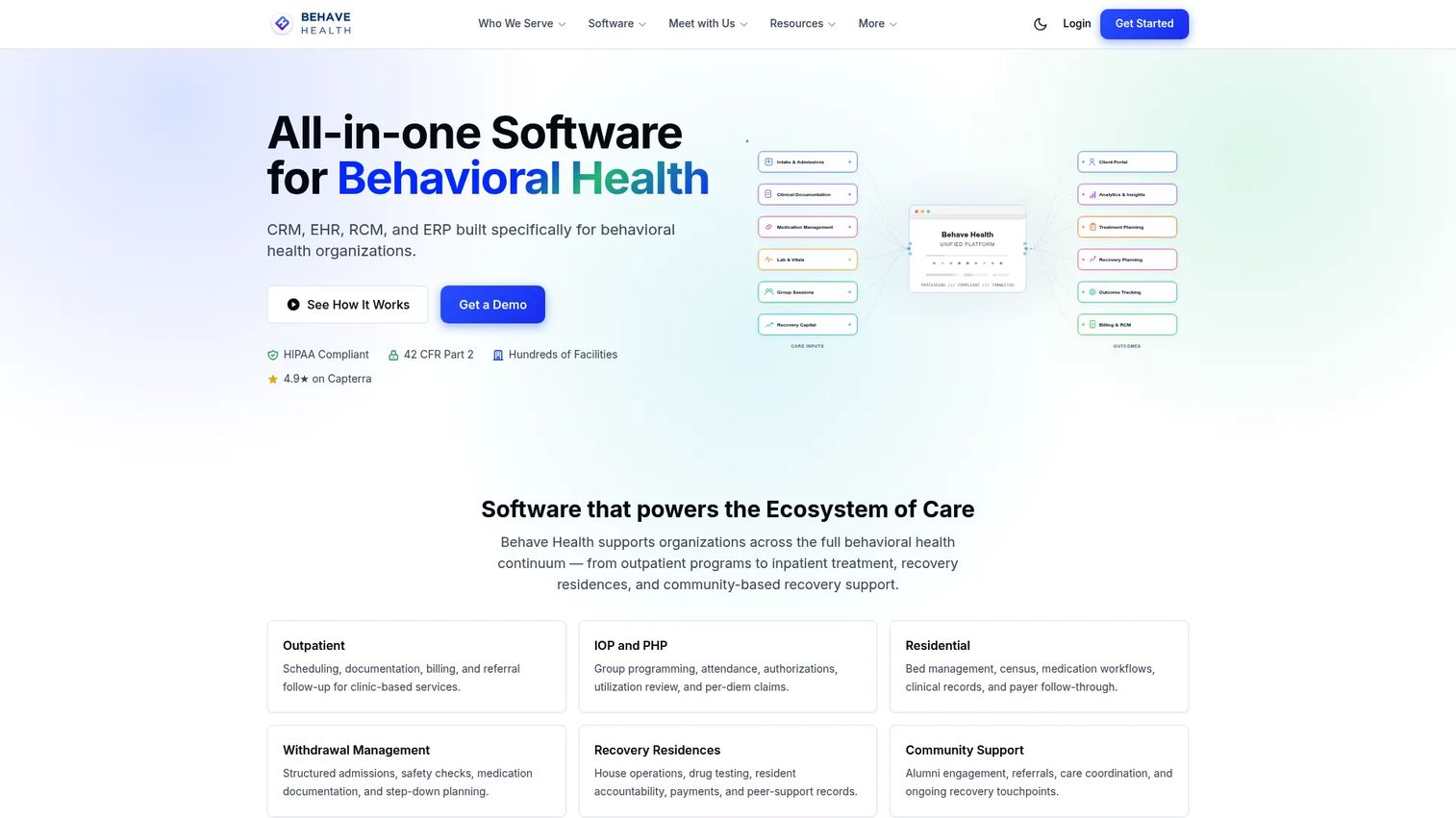
Behave Health is an all-in-one behavioral health platform that combines CRM, EHR, RCM, and ERP capabilities in a single system. For buyers still segmenting the market, it functions as a useful category benchmark: it spans admissions and intake, patient portal, clinical notes, insurance billing, verification of benefits, scheduling, and property management. That breadth makes it a natural reference point when you're deciding how much platform you actually need.
Best for: Behavioral health organizations that want clinical, billing, and operations workflows in one platform rather than a stitched-together stack.
Key strengths
- CRM to billing in one system: admissions, clinical notes, and insurance billing share the same data layer.
- Verification of benefits built in: VOB and eligibility checks live inside the workflow, not a separate tool.
- Operations coverage: property and facility management extends beyond clinical into the operational side treatment centers run.
Why choose Behave Health: Use this as your segmentation lens. If you run detox or residential, the admissions, VOB, and billing depth matters most. If you run outpatient, the portal and scheduling weigh heavier. Behave Health's all-in-one framing helps you decide whether a consolidated platform fits your operating model before you commit to a vendor with heavier implementation.
Behave Health pricing: Behave Health lists plan names publicly, Healthcare Provider and Support Provider, both quote-based, with a Provider Partner tier marked coming soon. No fixed public price is shown, and there is no free tier. The platform is new enough that G2 does not yet carry a meaningful rating. Treat pricing as a direct sales conversation and ask for a reference customer in your care setting.
3. TherapyNotes

TherapyNotes is a behavioral health EHR and practice management platform built for outpatient therapy practices that need scheduling, documentation, billing, and client engagement in one clean system. It's the pick when daily ease of use and reliable claims and billing matter more than enterprise breadth. The platform covers scheduling, notes and documentation, insurance billing and claims, and pairs them with client-facing tools like reminders and a patient portal.
Best for: Solo and group behavioral health practices that need an integrated EHR with scheduling, notes, and billing that runs without a dedicated IT team.
Key strengths
- Tight billing workflow: eligibility, claim submission, and ERAs are handled inside the same system as documentation.
- Clinical documentation built for therapy: notes and templates match how therapists actually chart.
- Client engagement: appointment reminders, a patient portal, and secure communication reduce no-shows and admin load.
Why choose TherapyNotes: For outpatient practices, this is the low-friction default. It delivers telehealth for behavioral health, scheduling, and billing without the configuration overhead of enterprise platforms. Reviewers consistently praise support quality and daily usability, which matters when clinicians, not IT staff, run the software. If you're a therapy group that wants clean claims and a portal your clients actually use, start here.
TherapyNotes pricing: TherapyNotes publishes transparent pricing. The Solo plan starts at $69/month. The Group plan is $79/month for the first clinician plus $50/month per additional clinician. A Storage option runs $9/month plus $3/month per additional user for inactive accounts. Every plan includes a 30-day free trial. There is no permanent free tier, but the transparent per-clinician model makes budgeting straightforward as you scale.
4. Netsmart
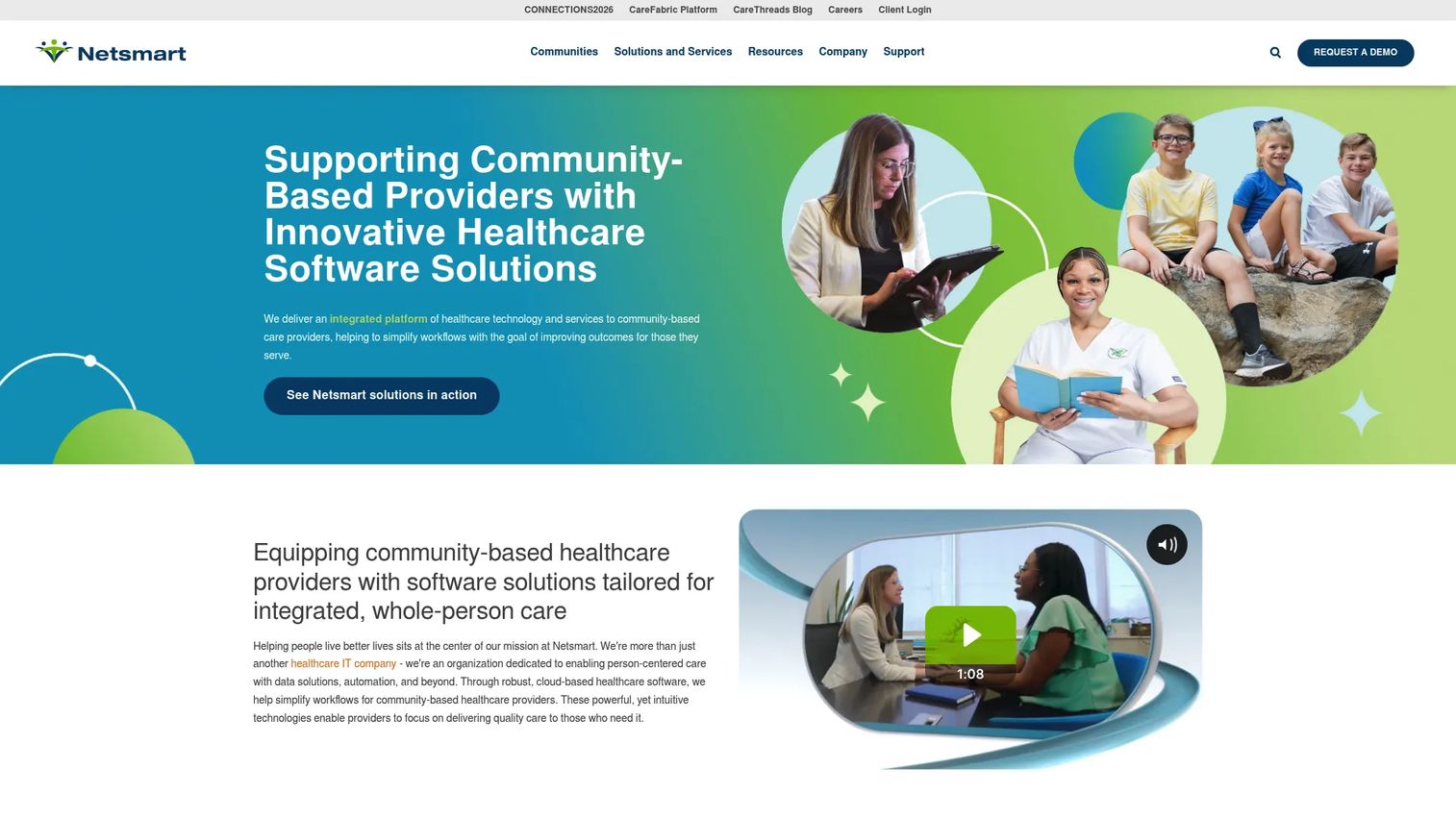
Netsmart builds healthcare software and services for community-based care organizations, and its CareFabric platform is aimed squarely at integrated care, community mental health, CCBHC programs, and public-sector complexity. If your organization coordinates whole-person care across multiple settings and reports against public funding requirements, Netsmart is engineered for that world. It combines EHR for human services and post-acute care with care coordination, interoperability, analytics, virtual care, and workforce management.
Best for: Larger, multi-setting behavioral health organizations, community mental health centers, and CCBHCs that need integrated care coordination and rigorous outcomes reporting.
Key strengths
- CareFabric integrated platform: clinical, operational, and coordination workflows unify across programs and settings.
- Interoperability and data exchange: built for whole-person care where behavioral, physical, and social data must connect.
- Analytics and outcomes measurement: reporting depth supports CCBHC software requirements and value-based care.
Why choose Netsmart: This is the platform for complexity, not simplicity. CCBHCs and public-sector providers need integrated care coordination, compliance depth, and outcomes reporting that lighter tools can't match. The virtual care and workforce management modules extend it beyond clinical documentation into full operational coverage. If you serve complex populations under public funding, Netsmart's breadth is the point.
Netsmart pricing: Netsmart does not display public numeric pricing on the pages reviewed. Pricing is sales-led and configured to organization scope. Its G2 seller rating sits at 3.6/5. Because these are enterprise implementations, budget for a longer procurement cycle and ask pointed questions about implementation timeline, data migration, and ongoing support structure before signing.
5. Kipu Health

Kipu Health is a behavioral health software provider focused on addiction treatment and recovery organizations, offering an integrated EMR, CRM, RCM, and compliance toolset. For detox, residential, and outpatient recovery programs, it's a category leader with the strongest review signal on this list. The platform covers behavioral health EMR with documentation, scheduling, portal, and medication workflows, plus revenue cycle management and governance, risk, and compliance tooling.
Best for: Addiction treatment centers and recovery-focused organizations that need integrated clinical, billing, and compliance workflows in one platform.
Key strengths
- Recovery-focused EMR: documentation, scheduling, patient portal, and medication workflows built for addiction treatment.
- Revenue cycle management: claims and billing workflows tuned to the multi-payer reality of treatment centers.
- Governance, risk, and compliance: dedicated tooling for the compliance load behavioral health organizations carry.
Why choose Kipu Health: If you run addiction treatment across levels of care, Kipu's depth in admissions, clinical documentation, billing, and compliance is purpose-built for your model. The GRC tooling addresses the heightened privacy and consent requirements, including 42 CFR Part 2 workflows, that recovery programs face. Its 4.7/5 G2 rating reflects strong operator satisfaction, which is a meaningful signal in a category where implementation pain is common.
Kipu Health pricing: Kipu does not publish public pricing. The site directs prospects to book a consultation or request a quote, so expect a sales-led process with no advertised free tier. Its G2 rating is 4.7/5, among the highest here. Given the addiction treatment focus, ask specifically about MAT documentation, 42 CFR Part 2 consent handling, and RCM performance during your evaluation.
6. Alleva
Alleva is a behavioral health EMR and operations platform for treatment centers, built to combine clinical documentation, billing, telehealth, CRM, and reporting in one system with AI-assisted documentation on top. For growing treatment organizations that want automation to reduce charting load, Alleva makes a strong case. The platform pairs a behavioral health EMR with built-in telehealth, billing, CRM, and reporting and insights.
Best for: Behavioral health treatment centers that want an all-in-one EMR and operations platform with automation to cut documentation time.
Key strengths
- AI-assisted documentation: automation reduces the manual charting burden that drives clinician burnout.
- Built-in telehealth: video visits are native, not a third-party bolt-on.
- Billing, CRM, and insights: revenue cycle, patient relationship management, and reporting share one platform.
Why choose Alleva: If operational efficiency and documentation automation are your top priorities, Alleva's AI features and consolidated workflow are the draw. Treatment centers scaling their census need billing, CRM, and clinical documentation working together, and Alleva builds toward that. Its 4.6/5 G2 rating signals solid satisfaction among behavioral health operators using it in production.
Alleva pricing: Alleva does not display public numeric pricing. The site and master service agreement indicate pricing is quote-based and set per order, so plan on a sales conversation with no advertised free tier. Its G2 rating sits at 4.6/5. Ask about implementation timeline, how the AI documentation features are priced, and what's included in the base configuration versus add-ons.
7. BestNotes
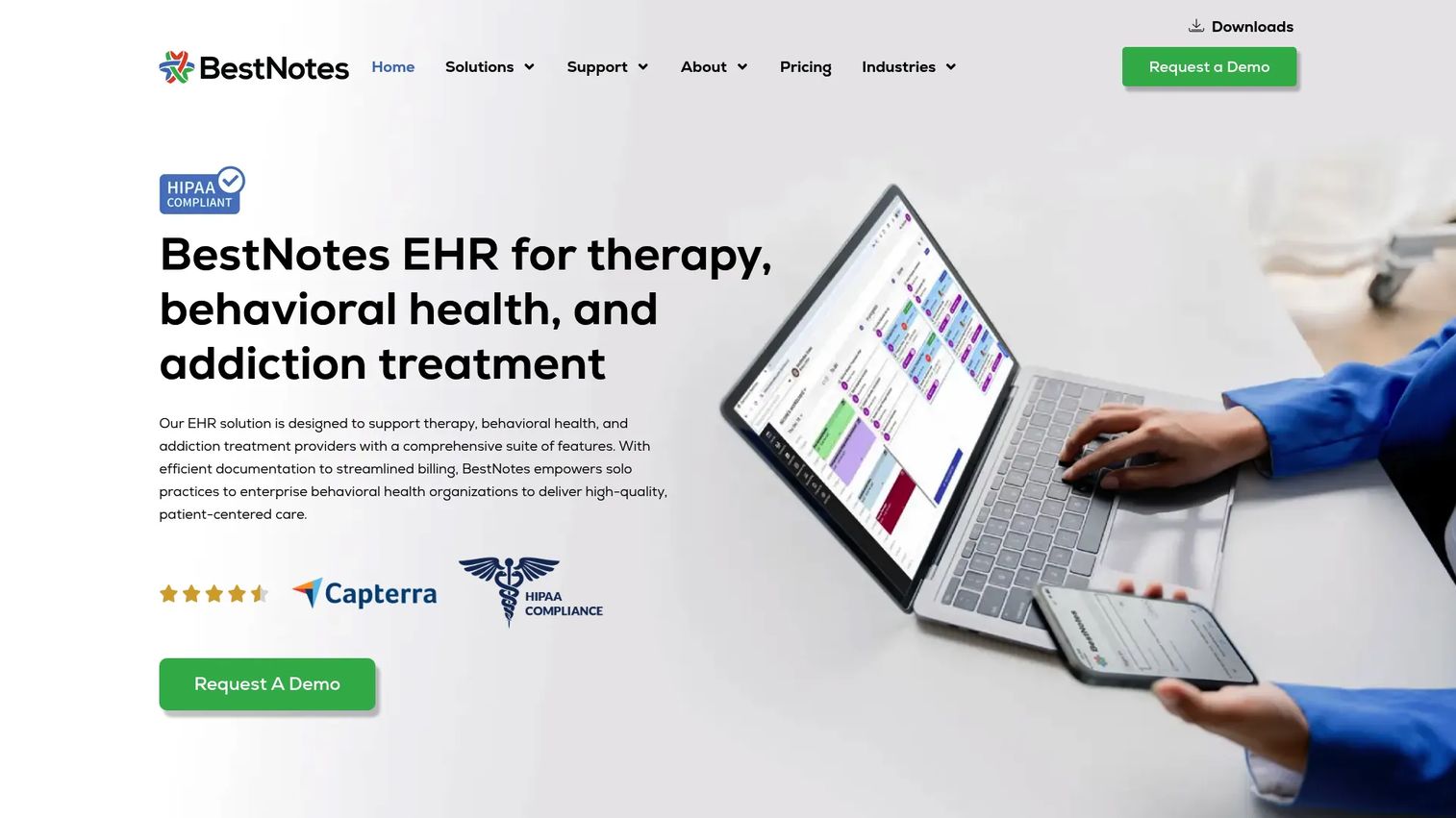
BestNotes is a behavioral health EHR and CRM platform built for organizations that prioritize documentation discipline and configurable clinical workflows. It covers clinical documentation and treatment planning, CRM and client communication, and billing plus telehealth integrations. For behavioral health and addiction treatment teams that want structured charting without enterprise-scale complexity, it's a practical fit with transparent, tiered pricing.
Best for: Behavioral health and addiction treatment organizations that need an all-in-one EHR and CRM with disciplined documentation and configurable workflows.
Key strengths
- Clinical documentation and treatment planning: structured charting and planning tools support documentation-heavy programs.
- CRM and client communication: relationship management and patient engagement live alongside the clinical record.
- Billing and telehealth integrations: revenue cycle and video visits connect into the core workflow.
Why choose BestNotes: For teams that value documentation rigor and want month-to-month flexibility, BestNotes delivers configurable workflows without locking you into a long contract. The transparent per-user pricing and the CRM layer make it appealing for addiction treatment organizations balancing clinical and admissions needs. It sits comfortably between lightweight outpatient tools and heavier enterprise platforms.
BestNotes pricing: BestNotes publishes transparent tiered pricing with a $100 upfront fee. Rates start at $58 per user per month for 1 to 10 users, drop to $24 per user per month for 11 to 100 users, and $12 per user per month for 101+ users. Plans are month-to-month with unlimited data, training, and support. There is no free tier. Its G2 rating is 4.1/5. The declining per-user cost at scale makes it budget-friendly for growing organizations.
8. Sunwave Health
Sunwave Health is an integrated behavioral health platform spanning EMR, CRM, RCM, and AI-assisted documentation, built for treatment centers that care about the full lifecycle from admissions through alumni engagement. For substance use and behavioral health organizations that want consolidation and post-treatment relationship management in one system, Sunwave covers unusual ground. Its behavioral health EMR unifies clinical, administrative, and financial workflows.
Best for: Enterprise behavioral health and substance use treatment organizations that want a single platform from admissions through alumni management.
Key strengths
- Unified EMR: clinical, administrative, and financial workflows run on one behavioral health EMR.
- CRM with alumni engagement: admissions, referral tracking, bed board, and alumni engagement extend the platform past discharge.
- RCM depth: claims, eligibility and VOB, billing, and payment workflows are built in.
Why choose Sunwave Health: The differentiator is lifecycle coverage. Treatment centers that measure success in long-term recovery need alumni management and outcome reporting, not just discharge documentation. Sunwave's consolidation of CRM, EMR, RCM, and AI documentation into one platform reduces the tool sprawl that plagues scaling treatment organizations. If post-treatment engagement and platform consolidation drive your evaluation, it belongs on the shortlist.
Sunwave Health pricing: Sunwave does not publish public pricing. The platform confirms its module lineup, but pricing is sales-led and contact-based, with no advertised free tier. Its G2 seller page shows 5.0/5, though from a very small review volume, so weigh that signal accordingly. Request a demo focused on your care setting and ask for references from organizations of similar size and complexity.
Considerations before you buy
The demo will look great. The implementation is where reality lives. Before you sign, pressure-test these criteria.
Care-setting fit
Match the platform to your actual operating model, not an aspirational one. Outpatient therapy, PHP and IOP, residential, and integrated care each demand different workflow depth. A tool built for one setting creates constant workarounds in another. Ask vendors for a reference customer running your exact model.
Billing and revenue cycle reliability
Billing leakage kills margin quietly. Verify how the platform handles eligibility, claim scrubbing, ERAs, denials, and multi-payer logic. For treatment centers, confirm VOB is built into the workflow. Ask what percentage of claims submit clean on the first pass for existing customers in your setting.
Compliance and 42 CFR Part 2
Behavioral health carries privacy obligations beyond standard HIPAA. If you handle substance use records, 42 CFR Part 2 consent management is non-negotiable. Confirm the platform enforces consent-based disclosure, maintains audit trails, and handles the redisclosure rules that trip up general medical software.
Implementation risk and support
Ask hard questions about timeline, data migration, and who owns the process. Get the support model in writing: response times, dedicated contacts, and whether training is included or billed. Read G2 and Capterra reviews specifically for implementation and support sentiment, not just feature praise.
Total cost and contract terms
Sticker price rarely reflects total cost. Factor in implementation fees, seat minimums, add-on modules, and contract length. Month-to-month options like BestNotes reduce risk, while enterprise platforms often require annual commitments. Model the fully loaded cost at your projected headcount.
Conclusion
There is no single best behavioral health software. There's the best fit for how you actually operate.
For outpatient therapy practices that want low friction and transparent pricing, TherapyNotes is the default. For addiction treatment centers, Kipu Health leads on depth and operator satisfaction, with Alleva and Sunwave Health strong for teams prioritizing AI documentation and lifecycle coverage. Integrated care and public-sector organizations should shortlist Netsmart for CCBHC and coordination depth. Practices wanting a network-connected all-in-one should evaluate athenaOne, and BestNotes fits documentation-focused teams wanting month-to-month flexibility. Behave Health works well as your segmentation benchmark before you commit.
Here's the practical move: shortlist two platforms that fit your care setting, then rank them on implementation risk and support quality over feature count. Ask each vendor for a reference customer running your model, pressure-test their billing and 42 CFR Part 2 handling, and model the fully loaded cost. The right software disappears into your workflow. The wrong one becomes a second full-time job.
FAQs
Behavioral health software is a specialized EHR and practice management system for mental health, addiction treatment, and behavioral care organizations. It combines clinical documentation, scheduling, claims and billing, telehealth, and a patient portal in one platform. Unlike general medical software, it's tuned to recurring therapy, treatment plans, and privacy rules like 42 CFR Part 2.
At minimum: scheduling and calendars, clinical documentation with therapy-specific templates, claims and billing with eligibility and ERA handling, patient engagement through a portal and reminders, compliance tooling including HIPAA and 42 CFR Part 2, outcome measurement, and telehealth. The strongest platforms unify these rather than bolting them together, which reduces duplicate data entry and billing leakage.
The terms are often used interchangeably. Technically, an EMR is the digital chart within one organization, while an EHR is designed to share records across providers and settings. In behavioral health, most vendors market both capabilities under either label. What matters more than the acronym is verifying interoperability, data exchange, and whether the system supports the care coordination your organization actually needs.
TherapyNotes is a strong default for outpatient therapy practices, with transparent pricing, tight billing, and low daily friction. BestNotes suits outpatient teams wanting a CRM layer and configurable documentation. Both deliver scheduling, telehealth for behavioral health, and a patient portal without the configuration overhead of enterprise platforms. Match the choice to whether you prioritize simplicity or workflow configurability.
Kipu Health leads for addiction treatment, with deep EMR, RCM, and compliance tooling and a strong operator review signal. Alleva and Sunwave Health are strong alternatives for centers prioritizing AI documentation and full lifecycle coverage from admissions through alumni. Look for admissions and intake, ASAM-aligned assessments, 42 CFR Part 2 handling, MAT documentation, and multi-payer revenue cycle management.
For any organization handling substance use disorder records, 42 CFR Part 2 support is essential, not optional. The rule imposes consent requirements and redisclosure restrictions that go beyond standard HIPAA. Software must enforce consent-based disclosure, maintain audit trails, and prevent unauthorized redisclosure. Verify this capability directly in a demo, since general medical software often mishandles these behavioral health-specific privacy rules.
Most modern behavioral health platforms include telehealth for behavioral health, but the depth varies significantly. Some offer native, integrated video with session documentation, while others rely on third-party integrations. Verify whether telehealth is built in, whether visits document directly into the clinical record, and whether the experience works reliably for both clinicians and clients before you commit.
Compare on care-setting fit first, then billing and revenue cycle reliability, clinical documentation quality, compliance depth including 42 CFR Part 2, implementation risk, support quality, and total cost of ownership. Ask each vendor for a reference customer running your exact model, pressure-test billing clean-claim rates, and read reviews specifically for implementation and support sentiment rather than feature lists.