You launched a subscription offer. The first hundred orders felt easy. Then card declines started piling up, customers couldn't pause their own plans, and your checkout abandoned more carts than it converted. Recurring revenue is a beautiful model until the operations underneath it start leaking.
That leak has a cost. Failed payments, manual cancellations, and clunky enrollment flows quietly erode the lifetime value you worked hard to build. And it compounds: every subscriber you lose to a billing failure is one you have to re-acquire at full price. A solid churn reduction and retention strategy is not a nice-to-have once you cross real volume. It is the difference between a business that grows and one that runs in place.
The market is moving fast. The global subscription e-commerce platform market is forecast to grow by USD 196.23 billion from 2025 to 2030 at a 19.5% CAGR, according to Technavio (2026). Consumer appetite backs that up: Crystallize (2026) reports an estimated 78% of adults worldwide hold at least one active subscription, with 40% planning to add more within a year. Demand is not the problem. Infrastructure is.
This guide compares the leading subscription ecommerce platforms by the things that actually matter when volume hits: billing flexibility, checkout experience, customer portal quality, dunning and failed-payment recovery, analytics, and fit across business models. If you came here from a broader stack hunt, you may also find our roundups of marketing automation tools and loyalty management software useful for the retention side of the equation.
What's inside
This guide is for operators, founders, ecommerce managers, and the RevOps-minded buyers who have to make a subscription ecommerce platform work in production, not just in a sales deck. It is also useful for enablement and revenue teams who need to standardize how recurring offers get packaged, sold, and renewed.
We ranked the seven platforms below on six criteria: billing flexibility, checkout and customer portal quality, churn reduction and dunning tooling, analytics and retention reporting, integrations, and fit across business models. Pricing and G2 ratings reflect verified values at the time of writing. Always confirm both on the vendor's live pricing page before you commit, since plans change.
TL;DR
- Best for all-in-one merchant of record billing: Paddle handles payments, subscriptions, tax, and compliance in one place.
- Best for subscription-first ecommerce brands: Subbly is purpose-built for launching subscription boxes and recurring products fast.
- Best for operational depth and retention tooling: Ordergroove focuses on recurring order management, subscriber retention, and enterprise launch guidance.
- Best for API-heavy or technical teams: Swell brings API-first, headless control for composable commerce.
- Best for rising billing complexity: Chargebee handles subscription management, recurring billing, and usage-based or hybrid pricing.
- Best for established ecommerce stacks: Shopify and BigCommerce give you a familiar commerce base that supports subscriptions through their ecosystems.
What are subscription ecommerce platforms?
A subscription ecommerce platform is software that handles the storefront, checkout, recurring billing, and subscriber management needed to sell products or access on a repeating schedule. Think of it as the infrastructure layer beneath any subscribe-and-save, membership, or curation box business.
The category overlaps with general ecommerce and pure billing software, but a true subscription based ecommerce platform stitches both together. Here are the core capabilities to evaluate.
- Recurring billing: Automated charges on flexible schedules (weekly, monthly, annual), proration, plan changes, and tiered or usage-based pricing. This is the engine. A weak payment gateway or rigid billing logic limits every model you can offer.
- Checkout and payment processing: A conversion-focused checkout experience, multiple payment methods, and merchant account or payment gateway connections. Enrollment friction here directly caps subscriber growth.
- Customer portal and self-service management: A customer portal where subscribers pause, skip, swap, upgrade, or cancel without emailing support. Self-service is one of the strongest retention levers you have.
- Dunning and failed-payment recovery: Smart dunning retries, card-update prompts, and recovery flows. Involuntary churn from expired cards is preventable revenue, and good dunning recaptures most of it.
- Analytics and retention reporting: Cohort retention, MRR movement, churn breakdowns, and LTV reporting so you can see what is actually happening to recurring revenue.
- Automation and integrations: Connections to your CRM, marketing automation, fulfillment, tax, and analytics stack, plus workflow automation for upsell and cross-sell triggers.
Common subscription business models
The right platform depends heavily on the model you run:
- Subscribe and save: Repeat purchases of consumables at a discount.
- Curation boxes: Surprise-and-delight assortments shipped on a cadence.
- Memberships: Recurring access to content, community, or perks.
- Replenishment: Auto-reorder of staples like coffee, supplements, or pet food.
- Meal kits: Perishable, logistics-heavy recurring bundles.
- CSA and local goods: Community-supported agriculture and local delivery subscriptions.
When to use a subscription ecommerce platform
Launch a recurring revenue model
If recurring revenue is your core model from day one, you want a platform built for it, not a storefront with billing bolted on later. Subscription-first tools handle proration, plan changes, and subscriber lifecycle natively. If subscriptions are a side motion on an established catalog, an add-on or app on your existing commerce base may be enough to start. The build vs buy question turns on how central recurring revenue is to the business: the more central, the stronger the case to buy purpose-built infrastructure rather than assemble it yourself.
Reduce churn and payment failures
Once you have real recurring volume, churn reduction becomes the dominant lever on growth. This is where dunning, a self-service customer portal, and retention workflows earn their keep. A meaningful share of cancellations are involuntary, driven by expired or declined cards, and strong dunning recovers a large portion of that revenue automatically. Voluntary churn drops when subscribers can pause or swap instead of cancel outright. If your platform makes cancellation easier than pausing, you are leaking LTV.
Improve checkout conversion
The enrollment flow is where interest becomes recurring revenue. A cluttered or multi-step checkout experience kills conversion before the first charge ever clears. Platforms with optimized, low-friction checkout and clear plan selection convert more browsers into subscribers. This is also where upsell and cross-sell at the point of enrollment can lift average order value without adding acquisition cost.
Comparison table
The table below ranks the seven platforms by relevance to subscription ecommerce and breadth of fit. Pricing and G2 ratings were verified at the time of writing. Confirm both on each vendor's live pricing page before purchase, because plans and ratings shift.
| # | Product | Intent | Key use case | Pricing | G2 rating |
|---|---|---|---|---|---|
| 1 | Paddle | Merchant of record billing | All-in-one payments, subscriptions, and tax for digital products | 5% + 50¢ per checkout transaction | Not listed |
| 2 | Subbly | Subscription-first commerce | No-code subscription box and recurring product storefronts | From $14/mo | 4.7/5 |
| 3 | Ordergroove | Enterprise subscription commerce | Recurring order management and subscriber retention | Custom (request a demo) | 4.5/5 |
| 4 | Swell | API-first commerce | Headless, composable storefronts with subscriptions | From $29/mo | 4.2/5 |
| 5 | Chargebee | Subscription billing | Recurring, usage-based, and hybrid billing management | From $0/mo | 4.4/5 |
| 6 | Shopify | All-in-one commerce | Familiar storefront with subscriptions via apps | From $29/mo | 4.4/5 |
| 7 | BigCommerce | Scalable commerce | Flexible multi-channel base for recurring products | From $29/mo | 4.2/5 |
1. Paddle
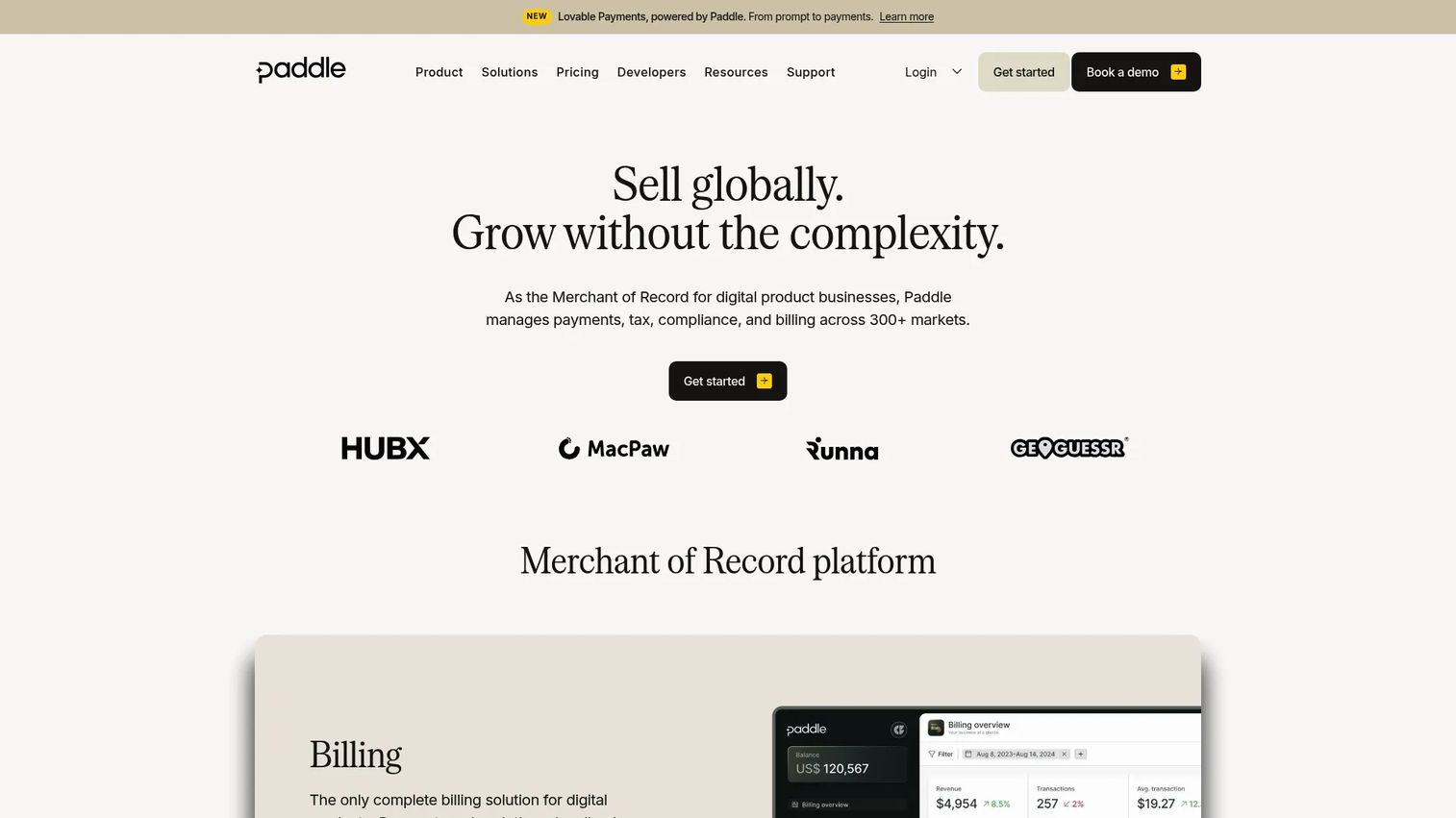
Paddle is a merchant of record platform built for SaaS and digital product businesses. Instead of stitching together a payment gateway, a tax engine, and a billing system, Paddle acts as the reseller of record and handles payments, subscriptions, sales tax, and compliance under one roof. That model is a strong fit for teams who want recurring revenue infrastructure without owning the regulatory overhead themselves.
For subscription businesses selling digital goods or software, the appeal is operational simplicity. Paddle takes on the global tax and compliance burden that usually requires a finance team, while still giving you the recurring billing, checkout, and reporting you need to run the model.
Best for: SaaS and digital product businesses that want an all-in-one merchant of record handling billing, tax, and compliance together.
Key strengths
- Merchant of record model: Paddle becomes the seller of record, absorbing global sales tax, VAT, and compliance work.
- Subscriptions and recurring billing: Native support for recurring plans, checkout, and renewals.
- Built-in fraud and reporting: Fraud protection plus reporting on revenue and subscription performance.
Why choose Paddle: If you sell digital products and dread the tax and compliance side of going global, the merchant of record model removes a huge category of operational risk. It is less about storefront curation and more about clean, compliant recurring revenue infrastructure. Brands shipping physical subscription boxes will find purpose-built commerce platforms a closer fit.
Paddle pricing: Paddle uses a transaction-based model rather than a monthly fee. The public pay-as-you-go plan is 5% + 50¢ per checkout transaction, with custom pricing available for larger businesses. There is no free tier shown on the pricing page. Verify current rates on Paddle's pricing page before committing.
2. Subbly
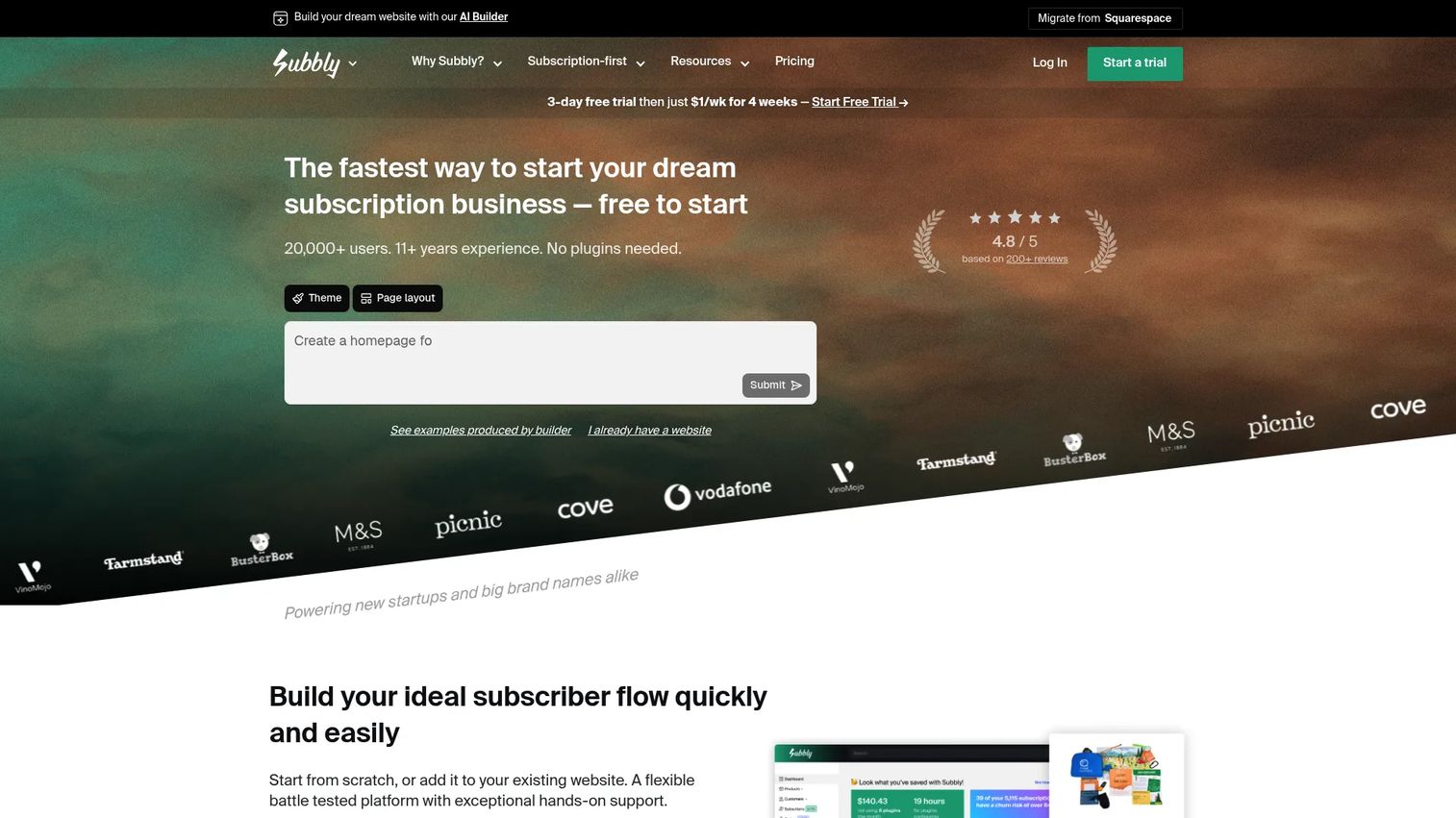
Subbly is a subscription-first commerce platform built specifically for launching and running subscription businesses. Where general ecommerce tools treat subscriptions as an add-on, Subbly designs the whole experience around recurring products: the no-code website builder, the custom checkout, and the billing all assume a subscription model from the start.
That focus shows up in speed to launch. Operators starting a subscription box platform or a curation business can stand up a branded storefront, checkout, and recurring billing without engineering help. Subbly supports both subscription and transactional products, so you can mix one-time add-ons with recurring plans.
Best for: Subscription box and recurring-product brands that want a no-code storefront, checkout, and recurring billing purpose-built for subscriptions.
Key strengths
- No-code website builder: Launch a branded subscription storefront without developers.
- Custom checkout experience: A checkout designed around subscription enrollment, not a retrofitted cart.
- Subscription and transactional products: Sell recurring plans and one-time items from the same store.
Why choose Subbly: If subscriptions are the core of your business and not a side feature, Subbly's purpose-built approach removes the friction of forcing a general platform to behave like a subscription engine. It is especially strong for box businesses, curation, and replenishment models. Subbly holds a 4.7/5 rating on G2.
Subbly pricing: Subbly's public plans start with Lite at $14/month, then Basic at $29/month, the Subbly plan at $59/month, Advanced at $119/month, and Subbly X from $499/month. A 14-day free trial is available. Confirm current tiers on Subbly's pricing page.
3. Ordergroove
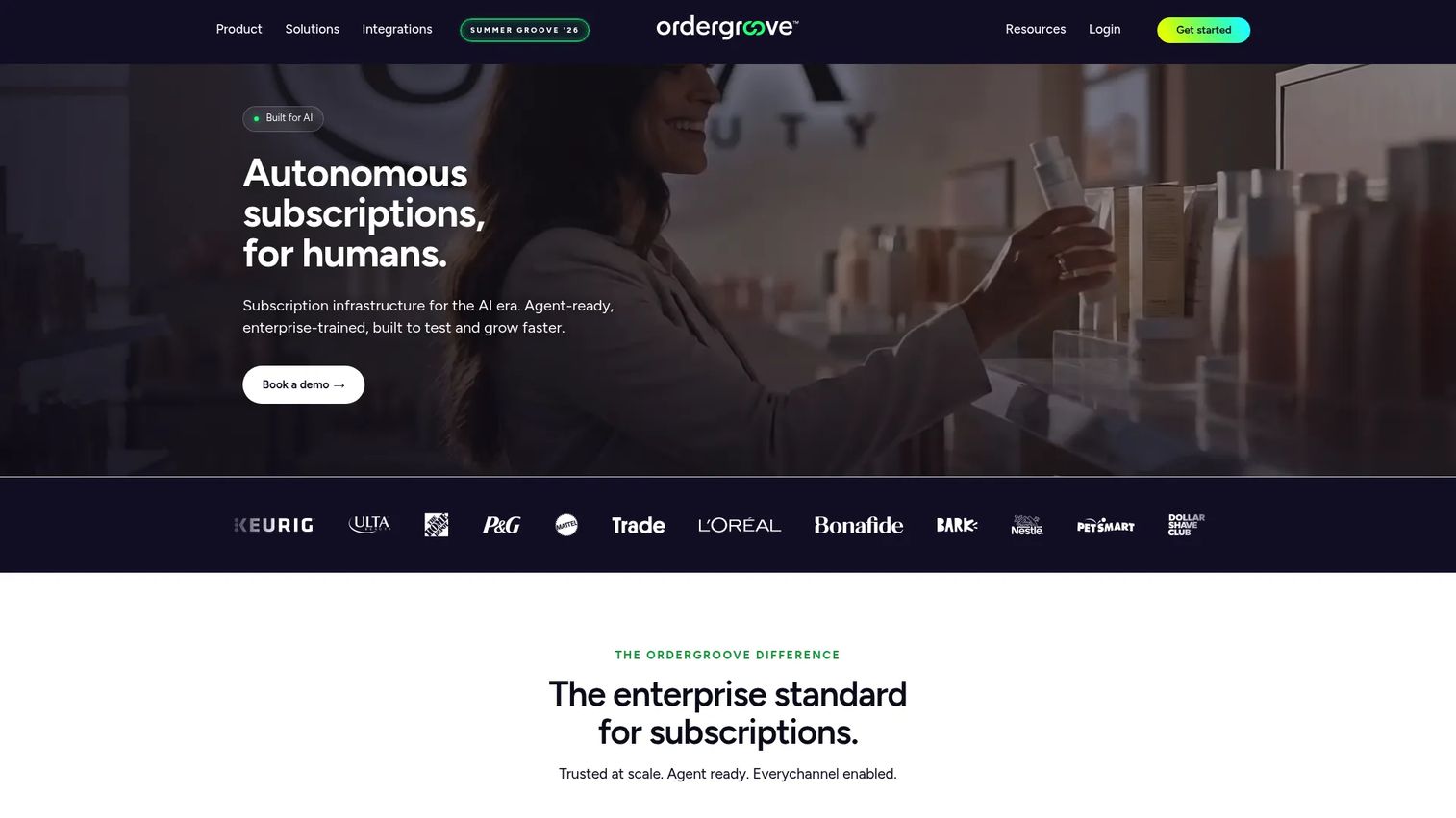
Ordergroove is a subscription and relationship commerce platform aimed at enterprise brands that take recurring revenue seriously. Its focus sits squarely on subscription management, subscriber retention, and the operational depth that comes with running recurring orders at scale. Beyond standard subscriptions, it supports bundles, clubs, and digital access subscriptions.
What sets Ordergroove apart is its orientation toward the full subscriber relationship, not just the first sale. The platform leans into retention mechanics and recurring order management, with launch guidance built for larger brands that need a structured rollout rather than a self-serve setup.
Best for: Enterprise brands selling subscriptions, memberships, bundles, or digital access that need deep retention and recurring order management.
Key strengths
- Subscription management: Full lifecycle management of recurring subscriber relationships.
- Bundles and clubs: Support for bundled offers and club-style recurring programs.
- Digital access subscriptions: Recurring access models beyond physical products.
Why choose Ordergroove: If you are an established brand where retention and subscriber lifetime value drive the business, Ordergroove's depth in recurring order management and retention is the draw. It is built for scale and complexity rather than the fastest possible self-serve launch. Ordergroove carries a 4.5/5 rating on G2.
Ordergroove pricing: Ordergroove does not publish pricing on its site; access is demo and contact-sales based. Request a demo through Ordergroove to get a quote scoped to your volume and requirements.
4. Swell
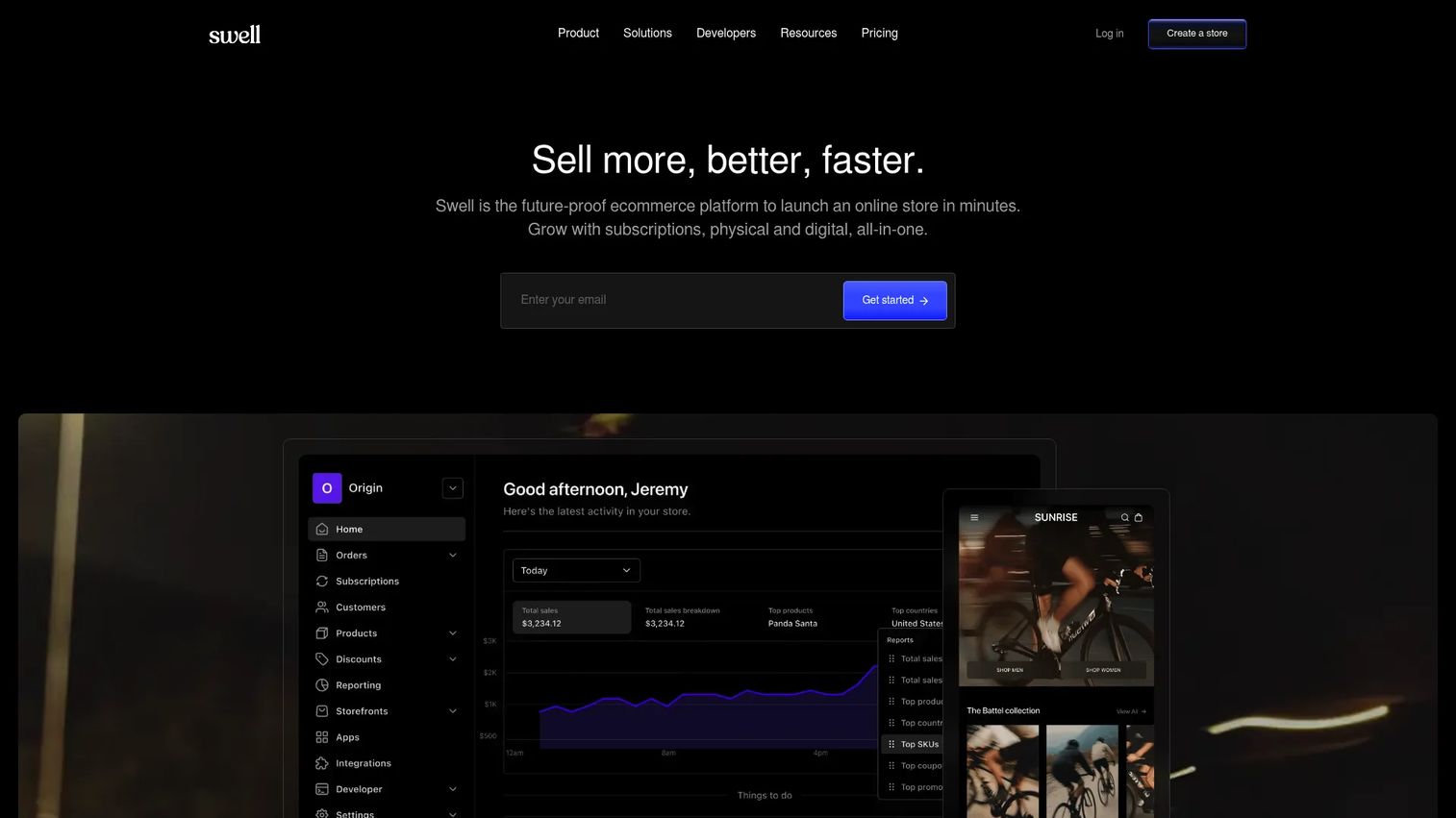
Swell is an API-first ecommerce platform for teams that want composable, headless control over their commerce stack. Rather than a fixed storefront, Swell gives developers the building blocks to assemble a custom front end while it handles the commerce backend, including subscriptions, multi-currency, and B2B features.
For technical teams, the appeal is flexibility. If your roadmap requires a bespoke checkout experience, a unique storefront, or tight integration with custom systems, an API-first approach gives you control that templated platforms cannot match. Swell offers both hosted and custom checkout plus a visual theme editor for teams that want some structure.
Best for: Brands with developer resources that want a customizable, headless ecommerce platform with subscriptions and B2B flexibility.
Key strengths
- Hosted and custom checkout: Choose a hosted checkout or build your own with full control.
- Headless storefronts: API-first architecture with a visual theme editor for composable builds.
- B2B, subscriptions, and multi-currency: Wholesale features, recurring billing, and global selling in one platform.
Why choose Swell: If you have engineering bandwidth and need a commerce backend that bends to your architecture rather than forcing you into a template, Swell is built for that control. It rewards teams who want to own the front-end experience. Swell holds a 4.2/5 rating on G2.
Swell pricing: Swell's public plans run Starter at $29/month, Basic at $79/month, Standard at $299/month, and Unlimited at $2,250/month, all billed yearly, with custom pricing for larger needs. A free trial is available. Confirm current figures on Swell's pricing page.
5. Chargebee
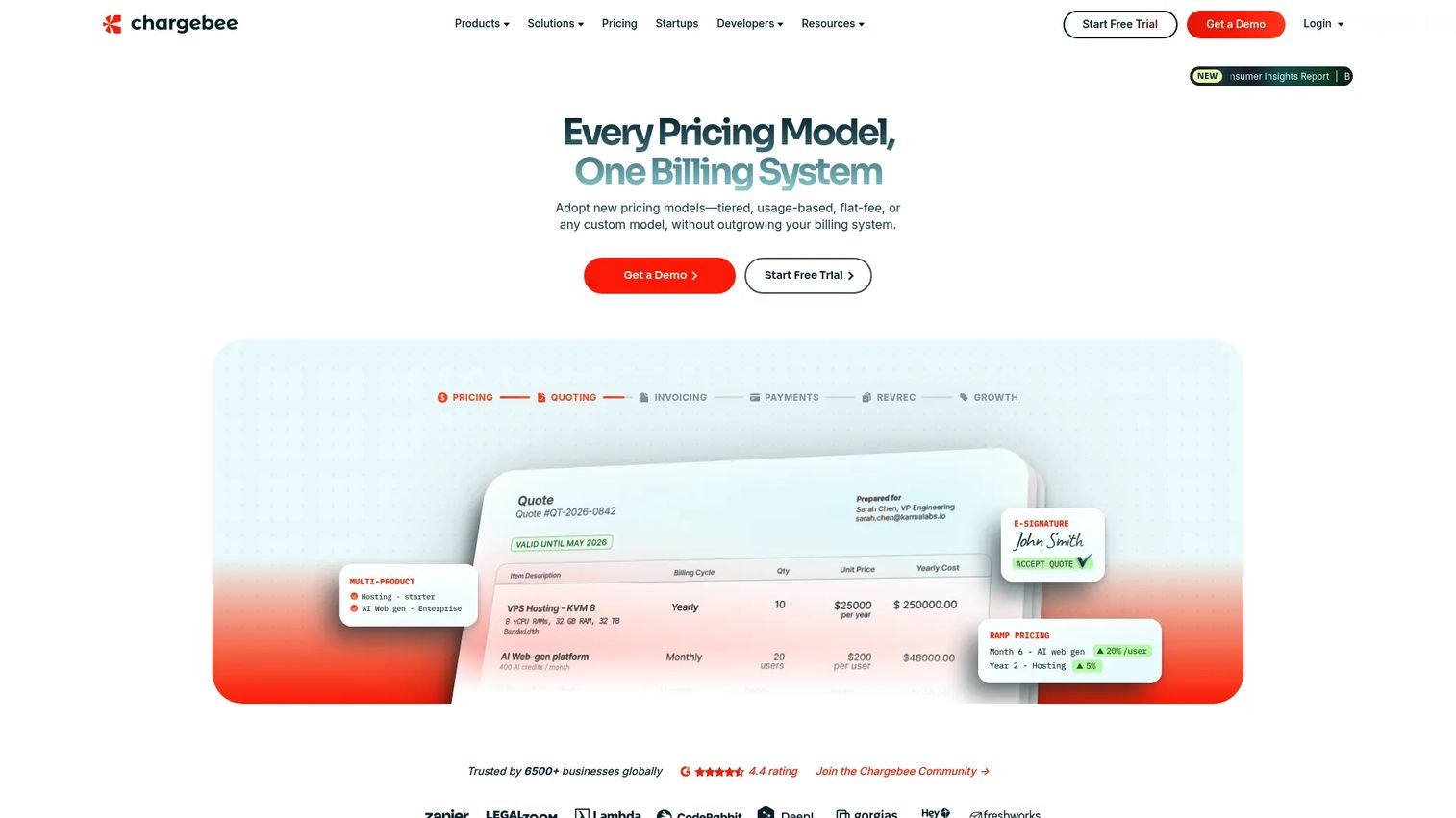
Chargebee is a billing and monetization platform built for subscription, usage-based, and hybrid revenue workflows. Its strength is the billing layer itself: subscription management, recurring billing and payments, hosted checkout, and a self-serve customer portal. For businesses where billing complexity is climbing, especially with tiered, usage-based, or hybrid pricing, Chargebee is purpose-built for the job.
Chargebee fits subscription businesses that are more billing-first than storefront-first. It pairs well with an existing commerce front end or product, handling the recurring revenue mechanics while your storefront handles the buying experience. That makes it strong for hybrid models and SaaS-adjacent subscription businesses.
Best for: Companies that need flexible subscription billing and monetization, including usage-based or hybrid pricing models.
Key strengths
- Subscription management: Full control over plans, proration, and the subscriber lifecycle.
- Recurring billing and payments: Robust recurring billing supporting usage-based and hybrid pricing.
- Hosted checkout and self-serve portal: A built-in checkout and customer portal for subscriber self-management.
Why choose Chargebee: When your pricing gets complicated, with usage tiers, add-ons, or hybrid models, Chargebee's billing depth handles what simpler tools struggle with. It is better suited to billing-led subscription businesses than to teams who primarily need a curated storefront. Chargebee carries a 4.4/5 rating on G2.
Chargebee pricing: Chargebee's Starter plan is $0/month, free for the first USD 250K of cumulative billing and then 0.75% on billing. The Performance plan runs $7,188/year, and Enterprise is custom. Verify the current structure on Chargebee's pricing page.
6. Shopify

Shopify is the familiar all-in-one commerce platform that powers a vast number of online and in-person stores. It is where many brands start, and it supports subscription offerings through its ecosystem and app approach. With subscription apps layered on its commerce base, Shopify can run subscribe-and-save, replenishment, and membership-style models alongside one-time sales.
The advantage is the ecosystem. Shopify gives you a mature storefront, a huge app marketplace, payment processing, and in-person selling, plus deep integrations across the wider commerce stack. For brands that already sell on Shopify or want a single platform for both one-time and recurring sales, adding subscriptions through apps is a practical path. Teams running heavy subscription complexity may layer in specialized tooling as they scale.
Best for: Merchants who want a familiar, all-in-one commerce platform for online and in-person sales, with subscriptions added through apps.
Key strengths
- Online store: A mature, well-supported storefront with extensive themes and customization.
- Unlimited products: Sell a broad catalog of one-time and recurring items.
- In-person selling: Unified online and point-of-sale commerce.
Why choose Shopify: If you already run an ecommerce store or want one platform for both one-time and recurring sales, Shopify's ecosystem makes adding subscriptions straightforward. It is the practical default for brands that want breadth and a huge app marketplace. Shopify holds a 4.4/5 rating on G2.
Shopify pricing: Shopify's plans are Basic at $29/month, Grow at $79/month, Advanced at $299/month, and Plus from $2,300/month, all billed yearly. The pricing page shows a 3-day free trial plus a $1/month offer for the first three months. Subscription functionality typically comes via apps, which may carry their own fees. Confirm current pricing on Shopify's pricing page.
7. BigCommerce
BigCommerce is an ecommerce platform built for brands and merchants that want more control than lightweight storefront builders and a strong commerce base for recurring products. It is designed to scale, with multi-channel selling across marketplaces and social channels, a customizable checkout, and a storefront management and analytics layer.
For subscription use cases, BigCommerce works as a flexible foundation that supports recurring products through its platform and partner ecosystem. Brands that expect to grow into multi-channel selling, or that want a commerce base with room to customize, will find it a capable starting point for recurring revenue alongside standard sales.
Best for: Brands and merchants that need a scalable ecommerce platform with built-in multi-channel selling and a flexible base for recurring products.
Key strengths
- Customizable checkout: Control over the checkout experience for both one-time and recurring orders.
- Multi-channel selling: Sell across marketplaces and social channels from one platform.
- Analytics and storefront management: Built-in analytics dashboard plus storefront control.
Why choose BigCommerce: If you want a commerce base that scales and sells across multiple channels, with room to customize the checkout and storefront, BigCommerce is a strong foundation. Subscription functionality comes through its platform and ecosystem rather than as a subscription-first core. BigCommerce carries a 4.2/5 rating on G2.
BigCommerce pricing: BigCommerce's plans are Core at $29/month, Growth at $79/month, and Scale at $299/month, all billed annually, with Performance starting at $1,499/month on custom pricing. Verify current figures on BigCommerce's pricing page.
Considerations before you buy
Before you commit to a platform, run your shortlist against these criteria. They map directly to where subscription businesses lose money in practice.
Billing flexibility and model fit
Match the platform to your model, not the reverse. A subscription box platform has different needs than a usage-based SaaS-adjacent product. Check that recurring billing supports the schedules, proration, plan changes, and pricing logic your model requires. The wrong fit forces workarounds that compound as you scale.
Churn reduction and dunning depth
Treat dunning and retention as first-class selection criteria, not afterthoughts. Ask how the platform handles failed payments, card-update prompts, and recovery retries. Involuntary churn is preventable revenue, and the strength of a platform's dunning directly affects your LTV and recurring revenue.
Checkout and customer portal quality
The checkout experience caps subscriber growth, and the customer portal shapes retention. Evaluate enrollment friction, payment method support, and whether subscribers can self-manage pauses, swaps, and upgrades without contacting support. Both are conversion and retention levers, not cosmetic features.
Integrations and migration
Confirm the platform connects to your CRM, marketing automation, fulfillment, tax, and analytics stack. If you are switching tools, scrutinize migration: data portability, customer and payment-token transfer, and renewal continuity all matter. A migration that disrupts active subscriptions can spike churn at exactly the wrong moment.
Analytics and reporting
You cannot improve a retention strategy you cannot measure. Look for cohort retention, MRR movement, churn breakdowns, and LTV reporting. The platforms that surface these clearly let you act on subscriber behavior instead of guessing. For deeper measurement, pair your platform with dedicated marketing analytics software or a customer data platform.
Conclusion
The right subscription ecommerce platform comes down to a few clear decisions. First, simple subscription storefront versus deeper billing infrastructure: Subbly and Shopify lean storefront, while Paddle and Chargebee lean billing. Second, retention and churn tooling versus pure checkout support: Ordergroove and Chargebee bring depth in dunning and subscriber management. Third, technical flexibility versus launch speed: Swell rewards engineering teams, while Subbly and Shopify get you live fast. Finally, fit by model: boxes, replenishment, memberships, and hybrid commerce each pull toward different tools.
Choose based on business model complexity and retention needs, not the longest feature list. If recurring revenue is your core model and churn reduction is your growth lever, weight billing flexibility, dunning, and the customer portal above everything else. If you already run a storefront and subscriptions are an extension, an established commerce base with subscription apps may serve you well. Map your model first, then pick the platform that fits it. While you are refining how recurring offers get sold and renewed, our guide to marketing automation software can help you operationalize the retention side.
FAQs
A subscription ecommerce platform is software that runs the storefront, checkout, recurring billing, and subscriber management needed to sell products or access on a repeating schedule. It combines commerce front end and billing infrastructure so businesses can offer subscribe-and-save, boxes, memberships, and replenishment models. The best platforms also handle dunning, retention, and analytics so recurring revenue stays predictable as volume grows.
At minimum: flexible recurring billing, a conversion-focused checkout experience, a self-service customer portal, dunning and failed-payment recovery, retention analytics, and integrations with your CRM, fulfillment, and tax tools. Billing flexibility and dunning matter most once you have real volume, because that is where preventable revenue is won or lost. Self-service portals reduce both support load and voluntary churn.
Businesses with repeat-purchase products or recurring value. Replenishment categories like coffee, supplements, and pet food are natural fits, as are curation and subscription box brands, memberships, and digital access models. Any product a customer needs again on a predictable cadence is a candidate, because the recurring model lifts lifetime value and smooths revenue.
Through three main levers: failed-payment recovery, customer self-service, and retention workflows. Dunning automatically retries declined cards and prompts subscribers to update expired payment methods, recovering revenue that would otherwise be lost to involuntary churn. A self-service customer portal lets subscribers pause or swap instead of canceling outright, and retention workflows can trigger win-back offers at the right moment.
For many brands, yes. Shopify supports subscriptions through its app ecosystem, which works well for subscribe-and-save, replenishment, and membership models added to an existing store. Teams running high subscription complexity, deep usage-based billing, or sophisticated retention programs often layer in specialized tooling as they scale. Start with your model: if subscriptions are an extension of one-time sales, Shopify plus apps is a practical path.
Subscription ecommerce software combines a storefront, checkout, and subscriber experience with recurring billing. Recurring billing software is billing-first: it manages plans, proration, invoices, and payments but assumes you bring your own front end. Subscription box and DTC brands usually need the full commerce experience, while SaaS-adjacent or hybrid businesses often pair a dedicated billing platform with a separate storefront or product.
Data portability first: confirm you can export subscriber records, plan details, and ideally payment tokens. Then plan for renewal continuity so active subscriptions are not interrupted, and minimize checkout disruption during the cutover. Migration done carelessly can spike churn at exactly the wrong time, so test the flow with a small cohort before moving your full base.
Tie the decision to scale, complexity, and retention requirements. If recurring revenue is your core model and you need deep billing flexibility, dunning, and subscriber lifecycle management, a subscription-first or billing-led platform fits best. If subscriptions are an extension of an established one-time catalog, a general ecommerce platform with subscription apps is often enough. The more central recurring revenue is to your business, the stronger the case for purpose-built infrastructure.