Your product roadmap adds AI inference, multi-region deployment, or enterprise security tiers. Then someone on the platform team surfaces the real constraint: The network operating model is still manual, fragmented, and built for a three-tier world that no longer matches the workload.
That gap has consequences. The wrong architecture choice delays AI feature releases, creates operational debt across platform and security teams, and surfaces during enterprise security reviews at the worst possible moment. The data center networking market reached USD 30.78 billion in 2025 and is projected to hit USD 80.21 billion by 2031, according to Mordor Intelligence (2026), reflecting how fast teams are being pushed to modernize.
Data center networks are increasingly a product dependency, not a rack-level infrastructure project. Which tools fit the architecture and operating model you are actually building?
What's inside
This guide is for infrastructure product managers, platform engineers, and technical leads evaluating a data center networking refresh. Items were selected for distinct operational roles, not as interchangeable substitutes.
- Seven tools covering fabric operations, AI Ethernet, switching, and network operating systems
- How each tool differs by architecture fit, automation depth, and operating model
- Evaluation criteria for teams coordinating platform, security, and infrastructure requirements
- A decision framework for AI workloads, EVPN VXLAN fabrics, multi-site connectivity, and lifecycle operations
TL;DR
- Best for integrated Cisco data center operations: Cisco Nexus Dashboard, for teams managing Cisco Nexus, ACI, or MDS environments from a unified console
- Best for multi-vendor intent-based fabric management: HPE Juniper Apstra Data Center Director, for continuous validation across heterogeneous switching environments
- Best for Arista-centric cloud-style NetOps: Arista CloudVision, for automation, telemetry, and change control across Arista estates
- Best for AI Ethernet networking: NVIDIA Spectrum-X Ethernet, for GPU clusters requiring congestion management and high-throughput fabric
- Best for automation-led leaf-spine fabrics: Nokia Data Center Fabric, for programmable stacks combining SR Linux and Event-Driven Automation
- Best for DPU-based east-west security: HPE Aruba Networking CX 10000 Switch Series, for distributed inline inspection close to workloads
- Best for open Linux-based network operations: NVIDIA Cumulus Linux, for teams with mature NetOps practices and EVPN VXLAN requirements
What is data center networking?
Data center networking is the architecture, hardware, software, protocols, and operating processes that connect compute, storage, applications, and external networks inside and between data centers.
Core functions
- Switching and routing traffic between workloads (east-west) and to external systems (north-south)
- Isolating tenants, environments, and services through segmentation
- Providing redundancy, failover, and predictable traffic paths
- Collecting telemetry for capacity planning and incident investigation
- Enforcing security controls at the network layer
- Connecting facilities, cloud environments, and edge locations through data center interconnect
Modern architecture in plain English
Legacy three-tier designs stack core, distribution, and access layers. That model works for north-south traffic but creates bottlenecks as east-west application communication grows.
Leaf-spine and Clos fabric designs solve this by connecting every leaf switch to every spine, giving workloads a predictable number of hops regardless of scale. An IP underlay provides physical connectivity, while EVPN VXLAN overlays create logical segmentation across the fabric. VXLAN encapsulates traffic into UDP packets, allowing tenant or segment separation through VNI identifiers without requiring separate physical infrastructure. EVPN then distributes endpoint and reachability information through the BGP control plane.
As a PM, you don't need to configure these protocols. You do need to understand that an architecture commitment here shapes the release cadence, operational overhead, and engineering opportunity cost for everything running above it.
Why AI changes the requirements
GPU clusters running distributed training or inference generate traffic patterns that standard enterprise switching wasn't designed for. RoCE (RDMA over Converged Ethernet) requires lossless delivery, predictable latency, and active congestion management. A single congestion event can stall an entire GPU job. That means AI data center networking demands higher-speed interfaces, richer telemetry, and fabric-level congestion control, not just more bandwidth.
When to use data center networking tools
Modernize a legacy three-tier network
Three-tier designs start showing strain when east-west traffic grows beyond what the aggregation layer was sized for. Leaf-spine migration flattens the topology, gives workloads predictable paths, and makes capacity scaling more straightforward. The operational question is whether you move with a vendor-integrated management stack or a multi-vendor automation platform.
Prepare for AI or GPU infrastructure
High-speed switching, lossless Ethernet, congestion visibility, and RoCE support become mandatory constraints, not optional features, once GPU clusters enter the architecture. Network instrumentation shifts from "nice to have" to a requirement for diagnosing job failures and GPU utilization gaps.
Reduce operational risk during frequent infrastructure changes
Automation, intent validation, configuration rollback, and continuous assurance reduce the blast radius of changes pushed across hundreds of switches. Manual change management doesn't scale with release cadence.
Connect multiple facilities and cloud environments
Multi-site data center networks require consistent policy, route control, and observability across locations. Data center interconnect strategy needs to be part of the platform decision, not an afterthought.
| Trigger | Capabilities to prioritize |
|---|---|
| AI cluster rollout | AI Ethernet, RoCE support, congestion telemetry, high-speed switching |
| Data center refresh | Leaf-spine design, EVPN VXLAN, fabric automation, lifecycle management |
| Multi-site expansion | Data center interconnect, policy consistency, multi-fabric visibility |
| Security modernization | Microsegmentation, distributed enforcement, east-west traffic visibility |
| Manual operations backlog | Intent-based workflows, change validation, telemetry, API coverage |
Data center networking tools comparison
These seven tools address different layers of the stack: Fabric operations platforms, AI Ethernet systems, and open network operating systems are not interchangeable. The right shortlist starts with your architecture and operating model, then maps each layer to the tool that fits that role.
Pricing and G2 ratings verified October 2026 from each vendor's official pricing page and G2 listing.
Best 7 tools for data center networking
Each entry below maps to a specific operational role. Read the "Why choose" section before treating any tool as a default.
1. Cisco Nexus Dashboard
Cisco Nexus Dashboard is a unified platform for provisioning, managing, monitoring, orchestrating, and analyzing Cisco data center networks across multiple fabrics. It supports Cisco ACI, Nexus Dashboard Fabric Controller (formerly DCNM), and MDS environments through a single operations console. Infrastructure and application insights surface in one place, reducing the number of disconnected views a platform team has to maintain.
Best for: Enterprise IT and network operations teams managing distributed Cisco data center fabrics and infrastructure.
Key features
- Fabric inventory and provisioning across Cisco ACI, NDFC, and NX-OS environments
- VXLAN EVPN automation and multi-fabric orchestration
- Streaming telemetry with real-time analytics and topology visibility
- AI and ML workload fabric operations
- Infrastructure-as-code integrations for repeatable change workflows
Why choose Cisco Nexus Dashboard: The deepest value aligns directly with Cisco-heavy estates. For PMs, the instrument here is fewer disconnected operating views and more repeatable network change workflows. If your environment already runs Cisco Nexus or ACI, the operational consistency this provides across lifecycle management is a meaningful reduction in engineering overhead.
Cisco Nexus Dashboard pricing: Cisco ties Nexus Dashboard feature access to its Data Center Networking subscription tiers: Essentials, Advantage, and Premier. The platform itself does not carry a separate license fee; the capability gates are in the tier you purchase. Contact Cisco or an authorized reseller for deployment-specific pricing.
G2 rating: 4.7/5, based on 11 reviews (verified October 2026).
2. HPE Juniper Apstra Data Center Director
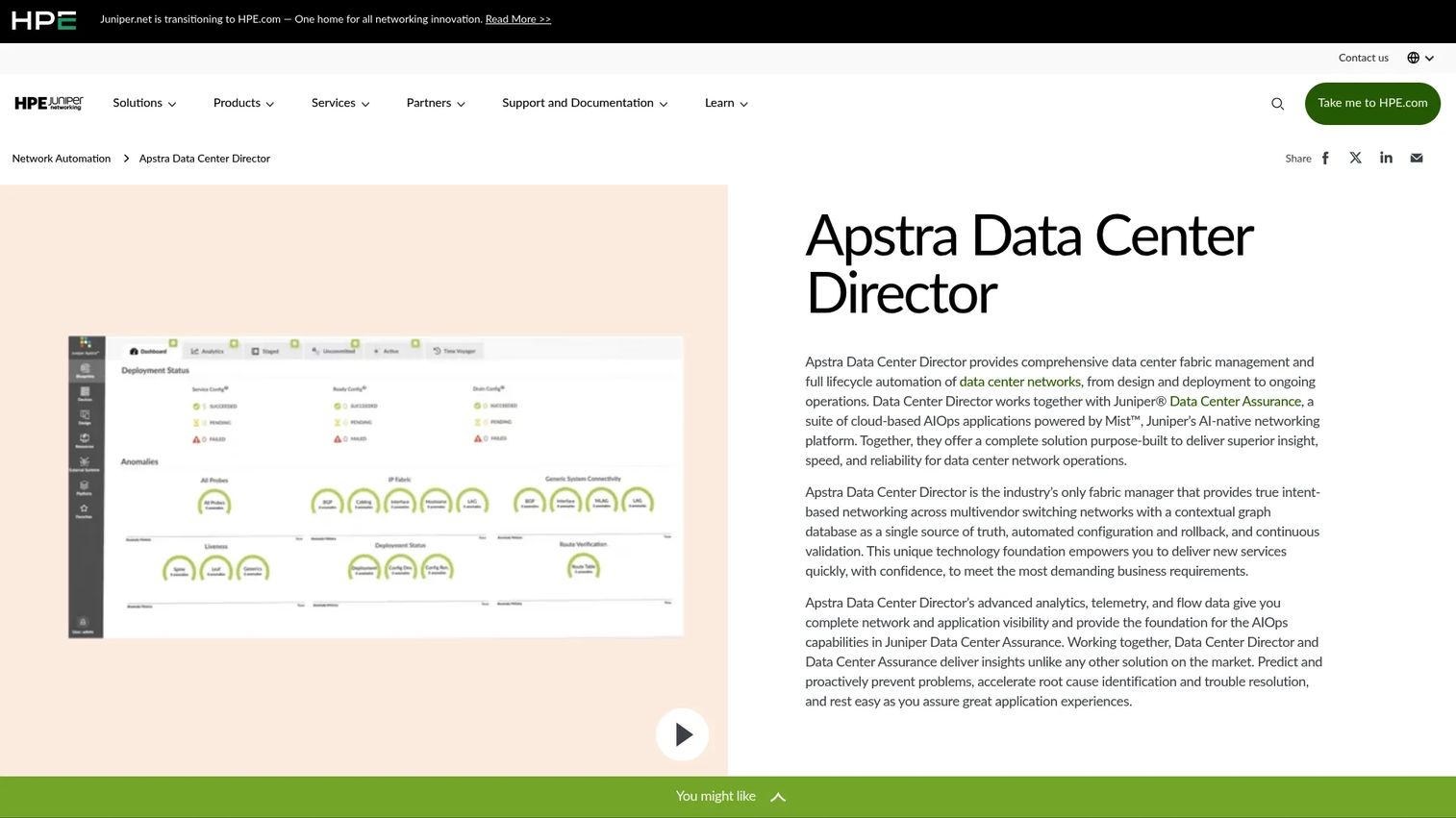
HPE Juniper Apstra Data Center Director is an intent-based fabric management platform covering Day 0 design through Day 2 operations. Its distinguishing architecture is a contextual graph database that models the entire network as a single source of truth, then uses that model to automate configuration, validate against intent, and surface drift. Multi-vendor switching support means teams aren't forced into a single hardware vendor to get consistent operations.
Best for: Infrastructure teams that need governance and continuous validation across multi-vendor switching environments.
Key features
- Intent-based fabric blueprints with graph-based network modeling
- Multi-vendor switching support and vendor-independent operations
- Automated configuration, rollback, and continuous validation workflows
- Advanced analytics, telemetry, and Flow Insights
- Data center interconnect with VXLAN stitching and Terraform/Ansible integrations
Why choose HPE Juniper Apstra Data Center Director: It earns its place when a team needs to translate architecture intent into repeatable operations across more than one switching vendor. For a PM, the benefit is a more defensible operating model when product expansion depends on infrastructure changes. Vendor-specific operational silos become a smaller risk.
HPE Juniper Apstra Data Center Director pricing: Apstra uses per-device subscription licensing across Standard, Advanced, and Premium tiers, available in 1-, 3-, or 5-year terms. Standard covers basic configuration and operations. Advanced adds full operations, assurance, and intent-based analytics. Premium adds large-scale multivendor support, policy control, Flow Insights, and Data Center Assurance. Contact HPE Juniper for deployment-specific pricing.
G2 rating: 4.0/5, based on 12 reviews (verified October 2026).
3. Arista CloudVision
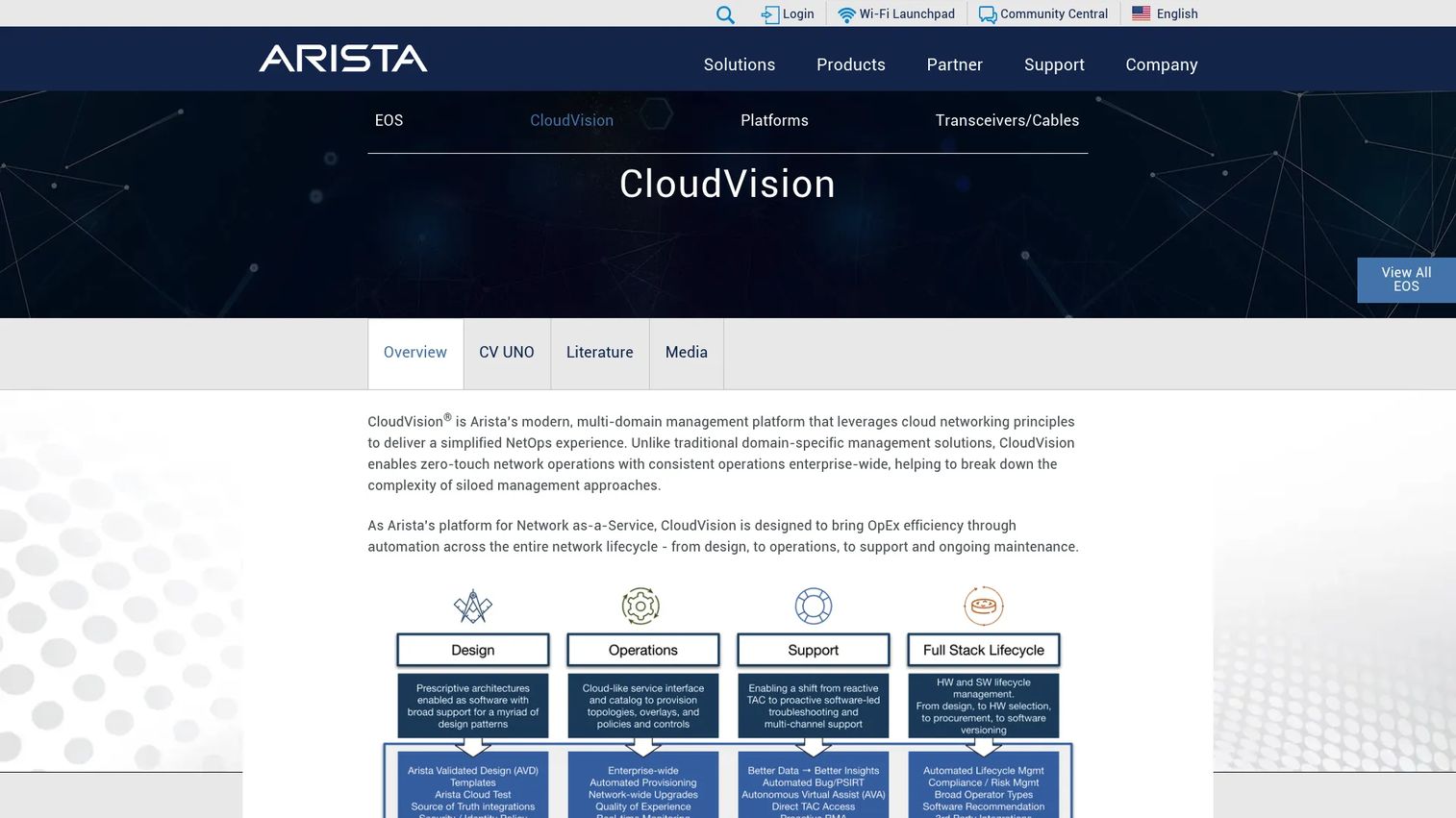
Arista CloudVision is a multi-domain network management platform for real-time telemetry, automation, analytics, and lifecycle operations. Its architecture centers on a network-wide state database that records every configuration change and state transition, giving operations teams a continuous historical record rather than a snapshot. Coverage spans data center, campus, WAN, and multi-cloud environments from a single management plane.
Best for: Teams using Arista switching that want a centralized NetOps layer for standardized changes, change control, and operational visibility.
Key features
- Network-wide state database with historical visibility and state streaming
- Change control, compliance workflows, snapshots, and rollback
- Zero-touch provisioning and configuration management
- Multi-domain operations across data center, campus, and WAN
- Streaming telemetry with analytics and upgrade orchestration
Why choose Arista CloudVision: Operational consistency across an Arista estate is where it performs best. PMs should weigh whether the organization benefits from a vendor-aligned management plane or whether a heterogeneous fabric-management approach is required. The historical state database makes instrumentation for reliability reviews and capacity planning more tractable.
Arista CloudVision pricing: CloudVision and CloudVision Lite are sold as term-based software subscriptions through Arista sales channels. Licensing is typically device-based. Contact Arista for current packaging, term options, and your specific configuration.
G2 rating: 4.8/5, based on 3 reviews (verified October 2026).
4. NVIDIA Spectrum-X Ethernet
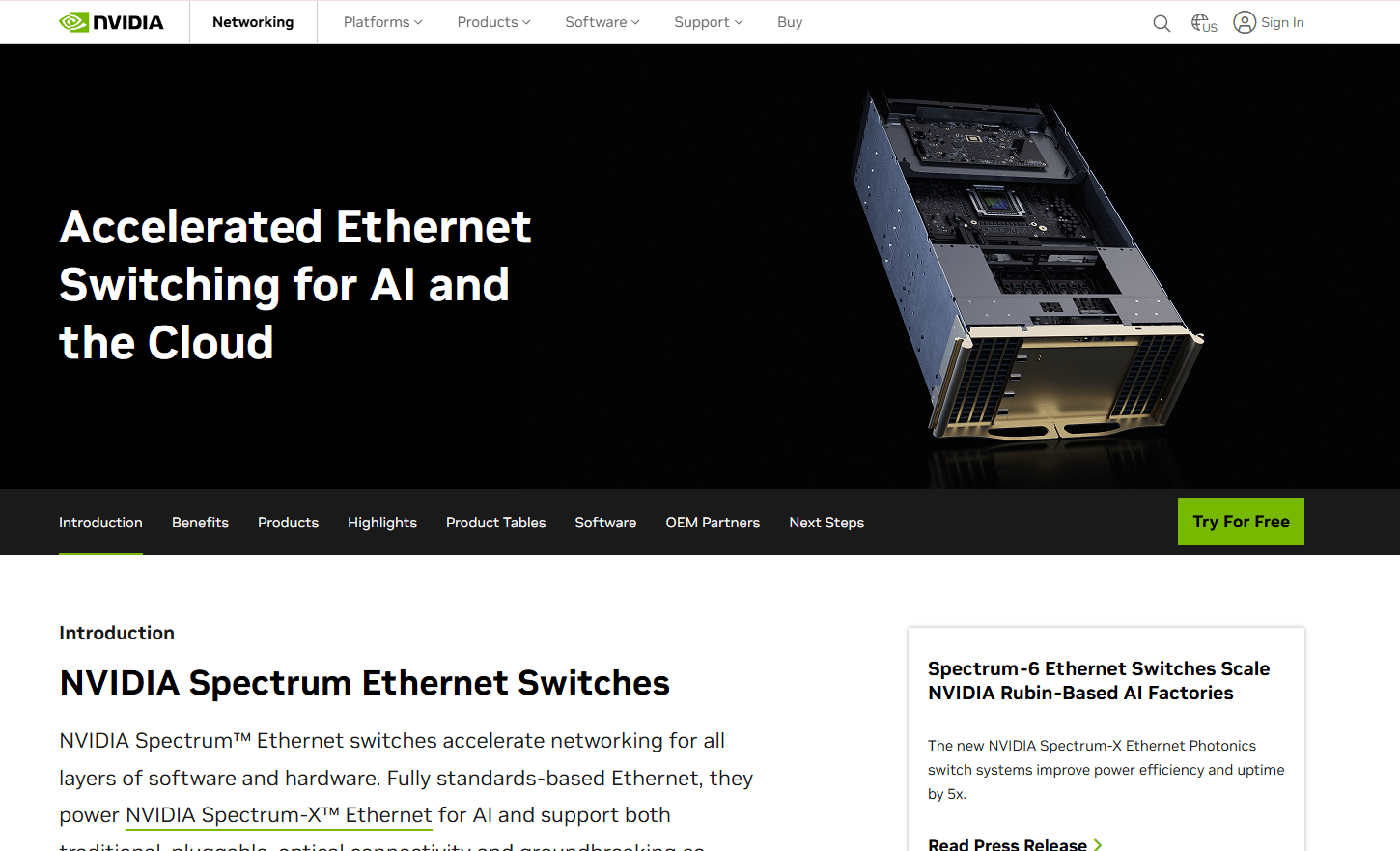
NVIDIA Spectrum-X Ethernet is an AI networking platform combining NVIDIA Spectrum Ethernet switches, SuperNICs (ConnectX and BlueField), NetQ telemetry, and Cumulus Linux into a fabric purpose-built for AI workloads. It uses standards-based Ethernet rather than proprietary interconnects, making it compatible with open network stacks. Adaptive routing and telemetry-driven congestion control address the specific failure modes that affect GPU cluster performance.
Best for: Organizations building or expanding GPU clusters, AI factories, or high-performance compute environments where standard enterprise switching creates throughput and latency constraints.
Key features
- Adaptive routing and telemetry-driven congestion control for AI workloads
- Lossless, high-performance Ethernet fabric for GPU cluster connectivity
- Integration with NVIDIA Spectrum switches, BlueField/ConnectX SuperNICs, and NetQ
- Standards-based open Ethernet stack compatibility
- High-speed switching for AI and inference workloads
Why choose NVIDIA Spectrum-X Ethernet: Put this on the shortlist when AI throughput is a product requirement, not an experiment. The connection to model training throughput, inference capacity, and GPU utilization makes the networking investment directly traceable to product roadmap feasibility. Congestion events that stall GPU jobs show up as product reliability problems.
NVIDIA Spectrum-X Ethernet pricing: Pricing covers switch configuration, SuperNICs, optics, support, and fabric scale. Request a quote that models the full fabric rather than comparing switch costs in isolation, as component choices interact significantly. Contact NVIDIA or an authorized partner for configuration-specific pricing.
5. Nokia Data Center Fabric
Nokia Data Center Fabric combines high-capacity switching platforms, the SR Linux network operating system, and Nokia Event-Driven Automation (EDA) into a single integrated stack. SR Linux is open and extensible, exposing gNMI, REST APIs, and model-driven telemetry that align with how infrastructure-as-code workflows operate. EDA handles Day 0 design through Day 2 operations, including intent-based management, pre- and post-checks, and a Digital Sandbox for validation before deployment.
Best for: Teams prioritizing programmable leaf-spine fabrics with automation guardrails, modern telemetry, and high-capacity switching for traditional and AI workloads.
Key features
- High-performance leaf, spine, super-spine, and management top-of-rack switching (up to 460.8 Tb/s)
- SR Linux NOS with gNMI, REST APIs, model-driven telemetry, and modern routing protocols
- EDA for intent-based Day 0 design, Day 1 deployment, and Day 2 operations
- Digital Sandbox for pre-deployment validation
- Integrations with OpenShift, VMware, OpenStack, and IT service management systems
Why choose Nokia Data Center Fabric: It fits operators who want automation baked into the stack from the start rather than bolted on later. Product leaders should evaluate whether its operating model matches the team's skills, deployment cadence, and plans for AI infrastructure. The automation-first approach reduces operational drag as the environment grows in complexity.
Nokia Data Center Fabric pricing: Nokia sells the fabric as an enterprise infrastructure portfolio with quote-based pricing. Costs reflect switching capacity, software scope, automation requirements, optics, support, and interconnect. Contact Nokia directly for a configuration-specific quote.
6. HPE Aruba Networking CX 10000 switch series
HPE Aruba Networking CX 10000 Switch Series is a DPU-enabled switching platform that runs distributed network and security services inline, at wire rate, without routing traffic through centralized appliances. Each switch pairs a 3.2 Tbps switching fabric with a programmable DPU that handles stateful segmentation, east-west firewalling, NAT, encryption, and telemetry. The AOS-CX operating system provides Layer 2/3 switching, QoS, stacking, and the Network Analytics Engine alongside these distributed services.
Best for: Enterprise data centers that need high-performance switching plus distributed east-west security enforcement without centralizing all inspection traffic.
Key features
- 3.2 Tbps switching capacity with DPU-enabled inline stateful services
- Distributed east-west firewalling, NAT, encryption, and microsegmentation
- 48 x 25GbE SFP28 ports plus 6 x 100GbE QSFP28 ports per switch
- AOS-CX with Network Analytics Engine, dynamic segmentation, and stacking
- CLI, REST API, SNMP, Fabric Composer, and HPE Aruba Networking Central management
Why choose HPE Aruba Networking CX 10000 switch series: It becomes relevant when security architecture drives network design rather than the other way around. Centralizing east-west inspection through a choke point introduces latency and creates a scaling constraint. This switch moves that inspection to the top of rack, which matters for application performance in multi-tenant environments and for enterprise buyer security requirements.
HPE Aruba Networking CX 10000 switch series pricing: Hardware starts at $49,869.27 for the CX 10000 series (verified October 2026 from the HPE online store). Add-on costs for transceivers, HPE Aruba Networking Central Advanced licensing for extended stateful firewall and telemetry capabilities, support contracts, and deployment services change the total materially. Request a configuration-specific quote for full fabric pricing.
7. NVIDIA Cumulus Linux
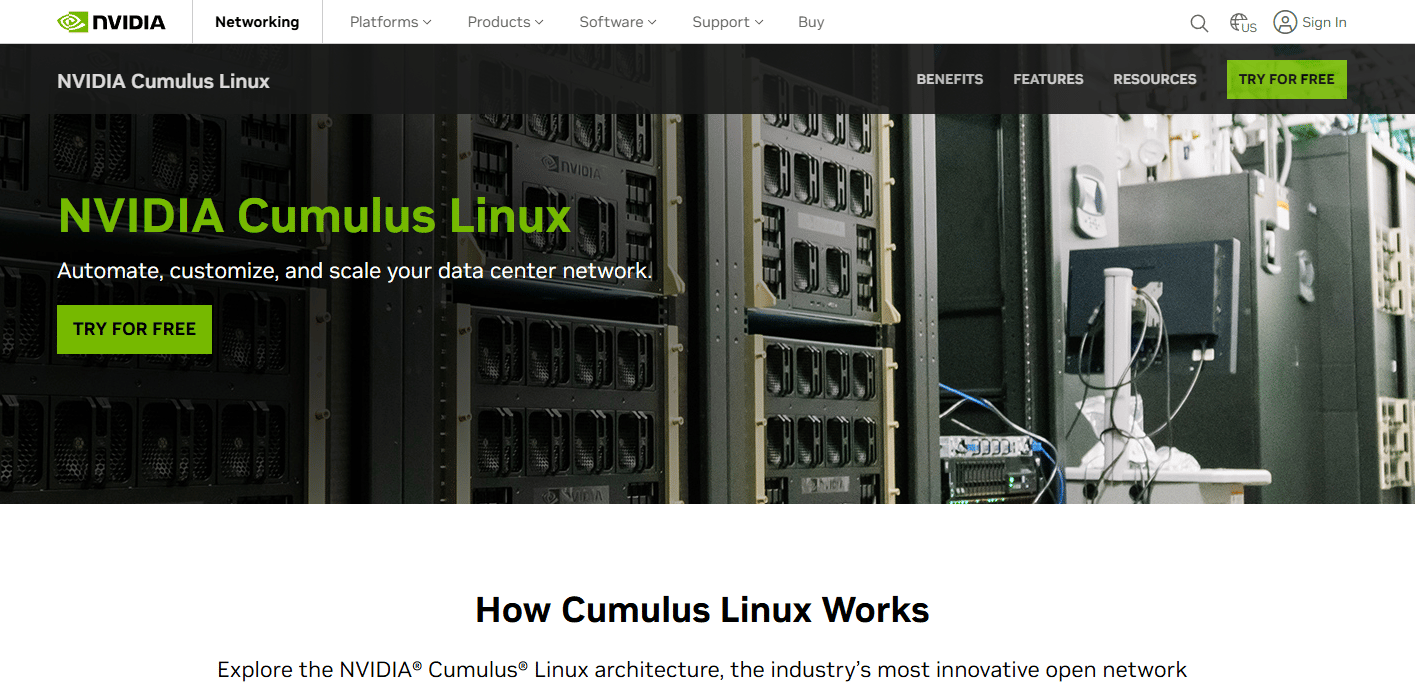
NVIDIA Cumulus Linux is a Linux-based network operating system for data center switching. It runs on commodity white-box and branded hardware, supports EVPN VXLAN, BGP, OSPF, and VRF, and integrates with FRRouting for routing protocol handling. The NVIDIA User Experience (NVUE) CLI provides an object-based model for configuration, and NVIDIA Air provides a digital-twin environment for pre-deployment validation.
Best for: Network and platform teams that prefer Linux-native workflows and want greater control over EVPN VXLAN fabric operations without being locked to a single management suite.
Key features
- Linux-based NOS with NVUE object-model CLI and full Linux shell access
- EVPN VXLAN support with VNI-based tenant segmentation
- BGP and OSPF routing through FRRouting integration
- Unnumbered interfaces for BGP and OSPF, plus Prescriptive Topology Manager
- NVIDIA Air digital-twin validation and telemetry/health monitoring
Why choose NVIDIA Cumulus Linux: It fits teams with strong NetOps or DevOps skills who want network automation to resemble the rest of the infrastructure workflow. Configuration management, GitOps, and automation tools that already run the application stack apply directly to the network layer. Evaluate it when open tooling, programmability, and operational consistency across the full infrastructure matter more than a vendor-integrated management suite.
NVIDIA Cumulus Linux pricing: Cumulus Linux uses a perpetual license model with 1-, 3-, and 5-year Software Updates and Support contracts available. NVIDIA states that pricing requires contacting the sales team; no numeric price is published. NVIDIA Cumulus VX, a free virtual appliance, is available separately for lab evaluation.
G2 rating: 3.8/5, based on reviewer-reported data (verified October 2026 via G2 listing).
Considerations when choosing data center networking tools
Start with the workload, not the vendor
Evaluate the traffic profile first: East-west application flows, storage protocols, AI GPU traffic, latency tolerance, and multi-site requirements. A SaaS control plane and a GPU training cluster have different architecture requirements even if they share a facility.
Separate fabric design from operations tooling
A switch portfolio, a network operating system, and a fabric-management platform solve related but distinct problems. Make ownership explicit across platform engineering, network engineering, and security before the procurement conversation starts. Buying the hardware without owning the operations model creates ongoing maintenance debt.
Validate EVPN VXLAN operational maturity
Protocol support is not sufficient. Evaluate design templates, VTEP visibility, route propagation handling, EVPN multihoming for resiliency, tenant segmentation workflows, and how change validation works day-to-day. Operational gaps surface during incidents, not evaluations.
Measure Day 2 operating cost
Ask vendors how teams handle telemetry collection, drift detection, upgrade orchestration, rollbacks, and change approvals. Hardware that appears cost-effective at acquisition becomes expensive when every operational task requires manual intervention.
Plan for AI scale before capacity becomes the constraint
For teams with AI infrastructure on the roadmap, validate GPU connectivity, congestion behavior, RoCE support, high-speed interface availability, optics choices, and observability before deployment. Treating the AI network as a standard server refresh creates capacity problems that surface at the worst time.
How to choose the right data center networking tool for your team
If you are standardizing an existing Cisco data center
Cisco Nexus Dashboard is the natural starting point when Cisco Nexus, ACI, or MDS already dominate the environment. Evaluate lifecycle management depth, the Essentials/Advantage/Premier licensing structure, and how far multi-fabric scope extends to your specific environment before committing.
If your network spans multiple switch vendors
HPE Juniper Apstra Data Center Director handles multi-vendor intent and continuous validation better than vendor-aligned management planes. Confirm hardware support for your current estate and planned expansion before deployment.
If AI infrastructure is on the product roadmap
NVIDIA Spectrum-X Ethernet earns evaluation when GPU utilization, AI throughput, and congestion management are explicit constraints. Nokia Data Center Fabric is worth including when the team also wants an automation-led fabric stack with programmable NOS capabilities.
If east-west security is the primary driver
HPE Aruba Networking CX 10000 Switch Series addresses distributed inspection and microsegmentation at the top of rack, avoiding the performance and scaling constraints of centralized appliance architectures.
If platform engineering wants Linux-native network operations
NVIDIA Cumulus Linux fits teams with mature automation practices who want EVPN VXLAN and BGP workflows to align with how the rest of the infrastructure runs. It requires solid NetOps skills to get the most from the open model.
Conclusion
Data center networking is a systems decision. The seven tools above address different layers of the stack, and the right shortlist starts with architecture fit, not vendor preference.
Cisco Nexus Dashboard covers Cisco-centric lifecycle operations. HPE Juniper Apstra Data Center Director handles multi-vendor intent-based fabrics. Arista CloudVision delivers Arista-driven NetOps with historical state tracking. NVIDIA Spectrum-X Ethernet addresses AI networking requirements. Nokia Data Center Fabric offers an automation-led leaf-spine stack. HPE Aruba Networking CX 10000 Switch Series provides distributed east-west security at wire rate. NVIDIA Cumulus Linux gives Linux-native teams open control over EVPN VXLAN operations.
The most productive next step is a cross-functional requirements workshop with infrastructure engineering, security, platform engineering, and product stakeholders. Align on workload requirements, ownership boundaries, and operational model before requesting vendor demos. The architecture decision shapes what you can ship, how fast you can change it, and what your security posture looks like at scale.
For a broader view of the AI governance tools and AI model deployment software that sit above the network layer, those guides cover the adjacent stack decisions that often get decided in parallel.
FAQs
A data center network is the full system connecting compute, storage, applications, users, and external services. A fabric is typically the high-capacity switching topology and operational design at the core of that system, most commonly built on leaf-spine or Clos architecture. The fabric is the performance and resiliency foundation; the broader network includes management planes, interconnect, and operational tooling layered on top.
Leaf-spine designs give every workload a predictable number of hops to any other workload, regardless of scale. Each leaf switch connects to every spine, so east-west traffic doesn't pass through an aggregation bottleneck. Capacity scales by adding leaf or spine switches without redesigning the topology, which matters when application and AI workload growth is non-linear.
VXLAN (Virtual Extensible LAN) encapsulates Layer 2 traffic into UDP packets, creating logical overlays across a Layer 3 IP underlay. VNI identifiers separate tenants or segments within those overlays. EVPN (Ethernet VPN) distributes endpoint reachability and MAC/IP binding information through the BGP control plane, replacing flood-and-learn with a scalable, controlled approach to segment awareness and workload mobility.
PMs don't need to configure these protocols. They should understand that the protocol choices made at this layer affect product reliability, AI infrastructure performance, security architecture, regional expansion feasibility, and how long infrastructure changes take to validate and deploy. The architecture is a product dependency, so the tradeoffs matter even if the implementation doesn't.
High-speed Ethernet interfaces, lossless fabric behavior, active congestion management, RoCE support, and per-flow telemetry are the core requirements. AI workloads generate bursty, all-to-all traffic patterns during training that expose congestion faster than standard application traffic. Telemetry that surfaces congestion events, queue depths, and flow imbalance is essential for diagnosing GPU job failures and improving utilization.
Intent-based networking lets teams define the desired state of the network, then uses automation to deploy that state and continuously validate that the infrastructure matches it. Drift from intended configuration gets flagged and can trigger automated remediation. It is most valuable when manual change management creates operational risk, especially in environments where configuration changes are frequent or the switching environment spans multiple vendors.
Total cost includes switching hardware, optics, software subscriptions, support contracts, automation platform licenses, deployment services, and ongoing operations overhead. Compare over a three to five year horizon and include staffing or managed-service assumptions. Hardware-only comparisons understate cost for any environment where Day 2 operations are non-trivial.
Several platforms support multi-fabric visibility and data center interconnect capabilities, but the specifics vary by product and deployment. Teams should validate policy consistency across sites, route control and failure behavior between facilities, security enforcement at the interconnect boundary, and how observability works when an incident spans locations. Confirm these capabilities against your specific topology before standardizing on a platform.