Your plant keeps running. Your technicians keep closing work orders. But the underlying maintenance process is already failing.
Work orders live in email inboxes. Spare-parts data sits in a spreadsheet someone updated last quarter. Downtime gets explained in a retrospective meeting rather than prevented by a system that saw it coming.
EAM software becomes necessary the moment maintenance data starts affecting operating margin, capacity planning, compliance obligations, or customer commitments. The global enterprise asset management software market was valued at $7.76 billion in 2026 and is projected to reach $12.55 billion by 2031, according to MarketsandMarkets (2026). That growth reflects how many asset-intensive operations are replacing fragmented tracking with a system of record.
The harder question is not whether you need one. The question is which platform fits your asset complexity, maintenance maturity, and implementation capacity. Buy too much system too soon and you own a six-month implementation project. Buy too little and you outgrow it before your new VP of Operations finishes onboarding.
This guide answers that question with a practical shortlist of 12 tools.
What's inside
This guide is built for founders evaluating EAM software for an industrial SaaS company, a portfolio business with complex physical assets, or a vertical expansion into asset-intensive markets. Items were chosen based on four criteria:
- Operational fit: Does the platform match the asset complexity and maintenance maturity of the likely buyer?
- Implementation realism: Can the team reach a usable baseline without a year-long deployment?
- Pricing transparency: Are commercial terms verifiable or clearly explained?
- Category range: Does the shortlist cover enterprise EAM, configurable CMMS, and mobile-first options?
TL;DR
- Best for global, asset-intensive enterprises: IBM Maximo Application Suite covers EAM, asset performance management, reliability planning, and lifecycle governance across complex asset classes
- Best for SAP-standardized operations: SAP S/4HANA embeds maintenance directly into finance and supply chain workflows for organizations already on the SAP stack
- Best for complex industrial and service operations: IFS Cloud combines EAM, field service, and enterprise operations in one platform
- Best free-tier starting point: MaintainX and Fiix CMMS both offer free plans for teams building maintenance discipline before committing to a paid platform
- Best decision rule: Choose an EAM platform when asset lifecycle management, compliance records, MRO inventory, financial impact, and multi-site governance must live in a single operating system
What is EAM software?
Enterprise asset management software is a system for planning, operating, maintaining, tracking, and retiring physical assets across their full lifecycle.
An EAM system centralizes asset data and maintenance activity across teams, sites, and asset classes. It differs from a CMMS primarily in scope: A CMMS focuses on maintenance execution, while EAM adds lifecycle planning, financial context, governance controls, and enterprise integrations.
What EAM software manages
- Asset registers, hierarchies, locations, and lifecycle status
- Preventive maintenance schedules and corrective work orders
- Labor planning, contractor coordination, and maintenance history
- Spare parts, MRO inventory, procurement links, and stock levels
- Inspections, audit records, compliance documentation, and safety workflows
- Mobile technician work, photos, meter readings, and offline updates
- Condition monitoring data and predictive maintenance signals
- Reporting on downtime, maintenance cost, asset availability, and backlog
EAM vs CMMS vs ERP vs APM
These categories overlap in modern suites. The question is not which label wins. It is which system owns the operating workflow.
| System | Primary job | Best for | Where it stops |
|---|---|---|---|
| EAM | Manage physical assets across the lifecycle | Multi-site, asset-intensive operations | May need broader finance or production systems |
| CMMS | Run maintenance work | Work orders, PM schedules, technician execution | Usually lighter on lifecycle and enterprise governance |
| ERP | Run financial and operational records | Finance, procurement, accounting, supply chain | Does not replace maintenance execution depth |
| APM | Improve asset health and reliability decisions | Condition monitoring, risk, performance analytics | Does not replace core work-order execution |
For a deeper look at how asset software categories relate to each other, the guides on asset inventory software and cloud compliance tools cover adjacent territory worth reading before finalizing your stack.
When to use EAM software
Centralize maintenance across multiple sites
If two facilities track asset history in different formats, leadership cannot reconcile downtime, backlog, or maintenance spend from a single report. EAM becomes justified when the absence of centralized records creates blind spots that affect operating decisions.
Connect maintenance work to inventory and finance
Spare-parts stockouts delay repairs. Maintenance costs that cannot be tied back to specific assets or locations make budget conversations difficult. EAM earns its place when integrations with ERP, procurement, and inventory systems are the only way to close those gaps.
Move from reactive repairs to planned reliability
Predictive maintenance does not start with sensors. It starts with reliable asset records, consistent work-order closeout, and usable condition signals. A maintenance team spending its week responding to failures needs a preventive maintenance program before it needs a predictive one. EAM creates the data foundation that makes the next stage possible.
EAM software comparison
The table below sorts from broad enterprise EAM platforms to maintenance-first tools. Enterprise platforms carry more governance depth but require more implementation capacity. Mobile-first tools move faster to adoption but may need supplementing as the operation grows.
Pricing terms for enterprise platforms vary by modules, users, sites, and implementation scope. Verify commercial terms directly before any purchase decision.
| # | Product | Best for | Key differentiator | Pricing | G2 rating |
|---|---|---|---|---|---|
| 1 | IBM Maximo Application Suite | Global, asset-intensive enterprises | EAM, APM, reliability, and lifecycle in one suite | Starting under $40K/year (Essentials) | 4.4/5 |
| 2 | SAP S/4HANA | SAP-standardized enterprises | Maintenance embedded in finance and supply chain | Quote-based | 4.4/5 |
| 3 | IFS Cloud | Complex industrial and service operations | EAM, field service, and ERP in one platform | Quote-based | 4.2/5 |
| 4 | HxGN EAM | Regulated and asset-heavy industries | Deep lifecycle, compliance, and audit control | Quote-based | N/A |
| 5 | eMaint CMMS | Configurable maintenance operations | Workflow depth with reporting and compliance tools | Quote-based | N/A |
| 6 | MaintainX | Mobile-first maintenance teams | Technician adoption and frontline work execution | Free to $65/user/mo | 4.8/5 |
| 7 | UpKeep Asset Operations Platform | Growing operations teams | Mobile maintenance with asset operations workflows | From $24/user/mo | 4.5/5 |
| 8 | Fracttal | Cloud-first multi-site maintenance | Connected asset data with IoT and mobile emphasis | Quote-based | 4.6/5 |
| 9 | IFS Ultimo | Mid-market and enterprise maintenance | Configurable EAM with safety and fleet focus | Quote-based | 4.5/5 |
| 10 | Maintenance Connection | Organizations replacing legacy CMMS | Configurable maintenance with ERP and IoT integrations | Quote-based | 4.4/5 |
| 11 | Limble CMMS | Teams prioritizing fast maintenance rollout | Accessible work orders, PMs, and mobile execution | Quote-based | 4.8/5 |
| 12 | Fiix CMMS | Maintenance teams scaling from reactive work | Work orders, asset history, and analytics | Free to $75/user/mo | N/A |
Pricing and G2 ratings verified October 2026 from each vendor's pricing page and G2 listing.
Best 12 EAM software tools for 2026
1. IBM Maximo Application Suite
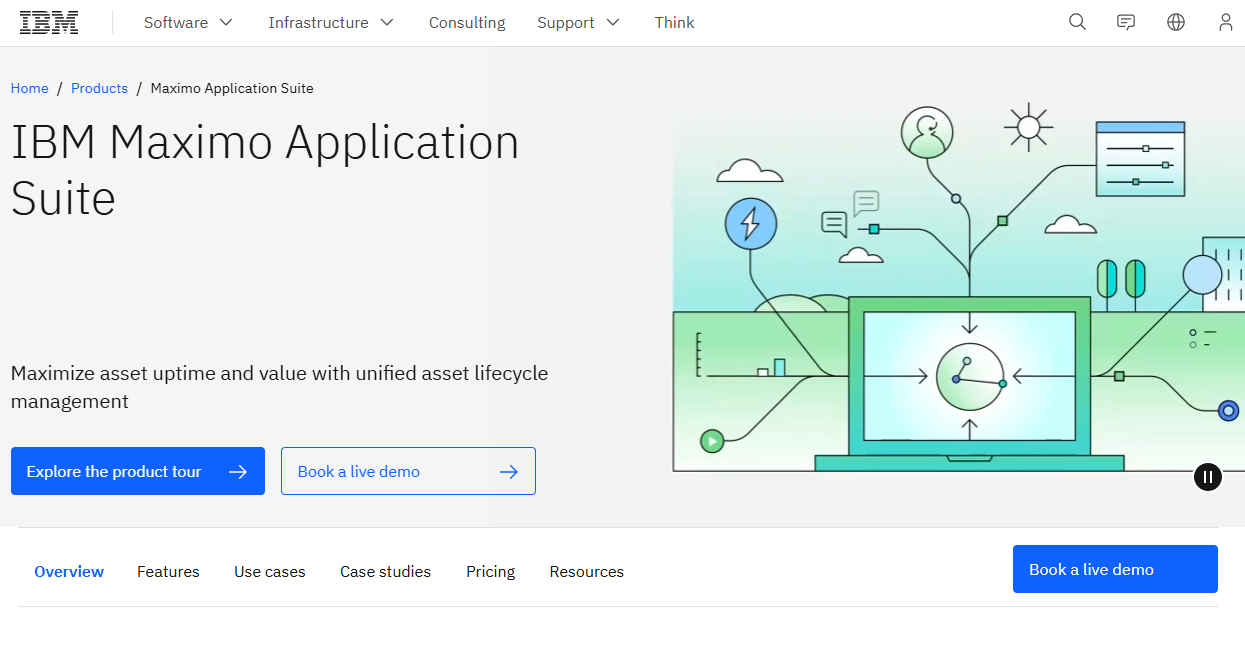
IBM Maximo Application Suite is a unified platform for maintenance, inspections, reliability, enterprise asset management, asset performance management, and asset investment planning. It covers the full lifecycle from acquisition through decommissioning across multiple asset classes. Organizations in utilities, energy, transportation, manufacturing, and public infrastructure use it when asset reliability directly affects safety, production capacity, or regulatory standing.
Best for: Global operations managing complex, high-value, heavily regulated physical assets across multiple sites.
Key features
- Enterprise asset lifecycle records and hierarchy management
- Work order and inspection management with mobile workforce support
- Asset performance management modules for condition-based decisions
- Predictive maintenance capabilities drawing on sensor and operational data
- AI-assisted features across maintenance, reliability, and lifecycle planning
Why choose IBM Maximo Application Suite: Maximo fits when asset reliability is a board-level risk, not just an operations metric. It is often excessive for a team whose primary need is work orders and PM schedules.
IBM Maximo Application Suite pricing: IBM publishes starting prices for the Essentials SaaS tier, which begins under $40,000 per year for modules including Maintenance, Inspection, and Inventory Optimization. Standard and Premium SaaS tiers, and the client-managed software option, require a quote. The cost drivers include selected modules, AppPoint licensing volume, deployment model, and implementation services.
G2 rating: 4.4/5 (verified October 2026)
2. SAP S/4HANA
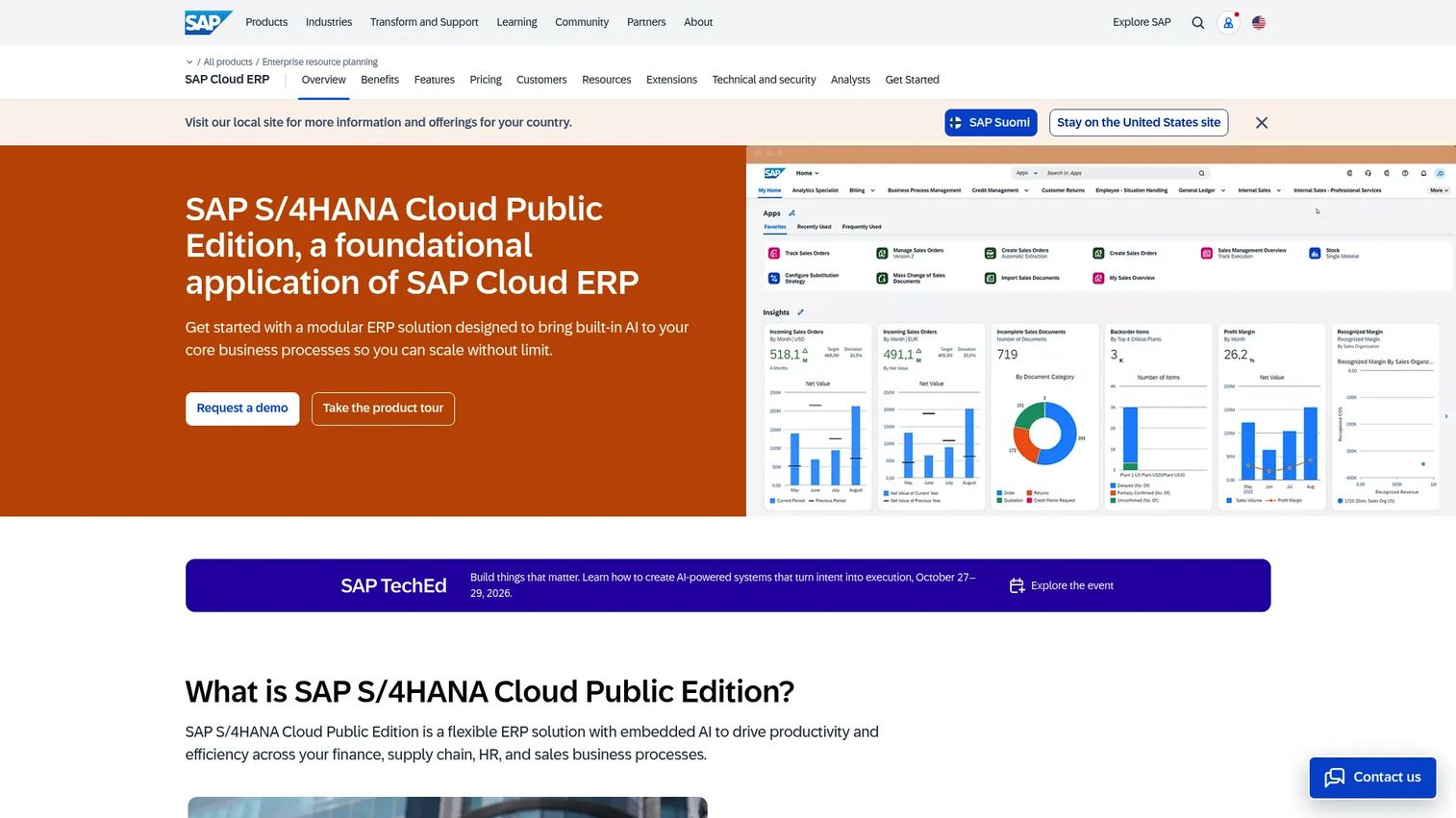
SAP S/4HANA is a modular ERP platform with embedded AI that covers finance, supply chain, human resources, and sales alongside asset maintenance. For organizations already standardized on SAP, the asset management module integrates maintenance planning and work orders directly with procurement, inventory, and financial records. That integration removes many of the manual data transfers that create gaps between maintenance teams and finance teams in non-integrated stacks.
Best for: Enterprises already running SAP that want maintenance embedded in the broader ERP workflow rather than managed in a separate system.
Key features
- Equipment and functional location records linked to financial data
- Maintenance planning, work orders, and labor scheduling
- Procurement and inventory integration within the SAP stack
- Mobile asset management options for field and plant technicians
- Asset performance management extensions for condition monitoring
Why choose SAP S/4HANA: SAP alignment reduces integration friction when finance, procurement, and maintenance already share the same data model. The implementation scope requires disciplined governance and a clear process owner. Teams without an existing SAP footprint will likely find a purpose-built EAM or CMMS easier to deploy.
SAP S/4HANA pricing: SAP directs all prospective buyers to request a quote. Commercial terms depend on the selected SAP modules, user count, deployment model (cloud or on-premise), and implementation scope.
G2 rating: 4.4/5 (verified October 2026)
3. IFS Cloud
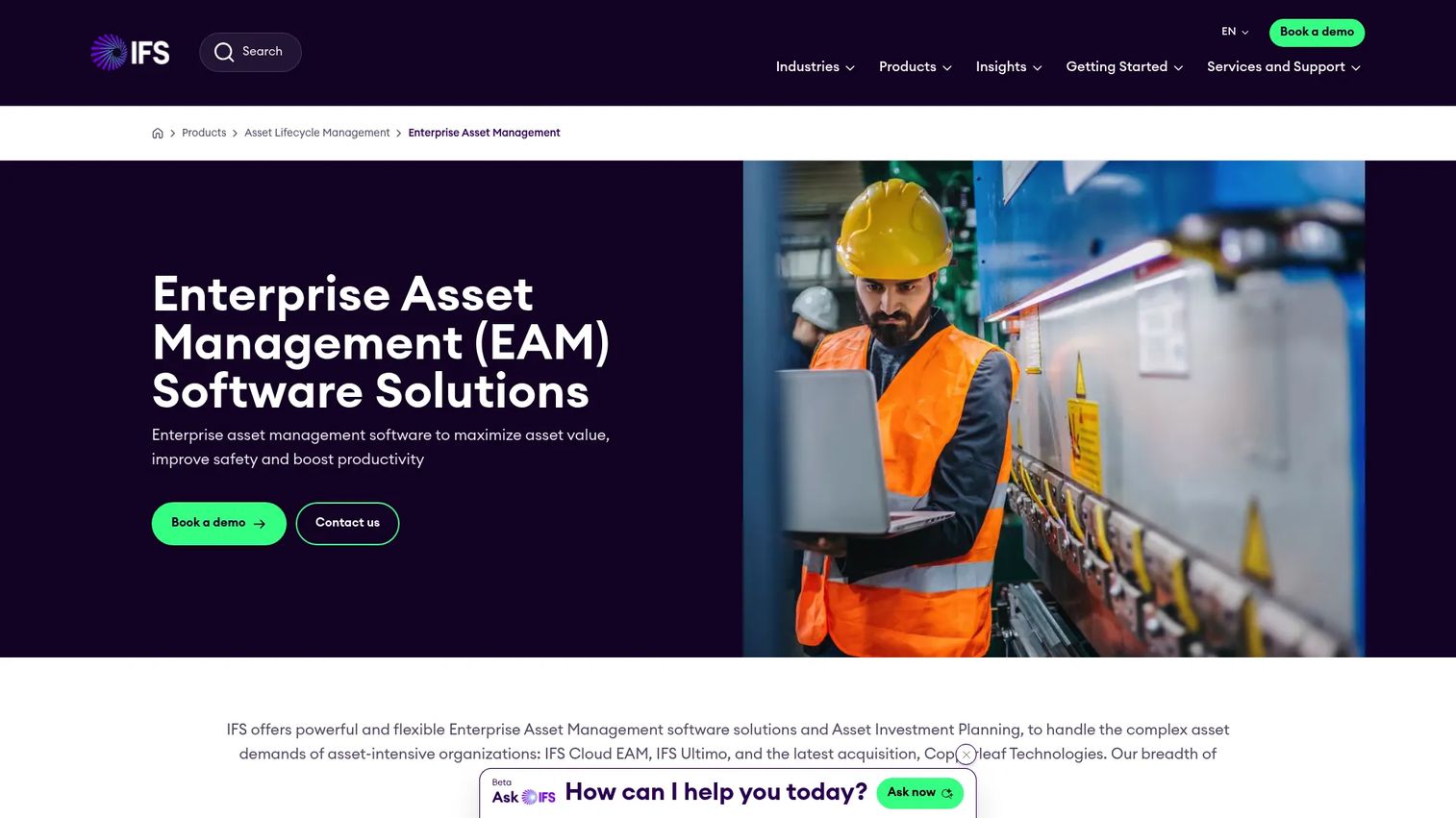
IFS Cloud is an AI-powered enterprise platform covering ERP, EAM, supply chain management, and field service management in a single suite. It is built for organizations where asset maintenance, distributed field operations, project management, and enterprise financials must operate from a common data model. The platform includes embedded industrial AI for predictive maintenance, anomaly detection, and dynamic scheduling, along with 3D visualization tools for asset inspection.
Best for: Asset-intensive companies with complex service operations, distributed workforces, or lifecycle processes that extend beyond a plant maintenance department.
Key features
- End-to-end asset lifecycle management from design through decommissioning
- Field service management and mobile technician dispatch
- Maintenance planning, scheduling, and work execution
- Embedded industrial AI for predictive maintenance and anomaly detection
- Supply chain and project connections within the same platform
Why choose IFS Cloud: IFS fits when the operating model spans both asset maintenance and field service delivery, and both need to share data without manual reconciliation. A disciplined rollout plan and a named process owner are prerequisites.
IFS Cloud pricing: IFS publishes no fixed price and directs buyers to its account team. Cost drivers include selected modules, user count, regional deployment requirements, industry-specific configuration, and implementation support scope.
G2 rating: 4.2/5 (verified October 2026)
4. HxGN EAM
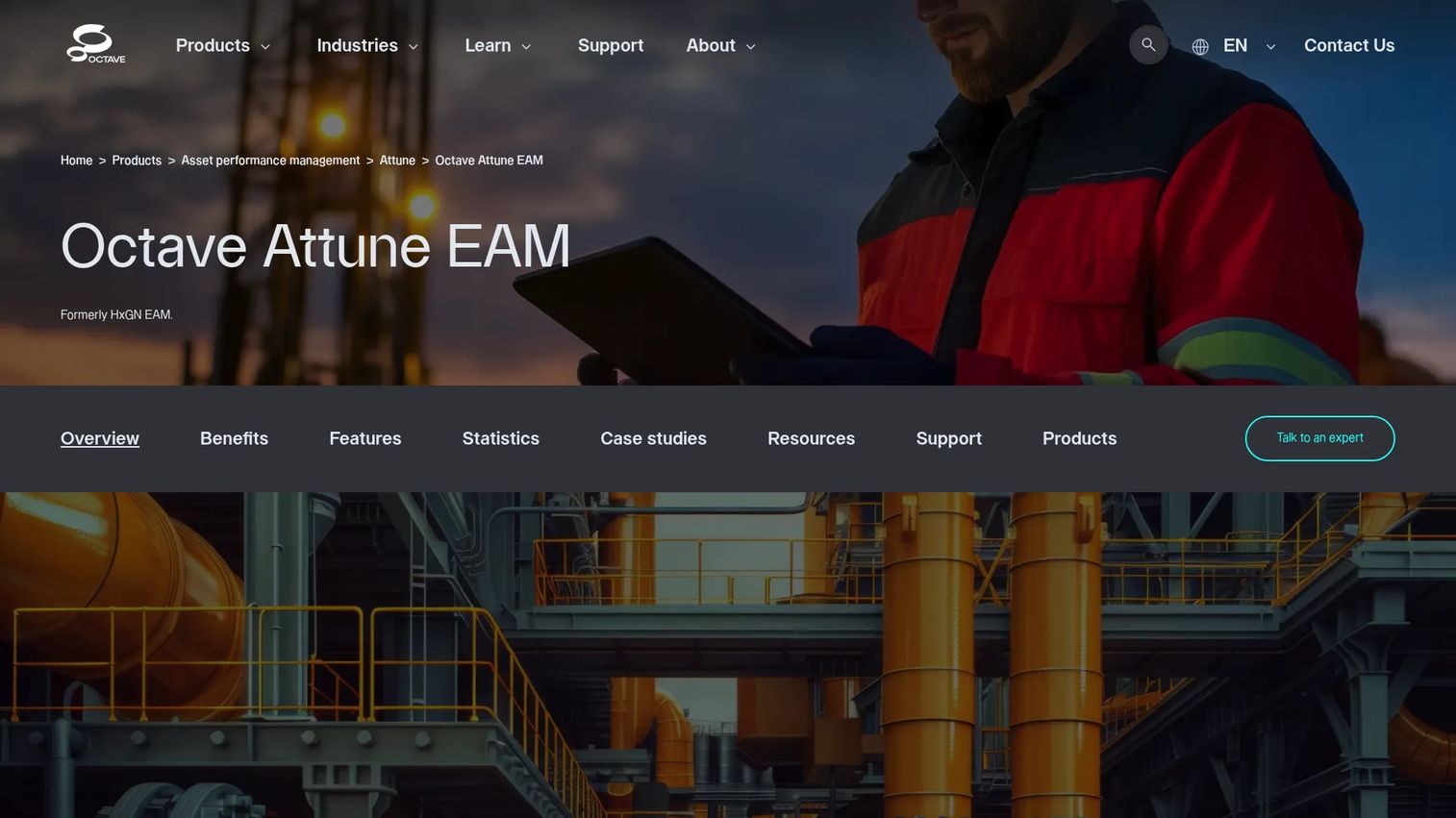
HxGN EAM, now rebranding as Octave Attune EAM under Hexagon, is an enterprise platform for managing assets, maintenance, work orders, inventory, and inspections with embedded AI assistance. It includes 2D CAD and 3D digital twin capabilities alongside standard EAM functions. Organizations in utilities, public sector, transportation, healthcare, and manufacturing use it when they need strong lifecycle governance and audit traceability.
Best for: Regulated and asset-heavy organizations that need governance, traceability, and lifecycle control across complex or geographically distributed asset portfolios.
Key features
- Asset hierarchy management and lifecycle tracking with digital twin support
- Work order management and labor scheduling
- Inventory and procurement management with embedded AI assistance
- Mobile access and field inspections
- Compliance documentation and audit records
Why choose HxGN EAM: The platform's strongest fit is organizations where asset complexity, regulatory exposure, and site count are all high. Teams evaluating it should account for the ongoing rebranding to Octave Attune EAM and confirm how that transition affects support, documentation, and contract terms.
HxGN EAM pricing: No public pricing is available. Contact Hexagon directly for commercial terms. Cost drivers include asset count, site count, selected modules, and implementation support.
5. eMaint CMMS
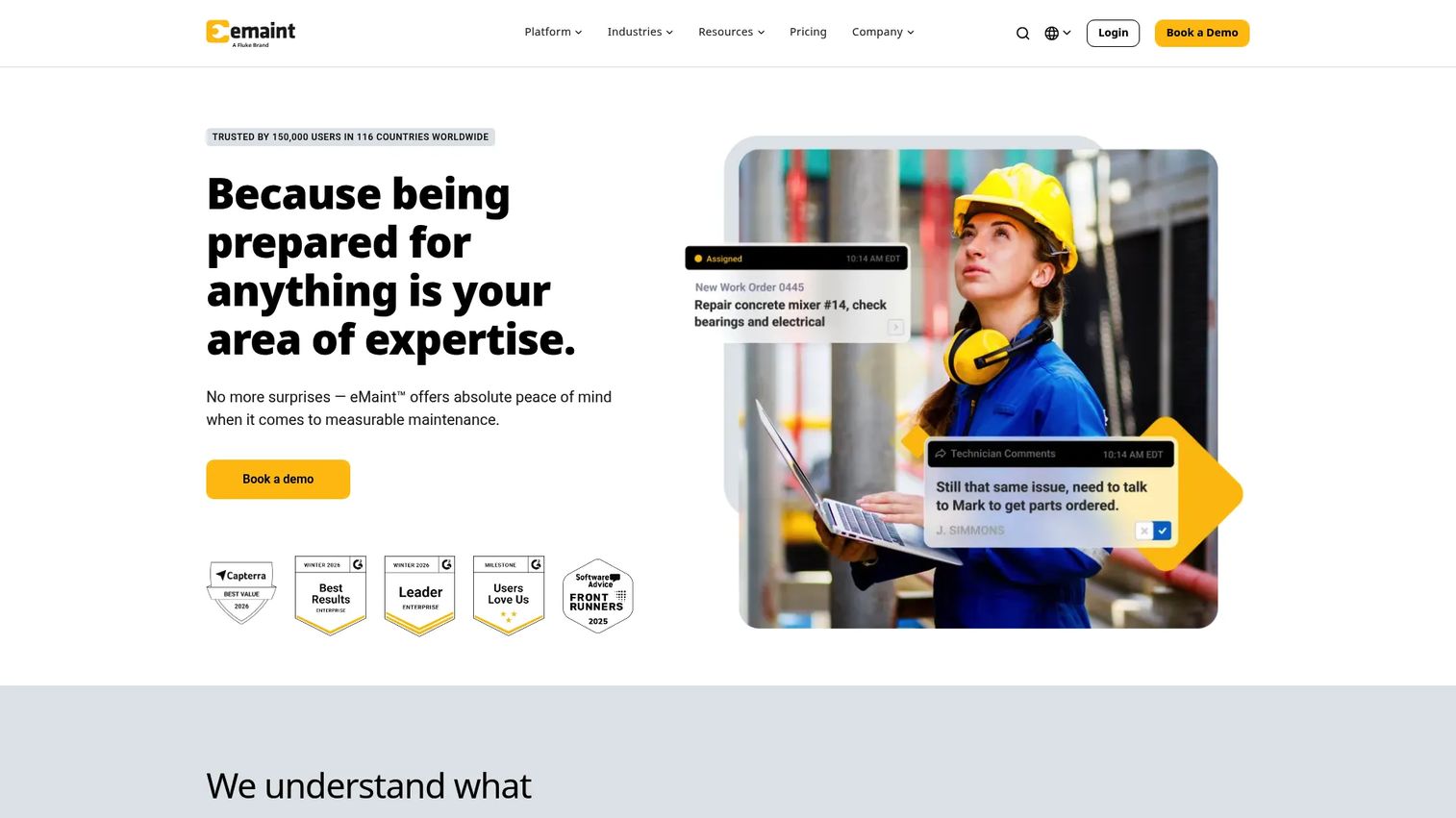
eMaint CMMS is a configurable maintenance management platform for teams that need stronger workflow depth, reporting, and compliance tools than a lightweight system provides. It covers work orders, preventive maintenance schedules, asset and location records, inventory management, and mobile access. Maintenance and reliability teams in regulated, multi-site, or complex operations use it when process standardization and audit readiness matter.
Best for: Maintenance organizations that need configurable workflows, compliance documentation, and reporting depth without purchasing a full enterprise EAM suite.
Key features
- Configurable work order workflows with approval routing
- Preventive maintenance schedules and asset history records
- Asset and location records with QR and barcode scanning
- Inventory management with procurement links
- Analytics, dashboards, compliance tools, and audit trails
Why choose eMaint CMMS: eMaint fits teams that need to standardize maintenance processes and demonstrate audit-ready records. The configuration scope should be defined before rollout to avoid scope creep during implementation.
eMaint CMMS pricing: eMaint offers Professional and Enterprise plans, both with prepaid annual commitments. Professional requires a minimum of three users; Enterprise requires five. Current numeric prices are set through direct negotiation. Contact eMaint for a quote.
6. MaintainX
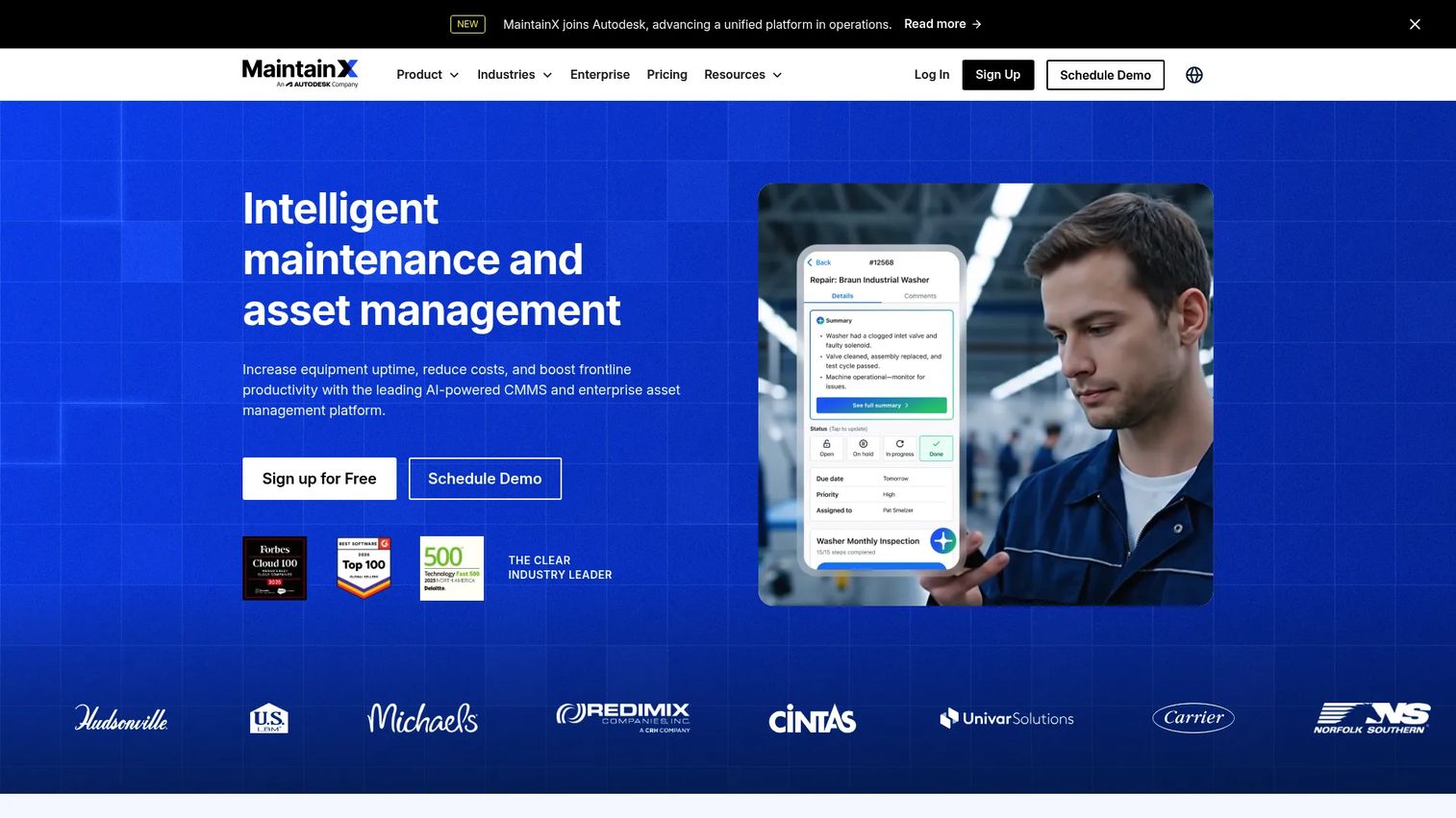
MaintainX is an AI-powered CMMS and EAM platform built for maintenance and frontline operations. Its mobile-first design makes it one of the fastest platforms to roll out at the technician level. It covers work orders, preventive maintenance, asset management, digital inspections, parts inventory, and reporting. AI-assisted troubleshooting and anomaly detection are included on higher plans.
Best for: Maintenance teams in manufacturing, facilities, and field operations that need technicians and frontline operators to consistently complete work orders and inspections from mobile devices.
Key features
- Mobile work order management with offline support
- Preventive and predictive maintenance scheduling
- Digital inspections and procedure management
- Asset history tracking across locations
- Reporting, workflow automation, and AI-assisted troubleshooting
Why choose MaintainX: MaintainX is the right choice when technician adoption is the first constraint, not enterprise architecture. Evaluate how it handles deeper governance and multi-site reporting requirements before standardizing across a large operation.
MaintainX pricing: MaintainX offers a free Basic plan. Essential is $20 per user per month billed annually ($25 monthly). Premium is $65 per user per month billed annually ($75 monthly). Enterprise pricing is custom.
G2 rating: 4.8/5 (verified October 2026)
7. UpKeep Asset Operations Platform
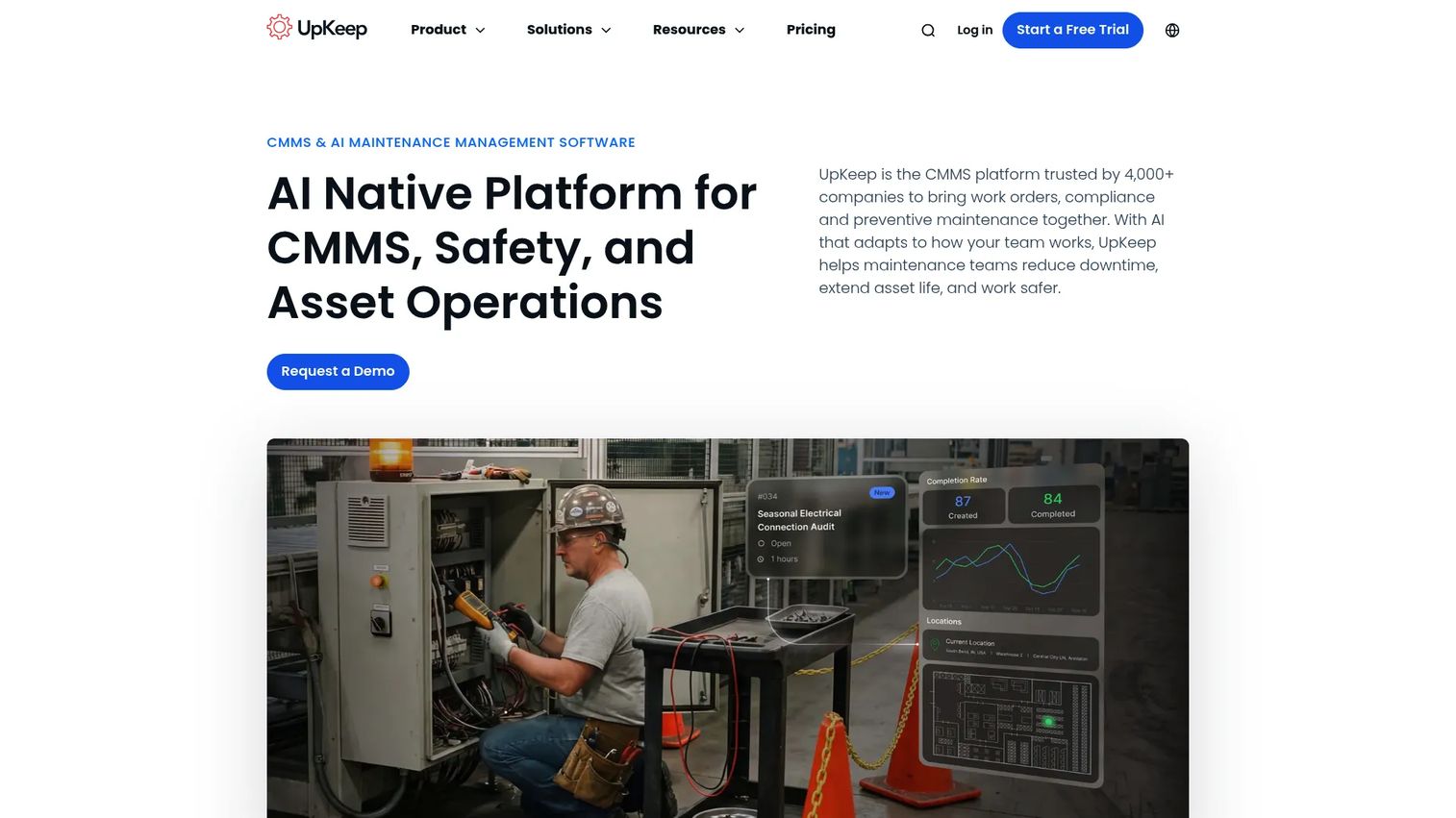
UpKeep Asset Operations Platform is a cloud-based asset operations platform covering work orders, preventive maintenance, asset tracking, inventory, and mobile technician workflows. It is designed for teams moving from spreadsheets and email coordination toward a structured maintenance system. AI maintenance tools and workflow automation are available across plans.
Best for: Operations teams that need work orders, asset tracking, and maintenance scheduling without a large enterprise deployment.
Key features
- Work order management with mobile technician access
- Preventive maintenance automation and scheduling
- Asset and maintenance records with history tracking
- Parts and inventory management
- AI maintenance tools and workflow automation
Why choose UpKeep Asset Operations Platform: UpKeep fits teams that need visible asset data and a structured maintenance process without committing to enterprise implementation overhead. Validate reporting depth and integration requirements during the evaluation, particularly if the operation spans multiple sites.
UpKeep Asset Operations Platform pricing: Essential starts at $24 per user per month. Premium is $55 per user per month. Professional and Enterprise tiers are quote-based. A free trial is available; a permanently free plan was not confirmed.
G2 rating: 4.5/5 (verified October 2026)
8. Fracttal
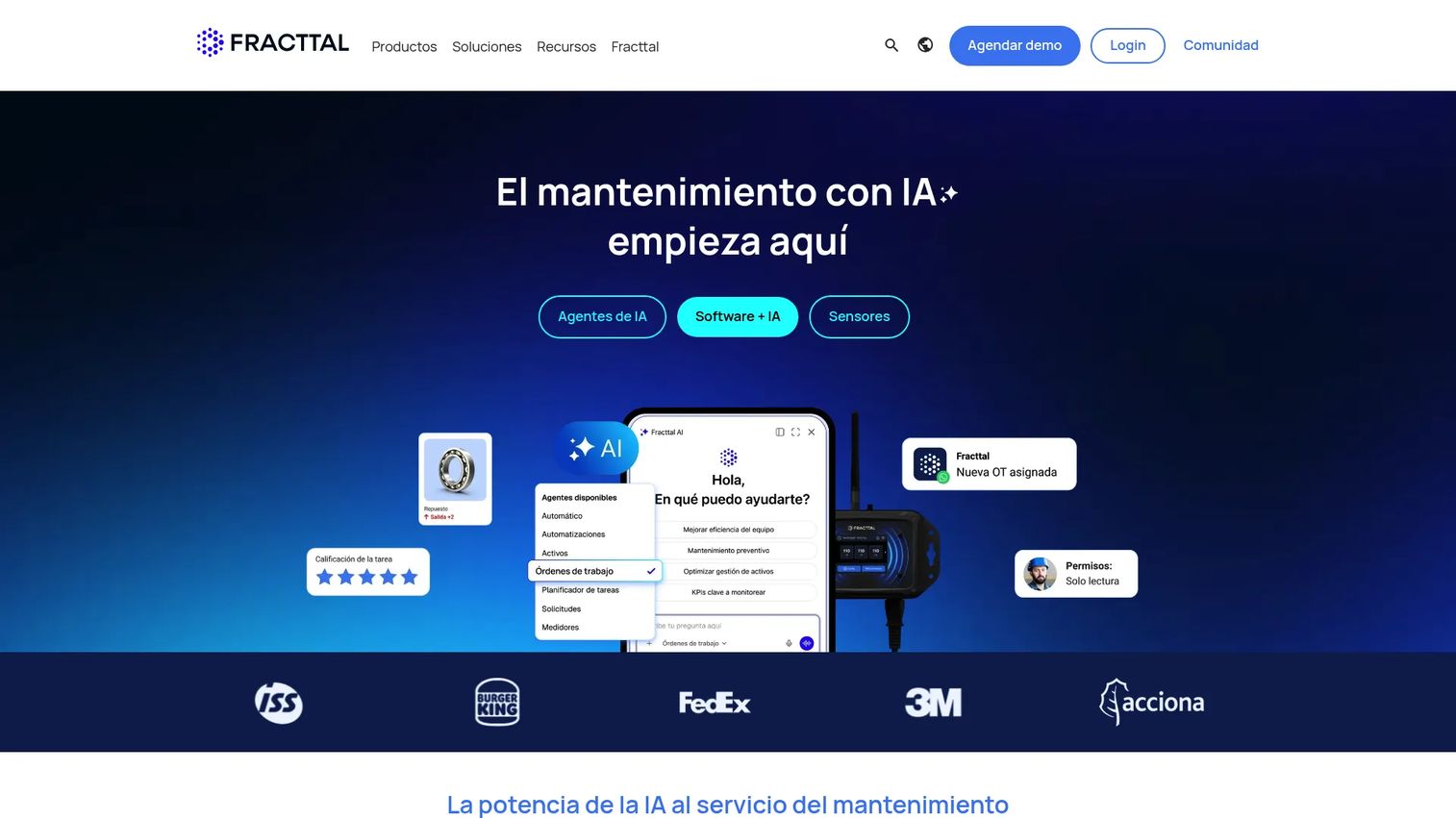
Fracttal is a cloud-based CMMS and EAM platform for organizing, automating, and executing maintenance operations across distributed locations. It covers asset management, work orders, preventive maintenance, IoT integrations, and predictive maintenance recommendations. Multi-site reporting and real-time KPIs give operations leaders visibility across locations without consolidating data manually.
Best for: Distributed maintenance teams that need centralized asset visibility, mobile work execution, and cloud-based reporting across multiple sites.
Key features
- Cloud asset management and monitoring
- Mobile maintenance operations with work-order management
- Preventive maintenance planning and scheduling
- IoT integrations and AI-assisted maintenance recommendations
- Multi-site reporting and real-time KPI dashboards
Why choose Fracttal: Fracttal suits organizations modernizing maintenance operations across distributed locations, particularly where IoT connectivity is part of the asset monitoring strategy. Assess integration compatibility with existing operational systems before committing.
Fracttal pricing: Fracttal provides pricing through a customized quote. Contact the sales team through their pricing page for commercial terms.
G2 rating: 4.6/5 (verified October 2026)
9. IFS Ultimo
IFS Ultimo is a cloud EAM solution focused on maintenance, safety, and management of technical, fleet, and medical assets. It includes an integrated EHS and operations suite, covering work permits, incident management, lockout/tagout, and task risk assessment alongside core maintenance functions. The platform deploys on Microsoft Azure and integrates with common business applications.
Best for: Organizations in manufacturing, logistics, and healthcare that need structured EAM with safety workflows and fleet or medical asset management.
Key features
- Technical, fleet, and medical asset lifecycle management
- Preventive maintenance scheduling and work-order execution
- Integrated EHS: Work permits, incident management, and lockout/tagout
- Fleet maintenance tracking including contracts, insurance, and mileage
- Microsoft Azure deployment with business application integrations
Why choose IFS Ultimo: IFS Ultimo balances enterprise EAM controls with a more focused deployment scope than the full IFS Cloud suite. It is a strong fit for teams that need structured maintenance and safety workflows without adopting an entire ERP platform. Evaluate data migration requirements and workflow configuration depth during the selection process.
IFS Ultimo pricing: IFS Ultimo is available in Professional, Premium, and Enterprise editions. Current numeric pricing is not displayed and requires a direct quote from IFS.
G2 rating: 4.5/5 (verified October 2026)
10. Maintenance Connection
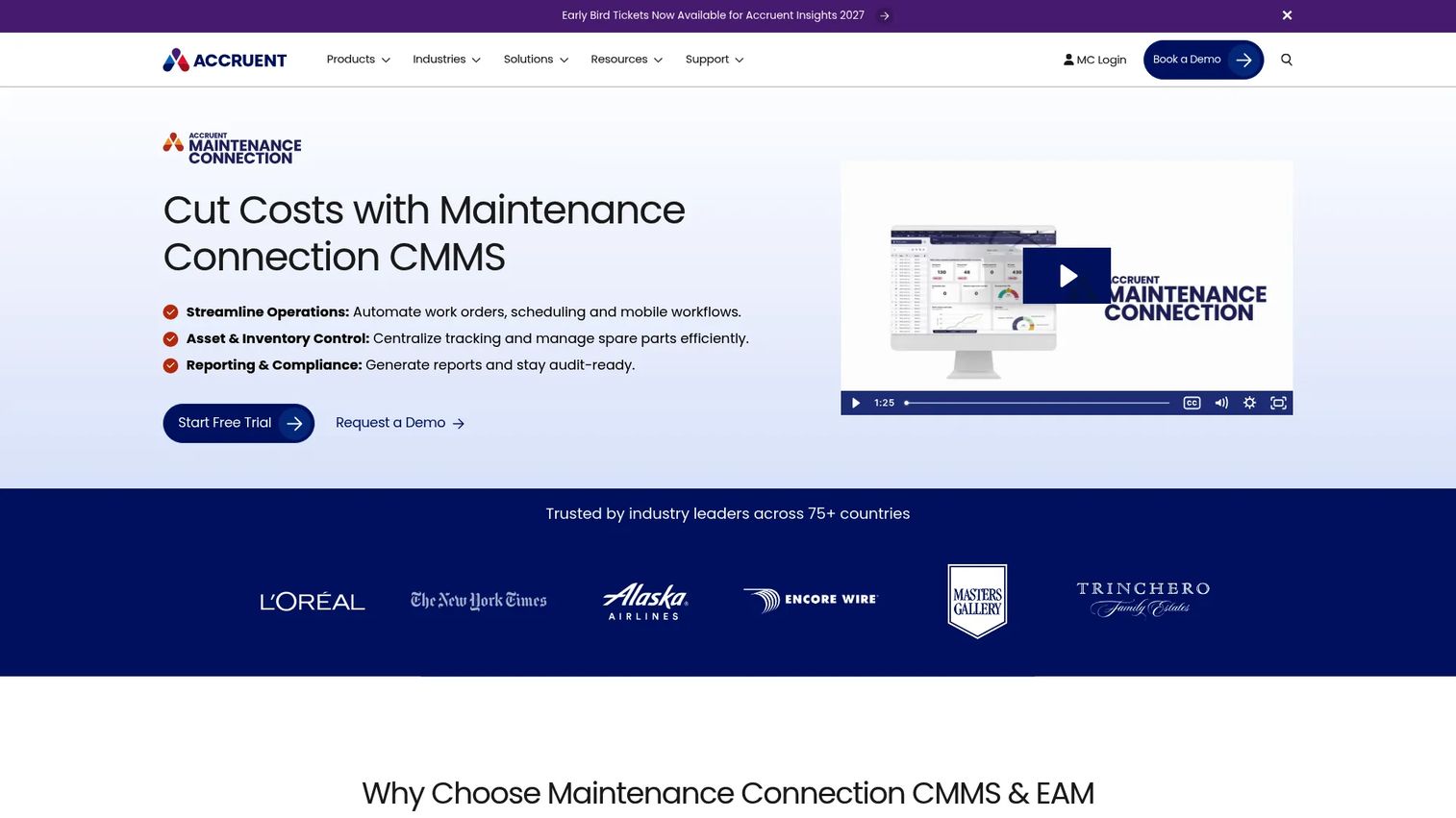
Maintenance Connection is a CMMS for work orders, asset tracking, preventive maintenance, inventory, and reporting, now owned and supported by Accruent. It offers configurable maintenance processes with both cloud and on-premise deployment options, mobile access with offline capabilities, and integrations with ERP, SCADA, IoT, and ArcGIS systems. A free trial is available.
Best for: Operations teams replacing legacy maintenance systems that need configurable processes, formal asset history, and broad integration support.
Key features
- Work order lifecycle management with automated notifications
- Preventive and predictive maintenance scheduling
- Asset and location tracking with full maintenance history
- Parts inventory management with barcode and QR scanning
- Integrations with ERP, SCADA, HR, EDMS, IoT, and ArcGIS
Why choose Maintenance Connection: Maintenance Connection belongs on the shortlist when configurable processes and formal maintenance history are the requirements. Migration quality will determine whether the system earns adoption. The integration breadth is a differentiator for operations already running SCADA or GIS platforms.
Maintenance Connection pricing: Pricing is customized based on configuration and named-user count. Subscription and perpetual licensing are both available. Contact Accruent through the pricing page for current commercial terms.
G2 rating: 4.4/5 (verified October 2026)
11. Limble CMMS
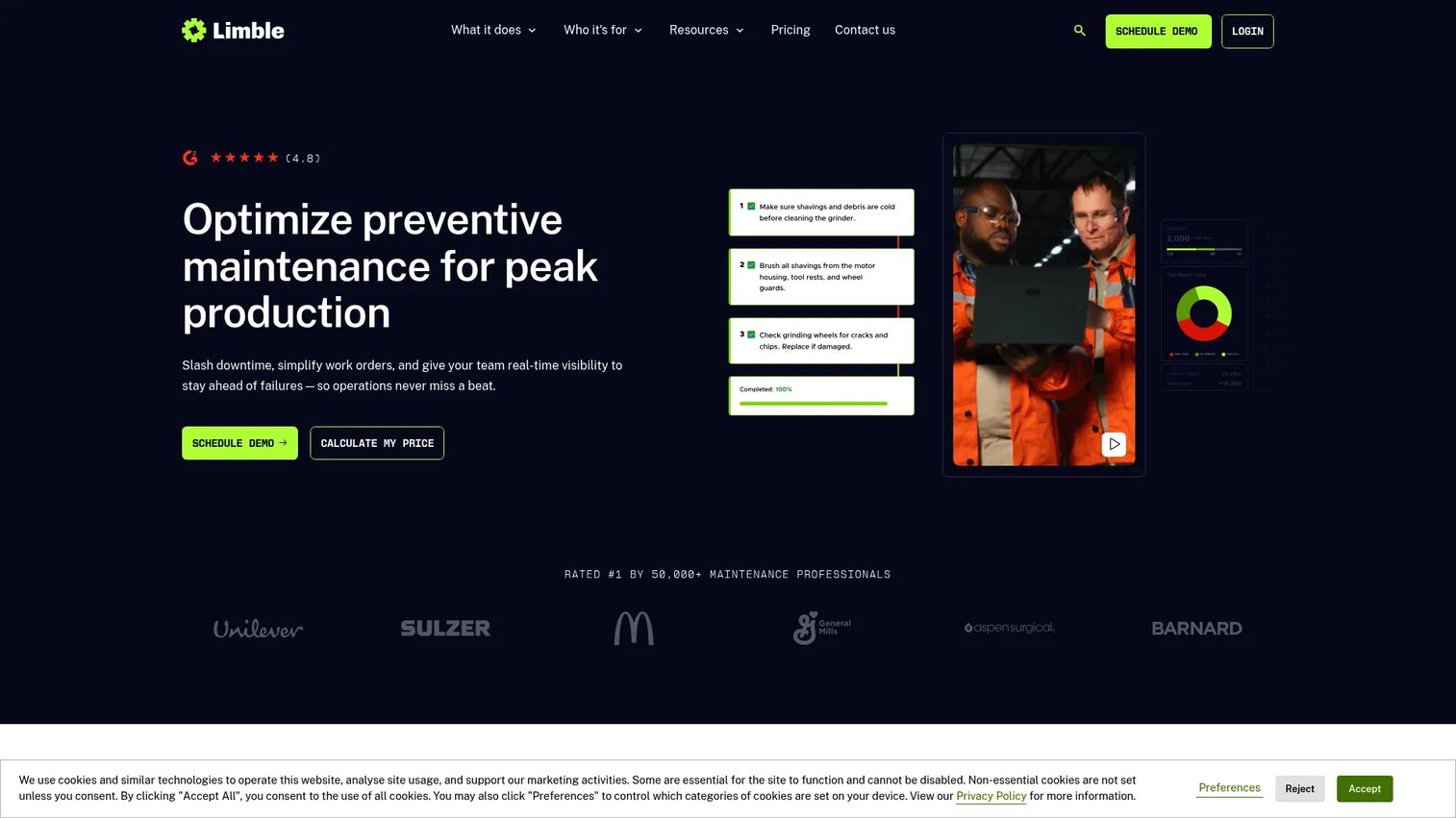
Limble CMMS is a mobile-first maintenance management system for teams that need to get work orders, preventive maintenance, parts, and asset history out of spreadsheets quickly. Its Standard, Premium+, and Enterprise plans scale from small maintenance teams to larger organizations. REST API access is included for teams that need custom integrations.
Best for: Small and mid-market maintenance teams that want fast adoption, mobile work execution, and accessible maintenance planning without a long implementation.
Key features
- Mobile CMMS app with work order management
- Preventive maintenance scheduling and asset history records
- Parts inventory and vendor management
- Custom dashboards, reporting, and REST API access
- Purchase order management
Why choose Limble CMMS: Limble's strongest fit is a team building discipline around maintenance basics. Buyers with complex compliance requirements, multi-region operations, or deep ERP integration needs should validate capability depth before standardizing.
Limble CMMS pricing: Limble offers Standard, Premium+, and Enterprise plans. Current numeric pricing is not displayed on the pricing page. Contact Limble for current commercial terms and plan specifics.
G2 rating: 4.8/5 (verified October 2026)
12. Fiix CMMS
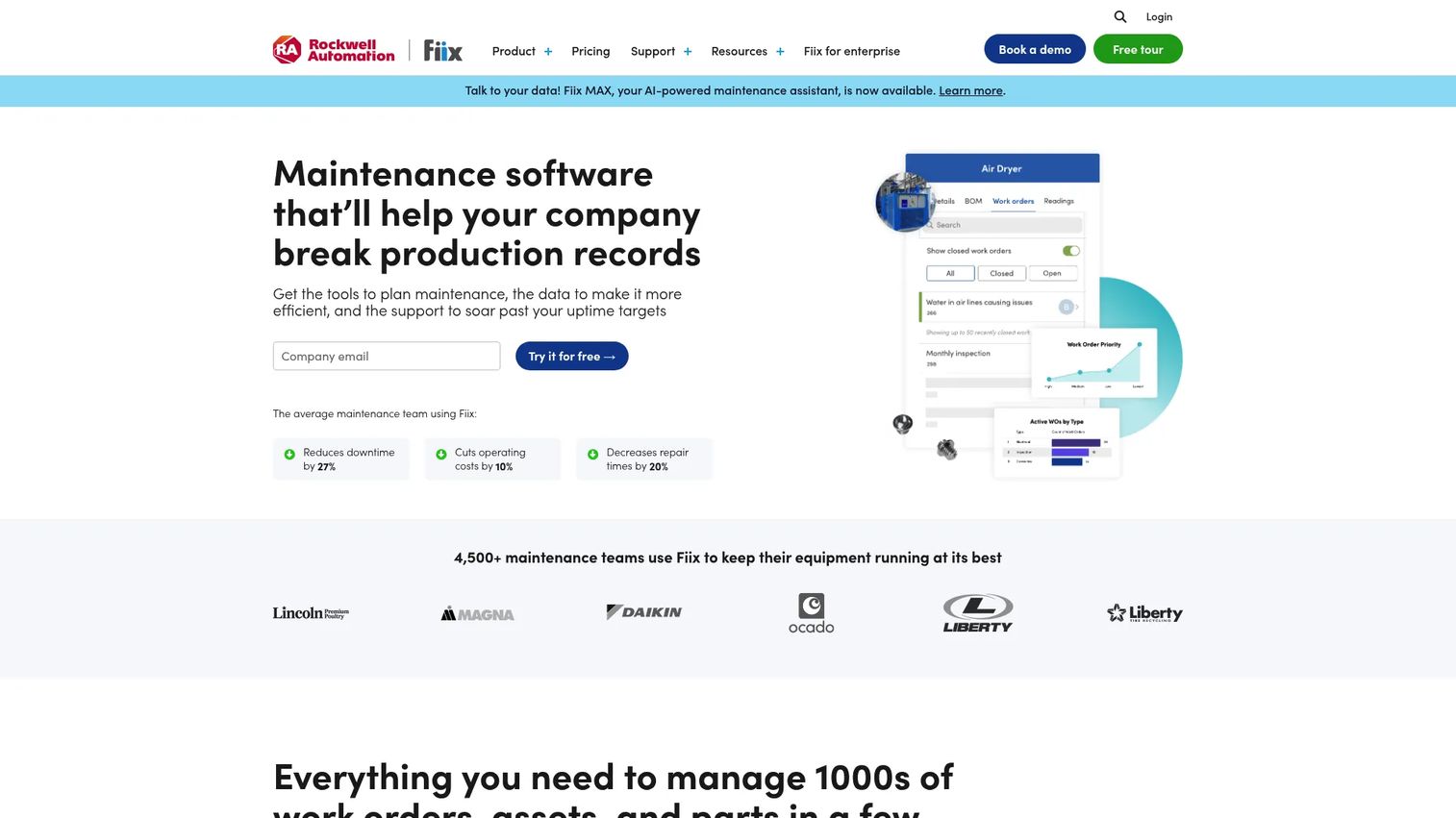
Fiix CMMS is a cloud-based maintenance management platform for planning, tracking, and optimizing maintenance operations. Its free plan covers core work orders, preventive maintenance, asset management, mobile access, and inventory. Paid plans add unlimited PMs, multi-site management, Fiix Foresight analytics, purchasing workflows, and enterprise governance features including SSO and audit trails.
Best for: Maintenance organizations that need work orders, PM schedules, asset history, and reporting as they move beyond reactive work.
Key features
- Work order management with asset lifecycle records
- Preventive maintenance planning and scheduling
- Mobile app with offline access and QR-code scanning
- Maintenance analytics and multi-site management on paid plans
- Integration capabilities with ERP and operational systems
Why choose Fiix CMMS: Fiix fits when the team wants a maintenance system that can mature with better planning and reporting. The free plan lowers the barrier to getting started. Validate the mobile workflow fit against your technician process before moving to a paid tier.
Fiix CMMS pricing: Fiix offers a free plan at $0. Basic is $45 per user per month. Professional is $75 per user per month. Enterprise is custom pricing. Lite License (Operator Access) and the Fiix MAX add-on are available at additional cost.
Considerations when choosing EAM software
Match the platform to your asset complexity
A fleet of similar field assets, a single manufacturing plant, and a multi-site utility do not need the same operating model. Evaluate asset count, hierarchy depth, criticality, location count, regulatory burden, and maintenance strategy before comparing features. A platform that handles 10,000 assets across 20 sites with compliance obligations is a different purchase than one managing 500 assets across two facilities.
Treat data migration as a product decision
Asset records, location structures, preventive maintenance plans, parts catalogs, and maintenance history often need cleanup before migration. Ask each vendor how they handle data mapping, bulk imports, validation, and rollback. The quality of the data that goes in determines whether the system earns adoption or becomes another source of distrust.
Verify technician adoption before buying enterprise breadth
A platform fails when technicians avoid it. Run a short workflow test with actual users: Create a work order, attach a photo, log labor, close the task, locate spare parts, and complete an inspection from a mobile device. Adoption at the frontline is the first metric that matters.
Map integrations to your operating stack
Confirm how the EAM connects to ERP, procurement, inventory, IoT platforms, BI tools, identity management, and field service systems. A generic "integration available" claim needs validation. Confirm the data direction, sync cadence, and whether the connection is native or requires a middleware layer. Related reading on contract lifecycle management software and asset inventory software covers adjacent stack decisions worth mapping alongside EAM.
Model total cost, not license cost
Software licensing is one component of the real cost. Implementation services, data migration work, integration development, administrator capacity, user training, custom reporting, and ongoing configuration all belong in the business case. The teams that regret EAM purchases usually underestimated one of these, not the license fee.
Conclusion
The right EAM purchase depends on where your operation sits today, not where you plan to be in three years.
IBM Maximo Application Suite, SAP S/4HANA, IFS Cloud, and HxGN EAM fit complex enterprise environments where asset reliability affects safety, compliance, or production. eMaint CMMS, IFS Ultimo, and Maintenance Connection fit organizations that need configurable maintenance processes with stronger governance depth. MaintainX, UpKeep, Fracttal, Limble CMMS, and Fiix CMMS fit teams prioritizing technician adoption, mobile work execution, and faster operational baseline.
The founder-level decision rule: Start with the maintenance workflow that costs you the most today. If your team cannot produce trusted asset history, planned work, parts availability, and downtime context from one system, you have an EAM problem. Choose the smallest platform that fixes that operating problem without creating a longer implementation problem.
Send this guide to your VP of Operations or your new Head of Maintenance. The right person to finalize the evaluation is the one who will live inside the system daily, not the one who approved the budget.
Start your journey with Guideflow today!
FAQs
EAM software, short for enterprise asset management software, is a platform for managing physical assets through acquisition, operation, maintenance, inspection, repair, and retirement. It centralizes asset records, work orders, inventory, and compliance documentation across teams and locations. The distinction from a basic CMMS is scope: EAM typically adds lifecycle planning, financial context, multi-site governance, and enterprise integrations.
A CMMS focuses primarily on maintenance execution, covering work orders, PM schedules, parts, and technician workflows. EAM includes those functions but adds lifecycle planning, deeper governance controls, financial context, multi-site visibility, and enterprise-grade integrations. Many organizations start with a CMMS and migrate to EAM as asset complexity or regulatory requirements grow.
ERP systems manage finance, procurement, supply chain, and core business processes. EAM systems manage the operational reliability and maintenance history of physical assets. Most enterprise environments integrate both, with ERP handling purchasing and financial records while EAM owns work execution and asset data. The integration between the two is often where organizations lose data quality if not managed carefully.
A small business should prioritize mobile usability, work orders, preventive maintenance, asset records, and inventory basics. MaintainX and Fiix CMMS both offer free plans that cover core maintenance functions. UpKeep starts at $24 per user per month. The right choice depends on asset count, site count, and whether you need integrations with existing accounting or ERP software.
Large enterprises should evaluate IBM Maximo Application Suite, SAP S/4HANA, IFS Cloud, and HxGN EAM when they need governance, complex integrations, high asset criticality, compliance controls, and multi-site standardization. IBM Maximo and IFS Cloud are purpose-built EAM platforms. SAP S/4HANA is the right fit specifically when the organization is already standardized on the SAP stack.
Many EAM systems can consume condition data, sensor readings, inspection history, or performance data to support predictive maintenance decisions. IBM Maximo, IFS Cloud, MaintainX, Fracttal, and Fiix all offer some form of predictive or AI-assisted maintenance capability. The critical prerequisite is reliable asset records and consistent work-order closeout. Predictive maintenance built on incomplete data produces unreliable signals.
Costs vary based on users, assets, sites, modules, integrations, and implementation scope. MaintainX starts free and scales to $65 per user per month. UpKeep starts at $24 per user per month. Fiix starts free with paid plans from $45 per user per month. Enterprise platforms like IBM Maximo, SAP S/4HANA, IFS Cloud, HxGN EAM, eMaint, and IFS Ultimo require quotes. IBM Maximo publishes an Essentials starting price under $40,000 per year. Implementation services and data migration often exceed the first-year license cost on enterprise deployments.
Implementation time depends primarily on asset data quality and workflow complexity. A mobile-first CMMS rollout can reach a usable baseline in weeks when asset data is clean and workflows are straightforward. Enterprise EAM deployments often run three to twelve months and require phased work across data migration, integration development, process definition, training, and change management. Buying a platform that matches your current maturity reduces implementation risk more than choosing the most feature-complete option.
Maintenance planning and scheduling covers the work of defining what maintenance tasks need to happen, estimating the labor and parts required, and sequencing the work against available technician capacity and planned downtime windows. EAM software automates PM triggers, tracks parts availability, assigns work to technicians, and records completion. Good scheduling data is the foundation for moving from reactive maintenance to reliability-centered programs over time.
Several platforms on this list support offline mobile access, including Maintenance Connection, Fiix CMMS, and MaintainX. Offline capability matters most for field operations, remote plant sites, and facilities with inconsistent connectivity. Confirm the specific offline features during evaluation: Some platforms cache read-only data offline, while others allow technicians to create and close work orders without a connection and sync when connectivity returns.