
Your sales team swears by live demos. Your marketing team wants recorded videos they can scale. Meanwhile, prospects ghost after both formats, and nobody agrees on what's actually working.
The live demos vs recorded demos debate misses the point. Neither format universally wins. The right choice depends on five factors: personalization requirements, scalability constraints, product complexity, control over the buyer experience, and how you plan to measure effectiveness.
Understanding live demos vs recorded demos helps you match format to deal context.
This guide breaks down each factor so you can match demo format to deal context instead of defaulting to whatever your team has always done.
TL;DR
- Personalization: Live demos adapt in real time to prospect reactions. Recorded demos deliver fixed content. Interactive demos use dynamic variables to personalize at scale without re-recording.
- Scalability: Live demos require rep time for every prospect. Recorded demos scale infinitely but sacrifice engagement. Your deal volume and average contract value determine the right mix.
- Product complexity: Complex products with many workflows often benefit from live guidance. Simple products work well as recorded content. Configurable products benefit from self-guided exploration.
- Control: Live demos risk technical failures and tangents. Recorded demos risk low completion rates. Interactive demos offer controlled experiences with engagement visibility.
- Measurement: Live demos rely on subjective rep notes. Recorded demos track views but not depth. Interactive demos capture granular engagement signals that inform follow-up.
What separates live demos vs recorded demos in practice
Live demos build trust through real-time interaction and high-touch personalization for complex sales. Recorded demos offer scalability, consistency, and convenience for top-of-funnel leads in a market moving toward 80% of B2B sales interactions in digital channels. According to Naoma's 2025 analysis, live demos often convert at 6 to 20 percent compared to 2 to 5 percent for traditional recorded videos, largely due to active objection handling.
Neither format universally wins. The right choice depends on deal stage, audience expectations, and what you plan to measure afterward.
Live product demos defined
A live product demo is a real-time, synchronous presentation where a sales rep walks through the product with the prospect present. The defining characteristic is two-way interaction happening in the moment.
Prospects ask questions, reps adjust the narrative, and both parties respond to each other's reactions. This format works best for complex, high-stakes, or enterprise sales requiring deep personalization.
Recorded product demos defined
A recorded product demo is a pre-made video walkthrough that prospects watch on their own schedule. The defining characteristic is one-way communication with no live interaction.
Viewers watch at their convenience, pause when needed, and share with colleagues. This format works best for scaling product walkthroughs, onboarding, and marketing.
Interactive demos as a third category
Interactive demos sit between live and recorded formats. They combine the on-demand nature of recorded content with hands-on exploration that keeps prospects engaged.
Instead of passively watching, prospects click through the product themselves. They make choices, explore features, and engage with the interface. This active participation increases engagement compared to passive video viewing.
| Format | Timing | Interaction | Personalization | Scalability |
|---|---|---|---|---|
| Live demo | Synchronous | Two-way, real-time | High (per call) | Low |
| Recorded demo | Asynchronous | One-way, passive | Low (fixed content) | High |
| Interactive demo | Asynchronous | Self-guided, active | Medium-high (dynamic variables) | High |
Factor 1: Personalization requirements for each deal
Personalization needs vary by deal size, buying stage, and stakeholder count. A $500 per month deal with a single decision-maker has different requirements than a $50,000 annual contract with eight stakeholders across three departments.
Live demos excel when you need to tailor messaging on the fly based on prospect reactions. You can skip irrelevant features when someone's eyes glaze over. You can dive deeper when they lean forward.
You can pivot entirely when they mention a competitor or reveal a pain point you hadn't anticipated.
Recorded demos struggle here because content is fixed at creation time. Every viewer sees the same walkthrough regardless of their role, industry, or specific challenges.
- Live demos: Adjust narrative mid-call, skip irrelevant features, answer questions in real time, respond to body language and verbal cues
- Recorded demos: Same content for every viewer unless you create multiple versions, no ability to respond to individual reactions
- Interactive demos: Use dynamic variables to swap names, logos, and data without re-recording, let prospects self-select paths based on their interests
The personalization spectrum matters most for high-value deals. When contract values justify the time investment, live personalization pays off. When you're running high-volume motions, scalable personalization through dynamic variables makes more sense.
Factor 2: Scalability of your demo motion
Live demos require rep time for every prospect. A single account executive can run perhaps 15 to 20 demos per week before quality suffers. That creates a hard ceiling on how many prospects can experience your product firsthand. Recorded demos scale infinitely. You create the content once, and thousands of prospects can watch it simultaneously. But completion rates drop without interaction.
Viewers multitask, skip ahead, or abandon the video entirely when nothing requires their active participation.
The trade-off sales teams face is reach versus depth. You can touch more prospects with recorded content or go deeper with fewer prospects through live calls.
- Live demo bottleneck: One rep can run a limited number of demos per week. Scaling requires hiring more reps, which increases cost and training overhead.
- Recorded demo scale: Unlimited viewers, but completion rates typically fall between 40 and 60 percent. Prospects who don't finish miss your most compelling features.
- Hybrid approach: Use recorded or interactive demos for early funnel qualification. Reserve live demos for prospects who've demonstrated intent through engagement.
Consider your average contract value when deciding where to invest. If deals average $2,000 annually, spending 45 minutes on a live demo for every inbound lead doesn't make economic sense. If deals average $200,000 annually, that same 45 minutes is a small investment relative to the potential return.
Factor 3: Product complexity and feature depth
Complex products with many workflows often benefit from live demos to navigate prospect questions. When your product serves multiple use cases across different departments, a linear recorded walkthrough can't anticipate which path each viewer cares about. Simple products with clear value propositions work well as recorded demos. If your product does one thing exceptionally well, a three-minute video can convey that value without requiring a live conversation.
The middle ground is where things get interesting. Products with moderate complexity and configurable workflows benefit from letting prospects self-navigate.
- High complexity products: Live demos let reps guide through relevant paths based on prospect role. A CFO sees ROI dashboards while an operations manager sees workflow automation.
- Simple products: Recorded demos suffice when the value prop is immediately clear. Viewers understand what they're getting within the first minute.
- Configurable products: Interactive demos let prospects explore the features that matter to them. Engagement data reveals which capabilities resonated most.
Think about how many questions prospects typically ask during your current demos. If most calls involve extensive Q&A about edge cases and integrations, live interaction adds value. If prospects mostly nod along and ask about pricing at the end, recorded content might serve them equally well.
Factor 4: Control over the buyer experience
Live demos give reps control over pacing and narrative, but that control comes with risks. Technical glitches happen. Demo environments break.
Internet connections drop at the worst moments.
Beyond technical failures, live demos risk tangents and awkward silences. A prospect asks about a feature you weren't planning to show. You navigate there, lose your place, and the demo loses momentum.
Recorded demos give you control over messaging but no control over whether prospects actually watch. You can't see their reactions. You don't know if they watched for 30 seconds or 30 minutes.
- Live demo risks: Technical glitches, awkward silences, prospect multitasking during the call, tangents that derail the narrative, demo environments that break under pressure
- Recorded demo risks: Low completion rates, no feedback loop, no way to know what resonated, prospects skipping to the end or abandoning entirely
- Interactive demo advantages: Controlled experience with engagement data showing what prospects clicked, how long they spent on each section, and where they dropped off
The control question also extends to consistency. With live demos, quality varies by rep. Your best account executive delivers a different experience than someone who joined last month.
Recorded and interactive demos ensure every prospect sees your best presentation of the product.
Factor 5: How you will measure demo effectiveness
Measurement capabilities differ dramatically by format. What you can track shapes what you can optimize.
Live demos rely on rep notes and deal outcomes. After the call, the rep logs their impressions in the CRM. "Good demo, prospect seemed engaged, following up next week." This subjective data helps with individual deal management but doesn't scale for pattern recognition across hundreds of demos.
Recorded demos track views and watch time. You know how many people clicked play and where they dropped off. But "viewed" tells you nothing about interest level.
Someone who watched passively while checking email counts the same as someone who took notes and shared with their team.
Interactive demos capture granular engagement signals. You see which features prospects explored, how long they spent on each section, and which paths they chose when given options.
- Live demo metrics: Subjective (rep feedback, deal progression, win/loss attribution). Hard to compare across reps or identify systematic improvements.
- Recorded demo metrics: Views, watch time, drop-off points. Better than nothing, but limited insight into actual interest.
- Interactive demo metrics: Clicks, feature exploration paths, time per section, completion rates. Actionable data for prioritizing follow-up and refining content.
The measurement gap matters most for teams trying to optimize their demo motion. If you can't see what's working, you can't improve it systematically.
When live demos still win
Despite the scalability advantages of recorded and interactive formats, live demos remain the best choice in specific scenarios.
Enterprise deals with executive stakeholders
Executives expect personalized attention and direct conversation. A recorded demo signals lower priority. When you're selling to a C-suite buyer, the live interaction itself communicates that you value their time.
These conversations also require real-time adaptation. An executive might redirect the entire discussion based on a strategic priority you didn't know about. Live demos let you pivot immediately rather than sending a different recording after the fact.
Technical products requiring real-time troubleshooting
When prospects have deep technical questions that vary by environment, live demos let presales teams address specifics. Pre-recorded content can't anticipate every integration scenario, security requirement, or edge case.
A solutions engineer can pull up documentation, demonstrate API calls, or walk through configuration options based on exactly what the prospect asks.
Late-stage negotiations with active objection handling
When a deal is close but objections remain, live conversation lets you address concerns immediately. Recorded content can't pivot to overcome last-minute hesitation about pricing, implementation timeline, or competitive positioning.
The back-and-forth of live negotiation also reveals what's really blocking the deal. Sometimes the stated objection isn't the real concern.
Competitive evaluations requiring rapid pivots
When a prospect is actively comparing you to competitors, live demos let you highlight differentiators based on what the prospect reveals about competitor demos. If they mention a limitation they saw elsewhere, you can demonstrate how your product handles that scenario differently.
When recorded demos make more sense
Recorded demos outperform live calls in scenarios where scalability, convenience, or consistency matters more than real-time interaction.
Top-of-funnel website conversion
Website visitors want instant information, not a meeting request. Embedding demos on landing pages lets prospects self-educate before committing to a conversation.
The friction of scheduling a call filters out curious visitors who might become qualified leads with more information. Recorded or interactive demos capture that interest while it's fresh.
Global audiences across multiple time zones
Scheduling live demos across time zones creates friction when 70% to 80% of B2B buyers prefer remote or digital interactions. A prospect in Singapore shouldn't have to take a call at midnight to see your product. Recorded demos are available when prospects are ready, regardless of your team's working hours.
High-volume outbound with standardized messaging
When running outbound campaigns to hundreds of prospects, attaching a recorded demo to emails scales without multiplying rep time. Every prospect gets the same quality presentation regardless of how many you're reaching.
Post-call leave-behinds for buying committees
After a live demo, sending a recorded or interactive version lets the champion share with stakeholders who missed the call. Buying committees rarely align schedules for a single live session when the average purchase involves 13 stakeholders.
Your champion can't recreate your demo from memory for each stakeholder. A shareable asset lets every stakeholder experience the product directly. A demo center organizes leave-behind assets by use case or persona, making it easy for champions to share the right content with the right stakeholders.
Why interactive demos change the live vs recorded equation
Interactive demos combine the scalability of recorded content with the engagement of live interaction. Prospects click through the product themselves rather than passively watching.
This shift from passive to active changes how prospects engage with your content. Instead of watching someone else use the product, they're using it themselves. They make choices, explore features, and build muscle memory for how the interface works.
- From passive to active: Prospects make choices, explore features, and engage with the product. Completion rates for interactive demos typically exceed those of passive video.
- From generic to personalized: Dynamic variables let you tailor content without re-recording. Swap in the prospect's company name, industry-specific data, or role-relevant workflows automatically.
- From blind to visible: Engagement analytics show exactly what prospects cared about. You see which features they explored, how long they spent, and where they dropped off.
The measurement advantage deserves emphasis. When you know a prospect spent three minutes exploring your reporting dashboard and skipped your collaboration features entirely, your follow-up conversation starts from a different place. You're not guessing what matters to them.
Capture any workflow in a few clicks and turn it into an interactive demo that prospects can explore on their own schedule.
How to build a hybrid demo strategy
The best demo strategies use multiple formats based on context. Here's how to combine them effectively.
1. Map demo format to each funnel stage
Different funnel stages warrant different formats. Early-stage prospects exploring options benefit from self-serve content. Late-stage prospects evaluating finalists benefit from live interaction.
- Website visitors: Interactive or recorded demos for immediate engagement without scheduling friction
- Discovery stage: Interactive demos to qualify interest before investing live time, or live calls for high-value accounts
- Evaluation stage: Live demos with leave-behind interactive versions for stakeholders who missed the call
- Close stage: Live demos with personalized sandbox environments for hands-on testing
2. Define triggers for live versus async delivery
Not every lead deserves a live demo. Define clear triggers that determine which format each prospect receives.
- Deal size thresholds: Prospects above a certain contract value get live demos. Below that threshold, they receive interactive content first.
- Engagement signals: Prospects who complete an interactive demo and return multiple times signal high intent. Prioritize them for live follow-up.
- Explicit requests: When prospects specifically ask for a live call, honor that preference regardless of deal size.
3. Create leave-behind assets for every live call
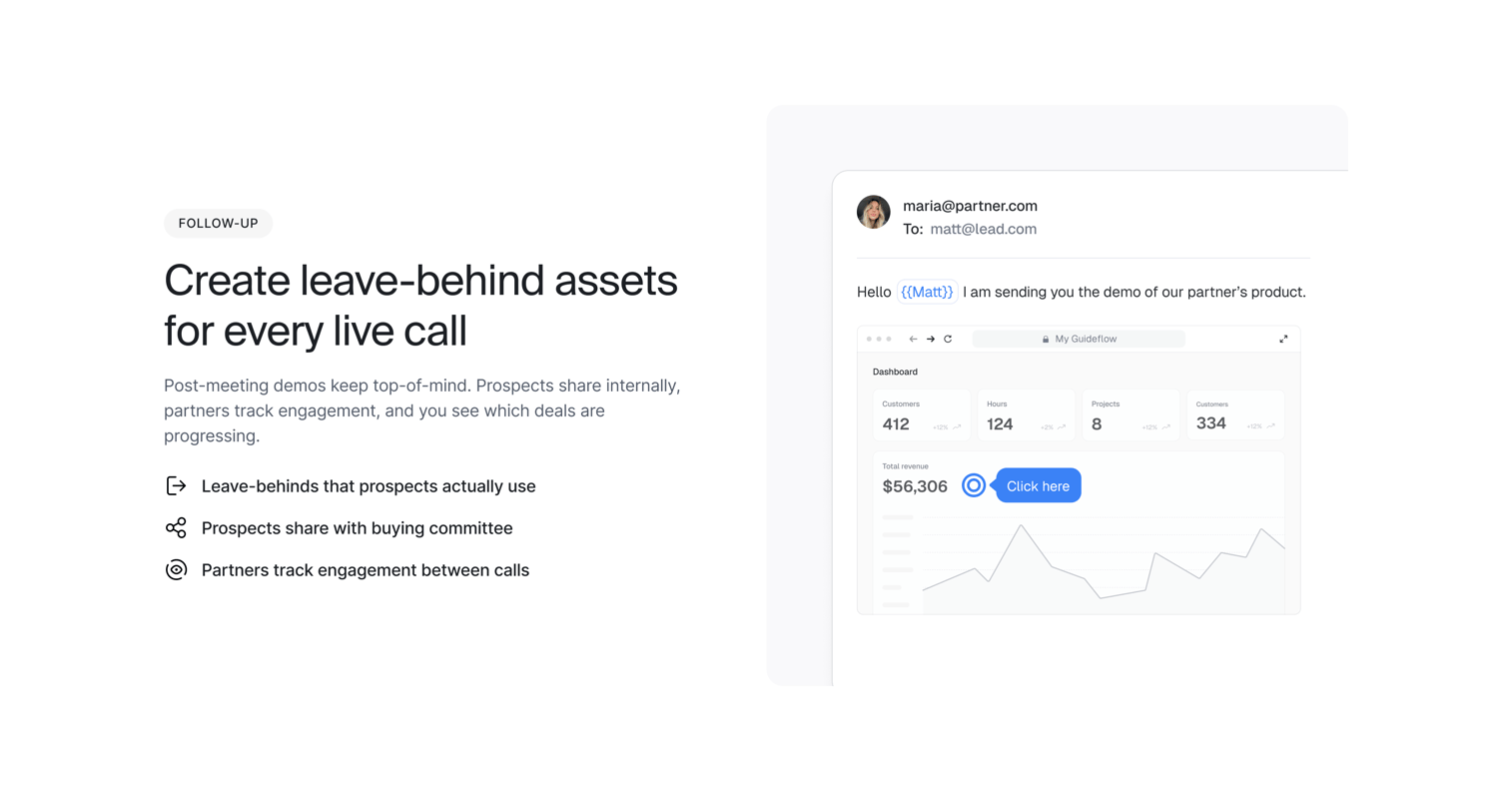
Even when you run live demos, you need async follow-up content. Prospects share internally, revisit features, and compare options after the call ends.
Send an interactive demo recap within 24 hours of every live call. Reference specific moments from the conversation: "Here's the reporting workflow we discussed that would save your team 10 hours per week."
4. Track engagement signals across all demo formats
Unified measurement matters. Whether a prospect watched a recorded demo, clicked through an interactive version, or attended a live call, you want visibility into their engagement.
Engagement data informs sales follow-up regardless of demo format. A prospect who explored your integration options extensively has different questions than one who focused on end-user workflows.
Integrate with HubSpot, Salesforce, and more to sync engagement data directly into your CRM.
Common mistakes that undermine both demo formats
These failure modes hurt conversion regardless of whether you're running live or recorded demos.
Treating all prospects identically regardless of intent
High-intent prospects want depth. They've done their research and have specific questions about implementation, integrations, or edge cases. Showing them a basic overview wastes their time.
Early-stage prospects want overview. They're still figuring out whether your category solves their problem. Diving into advanced features before they understand the basics overwhelms them.
Measuring views instead of engagement depth
"Demo viewed" tells you nothing about interest. A prospect who watched 30 seconds counts the same as one who watched the entire thing and took notes.
Track what prospects clicked, how long they spent on each section, and where they dropped off. Engagement depth data reveals actual interest far better than binary view counts.
Failing to follow up with demo engagement context
Sales follow-up often ignores what the prospect actually explored. Generic "did you watch the demo?" emails waste the signal you collected.
Reference specific features they engaged with. "I noticed you spent time exploring our reporting dashboard. Would it help to see how that integrates with your existing BI tools?"
Over-investing in production quality at the expense of speed
A polished video that takes weeks to produce is outdated by launch. Your product evolves, your messaging shifts, and the demo no longer reflects reality.
Prioritize speed and iteration over perfection. A good-enough demo you can ship today beats a perfect demo you'll ship next quarter.
Stop choosing between live demos vs recorded demos
The live demos vs recorded demos debate assumes you have to pick one. You don't. The live demos vs recorded demos question has no single answer.
The best demo strategies use multiple formats based on deal stage, prospect intent, and measurement needs.
Interactive demos offer the benefits of both: the scalability of recorded content with the engagement of hands-on exploration. Prospects experience your product on their own schedule while you capture the engagement signals that inform follow-up.
Get started now and create your first interactive demo in minutes.
FAQs about live demos vs recorded demos
Recorded demos are passive video content prospects watch. Interactive demos are clickable experiences prospects navigate themselves, making choices and exploring features at their own pace.
Keep recorded demos under three minutes for top-of-funnel audiences. Mid-funnel prospects who've shown intent can handle longer content, but attention still drops after 10 to 15 minutes.
Traditional recorded demos require creating multiple versions for different segments. Interactive demos allow personalization through dynamic variables that swap names, logos, and data without re-recording.
Live demos require reliable video conferencing software, a stable internet connection, and a clean demo environment with realistic data. Test everything an hour before the call.
Keep a backup recorded or interactive version ready. When something breaks, acknowledge it quickly and pivot: "Let me pull up the interactive version so we don't lose time."
Track demo completion rates, conversion from demo to next stage, and engagement depth (features explored, time spent). Compare metrics across demo formats to identify what's working.