You can service the first hundred loans with spreadsheets, a payment processor, and one ops person who remembers every exception. That breaks when the portfolio grows.
The problem is not the volume itself. It is that every workaround becomes a dependency. Late fees get calculated manually. Escrow exceptions live in someone's inbox. Investor reports take two days to assemble. The ops person becomes the loan servicing system, and the loan servicing system cannot take a vacation.
The global loan servicing software market was valued at $4.43 billion in 2026 and is projected to reach $8.11 billion by 2031, according to Mordor Intelligence (2026). That growth reflects something real: Servicing has moved from back-office admin to a growth and risk system. Whether you are a fintech lender scaling a consumer portfolio, a private lender managing real estate and construction loans, or a bank consolidating legacy infrastructure, the platform you choose determines whether lending operations scale cleanly or become the thing slowing everything else down.
This guide compares 11 loan servicing platforms for 2026 to help you build a shortlist, not justify a gut decision.
What's inside
This guide covers 11 loan servicing software platforms evaluated for 2026. Selection focused on lenders who are outgrowing spreadsheets, adding loan products, or replacing a system that worked at lower volume.
- Who this is for: Fintech lenders, private lenders, mortgage teams, banks, credit unions, and specialty finance operations
- Selection criteria: Loan product fit, servicing automation depth, reporting and investor reporting, integration breadth, and compliance controls
- Evidence standard: Pricing verified against vendor pages; G2 ratings pulled from live listings
TL;DR
- Best for configurable consumer and fintech lending: LoanPro, an API-first servicing platform with payment orchestration built for multi-product portfolios
- Best for modern fintech infrastructure: Peach Finance, cloud-native servicing with compliance workflows and borrower communications
- Best for end-to-end lending operations: TurnKey Lender, covering origination through servicing in one platform
- Best for private lenders: The Mortgage Office, with investor reporting, fund management, and construction draw support
- Best for enterprise financial institutions: Fiserv or FIS, for banks and credit unions consolidating multiple loan categories
- Best for commercial real estate servicing: Enterprise!, with CRE loan accounting, asset management, and investor reporting
What is loan servicing software?
Loan servicing software is a system lenders and servicers use to manage loans after origination, including payments, statements, escrow, borrower communication, collections, reporting, accounting, and compliance workflows.
It is the operational core of any lending business after a loan is booked. Without it, every payment posting, late fee calculation, and payoff quote becomes a manual judgment call.
Core loan servicing functions
A capable loan servicing system handles:
- Payment processing and posting
- Amortization schedules and payoff calculations
- Borrower account management and statements
- Collections and delinquency workflows
- Default management and loss mitigation
- Escrow, reserves, and construction draw management
- Investor reporting and distributions
- Loan accounting and general ledger export
- Borrower portals and document sharing
- Compliance records and audit trails
Loan servicing vs. loan origination software
These two categories solve different problems, and conflating them creates expensive gaps.
Origination covers applications, underwriting, credit decisioning, document collection, approvals, and closing. The primary risk is bad approvals.
Servicing starts after the loan is funded. The primary risk is bad portfolio management, which means missed payments going undetected, investor reports being wrong, or exceptions living outside any system.
| Area | Loan origination software | Loan servicing software |
|---|---|---|
| Primary stage | Before funding | After funding |
| Main users | Sales, underwriting, credit | Servicing, operations, finance |
| Core workflows | Applications, decisioning, documents | Payments, reporting, collections |
| Key risk | Bad approvals | Bad portfolio management |
Some platforms cover both. Most do one well and handle the other with workarounds. Verify depth in each workflow before committing to a combined platform.
What buyers should expect in 2026
Servicing automation has moved from optional to table stakes. The most capable platforms now offer configurable workflow automation, borrower self-service portals, real-time payment processing, and investor reporting that does not require a finance analyst to assemble. According to KPMG (2025), 60% of mortgage lenders and servicers cited modernizing their technology stack as a competitive differentiator, and 43% named reducing costs and driving efficiency as a top operational priority. The platforms that earn their spot on a shortlist in 2026 connect to your accounting stack, CRM, and payment processors without custom engineering on every integration.
When to use loan servicing software
Replace spreadsheets before exceptions become policy
Early lending operations often run on spreadsheets, point-in-time accounting exports, and a payment processor that was never designed for loan tracking. The danger is not inefficiency alone. Exceptions start living in people's heads. One ops person holds the logic for interest calculations, late fee waivers, and payoff adjustments. When that person leaves, the knowledge leaves with them. Loan servicing software creates repeatable workflows, audit trails, and reporting that a board or investor can actually trust.
Support more loan products without rebuilding operations
Adding a second loan product, whether that is installment loans alongside your revolving credit line, or bridge loans on top of standard mortgage servicing, typically breaks the manual workflows that worked for your first product. Configurable product rules, payment schedules, payoff logic, and reporting by product type are what let you expand without rebuilding operations from scratch each time.
Give borrowers and investors self-serve visibility
Borrowers expect statements, payment schedules, and payoff quotes on demand. Investors in private lending expect distribution schedules and portfolio summaries without emailing your ops team. Borrower portals and investor portals reduce that support load and improve the credibility of your reporting. For a founder heading into a fundraise or board review, having investor-ready reports that come directly from the servicing system matters more than the portal itself.
Loan servicing software comparison
Pricing and G2 ratings in this table reflect verified data from vendor pricing pages and live G2 listings. Vendors that do not post numeric pricing require a sales quote; the pricing column notes what drives cost in those cases.
| # | Product | Best for | Key differentiator | Pricing | G2 rating |
|---|---|---|---|---|---|
| 1 | LoanPro | Configurable consumer and fintech servicing | API-first platform with payment orchestration | Quote-based (volume and modules) | 4.4/5 |
| 2 | Nortridge | Specialty finance and multi-product lenders | Mature servicing with 150+ reports and escrow modules | From $1,200/month | 3.5/5 |
| 3 | Peach Finance | Modern fintech and embedded lending | Cloud servicing with compliance monitoring | Quote-based | 4.7/5 |
| 4 | TurnKey Lender | Lenders wanting origination plus servicing | End-to-end platform with AI-powered decisioning | Quote-based | 4.6/5 |
| 5 | Canopy | Consumer and embedded credit programs | API-first servicing with LoanLab simulation | Quote-based | 3.5/5 |
| 6 | Shaw Systems | Banks, credit unions, and finance companies | Per-loan subscription with embedded AI for collections | Quote-based | 4.3/5 |
| 7 | Fiserv | Enterprise financial institutions | Retail and mortgage servicing across multiple loan types | Quote-based | 4.3/5 |
| 8 | FIS | Large banks and enterprise lenders | Core banking integrations with enterprise lending tech | Quote-based | 4.2/5 |
| 9 | The Mortgage Office | Private lenders and mortgage teams | Fund management, investor portals, and construction draws | Quote-based | 4.8/5 |
| 10 | Bryt | Small and mid-sized private lenders | Modular cloud servicing with a 30-day free trial | Modular, trial available | N/A |
| 11 | Enterprise! | Commercial real estate servicers | CRE loan accounting, asset management, and investor reporting | Quote-based | N/A |
Best 11 loan servicing software platforms for 2026
1. LoanPro
LoanPro is a composable, API-first lending and credit platform built for lenders that need operational control across consumer and specialty portfolios. The platform covers origination, servicing, payments, collections, and reporting in a single system. LoanPro is used by financial institutions, fintechs, and specialty lenders managing multi-product lending portfolios.
Best for: Fintech lenders and consumer credit teams that need flexible servicing infrastructure without building a system from scratch.
Key features
- API-first configurable platform for multi-product lending
- Origination, servicing, payments, and collections suites
- Real-time ledger with compliance safeguards
- Configurable loan products and payment orchestration
- Borrower communication tools and servicing workflow automation
Why choose LoanPro: Choose LoanPro when servicing flexibility and payment control matter more than buying a mortgage-specific or narrow single-product tool. It suits teams that want to configure their own rules rather than inherit someone else's assumptions.
LoanPro pricing: LoanPro sets pricing by account volume and required modules; they do not post a flat rate. Contact sales with your portfolio size and product mix to get a quote.
G2 rating: 4.4/5
2. Nortridge
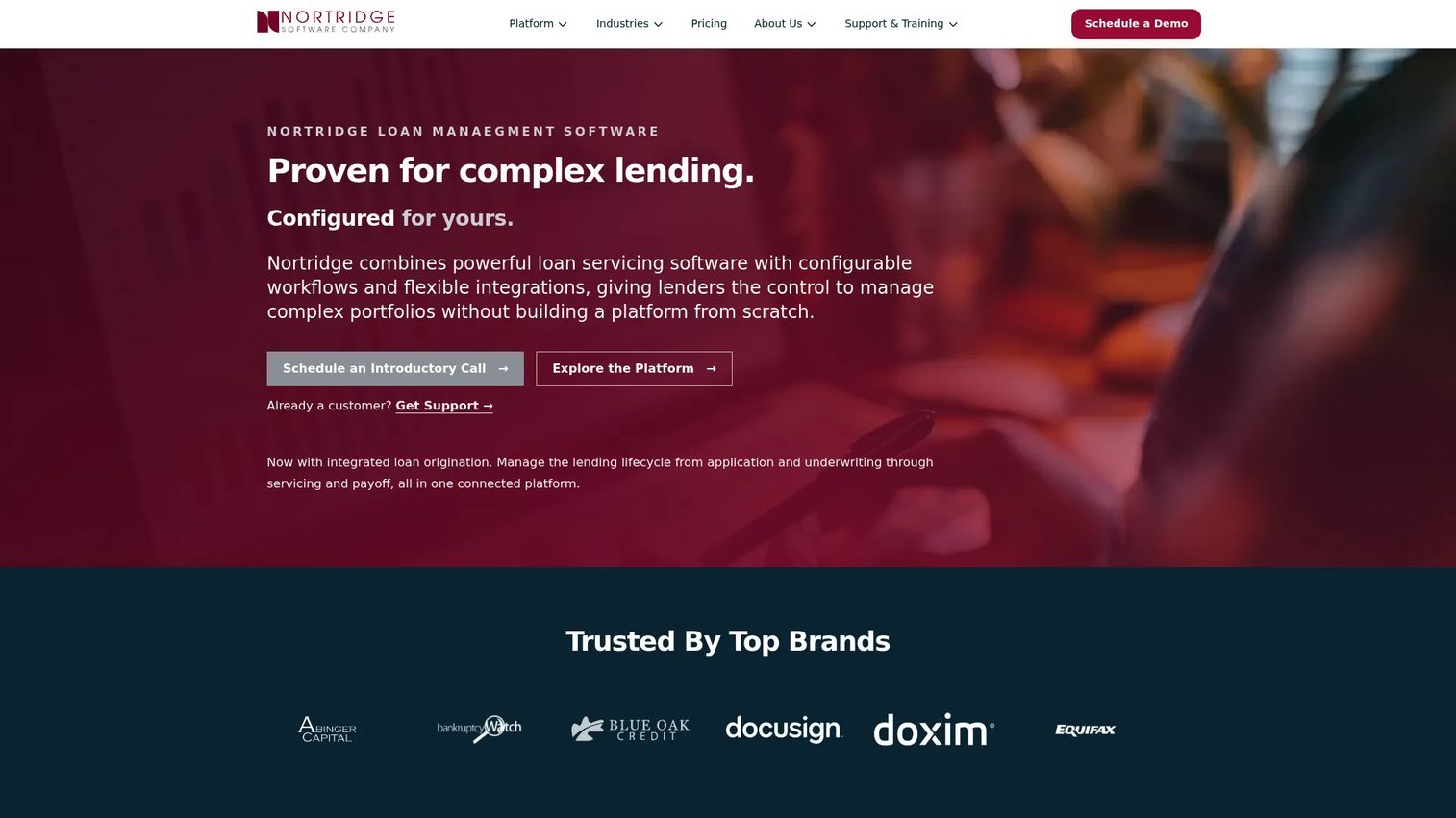
Nortridge provides configurable loan management and servicing software for lenders and loan servicers handling complex, multi-product portfolios. The platform covers servicing, collections, customer account management, escrow, and accounting. A $1,750 one-time setup fee applies, and the platform is available as cloud-hosted or on-premise deployment.
Best for: Established lenders that need deep servicing functionality and configurable workflows across multiple loan product types.
Key features
- Collections management with promise tracking and configurable workflows
- ACH, debit, credit card, and cash payment processing
- 150+ standard reports and configurable dashboards
- Escrow management, participation loans, and multi-book accounting modules
- Role-based access controls and audit trails with SOC II-level infrastructure
Why choose Nortridge: Choose Nortridge when the lending operation has grown beyond lightweight loan tracking and needs a proven servicing backbone with module-level depth for escrow, collections, and accounting.
Nortridge pricing: Base platform starts at $1,200 per month for up to three full users, plus a $1,750 one-time setup fee. Additional full users cost $400 per user per month, and read-only users cost $57 per user per month. Enterprise licensing is available by contacting sales.
G2 rating: 3.5/5
3. Peach Finance
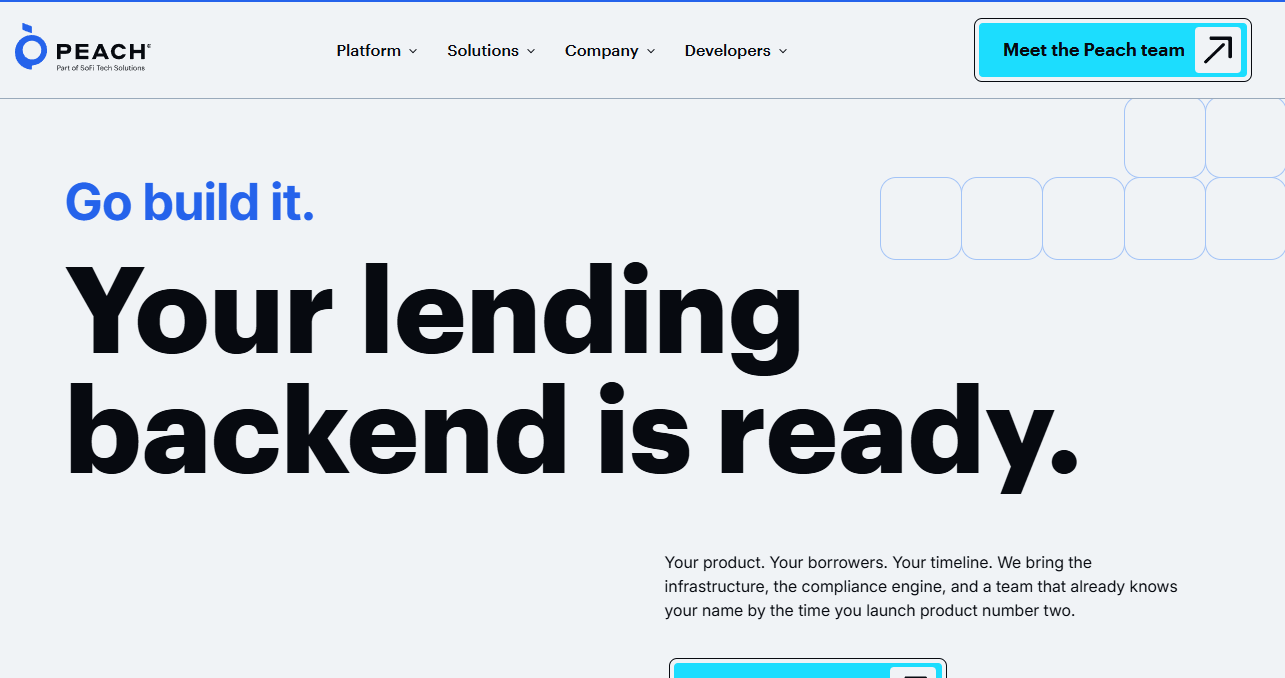
Peach Finance is an API-first loan management and servicing platform for fintechs and financial institutions launching or scaling lending programs. The platform handles loan management, payment processing, borrower communications, and regulatory monitoring. Its Compliance Guard feature monitors regulatory changes that affect loan programs.
Best for: Fintech lenders and embedded credit teams building modern servicing operations with compliance monitoring built in.
Key features
- API-first loan management and servicing
- Payment processing and operations
- Borrower portal and CRM
- Omnichannel communications for borrower engagement
- Compliance Guard for regulatory monitoring
Why choose Peach Finance: Choose Peach Finance when the team wants a modern servicing layer that supports fast product iteration and needs compliance monitoring embedded in the platform rather than bolted on separately.
Peach Finance pricing: Peach Finance does not post pricing on its website. Contact sales with your loan volume, program complexity, and integration requirements to get a proposal.
G2 rating: 4.7/5
4. TurnKey Lender
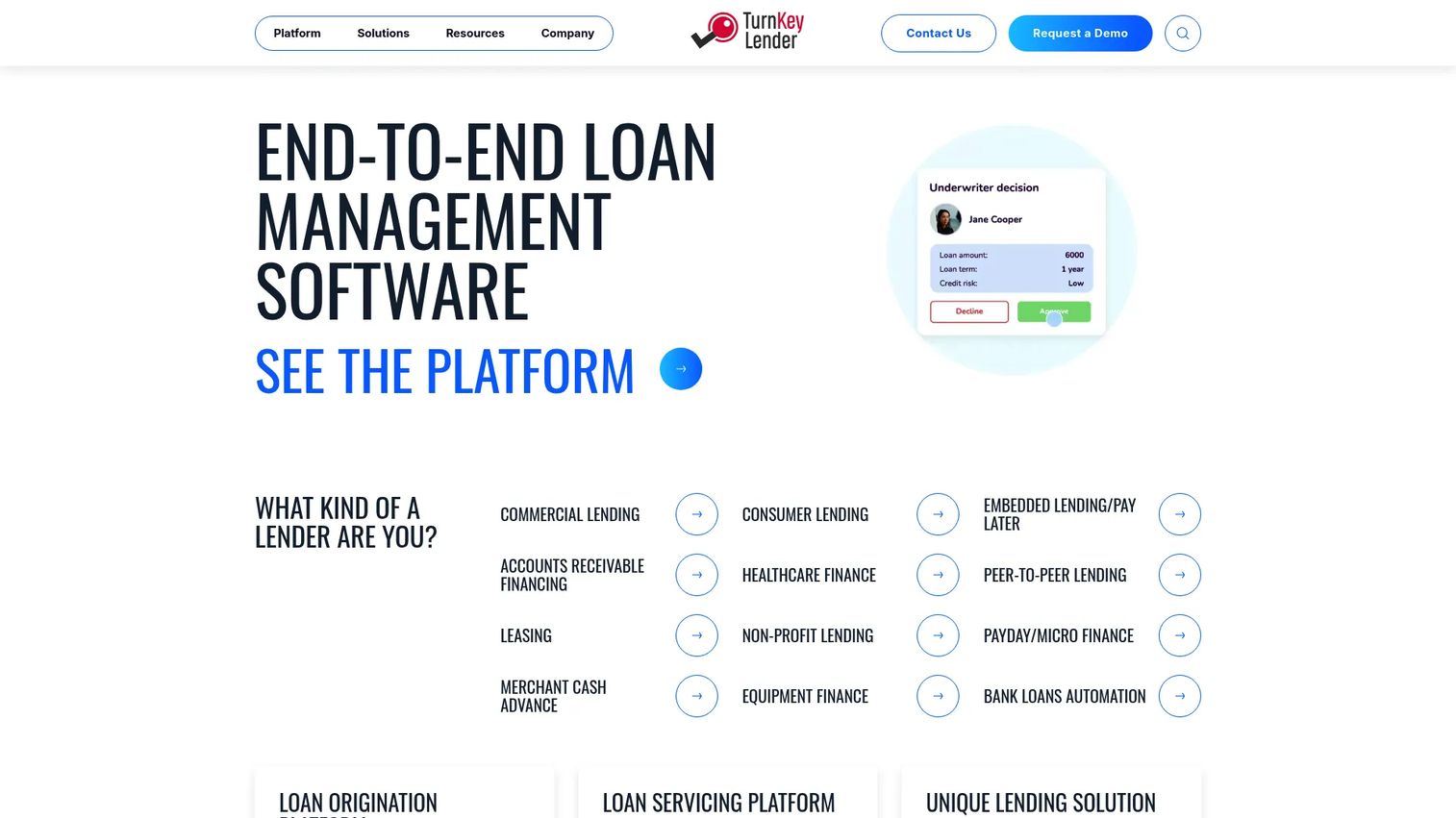
TurnKey Lender is an AI-powered, end-to-end lending automation platform covering origination, credit decisioning, servicing, portfolio management, and collections. It is built for banks, fintechs, embedded lenders, and other organizations that want to automate across the full lending lifecycle. The platform includes a credit product builder for configuring schedules, fees, and interest rules, plus more than 75 preconfigured integrations.
Best for: Lenders that want origination and servicing in the same operating system without managing separate platforms for each stage.
Key features
- Loan origination with configurable application flows
- AI-powered credit scoring, underwriting, and decisioning
- Loan servicing, automated payments, and borrower communications
- Debt collection automation
- Credit product builder with configurable fee and interest rules
Why choose TurnKey Lender: Choose TurnKey Lender when the operation wants fewer disconnected lending systems and can commit to a broader platform rollout. The AI-powered decisioning is a real differentiator for teams that underwrite at volume.
TurnKey Lender pricing: Pricing is customized by portfolio size, platform functionality, and required modules. Request a quote directly from the sales team.
G2 rating: 4.6/5
5. Canopy
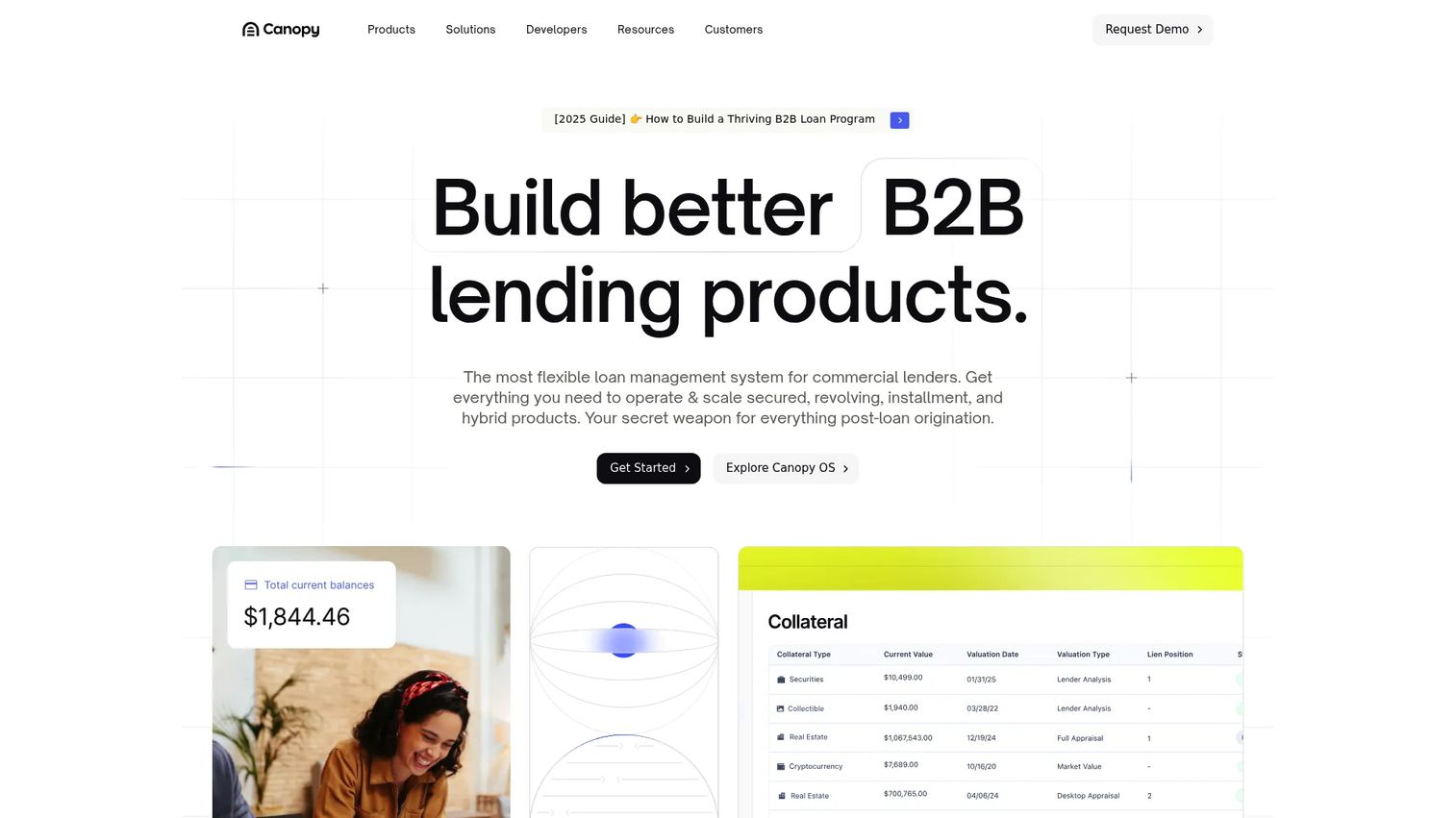
Canopy is an API-first loan management and servicing platform for teams launching or scaling configurable lending products. The platform includes CanopyOS for managing customer accounts and servicing, LoanLab for simulating loan lifecycles before deploying changes, DataDirect for near-real-time portfolio analytics, and a white-labeled borrower portal. Low-code workflow automation is available through Canopy Connect.
Best for: Consumer lending and embedded lending teams that need modern servicing infrastructure built for digital credit products.
Key features
- CanopyOS: Customer account management, product servicing, and team access
- LoanLab: Loan lifecycle simulation for testing policies before deployment
- DataDirect: Near-real-time analytical data access and portfolio reporting
- White-labeled borrower portal for account visibility and repayment
- Collateral management for tracking loan-to-value ratios
Why choose Canopy: Choose Canopy when the team wants servicing infrastructure built for digital credit products and needs the ability to test policy changes before they hit live accounts. LoanLab is a meaningful operational safeguard.
Canopy pricing: Canopy does not post pricing on its website. Contact sales with your portfolio size, product complexity, and implementation requirements.
G2 rating: 3.5/5
6. Shaw Systems
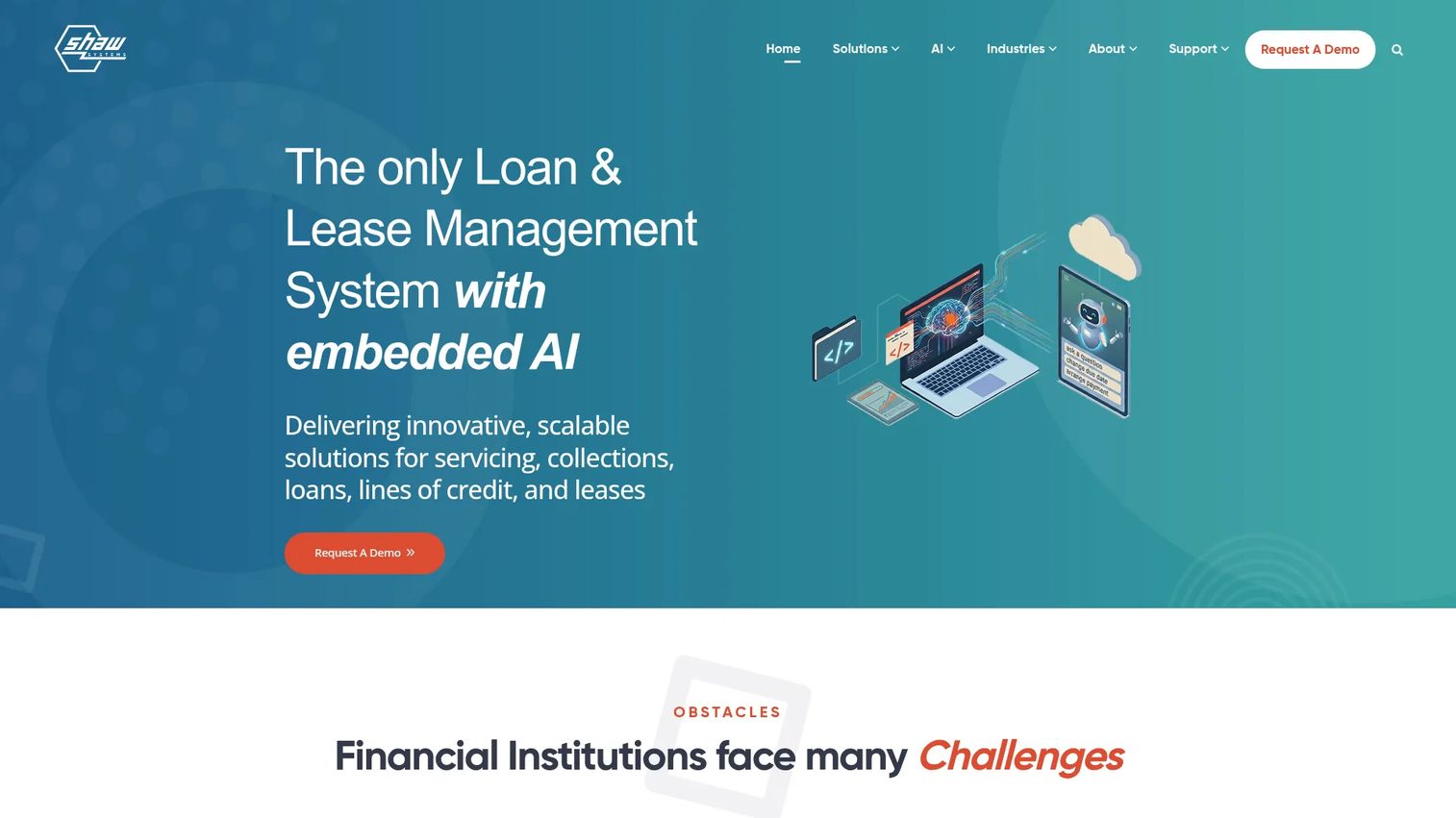
Shaw Systems provides loan and lease management software for servicing, collections, recovery, dealer floor plans, and lending operations at banks, credit unions, and finance companies. The platform is API-first, uses a per-loan subscription model, and includes embedded AI for servicing, collections, and recovery workflows. Shaw Systems has served financial institutions for several decades.
Best for: Financial institutions and finance companies with complex servicing and collections operations requiring configurable workflow management.
Key features
- End-to-end loan servicing lifecycle management
- Configurable automated workflows and queue management
- Collections and recovery with embedded AI
- API-first architecture with real-time processing
- Comprehensive reporting tools
Why choose Shaw Systems: Choose Shaw Systems when the servicing team values category experience and needs support for complex collections and recovery workflows at institutional scale.
Shaw Systems pricing: Subscription pricing is charged per loan; no flat monthly rate is posted. Contact sales to get pricing based on your portfolio volume, required modules, and implementation needs.
G2 rating: 4.3/5
7. Fiserv

Fiserv provides financial services technology across payments, banking, digital finance, risk management, and loan servicing for financial institutions and enterprises. Its lending and loan servicing capabilities span retail loans, mortgage servicing, home equity, personal loans, and installment loans. Fiserv also covers default management and loss mitigation for institutions managing delinquency at scale.
Best for: Banks, credit unions, and enterprise lenders consolidating multiple servicing operations under one technology provider.
Key features
- Retail loan servicing across multiple loan categories
- Mortgage servicing and mortgage servicing platform capabilities
- Default management and loss mitigation workflows
- Cloud-native, API-first banking and payment platforms
- Fraud detection and payment risk management
Why choose Fiserv: Choose Fiserv when consolidation, enterprise controls, and broad loan product support matter more than a lightweight or specialized deployment. It fits institutions where servicing is one piece of a larger financial technology infrastructure.
Fiserv pricing: Fiserv does not publish pricing for its lending products. Pricing is sales-led and varies by institution size, loan product mix, service model, and implementation scope. Contact sales for a proposal.
G2 rating: 4.3/5
8. FIS

FIS is a large financial technology provider serving banks, capital markets, asset managers, and insurance organizations. Its enterprise lending technology includes loan servicing workflows, banking system integrations, compliance support, and portfolio reporting. FIS serves large financial institutions where the loan servicing system needs to fit into a broader banking infrastructure.
Best for: Large financial institutions that need servicing connected to banking cores, capital markets systems, and enterprise compliance infrastructure.
Key features
- Core and digital banking platforms with lending integrations
- Enterprise loan servicing workflows
- Banking system integrations across trading, payments, and data
- Compliance support and regulatory reporting
- Portfolio analytics and data capabilities
Why choose FIS: Choose FIS when the lending system must connect to a larger financial institution technology environment and the buying process runs through enterprise procurement. It is not the right call for a lean fintech team that needs to move fast.
FIS pricing: FIS does not post pricing; the company offers numerous enterprise products rather than standardized plans. Pricing requires a sales conversation tied to institution size, implementation scope, modules, and support model.
G2 rating: 4.2/5
9. The Mortgage Office
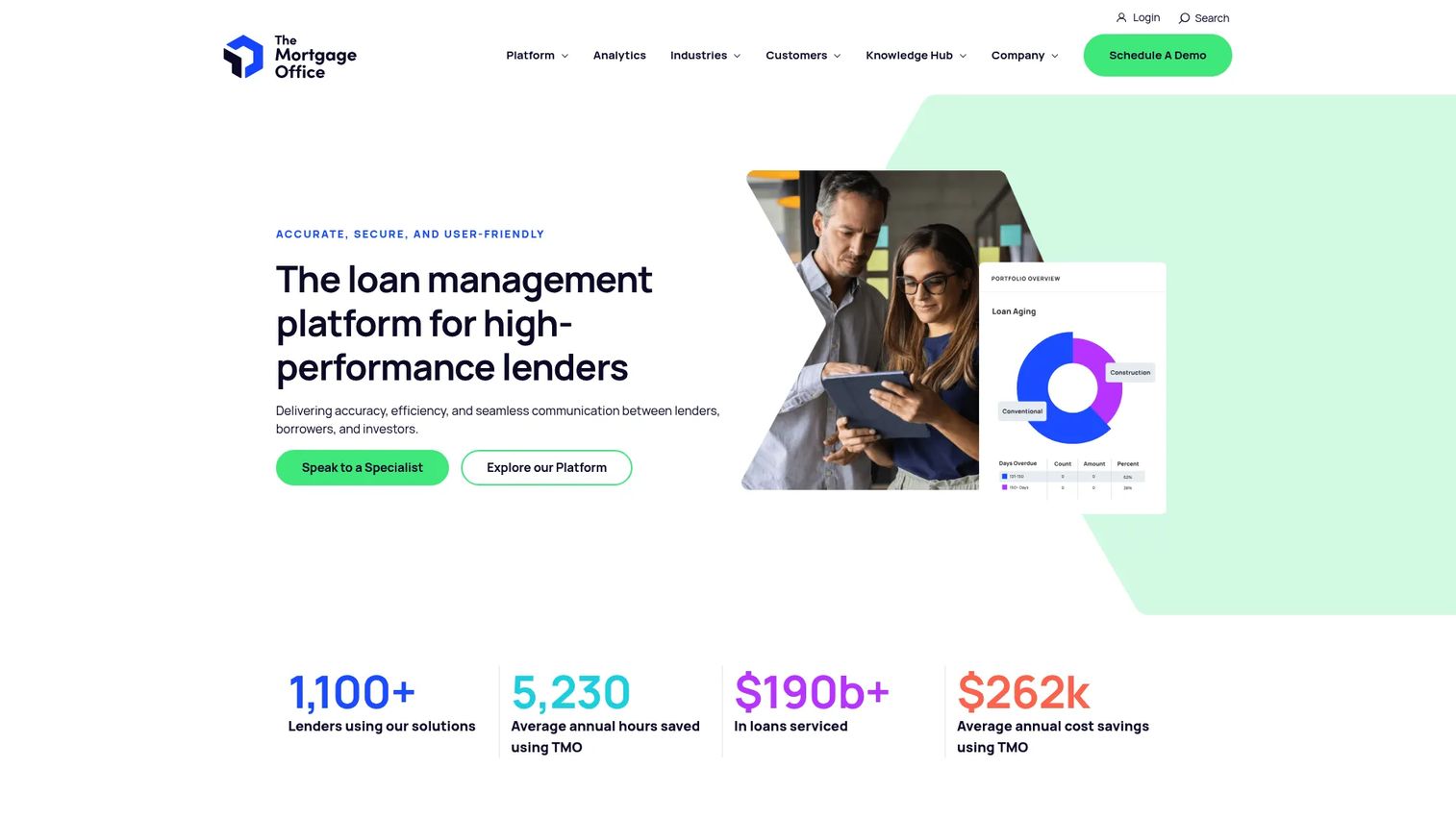
The Mortgage Office is an all-in-one, web-based loan origination and servicing platform for private lenders, CDFIs, nonprofits, municipalities, and government agencies managing complex loan portfolios. Key capabilities include fund management, investor accounting, construction draw management, borrower portals, and investor portals. The platform also integrates with accounting tools including QuickBooks.
Best for: Private lenders and mortgage teams where investor reporting, fund management, and construction draw tracking are central to daily operations.
Key features
- Loan origination and servicing for private and mortgage lending
- Fund management and investor accounting
- Automated payment, interest, escrow, and fee calculations
- Borrower and investor portals for self-serve visibility
- Construction loan and draw management
Why choose The Mortgage Office: Choose The Mortgage Office when private lending workflows and investor distributions are at the core of the operation. The combination of fund management, investor portals, and construction draw support in one system is difficult to replicate with a general-purpose servicing platform.
The Mortgage Office pricing: Pricing is not posted on the website; subscription options require contacting the sales team. Ask sales about user count, loan volume, fund management modules, and portal access when requesting a quote.
G2 rating: 4.8/5
10. Bryt
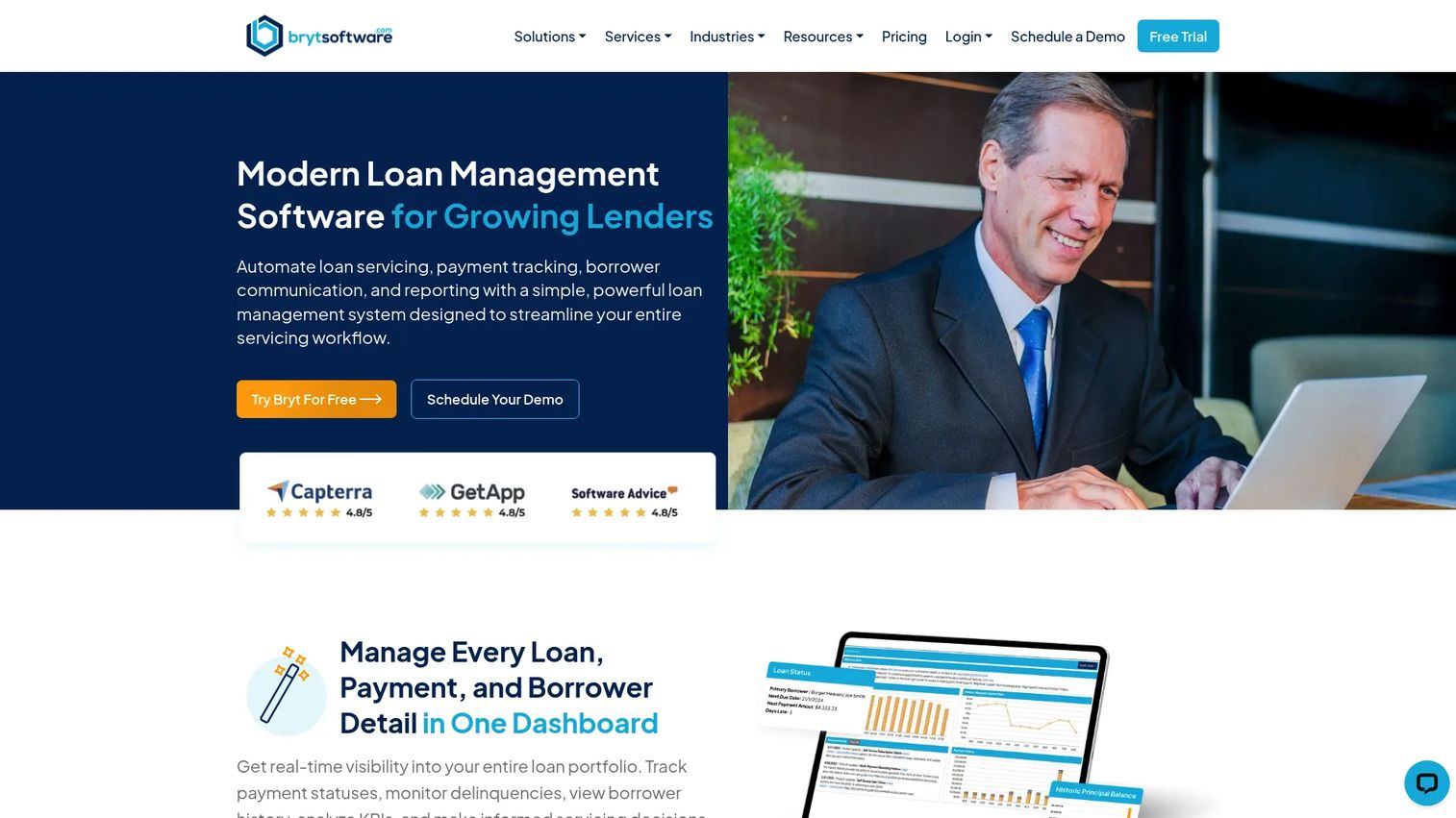
Bryt is cloud-based loan management software designed for automating loan servicing, payment tracking, borrower communication, and reporting across private lending workflows. The platform includes a Loan Payment Wizard for handling payoffs, partial payments, late fees, and schedule adjustments. A white-labeled borrower experience and workflow automation are available for teams that want to reduce manual servicing steps.
Best for: Private lenders that need an accessible loan management system without an enterprise implementation timeline or contract.
Key features
- Loan servicing and payment tracking
- Borrower relationship management with communication logs and documents
- Custom loan configurations for terms, rates, fees, and schedules
- Loan Payment Wizard for payoff and schedule adjustment calculations
- Custom reporting and document management
Why choose Bryt: Choose Bryt when the operation needs structure and reporting but does not need a large institutional servicing platform. The modular pricing and 30-day free trial make it practical to evaluate before committing.
Bryt pricing: Bryt uses modular pricing and provides a pricing calculator on its website, but numeric prices are not displayed publicly. A 30-day free trial is available; ask sales about the specific modules you need to get an accurate cost.
11. Enterprise!

Enterprise! is positioned as a commercial loan management system for commercial real estate servicing, asset management, loan accounting, investor reporting, escrow management, reserves tracking, and construction draw workflows. It is designed for servicers and lenders managing complex, asset-level CRE portfolios where accounting depth and investor reporting accuracy are the central operational requirements.
Best for: Commercial real estate lenders and servicers handling complex asset-level workflows where standard servicing platforms fall short.
Key features
- CRE loan servicing and asset management
- Loan accounting and general ledger support
- Investor reporting and distributions
- Escrow, reserves, and construction draw management
- Configurable CRE portfolio workflows
Why choose Enterprise!: Choose Enterprise! when commercial real estate workflows need deeper accounting, asset management, and investor reporting support than a generic loan servicing platform provides. CRE servicing has distinct escrow, draw, and asset-level reporting requirements that general platforms handle inconsistently.
Enterprise! pricing: No pricing is posted for Enterprise!. Contact the vendor to discuss portfolio type, asset complexity, user count, reporting requirements, and implementation services when requesting a quote.
Considerations when choosing loan servicing software
Match the platform to your loan products
Consumer installment loans, mortgage loans, private real estate loans, CRE loans, and home equity loans each have distinct amortization methods, fee structures, payment schedules, and escrow requirements. A platform optimized for consumer revolving credit will create workarounds for private mortgage servicing, and vice versa. Build your shortlist by product type, not by brand awareness.
Check payment, escrow, and accounting depth
Payment posting, payoff calculations, late fee logic, escrow management, reserves, construction draws, investor distributions, and general ledger export are where the real operational cost hides. Finance cleanup after choosing the wrong platform is expensive and slow. Ask vendors for a live walkthrough of the payment and escrow workflows specific to your loan product before signing.
Evaluate borrower and investor portals
Borrower self-service, statement visibility, payment access, and document sharing reduce support load. Investor reporting and lender portals improve stakeholder confidence. For a founder preparing for a board review or fundraise, having investor-ready reports that come directly from the servicing system removes a manual step that creates risk.
Verify integrations before signing
A promised integration is not the same as a production-ready workflow. Ask specifically which accounting systems, payment processors, banking cores, and CRM tools the vendor supports in production, not on a roadmap. Integration gaps discovered after implementation become expensive custom engineering projects.
Treat compliance and auditability as operating infrastructure
Audit trails, role-based permissions, data retention controls, and regulatory reporting are not features you add later. They are the infrastructure that lets you answer compliance and audit questions without scrambling. Ask vendors about SOC credentials, audit log exports, and how permissions work across user roles before you evaluate pricing.
Conclusion
The right loan servicing software is not the one with the most features. It is the one that matches your loan product, reporting requirements, and current operational maturity without creating a two-year implementation project.
For configurable consumer or fintech lending, LoanPro and Peach Finance lead the shortlist. For private lenders managing investor distributions and construction draws, The Mortgage Office stands apart. TurnKey Lender suits teams that want origination and servicing in one system. Fiserv and FIS are the right calls for financial institutions where the servicing platform must connect to core banking infrastructure. Enterprise! belongs on the shortlist for any CRE servicer where loan accounting and asset-level reporting are daily requirements.
The practical next step: Shortlist two or three platforms based on loan product fit, then request a live demo focused specifically on your payment workflows and investor reporting. Price negotiations come after you have confirmed that the platform can actually handle your edge cases.
For context on how SaaS vendors evaluate and demonstrate platforms in adjacent categories, the accounting software and best payment processing software guides on this site cover related evaluation criteria. Teams in financial operations may also find the accounts payable software roundup useful when thinking about integration requirements.
FAQs
Loan servicing software is a system that manages loans after funding, covering payment processing and posting, amortization schedules, borrower statements and notices, collections and delinquency workflows, escrow and reserves management, investor reporting, loan accounting, and compliance records. It is distinct from origination software, which handles the application through closing stage. Most lending operations need both, though some platforms cover the full lifecycle.
Private lenders typically need investor reporting, fund management, payment tracking, construction draw support, and borrower portals in one system. The Mortgage Office is the strongest all-in-one option for private lending, covering fund management, investor accounting, and construction draws. Bryt is a practical choice for smaller private lending operations that want modular, accessible software without an enterprise contract. Enterprise! belongs on the shortlist for private lenders managing commercial real estate portfolios with complex asset-level accounting.
Loan origination software handles the front-end process: Applications, underwriting, credit decisioning, document collection, approvals, and closing. Loan servicing software takes over after the loan is funded: Payments, statements, escrow, collections, investor reporting, and compliance records. Some platforms, including TurnKey Lender and The Mortgage Office, cover both. Teams should verify depth in each workflow, because platforms that claim to do both sometimes handle one well and treat the other as a secondary module.
Cost varies significantly by portfolio volume, number of users, required modules, implementation scope, and loan product complexity. Nortridge starts at $1,200 per month for up to three users, which is the only published base price among the platforms in this guide. Most others require a sales quote. Factors that drive cost include loan account volume, number of modules (escrow, collections, investor reporting), integration work, implementation services, and support tier. Get quotes from at least two vendors before entering price negotiations.
At minimum: Payment processing and posting, amortization and payoff calculations, borrower account management, statements and notices, collections workflows, escrow and reserves handling, investor reporting, loan accounting, and compliance audit trails. Borrower portals and investor portals are now standard expectations rather than premium additions. Configurable workflow automation separates modern platforms from older systems that require manual intervention for routine servicing tasks.
No. Banks and credit unions use it, but so do fintech lenders, private mortgage servicers, specialty finance companies, commercial real estate servicers, CDFIs, nonprofits, municipalities, and government lending agencies. The platforms in this guide span the range. Peach Finance and Canopy are built primarily for fintechs. The Mortgage Office and Bryt serve private lenders. Fiserv and FIS target financial institutions. LoanPro and TurnKey Lender serve multiple lender types. The right platform depends on loan product, not institution type.
It depends on the platform and how it is configured. Most modern systems support multiple amortization methods, fee structures, payment schedules, and interest calculation methods, but depth varies. Before adding a second loan product to an existing platform, verify that the new product's specific amortization method, escrow rules, payment schedule logic, and reporting requirements are supported in production. Platforms that handle one product type with confidence sometimes require significant configuration or custom development for a second.
Start with implementation timeline and data migration, because moving an existing portfolio to a new system is more complex than a new portfolio setup. Check compliance controls and audit log capabilities, since these become the bottleneck when regulators or investors ask questions. Verify integration depth with your accounting system and payment processor before signing. Ask whether the platform supports the next loan product on your roadmap, not just the one you are servicing today. Finally, get clarity on vendor support response times and escalation paths. A servicing platform outage or a miscalculated payoff is an operational emergency.