Your forecast said one thing. The market did another. By the time your planners rebuilt the numbers in a spreadsheet, the demand shift had already turned into a stockout or a warehouse full of inventory nobody wanted.
That gap between what you planned and what actually happened is expensive. It shows up as lost sales, bloated working capital, and cross-functional finger-pointing during the next S&OP meeting.
Demand planning software exists to close that gap. Instead of static forecasts locked in a spreadsheet, these platforms ingest real demand signals, run models continuously, and let sales, finance, operations, and supply chain plan against a shared view. The category is growing fast for a reason. According to Grand View Research (2024), the demand planning solutions market is worth USD 5.30 billion in 2025 and is forecast to reach USD 11.71 billion by 2033 at a 10.4% CAGR.
The pressure is real, and so is the buying activity. But most vendor pages read like brochures. They lead with AI agents and probabilistic planning without telling you which tool fits a 200-store retailer versus a global manufacturer with 40,000 SKUs. This guide fixes that.
If you're evaluating tools that touch cross-functional workflows and measurable outcomes, you already think like a product manager assessing a stack: workflow fit, integration burden, and provable impact. The same lens applies here. And if your evaluation later shifts toward showing complex software to buyers, our roundups of answer engine optimization tools and best AI cybersecurity solutions follow the same evidence-led comparison approach you'll see below.
What's inside
This guide compares seven demand planning software solutions for teams that need better forecast accuracy, stronger scenario planning, and tighter inventory control. It's written for operations leaders, supply chain managers, planning teams, and the cross-functional buyers who evaluate how these platforms fit an existing data and process stack.
We selected and ranked tools on four criteria that actually change outcomes:
- AI and automation in the forecasting engine
- Collaborative planning across sales, finance, and operations
- Scenario handling and what-if depth
- Integration and inventory outcomes, including how the tool connects to ERP and affects service levels
No single tool wins every category. The goal is to help you match a platform to your planning complexity and company maturity.
TL;DR
- Best for retail demand planning: RELEX Solutions, built around store-level demand sensing, replenishment, and merchandising.
- Best for connected enterprise planning: Anaplan, for cross-functional scenario planning across finance, supply chain, and sales.
- Best for uncertainty and new product forecasting: John Galt Solutions, strong on probabilistic planning and complex hierarchies.
- Best for large-scale AI planning: o9 Solutions, for integrated decision-making across commercial and supply chain functions.
- Best for end-to-end supply chain depth: Blue Yonder, spanning planning through fulfillment.
- Best for mid-market AI demand forecasting software: Datup, with AI forecasting and inventory optimization scaled to smaller teams.
- Best for concurrent planning and fast response: Kinaxis, for volatile, complex global operations.
What is demand planning software?
Demand planning software is a system that forecasts future demand and helps teams plan inventory, supply, and resources around that forecast. It replaces spreadsheet-based forecasting with a shared, continuously updated demand planning system that ingests real signals and coordinates decisions across functions.
A modern demand planning system does more than produce a number. It connects forecasting to the actions that follow it: what to buy, what to make, what to hold, and how to reconcile competing views from sales and finance.
Core capabilities to expect:
- Statistical and AI forecasting: Baseline forecasts using historical data, seasonality, and increasingly machine learning forecasting to handle noisy, high-dimensional inputs.
- Demand signal ingestion: Pulling in point-of-sale data, promotions, weather, and market signals through demand sensing to detect shifts faster than monthly cycles allow.
- Collaborative planning: A shared workspace where sales, operations, and finance align on one demand picture, with exception handling and consensus workflows.
- Scenario modeling: What-if analysis to stress test assumptions against disruptions, promotions, or supply constraints.
- Inventory optimization: Translating the forecast into stocking decisions that balance service levels against inventory holding costs.
The strongest platforms tie these together so a forecast change automatically ripples into replenishment, production, and financial plans. That connective tissue is what separates a demand planning system from a standalone demand forecasting tool.
When to use demand planning software
Not every team needs enterprise planning software. Here's how to tell when the switch pays off.
Improve forecast accuracy across volatile demand
Spreadsheets and static ERP planning work until demand stops behaving. Once seasonality, promotions, and shifting customer behavior start moving faster than your planning cycle, manual forecasts fall behind. Demand forecasting software with AI models adapts to new signals continuously, which lifts forecast accuracy where it matters most: the volatile, high-value SKUs that spreadsheets miss.
Coordinate planning across functions
When sales forecasts one number, finance budgets another, and operations plans a third, you don't have a forecast. You have three arguments. Demand planning solutions give these teams a shared view with versioning and exception handling, so the debate happens over one set of numbers. Collaborative planning turns the monthly reconciliation scramble into a governed workflow.
Reduce stock-outs and excess inventory
The core tension in planning is availability versus cost. Hold too little and you miss sales; hold too much and you tie up working capital, risk spoilage, and inflate inventory holding costs. Software helps balance service levels against inventory efficiency by optimizing stock against a more accurate, probability-aware forecast. Better inputs mean fewer emergency buys and less dead stock.
Comparison table
The table below ranks the seven tools by relevance to core demand planning software needs. Pricing across this category is almost universally demo-based, so figures reflect what vendors publish rather than negotiated enterprise contracts.
| # | Product | Intent | Key use case | Pricing | G2 rating |
|---|---|---|---|---|---|
| 1 | RELEX Solutions | Retail-led planning | Store-level demand sensing, replenishment, merchandising | Demo-based | 4.6/5 |
| 2 | Anaplan | Connected enterprise planning | Cross-functional scenario planning across finance and supply chain | Contact sales | 4.6/5 |
| 3 | John Galt Solutions | Uncertainty-focused planning | Probabilistic planning, new product forecasting, complex hierarchies | ForecastX from $99/mo; Atlas demo-based | 4.8/5 |
| 4 | o9 Solutions | Enterprise AI planning | Integrated business planning across commercial and supply chain | Demo-based | 4.2/5 |
| 5 | Blue Yonder | End-to-end supply chain | Planning through fulfillment on one platform | Demo-based | 4.1/5 |
| 6 | Datup | Mid-market AI forecasting | AI demand forecasting and inventory optimization | Subscription, demo-based | Not listed |
| 7 | Kinaxis | Concurrent planning | Real-time scenario response for complex global operations | Demo-based | 4.0/5 |
1. RELEX Solutions
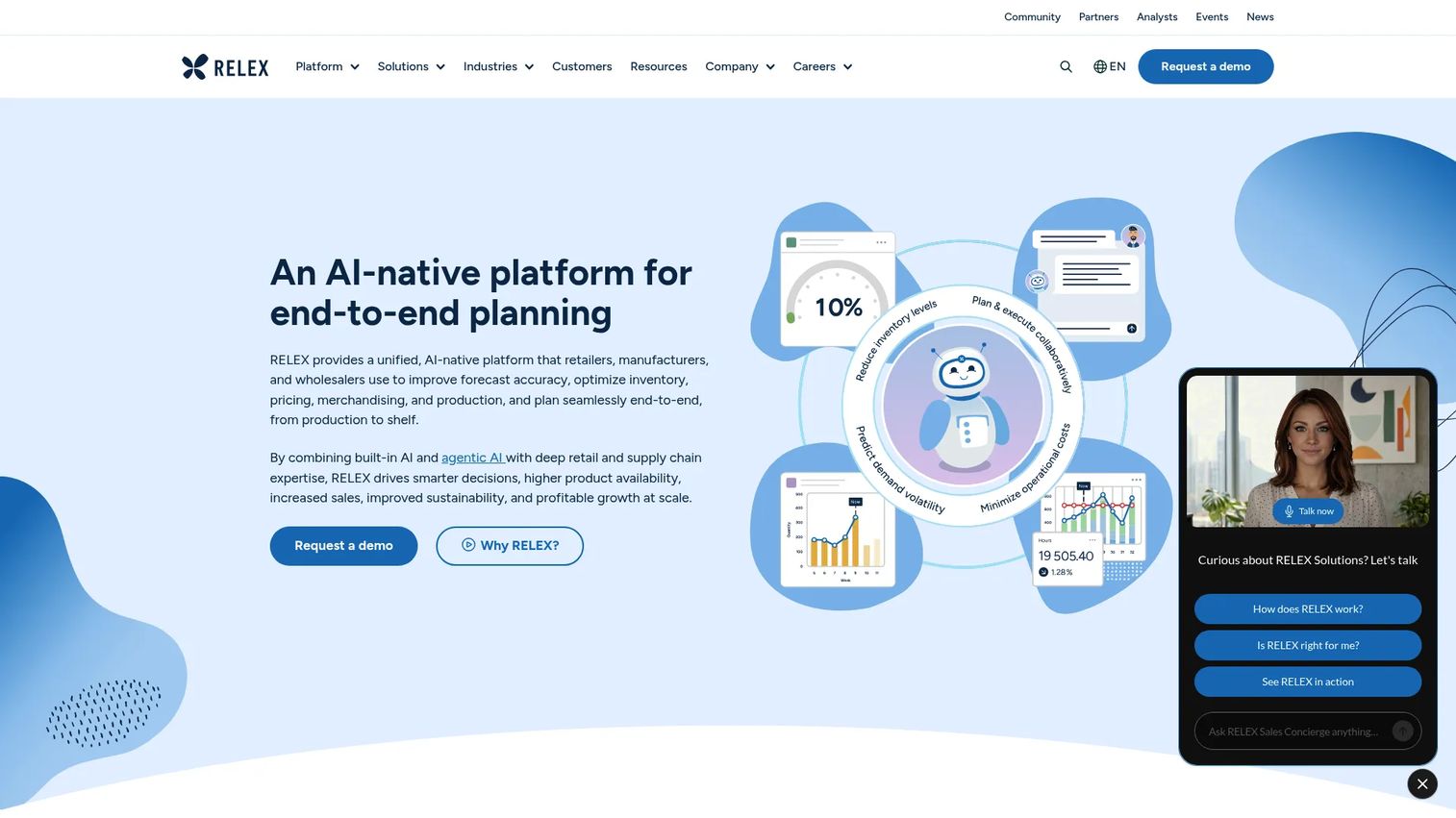
RELEX Solutions is an AI-native retail and supply chain planning platform that unifies forecasting, replenishment, merchandising, pricing, promotions, and production. It's built for the messiness of retail demand, where store-level variation, promotions, and seasonality make a single monthly forecast nearly useless. RELEX leans hard into demand sensing and probabilistic planning to keep forecasts responsive.
Best for: Large retailers, wholesalers, and manufacturers that need unified planning across supply chain and merchandising.
Key strengths
- Demand planning and demand sensing: Ingests store- and channel-level signals to detect demand shifts faster than traditional cycles.
- Inventory, replenishment, and production planning: Connects the forecast directly to what to stock, order, and produce.
- Pricing, promotions, and merchandising: Plans price and promotion impact alongside demand, plus space and merchandising planning.
Why choose RELEX Solutions: If your demand lives at the store shelf, RELEX is designed around that reality. Its strength is handling the attribute-level and promotional complexity that breaks generic planning tools, which makes it a strong fit for retail demand planning and new product forecasting where history is thin. Teams that need forecasting, replenishment, and merchandising in one system get tighter coordination than a stitched-together stack allows.
RELEX Solutions pricing: RELEX does not publish public pricing and sells through a demo-based process rather than posted plans. Expect an enterprise engagement scoped to your data volume, store count, and modules. The platform holds a 4.6/5 rating on G2.
2. Anaplan
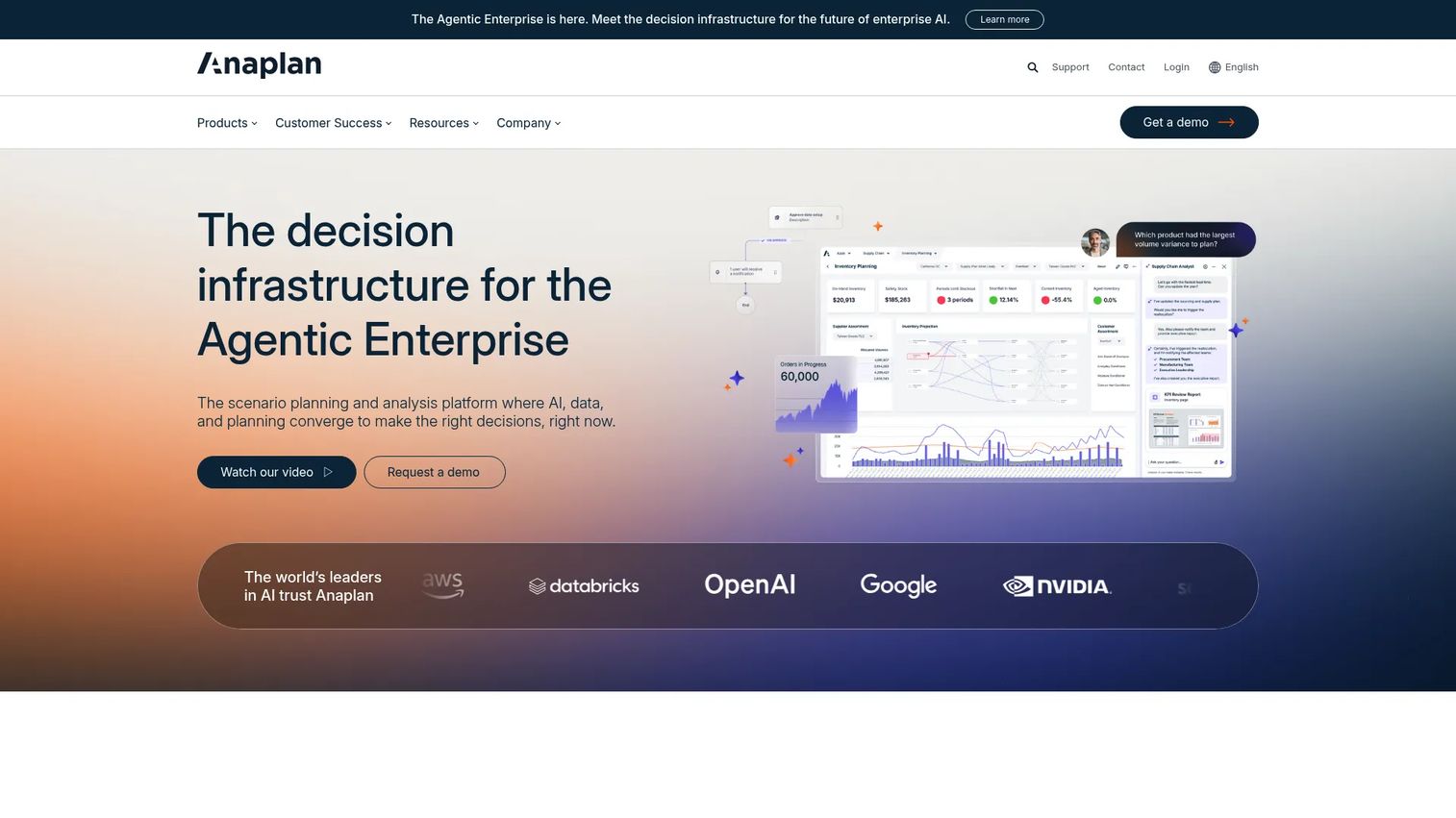
Anaplan is an AI-driven scenario planning and analysis platform for enterprise decision-making. Rather than being a pure supply chain tool, it's a connected planning engine that spans finance, supply chain, sales, and workforce planning on a shared modeling layer. That breadth is the point: demand planning inside Anaplan connects directly to the financial and commercial plans it drives.
Best for: Large enterprises that need connected planning across multiple business functions, not just supply chain.
Key strengths
- Scenario planning and analysis: Model multiple demand and supply futures and see the downstream financial impact instantly.
- Connected planning: Links demand plans to finance, sales, and workforce plans so a change in one flows through all.
- AI-powered forecasting and optimization: Adds forecasting, optimization, and conversational analytics on top of the modeling core.
Why choose Anaplan: Anaplan wins when the demand plan can't live in a silo. If your CFO, sales leadership, and supply chain team all need to plan against the same numbers, its connected modeling and scenario planning depth are the draw. Analyst recognition and a large enterprise install base back its position for cross-functional planning at scale.
Anaplan pricing: Anaplan does not display public pricing. G2 lists Essential and Standard as contact-us plans, so pricing is scoped through sales. The platform carries a 4.6/5 rating on G2.
3. John Galt Solutions
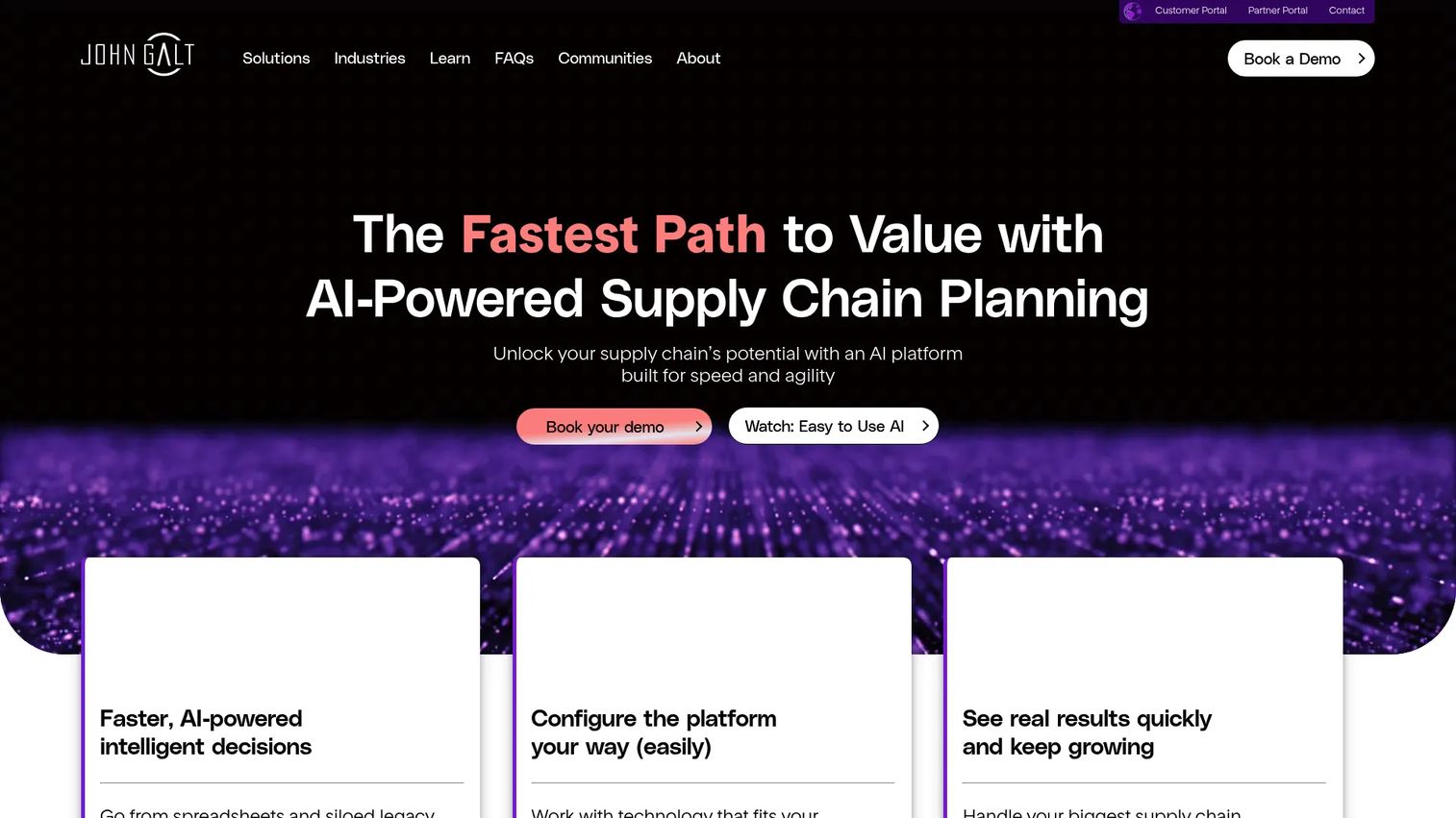
John Galt Solutions is AI-powered supply chain planning software covering demand, supply, inventory, S&OP/IBP, delivery, and scheduling through its Atlas platform. Its editorial angle leans into uncertainty: how do you plan when demand is genuinely unpredictable? That framing shows up in strong probabilistic planning and demand sensing capabilities.
Best for: Enterprises that need end-to-end supply chain planning software with deep support for uncertainty and complex hierarchies.
Key strengths
- Artificial intelligence: AI-driven forecasting tuned for volatile and hard-to-predict demand patterns.
- Advanced analytics: Multi-level forecasting and analytics across complex product and location hierarchies.
- Probabilistic planning: Plans against ranges and probabilities rather than a single deterministic number.
Why choose John Galt Solutions: John Galt is a strong pick when your demand doesn't follow tidy patterns. New product introductions, intermittent demand, and deep hierarchies are where its probabilistic approach and continuous planning shine. The 4.8/5 G2 rating, the highest in this list, reflects a loyal base of planners who value that uncertainty-first design.
John Galt Solutions pricing: The Atlas platform is sold through a demo and sales process without posted public prices. John Galt does publish pricing for its ForecastX 10 product at $99 per month, billed monthly, though that's a distinct forecasting product from the full Atlas platform. John Galt holds a 4.8/5 rating on G2.
4. o9 Solutions
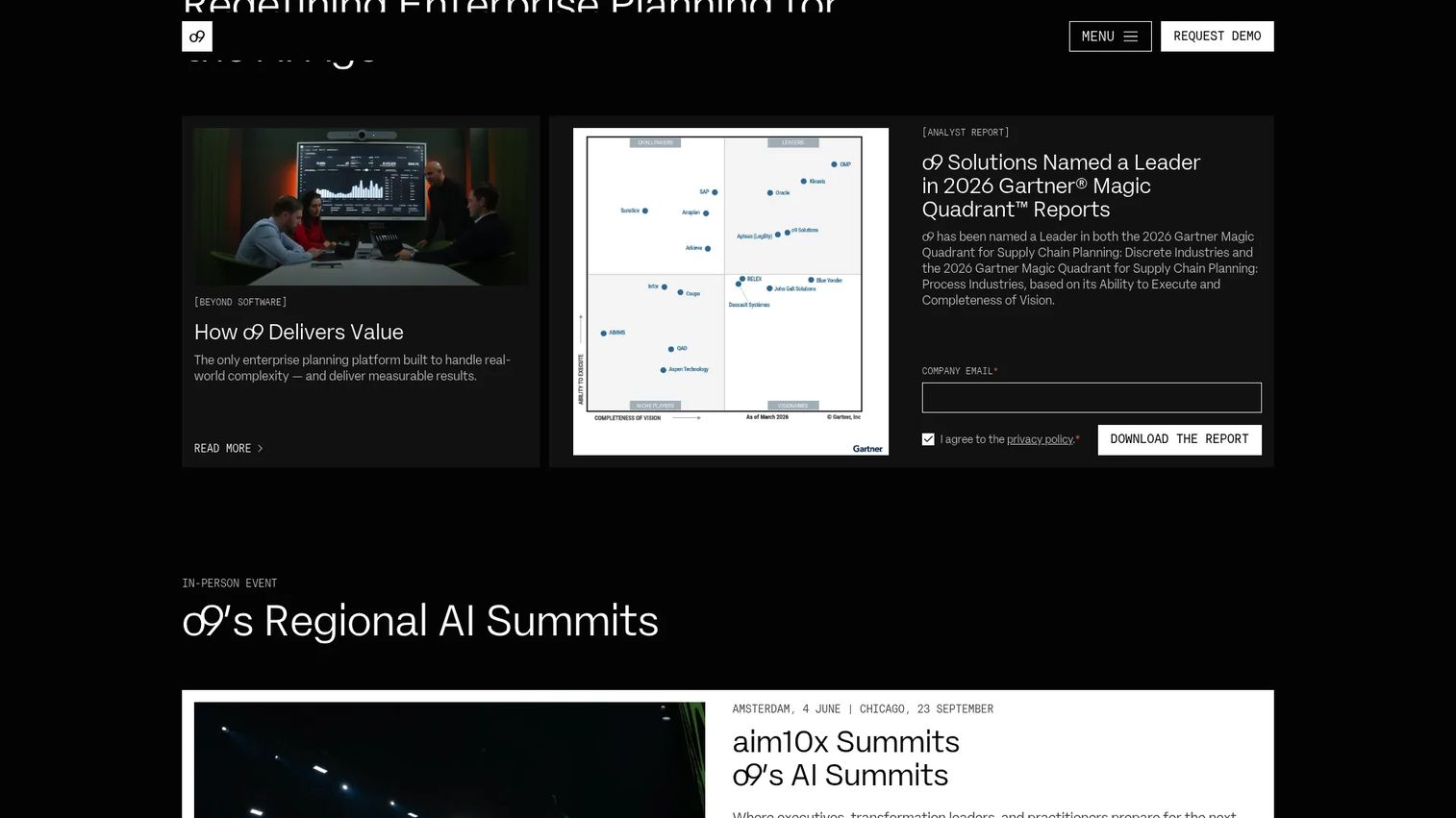
o9 Solutions is enterprise AI planning and execution software for connected business planning across supply chain, commercial, and finance functions. Its "digital brain" concept aims to integrate decision-making so demand, supply, and commercial plans reason against the same data model rather than trading exports back and forth.
Best for: Large enterprises that need AI-powered cross-functional planning and decisioning at scale.
Key strengths
- AI-driven planning and execution: A unified platform that spans planning and execution, not just forecasting.
- Integrated business planning: Connects finance, marketing, sales, and supply chain into one planning motion.
- Price planning and optimization: Adds dynamic pricing, elasticity modeling, and competitive benchmarking alongside demand.
Why choose o9 Solutions: o9 stands out in large, complex operations that want planning and decisioning integrated across the enterprise. Its combination of AI forecasting, scenario modeling, and commercial planning suits organizations trying to break down the walls between demand, supply, and revenue planning. The trade-off, reflected in its 4.2/5 G2 rating, is that the platform's depth rewards organizations with the maturity to use it fully.
o9 Solutions pricing: o9 does not publish public pricing; engagements are scoped through a demo and request process. The platform holds a 4.2/5 rating on G2.
5. Blue Yonder

Blue Yonder is AI-powered, end-to-end supply chain management software covering planning, execution, commerce, and fulfillment. Demand planning is one module in a much broader platform, which appeals to teams that want forecasting to sit inside the same system as warehouse, transportation, and order management.
Best for: Large enterprises that need a unified supply chain platform, not a standalone planning tool.
Key strengths
- Supply chain planning: Demand and supply planning as part of a broader planning suite.
- Order management and commerce: Connects planning to fulfillment and commerce workflows.
- Warehouse and transportation management: Extends the platform into physical execution across the network.
Why choose Blue Yonder: Blue Yonder makes sense when your priority is breadth across the supply chain, not just the demand plan. Teams consolidating planning, warehousing, and transportation onto one vendor get depth that point tools can't match. That breadth comes with real implementation scope, so evaluate the platform against your capacity to roll out a large system. Its 4.1/5 G2 rating reflects a powerful platform best suited to organizations ready for enterprise-scale deployment.
Blue Yonder pricing: Blue Yonder does not display public plan pricing; deals are scoped directly with the vendor. The platform carries a 4.1/5 rating on G2.
6. Datup
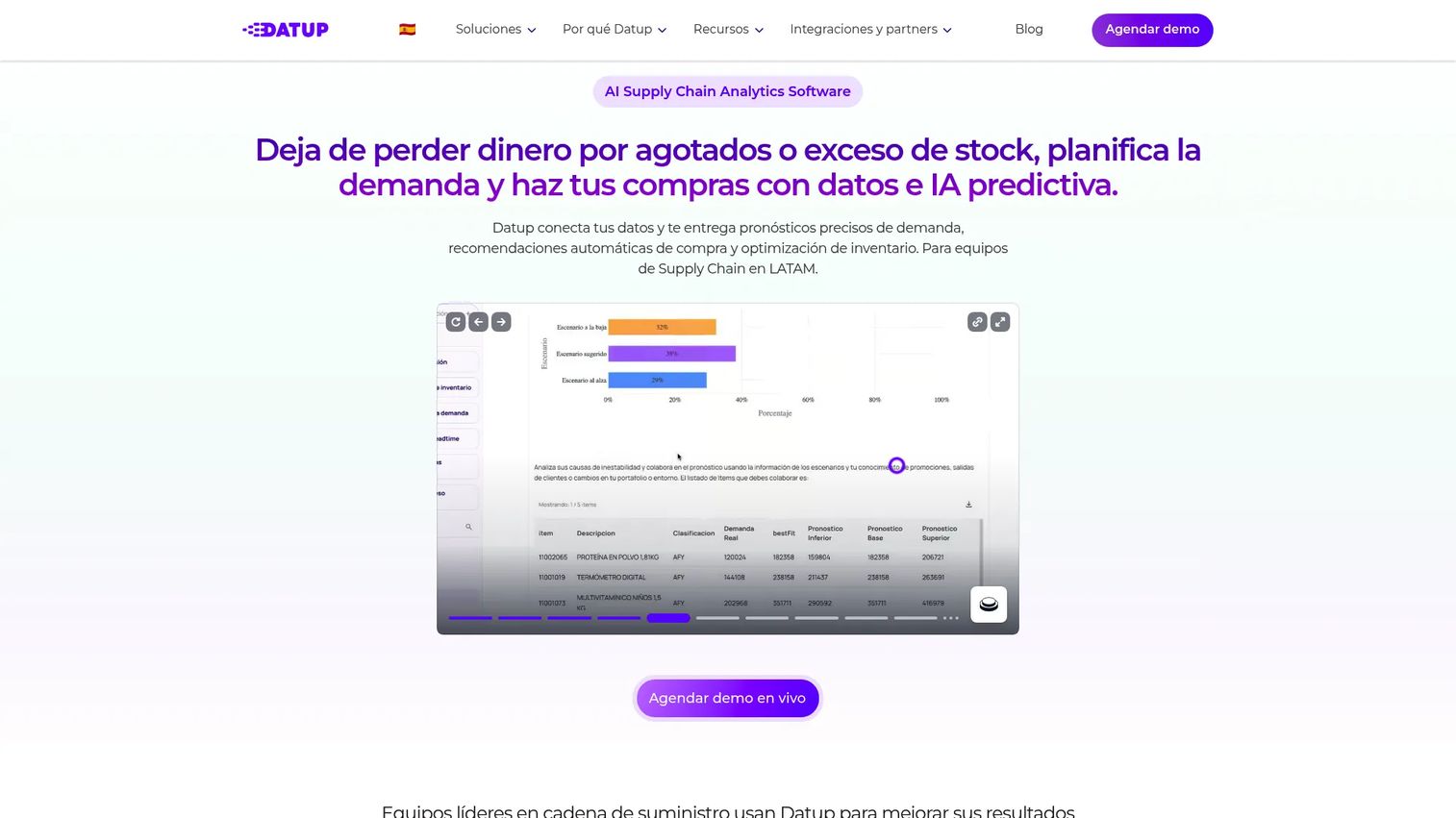
Datup is AI-powered supply chain analytics software focused on demand forecasting, inventory optimization, and purchasing decisions. It's the most approachable option on this list for mid-market teams that want AI-driven planning without a multi-year enterprise rollout. Its AI assistant, Alaia, supports S&OP and S&OE collaboration.
Best for: Medium and large supply chain teams that need AI-driven demand and inventory planning without enterprise-scale complexity.
Key strengths
- Demand forecasting and planning: AI forecasting aimed at practical accuracy for leaner planning teams.
- Inventory optimization and reorder recommendations: Turns forecasts into concrete reorder points and stocking decisions.
- S&OP/S&OE collaboration: Alaia, an AI assistant, supports sales and operations planning workflows.
Why choose Datup: Datup fits teams that want AI forecasting and inventory optimization scaled to their size, in manufacturing or retail contexts where enterprise platforms are overkill. Its month-to-month model and focus on demand and inventory make it a faster path to value for mid-market operations. Public G2 ratings weren't available at the time of writing, so weigh it through a trial and reference checks.
Datup pricing: Datup does not publish fixed prices. The company describes a month-to-month subscription proportional to data load and active modules, so cost scales with usage rather than a flat tier.
7. Kinaxis
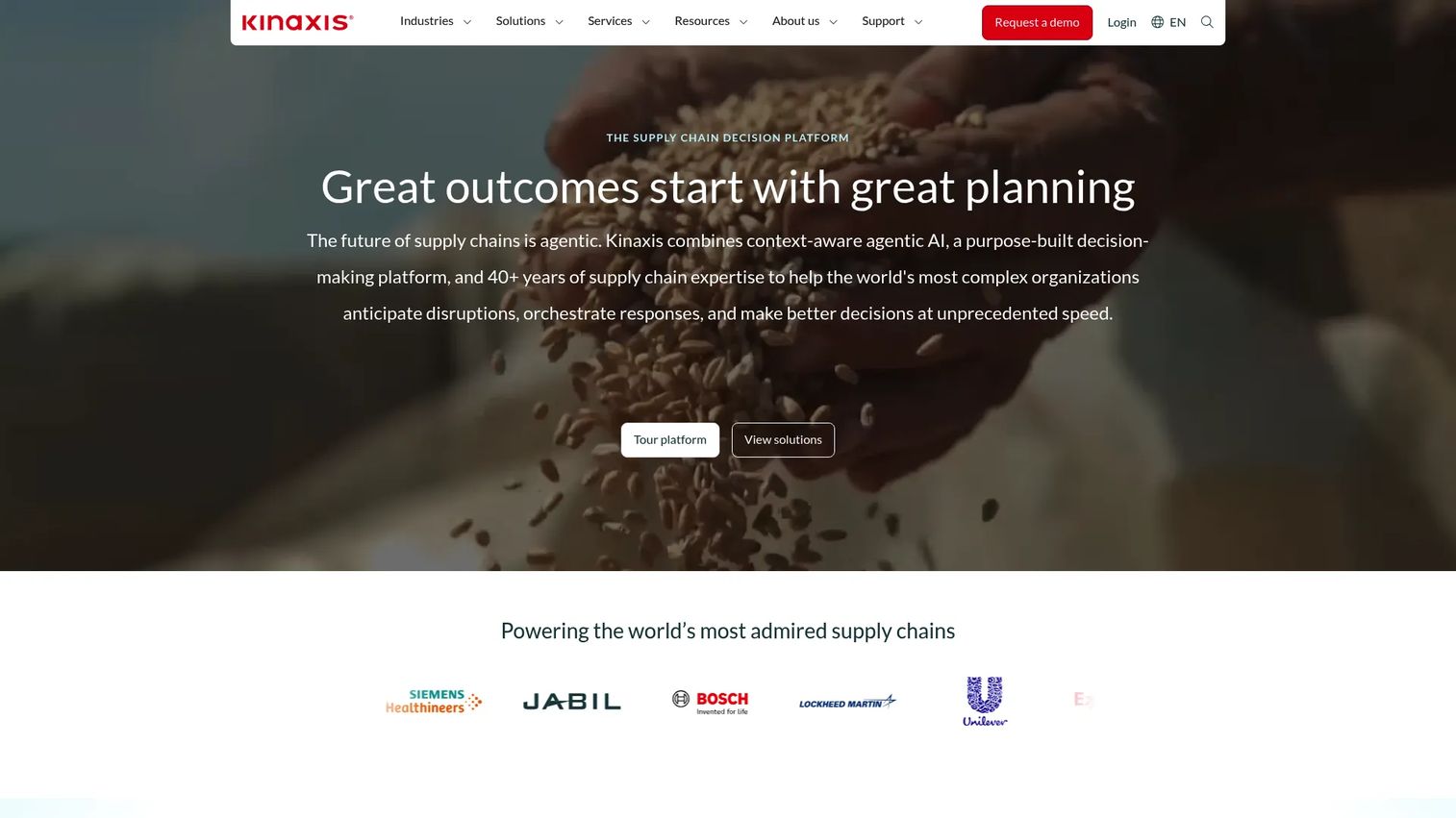
Kinaxis is a supply chain planning and orchestration platform built for complex global enterprises. Its signature is concurrent planning: demand, supply, and capacity plans update together in real time rather than in sequential batch cycles. That concurrency is what lets planners respond to disruptions in minutes instead of days.
Best for: Large enterprises that need end-to-end supply chain planning and fast response coordination.
Key strengths
- AI-infused planning and orchestration: Concurrent planning across demand, supply, and capacity on a shared model.
- Real-time scenario simulation: Run what-if scenarios and resolve exceptions on live data.
- Control tower visibility: Network-wide analytics and visibility for executive-level coordination.
Why choose Kinaxis: Kinaxis is often shortlisted by large, complex organizations that live in volatility. Its concurrent planning and rapid scenario response are built for teams that need to re-plan the moment a supplier slips or demand spikes. The 4.0/5 G2 rating reflects a platform engineered for scale and speed rather than lightweight simplicity.
Kinaxis pricing: Kinaxis does not publish pricing on its site; the available path is to request a demo and scope pricing with sales. The platform holds a 4.0/5 rating on G2.
Considerations before you buy
Feature checklists don't tell you which tool will actually improve your numbers. Use these criteria to pressure-test any shortlist.
Forecast model quality
Ask vendors to explain their AI/ML approach in plain terms, not marketing language. How does the model handle new products with no history? Can planners see why a forecast changed, or is it a black box? Push for accuracy claims backed by your data in a proof of concept, not published averages.
Scenario planning depth
Volatility is the default now, so scenario planning is core, not a bonus. Evaluate how easily planners build what-if scenarios, how the platform handles exceptions, and whether scenarios flow through to supply and financial plans. A tool that models demand but can't stress test it leaves you exposed.
Integration and interoperability
A demand planning system is only as good as the data feeding it. Confirm native or well-supported connections to your ERP, CRM, data warehouse, and the rest of your planning stack. Weak integration turns a promising platform into another data silo your team maintains by hand.
Inventory and service-level impact
The point of better forecasting is better inventory outcomes. Evaluate whether the tool improves working capital, fill rate, and stock availability together, not one at the expense of the others. Ask how it balances inventory holding costs against target service levels, since that trade-off is where the ROI lives.
Collaboration and governance
Cross-functional planning breaks down without structure. Check for approval flows, version control, role-based access, and audit trails. If sales, finance, and operations can't work in one governed workspace, you'll drift back to reconciling spreadsheets, which is the problem you're trying to solve.
Conclusion
There's no single best demand planning software, only the best fit for your planning complexity and company maturity.
For retail demand planning where store-level signals dominate, RELEX Solutions is purpose-built. For connected enterprise planning that ties demand to finance and sales, Anaplan and o9 Solutions lead. When uncertainty and new product forecasting are your hardest problems, John Galt Solutions earns its high ratings. Blue Yonder and Kinaxis suit large organizations that need end-to-end supply chain depth and real-time response. And Datup gives mid-market teams a faster route to AI demand forecasting software and inventory optimization.
Whatever you shortlist, judge it on the criteria that matter: forecast accuracy, scenario planning, inventory optimization, and cross-team alignment. Run a proof of concept with your own data before signing. The right supply chain forecasting software should pay for itself in reduced stockouts, lower inventory holding costs, and planning meetings that argue over strategy instead of whose spreadsheet is right.
FAQs
Demand planning software is a system that forecasts future demand and helps teams plan inventory, supply, and resources around that forecast. It replaces manual spreadsheet forecasting with a shared, continuously updated demand planning system that ingests real signals and coordinates decisions across sales, finance, and operations.
Forecasting is one part of demand planning. Demand forecasting software focuses on producing the number: the predicted demand. Demand planning also includes collaboration, scenario planning, and the inventory and supply actions that follow the forecast, so it covers the full loop from prediction to decision.
The features that change outcomes are AI forecasting, scenario planning, collaborative planning, strong integrations, and clear inventory impact. Prioritize model quality and explainability, how easily teams plan together in one workspace, and whether the tool connects cleanly to your ERP and data stack. Everything else is secondary to those.
AI helps most when demand is complex, data is noisy, or planning cycles are too slow to keep up. Machine learning forecasting can detect patterns and shifts that manual methods miss, especially across many SKUs. That said, model quality and business context still matter. AI amplifies good data and good process; it doesn't replace them.
Retail, manufacturing, consumer goods, and multi-location organizations feel the pain first. The common thread is volatility combined with inventory risk: many SKUs, seasonal or promotional demand, and real cost when you over- or under-stock. The higher your demand uncertainty and inventory exposure, the more the software pays back.
Scenario planning lets teams stress test assumptions and prepare for disruptions before they happen. You model what-if situations, a demand spike, a supplier delay, a promotion, and see how each plays out across supply and financial plans. That turns planning from a single fragile forecast into a set of prepared responses.
Yes, if it improves forecast accuracy and helps teams avoid overbuying. Better forecasts mean fewer safety-stock buffers built on guesswork and fewer emergency orders. The caveat is that service levels still need protection; the goal is balancing availability against cost, not simply cutting inventory until stockouts appear.
The trigger points are usually volatile demand, too many SKUs to manage by hand, cross-functional disconnect between sales, finance, and operations, and recurring forecast misses. If your planners spend more time rebuilding spreadsheets than analyzing demand, or if every S&OP meeting argues over whose numbers are right, it's time.