Your customer entity lives in four systems. CRM calls it an "account." Billing calls it a "subscriber." Support calls it a "ticket owner." Product analytics calls it a "user." Each system has its own identifier, its own relationship definitions, and its own idea of what "churned" means.
Storing the relationships is the easy part. Preserving what those relationships mean as your data model expands is where most teams hit a wall. Graph databases handle traversal well, but when you need standards-based interoperability, shared vocabularies, and reasoning that can derive new facts from existing ones, you need an RDF database.
Graph technologies were forecast to feature in 80% of data and analytics innovations by 2025, up from 10% in 2021, according to Gartner. The category is no longer a niche infrastructure concern. Product teams building knowledge graphs, data catalogs, semantic search, or entity-resolution features are evaluating RDF databases as serious roadmap dependencies.
The question most evaluation pages don't answer: Which RDF database fits your team's deployment reality, governance requirements, and engineering opportunity cost?
What's inside
This guide is for product managers and data platform leads evaluating RDF databases for knowledge graph, semantic layer, or interoperability initiatives. Items were assessed on four criteria:
- SPARQL query and update support
- Inference and reasoning capabilities
- Deployment model (managed cloud, self-hosted, or hybrid)
- Ecosystem maturity, licensing, and long-term maintainability
The guide also covers when RDF is the right choice versus a property graph, and includes a buying checklist and FAQ section.
TL;DR
- Best overall for enterprise semantic knowledge graphs: GraphDB, for teams that need RDF-native storage with built-in reasoning and a productized workbench
- Best for governed enterprise data integration: Stardog, for teams connecting distributed sources through a semantic layer with SHACL-based data quality controls
- Best managed cloud option: Amazon Neptune, for AWS-first teams that want SPARQL alongside managed operations and IAM integration
- Best open-source stack for custom development: Apache Jena Fuseki, for engineering-led teams comfortable owning infrastructure
- Best for high-performance reasoning workloads: RDFox, for teams where low-latency semantic inference is central to the product experience
What are RDF databases?
An RDF database is a graph database designed to store and query facts as subject-predicate-object statements, usually through the SPARQL query language.
How RDF triples work
Every fact in an RDF store is a triple. A simple example: The subject is "Customer 123," the predicate is "subscribed to," and the object is "Enterprise plan." Each element is identified by a URI, which means the same customer can be referenced consistently across billing, support, and product analytics without a field-mapping project for every integration.
When that customer also appears in a public reference dataset or a regulated domain vocabulary, the URI-based model lets your internal graph connect to external knowledge without schema surgery.
What separates an RDF store from a general graph database
A property graph stores nodes and edges with application-defined labels and properties. An RDF triplestore stores everything as triples and commonly relies on W3C standards for query language (SPARQL), schema (RDFS, OWL), and validation (SHACL). Ontologies define shared concepts, such as what counts as a customer, a contract, or a clinical event. Inference engines can derive additional facts from those definitions automatically.
Core capabilities to evaluate
- SPARQL 1.1 query and update support
- Named graphs and provenance controls
- RDF-star support for statement-level metadata
- Ontology management and reasoning profiles
- SHACL validation for data quality governance
- Federation and virtual graph access across sources
- Bulk loading and data integration pipelines
- Access control, deployment flexibility, and operational tooling
RDF databases versus property graphs
| Question | RDF database | Property graph |
|---|---|---|
| Primary modeling unit | Subject, predicate, object triple | Nodes, edges, labels, properties |
| Typical query language | SPARQL | Cypher, Gremlin, GQL |
| Best fit | Standards-based semantic interoperability | Operational graph apps and traversal-heavy workloads |
| Semantic modeling | Ontologies and inference | Application-defined labels and properties |
| Hybrid use | Can map to property graph models | Can integrate with RDF through mappings |
Neither model is universally superior. The choice follows from your product's data requirements and interoperability obligations.
When to use an RDF database
Model shared business meaning across systems
Use this when the same entities appear across multiple systems and each integration creates a new field-mapping project. RDF and ontologies create a durable semantic layer where "customer" means the same thing everywhere. The PM test: If your team is spending engineering sprints reconciling definitions rather than shipping features, a formal semantic model reduces that drift over time.
Build knowledge graphs that need standards and provenance
Use this when the product must connect internal data with external reference datasets, controlled vocabularies, or regulated domain standards. Life sciences, financial data, publishing, public-sector metadata catalogs, and research platforms all rely on shared URI-based identifiers and ontologies that RDF databases are designed to consume natively.
Support semantic search or entity resolution
Use this when users need results that explain why two entities are connected, rather than only retrieving text matches. Inference-derived relationships let a query surface facts the data never explicitly stated, which matters for recommendation, compliance checking, and explainable AI features.
Choose a property graph instead when traversal is the core job
If the product is primarily a real-time graph application with application-specific schemas and deep traversal patterns, a property graph is likely the more direct fit. RDF's standards overhead is a cost worth paying when interoperability and governed semantics are product requirements. When they're not, that overhead is engineering debt.
RDF database comparison
No comparison table replaces a proof of concept. Use this table to narrow your shortlist before engineering invests in data modeling and benchmark testing.
| # | Product | Best for | Key differentiator | Pricing | G2 rating |
|---|---|---|---|---|---|
| 1 | GraphDB | Enterprise semantic knowledge graphs | RDF-native platform with real-time reasoning | Free edition available; Enterprise requires quote | 4.2/5 |
| 2 | Stardog | Governed semantic data integration | SPARQL, virtualization, SHACL, and reasoning | Free cloud plan; Enterprise is custom pricing | 4.2/5 |
| 3 | AllegroGraph | Knowledge graphs with graph analytics | RDF, OWL, SPARQL, SHACL, and vector storage | Free edition; Enterprise via marketplace or quote | 5.0/5 |
| 4 | Amazon Neptune | AWS-managed RDF and graph workloads | Managed SPARQL with IAM and AWS integrations | From $0.348/hr (on-demand); free tier for new users | 4.3/5 |
| 5 | Apache Jena Fuseki | Open-source SPARQL server deployments | Open-source SPARQL 1.1 server on the Jena stack | Free and open source | 4.1/5 |
| 6 | OpenLink Virtuoso | Hybrid SQL and RDF workloads | Multi-model: SQL, SPARQL, and linked data | From $99.99 (Personal); open-source under GPL | 4.3/5 |
| 7 | Eclipse RDF4J | Java teams building RDF applications | Modular Java framework and SPARQL repository API | Free and open source | N/A |
| 8 | RDFox | High-performance reasoning workloads | In-memory RDF engine with Datalog reasoning | Contact Oxford Semantic Technologies for pricing | 4.8/5 |
| 9 | Blazegraph | Legacy or compatibility-driven RDF deployments | Mature open-source triplestore with Blueprints API | Free and open source | 5.0/5 |
Best 9 RDF databases for 2026
1. GraphDB
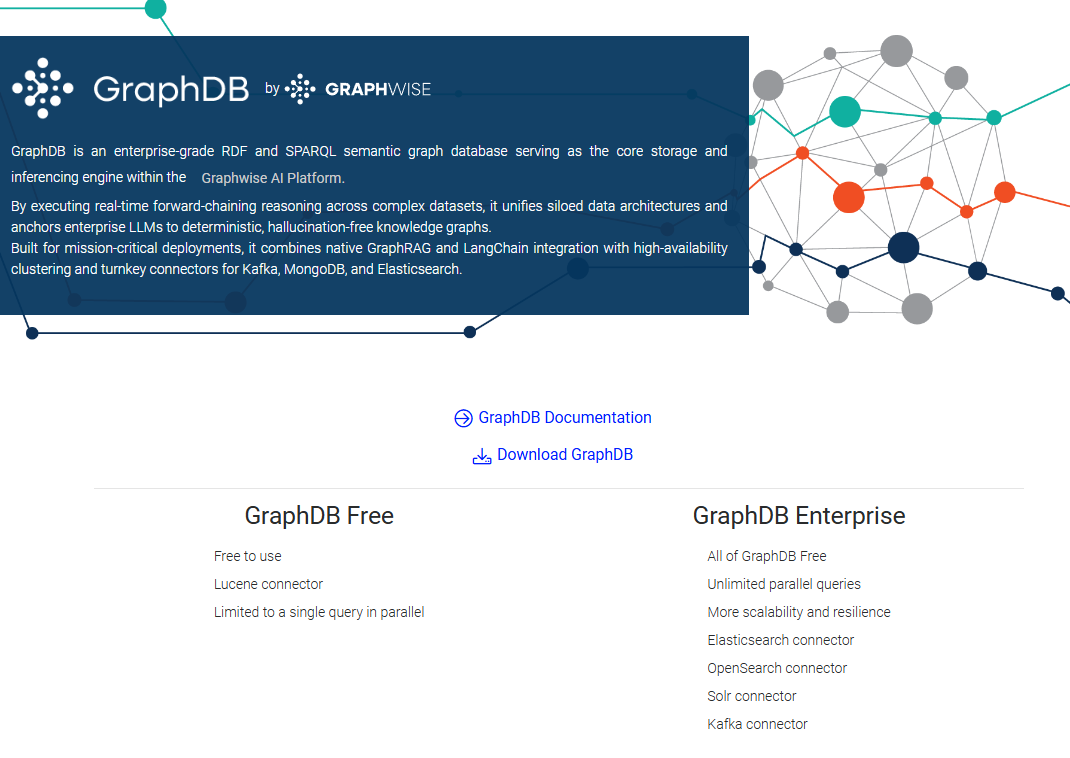
GraphDB is an enterprise-grade RDF triplestore built by Ontotext for teams constructing semantic knowledge graphs at scale. It combines SPARQL query and update support with real-time forward-chaining inference, giving product teams a platform where ontology rules produce derived facts automatically rather than requiring batch materialization. The Workbench interface makes data exploration and repository administration accessible without deep command-line expertise.
Best for: Product and data teams building governed knowledge graphs where inference and semantic interoperability are core product requirements.
Key features
- SPARQL query and update support
- Real-time forward-chaining semantic reasoning
- Lucene, Elasticsearch, OpenSearch, and Kafka connectors
- High-availability clustering support
- Workbench interface for administration and data exploration
Why choose GraphDB: It suits teams that want a productized RDF platform rather than a code-first framework. If your roadmap includes semantic governance across multiple teams publishing to the same graph, GraphDB's inference profiles and repository management reduce the risk of model fragmentation over time.
GraphDB pricing: GraphDB Free is available at no cost and includes the Lucene connector with parallel-query limitations. GraphDB Enterprise adds unlimited parallel queries, greater scalability, and additional connectors; pricing requires a quote from Ontotext.
G2 rating: 4.2/5
2. Stardog
Stardog positions itself as a Semantic AI platform and enterprise knowledge graph for connecting, enriching, querying, and governing distributed data. Its data virtualization layer means teams can expose relational databases, document stores, and other sources as RDF graphs without physically moving data into a centralized triplestore. SHACL-based data quality constraints let you enforce semantic contracts across source systems.
Best for: PMs leading data integration, semantic layer, or AI-readiness initiatives where source system migration is not a near-term option.
Key features
- SPARQL, SPARQL-star, and GraphQL query support
- Data virtualization across SQL and NoSQL sources
- SHACL-based data quality management
- Ontology-driven inference engine for explainable AI
- Cloud-hosted and self-managed deployment options
Why choose Stardog: The virtualization capability shortens time to a working graph when source systems cannot be restructured. For PMs who need consistent definitions across a dozen systems before a data team can physically consolidate them, Stardog's semantic layer model buys runway without blocking the roadmap.
Stardog pricing: Stardog Cloud offers a Free plan with shared hosting, up to one million stored edges, and three databases. Enterprise plans include dedicated hosting, custom edge limits, and a 99.9% uptime SLA; pricing requires a sales conversation.
G2 rating: 4.2/5
3. AllegroGraph
AllegroGraph is a high-performance graph, vector, and document database built for enterprise knowledge graph and neuro-symbolic AI applications. It combines RDF triple storage with OWL reasoning, SHACL validation, geospatial and temporal query functions, and vector storage in a single platform. The FedShard horizontal sharding and federation capability addresses scale requirements that most self-hosted triplestores cannot match without external infrastructure work.
Best for: Teams building governed knowledge graphs that need commercial support and have demanding graph analytics or AI-readiness requirements.
Key features
- RDF, OWL, SPARQL, and SHACL support
- Vector and document storage alongside triples
- FedShard horizontal sharding and federation
- Geospatial, temporal, and social-network analytics
- Triple-level security with ACID transactions
Why choose AllegroGraph: It fits teams where the semantic graph is also an AI data layer. The combination of SPARQL querying, vector search, and OWL reasoning in one platform reduces the number of systems a product team needs to maintain for an entity-resolution or recommendation feature.
AllegroGraph pricing: A Free Edition is available. Enterprise pricing is available through AWS or Azure Marketplaces at hourly or annual rates; on-premise and private-cloud deployments require a quote from Franz Inc.
G2 rating: 5.0/5
4. Amazon Neptune
Amazon Neptune is a fully managed graph database service that supports both RDF and SPARQL alongside Apache TinkerPop Gremlin and openCypher for property graph workloads. AWS handles storage scaling, replication, backups, and patching. For product teams already operating inside AWS, Neptune's IAM authentication and integration with analytics and search services reduce the credential and pipeline overhead that self-hosted triplestores require.
Best for: AWS-first product teams that want managed database operations and a path to support both RDF and property graph workloads from a single service.
Key features
- SPARQL 1.1 support for RDF data
- Named graph handling
- Automatic storage scaling with up to 15 read replicas
- Serverless capacity with billing per Neptune Capacity Unit-second
- IAM authentication and Multi-AZ replication
Why choose Amazon Neptune: The managed model removes database operations from your engineering team's release cadence obligations. The tradeoff is that SPARQL behavior, data-loading workflows, and cost under sustained query volume all require validation before a roadmap commitment. Run a cost model across expected query load before signing off on the infrastructure choice.
Amazon Neptune pricing: On-demand instances start at $0.348 per hour for a db.r5.large in US East (N. Virginia). Serverless billing uses Neptune Capacity Units per second. A free tier covering 750 instance hours, 10 million I/O requests, and 1 GB storage is available for 30 days to eligible new AWS users.
G2 rating: 4.3/5
5. Apache Jena Fuseki
Apache Jena Fuseki is an open-source SPARQL server built on the Apache Jena Java framework. Fuseki exposes RDF datasets through SPARQL 1.1 query and update endpoints and Graph Store protocol, backed by TDB2 persistent triple storage. It can run standalone, embedded in an application, as a Docker container, or as a web application, giving engineering teams full control over the deployment shape.
Best for: Engineering-led teams that need an open-source RDF stack and can own production hardening, monitoring, and long-term maintenance.
Key features
- SPARQL 1.1 query and update endpoints
- TDB2 persistent triple storage
- Graph Store protocol support
- HTTPS, authentication, and dataset-level access control
- Prometheus and JSON server statistics
Why choose Apache Jena Fuseki: Zero license cost and full deployment control make it a reasonable choice when the team has platform capacity to operate the stack. The opportunity cost is real: Production observability, backup strategy, scaling decisions, and security configuration all land on your engineering team rather than a managed service.
Apache Jena Fuseki pricing: Free and open source. Budget for hosting infrastructure, engineering time for production operations, and performance testing against your representative workload.
G2 rating: 4.1/5 for Apache Jena
6. OpenLink Virtuoso
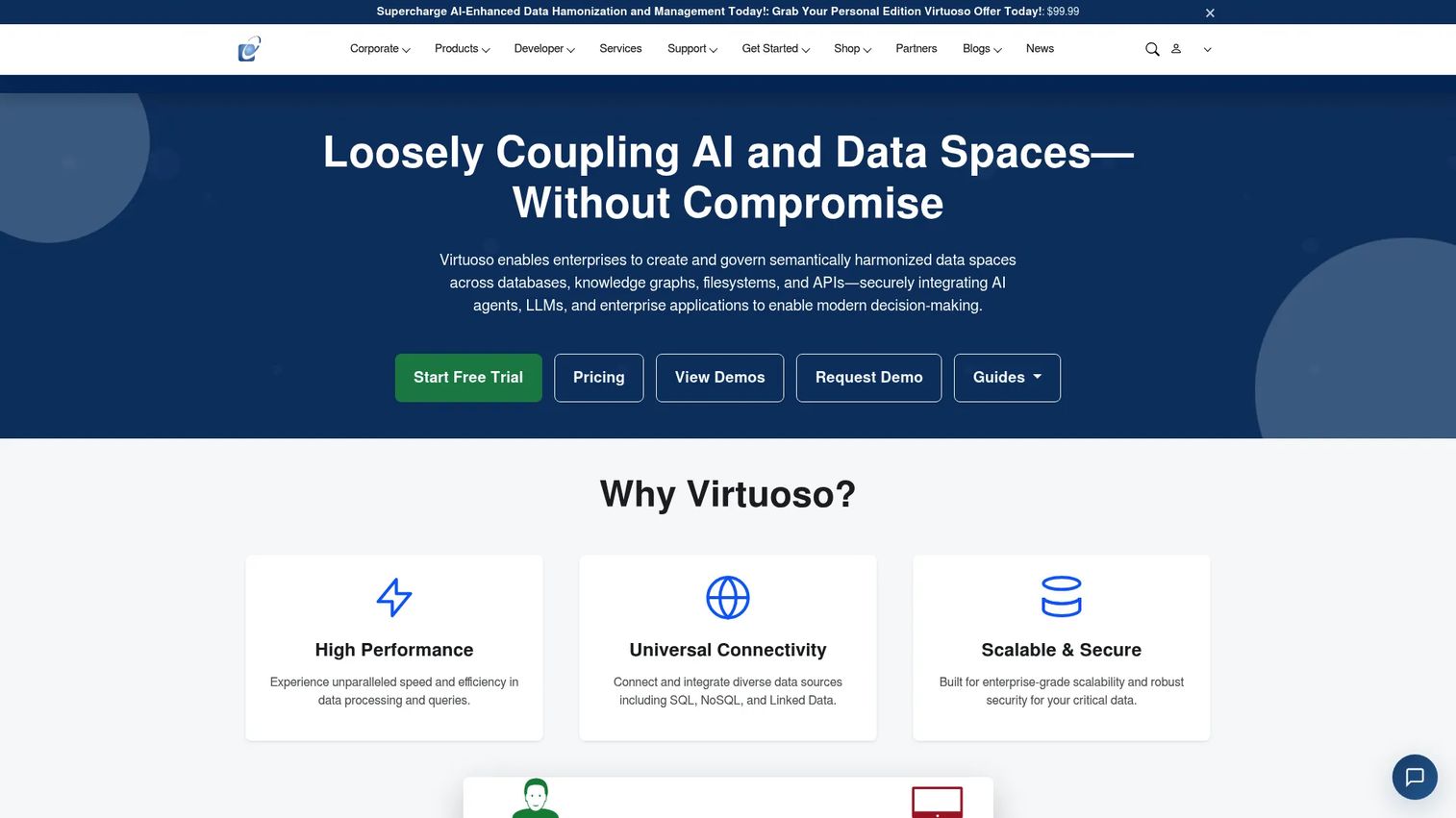
OpenLink Virtuoso is a cross-platform, multi-model database and HTTP application server that handles relational data, RDF graphs, XML, and text in a single platform. Its SPARQL support sits alongside SQL querying, linked-data publishing tools, and data virtualization across heterogeneous sources. Virtuoso has a long history powering large Linked Open Data deployments and public knowledge graph endpoints.
Best for: Teams that need RDF support alongside SQL-oriented systems, linked-data publishing, or hybrid data-serving requirements in a single platform.
Key features
- SQL, RDF, and SPARQL in one platform
- Data virtualization and integration across sources
- Native RDF storage with reasoning and inference
- Linked Data publishing tools
- Open-source edition under GPL
Why choose OpenLink Virtuoso: It may reduce the number of systems in your stack when RDF is one requirement among several rather than the primary design center. A hybrid platform requires broader platform expertise from the team operating it, so the integration benefit and the operational complexity need to be weighed against each other for your specific roadmap.
OpenLink Virtuoso pricing: The open-source edition is available under GPL. Workstation plans start at $99.99 (Personal), $199 (Developer), and $499 (Project). Enterprise licensing is custom pricing through a sales conversation.
G2 rating: 4.3/5
7. Eclipse RDF4J
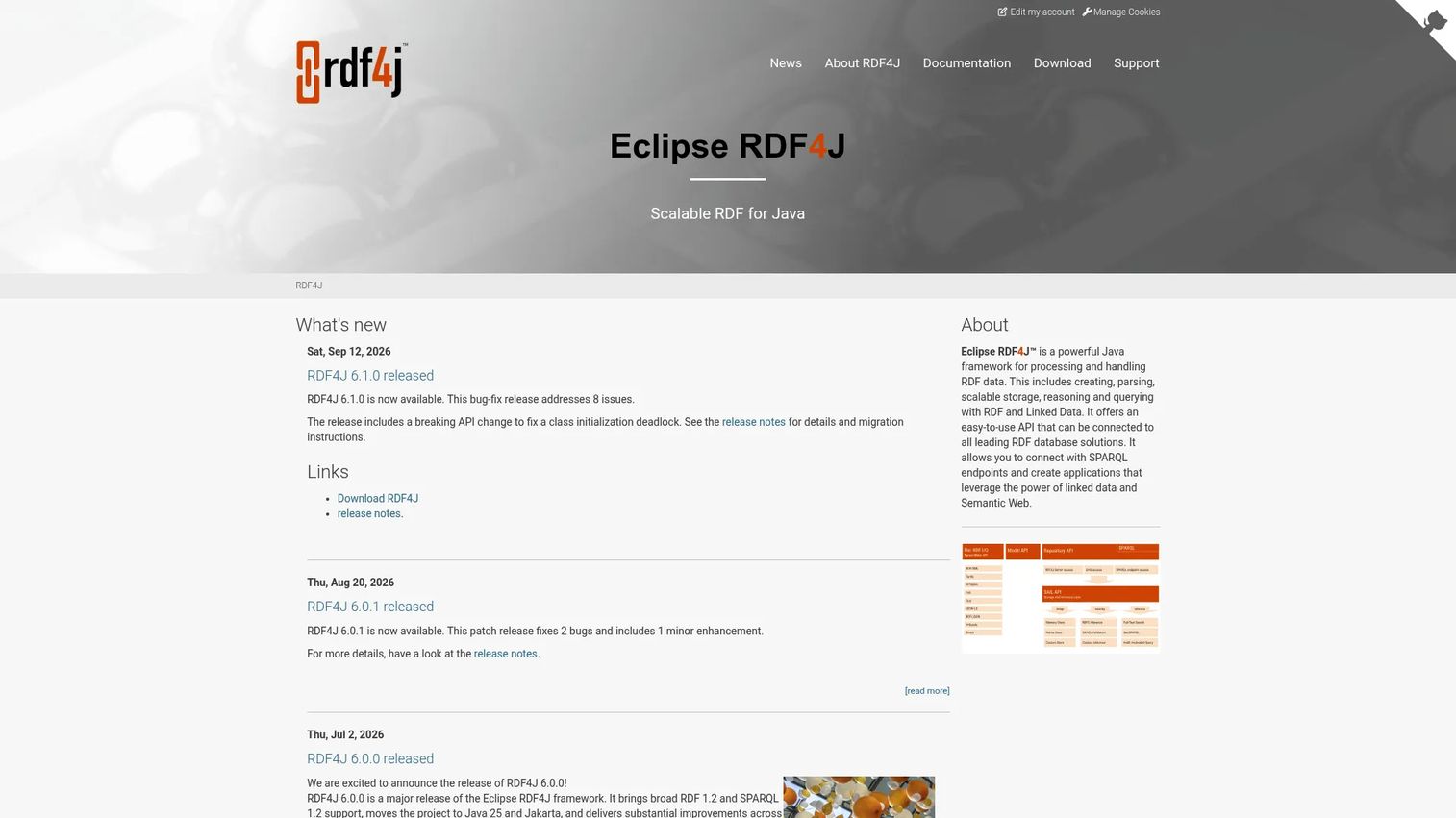
Eclipse RDF4J is a modular open-source Java framework for parsing, storing, inferencing, and querying RDF and Linked Data. It provides a repository API, a SPARQL parser and query engine, in-memory and native persistent stores, RDFS and rule-based inferencing, SHACL validation, and RIO parsers for every major RDF serialization format. The SAIL architecture makes storage backends pluggable, so teams can swap in a different store without rewriting application code.
Best for: Java product teams embedding RDF functionality into an existing application rather than deploying a packaged database platform.
Key features
- Java RDF repository API and SPARQL support
- In-memory and native persistent RDF stores
- RDFS inferencing and SHACL validation
- RIO parsers for RDF/XML, Turtle, N-Triples, and more
- Pluggable SAIL storage architecture
Why choose Eclipse RDF4J: It works as an application-development foundation when semantic features are deeply embedded in a Java service and product differentiation warrants custom development. It is not a turnkey database platform. The build-versus-buy question matters here: If your team needs a managed query interface, monitoring, and operational tooling out of the box, a packaged triplestore is a lower-maintenance path.
Eclipse RDF4J pricing: Free and open source under the Eclipse Distribution License (EDL) 1.0. The cost is engineering ownership, hosting, and long-term maintenance.
8. RDFox
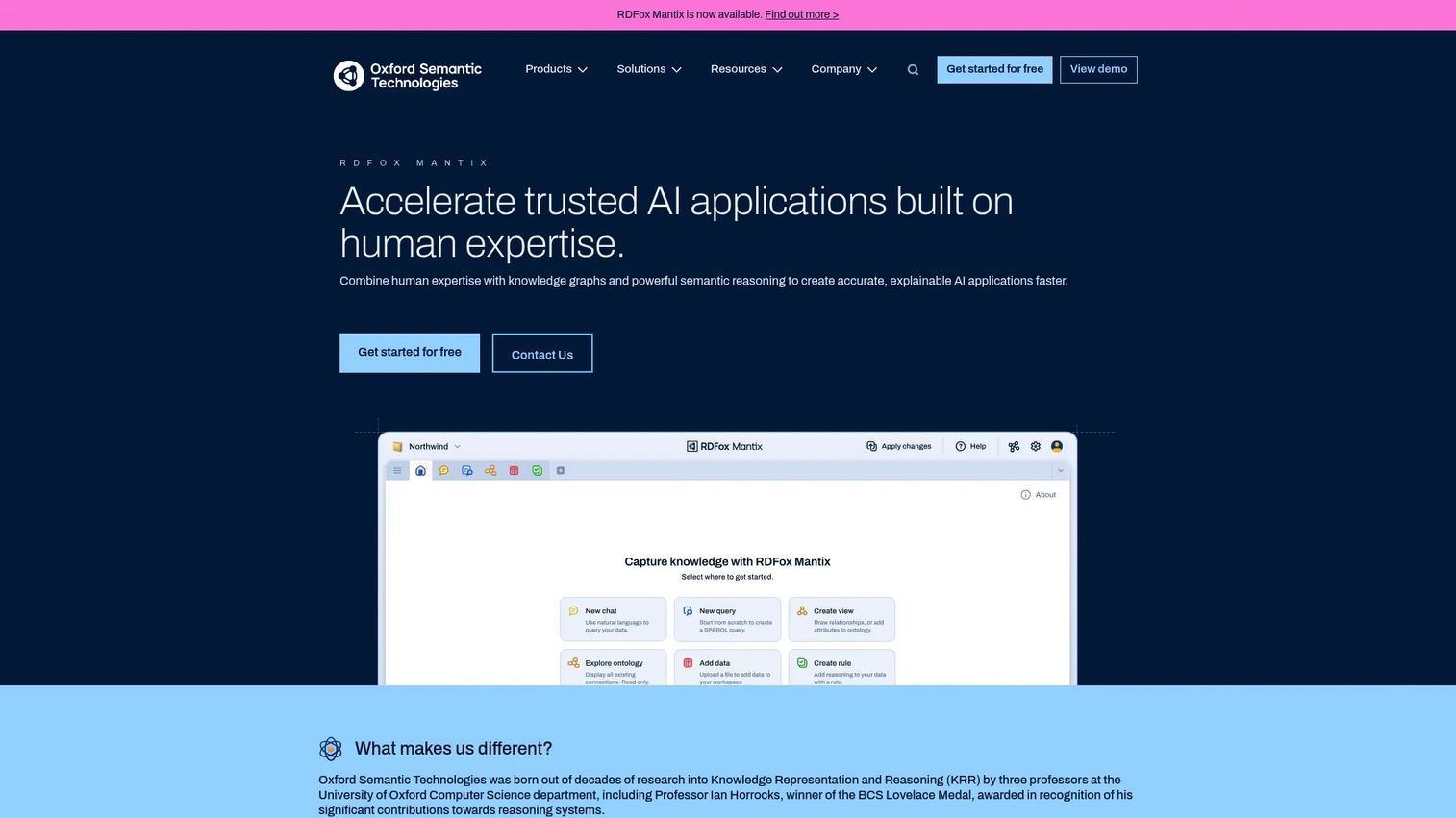
RDFox is an in-memory knowledge graph and semantic reasoning engine developed by Oxford Semantic Technologies. Its architecture prioritizes low-latency reasoning over Datalog, OWL 2, and SWRL rule sets, with incremental reasoning that updates the materialized closure as data changes rather than recomputing from scratch. SPARQL 1.1 querying, REST and Java APIs, and multi-format import make it accessible to product teams with diverse data pipelines.
Best for: Teams where real-time inference is central to the product experience and query latency on reasoning-heavy workloads determines feature viability.
Key features
- Datalog, OWL 2, and SWRL reasoning
- Incremental reasoning and automated materialization
- SPARQL 1.1 querying and triple-store support
- High-availability and scalable in-memory operation
- REST and Java APIs with multi-format import and export
Why choose RDFox: The incremental reasoning model fits products where the knowledge graph changes frequently and recomputing the full closure on every update is too slow. Before committing, ask whether real-time reasoning is the product requirement or whether batch materialization on a nightly cadence would meet the same user need with less infrastructure complexity.
RDFox pricing: Contact Oxford Semantic Technologies directly. A free trial is available on request; commercial and developer licensing terms are not displayed on the website.
G2 rating: 4.8/5
9. Blazegraph
Blazegraph is a high-performance open-source graph database that supports both RDF/SPARQL and Blueprints property graph APIs. It gained broad recognition through its use in large linked-data projects and remains in production at organizations with established expertise on the platform. Its architecture claims support for up to 50 billion edges on a single machine, with full-text indexing and bulk-load APIs.
Best for: Teams assessing existing RDF infrastructure, evaluating compatibility requirements, or maintaining a deployment where internal Blazegraph expertise already exists.
Key features
- RDF storage and SPARQL endpoint support
- Blueprints and TinkerPop3 API support
- Full-text indexing and search
- Bulk-load and query management APIs
- Named graph capabilities
Why choose Blazegraph: Its relevance is strongest for teams with existing deployments or specific compatibility requirements. New evaluations should include a review of release activity, community support, and migration options before selecting it as a production dependency. If product outcomes depend on this graph layer, confirm ownership and contingency planning before committing.
Blazegraph pricing: Free and open source. Budget for self-hosted operations, maintenance ownership, and contingency planning if release activity does not match your support requirements.
G2 rating: 5.0/5
Considerations when choosing an RDF database
Start with the semantic requirement
Before evaluating any platform, identify whether the product needs standards-based identifiers, ontologies, inference, provenance, or external linked-data integration. A team that only needs graph traversal and application-specific schemas will pay unnecessary overhead for a full RDF stack. Clarify the requirement first, then evaluate platforms against it.
Define the query and reasoning workload
Ask engineering for representative SPARQL queries before vendor selection. Include simple lookups, multi-hop joins, named graph queries, writes, bulk loading, and inference-heavy patterns. A platform that performs well on lookup queries may struggle under complex reasoning load. Run these queries against your actual data volume in a proof of concept before any roadmap commitment.
Separate platform cost from engineering cost
Managed and commercial platforms may reduce operations work but carry licensing or usage fees. Open-source platforms carry zero license cost but require your team to own deployment, scaling, observability, backup, and security configuration. Factor engineering hours into the total cost model, not just the vendor invoice.
Plan for ontology and data-contract governance
The ontology is part of the product architecture, not a setup task. Assign ownership for vocabulary changes, URI policies, validation rules, and deprecation. Without governance, ontology drift across teams creates the same inconsistency problem you were trying to solve with RDF in the first place.
Test interoperability before launch
If the roadmap includes property graph integrations, external vocabularies, data catalogs, or public datasets, run a proof of concept around the actual exchange and mapping requirements before selecting a platform. Interoperability claims on a vendor's documentation page are not a substitute for testing against your specific data contracts.
Conclusion
The right RDF database follows from three decisions: Whether RDF is the correct model for your product's data requirements, which semantic capabilities the roadmap actually needs, and what your team can realistically operate over time.
GraphDB is the most complete option for enterprise knowledge graph programs. Stardog suits teams that need to federate across distributed sources without waiting for centralization. AllegroGraph fits commercial semantic graph and AI use cases. Amazon Neptune covers AWS-managed graph operations with SPARQL support. Apache Jena Fuseki and Eclipse RDF4J serve engineering-led teams that want open-source, code-first control. OpenLink Virtuoso handles hybrid SQL and RDF requirements. RDFox belongs on the shortlist for inference-sensitive product features. Blazegraph remains relevant for existing deployments or specific compatibility needs.
Pick two platforms from this list, model one real business entity in each, load a representative dataset, and run the SPARQL queries your product will depend on. A small proof of concept will tell you more than a feature matrix.
Teams building complex data products often also need to explain how those products work to internal stakeholders, partners, or buyers. Guideflow helps you create interactive product experiences that show technical workflows, knowledge graph interfaces, and SPARQL-driven features to any audience without scheduling a live session.
Start your journey with Guideflow today!
FAQs
An RDF database is a type of graph database that stores data as subject-predicate-object triples and commonly relies on W3C standards such as RDF, SPARQL, and OWL. General graph databases can use different models, including property graphs with nodes, relationships, labels, and properties. The main distinction is whether the model prioritizes standards-based semantic interoperability or application-specific graph traversal.
A triplestore is a database optimized for storing and retrieving RDF statements in subject-predicate-object form. The terms "RDF store" and "RDF database" are used interchangeably with triplestore in most practitioner contexts. All three refer to a storage engine whose primary query interface is SPARQL.
Most RDF databases support SPARQL because it is the W3C-standardized query language for RDF data. The exact supported version, extensions, update features, federation behavior, and performance characteristics vary between platforms. Verify the specific SPARQL profile, including support for SPARQL 1.1 updates and federated queries, during your evaluation.
Choose RDF when semantic interoperability, standards-based vocabularies, ontology modeling, provenance tracking, and linked-data integration are central product requirements. Choose a property graph when the main job is application-specific graph traversal with a simpler, product-owned schema. The decision follows from the data model's interoperability obligations, not from performance benchmarks alone.
Ontologies define shared concepts and relationships across a knowledge graph, such as what counts as a customer, a product, a contract, or a clinical event. They let teams apply consistent meaning across datasets and enable inference engines to derive additional facts from those definitions. Treating the ontology as a governed data contract from the start prevents the semantic drift that defeats the purpose of building a shared graph.
RDF-star extends RDF syntax to allow statements about statements. A team can attach metadata such as confidence scores, source identifiers, timestamps, or reviewer status to an individual triple relationship without creating a separate reification structure. Not every platform supports RDF-star, and support levels vary by edition; verify against the vendor's current documentation before including it in your requirements.
Yes. Several RDF platforms expose relational data as virtual RDF graphs through data virtualization, while others require ingestion or ETL transformation. The right approach depends on query latency requirements, source-system ownership, governance constraints, and how frequently the underlying data changes. Virtualization avoids data movement but adds query-time overhead; physical ingestion improves query performance but creates a synchronization obligation.
Use representative data and production-like SPARQL queries rather than synthetic benchmarks. Measure ingestion speed for your expected data volumes, query latency under concurrent load, reasoning cost for your specific ontology rules, and the engineering hours required to maintain the platform after the initial deployment. Operational recovery time, backup verification, and update behavior under live query load are also worth testing before a production commitment.