
You started the week with a clean to-do list. By Wednesday, half of it was the same loop you ran last week: qualifying inbound, drafting follow-ups, routing tickets, fixing CRM data your reps forgot to update. Your VP of Sales has the same loop. So does your CS lead. The work is real, but no one wants to do it forever.
This is the gap AI agents are trying to fill. The category went from a curiosity in 2024 to a buying decision in 2026. Databricks reports multi-agent systems grew 327% in less than four months as enterprises shifted from single chatbots to coordinated agent teams (State of AI Agents, Databricks, 2025). Market forecasters peg the AI agents market at $7.63B in 2025 growing to $182.97B by 2033 at a 49.6% CAGR (Grand View Research, 2025).
That growth has a downside. There are now dozens of AI agent builder platforms, most of which sound identical on their landing pages. For a Series B SaaS founder watching burn multiple and CAC payback benchmarks, the question is not "which platform looks coolest." It is "which one earns its seat in our stack inside 30 days without routing every workflow through engineering."
This guide is the shortlist we would give a peer. Ten AI agent builders, ranked by fit for SaaS teams, with honest notes on where each one works and where it does not. If you're also evaluating adjacent categories, our roundups of the best AI orchestration platforms and agentic AI tools for sales cover overlapping territory worth a look.
What's inside
This guide covers 10 AI agent builder platforms ranked by fit for SaaS teams shipping real workflows in 2026. It is written for founders, RevOps and ops leads, and GTM operators at 30 to 150 person SaaS companies.
We selected platforms based on five criteria:
- Real production usage by SaaS teams, not just demos.
- Integration depth with the GTM stack: CRM, helpdesk, Slack, comms, data warehouse.
- Pricing transparency and reasonable payback economics for sub-$15M ARR companies.
- Human-in-the-loop and governance controls for customer-facing work.
- Speed to a first working agent inside week one.
TL;DR
- Best overall for SaaS GTM and ops teams: Gumloop, for its visual builder, multi-LLM support, and breadth across marketing, sales, and internal workflows.
- Best for technical teams that want self-hosting: n8n, especially for engineering-heavy SaaS companies that need code nodes and execution control.
- Best for non-developer ops teams that need approval gates: Relay.app, with its human-in-the-loop-first design.
- Best for enterprise governance and regulated buyers: Stack AI, with on-prem and VPC options plus SOC 2, HIPAA, and GDPR coverage.
- Best for SaaS teams already running Zapier or Make: Zapier Agents and Make, both layer agent capabilities onto the workflow stack you already use.
- Best for teams committed to Google Cloud: Vertex AI Agent Builder, deeply tied to Gemini and GCP datastores.
What is an AI agent builder?
An AI agent builder is a platform that lets teams design, deploy, and govern autonomous AI agents that can reason, use tools, and execute multi-step tasks across business applications without writing the orchestration logic from scratch.
The core components every AI agent platform includes:
- LLM layer: The reasoning engine, usually swappable across OpenAI, Anthropic, Google, and open models.
- Memory: Short-term context for a single task and long-term memory across sessions.
- Tools and integrations: Connections to CRMs, helpdesks, databases, email, Slack, and custom APIs.
- Orchestration: Logic for how an agent decides which tool to call and in what order.
- Observability: Logs, traces, and replay so you can see what an agent did and why.
- Human-in-the-loop: Approval gates for actions that touch customers, money, or production data.
The category emerged because three things matured at the same time in 2024 and 2025: function calling capabilities and the Model Context Protocol made tool use reliable, inference got cheap enough to support multi-step reasoning, and enterprises started shipping multi-agent systems instead of single chatbots. Today, the most common deployment patterns are copilots that assist a human, autonomous agents that complete tasks end to end, and multi-agent system patterns where specialized agents coordinate.
How AI agents differ from AI workflows and chatbots
The three look similar from a distance but behave very differently:
- AI workflows execute fixed steps in a defined order. They are deterministic.
- Chatbots respond to messages with text. They do not take actions in other systems.
- AI agents receive a goal, decide which tools to use, and execute multi-step actions. They are goal-directed.
A workflow knows what to do. An agent decides what to do.
When SaaS teams should use AI agent builders
Automate repetitive GTM workflows
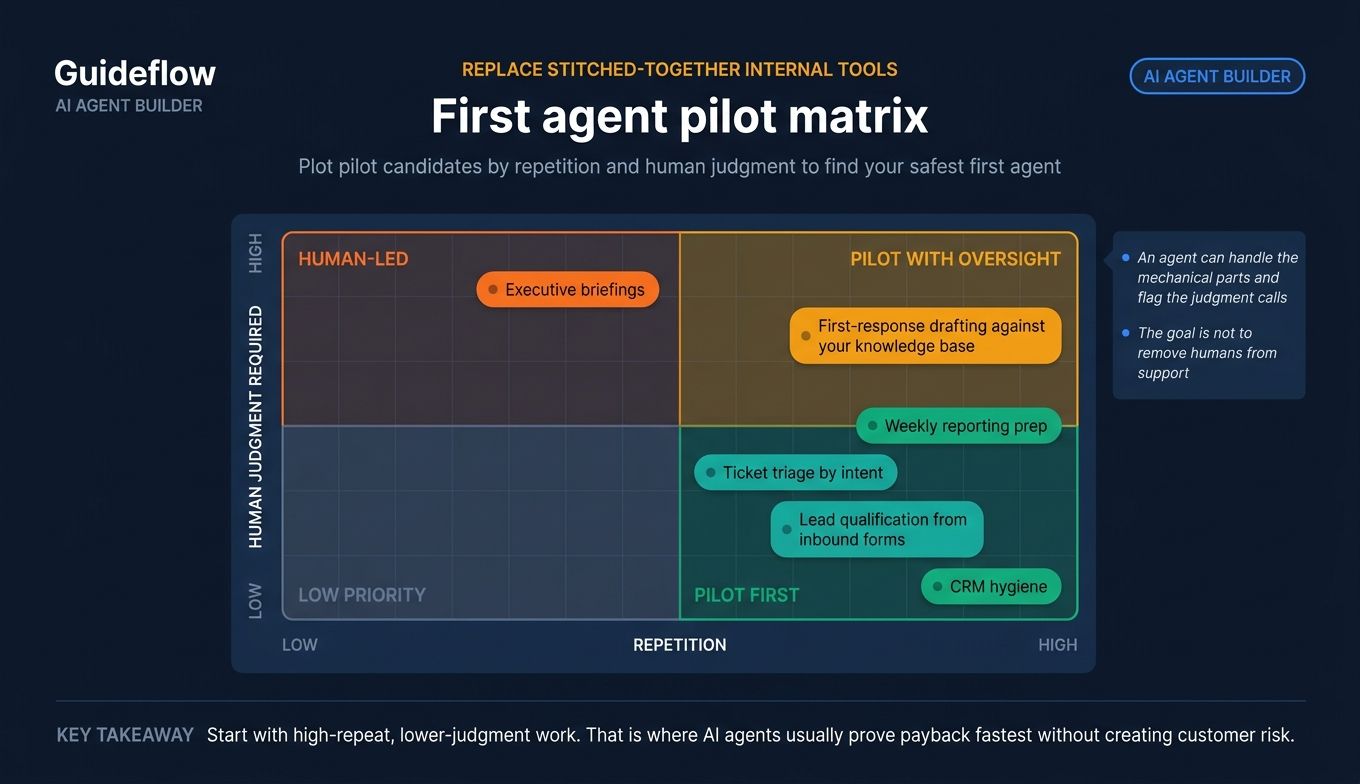
Lead qualification from inbound forms, follow-up drafting after demos, CRM hygiene, inbound routing by ICP fit, and meeting prep briefings. These are the workflows that eat a rep's morning. An agent can handle the mechanical parts and flag the judgment calls. Teams comparing dedicated SDR tooling alongside agent platforms should check our best AI SDR tools roundup.
Scale support without scaling headcount
Ticket triage by intent, first-response drafting against your knowledge base, doc retrieval for agents, and proactive education for new customers. The goal is not to remove humans from support. It is to make sure every human ticket is one that actually needs a human.
Replace stitched-together internal tools
RevOps tasks that currently live in spreadsheets, Slack threads, and tribal knowledge. Data movement between systems. Weekly reporting prep. Executive briefings. The Series B operator's actual job is to reduce tools while increasing signal. Agents help when they replace three Zapier zaps and a manual cleanup, not when they add a sixth dashboard.
Comparison table
Sorted by fit for SaaS teams, not alphabetically. Pricing reflects the entry tier publicly listed as of June 2026. Ratings pulled from G2.
| # | Product | Intent | Key differentiation | Pricing | G2 rating |
|---|---|---|---|---|---|
| 1 | Gumloop | GTM and ops automation | Visual canvas, multi-LLM, multi-agent workflows in Slack and Teams | Free; Pro $37/mo | 4.8/5 |
| 2 | n8n | Technical workflow + agent builder | Self-hosting, code nodes, LangChain support, execution replay | Starter 20€/mo (annual) | 4.7/5 |
| 3 | Relay.app | Human-in-the-loop automation | Built-in approval steps, AI + automation hybrid, 200+ app integrations | Free; Professional $19/mo | 4.9/5 |
| 4 | Stack AI | Enterprise agent platform | On-prem and VPC deployment, SOC 2, HIPAA, GDPR | Free; Enterprise custom | 4.5/5 |
| 5 | Lindy AI | AI assistant for GTM and ops | Email triage, meeting scheduling, meeting notes, templates | Plus $49.99/mo | 4.9/5 |
| 6 | Vertex AI Agent Builder | Google Cloud-native agent platform | Agent Development Kit, Agent Runtime, Sessions and Memory Bank | Usage-based; free tier | 4.3/5 |
| 7 | Relevance AI | Multi-agent workforce | Pre-built agent roles, multi-agent orchestration | Free; Pro $19/mo (annual) | 4.3/5 |
| 8 | Cassidy AI | Knowledge-grounded agents | Synced, cited, permission-aware knowledge base | Starter free | 5.0/5 |
| 9 | Make | Visual automation + AI agents | 3,000+ apps, no-code visual builder, Make AI Agents (beta) | Free; Core $12/mo | 4.8/5 |
| 10 | Zapier Agents | Agent layer on Zapier | Largest app catalog, browser extension, Copilot agent builder | Free; Pro $33.33/mo (annual) | 4.5/5 |
The 10 best AI agent builders for SaaS teams in 2026
1. Gumloop
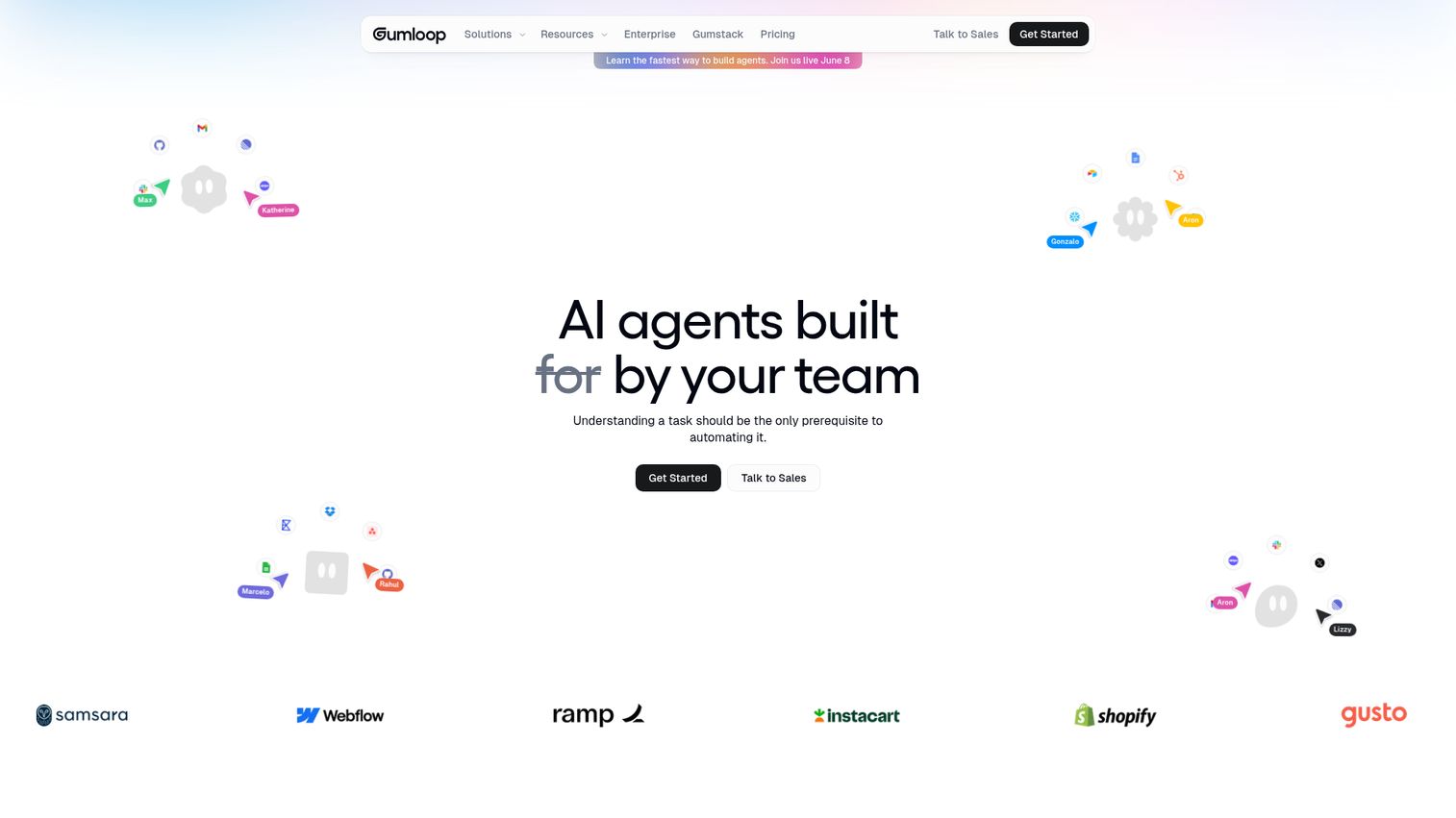
Gumloop is an AI automation framework for building agents and multi-agent workflows across a team. It uses a visual canvas where you orchestrate agents that can read from internal and external data, call tools, and operate inside Slack, Microsoft Teams, and Gmail. For SaaS teams, the appeal is breadth: marketing, sales, CS, and internal ops can all build on the same platform without each team needing its own automation tool.
Best for: SaaS ops, marketing, and RevOps teams that want a shared internal app platform for AI agents.
Key strengths
- Multi-agent canvas: Build orchestrations where specialized agents hand off tasks to each other, not just single linear flows.
- Internal and external data access: Agents can pull from internal sources and act on third-party systems in the same workflow.
- Embedded in work surfaces: Agents run in Slack, Microsoft Teams, and Gmail, which is where most SaaS GTM work actually happens.
Why choose Gumloop: If your team needs one platform that marketing can use for content workflows, sales can use for lead qualification, and ops can use for internal reporting, Gumloop covers the breadth without forcing you to learn a different tool per team. The visual builder lowers the bar for non-engineers without locking developers out.
Gumloop pricing: Free plan includes 5,000 credits per month. Pro starts at $37 per month and includes 20,000+ credits per month. Enterprise is custom priced. See the Gumloop pricing page for current details.
2. n8n
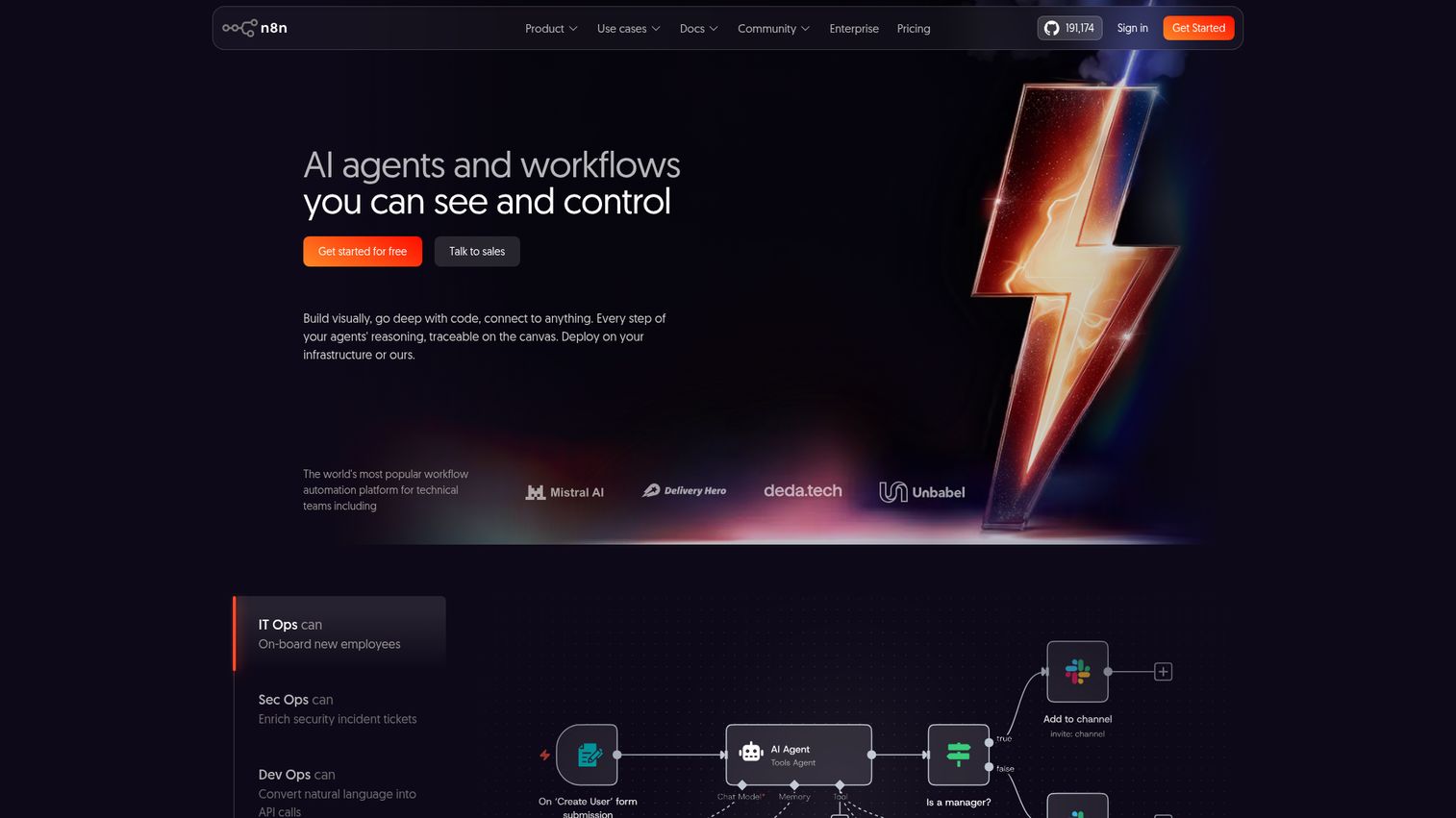
n8n is an AI workflow automation platform built for technical teams. It pairs a visual builder with code nodes (JavaScript or Python), built-in AI nodes, and LangChain support, plus debugging tools like execution replay and custom alerting. The n8n ai agent builder approach gives engineering-led SaaS teams the control they want: self-hosting, fine-grained logic, and the ability to drop into code when no-code blocks fall short.
Best for: Technical SaaS teams that want a controllable, code-friendly n8n agent builder with self-hosting or managed deployment options.
Key strengths
- Code when you need it: JavaScript and Python nodes let engineers extend any workflow without leaving the platform.
- Built-in AI and LangChain support: Modular AI app building with patterns engineers already know.
- Debugging and observability: Custom alerting, logs, and execution replay make n8n ai agents production-debuggable, not just demo-friendly.
Why choose n8n: If your engineering team rolls its eyes at no-code platforms but you still want a shared canvas for n8n ai agent workflows, n8n hits the middle. Self-hosting also matters for SaaS companies handling sensitive customer data or building inside regulated industries.
n8n pricing: Starter is 20€ per month billed annually. Pro is 50€ per month billed annually. Business is 667€ per month billed annually. Enterprise requires contacting sales. All plans include unlimited users, unlimited workflows, and every integration; pricing scales by monthly workflow executions. See the n8n pricing page for current details.
3. Relay.app
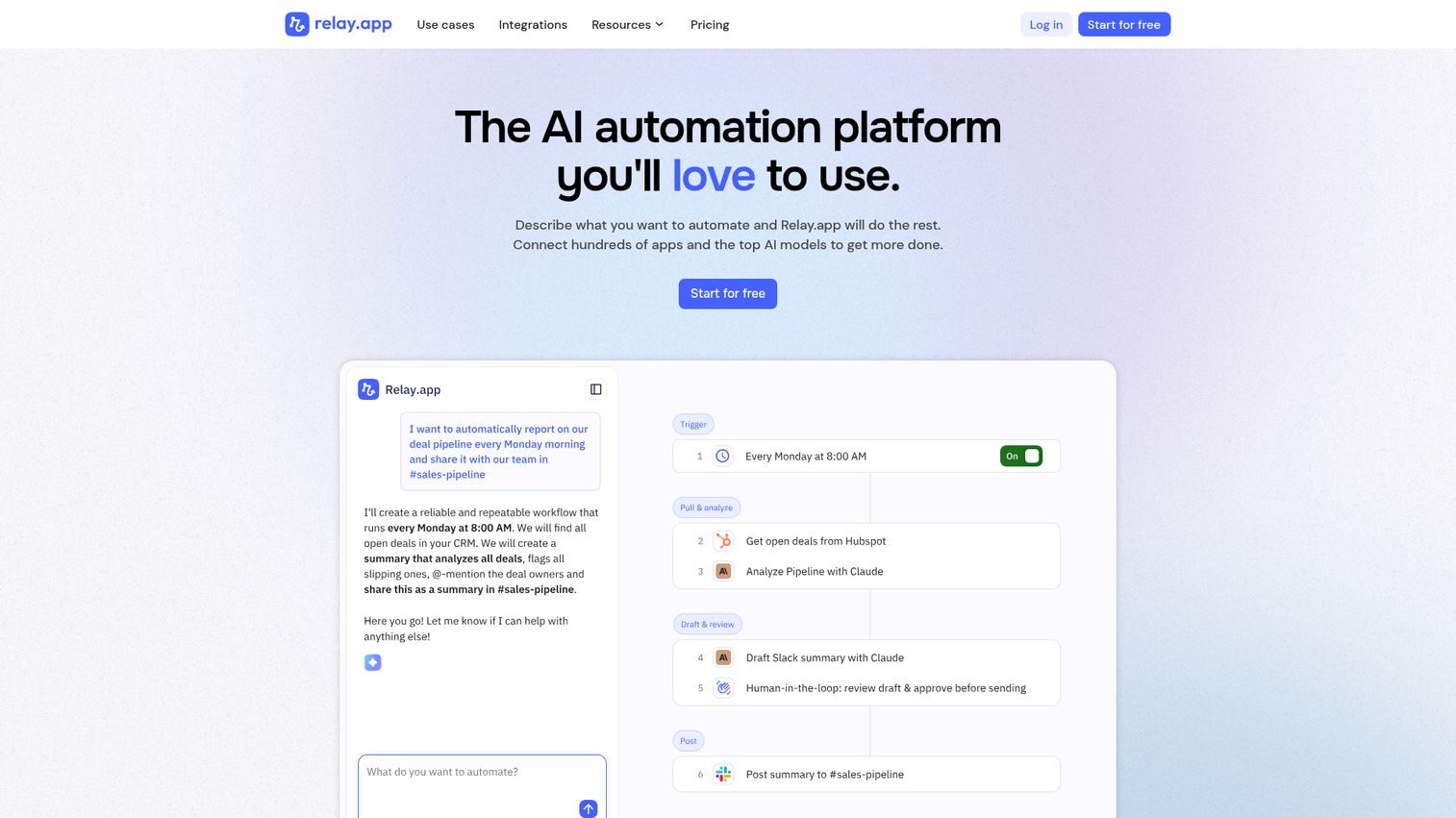
Relay.app automates work in 200+ popular apps with access to top AI models and fine-grained control over what each automation can access and do. The standout design choice is human-in-the-loop as a first-class primitive: approval steps, data entry checkpoints, and AI output review live inside workflows by default, not as a bolt-on.
Best for: SaaS teams that need approval guardrails on any agent action that touches customers, money, or production data.
Key strengths
- Human-in-the-loop actions: Approvals, data entry checkpoints, and AI output review are core building blocks, not afterthoughts.
- Reusable building blocks: Workflows, sequences, tables, and MCP servers compose together for more complex agents.
- Visual editor with real logic: Conditional paths, loops, filters, and drag-and-drop controls give ops teams enough power without code.
Why choose Relay.app: For SaaS teams whose VP of Sales or CS lead is nervous about autonomous agents touching customers, Relay's approval-first design solves the political problem before the technical one. You can ship customer-facing agents in week one and still have the human check that keeps your CSAT intact.
Relay.app pricing: Free plan at $0. Professional is $19 per month billed annually. Team is $59 per month billed annually. Enterprise is custom. See the Relay.app pricing page for current details.
4. Stack AI
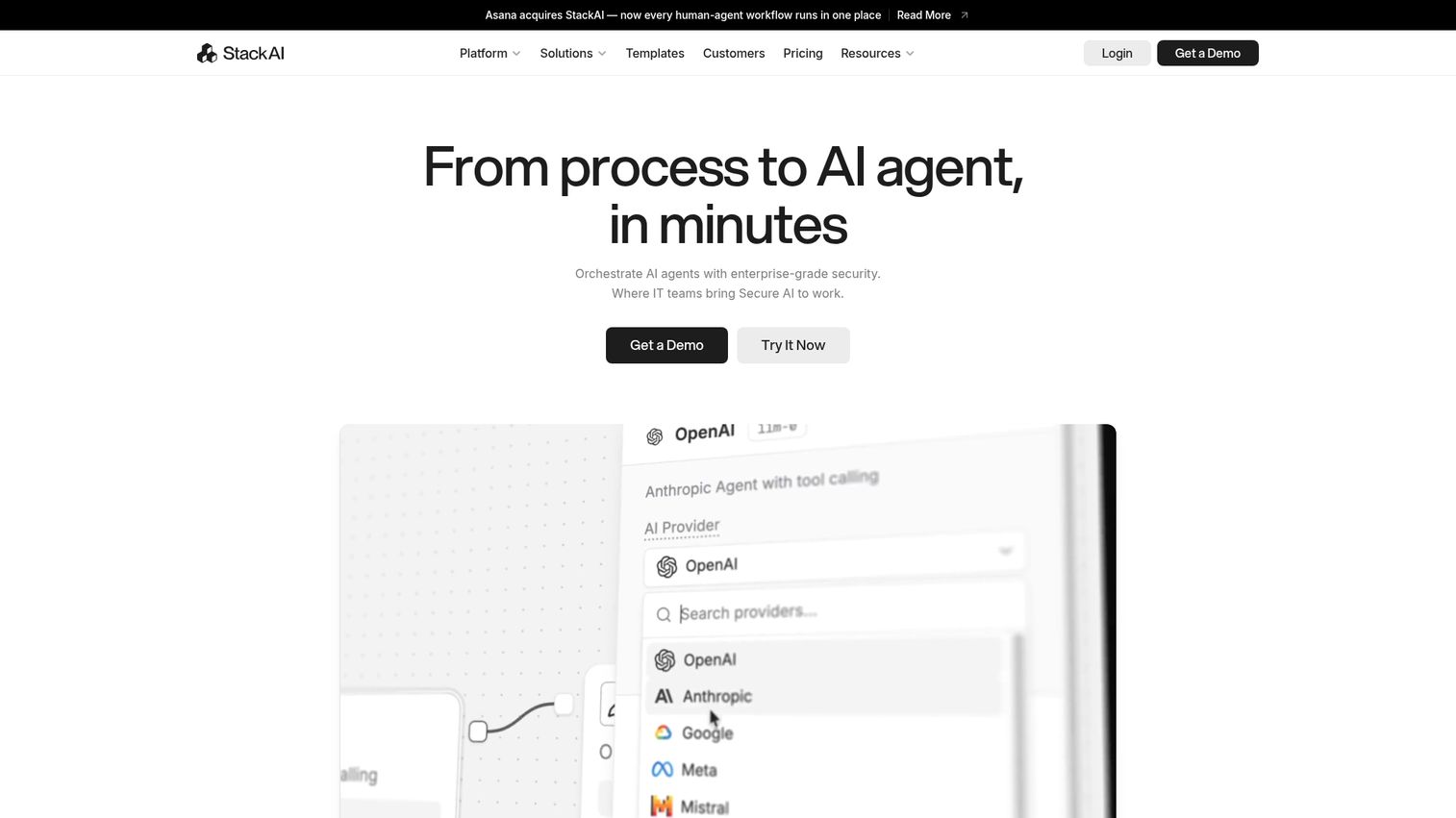
Stack AI is an end-to-end platform for deploying AI agents for enterprise teams. The platform offers 100+ enterprise integrations, governed retrieval-augmented generation (RAG) workflows, and a security posture built for regulated buyers: SSO, on-prem deployment, VPC deployment, plus SOC 2, HIPAA, and GDPR compliance.
Best for: SaaS founders selling into regulated buyers (fintech, healthtech, govtech) who need agent infrastructure that survives security review.
Key strengths
- Enterprise security by default: SOC 2 compliance, HIPAA requirements, GDPR data protection standards, SSO, on-prem, and VPC deployment options.
- 100+ enterprise integrations: Agents can read, write, and execute tasks inside the systems regulated buyers already use.
- Governed RAG workflows: Knowledge base grounding with audit trails that satisfy compliance reviewers.
Why choose Stack AI: If your buyers ask for a SIG questionnaire before they sign and your AI vendor list is part of their security review, Stack AI removes a procurement objection that lighter-weight tools cannot. The trade-off is that the platform is built for enterprise patterns, so the Free plan is more of an evaluation surface than a production tier.
Stack AI pricing: Free plan at $0 per month with 500 runs per month, 2 projects, and 1 seat. Enterprise is custom priced and includes dedicated infrastructure, on-prem and VPC deployment, access control, SSO, and SOC 2, HIPAA, and GDPR compliance. See the Stack AI pricing page for current details.
5. Lindy AI
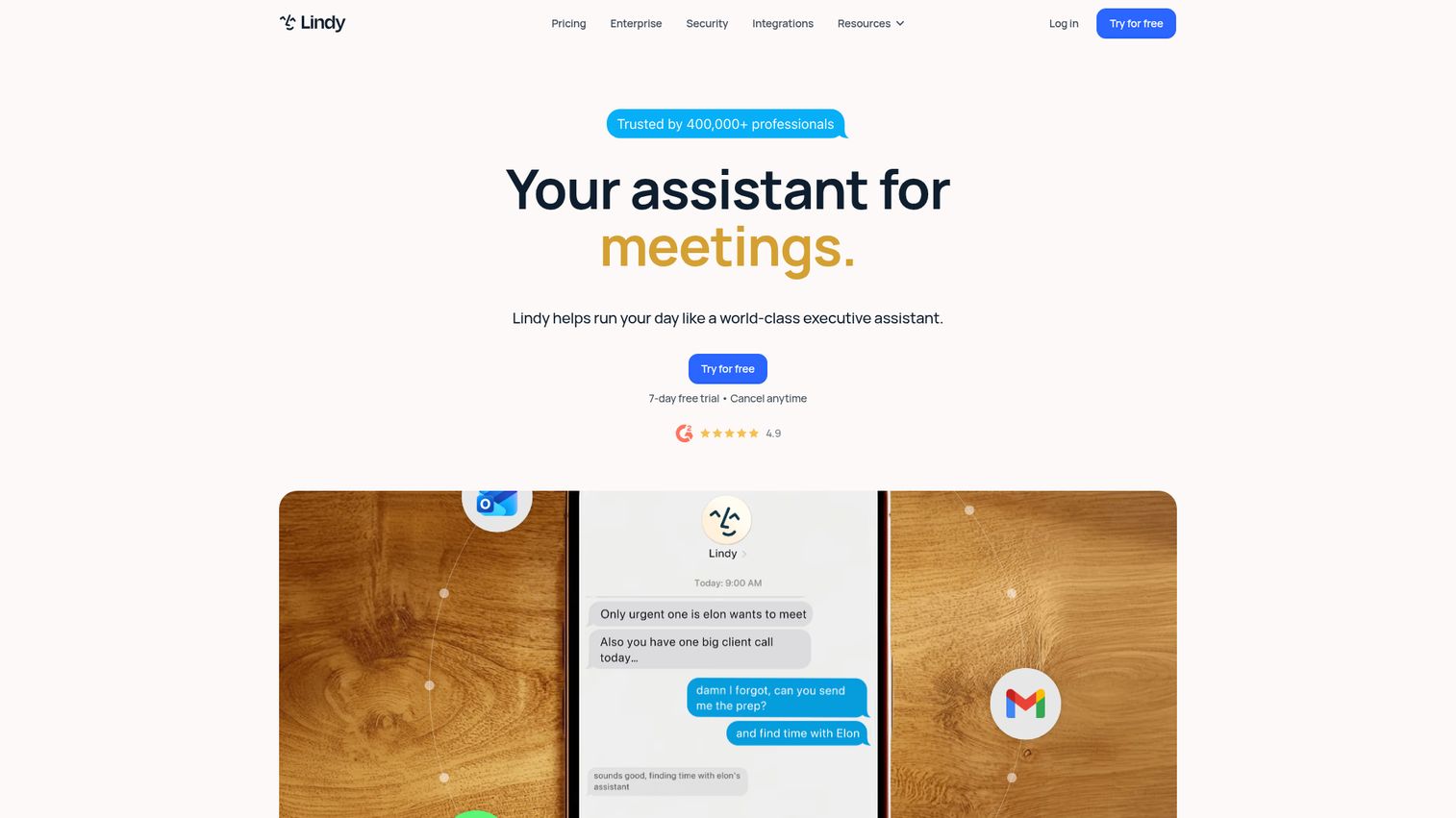
Lindy AI is an AI assistant for work that helps sort email, draft replies, schedule meetings, take notes, and handle follow-ups. The product leans into assistant-style agents that take ownership of recurring personal and team workflows rather than abstract automations.
Best for: Busy SaaS founders, AEs, and CS managers who want an AI assistant for inbox, scheduling, and meeting follow-up workflows.
Key strengths
- Email triage and drafting: Sort and reply in your voice without rewriting every message.
- Meeting scheduling: Send invites, reschedule, and coordinate across calendars without ping-pong.
- Meeting prep and recaps: Prep briefs, recording, notes, recaps, and action items in one flow.
Why choose Lindy AI: For SaaS GTM teams where the "we should automate this" conversation always ends with inbox and meetings, Lindy ships the assistant out of the box. You are not building agents from scratch; you are configuring assistants for known patterns. For teams pairing Lindy with a dedicated note-taker, our best AI note taking tools comparison is a useful next read.
Lindy AI pricing: Plus is $49.99 per month. Pro is $99.99 per month. Max is $199.99 per month. Enterprise is available on request. A 7-day free trial is offered. See the Lindy pricing page for current details.
6. Vertex AI Agent Builder
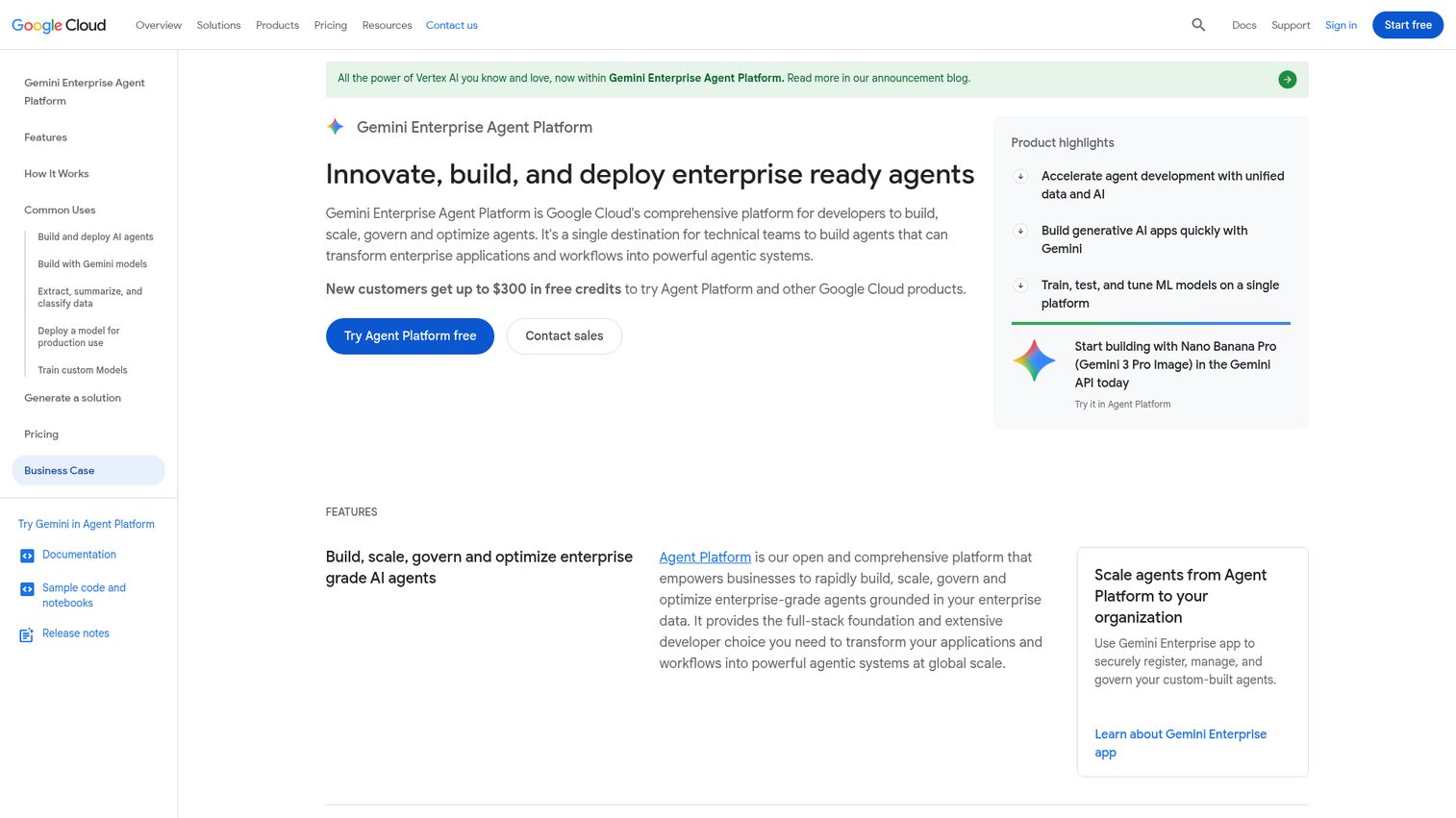
Vertex AI Agent Builder is Google Cloud's platform for building, scaling, governing, and optimizing enterprise AI agents. The vertex ai agent builder stack includes an Agent Development Kit, an Agent Runtime for scalable deployment, and Sessions and Memory Bank for stateful conversations. For teams already standardized on google vertex ai or building google agents tied to Google's Gemini model family, the vertex ai agent architecture is hard to beat on integration depth.
Best for: SaaS engineering teams already on Google Cloud or with strong Gemini integration needs.
Key strengths
- Agent Development Kit: First-class tooling for building and deploying complex google agents.
- Agent Runtime: Scalable, managed deployment that handles the production side of vertex ai agent architecture.
- Sessions and Memory Bank: Stateful conversations and persistent memory without bolting on a vector database fundamentals yourself.
Why choose Vertex AI Agent Builder: If your data lives in BigQuery data warehouse, your team writes Python, and Gemini is already your default model, vertex ai is the lowest-friction path. The flip side: if you are not on GCP, the lift to adopt is real, and pricing is consumption-based, which is harder to forecast than seat-based plans.
Vertex AI Agent Builder pricing: Usage-based across Runtime (vCPU at $0.0864 per vCPU hour, memory at $0.009 per GiB hour), Code Execution, Sessions ($0.25 per 1,000 events stored), and Memory Bank ($0.25 per 1,000 memories stored per month, $0.50 per 1,000 memories returned). A monthly free tier applies to Runtime. See the Vertex AI pricing page for current details.
7. Relevance AI
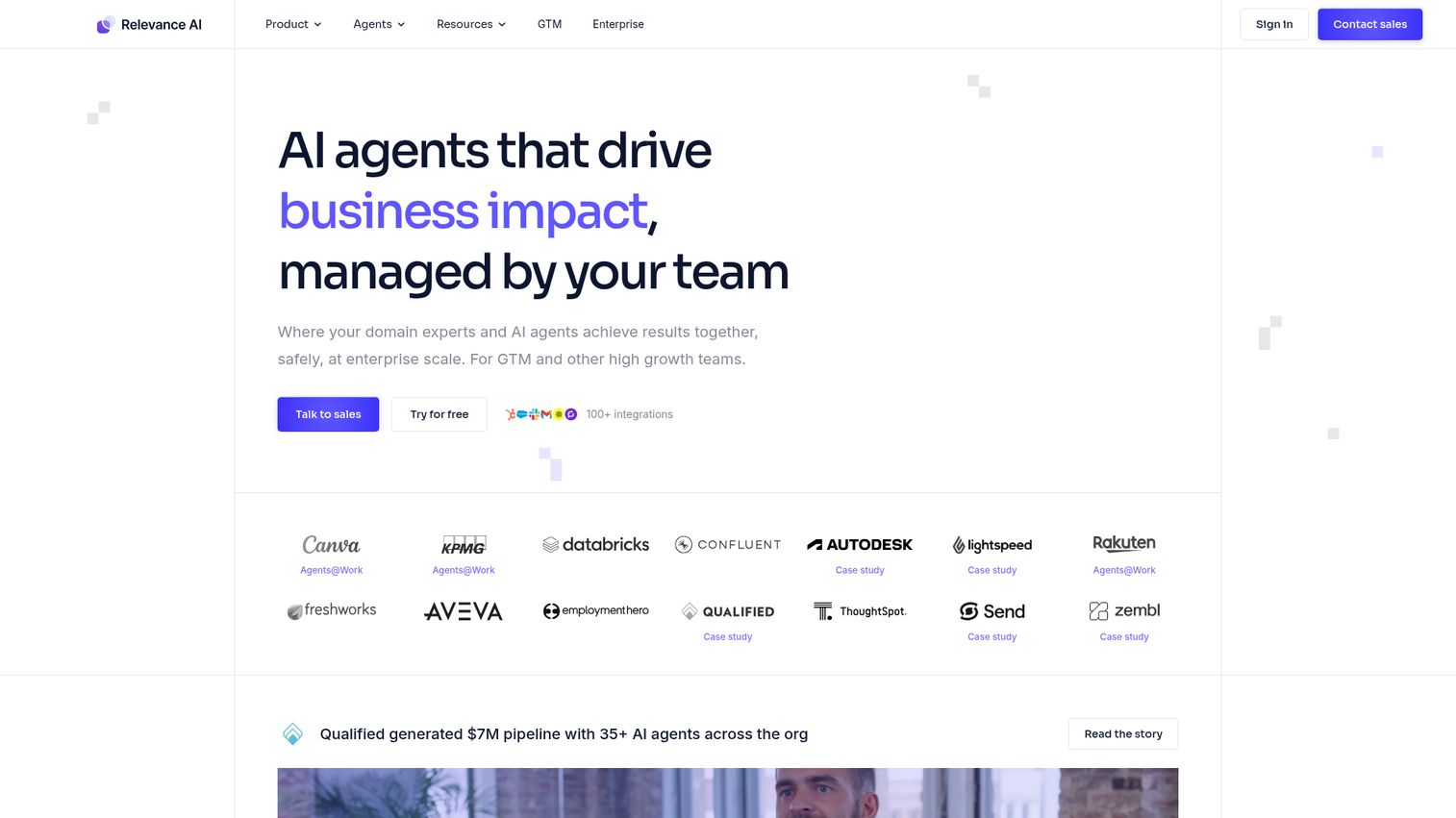
Relevance AI is a low and no-code platform for building AI agents and multi-agent teams that autonomously complete tasks. The platform's framing is "agent workforce" - specialized agents (researcher, SDR, CS responder) that coordinate as a team rather than a single do-everything agent.
Best for: SaaS GTM teams that want to deploy multiple specialized agents as a coordinated workforce.
Key strengths
- Autonomous task completion: Agents take a goal and execute end to end, not just suggest next steps.
- Multi-agent workforces: Pre-built and custom agents that hand off tasks for complex workflows.
- No-code tools builder: Build custom tools and integrations without engineering tickets.
Why choose Relevance AI: For SaaS sales teams that want an "AI SDR" or "AI researcher" without building one from scratch, the role-based templates shorten time to first working agent. If you're scoping the broader category, our best AI sales assistant software and best AI sales tools lists pair well here. The multi-agent framing also fits how operators actually think about work: not "one agent does everything" but "a small team of agents covers a process."
Relevance AI pricing: Free plan at $0. Pro is $19 per month annual or $29 per month monthly. Team is $234 per month annual or $349 per month monthly. Enterprise is custom. See the Relevance AI pricing for current details.
8. Cassidy AI
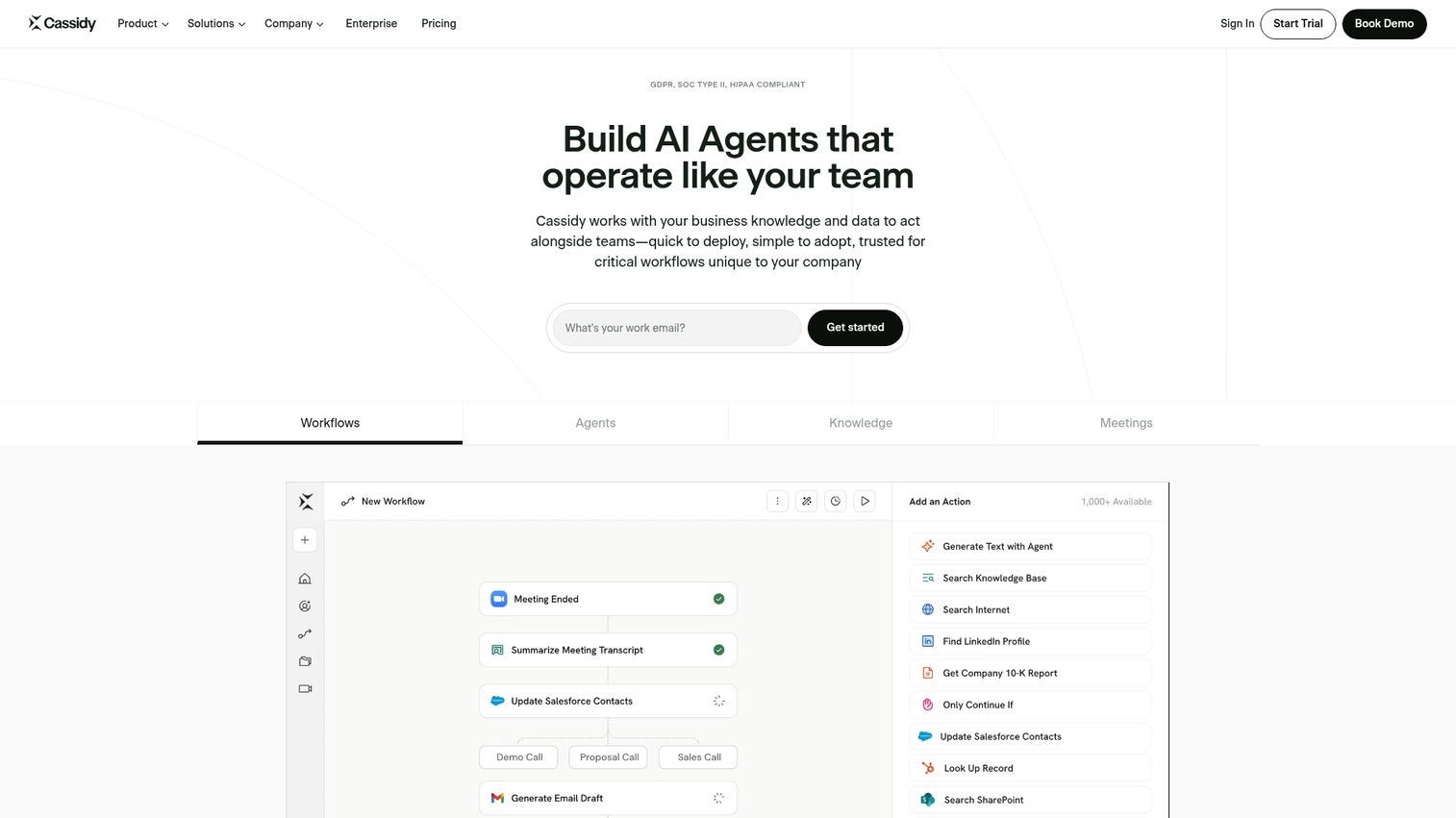
Cassidy AI is an AI automation platform that helps teams build agents and workflows powered by their business knowledge. The differentiator is the Knowledge Base: synced, cited, permission-aware company data that grounds every agent response, with deployments across Slack, Microsoft Teams, browser, API, CRM, and document tools.
Best for: SaaS teams that want agents grounded in internal knowledge across Notion, Drive, Confluence, and their CRM.
Key strengths
- Permission-aware knowledge base: Synced, cited content that respects existing access controls.
- No-code agents and workflows: Build multi-step automations without engineering support.
- Broad deployment surfaces: Run agents in Slack, Microsoft Teams, browser, API, CRM, and document tools.
Why choose Cassidy AI: If your customer-facing teams keep asking the same five questions because the answer is buried across Notion, Drive, and your help center, Cassidy's grounded-by-default design is the fastest way to ship a useful internal agent. Citations also matter when answers need to be auditable. If you're also evaluating standalone knowledge platforms, see our best knowledge base software roundup.
Cassidy AI pricing: Starter plan is free and includes 3 seats, 1 workspace, 10,000 AI credits per month, and 30,000 pages of storage. Business plan offers custom seats, workspaces, credits, and storage. See the Cassidy AI pricing page for current details.
9. Make
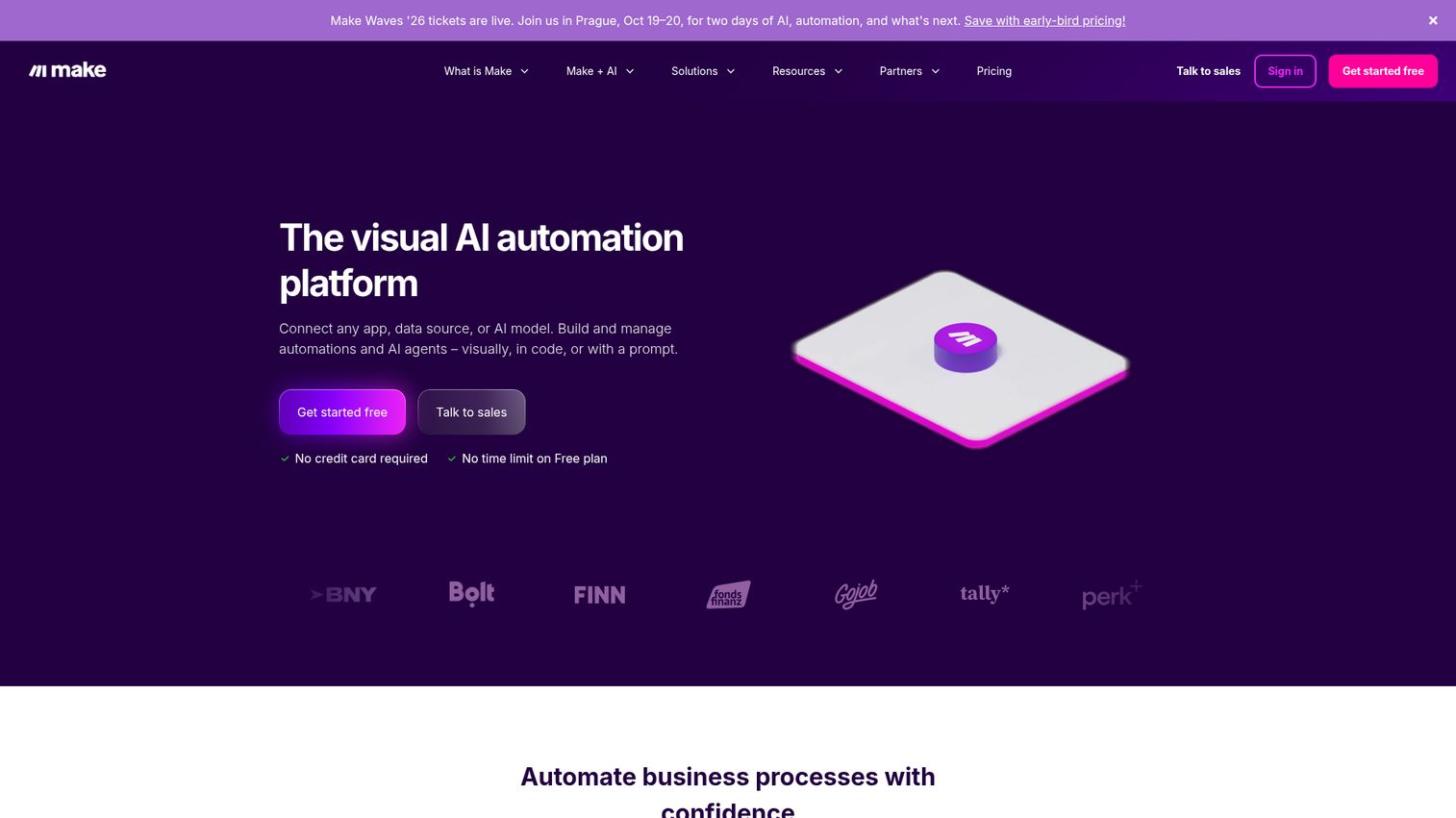
Make is a visual platform for designing, building, and automating without coding. With Make AI Agents (beta) layered onto a library of 3,000+ apps, Make lets teams extend existing automations with agent logic instead of rebuilding workflows on a new platform.
Best for: SaaS teams already running Make for workflow automation that want to layer AI agents onto existing flows.
Key strengths
- 3,000+ apps: One of the broadest integration catalogs in the category.
- No-code visual workflow builder: Familiar visual model for teams already comfortable with Make scenarios.
- Make AI Agents (beta): Agent capabilities that drop into existing automations rather than requiring a parallel platform.
Why choose Make: If your ops team has spent two years building Make scenarios, telling them to migrate is a non-starter. Make AI Agents lets you add reasoning and tool use to flows you already trust, which is the fastest path to "agent in production" for teams already invested.
Make pricing: Free plan at $0 per month. Core is $12 per month for 10,000 credits per month. Pro is $21 per month. Teams is $38 per month. Enterprise is custom. See the Make pricing page for current details.
10. Zapier Agents
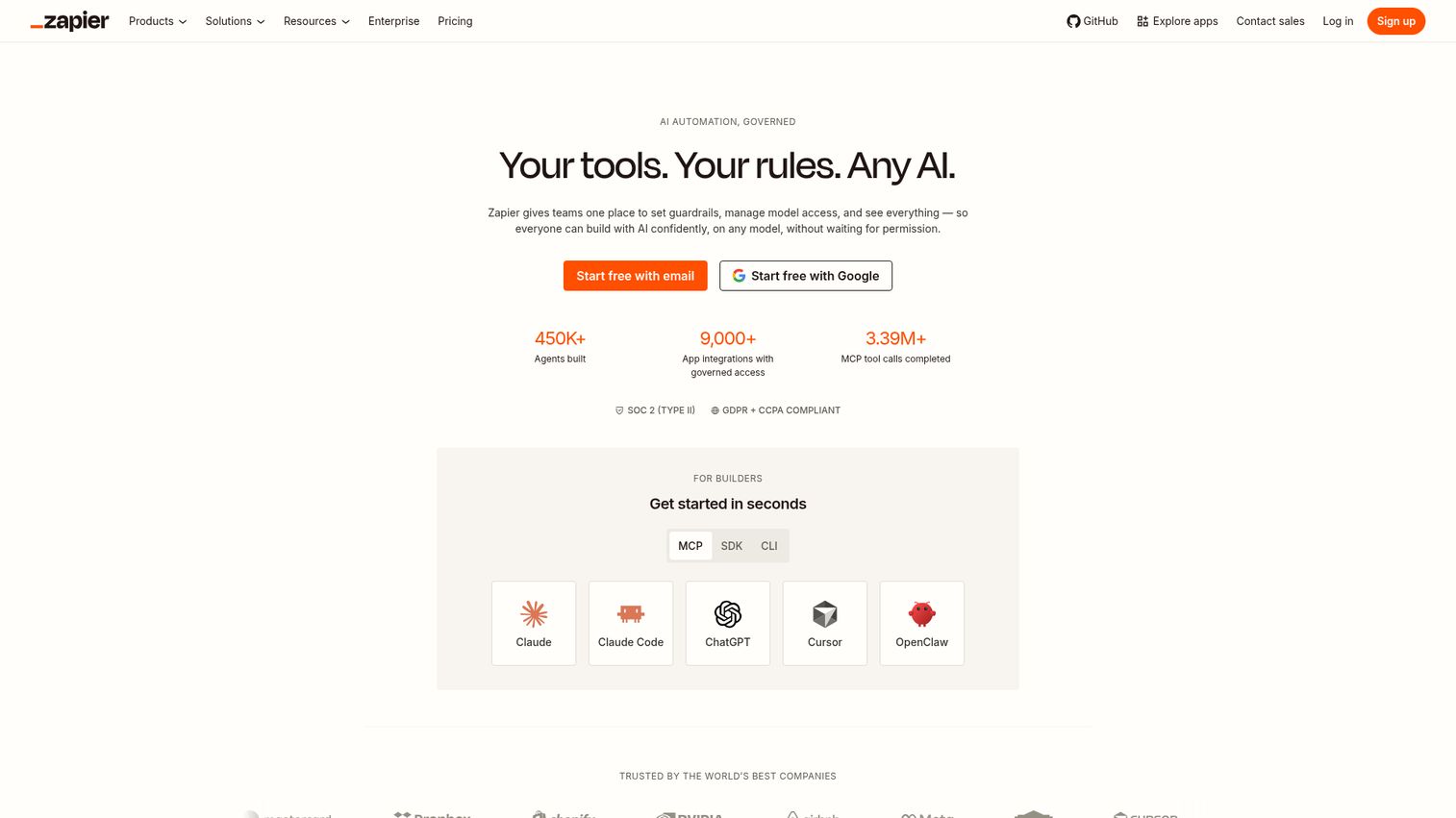
Zapier Agents lets you create AI-powered teammates that automate work across connected apps, browse the web, and use your knowledge sources. Built on Zapier's app footprint, Agents drop into the same surface where most non-technical SaaS operators already build automations.
Best for: SaaS teams already standardized on Zapier that want agent capabilities without changing platforms.
Key strengths
- Largest app catalog on this list: Build agents that touch nearly any SaaS tool your team uses.
- Zapier Copilot agent builder: Spin up agents from templates or natural-language descriptions.
- Web browsing and Chrome extension: Agents can research on the web and interact via the browser, not just connected apps.
Why choose Zapier Agents: For SaaS teams where every department already has a Zapier account, Agents is the lowest-friction adoption path. You are not asking RevOps to learn a new tool; you are asking them to add a new capability to one they use daily.
Zapier Agents pricing: Free plan at $0 per month with 400 activities per month. Pro is $33.33 per month billed annually with 1,500 activities per month. Enterprise (Coming Soon) is contact pricing. See the Zapier pricing page for current details.
What to look for when choosing an AI agent builder
Integration with your existing stack
Salesforce or HubSpot, Slack, your helpdesk, your data warehouse. If the platform does not integrate cleanly with the systems where your work already lives, the agent will not ship. Test the two or three integrations that matter most before signing anything. For CRM-specific evaluation criteria, our best CRM software guide covers what to validate.
Human-in-the-loop and governance
For any agent that touches customers, money, or production data, approval gates are not optional. Look for native HITL primitives, role-based access controls, and audit logs that you can actually export. This is the difference between an agent your VP will approve and one they will block.
LLM flexibility and cost control
Multi-model support across OpenAI, Anthropic, and Google matters more in 2026 than it did a year ago. Model prices and capabilities shift quarterly. You want the ability to swap models, log token usage by workflow, and cache where it makes sense.
Speed to first working agent
If a platform takes a month to deliver a first working agent, it will not survive your team's attention span. The week-one test is the right bar: pick a real workflow, build it in five days, and see whether the platform earns a second one.
Pricing model and payback
Per-seat, per-task, per-token, per-credit, per-execution. Each pricing model scales differently. Map your expected usage to two or three scenarios before committing. The cheapest entry tier is rarely the cheapest at scale.
How AI agents change the SaaS buyer experience
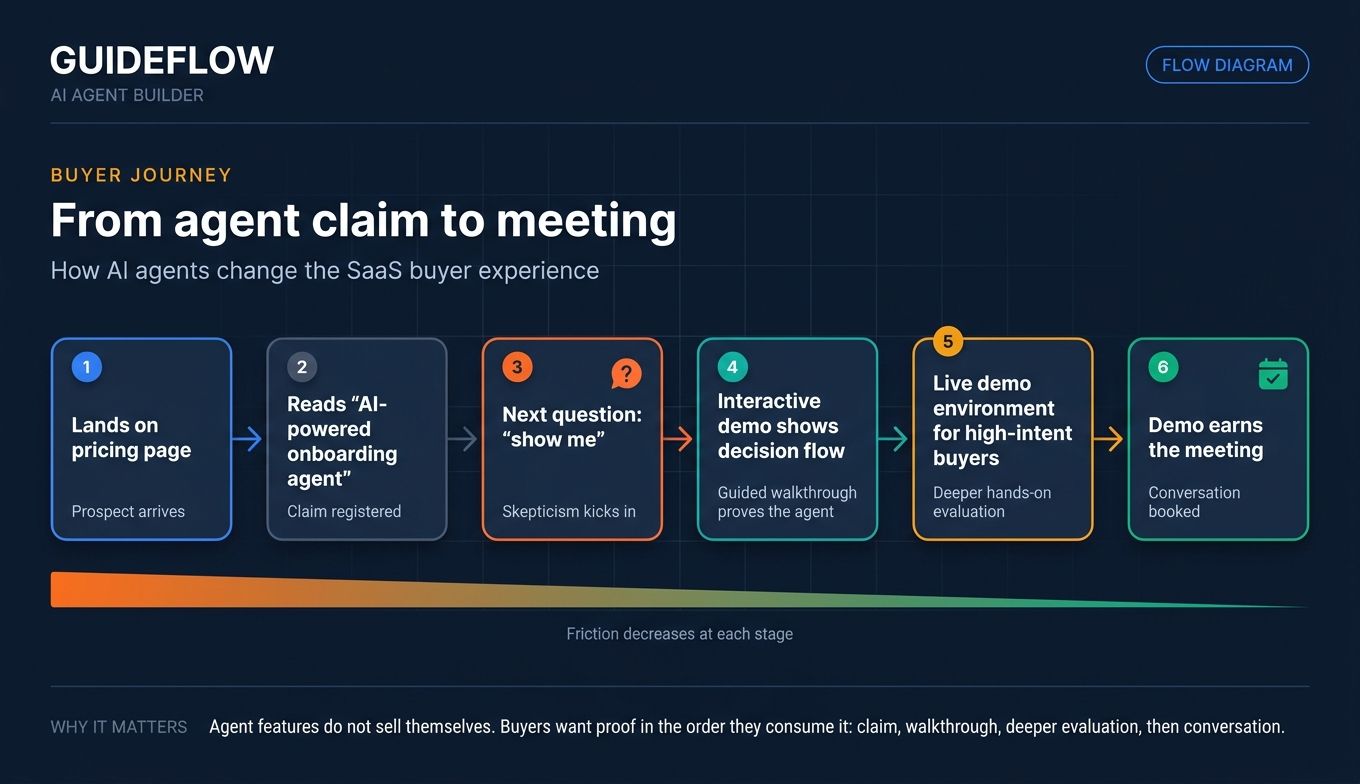
Agents are no longer just internal infrastructure. They are increasingly part of the product buyers evaluate. When a prospect lands on your pricing page and reads "AI-powered onboarding agent," the next question is not "how does it work?" It is "show me."
This is where interactive demos earn their place in the agent-era buyer journey. A screenshot of an agent dashboard or a recorded video of an agent running is materially different from a guided walkthrough that lets the buyer click through the agent's actual decision flow. Interactive demos perform best when you want to control the narrative and show exactly how an agent reasons, acts, and hands off to a human - on landing pages, in cold outbound, as sales leave-behinds, and inside help centers.
The pattern we see with SaaS teams shipping agents: build the agent on the platform that fits your stack, then use an interactive demo to show prospects the agent in action without scheduling a call. Pair that with a live demo environment for higher-intent buyers, and the agent does the work while the demo earns the meeting. For broader category context, see our best product tour software roundup.
Conclusion
The AI agent builder category is wider than any single article can cover, but the shortlist for SaaS teams in 2026 is shorter than the noise suggests. Gumloop and Relay.app cover the GTM and ops breadth most Series B teams need. n8n is the right call for engineering-led SaaS companies that want control. Stack AI and Vertex AI cover the enterprise and regulated-buyer end of the spectrum. Lindy, Relevance, Cassidy, Make, and Zapier Agents each own a specific lane worth a pilot.
The practical next step: pick two platforms that match your stack and your team's comfort level, then run a one-week pilot on a single workflow before committing. Choose a workflow that is repetitive, well-understood, and low-risk. Measure time saved, not feature usage. If the agent earns its keep in week one, scope a second workflow. If it does not, the platform is not the right fit and you will know fast.
The teams winning with agents in 2026 are not the ones who picked the perfect platform. They are the ones who shipped one working agent, learned from it, and shipped the next one a month later. Pick the platform your team will actually use this quarter, then re-evaluate in six months. The category is moving fast, and the right pick now is the one that gets you to your first working agent before the end of the month.
FAQs
An AI agent builder is a platform that lets teams design, deploy, and govern autonomous AI agents that can reason, use tools, and execute multi-step tasks. It differs from a workflow tool, which executes fixed steps, and from a chatbot, which only responds with text. An agent builder gives you the orchestration, memory, integrations, and observability needed to run goal-directed agents in production.
A workflow executes a fixed sequence of steps in a defined order. An agent receives a goal and decides which tools to use and in what order to achieve it. Workflows are deterministic; agents are goal-directed. In practice, most production systems blend both: deterministic workflows for predictable steps and agents for the steps that need reasoning.
Yes. Most platforms on this list are no-code or low-code. Gumloop, Relay.app, Lindy AI, Cassidy AI, Make, and Zapier Agents specifically target non-technical users with visual builders and templates. Developer-first platforms like n8n and Vertex AI Agent Builder still support no-code paths but reward teams that can drop into code when needed.
n8n is the strongest free option for technical teams because the self-hosted Community edition has no per-execution cost. Relay.app, Gumloop, Make, Cassidy AI, Zapier Agents, Relevance AI, and Stack AI all offer free tiers with usage limits that are usable for evaluation and small workflows. Vertex AI Agent Builder also includes a monthly free tier on Runtime, though it is consumption-based at scale.
Entry pricing ranges from free (n8n Community self-hosted, free tiers on Relay.app, Gumloop, Make, Cassidy, Zapier Agents, Stack AI, Relevance AI) to roughly $12 to $50 per month for mid-market plans. Enterprise tiers on Stack AI and Vertex AI are custom or consumption-based. Plan to model two or three usage scenarios before signing, since per-credit and per-execution pricing scales very differently from per-seat pricing.
With human-in-the-loop approval gates, yes. Without them, the risk is real. The pattern that works: agents draft and propose, humans approve and send for anything customer-facing in the first 90 days. Once you have logs showing the agent is consistently correct on a workflow, you can move to autonomous execution with sampling and audit logs. Platforms like Relay.app and Stack AI build HITL as a first-class primitive, which makes this pattern easier to enforce.
Vertex AI Agent Builder is Google Cloud-native, Gemini-powered, and built for teams already on GCP. It includes managed runtime, sessions, and memory bank as first-party services. n8n is platform-agnostic, self-hostable, and integration-rich, with code nodes and LangChain support that suit engineering-led teams. Choose Vertex AI if you live on Google Cloud and want managed infrastructure. Choose n8n if you want self-hosting, model flexibility, and code-level control.