Your sensitive data no longer sits in one place you can wall off. It moves through email threads, browser tabs, cloud drives, SaaS apps, endpoints, and now AI chat windows. A single employee can paste a customer list into a chatbot in three seconds, and by the time anyone notices, it has already left your control.
That shift is why data loss prevention software has changed from a compliance checkbox into an operational workflow problem. The old model, guarding a network perimeter, assumes data lives inside walls. It does not anymore. According to Forcepoint, citing the 2026 Verizon DBIR, 45% of employees were regular AI users on corporate devices in 2026, and source code was the most common data type submitted to external AI models. That is exfiltration happening in plain sight, one prompt at a time.
The DLP market reflects the pressure. Research and Markets valued the global data loss prevention market at $4.67B in 2026, projected to reach $12.53B by 2030 at a 28% CAGR. Cloud is where the weight sits: Mordor Intelligence reported that cloud platforms held 67.31% of DLP market share in 2025. So the question for security and presales teams is not whether to run DLP. It is which platform covers the channels your data actually travels through, without turning your stack into a maintenance burden.
If you are building out an adjacent evaluation, our roundups of the best AI cybersecurity solutions and the best customer data platform options pair well with this shortlist, since DLP rarely gets bought in isolation.
What's inside
This guide covers eight DLP platforms built for endpoint, network, cloud, email, and AI-aware protection. It is written for security, IT, and presales teams who need to evaluate vendors the way a deal cycle demands: by channel coverage, deployment model, policy tuning, and how cleanly the tool feeds SIEM, alerts, and incident response.
We chose tools on four criteria: breadth of channel coverage, depth of policy controls, integration with existing security operations, and practicality of rollout. The goal is not to crown one winner. It is to help you match a platform to your environment, compliance scope, and appetite for operational overhead.
TL;DR
- Best overall for unified enterprise coverage: Forcepoint DLP, for centralized policy across cloud, web, email, endpoint, and on-prem.
- Best for Microsoft-centric environments: Microsoft Purview Data Loss Prevention, for teams standardized on Microsoft 365.
- Best for modern data movement visibility: CrowdStrike Falcon Data Protection, for real-time exfiltration tracking across endpoints and GenAI.
- Best for SaaS-heavy and AI-aware workflows: Nightfall, for cloud-first teams protecting SaaS and AI apps.
- Best for a traditional enterprise DLP stack: Trellix and Symantec, for classic channel breadth and mature governance.
- Best for insider risk and simpler rollout: Safetica, for behavioral visibility with public pricing.
- Best for predictable packaging: Fortra DLP, for scalable tiers across endpoint, network, and cloud.
What data loss prevention software is
Data loss prevention software is a category of security tools that detect, classify, monitor, and control sensitive data to stop it from leaving an organization through unauthorized channels. It works across three states of data: data at rest (stored in databases, file shares, and cloud storage), data in motion (moving through email, web, and network traffic), and data in use (active on endpoints, in browsers, and inside applications).
DLP solutions span multiple channels rather than one. Endpoint DLP protects laptops and workstations. Network DLP inspects traffic leaving the organization. Cloud DLP watches SaaS apps, cloud storage, and collaboration tools. Email DLP catches misdirected or malicious sends. Modern platforms increasingly add browser and AI-app coverage, because that is where more data now travels.
Core features of DLP software
- Data discovery and classification: finds sensitive data and tags it by type, using classifiers, exact data match, and pattern rules.
- Policy templates and rule enforcement: predefined and custom policies that block, quarantine, encrypt, or alert on risky actions.
- Endpoint, cloud, and network controls: coverage across every channel where regulated or confidential data moves.
- Alerts, reporting, and incident response: dashboards and workflows to triage events and investigate incidents.
- SIEM and security stack integrations: feeding events into SIEM, XDR, and alerting tools instead of operating in a silo.
- AI and ML-assisted classification: machine learning to reduce false positives, plus GenAI controls for shadow AI usage.
Why DLP matters now
The risk drivers are practical, not theoretical. Shadow IT and SaaS sprawl mean data lands in apps security never approved. Employee turnover creates exfiltration windows as people leave with access. Misdirected sharing and accidental leakage remain the most common cause of data loss, not sophisticated attackers. And GenAI tools have opened a new channel where sensitive data walks out through a prompt.
DLP also underpins compliance. GDPR, HIPAA, PCI DSS, and CCPA all require demonstrable control over sensitive data. A DLP platform gives you the classification, enforcement, and audit trail that turns a compliance obligation into an enforceable policy. Teams comparing broader data tooling often review data visualization tools alongside DLP reporting, since incident dashboards only matter if someone can read them.
When to use data loss prevention software
Protect regulated data across SaaS and endpoints
Use DLP when you need one policy layer spanning cloud apps, local devices, and collaboration tools. If regulated data (PII, PHI, cardholder data) lives in Microsoft 365, Google Workspace, endpoints, and a dozen SaaS apps at once, point solutions leave gaps. A unified DLP platform applies consistent classification and enforcement wherever the data sits or moves.
Control accidental sharing and insider risk
Use DLP when the core problem is human behavior, not external attackers. Misdirected emails, oversharing in collaboration tools, and departing employees copying files are the everyday sources of data loss. DLP with insider risk features watches for these patterns, coaches users in real time, and blocks the highest-risk actions before data leaves.
Support security operations and incident response
Use DLP when it needs to feed your broader security motion rather than run in isolation. The best DLP tools push events into SIEM, XDR, and alerting workflows, giving analysts context to investigate incidents. For presales teams selling into security buyers, this integration question is often the one that decides the deal.
Comparison table
Use this table for fast vendor triage. It maps each platform to its buyer intent, primary use case, publicly available pricing, and current G2 rating. Where a vendor does not publish pricing, that reflects a quote-based model, not a gap in the product.
| # | Product | Intent | Key use case | Pricing | G2 rating |
|---|---|---|---|---|---|
| 1 | Forcepoint DLP | Unified enterprise coverage | Centralized policy across cloud, web, email, endpoint, on-prem | Custom (talk to sales) | 4.3/5 |
| 2 | Microsoft Purview DLP | Microsoft-centric environments | Policy-based DLP across Microsoft 365, devices, and AI apps | From $12.00 user/month (suite) | 4.6/5 |
| 3 | CrowdStrike Falcon Data Protection | Modern data movement visibility | Real-time exfiltration tracking across endpoints, SaaS, GenAI | From $59.99 per device (bundle) | 4.6/5 |
| 4 | Nightfall | SaaS and AI-aware workflows | DLP for SaaS, AI apps, browsers, endpoints | Quote-based | Not listed |
| 5 | Trellix DLP | Traditional enterprise stack | Endpoint and network DLP with centralized monitoring | Custom (talk to sales) | 4.3/5 |
| 6 | Symantec DLP | Mature security programs | Discovery and protection across cloud, email, web, endpoints, storage | Buy via partner | 4.4/5 |
| 7 | Safetica | Insider risk and simpler rollout | DLP, insider risk, and cloud data protection | From $72/user/year | 4.6/5 |
| 8 | Fortra DLP | Predictable packaging | DLP across endpoint, network, and cloud | Quote-based, three tiers | 4.3/5 |
1. Forcepoint DLP
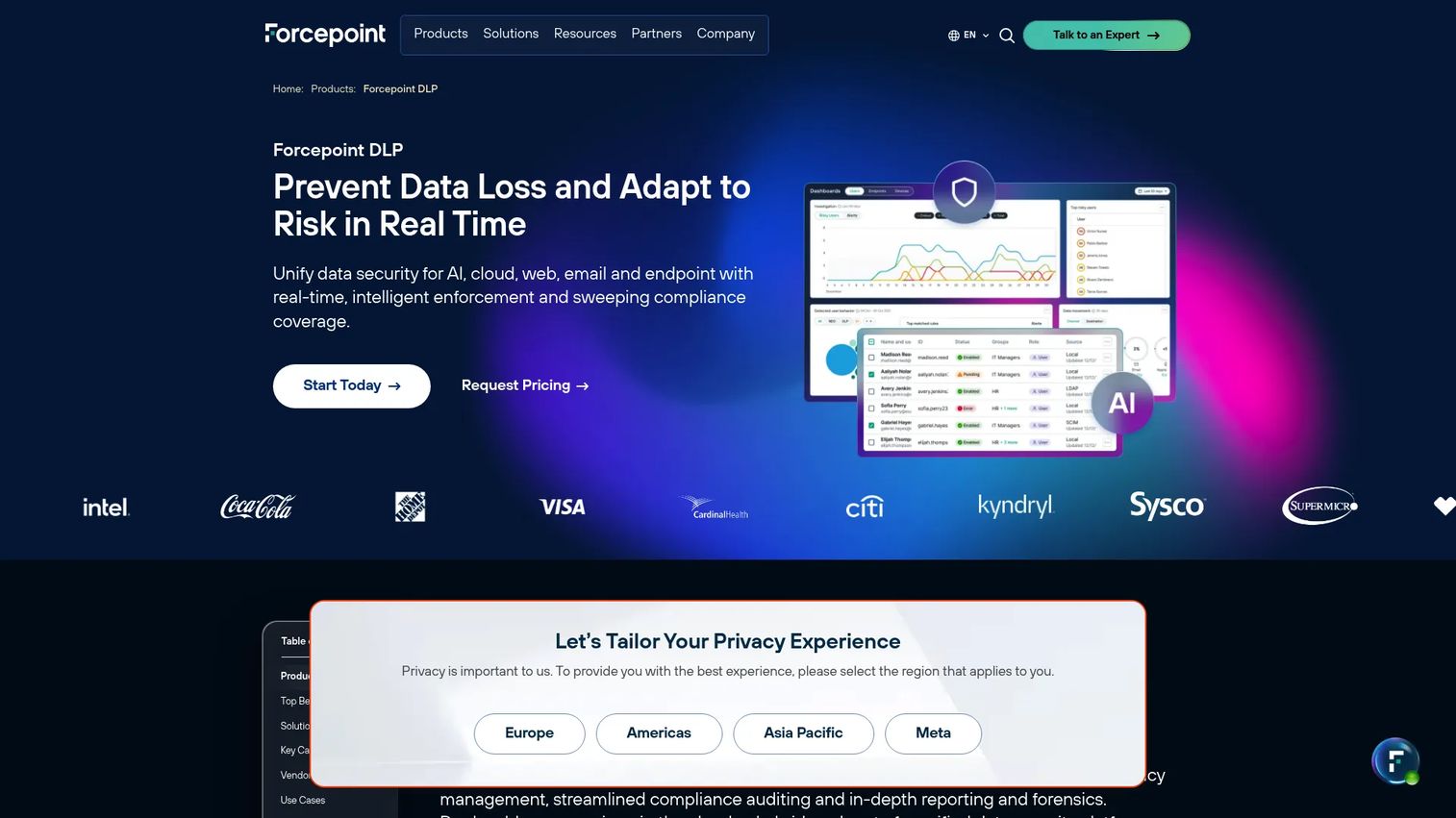
Forcepoint DLP is enterprise data loss prevention software built to protect data across cloud, web, email, endpoint, and on-prem environments from a single console. It targets organizations that want one policy layer rather than a patchwork of channel-specific tools. Forcepoint leans into risk-adaptive protection, adjusting enforcement based on user behavior and context instead of applying blanket rules to everyone.
Best for: Large organizations that need centralized DLP across multiple data channels and deployment models.
Key strengths
- Unified policy enforcement across channels: one set of policies applied consistently across cloud, web, email, and endpoint.
- 1,800+ predefined classifiers, templates, and policies: a large library that shortens time from deployment to enforcement.
- Cloud, on-premises, and hybrid deployment: flexibility to match the platform to your existing architecture.
Why choose Forcepoint DLP: If your data spans multiple channels and you want to manage classification and enforcement from one place, Forcepoint fits. The risk-adaptive model appeals to teams tired of tuning static rules, and the deep policy template library helps security teams cover common regulatory requirements without building everything from scratch. It is a strong pick for mature enterprise programs with dedicated security staff.
Forcepoint DLP pricing: Forcepoint does not publish public pricing. The vendor customizes pricing and directs buyers to talk to an expert. In scoping, confirm which channels (cloud, web, email, endpoint, on-prem) are included in your quote, seat or user counts, and whether risk-adaptive and cloud modules carry separate line items.
2. Microsoft Purview Data Loss Prevention
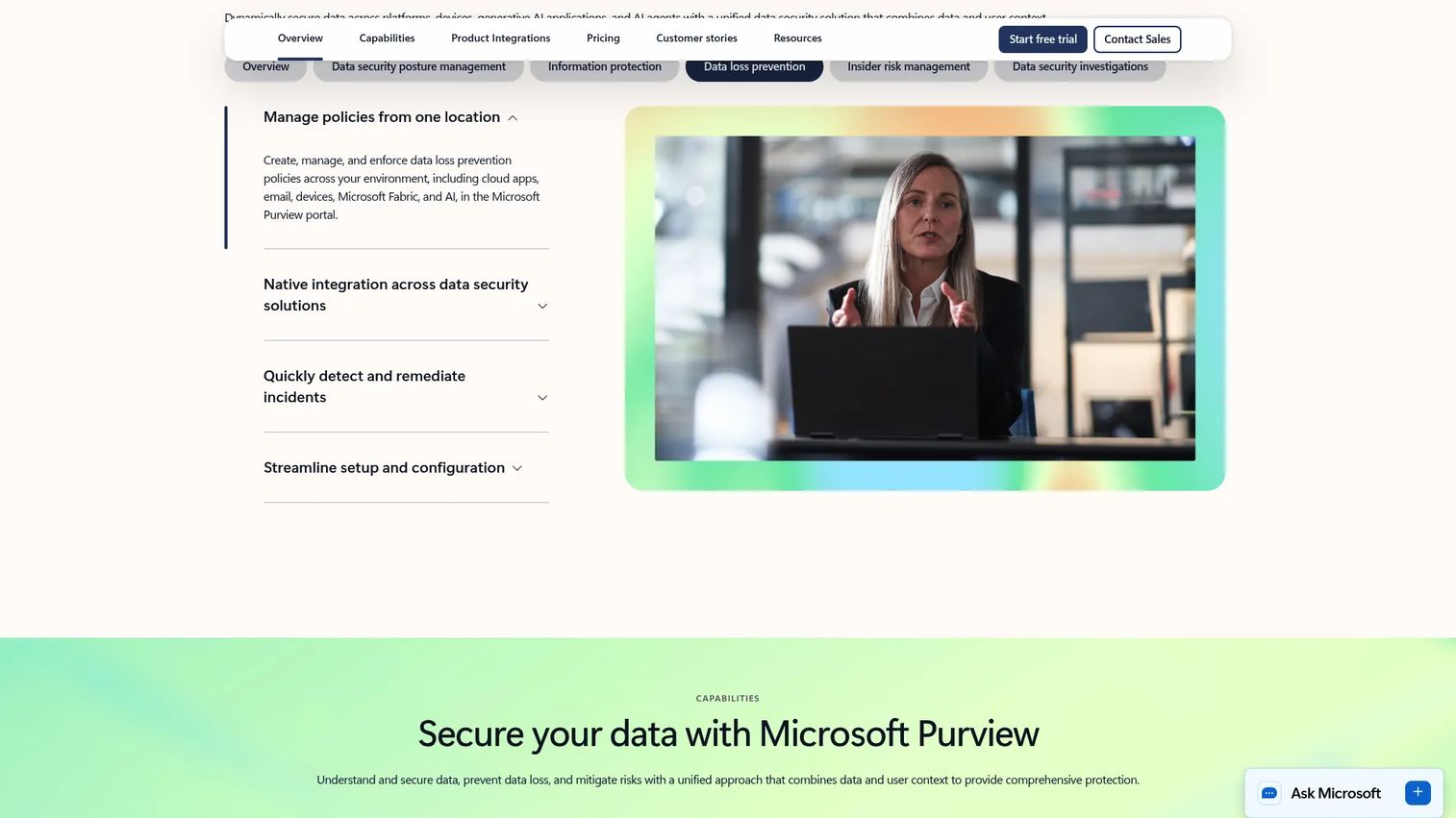
Microsoft Purview Data Loss Prevention detects and prevents unauthorized sharing of sensitive data across Microsoft 365, endpoints, browsers, networks, Microsoft Fabric, and AI apps. For teams already standardized on Microsoft 365, it is the natural DLP layer because the policy engine, classification, and incident workflows live inside the same admin surface they already use. It also extends coverage to Microsoft 365 Copilot and third-party AI apps.
Best for: Organizations using Microsoft 365 that need policy-based DLP and broader data security controls.
Key strengths
- Native Microsoft 365 policy coverage: enforce DLP across cloud apps, email, devices, Microsoft Fabric, and AI from one portal.
- Flexible detection methods: classifiers, exact data match, and sensitive information types for accurate identification.
- Integrated incident investigation: configure, triage, and investigate incidents across Microsoft Purview, Defender XDR, and Microsoft Sentinel.
Why choose Microsoft Purview DLP: If Microsoft 365 is your center of gravity, Purview removes the friction of bolting on a third-party DLP tool. Policies, classification, and investigations stay inside the Microsoft security ecosystem, which shortens rollout and keeps analysts in familiar tooling. The AI-app coverage, including Copilot, matters as more sensitive data flows through GenAI.
Microsoft Purview DLP pricing: The Microsoft Purview Suite is listed at $12.00 per user/month, paid yearly, and requires Microsoft 365 E3. Microsoft 365 E3 is described as including core Purview DLP for Exchange Online, SharePoint Online, and OneDrive for Business. Before purchase, verify which DLP capabilities are covered by your existing E3 or E5 licensing versus what the Purview Suite adds, since Microsoft licensing layers can be complex.
3. CrowdStrike Falcon Data Protection
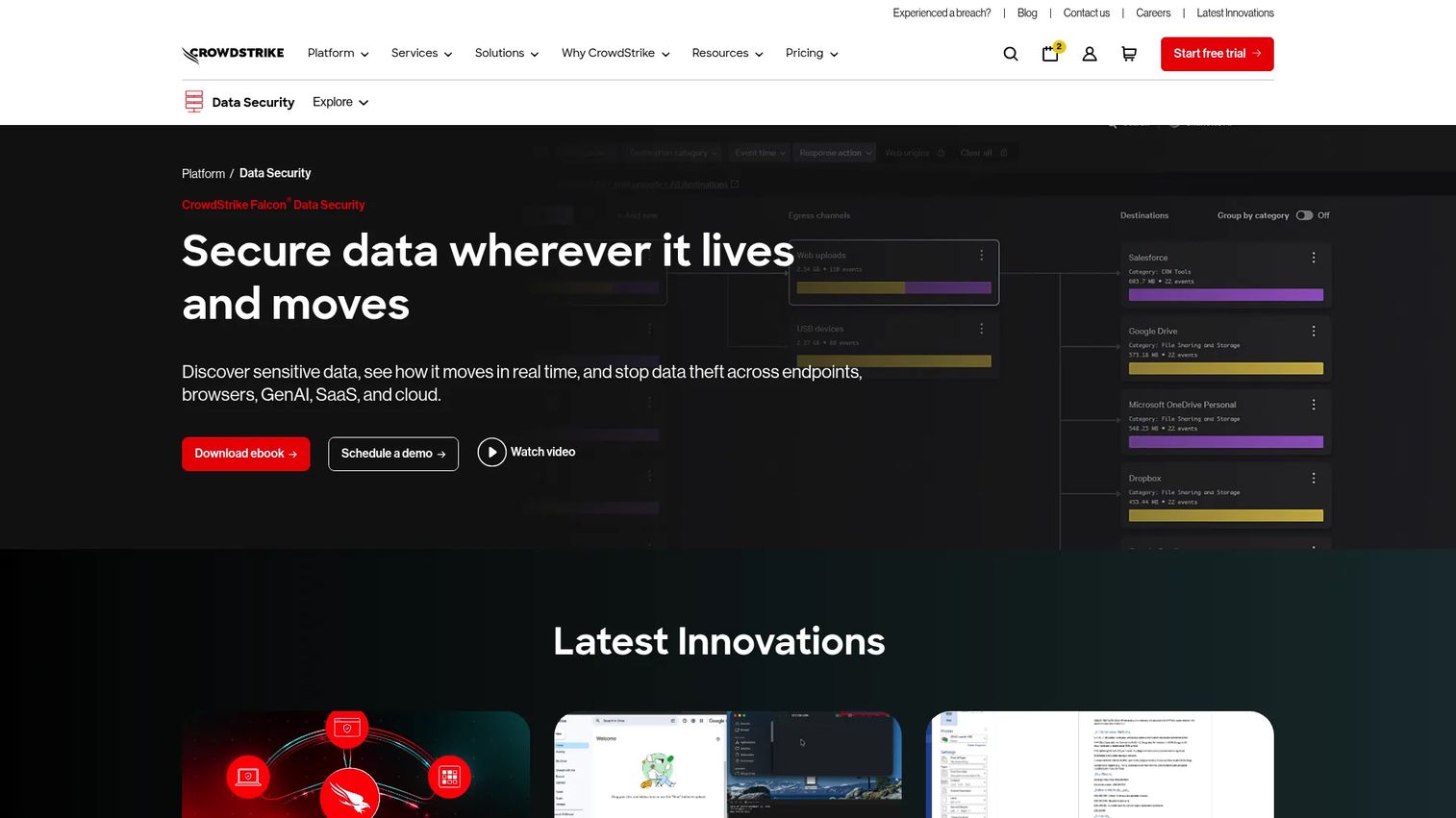
CrowdStrike Falcon Data Protection discovers, classifies, and protects sensitive data across endpoints, cloud, SaaS, and GenAI workflows. Its differentiator is real-time visibility into how data actually moves, so teams can see exfiltration attempts as they happen rather than reconstructing them after a breach. It runs on the same unified Falcon sensor teams already deploy for endpoint protection.
Best for: Enterprises wanting unified data protection across endpoint, cloud, SaaS, and GenAI environments.
Key strengths
- Sensitive data discovery and classification: locate and tag sensitive data across the environment.
- Real-time data movement visibility: track exfiltration attempts live and stop data theft in motion.
- Agentless cloud scans and unified sensor: deploy through the existing Falcon sensor with agentless cloud coverage.
Why choose CrowdStrike Falcon Data Protection: If you already run CrowdStrike Falcon, adding data protection avoids a new agent and a separate console. The real-time data movement focus fits teams that care about catching exfiltration through browsers, SaaS, and GenAI as it occurs. It suits security-mature organizations standardizing on the Falcon platform.
CrowdStrike Falcon Data Protection pricing: CrowdStrike does not publish a dedicated price for Falcon Data Protection on its own. Public pricing shows bundled Falcon plans, with Falcon Complete tiers listed at $59.99, $99.99, and $184.99 per device annually, and an Enterprise tier priced through sales. A 15-day free trial is offered. Confirm whether data protection is included in your bundle or priced as an add-on.
4. Nightfall
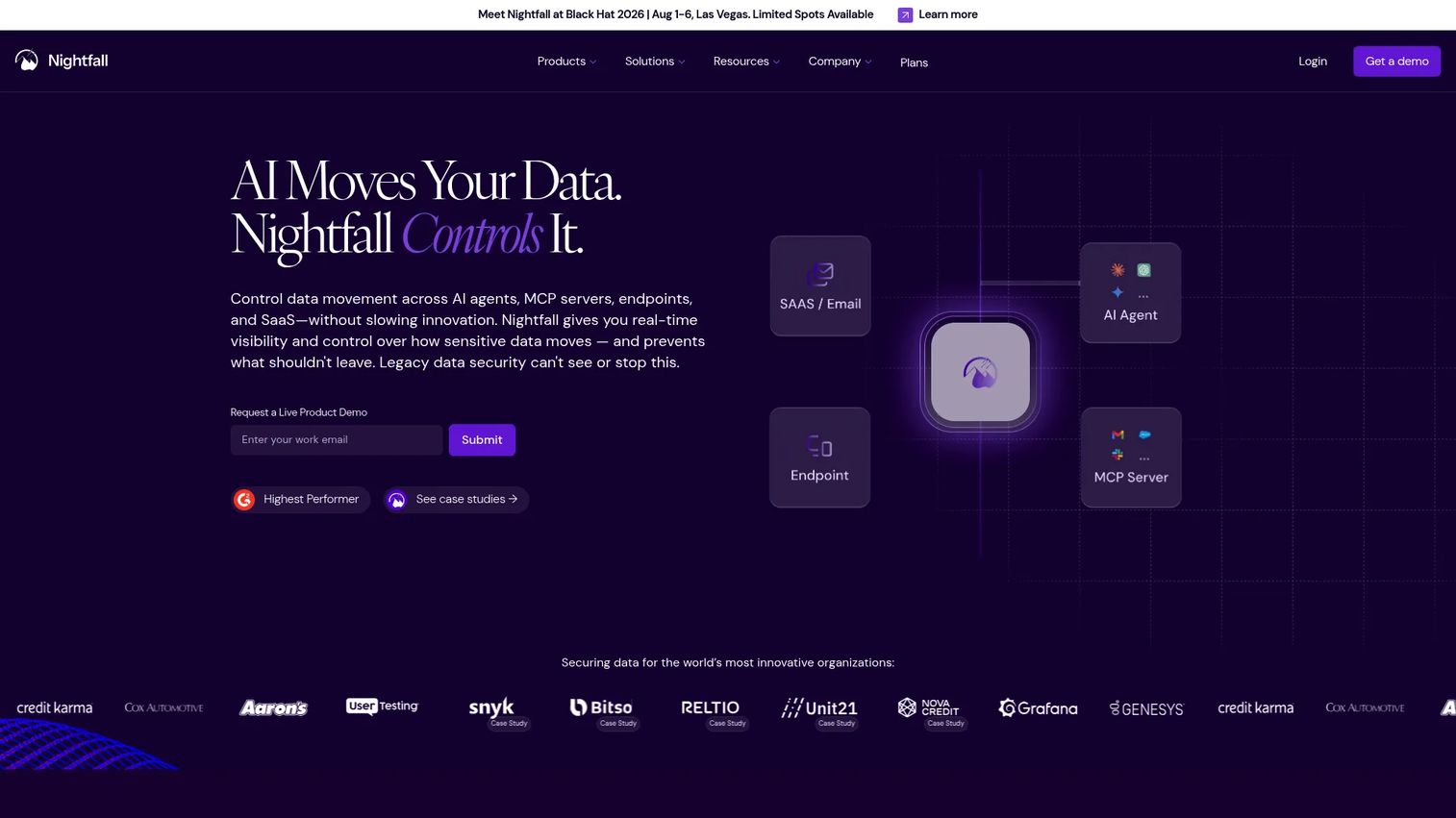
Nightfall is an AI-powered data loss prevention platform for SaaS, AI apps, browsers, and endpoints, positioned as purpose-built for the AI era. For cloud-first teams, its appeal is faster deployment and modern classification that leans on machine learning rather than brittle regex rules alone. It focuses on the channels where cloud-native companies actually lose data: collaboration apps, developer workflows, and GenAI tools.
Best for: Organizations needing DLP across SaaS, endpoints, browsers, and AI apps.
Key strengths
- AI-based content classification: machine learning detection that reduces false positives on sensitive data.
- AI-based data lineage: trace how sensitive data flows across systems and apps.
- Shadow AI protection: controls across major GenAI apps to catch data leaving through prompts.
Why choose Nightfall: If your organization runs on SaaS and cloud rather than legacy on-prem infrastructure, Nightfall speaks your language. The AI-native classification and shadow AI coverage fit teams whose biggest exposure is data pasted into collaboration tools and chatbots. It is a modern option for security teams that want DLP built around cloud and AI workflows from the start.
Nightfall pricing: Nightfall's public pricing page lists several plans, including Data Detection and Response, Data Exfiltration Prevention, Nightfall Complete, and Complete plus AI Agent Security, all priced per user per year. Numeric prices are not exposed on the page, and a 7-day proof-of-value is offered. Request a quote and confirm which detectors, integrations, and AI-app coverage are included at each tier.
5. Trellix Data Loss Prevention
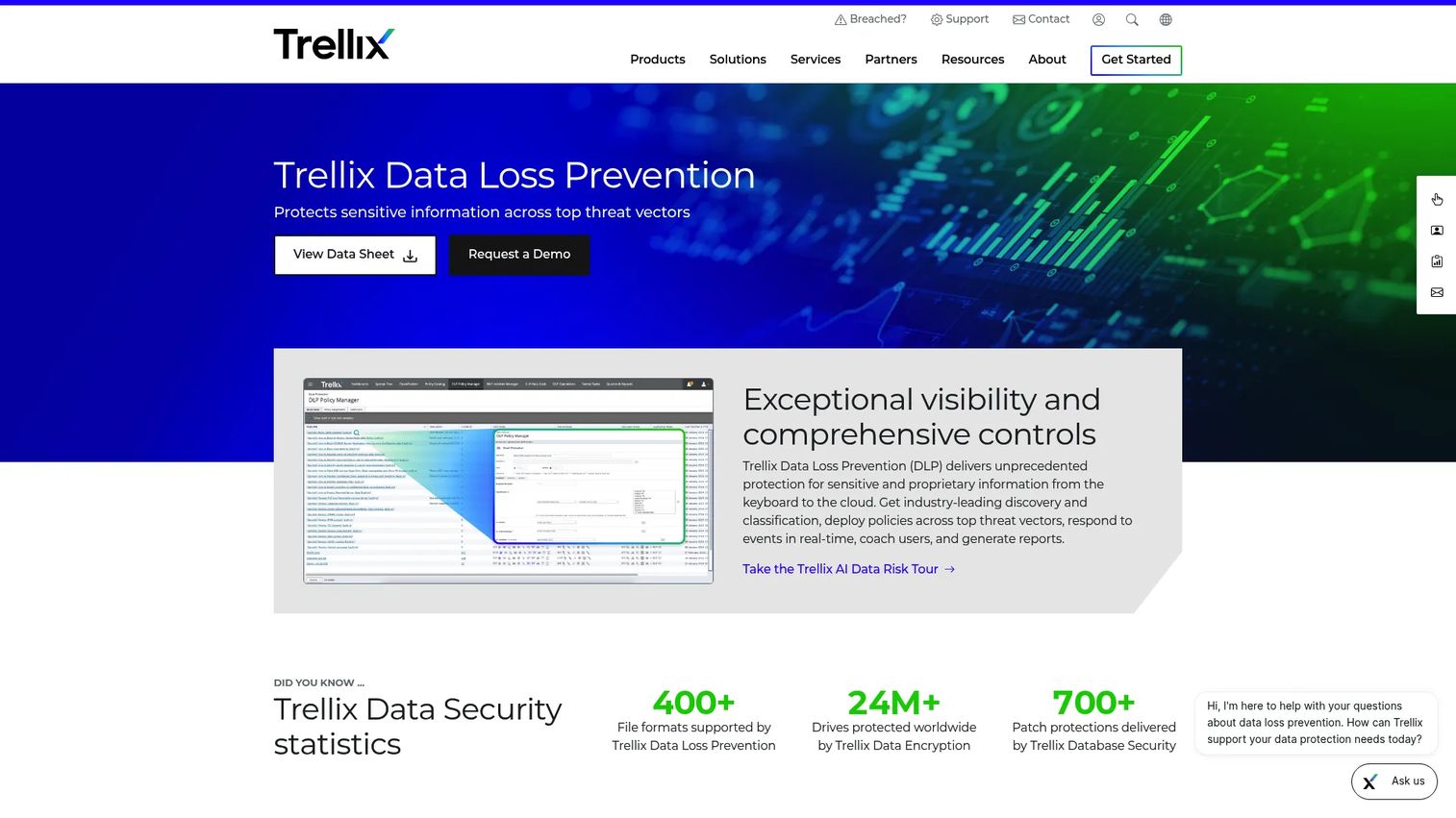
Trellix Data Loss Prevention is enterprise DLP software that protects sensitive information across endpoints, networks, email, web, and databases. It fits teams that still want a classic, channel-broad DLP suite with centralized management. Trellix leans on user coaching and notifications, so employees learn as policies fire, which reduces repeat incidents over time.
Best for: Large organizations needing centralized DLP across endpoint and network channels.
Key strengths
- Centralized monitoring and event tracking: one console for events across every covered channel.
- User coaching and notifications: real-time prompts that educate users when they trigger a policy.
- Policy enforcement across top threat vectors: coverage for the channels where data most often leaves.
Why choose Trellix DLP: If you want a traditional enterprise DLP suite with broad channel coverage and mature policy controls, Trellix delivers. The user coaching approach helps cut accidental leakage without heavy-handed blocking. Its endpoint DLP can run without adding a new agent for organizations already in the Trellix ecosystem, which eases deployment.
Trellix DLP pricing: Trellix does not publish public pricing and uses demo and contact-sales CTAs on its product page. Expect a quote-based model. In scoping, confirm which channels (endpoint, network, email, web, database) are in your quote, agent requirements, and whether centralized management is included or licensed separately.
6. Symantec Data Loss Prevention
Symantec Data Loss Prevention is an enterprise platform for discovering, monitoring, and protecting sensitive data across endpoints, email, web, cloud, and storage. Large organizations continue to evaluate it for mature security programs because of its detection depth and breadth of channel coverage. Its content-aware detection goes beyond simple pattern matching to reduce both misses and false positives.
Best for: Large enterprises needing centralized DLP across multiple data channels and compliance regimes.
Key strengths
- Discovery, monitoring, and protection across channels: coverage spanning cloud, email, web, endpoints, and storage.
- Content-aware detection: exact data match, indexed document matching, described content matching, file-type detection, and sensitive image recognition.
- Unified policies with real-time action: blocking, quarantine, and alerts, plus Microsoft Information Protection integration.
Why choose Symantec DLP: If you run a mature, large-scale security program and need detection depth across many channels, Symantec is a long-standing enterprise choice. The advanced detection methods suit organizations with complex data types and strict compliance regimes. It rewards teams with the resources to architect and tune a full enterprise DLP deployment.
Symantec DLP pricing: Symantec DLP is sold through partners, and no public price is shown on the product page. Because it is a partner-led purchase, get quotes that specify channel coverage, detection modules, and support tiers. Confirm deployment model and architecture requirements early, since enterprise Symantec deployments carry meaningful planning overhead.
7. Safetica
Safetica is an AI-powered data security platform that integrates data protection, insider risk, cloud security, and compliance. It fits teams that want practical control and behavioral visibility without an overloaded enterprise stack. Safetica combines DLP policy enforcement with insider risk insights, so security teams see not just what left, but the behavior that led up to it.
Best for: Mid-market and enterprise teams needing DLP, insider risk, and cloud data protection.
Key strengths
- Data classification and discovery: identify and tag sensitive data across the environment.
- DLP and policy enforcement: block or coach on risky data actions across endpoints and cloud.
- Insider risk management with AI-driven insights: surface risky behavior patterns before they become incidents.
Why choose Safetica: If your main concern is insider risk and accidental leakage, and you want a platform that is quicker to stand up than a heavyweight enterprise suite, Safetica is a strong fit. The insider risk lens and public pricing make it approachable for mid-market teams that need real control without a large security staff. Endpoint and cloud controls cover the everyday channels most teams worry about.
Safetica pricing: Safetica publishes public pricing. The Standard plan starts at $72 annually per user, Premium at $96, and Enterprise at $144, with a separate Safetica On-Prem option priced through sales. A free trial is available for the Standard plan. Confirm which insider risk and cloud security features live in each tier before choosing.
8. Fortra DLP

Fortra DLP helps organizations discover, classify, monitor, and block sensitive data movement across endpoints, networks, and cloud environments. Formerly Digital Guardian, it appeals to buyers who want broad coverage with predictable, tiered packaging for on-prem, cloud, or hybrid needs. Its agent captures events at the system, user, and data level, both on the corporate network and offline.
Best for: Enterprises needing DLP across endpoints, network, and cloud with scalable package options.
Key strengths
- Endpoint DLP for Windows, macOS, and Linux: broad OS coverage across multiple browsers and nearly every application.
- Network DLP traffic inspection: inspect traffic and enforce policy across network channels.
- Managed DLP services and centralized reporting: offload operations and centralize alerting and reporting.
Why choose Fortra DLP: If you want broad DLP coverage with clear tiers and the option of managed services, Fortra fits. The cross-platform endpoint support, including Linux, appeals to organizations with mixed OS fleets. The managed DLP option helps teams that want strong control without dedicating a full-time resource to daily operations.
Fortra DLP pricing: Fortra offers three DLP packages, Essentials, Advanced, and Elite, with tiered, scalable pricing that Fortra states starts at 1,000 users. No public numeric prices are shown, so pricing is by request quote. Confirm which package includes managed services, the channels covered, and how pricing scales with user count.
Considerations before you buy
Channel coverage vs your actual data flow
Map where your sensitive data really lives and moves before comparing vendors. If most of your exposure is SaaS and AI apps, a cloud-native platform fits better than an on-prem-first suite. If you are hybrid, confirm the tool covers endpoint, network, cloud, and email without licensing each as a separate product.
Policy tuning and false positive load
A DLP tool that fires on everything gets ignored. Evaluate how much tuning a platform needs, whether it ships useful templates, and how it handles false positives. AI and ML-assisted classification can cut noise, but only if it fits your data types. Ask for a proof-of-concept using your real sensitive data patterns.
Integration with your security stack
DLP that runs in isolation creates work instead of removing it. Confirm the platform feeds your SIEM, XDR, and alerting workflows, and that incident data is usable by your analysts. For presales teams, this integration question often decides technical validation.
Deployment model and operational overhead
Be honest about your team's capacity. A powerful enterprise suite that needs dedicated staff to run may cost more in operations than a lighter platform that covers 90% of your risk. Weigh deployment model, agent requirements, and whether managed services are available.
Compliance scope and reporting
If compliance drives the purchase, confirm the tool maps to your regimes: GDPR, HIPAA, PCI DSS, CCPA. Check that reporting produces the audit trail your auditors expect, and that policy templates cover your specific regulatory requirements out of the box.
Conclusion
There is no single best DLP platform, only the right fit for your environment, compliance scope, and rollout model. For unified enterprise coverage across every channel, Forcepoint DLP and Symantec remain strong. If Microsoft 365 is your center of gravity, Microsoft Purview keeps DLP inside tooling your team already knows. Teams standardized on CrowdStrike will find Falcon Data Protection the path of least resistance, with real-time data movement visibility as the standout.
For cloud-first and AI-heavy organizations, Nightfall is built for the channels you actually use. Trellix suits teams that want a classic enterprise suite with strong user coaching. Safetica fits mid-market teams prioritizing insider risk with public, predictable pricing. And Fortra DLP works when you want broad coverage, cross-platform endpoint support, and tiered packaging.
Your next step is practical: map your data flow, shortlist two or three vendors by channel fit, and run a proof-of-concept using your real sensitive data. The platform that produces clean alerts, integrates with your SIEM, and covers your highest-risk channels is the one to buy.
FAQs
DLP software detects, classifies, monitors, and controls sensitive data to stop it from leaving an organization without authorization. It protects data at rest in storage, data in motion across email and network traffic, and data in use on endpoints and in applications. When a risky action occurs, DLP can alert, block, quarantine, or encrypt to prevent the loss.
The main types map to the channels data travels through. Endpoint DLP protects laptops and workstations, network DLP inspects outbound traffic, and cloud DLP watches SaaS apps and cloud storage. Email DLP catches misdirected or malicious sends, and modern platforms increasingly add browser and AI-app coverage for shadow AI usage.
DLP works by classifying sensitive data using classifiers, exact data match, and pattern rules, then applying policies to how that data can be used or shared. When an action violates a policy, the tool triggers an alert, blocks the action, or quarantines the data. Events flow into incident workflows and often into SIEM or XDR tools so analysts can investigate.
Prioritize channel coverage that matches your actual data flow, policy tuning that keeps false positives low, and clean integration with your SIEM and security stack. Also weigh deployment model, operational overhead, and reporting depth. A tool that produces noisy alerts or runs in isolation adds work instead of reducing risk.
DLP gives you the classification, enforcement, and audit trail that regulations like GDPR, HIPAA, PCI DSS, and CCPA require. Policy templates map controls to specific regimes, and reporting produces the evidence auditors expect. That turns a compliance obligation into an enforceable, demonstrable control rather than a paper policy.
DLP focuses on controlling data movement across channels and stopping unauthorized use or exfiltration in real time. DSPM (data security posture management) focuses on discovering where sensitive data lives across your cloud environment and assessing its risk posture. In short, DSPM answers where your data and risks are, while DLP enforces what can happen to that data.
Yes. Modern DLP platforms add controls for AI usage, watching for sensitive data entering GenAI apps and prompts. Some detect and govern shadow AI across major chatbots, while Microsoft-native tools extend policy to Microsoft 365 Copilot and third-party AI apps. This matters because pasting confidential data into a chatbot is now one of the most common exfiltration paths.