A wellness budget is easy to approve and hard to defend. Someone on your leadership team signs off on gym stipends, a meditation app, and a step challenge. Six months later a board member asks what any of it did for retention or productivity. The honest answer is usually silence, because the spend was a collection of perks, not a system that produced measurable signal.
That gap is the real problem employee wellbeing software solves. The global employee wellness software market reached USD 5.92 billion in 2024 and is forecast to hit USD 12.5 billion by 2035 at a 7.1% CAGR, according to WiseGuy Reports (2025). Growth like that reflects a shift in how companies treat wellbeing: less as a benefits line item, more as operating infrastructure tied to engagement, churn, and workforce consistency.
For a founder scaling past 50 people, that shift matters. Retention and productivity stop being culture talking points and become board-level metrics. The question is no longer whether to fund wellbeing, but which corporate wellness platform gives you participation you can measure and reporting you can forward without a caveat. If you evaluate software the way you evaluate other parts of your stack, you can also read our takes on the best customer data platform and the best employee advocacy software tools to see how the same buyer discipline applies across categories, or study how best ai cybersecurity solutions get evaluated under the same lens.
What's inside
This guide compares 10 employee wellbeing software platforms for 2026, ranked for a founder or executive buyer who needs a credible shortlist, not a wellness explainer. We selected platforms on four criteria that survive scrutiny:
- Engagement mechanics that drive real participation, not one-time signups
- Analytics and reporting clean enough to defend in a board meeting
- Integrations with wearables, HRIS, Slack, and your existing stack
- Program breadth and workforce fit across hybrid, remote, and global teams
Every entry includes verified pricing where public, G2 ratings where available, and a clear read on who each platform fits.
TL;DR
- Best all-in-one, white-label platform: CoreHealth, for large employers and wellness providers who need a configurable system across many modules.
- Best for engagement plus recognition: Wellness360, covering whole-person wellness with rewards and surveys.
- Best for mental health depth: Unmind, for organizations prioritizing therapy, coaching, and resilience.
- Best for flexible program formats: Wellable, combining challenges, content, events, and guided breaks.
- Best for challenge-driven participation: Vantage Fit and MoveSpring, for teams that want activity engagement at scale.
- Best for hybrid and remote micro-breaks: Bright Breaks, for distributed teams fighting burnout.
What is employee wellbeing software?
Employee wellbeing software is a corporate wellness platform that helps organizations run, measure, and scale programs that improve the physical, mental, financial, and social health of their workforce. It replaces scattered perks with a single system for participation, incentives, and reporting.
Most workplace wellness solutions in this category share a common set of capabilities:
- Health assessments such as HRAs and self-reported surveys that establish a baseline
- Challenges and competitions across steps, activity, and habit formation
- Rewards and incentives to drive and sustain participation
- Content and coaching covering fitness, nutrition, mental health, and financial wellbeing
- Events and live sessions including classes, breaks, and webinars
- Dashboards and analytics for participation, engagement, and outcome reporting
- Mobile apps so distributed employees can engage from any device
- Integrations with wearables, HRIS, payroll, and communication tools like Slack
Why it matters now: employee wellness programs increasingly map to retention, productivity, and workforce consistency. Mobile applications are expected to account for 55% of corporate wellness platform usage by 2026, per Fact.MR (2024), which tells you where engagement actually happens. And large enterprises are projected to generate around 57% of corporate wellness software revenue in 2025, according to Future Market Insights (2025), a sign that bigger employers now treat these employee wellbeing solutions as core infrastructure rather than a nice-to-have.
When to use employee wellbeing software
Not every company needs a full platform on day one. Here is how to tell when structured employee wellness platforms earn their place in your stack.
Improve retention and engagement
Structured platforms support participation, habit formation, and manager visibility in ways ad hoc perks cannot. When you can see which teams engage, which programs stick, and where interest drops, wellbeing stops being a guess. For a founder watching churn eat into growth, that visibility connects a wellness plan to the metrics your board actually tracks: retention, culture, and productivity.
Launch a scalable wellness program
Spreadsheets and one-off perks stop working the moment you cross a few dozen employees across time zones. If any of this sounds like you, it is time for a real platform:
- You are manually tracking a step challenge in a shared sheet
- Reimbursements route through email and get lost
- You cannot report participation without a half-day of cleanup
- Leadership wants outcomes, not receipts
Corporate wellness apps built for scale give you assessments, incentives, and repeatable reporting in one place.
Support hybrid, remote, or global teams
Distributed workforces make participation inconsistent unless the tooling meets people where they are. That means mobile access, language support, and device integrations matter more than a physical gym benefit ever did. Look for workplace wellness programs that offer:
- Native mobile apps for both iOS and Android
- Wearable and app integrations (Apple Health, Fitbit, Garmin, Google Fit)
- Multi-language support for global teams
- Async formats so time zones do not gate participation
Comparison table
The table below ranks all 10 platforms by fit for a founder-led buyer. Pricing and ratings are drawn from first-party pages and G2 where publicly available; verify current figures before committing budget, since many vendors price by headcount and contract term.
| # | Product | Intent | Key use case | Pricing | G2 rating |
|---|---|---|---|---|---|
| 1 | CoreHealth | All-in-one, white-label | Configurable programs for large employers and providers | From $350 per feature/month | Not listed |
| 2 | Wellness360 | Engagement + recognition | Whole-person wellness with rewards and surveys | Contact sales | 4.4/5 |
| 3 | Wellable | Flexible program formats | Challenges, content, events, guided breaks | From $100/month | 4.7/5 |
| 4 | Unmind | Mental health depth | Therapy, coaching, resilience for enterprises | Contact sales | 4.6/5 |
| 5 | WellSteps | Managed behavior change | Preventive, outcomes-driven programs | From $0.50 PEPM | Not listed |
| 6 | Vantage Fit | Challenge-driven engagement | Fitness challenges and gamified participation | From $500/month | 4.5/5 |
| 7 | MoveSpring | Activity challenges | Step and activity competitions for distributed teams | Contact sales | 4.7/5 |
| 8 | Bright Breaks | Hybrid micro-breaks | Live breaks and burnout prevention | From $395/month | Not listed |
| 9 | BetterMe | Mobile-first holistic wellness | Fitness, nutrition, mental health via app | Shown at checkout | 4.9/5 |
| 10 | Sonic Boom Wellness | Gamified engagement | Challenges, recognition, high participation | Contact sales | 4.0/5 |
Read the table by intent, not just by rank. The top picks favor breadth and reporting; the mid-list leans into challenge mechanics and participation; the bottom entries specialize in mobile-first or engagement-heavy tactics.
1. CoreHealth
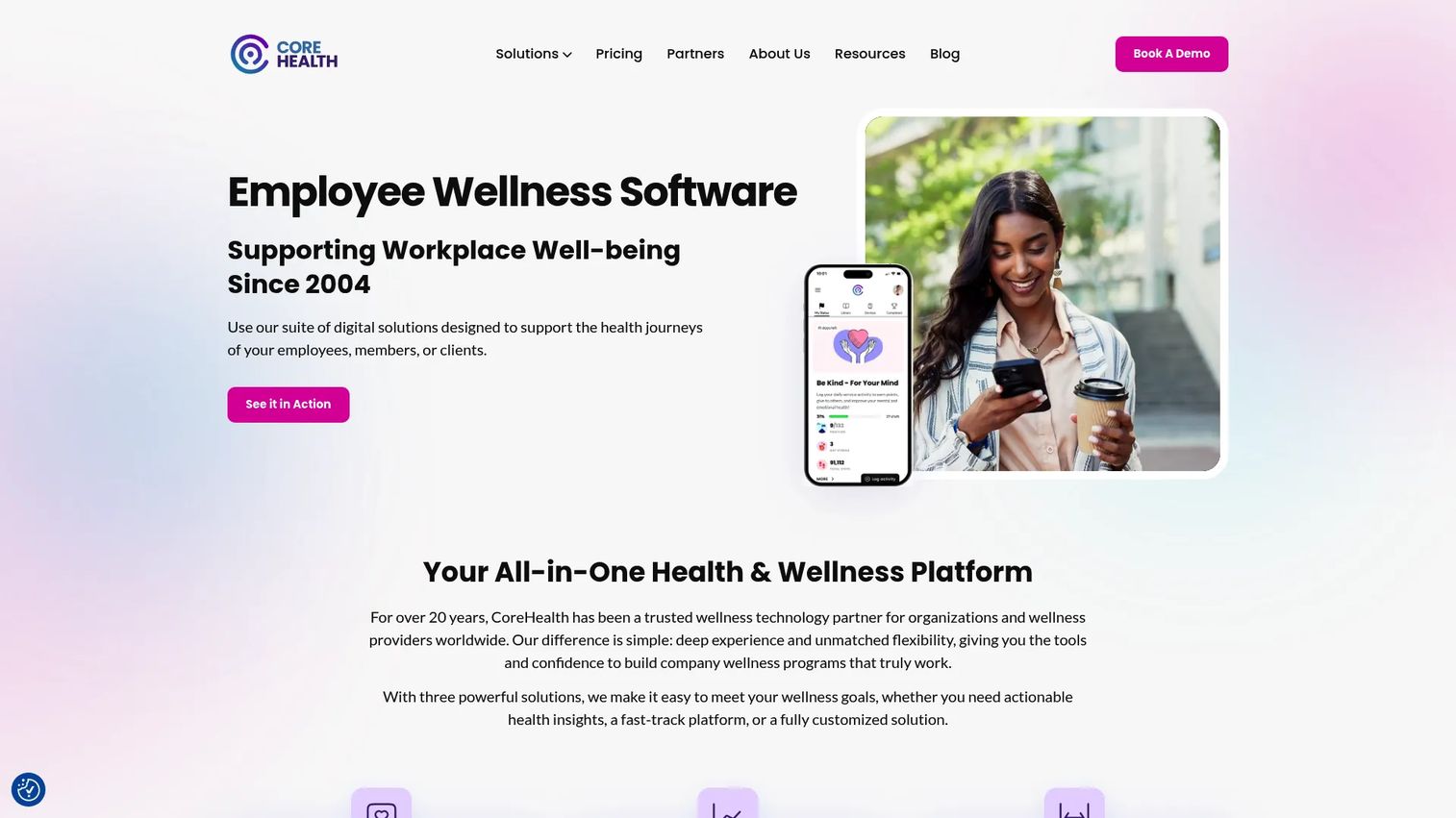
CoreHealth is an all-in-one employee wellness platform built for large employers and wellness providers who need a configurable, white-label system. Rather than a single fixed program, it offers a modular suite you assemble around your workforce, backed by global support and data-driven reporting. If you are scaling a wellness plan across regions and want one platform to standardize it, CoreHealth is engineered for that job.
Best for: large employers and wellness providers who need a configurable, white-labeled corporate wellness platform.
Key strengths
- Modular solution suite: Assemble health assessments, incentives, and engagement tools into a program that fits your workforce.
- MyWellApp mobile access: Employees engage from any device, which matters for hybrid and distributed teams.
- Real-time dashboards: Reporting and analytics give you participation and engagement signal you can act on.
Why choose CoreHealth: The configurability and white-label capability make it a fit for organizations that want a platform they can shape, not a rigid product they conform to. Entry points are structured as CoreHealth NOW, CoreHealth Checkpoint, and CoreHealth Pro, giving you distinct paths depending on program maturity and scale.
CoreHealth pricing: CoreHealth uses license-based contracts rather than a simple monthly seat price. First-party materials indicate pricing starts around $350 per feature, per month, with plans structured across CoreHealth NOW and Checkpoint on one-year licenses and CoreHealth Pro on a three-year license with a minimum of 5,000 users. There is no free tier. Confirm current terms directly, since feature-based pricing scales with what you configure.
2. Wellness360
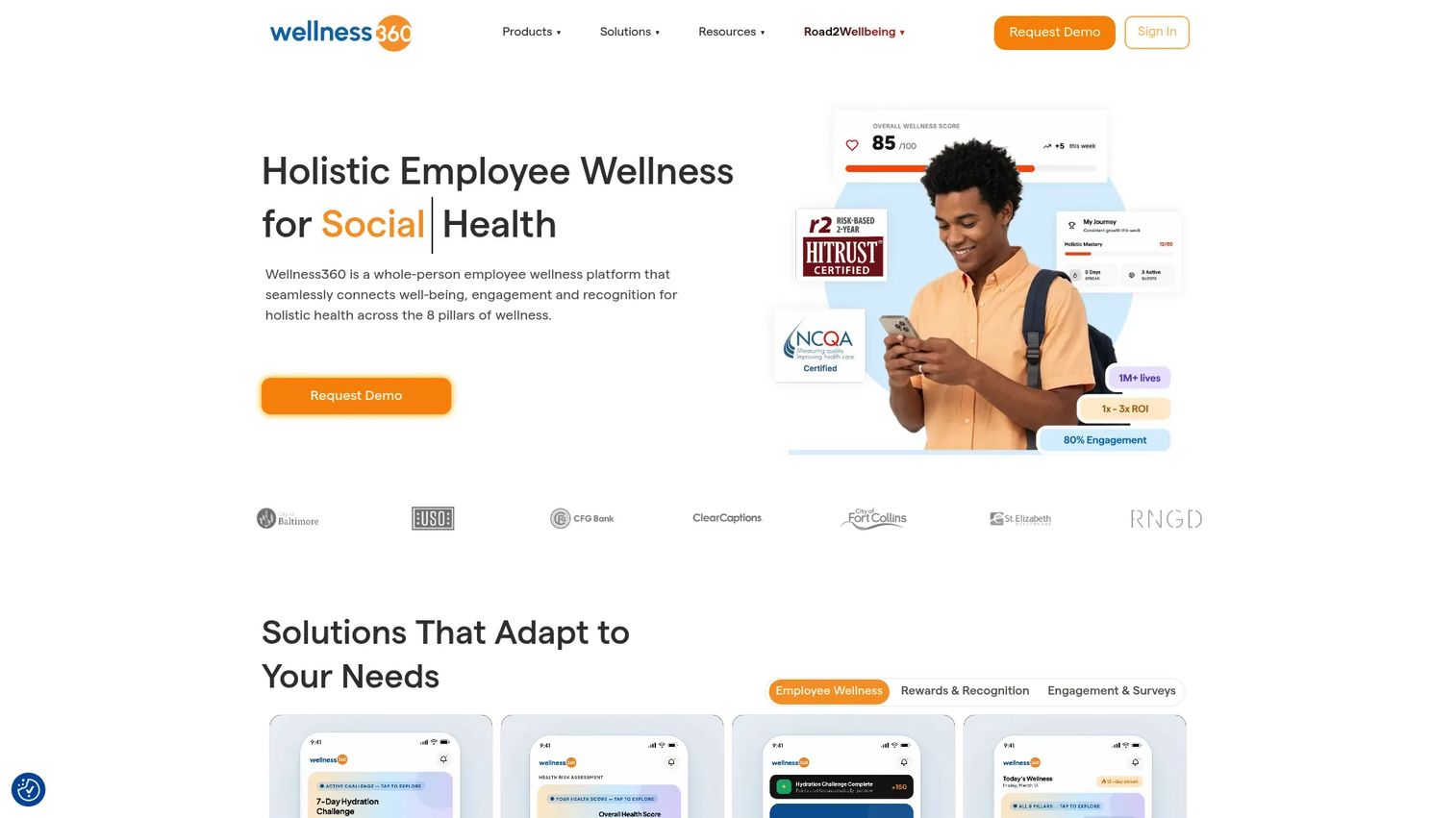
Wellness360 is a whole-person corporate wellness platform that spans physical, mental, financial, and social wellbeing across its wellness pillars. It leans hard into engagement, pairing challenges and assessments with rewards, recognition, and surveys. For buyers who want breadth and participation in one system rather than a single-purpose tool, it covers a lot of ground.
Best for: employers and healthcare organizations running broad employee wellness programs that need engagement plus recognition.
Key strengths
- Wellness challenges: Structured challenges keep participation active across the year, not just at launch.
- Health risk assessments: HRAs establish a baseline you can measure programs against.
- Incentive management: Rewards and recognition sustain engagement past the initial signup spike.
Why choose Wellness360: It fits buyers who want a single platform covering the full spectrum of employee wellbeing solutions with strong engagement mechanics layered on top. The recognition and survey tooling makes it more than a fitness tracker, which appeals to leaders who want culture signal alongside health data.
Wellness360 pricing: Wellness360 does not publish a first-party price. The sales flow is demo and contact based, so you request a quote scaled to your headcount and program scope. It holds a 4.4/5 rating on G2. Ask specifically about which pillars, integrations, and reporting depth are included at your tier before committing.
3. Wellable
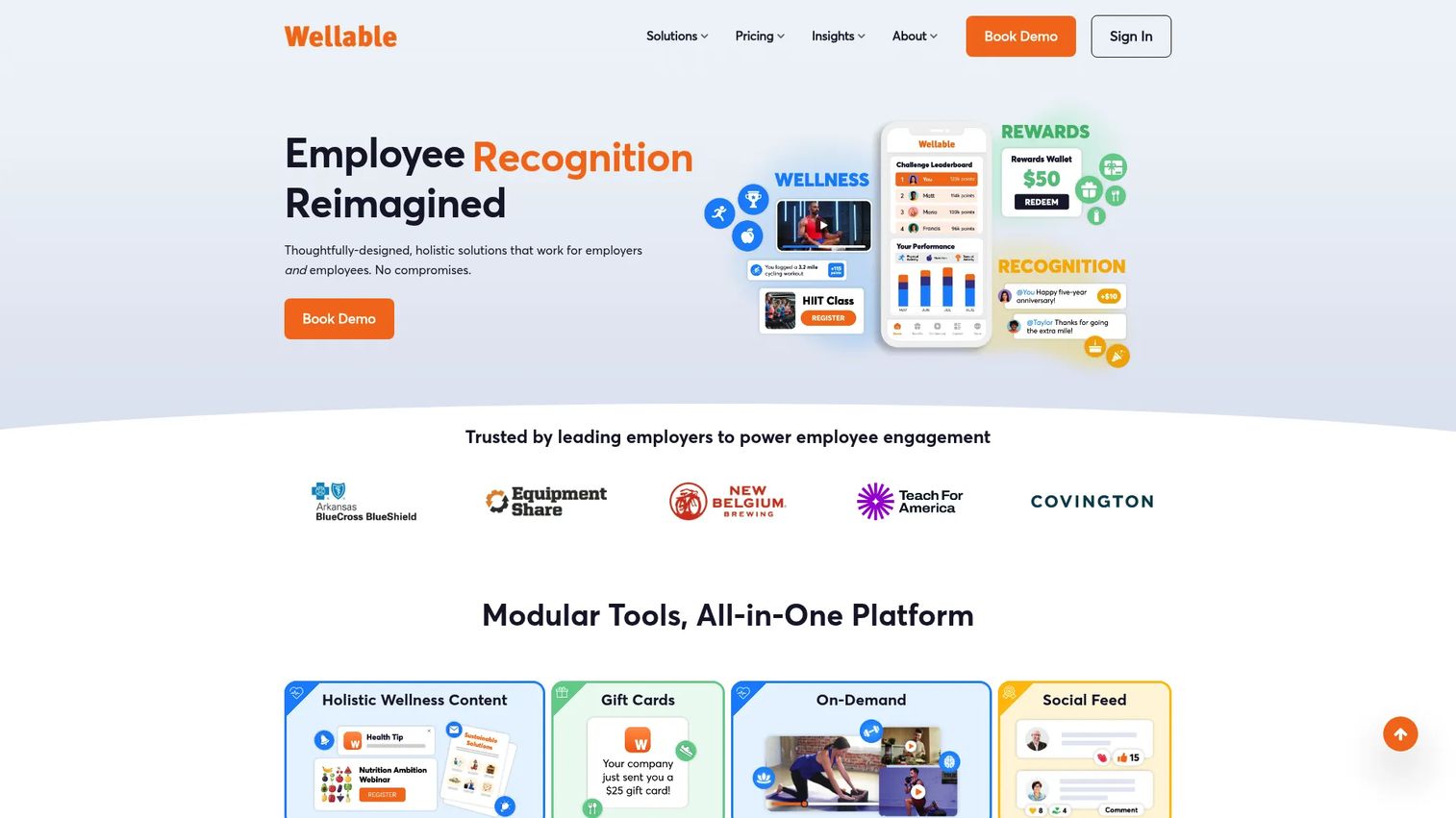
Wellable is an employee wellness, rewards, and recognition platform built for operational flexibility. It combines wellness challenges with Wellable Studio content, on-demand programming, live events, and guided breaks, so you can mix formats to match how your teams actually engage. For companies that want multi-format engagement rather than one channel, it is one of the more adaptable workplace wellness solutions on this list.
Best for: mid-market and enterprise teams that want flexible, multi-format employee wellness programs.
Key strengths
- Multi-format engagement: Challenges, content, events, and guided breaks let you meet different employee preferences.
- Wearable and app integrations: Direct connections to major wellness apps and wearables keep participation frictionless.
- Mobile and web access: Employees engage wherever they are, on any device.
Why choose Wellable: The format flexibility is the draw. If your workforce splits between people who love competition and people who prefer on-demand classes or short breaks, Wellable lets you run both without stitching tools together. It also earns a strong 4.7/5 on G2.
Wellable pricing: Wellable publishes transparent pricing, which is rare in this category and useful for budgeting. Essentials starts at $100/month ($4.00 per user per month), Pro at $150/month ($6.00 per user per month), and Enterprise is a custom quote through their sales team. Billing is shown monthly, and there is no free tier. The public entry price makes it easy to model cost before a sales call.
4. Unmind
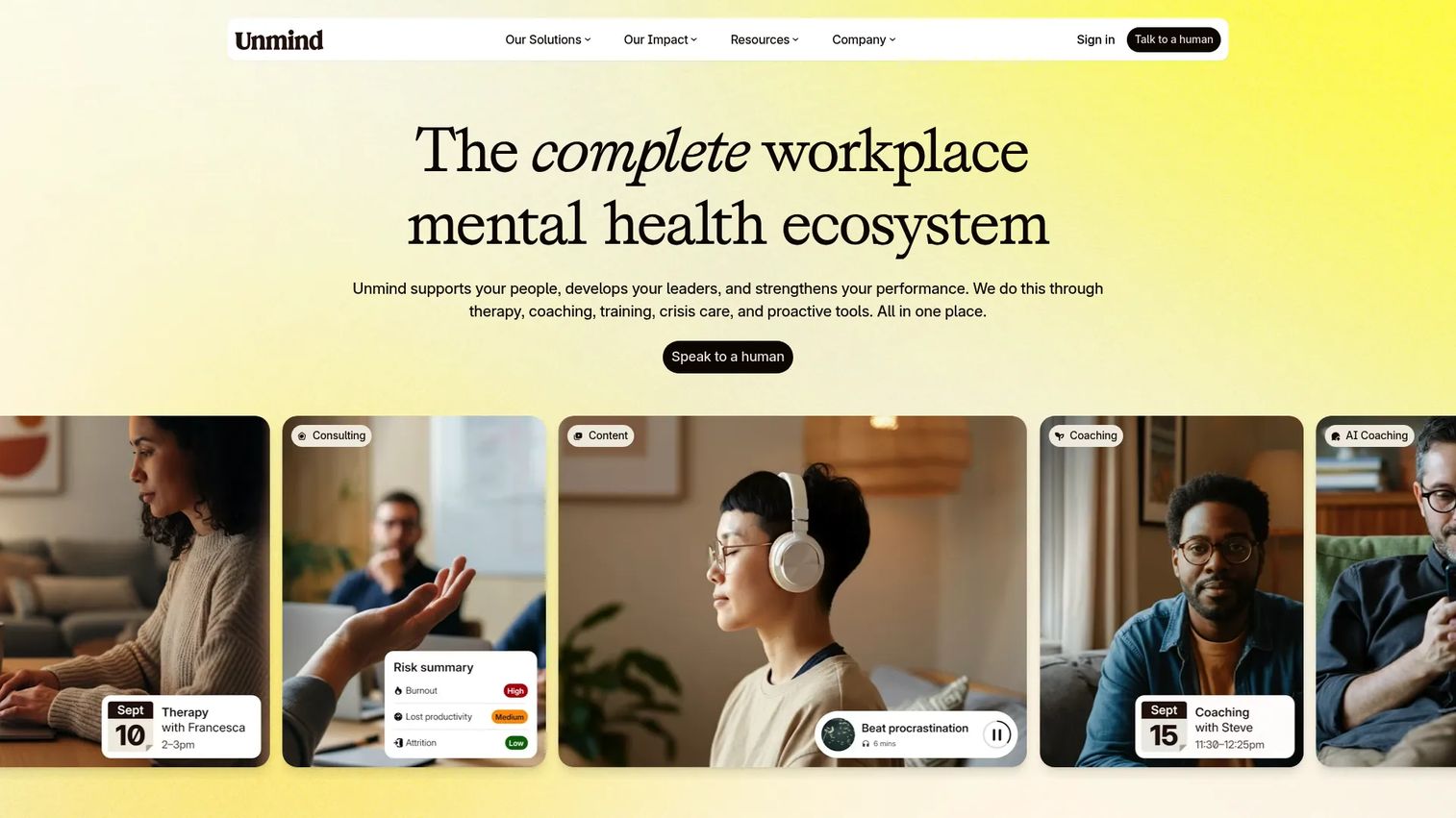
Unmind is an enterprise workplace mental health platform that goes deep where most wellness tools stay broad. It offers therapy, coaching, courses, crisis support, and assessments, backed by science-based guidance and a 24/7 global helpline. For organizations that treat mental health and resilience as the priority rather than an add-on, Unmind is purpose-built for that focus.
Best for: large organizations that want an all-in-one employee mental health and wellbeing platform.
Key strengths
- Therapy and coaching: Employees access professional support directly, not just self-help content.
- Nova AI support and assessments: Guided insights and check-ins help people find the right resource faster.
- 24/7 global helpline: Immediate support matters most for distributed and global teams.
Why choose Unmind: When resilience and mental health are your leadership's stated priority, a general challenge platform will not cut it. Unmind provides clinical depth and proactive tools that a step-counter cannot, which is why enterprises prioritizing psychological safety gravitate to it. It holds a 4.6/5 on G2 across its reviews.
Unmind pricing: Unmind does not publish numeric plan prices on its site; pricing is quote-based and scaled to organization size and scope. Given the clinical services involved, expect enterprise-oriented packaging. Request a proposal that spells out which support tiers, helpline coverage, and language options are included for your workforce.
5. WellSteps
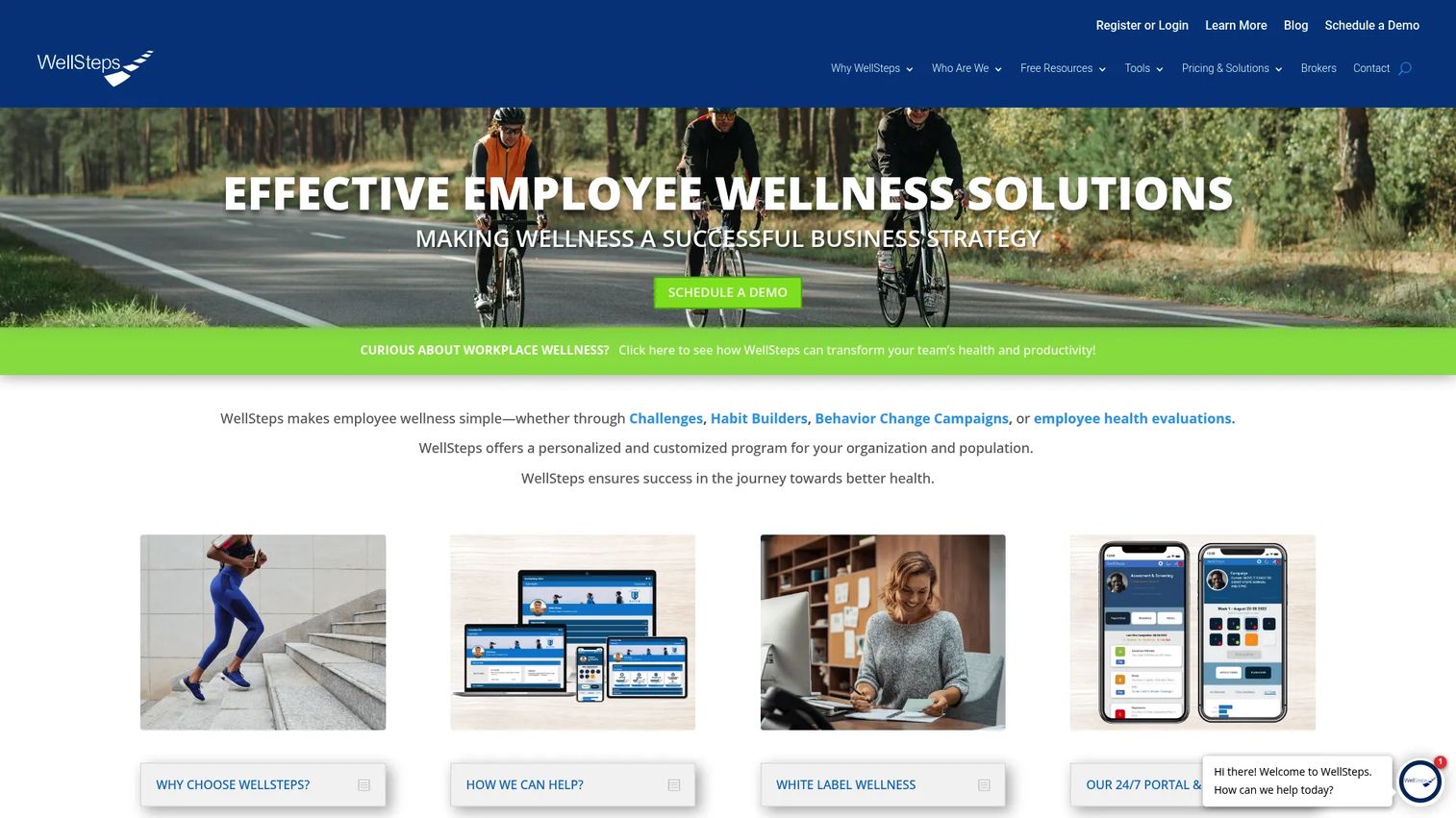
WellSteps is a preventive, outcomes-driven employee wellness platform focused on behavior change. It pairs challenges, habit builders, and behavior change campaigns with a dedicated WellSteps Guide, so programs get human support rather than launching and drifting. If you want measurable participation and a managed program rather than a self-serve tool, this is the structured option.
Best for: organizations that want a managed, outcomes-driven wellness program with customizable participation.
Key strengths
- Dedicated WellSteps Guide: Hands-on support keeps programs active instead of stalling after launch.
- Behavior change campaigns: Habit builders and campaigns target sustained change, not one-time activity.
- App and portal access: Employees engage through both mobile and web.
Why choose WellSteps: The guided, managed model fits teams that do not have internal bandwidth to run a program day to day. You get preventive, behavior-focused design plus a real person accountable for keeping it moving, which is a different value proposition from most self-serve corporate wellness apps.
WellSteps pricing: WellSteps publishes clear per-employee-per-month pricing, which helps budgeting. The Launch Program runs about $1.75 PEPM at a company size of 500, a Custom Solution ranges from $0.99 to $3.65 PEPM, and a Reseller and White-Label option starts at $0.50 PEPM plus a one-time training and enablement investment. There is no free tier. Costs scale with headcount and configuration.
6. Vantage Fit
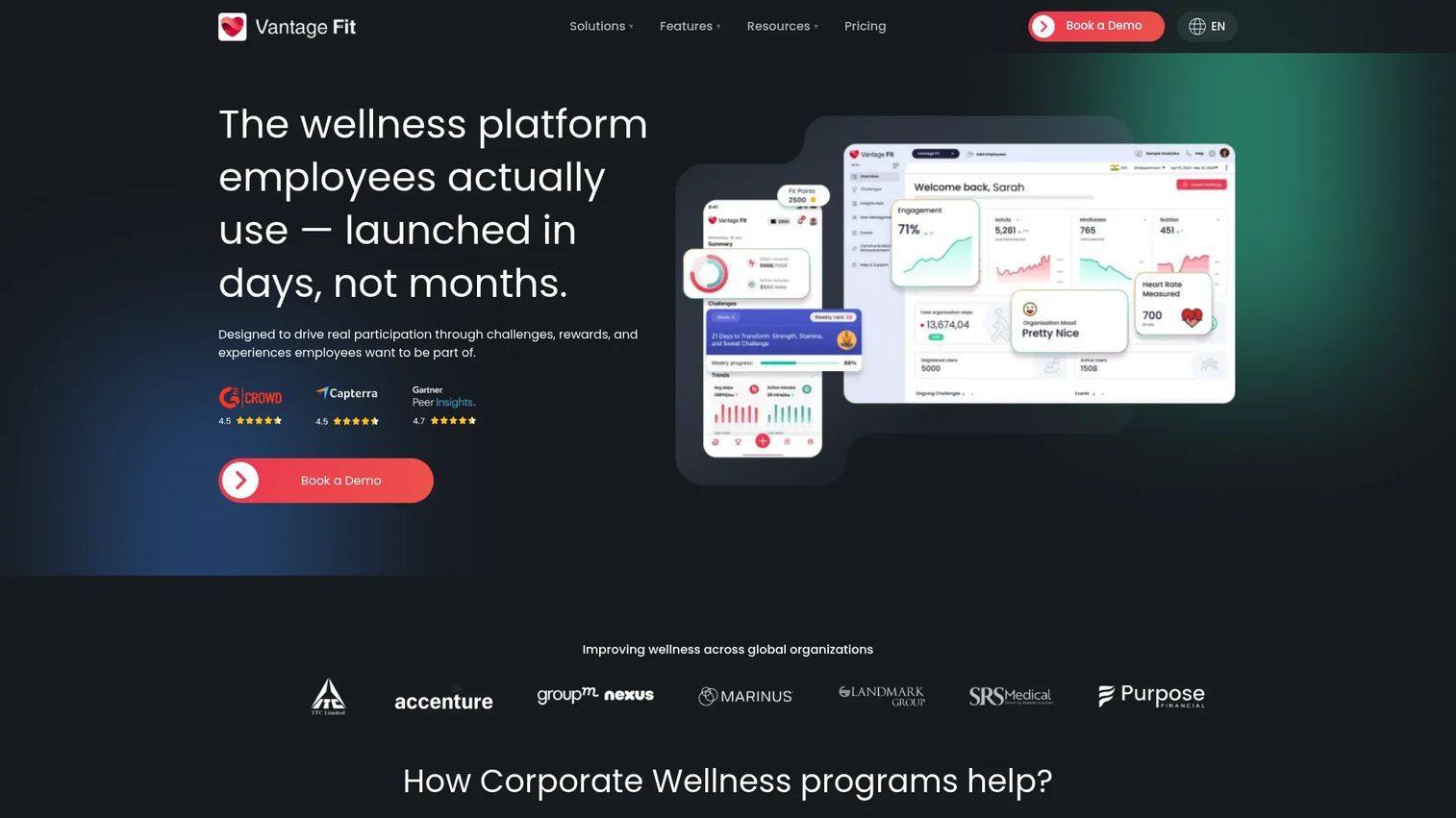
Vantage Fit is a corporate wellness platform built around challenges, activity tracking, and gamification. It covers step and multi-activity challenges, tracks activity, sleep, heart rate, and mood, and layers rewards and admin dashboards on top. For HR teams that want participation at scale through friendly competition, it is a strong fit among employee wellness platforms.
Best for: HR teams running employee wellness challenges and engagement programs at scale.
Key strengths
- Multi-activity challenges: Step and activity challenges drive broad, repeatable participation.
- Comprehensive tracking: Activity, sleep, heart rate, and mood data give a fuller wellbeing picture.
- Rewards and dashboards: Gamification plus admin analytics keep engagement and reporting in one place.
Why choose Vantage Fit: If your goal is high participation through gamified challenges, Vantage Fit is designed for exactly that. The rewards mechanics and analytics make it easy to launch a company-wide challenge and see who is engaging, which appeals to teams that want momentum fast. It carries a 4.5/5 on G2.
Vantage Fit pricing: Vantage Fit prices by headcount, with public tiers for Grow and Transform and a custom Enterprise plan. G2 pricing information lists Grow around $500/month and Transform around $900/month at a 500-user scale, with Enterprise as a custom quote. There is no free tier. Because pricing is headcount-based, model it against your actual employee count before deciding.
7. MoveSpring
MoveSpring is a corporate wellness challenge platform focused on simple, high-engagement activity competitions. It handles step and activity challenges, team competitions, chat and announcements, monthly goals, and wellbeing content, with wearable support built in. For distributed teams that want challenge-based engagement without complexity, MoveSpring keeps the experience light and social.
Best for: employers running recurring or one-time corporate wellness challenges across distributed teams.
Key strengths
- Activity and step challenges: Simple, repeatable competitions drive participation without heavy setup.
- Team competitions and chat: Social features build camaraderie across remote and hybrid teams.
- Wellbeing content and goals: Monthly step goals and content sustain engagement between challenges.
Why choose MoveSpring: The simplicity is the point. If you want to run a step challenge that people actually join, without configuring a sprawling platform, MoveSpring nails the challenge-based motion. Its social layer works well for distributed teams that need a shared moment. It holds a 4.7/5 on G2.
MoveSpring pricing: MoveSpring does not publish public prices on its site. Help center materials indicate One-time, Pro, and Ultimate plans, with pricing handled through an account executive or client success manager. Ask for the plan breakdown and any one-time challenge options if you want to pilot before committing to a recurring program.
8. Bright Breaks
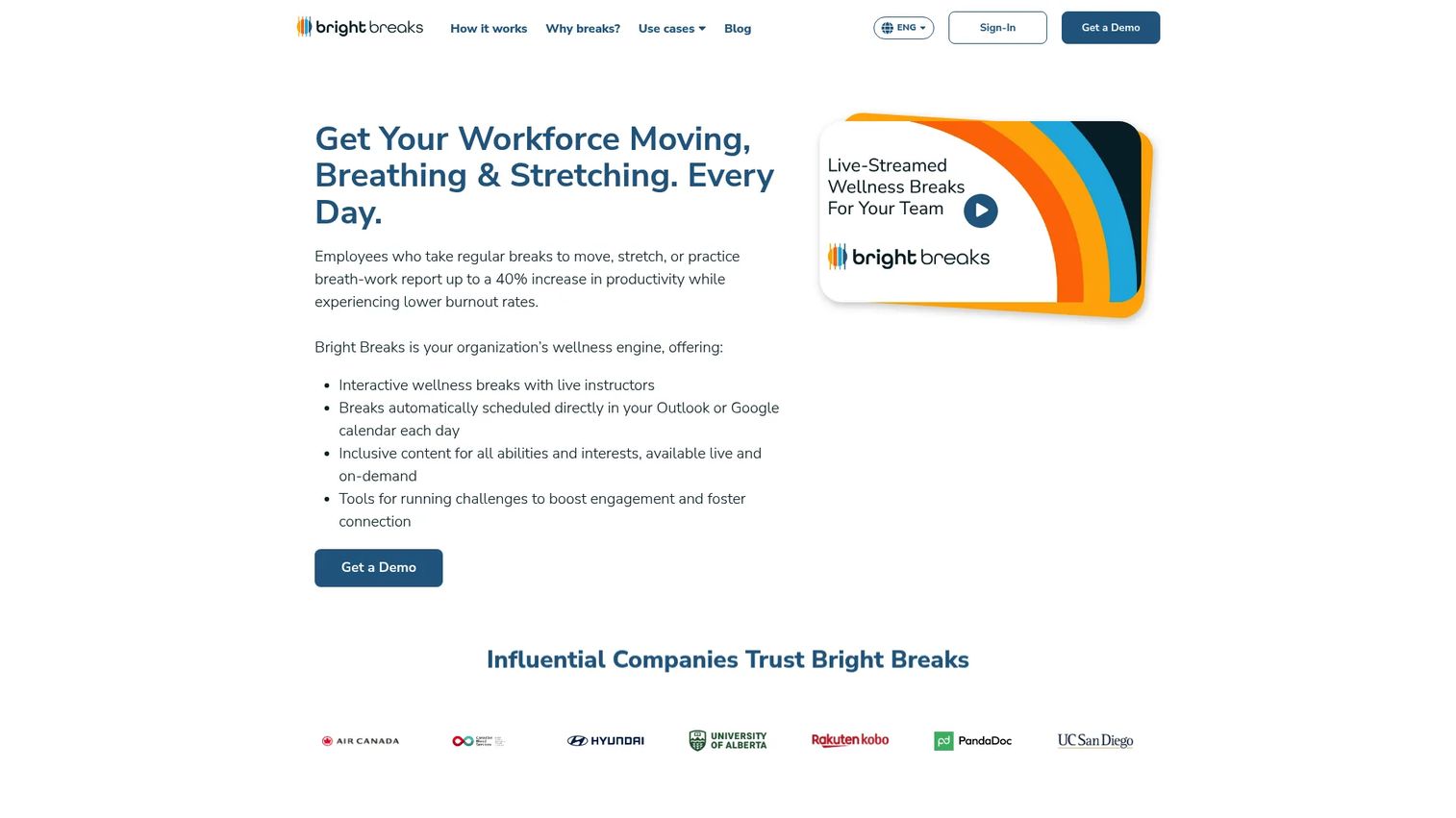
Bright Breaks is a corporate wellness platform built around short, live, scheduled breaks for remote and hybrid employees. It offers hundreds of live 7-minute breaks per week plus a large on-demand library, integrated into the calendar so people actually take them. For desk-bound, distributed teams fighting burnout, the micro-break model is a genuinely different approach.
Best for: HR and people teams seeking a lightweight wellness program for remote or hybrid employees.
Key strengths
- 250+ live breaks per week: Scheduled 7-minute sessions make it easy to build a break habit.
- 1000+ on-demand breaks: Async access covers every time zone and schedule.
- Calendar and Teams integration: Google Calendar and Microsoft Teams integration puts breaks where work already happens.
Why choose Bright Breaks: For hybrid and remote teams, burnout prevention often comes down to small, frequent resets rather than an annual wellness week. Bright Breaks operationalizes that with scheduled micro-breaks that slot into the workday. The Enterprise tier adds SSO, department analytics, step challenges, and health integrations.
Bright Breaks pricing: Bright Breaks publishes transparent pricing. The Core Workplace Wellness plan starts at $395/month on a month-to-month basis, and the Enterprise Workplace Wellness plan starts at $833/month with a 12-month minimum, adding SSO, user provisioning, department and location analytics, step challenges, and health integrations. There is no free tier. The month-to-month Core option makes it low-commitment to pilot.
9. BetterMe
BetterMe is a mobile-first holistic wellness platform spanning fitness, nutrition, and mental health. It offers workout programs like Wall Pilates and calisthenics, intermittent fasting guidance, and mental health tools including guided meditations, breathing exercises, and sleep sounds. For companies whose workforce lives on their phones, the app-based, accessible model meets employees where they already are.
Best for: teams that want a guided, mobile-first wellness app covering fitness, nutrition, and mental health.
Key strengths
- Movement programs: Wall Pilates, calisthenics, and structured workouts cover a range of fitness levels.
- Nutrition guidance: Intermittent fasting and dietary support broaden the program beyond exercise.
- Mental health tools: Guided meditations, breathing exercises, and sleep sounds support recovery and rest.
Why choose BetterMe: The mobile-first design and holistic coverage make it accessible for distributed workforces that will not engage with a desktop portal. It combines movement, recovery, and mental health in one app, which suits companies wanting a single consumer-grade experience. It holds a standout 4.9/5 on G2.
BetterMe pricing: BetterMe does not publish a fixed subscription price on its site; the charged price is shown at checkout and may include a free or paid trial depending on the plan. For a workforce rollout, contact the BetterMe for Business team to scope a plan for your headcount and confirm what business-tier access includes.
10. Sonic Boom Wellness
Sonic Boom Wellness is an employee wellbeing platform built around gamified challenges, recognition, and high-participation tactics. It combines daily wellbeing challenges, incentive management, employee recognition, coaching, and health education into an engagement-heavy program. For companies whose main goal is getting people to actually participate, its game-driven approach is designed to move the participation number.
Best for: organizations seeking a customizable, engagement-first employee wellbeing program.
Key strengths
- Daily wellbeing challenges: Frequent, gamified touchpoints keep engagement consistent.
- Incentive management: Rewards structures sustain participation over time.
- Employee recognition: Recognition features add a social and cultural layer to wellbeing.
Why choose Sonic Boom Wellness: If your primary metric is participation, Sonic Boom leans into the tactics that drive it: game mechanics, recognition, and daily engagement. Now part of Premise Health, it fits companies that want an engagement-first program with coaching and health education underneath. It shows a 4.0/5 on G2, though from a limited review base, so weigh that alongside a direct evaluation.
Sonic Boom Wellness pricing: Sonic Boom does not publish public pricing; plans are quote-based. Because packaging is not visible upfront, ask for a breakdown of challenge features, coaching, and recognition tooling scoped to your headcount, and clarify contract terms before committing.
What to evaluate before you buy
A shortlist is only useful if you pressure-test it against how you actually operate. Run every finalist through these criteria before budget goes out the door.
Engagement mechanics that hold past launch
Signup spikes are easy. Sustained participation is the real test. Look for challenges, incentives, and content variety that keep people engaged month over month, and ask vendors for retention data on participation, not just enrollment numbers.
Analytics you can defend
Your board will ask what the spend produced. Prioritize platforms with dashboards that report participation, engagement, and outcomes cleanly, and confirm you can export the data into your own reporting rather than living inside a vendor dashboard.
Integration with your existing stack
A wellness platform that does not talk to your HRIS, payroll, wearables, and Slack becomes another silo. Verify the specific integrations you need are supported at your pricing tier, not gated behind an enterprise upsell you did not budget for.
Fit for a hybrid, remote, or global workforce
If your team is distributed, mobile access and language support are not optional. Check that native apps, wearable integrations, and async formats cover every region where you employ people, so participation is not gated by geography or time zone.
Pricing that scales with headcount, not against you
Most platforms price per employee per month or by headcount tier. Model the cost at your current size and at your 12-month projection, and confirm what happens to price and feature access as you grow.
Choosing the right platform for your team
The right pick depends on what problem you are actually solving. If you need one configurable, white-label system across regions, CoreHealth is built for that scale. If engagement and recognition are the priority, Wellness360 covers whole-person wellness with strong participation mechanics. When mental health and resilience lead the mandate, Unmind offers clinical depth a challenge platform cannot match.
For flexible, multi-format programs, Wellable lets you run challenges, content, and breaks from one place with transparent pricing. If challenge-driven participation is the goal, Vantage Fit and MoveSpring specialize in exactly that, while Bright Breaks handles hybrid burnout prevention through scheduled micro-breaks. For a mobile-first workforce, BetterMe meets people on their phones, and Sonic Boom Wellness leans into gamified engagement for companies chasing high participation.
Start by naming your single most important outcome: retention, engagement, mental health, or challenge participation. Shortlist two platforms that lead on that outcome, then validate integration and reporting fit in a short pilot before you scale. Treat wellbeing software the way you treat the rest of your stack: it earns its place by producing signal you can act on, not by adding another perk you cannot measure.
FAQs
Employee wellbeing software is a corporate wellness platform that helps organizations run, measure, and scale programs supporting the physical, mental, financial, and social health of their workforce. It typically combines assessments, challenges, rewards, content, coaching, dashboards, mobile apps, and integrations into one system. The goal is to replace scattered perks with measurable, repeatable programs.
At minimum, look for health assessments, challenges and incentives, content and coaching, participation analytics, a mobile app, and integrations with wearables, HRIS, and communication tools. Reporting depth matters most for buyers who need to prove impact. Program breadth across physical, mental, and financial wellbeing separates a full platform from a single-purpose tool.
Most platforms track participation and engagement first, then tie those to outcomes like retention, absenteeism, and productivity over time. The strongest ROI cases connect program data to HR metrics you already report, rather than isolated wellness scores. Ask vendors how they measure sustained participation and whether you can export data into your own reporting stack.
The terms overlap heavily and are often used interchangeably. Corporate wellness software historically emphasized physical health, challenges, and fitness tracking, while employee wellbeing solutions frame a broader scope that includes mental, financial, and social health. In practice, most modern platforms cover the full spectrum, so evaluate by capability rather than by label.
Platforms with strong mobile apps, wearable integrations, multi-language support, and async formats serve distributed teams best. Bright Breaks fits scheduled micro-breaks for remote workers, while MoveSpring and Vantage Fit run challenge-based engagement that travels across time zones. The common thread is meeting employees on their own devices and schedules.
Challenges create structured, social reasons to engage, and rewards sustain that engagement past the initial signup. Together they turn wellbeing from a passive benefit into an active habit, which is why gamified platforms often post higher participation. The key is variety and recurrence, since a single one-time challenge rarely holds attention over a full year.
Prioritize engagement that holds past launch, analytics you can defend in a board meeting, integrations with your existing stack, and pricing that scales sensibly with headcount. Confirm the platform fits a hybrid or global workforce if that describes your team. Then validate reporting and integration fit in a short pilot before committing budget across the company.