You rolled out a perks program to help with retention. Six months later, it lives in a spreadsheet, three Slack threads, and a payroll note nobody reads. Employees ignore half the offers. HR spends hours reconciling gift cards. And when someone on the board asks whether the program moved retention at all, you have no clean answer.
That is the real problem with most perks programs. Not the perks themselves. The operational drag around them. When redemption is clunky and reporting is manual, a benefit that should reduce churn becomes another line item nobody can defend.
The demand for better tooling here is not niche. According to Business Research Insights (2026), 68% of organizations are adopting automated HR solutions to streamline benefits management and improve employee engagement. That shift is happening because manual perks administration does not scale past a few dozen people.
The right employee perks software turns a distribution headache into a low-friction employee experience with measurable usage. It centralizes rewards, discounts, and benefits, connects to your HRIS or payroll, and gives you analytics that survive board scrutiny. If you have evaluated adjacent categories like a customer data platform or employee advocacy software, you already know the drill: the tool that wins is the one your team adopts without a fight.
This guide compares seven platforms on the factors that actually matter for a lean, scaling team.
What's inside
This guide is for HR leaders, People Ops, founders, and operations leaders comparing employee perks software for rewards, discounts, and benefits delivery. We selected platforms based on four criteria: breadth of perk types, ease of redemption, integration depth with HRIS and payroll systems, and analytics that prove value. We also weighed implementation effort, since a lean team cannot absorb a heavy rollout.
Every tool here is verified against its own pricing pages and current G2 ratings. You will get a comparison table for quick filtering, a definition of the category, guidance on when each model fits, and a full breakdown of each platform's strengths, ideal user, and cost.
TL;DR
- Best overall engagement suite: Vantage Circle combines recognition, rewards, perks, and wellness in one platform for teams that want breadth.
- Best discount marketplace: Access Perks leads on merchant network scale and everyday employee savings, backed by a strong G2 rating.
- Best HRIS-connected option: Holisticly bundles HRIS integration at no extra cost with curated wellness stipends and transparent per-month pricing.
- Best lightweight starting point: Wellable offers the clearest published entry pricing at $100 per month, ideal for smaller teams testing a wellness-led program.
- Best flexible benefits wallet: Benepass runs card-first stipends and reimbursements with automated enrollment and real-time spending controls.
- Best branded perks hub: Paylode lets you launch a no-code, branded perks marketplace with pre-vetted partner offers and ROI dashboards.
What is employee perks software?
Employee perks software is a platform that lets companies distribute, manage, and measure perks, rewards, and discounts for their workforce from a single system, replacing manual reimbursements and scattered offers.
Most tools in this category fall into one of four models. Understanding which one you need saves you from buying breadth you will never use.
- Rewards and recognition platforms center on peer-to-peer recognition, points, and redeemable awards. This is where employee recognition software and perks overlap most.
- Discount marketplaces give employees access to a private network of brand offers, an employee discount platform that drives everyday savings without company spend.
- Benefits wallets and stipends load funds onto cards or reimbursement flows for wellness, learning, or lifestyle spending. This is the modern face of benefits administration software.
- All-in-one engagement platforms bundle recognition, perks, wellbeing, and feedback into one employee benefits platform.
Whichever model you choose, the same core features separate a tool people use from one they ignore:
- Redemption experience: how few clicks it takes an employee to claim a perk.
- Catalog depth: the size and relevance of the perks catalog or brand catalog.
- Analytics and reporting: usage, adoption, and proof of value you can show leadership.
- Integrations: clean HRIS integrations and payroll integrations so eligibility and funding stay accurate.
- Admin controls: eligibility rules, budgets, and permissions that reduce admin time.
A strong employee rewards software choice scores well on all five. A weak one wins on catalog size but loses on redemption, which is why usage stalls.
When to use employee perks software
Launch a perk program for a fast-growing team
Ad hoc gift cards and manual reimbursements work at ten people. At sixty, they break. You lose track of who got what, finance chases receipts, and the experience feels inconsistent. This is the moment to centralize. A dedicated employee perks platform gives you one place to set budgets, define eligibility, and let employees self-serve, so the program scales without adding headcount to HR.
Replace fragmented perks workflows
If perks currently live in spreadsheets, Slack messages, payroll notes, and one-off email threads, you are paying an invisible tax in admin time and reporting errors. Consolidating into one system cleans up reporting and cuts the manual overhead. You get a single source of truth for spend, redemption, and eligibility instead of reconstructing the picture every quarter.
Improve adoption and perceived value
Sometimes the perks exist but nobody uses them. Redemption is clunky, choices are unclear, or the offers feel irrelevant. Low-friction redemption and a relevant perks marketplace change that. When claiming a perk takes two clicks instead of ten, adoption climbs and the perceived value of the benefit rises, which is the entire point of the spend.
Comparison table
The table below is built for quick filtering. Use the intent column to match a tool to your primary goal, then read the full section for fit. Pricing and G2 ratings are pulled from each vendor's own pages and current listings.
| # | Product | Intent | Key differentiation | Pricing | G2 rating |
|---|---|---|---|---|---|
| 1 | Vantage Circle | All-in-one engagement | Recognition, rewards, perks, and wellness in one suite | Custom pricing | 4.7/5 |
| 2 | Perkbox | Unified employee experience | Perks, discounts, recognition, and wellbeing in one app | Custom pricing | 4.5/5 |
| 3 | Wellable | Wellness-led perks | Challenges, classes, and rewards with published entry pricing | From $100/month | 4.7/5 |
| 4 | Holisticly | Wellness stipends | Curated LSA options with HRIS integration included | From $129/month | 4.3/5 |
| 5 | Access Perks | Discount marketplace | Private discount network plus recognition | From $3 per employee/month | 4.8/5 |
| 6 | Benepass | Flexible benefits wallet | Card-first stipends and reimbursements | Custom pricing | 4.8/5 |
| 7 | Paylode | Branded perks hub | No-code perks marketplace with partner offers | Custom pricing | 4.4/5 |
1. Vantage Circle
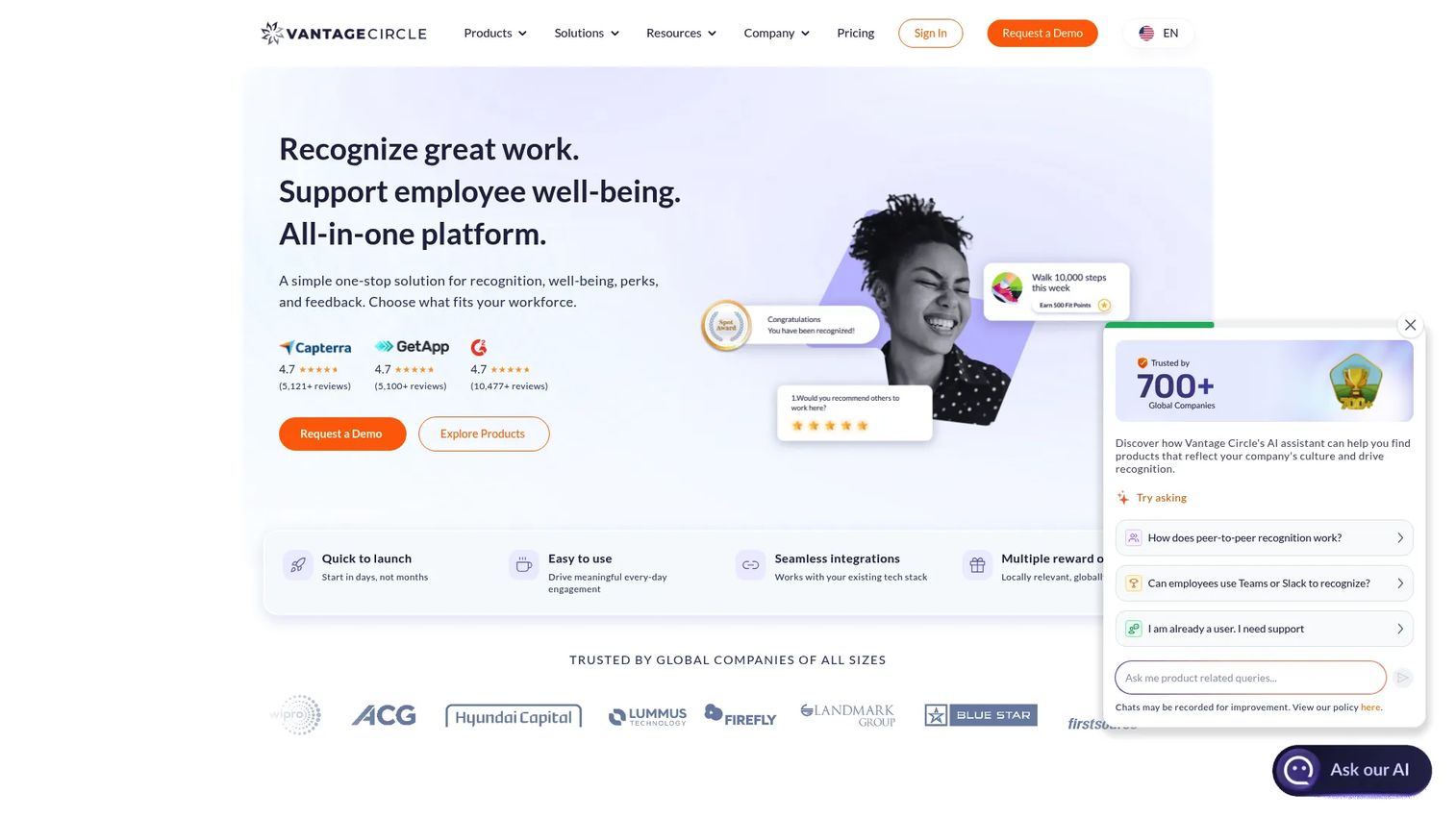
Vantage Circle is an employee engagement platform that bundles recognition, rewards, perks, wellness, and feedback into one suite. It is built for companies that want a single system covering the full engagement lifecycle rather than stitching together a recognition tool, a discount platform, and a wellness app. Peer-to-peer recognition and nomination-based awards sit alongside a perks catalog with global redemption options, which matters if your workforce spans multiple countries.
Best for: Companies wanting an all-in-one employee recognition and engagement suite.
Key strengths
- Recognition breadth: Peer-to-peer recognition and nomination-based awards keep engagement social, not top-down.
- Global redemption: Perks and rewards redeem across regions, useful for distributed teams.
- Enterprise integrations: Wellness, feedback, and HRIS integrations consolidate engagement data in one place.
Why choose Vantage Circle: If you are consolidating a fragmented engagement stack, the breadth here is the draw. You get recognition, rewards, and wellness under one contract with one set of analytics, which reduces both tool sprawl and reporting overhead. For a founder trying to cut tools while increasing signal, that consolidation is the pitch.
Vantage Circle pricing: Pricing is custom and scales with organization size, selected products, and required integrations. The site lists Grow, Transform, and Scale plans, plus a Vantage Edge option advertised as free for the first year. No public numeric price is published, so you will need a quote to model exact cost. Vantage Circle holds a 4.7/5 rating on G2.
2. Perkbox
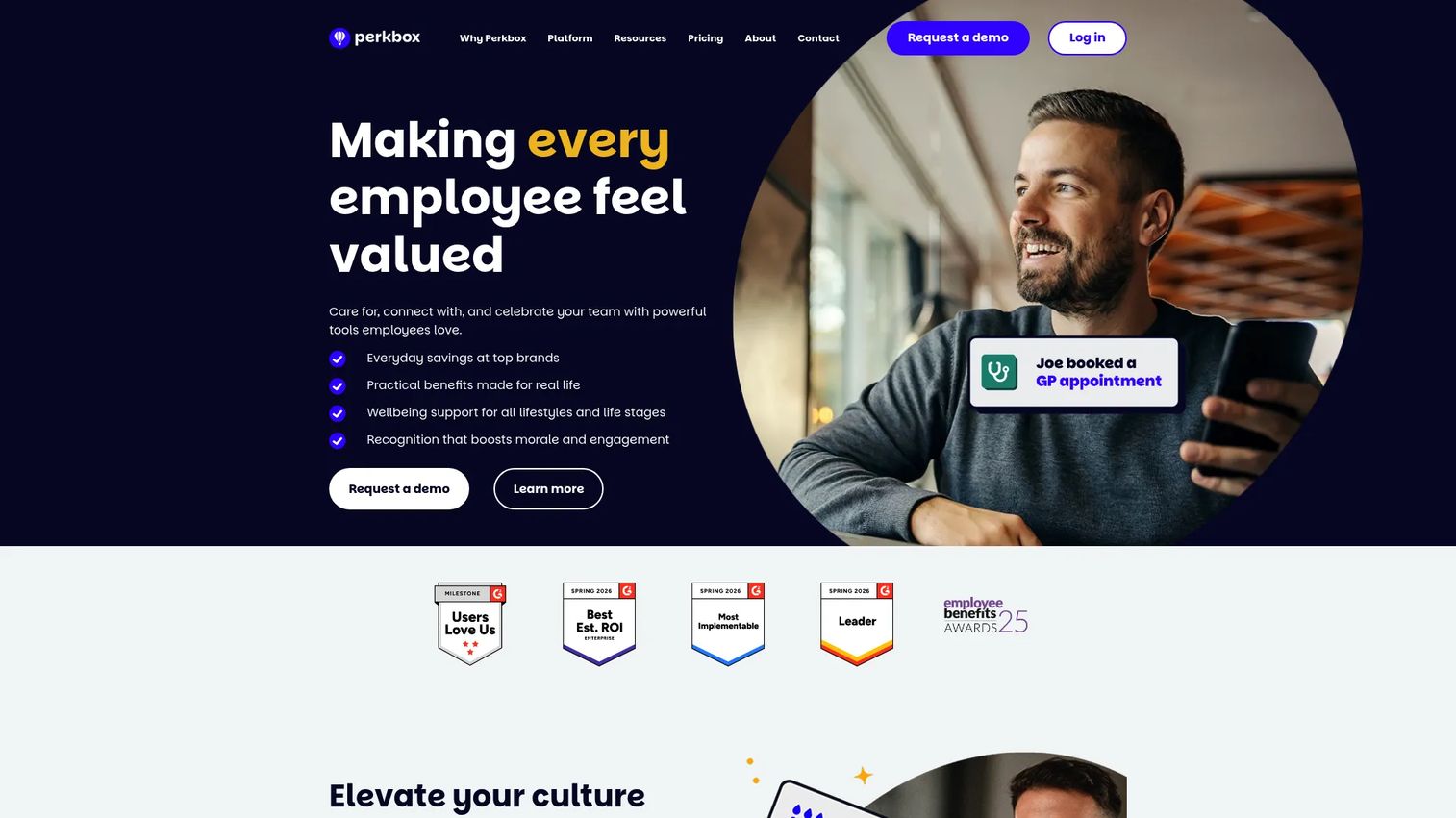
Perkbox is an employee experience platform that combines benefits, perks, deals and discounts, peer-to-peer recognition, and wellbeing support in one app. Its appeal is the unified layer: instead of asking employees to remember three logins, Perkbox puts the discount marketplace, recognition, and wellbeing tools behind a single experience. That single surface is what drives adoption, because employees actually return to it.
Best for: Organizations wanting a unified employee benefits and recognition platform.
Key strengths
- Perks and discounts: A broad set of deals and discounts gives employees everyday, tangible savings.
- Peer recognition: Built-in recognition keeps appreciation flowing without a separate tool.
- Wellbeing support: Wellbeing content sits alongside perks, widening perceived value.
Why choose Perkbox: The strength is consolidation. One app for perks, recognition, and wellbeing means fewer places for engagement to leak out and one dashboard to report from. For a mid-market team that wants a broad employee experience layer without managing multiple vendors, that breadth earns its place. If your only goal is a raw discount catalog, the recognition and wellbeing features may be more than you need.
Perkbox pricing: Pricing is user-based, and the public page lists Grow, Scale, and Enterprise tiers. No public numeric price is shown; the page prompts you to request a quote. Perkbox holds a 4.5/5 rating on G2.
3. Wellable
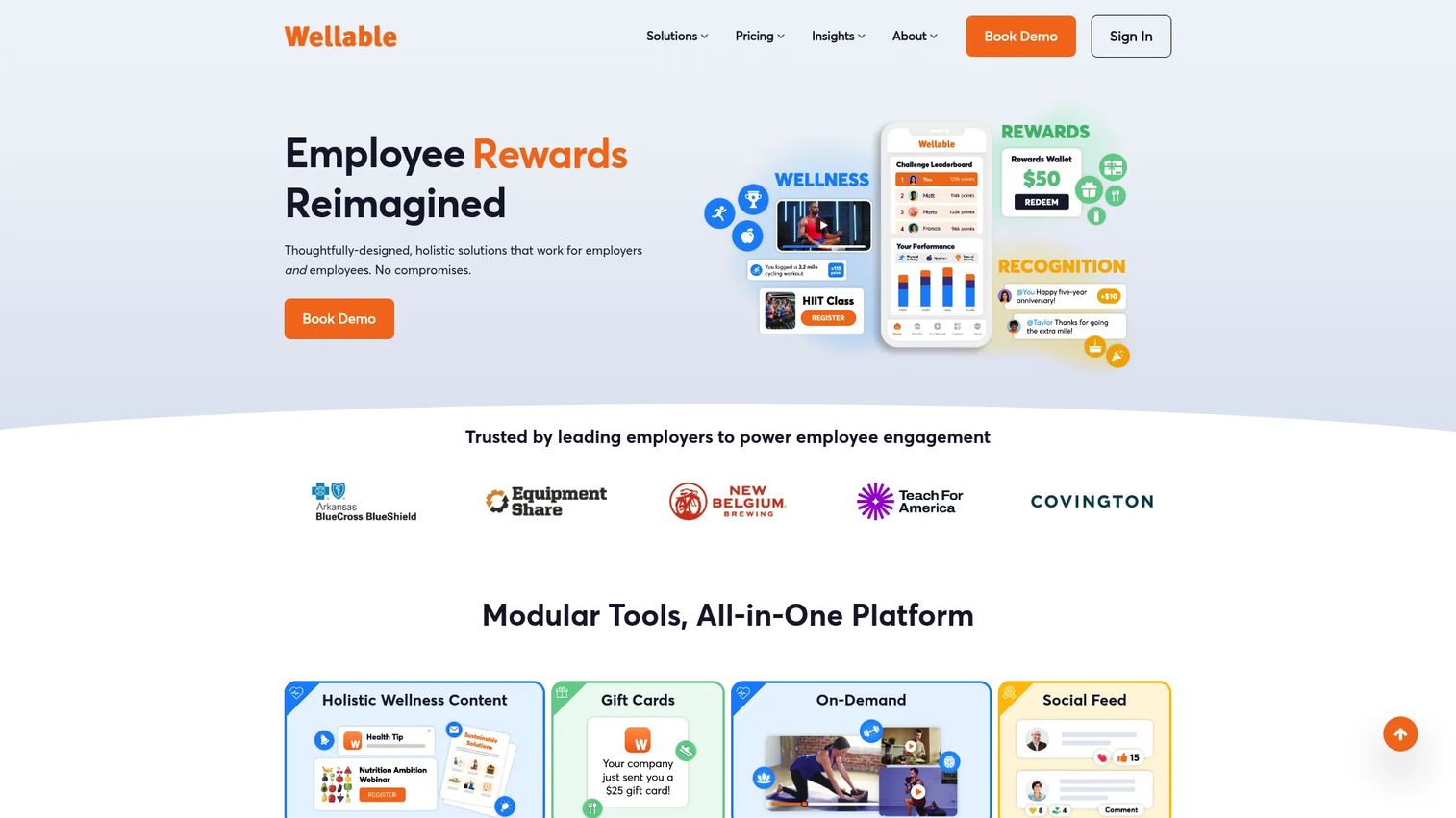
Wellable is an employee wellness and engagement platform built around challenges, on-demand classes and events, and rewards. It is wellness-first, which makes it a strong fit for companies whose perks strategy centers on wellbeing and participation rather than a broad discount catalog. Where an all-in-one suite spreads across many categories, Wellable goes deep on the wellness experience that drives ongoing engagement.
Best for: Companies seeking a customizable employee wellness and rewards platform.
Key strengths
- Wellness challenges: Structured challenges drive recurring participation, not one-time sign-ups.
- On-demand content: Classes and events give employees flexible ways to engage.
- Rewards and recognition: Built-in rewards tie participation back to tangible incentives.
Why choose Wellable: Wellable is the clearest pick when wellbeing is your program's core, not an afterthought. It also publishes entry pricing, which is rare in this category and helpful when you need to model cost before a sales call. It shines on wellness participation rather than pure discount redemption, so pair it with a discount platform if everyday savings are also a priority.
Wellable pricing: Wellable publishes three plans. Essentials starts at $100 per month, billed at $4.00 per user per month. Pro is $150 per month at $6.00 per user per month. Enterprise is custom, and plans carry a minimum commitment of 25 users. Billing is monthly by default. Wellable holds a 4.7/5 rating on G2.
4. Holisticly
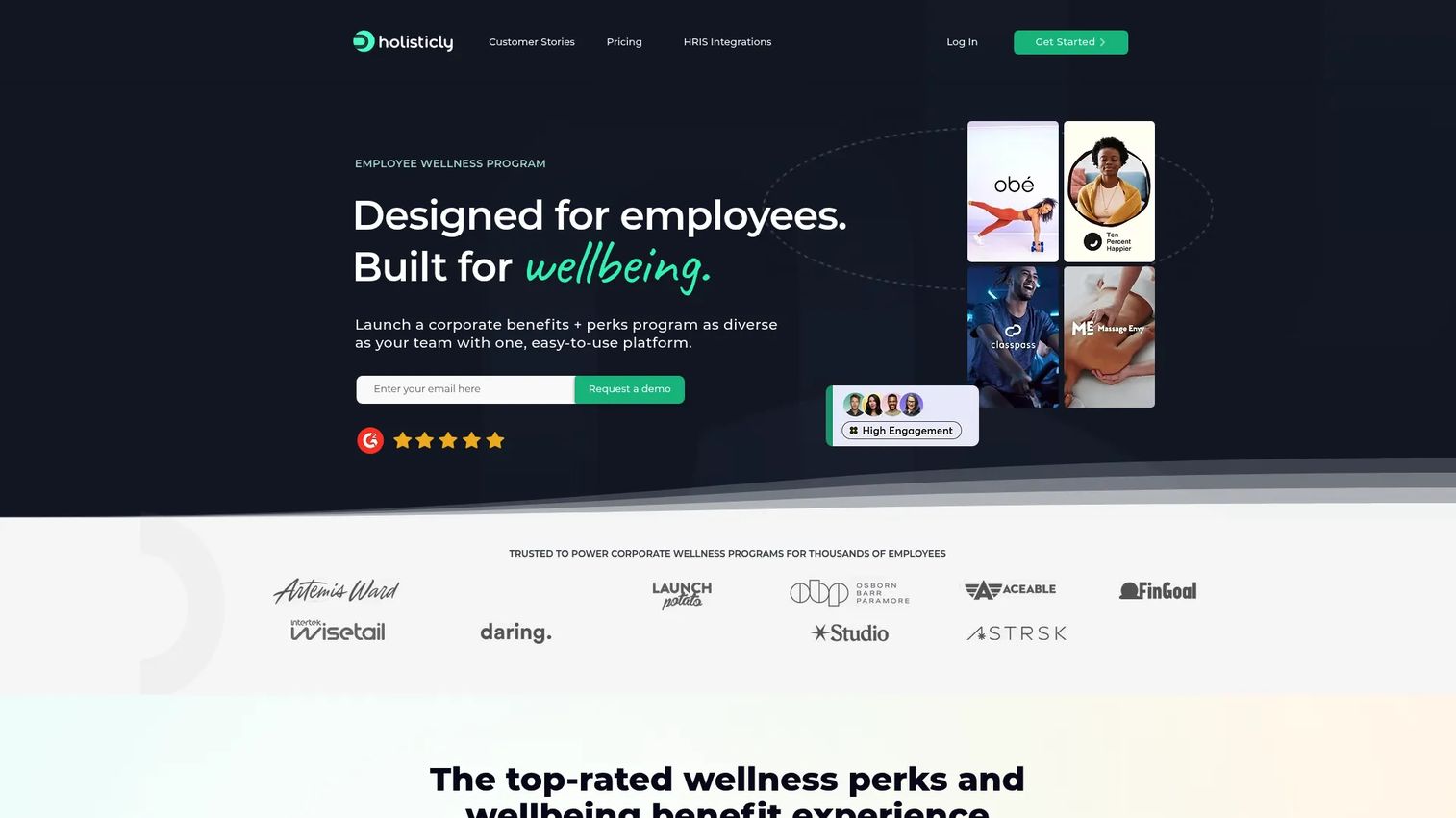
Holisticly is an employee wellness benefits and perks platform focused on stipends and curated wellbeing options. It runs wellness stipends and lifestyle spending account (LSA) programs across more than 300 curated benefit options spanning fitness, mental health, nutrition, and learning. The differentiator for a lean team is that HRIS integration is included at no extra cost, so eligibility and enrollment stay accurate without a separate integration fee.
Best for: Companies wanting a flexible employee wellness stipend platform with curated perks and HRIS integration.
Key strengths
- Wellness stipends: LSA programs let employees spend a set budget across curated categories.
- HRIS integrations: Included at no extra cost, keeping eligibility and enrollment clean.
- Curated catalog: 300+ vetted options across fitness, mental health, nutrition, and learning.
Why choose Holisticly: The published, per-month pricing and bundled HRIS integration make this a strong fit for distributed or modern benefits programs where you want spend flexibility without administrative drag. Unlike recognition-only or discount-only tools, Holisticly centers on stipends, giving employees choice while you keep budget control. It stands apart by pairing curation with clean payroll and HRIS data flow.
Holisticly pricing: Holisticly publishes two plans. Essentials is $129 per month for up to 50 employees. Plus is $399 per month for up to 300 employees. HRIS integration is included at no extra cost. Prices exclude the employee stipends themselves, transaction processing fees, and applicable taxes. Holisticly holds a 4.3/5 rating on G2.
5. Access Perks
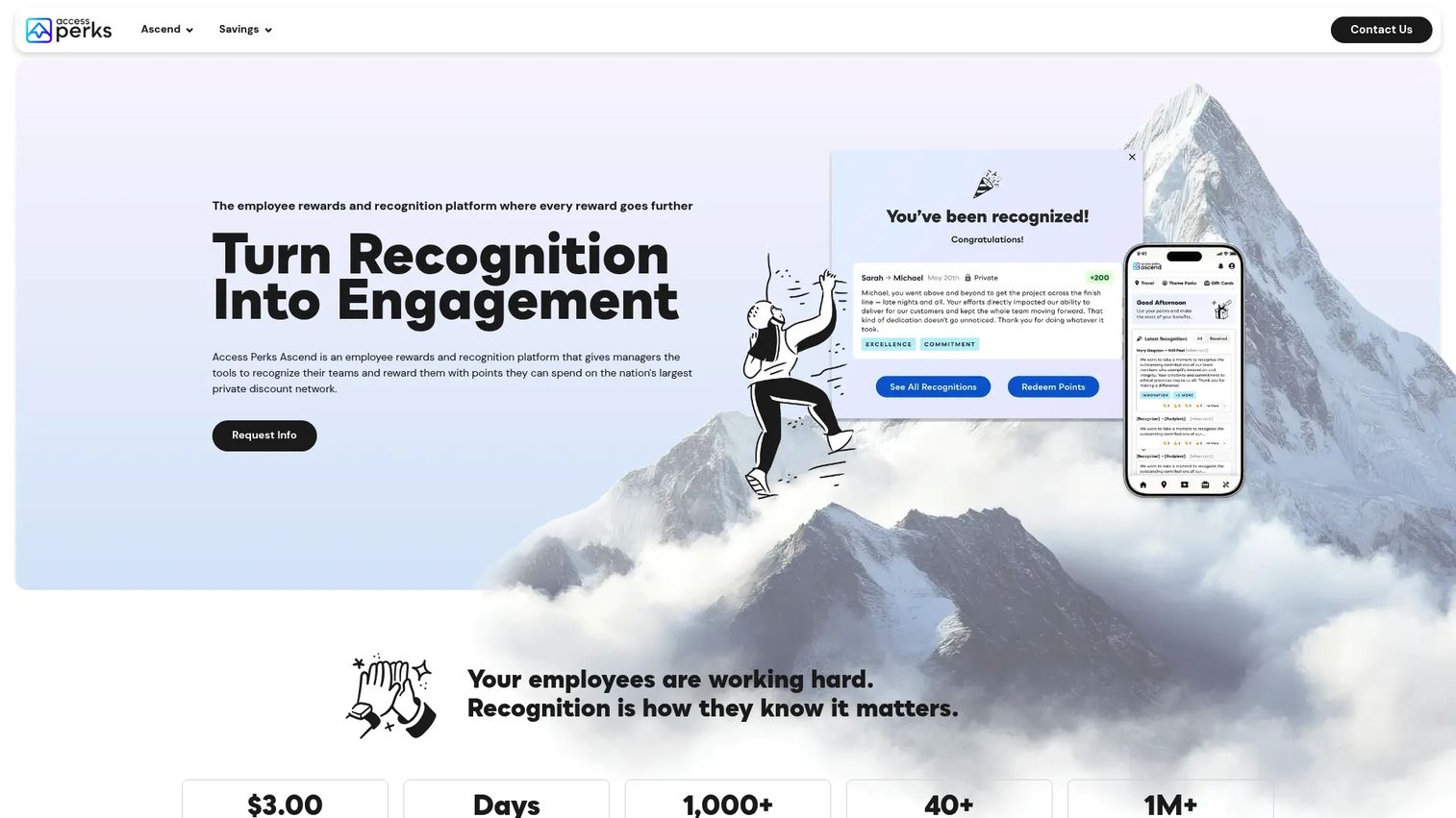
Access Perks is an employee rewards, recognition, and discount network platform. Its center of gravity is the private discount network, an employee discount platform built for everyday savings, paired with recognition and rewards points. For companies whose main goal is tangible, no-cost-to-employer savings that employees use often, the merchant network scale is the selling point.
Best for: Employers seeking employee recognition plus workforce discounts.
Key strengths
- Discount network: A private network of offers drives real, everyday employee savings.
- Recognition and rewards: Points-based recognition sits alongside the discount marketplace.
- Manager tools: Built-in tools help managers drive recognition and engagement.
Why choose Access Perks: If discount marketplace value is your priority, Access Perks leads on merchant network scale, and it carries one of the strongest G2 ratings in this list. The pairing of recognition with a deep discount catalog means you cover both the appreciation and the savings sides of a perks program from one platform. It is the pick when everyday employee savings matter more than a wellness-led or stipend-led model.
Access Perks pricing: Access Perks presents its Ascend rewards and recognition product with a starting price of $3.00 per employee per month. The site also offers an Access Perks Savings product. Detailed tier names beyond Ascend and Savings are not publicly listed. Access Perks holds a 4.8/5 rating on G2.
6. Benepass
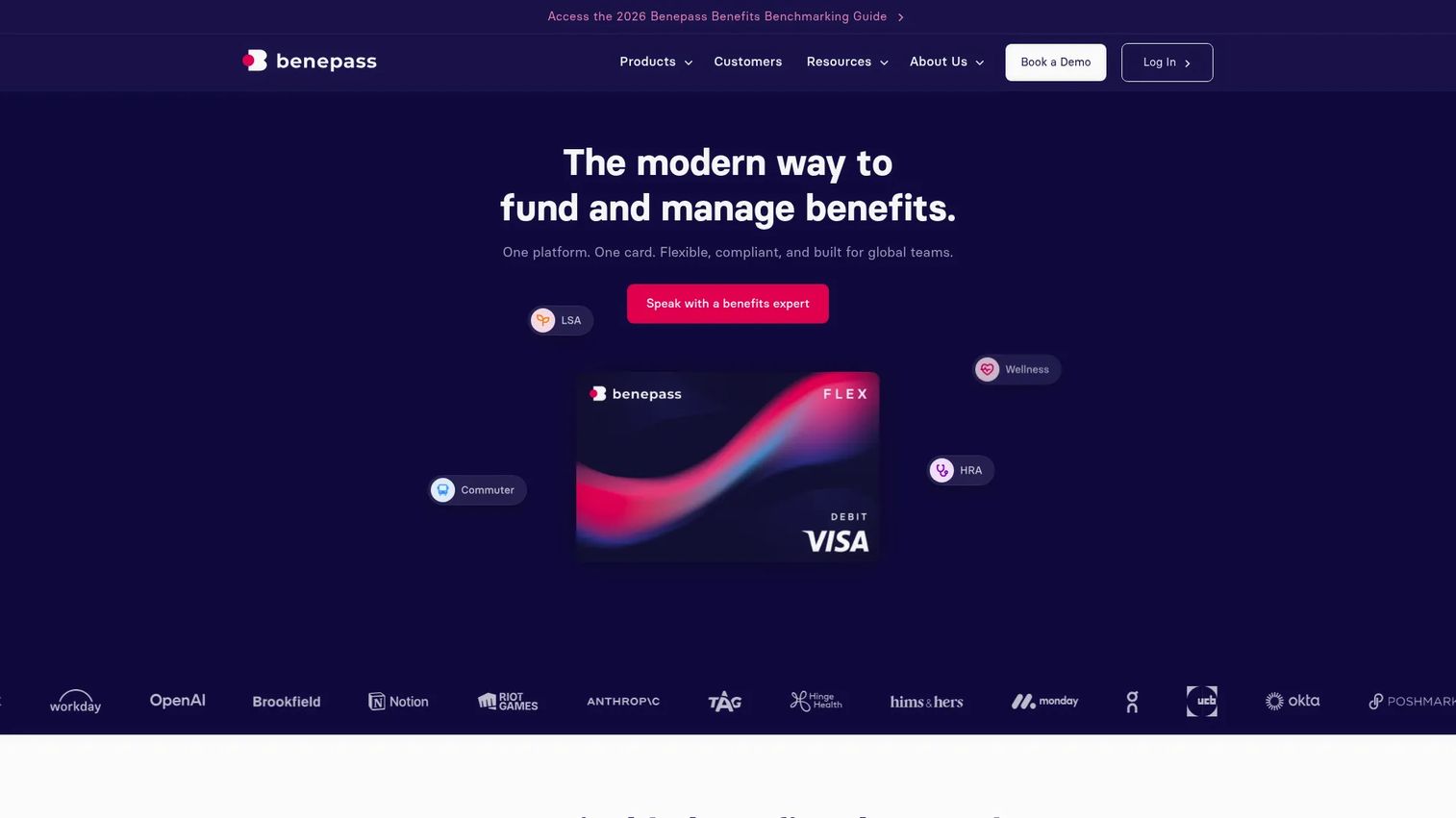
Benepass is an employee benefits platform built for flexible, card-first spending and reimbursement programs. It appeals to teams that want more than a simple perks catalog: think lifestyle spending accounts, wellness stipends, and reimbursements delivered through physical and virtual cards. Automated enrollment and compliance handle the administrative side, while real-time metrics give you visibility into how funds are actually spent.
Best for: Mid-market and enterprise employers offering flexible employee benefits across multiple programs.
Key strengths
- Card-first delivery: Physical and virtual cards with global parity make spending immediate.
- Automated enrollment: Enrollment and compliance run automatically, cutting admin time.
- Real-time metrics: Spending controls and live metrics give clear proof of value.
Why choose Benepass: Benepass fits when your benefits strategy is broader than perks and you want a benefits administration software layer that handles multiple programs at once. The card-first model removes reimbursement friction, and the real-time metrics answer the ROI question directly. For a scaling company running several benefit programs, that consolidation and visibility is the draw.
Benepass pricing: Benepass does not publish a public numeric price. Its lifestyle spending account page notes that pricing varies and requests a pricing proposal, so cost depends on your program mix and headcount. Benepass holds a 4.8/5 rating on G2.
7. Paylode
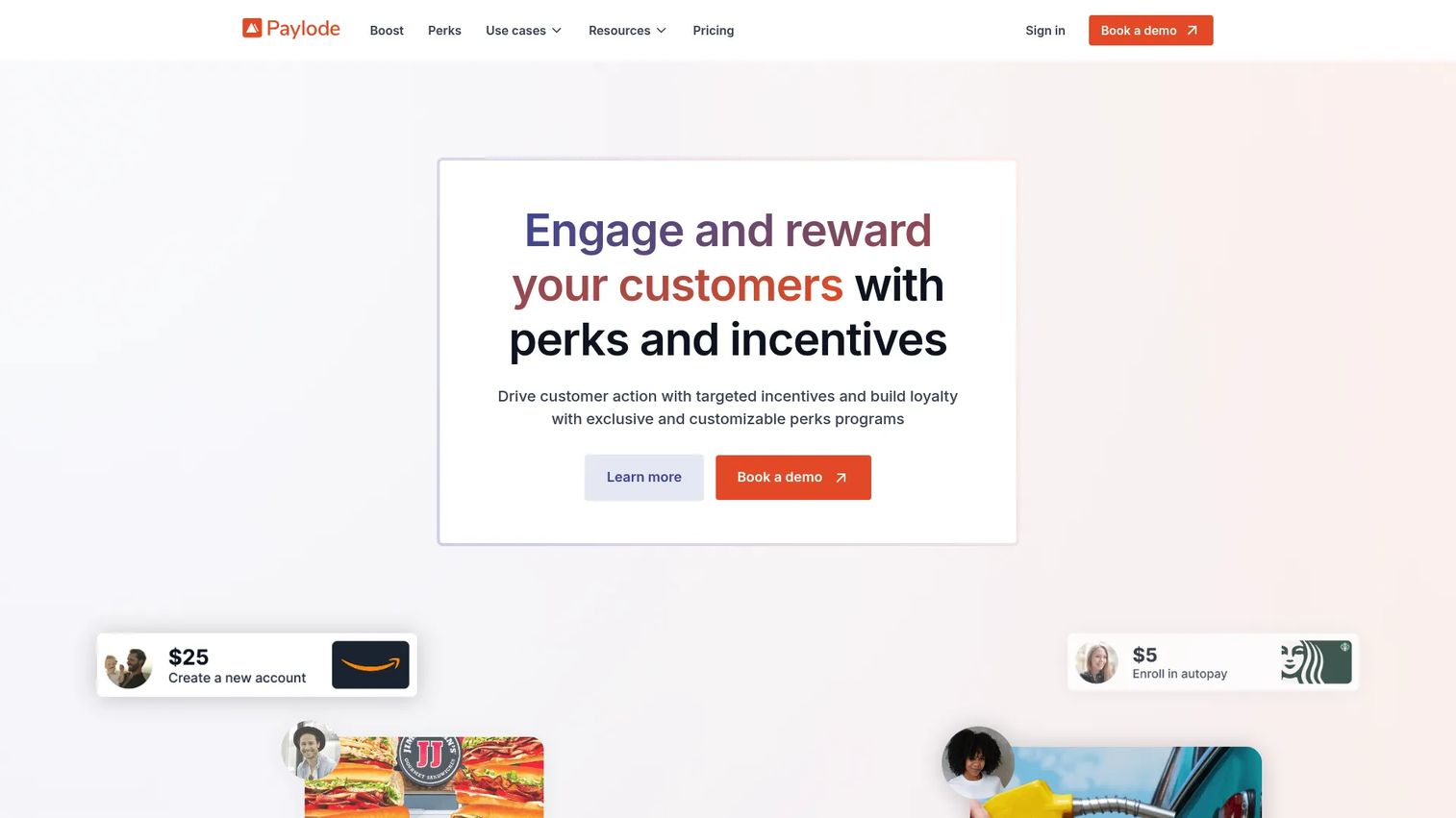
Paylode is a perks and incentive platform that lets companies launch a branded perks marketplace without building one in-house. Its no-code program creation and marketplace of pre-vetted partner offers make it a fast way to stand up a curated perks hub under your own brand. Perks pages, Boost campaigns, dashboards, and API access round out a platform aimed at teams that want control over branding and measurable engagement.
Best for: Companies that want to launch branded perks and action-based incentives without building a program in-house.
Key strengths
- No-code creation: Launch a branded perks program without engineering time.
- Partner marketplace: A catalog of pre-vetted partner offers fills the perks page fast.
- ROI dashboards: Dashboards and Boost campaigns tie perks to measurable engagement.
Why choose Paylode: Paylode fits teams that want a branded, marketplace-style perks hub with clear ROI reporting rather than a generic catalog. The no-code setup means you can launch quickly, and the branding control keeps the experience on-brand. An early-stage startup program is mentioned with discounted Essential-plan pricing, which is worth asking about if you are a smaller company.
Paylode pricing: Paylode lists Essential, Professional, and Enterprise plans, but no public numeric prices are shown; the page directs you to contact sales or book a demo. An early-stage startup program with discounted Essential-plan pricing is mentioned. Paylode holds a 4.4/5 rating on G2.
Considerations before you buy
Matching a tool to your program takes more than comparing catalogs. Run each shortlisted platform through this checklist before committing.
Redemption friction
Count the clicks from login to claimed perk. High catalog depth means nothing if redemption is a chore. Ask for a live walkthrough and watch how a typical employee would claim an offer. Low-friction redemption is the single biggest driver of adoption, and adoption is what makes the spend defensible.
Integration fit
Confirm exactly which HRIS integrations and payroll integrations the vendor supports, and whether they cost extra. Some platforms bundle HRIS integration, while others gate it behind a higher tier. Clean data flow keeps eligibility and funding accurate, which prevents the manual reconciliation that eats admin time.
Analytics and proof of value
You need to answer the ROI question before the board asks it. Look for usage, adoption, and redemption reporting you can export. If a platform cannot show you which perks employees actually use, you cannot prove the program moved retention or engagement.
Total cost and admin load
Model the full cost, not just the per-seat price. Factor in transaction fees, stipend funding, integration charges, and the internal hours to run the program. A tool that saves admin time can justify a higher price if it frees your team from manual work.
Conclusion
There is no single best employee perks software, only the best fit for your program model and admin capacity. If you want breadth, Vantage Circle and Perkbox consolidate recognition, perks, and wellbeing into one engagement layer. If everyday savings drive your strategy, Access Perks leads on discount network scale. For wellness-led programs, Wellable offers published pricing and deep participation tooling, while Holisticly pairs curated stipends with included HRIS integration. If your benefits strategy runs broader, Benepass handles flexible, card-first programs, and Paylode gives you a branded perks marketplace you can launch without engineering.
The right next step is to match the perk model to three things: your admin capacity, your employee experience goals, and your integration needs. Shortlist two platforms, run a redemption walkthrough on each, and confirm the HRIS and payroll fit before you sign. Heading into 2026, the programs that hold up are the ones employees actually use and you can measure, so weight redemption and analytics as heavily as catalog size.
FAQs
Employee perks software is a platform that distributes, manages, and measures perks, rewards, and discounts for a workforce from one system. It replaces manual reimbursements, scattered gift cards, and spreadsheet tracking with centralized administration, a redemption experience for employees, and reporting for HR and leadership.
Admins set budgets, eligibility rules, and available perks, then employees browse and redeem offers through a self-serve interface. The platform connects to your HRIS or payroll to keep eligibility and funding accurate, and it tracks redemption and usage so you can measure adoption and value over time.
At minimum, look for a low-friction redemption experience, a relevant perks or discount catalog, usage and adoption analytics, HRIS and payroll integrations, and admin controls for budgets and eligibility. The redemption experience matters most, because a deep catalog with clunky redemption still produces low adoption.
Most platforms offer HRIS integrations that sync employee records, eligibility, and status changes automatically, plus payroll integrations for funding stipends or reimbursements. Some vendors bundle these integrations at no extra cost, while others place them in higher tiers, so confirm both scope and cost during evaluation.
Employee recognition software centers on peer-to-peer appreciation, awards, and points, while employee perks software focuses on distributing discounts, rewards, and benefits employees can redeem. Many all-in-one platforms combine both, but a pure recognition tool will not give you a discount marketplace, and a pure discount platform will not run structured recognition programs.
Companies track redemption rates, adoption across the workforce, and program cost against retention and engagement outcomes. The clearest signals are how many employees actively use perks and whether usage correlates with lower churn, so prioritize platforms that export usage and adoption data you can tie to those metrics.
Small teams often want published pricing and a fast setup. Wellable publishes entry pricing from $100 per month, and Holisticly starts at $129 per month with HRIS integration included, both of which suit smaller headcounts. Paylode also mentions a discounted early-stage startup program worth asking about.
Pricing ranges from published per-month rates to fully custom quotes. Wellable starts at $100 per month, Holisticly at $129 per month, and Access Perks from $3.00 per employee per month, while Vantage Circle, Perkbox, Benepass, and Paylode use custom pricing based on headcount and program mix. Factor in transaction fees, stipend funding, and integration costs when comparing total cost.