A single hardcoded API key in a public repo can cost more than an entire quarter's security budget. That is not hyperbole. It is the everyday risk teams accept when credentials live in config files, environment variables, CI logs, and Slack messages instead of a controlled store.
The problem compounds fast. One microservice becomes forty. One cloud account becomes three. Each new pipeline, container, and service account needs credentials, and each credential is a potential breach path if nobody owns rotation, access, or audit. Machine identities now outnumber human ones in most environments, and every one of them holds a secret.
The market reflects that pressure. The global secrets management solutions market is projected to grow from USD 4.22 billion in 2025 to USD 8.05 billion by 2030, a 13.8% CAGR, according to Mordor Intelligence (2025). Large enterprises drove 71.3% of that revenue in 2024. Buyers are not experimenting anymore. They are consolidating credential chaos into governed platforms.
For presales teams, this category matters for a different reason. Secrets management questions are exactly the questions that stall deals in technical validation and security review. When a prospect's security lead asks how you handle rotation, RBAC, or audit trails, a vague answer costs you the deal. The same skepticism applies when you evaluate tools for your own stack. If you sell into security-conscious buyers, understanding how these platforms actually work helps you clear diligence faster and speak credibly to the people who sign off. Interactive formats like a hands-on sandbox or a self-serve interactive demo are how many security vendors let technical buyers validate these exact workflows before a call, and the same discipline applies when you build your own evaluation stack around a tool like audit management software or the broader set of best AI security posture management tools.
What's inside
This guide covers software for centralized secret storage, rotation automation, access control, audit logging, and DevOps integration. Every tool here handles the core job: get credentials out of code and into a governed store where access is scoped, logged, and revocable.
We chose these seven based on four criteria that matter to technical buyers: enterprise fit, cloud coverage, CI/CD and Kubernetes support, and governance depth (RBAC, MFA, dynamic secrets, and audit trails). The list mixes dedicated platforms with native cloud services so you can match the tool to your actual environment, not a vendor's ideal one.
TL;DR
- Best overall for enterprise security posture: Akeyless, for its [zero-knowledge architecture, dynamic secrets, and unified identity security across multi-cloud environments.
- Best for developer-friendly workflows: Doppler, for fast rollout and a clean CLI, dashboard, and API that developers actually adopt.
- Best for regulated enterprises: CyberArk, when secrets management](https://csrc.nist.gov/pubs/sp/800/207/final) needs to live inside a broader privileged access and identity security program.
- Best for infrastructure-heavy DevOps teams: HashiCorp Vault, for deep policy control, dynamic secrets, and broad ecosystem integration.
- Best for single-cloud native fit: AWS Secrets Manager, Azure Key Vault, and Google Secret Manager, each when your stack already lives in that provider.
What is secrets management software?
Secrets management software is a system that stores, controls access to, rotates, and audits the sensitive credentials applications and infrastructure use to authenticate. Instead of scattering credentials across code, config files, and environment variables, teams centralize them in an encrypted store with policy-based access.
A secret is any credential that grants access or proves identity. That includes:
- API keys for third-party and internal services
- Passwords for databases and admin accounts
- SSH keys for server and infrastructure access
- Tokens for OAuth, sessions, and service-to-service auth
- Certificates for TLS and mutual authentication
- Encryption keys for data at rest and in transit
Core capabilities of a modern secrets manager include:
- Centralized storage so every credential lives in one auditable place
- Rotation automation to expire and replace secrets on a schedule without manual work
- Least privilege and role-based access control (RBAC) so identities get only the access they need
- Multi-factor authentication (MFA) for human access to the vault
- Audit trails that log every read, write, and access attempt
- Dynamic secrets that are generated on demand and revoked after use
- CI/CD and Kubernetes integration so pipelines and workloads fetch credentials at runtime instead of storing them
The category exists because static, long-lived credentials are the single most exploited attack path in cloud environments. Secrets management shrinks that path with scoped access, short-lived credentials, and full visibility.
When to use secrets management software
Not every team needs a dedicated platform on day one. But three situations make it non-negotiable.
Secure CI/CD pipelines
Build systems, deployment jobs, and automation scripts are credential magnets. A pipeline needs a database password, a cloud key, and a registry token just to ship, and those values too often sit in plaintext env vars or, worse, committed to the repo. CI/CD secrets management pulls credentials at runtime from a governed store, enforces rotation, and scopes access per job. Non-human identities, the service accounts and machine identities running your automation, get short-lived dynamic secrets instead of permanent keys. If a job is compromised, the blast radius is a credential that expires in minutes.
Reduce secrets sprawl across cloud and app teams
Secrets sprawl is what happens when every team stores credentials their own way. Terraform state files here, a .env there, a shared password doc somewhere else. A secrets manager standardizes access across environments, apps, and teams so credentials stop scattering into code and config. One store, one access model, one audit log. For multi-cloud teams, this matters even more, because a single platform that spans AWS, Azure, and GCP beats stitching together three native services with three different access models.
Pass security and compliance review faster
This is where presales lives. When a prospect's security team runs diligence, they ask about audit trails, RBAC, MFA, and scoped access. A dedicated secrets platform gives you evidence for all of it: who accessed what, when, and under what policy. Zero trust secrets management, where nothing is trusted by default and every access is verified, is increasingly the standard enterprise buyers expect. Having clean answers here shortens security signoff and keeps procurement moving instead of stalling.
Comparison table
The table below ranks tools by relevance to the core secrets management job. Use it to compare architecture, buyer intent, and operating model quickly before you read the full sections. Dedicated platforms lead, followed by the native cloud services that fit single-provider stacks. Pricing reflects published rates at the time of writing; verify current figures before you commit.
| # | Product | Intent | Key use case | Pricing | G2 rating |
|---|---|---|---|---|---|
| 1 | Akeyless | Enterprise security-led | Unified secrets and identity across hybrid/multi-cloud | Free tier; Enterprise custom | 4.6/5 |
| 2 | Doppler | Developer-friendly | Centralized secrets across apps and environments | Free for 3 users; Team $21/user/mo | 4.8/5 |
| 3 | CyberArk | Regulated enterprise | Secrets inside broader identity security program | Standard from $5/user/mo | Not listed |
| 4 | HashiCorp Vault | Infrastructure/DevOps | Dynamic secrets and policy control at scale | HCP Vault Dedicated from $0.030/hr | 4.5/5 |
| 5 | AWS Secrets Manager | AWS-native | Managed storage and rotation inside AWS | $0.40 per secret/mo | 4.5/5 |
| 6 | Azure Key Vault | Azure-native | Key, secret, and certificate storage on Azure | Usage-based | 4.5/5 |
| 7 | Google Secret Manager | GCP-native | Managed secret storage with IAM controls | Free tier; usage-based | 4.5/5 |
1. Akeyless
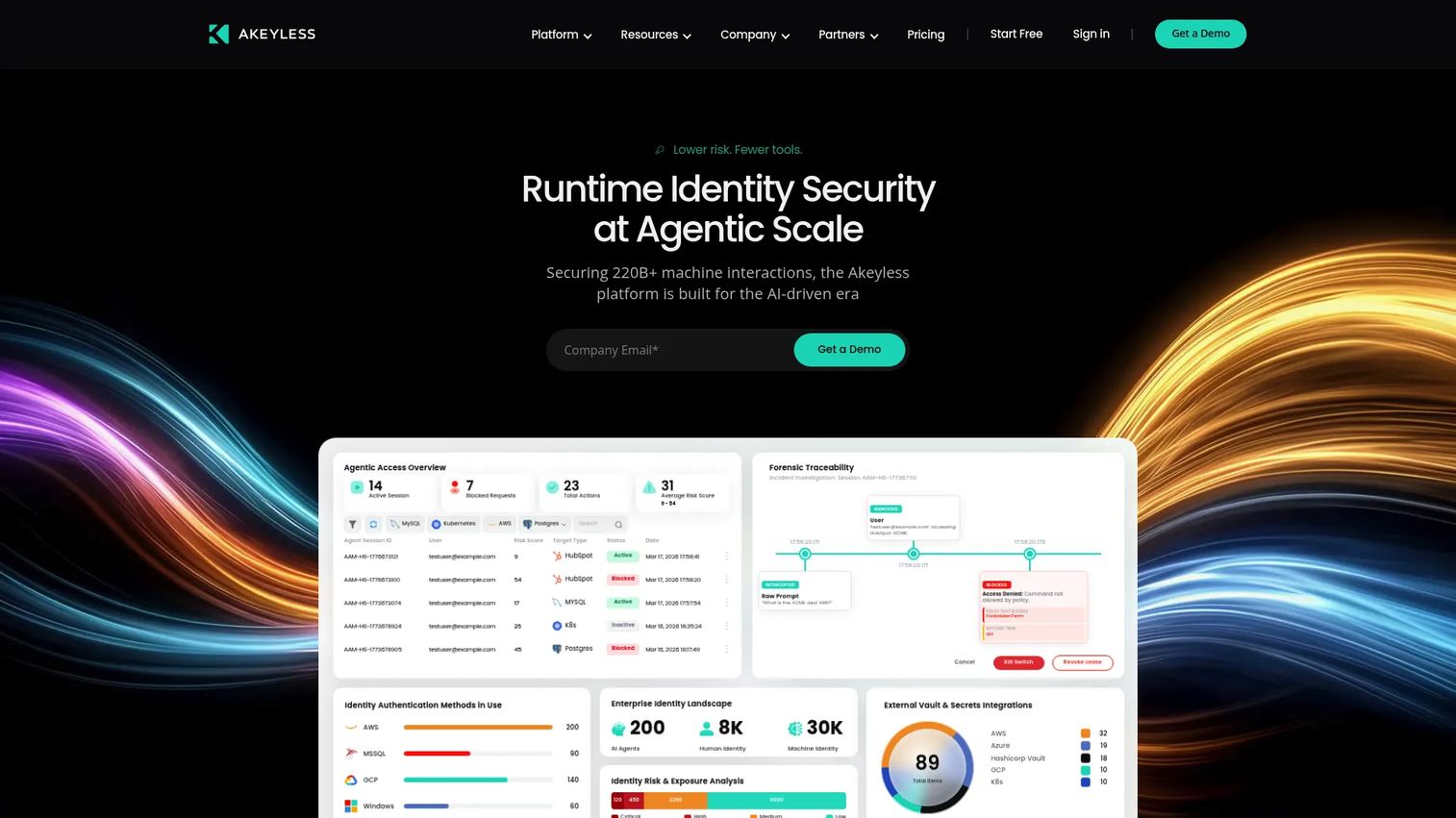
Akeyless is an identity security platform that unifies secrets, keys, certificates, and access across machines, AI agents, and humans. Its differentiator is architectural: a zero-knowledge approach that keeps the vendor from ever holding your encryption keys, paired with dynamic secrets and centralized policy control. For security-led teams juggling hybrid and multi-cloud environments, that combination is the reason it leads this list.
Best for: Enterprises needing unified secrets and identity security across hybrid and multi-cloud environments.
Key strengths
- Zero-knowledge architecture: Cryptographic design means the platform never sees your keys, which shortens the trust conversation in security review.
- Dynamic secrets: Credentials are generated on demand and revoked after use, shrinking the window a leaked secret stays valid.
- Certificate lifecycle management and modern PAM: Beyond secrets, it handles certificate automation and secure remote access from one control plane.
Why choose Akeyless: If your buyer scenario is a security team that wants to consolidate credential management, prove governance, and scale across clouds without running its own vault infrastructure, Akeyless fits. The zero-knowledge story is a concrete answer to the "who can see our secrets" question that stalls enterprise deals. It suits organizations that treat security posture as a differentiator, not a checkbox.
Akeyless pricing: Akeyless offers a free tier and an enterprise plan. The pricing page invites you to start free or customize an enterprise solution, and it lists free and enterprise plan limits but does not publish a numeric enterprise price. Expect a custom quote for enterprise scale. Verify current packaging on the vendor pricing page before you commit. Akeyless holds a 4.6/5 rating on G2.
2. Doppler
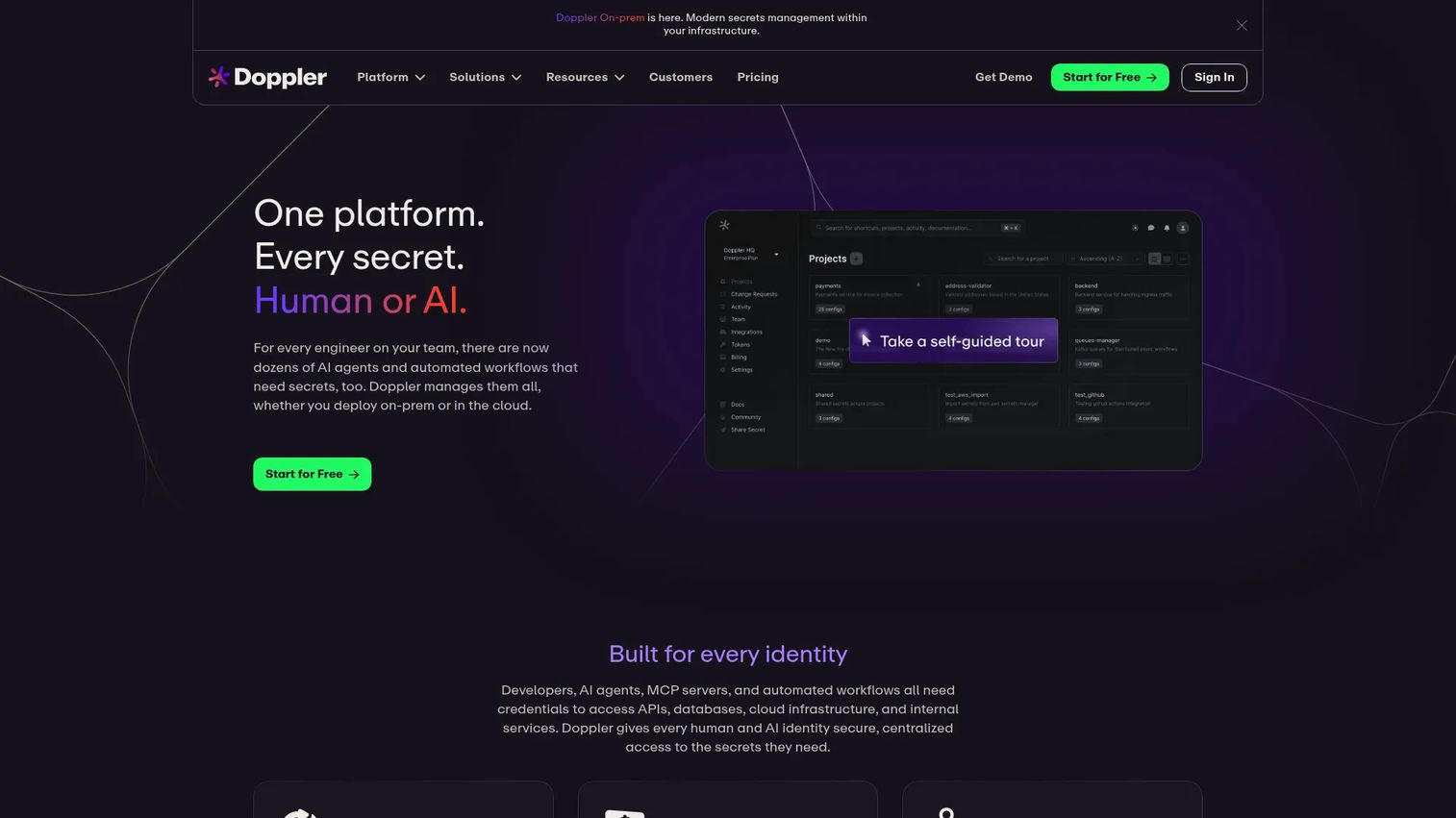
Doppler is a developer-first secrets management platform built for storing, syncing, and controlling application secrets across apps, environments, and infrastructure. Teams reach for it because adoption is fast: a clean dashboard, a capable CLI, and an API that fits into existing delivery workflows without a heavy rollout. It centralizes secrets for humans and automations alike.
Best for: Teams that need centralized secrets management across apps, environments, and infrastructure with minimal friction to adopt.
Key strengths
- Developer UX across dashboard, API, and CLI: Three ways to manage secrets means developers use the one that fits their workflow instead of fighting the tool.
- Config inheritance, branches, and personal configs: Structure secrets the way you structure code, so environments stay consistent and overrides stay clean.
- Versioning, recovery, and missing secrets detection: Roll back a bad change, recover a deleted value, and catch a missing secret before it breaks a deploy.
Why choose Doppler: When speed of rollout is the priority and your buyer values operational simplicity over a sprawling feature matrix, Doppler is the pragmatic pick. It fits teams that want centralized control without a lengthy implementation project. The developer-friendly design drives real adoption, which is where many secrets initiatives quietly stall.
Doppler pricing: The Developer plan is free for 3 users, with additional users at $8/mo each. The Team plan is free for 14 days, then $21/mo per user. Enterprise pricing is available but not published on the pricing page, so request a quote for that tier. Doppler carries a 4.8/5 rating on G2, the highest in this list.
3. CyberArk
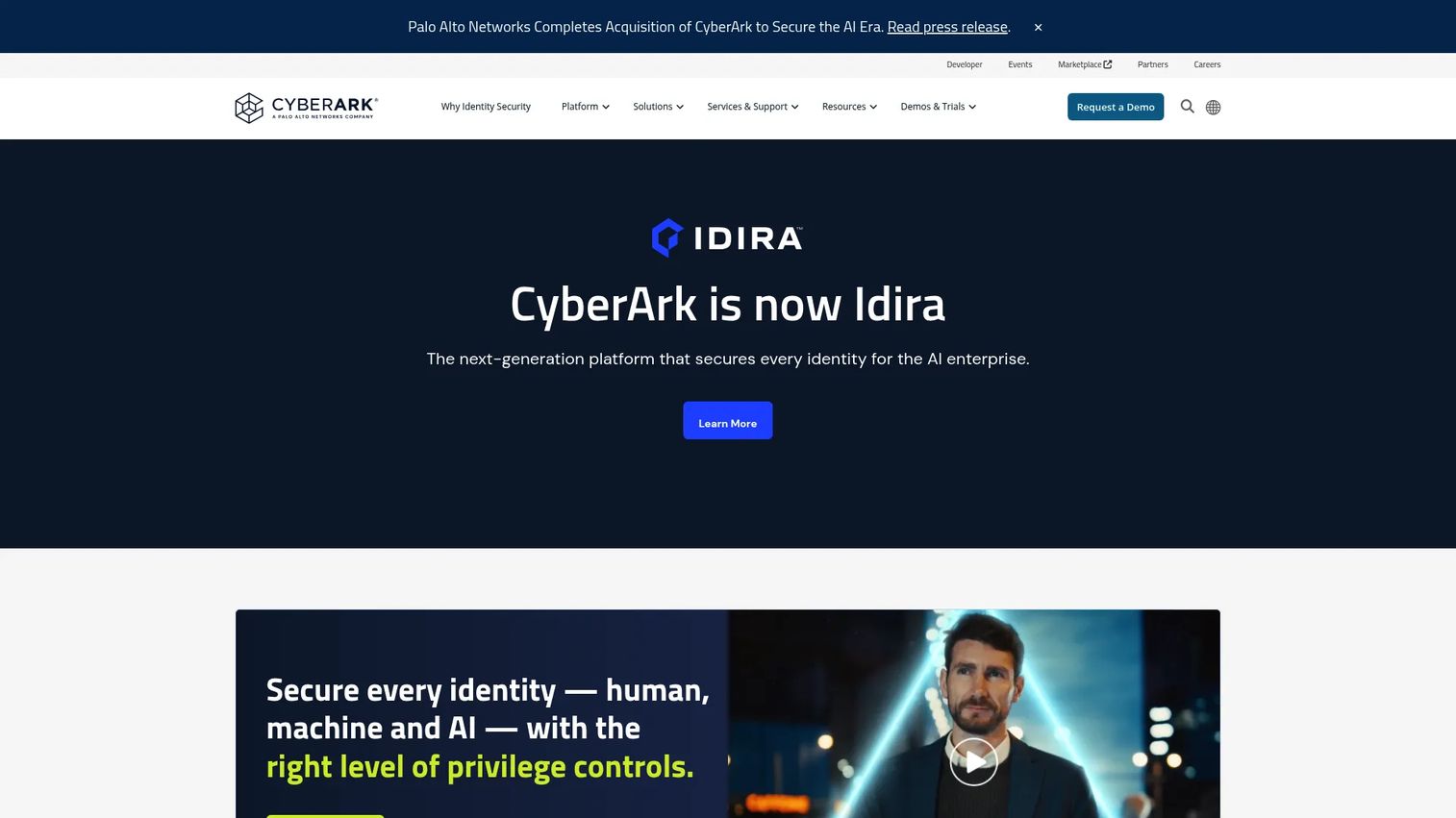
CyberArk is an identity security platform that protects human and machine identities through privileged access management, secrets and workload identity security, and certificate and PKI controls. It fits organizations that already run mature security operations and want secrets management as one layer inside a broader identity program rather than a standalone tool.
Best for: Regulated enterprises with mature security operations that need centralized identity security across privileged, workforce, and machine identities.
Key strengths
- Enterprise governance: Centralized policy and control designed for organizations with strict compliance and audit requirements.
- Identity security alignment: Secrets management sits alongside privileged access and workforce identity, so machine and human access share one governance model.
- Certificate and PKI security: Manage certificates and machine identities under the same controls as privileged accounts.
Why choose CyberArk: If the buyer already invests in privileged access management and wants secrets handled inside that same platform, CyberArk is the natural fit. It is strong when the requirement is enterprise-wide identity security, not a point solution. Teams with heavy compliance obligations value having audit, access, and governance under one roof.
CyberArk pricing: CyberArk sells its offerings on a subscription basis with free trials and demos available. Its Identity Compliance product lists a Standard tier starting at $5 monthly per user, and a free trial is offered. Enterprise packaging for the full identity security platform is quoted per organization, so confirm current terms with the vendor before you evaluate.
4. HashiCorp Vault
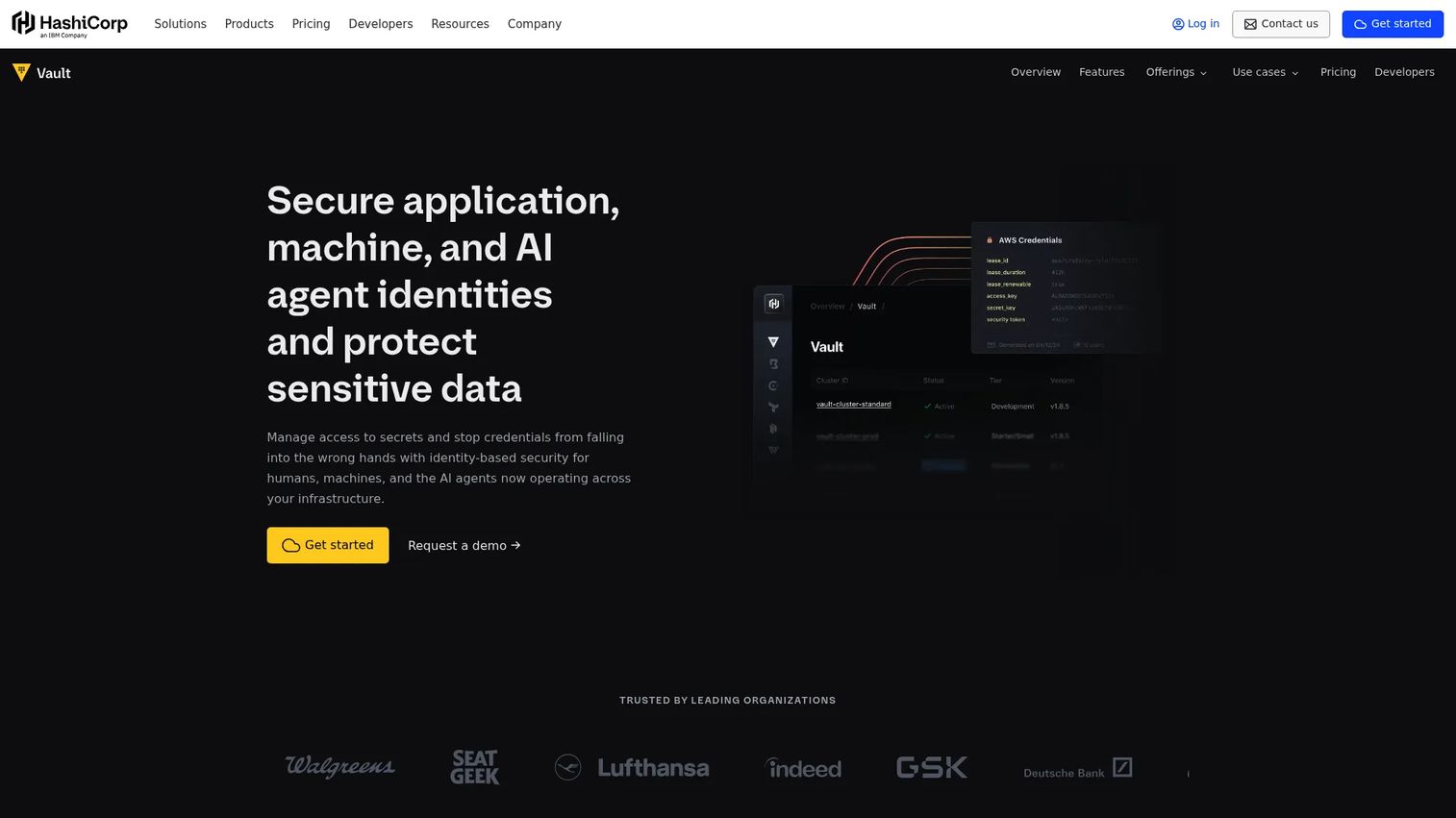
HashiCorp Vault is an identity-based secrets management tool for storing, accessing, and controlling secrets, keys, and certificates. It is widely recognized among infrastructure teams for its depth: fine-grained policy control, dynamic secrets, and broad integration across cloud and hybrid environments. For DevOps-heavy organizations with complex deployment patterns, Vault offers the configurability they need.
Best for: Teams needing centralized secrets, key, and certificate management across cloud and hybrid environments with granular control.
Key strengths
- Secrets lifecycle management: Handle the full lifecycle from creation through rotation and revocation with policy-driven controls.
- PKI and certificate automation: Issue and manage certificates programmatically instead of tracking them by hand.
- Data encryption and key management: Encryption-as-a-service and key management extend Vault beyond secret storage into broader cryptographic operations.
Why choose HashiCorp Vault: When infrastructure teams need fine-grained control and Vault has to plug into a wide range of deployment patterns, its ecosystem and policy engine deliver. It is powerful for organizations that want to define access precisely and integrate deeply with Terraform, Kubernetes, and CI/CD tooling. Weigh the open-source and enterprise editions carefully, since capabilities and support differ between them.
HashiCorp Vault pricing: HashiCorp publishes pay-as-you-go, flex, and enterprise self-managed options. HCP Vault Dedicated pricing starts at $0.030/hour for the Development edition, $1.578/hour for Standard, and $1.843/hour for Plus. HCP Vault is also offered free on the cloud platform. Verify the current consumption table and enterprise self-managed terms before committing. Vault's parent profile holds a 4.5/5 rating on G2.
5. AWS Secrets Manager
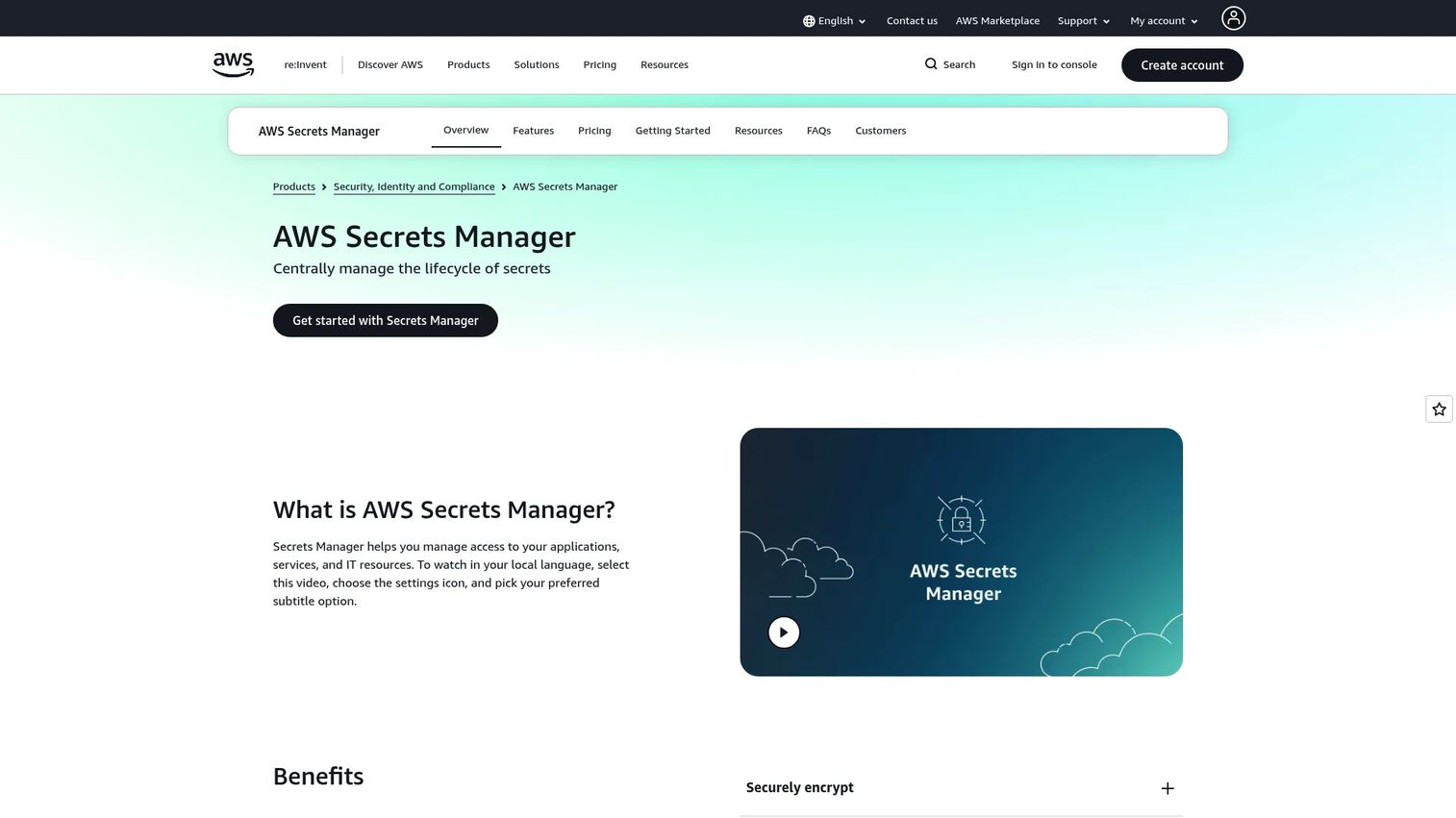
AWS Secrets Manager is the AWS-managed service for storing, rotating, and retrieving credentials and API keys. For teams whose stack already lives in AWS, it is the path of least resistance: native integration, managed operation, and built-in rotation without running any infrastructure yourself.
Best for: Teams already on AWS that need managed secrets storage and rotation without operational overhead.
Key strengths
- Encrypted storage with AWS KMS: Secrets are encrypted with your KMS keys, keeping encryption inside your AWS security boundary.
- Automatic secret rotation: Built-in rotation for supported services and Lambda-driven rotation for custom credentials.
- Multi-Region replication: Replicate secrets across Regions for availability and disaster recovery.
Why choose AWS Secrets Manager: When the stack already runs on AWS and the buyer prefers managed services over self-hosted infrastructure, this is the obvious fit. It removes the operational burden of running a vault and integrates cleanly with IAM, Lambda, and the rest of the AWS ecosystem. Weigh multi-cloud needs before standardizing on it, since native services tie you to one provider.
AWS Secrets Manager pricing: Pricing is pay-as-you-go: $0.40 per secret per month and $0.05 per 10,000 API calls, with no upfront fees or long-term commitments. Free-tier access comes from AWS account-level credits rather than a dedicated Secrets Manager free plan. Confirm current rates and any rotation-related Lambda costs on the AWS pricing page. AWS Secrets Manager holds a 4.5/5 rating on G2.
6. Azure Key Vault
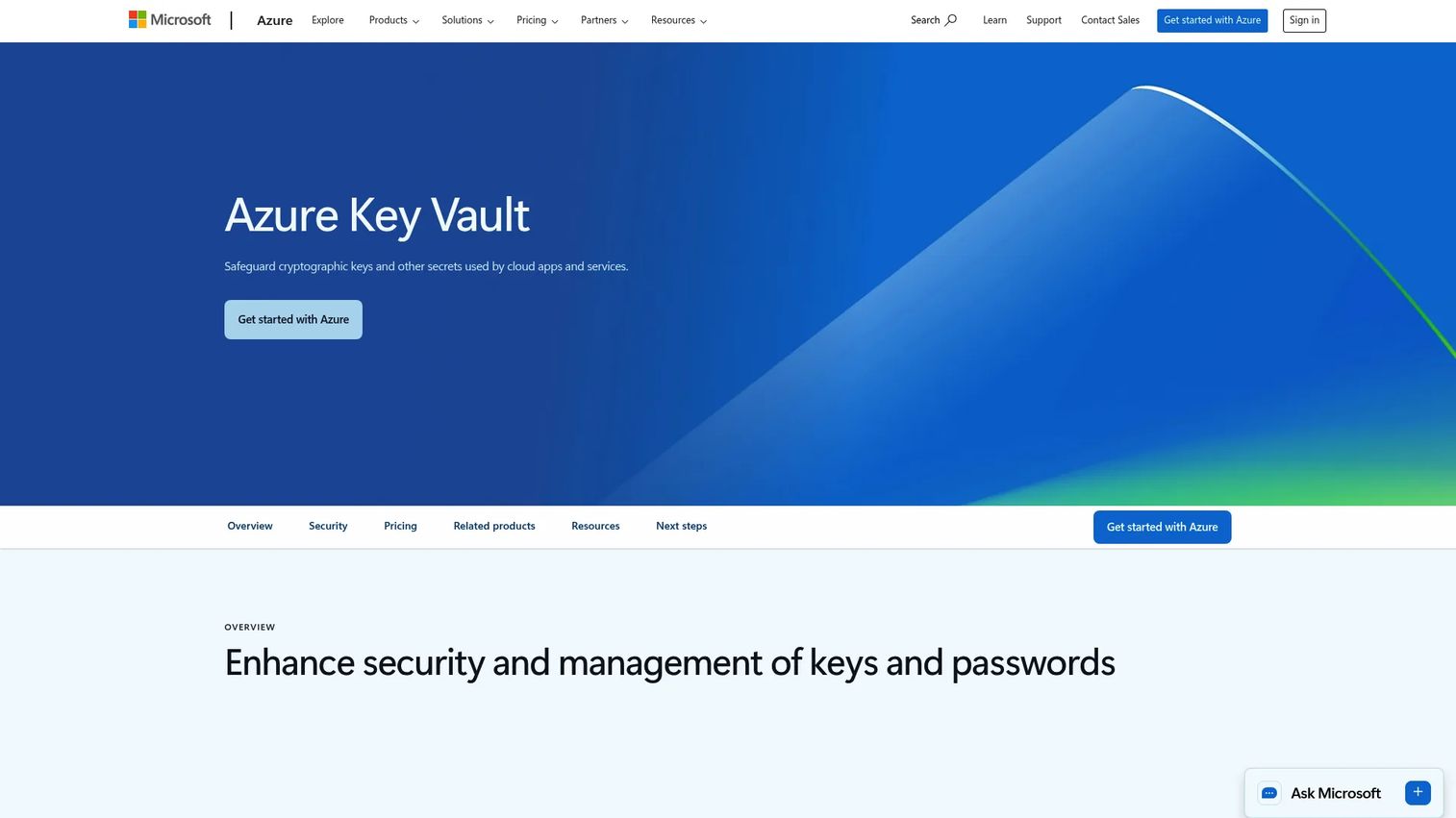
Azure Key Vault is a cloud service for securely storing and accessing secrets, keys, and certificates. It is the natural choice for Microsoft and Azure-heavy organizations, especially those standardized on Azure identity, because it slots directly into the platform's access controls and management tooling.
Best for: Teams needing managed cloud key, secret, and certificate storage on Azure.
Key strengths
- Centralized management of secrets, keys, and certificates: One service handles application secrets, encryption keys, and certificate storage together.
- HSM-backed keys: Store keys in hardware security modules for higher-assurance protection.
- No infrastructure to maintain: No need to provision, configure, patch, or maintain HSMs and key management software yourself.
Why choose Azure Key Vault: For teams already standardized on Azure and Microsoft identity, Key Vault is the low-friction option. It integrates natively with Azure services and Azure Active Directory access controls, so RBAC and access policies carry over from what your team already uses. As with any native service, factor in multi-cloud requirements before you commit to it as your only store.
Azure Key Vault pricing: Azure Key Vault uses usage-based pricing tied to operations and HSM usage. Published rates vary by transaction type and key protection level, so check the live Azure Key Vault pricing page for current figures and tier differences before you plan a rollout. Azure Key Vault holds a 4.5/5 rating on G2.
7. Google Secret Manager
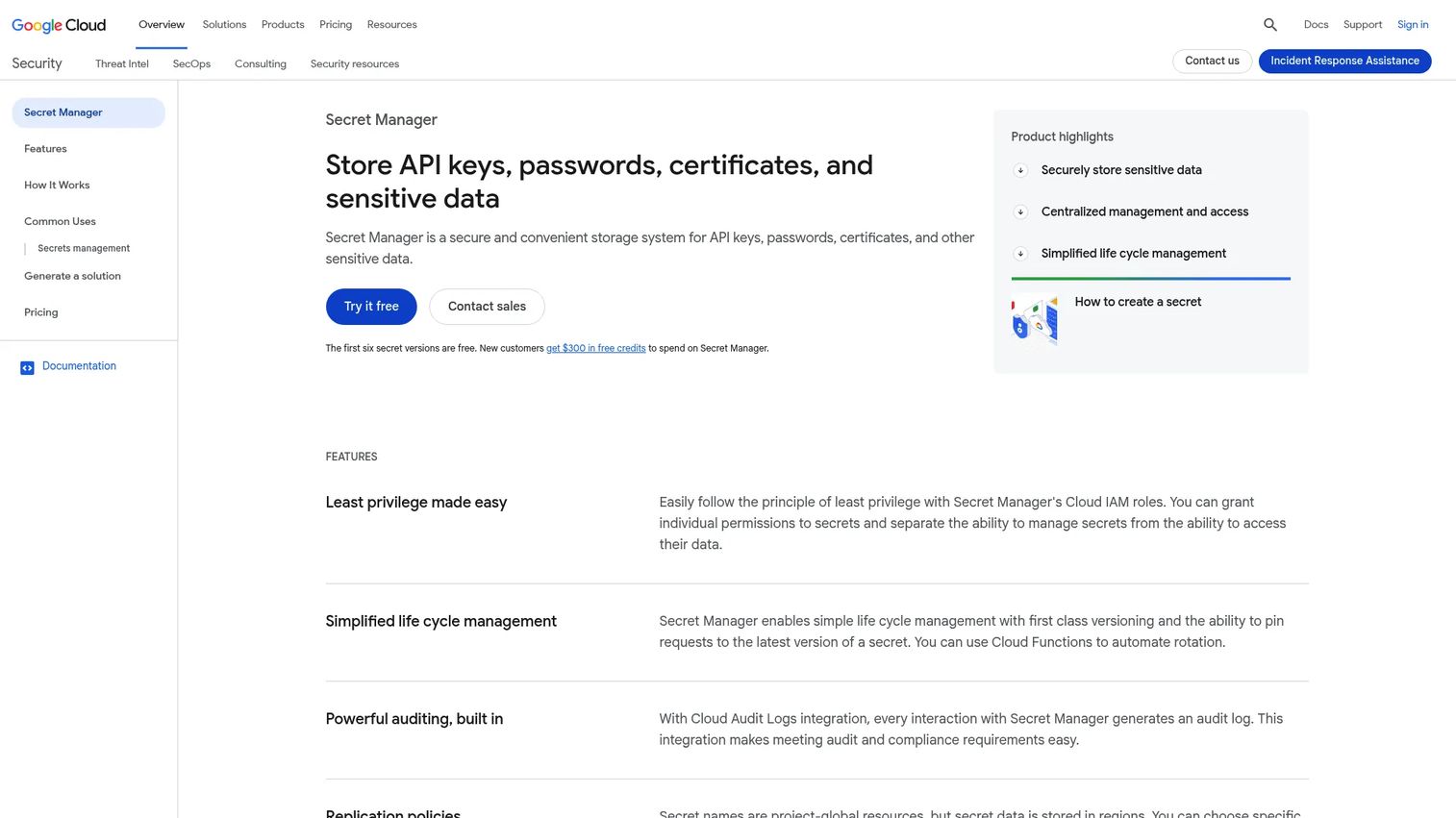
Google Secret Manager is a Google Cloud service for storing and managing secrets such as API keys, passwords, certificates, and other sensitive data. It fits GCP-native teams that want a managed service with straightforward operational overhead and clean integration with Google Cloud IAM.
Best for: Teams on Google Cloud that need managed secret storage, access control, and auditability.
Key strengths
- Secret versioning and rollback: Manage versions and roll back to a known-good secret when a change goes wrong.
- Fine-grained IAM access controls: Scope access with Google Cloud IAM so least privilege carries over from your existing setup.
- Encryption and automatic replication: Encryption at rest and in transit with CMEK support, plus automatic replication for availability and disaster recovery.
Why choose Google Secret Manager: When teams run on GCP and want a native option with minimal management overhead, this is the fit. It plugs into existing IAM and audit logging, so access control and evidence collection align with the rest of your Google Cloud governance. Consider broader multi-cloud needs before treating it as your single source for all environments.
Google Secret Manager pricing: Pricing is usage-based with a free monthly allowance: up to 6 active secret versions, 10,000 access operations, and 3 rotation notifications per month at no cost. Beyond that, access operations run $0.03 per 10,000, active secret versions cost $0.000082192 per hour, and rotation notifications are $0.05 each. Verify current usage rates on the Google Cloud pricing page. Google Secret Manager holds a 4.5/5 rating on G2, based on a small review sample.
Considerations before you buy
The right secrets manager depends less on feature lists and more on how it fits your environment, your team, and your governance obligations. Work through these before you shortlist.
Cloud footprint and multi-cloud reality
If your stack lives entirely in one provider, a native service (AWS Secrets Manager, Azure Key Vault, or Google Secret Manager) removes operational overhead and integrates instantly. If you span providers, a dedicated platform like Akeyless or HashiCorp Vault spares you from managing three separate access models. Be honest about where you are heading, not just where you are.
Access control and least privilege
Look for granular RBAC, MFA for human access, and support for machine identities and non-human identities at scale. The goal is least privilege enforced by policy, not by convention. Check how the tool handles service accounts, since those often outnumber your people.
Rotation and dynamic secrets
Static, long-lived credentials are the biggest exposure. Prioritize rotation automation and dynamic secrets that generate short-lived credentials on demand. Verify which of your databases, cloud services, and custom workloads the tool can rotate automatically versus manually.
Audit trails and compliance evidence
Security review will ask for logs of who accessed what and when. Confirm the tool produces exportable audit trails and maps cleanly to your compliance frameworks. This is the evidence that clears diligence and keeps procurement moving.
CI/CD and Kubernetes integration
For DevSecOps teams, the tool has to fetch credentials at runtime inside pipelines and clusters. Validate integrations with Terraform, Jenkins, GitHub Actions, and Kubernetes before you buy, and test the workflow in a proof of concept rather than trusting the docs.
Conclusion
The best secrets management software for your team is the one that matches your cloud footprint, security requirements, developer workflow, and governance needs, not the one with the longest feature list.
If you want the strongest enterprise security posture across multi-cloud environments, start with Akeyless. If developer adoption and fast rollout matter most, Doppler is the pragmatic pick. Regulated enterprises with mature security operations should look at CyberArk, where secrets sit inside a broader identity program. Infrastructure-heavy DevOps teams that need deep policy control will find it in HashiCorp Vault. And if your stack already lives in a single cloud, the native option from AWS, Azure, or Google gives you managed operation with minimal overhead.
Whichever you lean toward, do not buy on the datasheet alone. Match the tool to your actual cloud and compliance reality, then run a proof of concept that tests CI/CD integration and access-control fit before you sign. That test tells you more than any comparison table, including this one.
FAQs
Secrets management software is a system that stores, controls access to, rotates, and audits the sensitive credentials that applications and infrastructure use to authenticate. It protects secrets like API keys, passwords, SSH keys, tokens, certificates, and encryption keys by centralizing them in an encrypted store with policy-based access instead of scattering them across code and config.
DevOps automation runs on credentials, and hardcoding them into code, pipelines, or config files creates a wide attack surface. A secrets manager gives pipelines, containers, and service accounts controlled, scoped, and auditable access at runtime. It also enables rotation and dynamic secrets, so a compromised credential expires fast instead of granting permanent access.
A vault is the encrypted store where secrets live, while secrets management software is the broader system that includes the vault plus access control, rotation, audit logging, and integrations. In practice the terms overlap, and many products use "vault" in their name. Buyers still evaluate architecture and fit because how a tool handles access, rotation, and multi-cloud varies widely.
Most tools provide CLIs, APIs, and native plugins for build and deployment systems like Jenkins, GitHub Actions, Terraform, and Kubernetes. Pipelines authenticate to the secrets manager and fetch credentials at runtime, so nothing sensitive lives in the repo or job config. Many platforms also issue dynamic, short-lived secrets scoped to a single job.
Prioritize role-based access control (RBAC), MFA, exportable audit trails, rotation automation, dynamic secrets, and support for machine identities at scale. For multi-cloud teams, a platform that spans AWS, Azure, and GCP under one access model matters. Confirm the tool maps to your compliance frameworks and integrates with your CI/CD and Kubernetes stack.
Native services like AWS Secrets Manager, Azure Key Vault, and Google Secret Manager work well when your stack lives in one provider and you want managed operation with minimal overhead. They tie you to that provider, so multi-cloud and hybrid teams often move to a dedicated platform for a single access model and consistent governance across environments. The decision comes down to your cloud footprint and how much you value provider independence.
They support compliance through least privilege access, granular RBAC, MFA, and detailed audit trails that log every read, write, and access attempt. These logs become the evidence security teams need during diligence and audits. Dynamic secrets and rotation automation further reduce exposure, which strengthens the case you make to auditors and procurement.