Your analysts spend an hour hunting for the right table. When they find it, nobody agrees on what "active user" means. The dashboard breaks after an upstream schema change nobody flagged. And the one person who understood the pipeline left the company last quarter.
This is what happens when metadata lives in scattered docs, spreadsheets, and someone's memory. Data teams cannot move fast when nobody trusts definitions, lineage is a guessing game, and ownership is undocumented. The cost is real: slower decisions, broken reports, and analysts waiting on data engineers for answers a good system would surface instantly.
The market has caught up to the problem. The global metadata management tools market was valued at USD 11.69 billion in 2024 and is projected to reach USD 36.44 billion by 2030, growing at a 20.9% CAGR, according to Grand View Research. The push toward AI readiness, stronger data governance, and self-service search and discovery is driving that spend. Teams want data that is easy to find, trust, and use, plus the metadata intelligence to keep it that way as the stack changes.
Choosing a platform is a buyer evaluation problem, not a technical glossary exercise. The right pick depends on your governance maturity, your existing stack, and whether you need active metadata that feeds workflows or a catalog that documents them. This guide compares nine metadata management tools so you can match the platform to your reality. If you also evaluate adjacent categories, our roundups of AI governance tools and business intelligence software pair well with this one.
What's inside
This guide compares nine metadata management platforms chosen for the capabilities that matter most to product and data leaders: data lineage depth, governance and stewardship coverage, search and discovery usability, active metadata and automation, and enterprise integration depth.
We ranked each tool by relevance to metadata management as a whole, not by alphabetical order or brand size. For every platform you get a plain overview, who it fits best, key strengths, a "why choose it" summary, verified pricing where public, and its current G2 rating. Use the comparison table for a fast scan, then read the sections that match your stack and governance needs.
TL;DR
- Best overall for most teams: Alation, for balancing governed search and discovery with strong business-user adoption.
- Best for governance-heavy buyers: Collibra, for stewardship workflows, glossary control, and enterprise policy management.
- Best for AI-ready enterprises: Informatica Intelligent Data Management Cloud, for metadata intelligence and GenAI automation at scale.
- Best for Microsoft-centric stacks: Microsoft Purview, for native Azure and Microsoft 365 integration with pay-as-you-go governance.
- Best for modern data stack collaboration: Atlan, for active metadata and fast cross-team adoption.
- Best for lineage-first teams: Solidatus, for end-to-end dependency mapping and impact analysis.
What is metadata management software?
Metadata management software is a platform that organizes, governs, and operationalizes the data about your data, so teams can find, trust, and use information across the stack. It turns scattered context into a searchable, governed system.
Most platforms manage several categories of metadata:
- Technical metadata: schemas, tables, columns, data types, and pipeline structures.
- Business metadata: definitions, glossary terms, and the business context behind each asset.
- Operational metadata: freshness, usage patterns, query logs, and job status.
- Lineage metadata: how data flows from source to report, upstream and downstream.
- Governance metadata: ownership, policies, access rules, and stewardship assignments.
A modern metadata management platform layers several capabilities on top of these:
- Search and discovery: find trusted assets fast, with usage signals and popularity ranking.
- Data lineage and impact analysis: trace dependencies to assess the blast radius of a change before you ship it.
- Business glossary: a single source of truth for definitions across teams.
- Governance and stewardship: ownership workflows, approvals, and policy enforcement.
- Active metadata: context that updates dynamically and pushes signals into workflows, rather than sitting passively in a catalog.
- Taxonomy and ontology management: structured classification and relationships between concepts.
- Rules management and data quality: validation, profiling, and quality scoring.
- AI and GenAI automation: auto-tagging, description generation, and metadata curation at scale.
Why this matters now: data catalog platforms started as documentation. The category has shifted toward active metadata and metadata intelligence because AI models, self-service analytics, and regulatory pressure all depend on trusted, well-governed context. A unified catalog that supports data democratization is now a prerequisite for AI readiness, not a nice-to-have.
When to use metadata management software
Centralize scattered definitions
When your team outgrows docs, spreadsheets, and tribal knowledge, definitions drift. Marketing counts "active users" one way, product another, and finance a third. A metadata management platform gives every team one governed glossary and a single place to look. This is the moment cross-functional alignment stops being a meeting and starts being a system.
Trace lineage and impact
When a schema change quietly breaks three dashboards, you need upstream and downstream visibility. Data lineage and impact analysis let you see the full dependency chain before you make a change, so release management gets safer. If your data engineers keep firefighting broken pipelines after "small" edits, lineage is the fix.
Support self-service and governance
When analysts, product managers, and business users need data they can trust without waiting on the data team, self-service becomes the goal. Governed search and discovery lets people find the right asset, see its lineage and owner, and use it with confidence. This reduces the "how do I find X" ticket load while keeping governance and stewardship intact.
Comparison table
We ranked these platforms by overall relevance to metadata management, weighing lineage, governance, discovery, automation, and enterprise usability. Pricing and G2 ratings below reflect the most recent verified values available; confirm current figures with each vendor before you buy.
| # | Product | Intent | Key differentiation | Pricing | G2 rating |
|---|---|---|---|---|---|
| 1 | Alation | Governed discovery | Intelligent search plus ALLIE AI curation | Custom | 4.4/5 |
| 2 | Atlan | Modern stack context | Enterprise Data Graph and context agents | Custom | 4.5/5 |
| 3 | Collibra | Enterprise governance | Stewardship, glossary, AI governance | Custom | 4.2/5 |
| 4 | Microsoft Purview | Microsoft-native governance | Azure and M365 integration, pay-as-you-go | From $12.00 user/month | Not listed |
| 5 | Informatica IDMC | AI-ready enterprise data | Metadata intelligence, GenAI automation | Custom (IPU-based) | 4.2/5 |
| 6 | data.world | Collaborative catalog | Knowledge-graph catalog, free tier | Free tier; custom enterprise | 4.2/5 |
| 7 | Solidatus | Lineage and impact | Column-level lineage, versioned history | Custom | 4.2/5 |
| 8 | Dataedo | Documentation-first catalog | Approachable glossary and lineage | From $18,000/year | 5.0/5 |
| 9 | ServiceNow Data Catalog | Workflow-connected catalog | Catalog inside the ServiceNow platform | Custom | Not listed |
1. Alation

Alation is an enterprise data intelligence platform built around cataloging, governance, and AI-ready data context. It leans hard into search and discovery, using behavioral signals to surface the assets people actually trust and use. For teams that want business users adopting the catalog rather than avoiding it, Alation has long set the bar on usability.
Best for: Large enterprises that need governed data discovery with strong business-user adoption.
Key strengths
- Intelligent search: Ranks results by usage and trust signals, so analysts find the right asset fast.
- AI-powered curation with ALLIE AI: Automates descriptions and metadata curation to keep the catalog current.
- 120+ connectors and open standards: Ingests technical metadata across a broad stack without heavy custom work.
Why choose Alation: If your priority is making trusted data findable for a wide, non-technical audience, Alation's search-first design is a strong fit. It suits organizations that value active metadata and adoption over a governance-only control layer, and it pairs governance with the kind of discovery experience that reduces analyst wait times.
Alation pricing: Alation does not publish a public price. Its pages route buyers to explore pricing or book a demo, so budget expectations should be set through a direct quote. Its G2 rating sits at 4.4/5.
2. Atlan
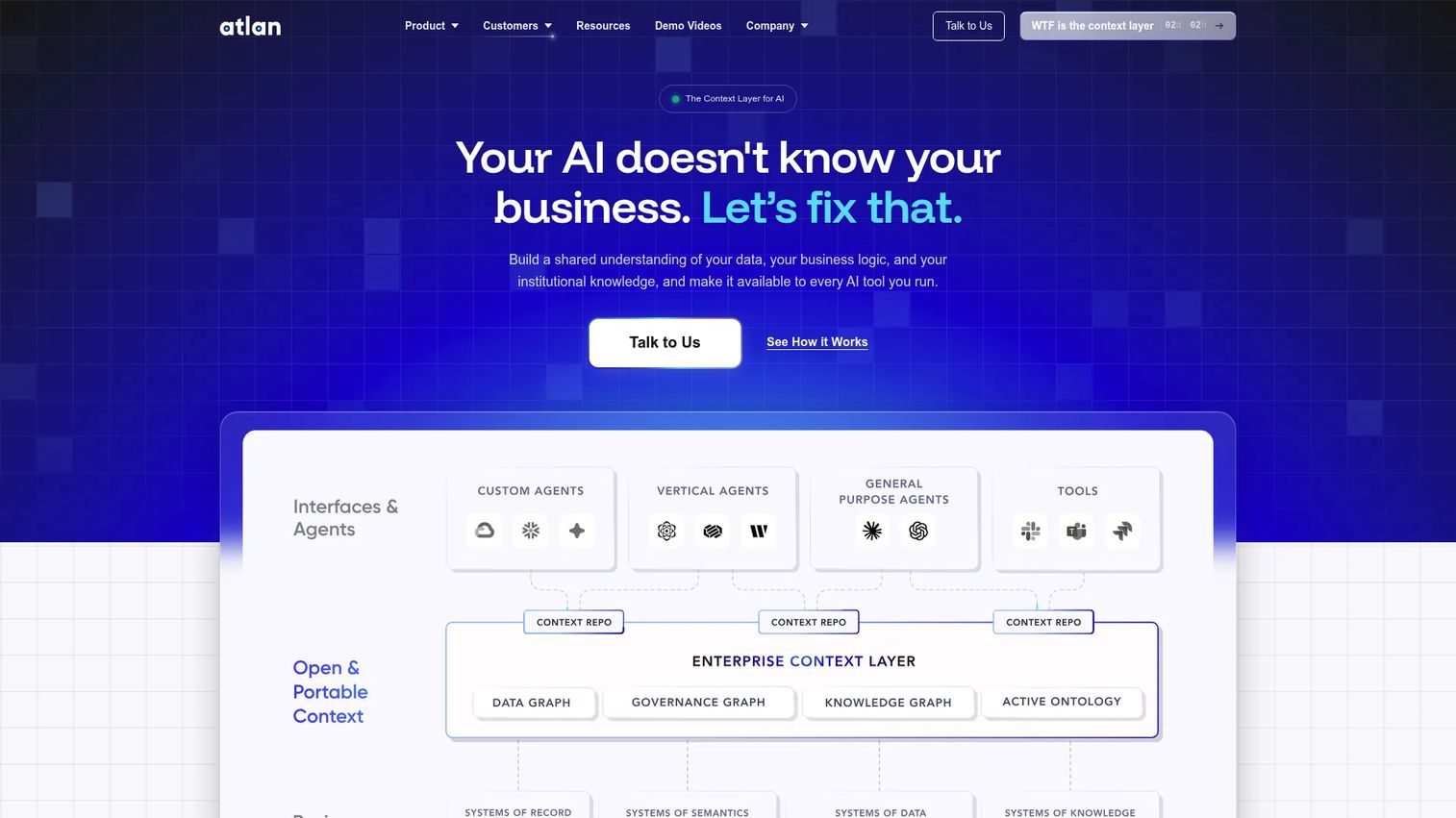
Atlan positions itself as a context layer for enterprise data and AI teams. Built for the modern data stack, it emphasizes active metadata and collaboration, so business and technical users work from shared context rather than siloed knowledge. Teams that want fast adoption and operational metadata tend to gravitate here.
Best for: Enterprise teams building governed data and AI context layers on a modern stack.
Key strengths
- Enterprise Data Graph: Connects assets, definitions, and relationships into a queryable context layer.
- Data lineage: Traces flows across the stack to support impact analysis and change confidence.
- Context agents and Context Engineering Studio: Applies AI to enrich and operationalize metadata for AI use cases.
Why choose Atlan: Atlan resonates with teams that treat metadata as a living, collaborative asset rather than static documentation. Its strength is bringing technical and business collaboration into one place, which speeds adoption across analysts, engineers, and product teams working in a modern data stack.
Atlan pricing: Atlan uses custom enterprise pricing and directs buyers to contact sales rather than listing public tiers. Its G2 rating is 4.5/5, the highest among the platforms in this guide.
3. Collibra
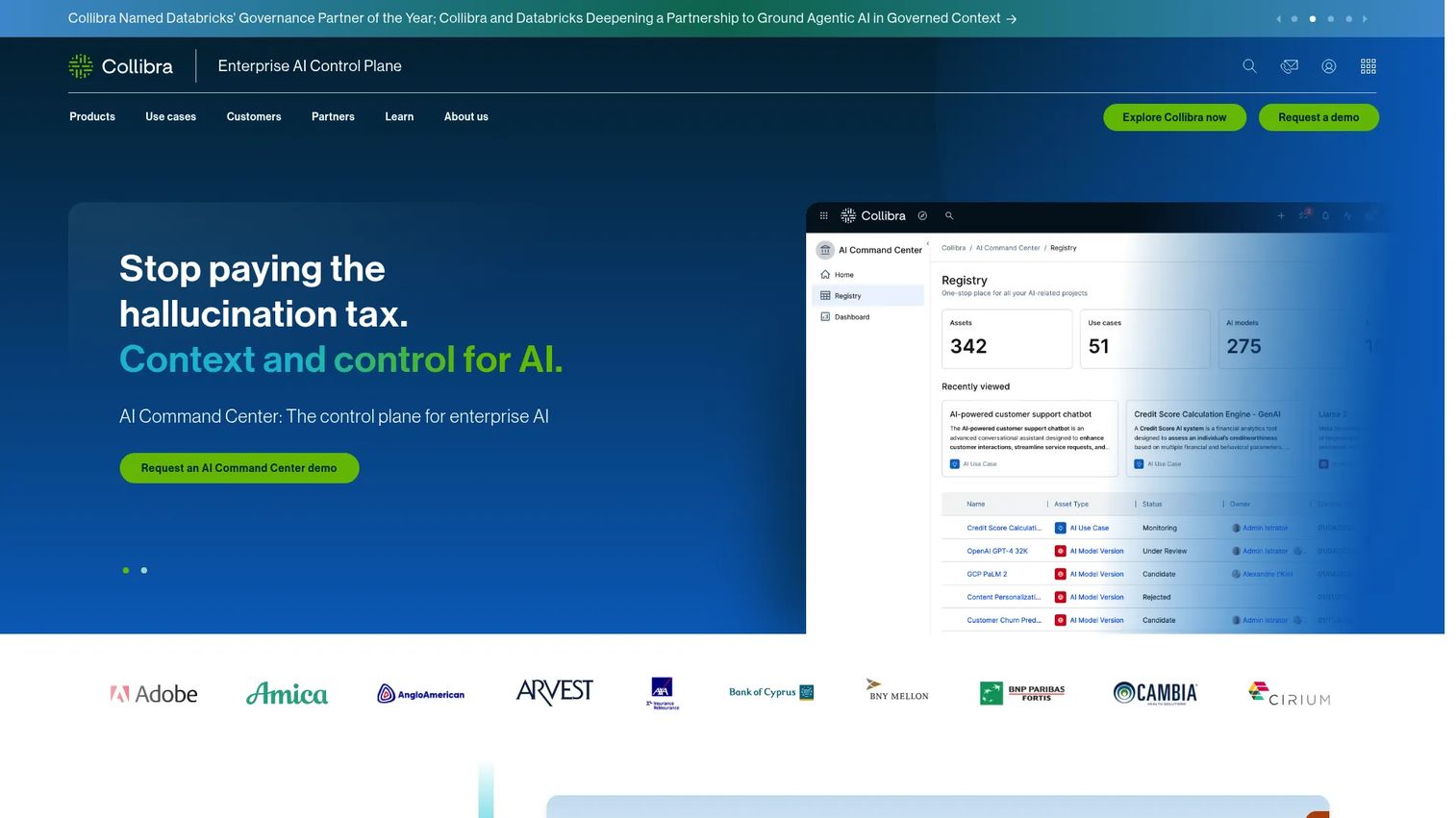
Collibra is a governance-first data intelligence platform built for large and regulated organizations. Where lighter catalogs focus on discovery, Collibra centers stewardship workflows, glossary management, and enterprise policy control. It is the platform teams reach for when governance and stewardship are the primary mandate, not an afterthought.
Best for: Large or regulated organizations that need enterprise governance, stewardship, and auditability.
Key strengths
- Data catalog: Unifies discovery with governed business context across the enterprise.
- AI governance: Extends policy and oversight to AI and model data use cases.
- Data quality and observability: Monitors quality and surfaces issues alongside governance workflows.
Why choose Collibra: Collibra fits organizations where compliance, stewardship assignments, and policy enforcement drive the requirements. It distinguishes itself from lighter catalog tools by treating governance as the core workflow, with approvals, ownership, and audit trails built in rather than bolted on. For regulated industries, that depth is the point.
Collibra pricing: Collibra does not display public pricing and routes buyers to demo and contact pages, so pricing is quote-based. Its G2 average is 4.2/5 across published reviews.
4. Microsoft Purview

Microsoft Purview is Microsoft's unified data security, governance, and compliance platform. It handles cataloging, lineage, and governance across data estates and AI apps, with native ties into Azure and Microsoft 365. For organizations already living in the Microsoft ecosystem, it removes a lot of integration friction.
Best for: Organizations that need Microsoft-native data governance across Microsoft 365 and broader data estates.
Key strengths
- Data loss prevention: Protects sensitive data across the estate with policy-driven controls.
- Information protection: Classifies and labels data to enforce governance consistently.
- Insider risk management: Surfaces risky data activity for compliance and security teams.
Why choose Microsoft Purview: If your stack already runs on Azure and Microsoft 365, Purview's native integration is the natural choice. Its billing model spans a Microsoft Purview Suite subscription and pay-as-you-go options for data governance, security, and compliance, which lets teams scale spend with usage instead of committing to a large upfront license.
Microsoft Purview pricing: The Microsoft Purview Suite starts at $12.00 per user per month, paid yearly, with a free tier available. Microsoft 365 E5 is listed at $57.00 per user per month, and pay-as-you-go options cover data governance, security, and compliance. Pricing is verified from Microsoft's pricing page as of July 2026.
5. Informatica Intelligent Data Management Cloud
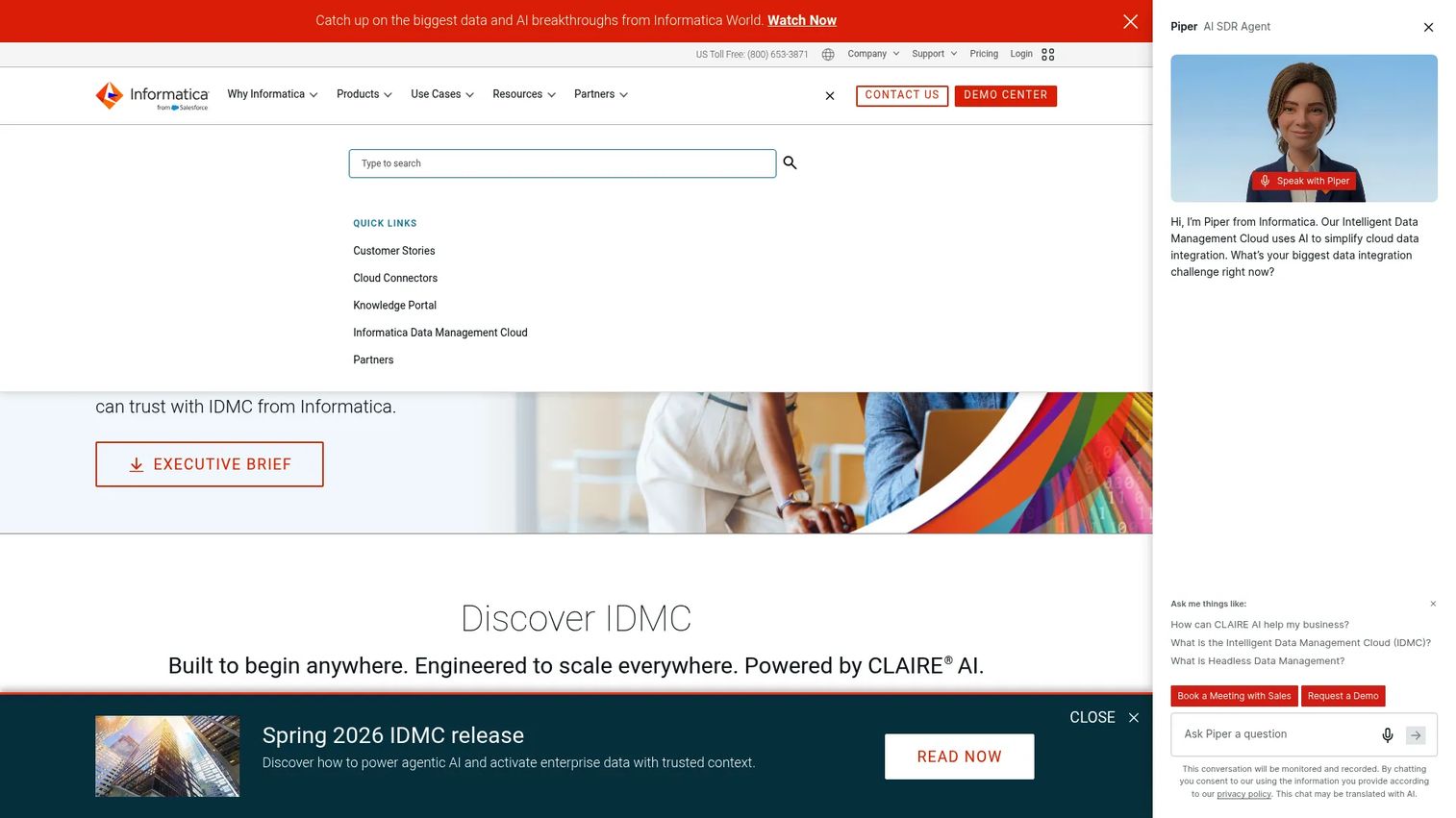
Informatica Intelligent Data Management Cloud is a cloud-native, AI-powered platform for discovering, connecting, governing, and managing enterprise data across hybrid and multi-cloud environments. It brings metadata intelligence, cataloging, quality, governance, and lineage under one roof, which appeals to large enterprises building for AI readiness.
Best for: Enterprises that need a unified cloud platform for data integration, governance, and AI-ready data management.
Key strengths
- Cloud-native multi-cloud reach: Discovers, connects, and manages data across hybrid and multi-cloud estates.
- AI-driven automation: Uses an embedded metadata system of intelligence to automate curation and classification.
- Integrated data services: Combines catalog, integration, data quality, MDM, governance, and marketplace in one platform.
Why choose Informatica IDMC: IDMC works as an end-to-end enterprise data management platform, not just a catalog. For teams that want metadata intelligence, GenAI automation, and governance operating as one system across a sprawling estate, it consolidates capabilities that would otherwise require several tools.
Informatica IDMC pricing: Informatica does not publish a public price. It uses consumption-based pricing measured in Informatica Processing Units (IPUs) and prompts buyers to request a quote. Its G2 rating is 4.2/5.
6. data.world
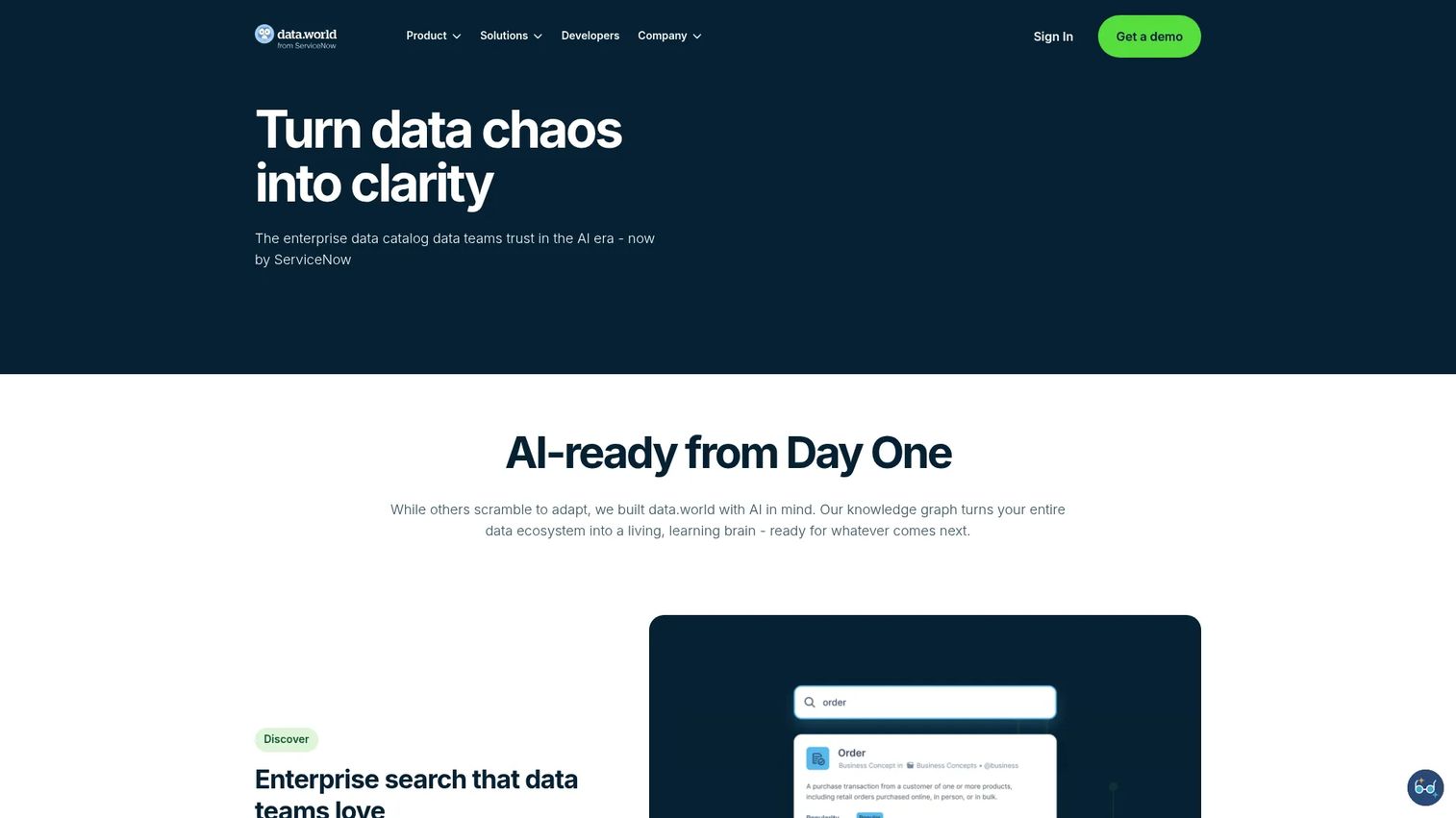
data.world is a cloud-native data catalog and governance platform built on a knowledge-graph foundation. It balances usability with governance and leans into collaboration and AI-assisted search, which makes it a strong fit for teams pursuing data democratization without sacrificing control.
Best for: Teams that need a collaborative data catalog with governance and lineage.
Key strengths
- Data catalog and metadata management: Organizes assets with a knowledge-graph model for richer relationships.
- Data governance and lineage: Pairs discovery with governed context and dependency tracing.
- AI-assisted search and collaboration: Speeds discovery and keeps teams working from shared context.
Why choose data.world: data.world suits teams that want people across the organization to explore and trust data, not just a central governance office. Its knowledge-graph approach connects assets in ways that support both search and discovery and governance, which is a good match for data democratization goals.
data.world pricing: data.world offers a free tier plus Professional and Enterprise plans, with the enterprise plan requiring a sales conversation. Public starting prices were not listed at the time of writing, so confirm with the vendor. Its G2 rating is 4.2/5.
7. Solidatus
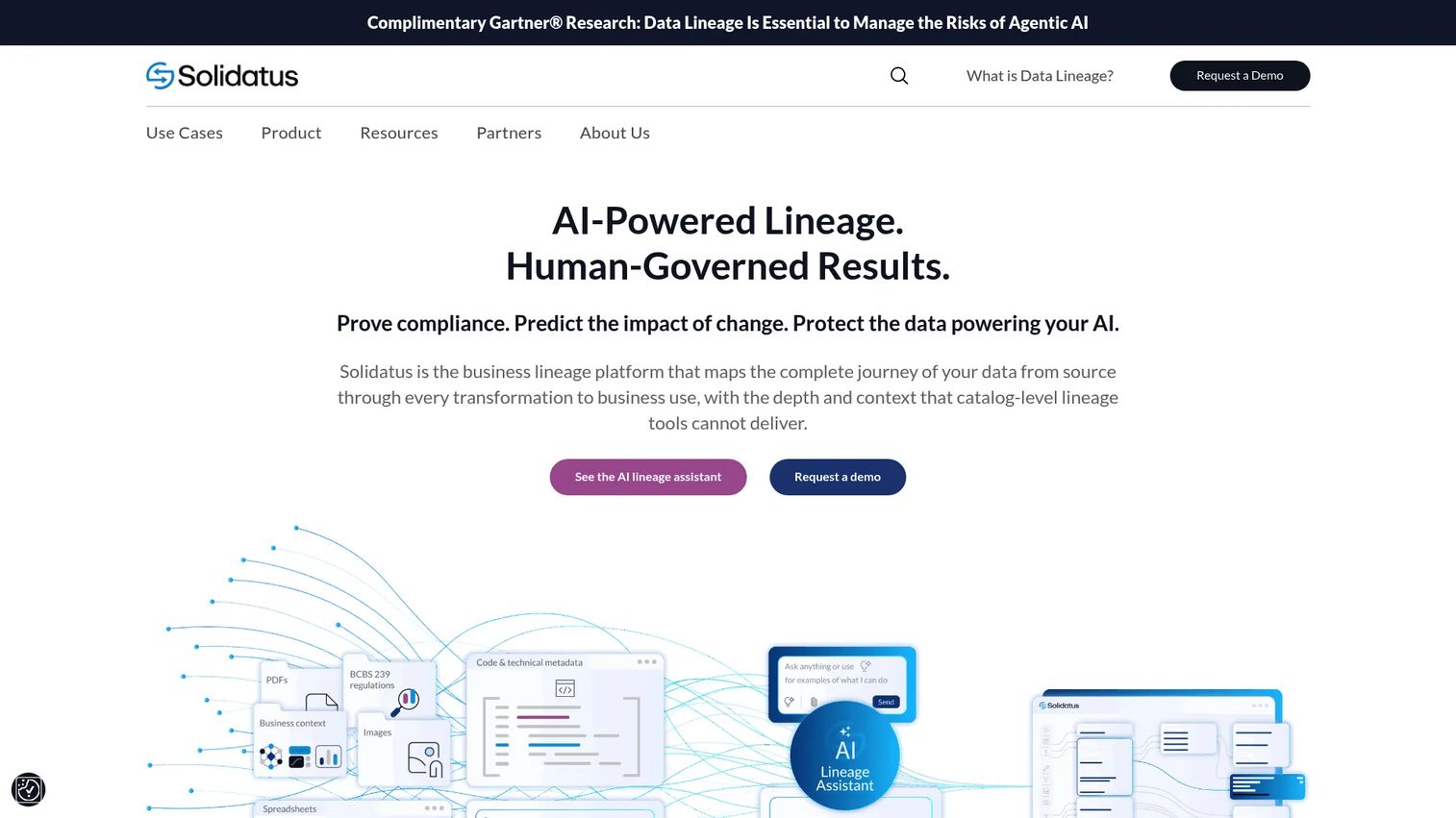
Solidatus is an enterprise data lineage, catalog, and governance platform with a strong focus on dependency mapping. Its architecture makes it the pick for organizations that live and die by lineage: where you need to trace exactly how data moves and what a change will break before you make it.
Best for: Regulated enterprises that need auditable data lineage and impact analysis.
Key strengths
- End-to-end and column-level lineage: Maps flows down to the column so impact analysis is precise.
- Audit trail and versioned history: Bi-temporal change tracking supports compliance and rollback confidence.
- Metadata ingestion via connectors and API: Pulls active metadata from across systems into one lineage model.
Why choose Solidatus: Solidatus excels when change confidence is the top priority. Its column-level lineage and versioned history give data teams the dependency map they need to ship changes safely and prove compliance. For architecture-heavy organizations, that technical lineage depth is the differentiator.
Solidatus pricing: Solidatus does not publish public pricing and directs buyers through a contact or demo request path. Its G2 rating is 4.2/5.
8. Dataedo
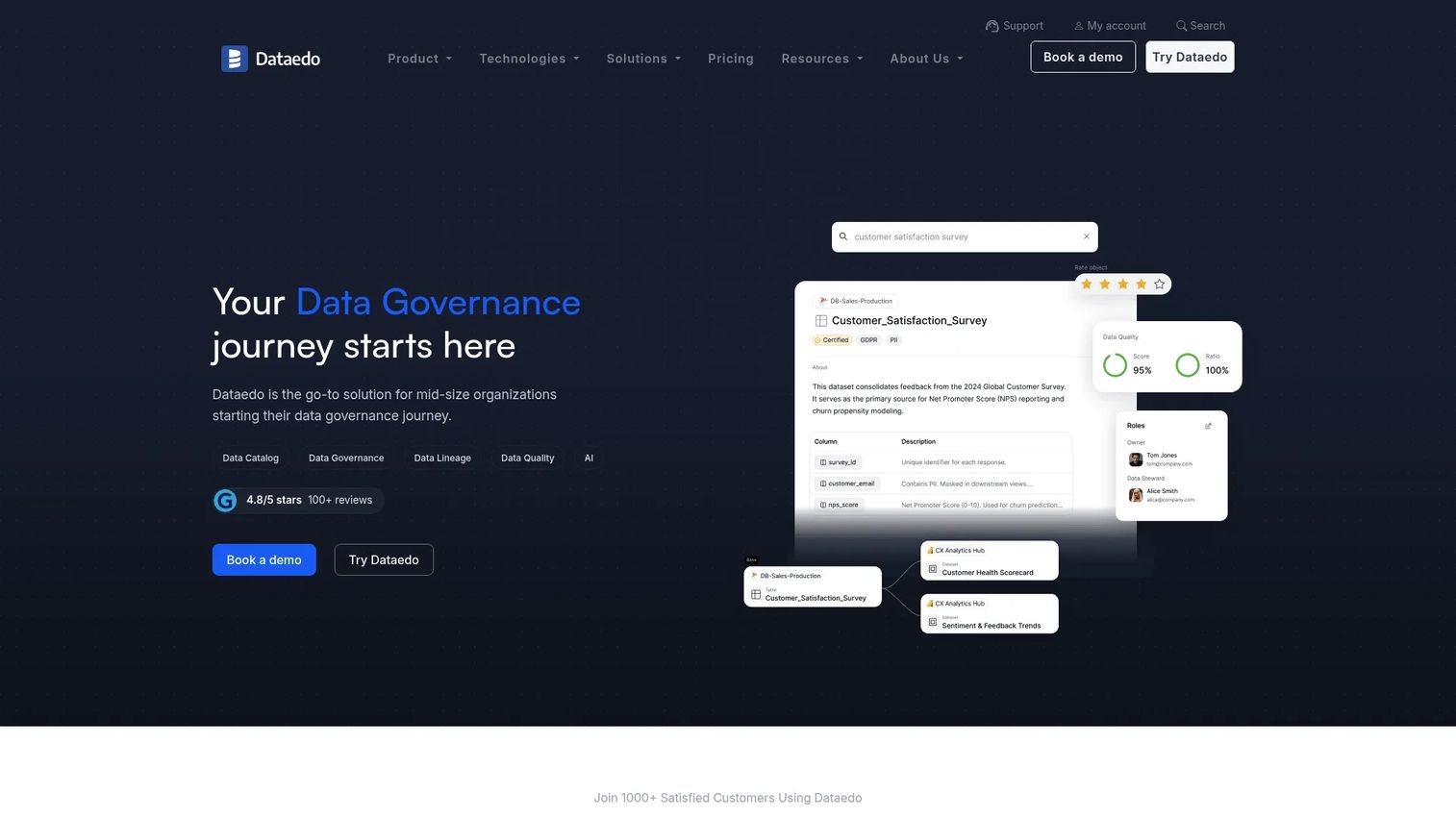
Dataedo is a data governance platform focused on cataloging, documentation, business glossary, and approachable governance. It suits mid-sized organizations that want practical documentation workflows and a governed catalog without the heavy implementation overhead of the largest enterprise suites.
Best for: Mid-sized organizations that need a governed data catalog with lineage and quality controls.
Key strengths
- Data catalog: Centralizes documentation and metadata curation in a practical, readable format.
- Data lineage: Traces dependencies to support impact analysis and change management.
- Data governance and quality: Adds glossary, ownership, and quality controls without steep complexity.
Why choose Dataedo: Dataedo fits teams that value clear documentation and a working business glossary over sprawling enterprise governance machinery. Its approachable model gets a governed catalog live faster, which matters for teams that want value without a long deployment.
Dataedo pricing: Dataedo publishes annual plans starting with Essentials at $18,000 per year, Data Lineage at $24,000 per year, and Data Quality at $32,000 per year. Pricing is based on editors with a minimum of three, and a free trial is available. Its G2 rating is 5.0/5.
9. ServiceNow Data Catalog
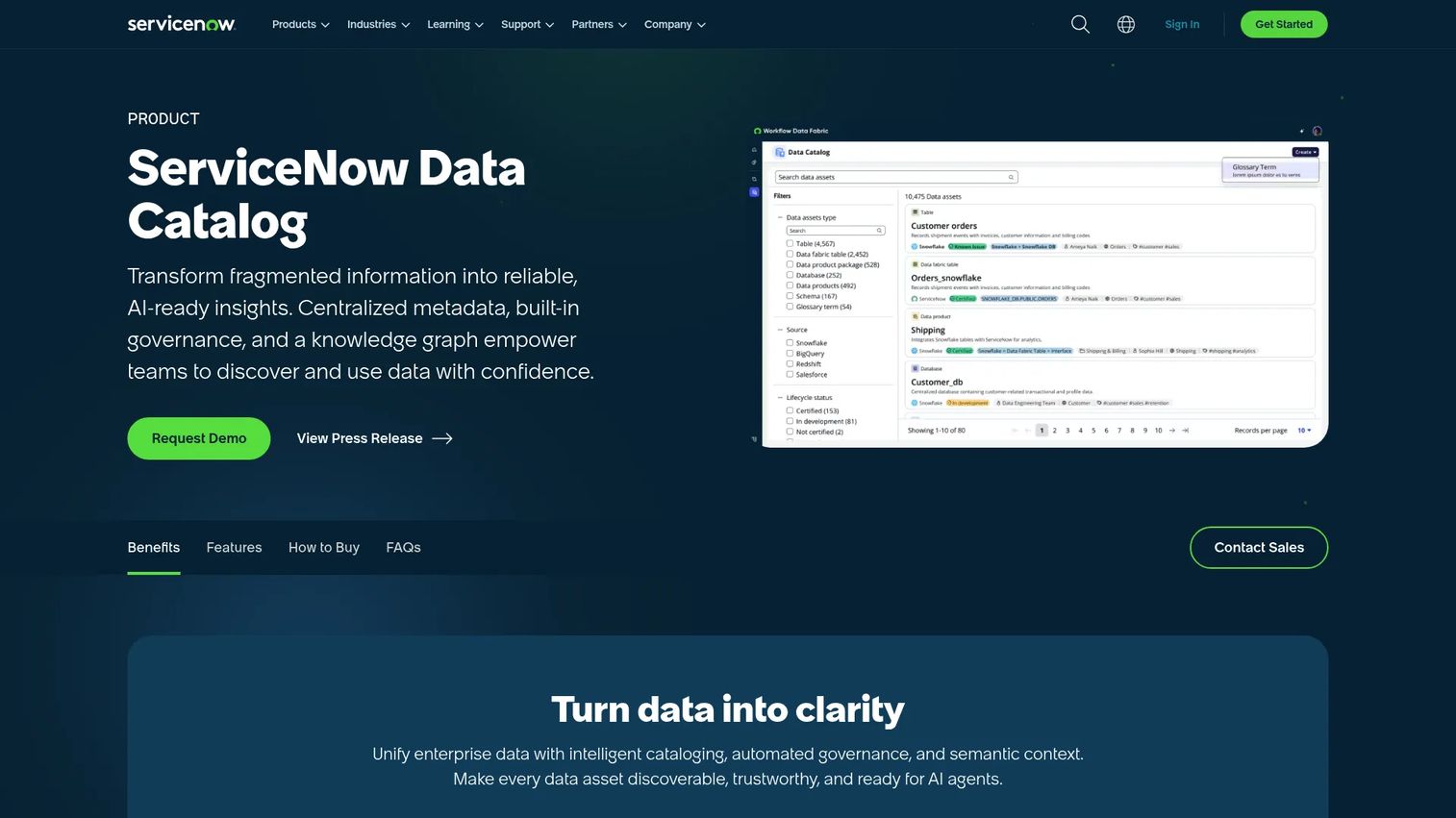
ServiceNow Data Catalog is an enterprise data catalog and governance product built inside the ServiceNow platform. It brings AI-ready data discovery and governed context to organizations that want metadata work connected directly to their service workflows and automation.
Best for: Large enterprises that need governed, AI-ready data discovery tied to service workflows.
Key strengths
- AI-powered data discovery and search: Surfaces trusted assets with AI-assisted search and discovery.
- Knowledge graph: Links metadata with business context for richer relationships and lineage.
- Automated governance workflows: Enforces policy through the ServiceNow workflow engine.
Why choose ServiceNow Data Catalog: ServiceNow Data Catalog is strongest when metadata work needs to connect to broader service and operational workflows. For organizations already standardized on ServiceNow, keeping cataloging, governance, and automation on one platform reduces tool sprawl and keeps context flowing into the work that acts on it.
ServiceNow Data Catalog pricing: ServiceNow does not publish public pricing for the Data Catalog and directs buyers to contact sales or request a demo. A product-specific G2 rating was not available at the time of writing.
Considerations before you buy
A vendor shortlist is easy. Matching a platform to your governance maturity and stack is the harder part. Run each candidate through this checklist before committing.
Governance and stewardship depth
Decide whether you need a discovery-first catalog or a full governance and stewardship engine. Regulated teams need approval workflows, ownership assignments, policy enforcement, and audit trails. Lighter teams may only need a glossary and search. Buying more governance than you can operate creates its own overhead.
Active metadata versus static cataloging
Ask whether the platform delivers active metadata that pushes signals into workflows, or a catalog that documents state passively. Active metadata drives more value for self-service and AI readiness, but confirm the integrations that make it active actually cover your systems.
Integration and stack fit
Check connector coverage against your real stack: warehouses, BI tools, pipelines, and cloud providers. A Microsoft-heavy team gets outsized value from native integration, while a modern data stack team should weigh how well the catalog ingests operational metadata. Thin connector coverage means manual metadata curation later.
Metadata operational support and taxonomy
Look at how the platform handles taxonomy and ontology management, rules management, and ongoing metadata operational support. The system has to stay current as schemas change and releases ship. Evaluate how much the vendor automates curation versus how much falls on your team.
Pricing model and total cost
Most enterprise catalogs use custom or consumption-based pricing. Model the total cost against usage, editor seats, and the systems you will connect. Pay-as-you-go can scale cleanly, while seat-based annual plans reward predictable teams. Get the quote before you fall in love with a demo.
Conclusion
The right metadata management software depends on where you are, not on which brand is loudest. For most teams that want governed discovery with real business-user adoption, Alation is the strongest all-around pick. Governance-heavy and regulated organizations should shortlist Collibra for its stewardship depth. If AI readiness and metadata intelligence across a large estate top your list, Informatica IDMC consolidates the most under one roof.
Microsoft-centric teams get the cleanest path with Microsoft Purview, while modern data stack teams chasing fast adoption and active metadata should look at Atlan. When lineage and impact analysis are the whole game, Solidatus wins on dependency depth. For collaborative data democratization, data.world fits, and mid-sized teams wanting practical documentation should evaluate Dataedo. Enterprises standardized on ServiceNow get the most from keeping cataloging inside their workflow engine.
Start with your governance maturity and your existing stack, then request quotes from your top two. If you are also building out adjacent capabilities, our guides to enterprise search software, data visualization tools, and audit management software are useful next reads. Teams evaluating how they present complex data internally often pair these with Guideflow to build clear, self-serve walkthroughs of their own tools and workflows.
FAQs
It helps teams organize, govern, discover, and trust data by managing definitions, lineage, ownership, and policies in one place. The goal is to make data easy to find and safe to use, so analysts and business users act on trusted context instead of guessing. It reduces the manual metadata chaos that slows decisions and breaks reports.
A data catalog is usually one component of the broader metadata management stack. The catalog focuses on discovery and documentation, while metadata management also covers governance, data lineage, stewardship, taxonomy, and operational workflows. Most enterprise platforms bundle the catalog inside a wider governance and active metadata system.
Governance-first platforms like Collibra are built for this, with stewardship workflows, access controls, and auditability at the core. Enterprise buyers should look for approval workflows, ownership assignments, policy enforcement, and full audit trails. Informatica IDMC and ServiceNow Data Catalog also serve heavily governed environments well.
Lineage-first platforms like Solidatus lead when change tracking and dependency mapping are the priority, thanks to column-level lineage and versioned history. Atlan and Informatica IDMC also offer strong lineage as part of broader platforms. Choose based on how precise your impact analysis needs to be before a change ships.
Active metadata is metadata that updates dynamically and pushes signals into workflows, rather than sitting passively in a catalog. It powers real-time recommendations, freshness alerts, and usage-based ranking. Because it feeds live context into tools and pipelines, active metadata is central to self-service analytics and AI readiness.
Prioritize native integration with Azure and Microsoft 365, which is where Microsoft Purview has a clear edge. Weigh its governance coverage against your compliance needs, and consider its pay-as-you-go options versus subscription pricing based on how variable your usage is. Native ties reduce integration effort and keep lineage flowing across the Microsoft estate.
Prioritize search and discovery, a business glossary, data lineage, stewardship workflows, taxonomy and ontology management, profiling, rules management, and AI-assisted automation. Match the depth to your governance maturity, since a small team rarely needs the full enterprise stack. Confirm connector coverage for your actual systems before buying.
A lighter, documentation-first tool like Dataedo is often enough when the main need is a governed catalog, glossary, and basic lineage. Larger, regulated, or AI-focused organizations justify a more robust metadata management platform with deep governance and stewardship. Match the investment to your complexity, not to the largest vendor in the market.