Your risk register lives in a spreadsheet. Your control evidence lives in a shared drive. Your third-party assessments live in someone's inbox. When leadership asks for a real-time view of enterprise exposure, you spend three days stitching exports together, and the picture is already stale by the time it lands in the board deck.
That fragmentation is the exact problem enterprise risk management software exists to fix. Analyst firms such as Gartner and Forrester describe the integrated risk management and GRC software market as a fast-growing segment, driven by regulatory change, cyber risk, and digital transformation. Recent risk research from Secureframe shows that cybersecurity, regulatory change, and third-party risk now rank among the top enterprise risks executives track, which is pushing more organizations to invest in risk technology and automation instead of manual cycles.
For the product managers, GRC leads, and IT and security owners who sit on the buying committee, the question is no longer whether to consolidate. It is which ERM software actually fits your data stack, your regulatory footprint, and your appetite for ongoing maintenance. A risk management platform that nobody can keep current is just a more expensive spreadsheet.
This guide ranks the tools that matter and gives you a way to compare them on the criteria that decide adoption.
What's inside
This guide is for risk, GRC, compliance, and IT or security leaders, plus the cross-functional buyers (including product and engineering stakeholders) who get pulled into an ERM software evaluation. We selected the 10 tools below from the established ERM, GRC, and integrated risk management market, then ranked them by relevance to the enterprise risk management software keyword.
We judged each tool on four criteria:
- Enterprise-wide risk visibility: connected risk register and a single source of truth, not siloed lists.
- Control and assessment depth: assessments, control testing, and continuous monitoring.
- Regulatory framework alignment: coverage for ISO, COSO, SOX, DORA, NIS2, NIST, GDPR, and HIPAA.
- Integrations and scalability: stack fit and low maintenance as the org changes.
TL;DR
Short on time? Here are the decision shortcuts by buyer segment:
- Best for broad, configurable all-in-one ERM: Riskonnect, for enterprises consolidating many point tools onto one platform.
- Best for mid-market risk teams: LogicManager, with fixed-fee licensing, unlimited users, and advisory support.
- Best for SOX and financial reporting alignment: Workiva, where risk data has to be reporting-grade.
- Best for audit-led organizations: AuditBoard (now Optro), built around internal audit, SOX, and controls.
- Best for AI-driven risk intelligence: IBM OpenPages with watsonx, for AI-augmented analytics at scale.
- Best for no-code workflow flexibility: LogicGate Risk Cloud, for teams that want to configure fast without heavy IT lift.
What is enterprise risk management software?
Enterprise risk management (ERM) software is a centralized platform that helps organizations identify, assess, monitor, and report risk across the entire enterprise in a single connected system. Instead of tracking risks in scattered spreadsheets and disconnected point tools, ERM software links risks to controls, owners, assessments, and reporting in one place.
It differs from a single-purpose GRC point tool, which usually handles one job (policy management, say, or vendor reviews). It also differs in scope from integrated risk management (IRM) software, which Gartner uses to describe the broader connected category spanning operational, vendor, IT, digital, and resilience risk. ERM is the enterprise-wide lens. IRM is the wider product family that connects those lenses together. In practice the terms overlap, and many vendors sell under both labels.
Core capabilities of ERM software
Most enterprise risk management solutions share a common feature set:
- Centralized, connected risk register: one source of truth for risks, owners, and approvals.
- Multi-dimensional risk assessments: score risks across likelihood, impact, and velocity.
- Control design and testing: map controls to risks and test their effectiveness over time.
- KRI and KPI monitoring: track key risk indicators against thresholds.
- Dashboards and heat maps: visualize exposure for analysts and the board.
- Workflow automation: route assessments, alerts, escalations, and remediation.
- Regulatory framework mapping: align controls to ISO, COSO, SOX, and similar.
- Reporting: board-ready and audit-ready outputs.
- Integrations: connect to CRM, ITSM, data warehouses, analytics, and SSO.
ERM vs. GRC vs. integrated risk management (IRM)
These three terms get used interchangeably, which causes confusion in RFPs. Here is the plain-language boundary.
| Category | Primary focus | Scope |
|---|---|---|
| ERM | Enterprise-wide risk identification, assessment, and reporting | Risk across all business units |
| GRC | Governance, risk, and compliance together | Adds policy, governance, and compliance to risk |
| IRM | Connected risk across many domains | The broadest family: operational, vendor, IT, digital, resilience |
Most vendors on this list cover all three to some degree. The label matters less than whether the platform connects your specific risk domains.
When to use enterprise risk management software
Not every team needs a full ERM platform on day one. These three triggers usually signal that a spreadsheet has run out of road.
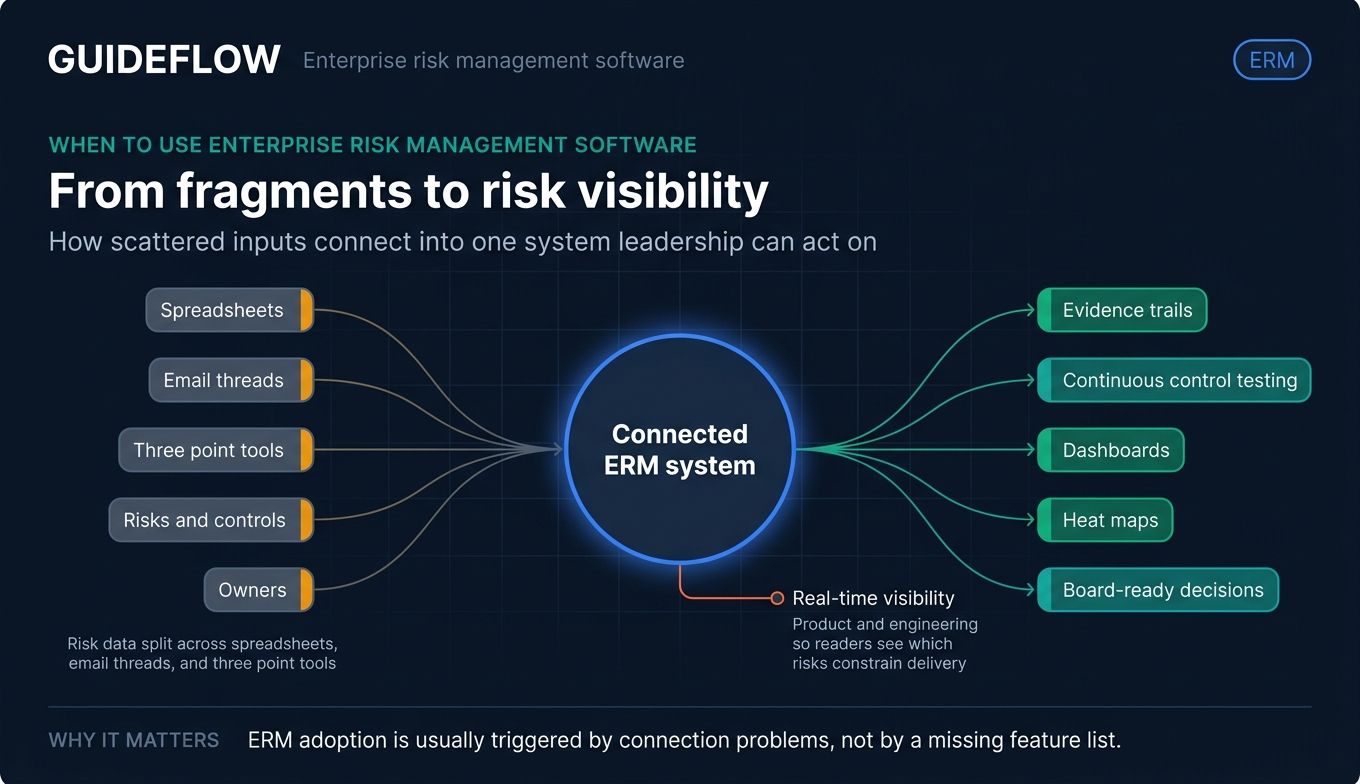
Centralize fragmented risk data into one source of truth
When risk data is split across spreadsheets, email threads, and three different point tools, nobody trusts the aggregate view. Enterprise risk assessment software pulls risks, controls, and owners into one connected register. That removes the manual reconciliation step that eats days every reporting cycle.
Prove control effectiveness and stay audit-ready
Auditors and regulators want evidence, not assurances. ERM software supports continuous control testing and stores the evidence trail in one place. That matters for SOX, ISO, DORA, and similar regimes where you have to show controls worked, not just that they existed. When it comes time to onboard new team members onto these tools, an interactive walkthrough beats a static manual, and the right contract management software can complement your evidence trail.
Give leadership real-time enterprise risk visibility
Boards expect a current view of exposure, not a snapshot from last quarter. Dashboards, heat maps, and board-ready reporting turn raw risk data into something leadership can act on. Real-time visibility also helps product and engineering stakeholders understand which risks constrain delivery.
Comparison table: enterprise risk management software at a glance
Here are the 10 enterprise risk management tools side by side. Pricing for most of these platforms is custom or quote-based, which is standard for enterprise GRC. Where a vendor publishes indicative figures, we show them. G2 ratings reflect each tool's current G2 listing.
| # | Product | Intent | Key use case | Pricing | G2 rating |
|---|---|---|---|---|---|
| 1 | Riskonnect | Configurable all-in-one ERM/GRC | Consolidating many risk domains on one platform | Custom | 4.4/5 |
| 2 | MetricStream | Enterprise connected GRC | Deep quantification and control testing | Custom | 3.8/5 |
| 3 | LogicManager | Mid-market ERM | Taxonomy-driven risk linking with advisory support | Custom (fixed-fee, unlimited users) | 4.2/5 |
| 4 | Archer | Integrated risk management | Mature, complex enterprise risk programs | Custom | 3.6/5 |
| 5 | ServiceNow GRC | Platform-native GRC | Orgs standardized on ServiceNow | Custom | 4.2/5 |
| 6 | IBM OpenPages | AI-driven GRC | AI-augmented risk analytics | From USD 3,300 | 4.2/5 |
| 7 | Resolver | Risk and incident intelligence | Connected operational and security risk | Custom | 4.3/5 |
| 8 | AuditBoard (Optro) | Audit-led connected risk | SOX, internal audit, and controls | Custom | 4.6/5 |
| 9 | Workiva | Reporting-grade ERM | Risk linked to SEC/SOX reporting | Custom | 4.5/5 |
| 10 | LogicGate Risk Cloud | No-code GRC/risk | Configurable, fast-to-deploy workflows | Custom | 4.6/5 |
The 10 best enterprise risk management software tools for 2026
1. Riskonnect
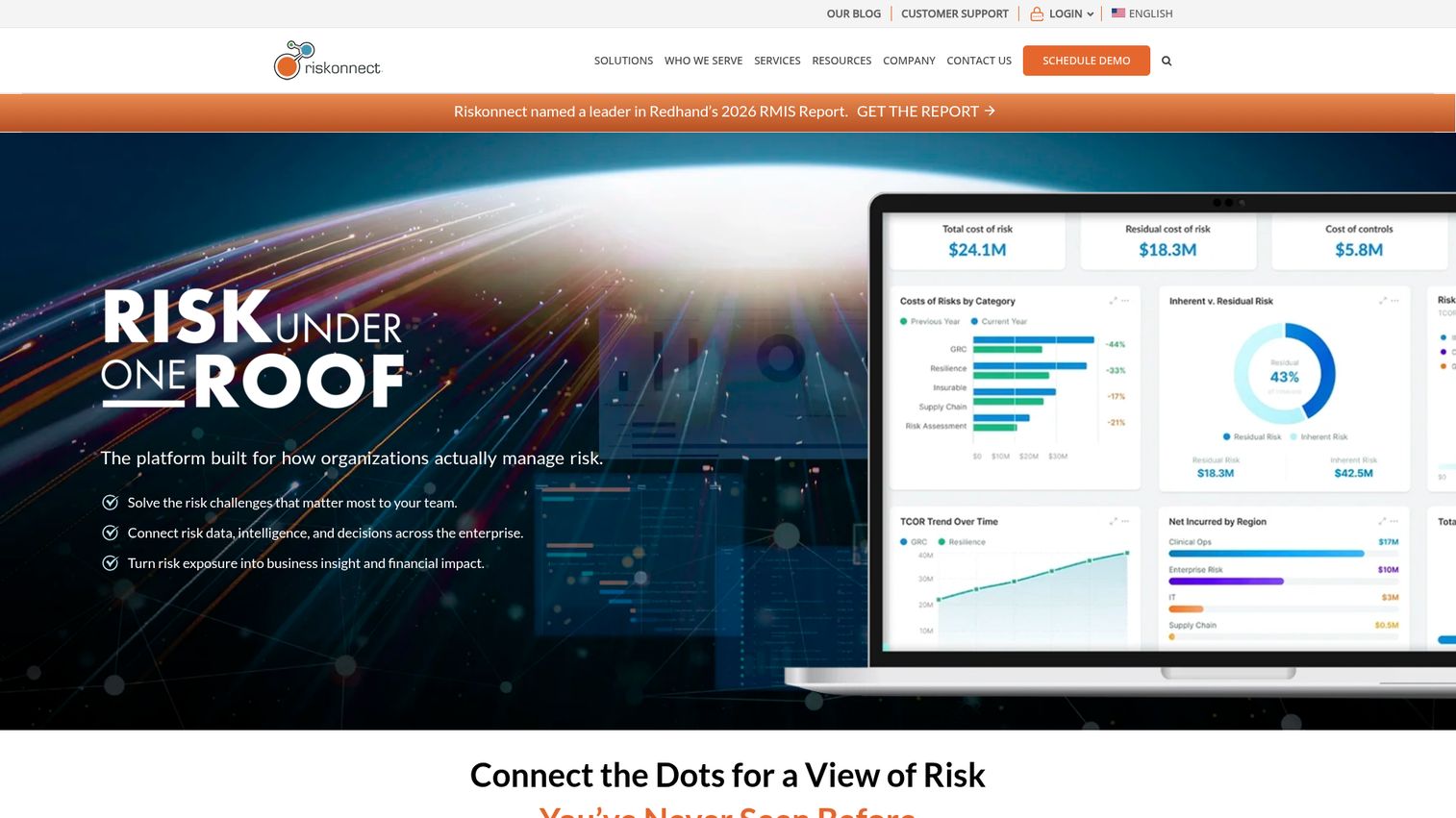
Riskonnect is a broad, configurable integrated risk management platform that connects risk, compliance, resilience, claims, safety, and related data across an organization. It is built for enterprises that want to retire a stack of point tools and run multiple risk domains from one system of record. The platform centers on centralized risk and compliance data with custom risk registers, risk owners, approvals, and escalations.
Best for: large enterprises that want one configurable platform across many risk types.
Key strengths
- Breadth of risk domains: covers enterprise, operational, third-party, claims, safety, and resilience risk in one place.
- Configurable risk registers: define risk owners, approvals, escalations, and key risk indicators to match your taxonomy.
- Automation and integrations: automated workflows, alerts, dashboards, reporting, and API integrations connect risk data to the rest of your stack.
Why choose Riskonnect: If your real problem is tool sprawl across separate risk programs, Riskonnect is built to consolidate. The trade-off is that breadth comes with configuration work, so it rewards teams ready to invest in setting up the platform to fit their model. It suits organizations with mature risk programs and dedicated GRC ownership.
Riskonnect pricing: Riskonnect does not publish public pricing. A first-party FAQ states that cost depends on project size, complexity, customization, and implementation options, so expect a custom enterprise quote scoped to your deployment. Riskonnect holds a 4.4 out of 5 rating on G2.
2. MetricStream
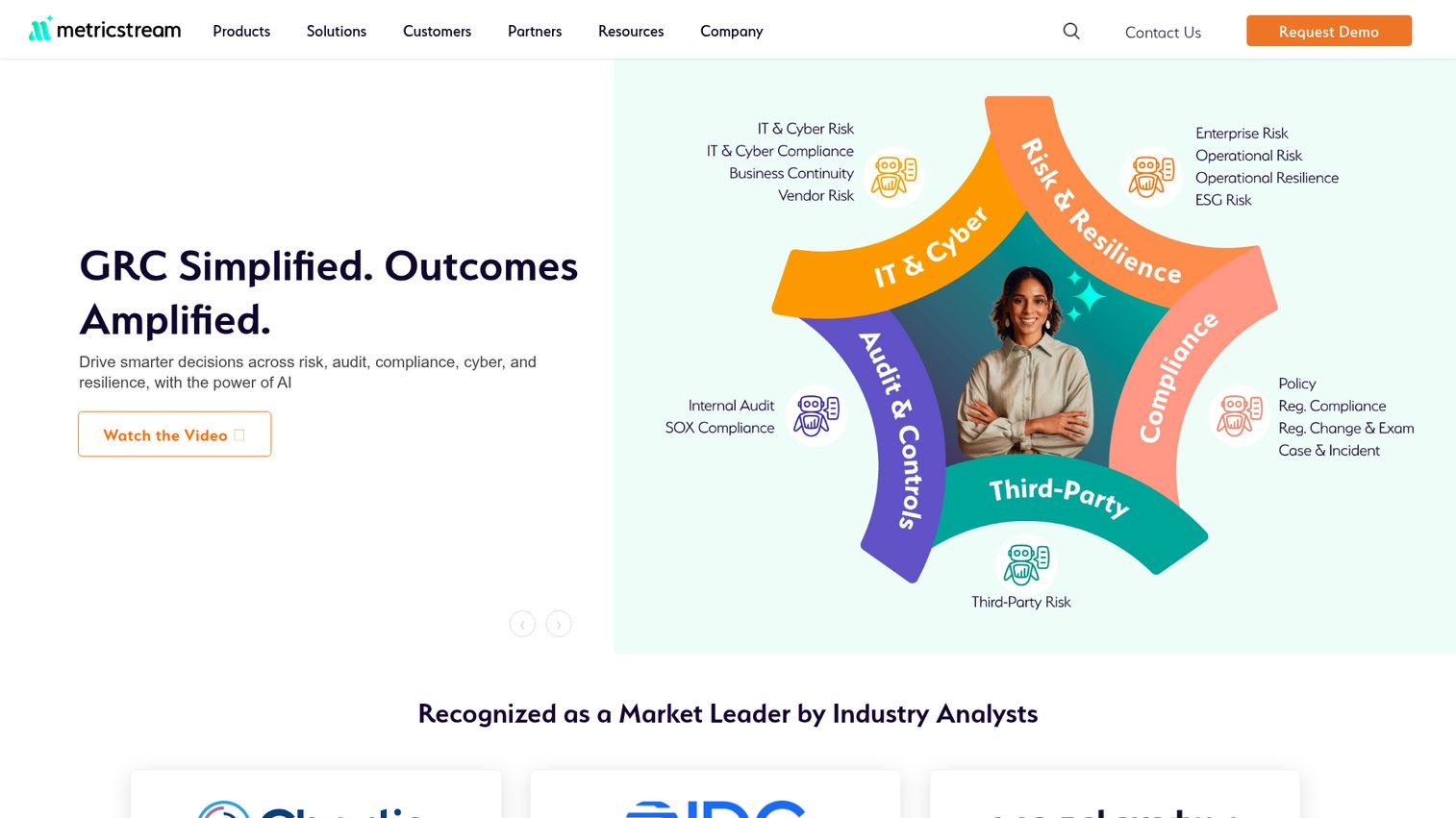
MetricStream is an AI-first connected GRC platform spanning enterprise and operational risk, compliance, audit, cyber GRC, third-party risk, and resilience. It is aimed at large, regulated enterprises that need depth in risk assessment, control effectiveness, and issue management. The platform runs on a federated data model with AppStudio configuration and continuous control monitoring.
Best for: large regulated enterprises that need deep risk and control coverage across many programs.
Key strengths
- Federated data model: connect risk data across functions while keeping local ownership.
- AI-driven risk insights: assessments, control effectiveness, risk response, and issue management with AI assistance.
- Compliance depth: regulatory update ingestion, compliance profile mapping, policy management, and case and incident management.
Why choose MetricStream: MetricStream fits enterprises with complex, multi-program GRC needs and the resources to run a platform of this depth. It is a serious commitment, so it pays off most for organizations that need the full connected GRC suite rather than a single risk register.
MetricStream pricing: MetricStream does not list public prices. Its pricing page provides a request form, and a representative follows up with a custom quote based on your needs. MetricStream holds a 3.8 out of 5 rating on G2.
3. LogicManager
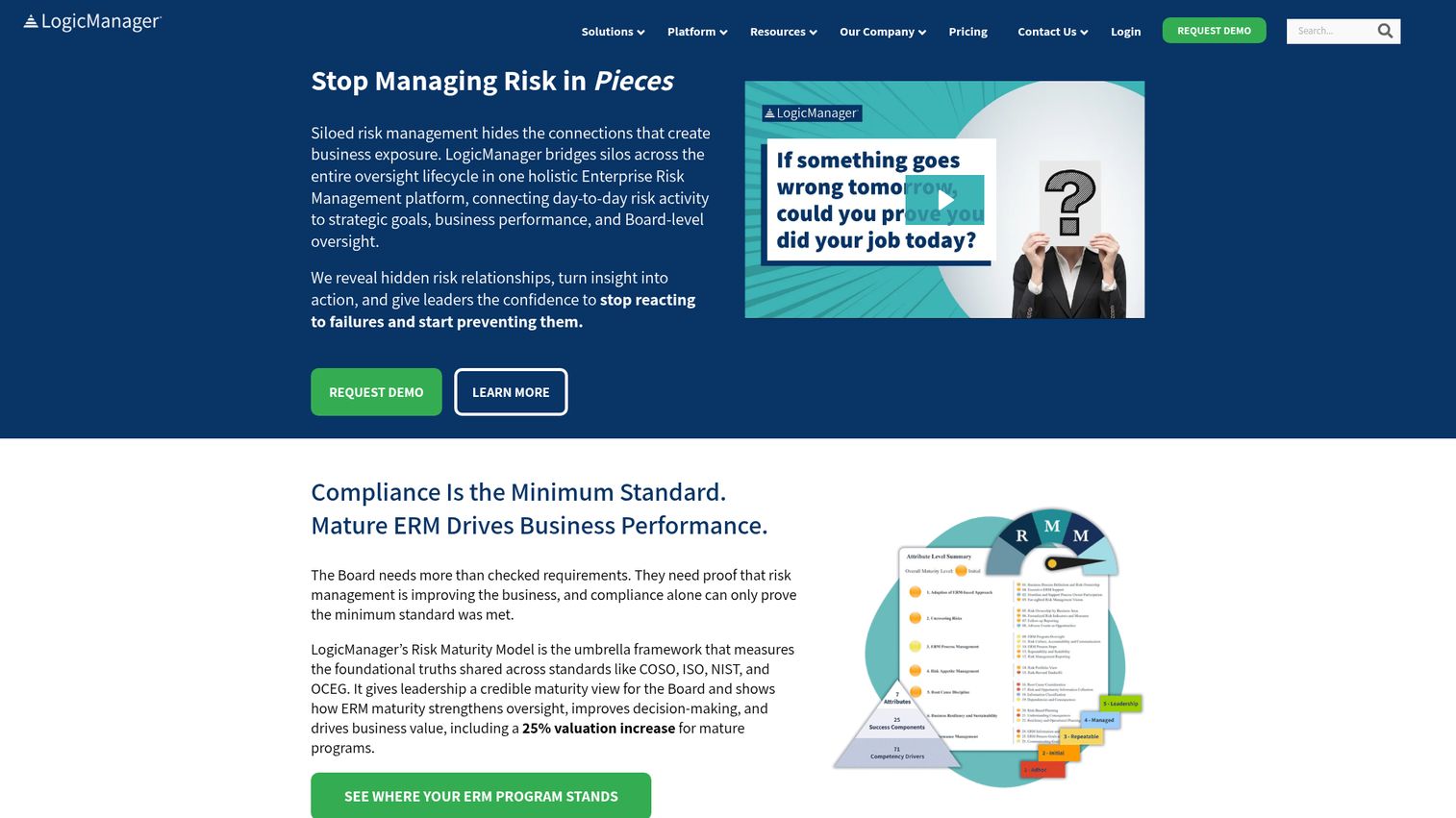
LogicManager is a SaaS enterprise risk management platform that connects risk activity to strategic goals, business performance, and board-level oversight. It is known for taxonomy-driven risk linking and a pricing model that lands well with mid-market teams. Its Risk Ripple Intelligence maps relationships between risks, controls, vendors, policies, systems, processes, and stakeholders.
Best for: mid-market risk teams that want structured ERM without enterprise overhead.
Key strengths
- Risk Ripple Intelligence: see how one risk connects to controls, vendors, policies, and stakeholders.
- Structured program workflow: Oversight, Assess, Mitigate, Monitor, and Events guide the full risk lifecycle.
- Integration Hub: no-code templated connections to over 7,000 third-party applications, plus LMX AI guidance and a Completeness Checker.
Why choose LogicManager: LogicManager balances depth with usability, and its fixed-fee model removes the per-seat math that complicates other tools. That makes it a strong fit for teams that want broad adoption without policing license counts.
LogicManager pricing: LogicManager uses SaaS, job-to-be-done, fixed-price, all-inclusive pricing with unlimited users, onboarding, and advisory service included. Solutions span Enterprise Risk Management, Security Risk Management, Privacy Risk Management, Third Party Risk Management, and more, with package-level discounts for multiple solutions. No public numeric price is shown, so request a tailored quote. LogicManager holds a 4.2 out of 5 rating on G2.
4. Archer
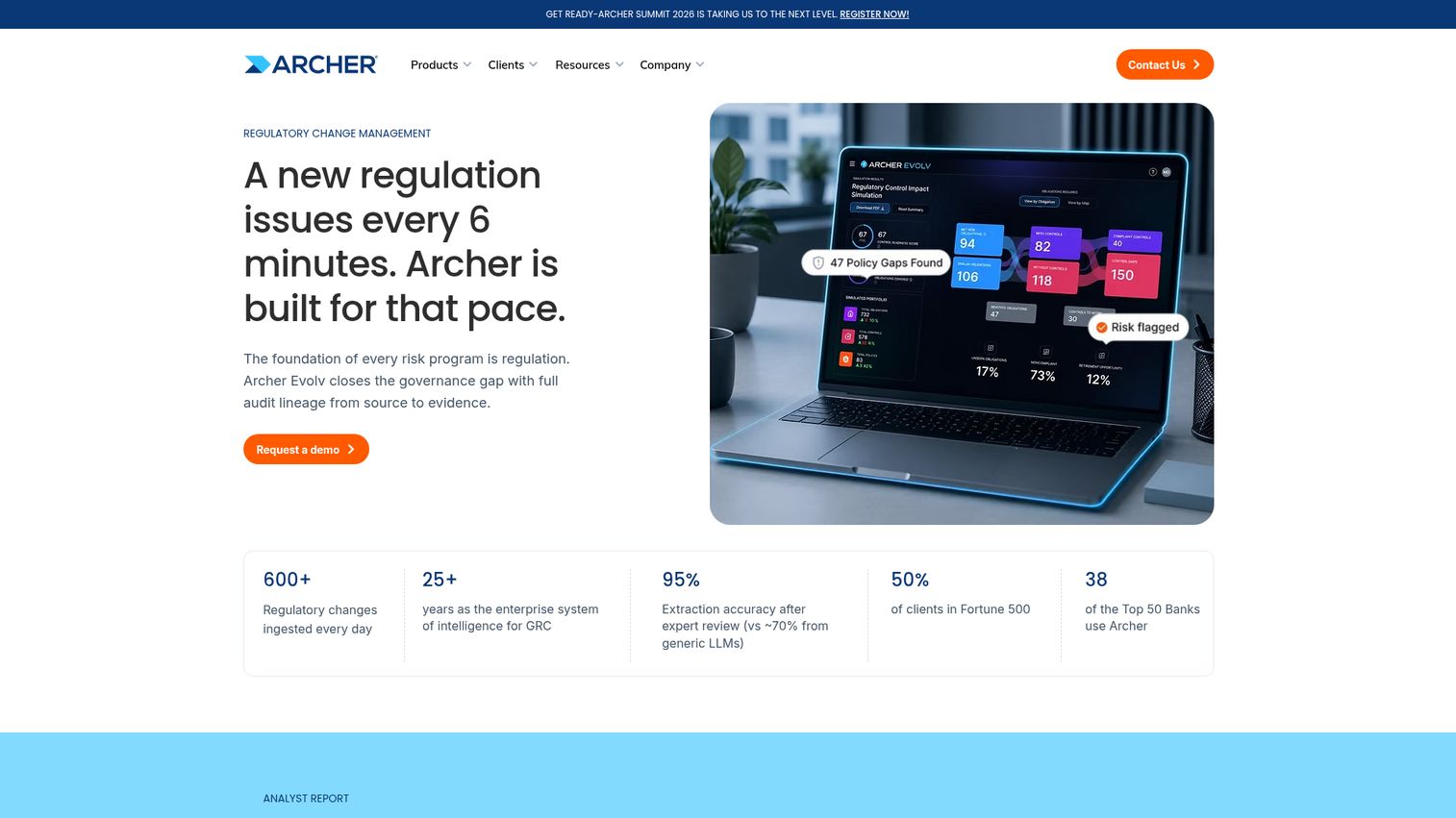
Archer is a long-established integrated risk management platform covering enterprise risk, compliance, audit, third-party risk, IT and security risk, ESG, resilience, and RMIS. It is recognized for deep configurability and a broad library of risk use cases, which suits large enterprises with mature, complex programs.
Best for: large enterprises with complex, mature risk programs that need extensive configurability.
Key strengths
- AI-powered regulatory change management: workflows that run from regulation to control to evidence.
- Centralized enterprise and operational risk: manage enterprise and operational risk in one location.
- Third-party risk management: automate and streamline oversight of vendor relationships.
Why choose Archer: Archer's maturity and breadth are the draw. If your program has outgrown lighter tools and you need to model intricate risk structures, Archer's configurability handles it. That depth means it fits teams with the GRC expertise to use it well.
Archer pricing: Archer does not publish public pricing on its site, which presents contact and demo CTAs instead. Expect a custom enterprise quote. Archer holds a 3.6 out of 5 rating on G2.
5. ServiceNow Governance, Risk, and Compliance (GRC)
ServiceNow Governance, Risk, and Compliance unifies enterprise risk, compliance, continuity, privacy, and third-party risk programs on the ServiceNow AI Platform. It is the natural pick for organizations already standardized on ServiceNow, since risk runs natively alongside ITSM and other workflows.
Best for: midsize to large enterprises standardized on ServiceNow ITSM and workflow.
Key strengths
- Integrated Risk Management: enterprise-wide risk and compliance visibility on one platform.
- Business Continuity Management: risk mitigation, crisis management, plan testing, and recovery workflows.
- Third-Party Risk Management: automated workflows for a consistent, repeatable, and auditable vendor risk process.
Why choose ServiceNow GRC: The case is stack fit. If your org already runs on ServiceNow, GRC inherits the same workflow engine, data, and automation, which cuts integration work and keeps risk data live. For teams not on ServiceNow, the platform consolidation argument is weaker.
ServiceNow GRC pricing: ServiceNow provides pricing through custom quotes, evaluating your needs and offering scalable packages tailored to requirements. No public price or named paid tiers are shown. ServiceNow GRC holds a 4.2 out of 5 rating on G2.
6. IBM OpenPages (with watsonx)
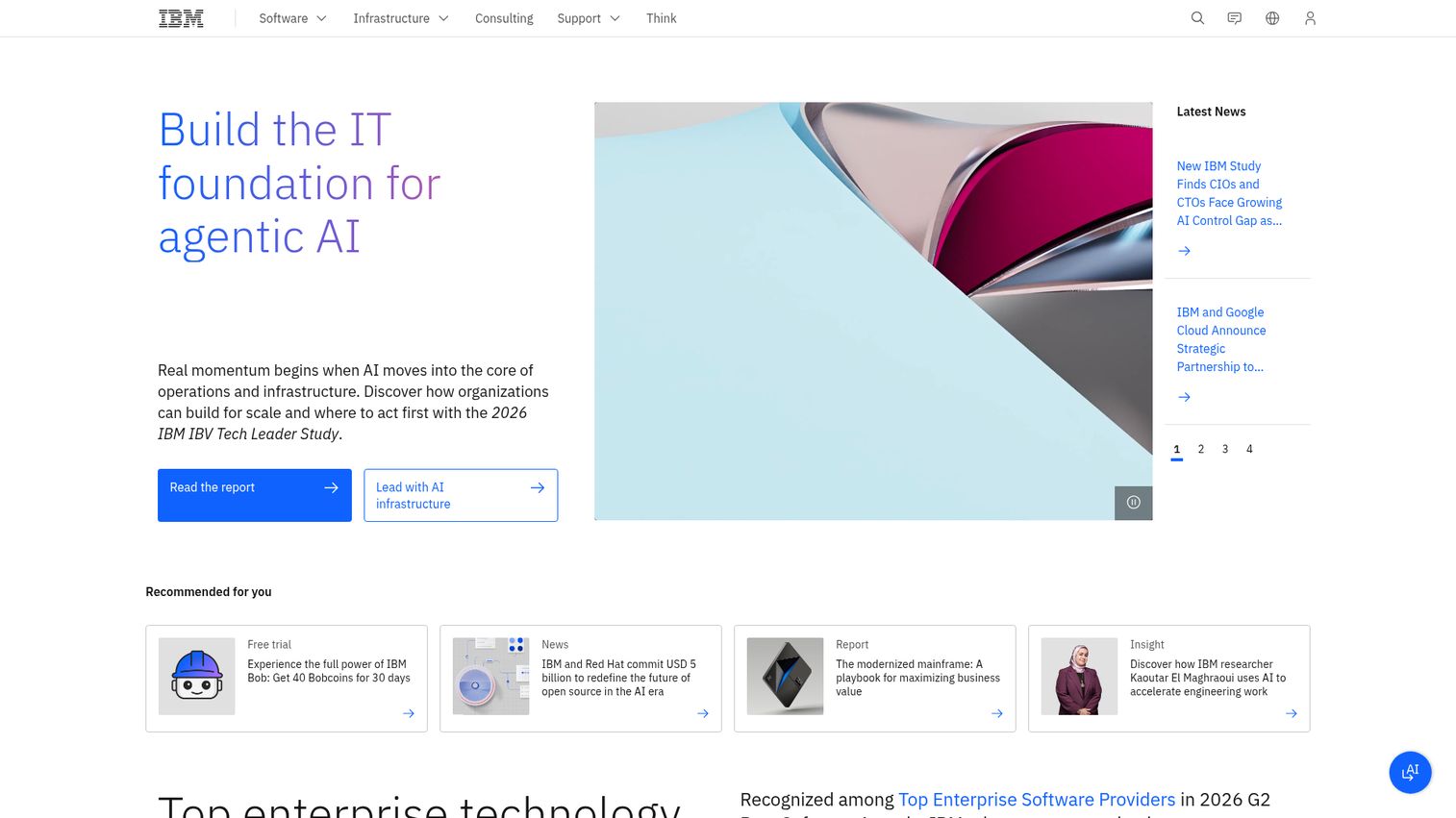
IBM OpenPages is a scalable, AI-powered GRC platform that manages risk, compliance, and audit in one integrated solution, with watsonx-driven analytics and automation. It suits large organizations that want AI augmentation layered onto a broad GRC foundation.
Best for: large enterprises that want AI-augmented risk analytics within the IBM ecosystem.
Key strengths
- OpenPages GRC Canvas: model processes, risks, and controls with live data.
- Embedded AI automation: watsonx-driven automation across governance, risk, and compliance activities.
- No-code configuration: workflow automation, a drag-and-drop view designer, a workflow designer, and a scheduler engine.
Why choose IBM OpenPages: OpenPages combines AI depth with enterprise scalability, and it is one of the few platforms here with published indicative pricing. That transparency helps when you need to budget before talking to sales. It fits organizations already invested in IBM or those prioritizing AI-augmented analytics.
IBM OpenPages pricing: IBM lists indicative starting prices: the SaaS Essentials edition from USD 3,300, the SaaS Standard edition from USD 6,050, On Cloud Single Solution from USD 6,250, and On Cloud Enterprise from USD 9,000. On-premises requires a custom quote. Prices are indicative, may vary by country, and exclude taxes. IBM OpenPages holds a 4.2 out of 5 rating on G2.
7. Resolver (a Kroll business)
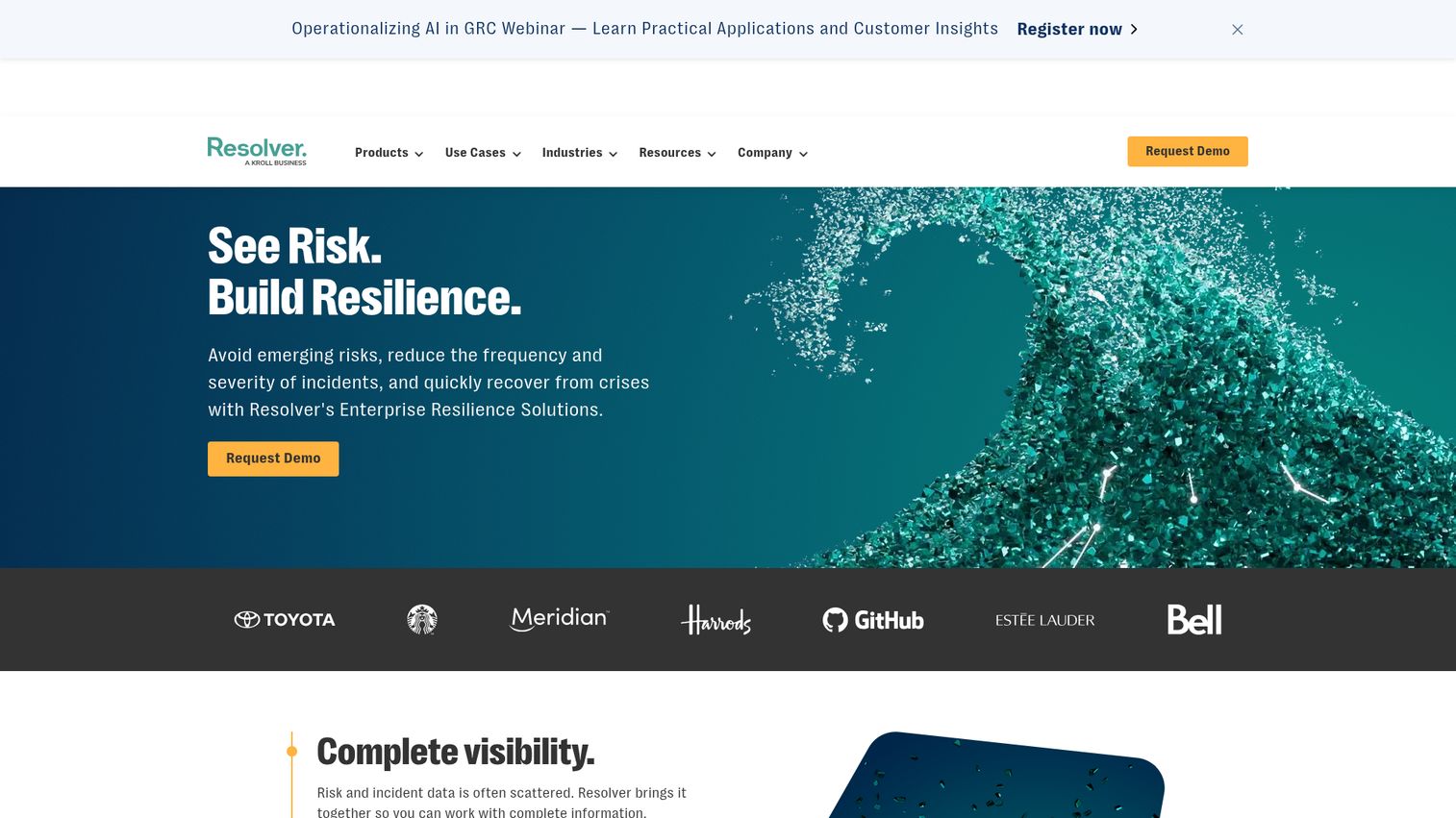
Resolver, a Kroll business, is an enterprise resilience and risk intelligence platform that connects risk, audit, compliance, incident, security, investigations, and trust-and-safety workflows. It stands out for linking operational and security risk data with strong reporting and analytics.
Best for: security, operational, and compliance risk teams that want connected risk and incident data.
Key strengths
- Unified risk and incident data: configurable workflows, dashboards, reports, analytics, and AI-assisted workflows.
- GRC coverage: enterprise risk management, internal audit, internal controls, third-party risk, business continuity, IT risk, and risk event management.
- Security and investigations depth: incident management, investigations, security risk management, command center, and threat protection.
Why choose Resolver: Resolver's strength is the link between risk and incidents, which matters for operational and physical security teams. If your risk picture depends on incident data as much as control testing, that connected model is the differentiator.
Resolver pricing: Resolver uses tailored pricing based on selected solutions, customization level, and active users. No public price figures or tier prices are listed, so request a custom quote. Resolver holds a 4.3 out of 5 rating on G2.
8. AuditBoard
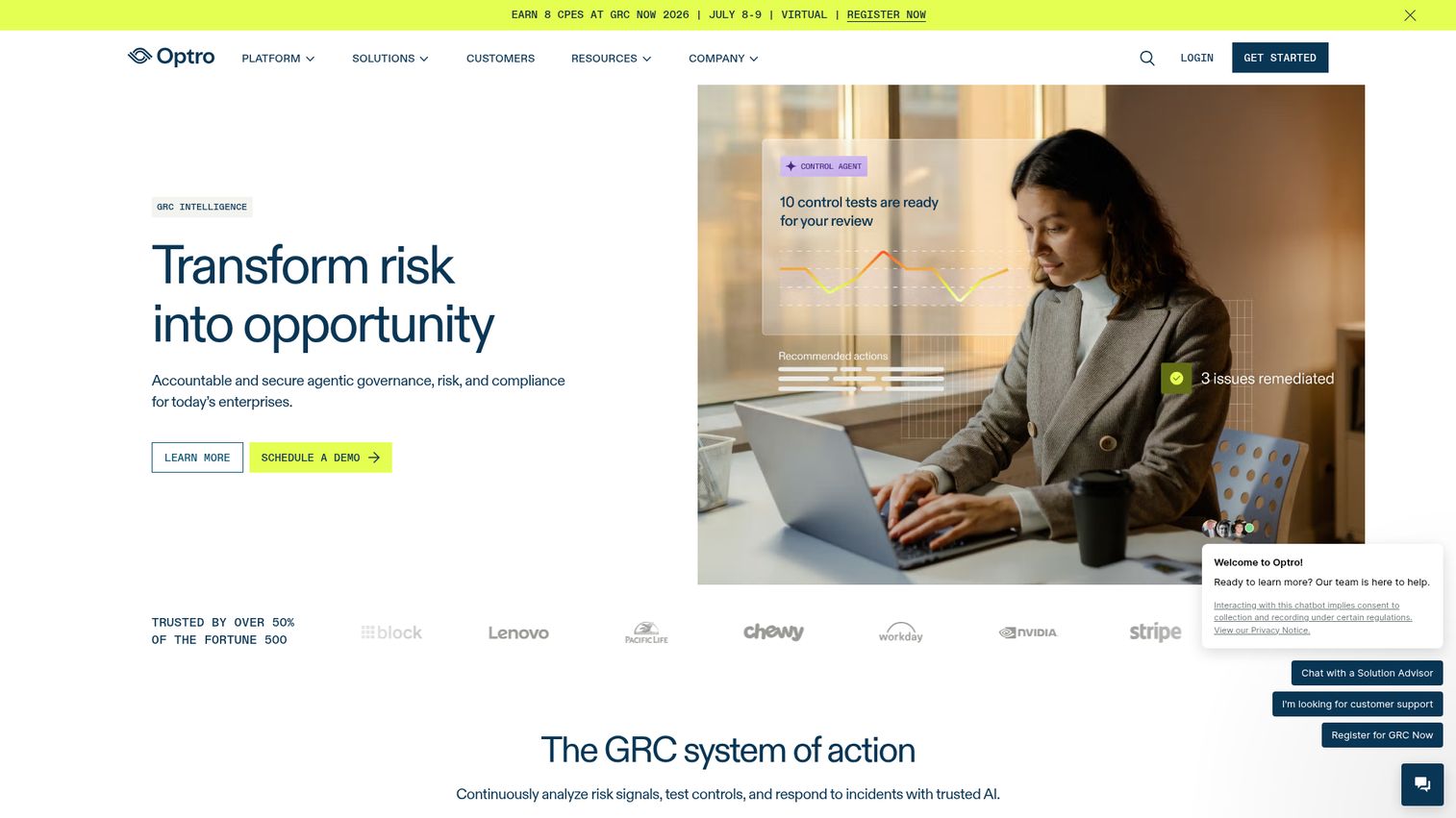
AuditBoard, now operating as Optro, is an AI-powered GRC platform for enterprise audit, risk, compliance, and governance. It built its reputation in internal audit and SOX, then expanded into connected risk and ERM, which makes it a natural fit for audit-led organizations.
Best for: audit-led organizations aligning risk with SOX and internal controls.
Key strengths
- Unified risk foundation: connect risks, controls, evidence, and frameworks in one place.
- GRC system of action: analyze evidence, surface control failures, identify emerging risks, and recommend actions.
- Continuous monitoring: automated assurance workflows, analytics, and automation.
Why choose AuditBoard: If internal audit and SOX drive your program, AuditBoard's auditor-friendly design and controls workflows are hard to beat. The convergence of audit and ERM on one platform suits teams that want risk and assurance speaking the same language.
AuditBoard pricing: AuditBoard, now Optro, aligns pricing to business needs and offers unlimited stakeholder licenses, flexible plans, and white-glove services. No public numeric prices or named tiers are displayed, so request a quote. The platform holds a 4.6 out of 5 rating on G2.
9. Workiva
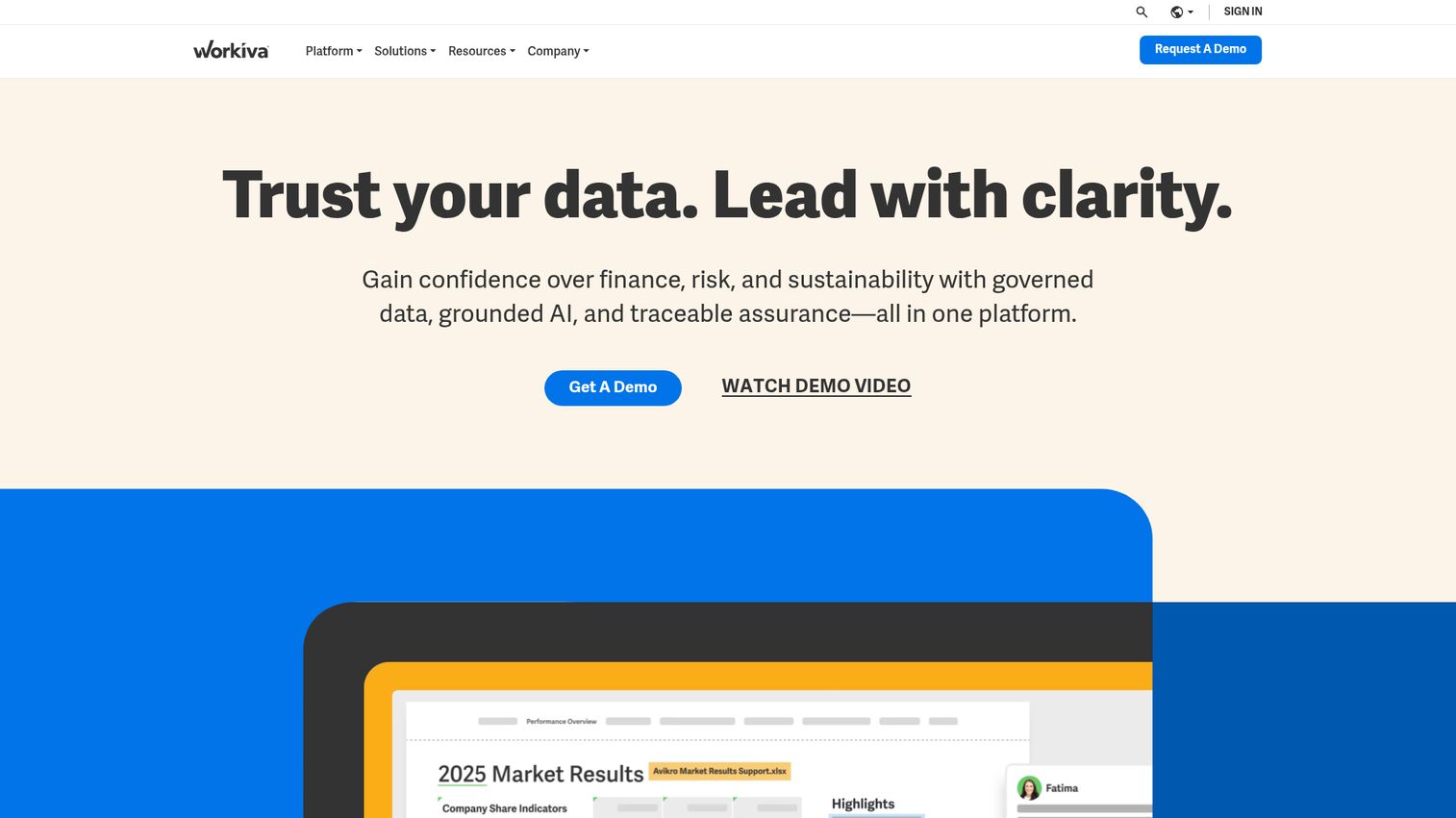
Workiva is an AI-powered cloud platform for finance, risk, sustainability, and assured integrated reporting. It connects risk, controls, audit, and policy to financial and regulatory reporting, including SEC and SOX, which makes data integrity its defining feature.
Best for: teams that need ERM tightly linked to financial and regulatory reporting.
Key strengths
- Data linking: connect data across documents, spreadsheets, and presentations so numbers stay consistent.
- Governed AI: AI for finance, risk, and sustainability workflows with controls around it.
- Connectivity: pre-built connectors, open APIs, and secure data connections.
Why choose Workiva: When risk data has to be reporting-grade and survive audit scrutiny, Workiva's link between risk and financial reporting is the draw. It fits finance, risk, audit, and sustainability teams that need one controlled, audit-ready source.
Workiva pricing: Workiva bases pricing on company needs and directs buyers to sales for a customized quote. Some solutions use a good, better, best packaging approach, but no public tier names or prices are shown. Workiva holds a 4.5 out of 5 rating on G2.
10. LogicGate Risk Cloud
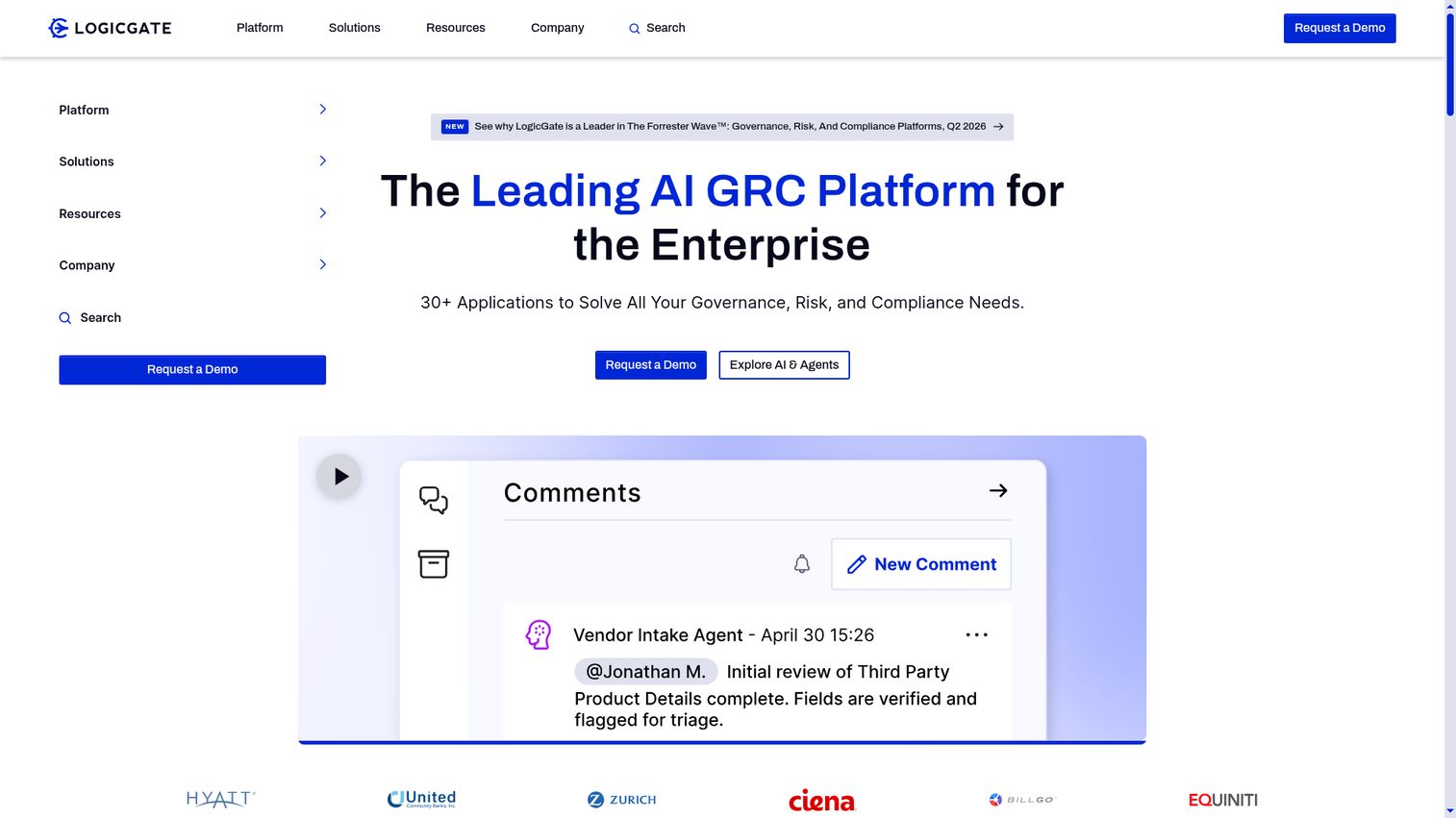
LogicGate Risk Cloud is a governance, risk, and compliance platform for managing GRC workflows, data, applications, and reporting. Its no-code application builder lets teams configure risk, compliance, audit, and third-party risk workflows quickly, without heavy IT involvement.
Best for: teams that want configurable, no-code risk workflows with fast deployment.
Key strengths
- No-code flexible graph database: build and connect risk applications without code.
- Workflow automation: automate assessments, approvals, and remediation across programs.
- Reporting and analytics: turn connected risk data into dashboards and reports.
Why choose LogicGate Risk Cloud: The appeal is speed and flexibility. If you need to stand up and adjust risk workflows without waiting on engineering, the no-code builder delivers. That makes it well suited to teams that expect their risk model to keep evolving.
LogicGate Risk Cloud pricing: LogicGate uses tailored pricing based on the applications needed plus Power User licenses, with optional product features, implementation, professional, and integration services. No public numeric price is shown, so request custom pricing. LogicGate Risk Cloud holds a 4.6 out of 5 rating on G2.
How to choose the right enterprise risk management software
A demo will show you features. The criteria below show you whether the platform survives contact with your org. When you do schedule those demos, an interactive demo of how each platform handles your actual workflows reveals far more than a feature checklist.
Enterprise-wide visibility and connected data
The whole point is one source of truth, not another siloed register. Check whether the platform links risks to controls, owners, assessments, and reporting automatically. If you still have to reconcile data by hand, the tool has not solved your core problem.
Regulatory framework alignment
Map the platform's coverage against your actual regulatory footprint: ISO 31000, COSO, SOX, DORA, NIS2, NIST, GDPR, and HIPAA. DORA, NIS2, and AI governance are reshaping resilience and compliance requirements in 2026, so verify the vendor is keeping pace, not just listing frameworks on a page. For teams evaluating how vendors handle data protection, our security and compliance standards offer a useful reference point.
Integrations and stack fit
Look at how the platform connects to your CRM, ITSM, data warehouse, analytics tools, and SSO. Weak integrations create manual data movement, and that is where the opportunity cost of maintenance hides. A risk control software platform that does not plug into your stack becomes a second job. The strength of a vendor's integration capabilities often decides whether a platform sticks.
Scalability and maintainability
Will it scale across business units, and will it survive frequent change without heavy admin overhead? Configurable platforms are powerful, but they need owners. Be honest about whether you have the GRC bandwidth to keep the system current. Pairing rollout with user onboarding software helps teams adopt complex platforms faster.
Measurable impact and reporting
Confirm the platform produces dashboards, KRIs, and board-ready reporting that prove ROI. If you cannot demonstrate that the enterprise risk management system software improved visibility or reduced audit effort, renewal conversations get hard.
Conclusion
The right enterprise risk management software depends on what is breaking. If tool sprawl is the problem, Riskonnect and Archer are built to consolidate many risk domains onto one configurable platform. For mid-market teams, LogicManager's fixed-fee, unlimited-user model removes the adoption friction that kills broader rollouts. Audit-led organizations gravitate to AuditBoard, while teams that need reporting-grade data linked to SEC and SOX lean toward Workiva. For AI-augmented analytics with published indicative pricing, IBM OpenPages stands out, and LogicGate Risk Cloud wins on no-code speed.
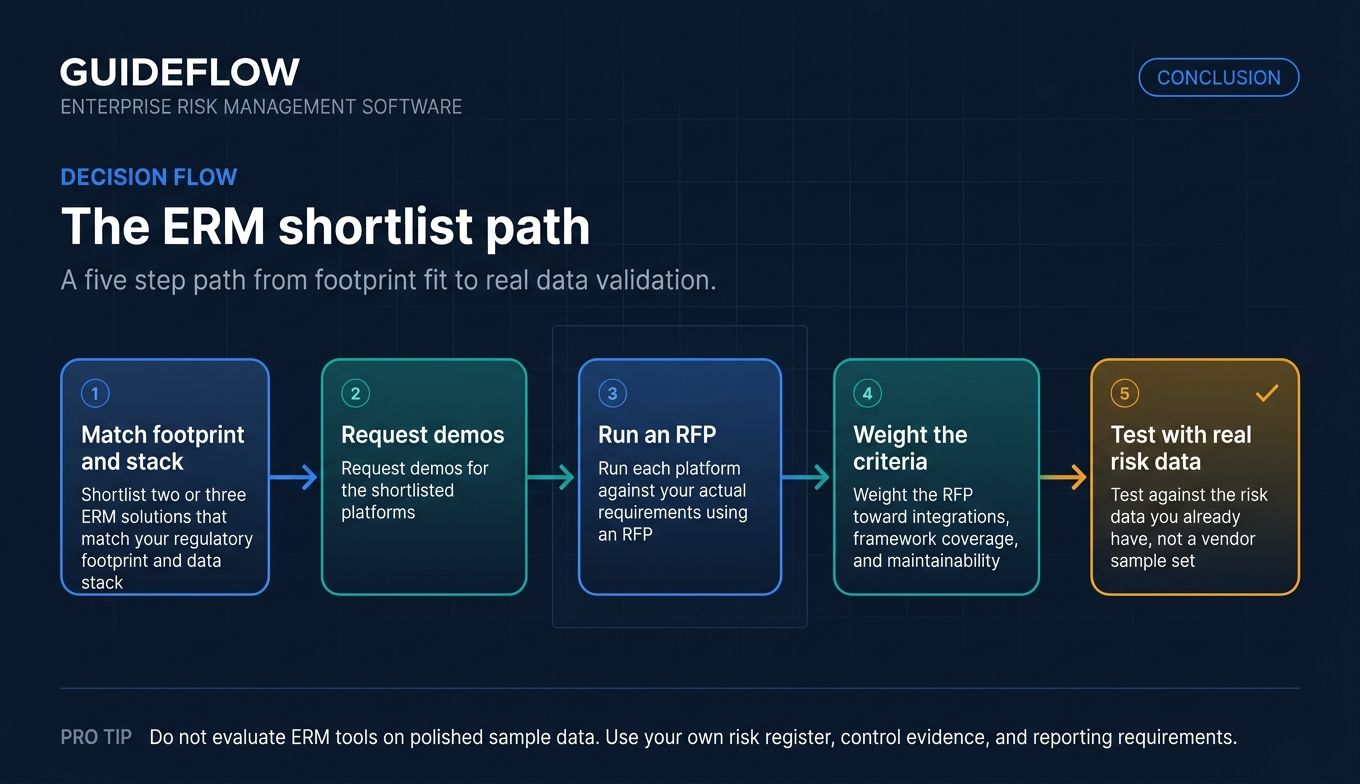
The next step is simple. Shortlist two or three of these enterprise risk management solutions that match your regulatory footprint and data stack. Request demos, then run each one against your actual requirements using an RFP, with weight on integrations, framework coverage, and maintainability. If your own team relies on tools like these, a digital adoption platform can speed up internal adoption. Test the platform against the risk data you already have, not a vendor's sample set, so you know how it performs in your environment before you commit.
FAQs
Enterprise risk management software is a centralized platform that helps organizations identify, assess, monitor, and report risk across the entire enterprise in one connected system. It replaces scattered spreadsheets and siloed point tools with a single source of truth that links risks, controls, owners, and reporting.
Core features include a connected risk register, multi-dimensional risk assessments, control design and testing, KRI and KPI monitoring, dashboards and heat maps, workflow automation, regulatory framework mapping, reporting, and integrations. Strong ERM software ties these together so risk data flows automatically rather than being reconciled by hand.
Evaluate enterprise-wide visibility, regulatory framework alignment, integrations and stack fit, scalability, and measurable impact. Shortlist two or three tools that match your regulatory footprint and data stack, then request demos and run each against your real requirements in an RFP. Test with your own risk data, not a vendor sample.
ERM software focuses on enterprise-wide risk identification, assessment, and reporting. GRC adds governance and compliance to that risk view. IRM is the broader connected category that spans operational, vendor, IT, digital, and resilience risk. The labels overlap, and most enterprise platforms cover all three to some degree.
Most ERM platforms use custom or enterprise pricing based on modules, users, and risk domains, so vendors typically provide a quote after a sales conversation. Some publish indicative figures: IBM OpenPages lists a SaaS Essentials edition starting around USD 3,300. Others, like LogicManager, use fixed-fee, all-inclusive pricing with unlimited users.
Look for support or mapping to ISO 31000, COSO, SOX, DORA, NIS2, NIST cybersecurity framework, GDPR, HIPAA, and APRA CPS 230 standard. Relevance varies by industry and region, so match the platform's coverage against your actual obligations. DORA, NIS2 directive, and AI governance are increasingly important for 2026 buyers.
Yes, if your risk data is fragmenting across spreadsheets or your audit load is rising. Some platforms, like LogicManager, are purpose-built for mid-market teams with fixed-fee pricing and advisory support. The value comes from consolidating fragmented data and reducing manual reporting before complexity outgrows your current process.
It maps to the full risk lifecycle: identification (a connected risk register), assessment (multi-dimensional scoring), treatment (control design and remediation workflows), monitoring (KRIs and continuous control testing), and reporting (dashboards and board-ready outputs). By connecting each stage in one system, ERM software keeps the process continuous rather than periodic.