Your content is scattered across 6 tools. Content experience platforms exist to fix that, but the category has gotten noisy.
You've got blog posts in one CMS, whitepapers in a DAM, case studies in a shared drive, product pages on your website, and demos living somewhere else entirely. Some of this content performs. Most doesn't. And you can't connect any of it to pipeline because your CMS tracks page views, not engagement. The right attribution software can help bridge that gap, but your content platform needs to do its part too.
Content experience platforms unify creation, personalization, distribution, and measurement of content across the buyer journey. But here's the problem: CMS vendors, digital experience platform vendors, and interactive content tools all claim the CXP label now. The category confusion is real.
This guide cuts through the noise.
You'll find 15 content platforms compared on what actually matters for growth and marketing teams: personalization depth, integration quality, analytics, and honest trade-offs for each.
What's inside
- 15 content experience platforms evaluated on personalization, content management, integration depth, analytics, and pricing
- A clear breakdown of CXP vs. CMS vs. DXP, with a side-by-side comparison table
- Situational guidance on when you actually need a CXP (and when you don't)
- How interactive content fits into the content experience category in 2026
- A structured "how to choose" framework with platform-to-use-case mapping
- 2026 trends shaping the category, with specific platforms driving each shift
TL;DR
- Content experience platforms go beyond CMS by adding personalization, analytics, and omnichannel delivery to your content stack. The CXP market is estimated at $5.5 billion in 2025 and growing at 15% CAGR (Data Insights Market, 2025).
- Enterprise picks: Adobe Experience Manager, Sitecore, Optimizely. Mid-market: Contentstack, HubSpot CMS Hub, Bloomreach. Lean teams: Storyblok, Contentful, Foleon.
- The category is converging with DXPs, DAMs, and interactive content tools. Know what problem you're solving before you shop.
- AI-driven personalization is the feature separating 2026 CXPs from glorified CMS platforms. AI-driven content optimization improves engagement metrics by up to 40% compared to traditional methods (Intel Market Research, 2026).
- Pricing ranges from free (open-source headless CMS) to $100K+/year (enterprise DXP suites). Budget alignment matters more than feature lists.
What is a content experience platform?
A content experience platform (CXP) is software that helps marketing teams create, manage, personalize, and analyze content across channels and touchpoints. Where a traditional CMS focuses on publishing and organizing content, a CXP adds personalization, audience targeting, engagement analytics, and distribution that turn static content into measurable experiences.
A digital content experience platform typically includes 5 core components:
- Content management: Create, organize, and store content in a central repository with version control and collaboration tools
- Personalization engine: Deliver different content to different audiences based on behavior, firmographics, or funnel stage. Explore dedicated personalization software if your CXP's native capabilities fall short.
- Omnichannel distribution: Publish content across web, mobile, email, social, and third-party channels from one platform
- Analytics and engagement tracking: Measure scroll depth, interaction rates, time on content, and content-to-pipeline attribution, not just page views. Marketing analytics software can supplement your CXP's built-in reporting.
- Integration layer: Connect to your CRM, marketing automation, ad platforms, and analytics tools so content data flows into your existing stack
A note on related terms: content experience platform is sometimes used interchangeably with "digital experience platform" (DXP), though digital experience platforms typically include broader capabilities like commerce, portals, and customer data management. "Content engagement platform" is another variant that emphasizes the measurement side of the equation.
CXP vs. CMS vs. DXP: what's the difference?
These three labels overlap enough to cause real confusion during platform evaluation. Here's how they differ in practice.
| Feature | CMS | CXP | DXP |
|---|---|---|---|
| Content creation & management | ✓ | ✓ | ✓ |
| Personalization | Basic/none | Advanced | Advanced |
| Omnichannel delivery | Limited | ✓ | ✓ |
| Content analytics | Page-level | Engagement-level | Full journey |
| Commerce | No | No | Often included |
| Customer data platform | No | Sometimes | Usually |
| Portal/community | No | No | Often included |
| Typical buyer | Small teams, bloggers | Marketing teams | Enterprise digital teams |
The digital customer experience platform category (DXP) is the broadest. It wraps content, commerce, portals, and customer data into one suite. A CXP is more focused: content-specific use cases without the commerce and portal overhead.
When to choose each:
- If you need to publish blog posts and landing pages, a CMS works.
- If you need to personalize content by audience and measure engagement across channels, you need a CXP.
- If you need all of that plus commerce, portals, and enterprise-grade orchestration, you're looking at a DXP.
When to use a content experience platform
Scaling personalized content across segments
When your content is one-size-fits-all and you need to deliver different content experiences to different buyer personas, industries, or funnel stages. A CXP lets you create once and personalize at delivery, rather than maintaining 12 versions of the same landing page. Teams running account-based marketing strategies benefit the most from this capability.
Measuring content impact on pipeline
When you can't connect content engagement to revenue and need analytics beyond page views. CXPs track engagement depth (scroll, click, time, interaction) and tie it to CRM data so you can see which content actually influences deals.
Consolidating content operations
When content lives in 5+ tools and your team spends more time managing platforms than creating content. A CXP centralizes creation, distribution, and measurement into one place. Pairing it with content creation software can further streamline your workflow.
Supporting ABM and account-based content
When your ABM strategy requires personalized content hubs or microsites for target accounts. CXPs with account-level personalization let you build tailored experiences without custom development for each account.
Content experience platform comparison table
Here's how the 15 content platforms compare on positioning, differentiation, pricing, and user ratings.
| # | Product | Best For | Key Differentiation | Pricing | G2 Rating |
|---|---|---|---|---|---|
| 1 | Adobe Experience Manager | Enterprise omnichannel | Full Adobe ecosystem integration | Custom (est. $100K+/yr) | 4.0/5 |
| 2 | Sitecore Experience Platform | Enterprise personalization | Deep personalization + analytics | Custom (est. $80K+/yr) | 3.9/5 |
| 3 | Optimizely One | Experimentation-driven CX | Built-in A/B testing and experimentation | Custom (est. $50K+/yr) | 4.2/5 |
| 4 | Contentstack | Headless CXP for mid-market | Composable, API-first architecture | From $995/mo | 4.6/5 |
| 5 | Bloomreach | Commerce-driven content | AI-powered search and merchandising | Custom pricing | 4.6/5 |
| 6 | HubSpot CMS Hub | All-in-one marketing | CRM-native personalization | Free tier; from $20/mo | 4.5/5 |
| 7 | Contentful | Developer-first headless | Flexible content modeling | Free tier; from $300/mo | 4.2/5 |
| 8 | Storyblok | Visual headless CMS | Visual editor + headless architecture | Free tier; from $99/mo | 4.6/5 |
| 9 | Acquia DXP | Drupal-based enterprise | Open-source foundation + enterprise tools | Custom pricing | 4.1/5 |
| 10 | Magnolia DXP | Integration-first DXP | Connector framework for existing stack | Custom pricing | 4.4/5 |
| 11 | Foleon | Interactive content creation | No-code interactive content builder | Custom pricing | 4.6/5 |
| 12 | RELAYTO | Document-to-experience conversion | Turns static docs into interactive experiences | Free tier; from $65/mo | 4.7/5 |
| 13 | Showpad | Sales content experience | Sales enablement + content analytics | Custom pricing | 4.6/5 |
| 14 | Kentico Xperience | .NET-based DXP | Headless + traditional hybrid | From $990/mo | 4.4/5 |
| 15 | Liferay DXP | Portal-centric DXP | Self-hosted + cloud, strong portal capabilities | Free (CE); custom (DXP) | 4.2/5 |
15 best content experience platforms reviewed
Below, each platform gets an honest review: what it does well, who it's built for, and where it falls short.
1. Adobe Experience Manager
Adobe Experience Manager is the enterprise standard for organizations already invested in the Adobe stack. It serves a dual role as both a content management system and a digital asset management platform, which means your content and assets live in one place instead of two separate tools.
The core value proposition is integration depth. AEM connects natively to Adobe Analytics, Adobe Target, Adobe Campaign, and Adobe's CDP. Its headless/hybrid architecture supports both traditional page-based and API-driven content delivery, giving enterprise teams flexibility as their content strategy evolves.
Best for: Enterprise marketing teams with dedicated technical resources and an existing Adobe stack.
Key strengths
- Integrated DAM and content management in one platform
- Advanced personalization via Adobe Target integration
- Omnichannel delivery across web, mobile, and IoT
- Headless and hybrid CMS architecture for flexible delivery
- Deep analytics via Adobe Analytics integration
AEM requires significant technical resources: dedicated developers, implementation partners, and 6-12+ months for implementation. Total cost of ownership is among the highest in the category. If you're a lean marketing team or don't have existing Adobe investments, this is the wrong starting point.
Pricing: Custom enterprise pricing (typically $100K+/year).
2. Sitecore Experience Platform
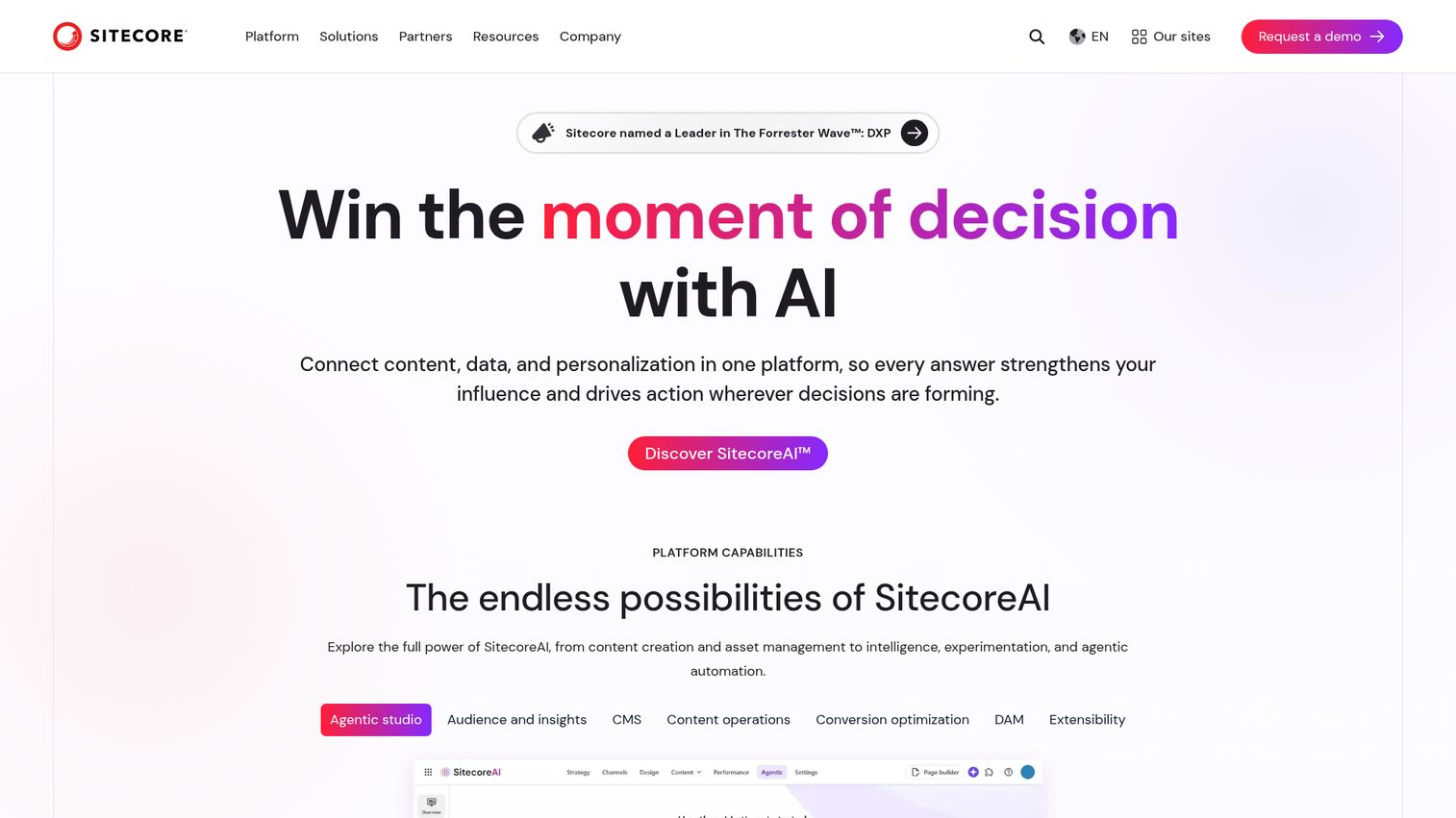
Sitecore is the personalization-first digital experience platform. Its core strength is behavioral personalization: delivering different content based on what users have done, not just who they are. The composable DXP strategy (XM Cloud, Content Hub, CDP) reflects Sitecore's shift from monolithic to modular architecture.
Both B2B and B2C teams use Sitecore, but it tends to work particularly well for organizations where personalization is a competitive advantage, not a nice-to-have.
Best for: Mid-to-large enterprises that need advanced behavioral personalization and have the technical team to support it.
Key strengths
- Personalization engine with behavioral and rules-based targeting
- Composable architecture via XM Cloud
- Built-in CDP and analytics for customer data unification
- Headless content delivery for multi-channel publishing
- Strong partner ecosystem for implementation support
Implementation is complex and expensive. Sitecore's architectural shift to XM Cloud creates migration friction for existing customers. The talent pool for Sitecore developers is smaller than for competing platforms, which directly affects hiring and ongoing maintenance costs.
Pricing: Custom enterprise pricing (typically $80K+/year).
3. Optimizely One
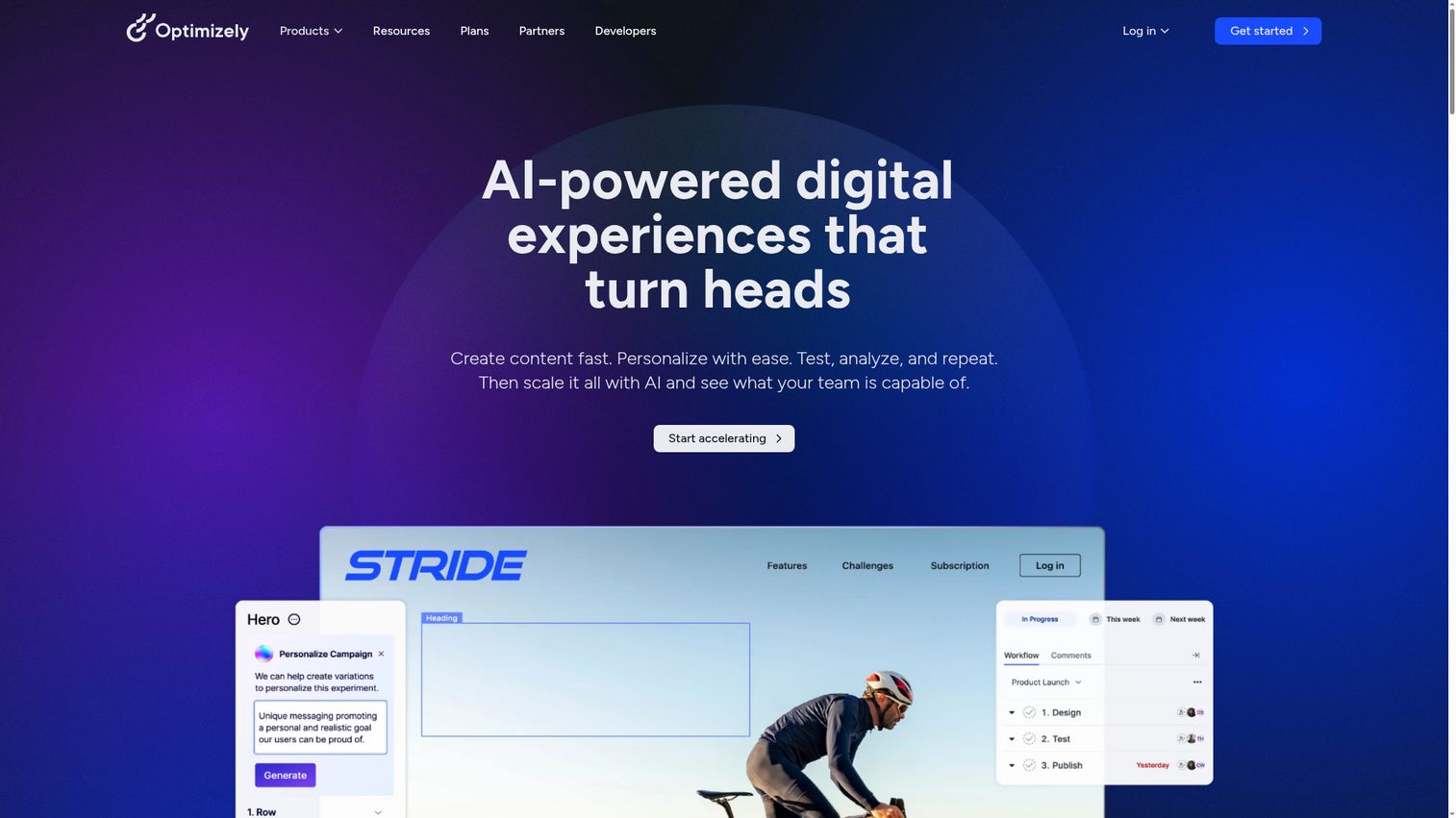
Optimizely is the experimentation-native CXP. A/B testing, feature flagging, and content experimentation are built into the platform's DNA, not bolted on as an afterthought. This resonates directly with growth marketers who think in experiments and hypotheses. If you're evaluating standalone experimentation tools, see our roundup of A/B testing tools.
The platform spans CMS, commerce, and content marketing, giving teams a single place to plan, create, test, and optimize content.
Best for: Growth-oriented teams that want experimentation built into their content delivery, not added as a separate tool.
Key strengths
- Native A/B testing and experimentation across content
- Content marketing platform for planning and creation
- Feature flagging for progressive rollouts
- Commerce capabilities for product-led content
- AI-powered content recommendations
Optimizely is still integrating multiple acquisitions (Episerver, Welcome, Zaius), so the unified experience can feel fragmented. Different modules have different UIs and different levels of maturity. Pricing is enterprise-level, putting it out of reach for smaller teams.
Pricing: Custom pricing (typically $50K+/year).
4. Contentstack
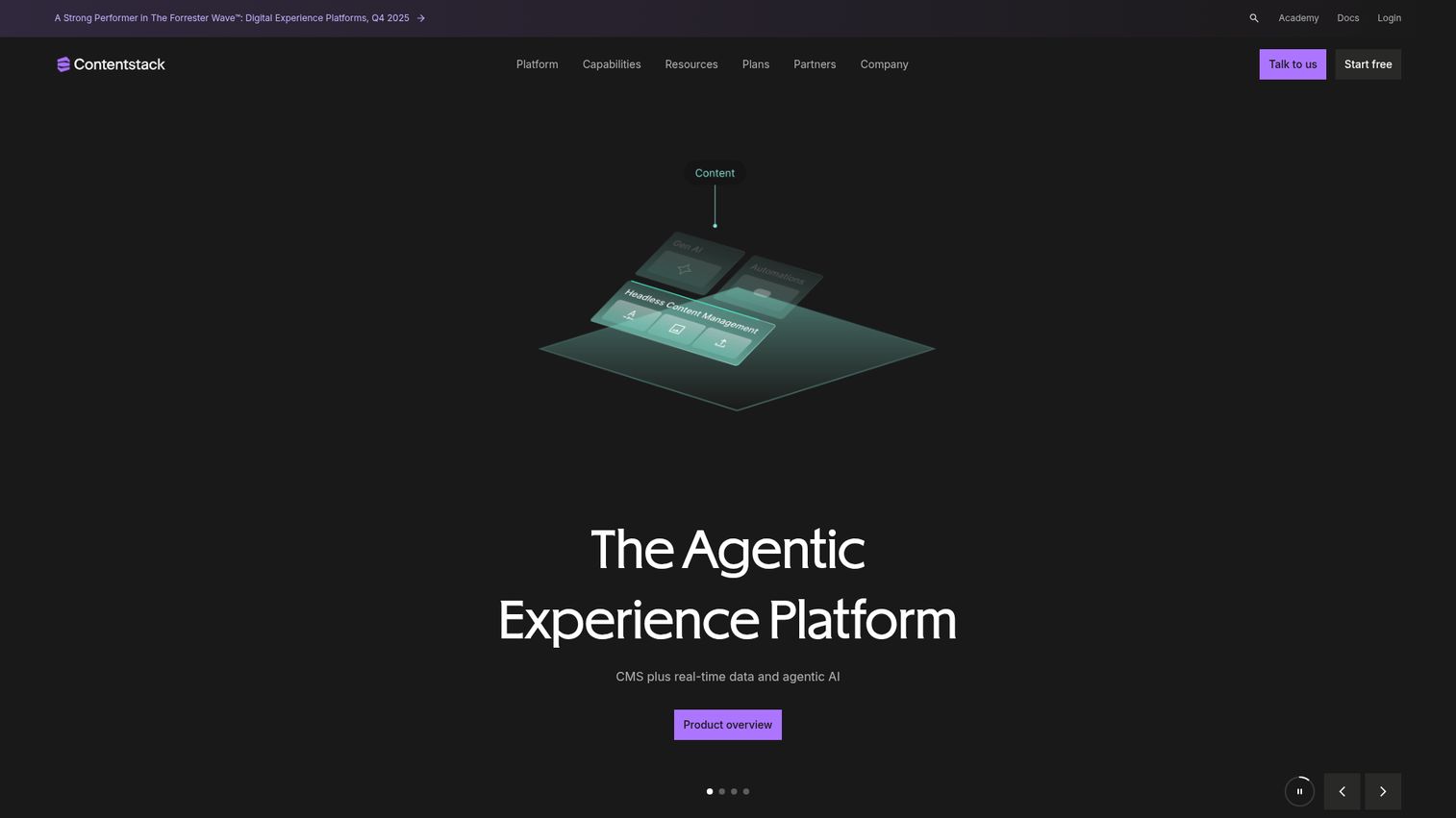
Contentstack is the leading headless CXP for mid-market teams that want composability without building everything from scratch. API-first architecture lets teams assemble their content stack with best-of-breed tools. The Automation Hub and marketplace (100+ integrations) reduce the "headless means more work" friction that stops many teams from going composable.
The AI content assistant is a 2026-relevant addition that helps teams create and optimize content faster within the platform.
Best for: Mid-market SaaS and B2B teams that want a composable, API-first content stack and have developer resources available.
Key strengths
- Composable, API-first architecture for flexible stacks
- Automation Hub for workflow automation
- Marketplace with 100+ pre-built integrations
- AI-powered content assistant for faster creation
- Multi-brand and multi-language support
Headless means you need frontend development resources. If your marketing team doesn't have access to developers (or a frontend framework), Contentstack requires more setup than traditional CXPs. The starting price ($995/month) is significant for early-stage teams.
Pricing: From $995/month.
5. Bloomreach
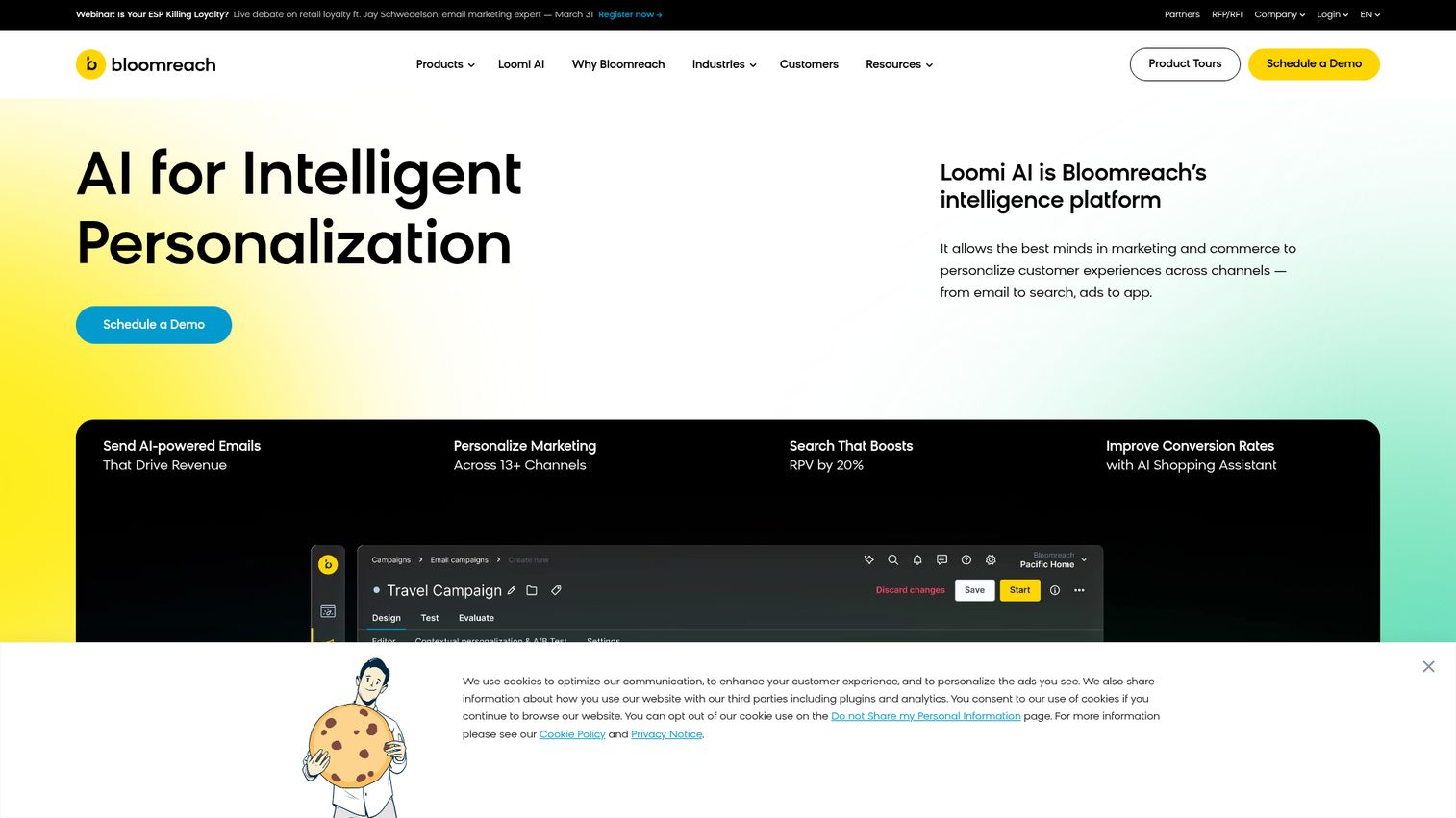
Bloomreach sits at the intersection of content and commerce. Its AI engine (Loomi) powers search, merchandising, and content personalization from a single platform. The Content module handles CMS and content delivery, while the Discovery module manages site search and recommendations.
This combination works particularly well for e-commerce and product-led companies where content and commerce need to operate as one experience, not two silos.
Best for: E-commerce and product-led companies that need AI-driven content + commerce personalization.
Key strengths
- Loomi AI for personalization and intelligent search
- Unified content and commerce platform
- Real-time customer segmentation
- Headless CMS capabilities for flexible delivery
- Strong A/B testing for content and merchandising
If you're purely B2B content marketing without a commerce component, much of Bloomreach's value goes unused. The platform is optimized for commerce-driven experiences, and B2B content-only teams will find themselves paying for capabilities they don't need.
Pricing: Custom pricing.
6. HubSpot CMS Hub
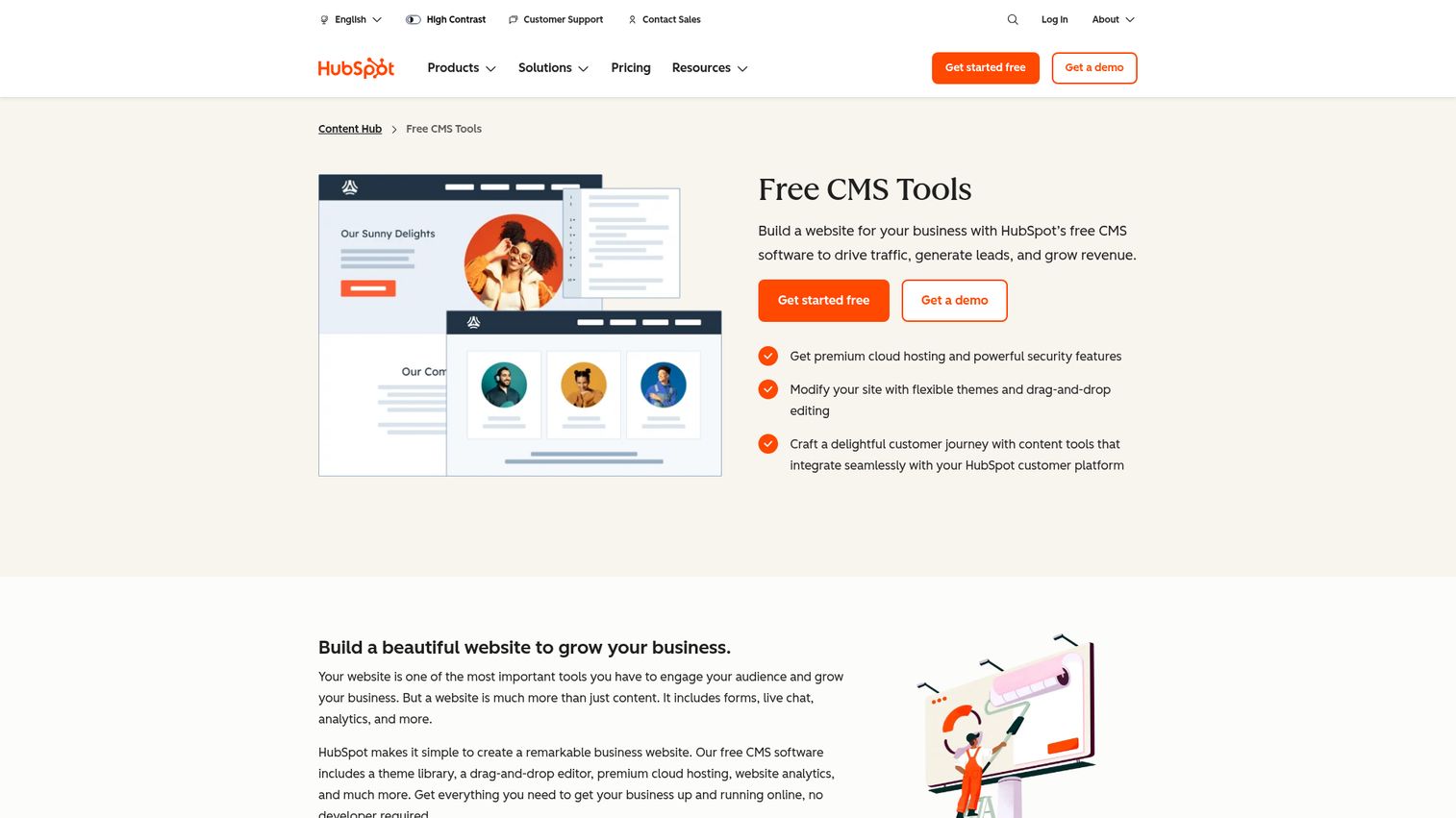
HubSpot CMS Hub is the most accessible CXP for teams already in the HubSpot world. The advantage is CRM-native personalization: you can personalize content based on CRM data (lifecycle stage, company size, deal stage) without any additional integration or data piping. If you're evaluating CRMs alongside your CXP, our best CRM software guide covers the broader landscape.
Smart content modules, adaptive testing (AI-driven A/B), and built-in analytics make it the fastest path from "we need personalization" to "it's live." The free tier makes it the lowest-risk entry point on this list.
Best for: Growth marketing teams already using HubSpot CRM who want fast, CRM-driven content personalization without adding another tool.
Key strengths
- CRM-native personalization via smart content modules
- Built-in analytics and attribution reporting
- Drag-and-drop page builder for non-technical users
- Adaptive testing with AI-driven A/B optimization
- Free tier available for getting started
Personalization is limited to HubSpot's data model. If your personalization needs go beyond what HubSpot CRM tracks, you'll hit a ceiling. The CMS is also less flexible than headless alternatives for complex content architectures or multi-brand setups. You're trading depth for speed and simplicity.
Pricing: Free tier available. Paid plans from $20/month.
7. Contentful
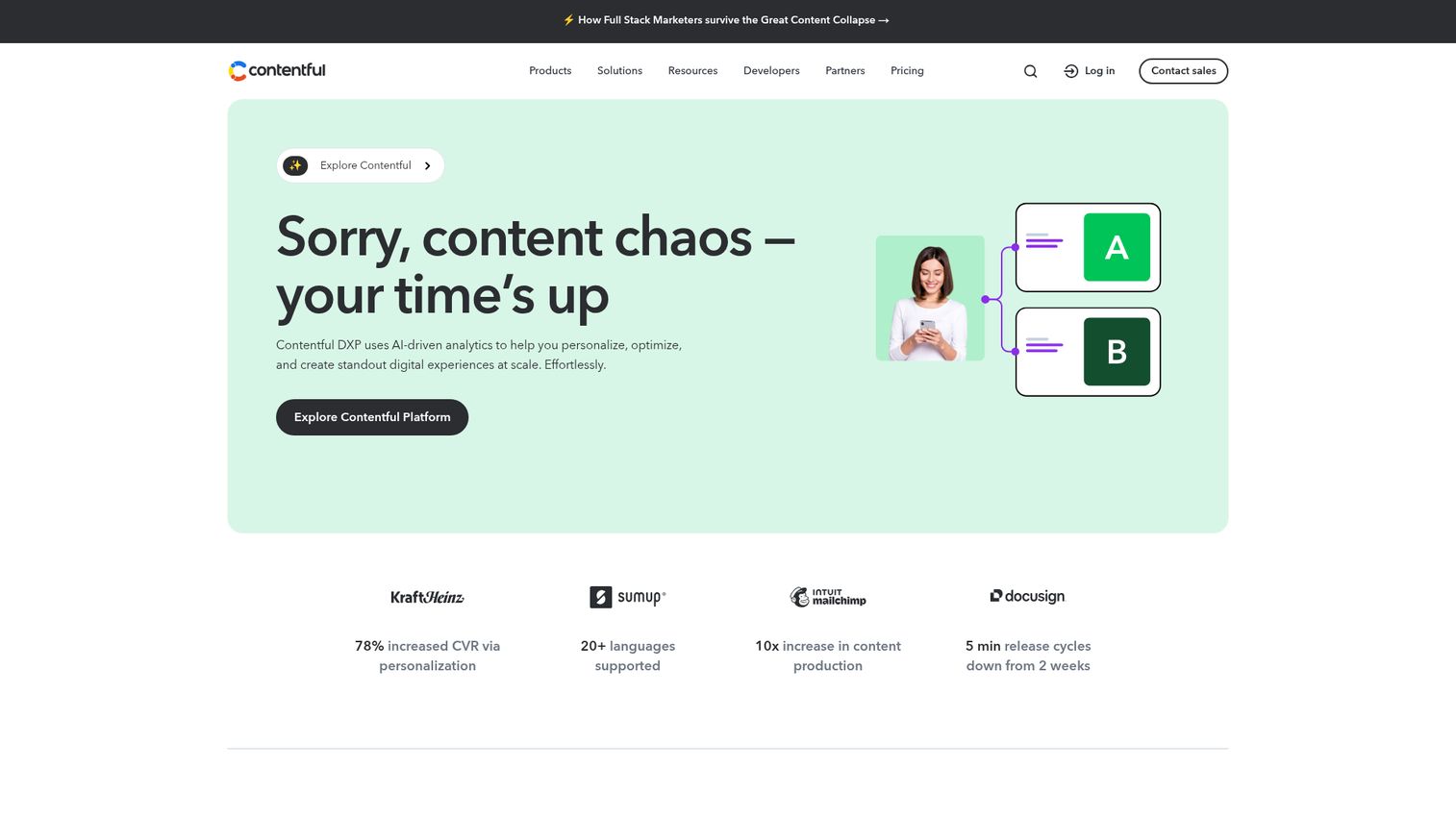
Contentful is the developer-favorite headless CMS that serves as a CXP foundation. Flexible content modeling, a strong API, and a large integration ecosystem make it the go-to for teams building custom content experiences from the ground up.
Contentful Studio adds a visual editing layer for non-technical users, which addresses the historical "marketers can't use headless CMS" complaint.
Best for: Teams with developer resources that want maximum flexibility in content architecture and are willing to assemble their own CXP stack.
Key strengths
- Flexible content modeling for any content structure
- Strong API and SDK ecosystem for developers
- Contentful Studio for visual editing by marketers
- App framework for custom extensibility
- Strong localization and multi-language support
Contentful is infrastructure, not a turnkey CXP. Personalization, analytics, and distribution require additional tools or custom development on top. Pricing scales with usage (API calls, content entries), which can get expensive at scale without careful monitoring.
Pricing: Free tier available. Paid plans from $300/month.
8. Storyblok
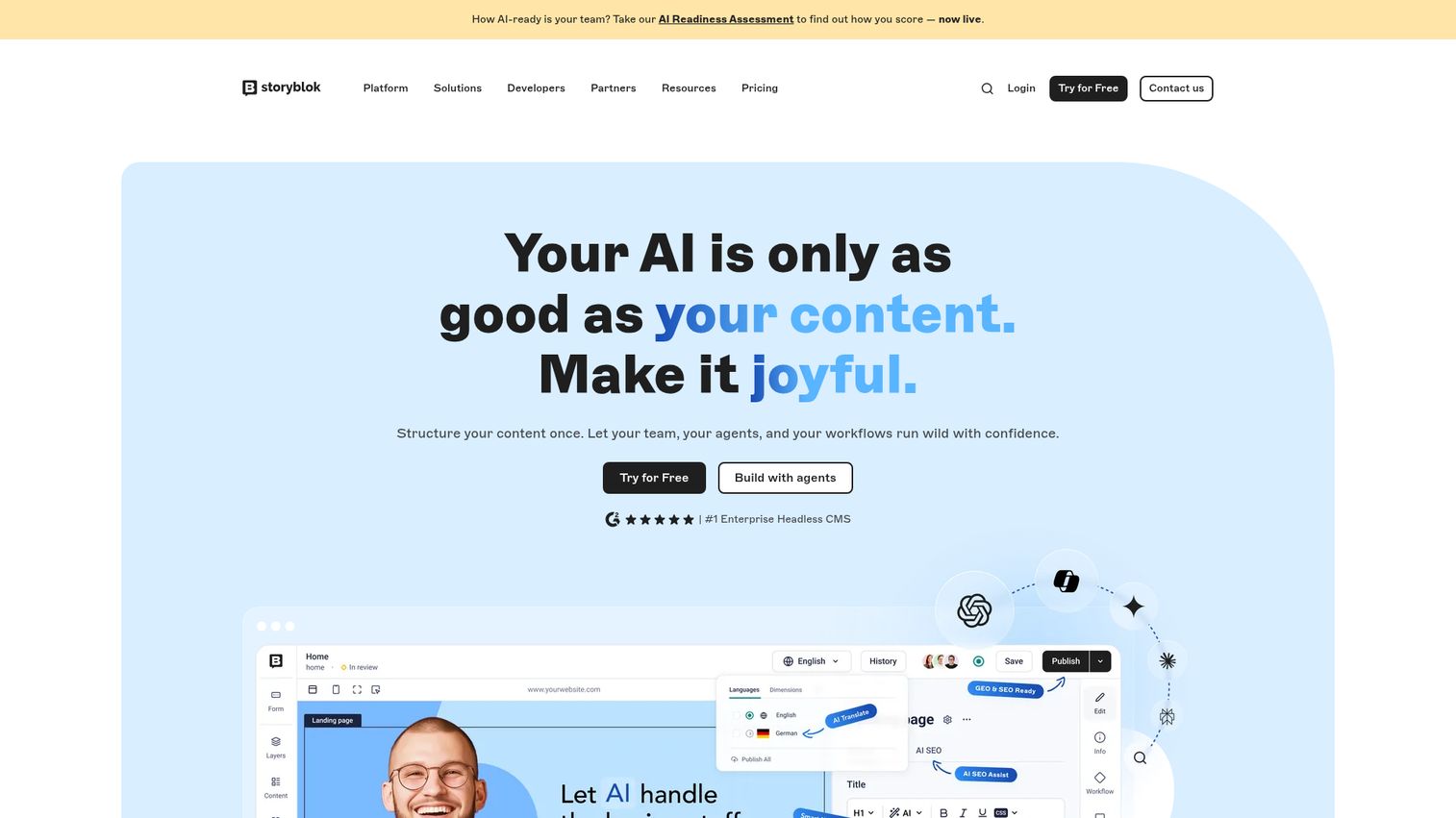
Storyblok is the headless CMS that solves the biggest headless pain point: marketers can't preview their work. The visual editor shows real-time previews of content across devices while maintaining headless architecture underneath.
This bridges the gap between developer flexibility and marketer usability better than any other headless CMS. Component-based content management is the other standout, letting teams build reusable content blocks.
Best for: Teams that want headless CMS flexibility with a visual editing experience marketers can actually use without developer help for every change.
Key strengths
- Visual editor with real-time preview across devices
- Headless, API-first architecture underneath
- Component-based content management for reusability
- Built-in image optimization for performance
- Multi-language and multi-site support
The platform is still maturing its enterprise features compared to Contentful or Contentstack. Personalization capabilities are basic compared to full CXP platforms like Sitecore or AEM. If advanced personalization is your primary need, Storyblok alone won't get you there.
Pricing: Free tier available. Paid plans from $99/month.
9. Acquia DXP
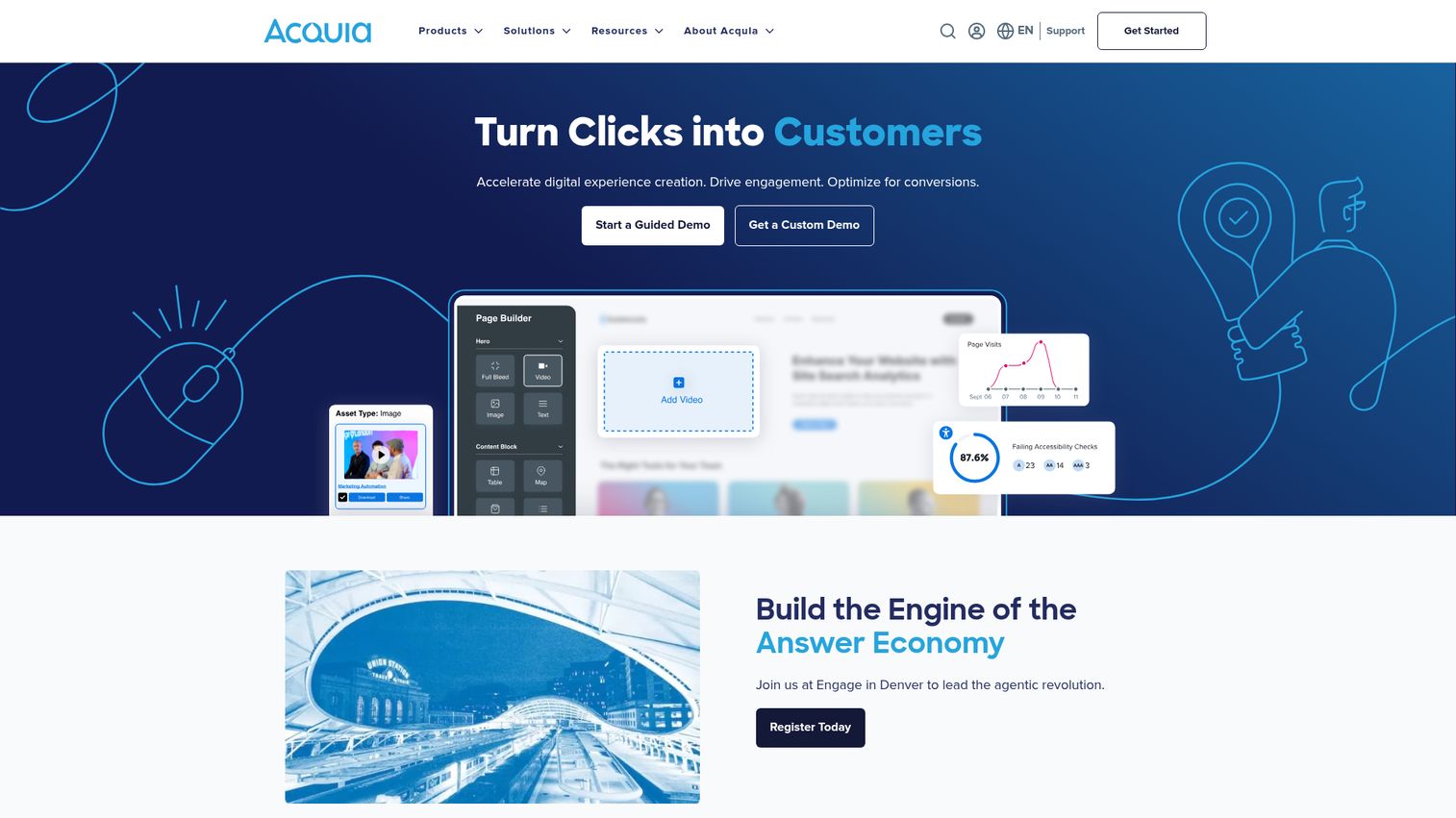
Acquia is the enterprise layer on top of Drupal's open-source foundation. For organizations already running Drupal, Acquia adds what Drupal alone can't provide: cloud hosting, CDN, personalization (Acquia Personalization), CDP, and DAM.
The open-source foundation gives more control and flexibility than proprietary platforms, and avoids vendor lock-in that concerns many enterprise buyers.
Best for: Organizations with existing Drupal investments that need enterprise-grade CXP capabilities without migrating to a new CMS.
Key strengths
- Built on open-source Drupal for maximum control
- Acquia CDP for customer data unification
- Personalization engine for targeted content delivery
- Cloud-native hosting and CDN for performance
- DAM integration via Acquia DAM
Drupal expertise is required, and the talent pool is smaller than for other CMS platforms. Implementation timelines tend to be longer than SaaS-native alternatives. If you're not already on Drupal, starting with Acquia means adopting Drupal first, which is a significant commitment.
Pricing: Custom pricing.
10. Magnolia DXP
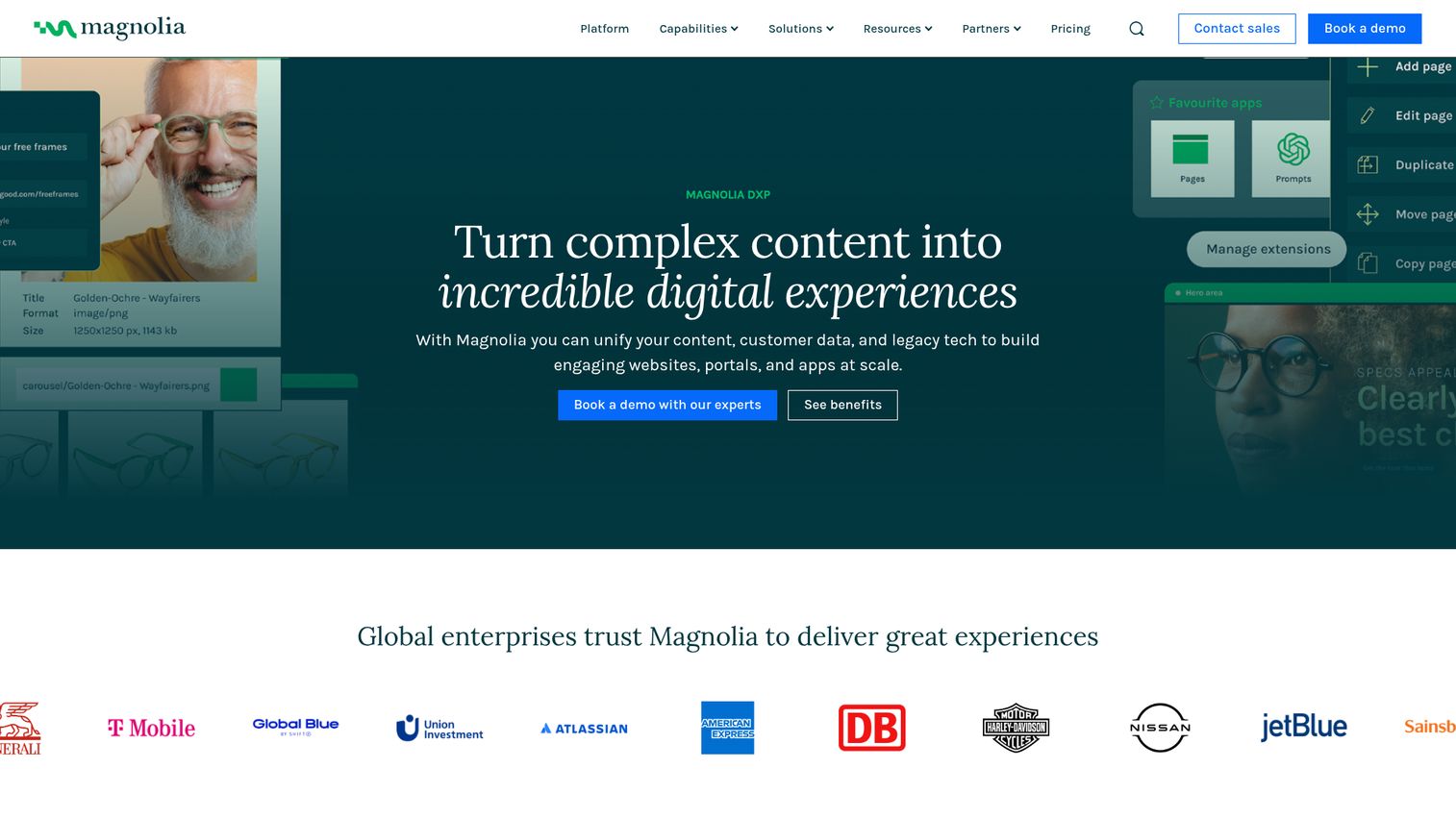
Magnolia is the integration-first DXP. Its connector framework is designed to plug into existing enterprise systems (CRM, ERP, marketing automation, commerce) rather than replacing them. This makes it the right choice for organizations with complex existing stacks that need a content experience layer on top, not a rip-and-replace.
The Light Development approach lets teams build and iterate faster than traditional enterprise DXPs.
Best for: Enterprise teams with complex existing tech stacks that need a CXP layer on top of what they already have, not a replacement.
Key strengths
- Connector framework for deep system integrations
- Light Development approach for faster iteration
- Headless and hybrid architecture options
- Visual SPA editor for single-page applications
- Strong multi-site and multi-language support
Smaller community compared to Adobe, Sitecore, or Contentful. Less brand recognition means fewer implementation partners, fewer community resources, and a steeper learning curve for teams that rely on community support.
Pricing: Custom pricing.
11. Foleon
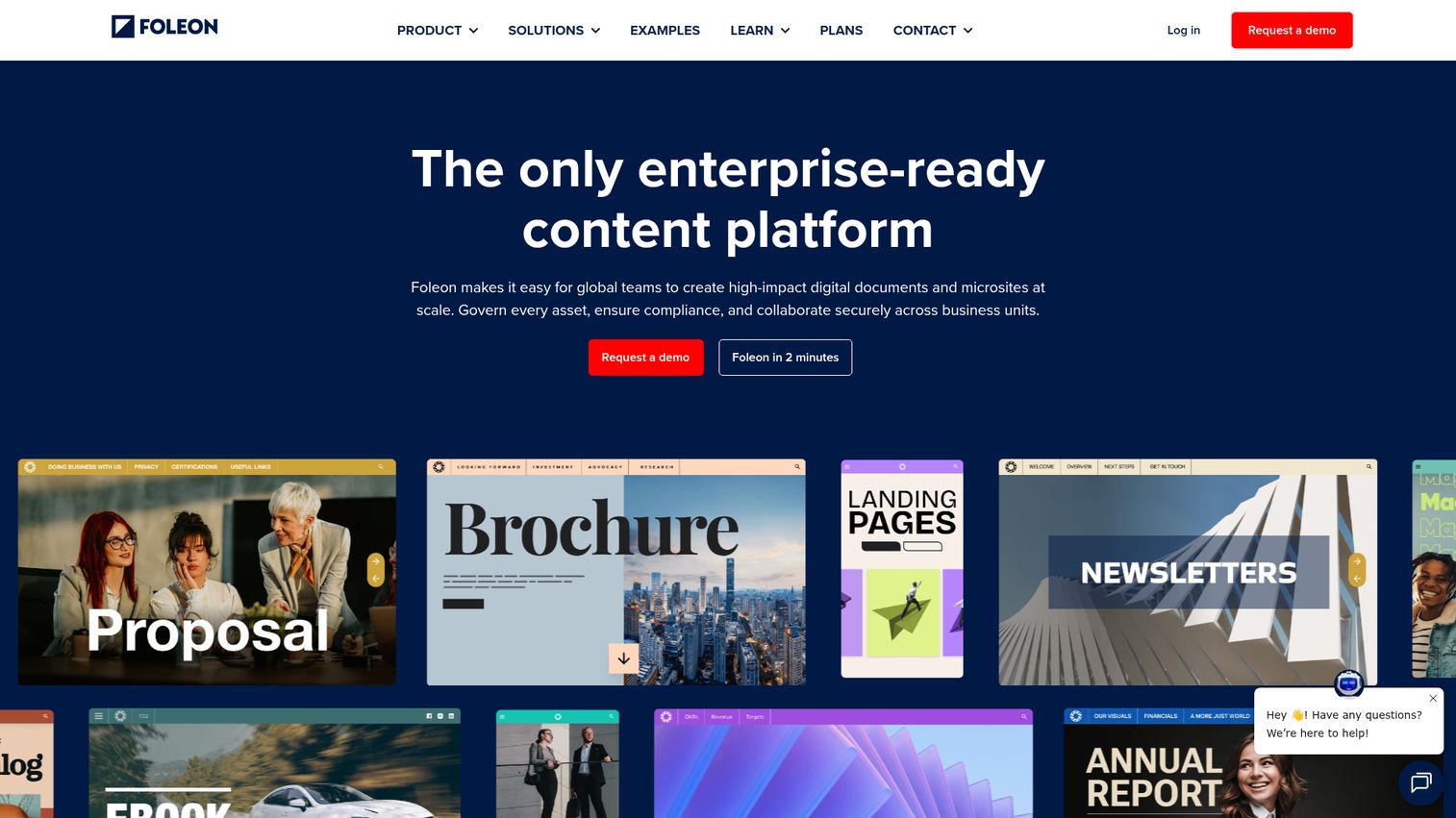
Foleon is the interactive content creation platform. Unlike the CMS/DXP-focused tools above, Foleon is purpose-built for creating interactive, web-based content experiences: digital magazines, microsites, interactive reports, and content hubs.
The drag-and-drop builder requires no code. The analytics are content-specific (scroll depth, clicks, time spent per section), giving marketers engagement data that page-view-based analytics miss entirely.
Best for: Marketing teams that want to create interactive content experiences (reports, magazines, hubs) without developer resources.
Key strengths
- No-code drag-and-drop content builder
- Interactive content formats like magazines and reports
- Engagement analytics tracking scroll, click, and time
- Brand templating and design system enforcement
- Lead capture and CRM integration
Foleon is a content creation tool, not a full CMS or DXP. It doesn't manage your website, blog, or broader content operations. It complements your stack; it doesn't replace it.
Pricing: Custom pricing.
12. RELAYTO
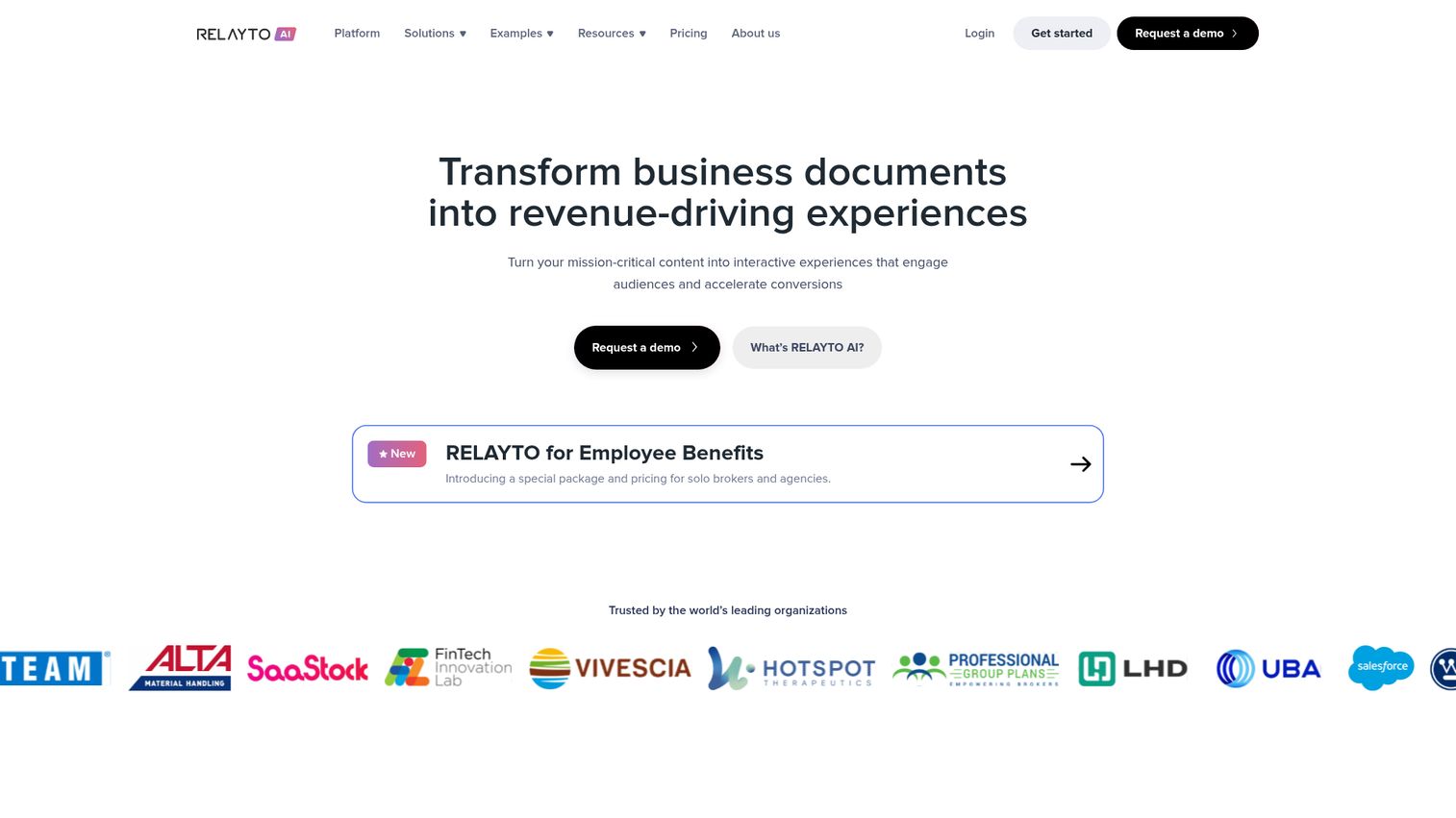
RELAYTO converts existing static content into interactive experiences. The AI-powered conversion is the hook: upload a PDF, presentation, or document, and RELAYTO turns it into an interactive, trackable web experience with engagement analytics and heatmaps.
This is the fastest path for teams with large existing content libraries that want to make them interactive without recreating from scratch.
Best for: Teams with large existing content libraries (PDFs, decks, reports) that want to make them interactive and trackable without rebuilding from scratch.
Key strengths
- AI-powered document-to-experience conversion
- Engagement analytics and heatmaps per content piece
- Interactive elements like video, forms, and navigation
- Hub and microsite creation for content collections
- Free tier available for testing
Output quality depends on input quality. Complex layouts, heavy graphics, and non-standard formatting don't always convert cleanly. It's a content enhancement tool, not a content creation or management platform.
Pricing: Free tier available. Paid plans from $65/month.
13. Showpad
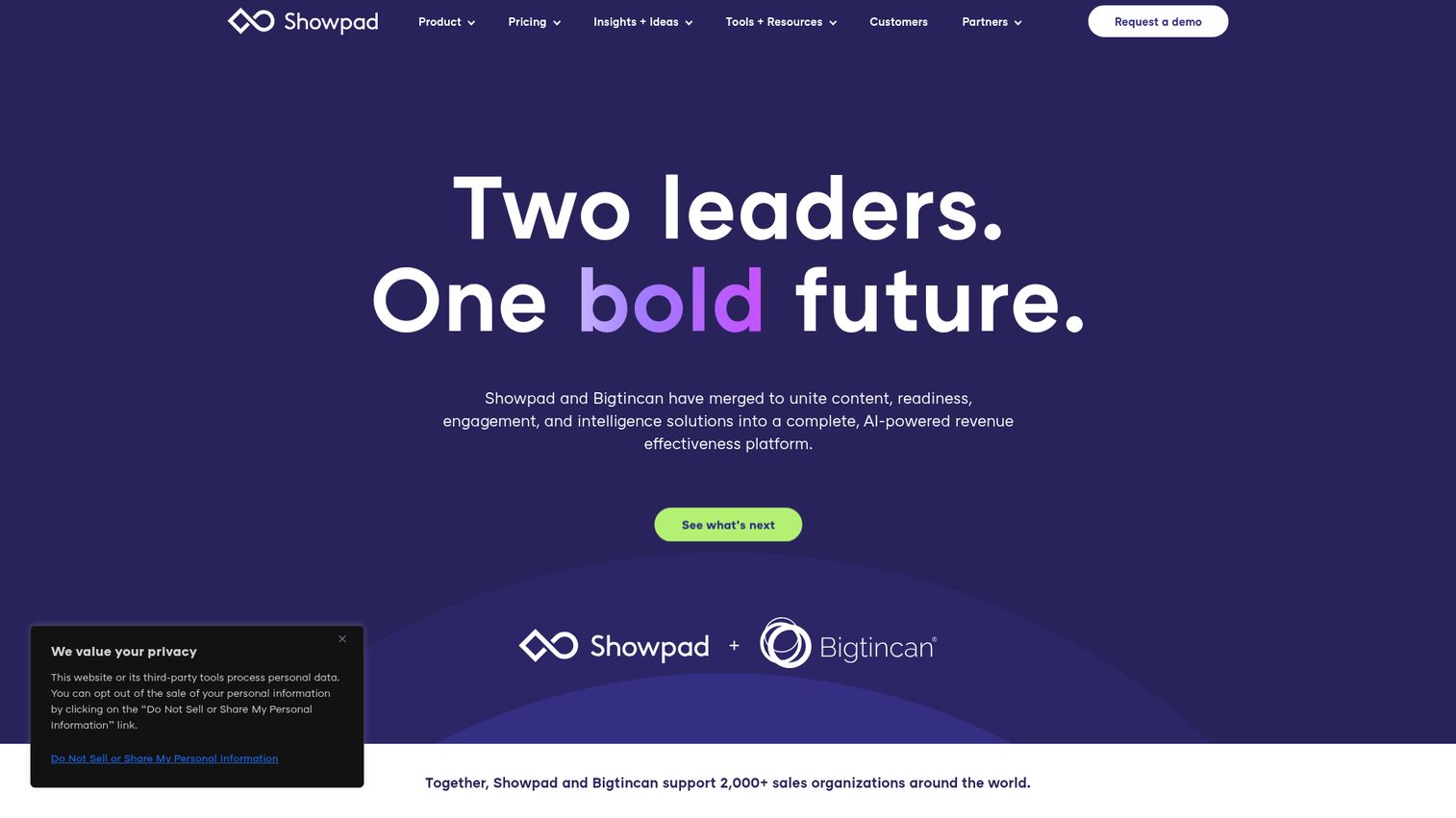
Showpad is the sales content experience platform. While most CXPs focus on marketing-to-audience content delivery, Showpad focuses on the content experience between sales teams and buyers. Content management, seller training, buyer engagement analytics, and shared spaces for buyer collaboration all live in one place.
This is the tool for B2B SaaS companies where sales-led content experiences directly impact deal velocity. Teams evaluating sales-focused tools should also explore sales engagement platforms and digital sales room software for complementary capabilities.
Best for: B2B sales teams that need to manage, share, and track sales content with buyers throughout the deal cycle.
Key strengths
- Sales content management and organization
- Buyer engagement tracking and analytics
- Seller training and coaching capabilities
- Shared spaces for buyer collaboration
- CRM integration with Salesforce and HubSpot
Showpad is sales enablement first, content experience second. If your primary need is marketing content delivery to broad audiences (website visitors, email subscribers, social followers), Showpad is the wrong tool. It's built for 1-to-1 and 1-to-few sales interactions, not 1-to-many marketing distribution.
Pricing: Custom pricing.
14. Kentico Xperience
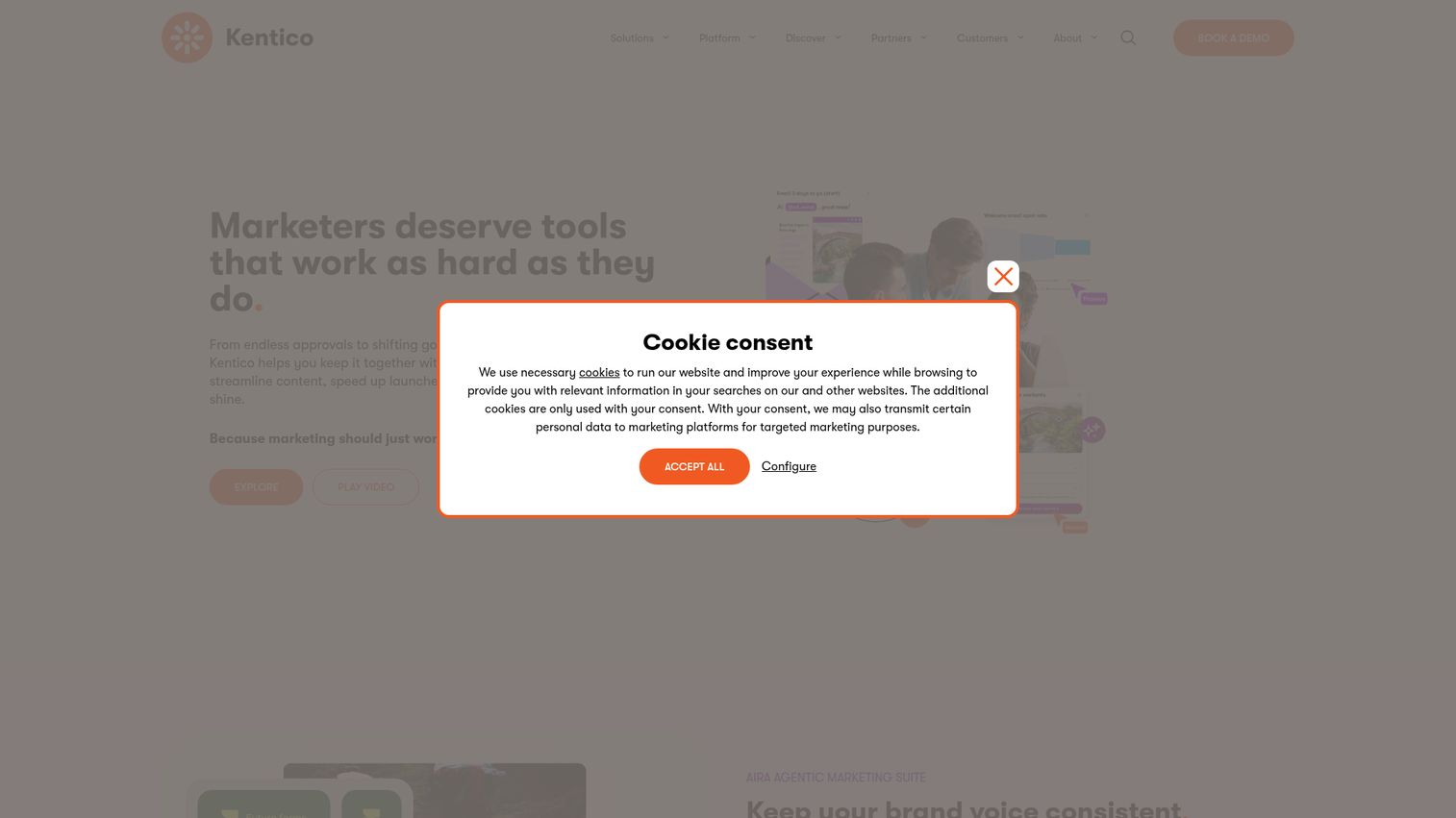
Kentico Xperience is the .NET-based DXP that offers both traditional and headless content delivery. Strong for organizations running Microsoft/.NET technology stacks that don't want to switch development environments. The hybrid approach lets teams use traditional page-based content management alongside headless API delivery.
Built-in email marketing, forms, and automation reduce the need for additional tools in your stack.
Best for: Organizations on Microsoft/.NET stacks that want a hybrid CMS/DXP without switching development environments.
Key strengths
- Hybrid headless and traditional architecture
- Built-in email marketing and automation
- .NET-native development for Microsoft shops
- Content personalization based on visitor behavior
- Multi-site and multi-language management
.NET dependency limits the developer talent pool. The platform is less well-known than competitors, which makes hiring Kentico-experienced developers harder and community resources thinner. If your team isn't already on .NET, there's no compelling reason to start here.
Pricing: From $990/month.
15. Liferay DXP
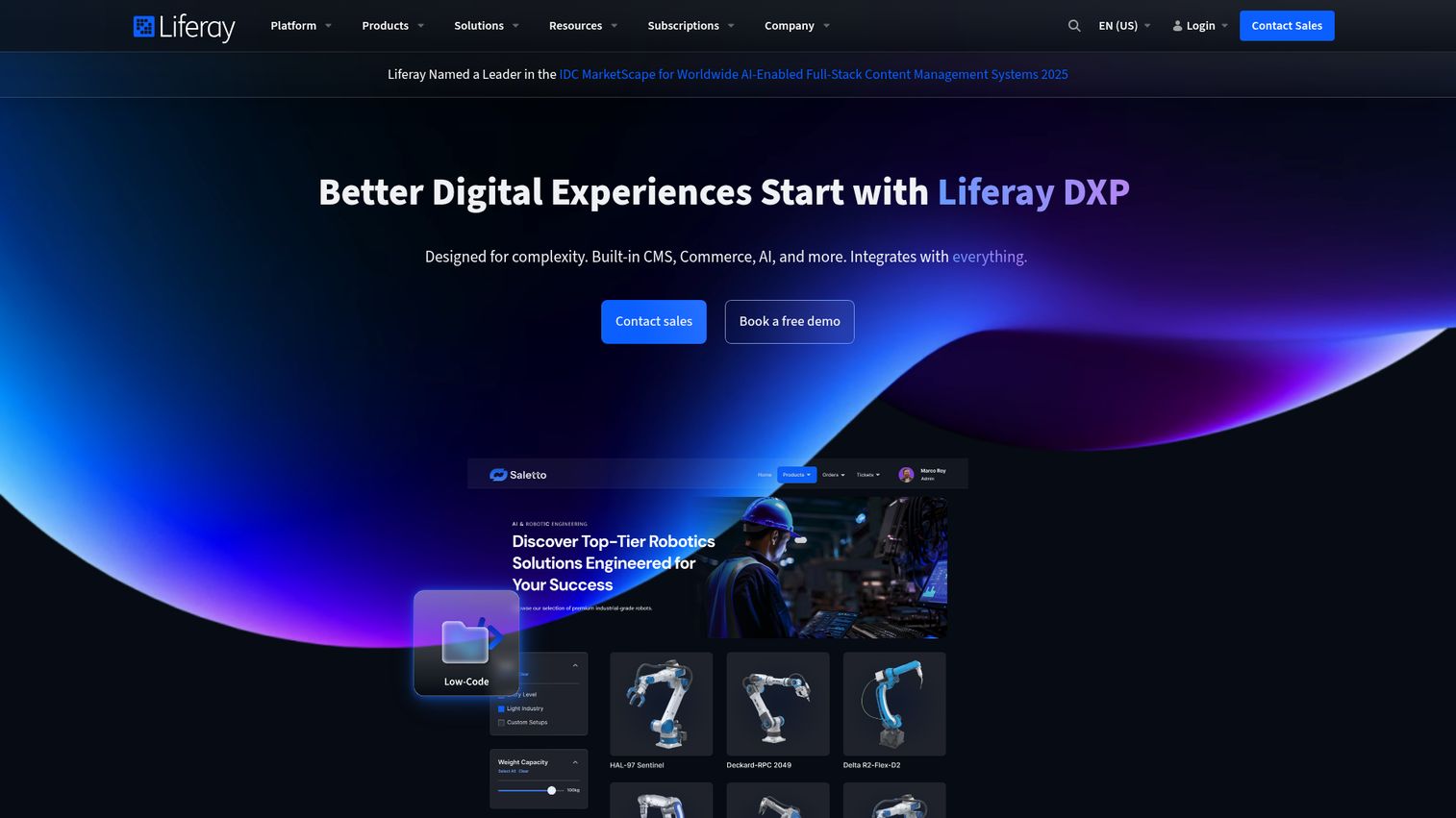
Liferay is the portal-centric digital experience platform. Originally built for enterprise portals (intranets, customer portals, partner portals), Liferay has expanded into broader content experience delivery. The open-source Community Edition is free, making it the most accessible enterprise-grade platform for teams that want to evaluate before committing budget.
Strong for organizations that need both internal and external content experiences from one platform.
Best for: Enterprise organizations that need portal capabilities (intranet, customer portal) alongside public-facing content experiences.
Key strengths
- Open-source Community Edition available for free
- Enterprise portal capabilities for internal use
- Headless content delivery for external channels
- Workflow and approval management built in
- Strong security and compliance features
The portal heritage means the UX and content creation experience feel less modern than purpose-built CXPs. Implementation is complex and typically requires a partner. If your primary need is sleek, marketer-friendly content creation, Liferay will feel heavy.
Pricing: Free (Community Edition). Custom pricing (DXP).
How interactive demos enhance content experiences
Content experience platforms handle management, personalization, and distribution. But the content itself is often still static: articles, PDFs, landing pages, videos. The format hasn't kept up with the infrastructure.
Interactive content (demos, calculators, assessments, configurators) is emerging as a content format that outperforms static assets on engagement and conversion metrics. G2 already lists interactive demo platforms in the CXP category. The line between "content experience platform" and "interactive content tool" is blurring.
Here are 4 specific use cases where interactive demos improve the content experience:
- Product pages and landing pages: Embed a clickable product walkthrough instead of a feature screenshot. Pair it with a dedicated landing page builder for maximum conversion.
- Content hubs: Add interactive demos to your resource center so prospects can self-serve product evaluation. A demo center makes this easy to organize and scale.
- Email campaigns: Include demo links that let recipients explore your product without scheduling a call. See our guide on how to energize your email campaigns with interactive demos.
- Sales content: Give buyers interactive proof points they can share internally with stakeholders
Guideflow lets you capture your product flow in a few clicks and embed the interactive demo anywhere your content lives, with analytics that show how prospects engage.
Instead of tracking page views, you're tracking demo completion rates, step-level drop-offs, and conversion from content engagement to pipeline. That's the measurement shift that makes content experience data actionable.
How to choose the right content experience platform
Define your primary use case
Are you solving for marketing content personalization, sales content management, developer-led content architecture, or enterprise-wide digital experience? The answer narrows your list from 15 to 3-5 immediately.
Quick mapping: personalization → Sitecore, AEM, HubSpot. Sales content → Showpad. Developer-led → Contentful, Contentstack, Storyblok. Enterprise-wide → AEM, Optimizely, Liferay.
Assess your technical resources
Headless CXPs (Contentstack, Contentful, Storyblok) require frontend developers. Traditional CXPs (HubSpot, Sitecore, AEM) provide more out-of-the-box but less flexibility. Match the platform to your team's actual capabilities, not aspirational ones.
Map integrations to your existing stack
List every tool in your current stack (CRM, marketing automation, analytics, ad platforms). Check native integrations first, API availability second. A content experience platform that doesn't connect to your CRM is a content silo, not a content experience. Guideflow's own integrations connect interactive demos to your CRM, marketing automation, and analytics tools.
Evaluate personalization depth
The range spans from basic (HubSpot smart content) to advanced (Sitecore, AEM with CDP). Define what "personalization" means for your use case before comparing platforms. Most teams overestimate their personalization maturity and underuse what they buy.
Understand total cost of ownership
Licensing is the visible cost. Implementation, developer time, training, and ongoing maintenance are the hidden costs. Enterprise DXPs can cost 3-5x the license fee in implementation alone. Factor this in before comparing sticker prices. Check Guideflow's pricing for a transparent example of how interactive demo platforms price.
Content experience platform trends in 2026
AI-driven content personalization: The shift from segment-based personalization (show Version A to "enterprise" visitors) to individual-level personalization (assemble a unique page for each visitor based on behavior, company, and intent signals). Platforms like Bloomreach (Loomi) and Optimizely are leading this shift. The DXP market is valued at $15.75 billion in 2026 and projected to reach $26.2 billion by 2030 (Research and Markets, 2026), with AI personalization driving much of that growth.
Composable architecture adoption: The shift from monolithic DXPs to composable stacks where teams pick best-of-breed components connected via APIs. Contentstack, Contentful, and Storyblok are the poster children. Enterprise buyers are increasingly choosing composable over monolithic, even at the cost of more integration work.
Interactive and self-serve content: Growth of interactive demos, calculators, assessments, and configurators as content formats that outperform static assets on engagement metrics. G2's CXP category already includes interactive demo platforms, signaling category convergence. Digital content platform usage increased 27% year-over-year (Intel Market Research, 2026). Explore the best content marketing tools to see how interactive formats fit into a broader content strategy.
Content analytics convergence: CXPs integrating deeper analytics (engagement scoring, attribution, revenue impact) rather than relying on external analytics tools. The goal: connect content engagement directly to pipeline without a separate attribution platform. Teams investing in product analytics software alongside their CXP get the most complete picture.
Conclusion
Three variables determine the right content experience platform: your team's technical capabilities, your personalization ambitions, and your existing stack.
- Enterprise teams with dedicated developers and large budgets → Adobe Experience Manager, Sitecore, Optimizely
- Mid-market growth teams that want speed → Contentstack, HubSpot CMS Hub, Storyblok
- Teams focused on making existing content interactive → Foleon, RELAYTO
Whatever platform you choose, the content inside it determines the experience. Static PDFs and feature lists don't convert the way they used to. Interactive, self-serve content that lets prospects experience your product is where engagement and