

Your security team can see every misconfigured S3 bucket in your cloud environment. But they probably can't tell you which AI models are pulling training data from databases containing customer PII, or whether your fine-tuned LLM might leak sensitive information through its outputs.
AI security posture management (AI-SPM) is a continuous security framework that discovers, assesses, and protects AI models, data pipelines, and intelligent agents across their lifecycle. This guide covers what AI-SPM is, how it differs from CSPM and DSPM, and reviews 9 platforms that provide the visibility traditional security tools lack.
What's inside
This guide covers everything you need to evaluate AI security posture management platforms:
- A clear explanation of what AI-SPM is and why it matters
- How AI-SPM differs from CSPM and DSPM
- Six key capabilities to evaluate in any platform
- Detailed reviews of 9 AI-SPM tools with pricing and G2 ratings
- A framework for choosing the right platform for your team
TL;DR
- Best for multi-cloud AI workloads: Wiz provides agentless scanning across AWS, Azure, and GCP with deep attack path analysis
- Best for existing Prisma Cloud users: Palo Alto Prisma Cloud offers native AI-SPM within the broader CNAPP
- Best for agentless deployment: Orca Security delivers side-scanning with complete AI bill of materials
- Best for Azure-native environments: Microsoft Defender for Cloud integrates deeply with Azure OpenAI and Azure ML
- Best for container and Kubernetes AI workloads: Aqua Security focuses on containerized ML pipelines
- Best for behavioral anomaly detection: Lacework applies behavioral baselining to AI workload patterns
What is AI-SPM
AI security posture management (AI-SPM) is a continuous security framework designed to discover, assess, and protect an organization's AI models, data pipelines, and intelligent agents across their entire lifecycle. Traditional cloud security tools know how to find a misconfigured S3 bucket. They don't understand that your fine-tuned LLM is pulling training data from a database containing customer PII.
That's the gap AI-SPM fills.
AI-SPM platforms tackle three categories of AI-specific threats:
- Prompt injection: Malicious inputs designed to manipulate AI model behavior, causing the model to ignore instructions or leak sensitive information
- Shadow AI: Unauthorized AI tools deployed by teams without security oversight, creating blind spots in your security posture
- Data poisoning: Corrupted or manipulated training data that compromises model integrity and produces unreliable outputs
Traditional security tools lack the context to understand AI logic. They can't see how a model's underlying algorithms might be manipulated, or trace the lineage of training data through your pipelines. AI-SPM platforms provide that visibility.
Why AI-SPM matters for security teams
Security teams face a visibility problem. Developers and data scientists spin up AI services faster than security can track them. The compliance landscape is shifting too, with the EU AI Act introducing requirements for high-risk AI systems, NIST's AI Risk Management Framework (AI RMF) providing guidelines that auditors increasingly reference, and OWASP's LLM Top 10 cataloging the most critical security risks in large language model applications.
Without AI-SPM, security teams often can't answer basic questions:
- Which AI services are running in our environment?
- What data do our models access during training and inference?
- How do our AI deployments connect to production systems?
- Are we exposing sensitive data through model outputs?
AI-SPM platforms create an inventory of AI assets, map data flows, and surface misconfigurations before they become breaches that cost USD $670,000 more.
How AI-SPM differs from CSPM and DSPM
You might already use cloud security posture management (CSPM) or data security posture management (DSPM) tools. AI-SPM isn't a replacement for either. It's a complementary discipline that extends their capabilities to AI-specific assets.
AI-SPM vs CSPM
Cloud security posture management focuses on infrastructure misconfigurations. CSPM tools excel at finding publicly exposed storage buckets, overly permissive IAM roles, and unencrypted databases. They understand cloud resources.
What CSPM tools don't understand is AI model behavior. They can't tell you that your inference endpoint accepts arbitrary user input without validation. They can't trace how a model's training pipeline connects to sensitive data sources. They see the compute instance running your model, but not the model itself.
AI-SPM extends CSPM by adding AI-aware context. It understands that the Kubernetes pod running your model is different from a standard web application. It knows to check for prompt injection vulnerabilities, not just network exposure.
AI-SPM vs DSPM
Data security posture management focuses on sensitive data discovery and classification. DSPM tools find PII in your databases, track data flows, and identify compliance risks. They're excellent at answering "where is our sensitive data?"
DSPM tools typically don't understand how AI models consume that data. They might flag a database containing customer records, but they won't tell you that your LLM is using those records for fine-tuning. They don't track whether sensitive information might leak through model outputs during inference.
AI-SPM specifically monitors how AI systems interact with sensitive data. It tracks training data lineage, identifies when models might memorize and regurgitate sensitive information, and flags data exposure risks unique to AI workloads.
Key capabilities to evaluate in AI-SPM tools
When comparing platforms, focus on six capabilities. Not every organization needs all of them at the same depth, but understanding what's available helps you match tools to your requirements. For broader context on evaluating B2B software, see our guide to product marketing software tools.
AI asset discovery and inventory
Before you can secure AI workloads, you need to know they exist. Discovery capabilities scan your cloud environments (AWS, Azure, GCP) and SaaS applications (M365 Copilot, Salesforce Einstein) to build an inventory of AI assets.
Strong discovery goes beyond listing services. It creates an AI bill of materials (AI-BOM) that catalogs models, frameworks, libraries, and dependencies. This inventory becomes the foundation for vulnerability tracking and supply chain security. Look for platforms that detect shadow AI, meaning more than 80% of workers use AI tools without security team awareness.
Sensitive data detection in training pipelines
AI models learn from data. If that data contains PII, credentials, or proprietary information, the model might memorize and expose it. Sensitive data detection scans training pipelines to identify what information flows into your models.
This capability matters most during fine-tuning, when organizations customize foundation models with their own data. A model fine-tuned on customer support tickets might learn to reproduce customer names, account numbers, or other sensitive details.
AI misconfiguration detection
Just like cloud resources, AI services have configurations that affect security. Misconfiguration detection evaluates IAM permissions, network exposure, and service settings specific to AI workloads.
Common misconfigurations include overly permissive access that lets AI agents reach unintended data sources, publicly exposed inference endpoints without authentication, missing encryption for model artifacts and training data, and excessive logging that captures sensitive inputs.
Runtime threat monitoring
Discovery and configuration scanning happen at rest. Runtime monitoring watches AI workloads during operation. It detects active attacks against deployed models, including prompt injection attempts, model extraction, and adversarial inputs. When demonstrating these capabilities, live demos for sales teams can show real-time threat detection in action.
This capability requires understanding what "normal" looks like for your AI workloads. Behavioral baselining establishes patterns, then alerts when activity deviates. A sudden spike in unusual queries to your inference endpoint might indicate an extraction attempt.
Attack path analysis
Attack path analysis maps how an adversary could move from an initial foothold to compromise AI assets. It answers questions like: "If an attacker compromises this developer workstation, can they reach our production model?"
Strong attack path analysis extends traditional cloud attack paths to include AI-specific endpoints. It considers how model APIs, training pipelines, and data stores connect, then identifies the shortest paths to high-value targets.
Compliance and governance reporting
Compliance capabilities map your AI deployments against frameworks like NIST AI RMF, OWASP LLM Top 10, and emerging regulations like the EU AI Act 2 August 2026. They generate audit-ready reports that demonstrate your security posture and compliance to regulators and auditors.
Look for pre-built policies aligned to your compliance requirements. Building custom policies from scratch adds significant implementation time.
AI-SPM tools comparison
1. Wiz
Wiz delivers agentless AI security posture management across multi-cloud environments. The platform scans cloud workloads without installing agents, providing visibility into AI assets, configurations, and attack paths from a single console.
Wiz's approach connects AI security to broader cloud context. When it finds a misconfigured AI endpoint, it shows you the full attack path from internet exposure through to sensitive data access. This context helps security teams prioritize remediation based on actual risk, not just individual findings.
Best for: Security teams managing AI workloads across AWS, Azure, and GCP who want unified visibility without deploying agents.
Key strengths
- Agentless architecture: Discovers AI assets by scanning cloud APIs and configurations, with no software to install on workloads
- Attack path visualization: Maps exploitation routes from cloud entry points through to AI models and training data
- Data context correlation: Links AI model access patterns to sensitive data locations across your environment
Why choose Wiz
Wiz works well for organizations that already use (or plan to use) a cloud-native application protection platform. The AI-SPM capabilities integrate with Wiz's broader CSPM, DSPM, and vulnerability management features. If you want a single platform for cloud security with strong AI coverage, Wiz delivers that consolidation.
The trade-off is cost. Wiz positions as an enterprise platform with pricing to match. Smaller teams or those with limited AI deployments might find the investment difficult to justify.
Wiz pricing
Custom pricing based on cloud workload volume. Contact Wiz for a quote.
2. Palo Alto Prisma Cloud
Palo Alto Prisma Cloud provides AI-SPM as part of its comprehensive cloud-native application protection platform. The 2024 acquisition of Protect AI strengthened AI-SPM capabilities, adding model scanning and ML supply chain security.
Prisma Cloud's AI-SPM integrates with the platform's existing CSPM, CWPP, and code security features. For organizations already invested in the Palo Alto ecosystem, this means AI security without adding another vendor relationship.
Best for: Enterprises already using Prisma Cloud who want native AI security capabilities without expanding their vendor footprint.
Key strengths
- Model integrity monitoring: Detects tampering with model parameters, weights, and artifacts throughout the ML lifecycle
- CNAPP integration: Unifies AI-SPM with cloud workload protection, code security, and infrastructure scanning
- Compliance mapping: Pre-built policies for NIST AI RMF and OWASP LLM Top 10 accelerate compliance reporting
Why choose Palo Alto Prisma Cloud
Choose Prisma Cloud when you want AI-SPM embedded in a broader security platform rather than as a standalone tool. The integration means AI findings appear alongside other cloud security issues, with unified prioritization and workflow.
The platform's depth comes with complexity. Implementation typically requires professional services, and the learning curve is steeper than point solutions. Organizations without existing Palo Alto investments might find the onboarding overhead significant.
Palo Alto Prisma Cloud pricing
Custom pricing based on credits consumed across modules. AI-SPM capabilities require the Prisma Cloud Enterprise tier. Contact Palo Alto for specific pricing.
3. Orca Security
Orca Security pioneered agentless cloud security through its SideScanning technology. The platform reads cloud workloads directly from block storage, providing deep visibility without runtime agents. AI-SPM extends this approach to machine learning assets.
Orca's AI bill of materials capability creates a complete inventory of models, frameworks, and dependencies. This inventory enables vulnerability tracking across your AI supply chain, identifying risks in the libraries and tools your models depend on.
Best for: Teams wanting fast deployment with comprehensive AI asset visibility and no agent overhead.
Key strengths
- AI bill of materials: Catalogs all components in your AI systems including models, frameworks, libraries, and data sources
- Exposed credential detection: Finds AI service API keys and access tokens at risk of compromise
- Side-scanning architecture: Reads workloads without performance impact or agent deployment
Why choose Orca Security
Orca works well for organizations that prioritize deployment speed. The agentless architecture means you can achieve visibility within hours of connecting cloud accounts. There's no agent rollout to coordinate with development teams.
The platform's breadth (covering CSPM, CWPP, DSPM, and AI-SPM) can be both strength and weakness. You get consolidated visibility, but the AI-SPM capabilities may not be as deep as purpose-built alternatives. Evaluate whether the coverage meets your specific AI security requirements.
Orca Security pricing
Custom pricing based on cloud asset volume. Orca offers a free trial for initial assessment. Contact Orca for enterprise pricing.
4. Microsoft Defender for Cloud
Microsoft Defender for Cloud provides native AI-SPM for Azure environments with extending coverage to AWS and GCP. The platform discovers Azure OpenAI deployments, Azure Machine Learning workspaces, and generative AI applications built on Microsoft's AI services.
For organizations heavily invested in Azure, Defender for Cloud offers the deepest integration. It understands Azure-specific AI services at a level third-party tools can't match, with recommendations tailored to Microsoft's AI platform architecture.
Best for: Organizations with significant Azure AI investments who want native security tooling integrated with their cloud platform.
Key strengths
- Native Azure integration: Deep visibility into Azure OpenAI Service, Azure ML, and Cognitive Services deployments
- Multi-cloud discovery: Extends AI asset discovery to AWS Bedrock and GCP Vertex AI workloads
- Prioritized recommendations: Risk-based remediation guidance specific to Azure AI service configurations
Why choose Microsoft Defender for Cloud
Choose Defender for Cloud when Azure is your primary AI platform. The native integration provides visibility and recommendations that third-party tools can't replicate. You also benefit from unified billing and management through the Azure portal.
The trade-off is depth outside Azure. While Defender for Cloud supports multi-cloud, the AI-SPM capabilities are strongest for Microsoft's own AI services. Organizations with significant AWS or GCP AI workloads might need supplementary tooling.
Microsoft Defender for Cloud pricing
AI-SPM capabilities require Defender CSPM. Some AI security features are included in the free tier. Check Azure pricing calculator for current rates.
5. Lacework
Lacework applies behavioral analytics to cloud security, including AI workloads. The platform's Polygraph technology learns normal patterns across your environment, then alerts when AI workload behavior deviates from baseline.
This approach catches threats that signature-based detection misses. An attacker probing your model with unusual queries might not trigger traditional alerts, but Lacework's behavioral analysis can identify the anomaly.
Best for: Security teams wanting behavioral anomaly detection for AI workloads, particularly those running containerized ML pipelines.
Key strengths
- Behavioral baselining: Learns normal AI workload patterns to detect anomalies that indicate compromise or misuse
- Polygraph visualization: Maps relationships between AI components, data flows, and access patterns
- Container and Kubernetes support: Strong coverage for containerized ML training and inference workloads
Why choose Lacework
Lacework works well for organizations that want detection capabilities beyond configuration scanning. The behavioral approach catches runtime threats that point-in-time assessments miss. If your concern is active attacks against deployed models, Lacework's anomaly detection adds value.
The platform requires time to establish baselines. You won't get meaningful behavioral alerts immediately after deployment. Plan for a learning period before the detection capabilities reach full effectiveness.
Lacework pricing
Custom pricing based on cloud resource volume. Lacework offers a free trial. Contact Lacework for enterprise pricing.
6. SentinelOne Singularity Cloud Security
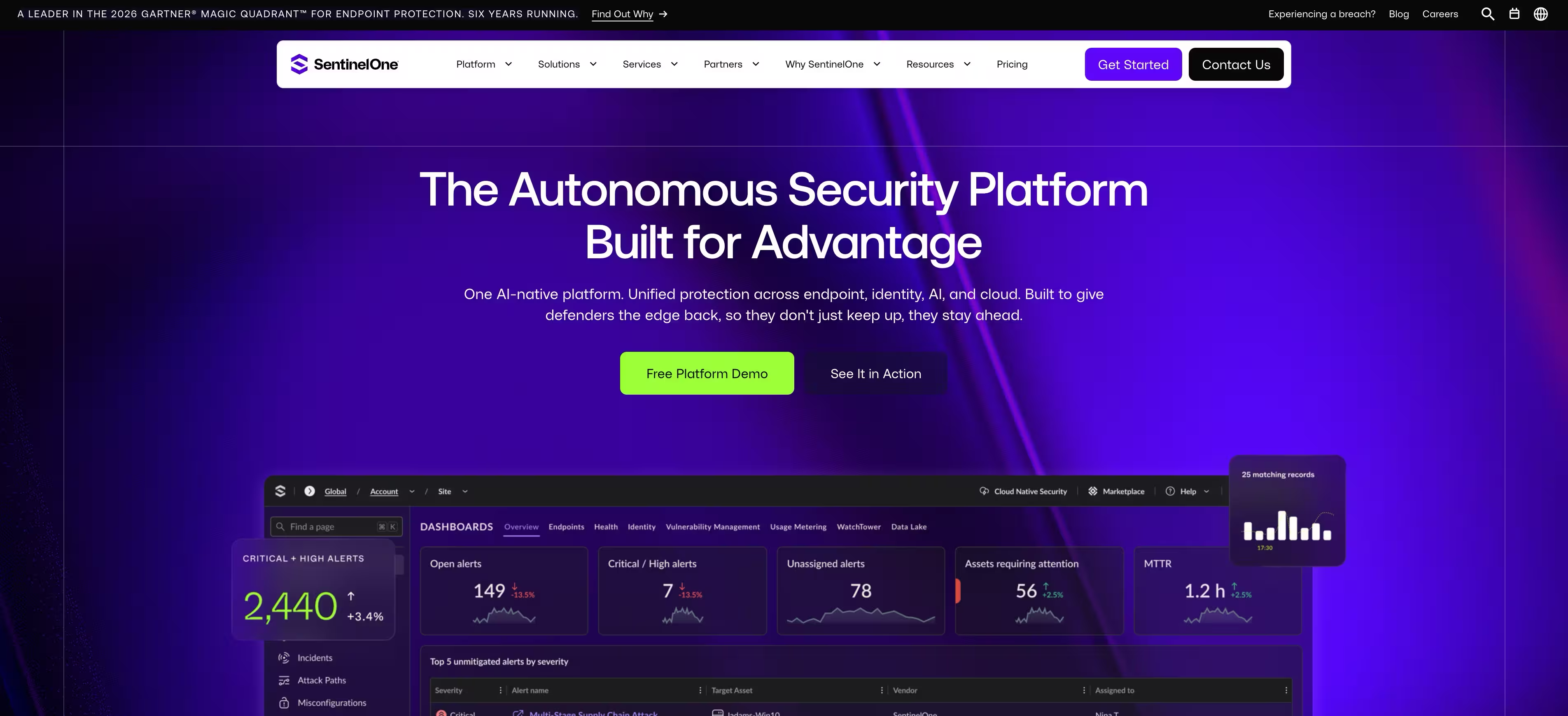
SentinelOne extends its unified security platform to cloud and AI workloads. Singularity Cloud Security combines cloud security posture management with the company's endpoint and XDR capabilities, creating a single console for security operations.
The platform's AI-SPM capabilities are emerging but benefit from SentinelOne's broader threat intelligence and automated response features. When the platform detects an AI security issue, it can trigger automated remediation workflows.
Best for: Organizations already using SentinelOne for endpoint security who want to extend coverage to cloud and AI workloads.
Key strengths
- Unified platform: Single console for endpoint, cloud, identity, and AI security reduces tool sprawl
- Automated response: Real-time remediation capabilities for detected AI security threats
- XDR correlation: Links AI security events with broader threat intelligence across your environment
Why choose SentinelOne Singularity Cloud Security
Choose SentinelOne when platform consolidation is a priority. If you already use SentinelOne for endpoint protection, adding cloud and AI security to the same platform simplifies operations. The unified data model enables correlation across security domains.
The AI-SPM capabilities are less mature than dedicated platforms. Organizations with complex AI deployments might find the coverage insufficient. Evaluate whether the consolidation benefits outweigh the depth trade-off.
SentinelOne Singularity Cloud Security pricing
Custom pricing based on deployment scope. Contact SentinelOne for cloud security pricing.
7. CrowdStrike Falcon Cloud Security
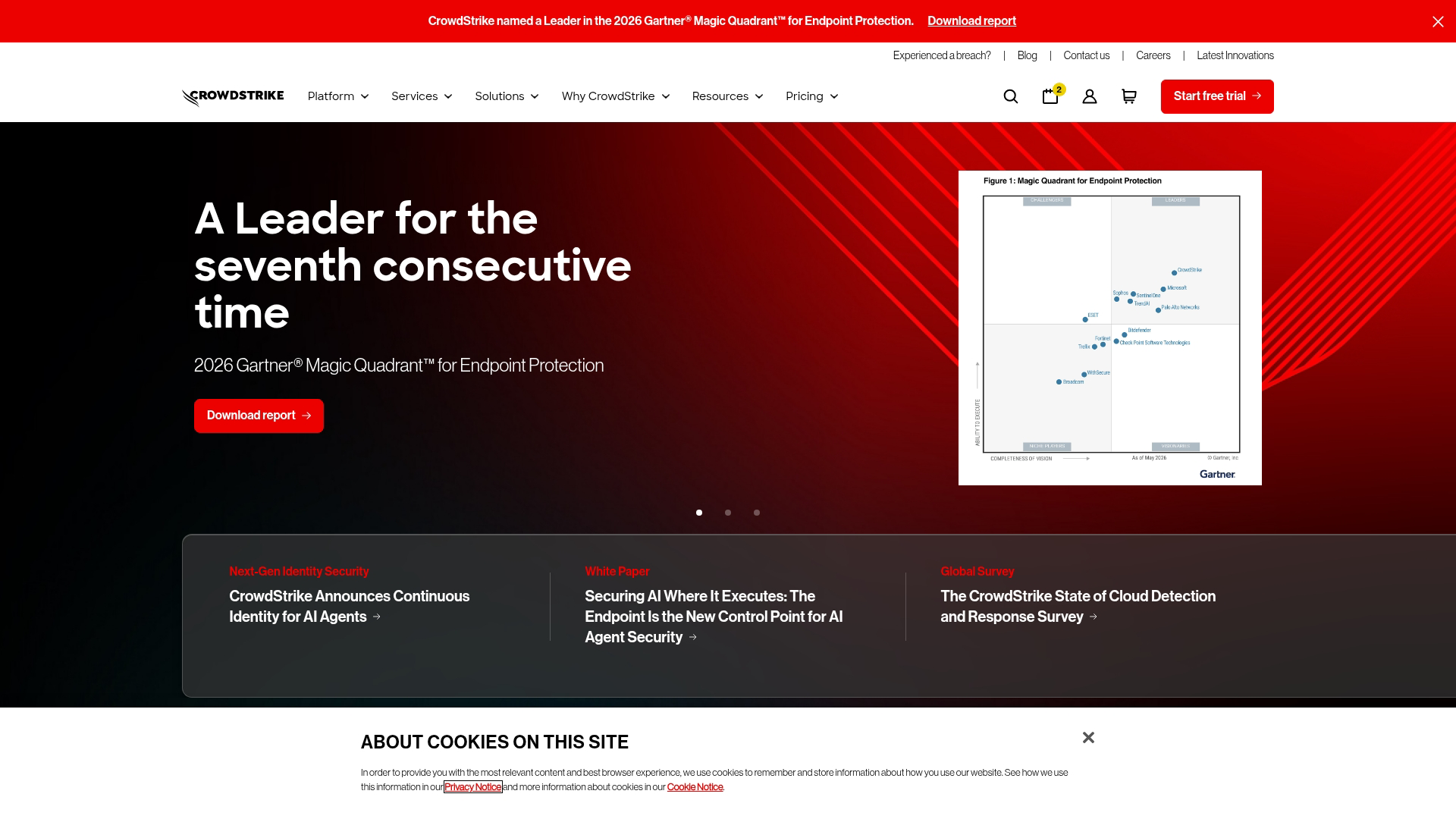
CrowdStrike brings its threat intelligence heritage to cloud and AI security. Falcon Cloud Security leverages CrowdStrike's adversary database to identify AI-specific threats, connecting cloud security findings to known attacker techniques.
The platform's strength is threat context. When it identifies an AI security issue, it can tell you which threat actors use similar techniques and what their objectives typically are. This intelligence helps security teams understand the real-world risk behind findings.
Best for: Security teams that prioritize threat intelligence and want to understand the adversary perspective on AI security risks.
Key strengths
- Threat intelligence integration: Applies CrowdStrike's adversary database to AI-specific attack patterns
- Runtime protection: Active defense capabilities for AI inference endpoints and training pipelines
- Identity correlation: Links AI access patterns to user and service identities for investigation
Why choose CrowdStrike Falcon Cloud Security
Choose CrowdStrike when threat intelligence is central to your security program. The platform excels at connecting technical findings to adversary behavior, helping you prioritize based on real-world attack patterns rather than theoretical risk.
Like SentinelOne, CrowdStrike's AI-SPM capabilities are part of a broader platform. The depth may not match purpose-built AI security tools. Evaluate whether the threat intelligence value compensates for any capability gaps.
CrowdStrike Falcon Cloud Security pricing
Custom pricing based on modules and deployment scope. Contact CrowdStrike for specific pricing.
8. Tenable Cloud Security
Tenable applies its vulnerability management expertise to cloud and AI security. Tenable Cloud Security focuses on exposure management, helping you understand which AI vulnerabilities pose the greatest risk based on exploitability and asset criticality.
The platform's identity-first approach maps AI service permissions to risk. It identifies when AI workloads have excessive access that could be exploited, then provides just-in-time access controls to reduce standing privileges.
Best for: Organizations with mature vulnerability management programs who want to extend that discipline to AI assets.
Key strengths
- Exposure prioritization: Ranks AI vulnerabilities by exploitability, not just severity scores
- Identity-first security: Maps AI service permissions to risk and identifies excessive access
- Just-in-time access: Reduces standing privileges for AI resources through time-limited access grants
Why choose Tenable Cloud Security
Choose Tenable when vulnerability prioritization is your primary challenge. If you're overwhelmed by findings and need help focusing on what matters most, Tenable's exposure management approach helps cut through the noise.
The platform's AI-SPM capabilities are evolving. Organizations with advanced AI security requirements might need to supplement with additional tooling. Evaluate the current feature set against your specific needs.
Tenable Cloud Security pricing
Custom pricing based on asset volume. Contact Tenable for cloud security pricing.
9. Aqua Security
Aqua Security focuses on cloud-native security with particular strength in containers and Kubernetes. For organizations running AI workloads on Kubernetes (which is increasingly common for ML training and inference), Aqua provides purpose-built protection.
The platform's supply chain security capabilities scan AI model dependencies and container images for vulnerabilities. This matters because ML frameworks and libraries frequently contain security issues that traditional scanning might miss.
Best for: Teams running AI workloads on Kubernetes who want container-native security with ML pipeline awareness.
Key strengths
- Container-native architecture: Purpose-built for Kubernetes AI deployments with deep orchestration integration
- Supply chain scanning: Identifies vulnerabilities in AI model dependencies, frameworks, and container images
- Runtime policies: Enforces least-privilege access for containerized AI workloads during operation
Why choose Aqua Security
Choose Aqua when Kubernetes is your primary AI deployment platform. The container-native approach provides depth that general-purpose cloud security tools can't match. If your ML pipelines run on Kubernetes, Aqua understands that environment intimately.
The trade-off is scope. Aqua's strength is containers, not managed AI services. Organizations using primarily managed offerings (Azure OpenAI, AWS Bedrock) might find less value. Match the platform to your deployment model.
Aqua Security pricing
Custom pricing based on container and Kubernetes node volume. Contact Aqua for enterprise pricing.
How to choose the right AI-SPM platform
Selecting an AI-SPM platform depends on your environment, compliance requirements, and existing security stack. Here's a framework for making that decision.
1. Assess your AI footprint first
Before evaluating tools, inventory your current AI deployments. Document which clouds you use, which AI services (managed vs. self-hosted), and which teams deploy AI workloads. If you lack this visibility, shadow AI discovery becomes a critical capability.
Questions to answer:
- Are you primarily using managed AI services or self-hosted models?
- Which cloud providers host your AI workloads?
- How many teams deploy AI independently?
- What's your mix of training vs. inference workloads?
2. Map capabilities to compliance requirements
Identify which frameworks apply to your organization. If you're subject to the EU AI Act, you need platforms with relevant policy mappings. If auditors reference NIST AI RMF, look for pre-built controls aligned to that framework.
Building custom compliance policies from scratch adds months to implementation. Pre-built mappings accelerate time to value.
3. Evaluate integration depth with existing tools
Consider how each platform connects to your SIEM, SOAR, ticketing, and CI/CD systems. Native integrations reduce manual work and accelerate response. API access matters if you need custom integrations.
Also consider your existing security investments. If you already use Palo Alto, Microsoft, or CrowdStrike, their AI-SPM offerings provide consolidation benefits. If you're starting fresh, purpose-built platforms might offer deeper capabilities.
4. Test multi-cloud support
If you run AI workloads across AWS, Azure, and GCP, verify the platform provides consistent visibility and policy enforcement across all three. Some tools have deeper capabilities in specific clouds. Match the platform's strengths to your primary environment.
Tip: When evaluating AI-SPM platforms, consider how you'll demonstrate capabilities to stakeholders. Security tools often require buy-in from multiple teams. Interactive demos can help communicate complex security workflows to non-technical decision makers.
Secure your AI workloads with complete visibility
AI-SPM is becoming essential as organizations scale generative AI adoption. The platforms reviewed here provide the visibility and controls that traditional security tools lack for AI workloads.
Start by matching your primary cloud provider and compliance requirements to platform capabilities. Wiz and Orca offer strong multi-cloud coverage. Microsoft Defender excels in Azure environments. Aqua provides depth for Kubernetes deployments.
For teams evaluating security tools, demonstrating capabilities to stakeholders often determines adoption success. Start your journey with Guideflow today to create interactive walkthroughs that communicate security workflows clearly.
FAQs about AI security posture management
What is the difference between AI-SPM and traditional cloud security?
Traditional cloud security focuses on infrastructure misconfigurations and network threats. AI-SPM extends this to AI-specific risks like model tampering, training data poisoning, and prompt injection that traditional tools cannot detect. The key difference is context: AI-SPM understands how AI systems behave, not just how they're configured.
Do organizations need AI-SPM if they already use a CNAPP?
CNAPPs provide foundational cloud security but typically lack AI-specific context. AI-SPM adds visibility into model behavior, training pipelines, and AI-specific attack vectors that CNAPPs miss. Most organizations benefit from both, either through a CNAPP with strong AI-SPM capabilities or by adding a dedicated AI security layer.
How long does AI-SPM implementation typically take?
Agentless platforms can begin scanning within hours of connecting cloud accounts. Full deployment with policy tuning and integration typically takes two to four weeks depending on environment complexity. Platforms requiring agents take longer due to rollout coordination.
Can AI-SPM platforms detect shadow AI deployments?
Yes, AI asset discovery scans cloud and SaaS environments to identify unauthorized AI tools. This includes third-party AI services, self-hosted models, and AI features embedded in SaaS applications. Shadow AI detection is a core capability for most platforms reviewed here.
Which compliance frameworks does AI-SPM address?
Most AI-SPM platforms map to NIST AI Risk Management Framework and OWASP LLM Top 10. Some also support EU AI Act requirements and industry-specific standards for healthcare (HIPAA) and financial services. Verify specific framework coverage before selecting a platform.
Does AI-SPM work across AWS, Azure, and GCP simultaneously?
Most enterprise AI-SPM platforms support multi-cloud deployments with a single console. Coverage depth varies by cloud and AI service. Verify specific service coverage (Bedrock, Vertex, Azure OpenAI) for each tool, as some platforms have stronger capabilities in particular clouds.
What is an AI bill of materials and why does it matter?
An AI bill of materials (AI-BOM) inventories all components in an AI system including models, frameworks, libraries, and data sources. It enables vulnerability tracking and supply chain security for AI deployments. When a vulnerability is discovered in a popular ML library, an AI-BOM tells you which models are affected.


.avif)