Your audit plan lives in one spreadsheet. Evidence sits in a shared drive nobody trusts. Findings get emailed, then lost. Follow-up happens when someone remembers. Sound familiar?
Most internal audit teams do not have a coverage problem. They have a plumbing problem. Planning, fieldwork, evidence, reporting, and remediation all move through disconnected tools, and every handoff bleeds time. When the audit committee asks for status, you spend two days rebuilding a picture that should take two clicks.
The market is voting with its budgets. The internal audit management software market is expected to grow from $42.41 billion in 2025 to $52.75 billion in 2030 at a 4.3% CAGR, according to The Business Research Company (2026). Teams are not buying tools for novelty. They are buying because manual audit management no longer scales against tighter regulatory expectations and thinner staffing.
The right audit software collapses that plumbing into one system. You plan against a live audit universe, collect evidence with a traceable chain, generate workpapers that hold up under review, and track issues to closure without chasing owners over email. If you are also mapping adjacent operational tooling, our roundups on audit management software and best contract lifecycle management software cover neighboring workflows that audit teams frequently touch.
This guide is a buyer's shortlist, not a vendor brochure. It compares seven internal audit management software platforms so you can narrow your evaluation faster.
What's inside
This guide is for internal audit leaders, CAEs, audit managers, and GRC teams evaluating platforms to run audit programs without living in spreadsheets. We selected the seven based on four criteria: audit lifecycle coverage (planning through remediation), standards alignment with IIA expectations, evidence and workpaper handling, and reporting clarity for leadership and audit committees. We also weighed integration depth and buyer trust signals like published G2 ratings. Every platform here targets internal audit or the broader risk and compliance context that audit teams operate inside. Pricing is included where the vendor publishes it and written around where it does not.
TL;DR
- Best for connected reporting and audit-ready data: Workiva, for enterprises that need controlled financial, regulatory, and audit reporting in one linked data model.
- Best for configurable end-to-end audit workflow: TeamMate, built on deep internal audit heritage with strong standards alignment.
- Best for AI-driven continuous auditing: Optro, for teams leaning into autonomous testing and real-time assurance.
- Best for internal audit inside broader GRC: Diligent One Platform and OpenPages, when audit sits alongside board, risk, and compliance work.
- Best for SAP-centric organizations: SAP Audit Management, when your audit process control lives close to your ERP.
- Best for compliance operations alongside audit: Hyperproof, for teams managing many frameworks and evidence workflows together.
What is internal audit software?
Internal audit software is a platform that centralizes audit planning, fieldwork, evidence collection, workpaper management, reporting, and remediation tracking so audit teams can run their full program in one system instead of spreadsheets and shared drives.
A modern audit management system typically covers:
- Risk-based planning: Build and maintain an audit universe, score risk, and schedule resources against coverage.
- Fieldwork and testing: Execute test steps, log results, and keep workpapers organized and reviewable.
- Evidence management: Attach, tag, and trace evidence with version control so nothing gets lost or duplicated.
- Reporting: Turn findings into clear reports for management and the audit committee.
- Remediation tracking: Assign issues, set due dates, and follow action items to closure.
- Audit analytics: Surface trends, coverage gaps, and testing exceptions across engagements.
- Stakeholder communication: Keep auditees, owners, and leadership aligned without email chains.
How internal audit management software differs from spreadsheets and generic GRC:
- Versus spreadsheets: Purpose-built audit and compliance software gives you an audit trail, version control, role-based access, and reporting that a spreadsheet cannot. Coverage is provable, not reconstructed.
- Versus generic GRC: A broad GRC suite may treat audit as one module among many. Dedicated internal auditing software goes deeper on workpapers, testing workflow, and IIA-aligned methodology, though many buyers want both in one platform.
When to use internal audit software
Not every team needs the same thing. Match the tool to the pain.
Standardize planning and resource allocation
If your audit plan is a spreadsheet that only one person understands, you have outgrown manual planning. Centralized software gives you audit universe visibility, risk-based planning, and resource scheduling in one place. You see coverage against risk, assign auditors to engagements, and adjust the plan when priorities shift without emailing a new version to everyone. This matters most when you run multiple concurrent audits or report coverage to a board that expects a defensible, risk-ranked plan.
Speed up fieldwork, evidence collection, and workpapers
The slowest part of most audits is not the thinking. It is chasing evidence and wrestling workpaper versions. When auditors spend more time requesting documents and reconciling file names than testing controls, an audit management system pays for itself. Look here when evidence lives in email attachments, workpaper review happens by tracked changes, and nobody is certain which version is final. Traceability and version control turn a week of cleanup into a clean, reviewable record.
Improve reporting, remediation, and executive visibility
Sometimes the audits get done fine, but proving it is the problem. If leadership keeps asking what you covered, which issues are open, and whether remediation is on track, the gap is visibility. Internal audit software with strong reporting and remediation tracking lets you show assurance across the organization, tie findings to owners and due dates, and give the audit committee a live view instead of a quarterly scramble.
Comparison table
Use this table to narrow your shortlist before reading the detailed writeups. It prioritizes what matters most for internal audit: workflow coverage, standards and automation, published pricing where available, and buyer trust signals. Intent describes the ideal buyer, and key differentiation captures why a team picks that platform over the others.
| # | Product | Intent | Key differentiation | Pricing | G2 rating |
|---|---|---|---|---|---|
| 1 | Workiva | Enterprise connected reporting and audit | Linked data model across documents, spreadsheets, and reports | Quote-based | Not published |
| 2 | TeamMate | Mid-market to enterprise audit teams | Deep internal audit heritage, configurable workflow | Quote-based | 4.2/5 |
| 3 | Optro | AI-forward audit and GRC teams | Autonomous testing, real-time assurance, 30+ frameworks | Quote-based | 4.6/5 |
| 4 | Diligent One Platform | Audit inside broader GRC and board governance | Unified GRC across board, risk, audit, compliance | Quote-based | 4.3/5 |
| 5 | SAP Audit Management | SAP-centric enterprises | Native audit process control near the ERP | Quote-based | Not published |
| 6 | OpenPages Internal Audit Management | Enterprises deep in IBM risk tooling | Audit workflow inside a broader GRC platform | From USD 3,300 | 4.2/5 |
| 7 | Hyperproof | Compliance-heavy teams with audit needs | 140+ frameworks, evidence and compliance operations | Quote-based | 4.5/5 |
1. Workiva
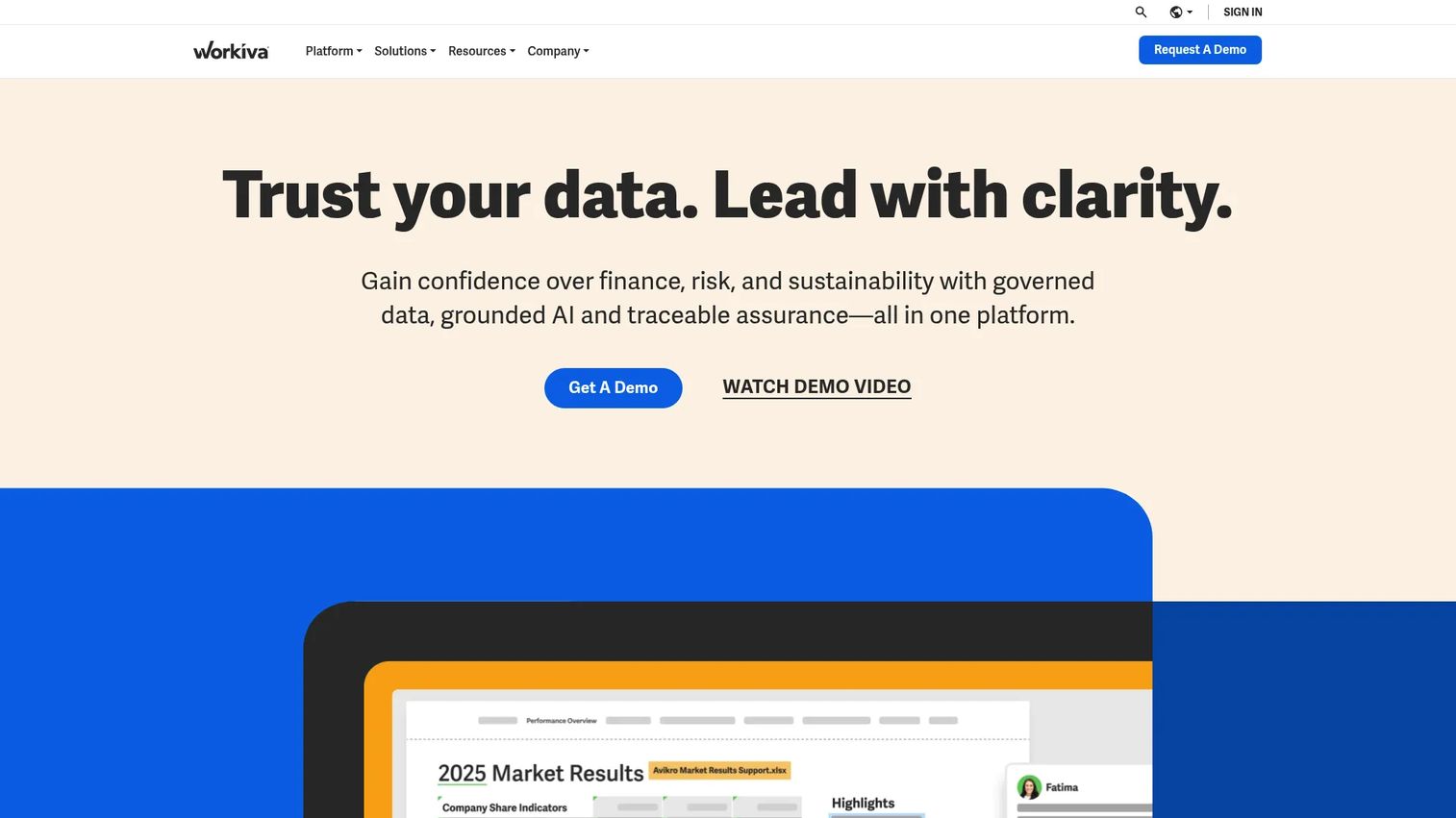
Workiva is a cloud-based connected reporting and compliance platform used by finance, accounting, sustainability, risk, and audit teams. Its defining idea is a linked data model: numbers, narratives, and documents stay connected so a change in one place flows everywhere it appears. For internal audit, that means workpapers, findings, and reports draw from the same source of truth instead of being copied and reconciled by hand.
Best for: Enterprises that need controlled, audit-ready financial, regulatory, sustainability, and audit reporting in one connected environment.
Key strengths
- Connected data model: Linking across documents, spreadsheets, and presentations keeps every figure and finding traceable to its source.
- Workiva AI for reporting: AI supports reporting workflows so teams draft and review faster without losing control.
- Governance built in: Role-based collaboration, permissions, and a full audit trail make review defensible.
Why choose Workiva: If your audit function sits inside a broader reporting mandate spanning SEC filings, regulatory disclosures, and sustainability, Workiva reduces the reconciliation tax between them. Enterprises pick it because one connected platform beats stitching audit outputs to separate reporting systems. The connected model shines when the same data feeds many audiences.
Workiva pricing: Workiva uses quote-based pricing and does not publish a public price. Plan to contact their team for a tailored quote based on modules, users, and scope. A current numeric G2 rating was not confirmed at the time of writing.
2. TeamMate
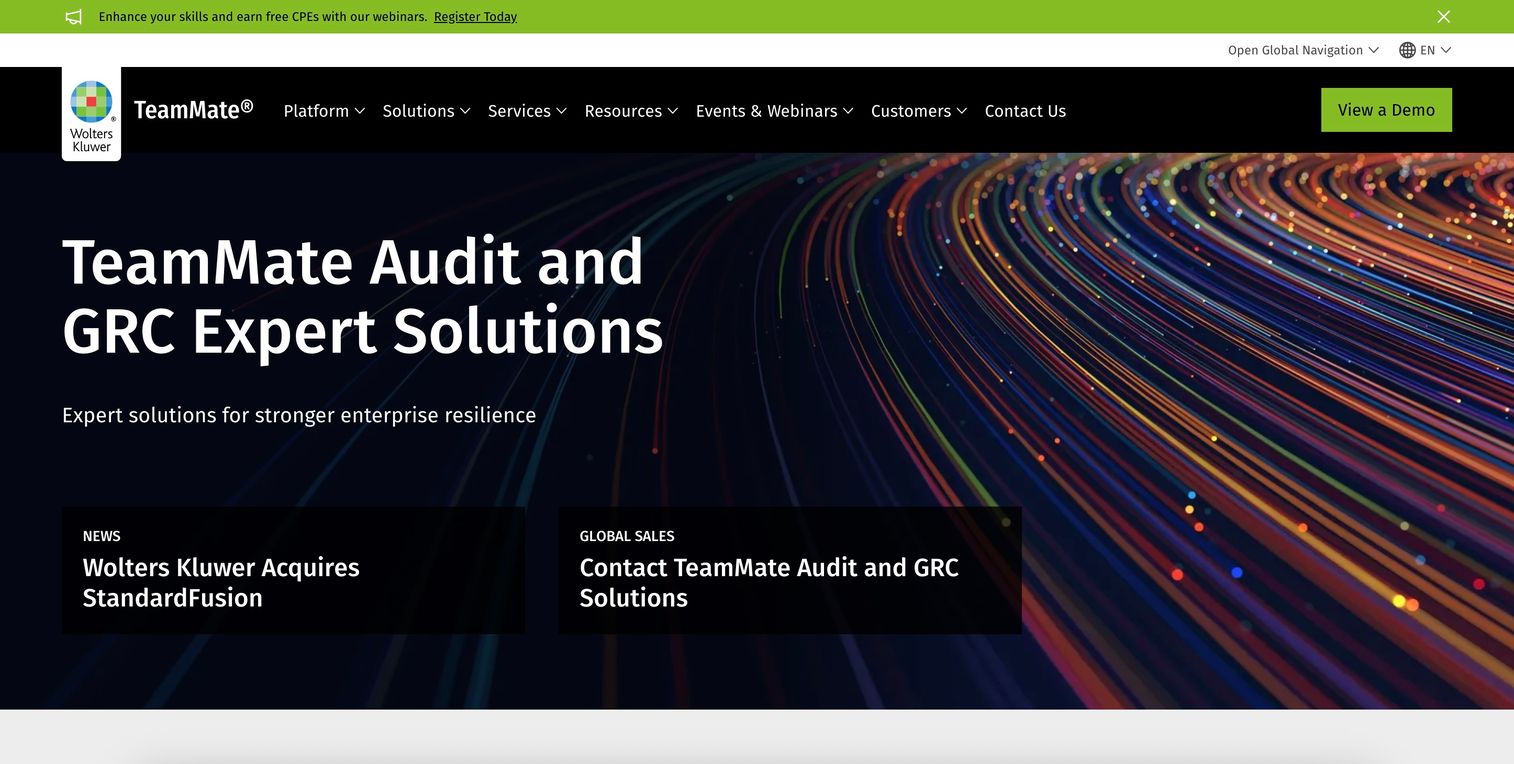
TeamMate, from Wolters Kluwer, is an audit and GRC software suite built for internal audit, risk, compliance, and controls teams. It carries deep internal audit heritage, which shows in how closely its workflow maps to how audit teams actually plan, test, and report. Beyond audit, the suite spans integrated GRC modules, so teams that grow into risk and compliance work do not have to switch platforms.
Best for: Mid-market to enterprise audit and GRC teams that want a configurable, integrated platform with strong internal audit methodology.
Key strengths
- Configurable audit workflow: Automation for audit and GRC processes adapts to your methodology instead of forcing a rigid one.
- Integrated GRC modules: Risk, compliance, policy, vendor, privacy, business continuity, and incident management live in one suite.
- Open integrations: API access and connections to common business tools keep audit data flowing to the rest of the stack.
Why choose TeamMate: Teams choose TeamMate when internal audit is the core discipline and they want software shaped by decades of audit practice. It suits programs that need configurable workflow, resource planning, and stakeholder collaboration without heavy custom build. The integrated modules make it a fit when audit is the anchor and GRC coverage grows around it.
TeamMate pricing: TeamMate uses quote-based pricing. The vendor's pricing page directs buyers to request a quote rather than listing a public price. TeamMate holds a 4.2 out of 5 rating on G2.
3. Optro
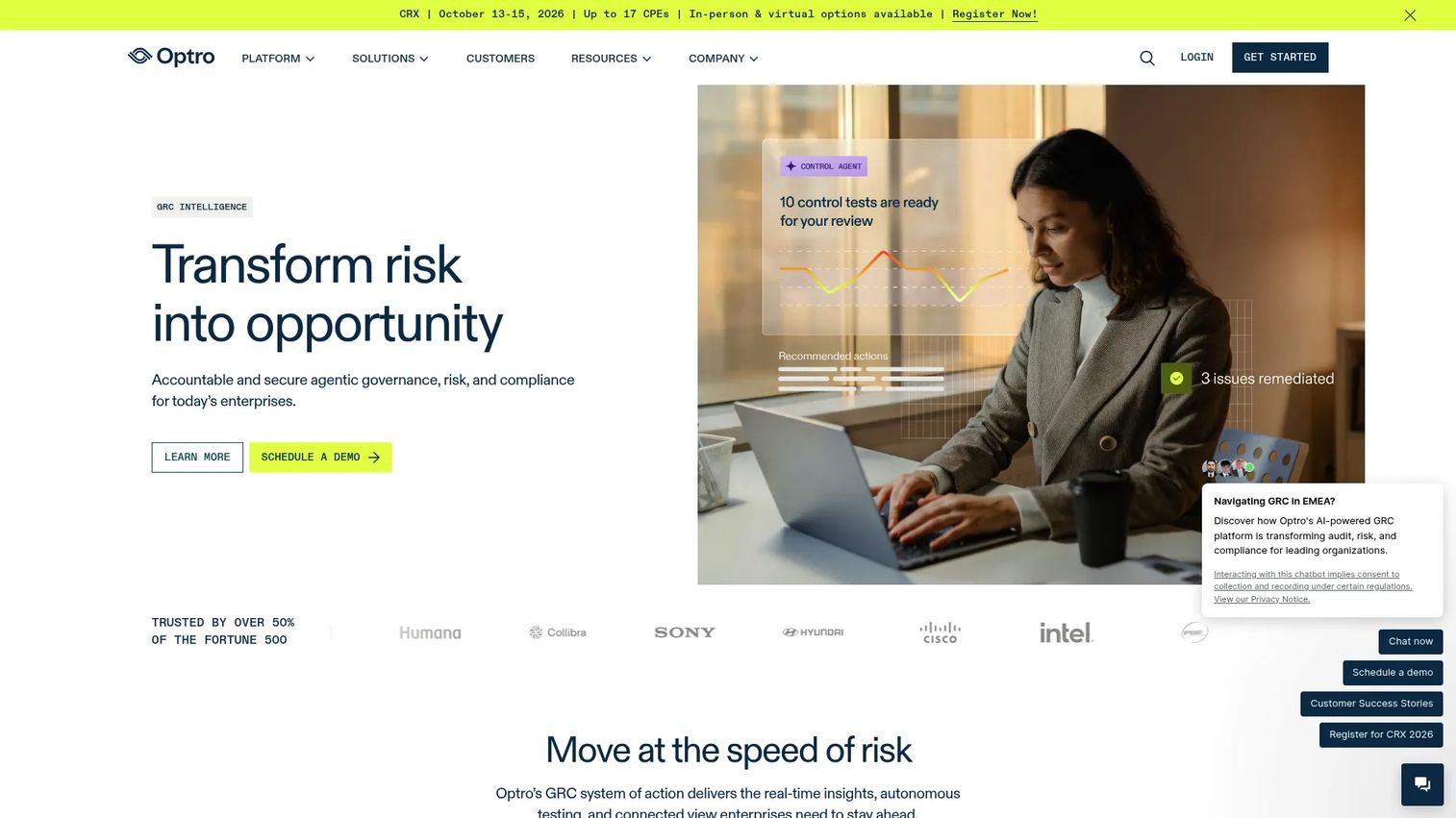
Optro is AI-powered GRC software spanning audit, risk, compliance, and AI governance. Its positioning leans hard into modern assurance: autonomous testing, real-time insights, and connected risk views rather than periodic point-in-time checks. For teams pursuing continuous auditing, that shift from batch to always-on is the whole point. AI adoption in internal audit is accelerating fast, with 39% of professionals already using AI-enabled audit technologies in 2025 and another 41% planning adoption within 12 months, per Precedence Research (2025).
Best for: Enterprises that want a connected GRC platform with AI-driven audit, risk, and compliance workflows.
Key strengths
- Autonomous testing and real-time insights: Continuous, automated testing surfaces exceptions as they happen rather than at quarter close.
- Broad framework coverage: 30+ supported frameworks and standards support standards-heavy programs.
- Extensive integrations: 200+ out-of-the-box integrations connect audit data to the tools risk and compliance teams already run.
Why choose Optro: Optro fits teams betting on AI and continuous assurance as their operating model, not a bolt-on. It suits risk-aligned planning, real-time monitoring, and audit analytics across a connected data set. If your roadmap points toward continuous auditing and agentic workflows, Optro is built for that direction.
Optro pricing: Optro uses quote-based pricing. Its pricing page references flexible plans and unlimited stakeholder licenses but does not display a public price. Optro holds a 4.6 out of 5 rating on G2, the highest in this comparison.
4. Diligent One Platform
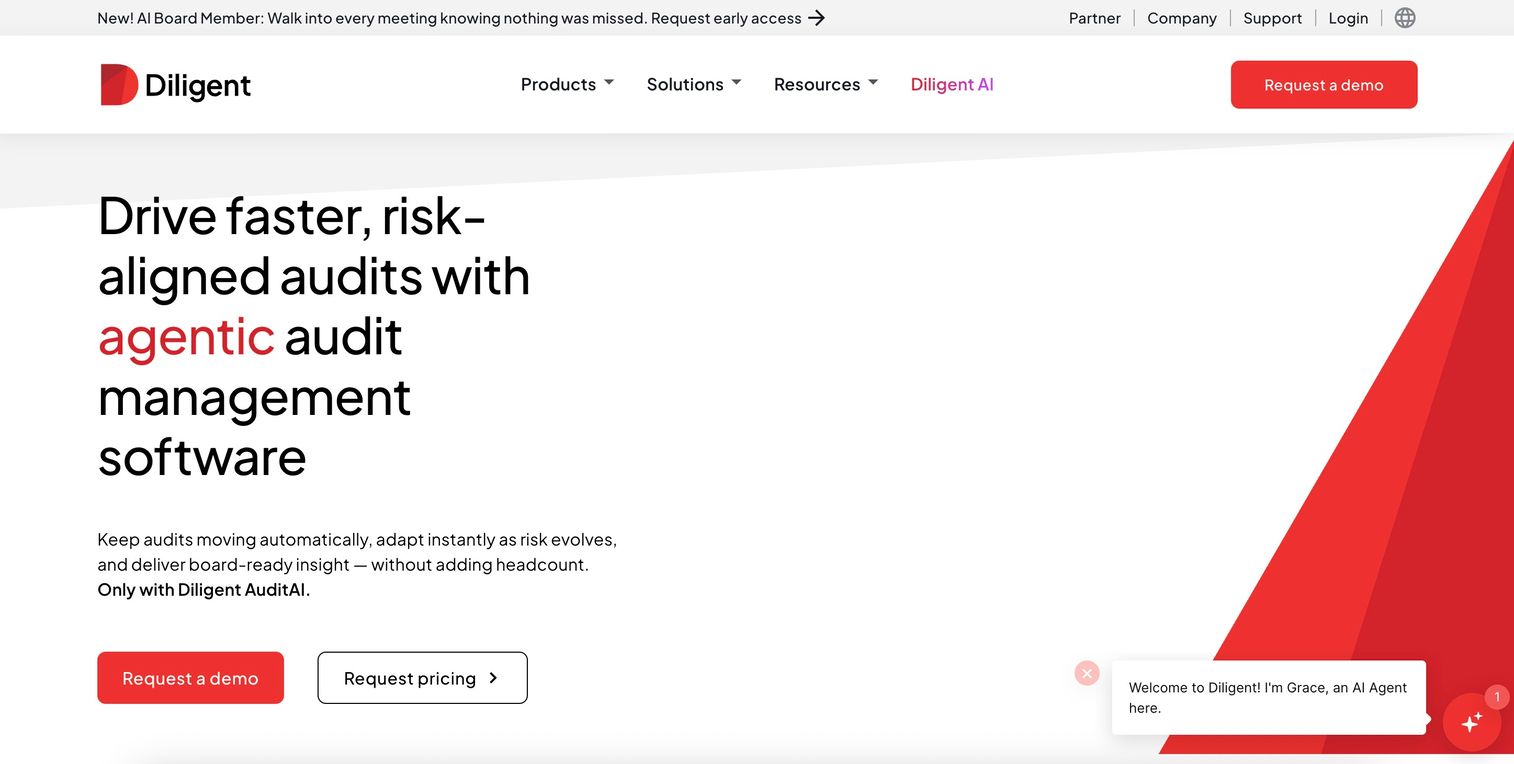
The Diligent One Platform is a unified, AI-powered GRC platform spanning board governance, risk, audit, compliance, and governance work. Internal audit is one discipline inside a wider system, which is the point for organizations that want audit findings to connect directly to board reporting and enterprise risk. Instead of audit living in isolation, results feed the same governance picture leadership already reviews.
Best for: Large organizations seeking a single GRC platform that serves board, risk, audit, and compliance teams together.
Key strengths
- Unified GRC workflows: AI-powered governance, risk, and compliance workflows keep audit connected to the broader risk story.
- Templates and dashboards: Pre-built and customizable templates and dashboards speed up setup and reporting.
- Wide data connectivity: Integrations with 100+ third-party data providers pull external signals into the platform.
Why choose Diligent One Platform: Choose it when internal audit is one of several governance functions you want on shared infrastructure. It fits enterprises where board reporting, enterprise risk, and audit should draw from the same data. The value is coherence across governance, not audit depth in isolation.
Diligent One Platform pricing: Diligent uses quote-based pricing gated behind a request form, with no public numeric price on its pricing page. Diligent One Platform holds a 4.3 out of 5 rating on G2.
5. SAP
SAP Audit Management is SAP's solution for planning, executing, documenting, and monitoring audits. Its natural home is inside SAP-centric organizations, where audit process control sits close to the ERP and financial data auditors already work with. When your systems of record are SAP, keeping audit workflow in the same ecosystem reduces integration friction and keeps evidence close to source.
Best for: Enterprises that need centralized internal audit workflow with SAP-integrated compliance processes.
Key strengths
- Build and plan audits: Structured planning tools cover the front end of the audit lifecycle.
- Analyze and document results: Capture information and document findings within a controlled workflow.
- Form and communicate opinions: Turn results into audit opinions and communicate them to stakeholders.
Why choose SAP Audit Management: It makes the most sense operationally when SAP is already the backbone of finance and controls. Keeping audit inside that environment means evidence and process control stay near the data they cover. For SAP-heavy enterprises, that proximity is the deciding factor.
SAP Audit Management pricing: SAP does not expose a public standalone price for Audit Management on its accessible pages; related bundles are priced on request. Plan to engage SAP or a partner for scoped pricing. A current G2 star rating for the product was not confirmed at the time of writing.
6. OpenPages Internal Audit Management
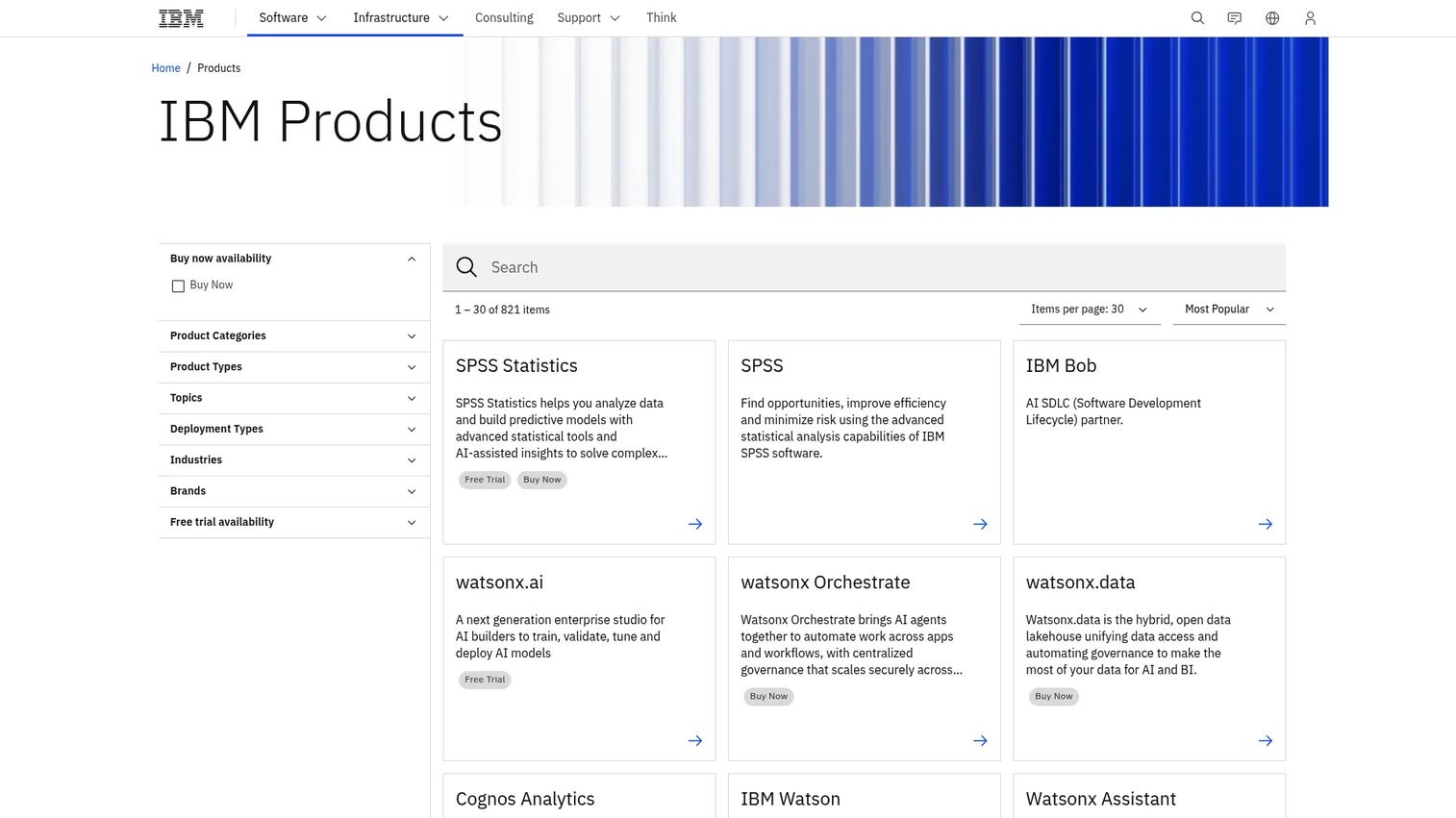
OpenPages Internal Audit Management is IBM's internal audit module within the broader OpenPages GRC platform. It is built to plan, execute, report on, and review internal audits with the workflow rigor enterprises expect, while connecting audit to enterprise risk in the same system. For organizations already invested in IBM risk and governance tooling, that integration is the draw.
Best for: Enterprises that need configurable internal audit workflows inside a broader GRC platform.
Key strengths
- Annual and engagement planning: Structured planning covers both the yearly audit universe and individual engagements.
- Audit close process: A defined close workflow keeps engagements moving to a clean, reviewable finish.
- Enterprise risk integration: Audit connects to the wider OpenPages risk and governance model.
Why choose OpenPages Internal Audit Management: Choose it when you are already deep in IBM's risk stack and want audit to live in the same platform as enterprise risk. It fits large, regulated organizations that value configurability and want workflow rigor across the audit lifecycle. The integration with broader OpenPages is the reason to pick it over standalone tools.
OpenPages pricing: IBM publishes starting prices for OpenPages editions. The Essentials edition (SaaS) starts at USD 3,300 and the Standard edition (SaaS) starts at USD 6,050. On-cloud options begin at USD 6,250 for a single solution and USD 9,000 for enterprise, while on-premises requires a quote. These are bundle prices, not a module-only figure. OpenPages holds a 4.2 out of 5 rating on G2.
7. Hyperproof
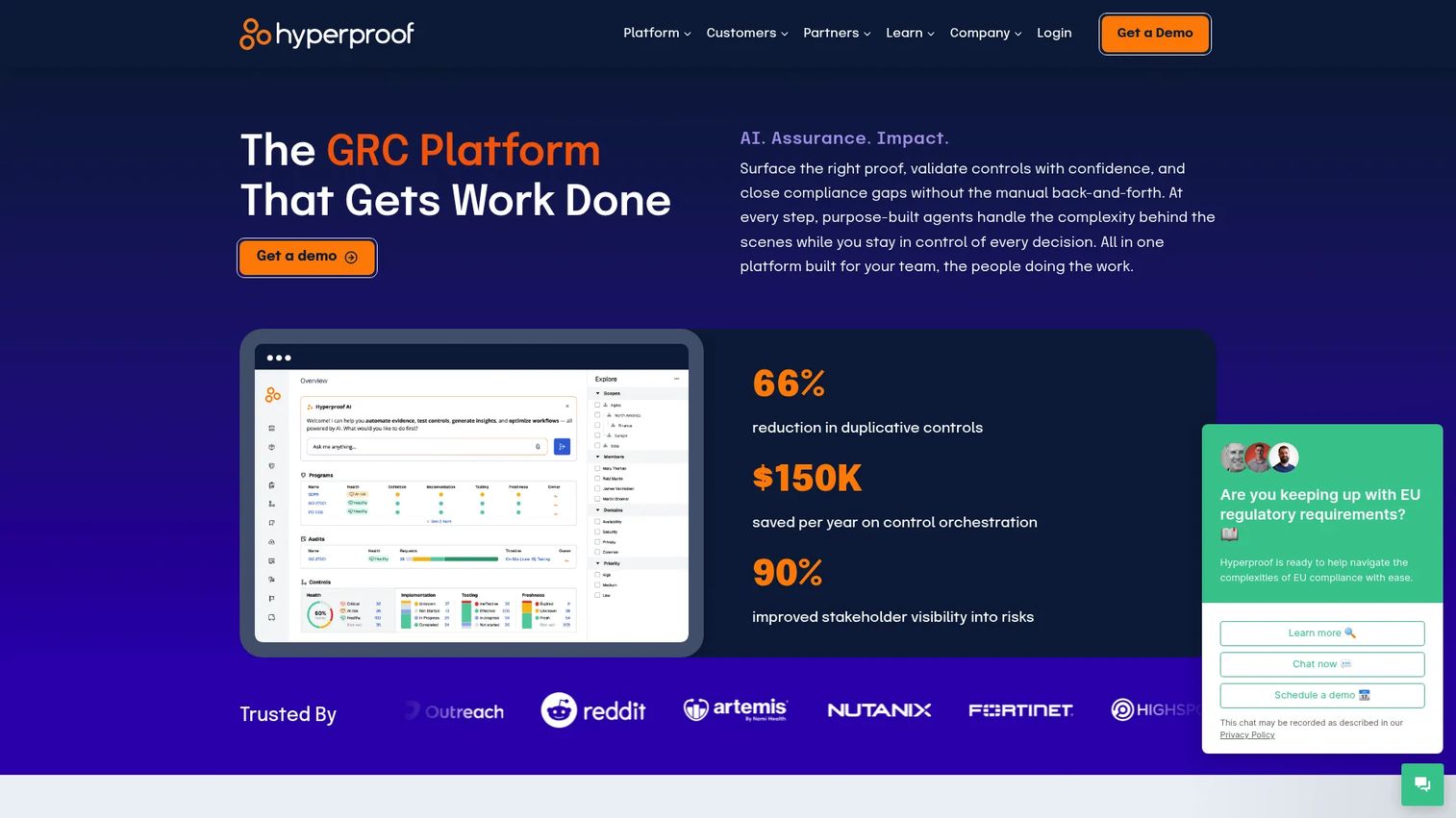
Hyperproof is AI-powered GRC software for compliance, risk, audit, and third-party risk management. Teams often shortlist it when they want broad compliance operations sitting alongside internal audit, rather than an audit-only tool. Its strength is managing many frameworks and their evidence in one place, which matters when audit and compliance workloads overlap heavily.
Best for: Teams that need a centralized GRC platform for compliance and risk operations with audit alongside.
Key strengths
- Broad framework coverage: Compliance management across 140+ frameworks supports standards-heavy, multi-framework programs.
- Risk and vendor workflows: Risk management and vendor risk workflows extend beyond audit into third-party risk.
- AI-powered platform: AI assists compliance and evidence workflows across the operation.
Why choose Hyperproof: Teams choose Hyperproof when compliance operations are as important as internal audit, and they want both in one system. It suits organizations juggling many frameworks that need shared evidence management and continuous control monitoring. The wide framework coverage is the differentiator when compliance breadth is the priority.
Hyperproof pricing: Hyperproof does not publish a public price on its site; pages prompt for a demo or quote request. Plan to contact their team for scoped pricing. Hyperproof holds a 4.5 out of 5 rating on G2.
Considerations
Positive positioning aside, use this checklist to pressure-test any platform against your operating model before you buy.
Audit lifecycle coverage
Confirm the platform handles planning, fieldwork, reporting, and remediation in one place. Gaps between systems are where time and evidence leak. If a tool covers testing beautifully but hands off remediation to email, you have not solved the problem, only moved it.
Standards alignment
Verify support for IIA expectations, the Global Internal Audit Standards, and any QAIP-related workflows you rely on. Standards conformance is not a checkbox; it shapes how the tool structures workpapers, review, and quality assessment. Ask the vendor how their methodology maps to the standards you report against.
Evidence and workpaper management
Look for traceability, version control, and easy evidence retrieval. The real test is whether an auditor six months from now can find the right evidence and prove it supports the finding. Weak evidence handling turns every review into a scavenger hunt.
Reporting and executive visibility
Check whether the software makes audit results understandable to leadership and the audit committee. Dashboards that only auditors can read are not visibility. The best reporting turns findings, coverage, and remediation status into something a board can absorb in minutes.
Integrations and change management
Confirm integrations with your document, storage, and analytics tools only where they fit your audit operating model. More connectors are not better; relevant ones are. Also weigh adoption: a powerful platform nobody uses consistently underdelivers, so factor in training and change management.
Conclusion
The strongest pick depends on where your audit function sits. Choose Workiva when audit is part of a broad, connected reporting mandate. Choose TeamMate when internal audit is the core discipline and you want software shaped by audit heritage. Choose Optro when AI-driven continuous auditing is your operating model. Diligent One Platform and OpenPages fit best when audit belongs inside a wider GRC and board governance system, SAP Audit Management when SAP is your backbone, and Hyperproof when compliance operations run alongside audit at scale.
Shortlist based on three things: your audit maturity, your standards requirements, and your reporting complexity. Map each platform against the considerations checklist, then run a scoped evaluation with your real audit universe and a live engagement. The tool that fits your workflow beats the tool with the longest feature list every time.
FAQs
Internal audit software centralizes the full audit program: risk-based planning, fieldwork and testing, evidence collection, workpapers, reporting, and remediation tracking. Instead of running audits across spreadsheets, shared drives, and email, teams work in one system with an audit trail, version control, and role-based access. The result is provable coverage and faster reporting to leadership.
Prioritize audit lifecycle coverage from planning through remediation, evidence and workpaper management with version control, standards-aligned methodology, and reporting that leadership can actually read. Audit analytics and stakeholder communication features matter next. The right mix depends on whether your pain is planning, fieldwork, or proving assurance.
Dedicated internal auditing software goes deep on audit-specific workflow: workpapers, test steps, review, and IIA-aligned methodology. GRC software covers a wider surface including enterprise risk, compliance, policy, and vendor management, often treating audit as one module. Many buyers want both, which is why several platforms here combine dedicated audit workflow with broader GRC coverage.
Yes. Strong platforms are built around IIA expectations and the Global Internal Audit Standards, structuring workpapers, review, and quality assessment (QAIP) to conform. Support varies by vendor, so ask directly how their methodology maps to the standards you report against and whether quality assessment workflows are built in.
A small team should prioritize fast time-to-value, clean evidence and workpaper handling, and reporting that does not require a specialist to run. Avoid platforms whose value only appears at enterprise scale. Look for configurable but lightweight workflow so a lean team can standardize planning and remediation without heavy administration.
Enterprises should weigh standards conformance, integration with existing risk and reporting systems, governance and permissions, and the ability to report coverage across many concurrent audits. Connected data and shared GRC infrastructure matter more at scale, since audit findings often need to feed board reporting and enterprise risk views.
Test three things: traceability (can you tie every piece of evidence to a finding), version control (is there one clear final version), and retrieval (can someone find the right evidence months later). Ask to see how the platform handles a full evidence trail during a live demo, not just a screenshot. Weak evidence handling shows up during review, not the sales cycle.
Increasingly, yes. AI adoption in internal audit is rising fast, with 39% of professionals already using AI-enabled audit technologies in 2025 and 41% more planning adoption within 12 months, per Precedence Research (2025). Practical uses include autonomous testing, exception detection, continuous auditing, and drafting support for reporting. Judge it by whether it reduces manual testing and review time, not by the label.