A phishing kit goes live at 2 a.m. It clones your login page, harvests credentials for six hours, and by the time an analyst spots it in the morning queue, the damage is already booked. Attackers do not wait for business hours. Your manual monitoring does.
That gap is the core problem digital risk protection software solves. The category exists because external threats now move faster than any team can track by hand across the open web, deep web, and dark web. And the money follows the problem: the global digital risk protection market grew from USD 61.49 billion in 2024 to USD 73.59 billion in 2025, and is projected to reach USD 177.59 billion by 2030 at a 19.33% CAGR, according to Research and Markets (2024).
For presales and security evaluators, the buying lens is narrow and unforgiving. You are judging four things: external monitoring coverage, takedown capability, evidence quality, and managed support depth. Everything else is packaging. A digital risk protection platform that detects fast but takes days to remediate leaves you exposed. One that removes threats quickly but hands you thin evidence leaves your legal team stranded. This article compares seven real digital risk protection solutions for 2026 so you can shortlist with confidence and defend the choice to security, legal, and procurement in the same meeting.
What's inside
This guide covers digital risk protection software built for external threat monitoring across the open, deep, and dark web, plus brand protection, phishing detection, data leak detection, and takedown workflow automation. It is written for security, brand, fraud, and presales teams comparing digital risk protection vendors for an enterprise program.
We evaluated each platform on five criteria that matter in a real buying cycle: monitoring breadth across web layers, detection accuracy, remediation and takedown speed, evidence collection quality, and the depth of analyst or managed support behind the tooling. Every tool here is a shipping product with verifiable capabilities, not a roadmap promise.
TL;DR
- Best overall for broad enterprise DRP coverage: Group-IB, an all-in-one platform with evidence-rich takedowns and 24x7 analysts.
- Best for managed remediation plus MDR alignment: Rapid7, especially if you already run its Command Platform.
- Best for integrated threat intelligence: CrowdStrike, with digital risk folded into Falcon.
- Best for rapid takedowns and brand protection: Netcraft, built around disruption speed.
- Best for intelligence-led programs: Recorded Future, for teams that want actor context before mitigation.
- Best for social and impersonation monitoring: ZeroFox, with strong external attack surface coverage.
- Best for people-centric and email-adjacent risk: Proofpoint, tied to identity and account protection.
What is digital risk protection software?
Digital risk protection (DRP) software is a category of external threat monitoring and remediation tools that continuously scan the open, deep, and dark web to detect, investigate, and take down threats targeting an organization's brand, executives, customers, and data.
Here is what separates DRP cyber security from adjacent categories, broken into the subtopics buyers actually evaluate:
- What it monitors: public websites, social platforms, app stores, marketplaces, paste sites, forums, messaging channels, and dark web markets. Good coverage spans all three web layers, not just the surface.
- What threats it covers: phishing domains, brand impersonation monitoring, executive impersonation protection, counterfeit monitoring, scam intelligence, credential and data leak detection, and fraud infrastructure.
- How takedown and remediation work: a mature takedown workflow moves from detection to evidence collection to enforcement, coordinating with registrars, hosts, social platforms, and app stores to remove malicious content.
- Why evidence collection matters: takedowns and legal escalation depend on defensible proof. Screenshots, WHOIS records, hosting data, and timeline reconstruction turn a detection into an actionable case.
- Where human analysts add value: automation surfaces volume, but analysts validate, prioritize, and pursue enforcement. Managed digital risk protection pairs the platform with a team that runs the workflow for you.
The category spans far more than phishing. Online brand protection, threat intelligence enrichment, deep web monitoring, and dark web monitoring all sit under the same roof, which is why enterprise buyers treat DRP as a program rather than a single feature.
When to use digital risk protection software
Monitor brand abuse before it becomes a legal or customer issue
Impersonation sites, fake social accounts, counterfeit listings, and lookalike phishing domains damage revenue and trust long before anyone files a complaint. Digital risk protection solutions catch these early by scanning registration data, social platforms, and marketplaces continuously. The goal is disruption before a customer gets scammed, not cleanup after.
Track leaks and executive impersonation continuously
Credential dumps, stolen source code, leaked customer records, and VIP spoofing surface in places your team does not routinely watch. Data leak detection across paste sites and dark web forums flags exposure while it is still contained. Executive impersonation protection catches fake profiles and fraudulent partnership scams that target your leadership by name.
Coordinate security, legal, and fraud response in one workflow
When a threat lands, multiple teams need the same thing at once: evidence, prioritization, and a clear takedown path. DRP matters most when it becomes the shared workspace where security triages, legal reviews defensible proof, and fraud teams track infrastructure. Without that coordination, response fragments across inboxes and stalls.
Comparison table
The table below compares the seven digital risk protection vendors by primary intent, key differentiation, pricing, and G2 rating. Pricing in this category is largely quote-based, so treat public figures as entry points rather than program cost. Ratings reflect current G2 seller and product pages.
| # | Product | Intent | Key differentiation | Pricing | G2 rating |
|---|---|---|---|---|---|
| 1 | Group-IB | Broad managed DRP | Evidence-rich takedowns, 24x7 analysts | Quote-based | 4.6/5 |
| 2 | Rapid7 | Managed DRP plus MDR | Specialist-run takedowns inside Command Platform | Quote-based for DRP | 4.3/5 |
| 3 | CrowdStrike | Intelligence-integrated DRP | Digital risk inside Falcon threat intelligence | Falcon from $7.99/device/mo | 4.6/5 |
| 4 | Netcraft | Rapid takedown and brand protection | Disruption speed across web layers | Custom quote | 4.6/5 |
| 5 | Recorded Future | Intelligence-led DRP | Actor mapping and contextual prioritization | Quote-based | 4.6/5 |
| 6 | ZeroFox | Social and impersonation monitoring | External attack surface plus takedowns | Request pricing | 4.4/5 |
| 7 | Proofpoint | People-centric external risk | Identity and account-takeover protection | Essentials from $1.00/user/mo | 4.5/5 |
1. Group-IB
Group-IB runs an intelligence-led cybersecurity practice, and its Digital Risk Protection sits inside a Unified Risk Platform that also spans threat intelligence, fraud prevention, and incident response. The platform continuously monitors online resources across the open, deep, and dark web, then feeds detections into a structured takedown workflow. For buyers who want one vendor covering monitoring, enforcement, and analyst support, Group-IB is built for that breadth.
Best for: enterprises that want a broad, managed, evidence-rich program with strong enforcement behind it.
Key strengths
- Unified Risk Platform: monitoring, fraud protection, and digital risk sit under one system so detections carry threat intelligence context.
- Evidence-driven takedowns: the platform collects defensible proof and coordinates removal, which matters when legal escalation follows.
- Analyst-backed enforcement: takedown workflows are supported by teams, so volume does not stall in a queue.
Why choose Group-IB: if your program touches phishing detection, brand protection, counterfeit monitoring, data leak detection, and executive impersonation protection all at once, consolidating into one intelligence-led platform reduces the seams where threats slip through. It fits security teams that want fraud prevention and DRP in the same lens rather than stitched across tools.
Group-IB pricing: Group-IB does not publish public pricing. The site directs buyers to talk to sales or request a demo, and pricing-related notes indicate services are quote-based, with capabilities like Attack Surface Management priced by organizational asset counts. Expect a tailored enterprise quote scoped to your monitoring footprint and enforcement needs. Group-IB holds a 4.6/5 G2 seller rating.
2. Rapid7
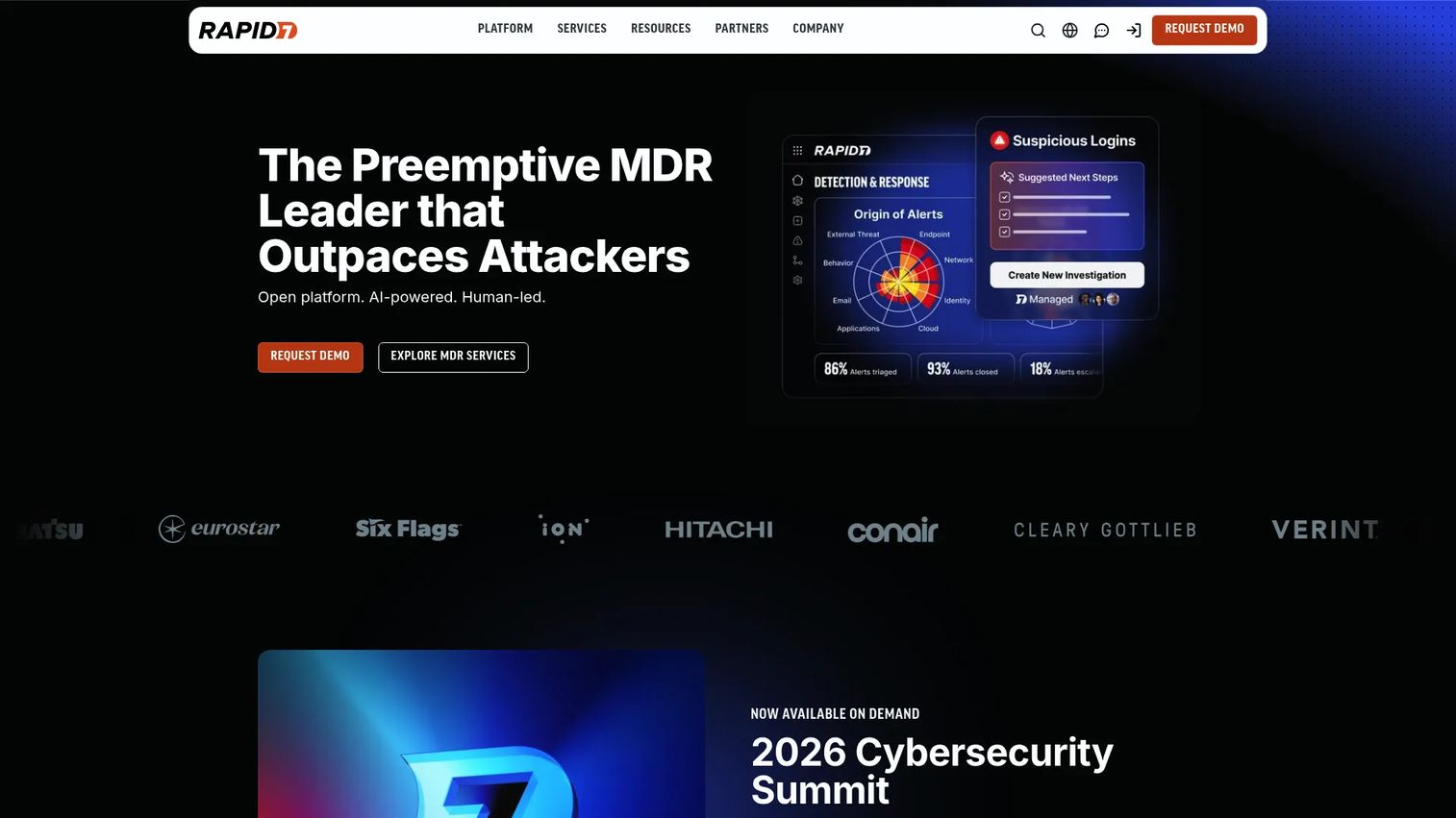
Rapid7 delivers Managed Digital Risk Protection as part of its managed services portfolio, aligned with MDR and its Command Platform for unified exposure, detection, and response. The differentiator here is that specialists run the takedowns and remediations for you. Coverage spans phishing and brand impersonation, dark web exposure, and executive and VIP protection, so the external risk surface connects to the same team watching your internal telemetry.
Best for: security teams already in the Rapid7 ecosystem, or any team that wants external monitoring paired with hands-on managed response.
Key strengths
- Specialist-run remediation: takedowns and remediations are executed by Rapid7 analysts, not left to your queue.
- Command Platform alignment: DRP data connects to unified exposure, detection, and response rather than living in a silo.
- Broad external coverage: phishing, brand impersonation monitoring, dark web exposure, and VIP protection under one managed program.
Why choose Rapid7: the value is consolidation. If you already run Rapid7 for MDR or exposure management, adding managed DRP keeps external and internal risk on one operational surface. For lean security teams, letting specialists own the takedown workflow frees analysts from repetitive enforcement.
Rapid7 pricing: Rapid7 publishes starting prices for select Insight products. InsightVM starts at $1.62/mo for 500 assets, InsightAppSec at $175/mo per app, and InsightCloudSec at $5,775/mo for up to 500 instances. Managed services, including Managed Digital Risk Protection, are quote-based, so expect a custom scope. Rapid7 holds a 4.3/5 G2 rating and does not offer a free tier.
3. CrowdStrike
CrowdStrike folds digital risk protection into Falcon, its AI-native unified security platform. Rather than a standalone product, DRP capabilities live alongside threat intelligence and threat hunting, drawing on the same telemetry and adversary data. Coverage includes deep and dark web monitoring, credential exposure, and brand impersonation detection, all enriched by CrowdStrike's intelligence stack.
Best for: security teams that want digital risk embedded in a larger intelligence and detection platform rather than bolted on.
Key strengths
- Intelligence-integrated DRP: digital risk sits inside Falcon threat intelligence, so external signals connect to adversary tracking.
- Deep and dark web monitoring: credential exposure and leaked data surface through the same platform watching endpoints.
- Brand impersonation detection: external impersonation threats are correlated with broader hunting workflows.
Why choose CrowdStrike: if Falcon is already your platform of record, running DRP inside it means external threats inherit the same intelligence context as endpoint and identity signals. That correlation matters when you want to see whether an impersonation campaign ties to a tracked adversary rather than treating it as an isolated event.
CrowdStrike pricing: CrowdStrike publishes public Falcon pricing. A 15-day free trial is available, then Falcon Go at $7.99 per device, Falcon Pro at $14.99 per device, and Falcon Enterprise at $19.99 per device, all billed monthly. Falcon Complete Next-Gen MDR is contact-sales. Digital risk capabilities typically attach to intelligence tiers, so confirm scope during quoting. CrowdStrike holds a 4.6/5 G2 rating.
4. Netcraft
Netcraft is built around disruption speed. The platform combines phishing detection and disruption, brand impersonation monitoring, and takedown with attack analysis across clear, deep, and dark web sources. Netcraft pairs automation and AI with human insight, and its reputation rests heavily on how fast it moves from detection to removal. For brands where the metric that matters is time-to-takedown, that focus is the draw.
Best for: brands prioritizing takedown speed and mature disruption operations against phishing and impersonation.
Key strengths
- Phishing detection and disruption: the core engine is tuned to find and dismantle phishing infrastructure quickly.
- Brand impersonation monitoring: lookalike domains and impersonation content are tracked across web layers.
- Takedown and attack analysis: removal is paired with analysis of the underlying attack so you understand the campaign, not just the artifact.
Why choose Netcraft: the platform is engineered for speed and accuracy in takedowns, which is the right emphasis if phishing volume is your dominant pain and you need disruption operations that run continuously. It also offers free browser, mobile, and email protection tools, which gives evaluators a way to sample the detection quality before a paid conversation.
Netcraft pricing: Netcraft does not publish subscription pricing. The site routes buyers to request a custom quote scoped to their brand protection and takedown needs. Free protective tools for browser, mobile, and email are publicly available, but paid plan pricing is not disclosed. Netcraft holds a 4.6/5 G2 rating.
5. Recorded Future
Recorded Future approaches digital risk protection from an intelligence-first angle. Its Intelligence Cloud maps adversaries, infrastructure, and targets, and the DRP capability sits inside that context. Rather than surfacing a raw list of impersonation domains, the platform helps teams understand which threats connect to which actors, so prioritization happens before mitigation. AI-driven threat hunting, monitoring, and alert triage reduce the noise analysts have to wade through.
Best for: security teams that want intelligence depth and cross-functional threat visibility, not just a narrow point solution.
Key strengths
- Intelligence Cloud context: adversaries, infrastructure, and targets are mapped so external risk carries actor attribution.
- Malware and threat-actor analysis: Intelligence Cards give analysts depth on the entities behind a threat.
- AI-driven triage: hunting, monitoring, and alert triage cut the volume analysts manually review.
Why choose Recorded Future: if your program values understanding the adversary before pulling a takedown lever, Recorded Future's context-first model fits. It suits teams that run threat intelligence as a discipline and want digital risk monitoring, third-party risk, and cyber operations sharing the same intelligence backbone.
Recorded Future pricing: Recorded Future does not publish public pricing. Plans are structured across Core, Professional, and Elite tiers, with cost based on package selection, organization size, usage levels, and services. The site directs buyers to contact sales for a tailored quote. There is no free tier. Recorded Future holds a 4.6/5 G2 rating.
6. ZeroFox
ZeroFox is an external cybersecurity platform covering threat intelligence, digital risk protection, attack surface intelligence, and takedowns. Its strength shows up in social media and impersonation monitoring, where fake accounts, executive spoofing, and brand abuse spread fast. The platform combines AI-powered discovery with 24/7 analyst validation, automated takedowns and disruption, and threat intelligence spanning the surface, deep, and dark web.
Best for: organizations where social impersonation and public attack surface abuse are the primary pain points.
Key strengths
- AI discovery with analyst validation: automated detection is checked by 24/7 analysts so alerts stay actionable.
- Automated takedowns and disruption: removal workflows run automatically across channels.
- Full-spectrum threat intelligence: coverage extends across surface, deep, and dark web sources.
Why choose ZeroFox: if your exposure concentrates in social channels and public-facing impersonation, ZeroFox is built around that surface. It fits teams that need executive impersonation protection, brand impersonation monitoring, and scam intelligence with automated takedown backing rather than a general-purpose intelligence platform.
ZeroFox pricing: ZeroFox does not disclose numeric pricing. The pricing page lists Foundation, Core, Premium, and Executive bundles, each with a "Request Pricing" path, plus add-ons and services. Expect a bundle-based quote scoped to your channels and takedown volume. ZeroFox holds a 4.4/5 G2 rating.
7. Proofpoint
Proofpoint is a people-, data-, and AI-centric security company, and its external risk capabilities tie into that broader posture. Digital risk and impersonation monitoring connect to email and collaboration threat protection, data security and DLP, and identity and account-takeover protection. For buyers whose threat model centers on impersonation, phishing detection, and email-adjacent fraud, Proofpoint's people-centric framing keeps external monitoring aligned with the channels attackers actually use.
Best for: security teams that already run Proofpoint or want brand and identity monitoring tied to email and social threat workflows.
Key strengths
- Email and collaboration protection: external impersonation risk connects to the platform watching inbound threats.
- Data security and DLP: data leak detection sits alongside external monitoring rather than in a separate tool.
- Identity and account-takeover protection: executive impersonation protection ties into identity defense.
Why choose Proofpoint: DRP here is broader than a standalone product, so the fit is strongest when your primary concern is people-centric risk that spans email, identity, and impersonation. Teams already invested in Proofpoint gain external monitoring that shares context with their email security stack rather than running as a disconnected feed.
Proofpoint pricing: Proofpoint publishes pricing for its Essentials line. PESA starts at $1.00 per active user per month, Business at $1.65, and Advanced at $4.13, all billed per active user monthly. Broader Proofpoint products generally route to demo or partner pricing, so external risk capabilities require a scoped quote. There is no free tier. Proofpoint holds a 4.5/5 G2 rating.
Considerations before you buy
A DRP purchase is easy to get wrong when the demo looks impressive but the operational reality does not hold up. Evaluate against these criteria before signing.
Coverage across all three web layers
Confirm the platform monitors the open, deep, and dark web, not just the surface. Ask for named source types: social platforms, marketplaces, paste sites, forums, and dark web markets. A tool that only watches public websites leaves your credential and data leak detection blind.
Takedown workflow depth and speed
Detection is table stakes. What separates digital risk protection vendors is the takedown workflow: who executes it, how fast, and against which registrars, hosts, and platforms. Ask for median takedown times by threat type and confirm whether specialists run the process or hand you the queue.
Evidence collection quality
Enforcement and legal escalation depend on defensible proof. Verify the platform captures screenshots, WHOIS records, hosting data, and timeline reconstruction. Thin evidence stalls both takedowns and any downstream legal action.
Managed support depth
Decide early whether you want tooling or managed digital risk protection. If your team is lean, analyst-backed enforcement and 24x7 validation matter more than dashboard breadth. Confirm what is included versus what costs extra.
Integration with your existing stack
Check how detections flow into your SIEM, SOAR, ticketing, and threat intelligence tools. External monitoring that lives in a silo forces manual re-entry and slows response.
Conclusion
The right choice comes down to what your program needs most. If you want broad managed protection with evidence-rich enforcement, Group-IB and Rapid7 lead. If takedown speed against phishing is the metric that matters, Netcraft is built for it. If you want intelligence and actor context before you act, Recorded Future fits. For social and impersonation-heavy exposure, ZeroFox concentrates there, and for people-centric risk tied to email and identity, Proofpoint aligns with that posture. CrowdStrike is the pick when you want digital risk embedded in an existing Falcon deployment.
The next step is practical. Shortlist two or three digital risk protection solutions, then ask each for proof of coverage on phishing detection, brand impersonation monitoring, data leak detection, and takedown speed. Run a short proof of value against your own brand and executives so you are judging real detections, not a scripted demo. Buy the platform that removes threats fastest with evidence you can defend.
FAQs
Digital risk protection software is a category of external threat monitoring and remediation tools that scan the open, deep, and dark web to detect and take down threats targeting an organization's brand, executives, customers, and data. It covers phishing, impersonation, counterfeit listings, and data leaks. The goal is to disrupt external threats before they reach customers or cause reputational and financial damage.
It continuously collects data across public websites, social platforms, marketplaces, paste sites, forums, and dark web markets. Detection engines and AI flag threats like phishing domains and executive impersonation, then analysts validate and prioritize them. Confirmed threats move into a takedown workflow where the platform collects evidence and coordinates removal with registrars, hosts, and platforms.
DRP cyber security covers phishing detection, brand impersonation monitoring, executive impersonation protection, counterfeit and piracy monitoring, scam intelligence, credential and data leak detection, and fraud infrastructure. Coverage spans the surface, deep, and dark web. The breadth is why enterprises treat digital threat protection as a program rather than a single point tool.
They overlap but are not identical. Threat intelligence focuses on understanding adversaries, infrastructure, and campaigns, while digital risk protection applies that context to external threats against your specific brand and assets, then remediates them. Several platforms combine both, using threat intelligence to enrich and prioritize DRP detections before takedown.
Evaluate monitoring coverage across all three web layers, takedown workflow speed and who executes it, evidence collection quality, managed support depth, and integration with your SIEM and threat intelligence stack. Ask digital risk protection vendors for median takedown times by threat type. The strongest fit removes threats fast with proof your legal team can act on.
Speed expectations vary by threat, but phishing takedowns are where minutes matter most because active kits harvest credentials in real time. Ask each vendor for median takedown times by threat type and confirm whether removal runs automatically, is analyst-driven, or both. Faster disruption directly reduces the window attackers have to cause harm.
No, they extend them. Managed digital risk protection handles high-volume detection, validation, and enforcement so internal analysts focus on strategic work and complex cases. For lean teams, this is the difference between running a real program and drowning in alerts. Most enterprises pair managed services with internal ownership of policy and escalation.
Shortlist two or three digital risk protection solutions, then run a proof of value against your own brand and executives. Judge real detections on phishing detection, impersonation, and data leak detection, measure takedown speed, and inspect evidence quality. Confirm integrations, managed support scope, and pricing structure before committing to an enterprise contract.