A shopper types "waterproof running jacket men's medium" into your search bar. Your site returns 0 results. Or worse, it returns 400 loosely related products with no clear winner near the top. They bounce. That shopper had intent, a size, and a budget, and your search box lost the sale before a single category page loaded.
This happens constantly. The global ecommerce search software market is projected to grow from $581 million in 2024 to $1.18 billion by 2033, at an 8.14% CAGR, according to Market Growth Reports (2024). The reason is simple: search is where high-intent shoppers tell you exactly what they want, and weak relevance turns that intent into cart abandonment. Mobile makes the stakes higher still, with mobile now accounting for over 63% of total ecommerce search queries (Market Growth Reports, 2024).
For a digital marketer, this is a conversion problem wearing a UX costume. You can pour budget into paid acquisition, but if the onsite search engine can't convert intent into a purchase, your CAC quietly inflates. The right platform fixes relevance, surfaces the right products, and gives merchandisers control without an engineering ticket. The wrong one adds another tool to a sprawling stack that nobody can tie back to revenue.
Tools win on different things. Some win on raw speed and developer flexibility. Some win on personalization depth. Some win on merchandiser control. Knowing which axis matters most for your catalog is the whole game, and that's what the criteria below are built to sort out. If you research buying decisions through ranked guides like this, you may also find our roundups of ai content creation tools and best ai image generators useful for adjacent marketing stack decisions.
What's inside
This guide compares 9 ecommerce search platforms for teams that need better onsite search, product discovery, merchandising control, and measurable conversion lift. We selected each platform on four criteria: feature depth across search and discovery, buyer relevance for marketing and ecommerce teams, platform and stack fit, and evidence of real adoption. This is built for marketers and ecommerce managers who want a practical shortlist they can act on, not a glossary. You'll get a comparison table, individual breakdowns with pricing and G2 ratings, and a buyer's checklist to narrow your options fast.
TL;DR
- Best overall ecommerce search engine: Algolia, for fast, AI-driven search with deep developer flexibility and strong analytics.
- Best for enterprise personalization: Bloomreach, which unifies search, merchandising, and customer data under one roof.
- Best AI-first product discovery at scale: Constructor, named a Leader in the Gartner Magic Quadrant for Search and Product Discovery, 2026.
- Easiest to set up for SMB and mid-market: Doofinder, with public pricing from $49/month and quick deployment.
- Best lightweight option for lean teams: Searchanise, with a free tier and Shopify-friendly setup.
- Best for merchandising-led control: Searchspring, for teams who want to shape browsing as much as search.
What is ecommerce search software?
Ecommerce search software is the layer that indexes your product catalog and helps shoppers find the right item through onsite search, autocomplete, filters, recommendations, semantic relevance, and merchandising rules. It sits between a shopper's query and your catalog, turning messy intent into a ranked, relevant result set that drives them toward checkout.
Modern platforms in this category go well beyond a keyword match. They interpret intent, tolerate typos, expand synonyms, and increasingly use AI to understand meaning rather than just exact strings. The core capabilities to expect:
- Catalog indexing: ingesting product data, attributes, and inventory so search stays current.
- Autocomplete and typo tolerance: surfacing suggestions as shoppers type and forgiving misspellings.
- Filters and facets: letting shoppers refine by size, price, color, brand, and attributes.
- Recommendations: showing related, complementary, or personalized products.
- Semantic and AI search: interpreting meaning and natural language, not just keywords.
- Merchandising controls: boosting, burying, pinning, and tuning results with no-code admin controls.
- Analytics: reporting on queries, zero-result searches, click-through, and search conversion.
This differs from broader enterprise search, which often spans internal documents, knowledge bases, and support content. An ecommerce product search engine is purpose-built for catalogs, conversion, and merchandising. The newest entrants add AI ecommerce search, conversational search, and guided selling, framing the category as search and product discovery rather than just a search box.
When to use ecommerce search software
Not every store needs a dedicated search platform on day one. These are the situations where it earns its place in the stack.
Improve poor product discovery
When your catalog is large, attribute-heavy, or hard to navigate through categories alone, browsing breaks down. A shopper who knows exactly what they want but can't find it through your menu structure is a search problem. The bigger and more nuanced your catalog, the more a dedicated ecommerce search engine pays for itself by connecting specific intent to the right product fast.
Reduce bounce after onsite searches
Search quality directly shapes abandonment. Zero-result pages, vague rankings, and slow response times all push shoppers to leave. With over 75% of online retailers deploying AI-enabled search in 2023 (Market Growth Reports, 2024), the baseline shopper expectation has risen. If your search returns irrelevant results while competitors return precise ones, you lose the comparison before it starts.
Support merchandisers and growth teams
When your team needs no-code control over ranking, boosting, synonyms, recommendations, and search tuning without filing engineering tickets, a modern search platform is the answer. Merchandisers want to promote seasonal lines, fix underperforming queries, and tune relevance on their own. Growth teams want to run experiments and tie search behavior to revenue. The right platform hands both groups direct levers.
Comparison table
Here's how the nine platforms compare at a glance. The table is sorted by overall relevance to ecommerce search, with the strongest AI-driven and personalization-led platforms near the top. Use it to spot fast distinctions like enterprise depth, SMB friendliness, or merchandising strength before reading the full breakdowns.
| # | Product | Intent | Key use case | Pricing | G2 rating |
|---|---|---|---|---|---|
| 1 | Algolia | AI search and discovery | Fast, customizable site search at scale | Free tier; from $0.50 per additional 1K requests | 4.5/5 |
| 2 | Bloomreach | Personalization-led discovery | Unified search, merchandising, and customer data | Request pricing (usage-based) | 4.6/5 |
| 3 | Constructor | Enterprise AI product discovery | AI-first search and browse for large catalogs | Request a demo | 4.8/5 |
| 4 | Doofinder | Conversion-focused search | Quick-setup AI search for SMB and mid-market | From $49/month | 4.7/5 |
| 5 | Luigi's Box | Balanced search and analytics | Search, merchandising, and query insights | Quote-based; 30-day free trial | 4.8/5 |
| 6 | Searchanise | Lightweight site search | Onsite search and filtering for lean teams | Free tier; from $19/month | 4.8/5 |
| 7 | Coveo | Enterprise search intelligence | AI search and relevance across complex catalogs | Contact sales | Not listed |
| 8 | Searchspring | Merchandising and discovery | Shaping search and category browsing | Contact sales | Not listed |
| 9 | Klevu | AI-assisted discovery | Guided AI search and recommendations | Request pricing | 3.0/5 |
1. Algolia
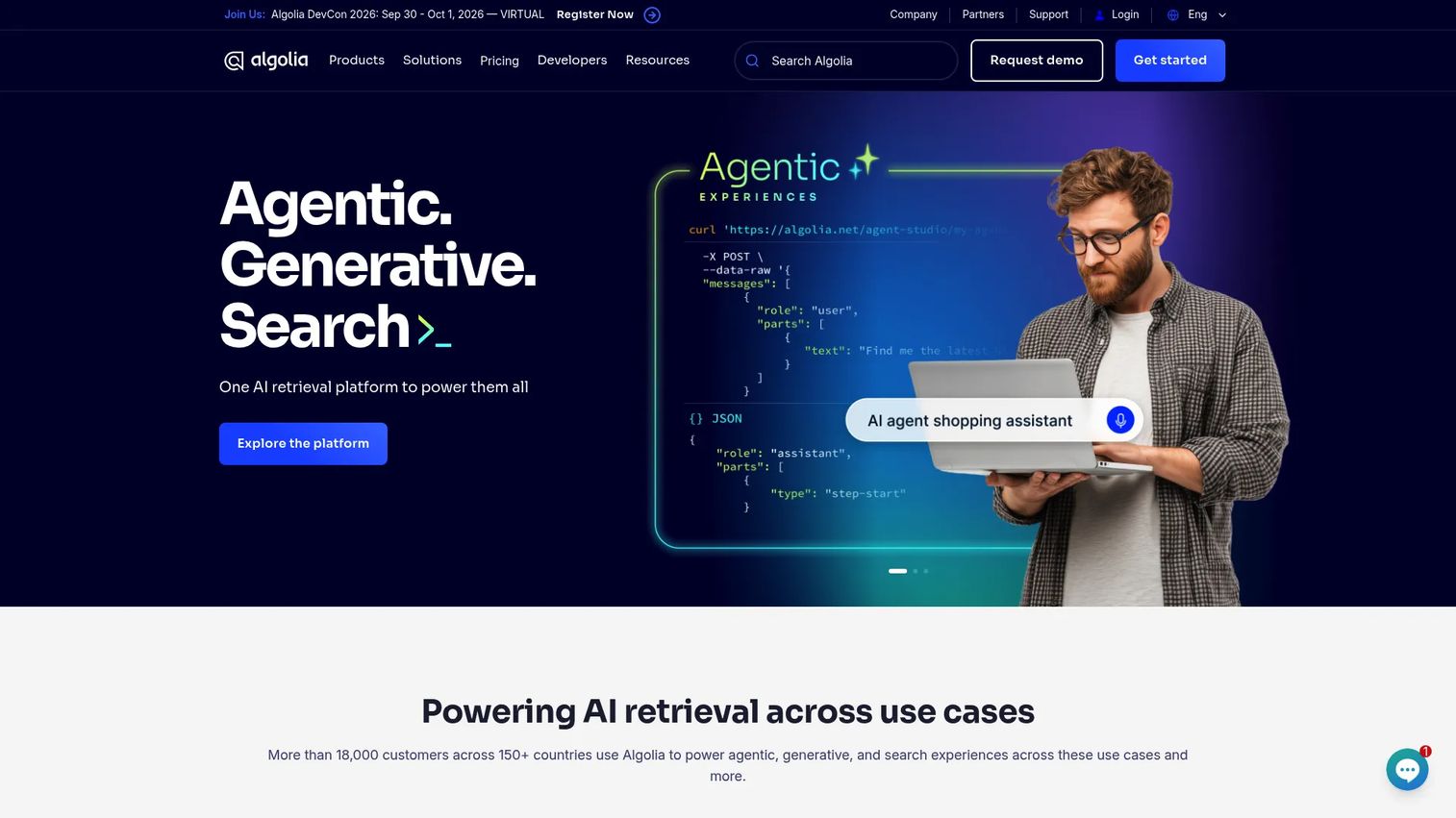
Algolia is an AI search and discovery platform for websites and apps, built for teams that treat search speed and relevance as conversion levers. It's known for sub-50ms response times, a developer-friendly API, and a deep set of pre-built UI components that let teams ship polished search experiences fast. For ecommerce specifically, it handles semantic search, autocomplete, dynamic re-ranking, and merchandising in one platform.
Best for: Teams that need fast, highly customizable site search and discovery with strong engineering control.
Key strengths
- Semantic search and vector matching: interprets meaning and intent, not just exact keyword strings.
- Real-time personalization and dynamic re-ranking: adjusts results based on behavior to surface the most relevant products.
- Analytics, merchandising, and UI components: gives teams query insights, no-code merchandising, and ready-made front-end blocks plus broad integrations.
Why choose Algolia: Marketers pick Algolia when search quality is directly tied to conversion and the team has the engineering bandwidth to customize. Its speed and flexibility make it a default for high-traffic stores, and its analytics make it easy to see which queries drive revenue and which fall flat. If you want control over every part of the search experience, this is the platform that gives it to you.
Algolia pricing: Algolia offers a free Build plan that includes 10K search requests per month and 1M records. The Grow plan starts free and then charges $0.50 per additional 1K search requests, while Grow Plus adds AI capabilities at $1.75 per additional 1K requests. The Elevate plan is enterprise-scale with custom limits and volume-based discounts, available by contacting sales. Pricing is usage-based, so cost scales with search volume rather than seats.
2. Bloomreach
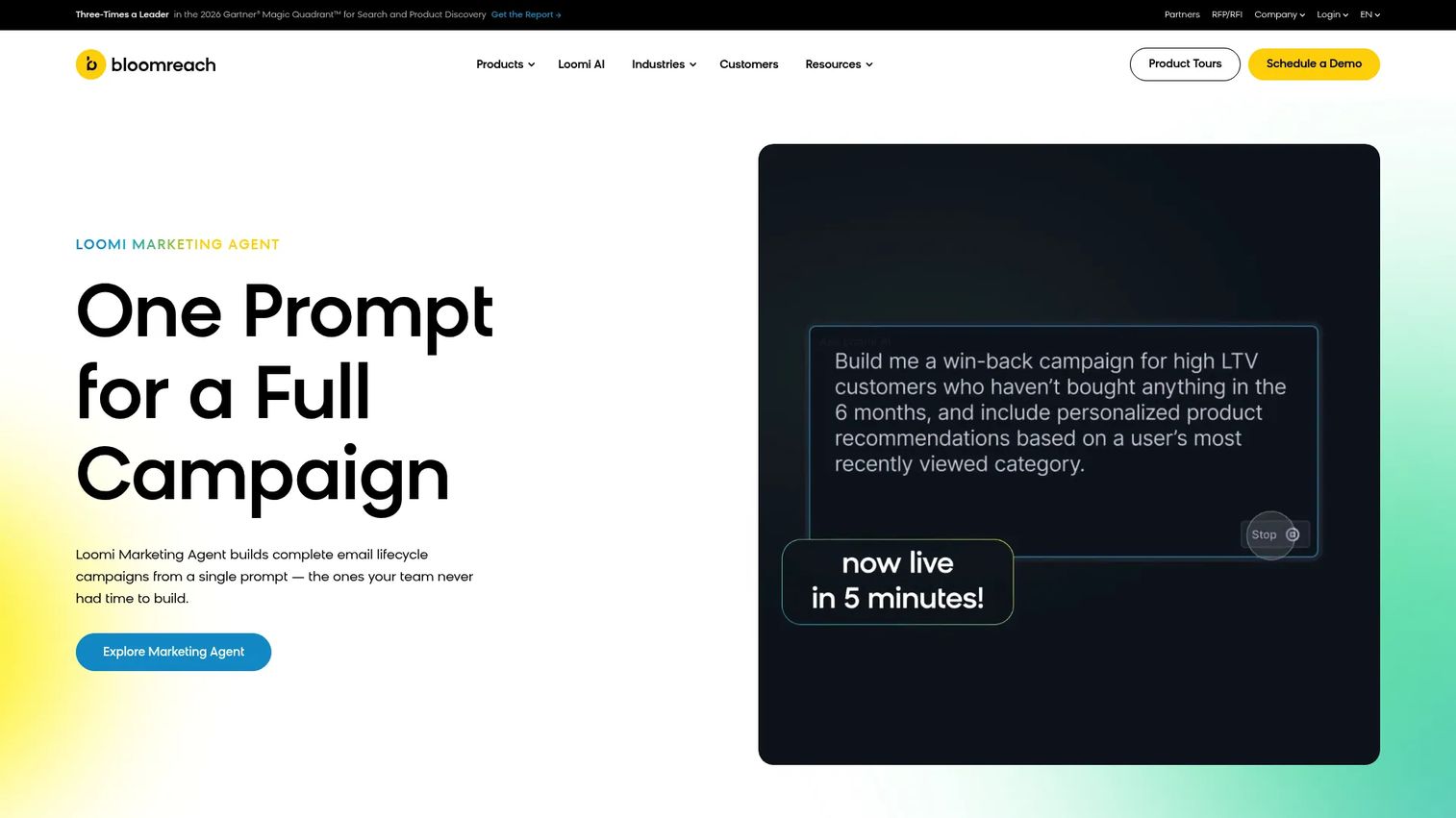
Bloomreach is an AI-powered customer experience platform that combines marketing automation, ecommerce search, merchandising, and content personalization. Where standalone search tools focus on the search box, Bloomreach connects onsite discovery to the broader customer experience, using unified customer and product data to personalize what shoppers see. It's a fit for brands that want search, merchandising, and personalization under one roof.
Best for: Enterprise ecommerce teams that want to connect search and product discovery to a wider personalization and marketing strategy.
Key strengths
- AI-driven marketing automation: ties search and discovery to lifecycle campaigns and customer journeys.
- Ecommerce search and merchandising: delivers personalized results across search and category pages with merchandiser control.
- Headless and hybrid content management: supports flexible content delivery across storefronts and channels.
Why choose Bloomreach: Larger teams choose Bloomreach when they want to stop stitching search, merchandising, and personalization together from separate vendors. By unifying customer and product data, it makes onsite discovery part of a connected experience rather than an isolated feature. For marketers who own both acquisition and onsite conversion, having one data layer behind both is a real advantage.
Bloomreach pricing: Bloomreach does not publish a numeric starting price. Pricing is customized and usage-based, combining a module fee plus a usage fee, and customers request a quote based on business needs. The platform is organized into modules including Autonomous Marketing, Autonomous Search, and Conversational Shopping, each on an annual plan. Expect an enterprise sales conversation rather than self-serve signup.
3. Constructor
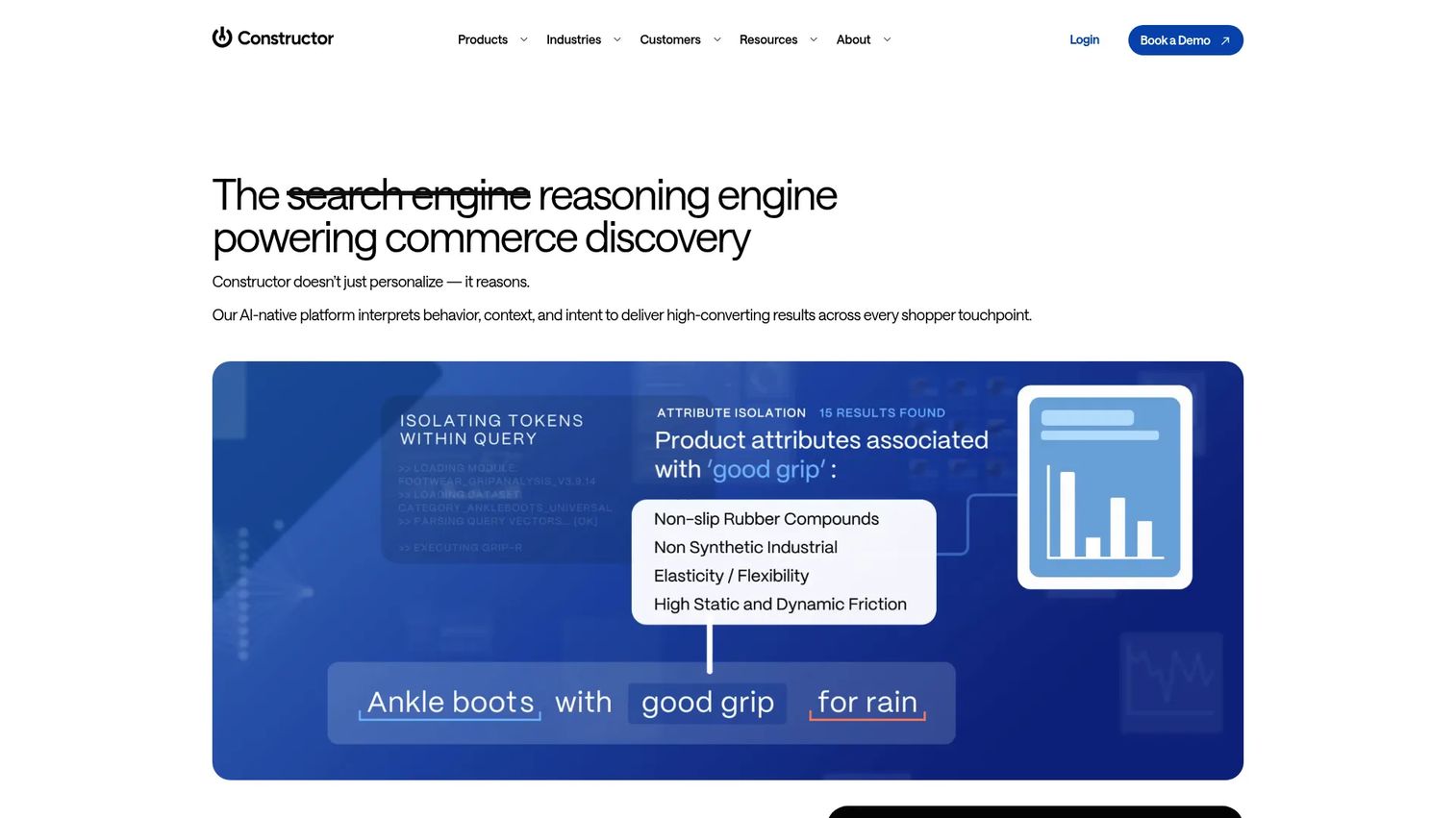
Constructor is an AI-native commerce search and product discovery platform built for enterprise ecommerce. It was named a Leader in the Gartner Magic Quadrant for Search and Product Discovery, 2026, and is the only product discovery vendor named a Leader by three independent analyst firms. Its core pitch is optimizing search and browse for revenue, not just relevance, which resonates with teams where discovery directly moves the top line.
Best for: Enterprise ecommerce teams with large catalogs and serious revenue stakes that need AI-first search and ranking control.
Key strengths
- AI Shopping Agents: apply AI to guide shoppers through discovery and surface the right products.
- Search and browse personalization: tailors results across search and category pages to each shopper.
- Recommendations and Collections: powers product recommendations and dynamic, curated product pages.
Why choose Constructor: Teams choose Constructor when relevance tuning, ranking control, and scale all matter at once. It handles over 400 billion requests per year and reports a 98.5% average client retention rate over the last three years, signals that resonate with enterprise buyers wary of switching costs. With a setup window of around 8 weeks or less and a 4.8 G2 rating, it positions itself as a high-end platform that still ships fast.
Constructor pricing: Constructor does not publish public pricing on its site. The platform routes prospects to a demo request rather than displaying plan prices, which is typical for enterprise product discovery platforms. Expect custom pricing tied to catalog size, request volume, and the modules you deploy, scoped through a sales conversation.
4. Doofinder
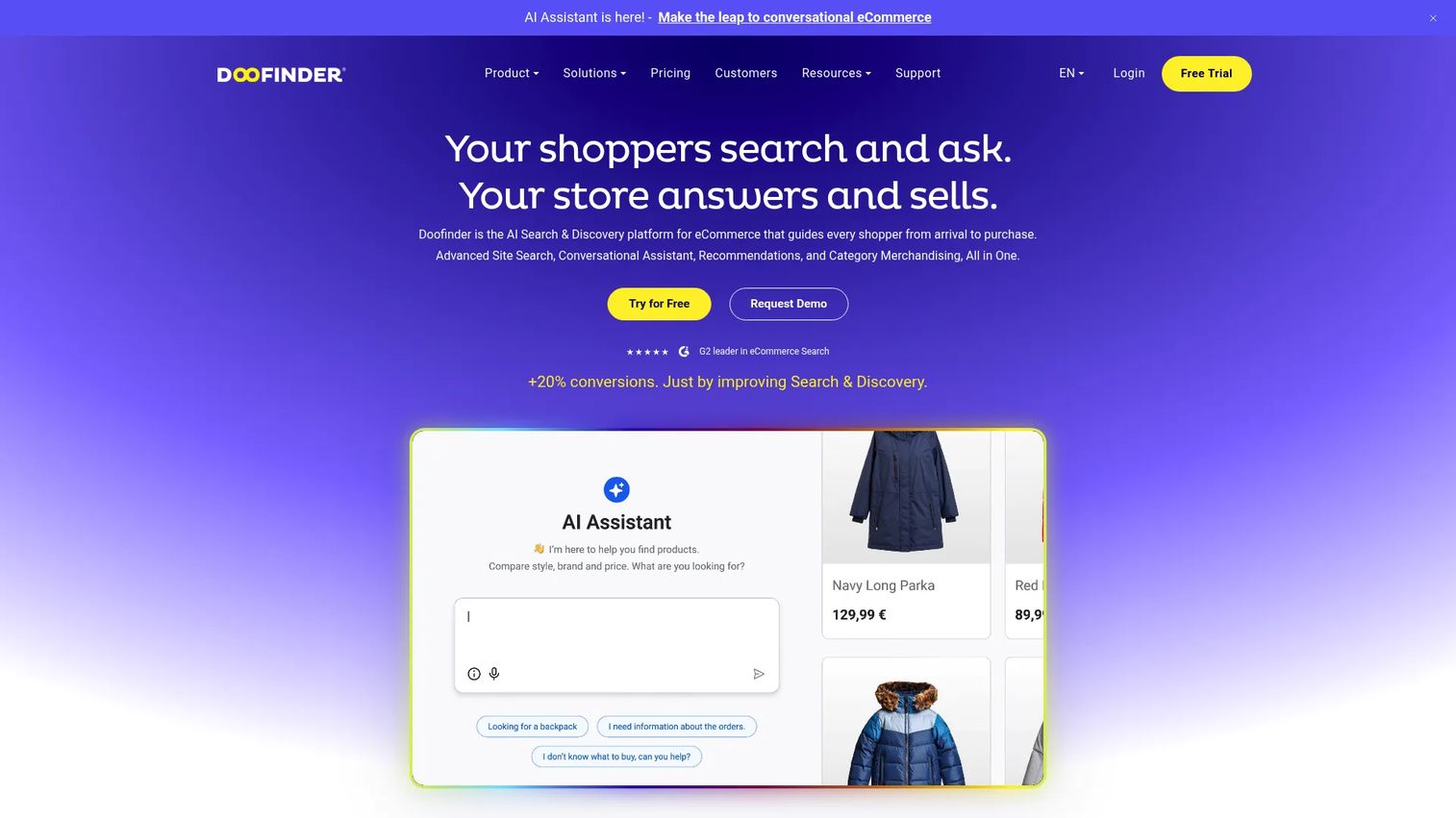
Doofinder is an AI-powered site search and discovery platform built for ecommerce stores that want better search without a long deployment cycle. It understands search intent, typos, and even images, so each query lands on a relevant result. With over 10,000 online stores using it and a reported 20% conversion lift from optimizing search and discovery, it's a practical, conversion-focused pick for stores that want fast wins.
Best for: Smaller and mid-market stores that want strong everyday search, recommendations, and merchandising with quick setup.
Key strengths
- AI search and guided search: interprets intent, tolerates typos, and even supports image-based search.
- Product recommendations: surfaces related and complementary products to lift average order value.
- Quiz maker: builds guided discovery experiences that help shoppers find the right product.
Why choose Doofinder: Doofinder appeals to teams that want measurable conversion improvements without an enterprise deployment timeline. Its public pricing, fast setup, and AI search make it an easy entry point for stores that have outgrown native platform search but aren't ready for a six-figure enterprise contract. The free trial lowers the risk of trying it on a live catalog.
Doofinder pricing: Doofinder publishes clear pricing. The Basic plan is $49/month, or $44/month billed annually. Pro is $149/month, or $134/month billed annually, and Advanced is $349/month, or $314/month billed annually. An Enterprise tier is available with custom pricing. All plans include Search, Recommendations, and Quiz, and Doofinder offers a free trial plus a free plan after cancellation.
5. Luigi's Box
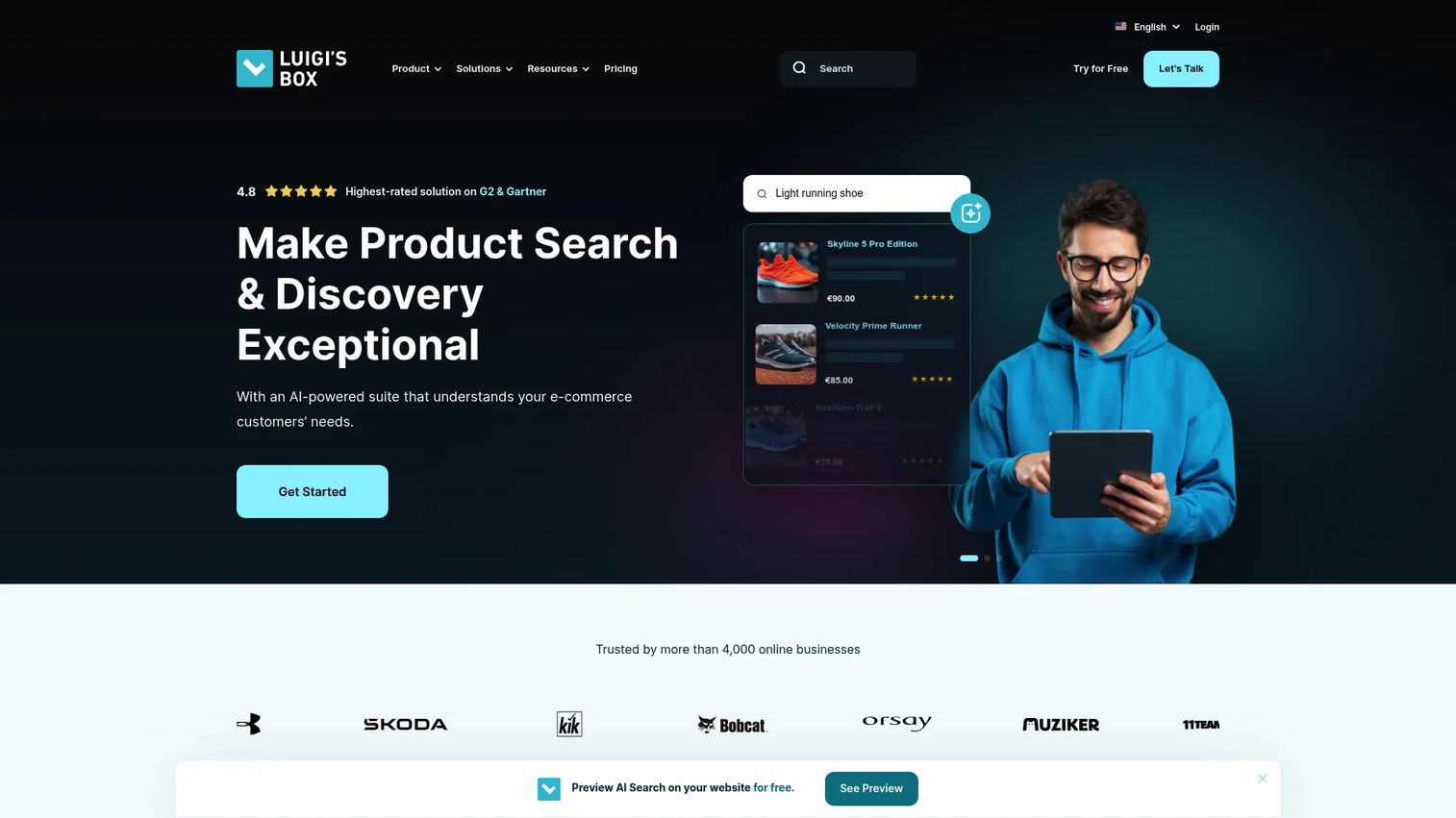
Luigi's Box is an AI-powered ecommerce search and product discovery platform with a strong analytics layer. It's a balanced, all-around option: solid autocomplete, personalization, and merchandising paired with search analytics that help teams spot query gaps, zero-result searches, and shifting product demand. For merchandisers, that insight layer turns search from a black box into a tunable system.
Best for: Ecommerce teams that want practical search, merchandising, and recommendations with real search analytics depth.
Key strengths
- Autocomplete: surfaces fast, relevant suggestions as shoppers type their queries.
- Personalization: tailors search and discovery results based on shopper behavior.
- Merchandising: gives teams control over ranking, boosting, and promotion across results.
Why choose Luigi's Box: Teams pick Luigi's Box when they want both control and insight in one place. The analytics depth helps merchandisers see exactly where search is leaking revenue, which queries return nothing, and which products shoppers actually want. That feedback loop, paired with a 4.8 G2 rating, makes it a strong fit for teams that treat search as something to continuously optimize.
Luigi's Box pricing: Luigi's Box uses quote-based pricing, with the base price depending on website usage and catalog size. There's no published numeric starting price, but the platform offers a 30-day free trial rather than a permanent free plan. Plans range from self-integration through custom integration and enterprise, so cost scales with your traffic and catalog complexity.
6. Searchanise
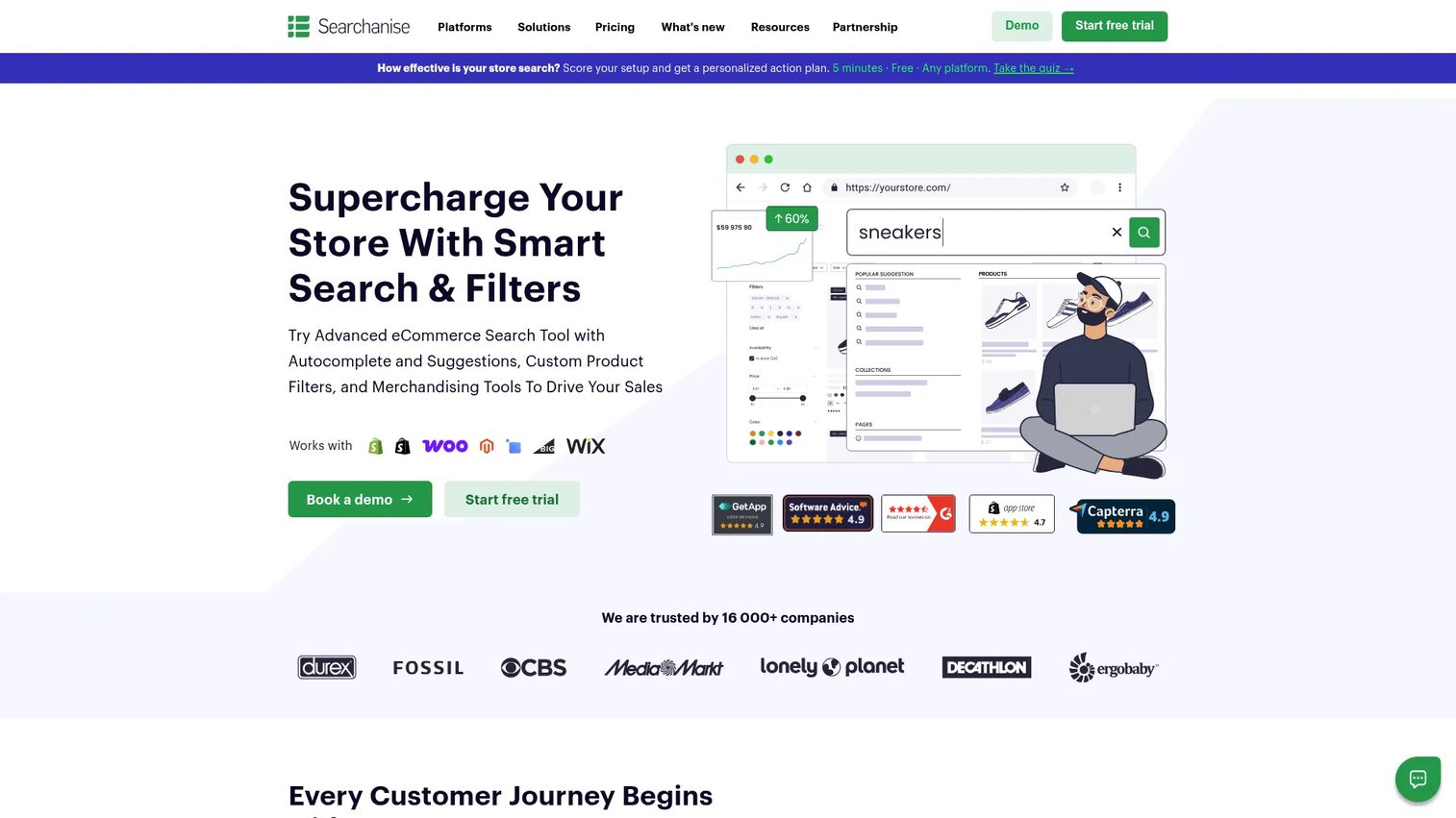
Searchanise is ecommerce search, filtering, and merchandising software focused on storefront product discovery. It's a lightweight, approachable option that helps smaller teams improve site search and filtering quickly, especially on Shopify. Where enterprise platforms ask for long deployments, Searchanise gets the basics live fast: instant search, autocomplete, advanced filters, and everyday merchandising.
Best for: Shopify and other ecommerce stores that want onsite search and filtering with merchandising tools, without enterprise complexity.
Key strengths
- Instant search and autocomplete: delivers fast, relevant results and suggestions as shoppers type.
- Advanced filters and facets: lets shoppers refine by attributes to narrow results quickly.
- Synonyms, redirects, personalization, and typo correction: keeps results relevant even with imprecise queries.
Why choose Searchanise: Lean teams choose Searchanise when they want more control over search and filtering than native platform tools offer, without the cost or complexity of enterprise search. The free tier lets a small store start improving search at no cost, then scale up as traffic grows. With a 4.8 G2 rating, it earns trust among the SMB and mid-market stores that make up its core base.
Searchanise pricing: Searchanise publishes platform-specific pricing, currently shown for Shopify, and offers a free tier at $0/month. Paid plans start at $19/month for Basic, with Advanced at $89/month and Pro at $209/month, plus Growth, Premium, and Essential tiers. Annual billing discounts are shown on the pricing page, so longer commitments lower the monthly cost.
7. Coveo
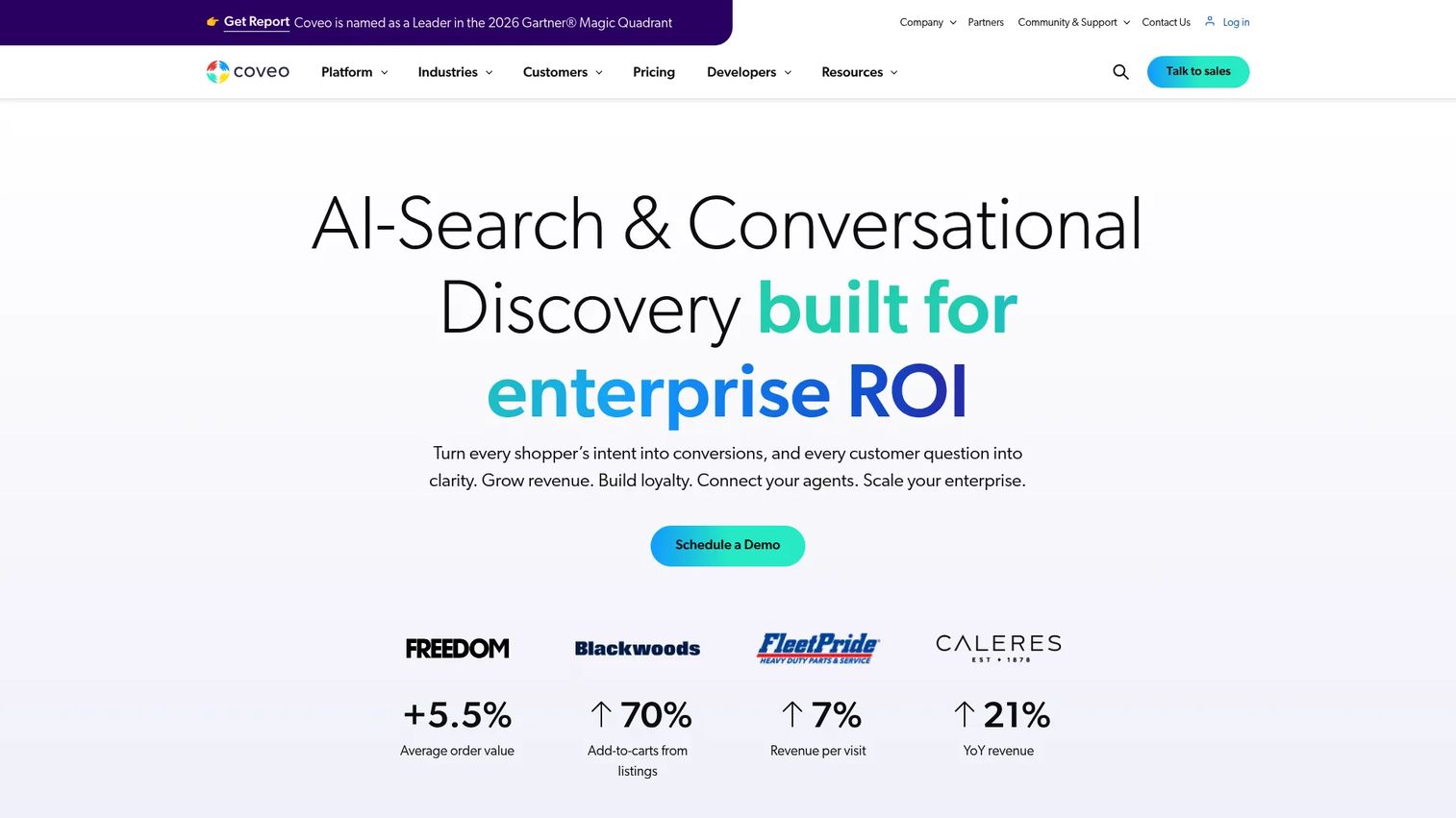
Coveo is an AI-powered search, recommendations, and generative answering platform for enterprise digital experiences. It's built for complex discovery environments where search has to serve more than just conversion: commerce, service, website, and workplace use cases under one relevance engine. For large organizations with high catalog complexity and multiple audience types, that breadth is the draw.
Best for: Enterprises that need AI search and relevance across service, commerce, website, or workplace use cases.
Key strengths
- Generative answering grounded in enterprise content: returns AI answers tied to your own product and content data.
- Unified index across cloud and on-premises repositories: searches across diverse data sources in one index.
- AI-powered dynamic search and recommendations: adapts results and recommendations to shopper behavior.
Why choose Coveo: Coveo fits organizations where search quality must serve both conversion and operational needs at once. If your search has to handle ecommerce discovery alongside support and self-service content, a unified relevance platform avoids running separate engines. Its generative answering also positions it well for teams investing in conversational and AI ecommerce search experiences.
Coveo pricing: Coveo does not publish public pricing numbers. Its documentation describes subscriptions that combine a Platform Plan, available as Pro or Enterprise, with a Solution Plan, and references some free trial language. In practice, pricing is scoped through sales based on your use cases, data sources, and query volume. Plan on an enterprise procurement conversation.
8. Searchspring
Searchspring, now operating under Athos Commerce, is an ecommerce search, merchandising, personalization, and analytics platform. It's positioned as a global provider of AI-driven discovery, and its real strength is shaping what shoppers see after they search or land on a category page. For marketers who want more than a search box, Searchspring offers direct influence over both search results and browsing behavior.
Best for: Ecommerce teams that need search plus strong category merchandising and product discovery control.
Key strengths
- Site search: delivers relevant results with AI-driven discovery across queries.
- Merchandising: gives teams direct control over category pages and how products are ordered.
- Personalization: tailors search and browsing experiences to individual shoppers.
Why choose Searchspring: Marketers pick Searchspring when merchandising matters as much as search. The platform lets teams shape category browsing, not just query results, which suits stores where curated collections and seasonal merchandising drive a lot of revenue. If you want to control the full discovery journey from search box to category page, this is built for that job.
Searchspring pricing: Searchspring does not publish public first-party pricing. Pricing is handled through sales, scoped to your catalog and traffic. As the brand transitions under the Athos Commerce name, the best path is to request a quote directly so you get current packaging tied to your specific search and merchandising needs.
9. Klevu
Klevu is AI-powered ecommerce search and discovery software designed to improve product discovery through smarter relevance and shopping assistance. It appeals to brands that want a more guided discovery experience, with AI site search, natural-language matching, smart category merchandising, and recommendations layered together. For teams that want an AI discovery layer without heavy build, it's a lighter-weight option.
Best for: Ecommerce teams needing AI search, merchandising, and recommendations with a guided discovery feel.
Key strengths
- AI site search with autocomplete and natural-language matching: interprets queries and surfaces relevant products.
- Smart category merchandising: automatically organizes and curates collection pages.
- Product recommendations and personalization: suggests relevant products tailored to each shopper.
Why choose Klevu: Klevu suits brands that want AI-assisted discovery and shopping guidance without standing up a complex enterprise platform. Its combination of search, merchandising, and recommendations covers the core discovery journey, making it a fit for mid-market stores leaning into AI relevance. Evaluate it against your specific catalog and integration needs, as it currently shares branding with Athos Commerce on its live site.
Klevu pricing: Klevu does not publish public pricing numbers; the site routes pricing inquiries through a request flow. Its terms reference growth, premium, premium plus, and enterprise plans, but exact prices aren't verifiable on the brand site. Expect a quote scoped to your catalog size, traffic, and the features you need, confirmed through a sales conversation.
Considerations before you buy
Picking an ecommerce search platform is less about feature checklists and more about matching the tool to your actual bottleneck. Use these criteria to narrow the field.
Conversion impact
The whole point is revenue, not relevance scores. Ask each vendor how they measure search conversion lift, and whether they can attribute revenue to specific queries and search sessions. A platform that can't show you conversion per search session makes ROI impossible to defend to your CFO.
Merchandising control
Decide how much no-code control your team needs over ranking, boosting, synonyms, and promotions. If merchandisers will tune search weekly, prioritize platforms with strong no-code admin controls. If search is set-and-forget, raw relevance and AI matter more than the merchandising UI.
Analytics depth
Zero-result rate, refinement rate, and click-through from search are the numbers that tell you what's broken. Platforms with deeper search analytics let you find query gaps and unmet demand before they cost you sales. Treat analytics as a first-class requirement, not a nice-to-have.
Implementation and stack fit
Match the deployment effort to your resources and platform. Lean Shopify stores can go live fast on lighter platforms; enterprise catalogs with complex data need more scoping. Confirm catalog indexing, integrations with your existing stack, and how the platform handles your data before signing.
Conclusion
The right ecommerce search platform depends entirely on what you value most: speed, AI depth, or merchandiser control. Algolia leads for fast, customizable AI search when search quality drives conversion. Bloomreach is the pick when you want search, merchandising, and personalization unified under one roof. Constructor stands out for enterprise AI product discovery at scale, and Doofinder is the easiest entry point for SMB and mid-market stores. Luigi's Box brings balanced control plus analytics depth, Searchanise serves lean teams with a free tier, Coveo handles complex enterprise discovery, Searchspring excels at merchandising-led control, and Klevu offers a guided AI discovery layer.
Before you book demos, do the homework that makes those calls sharper: audit your top search queries, your zero-result terms, and where shoppers drop off after searching. That data tells you whether your real problem is relevance, merchandising, or analytics, and it turns a vague "we need better search" into a precise spec each vendor has to answer.
FAQs
Ecommerce search software is the layer that helps shoppers find products quickly through onsite search, autocomplete, filters, recommendations, and relevance tuning. It indexes your catalog and turns shopper queries into ranked, relevant results that drive product discovery and conversion. It's purpose-built for product catalogs rather than general document or knowledge-base search.
The core checklist is catalog indexing, autocomplete, typo tolerance, synonyms, filtering, recommendations, merchandising controls, analytics, and integrations. For most teams, relevance quality and merchandising control matter most day to day. Analytics is the underrated one, since it tells you which queries fail and where revenue leaks.
AI search can improve semantic understanding, intent matching, and guided discovery, especially for natural-language and conversational queries. But it isn't magic: keyword and catalog data quality still determine how well it performs. Think of AI as a maturity upgrade that builds on clean product data, not a replacement for it.
Focus on conversion impact, merchandising control, analytics depth, implementation speed, and whether the platform fits your existing ecommerce infrastructure. The best fit depends on whether your bottleneck is relevance, merchandising, or insight. Ask each vendor to show search conversion attribution, because that's what ties the tool back to revenue.
Track search conversion rate, zero-result rate, refinement rate, click-through from search, and revenue per search session. A falling zero-result rate and rising search conversion rate are the clearest signals it's working. If revenue per search session climbs after deployment, the platform is earning its cost.
Stores with large catalogs, attribute-heavy products, or high-consideration purchases benefit most, especially when browsing alone can't connect shoppers to the right item. If a meaningful share of your traffic uses the search bar, search quality is directly shaping revenue. Smaller catalogs with simple navigation can often start with native platform search.
It depends on catalog size, integrations, and customization level. Leaner platforms like Searchanise or Doofinder can go live quickly, sometimes within days on Shopify. Enterprise platforms like Constructor or Coveo take longer, often weeks, because of catalog complexity, data sources, and deeper customization.
Some teams just want better search; others want search bundled with personalization and merchandising. Standalone search engines like Algolia or Doofinder excel when search is the bottleneck. Broader platforms like Bloomreach make sense when you want unified search, merchandising, and personalization. Choose based on your actual bottleneck, not the trendiest stack category.