
Your rep finishes a customer visit at 2:14 PM. Great meeting. New opportunity, clear next step, a competitor mention worth logging.
Then they get in the car. The next stop is 40 minutes away, they need to check whether a nearby account is on today's route, and the CRM update from that last visit is now competing with lunch and three unread texts. By the time they get back to a desk that evening, half the detail is gone.
That gap between what happens in the field and what lands in the system of record is where deals go quiet. It is also expensive. The global field sales software market is estimated at USD 4.85 billion in 2026, growing at a 12.19% CAGR through 2031, according to Mordor Intelligence (2024). Mobile-based platforms already account for 42.36% of that revenue, because the work does not happen at a desk.
Field sales software exists to close that gap. It plans the route, holds the territory, captures the visit, and gives managers visibility without turning every rep into a data-entry clerk. The eight tools below are the ones worth shortlisting for 2026.
What's inside
This guide is built for account executives, regional sales leaders, and RevOps teams evaluating field sales software that keeps outside reps productive without adding admin.
We selected tools based on four criteria that matter for real field motions:
- Route planning and territory management: how well the tool optimizes daily visits and enforces account ownership.
- Rep adoption: whether logging activity in the field feels fast or feels like homework.
- CRM coexistence: how cleanly it syncs with Salesforce, HubSpot, and other systems of record instead of replacing them.
- Manager visibility: the depth of reporting and rep activity tracking without micromanagement.
Every pricing figure and rating below reflects the vendor's current published information.
TL;DR
- Best overall for outside sales reps: Badger Maps, for route optimization, mapping, and territory management built around reps who live in the car.
- Best for rep accountability and management controls: SPOTIO, for teams that need territory, route, and activity tracking in one platform.
- Best for door-to-door and canvassing: SalesRabbit, for high-volume field acquisition motions.
- Best mobile field CRM: Outfield, for teams that want a performance-based CRM with activity verification.
- Best AI-assisted capture: Leadbeam, for fast voice-to-CRM logging and territory intelligence.
- Best map-first execution: Map My Customers, for teams that plan the day around the map.
- Best for CRM-heavy territory ops: Mapsly, for map-based routing and no-code automation on top of your CRM.
- Best for retail execution: Repsly, for CPG and merchandising teams managing store-level compliance.
What is field sales software
Field sales software is a mobile-first platform that helps outside sales reps plan routes, manage territories, log visits, and stay visible to managers while working away from a desk. It sits on top of, or alongside, a standard CRM and translates in-person selling into structured data.
Where a traditional CRM assumes a rep at a keyboard, field sales software assumes a rep in a car, a store, or a driveway. It optimizes for speed of capture and geographic context, not long-form data entry.
Core capabilities usually include:
- Route planning and route optimization: sequence daily stops to cut drive time and fit more visits into a day.
- Territory management: define, assign, and protect account ownership across reps and regions.
- Activity capture: log visits, notes, and outcomes from a phone in seconds, often with location stamps.
- Mobile access: native apps for iOS and Android, frequently with offline support for weak-signal areas.
- CRM integration: two-way sync with Salesforce, HubSpot, and other systems of record.
- Field sales analytics: manager dashboards for coverage, activity, and pipeline movement.
The distinction from a standard CRM is coexistence, not replacement. Most field sales platforms feed the CRM rather than compete with it, so RevOps keeps one source of truth while reps get a tool built for the field.
When to use field sales software
Not every sales team needs it. If your reps sell entirely over Zoom, a standard CRM and a scheduling tool cover most of the job. Field sales software earns its place when the selling motion is physical, geographic, and high-volume. Three situations make the case.
Plan efficient routes and daily visit schedules
When a rep manages 60 accounts across a metro area, the difference between a smart route and a random one is two extra visits a day. Route planning tools sequence stops by drive time, let reps insert nearby accounts on the fly, and rebuild the day when a meeting cancels. Over a quarter, that recovered drive time turns into pipeline.
Track territory ownership and account coverage
Overlapping territories create awkward conversations and missed accounts. Territory management defines who owns what, flags accounts nobody has visited in 90 days, and routes new leads to the right rep automatically. For managers running multiple regions, it turns coverage from a guess into a map.
Capture rep activity in the field without extra admin
The visit note written in the parking lot is worth ten written from memory that night. Field-first activity capture lets reps log outcomes, next steps, and competitive intel in seconds, often by voice or a few taps. Less admin means more selling, and it means the CRM actually reflects reality.
Comparison table
The table below summarizes all eight tools by best fit, differentiator, pricing, and rating. Pricing reflects each vendor's current published plans; where a vendor quotes custom pricing, that is noted.
| # | Product | Best for | Key differentiator | Pricing | G2 rating |
|---|---|---|---|---|---|
| 1 | Badger Maps | Outside reps who live in the car | Route optimization plus mapping and territory tools | From $58/user/mo (annual) | 4.7/5 |
| 2 | SPOTIO | Rep accountability and management | Territory, route, and activity in one platform | Custom (user-based, 25+ licenses) | 4.5/5 |
| 3 | SalesRabbit | Door-to-door and canvassing | Canvassing plus gamification and scheduling | Free; Team from $59/user/mo | Not published |
| 4 | Outfield | Mobile field CRM | Performance-based CRM with activity verification | Custom | 4.2/5 |
| 5 | Leadbeam | AI capture and routing | Voice and photo to CRM logging | From $59/rep/mo (annual) | 4.8/5 |
| 6 | Map My Customers | Map-first field execution | Map-based routing with offline logging | From $99/user/mo (annual) | 4.5/5 |
| 7 | Mapsly | CRM-heavy territory ops | Map routing plus no-code automation | From $25/user/mo | 4.2/5 |
| 8 | Repsly | Retail execution | Store-level merchandising and compliance | Custom (annual, 12-mo min) | 4.3/5 |
1. Badger Maps
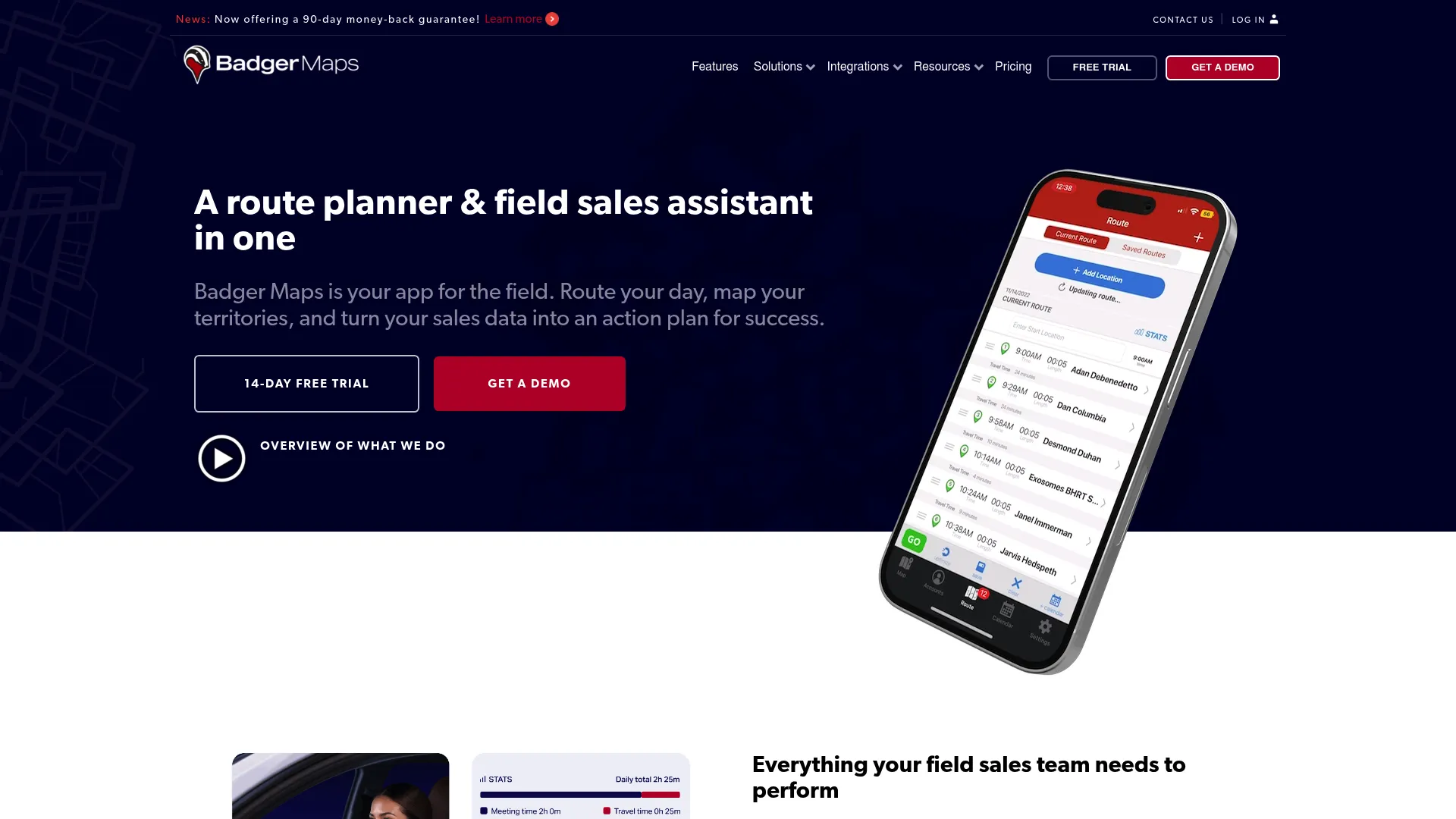
Badger Maps is mobile-first sales mapping and territory management software built for reps who spend most of the day driving. It takes the accounts already in your CRM, drops them on a map, and turns a chaotic list of visits into an optimized route. The pitch is simple: less time behind the wheel, more time in front of customers.
The core strength is route optimization with up to 120 stops. A rep can filter accounts by last-visit date, revenue, or a custom field, then build a route that minimizes drive time. When a meeting cancels, they rebuild in seconds and drop in a nearby account instead of losing the slot.
Best for: outside sales and field teams that need route optimization, mapping, and territory management in a single mobile tool.
Key strengths
- Route planning and optimization with up to 120 stops
- Sales mapping with filtering, color-coding, geocoding, and custom fields
- Territory management with alignment, insights, and lead routing
Why choose Badger Maps: if your reps measure their day in miles driven, this is the tool most directly built for that reality. It layers cleanly over an existing CRM rather than asking reps to abandon it, and managers get territory insights and lead routing without a heavy implementation. Teams that sell over the phone will get less from it than teams that sell face to face.
Badger Maps pricing: the Business plan starts at $58 per user per month billed annually, or $69 billed monthly. Add-on products are priced separately: Badger Align at $20 per territory per month annually, Badger Lead Routing from $16 per rep per month annually, and Badger Insights from $50 per user per month annually. A 14-day free trial is available, with 14-day team pilots.
2. SPOTIO

SPOTIO is an AI-powered field sales execution platform aimed at revenue-driven teams that need structure and accountability. It combines territory management, route optimization, and activity tracking so a manager can see who visited whom, what happened, and what should happen next, without chasing reps for updates.
Where some tools focus narrowly on mapping, SPOTIO leans into the full field motion: lead management, coaching visibility, and an AI assistant that helps prioritize the day. That makes it a fit for teams where consistent rep behavior, not just navigation, is the problem to solve.
Best for: field sales teams that need territory, route, and activity management in one platform with strong management controls.
Key strengths
- Territory management with mapping and assignment
- Route optimization for daily field visits
- Activity tracking with two-way CRM sync
Why choose SPOTIO: if your challenge is rep accountability and pipeline consistency across a distributed team, SPOTIO is built around that. Activity tracking and coaching visibility give managers signal without requiring reps to file long reports. It is a heavier platform than a pure mapping app, which suits teams ready to standardize a field process rather than just optimize drives.
SPOTIO pricing: SPOTIO lists B2B and Custom plans but does not publish prices. Pricing is user-based and requires a personalized quote, typically for teams of 25 licenses or more. The site notes there is no free trial, though demos and pilot programs may be available.
3. SalesRabbit
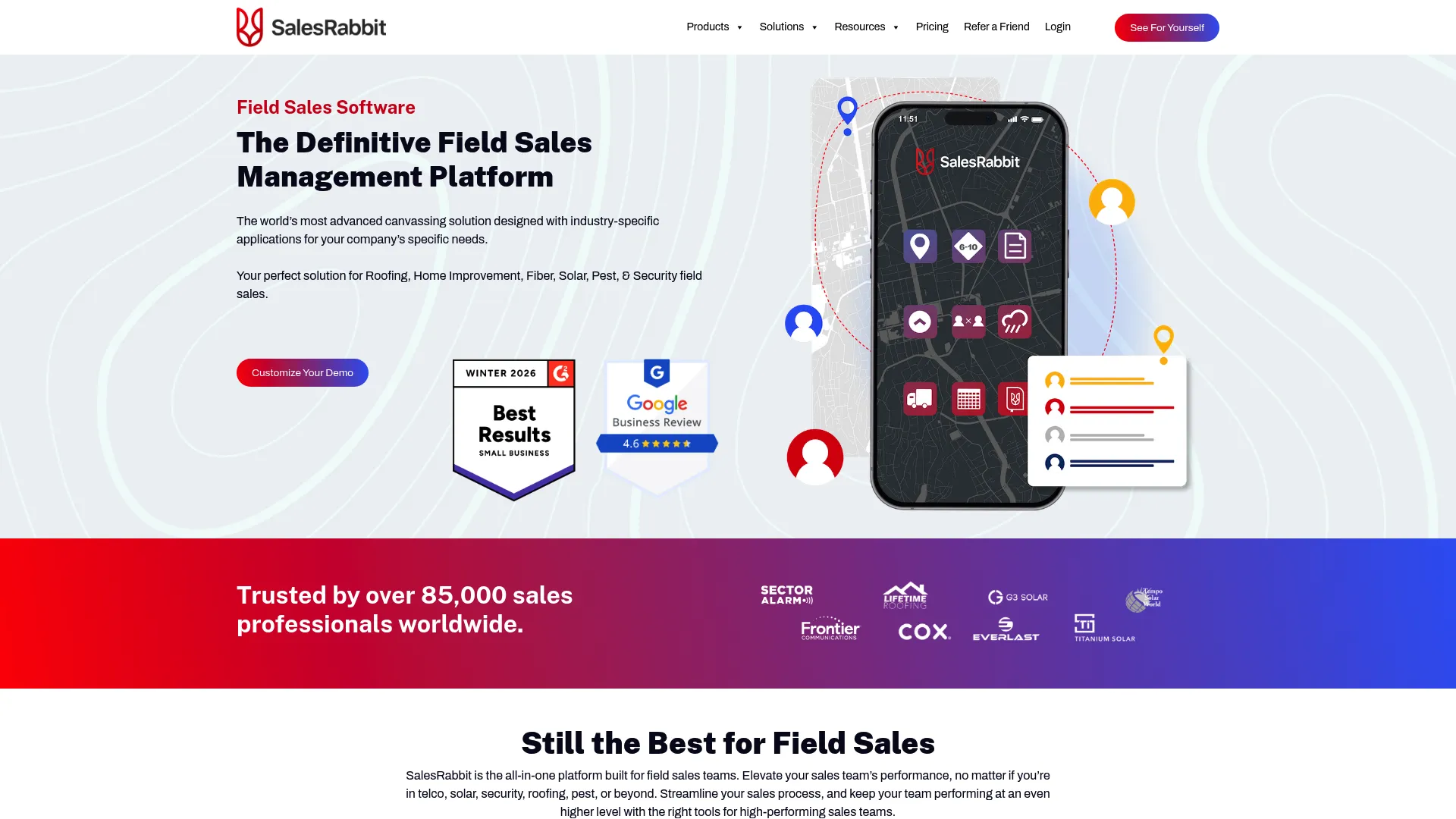
SalesRabbit is a field sales management platform built for canvassing and door-to-door motions. If your team works neighborhoods, tracks status door by door, and lives on a mobile app all day, this is the category it was designed for. It handles lead tracking, area mapping, scheduling, and the gamification that keeps high-volume field teams motivated.
The canvassing workflow is the differentiator. Reps color-code territories by status, drop notes on each stop, and hand off qualified leads without losing context. Managers see coverage and rep activity across an area in real time, which matters when acquisition volume is the whole game.
Best for: door-to-door and outside sales teams that need mobile canvassing, lead tracking, and territory management.
Key strengths
- Canvassing and lead tracking by door status
- Territory and area management with route planning
- Analytics, gamification, and appointment scheduling
Why choose SalesRabbit: for high-volume field acquisition, few tools match its canvassing depth. The gamification and scheduling features keep large teams moving and give managers a live view of the field. Teams selling complex B2B deals with long cycles will find it more tuned to volume than to multi-stakeholder orchestration.
SalesRabbit pricing: the Lite plan is free. Team starts at $59 per user per month and Pro at $75 per user per month, both billed monthly. Enterprise pricing requires contacting SalesRabbit. The free tier makes it easy to trial the canvassing workflow before committing a full team.
4. Outfield
Outfield is a performance-based CRM designed for field sales and marketing teams. Rather than bolting mapping onto a desktop CRM, it puts the CRM itself on the phone, with apps for iPhone, Android, and web. Reps log visits, track activity, and access accounts from wherever they are standing.
The performance angle is the hook. Outfield tracks and verifies field team activity, so managers can confirm visits actually happened and see reporting on where time goes. That verification layer suits teams where the question is not just what a rep says they did, but what the data confirms.
Best for: field sales and marketing teams that need a mobile CRM with activity tracking and verification.
Key strengths
- Mobile CRM apps for iPhone, Android, and web
- Activity tracking and verification for field teams
- Reporting and analytics for sales and marketing
Why choose Outfield: if you want the CRM and the field tool to be the same thing, rather than two systems syncing, Outfield collapses them. The activity verification gives managers confidence in the pipeline picture. Teams already committed to Salesforce or HubSpot as the system of record may prefer a tool that syncs into it rather than replacing it.
Outfield pricing: Outfield does not publish pricing on its site. Interested teams should request a quote directly. Because pricing is not public, confirm plan structure and any trial availability during the sales conversation before committing.
5. Leadbeam
Leadbeam is AI-powered field sales software and a mobile CRM built to kill the parking-lot admin problem. Its signature feature is voice and photo to CRM logging: a rep talks through the visit, snaps a business card or storefront, and Leadbeam structures it into a clean CRM record. The detail lands while it is fresh, not at 9 PM from memory.
Beyond capture, Leadbeam adds territory intelligence, lead scoring, and smart routing, so the tool helps decide where to go next, not just record where you have been. For teams where CRM hygiene is the chronic failure point, that fast capture is the whole value proposition.
Best for: field sales teams that want fast CRM updates, routing, and territory insights without manual data entry.
Key strengths
- Voice and photo to CRM logging
- Territory intelligence and lead scoring
- Smart routing with a rep companion app
Why choose Leadbeam: if reps hate logging activity and your CRM data reflects it, Leadbeam attacks that problem directly. The AI capture removes the friction that kills adoption. It carries a higher per-seat price than basic mapping tools, so it fits teams that value data completeness enough to pay for it.
Leadbeam pricing: Starter is $89 per rep per month billed monthly, or $59 per rep per month billed annually. Pro is $229 per rep per month monthly, or $149 billed annually. Enterprise uses volume pricing through sales. There is no free tier listed.
6. Map My Customers
Map My Customers is a field sales execution platform for teams that plan the day around a map. It combines route planning, territory management, CRM sync, and field activity capture, with offline mobile support for reps working in areas with weak signal. The map is the home screen, and everything else flows from it.
Advanced routing and route optimization are the core, with territory mapping layered on top so managers can see coverage geographically. Activity logging works offline and syncs when the rep is back in range, which matters for rural territories and dead zones where a cloud-only tool would stall.
Best for: outside sales teams that need mobile routing, territory visibility, and CRM-connected field execution.
Key strengths
- Advanced routing and route optimization
- Territory mapping and management
- Activity logging with offline mobile support
Why choose Map My Customers: if your reps think spatially and your territories include weak-signal areas, the map-first design and offline support fit the way they actually work. It connects to your CRM rather than replacing it. Teams that prefer a list-first or calendar-first workflow may find the map-centric layout more than they need.
Map My Customers pricing: the Industry Leader plan is $99 per user per month, billed annually. Higher tiers, Field Intelligence and Exec HQ, are quote-based with some pricing not published. Confirm current tier details and any trial during your evaluation.
7. Mapsly
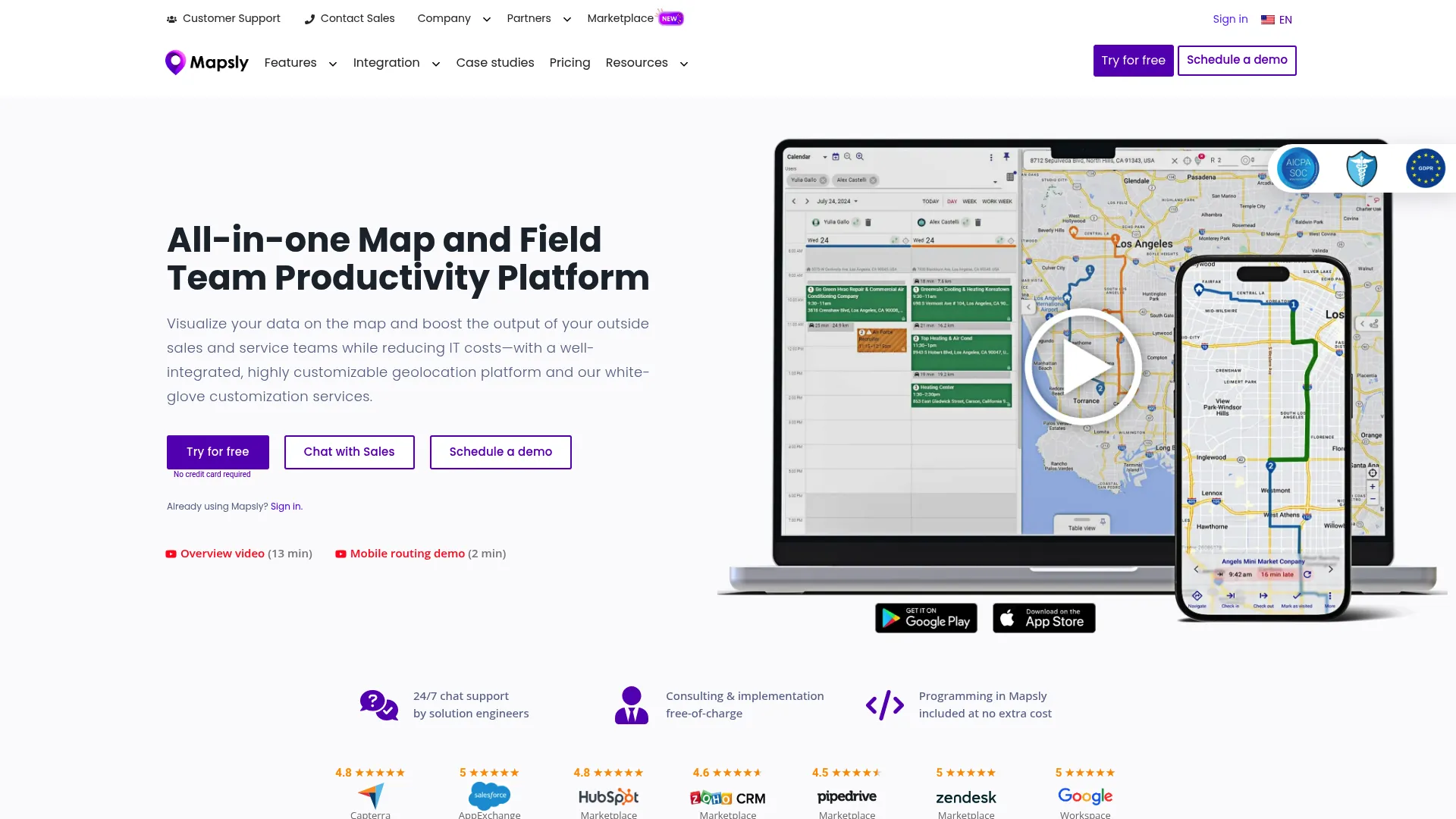
Mapsly is geo-analysis, routing, and territory management software built to sit on top of CRM data with no-code automation. It suits teams with complex territory operations and CRM-heavy workflows, where the challenge is not just planning a route but automating what happens around it: assigning leads, triggering actions, and keeping the map in sync with the system of record.
The interactive map and datagrid let ops teams slice records however they need, while routing and location tracking cover the field motion. The no-code automation is what separates it, letting a RevOps team build territory rules and workflows without engineering time.
Best for: field sales, service, and operations teams needing map-based CRM workflows and routing.
Key strengths
- Interactive map and datagrid for CRM records
- Routing and location tracking
- Territory management with no-code automation
Why choose Mapsly: if your territory ops are complex and you want automation, not just visualization, Mapsly gives RevOps real control. It rewards teams that will invest in configuring workflows. Teams wanting a plug-and-play rep app with minimal setup may prefer a more opinionated tool.
Mapsly pricing: Essential starts at $25 per user per month, Pro at $45 per user per month, and Enterprise at $70 per user per month. Usage-based add-ons are also listed. The pricing page includes a free trial callout, so teams can test the map and routing before committing.
8. Repsly
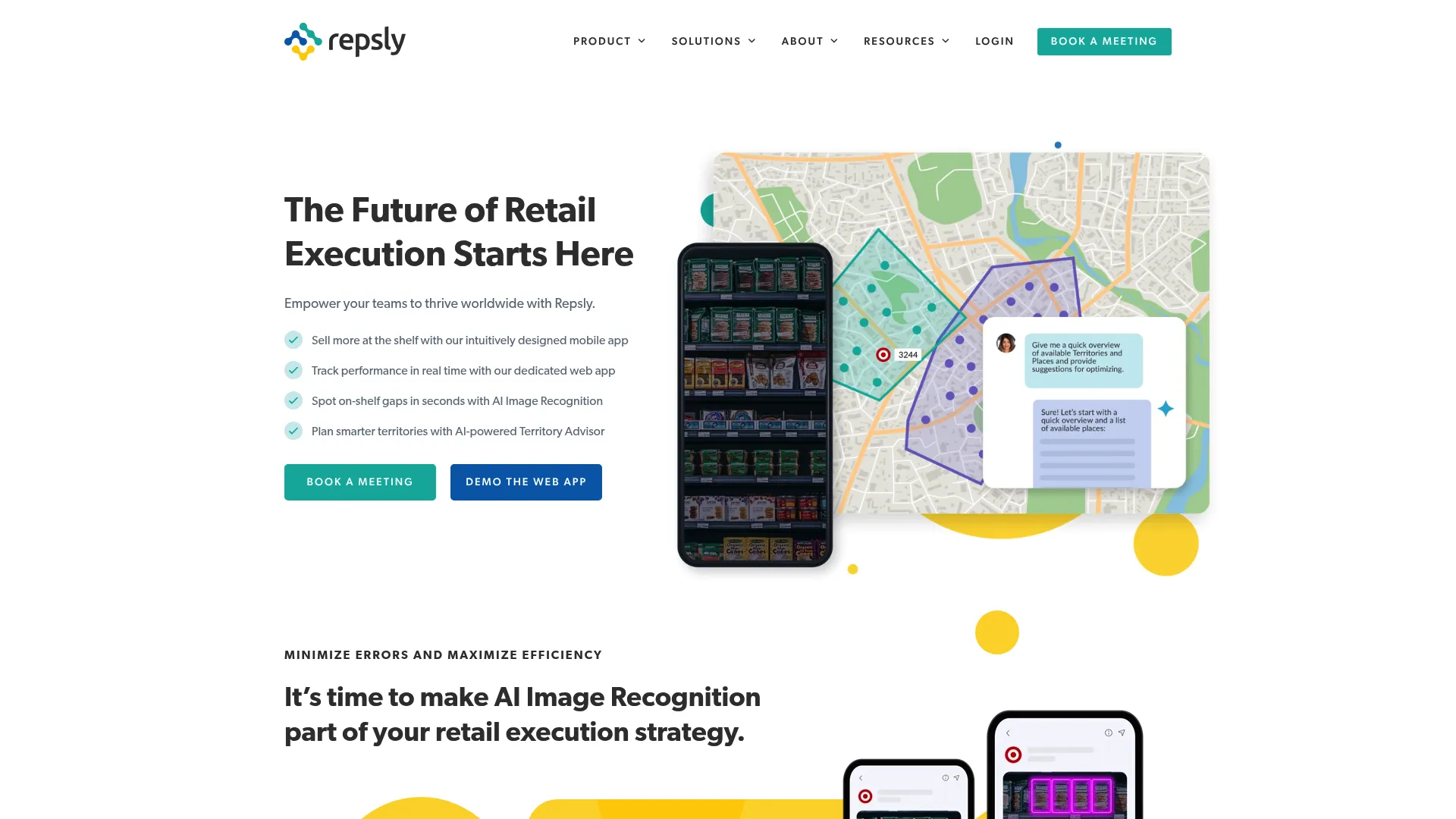
Repsly is retail execution software for CPG brands, field sales teams, and retail service providers. Its focus is different from the pure route-and-territory tools: it is built for the merchandiser and field rep who walk into a store to check shelf compliance, capture photos, complete tasks, and log in-store sales activity. The job is store-level execution, not driveway canvassing.
The AI image recognition feature is a standout for retail teams, turning a shelf photo into structured compliance data. Combined with scheduling and a representative database, it gives brand managers a clear view of what is actually happening at the store level across a large field team.
Best for: CPG brands and field teams managing retail execution, merchandising, and in-store sales activity.
Key strengths
- Representative database and scheduling
- AI image recognition for shelf compliance
- Task management and field reporting
Why choose Repsly: if your field motion is retail execution rather than B2B outside sales, Repsly is tuned to that specific work, from planogram checks to store-level reporting. It gives managers a store-by-store execution dashboard. Teams selling directly to businesses on a route will find the mapping-focused tools above closer to their motion.
Repsly pricing: Repsly does not publish dollar figures on its pricing page. Plans are Core, Grow, Scale, and Flex, and the vendor states all contracts require a 12-month minimum commitment paid annually upfront, with no free trial. Confirm current pricing directly with Repsly during evaluation.
Considerations
Feature lists blur together fast. These are the criteria that actually separate a good fit from an expensive shelfware purchase.
Match the tool to your field motion
A door-to-door canvassing team, a B2B route-selling team, and a CPG merchandising team have different jobs. Canvassing tools optimize for door status and volume. Route-selling tools optimize for drive time and territory coverage. Retail execution tools optimize for shelf compliance. Buy for your motion, not for the longest feature list.
Verify CRM sync and data ownership
Most field sales software is meant to feed your CRM, not replace it. Confirm the sync is two-way, that it maps to your fields cleanly, and that you own the data if you leave. Ask specifically about Salesforce and HubSpot support, and whether sync is real-time or batched.
Check mobile usability in weak-signal environments
The demo always runs on office wifi. Your reps do not. Test offline support in a real dead zone: does the app queue activity and sync later, or does it stall? For rural or basement-heavy territories, offline capability is not optional.
Confirm reporting depth for managers
Rep visibility should mean useful signal, not surveillance. Look for dashboards that show coverage gaps, activity trends, and pipeline movement, not just dots on a map. The goal is coaching input, not a way to police reps into resenting the tool.
Evaluate adoption friction for reps
If logging a visit takes more than a few taps, reps will skip it, and the whole system decays. Run a pilot with your actual reps, not just managers. The tool that gets used beats the tool with more features every time.
Conclusion
The right pick comes down to your field motion, not the feature count. For classic outside sales reps who live in the car, Badger Maps is the most direct fit for route optimization and territory management. For teams that need accountability and management controls across a distributed field force, SPOTIO consolidates territory, route, and activity into one platform. Door-to-door and canvassing teams should shortlist SalesRabbit, while CPG and retail execution teams will find Repsly tuned to store-level work.
If fast, clean capture is your bottleneck, Leadbeam's voice and photo logging attacks it head on. Map-first teams have Map My Customers, and CRM-heavy operations with complex territories should look at Mapsly.
Shortlist two or three that match your motion, then run a real pilot with real reps in real territories. Adoption is the only metric that matters in the end. A tool your reps ignore is more expensive than no tool at all, so weight the trial heavily toward whether logging a visit feels fast enough to actually happen.
FAQs
Field sales software is a mobile-first platform that helps outside sales reps plan routes, manage territories, log visits, and stay visible to managers while working away from a desk. It usually sits on top of a CRM and is built for speed of capture and geographic context rather than long-form data entry.
A standard CRM assumes a rep at a keyboard and optimizes for detailed record-keeping. Field sales software assumes a rep in a car or store and optimizes for route planning, fast mobile capture, and territory coverage. Most field tools feed the CRM rather than replace it, so you keep one source of truth.
Many field sales apps include offline support, queuing activity and visit logs on the phone and syncing when signal returns. This matters for rural routes, basements, and dead zones. Always test offline behavior in a real weak-signal area during evaluation, since not every tool handles it the same way.
Most leading field sales platforms integrate with Salesforce and HubSpot, often with two-way sync so activity captured in the field flows into the CRM automatically. Confirm the direction of sync, how fields map, and whether it is real-time or batched before you buy.
Route planning and optimization, fast mobile activity capture, and clean CRM sync usually top the list. Reps care most about anything that reduces drive time and admin. If logging a visit takes more than a few taps, adoption drops, so low-friction capture is often the deciding factor.
Yes. Canvassing-focused tools are built specifically for door-to-door motions, with door-status tracking, area mapping, gamification, and scheduling. These features suit high-volume field acquisition where coverage and speed matter more than long, multi-stakeholder deal cycles.
Managers use it for territory management, coverage visibility, activity tracking, and pipeline reporting. Good dashboards surface coaching signal, such as accounts nobody has visited or reps trending below activity targets, rather than just tracking locations. The goal is useful visibility, not surveillance.
Common users include B2B outside sales, CPG and consumer goods, home services, medical and pharmaceutical sales, distribution, and retail merchandising. Any team that sells or services accounts in person across a geographic territory tends to benefit from route planning, territory management, and field activity capture.