You booked the shipment on Monday. By Wednesday, three people have emailed asking where it is. The carrier portal says one thing, your spreadsheet says another, and the customer wants an ETA you cannot confidently give.
That gap is not a people problem. It is a systems problem. Freight moves across too many carriers, modes, and handoffs to manage in email threads and disconnected portals. Every manual re-entry is a chance for bad data. Every blind spot is a chance for a missed SLA and an angry call.
Transportation management software exists to close that gap. It sits between your orders and your carriers, handling planning, execution, visibility, and settlement in one place instead of five. The demand behind it is not slowing. The global transportation management system market is projected to grow from $21.8 billion in 2026 to $68.4 billion by 2033, a 17.8% compound annual growth rate, according to Grand View Research (2026).
For teams evaluating software adjacent to logistics workflows, the same discipline that goes into choosing a TMS applies to any complex operational tool: check integration depth, data quality, and reporting before the demo hype wins you over. If you own product decisions around onboarding or activation, the way you'd shortlist a contract lifecycle management platform or an event management tool maps closely to how a TMS should be scoped. The wrong choice creates manual work forever. The right one compounds.
What's inside
This guide compares eight transportation management software options for teams that need planning, execution, real-time visibility, carrier selection, route optimization, freight billing, analytics, and ERP or WMS integration in one system.
We chose entries based on four things: breadth of mode support across land, air, ocean, and rail; depth of shipment visibility and exception handling; reporting and transportation intelligence; and how cleanly each platform fits into an existing supply chain stack. We included one category baseline, established enterprise vendors, a visibility-first platform, and a peer-review resource, so you can judge fit rather than marketing claims.
TL;DR
- Best for enterprise supply chain planning: Oracle Transportation Management, for global freight networks running in the cloud.
- Best for SAP-centric supply chains: SAP Transportation Management, for teams already standardized on SAP ERP and WMS.
- Best for flexible, modular deployment: Descartes Transportation Management, for shippers, brokers, and 3PLs who want to add modules over time.
- Best for freight visibility and track and trace: project44 Movement, for teams prioritizing real-time shipment intelligence across carriers.
- Best for vendor research: Gartner Peer Insights, for validating a shortlist with peer ratings before you buy.
- Best for unified enterprise operations: Manhattan Associates Active Transportation, for complex, highly configurable logistics.
What is transportation management software?
Transportation management software is a logistics platform that plans, executes, and optimizes the physical movement of freight across carriers and modes, then handles the billing and reporting that follow.
The core workflow is simple to state and hard to do well: plan, execute, optimize. You plan the most cost-effective route and carrier, execute the booking and dispatch, then optimize continuously using data on cost, transit time, and service performance.
Most transportation management systems software includes:
- Carrier selection and rate comparison across contracted and spot rates
- Route and load optimization, including consolidation
- Freight booking, tendering, and dispatch
- Shipment visibility with real-time track and trace
- Freight billing, auditing, and settlement
- Dashboards, KPIs, and transportation intelligence
- ERP integration and WMS integration for clean, connected data
Who uses transportation management systems?
TMS software is used across the freight economy. Manufacturers coordinate inbound and outbound movement. Distributors and retailers manage complex networks with tight delivery windows. Ecommerce brands lean on it for parcel and last-mile performance, and retail plus ecommerce made up 28.77% of TMS demand in 2025, the largest vertical, per Mordor Intelligence (2026). Logistics providers, shippers, and 3PLs use it to run freight on behalf of clients at scale.
When to use transportation management software
Reduce freight spend without losing service
Freight is one of the largest controllable costs in most supply chains. A TMS earns its keep when rate comparison, route optimization, mode selection, and load consolidation are done automatically instead of by hand. The moment you are choosing carriers on gut feel or old spreadsheets, you are leaving money on the table. Software surfaces the cheapest route that still hits the service window.
Improve shipment visibility across carriers
Real-time visibility becomes critical the second a customer expects an accurate ETA and your carriers report status in different formats. Track and trace pulls every shipment into one view, and exception alerts flag delays before they become escalations. That turns your team from reactive firefighters into proactive communicators who tell customers about a problem before they ask.
Connect transportation to the rest of the supply chain
ERP integration and WMS integration stop being nice-to-haves the moment finance, warehousing, and transportation depend on the same order data. Clean integration means an order flows from ERP to warehouse to carrier without re-keying, and freight costs post back automatically. Weak integration is where manual work and bad data breed. Scope this hard before you sign.
Comparison table
We ordered the list to move from the category baseline through established enterprise vendors, a visibility-first platform, and a peer-review resource. Compare each on intent, primary use case, pricing model, and verified G2 rating. Most enterprise TMS vendors quote custom pricing tied to freight volume, so treat pricing as a conversation starter, not a sticker price.
| # | Product | Intent | Key use case | Pricing | G2 rating |
|---|---|---|---|---|---|
| 1 | Transportation Management System | Category baseline | Defining core TMS capabilities | Varies by vendor | N/A |
| 2 | Oracle Transportation Management | Enterprise planning | Global cloud freight planning and execution | Custom pricing | 4.2/5 |
| 3 | SAP Transportation Management | SAP-centric supply chains | Planning, tendering, and freight settlement | Price upon request | 4.2/5 |
| 4 | Descartes Transportation Management | Modular deployment | Multimodal TMS with carrier connectivity | Custom pricing | 4.4/5 |
| 5 | Gartner Peer Insights TMS | Vendor research | Peer ratings and category comparison | N/A | N/A |
| 6 | project44 Movement | Freight visibility | Real-time shipment intelligence | Custom pricing | 4.7/5 |
| 7 | Manhattan Associates Active Transportation | Unified operations | Configurable enterprise logistics | Custom pricing | 4.0/5 |
| 8 | E2open Transportation and Logistics Suite | Global orchestration | Multimodal network coordination | Custom pricing | 4.1/5 |
1. Transportation Management System
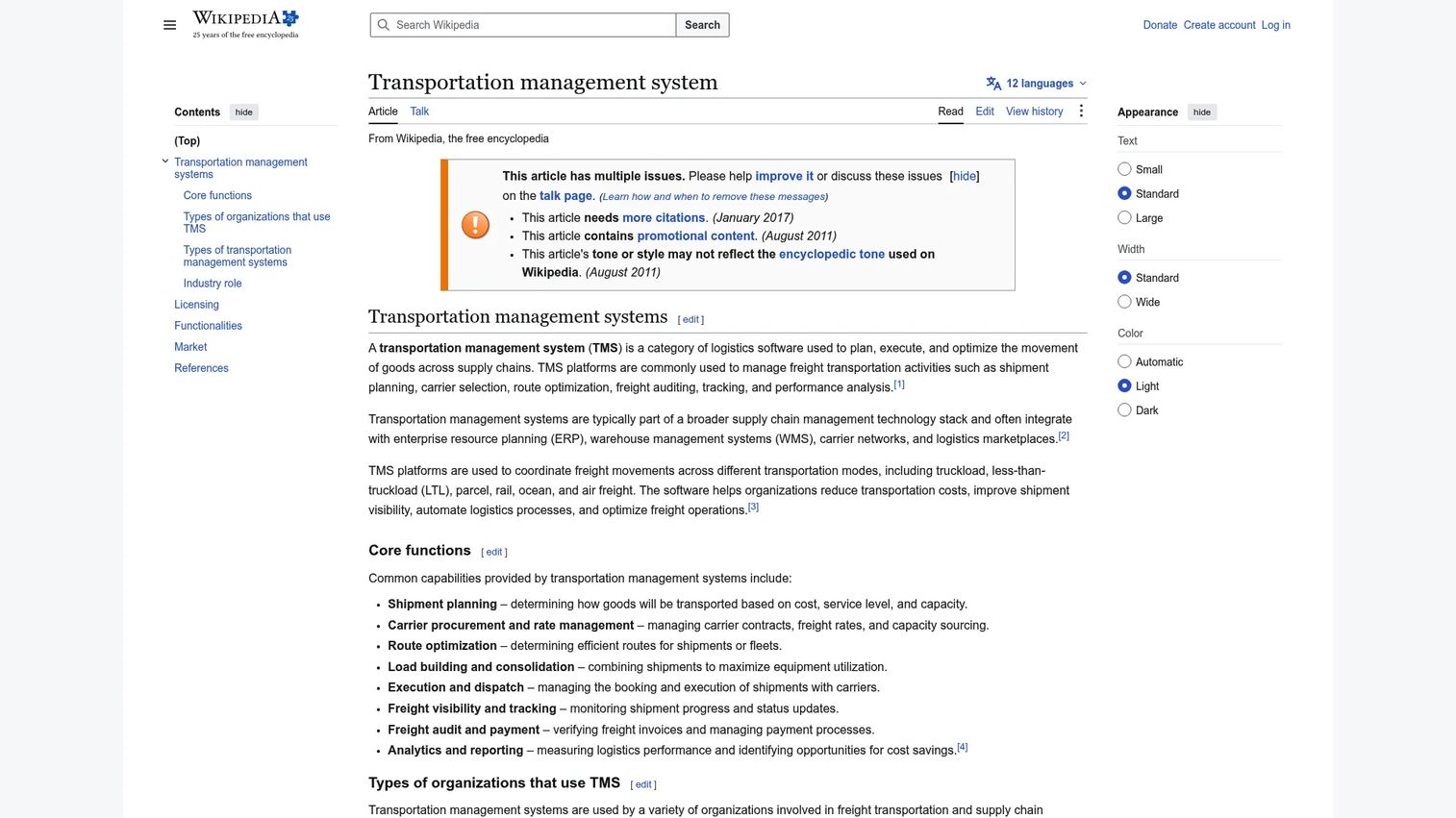
Before naming vendors, it helps to agree on what a transportation management system actually is. This is the category baseline, not a product you buy. It defines the framework every vendor below is measured against, so you can separate real capability from packaging.
At its core, a TMS covers the full freight lifecycle. Planning selects the right carrier, mode, and route. Execution handles tendering, booking, and dispatch. Visibility tracks the shipment through delivery. Settlement covers freight billing, auditing, and payment. Reporting closes the loop with transportation intelligence on cost and service.
Best for: Teams building an evaluation framework before scoping vendor demos.
Key strengths
- End-to-end freight lifecycle: Plan, execute, optimize, and settle in one connected system rather than five tools.
- Multimodal transportation support: Coordinate land, air, ocean, and rail under a single set of workflows.
- Data backbone: ERP and WMS integration keeps order, inventory, and cost data consistent across teams.
Why choose the category baseline: Understanding the generic TMS model protects you from vendor spin. When a sales rep leads with a shiny feature, you can ask how it maps to planning, execution, visibility, and settlement. That framing keeps evaluations honest and comparable across every option on this list.
Pricing: There is no single price for the category. Commercial TMS platforms range from per-shipment SaaS pricing for smaller shippers to enterprise contracts tied to freight spend and volume. Cloud-based deployments accounted for 61.23% of the market in 2025, per Mordor Intelligence (2026), which usually means subscription rather than large upfront license costs.
2. Oracle Transportation Management
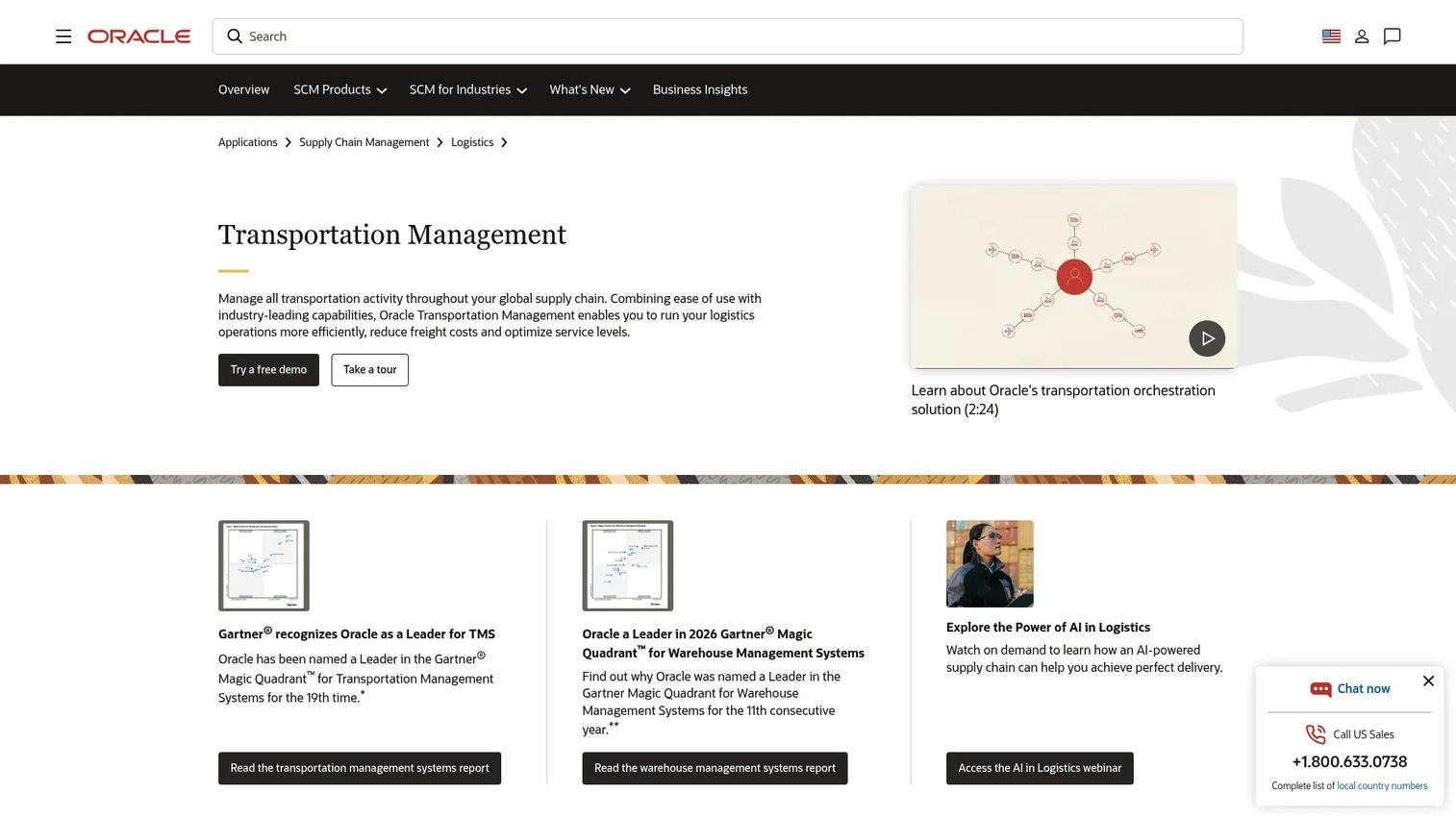
Oracle Transportation Management is a cloud TMS built for planning, execution, fleet, and logistics optimization at enterprise scale. It targets organizations running complex, global freight networks that need one system to orchestrate movement across regions and modes. Oracle positions it as part of a broader supply chain suite, which appeals to teams already invested in Oracle Cloud.
Best for: Large enterprises needing global transportation planning and execution in a cloud TMS.
Key strengths
- Multimodal and multileg planning: Operational planning that spans complex routes across transport modes and legs.
- Automated freight billing and payment: Reduces manual invoice reconciliation and speeds settlement.
- Machine-learning transit prediction: Predicts transit times to sharpen ETAs and planning accuracy.
Why choose Oracle Transportation Management: If your freight network is genuinely global and complex, Oracle's depth in planning and optimization is hard to match. It fits best when you already run Oracle ERP or plan to, because the supply chain integration removes friction that standalone tools cannot. Smaller shippers may find the platform heavier than they need.
Oracle Transportation Management pricing: Oracle does not publish a public price for this product and directs buyers to contact sales for a quote tied to their network. On G2, Oracle Transportation Management Cloud holds a 4.2 out of 5 rating. Expect enterprise contract terms rather than a self-serve subscription.
3. SAP Transportation Management
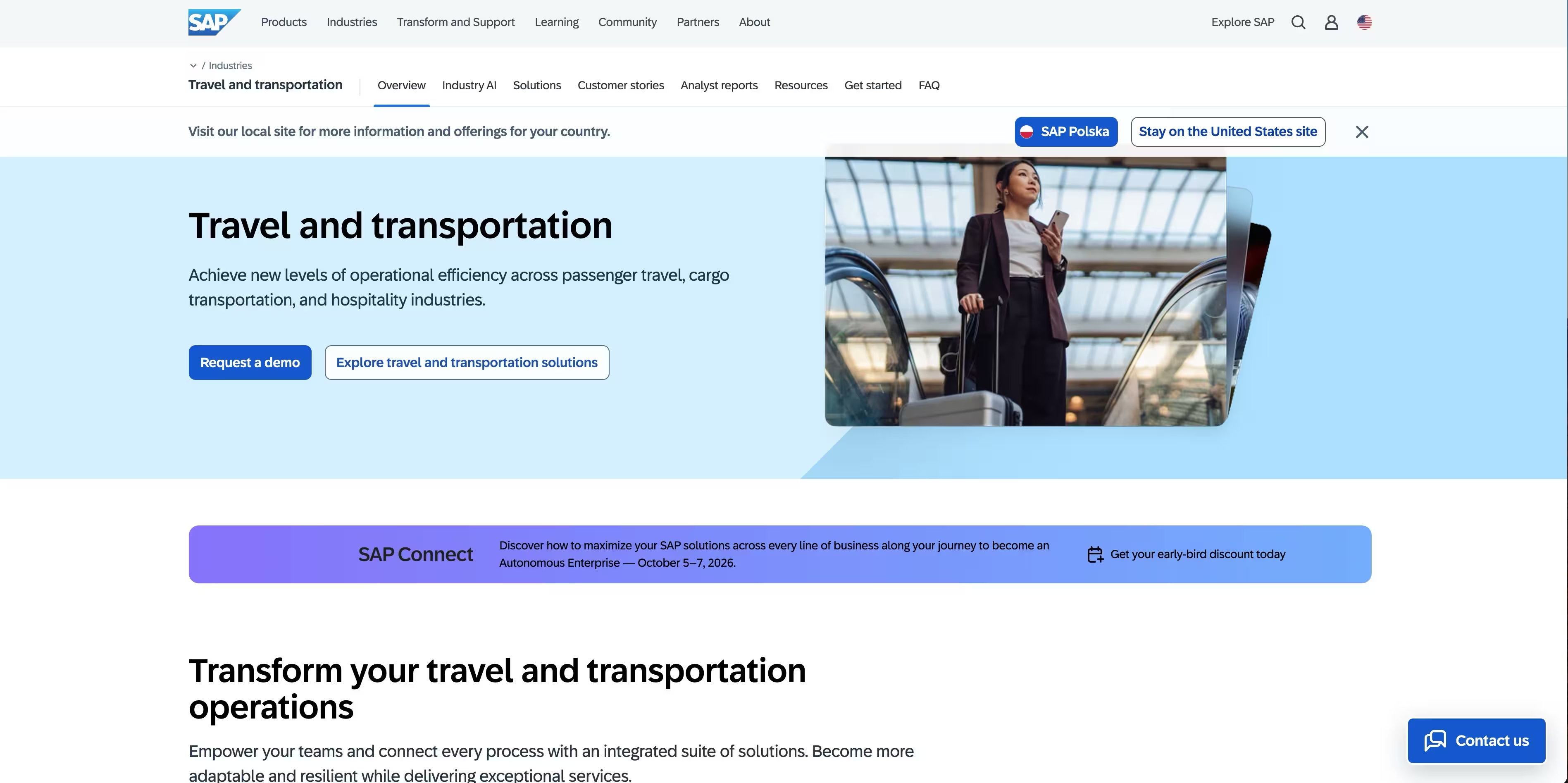
SAP Transportation Management handles planning, tendering, settlement, and logistics visibility for supply chains built on SAP. It covers transportation and demand planning, interactive freight tendering, and freight settlement in one application. For organizations already standardized on SAP ERP and WMS, the appeal is a single data model across the whole operation.
Best for: Enterprises needing transportation planning, freight tendering, and freight settlement inside SAP-centric supply chains.
Key strengths
- Transportation and demand planning: Aligns freight movement with demand signals across the supply chain.
- Interactive freight tendering: Streamlines carrier negotiation and award workflows.
- Freight settlement: Automates cost calculation, billing, and payment reconciliation.
Why choose SAP Transportation Management: The value concentrates when SAP is already your system of record. Native alignment with SAP ERP and WMS means fewer integration projects and cleaner data end to end. SAP's education-heavy product framing also helps buyers understand exactly how planning, execution, and settlement fit together before committing. Teams outside the SAP ecosystem should weigh the integration lift carefully.
SAP Transportation Management pricing: SAP lists the product under its S/4HANA Cloud Private Edition with pricing shown as price upon request, sold in blocks of spend per year rather than a flat subscription. On G2, SAP Transportation Management holds a 4.2 out of 5 rating. Plan for an enterprise procurement cycle rather than a quick purchase.
4. Descartes Transportation Management
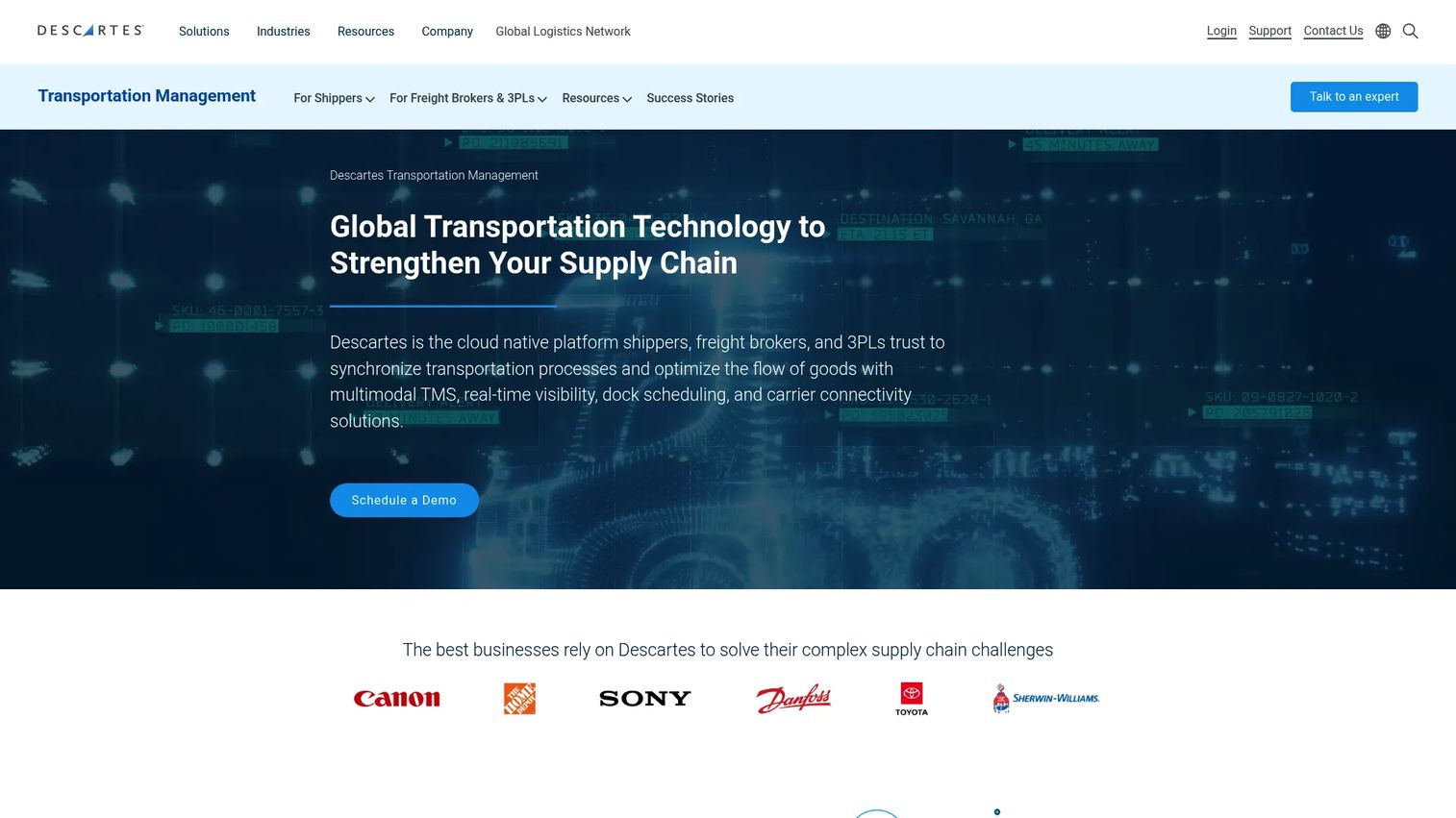
Descartes Transportation Management is a cloud-native TMS for shippers, freight brokers, and 3PLs, built around multimodal transportation, visibility, dock scheduling, and carrier connectivity. Its modular structure lets teams start with one capability and add more over time, which suits operations that expect their needs to grow. Descartes leans heavily on its logistics network for carrier reach.
Best for: Shippers and logistics teams needing an enterprise TMS with strong visibility and carrier connectivity.
Key strengths
- Multimodal transportation management: Handle land, ocean, parcel, and fleet freight under one platform.
- Real-time shipment visibility: Track and trace across carriers with exception alerts.
- Dock appointment scheduling and yard management: Coordinate arrivals to reduce detention and dwell time.
Why choose Descartes Transportation Management: The modular deployment model is the differentiator. Teams that do not want a monolithic rollout can adopt the freight broker, parcel, fleet, or shipment visibility modules as their operation demands. Descartes also surfaces sustainability and emissions reporting where relevant, which matters as more shippers track freight carbon. It fits teams that value flexibility over an all-in-one mandate.
Descartes Transportation Management pricing: Descartes does not publish public pricing and notes that TMS pricing varies by scope, directing buyers to contact the team. On G2, Descartes Shipper TMS holds a 4.4 out of 5 rating. Expect pricing to scale with the modules and volume you deploy.
5. Gartner Peer Insights Transportation Management Systems
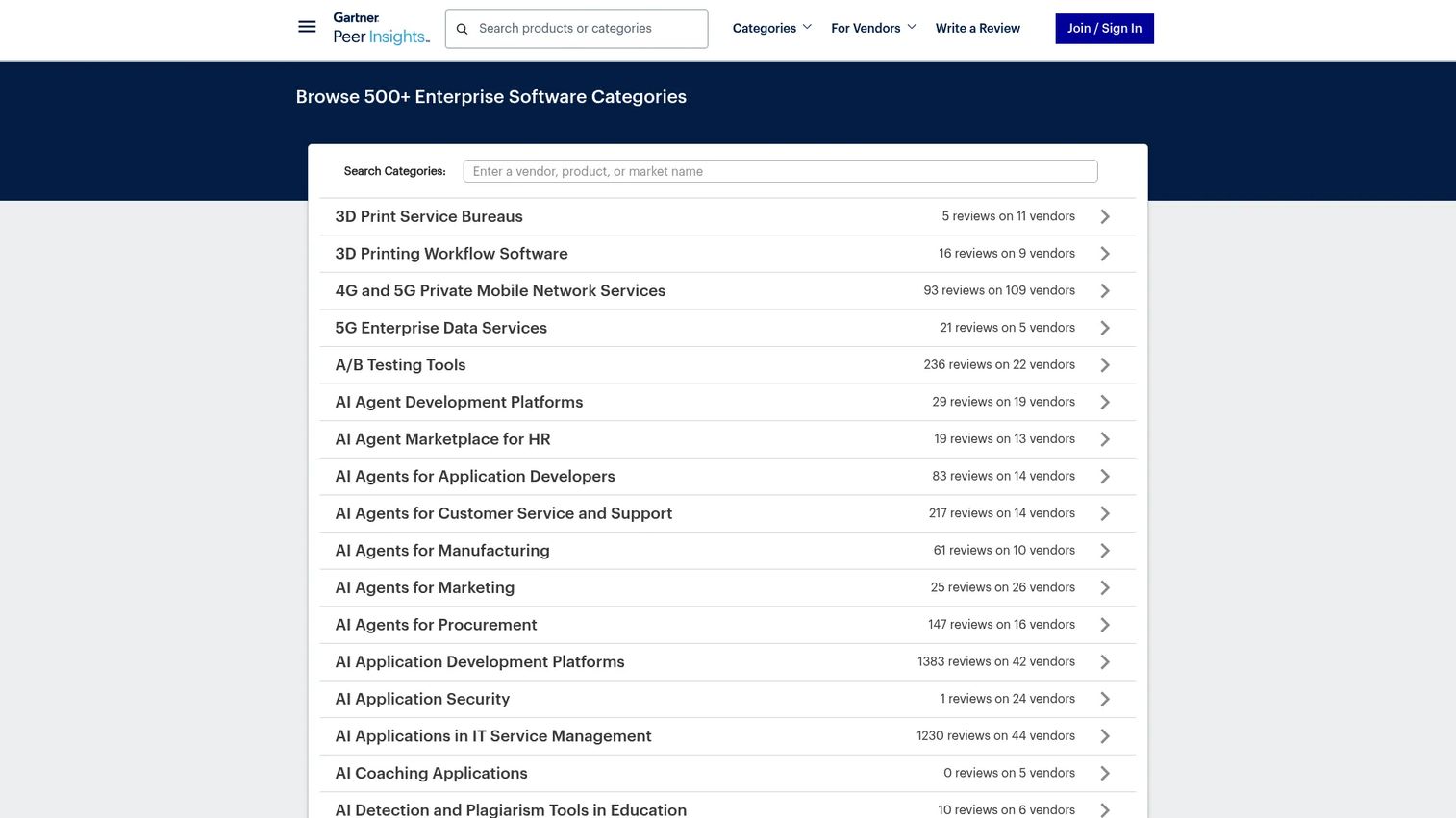
Gartner Peer Insights is not a software vendor. It is a review and evaluation resource, and it belongs on this list because a shortlist you cannot validate is a gamble. Buyers use it to read peer ratings, filter by company size and industry, compare products side by side, and understand the category taxonomy before they ever book a demo.
Best for: Buyers researching TMS vendors through verified peer reviews and category comparisons.
Key strengths
- Peer ratings from real users: Reviews from practitioners who run these systems daily, not vendor marketing.
- Category comparison and filters: Compare vendors by segment, deployment, and function.
- Market taxonomy: A structured view of what the TMS category includes across sourcing, planning, and execution.
Why choose Gartner Peer Insights: Use it as the research layer, not the buying layer. Before you commit to demos, it helps you confirm a vendor's reputation, spot recurring complaints, and understand which tools serve which operational contexts. That validation reduces the risk of a shortlist built entirely on vendor decks. It works best paired with hands-on evaluation, not as a substitute for it.
Gartner Peer Insights pricing: The review platform itself is a research resource rather than a purchased product, so there is no software price to quote. Value comes from the diligence it enables before you spend on a TMS contract.
6. project44 Movement
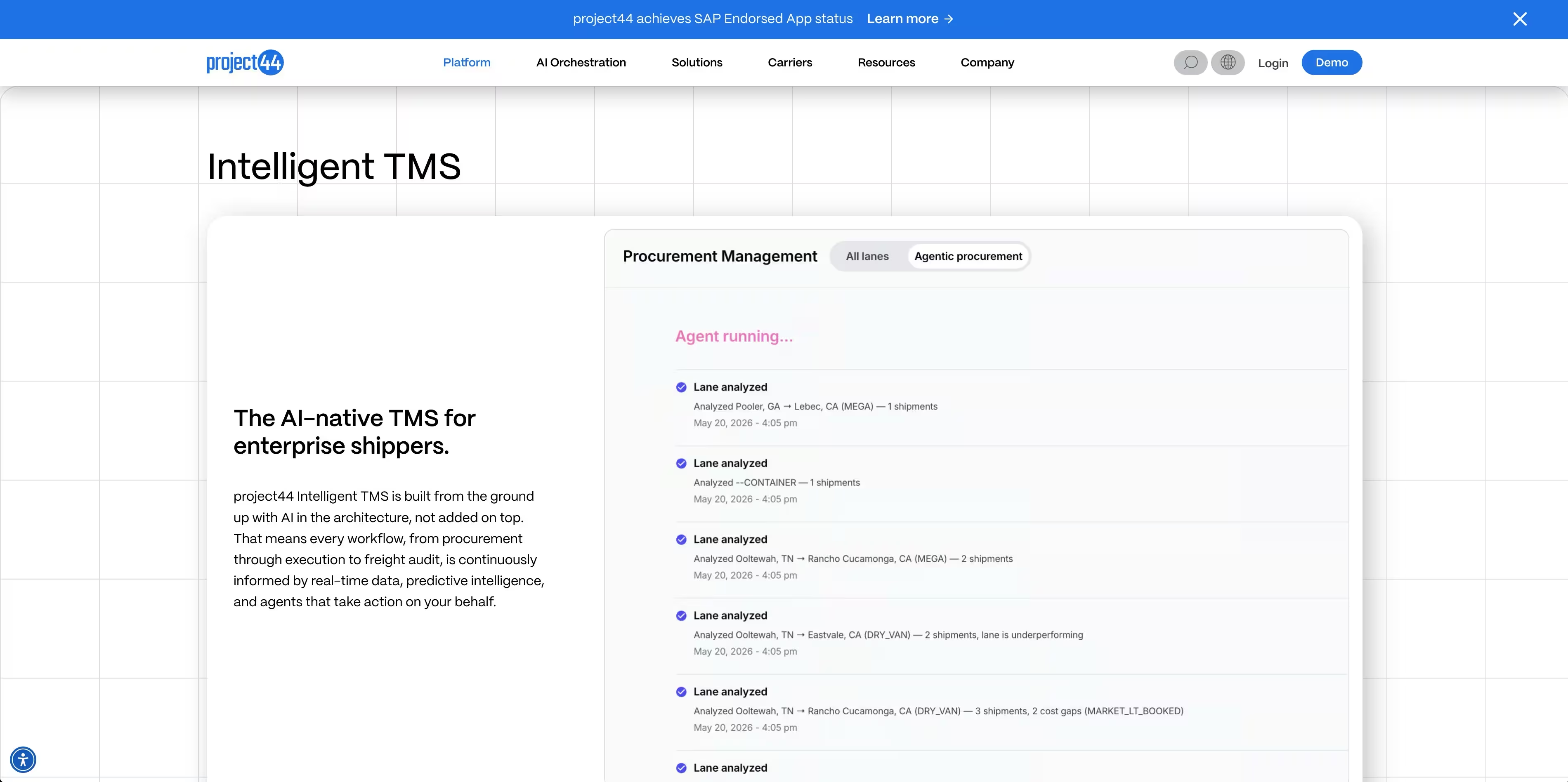
project44 Movement is a decision intelligence platform for supply chain visibility, transportation management, yard management, and ecommerce logistics. Its strength is real-time, AI-powered visibility across shipment modes and nodes, which makes it a natural fit for teams whose biggest pain is not knowing where freight is. It complements and extends TMS workflows rather than replacing planning outright.
Best for: Large shippers and logistics teams needing enterprise supply chain visibility and workflow automation.
Key strengths
- AI-powered decision intelligence: Turns visibility data into predictive ETAs and proactive exception handling.
- End-to-end visibility: Tracks shipments across modes and nodes in one view.
- Transportation and yard workflows: Connects visibility to execution across transportation, yard, and ecommerce logistics.
Why choose project44 Movement: When live shipment intelligence is the priority, this is the entry to evaluate. Teams that already have planning and settlement handled but struggle with track and trace across a fragmented carrier base get the most value here. The predictive ETA capability turns raw tracking into decisions, which is where visibility platforms earn their cost. Pair it with a planning-first TMS for full coverage.
project44 Movement pricing: project44 does not publish public pricing and directs visitors to contact sales. On G2, project44 holds a 4.7 out of 5 rating, the highest on this list. Expect enterprise pricing scaled to shipment volume and network complexity.
7. Manhattan Associates Active Transportation
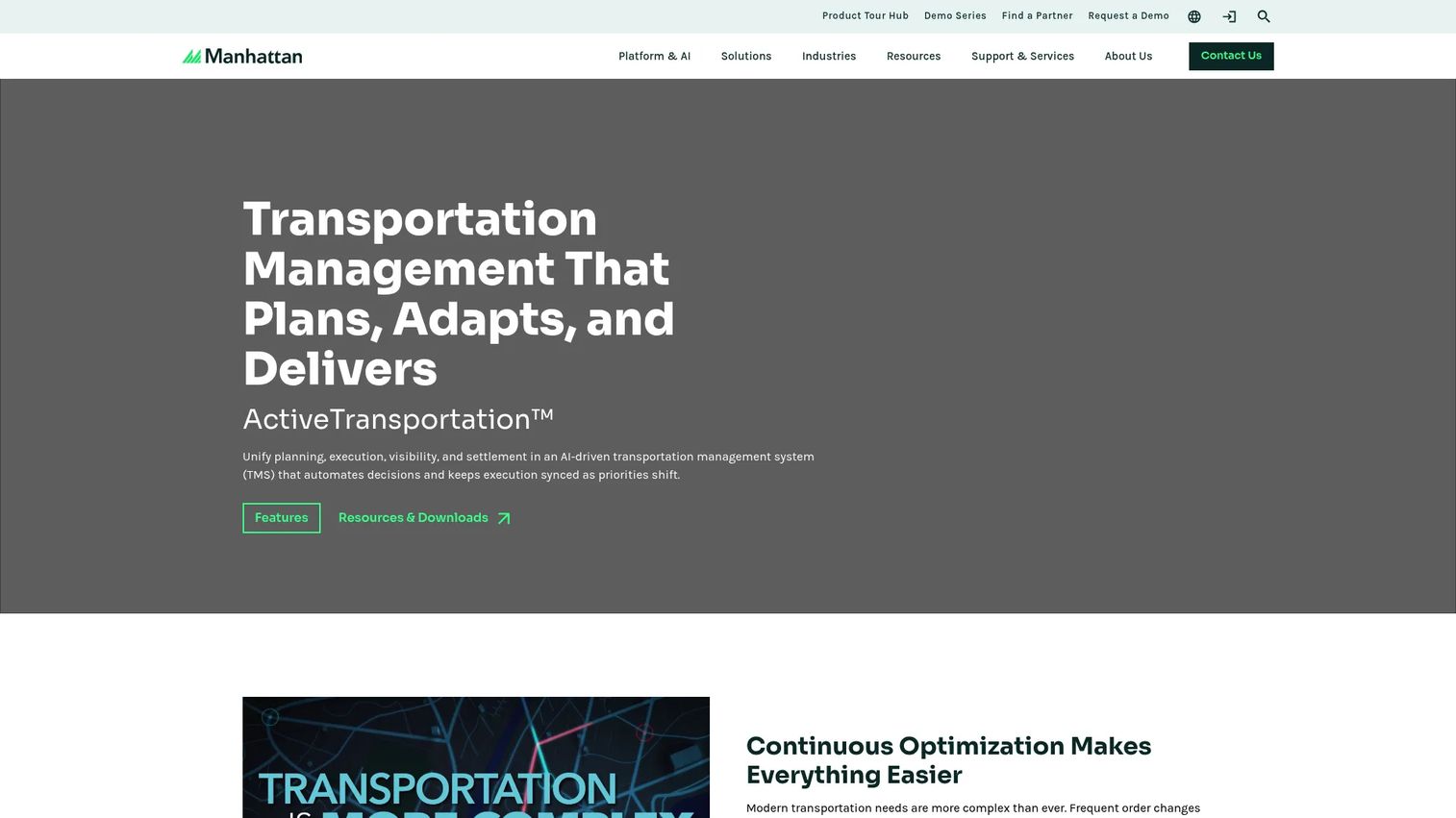
Manhattan Associates Active Transportation is an AI-driven TMS for planning, execution, visibility, and settlement across a logistics network. It is built for large-scale operations that need a unified, highly configurable system, and it integrates with Manhattan's broader warehouse and fulfillment portfolio. That coordination between transportation and warehouse workflows is a real advantage for complex enterprises.
Best for: Enterprises needing a unified, highly configurable TMS for complex transportation operations.
Key strengths
- Unified logistics control: Planning and execution managed from one control layer.
- Continuous optimization and multimodal support: Optimizes routing and mode selection continuously across freight types.
- Transportation procurement, modeling, and settlement: Covers carrier sourcing through freight payment in one platform.
Why choose Manhattan Associates Active Transportation: The pull is tight coordination between transportation and the warehouse. If you already run Manhattan for WMS or fulfillment, transportation slots in without the integration friction standalone tools carry. The configurability suits operations with unusual requirements that off-the-shelf tools cannot bend to fit. Smaller or simpler networks may not need this depth.
Manhattan Associates Active Transportation pricing: Manhattan does not display public pricing and directs buyers to contact sales. On G2, Manhattan Associates holds a 4.0 out of 5 rating across its portfolio. Expect enterprise contract terms configured to your operation.
8. E2open Transportation and Logistics Suite
E2open is enterprise TMS software for planning, booking, execution, tracking, and settlement across multiple transport modes. Its focus is networked logistics and global orchestration, with carrier procurement and settlement handled in a single application. For large, complex, global operations, the control-tower style oversight is the draw.
Best for: Large shippers needing global, multimodal transportation management.
Key strengths
- Multimode planning, tendering, and tracking: Coordinate shipments across modes from a single application.
- Carrier procurement and settlement: Source carriers and settle freight in one workflow.
- Real-time visibility and orchestration: Global logistics orchestration with live shipment visibility.
Why choose E2open Transportation and Logistics Suite: The value shows up in scale and reach. Organizations running global, multimodal freight with many carriers and partners benefit from network-wide coordination and control-tower oversight. Combining procurement, execution, and settlement in one application reduces the handoffs that break in fragmented stacks. It fits complex global operations more than lean regional ones.
E2open Transportation and Logistics Suite pricing: E2open does not publish public pricing on its product pages, and G2 notes that pricing details are not currently available. On G2, the E2open logistics suite holds a 4.1 out of 5 rating. Plan for an enterprise engagement scaled to your network.
Considerations before you buy
Mode coverage
Confirm exactly which modes the platform supports: land, air, ocean, rail, parcel. A tool that handles truckload beautifully but ignores ocean is useless for a mixed freight network. Match mode coverage to the freight you actually move, not the freight you might move someday.
Visibility and exception management
Real-time shipment status is table stakes. The real question is whether the tool only reports status or actively helps you resolve exceptions. Look for alerts, root-cause context, and workflows that route a delay to the right person before a customer notices.
ERP and WMS integration
Do not accept "we integrate" at face value. Ask how deep the integration runs, whether it is real-time or batch, and what data flows both ways. Weak ERP integration and WMS integration create manual re-entry and inconsistent data, which quietly erodes every benefit the TMS promised.
Billing, auditing, and settlement
If finance owns part of the freight process, the platform must handle freight billing, auditing, and settlement cleanly. Check for automated audit against contracted rates, clear settlement workflows, and the auditability and compliance records finance will demand at close.
Reporting and transportation intelligence
Dashboards should tie directly to cost, service levels, and on-time performance. Confirm you can track the KPIs your team is measured on, export the data, and build the reports leadership expects. Reporting that lives only inside the vendor's UI, with no export, becomes a bottleneck fast.
Conclusion
The right transportation management software depends on network complexity, integration depth, and reporting needs, not a leaderboard. For enterprise planning across a global network, Oracle Transportation Management and SAP Transportation Management lead, especially when you already run their ERP. For multimodal operations that want flexible, modular deployment, Descartes Transportation Management fits. When live shipment intelligence is the priority, project44 Movement stands out. For unified enterprise operations tied to the warehouse, Manhattan Associates Active Transportation and E2open handle global orchestration well.
Start by defining your operating model and integration requirements, then use Gartner Peer Insights to validate reputation. Shortlist one or two tools that match your freight reality and run a hands-on evaluation against real shipments before you sign anything.
FAQs
What does transportation management software do?
It plans, executes, and optimizes the physical movement of freight, then handles the billing and reporting that follow. In practice that means selecting carriers and routes, booking and dispatching shipments, tracking them in real time, and settling freight costs. The plan, execute, optimize loop is the core value.
How is a TMS different from ERP or WMS software?
A TMS manages freight movement between locations. A WMS manages inventory and operations inside a warehouse. An ERP is the system of record for finance, orders, and broader operations. They work best connected: the ERP holds the order, the WMS picks and packs it, and the TMS moves it, with data flowing across all three.
What features matter most in transportation management systems?
Prioritize the workflow you struggle with most. For cost, focus on carrier selection, rate comparison, and route optimization. For service, focus on real-time visibility and exception management. For finance, focus on freight billing and auditing. And for every buyer, scope ERP integration and WMS integration hard, since weak integration undermines the rest.
Does transportation management software support multimodal shipping?
Most enterprise TMS platforms support multimodal transportation across land, air, ocean, and rail, but coverage varies. Some tools excel at truckload and parcel while treating ocean or rail as an afterthought. Confirm the specific modes you move are first-class in the platform, not bolted on.
How does TMS improve freight visibility and track and trace?
It pulls status from every carrier into one view, so you stop checking five portals to answer one question. Strong platforms layer predictive ETAs and exception alerts on top, flagging delays before they become escalations. That shifts your team from reacting to problems to communicating them proactively.
What should teams look for in freight billing and auditing?
Look for automated auditing against contracted rates, so you catch overbilling without manual review. Confirm the platform supports your settlement workflow and produces the audit trail finance needs for compliance. If finance owns part of the process, involve them in the evaluation early rather than after purchase.
How do cloud TMS platforms compare with on-premise systems?
Cloud TMS deployments dominate the market, accounting for 61.23% of it in 2025 per Mordor Intelligence (2026). Cloud typically means faster deployment, lower upfront cost, automatic updates, and easier scaling. On-premise can appeal to organizations with strict data control requirements, but it carries heavier maintenance and infrastructure overhead.
Which teams typically use transportation management software?
Manufacturers, distributors, retailers, and ecommerce brands use it to move their own freight, while logistics providers and 3PLs use it to move freight for clients. Retail and ecommerce were the largest vertical in 2025 at 28.77% of demand, per Mordor Intelligence (2026). Within a company, logistics, operations, and finance teams share the workflow.