You inherited three microservices last quarter. Now you have thirty. Every one of them exposes an endpoint, and every endpoint needs auth, rate limits, logging, and a routing rule that someone actually understands six months from now. Nobody planned for this. It just happened, one deploy at a time.
That is the real problem an API gateway solves. Not "manage APIs" in the abstract. It absorbs the sprawl, so routing, policy enforcement, and observability live in one layer instead of scattered across services nobody owns. The global API management market is projected to grow from USD 10.32 billion in 2026 to USD 22.11 billion by 2031, a 16.45% CAGR, according to Mordor Intelligence. Cloud deployments already hold 79.55% of the market, with hybrid architectures growing fastest. Translation: more teams are fronting more traffic, and the gateway decision is getting harder to defer.
For presales engineers and technical buyers, the friction is not finding a gateway. It is separating tools that sound identical on a feature grid from the ones that actually fit a customer's stack, security posture, and deployment model. That is where deals stall in technical validation. If you build interactive demos or share evaluation environments for a living, you already know how much clarity matters when an architecture review starts asking hard questions. The same discipline applies here. This guide compares 11 API gateway software options for 2026, built for the people who have to defend the choice, not just make it.
What's inside
This guide covers 11 API gateway software options selected for relevance to security, routing, observability, scalability, and cloud-native deployment. The list spans open source, managed, self-hosted, and hybrid gateways, so you can match a tool to the customer's runtime instead of forcing the customer into a tool. We chose products on four criteria: deployment flexibility, security depth, Kubernetes and microservices fit, and operational overhead. It is written for presales, sales engineers, and platform buyers who need to explain, compare, and defend architecture choices during shortlist, RFP, or POC planning.
TL;DR
- Best overall for broad coverage and enterprise controls: Kong Gateway, for teams that want routing, security, and deployment flexibility in one credible package.
- Best open source for cloud-native teams: Tyk, for REST and GraphQL workloads that need governance without a licensing wall.
- Best for AWS-centric teams: Amazon API Gateway, when serverless and native AWS alignment outweigh portability.
- Best for deep API management: Apigee, for large-scale API programs that need lifecycle control and analytics.
- Best for Kubernetes-heavy environments: Apinizer, a Kubernetes-native API and AI gateway with multi-protocol support.
- Best for enterprise governance language: IBM API Connect, when procurement and internal approval need control plane and lifecycle depth.
What is an API gateway?
An API gateway is the front door for API traffic. It sits between clients and backend services, handling routing, policy enforcement, security, request transformation, observability, and traffic control from a single layer. Instead of each service reinventing authentication or rate limiting, the gateway centralizes those concerns.
Here is how the responsibilities break down.
- Core functions: Route requests to the right service, aggregate responses, transform payloads between protocols, and shape traffic with rate limiting and throttling.
- Security responsibilities: Terminate TLS, enforce authentication and authorization (OAuth, JWT, mTLS), validate tokens, and apply consistent policy across every endpoint.
- In microservices: Give clients one stable entry point instead of dozens of service URLs, and decouple the client from internal service topology.
- In Kubernetes and serverless: Front ingress traffic, integrate with the Gateway API standard, and route to serverless functions or containerized workloads without exposing them directly.
- Versus broader API management: A gateway handles runtime traffic. An API management platform wraps the gateway with developer portals, lifecycle governance, analytics, and monetization. Every management platform includes a gateway; not every gateway is a full management platform.
That vocabulary matters in an architecture review. A gateway is not an ingress controller, though they overlap at the edge. It is not a service mesh, which handles service-to-service traffic inside the cluster. And a cloud native API gateway is one built to run and scale inside container orchestration, not bolted on after the fact.
When to use an API gateway
Secure API traffic at the edge
Reach for a gateway when you need authentication, authorization, TLS termination, OAuth, and rate limiting enforced in one place. Scattering these controls across services means every team implements security slightly differently, and every difference is a gap. A gateway makes API gateway security a policy you write once and apply everywhere, which is exactly the story that survives a security review.
Route and transform requests across services
Use a gateway when clients need aggregation across multiple backends, protocol translation (REST to gRPC, SOAP to REST), or traffic shaping during a migration. This is where a gateway earns its keep in microservices: the client sees one clean contract while you refactor the mess behind it.
Standardize governance across teams
Large organizations need versioning, consistent logging, analytics, and policy that does not drift between teams. When five squads each ship APIs on their own schedule, a gateway (or full api management platform) becomes the enforcement point for standards nobody can quietly ignore.
Support cloud-native deployments
If the customer runs microservices on Kubernetes, mixes hybrid runtimes, or leans on serverless, the gateway has to fit that model natively. A kubernetes api gateway that speaks the Gateway API standard and scales with the cluster beats a legacy proxy retrofitted for containers.
API gateway comparison table
Use this table to build a shortlist, not to make a final call. It maps each tool to an intent and a primary use case so you can eliminate poor fits fast, then dig into deployment model and security depth for the two or three that survive. Pricing and G2 ratings reflect the most recent verified figures at the time of writing; confirm both on the vendor's live pricing page before you quote anything in an RFP.
| # | Product | Intent | Key use case | Pricing | G2 rating |
|---|---|---|---|---|---|
| 1 | KrakenD | Low-latency edge gateway | Aggregation and transformation at speed | Free Community; Enterprise quote-based | 4.7/5 |
| 2 | Membrane | Open source and cloud native | Internal tooling, automations, and APIs | Not publicly listed | Not listed |
| 3 | Apinizer | Kubernetes native gateway | Multi-protocol API and AI gateway | Free Community; Starter $500/mo | 4.5/5 |
| 4 | Otoroshi | Open source and cloud native | Runtime-programmable reverse proxy | Free (Apache 2.0) | Not listed |
| 5 | Tharion Apex | Kubernetes native gateway | Gateway and service mesh traffic control | Free trial | Not listed |
| 6 | webMethods API Gateway | Enterprise API management | Runtime security and governance | Contact sales | 4.2/5 |
| 7 | Kong Gateway | Enterprise API management | Hybrid and multi-cloud routing | Free trial; Plus per gateway/mo | Not listed |
| 8 | Tyk | Open source and cloud native | REST and GraphQL governance | Free OSS; paid tiers | 4.6/5 |
| 9 | Amazon API Gateway | Managed cloud gateway | Serverless APIs on AWS | Pay-as-you-go; free tier | 4.2/5 |
| 10 | Apigee | Enterprise API management | Full API lifecycle and analytics | Free 60-day; $20/1M calls | 4.5/5 |
| 11 | Gravitee | Hybrid runtime governance | APIs, events, and AI agent management | Comet $1,250/mo; Planet $2,500/mo | 4.5/5 |
IBM API Connect appears as the twelfth deep-dive below for teams that need full lifecycle governance across hybrid and multicloud estates.
1. KrakenD
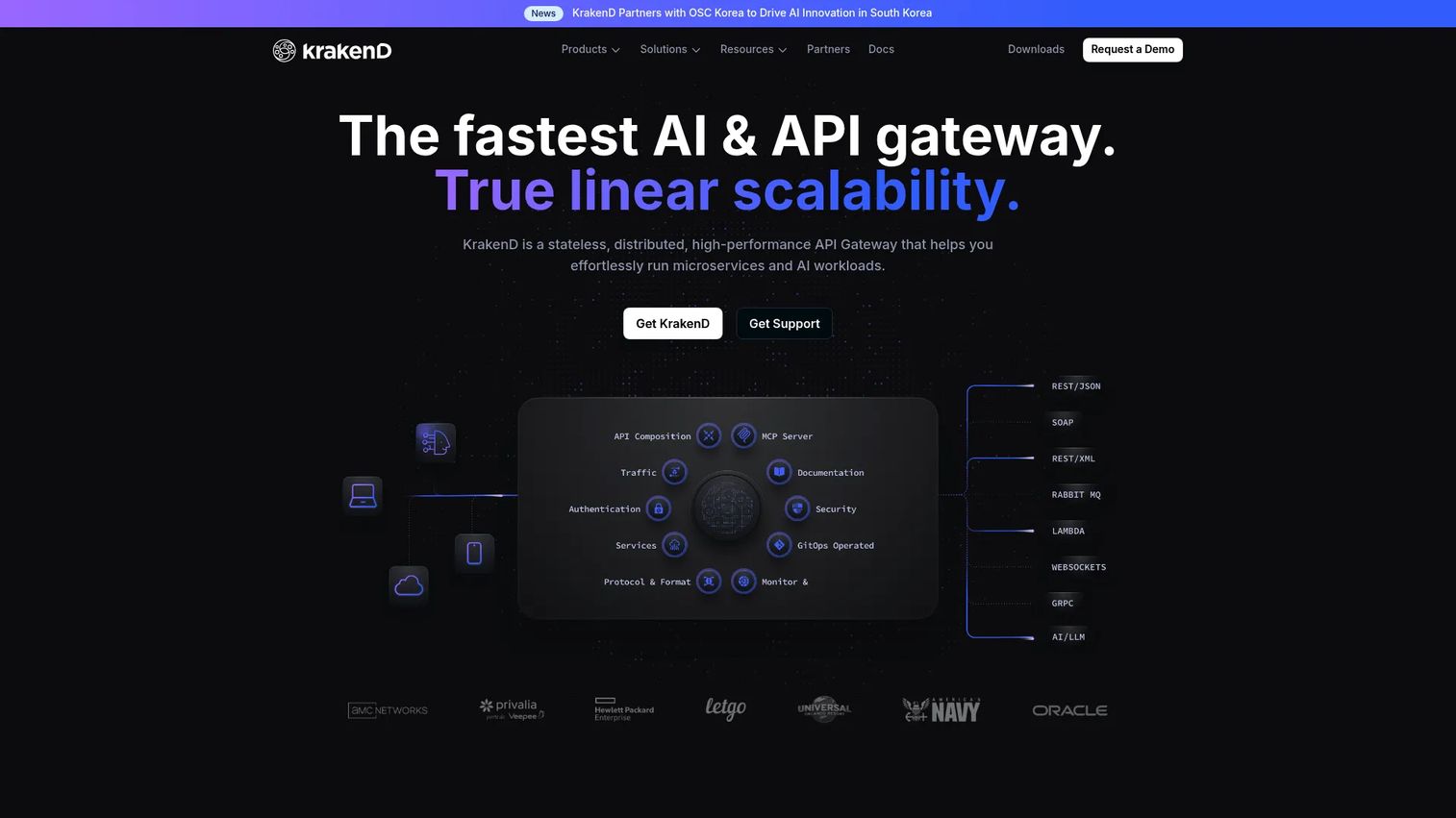
KrakenD is a high-performance, stateless API gateway built for teams that care about aggregation, transformation, and raw speed. It sits well in front of microservices where a single client request needs to fan out to several backends and come back as one clean response. Because it holds no state, it scales horizontally without coordination overhead, which is why performance-focused buyers put it on their shortlist. It now extends to AI workloads with gateway and MCP support.
Best for: Teams needing a self-hosted, high-performance gateway with enterprise support options available.
Key strengths
- API aggregation and transformation: Combine multiple backend calls into one response and reshape payloads at the edge.
- Traffic management and security controls: Rate limiting, auth, and policy enforcement without adding latency.
- AI gateway and MCP support: Route and govern LLM and agent traffic alongside conventional APIs.
Why choose KrakenD: When latency and throughput are the deciding factors, KrakenD's stateless design gives presales a clean performance story to defend. It fits customers who want a lean gateway they control, not a sprawling management suite.
KrakenD pricing: A free Community Edition is available to self-host. The Enterprise Edition adds SLAs, support, governance, and security and compliance features, and is quote-based through sales. No public enterprise price is listed. KrakenD holds a 4.7/5 rating on G2.
2. Membrane
Membrane is a platform for building internal tools, automations, admin panels, and APIs on a durable JavaScript runtime. It appeals to teams that want to compose API logic and integrations in code rather than configure a heavyweight proxy. The durable runtime persists program state, which suits long-running automations and glue services that traditional stateless gateways handle awkwardly.
Best for: Teams building internal tooling and automations on a JavaScript runtime.
Key strengths
- Durable programs with persisted state: Keep long-running automations and workflows alive across restarts.
- Dashboard for internal tools and admin panels: Build and expose internal interfaces without a separate frontend stack.
- Graph-based access control and API integrations: Model permissions and wire up integrations through a graph.
Why choose Membrane: For platform teams that treat API composition as a coding problem, Membrane fits the mental model better than a config-driven gateway. It is a strong fit when internal tooling and API glue sit at the center of the use case.
Membrane pricing: Pricing details were not publicly readable on the primary site at the time of writing, so confirm current tiers and any free option directly with the vendor before quoting.
3. Apinizer
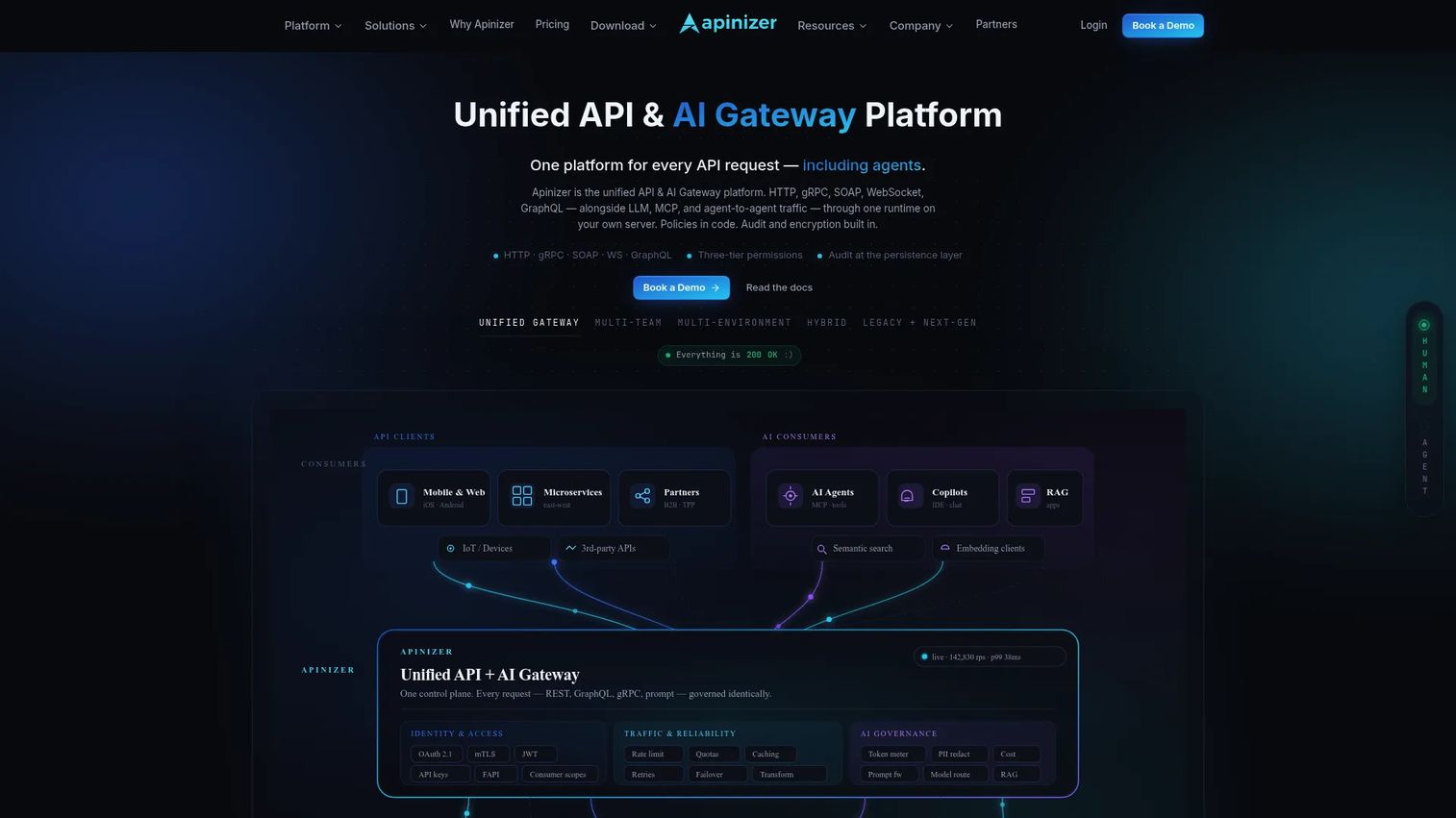
Apinizer is a Kubernetes-native API and AI gateway platform for managing, securing, and observing API traffic. It matters to buyers evaluating multi-protocol support, because it fronts HTTP, gRPC, WebSocket, SOAP, and GraphQL from one layer. Its identity manager covers OAuth2, OIDC, JWT, mTLS, LDAP/AD, and SAML 2.0, which is the kind of coverage that clears an enterprise security review without a stack of caveats.
Best for: Teams that need a self-hosted API and AI gateway with enterprise controls and regulated deployment options.
Key strengths
- Broad multi-protocol gateway: Handle HTTP, gRPC, WebSocket, SOAP, and GraphQL through a single gateway.
- Deep identity management: OAuth2, OIDC, JWT, mTLS, LDAP/AD, and SAML 2.0 for enterprise auth.
- AI gateway controls: Multi-LLM routing, MCP, A2A governance, semantic cache, and a prompt firewall.
Why choose Apinizer: For platform teams standardizing on Kubernetes that also need to govern AI traffic, Apinizer covers both without a second product. The regulated deployment options give presales a clean answer to compliance questions.
Apinizer pricing: A free Community edition is self-managed. Paid tiers include Starter at $500/month and Professional at $1,000/month, with Enterprise available as a custom annual subscription. Apinizer holds a 4.5/5 rating on G2.
4. Otoroshi
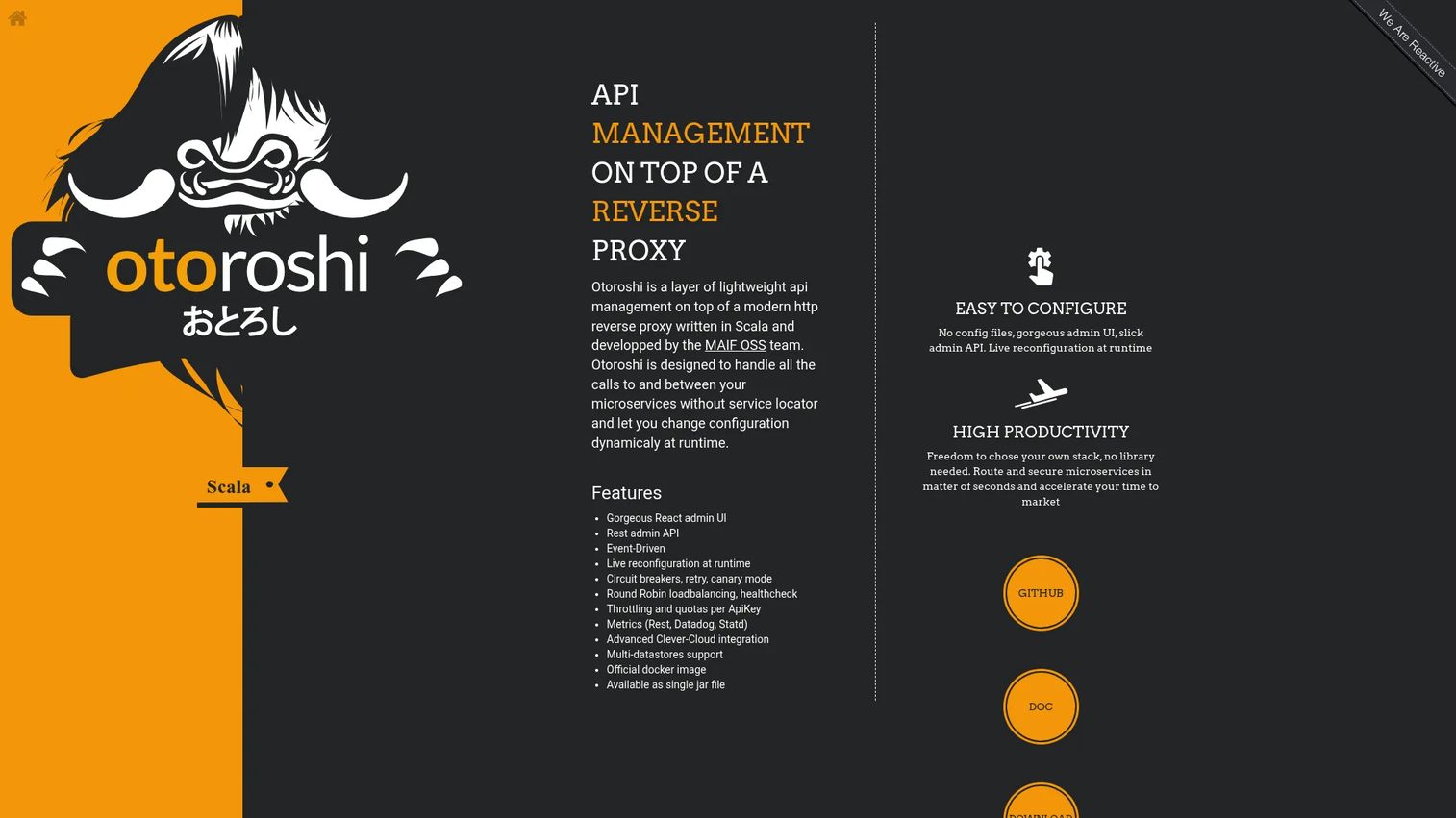
Otoroshi is an open source, lightweight API management and reverse-proxy platform for microservices, with an emphasis on runtime programmability. It fits buyers who want to execute logic directly on traffic and reconfigure the gateway without redeploying. Live reconfiguration at runtime is the differentiator here: policies and routes change on the fly through the admin API or React UI.
Best for: Teams needing an open source API gateway and reverse proxy with runtime configuration.
Key strengths
- React admin UI: Manage routes, services, and policies through a modern interface.
- REST admin API: Automate configuration and wire the gateway into CI/CD.
- Live reconfiguration at runtime: Change routing and policy without redeploying the gateway.
Why choose Otoroshi: When a customer wants to avoid rigid, redeploy-heavy gateway setups, Otoroshi's runtime flexibility is the pitch. It suits engineering-led teams comfortable operating open source infrastructure.
Otoroshi pricing: Otoroshi is open source under the Apache 2.0 license. No public paid plan pricing was found on the primary site, so treat it as free to self-host and confirm any commercial support options with the maintainers.
5. Tharion Apex
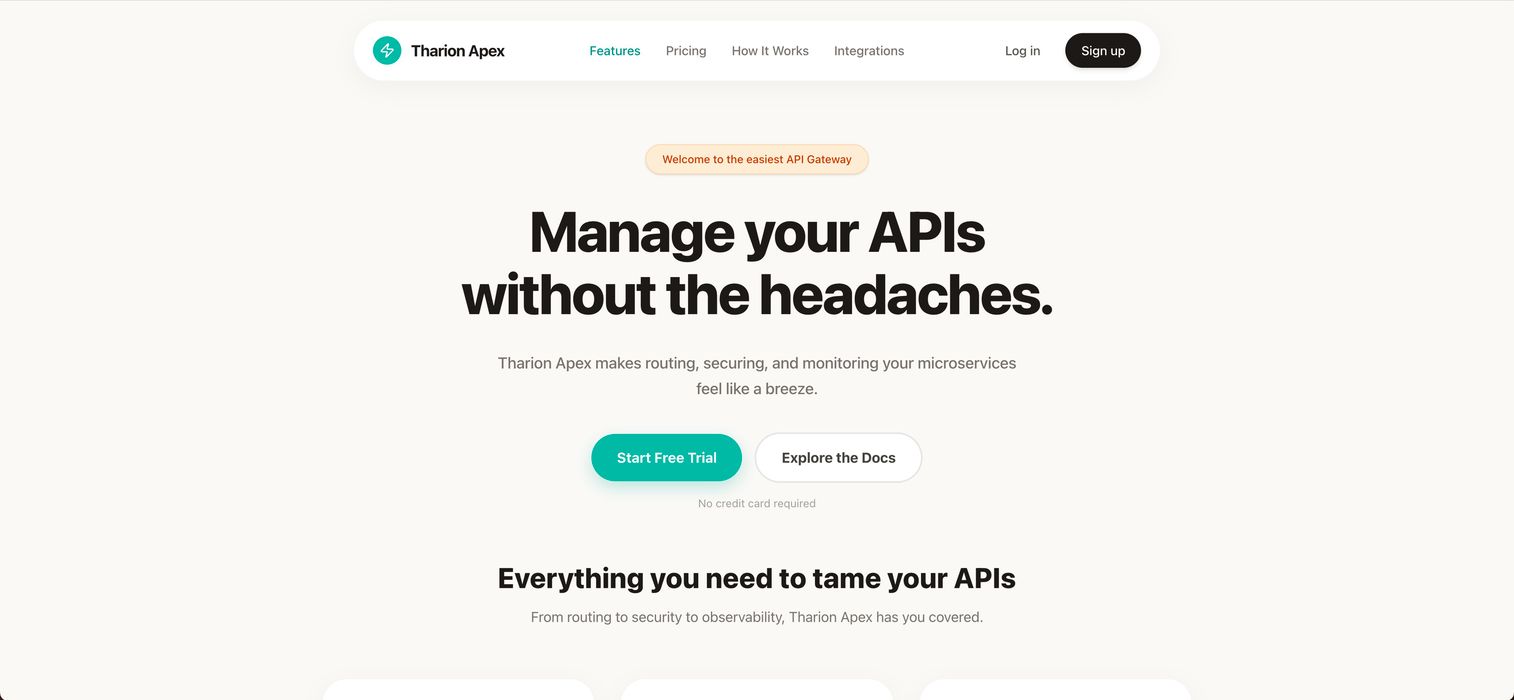
Tharion Apex is an API gateway and service mesh option for buyers comparing traffic control layers. It sits at the point where gateway thinking and mesh thinking overlap: north-south edge traffic and east-west service-to-service traffic managed with a shared model. That framing helps in architecture conversations where a team is deciding whether they need a gateway, a mesh, or both.
Best for: Teams that need an API gateway for microservices traffic control and observability.
Key strengths
- Multi-protocol support: REST, GraphQL, and gRPC handled through one control layer.
- Security controls: Rate limiting, JWT validation, and CORS enforcement at the edge.
- Developer portal: Auto-generated docs and API keys for consumer onboarding.
Why choose Tharion Apex: When the customer conversation blurs the line between api gateway vs service mesh, Tharion Apex gives presales a single product to anchor the discussion. It fits microservices teams that want traffic control and observability without stitching two tools together.
Tharion Apex pricing: The homepage offers a free trial with no credit card required, but public plan prices were not visible on the brand site at the time of writing. Confirm tiers and pricing directly with the vendor before including figures in a proposal.
6. webMethods API Gateway
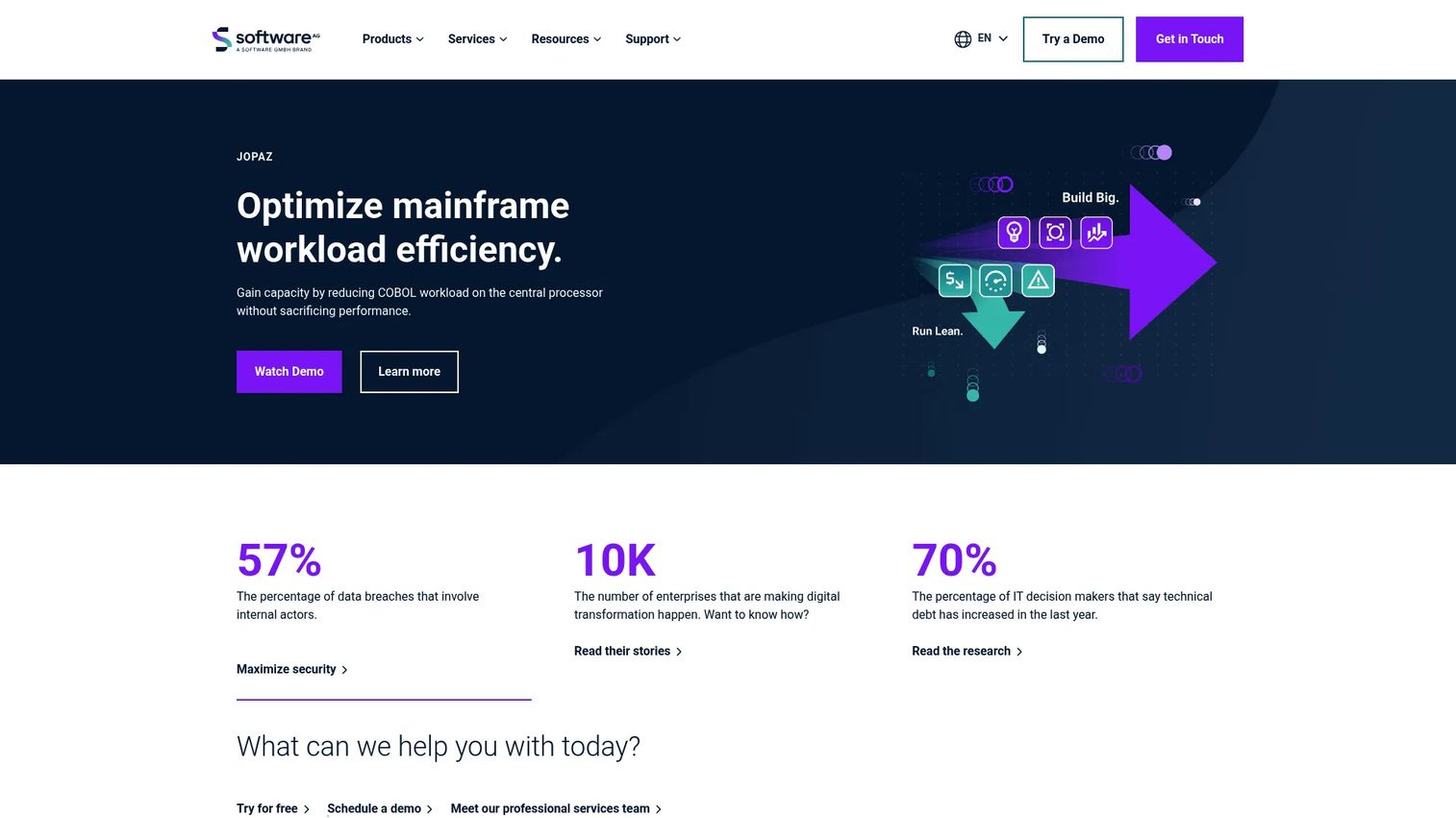
webMethods API Gateway is an enterprise gateway tied to broader API governance and integration needs. It fits teams that need stronger platform control, consistent policy, and procurement alignment with an established vendor. The gateway handles API security and mediation at runtime, with a web-based admin UI, usage analytics, and support for both SOAP and REST, which matters in estates still carrying legacy services.
Best for: Enterprises needing runtime API security and governance.
Key strengths
- API security and mediation: Enforce policy and transform traffic at runtime.
- Web-based administration UI: Manage the gateway and inspect usage from one console.
- Dashboarding and usage analytics: Track consumption and surface governance signals.
Why choose webMethods API Gateway: When the customer already runs webMethods integration or wants a single vendor for gateway and governance, this is the aligned choice. It resonates with enterprise buyers who value SOAP and REST coverage and established procurement relationships.
webMethods API Gateway pricing: No public first-party price is listed; the vendor directs buyers to contact a representative. On G2, the associated webMethods API management listing holds a 4.2/5 rating. Verify current packaging with the vendor before quoting.
7. Kong Gateway
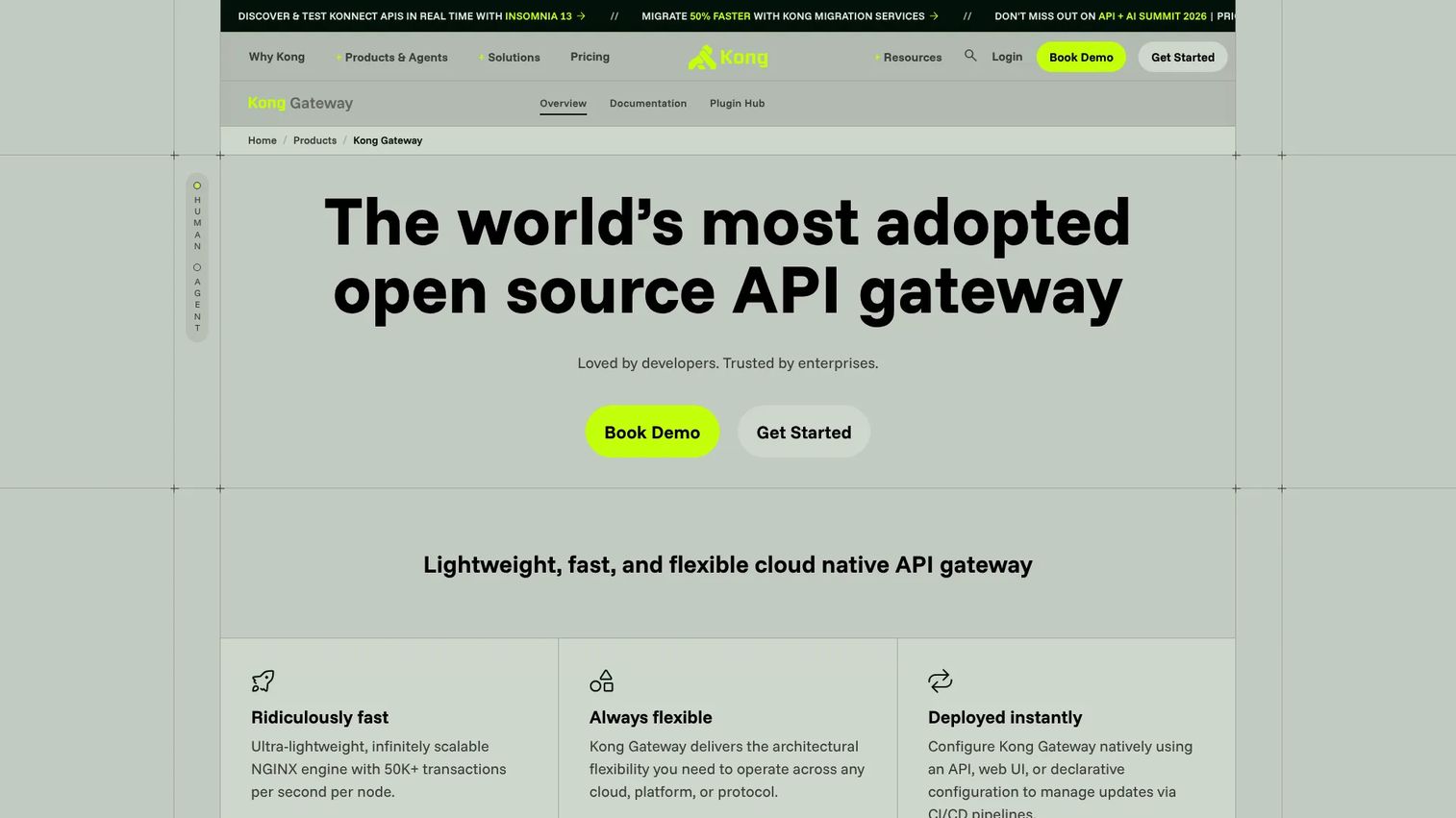
Kong Gateway is a strong enterprise and cloud-native choice with broad ecosystem credibility. It handles routing, authentication, rate limiting, and transformations through a plugin model, and deploys across cloud-hosted, hybrid, Kubernetes, on-prem, and serverless environments. That deployment range is why it shows up on so many technical shortlists: the same gateway follows the customer wherever their runtime lives.
Best for: Teams needing a flexible, cloud-native API gateway across hybrid and multi-cloud environments.
Key strengths
- Plugin-based extensibility: Add auth, rate limiting, and transformations without custom code.
- Broad deployment flexibility: Run cloud-hosted, hybrid, Kubernetes, on-prem, or serverless.
- Cloud-native routing and proxying: Scale API traffic across multi-cloud estates.
Why choose Kong Gateway: When a customer wants one gateway that works consistently across every runtime, Kong's deployment breadth is the argument. Platform and infrastructure teams typically drive the evaluation, and the plugin ecosystem gives them room to extend without waiting on the vendor.
Kong Gateway pricing: A 30-day free trial is available at no cost. The Plus tier is charged per gateway per month, billed monthly, and Enterprise is custom pricing billed annually. Confirm current per-gateway rates on Kong's pricing page before quoting.
8. Tyk
Tyk is a cloud-native, open source friendly API management platform for developing, governing, securing, and publishing APIs across cloud, hybrid, and self-managed deployments. It appeals to teams balancing control and flexibility: run the open source gateway yourself, or move to managed tiers as governance needs grow. It handles REST, GraphQL, gRPC, and async APIs, with a developer portal and analytics built in.
Best for: Teams needing flexible API management across cloud, hybrid, or on-prem environments.
Key strengths
- Multi-protocol support: REST, GraphQL, gRPC, and async APIs from one platform.
- Developer portal: Publish, document, and onboard API consumers.
- Analytics and governance: Track usage and enforce policy across deployments.
Why choose Tyk: When a customer wants an open source api gateway path that scales into managed governance, Tyk covers both without forcing an early commitment. It fits teams that need REST and GraphQL support and want to control the deployment model.
Tyk pricing: Tyk offers a free open source gateway and a 48-hour free trial of Tyk Cloud. Paid tiers are Core (usage-based), Professional (flat-rate), and Enterprise (custom). Public numeric prices are not displayed, so confirm figures with the vendor. Tyk holds a 4.6/5 rating on G2.
9. Amazon API Gateway
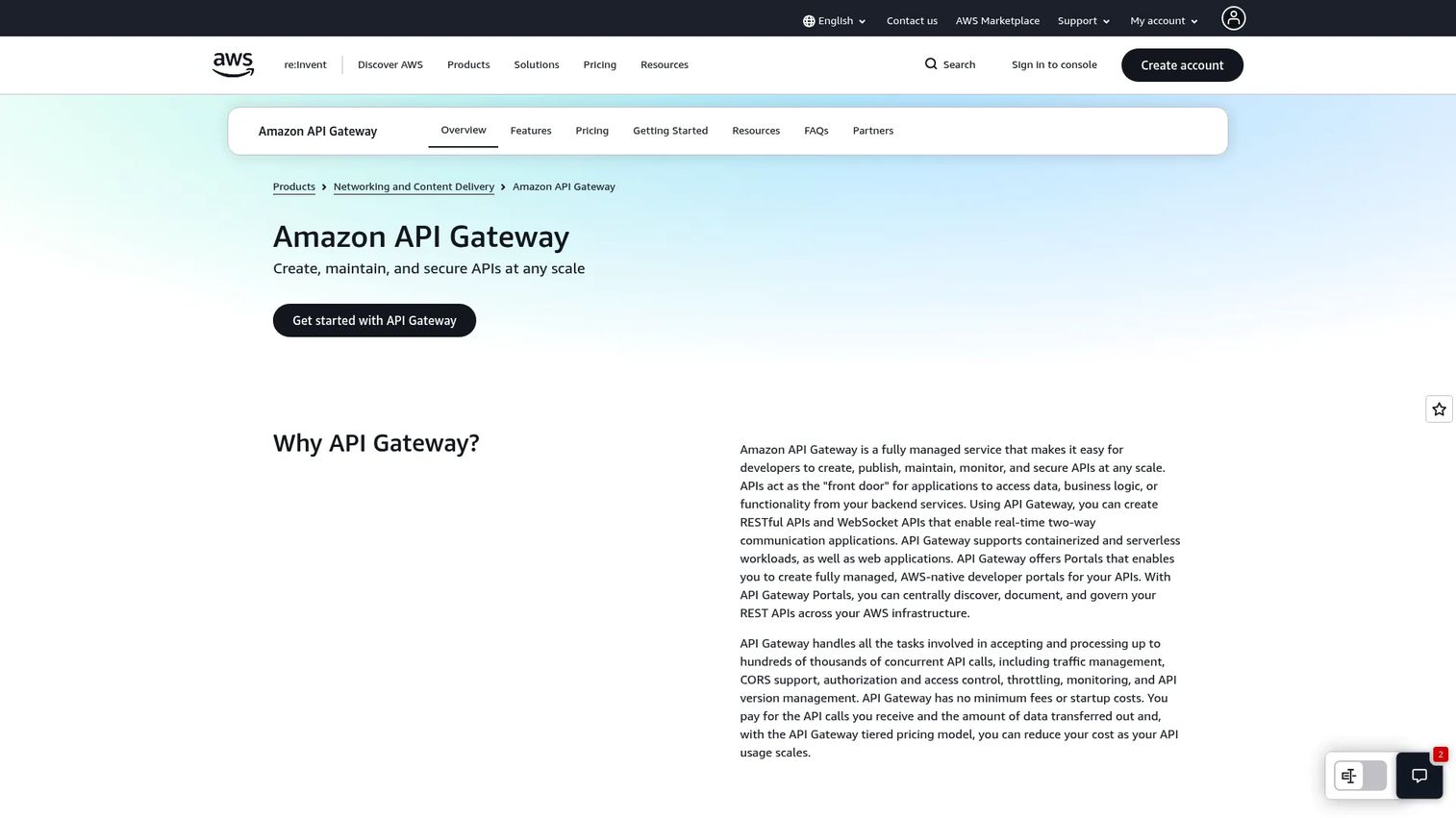
Amazon API Gateway is the natural fit for AWS-centric teams. It is a fully managed service for creating, publishing, securing, and monitoring REST, HTTP, and WebSocket APIs at scale, with native integration into Lambda, Cognito, CloudWatch, WAF, and X-Ray. When a team wants speed and tight AWS alignment, it often wins on operations alone: no gateway to run, patch, or scale yourself.
Best for: Teams building and operating APIs on AWS with serverless or cloud-native backends.
Key strengths
- Managed operations: No infrastructure to run; AWS handles scaling and patching.
- Native AWS integrations: Lambda, Cognito, CloudWatch, WAF, and X-Ray out of the box.
- Multi-protocol API support: REST, HTTP, and WebSocket APIs from one service.
Why choose Amazon API Gateway: For teams already committed to AWS, the operational simplicity and serverless integration are hard to beat. Presales should surface the tradeoffs honestly: portability across clouds and vendor alignment are worth evaluating before the customer standardizes on it.
Amazon API Gateway pricing: Pricing is pay-as-you-go with no minimum fees. A free tier covers 1M REST API calls, 1M HTTP API calls, 1M messages, and 750,000 connection minutes per month for up to 12 months. No single public starting dollar price is exposed. Amazon API Gateway holds a 4.2/5 rating on G2.
10. Apigee
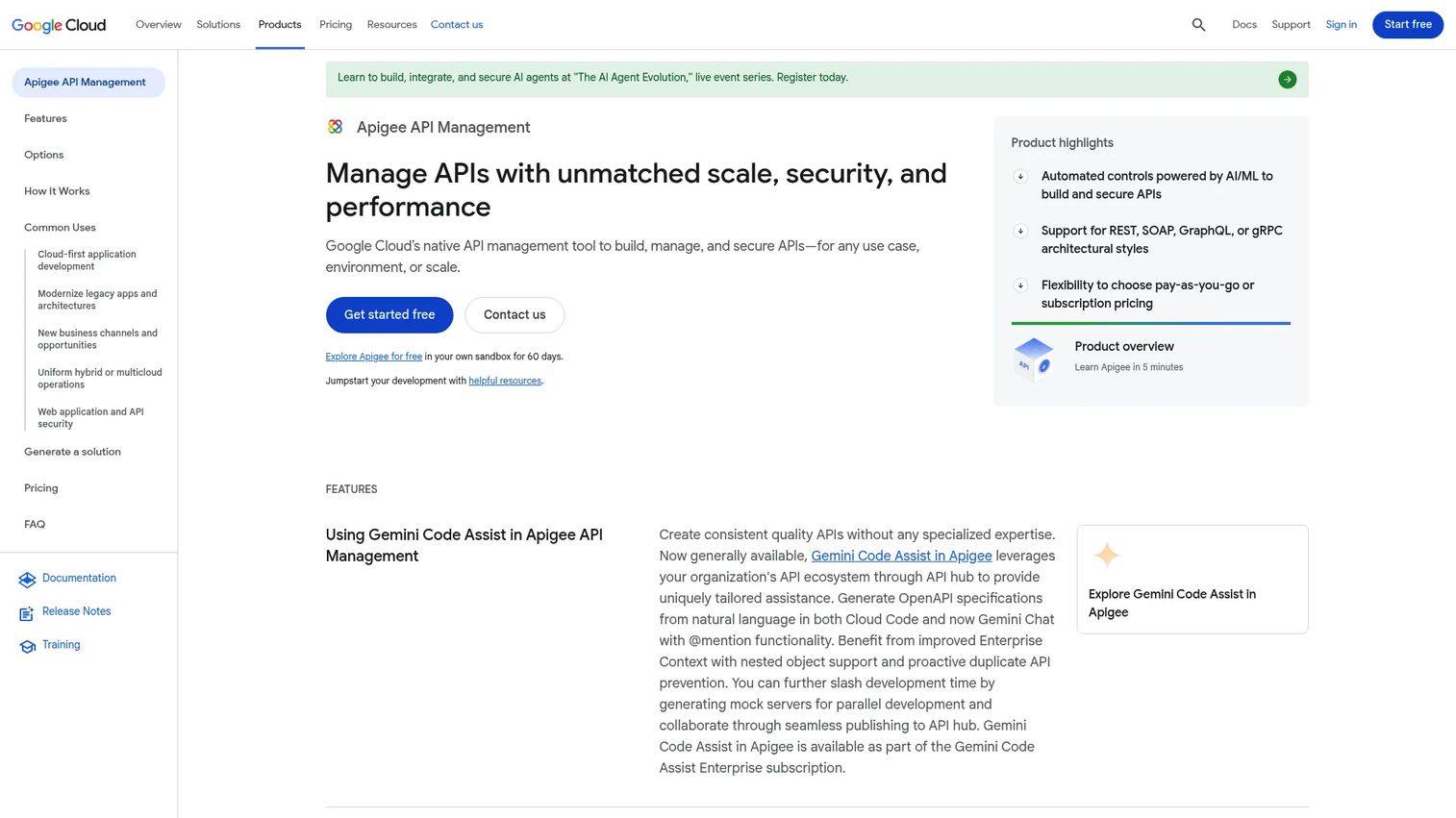
Apigee is Google Cloud's fully managed API management platform for designing, securing, and governing APIs. It is the mature choice for buyers running large-scale API programs that need lifecycle control, analytics, and advanced security beyond simple routing. It manages REST, SOAP, GraphQL, gRPC, and OpenAPI, with WAAP support and hybrid deployment through Apigee hybrid.
Best for: Enterprises needing governed API management with security and hybrid deployment support.
Key strengths
- Full API lifecycle management: Design, secure, publish, and govern APIs across protocols.
- Advanced API security: WAAP support and policy enforcement for exposed APIs.
- Hybrid deployment: Run in Google Cloud or across hybrid environments with Apigee hybrid.
Why choose Apigee: When the customer needs an API program, not just a gateway, Apigee's lifecycle and analytics depth is the case to make. Presales should emphasize governance and reporting when the buyer's real need is control over dozens or hundreds of APIs.
Apigee pricing: A free 60-day evaluation is available. Pay-as-you-go starts at $20 per 1M API calls, with environments starting at $365 per month per region. Standard, Enterprise, and Enterprise Plus subscriptions require a custom quote from sales. Apigee holds a 4.5/5 rating on G2.
11. Gravitee
Gravitee is an event-native API, event, and AI agent management platform with broad appeal for governance-focused teams. It matters in cloud-native and hybrid environments because it treats event streams and AI agent access as first-class alongside conventional APIs. For organizations that want a flexible, policy-driven platform rather than a single-purpose proxy, Gravitee gives presales a wider surface to work with.
Best for: Teams managing APIs, events, and AI agent access in one platform.
Key strengths
- API gateway and policy enforcement: Route and govern API and event traffic from one layer.
- Developer portal and subscription management: Manage plans, subscriptions, and consumer access.
- Unified observability: Monitor APIs, events, and AI agents together.
Why choose Gravitee: When a customer's roadmap includes event-driven architecture or AI agent traffic, Gravitee's breadth avoids a second platform later. It fits governance-focused teams that want policy consistency across more than just request-response APIs.
Gravitee pricing: The public pricing page lists Comet at $1,250/month and Planet at $2,500/month, with additional packages shown as custom or undisclosed. An open source edition is referenced on third-party review pages. Gravitee holds a 4.5/5 rating on G2.
12. IBM API Connect
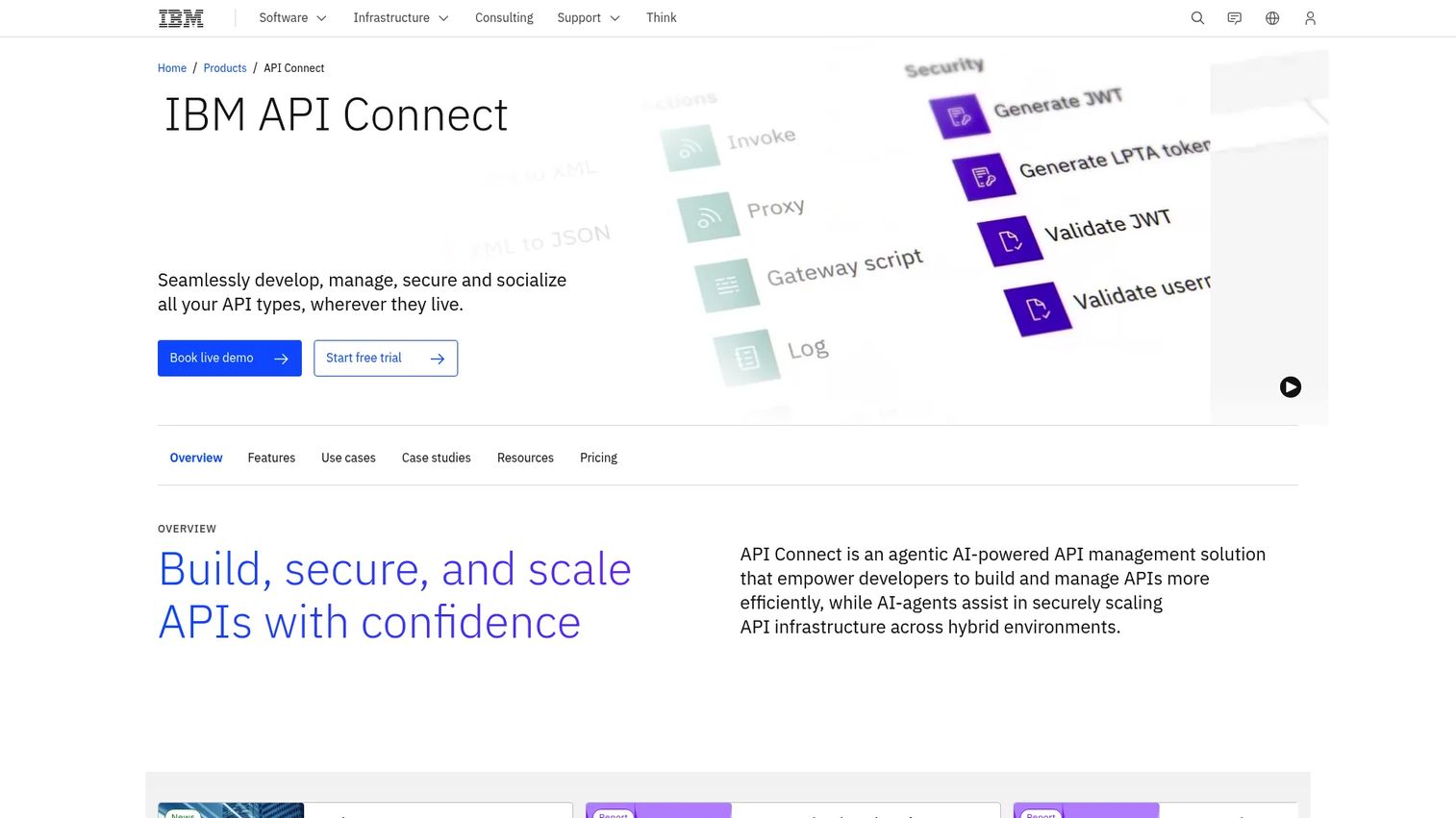
IBM API Connect is IBM's multicloud API management platform for building, securing, governing, and testing APIs. It fits larger technical estates and enterprise buying processes where lifecycle governance and integration depth outweigh raw simplicity. The platform bundles an API gateway, API manager, developer portal, API testing, an AI gateway, and an API assistant, which gives enterprise buyers a single vendor across the lifecycle.
Best for: Enterprises needing API lifecycle management across hybrid and multicloud environments.
Key strengths
- Full lifecycle platform: Gateway, manager, portal, and testing in one product.
- AI gateway and API assistant: Govern AI traffic and accelerate API work with assistive tooling.
- Hybrid and multicloud deployment: Run across mixed environments under one governance model.
Why choose IBM API Connect: In late-stage enterprise deals, procurement and architecture teams value a single accountable vendor with lifecycle depth. Presales should lead with governance and the control plane story that internal approval committees expect.
IBM API Connect pricing: A 30-day free trial is available. The Standard SaaS tier is listed at $83.00/month billed annually, and the Premium SaaS tier at $2,280.00/month billed annually. Reserved Instance and self-managed software pricing are not publicly displayed. IBM API Connect holds a 4.3/5 rating on G2.
Considerations before you buy
A shortlist is only as good as the criteria behind it. Before you recommend a gateway to a customer, pressure-test each option against the factors that decide the deal in an architecture review.
Deployment model fit
Match the gateway to the customer's runtime first, not last. A managed api gateway like Amazon API Gateway removes operational load but ties you to a cloud. A self-hosted api gateway gives control at the cost of running it yourself. Hybrid buyers need a tool that spans both without a second product.
Security and compliance depth
Verify the auth methods, TLS handling, and policy model against the customer's security requirements. Confirm OAuth, JWT, and mTLS support, and check whether the gateway clears the compliance frameworks the buyer's security team will ask about. This is where deals stall if you guess.
Kubernetes and cloud-native alignment
If the customer runs Kubernetes, confirm the gateway is genuinely cloud-native and speaks the Gateway API standard, not a legacy proxy in a container. A true kubernetes api gateway scales with the cluster and integrates with existing ingress patterns.
Observability and operational overhead
Check logging, metrics, tracing, and dashboard depth. A gateway you cannot see into becomes a black box the day something breaks. Weigh the operational cost of running and upgrading the tool against the visibility it gives your team.
Governance and scalability
For large API programs, evaluate versioning, developer portals, analytics, and policy consistency across teams. A gateway that handles ten APIs cleanly can buckle at three hundred without proper governance tooling.
Conclusion
The right gateway depends on one question you should answer before comparing features: does the customer prioritize open source flexibility, managed cloud speed, enterprise governance, or Kubernetes-native control? That decision narrows the field faster than any feature grid.
Shortlist two or three options based on deployment model and security requirements first. Kong Gateway and Tyk cover cloud-native and hybrid teams that want flexibility. Amazon API Gateway wins for AWS-committed stacks. Apigee and IBM API Connect fit large API programs that need lifecycle governance and internal approval language. Apinizer and Gravitee suit Kubernetes-heavy and event-driven environments. Then compare observability and policy depth for the survivors.
For presales teams, the win is not just picking a tool. It is being able to defend the choice when the architecture review gets sharp. Match the gateway to the runtime, verify the security story, and you keep the deal moving through technical validation instead of stalling in it.
FAQs
An API gateway handles runtime traffic: routing, security, rate limiting, and transformation at the edge. API management is broader, wrapping the gateway with developer portals, lifecycle governance, analytics, and sometimes monetization. Every management platform includes a gateway, but a standalone gateway is not a full management platform.
Usually, yes. Without one, every client has to know your internal service topology, and each service reinvents auth, rate limiting, and logging. A gateway gives clients one stable entry point and centralizes cross-cutting concerns, which becomes essential as the number of services grows.
No, though they overlap at the edge. An ingress controller routes external HTTP traffic into a Kubernetes cluster at the network level. An API gateway adds application-layer concerns like authentication, rate limiting, transformation, and analytics. Some cloud native api gateway products can serve as both, but the roles are distinct.
A managed api gateway removes operational overhead and scales automatically, but ties you to a provider. A self-hosted api gateway gives full control over deployment, data, and configuration at the cost of running and upgrading it yourself. Match the choice to the customer's cloud strategy and operational capacity.
Look for TLS termination, OAuth and JWT support, mTLS for service-to-service auth, rate limiting, and consistent authorization policy. Strong api gateway security means writing policy once and enforcing it across every endpoint, which is far more reliable than duplicating controls in each service.
A kubernetes api gateway runs inside the cluster, fronts ingress traffic, and often implements the Gateway API standard for portable configuration. It routes to containerized workloads and serverless functions, scales with the cluster, and integrates with existing ingress patterns rather than sitting outside as a bolt-on.
Start with deployment model fit and security posture, since those decide the deal. Then validate multi-protocol support, observability depth, and how the gateway behaves under the customer's real traffic patterns. Capture requirements and success criteria up front so the POC proves technical fit instead of drifting.
It can, if it is undersized or poorly configured, because all traffic flows through it. The fix is choosing a gateway whose scaling model matches your load, such as a stateless design that scales horizontally, and instrumenting it with observability so you catch saturation before it hits users.