You found a brilliant engineer in Portugal. Your best inbound lead this quarter sits in Singapore. A designer in Brazil wants to join next month. The talent is global. Your legal entities are not.
That gap is where most growing companies stall. To hire someone in a country where you have no entity, you either spend months and tens of thousands of dollars incorporating, or you misclassify them as a contractor and absorb the compliance risk yourself. Neither is a real plan. This is the exact friction employer of record software removes.
The market reflects the pressure. The global employer of record market was valued at $6.8 billion in 2025 and is projected to reach $19.4 billion by 2034 at a 12.3% CAGR, according to Dataintelo (2025). More telling for an operator: 41% of teams already use EOR services and another 49% plan to start, per Atlas data summarized by SelectSoftware Reviews (2026). International hiring stopped being an edge case. It became the default growth lever.
For a Series B founder, the math is simple. Every market you can hire in without standing up an entity is a market you can compete in faster. The wrong provider buries you in hidden fees, slow onboarding, and compliance gaps that surface during due diligence. The right one turns international hiring into a checkbox your VP can own without routing every decision through you. If you are also rethinking how new hires ramp once they sign, our guide to the best onboarding flow software pairs well with the people side of this stack.
What's inside
This guide compares the best employer of record software for 2026 for founders, operators, and finance leaders evaluating remote hiring and international expansion. We selected platforms based on four things that actually matter at your stage: country coverage and regional depth, compliance and legal employer strength, onboarding experience and speed to first hire, and pricing clarity. Each entry covers who it fits, where it stands out, and what it costs based on verified, current pricing. No vague "best-in-class" claims, no unverified numbers. Just enough signal to build a shortlist and move.
TL;DR
- Best overall for global teams: Remote, with owned-entity infrastructure and strong compliance.
- Best for fast launch and broad coverage: Deel, hiring in 110+ countries with modular pricing.
- Best for enterprise compliance depth: G-P (Globalization Partners), built for complex orgs.
- Best for HR stack consolidation: Rippling, where EOR lives inside one HR, payroll, and IT system.
- Best for remote-first operating models: Oyster, with contractor and EOR workflows for distributed teams.
- Best for value and simple pricing: Remofirst, with EOR starting at $199 per person per month.
- Best for multi-country hiring with localized support: Multiplier, covering 150+ countries.
- Best for global payroll coordination: Papaya Global, for payroll-heavy international operations.
What is employer of record software?
Employer of record software is a platform that lets a company legally hire, pay, and manage employees in countries where it has no local entity, by acting as the registered legal employer on paper while the hiring company directs the day-to-day work. The EOR holds the employment liability. You keep control of the role, the work, and the relationship.
In practice, the EOR handles the parts of international hiring that create legal and operational risk. The hiring company still owns management, performance, compensation decisions, and culture. The provider owns the compliance machinery underneath.
A global employer of record typically handles:
- Payroll: running local payroll in local currency, on local cycles.
- Local taxes: withholding, filing, and remitting payroll and income taxes.
- Benefits administration: statutory and supplemental benefits that meet local norms.
- Onboarding and offboarding: compliant hiring paperwork, terminations, and severance.
- Contract and document management: locally compliant employment agreements and records.
- Compliance with local labor laws: working hours, leave, notice periods, and worker protections.
The result is liability transfer. Instead of your company carrying the full weight of local employment law in every market, the EOR carries the legal employer responsibility and indemnifies much of the risk.
EOR vs PEO: which model do you need?
The EOR vs PEO distinction trips up most first-time buyers, and it changes who is legally on the hook.
An EOR becomes the full legal employer in a country where you have no entity. It is the model for hiring abroad without incorporating. A PEO (professional employer organization) operates as a co-employer, usually inside a country where you already have an entity, sharing employment responsibilities while you remain a legal employer.
The short version: if you want to hire in a country where you have no entity, you need an EOR. If you already have an entity and want to offload HR administration and benefits buying power, a PEO fits. Many providers on this list offer both, so you can start with EOR coverage and shift to PEO once you incorporate in a market that grows large enough to justify it.
When to use employer of record software
Hire in a country before opening an entity
Standing up a legal entity in a new market can take months and real legal spend before a single person is hired. Employer of record services compress that to days. You identify the candidate, the EOR runs the compliant hire, and your new employee starts without you incorporating anything. For a founder chasing speed-to-market, that is the difference between landing a key hire and losing them to a competitor who could move faster.
Support remote hires across multiple countries
Distributed teams break when every new country requires its own payroll setup, benefits research, and local HR process. An EOR gives you one platform and one workflow across markets. Your finance lead runs payroll for ten countries from one dashboard instead of managing ten local relationships. International hiring becomes repeatable, which is exactly what makes it delegable to a VP instead of a founder-level project.
Reduce compliance risk during expansion
The common workaround, paying global talent as contractors, looks cheap until it is not. Misclassification penalties, back taxes, and benefits claims surface during fundraises and acquisitions, precisely when you cannot afford surprises. An EOR converts that ambiguity into clean, compliant employment. The platform absorbs the local labor law complexity so your expansion does not become a liability line item in due diligence.
Comparison table
Pricing and ratings below reflect verified, current first-party values. EOR pricing is often shown as a starting point and varies by country, so treat these as anchors rather than final quotes.
| # | Product | Intent | Key differentiation | Pricing | G2 rating |
|---|---|---|---|---|---|
| 1 | Remote | Owned-entity global hiring | Direct entities and strong compliance/IP protection | EOR shown around $599 per employee/mo (annual) on UK pricing | 4.5/5 |
| 2 | Deel | Fast, broad global coverage | EOR in 110+ countries with modular HR add-ons | EOR Standard $599 per employee/mo | 4.8/5 |
| 3 | G-P | Enterprise compliance depth | AI compliance advisor and global employment scale | EOR pricing on request; Contractor from $39/mo | Not listed |
| 4 | Rippling | HR stack consolidation | EOR inside unified HR, payroll, and IT | Custom quote | 4.8/5 |
| 5 | Oyster | Remote-first operating model | Contractor and EOR workflows for distributed teams | Contractors from $29/mo; account free to create | 4.4/5 |
| 6 | Papaya Global | Global payroll coordination | Payroll and payments across 160+ countries | EOR from $499 per employee/mo | 4.5/5 |
| 7 | Multiplier | Multi-country localized hiring | EOR across 150+ countries | EOR from $400/mo per employee | 4.7/5 |
| 8 | Remofirst | Value-oriented EOR | EOR in 185+ countries at a low entry price | EOR from $199 per person/mo | 4.5/5 |
1. Remote
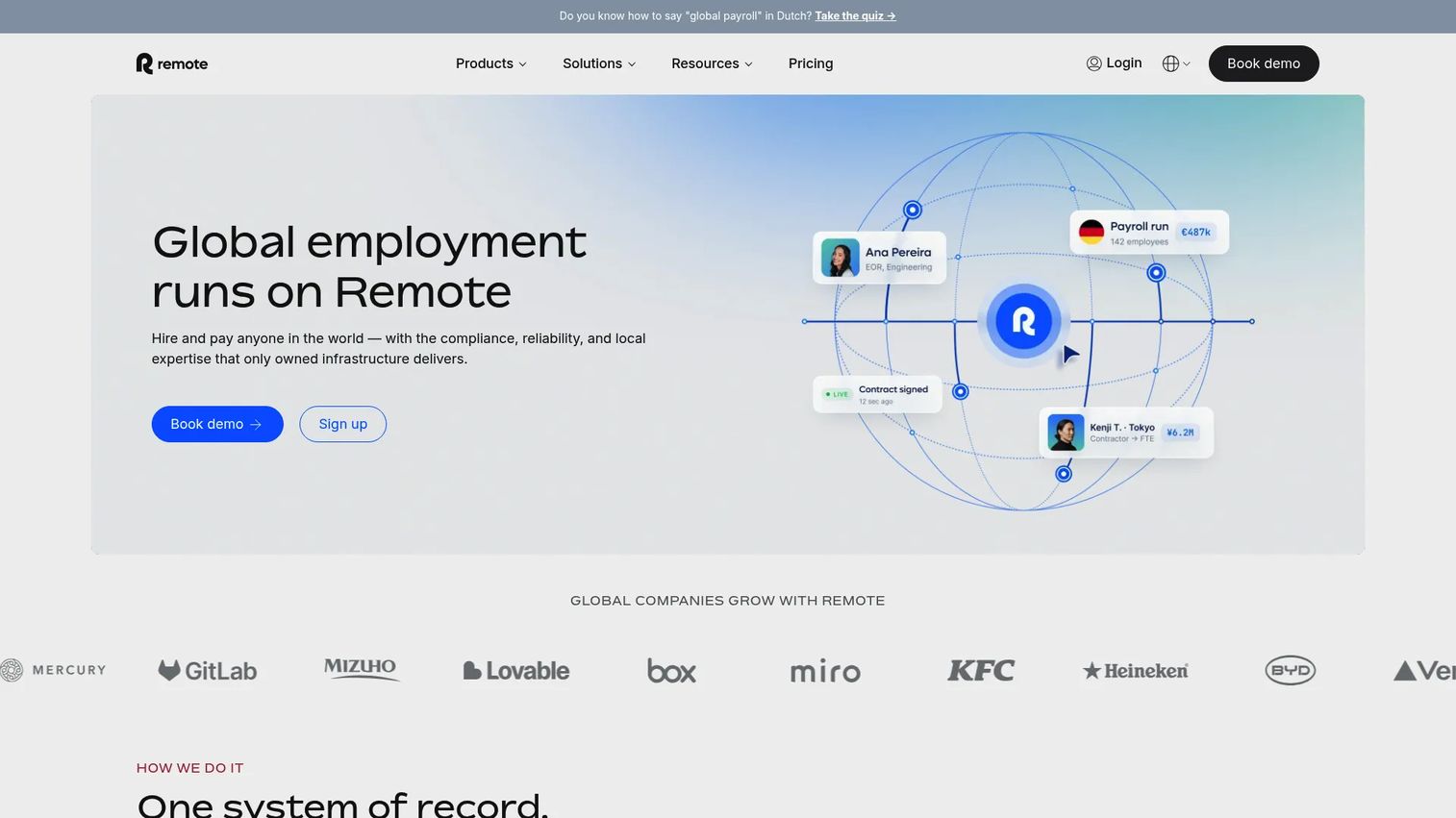
Remote built its EOR on owned legal entities rather than a patchwork of local partners, which is the detail founders should care about most. Owned entities mean the company controlling compliance is the same company you signed with, so accountability does not get passed down a chain. Remote covers global payroll, contractor management, and employer of record hiring under one platform built for distributed teams.
Best for: Companies that want owned-entity confidence and strong IP protection while hiring across countries.
Key strengths
- Owned-entity infrastructure: Direct legal entities in its core markets, so compliance and liability sit with Remote, not a third party.
- Compliance and IP protection: Built-in monitoring of local labor laws plus IP and invention assignment handling that protects your product.
- Lifecycle management: Onboarding, payroll, benefits administration, and offboarding handled in one workflow.
Why choose Remote: If legal-employer confidence is your top concern, owned entities reduce the number of parties between you and compliance. That matters most when you are hiring senior people, protecting IP, or expecting your employment setup to survive due diligence. Remote also offers a free HR Management tier for direct employees, which is useful as your team grows beyond EOR hires.
Remote pricing: Remote offers a free HR Management tier for direct employees. Payroll and contractor management start around £23 per person per month. The UK pricing page shows EOR at £559 per employee per month billed monthly, or £479 billed annually, with first-party docs confirming a USD equivalent. Pricing is region-specific, so confirm your market.
2. Deel
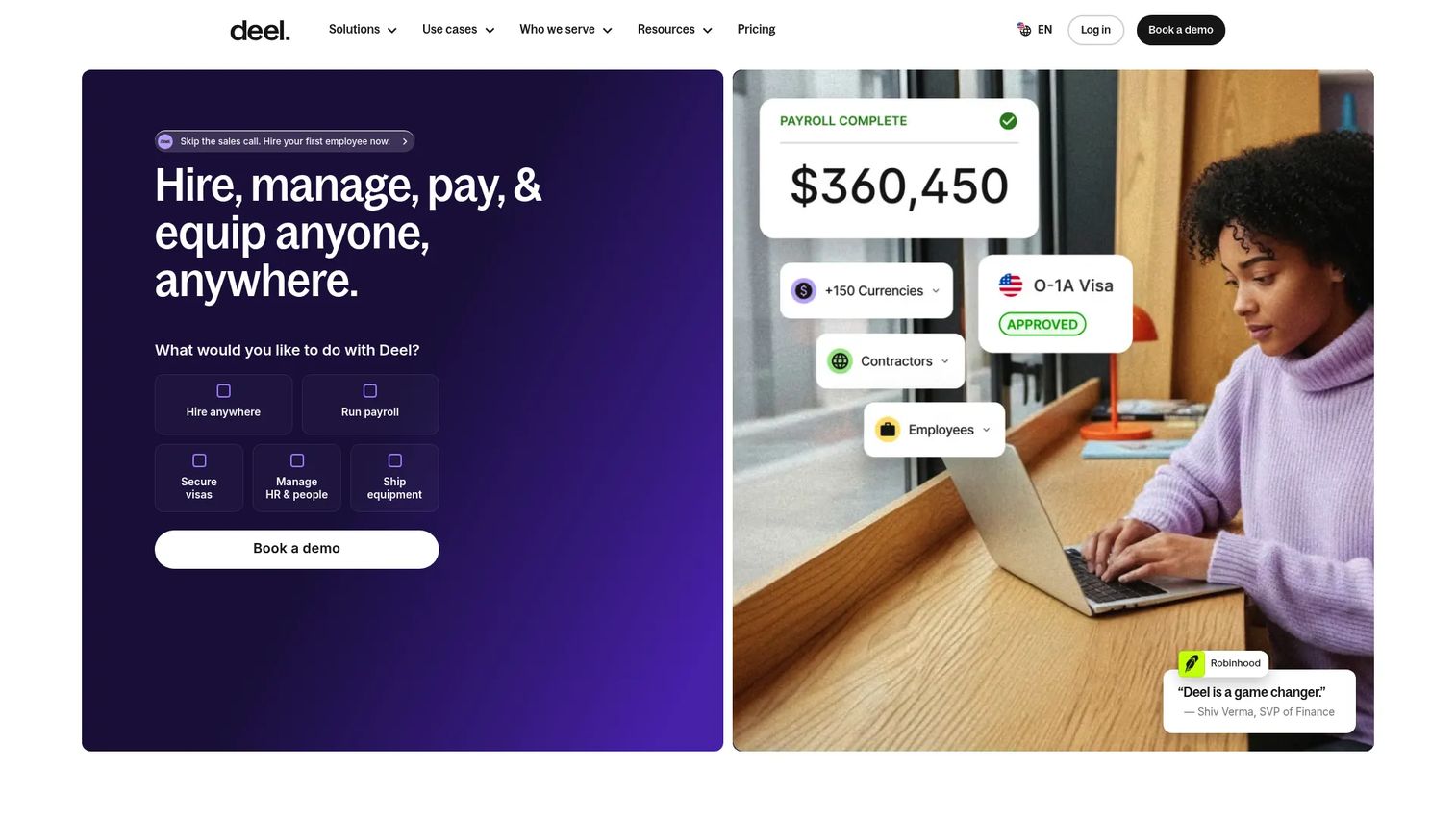
Deel is the broad global workforce platform on this list, covering EOR hiring in 110+ countries and HRIS workflows across 150+ countries. Its strength is range and speed: you can move a contractor to full EOR employment, run global payroll, and bolt on HR modules as your team grows, all from one account. For founders who want one vendor to scale into rather than swap out, that breadth is the draw.
Best for: Companies that want fast onboarding and the option to expand from EOR into a full global HR suite.
Key strengths
- Broad EOR coverage: Compliant hiring across 110+ countries with fast onboarding timelines.
- Contractor-to-EOR crossover: Convert contractors to employees without changing platforms as your needs mature.
- Modular HR add-ons: Layer on recruiting, HR, and payroll modules priced per employee per month.
Why choose Deel: Deel earns its place when you expect international hiring to grow and want to avoid re-platforming later. The modular pricing means you pay for EOR now and add HRIS, payroll, or recruiting as the team scales. Its 4.8/5 G2 rating reflects strong adoption among fast-moving teams.
Deel pricing: Basic HR starts at $5 per employee per month. EOR Standard is $599 per employee per month, with EOR Enterprise at $899. Contractor management starts at $49 per contractor per month, and global payroll at $29 per employee per month. Pricing is modular, so you assemble the stack you need.
3. G-P (Globalization Partners)
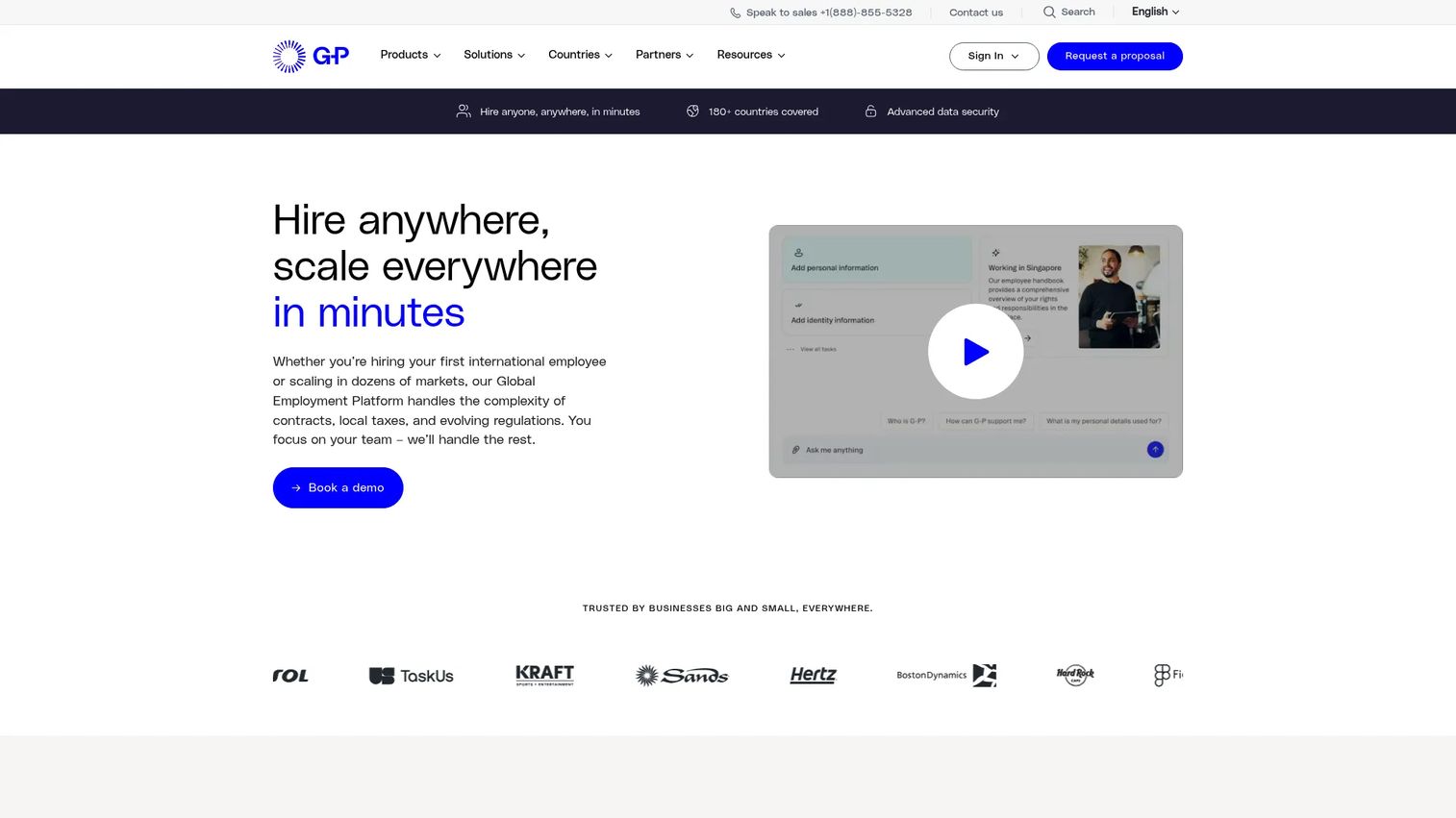
G-P is built for complex, compliance-heavy global expansion. Its EOR coverage spans a wide global footprint, and its newer G-P Gia AI compliance advisor surfaces local employment guidance as you hire. For larger orgs or founders planning aggressive multi-market expansion, G-P leans into depth of compliance support over the simplest possible onboarding.
Best for: Companies with mature compliance needs and larger international hiring plans.
Key strengths
- Enterprise compliance depth: Global employment infrastructure designed for complex, regulated hiring.
- AI compliance advisor: G-P Gia provides local employment and compliance guidance on demand.
- Contractor and EOR coverage: Manage employees and contractors across many countries from one platform.
Why choose G-P: When your hiring plan spans many markets and compliance scrutiny is high, G-P's depth becomes the differentiator. It fits founders who would rather over-invest in compliance now than retrofit it during a fundraise or acquisition. The platform skews toward organizations that value compliance breadth and support over a stripped-down entry experience.
G-P pricing: Public pricing is shown for G-P Contractor at $39 per contractor per month. G-P Gia Individual is $500 per month billed annually, with a 14-day free trial, and Gia Teams is custom. G-P EOR pricing is not publicly listed, so you will need a quote for employer of record hiring.
4. Rippling
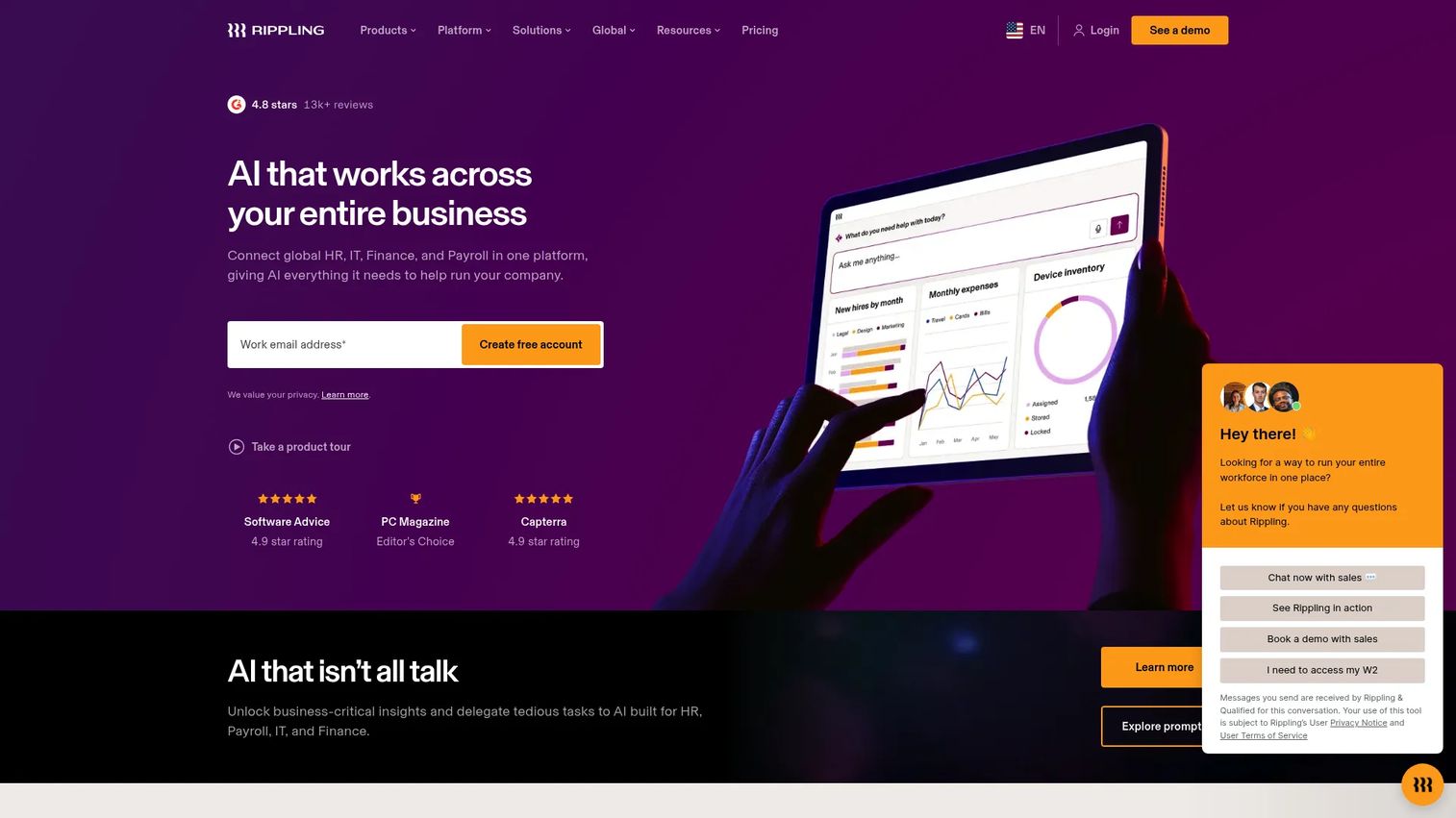
Rippling is the consolidation play. Instead of a standalone EOR point solution, Rippling sits EOR inside a unified system spanning HR, payroll, IT, and finance. For founders trying to reduce tools while increasing signal, that is the pitch: one platform where global hiring, device management, app provisioning, and payroll share the same data layer.
Best for: Companies that want EOR as part of one system for HR, payroll, IT, and finance.
Key strengths
- Unified product ecosystem: EOR lives alongside HCM, payroll, IT, and finance in one platform.
- Per-employee modular billing: Buy the products you need and add more without integrating separate vendors.
- Single data layer: Employee data flows across HR, payroll, and IT without manual syncing.
Why choose Rippling: Choose Rippling when consolidation matters more than buying a dedicated EOR. If you are already drowning in HR and IT tools, folding global employment into the same system reduces stitching and gives your new VP something that works on day one. Its 4.8/5 G2 rating reflects strength as an all-in-one operations layer.
Rippling pricing: Rippling uses custom quote-based pricing. You tell them which products you need and receive a quote, with most products billed per employee per month and some carrying a monthly platform fee. No public list price is shown, so plan a brief sales conversation to scope your stack.
5. Oyster
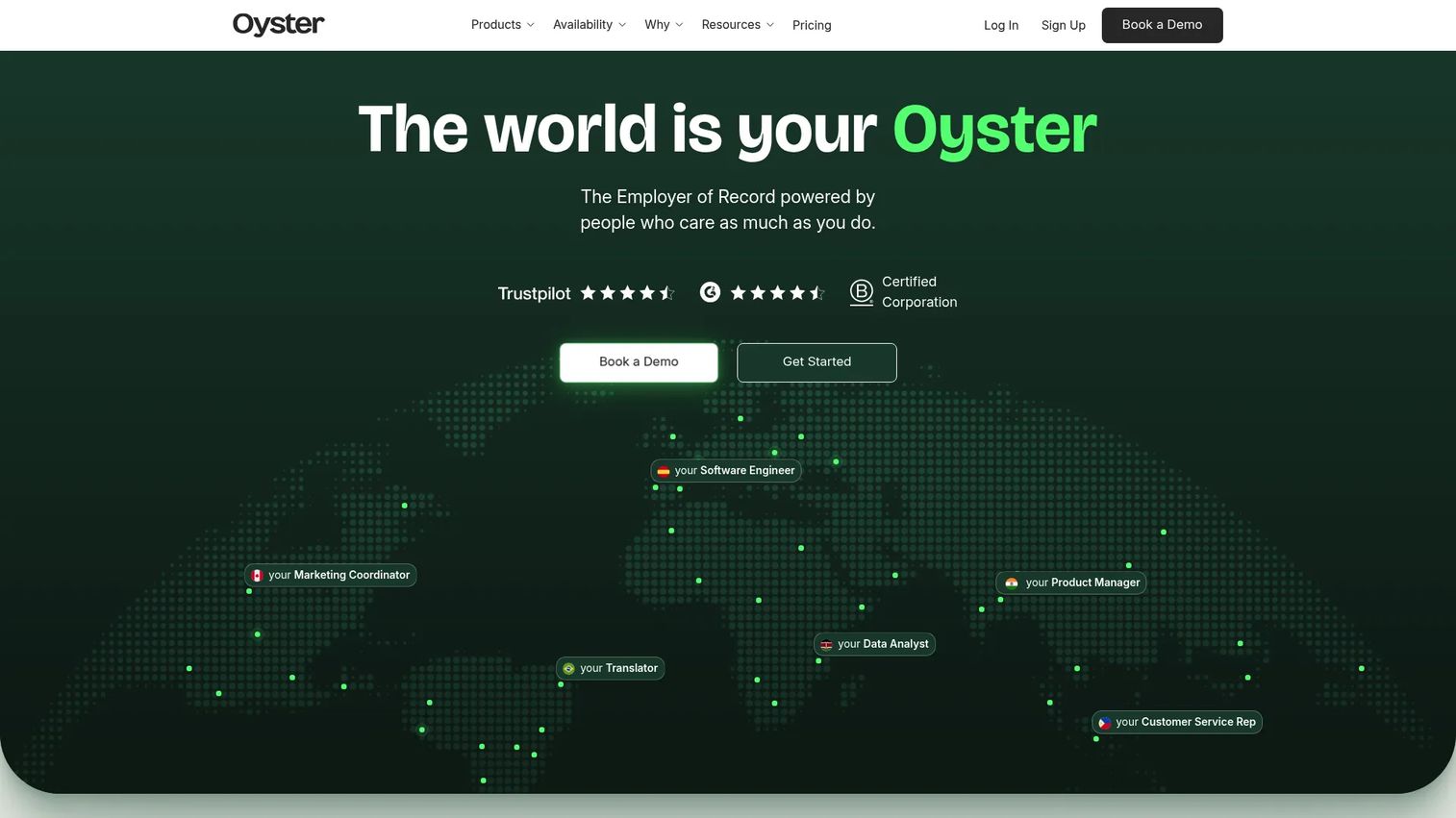
Oyster is built around a remote-first operating model, with workflows for hiring and paying both contractors and employees globally without local entities. It offers salary insights across 130+ countries and People Partner advisory services, which help founders make informed offers and navigate local norms. For companies that treat distributed work as the default rather than the exception, Oyster fits the philosophy.
Best for: Companies that want a remote-first model with strong contractor and EOR workflows.
Key strengths
- Distributed-team workflows: Hire and pay contractors and employees globally from one platform.
- Salary insights: Benchmarking across 130+ countries to make competitive, compliant offers.
- People advisory: People Partner services provide HR guidance for distributed teams.
Why choose Oyster: Oyster fits founders who want the operating model, not just the legal mechanism. Free account creation and per-contractor pricing make it easy to start small and expand into EOR as hiring grows. Its salary benchmarking is genuinely useful when you are entering an unfamiliar market and need a defensible offer.
Oyster pricing: Creating an Oyster account is free, with fees starting only after you engage a contractor, EOR, or payroll team member. Global Contractors are free for 30 days, then $29 per contractor per month. People Partner Services are $300 per hour. EOR and payroll pricing are quoted based on your needs.
6. Papaya Global
Papaya Global leads with global payroll and workforce payments, with EOR as part of a broader cross-border employment platform. Its Workforce OS handles end-to-end employee lifecycle management, and payroll and payments span 160+ countries. For payroll-heavy international operations where coordinating payments across many currencies is the hard part, Papaya brings operational visibility that pure-EOR tools do not center on.
Best for: Enterprises that need global payroll, contractor management, EOR, and cross-border payments in one platform.
Key strengths
- Global payroll and payments: Coordinated payroll and payments across 160+ countries.
- Workforce OS: End-to-end employee lifecycle management in a single system.
- EOR plus contractor management: Employer of record and contractor handling alongside payroll.
Why choose Papaya Global: Papaya fits when payroll complexity is the bottleneck rather than the hiring mechanism. If you are paying a large distributed workforce across many countries and currencies, its payments infrastructure and operational visibility carry real weight. The platform is well-suited to larger, payroll-intensive operations.
Papaya Global pricing: Papaya publishes starting prices: Payments OS at $3.50 per transaction, Contractor at $5 per contractor per month, Payroll Plus at $29 per employee per month, Contractor of Record at $295 per contractor per month, and EOR at $499 per employee per month. WorkforceOS is quote-based.
7. Multiplier

Multiplier is a practical option for teams expanding into several markets at once, with EOR coverage across 150+ countries plus global payroll and contractor management. It pairs broad coverage with localized employment support and fast onboarding, which is what most multi-country hiring plans actually need. For founders entering three or four markets in a single quarter, that combination keeps the process from fragmenting.
Best for: Companies hiring, paying, and managing distributed workers across multiple countries.
Key strengths
- Wide country coverage: Employer of record across 150+ countries.
- Localized employment support: Compliant contracts, onboarding, and payroll tuned to each market.
- Contractor of record: Manage contractors alongside employees from the same platform.
Why choose Multiplier: Multiplier earns its spot when you need breadth and localized support without enterprise-level complexity. The straightforward EOR pricing makes it easy to budget per hire, and its 4.7/5 G2 rating reflects a strong onboarding and support experience for fast-growing teams.
Multiplier pricing: Employer of record starts at $400 per employee per month. Contractor management is $40 per active contract per month. Global payroll and immigration services are quoted by speaking to sales. The transparent EOR entry price makes early budgeting simple.
8. Remofirst
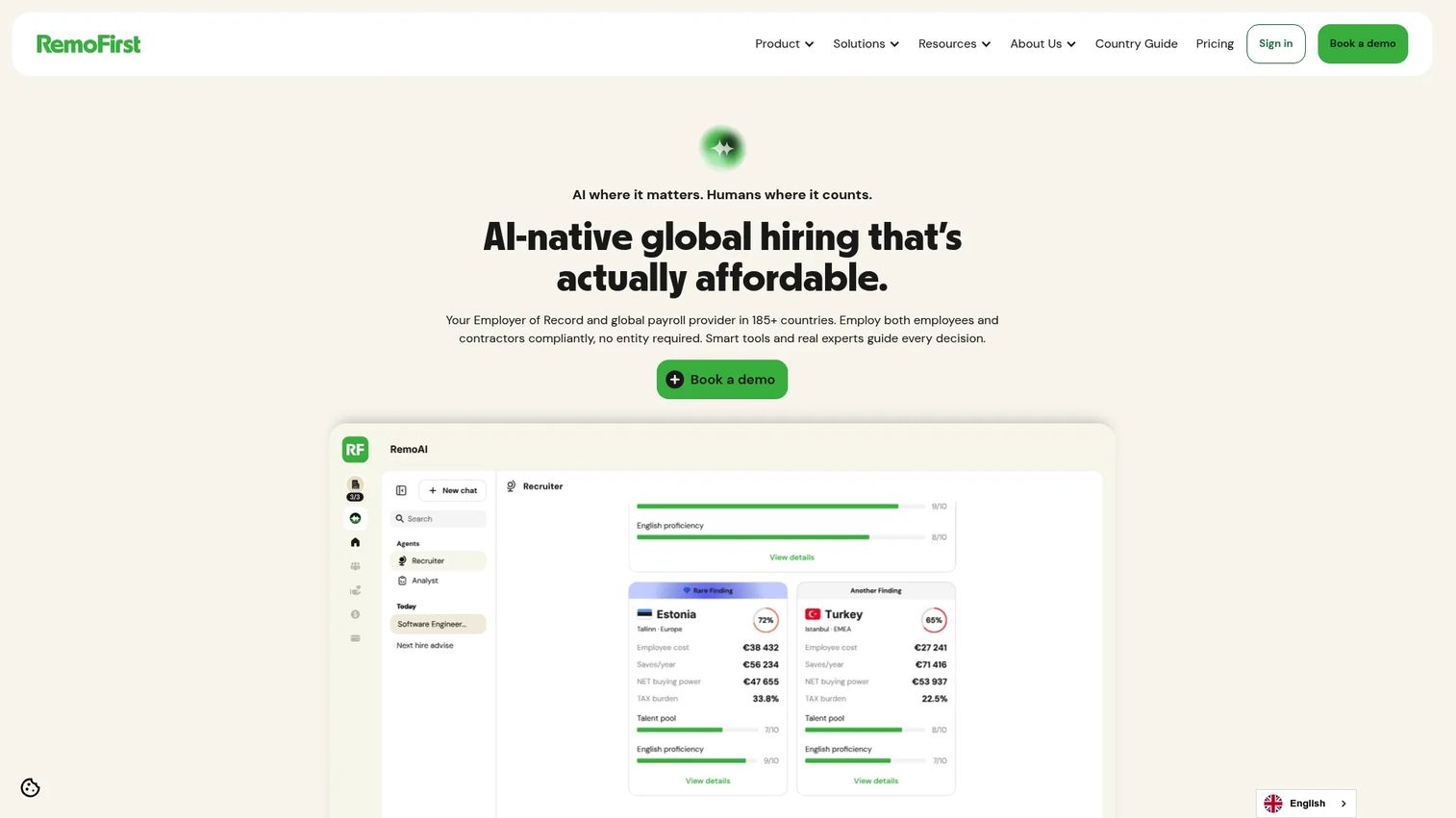
Remofirst is the value-oriented pick, with EOR in 185+ countries at one of the lowest entry prices on this list. It covers global payroll, compliance, onboarding, and support without the heavy process or long contracts some providers require. For teams that want to move quickly and keep costs predictable, Remofirst removes friction from the first hire.
Best for: Companies hiring international workers without setting up local entities, on a tight budget.
Key strengths
- Broad coverage at low cost: EOR in 185+ countries starting at $199 per person per month.
- Free contractor tier: Manage contractors at no cost, with a premium tier at $25 per person per month.
- No hidden fees: No setup, onboarding, termination fees, annual contracts, or minimums stated.
Why choose Remofirst: Remofirst wins on pricing transparency and speed. When you want straightforward employer of record services without a heavy procurement process, the low entry price and absence of setup or termination fees make it the cleanest path to a first international hire. Its 4.5/5 G2 rating reflects solid execution at the value end of the market.
Remofirst pricing: EOR starts at $199 per person per month, though it may vary by country. Contractor management has a free tier, with Premium Contractors at $25 per person per month. Remofirst states no setup, onboarding, or termination fees, no annual contracts, and no minimums.
Considerations before you buy
Country coverage and regional depth
Coverage counts are a starting point, not the whole story. A provider claiming 180+ countries may use owned entities in some and local partners in others, which changes who controls compliance. Confirm the provider has real depth in the specific markets you are hiring into, not just a long list.
Compliance and liability transfer
The entire value of an EOR is that it carries legal employer responsibility. Ask exactly what the provider indemnifies, how it monitors local labor law changes, and how it handles terminations and severance. Strong liability transfer is the difference between offloading risk and merely relocating it.
Onboarding speed and employee experience
Speed to first hire matters when you are competing for talent. Ask for realistic onboarding timelines per market, and look at the employee-facing experience: how payslips, benefits, and time-off requests feel to the new hire. A clumsy experience reflects on you, not the EOR.
Pricing transparency
Per-employee monthly fees are common, but watch for setup fees, deposit requirements, FX markups, and termination charges. The providers with the clearest published pricing make budgeting easier and reduce surprises. Always confirm whether quoted prices are per-country anchors or firm rates.
Security and integrations
Your EOR holds sensitive employee and payroll data. Check security certifications and how the platform integrates with your existing HRIS, accounting, and finance stack. Clean integrations keep payroll and headcount data accurate without manual reconciliation.
Conclusion
The best employer of record software for 2026 sorts into a few practical buckets. For global-first workflows and owned-entity confidence, Remote leads. For fast launch and the broadest coverage to scale into, Deel is the pick. G-P fits enterprise complexity and deep compliance needs, while Rippling wins when you want EOR folded into one HR, payroll, and IT system. For a remote-first operating model, Oyster fits the philosophy. Papaya Global centers global payroll coordination, Multiplier handles multi-country hiring with localized support, and Remofirst delivers value and pricing clarity at the lowest entry point.
To choose fast, start with three questions: which countries do you actually need, how quickly do you need the first hire live, and how much internal HR complexity do you want to own. Map those answers to the buckets above and your shortlist narrows to two or three. From there, run a short trial or scoping call and pick the one your finance or people lead can own without routing every decision back to you.
FAQs
Employer of record software lets a company legally hire and pay employees in countries where it has no entity by acting as the registered legal employer. The platform handles payroll, taxes, benefits administration, compliant contracts, and onboarding, while your company directs the actual work, management, and compensation decisions.
In the EOR vs PEO comparison, an EOR becomes the full legal employer in a country where you have no entity, making it the model for international hiring without incorporating. A PEO operates as a co-employer inside a country where you already have an entity, sharing HR responsibilities. Choose an EOR to hire abroad without an entity; choose a PEO once you have one.
Most EOR providers charge a per-employee monthly fee, commonly ranging from around $199 to $899 per employee per month depending on the provider and country. Contractor management is usually cheaper, sometimes free at the entry tier. Pricing transparency varies, so watch for setup fees, deposits, and termination charges beyond the headline rate.
You need an EOR when you want to hire a full-time employee in a country where you have no legal entity and do not want to incorporate one. If you already have an entity in that market, you can run payroll directly or use a PEO. For contractors rather than employees, you may not need an EOR at all.
Prioritize real coverage in your target countries, strong compliance and liability transfer, fast and clean onboarding, solid integrations with your finance and HR stack, and transparent pricing. The goal is an EOR your people or finance lead can own end to end, turning international hiring into a repeatable process rather than a founder-level project.
No. Employer of record services are commonly used by growing SaaS teams testing a single new market or hiring one remote specialist abroad. You do not need a global footprint to benefit. Many companies use an EOR for their first international hire, then expand market by market as the model proves out.
An EOR runs payroll for the employees it legally employs in countries where you have no entity, so it covers payroll execution for those workers. It does not replace domestic payroll software for employees of your own legal entities. Many companies run both: payroll software for home-country staff and an EOR for international hires.
An EOR reduces misclassification risk, payroll and income tax errors, non-compliant employment contracts, benefits gaps, and exposure to unfamiliar local labor laws. By holding legal employer responsibility, it transfers much of the employment liability away from your company, which matters most during fundraises and acquisitions when compliance gaps surface.