Your cap table lives in a spreadsheet. It worked at seed. Then you raised a Series A, granted options to 30 hires, took on a SAFE, and now three versions of the same file float around Slack with slightly different numbers. Your last diligence process caught a vesting error nobody noticed for eight months.
That is the moment most founders start shopping for real equity management software.
The stakes are not abstract. A wrong cap table entry can misstate ownership, trigger tax problems, or stall a financing while lawyers reconcile the mess. The global equity management software market is forecast to grow from about USD 0.61 billion in 2024 to USD 1.13 billion by 2029, a 13.1% CAGR, according to Research and Markets (2024). Adoption in developed markets already sits near 65% and is expected to reach 85% by 2030 per PulsePrecision Research (2024). Founders are moving off spreadsheets because the risk of staying on them keeps rising.
But here is the distinction most buyer guides skip. Recording who owns what is table stakes. Managing equity as a live workflow, cap table management, grant issuance, 409A valuations, compliance reporting, and a clean employee equity portal, is a different job. This guide separates the two. It is written for founders and finance leads who need equity administration software that survives board scrutiny and diligence, not just a prettier ledger. If you want to understand how interactive product experiences shorten evaluation cycles when you eventually vet these tools, the same interactive demo logic applies to any software you buy.
What's inside
This guide covers seven equity management solutions built for startup equity management and companies scaling past the spreadsheet stage. We ranked them on four criteria that matter to founders: cap table accuracy and workflow depth, compliance support (409A valuations, ASC 718, 83(b) election support), pricing transparency and stakeholder-based cost, and stakeholder experience through a real employee equity portal. Each entry includes verified pricing where public, a G2 rating where available, and a clear read on which stage the platform fits. No generic feature dumps. Just what changes when your company grows.
TL;DR
- Best for early-stage startups on a budget: Cake Equity, with a genuine free tier and stakeholder-based pricing.
- Best all-around equity management platform: Carta, for end-to-end cap table, valuations, and investor-ready reporting.
- Best for pricing transparency and scenario modeling: Pulley, with public annual pricing and strong fundraise planning tools.
- Best for enterprise and multinational teams: Shareworks (Morgan Stanley at Work) and Global Shares (J.P. Morgan), for global plan administration.
- Best for European and globally distributed teams: Ledgy, for multi-region equity planning.
- Best for reporting-heavy finance operations: Certent Equity Management, for disclosure and compliance workflows.
Most founders leaving spreadsheets land on Cake Equity, Carta, or Pulley. The enterprise names matter once you scale headcount and geographies.
What is equity management software?
Equity management software is a platform that records, administers, and reports on a company's ownership, including cap table management, stock option grants, vesting schedules, fundraising rounds, and compliance obligations. It replaces spreadsheets and fragmented point tools with a single source of truth for who owns what and under what terms.
The category sits at the intersection of finance, legal, and HR. It handles the mechanics of employee stock options, the tax and regulatory layer around them, and the reporting that investors and auditors demand.
Core features to expect from modern equity administration software:
- Cap table management: A live, versioned record of shares, options, SAFEs, and convertible notes, with dilution forecasting across rounds.
- Stock option management software: Grant issuance, vesting tracking, exercise workflows, and vested equity reporting for employees.
- 409A valuations: Independent fair market value assessments required for pricing option grants, often bundled or offered as an add-on.
- ASC 718 and compliance reporting: Stock-based compensation expense calculations and audit-ready reporting for financial statements.
- 83(b) election support: Guidance and documentation for the early tax election that founders and early employees often need.
- QSBS attestation: Qualified Small Business Stock tracking that can support meaningful tax benefits for shareholders.
- Scenario modeling: Round modeling, waterfall analysis, and fundraise planning to test dilution before you sign a term sheet.
- Employee equity portal: A self-serve participant portal where employees see their grants, vesting, and value.
The best equity tracking software connects these into one workflow. The weakest options just store numbers you still reconcile by hand.
When to use equity management software
Move off spreadsheets before diligence forces it
If a financing, acquisition, or audit is on the horizon, a clean cap table is not optional. Diligence teams pull ownership records apart line by line. A platform that produces investor-ready reporting on demand saves weeks and prevents the version-control errors that stall deals. Founders who wait until the term sheet arrives pay for it in legal hours and lost momentum.
Scale equity across a growing team
Once you are granting options to dozens of hires, manual tracking breaks. Vesting cliffs, exercise windows, and 83(b) election support all need consistent handling. Stock option management software automates the math and gives employees a portal instead of a founder answering equity questions in Slack. This is the point where cap table management becomes genuine plan administration.
Prepare for a Series B or Series C raise
Later rounds bring more stakeholders, more scenario modeling, and harder questions about dilution. Scenario modeling and dilution forecasting let you walk into a board meeting with defensible numbers. When your finance lead can model a round in minutes rather than rebuilding a spreadsheet, you make faster, cleaner decisions.
Comparison table
Here is a side-by-side view of the seven platforms. Pricing reflects verified public figures where available. G2 ratings are drawn from each tool's live listing. Enterprise-oriented tools often use sales-led pricing, so we note that rather than guess.
| # | Product | Intent | Key use case | Pricing | G2 rating |
|---|---|---|---|---|---|
| 1 | Cake Equity | Startup equity management | Cap tables, grants, fundraising scenarios | Free; Build $1,000/yr; Team $2,750/yr; Pro custom | 4.8/5 |
| 2 | Carta | End-to-end equity platform | Cap table, 409A valuations, investor reporting | Free Carta Launch; paid sales-led | 4.3/5 |
| 3 | Pulley | Transparent, scenario-led | Cap table, fundraise modeling, 409A | Startup $1,200/yr; Growth $3,500/yr; Enterprise custom | 4.7/5 |
| 4 | Shareworks (Morgan Stanley at Work) | Enterprise equity comp | Global plan admin, audit-ready reporting | Sales-led | 3.8/5 |
| 5 | Ledgy | International equity planning | Cap table, equity plans, multi-region | Free Launch; Scale from €4k/yr; Enterprise custom | 4.7/5 |
| 6 | Global Shares (J.P. Morgan) | Multinational administration | Cap table, share plans, round modeling | Free; Premium €2,000/yr; Custom from €4,500/yr | 4.8/5 |
| 7 | Certent Equity Management | Reporting-heavy finance ops | Disclosure, SEC/XBRL, compliance | Sales-led | Not listed |
1. Cake Equity

Cake Equity is an equity management platform built for startups managing cap tables, incentives, fundraising, and employee ownership. It handles the full early-stage stack: cap table management, SAFE and convertible note support, and stock option workflows. For founders who want to leave spreadsheets without committing to enterprise pricing, Cake is one of the most accessible entry points in the category.
Best for: Early-stage startups managing cap tables, equity grants, and fundraising scenarios on a lean budget.
Key strengths
- Genuine free tier: The free plan covers up to 5 stakeholders, so founders can start clean before raising a round.
- Stakeholder-based pricing: Cost scales with stakeholder count, which keeps early spend predictable and tied to actual growth.
- Fundraising support: SAFE and convertible note handling built for the way modern startups actually raise.
Why choose Cake Equity: Cake fits the founder who wants a clean cap table and simple grant management without a heavy migration or a sales call. The stakeholder-based tiers map directly to company stage, so you are not overpaying at seed for features you need at Series B. It is the practical first move off spreadsheets.
Cake Equity pricing: Cake offers a free plan for up to 5 stakeholders. The Build plan runs $1,000 annually for 25 stakeholders, and the Team plan is $2,750 annually for 40 stakeholders. The Pro plan is custom and annual only. The pricing page also references add-ons such as 409A valuations and QSBS attestation. Cake holds a 4.8/5 rating on G2.
2. Carta
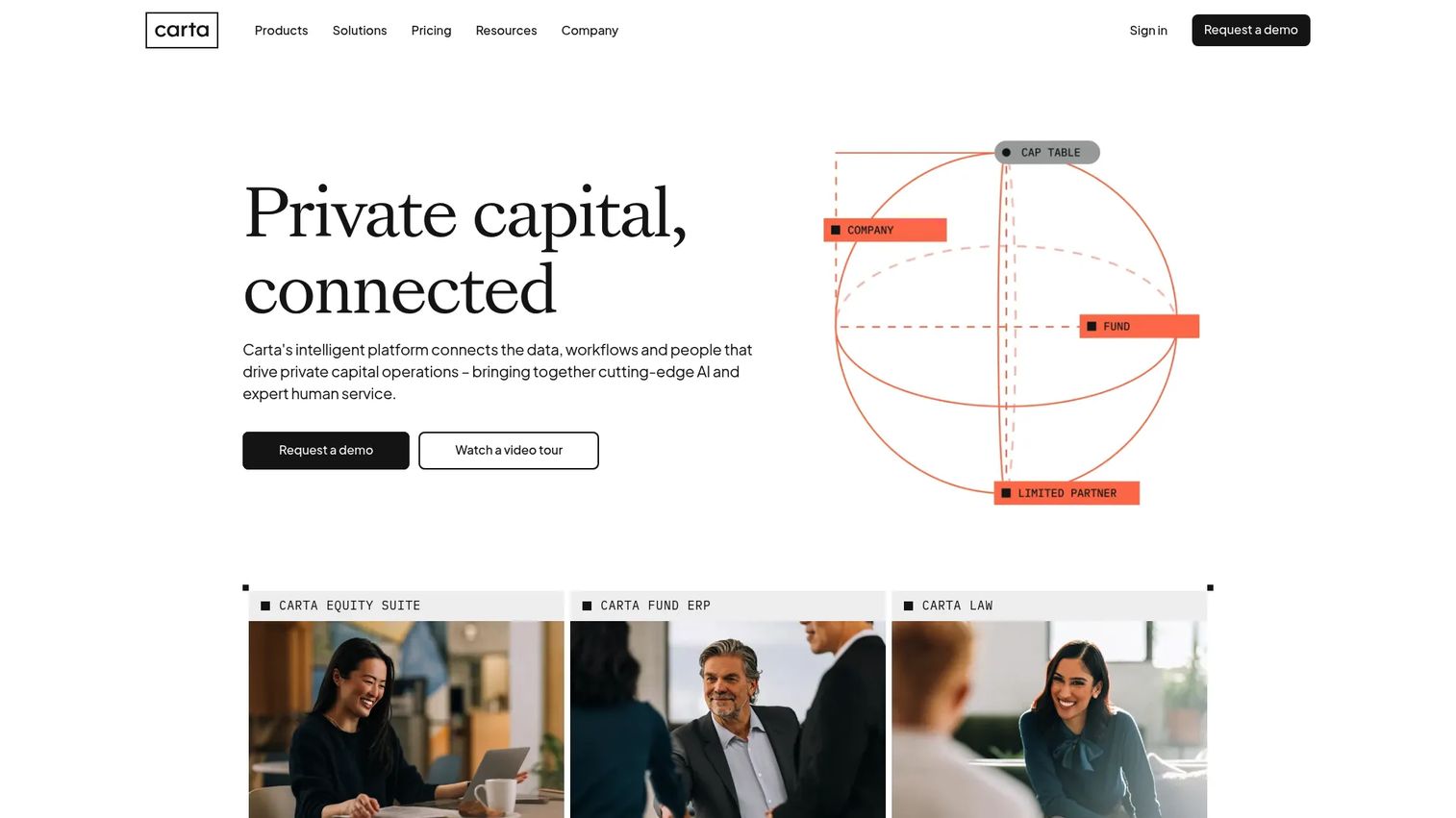
Carta is equity management software for private companies and funds, and it is the name most founders hear first. It covers cap table management, SAFE financings, and 409A valuations in one platform, with investor-grade reporting that larger teams lean on during diligence and board reviews. Carta's breadth is why it shows up on most shortlists.
Best for: Private companies that need end-to-end equity management with strong investor-ready reporting.
Key strengths
- End-to-end coverage: Cap table, valuations, and equity workflows live in one system, reducing reconciliation across tools.
- 409A valuations: Native support for the fair market value assessments that pricing option grants requires.
- Investor and board reporting: Reporting built to survive scrutiny, which matters as your stakeholder count and complexity grow.
Why choose Carta: Carta is the default for founders who want one platform to carry them from early grants through later rounds. Its depth suits companies that expect to scale headcount and financing complexity. The tradeoff is that most paid pricing is sales-led rather than fully public.
Carta pricing: Carta offers a free Carta Launch option for early-stage founders. Beyond that, pricing is sales-led, so paid tiers require a conversation rather than a public number. Carta holds a 4.3/5 rating on G2.
3. Pulley
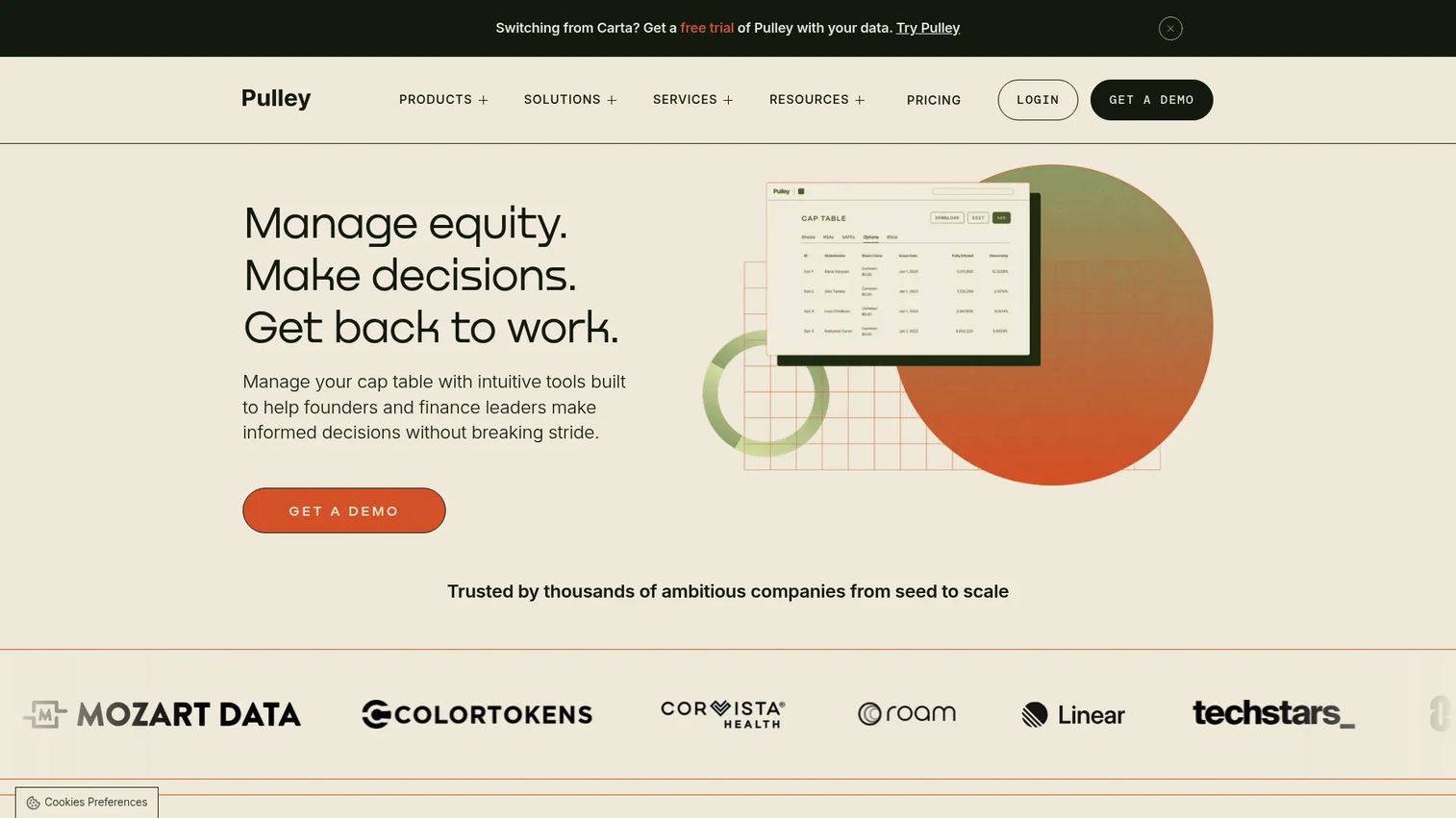
Pulley is equity management software for founders and finance teams, with cap table, fundraising, and token tools. Founders compare it heavily against Carta because of its pricing transparency and its strength in scenario modeling. It covers cap table management, fundraising modeling, 409A valuations, SAFE, option, and RSA workflows, plus token cap tables for crypto-native companies.
Best for: Startups and growing companies that want transparent pricing and strong fundraise planning tools.
Key strengths
- Public pricing: Annual pricing is listed openly, which removes the sales-call friction founders dislike.
- Scenario modeling: Fundraising and dilution forecasting let finance leads model rounds in minutes, not spreadsheets.
- 409A and forms support: Native 409A valuations plus SAFE, option, and RSA workflows keep grant issuance clean.
Why choose Pulley: Pulley wins the founder who wants to see the price before committing and who cares about modeling the next round with confidence. The scenario modeling depth makes it a strong fit heading into a Series B or Series C, where dilution forecasting drives board conversations. Onboarding is built to move fast.
Pulley pricing: The Startup plan is $1,200 per year and includes 25 stakeholders. The Growth plan is $3,500 per year and includes 40 stakeholders. Enterprise pricing is tailored. The pricing page also shows public pricing for token-related offerings and valuations. Pulley holds a 4.7/5 rating on G2.
4. Shareworks (Morgan Stanley at Work)
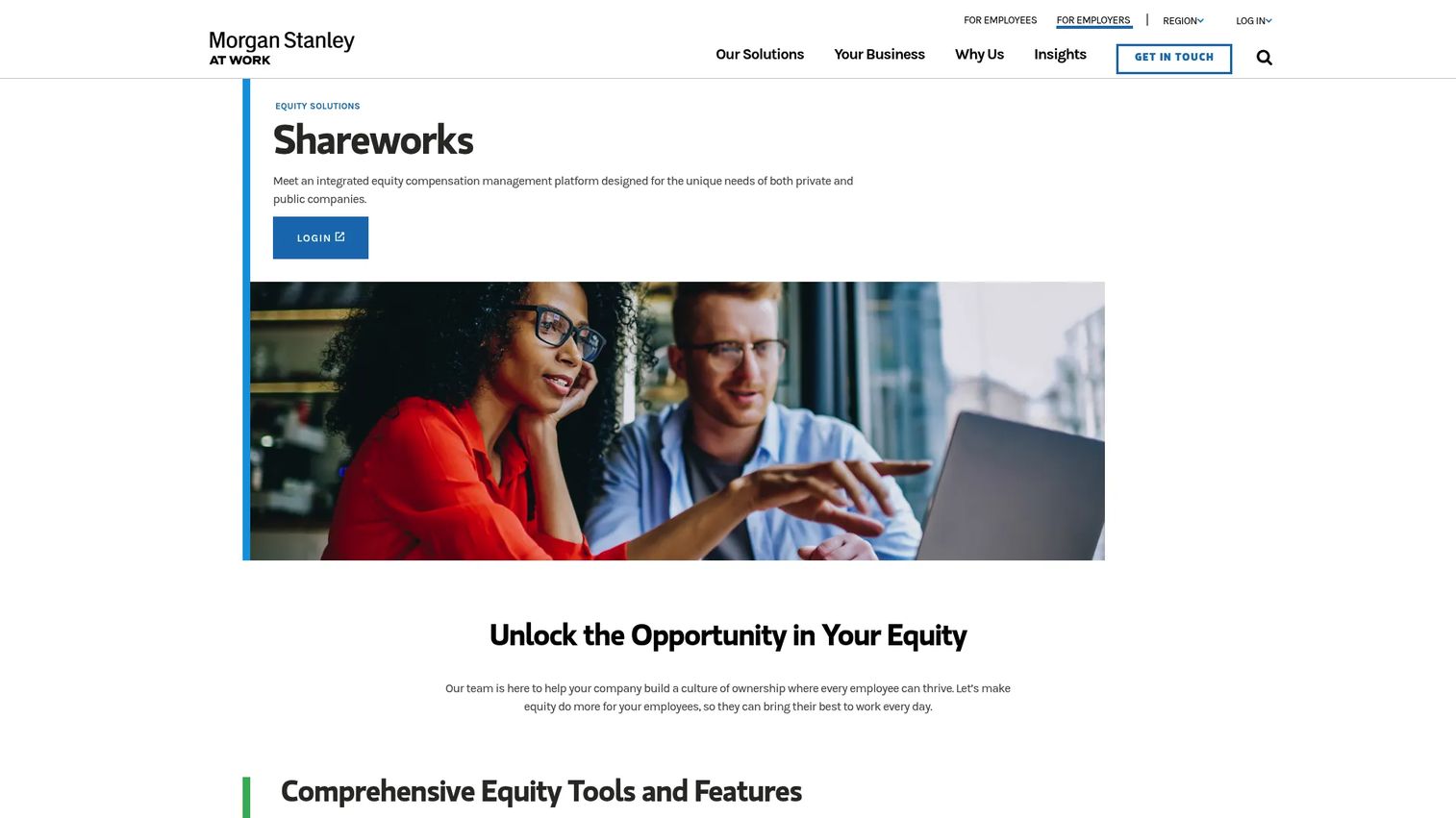
Shareworks (Morgan Stanley at Work) is an integrated equity compensation management platform for private and public companies. It is built for the complexity that comes with scale: global plans, audit-ready reporting, and deep integration with HR systems. Late-stage and multinational teams shortlist it when equity administration outgrows startup-first tools.
Best for: Companies that need equity compensation administration and reporting across private or public plans.
Key strengths
- Custom global plans: Supports equity programs across jurisdictions, which multinational teams require for compliance.
- Audit-ready reporting: Built for events like 409A valuations and Section 16 filings, so finance and legal stay covered.
- HRIS integration: Real-time API data sharing from HR systems keeps grant and participant data in sync.
Why choose Shareworks: Shareworks fits the company where equity compensation has become a serious operational function, not just a founder spreadsheet. Its sandbox test site for modeling, budgeting, and forecasting scenarios, plus secure collaboration controls, suit teams with real compliance obligations. It is an enterprise commitment, not a quick self-serve start.
Shareworks pricing: Morgan Stanley presents Shareworks as a sales-led solution, so no public plan pricing is listed. Pricing requires a conversation with their team. Shareworks holds a 3.8/5 rating on G2.
5. Ledgy
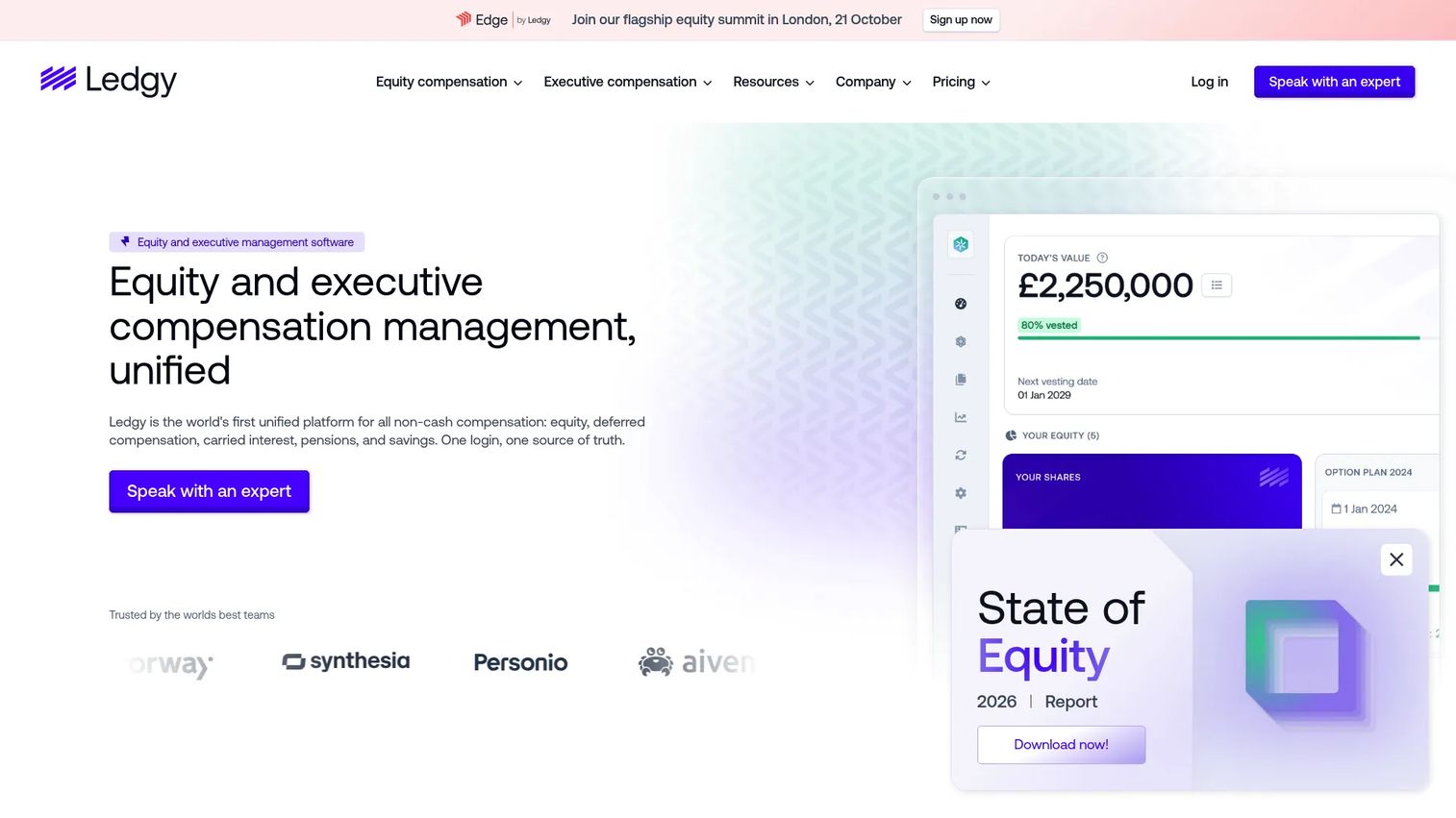
Ledgy is equity and executive compensation management software for private and public companies, with particular strength for European and globally distributed teams. It covers cap table management, equity plan automation, employee and shareholder engagement dashboards, trading and settlement, equity compliance, and financial reporting. Teams scaling across regions shortlist it for its multi-jurisdiction handling.
Best for: Companies managing equity, cap tables, and employee share plans across private or public stages, especially in Europe.
Key strengths
- Multi-region equity planning: Built for cross-border teams, with compliance handling across jurisdictions.
- Engagement dashboards: An employee and shareholder equity portal that makes vested equity visible and understandable.
- Financial reporting: Reporting add-ons for the compliance layer public and scaling companies need.
Why choose Ledgy: Ledgy fits founders and finance leads with a distributed or European footprint who need equity administration that respects regional rules. The engagement dashboards give employees clarity on their stake, which reduces the founder-as-help-desk problem. Its reporting depth supports companies moving toward public-market readiness.
Ledgy pricing: Ledgy prices in euros. The Launch plan is free. The Scale plan starts at €4k per year, and Enterprise is custom. Financial reporting add-ons include Essentials starting at €3k per year and Advanced starting at €5k per year. Public company pricing is custom. Ledgy holds a 4.7/5 rating on G2.
6. Global Shares (J.P. Morgan)
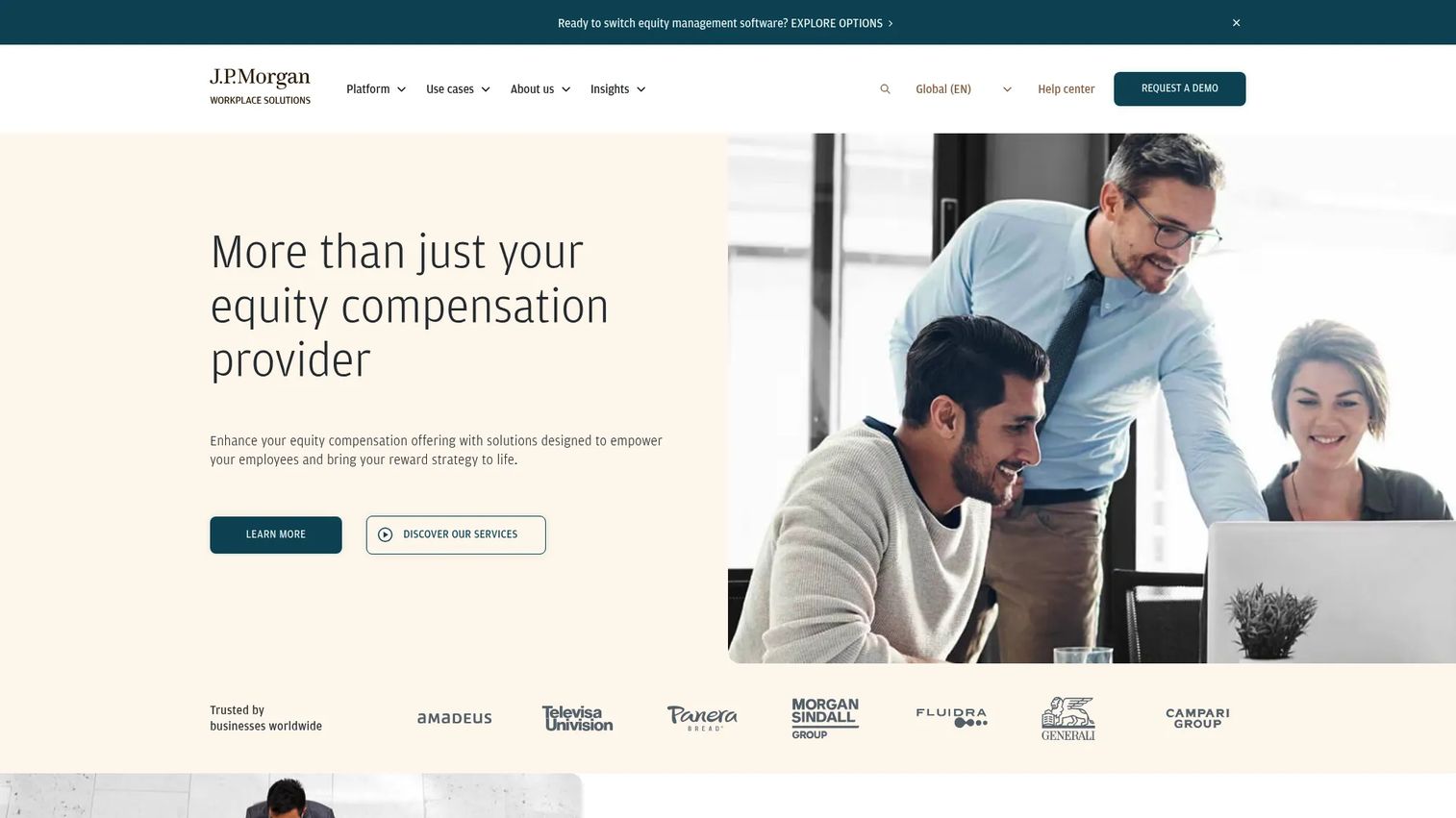
Global Shares (J.P. Morgan) is the J.P. Morgan Workplace Solutions brand for equity compensation administration and cap table management software. Large organizations use it for multinational admin, governance, a participant portal, and broad financial controls. It combines cap table management, share plan management, and round modeling under one enterprise umbrella.
Best for: Companies that need global equity compensation and cap table administration at scale.
Key strengths
- Multinational administration: Handles equity across borders with the governance large organizations require.
- Participant portal: A stakeholder-facing portal that improves the employee equity experience globally.
- Round modeling: Built-in modeling supports fundraise planning and scenario work as complexity grows.
Why choose Global Shares: Global Shares suits organizations that want the backing of a major financial institution alongside equity administration software. The combination of governance, financial controls, and a participant portal fits companies with large, distributed employee bases. It scales well past the point where startup-first tools are designed to operate.
Global Shares pricing: Global Shares prices in euros on its Ireland pricing page. The Standard plan is free for up to 40 stakeholders. The Premium plan is €2,000 per year or €200 per month for up to 100 stakeholders. The Custom plan starts from €4,500 per year or €450 per month for over 100 stakeholders. Global Shares holds a 4.8/5 rating on G2.
7. Certent Equity Management
Certent Equity Management is a disclosure and equity-related software brand offering cloud-based document management and SEC/XBRL filing workflows, with historical materials describing its equity management system. Finance teams choose it for reporting-heavy operations where disclosure and compliance workflows carry as much weight as the cap table itself.
Best for: Companies that need disclosure management and SEC/XBRL reporting workflows alongside equity administration.
Key strengths
- Disclosure Management Console: A cloud-based hub for projects, reports, files, and collaboration across finance teams.
- Office add-ins: Microsoft Word, Excel, and PowerPoint add-ins that fit disclosure workflows into existing tools.
- Filing support: Section 16 Form Filer and Inline XBRL filing package support for regulated reporting.
Why choose Certent Equity Management: Certent fits finance-led organizations where equity reporting connects tightly to broader disclosure and SEC filing obligations. Its integration into Microsoft Office and its filing workflows suit teams that live in compliance reporting. It is a reporting-first choice rather than a founder-first cap table starter.
Certent Equity Management pricing: Certent does not publish plan pricing on a readable first-party page, so cost requires contacting their team. Public G2 ratings were not available at the time of writing.
Considerations before you choose
Picking the right equity management solutions comes down to matching the platform to your stage and your obligations. Here is what to evaluate.
Stage and stakeholder count pricing
Most platforms price by stakeholder count, so map your current and projected headcount before you commit. A free tier that covers 5 stakeholders is fine at seed but breaks the moment you grant broadly. Check where the next pricing threshold sits so a hiring wave does not blow your budget.
Compliance depth
Confirm the platform handles 409A valuations, ASC 718 stock-based compensation calculations, 83(b) election support, and QSBS attestation. Some tools bundle these, others charge add-ons, and a few leave them to you. If you are approaching an audit or a raise, compliance reporting depth is not negotiable.
Pricing transparency
Public pricing lets you compare without a sales cycle. Sales-led pricing is common for enterprise tools and often reflects genuine complexity, but for founder-stage buyers, a listed annual number removes friction. Weigh transparency against the depth you actually need.
Stakeholder experience and the portal
A strong employee equity portal reduces the founder-as-help-desk load. Employees who can see their vested equity and grant details self-serve stop routing questions through you. A good stakeholder experience is a retention lever, not just a nice-to-have.
Migration support
Moving off a spreadsheet or between platforms carries risk. Ask what migration support the vendor provides, how they validate imported data, and how long it takes. The founder-friendly UI matters, but clean migration matters more when your cap table is the source of truth.
Conclusion
The right equity management platform depends on where you are and where you are headed. For early-stage founders leaving spreadsheets, Cake Equity offers the most accessible on-ramp with a free tier and stakeholder-based pricing. Carta remains the broad, end-to-end default for private companies that want one system through multiple rounds. Pulley wins on pricing transparency and scenario modeling, making it a strong pick heading into a Series B or Series C.
For enterprise and multinational teams, Shareworks and Global Shares bring global plan administration and institutional backing. Ledgy suits European and globally distributed companies, and Certent Equity Management fits reporting-heavy finance operations with heavy disclosure obligations.
Your next step: map your stakeholder count, list your compliance obligations, and shortlist two platforms that fit your stage. Then run a short trial or demo before your next raise, not during it.
When you evaluate any software this way, letting your team experience the product before committing shortens the decision. That is the same principle behind Guideflow and its interactive product experiences. Start your journey with Guideflow today!
FAQs
Equity management software records and administers your ownership: cap table management, stock option grants, vesting, fundraising rounds, and compliance reporting. It replaces spreadsheets with a single source of truth and gives employees a portal to see their equity. For a startup, it prevents the version-control errors that surface painfully during diligence.
Cap table management is one function: recording who owns what shares, options, and SAFEs. Equity management software is broader. It adds grant issuance, vesting workflows, 409A valuations, ASC 718 reporting, scenario modeling, and an employee equity portal. Recording ownership is table stakes; managing equity as a live workflow is the fuller job.
Switch before a financing, audit, or acquisition forces it. The practical trigger is usually granting options to more than a handful of employees or taking on a SAFE or convertible note. Once multiple versions of your cap table exist, the error risk outweighs the cost of a platform.
Prioritize scenario modeling, dilution forecasting, and investor-ready reporting. Later rounds bring more stakeholders and harder dilution questions, so your finance lead needs to model rounds quickly and defend the numbers to your board. Clean 409A valuations and compliance reporting round out the diligence-readiness checklist.
If you grant stock options in the US, yes. A 409A valuation sets the fair market value used to price grants, and you need current ones to stay compliant. Some platforms include 409A valuations, others offer them as an add-on. Confirm how your chosen tool handles it before you issue grants.
Very, once you have granted equity broadly. An employee equity portal lets people see their grants, vesting, and value without routing every question through the founder or finance. That self-serve stakeholder experience reduces internal load and helps employees actually understand and value their vested equity.
Watch the thresholds. Most platforms use stakeholder count pricing, so a free or entry tier covering 5 to 25 stakeholders can jump in cost after a hiring wave. Map your projected headcount against each tier's limits and factor add-ons like 409A valuations and QSBS attestation into the real total.
It varies, and it is the step most founders underestimate. Ask each vendor about migration support, how they validate imported cap table data, and the typical timeline. A careful migration with data validation protects your source of truth; a rushed one imports the same errors you were trying to escape.