Month closes. Finance pulls the commission spreadsheet. A formula is off by one row, a rep's accelerator didn't trigger, and three account executives are already in your DMs asking why their number looks wrong. You spend the next two days reconciling instead of forecasting.
If you run a scaling SaaS company, you've probably lived some version of this. Commissions start simple. One plan, one rate, a tab in Google Sheets. Then you add accelerators, SPIFs, clawbacks, multi-product attach, territory splits, and ramp adjustments. The spreadsheet that worked at ten reps quietly becomes a liability at forty. Payout errors erode trust. Disputes eat RevOps time. And when the board asks how compensation ties to revenue, nobody can answer cleanly.
The market has noticed. The global sales compensation software category was worth USD 16.09 billion in 2024 and is projected to reach USD 45.79 billion by 2035, a 9.97% CAGR, according to Market Research Future (2024). That growth is buyers leaving spreadsheets behind because the cost of getting comp wrong keeps rising.
That's where incentive compensation management software earns its place. The right sales compensation software automates calculations, gives reps real-time visibility into earnings, and produces the audit trail your finance team needs. The wrong one adds a six-month implementation and another admin headache. This guide helps you tell them apart. If you're also evaluating adjacent revenue tooling, our roundups of the best AI sales tools and field sales software cover the rest of the GTM stack.
What's inside
This guide covers eight incentive compensation management tools built for teams that have outgrown manual commission tracking. We focused on the platforms RevOps, finance, and sales leaders actually shortlist, then evaluated each on the criteria that decide whether the tool removes work or adds it.
Selection criteria:
- Automation depth: how much of the calculation, approval, and payout flow runs without manual intervention
- Reporting and transparency: rep-facing dashboards, manager visibility, and audit-ready records
- Integration fit: native connections to CRM, ERP, HRIS, and payroll
- Compliance support: ASC 606, IFRS 15, and clean audit trails
- Scalability and administration: how the tool handles plan complexity as headcount grows
TL;DR
Short on time? Here's the fast route to a shortlist:
- Best for flexible, fast-scaling teams: CaptivateIQ, modern modeling and workflows without legacy rigidity
- Best for rep transparency and quick implementation: Everstage, live commission forecasting reps actually trust
- Best for Salesforce-native organizations: Salesforce Spiff, real-time statements inside the CRM you already run
- Best for enterprise-grade automation and compliance: Xactly Incent, deep audit trails and scale
- Best for complex enterprise comp plus planning: Varicent, sales planning and incentives in one system
- Best for finance-led compensation operations: Performio, no-code plan changes and operational control
- Best for SAP ecosystem governance: SAP SuccessFactors Incentive Management
- Best for connected sales performance management: Forma.ai, a data foundation across territories, quotas, and comp
What is incentive compensation management software?
Incentive compensation management software automates the design, calculation, payout, and reporting of variable pay so commissions stop living in fragile spreadsheets. It replaces manual formulas with a system of record that connects comp plans to revenue data and produces auditable results.
At a category level, incentive compensation management covers a few core capabilities that buyers should expect:
- Plan design: build and version comp plans with accelerators, tiers, SPIFs, clawbacks, and multi-product logic without rewriting formulas every quarter
- Calculation automation: pull source data, apply plan rules, and run commission automation at scale with payout accuracy you can defend
- Rep and manager dashboards: give reps rep-facing transparency into earnings and let managers see attainment in real time through compensation dashboards
- Compliance and audit trails: maintain records that support ASC 606 and IFRS 15 revenue recognition and survive financial scrutiny
- Integrations: connect CRM, ERP, HRIS, payroll, and BI so the numbers stay consistent across systems
- Sales performance management alignment: tie incentives to quota and territory management and broader sales performance management where the vendor supports it
The distinction worth holding onto: incentive management software is the compensation layer. Sales performance management is the broader category that may also include quotas, territories, and planning. Some vendors cover both. Buyers should not assume one means the other.
When to use incentive compensation management software
Not every team needs to leave spreadsheets on day one. But three signals make the decision obvious.
When spreadsheets start breaking
You know the moment. A formula breaks silently, a payout goes out wrong, and finance spends the close reconciling instead of reporting. When your comp logic has more exceptions than rules, and one person is the only human who understands the model, the spreadsheet has become a single point of failure. Commission management software removes that risk.
When payout accuracy and auditability matter
The first time a rep disputes a payout and you can't prove the number, trust takes a hit. The first time an auditor asks how a commission was calculated, you need a clean answer. When payout accuracy and audit trails move from nice-to-have to non-negotiable, dedicated sales incentive software pays for itself.
When compensation needs to align with planning
Comp doesn't live in a vacuum. It connects to quotas, territories, and headcount planning. When you need an incentive compensation plan that reflects quota and territory management, and you want comp decisions to inform planning instead of fighting it, an ICM platform with sales performance management depth earns its place.
Comparison table
Before you scan the table, know what you're optimizing for. If you run on Salesforce, native fit matters more than feature breadth. If your plans are genuinely complex, automation depth and audit trails matter most. If you're scaling fast, modeling flexibility and implementation speed win. Pricing across this category is mostly quote-based because it scales with payee count and plan complexity, so treat the figures below as anchors, not final numbers. The table is sorted by relevance to fast-scaling SaaS teams.
| # | Product | Intent | Key differentiation | Pricing | G2 rating |
|---|---|---|---|---|---|
| 1 | CaptivateIQ | Flexible modeling for scaling teams | Modern, configurable plan modeling and real-time calculations | Custom quote | 4.7/5 |
| 2 | Everstage | Rep transparency, fast implementation | Live commission forecasting for reps | Custom quote | 4.8/5 |
| 3 | Salesforce Spiff | Salesforce-native comp | Real-time statements inside Salesforce | $75 USD/user/month, billed annually | 4.6/5 |
| 4 | Xactly Incent | Enterprise automation and compliance | Deep audit trails and configurator | Custom quote | Not listed |
| 5 | Varicent | Complex enterprise comp plus planning | SPM and incentives in one system | Custom quote | Not listed |
| 6 | Performio | Finance-led comp operations | No-code plan changes, built-in data management | Custom quote | 4.4/5 |
| 7 | SAP SuccessFactors Incentive Management | SAP ecosystem governance | Flexible rules engine, dispute management | Price upon request | 4.1/5 |
| 8 | Forma.ai | Connected sales performance management | AI-driven data foundation across SPM | Custom quote | 4.7/5 |
1. CaptivateIQ
CaptivateIQ is a sales compensation and sales planning platform built for teams whose comp plans refuse to stay simple. It pairs configurable plan modeling with real-time calculations, so RevOps can change logic without rebuilding the whole model. For a scaling SaaS company, that flexibility is the difference between adjusting a plan in an afternoon and dreading every comp revision.
Best for: Mid-market to enterprise teams managing complex commission plans alongside sales planning.
Key strengths
- Reporting and dashboards: clear compensation dashboards that give reps and managers a believable, real-time view of earnings and attainment.
- Plan advisor with AI assistance: guidance that helps design and refine comp plans without starting from a blank page.
- Real-time data management with SmartGrid ELT: keeps source data current so calculations reflect reality, not last week's snapshot.
Why choose CaptivateIQ: If your plans evolve faster than legacy suites can handle, CaptivateIQ's modeling flexibility fits how modern RevOps teams actually work. It rewards teams that want to own and iterate their comp logic rather than file a ticket for every change.
CaptivateIQ pricing: Pricing is customized and quote-based. CaptivateIQ uses a seat-based model with setup and support options, and directs buyers to contact sales for a tailored quote. No public starting price is published.
Fit note for founders: This is a strong pick when you're past spreadsheet hacks but not ready to inherit a rigid enterprise suite. Where it's less of a fit: very small teams with one flat plan and no near-term complexity may not need this depth yet.
2. Everstage
Everstage is an AI-native revenue platform spanning sales compensation, planning, and CPQ. Its standout for scaling teams is rep transparency: reps see live commission forecasts, which cuts disputes and the constant "what's my number" Slack messages. Implementation tends to move quickly, which matters when a new VP of Sales needs working infrastructure now, not next quarter.
Best for: Enterprises and scaling teams that want configurable commission management with strong rep-facing transparency.
Key strengths
- Self-serve plan builder: lets comp owners build and adjust plans without engineering involvement.
- Plan simulation: model how a plan change lands before it goes live, so you avoid expensive surprises.
- Live commission forecasting: reps see projected earnings in real time, which turns comp into motivation instead of mystery.
Why choose Everstage: When rep trust is the problem you're solving, Everstage leads with transparency. Reps who can see and forecast their own commissions stop opening disputes and start chasing the next deal.
Everstage pricing: Pricing is quote-based, shown as a per-payee model with platform license, enterprise support, and onboarding or implementation included. No public numeric price is displayed; contact sales for a quote.
Fit note for founders: A practical choice if your biggest comp pain is rep confusion and slow rollout. Where it's less of a fit: teams that want a fully public, self-serve price before talking to sales will need a quote conversation first.
3. Salesforce Spiff
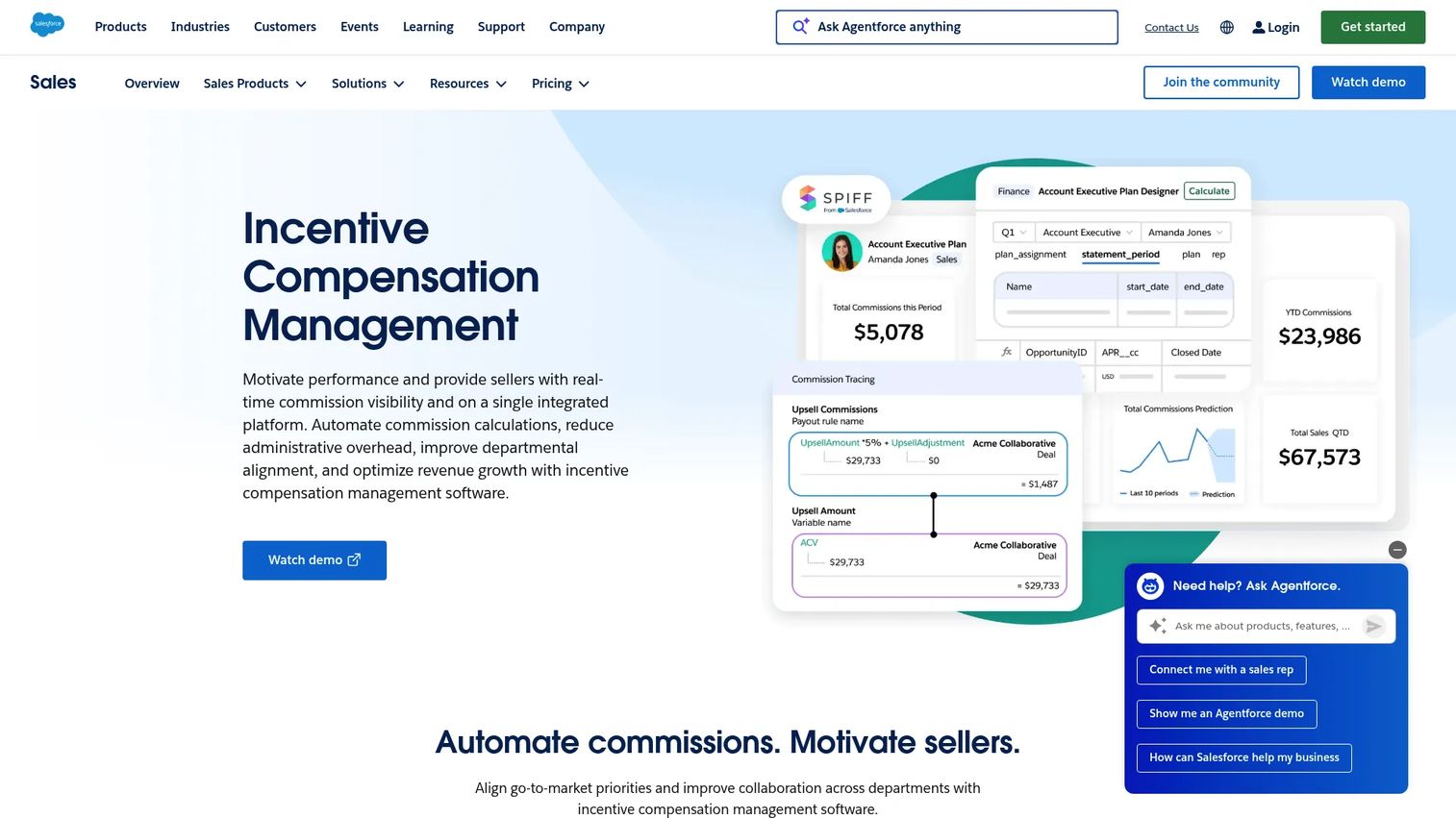
Salesforce Spiff is Salesforce's incentive compensation management software, built to automate commissions and give reps real-time visibility into earnings. More than two-thirds of Spiff customers use Salesforce as their CRM, and that native fit is the point: comp data and revenue data live in the same ecosystem, so reconciliation gets simpler.
Best for: Teams that run on Salesforce and want commission management that lives inside their existing CRM.
Key strengths
- Commission Estimator: lets reps model what a deal will pay before they close it, which sharpens deal prioritization.
- Real-time Rep Statement: up-to-date earnings statements that reduce disputes and build trust.
- Commission Plan Management: configure and manage plans with the calculation logic your comp model needs.
Why choose Salesforce Spiff: If Salesforce is your system of record, Spiff removes the integration friction that comes with a standalone tool. The estimator and real-time statements give reps the transparency that keeps them focused on selling.
Salesforce Spiff pricing: Published at $75 USD per user per month, billed annually. Additional connectors are listed at $250 per connector per month, and premium support runs 30% of net price. There is no free tier and no trial license currently offered.
Fit note for founders: The obvious pick for Salesforce-centric orgs that want fewer moving parts. Where it's less of a fit: teams not standardized on Salesforce won't get the native advantage that justifies the choice.
4. Xactly Incent
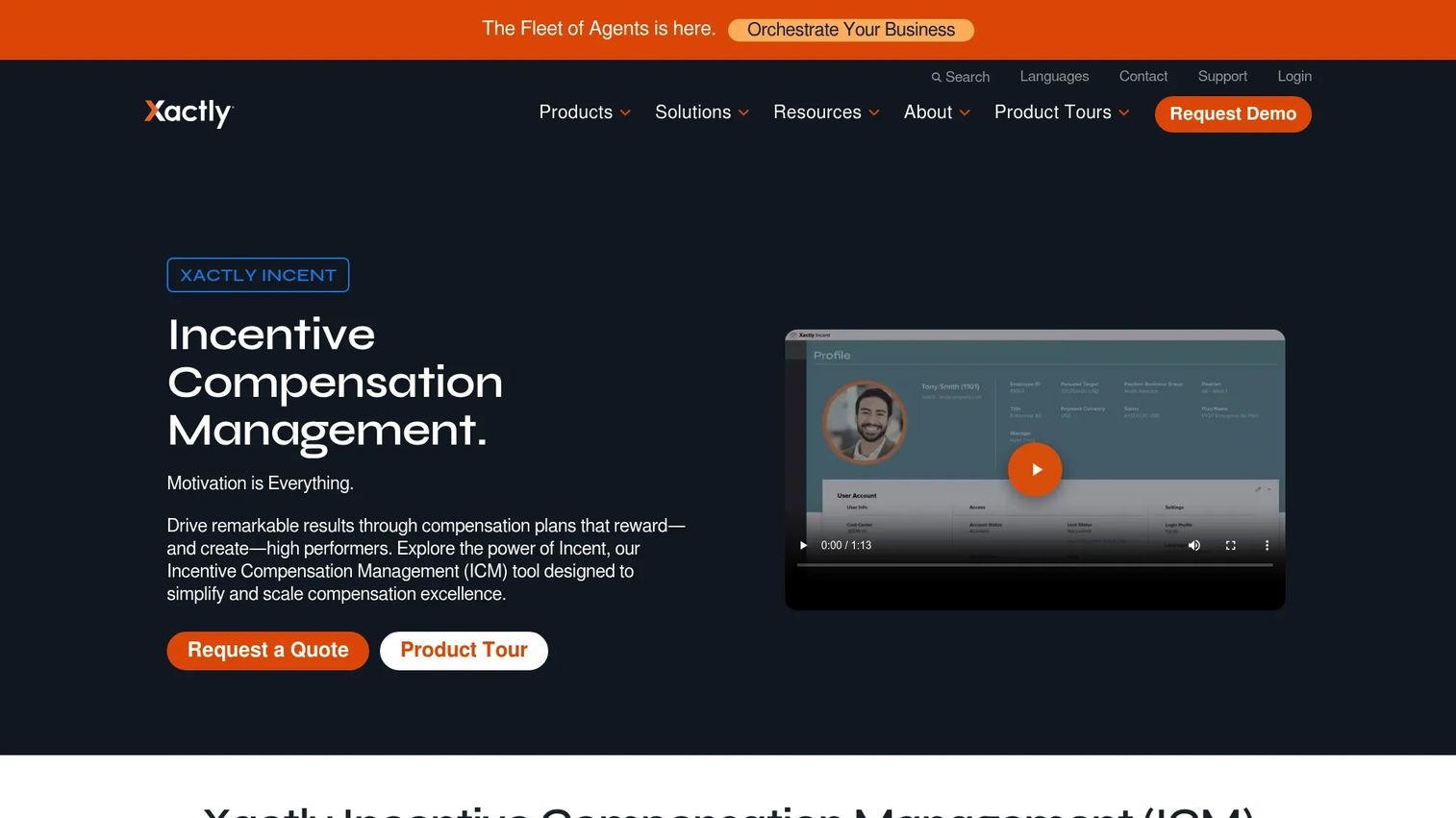
Xactly Incent is incentive compensation management software built for designing, automating, and reporting on sales compensation plans at enterprise scale. Its strength is depth: a configurator for rules, quotas, and rate tables, plus automation that carries a clear audit trail. For teams where compliance and complexity are real constraints, that rigor is the appeal.
Best for: Enterprise teams managing complex incentive compensation plans with serious compliance requirements.
Key strengths
- Compensation configurator: define rules, quotas, and rate tables that handle genuinely intricate plan structures.
- Customizable incentive statements and real-time dashboards: give reps and managers visibility tailored to how your org reports.
- Automation with audit trail and compliance: commission calculations that produce records auditors and finance can rely on.
Why choose Xactly Incent: When plan complexity and audit readiness are non-negotiable, Xactly's configurator and compliance-focused automation are built for that weight. It rewards teams that need rigor over rapid iteration.
Xactly Incent pricing: Pricing is quote-based and depends on how many people you're paying and how complex your plans are. Xactly does not publish a public starting price; contact sales for a tailored estimate.
Fit note for founders: Worth a look once your plans and compliance needs have outgrown lighter tools. Where it's less of a fit: early-stage teams with simple plans may find more depth here than they need today.
5. Varicent
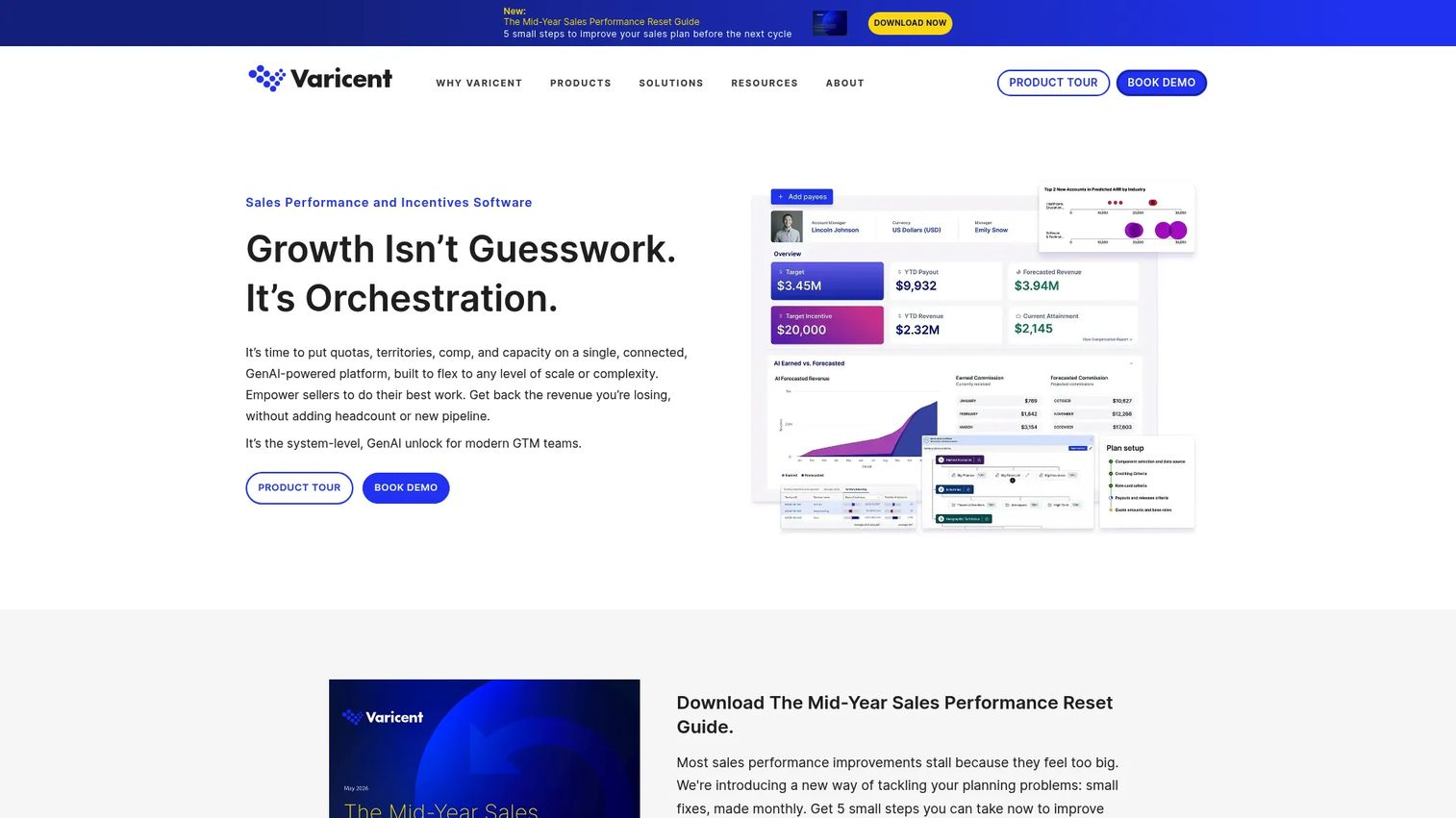
Varicent is sales performance management software that combines sales planning with incentive compensation, so strategy, performance, and execution can live in one system. With GenAI woven through planning and execution, it targets enterprise revenue teams that want comp and planning aligned rather than stitched together across tools.
Best for: Enterprise revenue teams that need both sales planning and incentive compensation in a single platform.
Key strengths
- Sales planning: handle quotas, territories, capacity, and resource allocation alongside comp.
- Incentive compensation management: track commissions and run payouts with the accuracy enterprise teams require.
- AI and GenAI-powered planning: surface insights across revenue planning and execution to inform comp decisions.
Why choose Varicent: If you want incentives and planning to reinforce each other instead of competing, Varicent's single-system approach connects the two. It fits teams that own the number and want one source of truth for how they plan and pay.
Varicent pricing: Pricing is not publicly listed and appears to be quote-based. Reach out to Varicent for an estimate tied to your team size and plan complexity.
Fit note for founders: A fit when planning and comp alignment is the actual problem, not just calculation. Where it's less of a fit: teams that only need commission automation, without the planning layer, may not use the full platform.
6. Performio
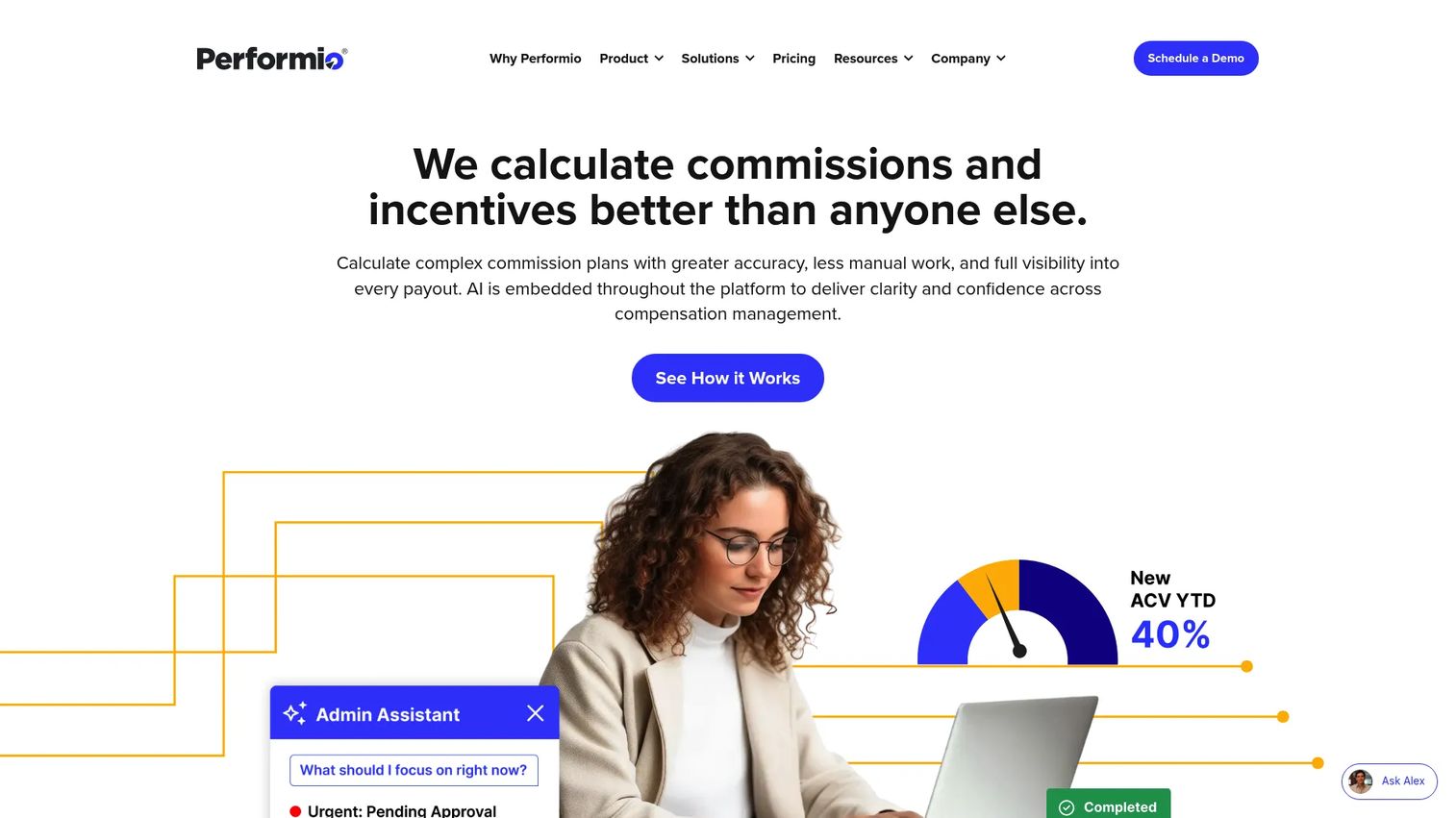
Performio is sales compensation software for managing complex incentive plans, calculations, and payouts. It's a global platform that scales from teams of around 100 reps to enterprises with thousands of participants. The pitch leans toward finance and comp teams that want operational control and clarity rather than a black box.
Best for: Mid-market and enterprise teams with complex sales commission plans that finance wants to own.
Key strengths
- No-code plan changes: adjust comp logic without engineering, so plan updates don't become projects.
- Built-in data management: keep source data clean and consistent for trustworthy calculations.
- End-to-end automation: run the full commission flow from data to payout with less manual intervention.
Why choose Performio: When finance wants to own compensation operations with clarity and control, Performio's no-code changes and built-in data management fit that mandate. It suits teams that value operational stability across a wide range of plan complexity.
Performio pricing: Pricing is quote-based, determined by team size and implementation scope. Performio prompts buyers to request a pricing estimate; no public starting price is shown.
Fit note for founders: A solid pick when finance leads comp and wants operational control without constant engineering asks. Where it's less of a fit: very small teams with a single simple plan may not need this level of depth yet.
7. SAP SuccessFactors Incentive Management
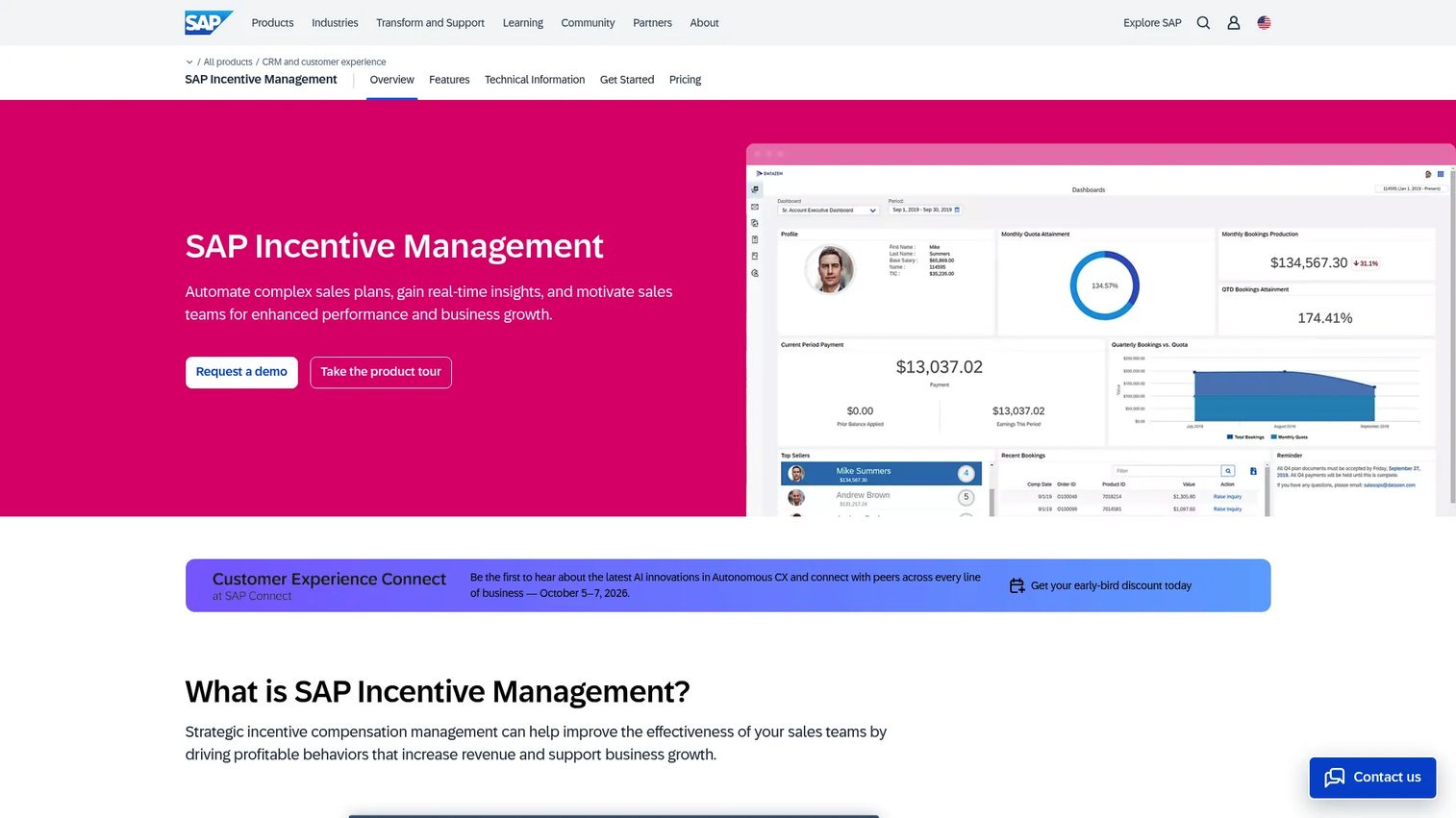
SAP SuccessFactors Incentive Management is cloud software for designing, managing, and optimizing sales incentive compensation plans with real-time insights and dispute management. Formerly SAP Commissions, it targets enterprises that want governance and complex incentive structures, especially organizations already running SAP.
Best for: Enterprises with complex sales compensation workflows, particularly those invested in the SAP ecosystem.
Key strengths
- Persona-based dashboards with embedded analytics: tailored views for reps, managers, and finance with analytics built in.
- Flexible rules engine: model complex incentive structures without forcing your plans into a rigid template.
- Inquiry and dispute management: workflow automation that handles disputes cleanly and keeps an audit trail.
Why choose SAP SuccessFactors Incentive Management: For enterprises standardized on SAP, the ecosystem fit and governance depth make it a natural extension. The flexible rules engine and dispute management suit organizations where complexity and control are the priority.
SAP SuccessFactors Incentive Management pricing: Pricing is request-a-demo or price-upon-request, available as a hyperscaler option and an enterprise edition. No public numeric price is shown; contact SAP for a quote.
Fit note for founders: Most compelling if you're already an SAP shop and want comp inside that governance model. Where it's less of a fit: teams outside the SAP ecosystem may find lighter, faster-to-deploy options closer to their stack.
8. Forma.ai
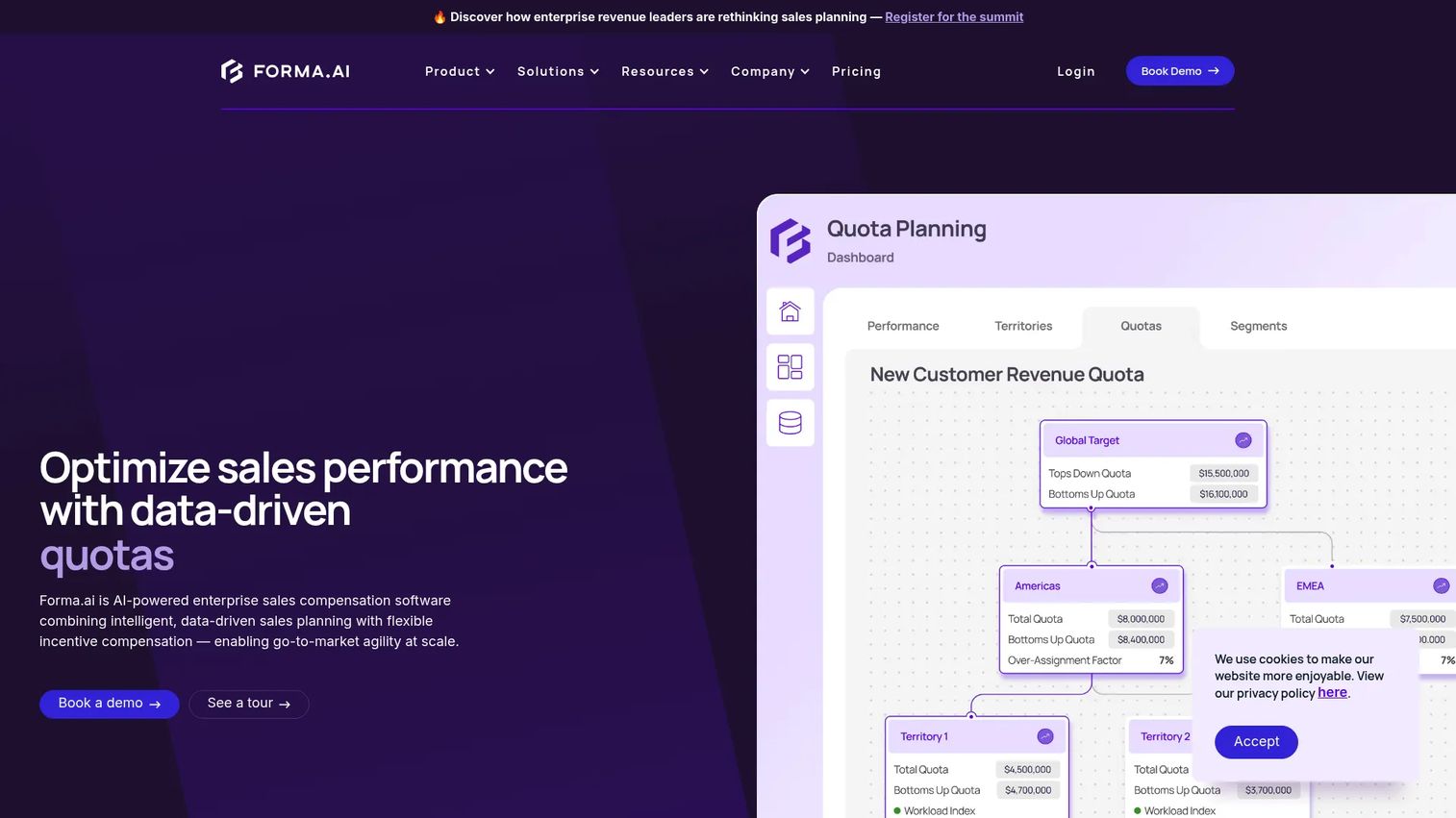
Forma.ai is AI-powered sales performance management software spanning territories, quotas, and incentive compensation. Its angle is a connected data foundation: instead of treating comp as an island, it links territory planning, quota management, and incentives so the data behind your numbers stays consistent. It supports a growing roster of large sales organizations.
Best for: Enterprise revenue operations teams managing complex sales compensation and planning workflows together.
Key strengths
- Territory planning and quota management: plan coverage and quotas alongside comp in one connected system.
- Incentive compensation management: calculate and pay commissions on a unified data foundation.
- Data validation and workflow automation: keep source data clean and automate the workflows that produce payouts.
Why choose Forma.ai: When the real problem is fragmented data across territories, quotas, and comp, Forma.ai's connected SPM foundation pulls them together. It fits RevOps teams that want one data layer behind every compensation decision.
Forma.ai pricing: Pricing is custom and tailored to each team's needs. Forma.ai requires a form submission for a proposal and does not display public pricing; there is no free tier.
Fit note for founders: A fit when you're solving for data consistency across the full sales performance management picture, not just calculation. Where it's less of a fit: teams that need only commission automation may not tap the broader planning and data layer.
Considerations before you buy
Picking incentive compensation management software is less about feature checklists and more about whether the tool fits how your team actually runs comp. Pressure-test these before you sign.
Integration depth
Your commission numbers are only as trustworthy as the data feeding them. Verify native connections to your CRM, ERP, HRIS, and payroll. Clean source data is what makes the whole system believable, so confirm the integrations are real, maintained, and bidirectional where it matters. Many of these tools sit alongside contract lifecycle management software and marketing automation tools in a broader RevOps stack, so integration breadth compounds.
Reporting and visibility
Reps need rep-facing transparency, managers need attainment views, and finance needs audit-ready records. Ask whether dashboards update in real time and whether reps can forecast their own earnings. The faster a rep can self-serve their number, the fewer disputes land on RevOps.
Compliance and audit needs
If revenue recognition under ASC 606 or IFRS 15 applies to you, treat compliance as a finance and governance concern, not a sales ops afterthought. Confirm the tool produces audit trails that survive scrutiny and supports the controls your finance team and auditors expect.
Scale and plan complexity
Map the tool to where your plans are heading, not just where they are. Accelerators, clawbacks, multi-product attach, and territory splits all add weight. The right platform handles your roadmap of complexity without forcing a re-platform in eighteen months.
Implementation effort and ownership
Decide who owns the tool day to day before you buy. If finance or RevOps owns comp, no-code plan changes matter more than developer-friendly APIs. Validate the implementation timeline against the verified figure, not the sales promise, and confirm your team can run it without the vendor in the loop forever.
Conclusion
There's no single best incentive compensation management software, only the best fit for your plan complexity, reporting needs, and existing systems. For fast-scaling SaaS teams that want flexible modeling, CaptivateIQ is a strong starting point. If rep transparency and quick rollout top your list, Everstage leads there. Salesforce-native orgs should look hard at Salesforce Spiff, while enterprise teams with heavy compliance needs will weigh Xactly Incent, Varicent, SAP SuccessFactors Incentive Management, and Forma.ai depending on how much planning and data unification they need. Finance-led teams that want operational control should test Performio.
Here's the move: shortlist two or three tools, then validate them against a real commission scenario from your business. Pull a messy month, run it through each platform, and see which one produces a number you'd defend in front of your board and your reps. That single test tells you more than any feature page. The goal of every sales incentive compensation management software decision is the same, compensation numbers that are believable, auditable, and easier to run as you scale.
FAQs
Incentive compensation management software automates commission and variable pay workflows, replacing spreadsheets and manual checks. It handles plan design, calculation, payout visibility, and auditability in one system. The result is faster, more accurate payouts and records your finance team can stand behind.
It pulls source data from your CRM and other systems, applies your comp plan rules, and runs the calculations automatically. From there it routes approvals, surfaces dashboards for reps and managers, and produces payout records. The flow turns a manual, error-prone process into a repeatable system with a clear trail.
At minimum, look for native connections to CRM, ERP, HRIS, payroll, BI, and your data warehouse. Clean source data is what makes the system trustworthy, so the quality of these integrations matters as much as the calculation engine. Weak integrations reintroduce the manual reconciliation you bought the tool to remove.
No. Smaller teams can use it too. The biggest payoff tends to arrive when plans get complex, headcount grows, and payout accuracy starts to carry real financial and trust consequences. If your spreadsheet has more exceptions than rules, you're ready regardless of size.
ASC 606 and IFRS 15 govern how you recognize commission costs, and audit trails plus financial controls are what prove your numbers hold up. Treat this as a finance and governance concern, not just a sales ops one. The right tool maintains the records auditors expect without extra manual work.
Use criteria like automation depth, reporting quality, admin experience, integration fit, implementation speed, and scalability. The most reliable test is running a real compensation scenario from your business through each shortlisted tool. Whichever produces a number you'd defend in front of reps and your board wins.
ICM is the compensation layer: plan design, calculation, and payout. Sales performance management is broader and may include quotas, territories, and planning. Some vendors cover both, but the terms are not interchangeable, so confirm exactly what a platform handles before you assume it does everything.
Payout errors, delayed closes, broken trust with reps, weak auditability, and wasted finance and RevOps time. Each one chips away at revenue operations reliability, and the cost grows with every new rep and plan exception. When the spreadsheet becomes a single point of failure, the risk outweighs the savings.