


You just pulled a carrier's DOT number, cross-checked BASIC percentiles on one site, opened crash history on another, and copied inspection data into a spreadsheet to decide whether to write the policy. Twenty minutes gone. One carrier down. You have forty more in the queue.
That workflow is the real cost of fragmented carrier data. Not the tools themselves, but the stitching between them.
The trucking software market was valued at $8.42 billion in 2025 and is projected to reach $16.78 billion by 2033, growing at a 9.1% CAGR, according to DataHorizzon Research (2025). That growth is not about dashboards. It is about buyers who need cleaner decisions on risk, compliance, and fleet visibility without living in six browser tabs.
Motor carrier software solves a specific problem: turning scattered FMCSA, roadside, and underwriting signals into decisions you can defend. Whether you screen carriers for insurance, monitor a portfolio for compliance drift, or run safety analytics on your own fleet, the right platform replaces manual research with repeatable output. This guide breaks down six options and, more importantly, tells you which one fits which job.
What's inside
This guide is built for commercial buyers comparing motor carrier software, not casual readers. That means insurance underwriters, risk managers, fleet safety teams, and sales operators who evaluate trucking software for carriers as an operational purchase.
We selected and ordered tools based on four criteria:
- Category fit: does it solve a core motor carrier job (leads, underwriting, monitoring, safety, telematics)?
- Use-case coverage: how many workflows does one platform handle?
- Trust signals: verifiable data sources, established provider, transparent methodology.
- Practical differentiation: what does this tool do that the others do not?
No fluff, no filler entries. Every tool here earns its place by doing one job well or several jobs together.
TL;DR
- Best broad suite: Carrier Software covers leads, underwriting, monitoring, and fleet safety in one platform. Start here if you want fewer vendors.
- Best free authoritative reference: FMCSA is the source of truth for compliance data, registration, and CSA research. It complements commercial tools rather than replacing them.
- Best for insurers screening carriers: Travelers Carrier Assure supports transportation risk review for insurance and risk teams.
- Best for lead generation: DOT Leads surfaces qualified carrier prospects with BASIC percentiles and risk scoring built in.
- Best for fast triage: Carrier Underwriting Snapshot Report gives underwriters a three-page risk summary in seconds.
- Best for ongoing oversight: DOT Client Monitoring watches your book for compliance changes and sends daily alerts.
What is motor carrier software
Motor carrier software is a category of commercial transportation tools that pull, analyze, and monitor federal safety, compliance, and risk data on trucking companies so insurers, brokers, and fleet operators can make faster underwriting and safety decisions.
The category splits into distinct buckets, and most buyers need more than one:
- Lead generation: finds and qualifies carrier prospects for insurance and sales teams, often with risk scoring attached.
- Underwriting reports: summarize a carrier's authority, safety, crash, and inspection history into a decision-ready document.
- DOT client monitoring: watches carriers you already work with for changes in status, violations, or unreported activity.
- Fleet safety analysis: scores drivers, flags inspection issues, and helps prioritize interventions before they become violations.
- Telematics software: captures real-time vehicle and driver behavior data for both operations and underwriting inputs.
Core capabilities buyers evaluate across these buckets:
- SAFER and FMCSA data integration
- BASIC percentiles and ISS scoring
- Crash and inspection history with geographic mapping
- White-label or brandable reporting output
- Automated alerts and change detection
- Portfolio-level monitoring across many carriers
- Integration with agency management or CRM systems
The distinction matters because a lead tool and a monitoring tool answer different questions. One asks "should I pursue this carrier?" The other asks "has anything changed since I onboarded them?"
When to use motor carrier software
Reduce manual risk screening
If your underwriters spend more than a few minutes pulling data per carrier, you have a screening problem, not a staffing problem. Motor carrier safety software collapses SAFER lookups, BASIC percentiles, and crash history into a single view. That matters most when volume is high and the cost of a slow quote is a lost deal. A carrier underwriting report replaces the manual research that eats underwriter time and introduces copy-paste errors.
Monitor fleet safety in real time
Screening a carrier once tells you nothing about what happens six months later. When you need ongoing visibility, motor carrier monitoring software with roadside monitoring and daily alerts flags new inspections, violations, and status changes as they land. This is the difference between discovering a compliance problem during a claim and catching it the week it happens. Telematics software adds another layer, pulling live driver and vehicle behavior into the picture.
Improve CSA and BASIC scores
Safety teams that only react to violations are always behind. Fleet safety software surfaces the patterns behind BASIC alerts early, so you can prioritize the drivers, vehicles, and behaviors driving your scores up. CSA score improvement is not about disputing individual violations. It is about seeing the trend before it crosses a threshold and acting on it.
Comparison table
The tools below differ mostly by job. Some generate leads, some produce underwriting reports, some monitor your existing book, and one is the federal data source everything else builds on. Read the "best for" column first, then narrow.
| # | Product | Best for | Key differentiator | Pricing | G2 rating |
|---|---|---|---|---|---|
| 1 | Carrier Software | Broad suite coverage | Leads, underwriting, monitoring, and fleet safety in one platform | Quote and block-based | Not listed |
| 2 | FMCSA | Compliance research | Authoritative federal safety and registration source | Free (filing fees apply) | Not applicable |
| 3 | Travelers Carrier Assure | Insurers and risk teams | Transportation carrier risk review | Not public | Not listed |
| 4 | DOT Leads | Lead generation | 2.1M+ carrier search with risk scoring | Not public | Not listed |
| 5 | Carrier Underwriting Snapshot Report | Fast triage | Three-page white-label risk summary | Block-based | Not listed |
| 6 | DOT Client Monitoring | Ongoing oversight | Daily change detection with email alerts | Quote-based | Not listed |
Best 6 motor carrier software tools for 2026
1. Carrier Software
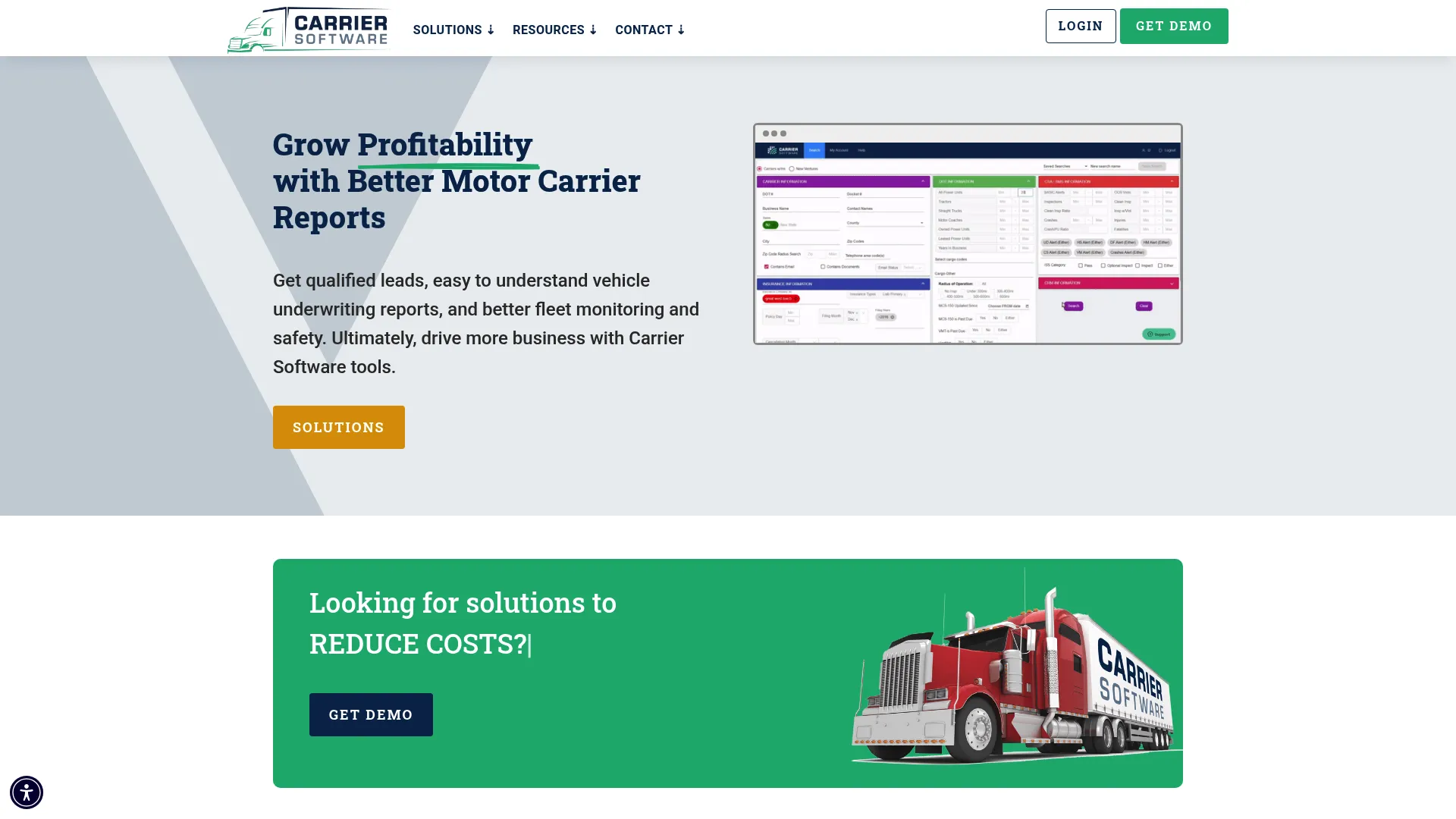
Carrier Software is the broadest platform in this category. Instead of buying separate tools for leads, underwriting, and monitoring, you get them under one provider that specializes in motor-carrier data analysis. It serves motor carriers, risk managers, insurance carriers, brokers, and shippers who need trucking risk and safety analytics without assembling a stack from scratch.
The platform's range is its strongest argument. DOT leads feed your prospecting, underwriting reports handle screening, DOT client monitoring watches your book, and the Safeguard Advanced safety platform layers driver scorecards and daily inspection notifications on top. Fleet monitoring and telematics integration round it out for operators managing their own vehicles.
Best for: insurance and risk teams that want lead generation, underwriting, and monitoring from a single vendor rather than a patchwork of point tools.
Key strengths
- DOT leads and underwriting reports in one platform
- Fleet monitoring and telematics integration
- Safeguard Advanced safety platform with driver scorecards and daily inspection notifications
Why choose Carrier Software: if you are tired of reconciling data across three vendors, consolidating onto one platform reduces the reconciliation tax and keeps your carrier data consistent from prospecting through monitoring. It fits teams ready to standardize their whole carrier workflow.
Carrier Software pricing: most products are quote-based. Report products such as the underwriting snapshot and fleet safety reports are sold in monthly blocks with volume discounts, and DOT leads are priced by lead type and state. Contact the vendor for a custom quote based on your carrier volume and integration needs.
Start your journey with Guideflow today!
2. FMCSA
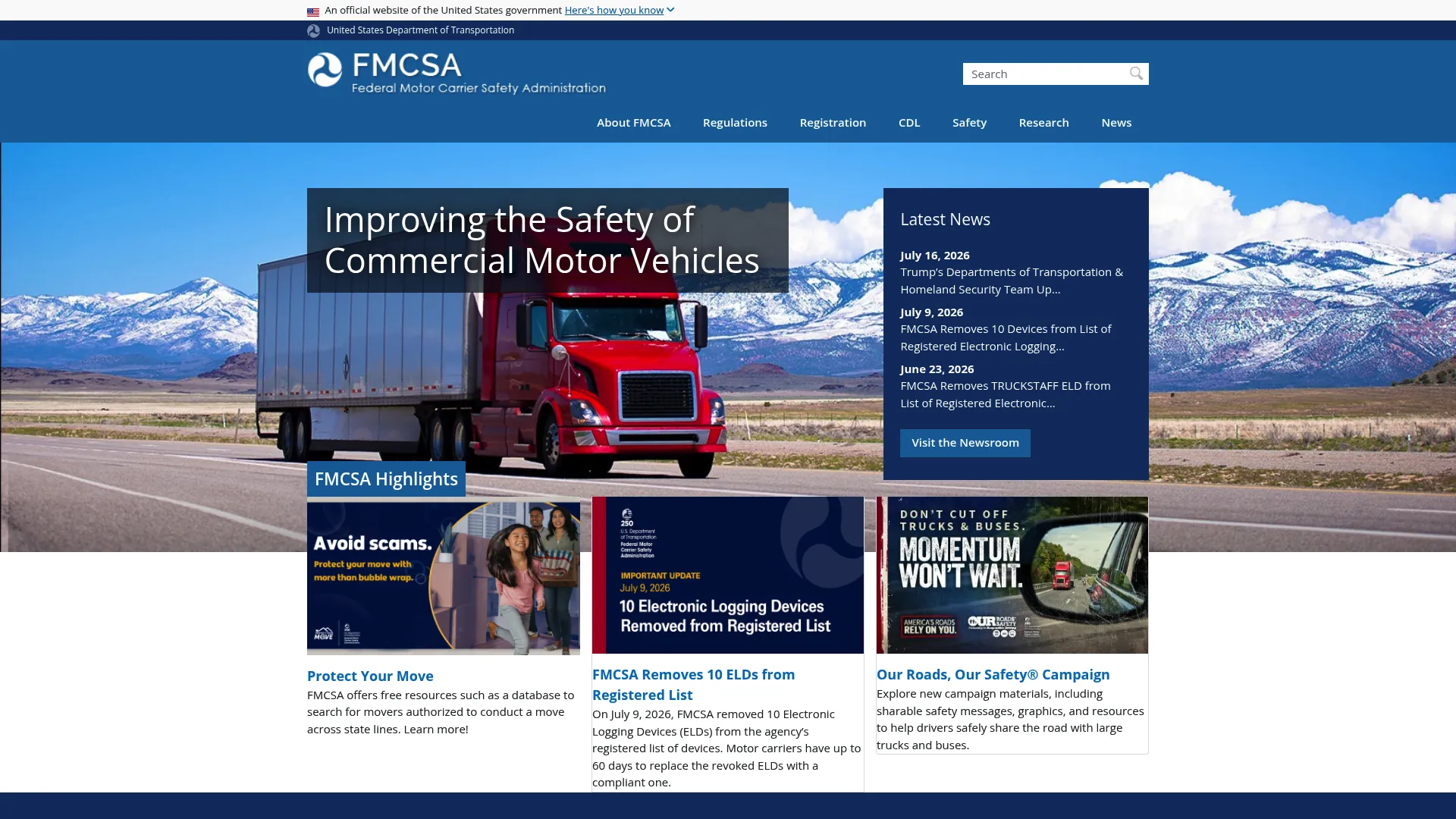
FMCSA is not a commercial software vendor in the usual sense. It is the U.S. federal agency that oversees motor carrier safety and commercial vehicle regulation, and its site is the authoritative source that most commercial tools pull from. Every serious carrier workflow touches it at some point.
Buyers use FMCSA for compliance research, carrier lookups through the SAFER website, and CSA resource guidance. When you need to verify operating authority, check registration status, or confirm what a rule actually says, this is the source of truth. It is the raw data layer, not the analysis layer.
Best for: motor carriers, brokers, and drivers who need federal safety guidance, registration information, and direct access to primary compliance data.
Key strengths
- Driver resources and safety guidance
- Registration and operating authority information
- Compliance, Safety, Accountability (CSA) resources
Why choose FMCSA: it complements commercial software rather than replacing it. Use it to verify anything a paid tool surfaces, and use it directly when you need the primary record. No commercial platform is a substitute for the agency that publishes the data.
FMCSA pricing: most resources are free. Operating authority filings carry a one-time fee of $300 per authority, name changes are $14, and authority reinstatement is $80.
3. Travelers Carrier Assure

Travelers Carrier Assure sits on the insurance and risk management side of the category. It is positioned as a transportation product from Travelers, aimed at businesses and risk teams that need commercial transportation intelligence for carrier screening and portfolio review. For insurers evaluating trucking risk, an offering backed by a major carrier brings underwriting depth that pure data tools do not.
The angle here is insurer-first. Where a lead tool helps you find carriers and a monitoring tool watches them, this kind of product supports the underwriting and portfolio-risk decisions insurers make about which carriers to write and on what terms.
Best for: insurers and risk teams that want carrier screening and portfolio risk review tied to a transportation insurance relationship.
Key strengths
- Transportation-focused carrier risk framing
- Support for insurer underwriting workflows
- Portfolio-level risk perspective for risk teams
Why choose Travelers Carrier Assure: if your evaluation is anchored in an insurance relationship rather than raw data access, an insurer-built product aligns the risk view with the coverage decision. Confirm current availability and product details directly with Travelers before you build a workflow around it.
Travelers Carrier Assure pricing: public pricing is not listed. Contact Travelers for availability and terms in your market.
4. DOT Leads
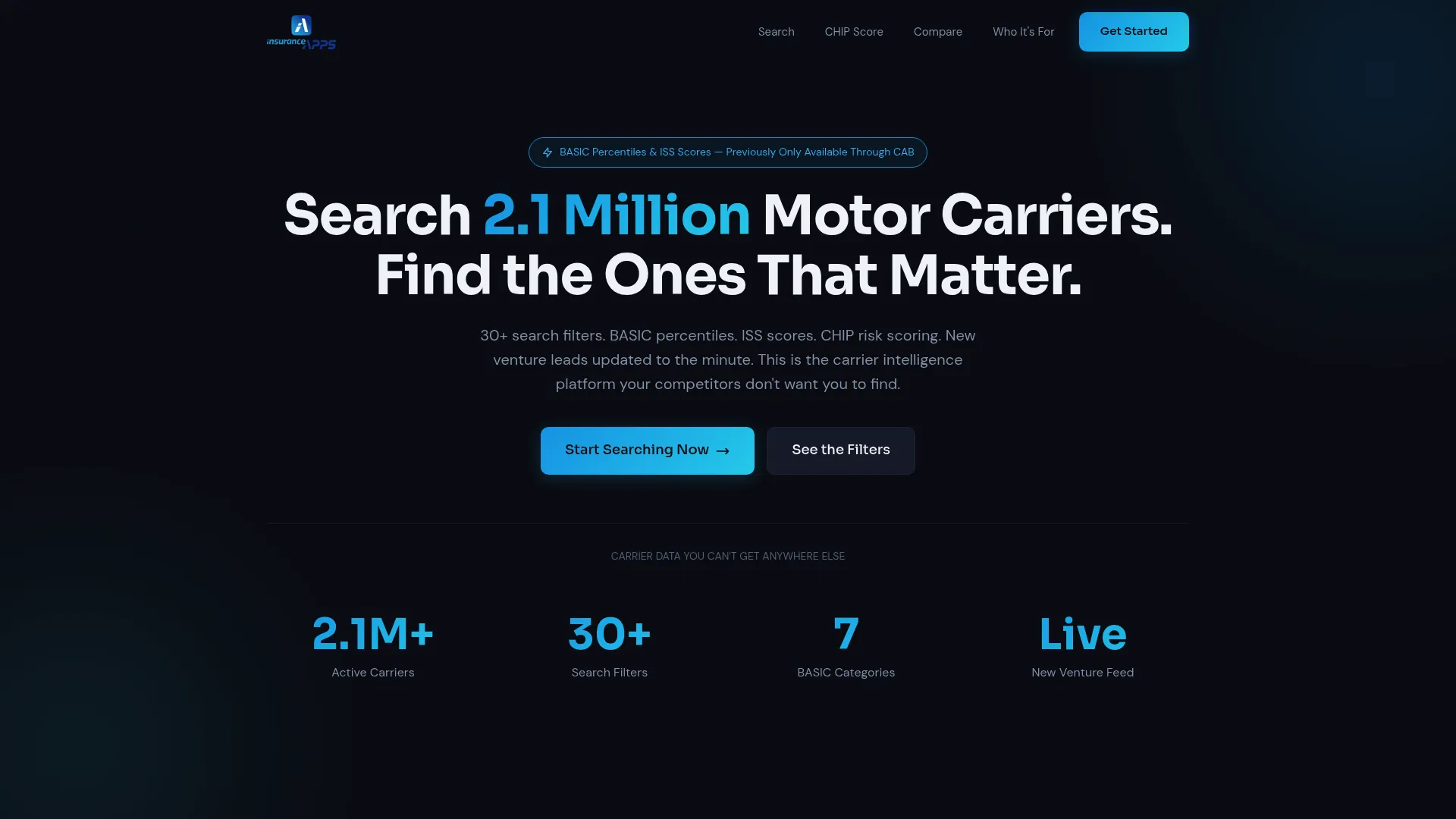
DOT Leads is built for the prospecting side of truck insurance software. It is a carrier intelligence and lead search platform that lets insurance professionals search more than 2.1 million motor carriers with over 30 filters, then act on that data with underwriting context already attached.
What sets it apart is that leads and risk signals live in the same view. BASIC percentiles, ISS scores, and CHIP risk scoring are built in, so a prospect list is also a pre-qualified risk list. New venture leads update to the minute, and a built-in CRM plus market matching keeps outreach organized without a second tool.
Best for: insurance agents and brokers who need carrier search and underwriting-oriented lead intelligence in one place.
Key strengths
- Search 2.1M+ motor carriers with 30+ filters
- BASIC percentiles, ISS scores, and CHIP risk scoring
- New venture leads updated to the minute with built-in CRM and market matching
Why choose DOT Leads: for sales and marketing teams in the trucking insurance space, prospecting and risk qualification usually happen in separate tools. Combining them means you spend outreach effort on carriers you would actually write, not on names you have to screen later.
DOT Leads pricing: pricing is not publicly displayed on the site. Contact the vendor for a quote based on your search volume and lead needs.
5. Carrier Underwriting Snapshot Report
Carrier Underwriting Snapshot Report is the fast-triage tool in this lineup. It compresses a motor carrier's key risk data into a three-page white-label PDF, so an underwriter can qualify or pass on an account in the time it used to take to open the first browser tab.
The report pulls SAFER operating status and authority data, inspection and crash maps, and crash history into a clean, brandable summary. Because it is white-label, agents can send it to clients or use it internally without stripping out someone else's logo. The point is speed and clarity for quick account review.
Best for: insurance agents and underwriters who need a fast motor carrier risk summary for triage and qualification.
Key strengths
- Three-page white-label PDF snapshot
- SAFER operating status and authority data
- Inspection and crash maps with crash history
Why choose Carrier Underwriting Snapshot Report: when you are working a high-volume queue, a full report is overkill for the carriers you will decline in the first ten seconds. A snapshot gives you enough to triage fast and reserve deeper review for accounts that clear the first pass.
Carrier Underwriting Snapshot Report pricing: sold in monthly blocks starting at 10 reports per month, with no public numeric price displayed. Contact the vendor for block pricing based on your volume.
6. DOT Client Monitoring
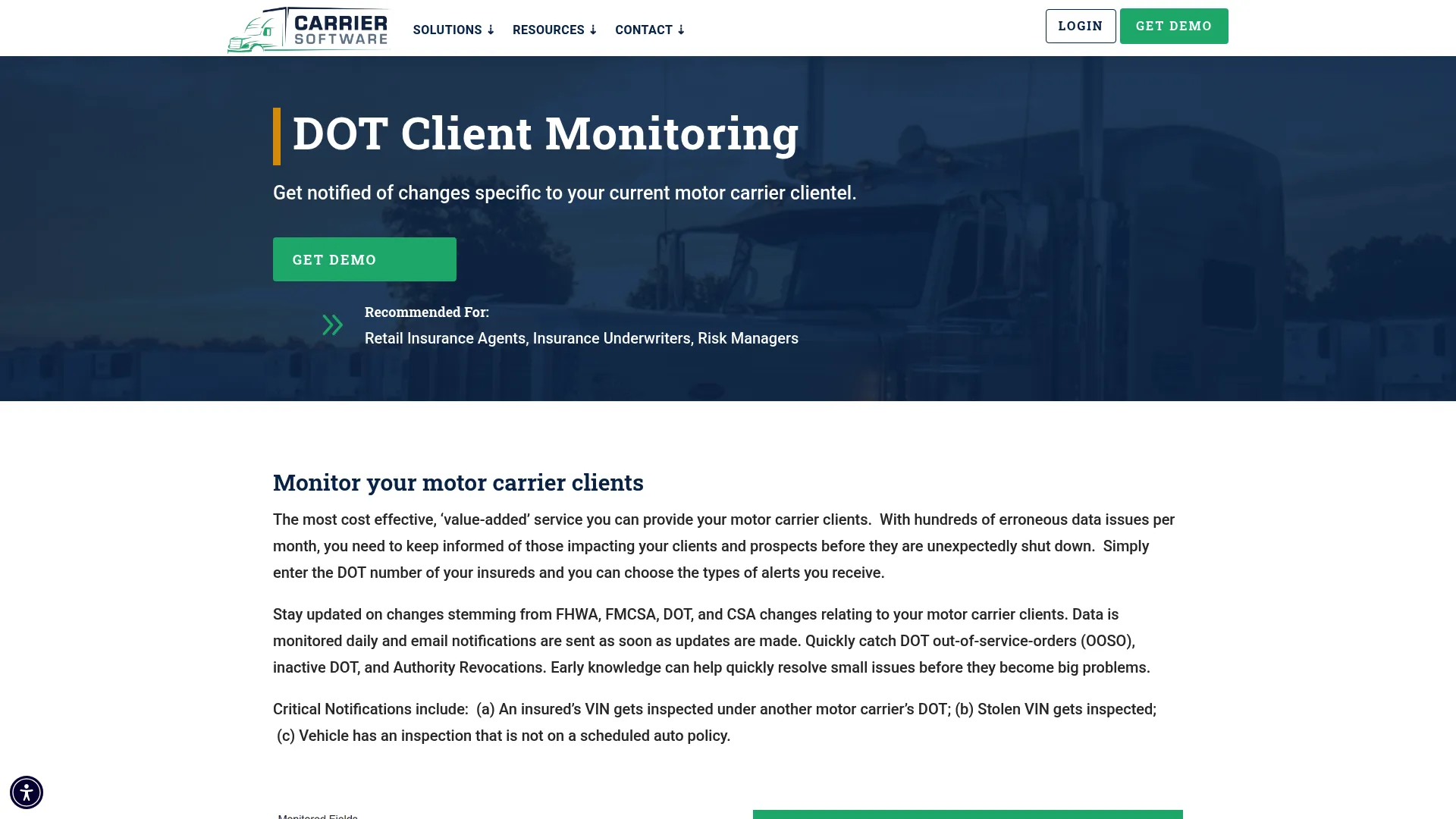
DOT Client Monitoring handles the job that starts after you onboard a carrier. It monitors your motor carrier clients for DOT, FHWA, FMCSA, and CSA-related changes, then sends email alerts when something shifts. This is the DOT client monitoring layer that keeps a book of business current.
The value is in catching what you would otherwise miss. It runs daily monitoring and tracks inspections, violations, crash history, and unreported vehicles, so a carrier quietly adding trucks off the books or racking up violations does not slip past you until claim time. For risk teams managing a portfolio, that continuous view is the difference between reactive and proactive.
Best for: insurance agents, underwriters, and risk managers who need to monitor motor carrier clients across a portfolio.
Key strengths
- Monitors clients for changes in key data
- Daily monitoring with email notifications
- Tracks inspections, violations, crash history, and unreported vehicles
Why choose DOT Client Monitoring: underwriting is a snapshot in time, but risk is not static. Ongoing monitoring turns a one-time screening decision into a living view of your book, which matters most for account monitoring and portfolio oversight where a single missed change can trigger a bad claim.
DOT Client Monitoring pricing: quoted by the number of carriers monitored and whether you need automated integration with an agency management system. Pricing is not tiered; contact the vendor for a quote.
Considerations before you buy
Motor carrier software is an operational purchase, not a nice-to-have. Evaluate it the way you would any tool that touches revenue decisions.
Data source and accuracy
Every tool here is only as good as the FMCSA and SAFER data it pulls. Ask how often the platform refreshes, whether it flags data lag, and how it handles unreported vehicles. Stale data on a risk decision is worse than no data because it feels authoritative.
Job fit over feature count
A monitoring tool and a lead tool solve different problems. Decide which job is your actual bottleneck before comparing feature lists. Buying a broad suite when you only need triage wastes budget; buying a single point tool when you need portfolio oversight leaves gaps.
Integration with your existing stack
Check whether the platform connects to your agency management system or CRM. A tool that forces manual re-entry back into your system of record recreates the copy-paste problem you were trying to escape. Automated integration is worth paying for if you run volume.
Output format and shareability
White-label reports matter if you send anything to clients. Confirm whether output is a static PDF or an interactive view, and whether branding is included at your tier. The format shapes how the tool fits your workflow, not just how it looks.
Pricing model versus your volume
Block-based pricing rewards steady volume; quote-based pricing suits larger or integrated deployments. Match the model to how you actually work. A per-report block plan can get expensive fast if your volume spikes, so project your real monthly usage before committing.
Conclusion
The right motor carrier software depends entirely on the job in front of you. If you want to reduce vendors and cover leads, underwriting, monitoring, and safety from one place, start with the broad suite in Carrier Software and narrow from there. If you need the primary compliance record, FMCSA is free and authoritative.
For insurers screening carriers, Travelers Carrier Assure ties risk review to an insurance relationship, while DOT Leads combines prospecting with built-in risk scoring. On the underwriting side, the Carrier Underwriting Snapshot Report handles fast triage. And once carriers are on your book, DOT Client Monitoring keeps that risk view current.
The practical move: evaluate the broad suite first, identify your single biggest bottleneck, then narrow to the specialized tool that fixes it. Buying for the job, not the feature list, is how you avoid paying for software you do not use.
Start your journey with Guideflow today!
FAQs
It pulls federal safety, compliance, and risk data on trucking companies so insurers, brokers, and fleet operators can make faster underwriting, screening, and monitoring decisions. In practice, it replaces manual SAFER lookups and spreadsheet research with decision-ready reports and alerts. The specific use ranges from generating carrier leads to monitoring an existing book for compliance changes.
Insurers typically use underwriting report tools that summarize a carrier's authority, BASIC percentiles, crash history, and inspection record into a single view. Some use a fast snapshot for triage and a fuller interactive report for accounts that clear the first pass. Insurer-backed products like Travelers Carrier Assure add a risk perspective tied directly to the coverage decision.
DOT client monitoring watches the carriers you already work with for changes in key FMCSA and CSA data, then alerts you when something shifts. A tool like DOT Client Monitoring runs daily checks and emails you about new inspections, violations, crash history, and unreported vehicles. The goal is catching a compliance problem the week it happens instead of during a claim.
A snapshot report compresses key risk data into a short, brandable summary built for fast triage, often three pages you can read in seconds. A full underwriting report adds interactive charts, BASIC score history, and violation trends for accounts that need deeper review. Most teams use the snapshot to qualify quickly and a fuller report to underwrite accounts worth a closer look.
Fleet safety software surfaces the patterns behind BASIC alerts before they cross a threshold, so you can act on the drivers, vehicles, and behaviors driving scores up. Driver scorecards and daily inspection notifications flag issues early rather than after a violation posts. CSA score improvement comes from catching trends proactively, not from disputing individual violations after the fact.
Yes. Telematics software captures real-time driver and vehicle behavior, which gives underwriters a live input beyond static crash and inspection history. That behavioral data can sharpen risk assessment on carriers where the historical record is thin or ambiguous. Several motor carrier platforms integrate telematics alongside their underwriting and monitoring products.
Start with the job you actually need solved: leads, underwriting, monitoring, or fleet safety. Then check data freshness, integration with your agency management or CRM system, output format and white-label options, and whether the pricing model fits your real monthly volume. A broad suite reduces vendors, while a point tool goes deeper on a single workflow, so match the choice to your biggest bottleneck.