A product team scopes an integration. Three weeks in, the work has tripled. Authentication differs across every target system. Fields don't map cleanly. One customer needs data stored in a specific region. A partner wants EDI. The warehouse team needs a new feed. What started as "one integration" is now a collection of pipelines nobody fully owns.
This pattern is not an edge case. The global data exchange platform market reached $7.4 billion in 2025, according to Dataintelo, and the pressure on teams to move data reliably across partners, cloud environments, and SaaS tools keeps growing.
The platform decision determines whether data exchange becomes dependable infrastructure or another source of operational debt. Choose the wrong architecture, and engineering inherits years of undocumented pipelines. Choose the right one, and your product instrumentation, partner workflows, and customer integrations all run on a shared, governed foundation.
What's inside
This guide covers 12 data exchange platforms evaluated for product managers who need to move, share, and govern data across partners, cloud services, and internal systems. Each platform was assessed against:
- Interoperability: Supported protocols, formats, and integration patterns
- Governance and security: Access controls, encryption, audit logging, and compliance posture
- Operational reliability: Schema-change handling, error recovery, and pipeline observability
- Implementation fit: Setup complexity, ownership model, and engineering cost
Pricing and G2 ratings were verified against live vendor pages and G2 listings in October 2026.
TL;DR
- Best for B2B integration and managed file transfer: IBM Sterling handles EDI, trading-partner onboarding, and secure file workflows at enterprise scale
- Best for Azure-centered data sharing: Microsoft Azure Data Share fits teams whose data already lives in Azure services
- Best for governed warehouse sharing: Snowflake Data Sharing and Marketplace lets you share live data without copying files
- Best for third-party data subscriptions: AWS Data Exchange connects analytics teams to commercial data products natively in AWS
- Best for enterprise API integration: MuleSoft Anypoint Platform suits complex enterprises managing many API-driven systems
- Best for managed analytics pipelines: Fivetran automates connector maintenance and schema-change handling so data teams can focus on analysis
- Best open-source option: Airbyte provides 700+ connectors with full deployment flexibility
- Best for real-time streaming: Confluent delivers Kafka-based event streaming with governance built in
- Best for partner and EDI workflows: Cleo Integration Cloud specializes in supply-chain and trading-partner connectivity
- Best for secure encrypted delivery: DataMotion fits regulated workflows where controlled, auditable delivery matters
What are data exchange platforms?
Data exchange platforms are software systems that move, share, synchronize, or govern data between applications, cloud environments, external partners, and data consumers.
For product managers, the category matters because the operating model varies sharply by platform type. A cloud data-sharing platform, an enterprise integration suite, and an event-streaming system may all support "data exchange," but they solve different operational problems. Selecting from a single ranked list without understanding these distinctions leads to integration backlog and long security reviews.
What data exchange platforms do
- Connect APIs, applications, databases, warehouses, files, and partner systems
- Support batch, near-real-time, or continuous streaming delivery
- Transform data formats and map schemas across sources and destinations
- Authenticate users and systems using supported identity protocols
- Apply access controls, encryption, audit logging, and retention policies
- Monitor freshness, delivery status, failures, and data lineage
Common types of data exchange platforms
- Cloud data sharing: Shares governed datasets across cloud accounts without conventional file exports (Snowflake, Azure Data Share, AWS Data Exchange)
- Integration platforms (iPaaS): Connects applications and APIs with orchestration and transformation logic (MuleSoft, Boomi)
- ELT platforms: Moves source data into a warehouse or lakehouse for analytics (Fivetran, Airbyte)
- Streaming platforms: Delivers events continuously for real-time product workflows (Confluent)
- B2B, EDI, and managed file transfer: Exchanges documents and files with trading partners or regulated organizations (IBM Sterling, Cleo, DataMotion)
Data exchange vs. data integration
Data integration usually refers to moving and transforming data for analytics or operational use within your own environment. Data exchange extends to external parties, governed sharing models, commercial data products, and regulated file delivery. Many platforms span both categories, which is why architecture clarity matters before vendor selection.
Relevant formats include JSON, CSV, XML, HL7 (healthcare), FIX (financial markets), SFTP, HTTP, and WebSockets. The right platform matches the delivery pattern the recipient actually needs, not the one your team finds easiest to configure.
When to use a data exchange platform
Connect product and customer data across your stack
When product events, CRM context, lifecycle tools, and the data warehouse all need to agree, a data exchange platform provides the instrumentation layer that makes downstream workflows trustworthy. Without it, every team queries a different source and reaches different conclusions. The opportunity cost shows up in delayed launches, missing segmentation, and lifecycle emails that fire on stale data.
Deliver data to customers, partners, or suppliers
Partner integration requirements often determine architecture. A supplier that expects EDI X12 documents over SFTP needs a different platform than a SaaS customer who wants a REST API feed. Understanding recipient requirements before selecting a vendor saves months of late-stage rework and avoids the classic "we built the wrong connector" failure.
Support real-time workflows and product experiences
Batch pipelines introduce latency that some product features cannot absorb. Fraud signals, inventory changes, usage-based billing triggers, and time-sensitive customer alerts all require data that reflects current state. When batch update cycles create user-facing errors or business risk, streaming and change data capture software become the right architectural path, not a preference.
Data exchange platforms comparison
Not every platform on this list is interchangeable. Comparing a warehouse-sharing tool to a B2B EDI suite on a single scale misleads buyers. The table below groups platforms by their primary job so you can shortlist the architecture category before evaluating specific vendors.
| # | Product | Best for | Key differentiator | Pricing | G2 rating |
|---|---|---|---|---|---|
| 1 | IBM Sterling | B2B integration and managed file transfer | EDI, trading-partner onboarding, secure file workflows | From $2,800/12 months | 4.5/5 |
| 2 | Microsoft Azure Data Share | Azure-centered data sharing | Governed dataset sharing across Azure services | Pay-as-you-go | N/A |
| 3 | Snowflake Data Sharing and Marketplace | Governed warehouse-to-warehouse sharing | Secure sharing without data copies | Consumption-based | 4.6/5 |
| 4 | AWS Data Exchange | Third-party data subscriptions | Marketplace model for AWS data products | Provider-set; free data available | 4.2/5 |
| 5 | MuleSoft Anypoint Platform | Enterprise API integration | API-led connectivity and orchestration | Contact for pricing | 4.5/5 |
| 6 | Boomi | Broad enterprise integration | Low-code integration with B2B and API support | From $99/month (PAYG) | 4.5/5 |
| 7 | Informatica IDMC | Governance-heavy enterprise data operations | Integration, quality, governance, and lineage | Consumption-based (IPUs) | 4.2/5 |
| 8 | Fivetran | Managed analytics pipelines | Automated connectors and ELT | Free tier; from $5/connection | 4.4/5 |
| 9 | Airbyte | Customizable open-source connectors | 700+ connectors, self-managed or cloud | From $10/month | 4.4/5 |
| 10 | Confluent | Real-time event streaming | Kafka-based streaming with stream governance | Free Basic tier; \~$385/month (Standard) | 4.4/5 |
| 11 | Cleo Integration Cloud | Partner and EDI integration | B2B workflows, EDI, supply-chain connectivity | Contact for pricing | 4.4/5 |
| 12 | DataMotion | Secure encrypted message and file exchange | Encrypted delivery and auditable workflows | Contact for pricing | 5.0/5 |
Pricing and G2 ratings verified in October 2026 from each vendor's pricing page and G2 listing.
Best 12 data exchange platforms for 2026
1. IBM Sterling
IBM Sterling is an enterprise portfolio covering B2B integration, managed file transfer, supply-chain visibility, and omnichannel order management. For product managers whose integration reliability affects supplier, distributor, or regulated customer workflows, IBM Sterling provides the trading-partner infrastructure to move and track documents at scale.
Best for: Large enterprises with established partner networks that need EDI, secure file transfer, and supply-chain visibility in a governed environment.
Key features
- EDI and B2B document exchange across standard formats
- Managed file transfer with protocol support (SFTP, AS2, FTPS)
- Trading-partner onboarding and lifecycle management
- Real-time inventory and supply-chain dashboards
- Audit controls and operational monitoring
Why choose IBM Sterling: IBM Sterling fits organizations where partner integration failures translate directly into revenue loss or compliance risk. It is not the right choice for teams that need a lightweight analytics connector or want to avoid a significant implementation and licensing investment.
IBM Sterling pricing: The Essentials edition of IBM Sterling B2B Integration SaaS starts at $2,800 for a 12-month term. Standard and Premium editions add data formats, standards support, and managed services; contact IBM for those figures.
G2 rating: 4.5/5
2. Microsoft Azure Data Share
Microsoft Azure Data Share is a managed Azure service for sharing structured and unstructured data with external organizations without building custom pipelines. It supports both snapshot-based and in-place sharing, depending on the data store and use case. For teams already operating in the Azure environment, this removes the need for third-party tooling to handle governed cross-organization data access.
Best for: Product and data teams whose data already lives in Azure storage, analytics, or database services and who need to share datasets with external partners or customers.
Key features
- Snapshot-based and in-place sharing across Azure data stores
- Dataset invitations with recipient access controls
- Cross-organization sharing without data duplication
- Azure Active Directory identity integration
- REST API for sharing process automation
Why choose Azure Data Share: The strongest case for Azure Data Share is operational simplicity for Azure-native teams. If your data lives outside Azure, or if you need multi-cloud interoperability, you will hit its limits early. For teams using tools like cloud file storage software across multiple providers, a more portable integration layer may serve better.
Microsoft Azure Data Share pricing: Azure Data Share uses pay-as-you-go billing. Snapshot sharing incurs charges for dataset snapshots and snapshot execution; in-place sharing carries no snapshot charge. Microsoft's pricing page shows placeholder values rather than numeric figures, so contact Azure for a usage estimate specific to your data volumes.
3. Snowflake Data Sharing and Marketplace
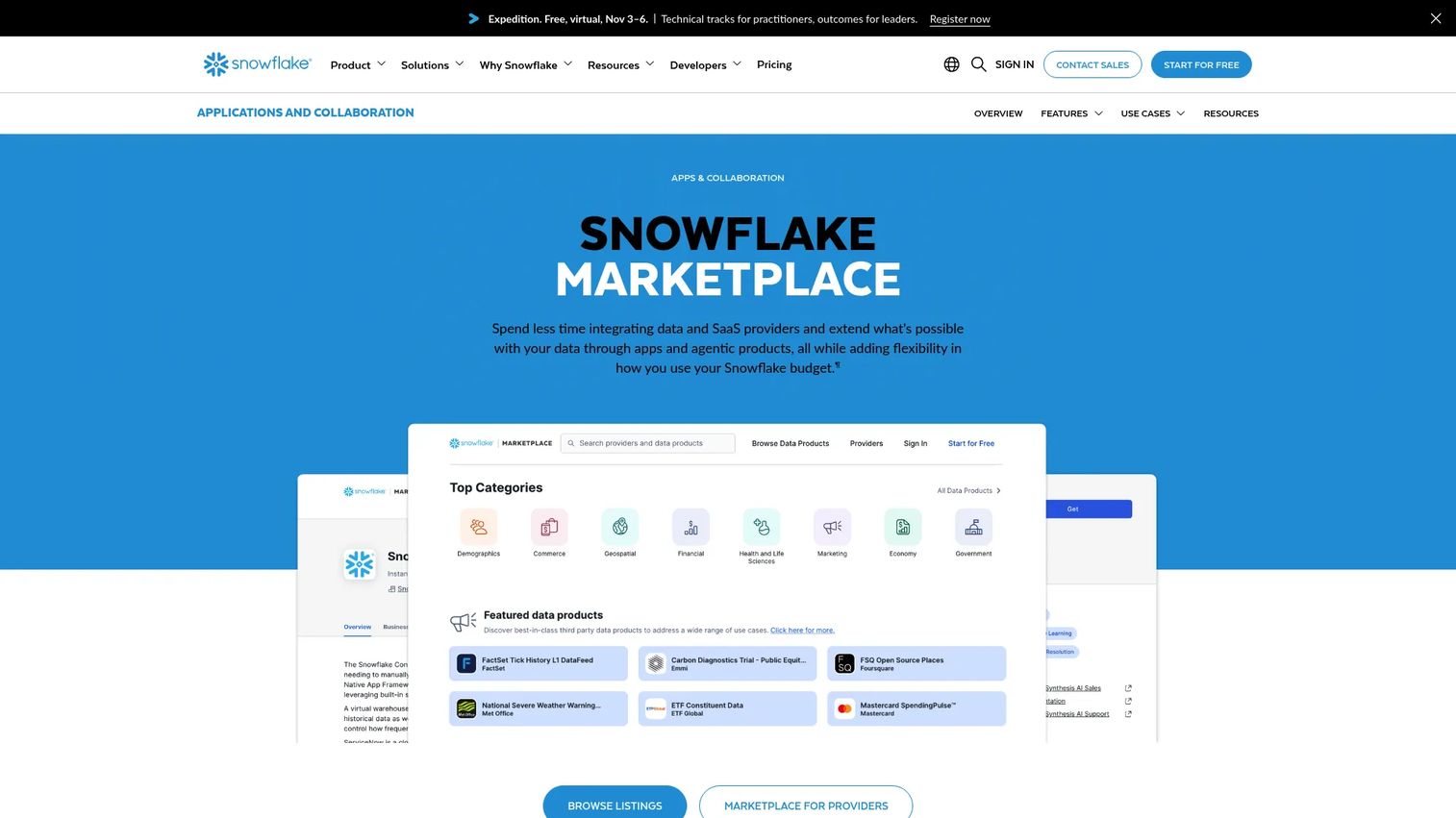
Snowflake Data Sharing and Marketplace allows organizations to share live data across Snowflake accounts without copying or exporting files. The Marketplace extends this model commercially, letting providers list data products that consumers can subscribe to directly. For product managers where data access is part of the product or partner value proposition, Snowflake's sharing model avoids the governance overhead of traditional file-based exchange.
Best for: Analytics and data platform teams that already use Snowflake and want to share governed datasets with customers, partners, or internal consumers without data movement.
Key features
- Secure data shares with revocable, fine-grained access controls
- Private listings for targeted customer or partner distribution
- Marketplace for commercial data product distribution
- Cross-region data sharing with governance controls
- Native App integrations without data leaving governance boundaries
Why choose Snowflake: Snowflake's sharing model removes the latency and duplication costs of file-based exchange, and the Marketplace opens a commercial distribution channel for data products. The model works best when both provider and consumer operate within Snowflake. For teams on other warehouse platforms, the dependency is a meaningful architectural constraint.
Snowflake Data Sharing pricing: Creating shares or private listings carries no direct Snowflake provider charge. Consumers pay for their own compute and storage. Marketplace listings are priced by the individual provider and may be free, subscription-based, or usage-based. Contact Snowflake for volume and cross-region cost estimates.
G2 rating: 4.6/5
4. AWS Data Exchange
AWS Data Exchange is an AWS marketplace service for discovering, subscribing to, and using third-party datasets natively in AWS. Data products are delivered through Amazon S3, Redshift, Lake Formation, and other AWS services. For product managers building analytics, risk, market intelligence, or enrichment workflows, AWS Data Exchange removes the procurement friction of sourcing external data.
Best for: Analytics and data engineering teams that use AWS services and want to incorporate commercial third-party data into existing pipelines without custom ingestion work.
Key features
- Third-party data subscriptions across files, APIs, Amazon Redshift, and Lake Formation
- Automatic retrieval of new data revisions from subscribed providers
- Private products and private offers for custom data arrangements
- CloudTrail auditing for subscription and access events
- Integration with Amazon S3, Athena, SageMaker, and Glue
Why choose AWS Data Exchange: The platform removes procurement and ingestion overhead for external data products when your environment is already AWS. It is not a general-purpose integration platform or a tool for sharing your own data with partners. Teams evaluating best customer data platform options alongside a data exchange strategy will find AWS Data Exchange covers the acquisition side, not the distribution side.
AWS Data Exchange pricing: Data product prices are set by individual providers and vary by listing. Open Data on AWS products are free. Additional charges may apply for connected AWS services including storage and data transfer. Review individual product listings for subscription terms.
G2 rating: 4.2/5
5. MuleSoft Anypoint Platform
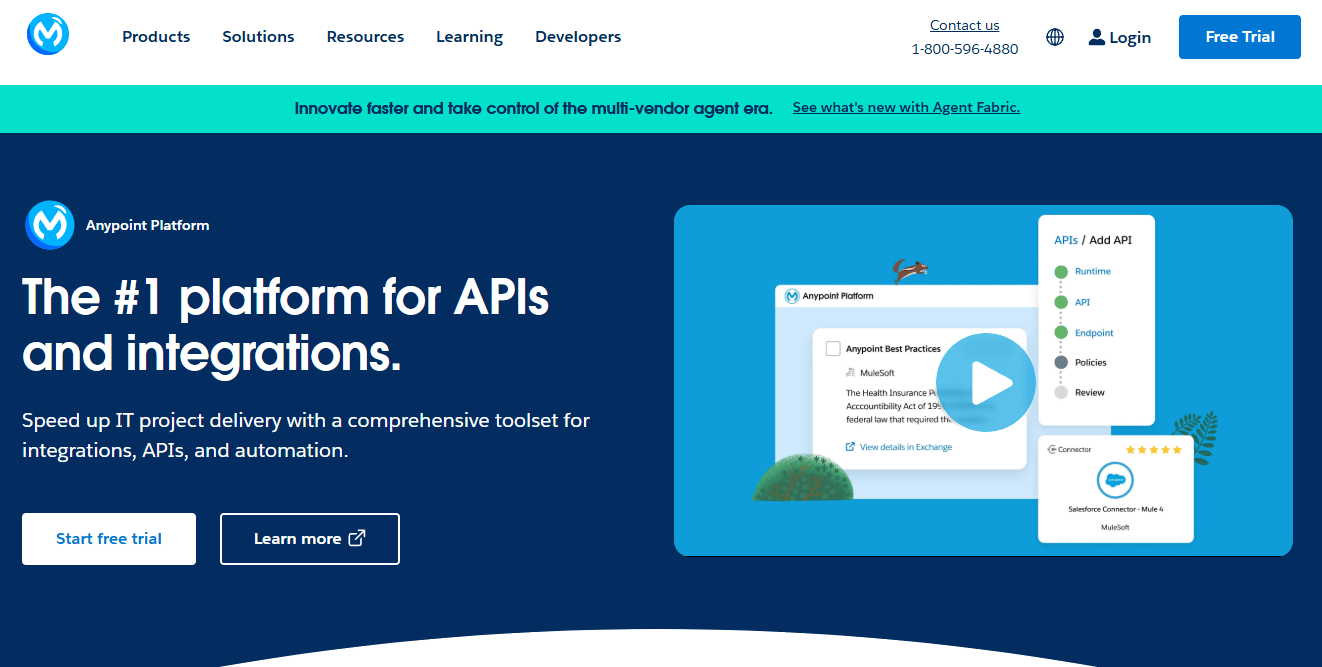
MuleSoft Anypoint Platform is an enterprise integration and API management platform for building, governing, and operating integrations across cloud, on-premises, and hybrid environments. For product managers coordinating integrations across many legacy systems, SaaS tools, and customer-facing APIs, MuleSoft provides reusable integration assets that reduce the opportunity cost of one-off connector builds.
Best for: Large enterprises managing complex API ecosystems across many applications, departments, or customer integration workflows.
Key features
- API design, documentation, testing, and governance
- Integration development with prebuilt connectors and data transformation
- Centralized runtime management and deployment monitoring
- Cloud, hybrid, and on-premises deployment support
- 30-day free trial for evaluation
Why choose MuleSoft: MuleSoft fits best when APIs are central to your product ecosystem and reuse across teams is a concrete objective. Organizations that need api monitoring tools or governed api gateway software at scale will find MuleSoft's governance layer valuable. For smaller integration scopes, the platform's depth and cost may exceed the requirement.
MuleSoft Anypoint Platform pricing: MuleSoft offers Integration Starter, Integration Advanced, and API Management Solution packages. All require contacting sales for pricing. A 30-day free trial is available. G2 reviewers report that annual commitments typically run into the tens of thousands.
G2 rating: 4.5/5
6. Boomi
Boomi is a low-code integration platform for connecting applications, data, APIs, and AI systems across cloud and on-premises environments. Its visual builder and prebuilt connector library cover a wide range of SaaS applications and database sources, making it accessible to operations and IT teams without deep engineering resources. Boomi also includes B2B integration and API management as core capabilities rather than add-ons.
Best for: Mid-market and enterprise teams that need operational integration across SaaS applications, databases, and B2B partner workflows without heavy custom development.
Key features
- Visual low-code integration builder
- Prebuilt connector library across SaaS apps and databases
- API management and design capabilities
- B2B integration with EDI and document transformation
- Hybrid deployment across cloud, on-premises, and edge environments
Why choose Boomi: Boomi's advantage is breadth without requiring specialist developers for routine integrations. The platform spans application sync, data management, and B2B exchange in a single toolset. Teams that need a narrower scope, such as pure warehouse ingestion, will find Fivetran or Airbyte more focused for that job.
Boomi pricing: A 30-day free trial is available. Pay-as-you-go starts at $99 per month plus usage, billed monthly. Subscription plans with higher volume and feature entitlements require contacting sales.
G2 rating: 4.5/5
7. Informatica Intelligent Data Management Cloud
Informatica Intelligent Data Management Cloud (IDMC) is a broad data management platform covering integration, quality, governance, metadata, lineage, and master data management. For product managers whose data trust problems affect customer reporting, regulated product workflows, or multi-domain analytics, Informatica adds governance and lineage alongside integration, rather than treating them as separate concerns.
Best for: Enterprise teams running complex multi-cloud or hybrid data programs where data quality, lineage, and governance are as important as pipeline throughput.
Key features
- Cloud data integration and engineering workflows
- Data quality profiling and monitoring
- Data catalog with metadata management and lineage
- Master data management across product, customer, and operational domains
- Data governance, access controls, and privacy classification
Why choose Informatica: Informatica makes the most sense when data trust is a cross-organizational problem, not just a pipeline problem. Teams evaluating ai governance tools alongside their data platform often find Informatica's governance layer addresses compliance and auditability requirements that narrower tools skip. Organizations that need only basic ingestion will find the platform more complex than their requirements warrant.
Informatica IDMC pricing: Informatica uses consumption-based pricing measured in Informatica Processing Units (IPUs). Charges accumulate across eligible cloud services as they are used. Request a quote from Informatica for a volume-based estimate.
G2 rating: 4.2/5
8. Fivetran
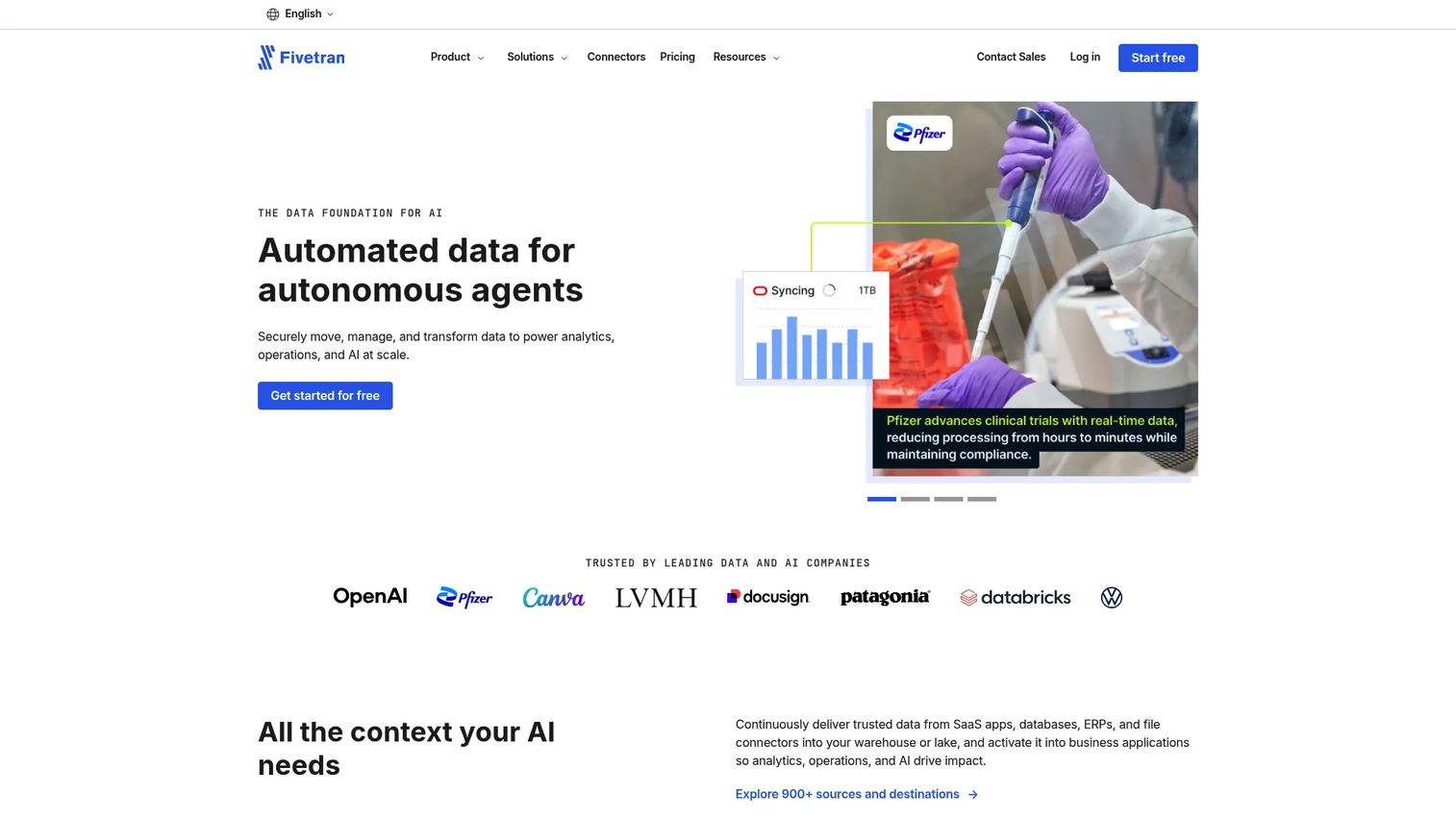
Fivetran is a managed data movement platform that automates pipeline maintenance, schema-change handling, and incremental syncs from SaaS applications and databases into warehouses and lakehouses. For product and data teams whose primary goal is reliable, current data in a warehouse, Fivetran removes the engineering overhead of building and maintaining connectors.
Best for: Data and analytics teams that need low-maintenance, high-reliability pipelines from SaaS apps and databases into a warehouse, without writing or maintaining connector code.
Key features
- Managed connectors with automated incremental syncs
- Change data capture and delete detection for database sources
- Schema drift handling with configurable responses
- SQL-based transformations and reverse ETL activations
- Data blocking and column hashing for sensitive fields
Why choose Fivetran: Fivetran's value is time to first reliable pipeline. Teams that need a connector for Salesforce, Stripe, or a Postgres database can be running in hours rather than weeks. If your sources are uncommon or internal, Fivetran's connector library may not cover them, in which case Airbyte's open-source framework gives more flexibility.
Fivetran pricing: A free tier covers up to 500,000 Monthly Active Rows and 5,000 model runs. Paid usage applies a $5 base charge per standard connection generating between 1 and 1 million MAR monthly, with higher-volume connectors priced by usage. Enterprise and Business Critical plans are usage-based; contact Fivetran for specifics.
G2 rating: 4.4/5
9. Airbyte
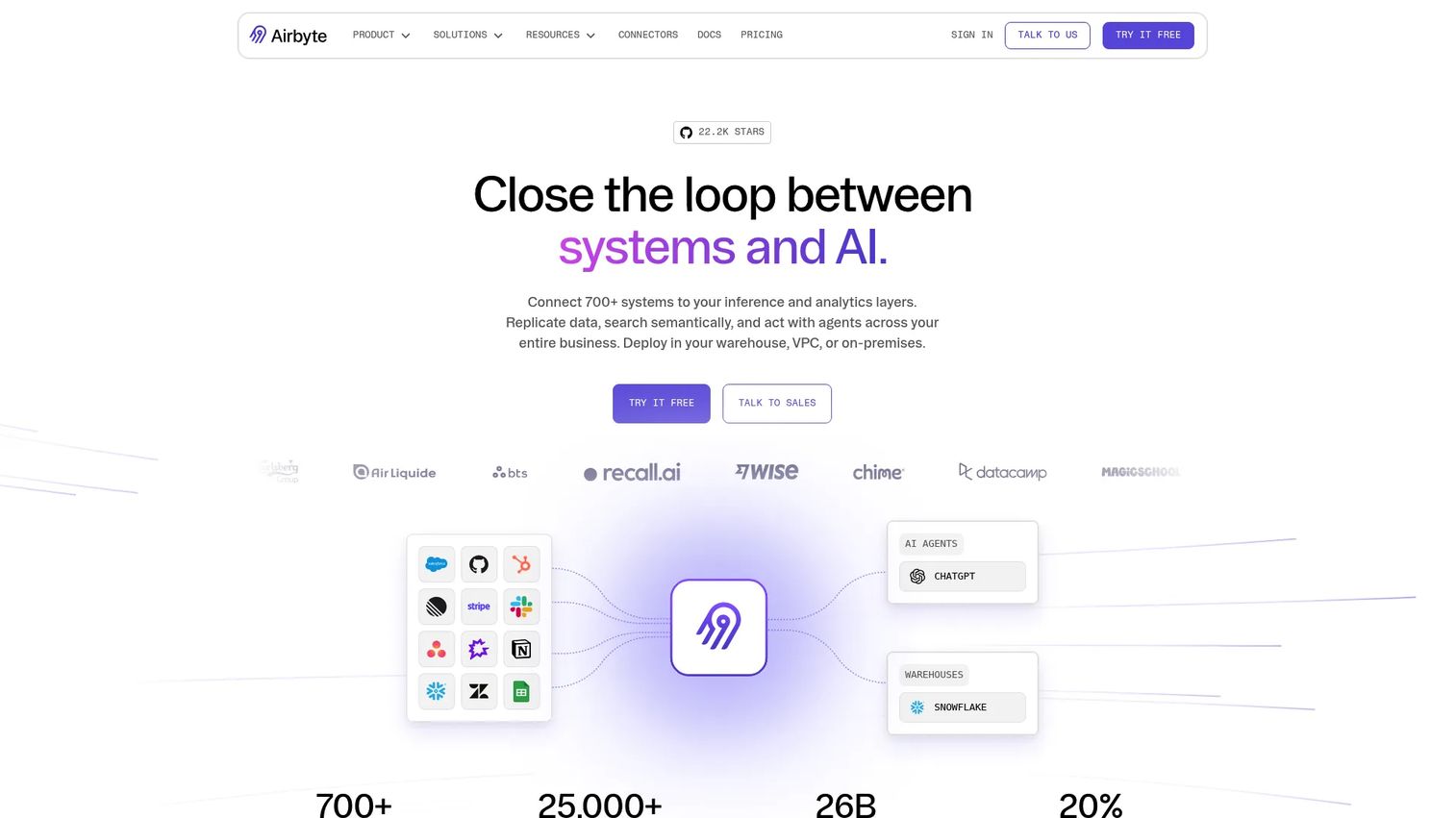
Airbyte is an open-source data replication and integration platform with over 700 connectors and full flexibility on deployment model. Teams can run Airbyte in their own infrastructure, use the managed cloud version, or combine both with Enterprise Flex for sovereign data movement. For product and data teams that need to integrate unusual sources, internal systems, or AI data pipelines, Airbyte's Connector Builder covers ground that managed platforms leave out.
Best for: Technical data teams with uncommon sources, internal system integrations, or a need to own and extend connector logic.
Key features
- 700+ connectors for sources, destinations, and AI systems
- No-code Connector Builder for custom source development
- Change data capture and full database replication
- Cloud, self-managed, hybrid, and on-premises deployment
- Terraform Provider and integrations with Airflow, Dagster, and Prefect
Why choose Airbyte: Airbyte's open-source foundation means you can build a connector for any source, which matters when your product relies on internal APIs or legacy systems. The trade-off is that self-managed deployments require real engineering ownership. Teams that want zero maintenance should look at Fivetran instead. For teams exploring api documentation tools alongside integration strategy, Airbyte's API-first architecture is compatible with most documentation workflows.
Airbyte pricing: Standard starts at $10 per month and uses volume-based pricing. Pro uses capacity-based pricing; contact sales. Enterprise Flex uses custom pricing for sovereign or on-premises deployment.
G2 rating: 4.4/5
10. Confluent
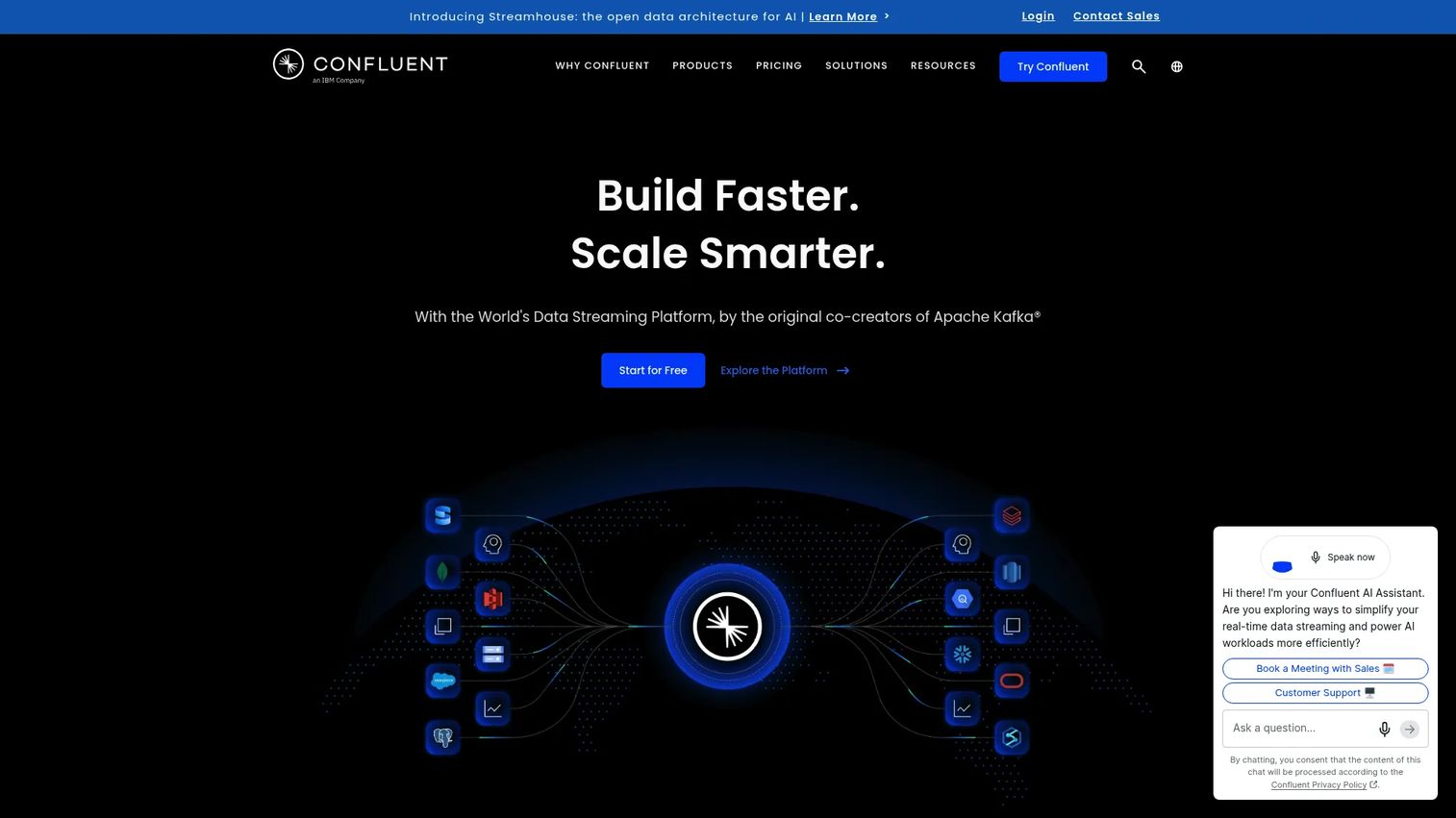
Confluent is a managed data streaming platform built on Apache Kafka. It handles real-time event ingestion, stream processing with Apache Flink, and stream governance for organizations that need continuous data delivery rather than scheduled batch updates. For product managers where data freshness is part of the user experience or commercial model, Confluent makes streaming operationally maintainable at scale.
Best for: Engineering and data teams that need scalable, real-time event streaming for product telemetry, fraud detection, usage-based billing, or operational alerting.
Key features
- Fully managed Apache Kafka clusters with automated operations
- Apache Flink stream processing for real-time transformations
- Stream Governance with schema registry and data lineage
- Managed Kafka connectors for sources and sinks
- Enterprise security including RBAC, encryption, and audit logs
Why choose Confluent: Confluent fits when batch pipelines introduce business or user-facing risk. The platform is not a replacement for ELT tools in analytics-focused workflows; it is the right layer when your product depends on events that must arrive in near real-time. Teams evaluating api monitoring tools for streaming pipelines will find Confluent's built-in observability covers many of the same needs.
Confluent pricing: The Basic cluster tier starts at $0 per month (estimated starting cost; usage-based charges apply). Standard is approximately $385 per month, Enterprise approximately $895 per month, and Freight at $2,300 per month. Connectors, compute, storage, and governance each carry separate usage-based charges.
G2 rating: 4.4/5
11. Cleo Integration Cloud
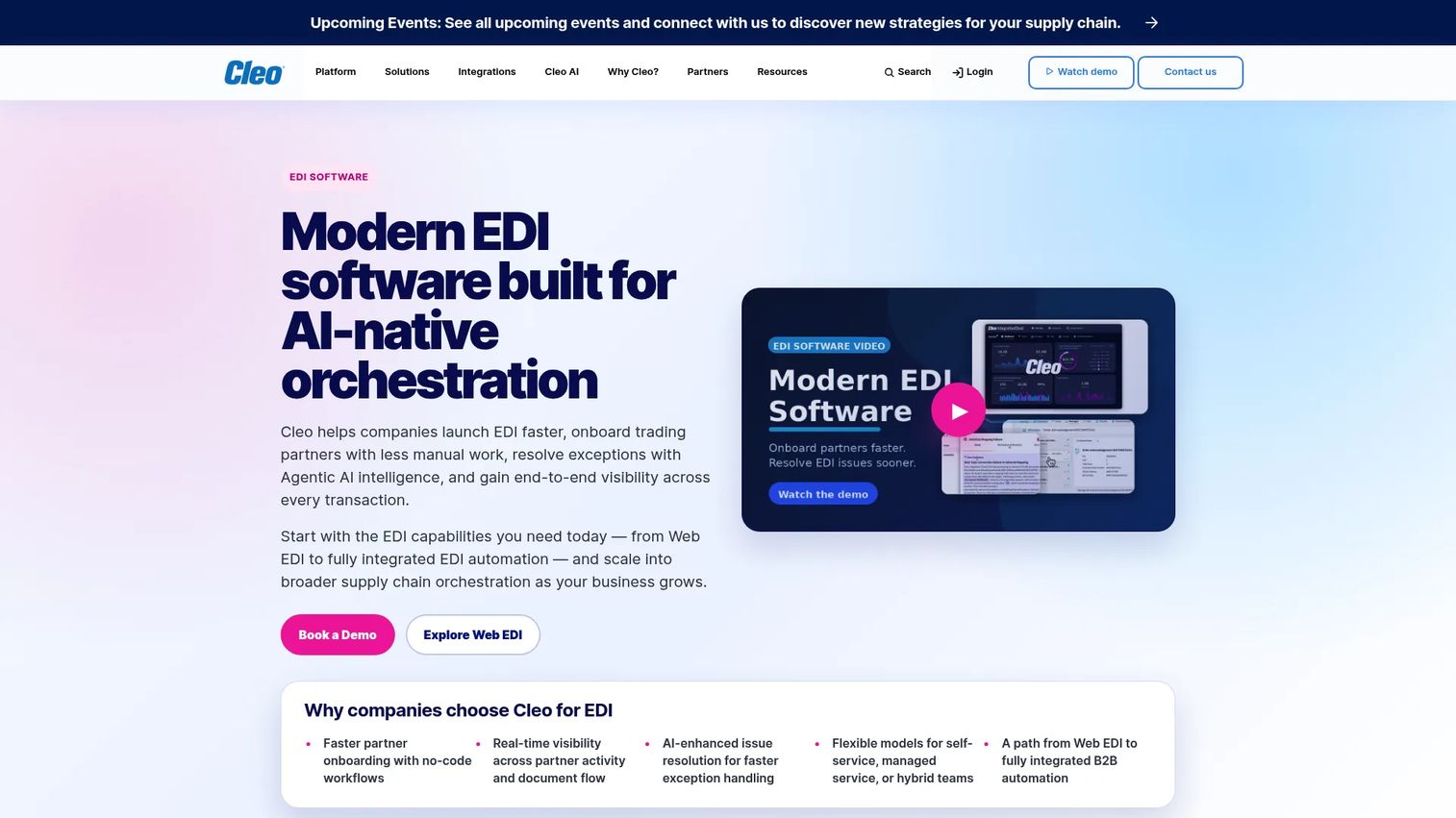
Cleo Integration Cloud is an ecosystem integration platform purpose-built for EDI, B2B partner management, API integration, and supply-chain workflows. It serves manufacturing, retail, logistics, and healthcare organizations that need to onboard trading partners and maintain high-volume document flows reliably. For product managers whose partner onboarding timelines directly affect time to revenue, Cleo's no-code partner management and reusable workflow templates reduce that friction.
Best for: Organizations in manufacturing, retail, logistics, or healthcare that manage high-volume EDI and B2B partner workflows as a core operational requirement.
Key features
- EDI integration across X12, EDIFACT, and other standard formats
- No-code trading-partner onboarding with reusable workflows
- API and file-transfer integration alongside EDI in a single platform
- Real-time transaction and partner visibility dashboards
- AI-enhanced exception management for operational anomalies
Why choose Cleo: Cleo's strength is the depth of its EDI and partner management layer, which general iPaaS platforms treat as an edge case. For supply-chain and partner-dependent revenue workflows, that depth matters. Teams primarily focused on SaaS-to-warehouse data movement or internal application sync will find Boomi or Fivetran more aligned. For background on managing partner ecosystems, best partner ecosystem platforms covers adjacent tooling.
Cleo Integration Cloud pricing: Custom pricing configured to ecosystem scale and complexity. Contact Cleo for a quote.
G2 rating: 4.4/5
12. DataMotion
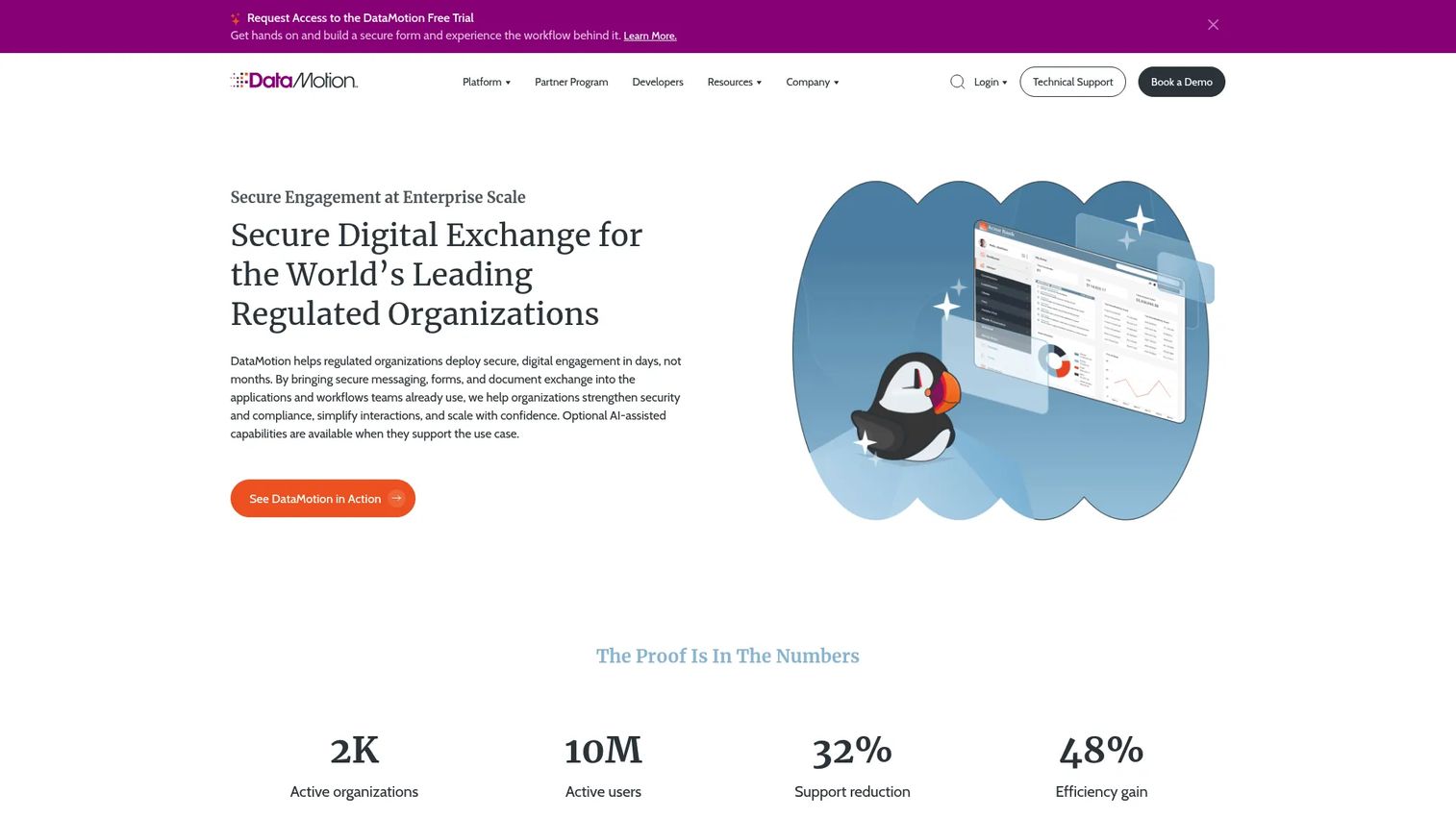
DataMotion provides secure, compliant messaging, encrypted email, forms, and document exchange for regulated industries including healthcare, financial services, and public sector. Its platform embeds secure communication workflows into existing portals, CRMs, and productivity tools rather than requiring recipients to adopt a separate system. For product managers whose data exchange requirements center on secure delivery and auditability rather than volume throughput, DataMotion addresses the identity and compliance layer directly.
Best for: Regulated organizations in healthcare, financial services, or government that need auditable, encrypted exchange of messages, forms, and documents across organizational boundaries.
Key features
- End-to-end encrypted email and document delivery
- Secure forms with encryption, tracking, and receipt confirmation
- Secure messaging embedded in portals, CRMs, and contact centers
- Reporting, analytics, and full audit trails per exchange
- Integrations with Microsoft 365, Outlook, Teams, Dynamics 365, Salesforce, and Google Workspace
Why choose DataMotion: DataMotion solves a specific problem: Getting sensitive data to a named recipient with proof of delivery and audit trail, without exposing it in transit. It is not a high-throughput pipeline tool or a warehouse integration platform. For regulated workflows where identity verification and controlled delivery are the primary requirements, it addresses a gap that general-purpose platforms leave open.
DataMotion pricing: Contact DataMotion directly for pricing. G2 reviewers do not report a range, and the vendor's pricing page was not publicly accessible at time of verification.
G2 rating: 5.0/5
Considerations when choosing a data exchange platform
Match the platform to your exchange model
The single most common mistake is selecting a platform category before defining the delivery pattern. Identify whether you are sharing files, calling APIs, streaming events, sharing warehouse tables, or exchanging B2B documents. A team that answers "warehouse tables" should not evaluate an EDI platform. A team that answers "EDI with 300 trading partners" should not evaluate a batch ELT tool.
Define the operating owner before implementation
Clarify who owns connector updates, schema changes, failed deliveries, vendor relationships, and access reviews. Data exchange platforms do not run themselves. A system without a named owner accumulates silent data debt, and the bill arrives when a partner workflow breaks in production or a security reviewer asks who approved a data flow six months ago.
Measure reliability, not initial setup speed
Require metrics for freshness, failure rate, mean time to detect, mean time to recover, and schema-change response from any vendor you evaluate. The first successful connection is not evidence of production reliability. Teams tracking best data visualization tools alongside their pipeline work need upstream data they can trust before visualization adds value.
Review governance at field level
Evaluate encryption in transit and at rest, role-based access, field-level masking, audit logs, data residency controls, and retention policies. Vague claims about certifications are not substitutes for specific answers to: Which fields does PII appear in, and who can read them, in which environment?
Price for data volume and operating behavior
Costs on consumption-based platforms scale with records, connectors, compute, throughput, API calls, and managed environments. Get a usage estimate based on your actual data volumes before signing, not an entry-tier headline figure. The entry price on many platforms in this list reflects minimal usage, not the operational volume a product integration actually generates.
Conclusion
The right data exchange platform depends on the exchange pattern, not the vendor's marketing category. IBM Sterling and Cleo Integration Cloud fit B2B, EDI, and partner document workflows. Azure Data Share, Snowflake, and AWS Data Exchange fit cloud-based data sharing and commercial data product distribution. MuleSoft and Boomi fit broad enterprise integration across many applications. Fivetran and Airbyte cover warehouse-oriented data movement, with Fivetran prioritizing managed reliability and Airbyte prioritizing connector flexibility. Confluent fits streaming and event-driven architectures where latency matters. DataMotion fits secure, auditable delivery in regulated environments.
Start with one concrete exchange workflow. Define what data is moving, who receives it, how fresh it must be, who owns it after launch, and what security controls are non-negotiable. Score platforms against those requirements rather than against a generic feature checklist. That process surfaces the right shortlist faster than any ranking.
Start your journey with Guideflow today!
FAQs
A data exchange platform is a software system for moving, sharing, synchronizing, or governing data between applications, cloud environments, external partners, and data consumers. The category covers multiple platform types including cloud data sharing, API integration, managed file transfer, event streaming, and B2B document exchange. Choosing the right type requires understanding the delivery pattern first.
ETL and ELT tools primarily move and transform data from sources into analytics destinations such as warehouses or lakehouses. Data exchange platforms address a broader set of patterns including API-based integration, B2B and EDI document flows, event streaming, and governed sharing without data movement. Many modern ELT tools like Fivetran and Airbyte overlap with data exchange for warehouse use cases, but they are not substitutes for B2B integration or streaming platforms.
The answer depends on the recipient, the file size, the identity model, and the audit requirements. DataMotion fits regulated workflows where encrypted delivery and receipt confirmation matter. IBM Sterling and Cleo Integration Cloud fit high-volume partner file transfer using EDI and SFTP. Azure Data Share and Snowflake fit internal or partner sharing of structured datasets within cloud environments.
Confluent is the strongest option for continuous event streaming based on Apache Kafka. For near-real-time sync from databases, Fivetran and Airbyte support change data capture, which reduces latency compared to scheduled batch pulls. The right choice depends on whether you need true streaming (sub-second delivery) or near-real-time sync (minutes). Batch pipelines are not a substitute when the product experience or commercial model requires current state.
Handling varies by platform. Fivetran detects schema changes automatically and can add new columns, flag breaking changes, or pause a pipeline depending on configuration. Airbyte offers configurable schema change policies. Streaming platforms like Confluent use a schema registry to version and validate schemas before events reach consumers. Regardless of the platform, schema changes require a defined operating process: Who is alerted, who approves the change, and whether downstream consumers need coordination.
Yes. API-based platforms like MuleSoft and Boomi support customer-facing integrations directly through managed APIs. Snowflake's sharing model lets customers access governed data products within their own Snowflake environment. AWS Data Exchange supports external data distribution. The platform choice should align with your product API strategy, support model, and the technical capability of your customers. Some integrations require your customer to have an account on the same platform.
At minimum: Encryption in transit and at rest, authentication via OAuth or SAML, role-based access control, field-level masking for sensitive data, audit logs with timestamps and user attribution, and configurable data retention. For regulated industries, add data residency controls, regional storage options, and a clear data-processing agreement. Treat certifications like SOC 2 as a starting point for a conversation, not a final answer.
Track connector setup time from specification to first reliable delivery, integration adoption rate across the partner or internal consumer base, pipeline freshness relative to the agreed SLA, delivery success rate and failure recovery time, support ticket volume related to data issues, and downstream business outcomes tied to the integration. Establish a baseline before launch so you can attribute changes to the platform rather than to seasonal or product factors.