You closed a strong quarter. Two of your best candidates this cycle live in Lisbon and São Paulo. Neither has a local entity you can hire through, and neither wants to be misclassified as a contractor while your finance lead loses sleep over permanent-establishment risk.
That is the moment most founders meet the global employment platform category. Hiring across borders used to mean either opening a foreign entity (months of legal cost) or stretching contractor agreements past their breaking point. A global employment platform sits in between: it becomes the legal employer in-country, runs payroll in local currency, handles statutory benefits, and keeps you compliant with labor law you have no intention of learning.
The pressure is structural, not optional. Over 70% of organizations now maintain cross-border teams, a shift attributed in part to the adoption of these platforms, according to AgileHRO (2026). The market is moving with that demand. Mordor Intelligence (2024) projects the employment platform market to reach USD 50.75 billion in 2026 and USD 109.29 billion by 2031, a 16.58% CAGR.
For a founder, the real question is not whether you need this infrastructure. It is which platform fits your operating model without becoming another tool nobody owns. The same evaluation discipline you would apply to contract lifecycle management software or a customer data platform applies here: coverage, compliance depth, integrations, and how cleanly it hands off to a functional leader.
What's inside
This guide is for founders and operators choosing a global employment platform to hire, pay, and stay compliant across borders without opening entities. We focused on platforms that handle the core jobs: employer of record (EOR) coverage, global payroll, contractor management, and compliance. We selected and compared the eight based on four criteria that matter at scale: country coverage and entity-free hiring, compliance and payroll depth, integration fit with your HRIS and finance stack, and operational visibility across a distributed workforce. Pricing and G2 ratings reflect verified, first-party figures where available.
TL;DR
- Best for enterprise-grade compliance breadth: G-P, with hiring across 180+ countries and AI compliance guidance.
- Best for employee-experience-first hiring: Oyster, built around distributed teams and a clean EOR motion.
- Best for payroll consolidation across many countries: Lano, strong on multi-country payroll and contractor payments.
- Best for a balanced HR, payroll, and EOR platform: Remote, with a free HR tier and broad product coverage.
- Best for fast multi-country expansion: WorkMotion, focused on EOR and direct hiring with quick onboarding.
- Best when you want employment inside a wider workforce system: Rippling, unifying HR, IT, payroll, and finance.
- Best for high-volume global operations: Deel, with deep product breadth across hiring, payroll, and contractors.
- Best for payroll-centric workforce orchestration: Papaya Global, built around payments and centralized payroll.
What is a global employment platform?
A global employment platform (sometimes called a global employer organization or global employment company) is software plus in-country infrastructure that lets you hire, pay, and manage workers in countries where you have no legal entity. The platform, or its local partner, becomes the legal employer of record, while your team manages the day-to-day relationship.
It collapses three things that used to be separate projects: entity setup, payroll, and compliance. Instead of registering a subsidiary, you hire through the platform's existing entity network and stay compliant with local labor law, tax administration, and statutory benefits.
Core capabilities most platforms share:
- Employer of record (EOR): Legal employment in-country without your own entity, including localized contracts and onboarding.
- Global payroll: Multi-country payroll, local currency remittance, and tax administration.
- Contractor management: Compliant onboarding, payments, and classification controls for freelancers and contractors.
- Compliance intelligence: Localized employment terms, document generation, and increasingly AI-assisted compliance guidance.
- Workforce data and oversight: Consolidated HRIS or HCM records, reporting, and operational visibility across countries.
- Integrations: Connections into HRIS, payroll, accounting, and finance tools so data flows without manual re-entry.
Buyer behavior backs the category. Permanent employment represents 62.47% of employment platform spend in 2025, while freelance and gig usage grows at a 21.28% CAGR through 2031, per Mordor Intelligence (2024). Most growing companies need both employee and contractor coverage in one place.
When to use a global employment platform
Hire across borders without opening entities
You found the right person in a country where you have no presence. Opening an entity costs months and legal fees you cannot justify for one or two hires. A global employment platform lets you hire compliantly through an existing entity, often in days. This is the most common entry point for cross-border teams.
Reduce compliance and payroll risk
Misclassifying a full-time worker as a contractor creates real liability: back taxes, penalties, and permanent-establishment exposure. Platforms handle localized contracts, statutory benefits, and local currency remittance so payroll accuracy and labor-law complexity stop being your problem. This matters most when finance and legal scrutiny increases ahead of a fundraise.
Centralize workforce operations as you scale
Once you have employees and contractors across several countries, fragmented spreadsheets and local providers break down. A global employment platform consolidates workforce data, onboarding, and payroll into one system with operational oversight your VP of Finance or People lead can actually run. The goal is a repeatable process that does not route through the founder.
Comparison table
Here is how the eight platforms compare on intent, differentiation, verified pricing, and G2 rating. Use it to shortlist two or three before reading the full sections.
| # | Product | Intent | Key differentiation | Pricing | G2 rating |
|---|---|---|---|---|---|
| 1 | G-P | Enterprise global hiring | 180+ country coverage, AI compliance via G-P Gia | Contractor from $39/mo per contractor | 4.4/5 |
| 2 | Oyster | Distributed-team EOR | Employee-experience-first hiring | Contractors from $29/contractor/mo | 4.4/5 |
| 3 | Lano | Payroll consolidation | Multi-country payroll and payments | Payroll from €3/employee/mo | 4.3/5 |
| 4 | Remote | Balanced HR + EOR | Free HR tier, broad product range | HR Management free; EOR from $599/employee/mo | 4.5/5 |
| 5 | WorkMotion | Fast expansion | EOR and direct hiring in 160+ countries | EOR from €499 per talent/mo | 4.6/5 |
| 6 | Rippling | Unified workforce system | HR, IT, payroll, finance in one | Per-employee, per-month (quote-based) | 4.8/5 |
| 7 | Deel | High-volume operations | Deep product breadth across hiring and payroll | Payroll from $29/employee/mo; EOR from $599 | 4.8/5 |
| 8 | Papaya Global | Payroll orchestration | Payments-first global payroll | Payments OS from $3.50/transaction | Not listed |
1. G-P
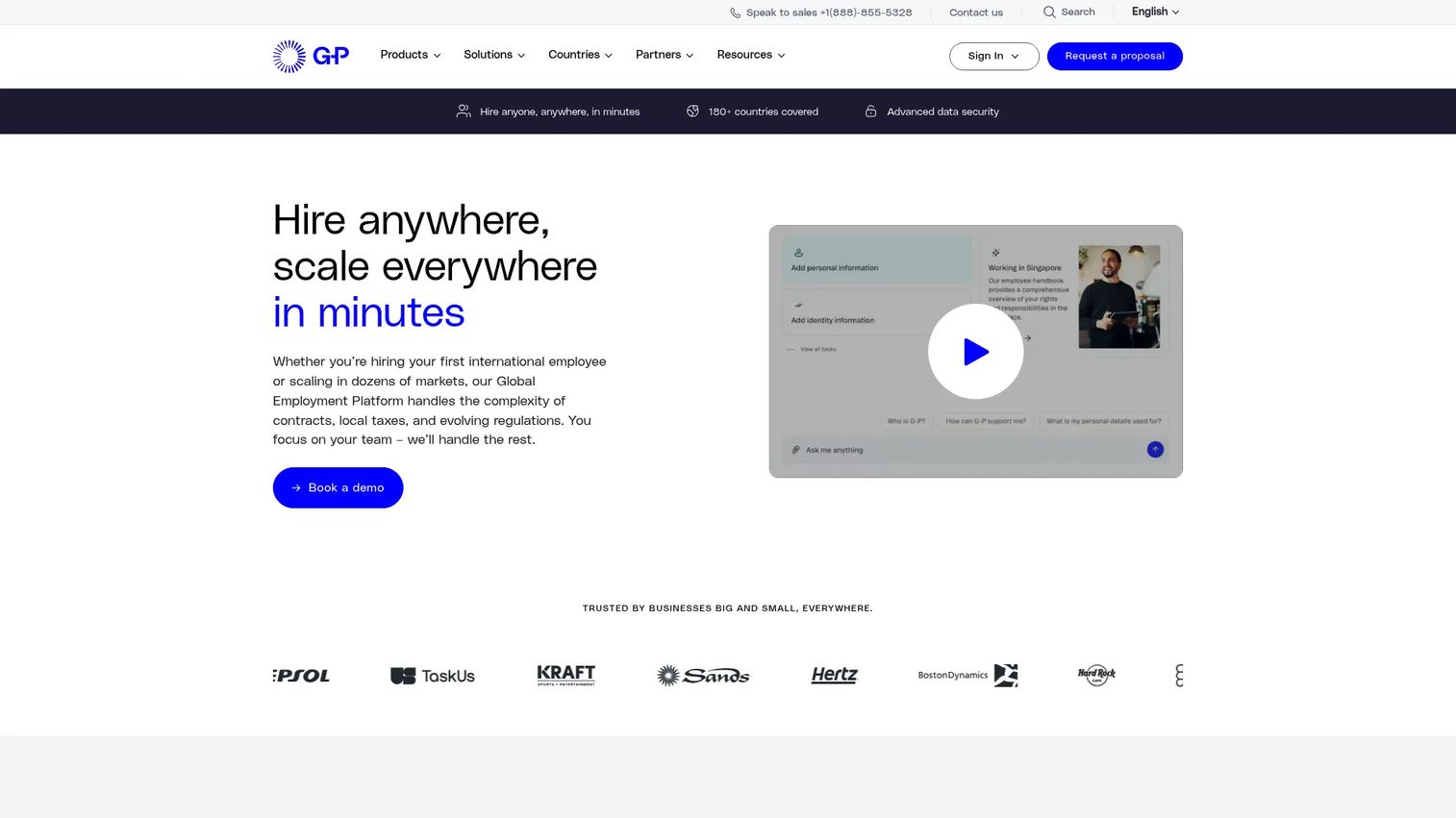
G-P (formerly Globalization Partners) is one of the most established names in the category and often the benchmark for enterprise-grade global hiring. It supports hiring and onboarding across 180+ countries, handles contractor management and payments, and layers in G-P Gia, its AI-powered HR and compliance guidance. For founders who want compliance depth before everything else, G-P sets the bar.
Best for: Companies hiring, paying, and managing global employees and contractors who prioritize compliance breadth.
Key strengths
- 180+ country coverage: Hire and onboard internationally through an established entity network with localized contracts.
- Contractor management: Onboard and pay contractors alongside employees in one system.
- G-P Gia compliance AI: AI-assisted guidance for HR and compliance questions across jurisdictions.
Why choose G-P: If your buying trigger is risk reduction ahead of a raise or an expansion into a regulated market, G-P's depth and country footprint are hard to match. It reads as the safe, enterprise-credible choice that survives board and due-diligence scrutiny.
G-P pricing: Public first-party pricing is shown for some products. G-P Contractor starts at $39 per month per contractor. G-P Gia is offered at $199 (Essential) and $499 (Unlimited) per user per month, and the site notes Gia is available at no cost during beta. Core EOR pricing is not publicly listed and is quoted by sales. There is no free tier for the core platform.
2. Oyster
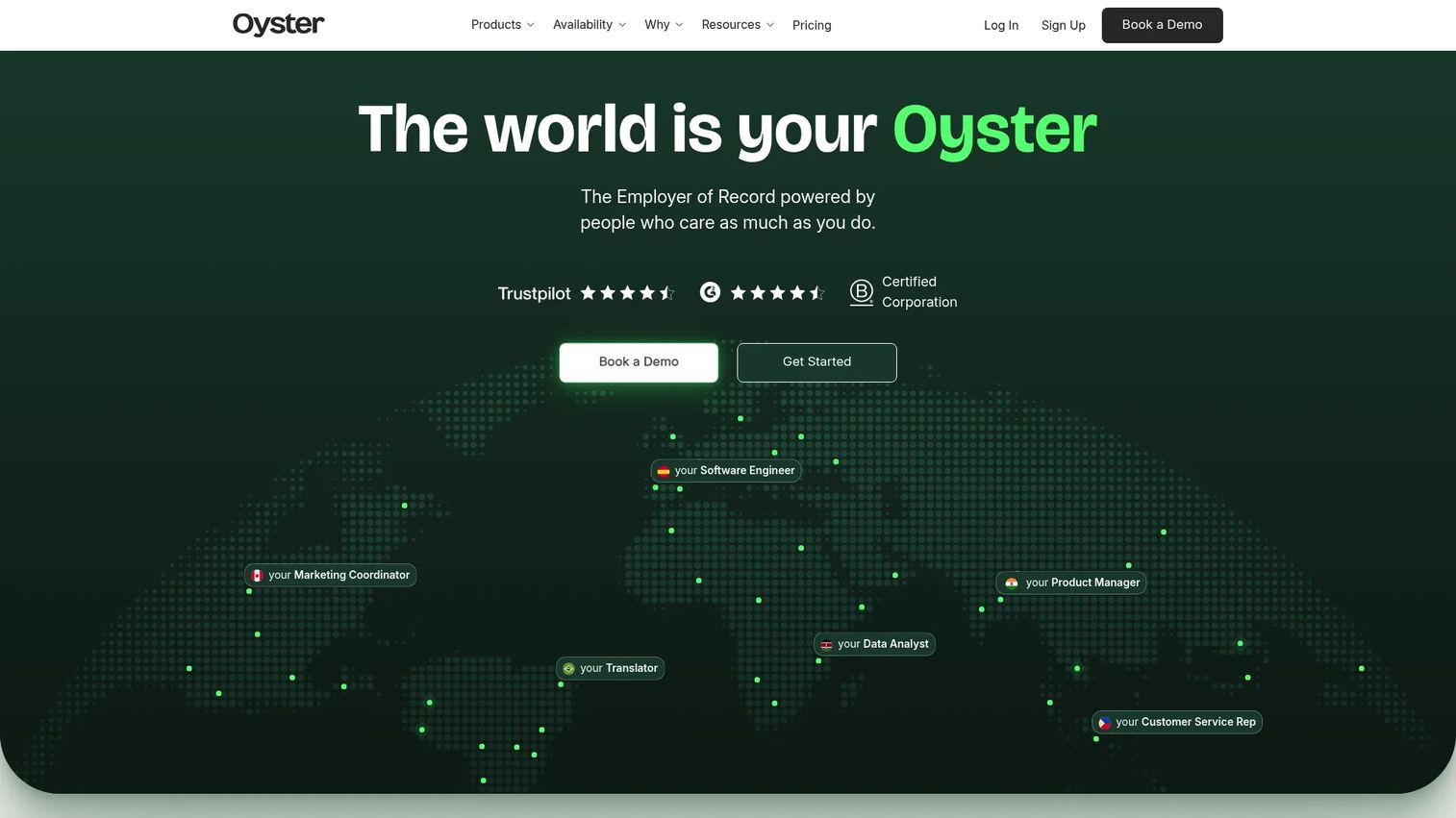
Oyster is built around hiring, paying, and managing distributed teams without setting up local entities. It offers EOR hiring in 180+ countries, global contractor management and payments, plus US PEO and People Partner Services. Oyster leans hard into the employee-experience side of international hiring, which resonates with founders who treat talent brand as a competitive edge.
Best for: Companies hiring employees or contractors internationally without local entities, with a focus on a clean candidate and employee experience.
Key strengths
- EOR in 180+ countries: Broad entity-free hiring with localized employment handled for you.
- Contractor management: Compliant onboarding and payments for global contractors.
- US PEO and People Partner Services: Domestic PEO coverage plus on-demand people expertise.
Why choose Oyster: Oyster fits founders who want international hiring to feel simple and human, not bureaucratic. The breadth across EOR, contractors, and PEO means one platform can cover most of your headcount as you scale distributed teams.
Oyster pricing: Global Contractors are free for 30 days, then USD 29 per contractor per month. US PEO runs USD 114 per employee per month, and People Partner Services is USD 300 per hour. The homepage lists Employer of Record at USD 699 per employee per month. Free account sign-up is available, and pricing is positioned as predictable.
3. Lano
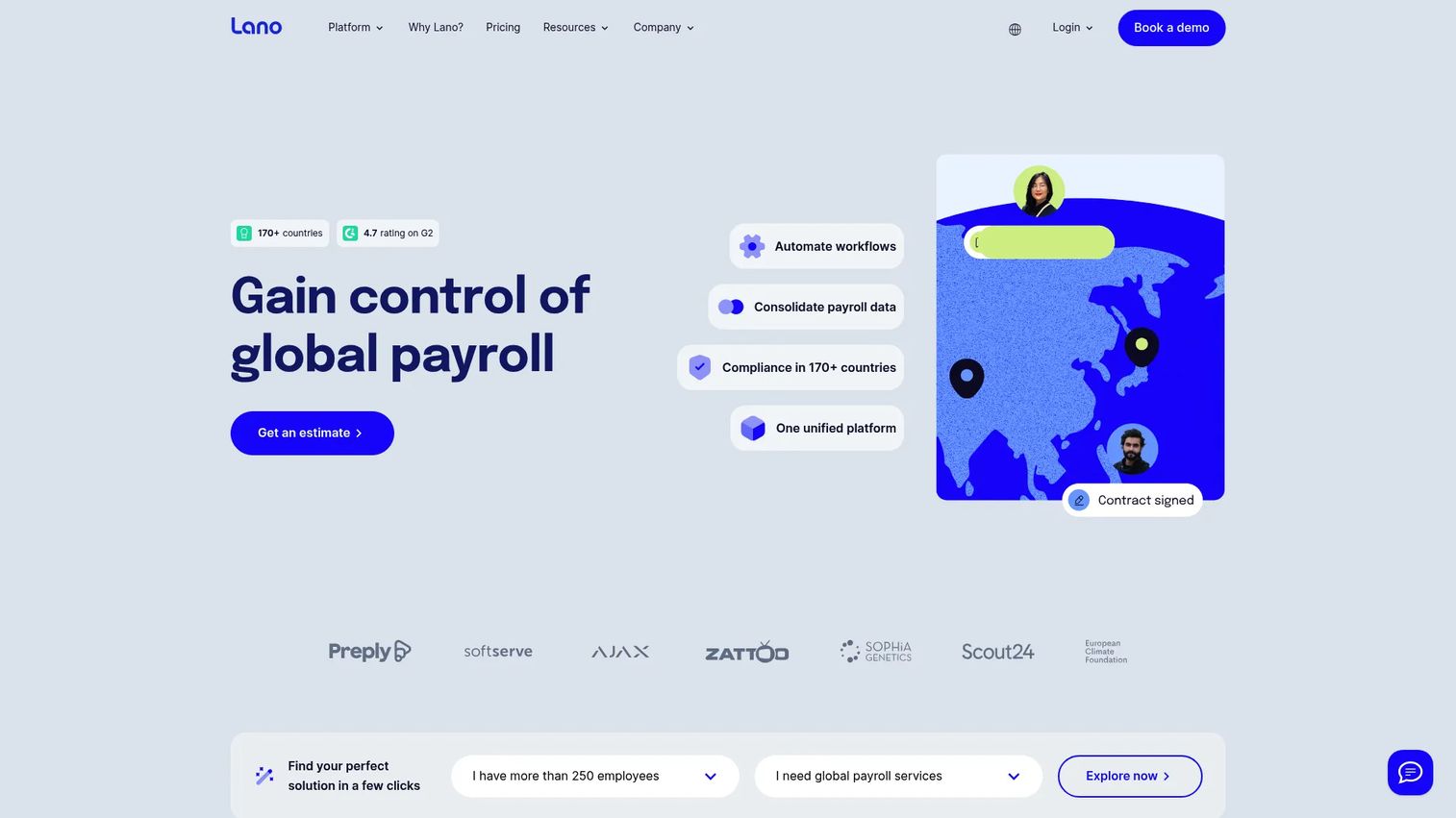
Lano is a global payroll, employer-of-record, contractor management, and payments platform aimed at mid-market companies running operations across multiple countries. Its strength is payroll: consolidation, multi-country payroll, and integrated payments under one roof. For leaders who want clearer visibility across a distributed workforce, Lano centralizes the messy parts.
Best for: Mid-market companies managing global payroll, hiring, and contractor payments across multiple countries.
Key strengths
- Payroll consolidation: Bring fragmented country payrolls into a single view.
- Multi-country payroll: Run payroll across jurisdictions with local compliance built in.
- Employer of record: Entity-free hiring with localized employment handled by Lano.
Why choose Lano: If payroll fragmentation is your real pain, not just headcount, Lano is built for it. Integrated payments across all plans and a tailored-proposal model mean pricing flexes with your country mix and team size.
Lano pricing: First-party pricing starts at €3 per employee per month for payroll consolidation, €19 per employee per month for multi-country payroll, €499 per employee per month for employer of record, and €19 per contractor per month for contractor management. Integrated Payments is included across plans, and Lano also offers tailored proposals based on team size, countries, and services.
4. Remote
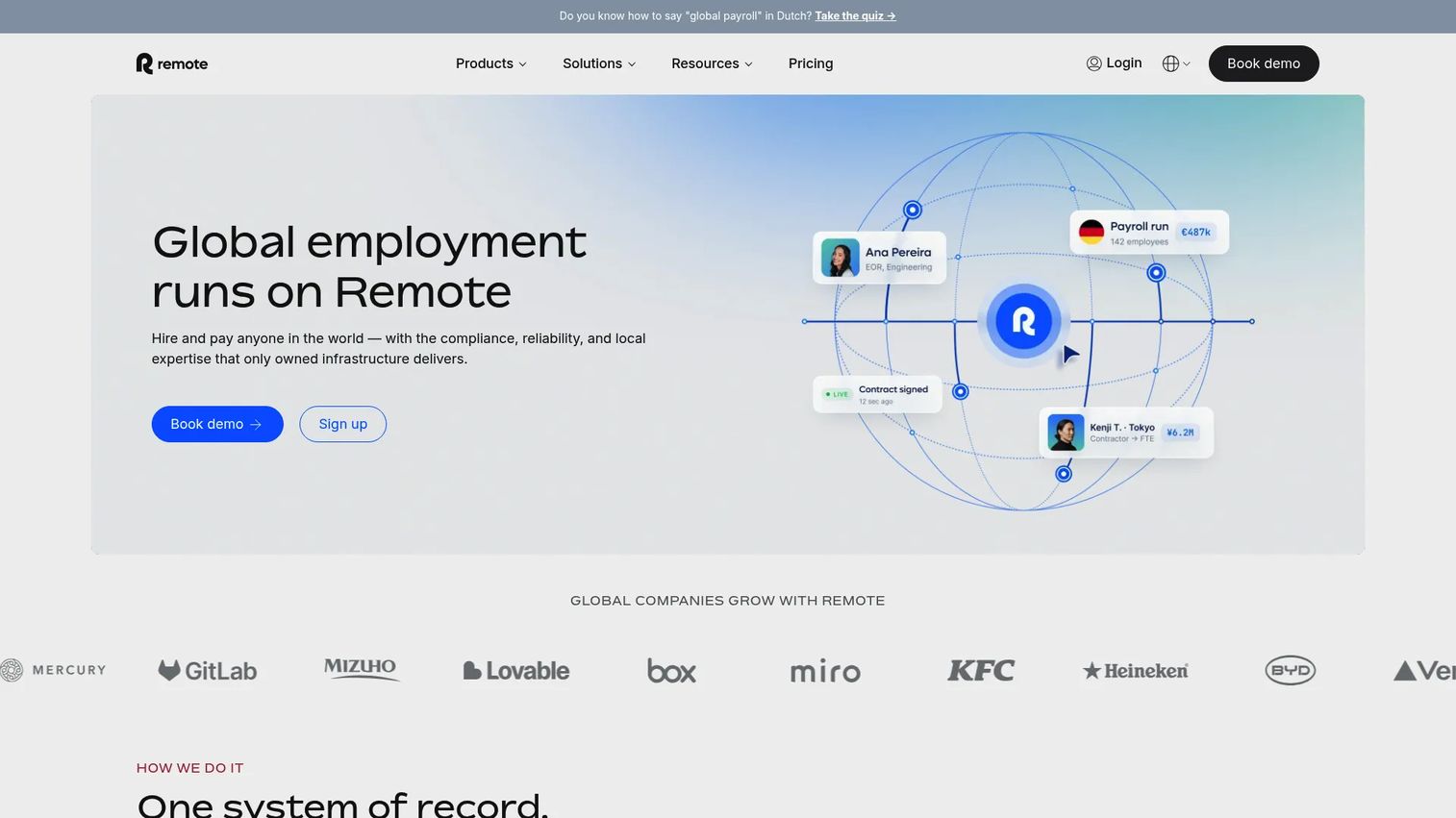
Remote is a global HR, payroll, contractor, and EOR platform for hiring and managing distributed teams. It covers EOR in 90+ countries, global payroll, contractor management including Contractor of Record, and a built-in HRIS. The free HR Management tier for direct employees makes Remote one of the easier platforms to adopt incrementally.
Best for: Companies hiring, paying, and managing distributed employees and contractors who want a balanced, modular platform.
Key strengths
- EOR in 90+ countries: Entity-free employment with localized contracts and compliance.
- HR Management / HRIS: A free HR layer for direct employees, useful as a starting point.
- Contractor of Record: Shifts contractor classification risk onto the platform.
Why choose Remote: Remote's modular pricing lets you start free on HR and add EOR, payroll, or contractor management as you grow. That stage-friendly approach suits founders who want to prove value before committing budget across the board.
Remote pricing: HR Management is free for direct employees. Recruit is $199 per month. Employer of Record is $599 per employee per month billed annually, or $699 monthly. Payroll and Contractor Management each start at $29 per employee or contractor per month, Contractor Management Plus is $99, Contractor of Record starts from $325, PEO starts from $99 per employee per month, and Equity starts from $39 per month.
5. WorkMotion
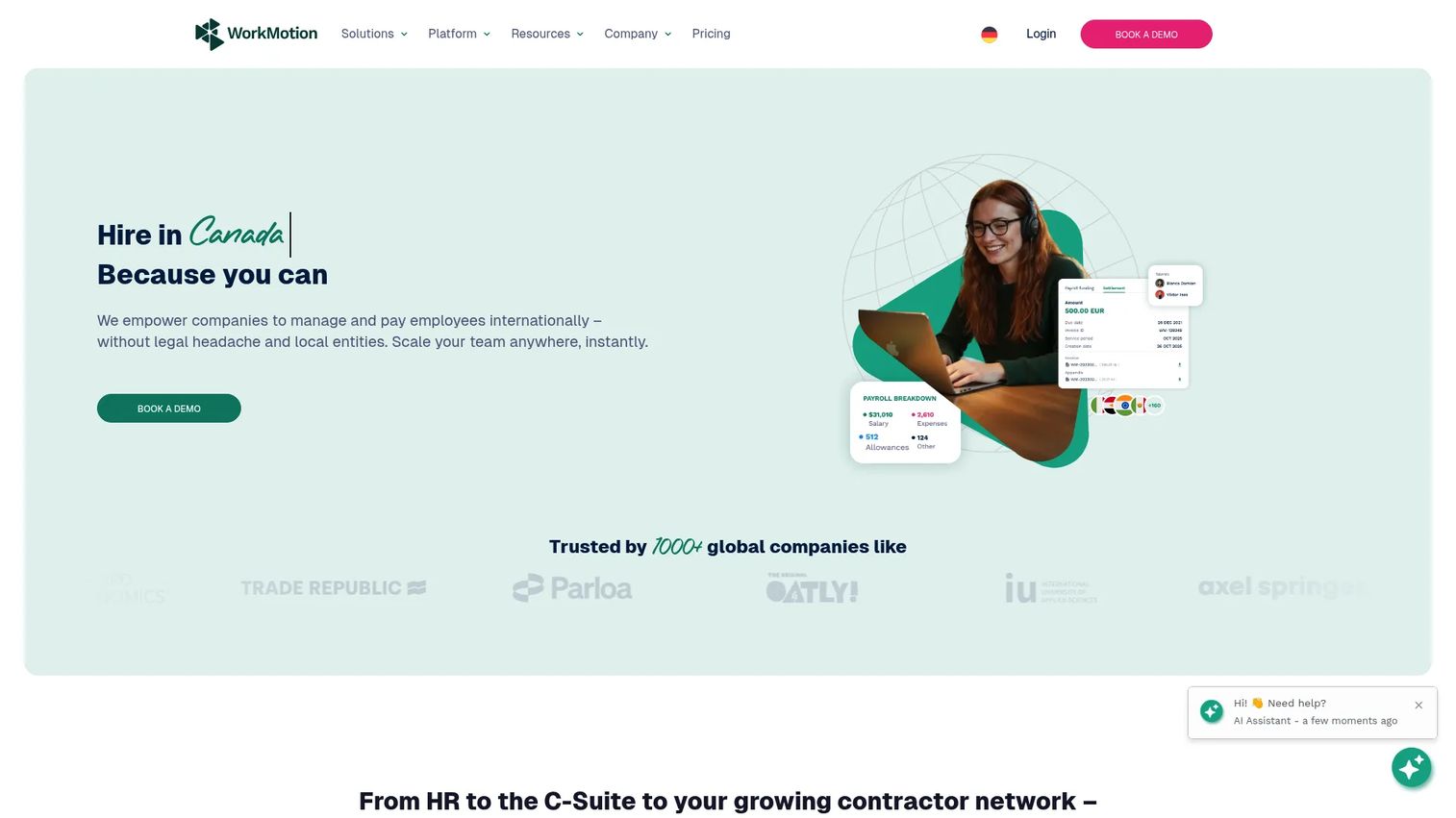
WorkMotion is a global hiring platform centered on EOR, direct hiring, and contractor management. It supports employer of record in 160+ countries and emphasizes fast, compliant onboarding for companies pushing into several markets at once. If your trigger is speed of expansion, WorkMotion is built for that motion.
Best for: Companies hiring employees or contractors internationally without opening local entities, especially during rapid expansion.
Key strengths
- EOR in 160+ countries: Broad entity-free coverage for fast market entry.
- Direct Hiring: Support for hiring through your own entity where you have one.
- Contractor management: Compliant freelancer and contractor onboarding and payments.
Why choose WorkMotion: WorkMotion suits founders who need to move into multiple countries quickly without stitching together local providers. The combination of EOR and direct hiring gives you flexibility as your entity strategy matures.
WorkMotion pricing: Public starting prices are listed and marked Talk To Sales. Employer of Record starts at €499 per talent per month, Direct Hiring at €399 per talent per month, and Contractor management at €29 per contractor or freelancer per month. No free tier is shown.
6. Rippling
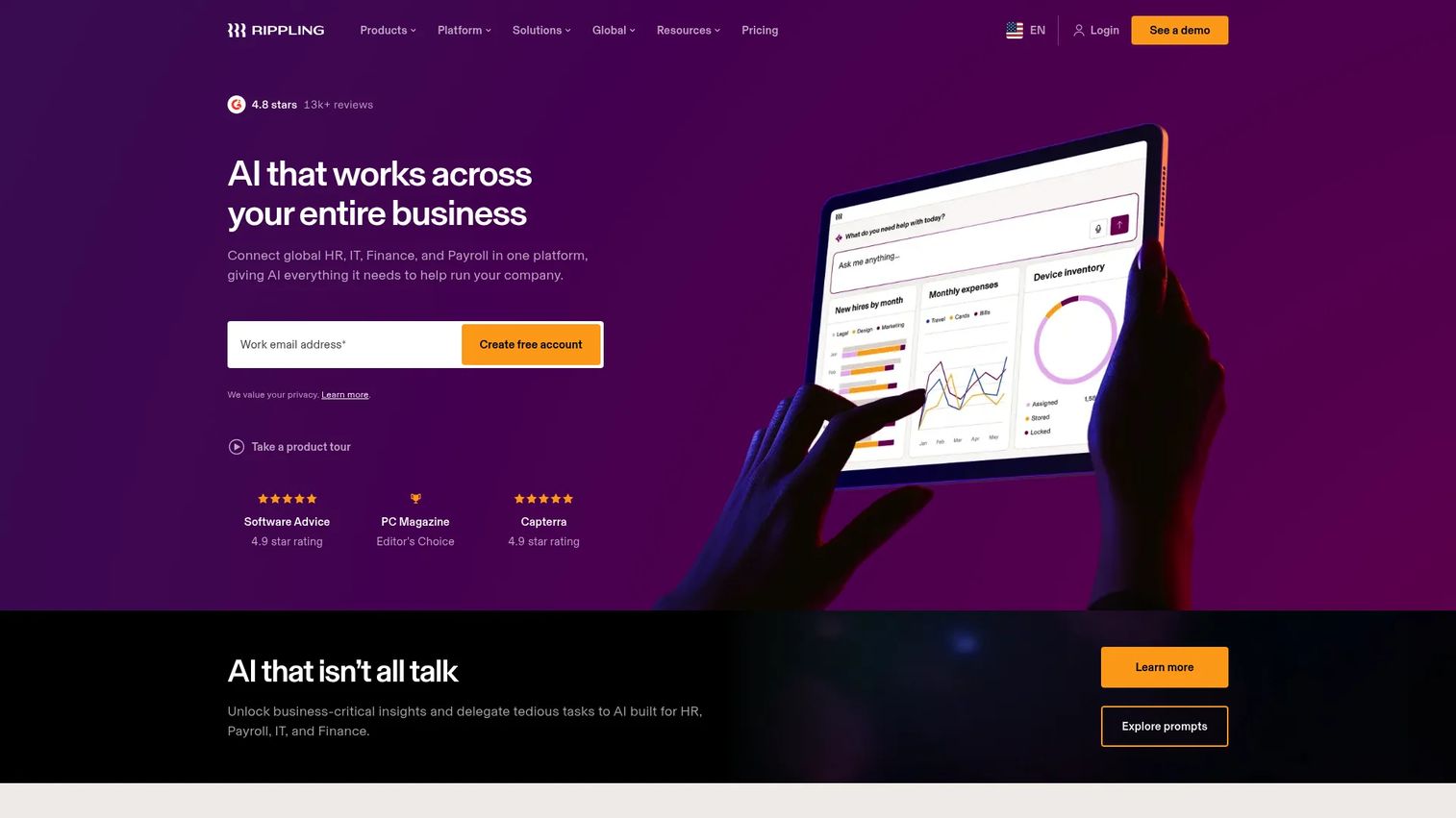
Rippling takes a broader angle: it is a unified workforce platform spanning HR, payroll, IT, and finance, with global employment capabilities inside that wider system. For founders who want one place for HR, device management, payroll, and spend, Rippling's appeal is consolidation. The global employment piece lives alongside everything else your operations team touches.
Best for: Companies that want one system for HR, IT, payroll, and spend workflows, with global employment included.
Key strengths
- Unified HR, payroll, IT, and finance: One platform for workforce operations end to end.
- Payroll and benefits administration: Payroll, benefits, time and attendance, and scheduling in one place.
- Device and identity management: Device management, identity and access, and workflow automation.
Why choose Rippling: Rippling is the pick when consolidation matters more than best-of-breed depth in any single area. If you are trying to reduce tools while increasing signal, owning HR, IT, and payroll in one system is a strong argument, especially when a new VP needs infrastructure on day one.
Rippling pricing: Rippling does not display a public numeric starting price. Products can be purchased separately alongside the core Rippling Platform, and most are billed per employee, per month, with some monthly basis fees. Pricing is quote-based and tailored to the modules you select.
7. Deel
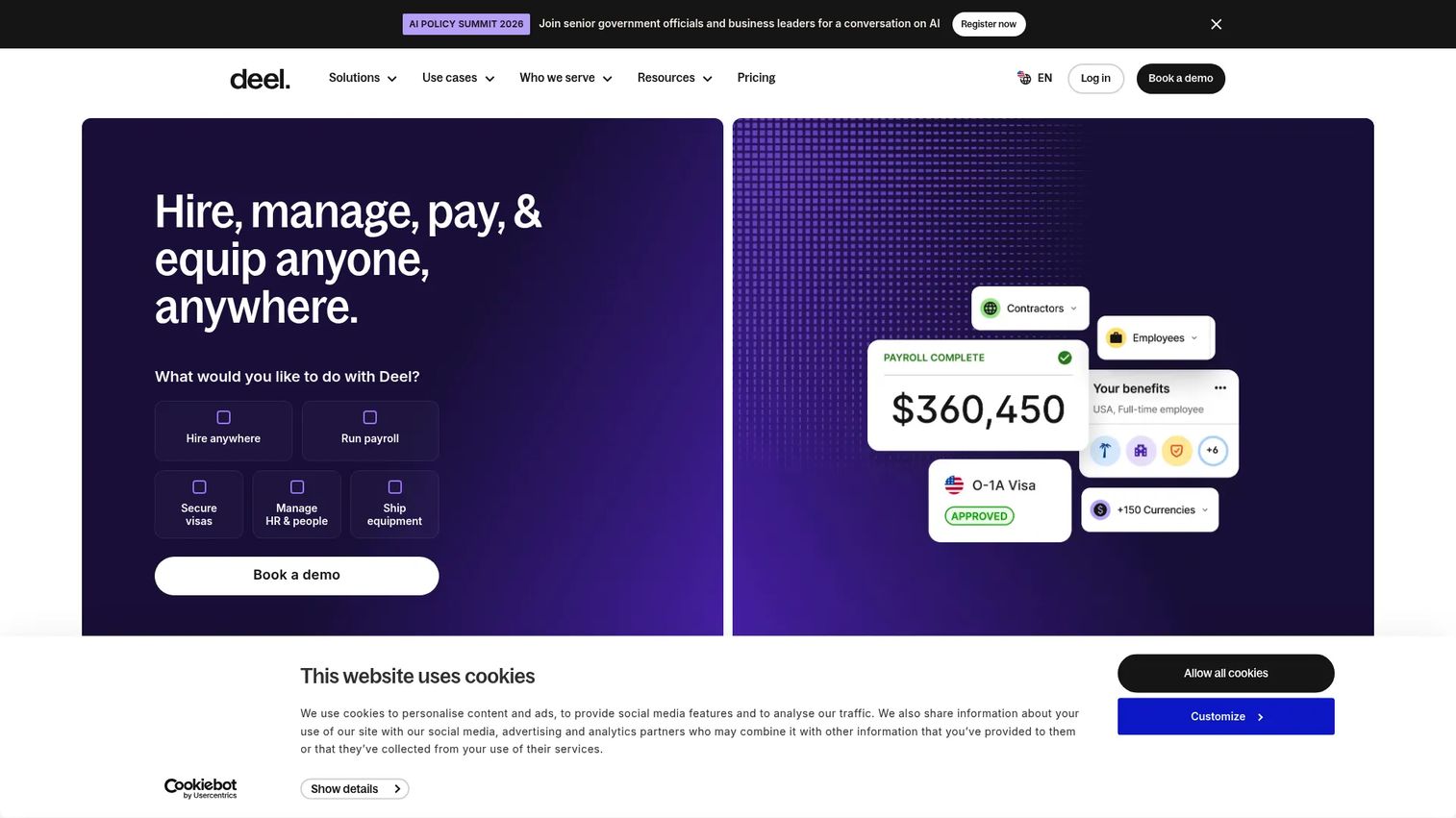
Deel is a global HR and payroll platform for hiring, paying, managing, and equipping workers across countries. It covers global hiring and onboarding, payroll and contractor payments, and compliance with local contracts. Deel's breadth and broad adoption make it a default shortlist entry for companies running high-volume global operations.
Best for: Companies hiring, paying, and managing distributed teams internationally at scale.
Key strengths
- Global hiring and onboarding: Hire and onboard employees and contractors across many countries.
- Payroll and contractor payments: Run global payroll and pay contractors from one platform.
- Compliance and local contracts: Localized contracts and compliance baked into onboarding.
Why choose Deel: Deel's product breadth means it can cover EOR, PEO, payroll, contractors, and talent in one stack. For founders scaling headcount fast across many countries, the depth and adoption reduce the risk of outgrowing the platform.
Deel pricing: First-party pricing lists Global Payroll from $29 per employee per month, EOR Standard at $599 and EOR Enterprise at $899 per employee per month, PEO at $125 per employee per month, Contractor Standard at $49 per contractor per month, Contractor of Record at $325 per contractor per month, and Talent Management from $99 per hire plus recruiting fees. Some product lines require contacting sales.
8. Papaya Global
Papaya Global is a global workforce management platform built around payroll, payments, contractor management, and EOR services. Its center of gravity is payroll and cross-border payments, with integrations and analytics layered on top. For teams whose biggest challenge is paying a global workforce accurately and on time, Papaya orients the whole platform around that.
Best for: Companies needing one platform to manage global payroll, contractors, and cross-border payments.
Key strengths
- Global payroll and workforce management: Centralized payroll across countries with in-country expertise.
- Global payments platform: Cross-border payments built into the workforce system.
- Contractor and EOR support: Contractor of Record and employer of record coverage alongside payroll.
Why choose Papaya Global: If payroll accuracy and centralized payments are the operational priority, Papaya's payments-first design fits. The platform suits finance-led teams that want payroll, contractors, and EOR orchestrated from one workforce system.
Papaya Global pricing: First-party pricing starts at $3.50 per transaction for Payments OS, $5 per contractor per month for the Contractor solution, $29 per employee per month for Payroll Plus, $295 per contractor per month for Contractor of Record, and $499 per employee per month for Employer of Record. WorkforceOS is quote-based.
Considerations before you buy
Before you sign, pressure-test the shortlist against the criteria that actually predict fit. The goal is infrastructure your team can run, not another tool that routes back through you.
Country coverage and entity-free hiring
Map your hiring plan against each platform's owned-entity countries versus partner-network countries. Owned entities usually mean faster onboarding and cleaner compliance. Partner coverage is fine but worth verifying for the specific countries you care about. The same diligence you would apply to contract management software applies: confirm the coverage is real where you need it.
Compliance and payroll depth
Look past the country count. Check how each platform handles localized contracts, statutory benefits, tax administration, and local currency remittance. Ask about payroll accuracy and what happens when labor law changes. Compliance intelligence and document generation are where a platform earns or loses your trust.
Integrations with your stack
A global employment platform that does not sync with your HRIS, accounting, and finance tools creates manual re-entry and reporting gaps. Confirm API-first or native integrations into the systems your finance and people leaders already use. Treat integration depth the way you would when evaluating audit management software: data has to flow without a human stitching it together.
Operational visibility and oversight
You want consolidated workforce data, not eight country logins. Evaluate reporting, dashboards, and how easily a functional leader gets oversight without the founder in the loop. Strong analytics here separate a platform you adopt from one you abandon. The same operational-visibility lens you would use for event management software or loyalty management software applies.
Contractor versus employee coverage
Most teams need both. Confirm the platform handles compliant contractor onboarding, classification controls, and Contractor of Record options alongside full EOR employment, so you are not running two systems.
Conclusion
The best global employment platform depends entirely on what is breaking. If compliance breadth and enterprise credibility lead, G-P and WorkMotion bring deep country coverage. If you want employee-experience-first hiring, Oyster fits. If payroll fragmentation is the real pain, Lano and Papaya Global center the whole platform on it. If you want employment inside a wider workforce system, Rippling consolidates HR, IT, and payroll. And if you need broad, high-volume coverage across hiring, payroll, and contractors, Remote and Deel both deliver modular depth.
Shortlist two or three against four tests: entity-free hiring in the countries you actually need, compliance and payroll depth, integrations with your HRIS and finance stack, and operational visibility a functional leader can own without you. Run a small pilot, hire one real person through it, and watch how cleanly it handles payroll, contracts, and reporting before you commit your whole workforce.
The same evaluation discipline that earns any tool its place in your stack applies here. For more category breakdowns to sharpen that process, the best community management software and best marketing resource management software guides walk through similar buyer logic.
Start your journey with Guideflow today!
FAQs
A global employment platform is software plus in-country infrastructure that lets you hire, pay, and manage workers in countries where you have no legal entity. It acts as, or partners with, the legal employer of record, running payroll, benefits, and compliance locally. It collapses entity setup, payroll, and compliance into one system.
An employer of record is one capability: legally employing someone on your behalf in a country. A global employment platform is the broader software layer that usually includes EOR, plus global payroll, contractor management, HRIS, and reporting. Put simply, EOR is a service the platform delivers, while the platform is the system you operate it from.
Use one when you want to hire across borders without opening entities, reduce misclassification and compliance risk, or centralize workforce operations as headcount grows. The trigger is usually a great candidate in a country where you have no presence, or finance scrutiny ahead of a raise. It turns cross-border hiring into a repeatable process instead of a founder bottleneck.
Look past country counts to how the platform handles localized contracts, statutory benefits, tax administration, and local currency remittance. Verify owned-entity versus partner coverage in the specific countries you need. Ask what happens when labor law changes and how payroll accuracy is guaranteed.
For most early and growth-stage companies, yes, they remove the need to open entities for a handful of hires. The platform's existing entity network employs your people compliantly. At larger scale in a given country, founders sometimes open their own entity and shift to direct hiring, which several platforms also support.
Very. A platform that does not sync with your HRIS, accounting, and finance stack forces manual re-entry and creates reporting gaps. Confirm API-first or native integrations before buying, so workforce data flows cleanly into the systems your finance and people leaders already use.
Contractor management covers compliant onboarding, payments, and classification controls for freelancers you engage on a contract basis. Employee hiring through EOR makes the platform the legal employer, with statutory benefits, payroll taxes, and local employment protections. Most teams need both, and Contractor of Record options shift classification risk onto the platform.
For fast multi-country expansion, platforms with broad owned-entity coverage and quick onboarding fit best, with WorkMotion and G-P offering wide country footprints and Deel adding high-volume breadth. The right answer depends on which specific countries you are entering and whether you need EOR, payroll, or both in each.