You built the ESG report in spreadsheets last year. It took three people six weeks, half the source data could not be traced back to a system of record, and your auditor flagged it. Now the disclosure is mandatory, the deadline is fixed, and the same approach will not hold.
That shift is the whole story. According to DFIN's 2025 ESG trends analysis, 2025 marked the true arrival of mandatory climate and sustainability reporting, pushing companies away from narrative-heavy disclosures toward centralized ESG data ecosystems with audit trails, automation, and XBRL tagging. The era of treating ESG reporting software as a nice-to-have ended.
The market reflects that. Grand View Research valued the global ESG software market at USD 1.24 billion in 2025, projecting USD 5.19 billion by 2033 at a 20.1% CAGR through 2033. The money is moving because the obligation is real. California's SB 253 and SB 261, enhanced SEC climate disclosure expectations, and the EU's CSRD have turned ESG reporting into a governed, audit-scrutinized process.
The problem is that the category is crowded and most vendor pages tell you nothing about pricing, framework fit, or where a tool actually breaks down. This guide fixes that. It is built for the people who have to defend a software choice to procurement and prove it consolidates a fragile reporting stack. We compare ten genuine ESG reporting platforms on the criteria that decide the purchase, not the criteria that fill a brochure.
What's inside
This guide is for sustainability leads, ESG and CSR managers, finance and controllership teams, and the demand-gen and operations people who build the shortlist before procurement gets involved. We compared platforms on four criteria that decide real-world fit:
- Framework and standards coverage (GRI, SASB, ISSB, CSRD, SEC, TCFD).
- Audit readiness and data governance (source-linked evidence, version control, assurance support).
- Integrations and data automation (API sync with ERP, HRIS, utility, and emissions sources).
- Pricing transparency and fit by company size.
Every tool below is an active, recognized ESG or sustainability platform. We note where each fits and where it does not.
TL;DR
Short on time? Here are the decision shortcuts.
- Best for SEC-ready XBRL and audit trails: Workiva, for source-linked, governed disclosure at enterprise scale.
- Best for complex multi-framework ESG data management: Novisto, for teams juggling many standards and investor requests.
- Best for ERP-native, CSRD-aligned reporting: SAP Sustainability Control Tower, for organizations already on SAP.
- Best for governance and risk-led teams: Diligent One Platform, where ESG sits inside board and GRC oversight.
- Best for mid-market sustainability teams: EcoOnline ESG, for accessible EHS and sustainability reporting.
- Best for published, transparent pricing: APLANET, one of the few vendors with public subscription tiers.
Background: what is ESG reporting software?
ESG reporting software is a platform that collects, manages, and discloses environmental, social, and governance data so companies can produce audit-ready sustainability reports aligned to recognized frameworks. It acts as a single source of truth for ESG metrics, replacing fragmented spreadsheets with governed data, controls, and disclosure outputs.
That definition holds across the category. Watershed describes sustainability reporting software as a centralized platform to collect, validate, manage, and disclose sustainability data at scale, supporting multiple frameworks while maintaining audit trails, evidence, and governance controls. Persefoni frames ESG software as a centralized solution to track, manage, and report environmental, social, and governance data, aiding compliance with regimes like the EU's CSRD.
So when people ask "what is ESG software," the honest answer is: it is the system of record that turns scattered sustainability data into something an auditor and an investor will both accept. The same applies to terms like esg management software, esg compliance software, and environmental reporting software. They describe overlapping capabilities under different emphasis.
A capable esg reporting platform usually covers these features:
- Data collection and aggregation: Intake workflows, document imports, and API pulls from across the business.
- Framework mapping: Pre-built libraries that map your data to GRI, SASB, ISSB, CSRD, SEC, and TCFD.
- Automation and API sync: Connections to ERP, HRIS, utility, and emissions data sources to cut manual entry. Evaluating these connections is easier when vendors offer an interactive product demo of how data flows through the platform.
- Collaboration and workflows: Assigned tasks, reviewers, and approvals across distributed teams.
- Audit trails and version control: Source-linked evidence so every number traces to its origin.
- Dashboards and analytics: Performance views for internal steering and stakeholder communication.
- Disclosure output: XBRL tagging, formatted reports, and questionnaire responses.
Those seven features are the difference between an esg reporting tool and another spreadsheet. The strength of each, and the price, is where the tools diverge.
When to use ESG reporting software
Not every company needs a platform yet. These three triggers usually mean you do.
Meet CSRD, SEC, or ISSB disclosure deadlines
When a mandatory disclosure regime applies to you, the stakes change. Persefoni notes that ESG software is explicitly built to help businesses ensure compliance with CSRD and similar standards. A fixed deadline with assurance requirements is hard to hit with manual processes. Sustainability reporting software gives you the framework mapping and audit trail regulators expect.
Replace spreadsheet-based ESG data collection
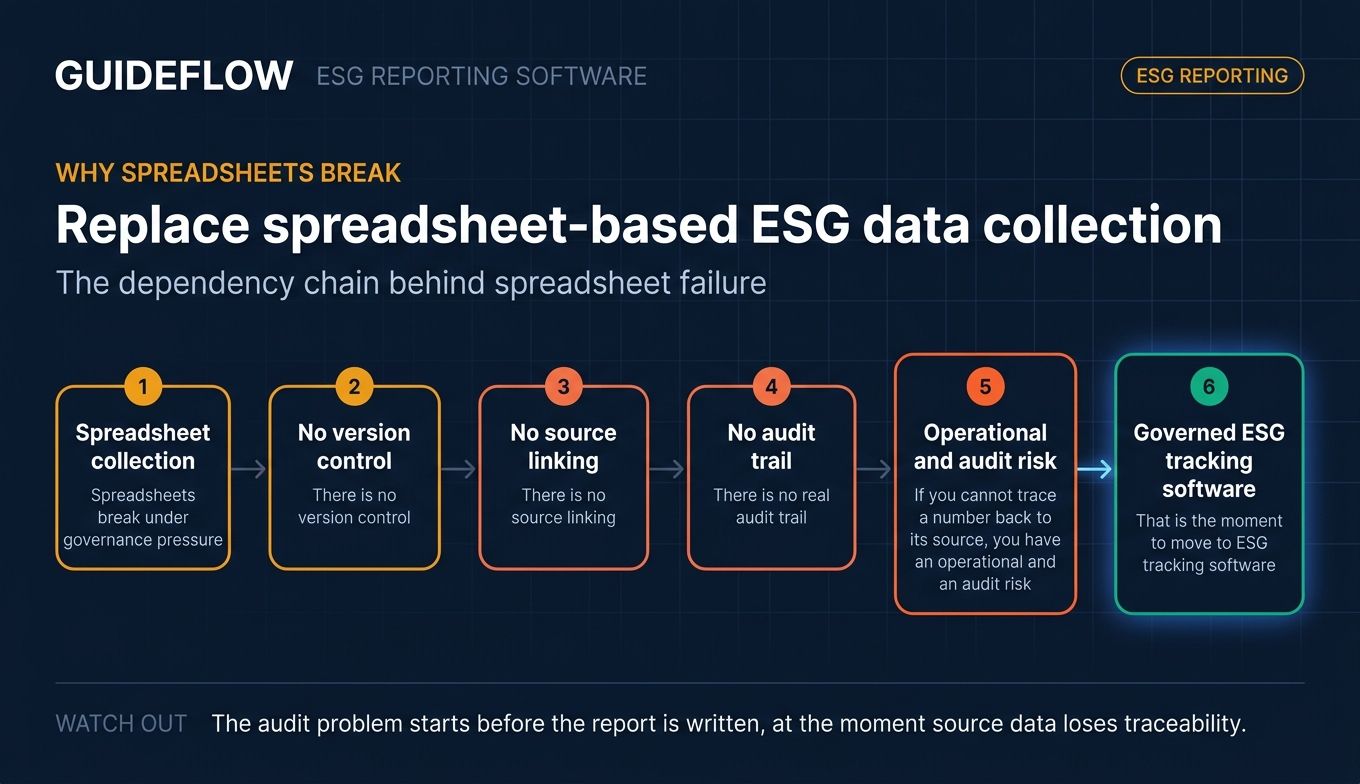
Spreadsheets break under governance pressure. There is no version control, no source linking, and no real audit trail. DFIN describes the broad shift from manual, fragmented processes to centralized ESG data ecosystems with automation and controls. If you cannot trace a number back to its source, you have an operational and an audit risk. That is the moment to move to esg tracking software.
Answer investor and customer ESG questionnaires at scale
Investors and large customers send ESG questionnaires constantly. Answering each one from scratch wastes weeks. An esg reporting solution centralizes your metrics so you can respond consistently and quickly, with the same governed data behind every answer. When questionnaire volume rises faster than your team, software stops being optional.
Comparison table
Read this table top to bottom by relevance to the ESG reporting software keyword, with the most established platforms first. The Intent column tells you the buyer the tool is built for. Pricing reflects what vendors publish on their live pricing pages as of June 2026. Most enterprise ESG vendors use quote-based pricing, so "Custom" is common and accurate, not evasive. G2 ratings are taken from each tool's live G2 listing.
| # | Product | Intent | Key use case | Pricing | G2 rating |
|---|---|---|---|---|---|
| 1 | Workiva | Enterprise governed reporting | SEC-ready, audit-linked ESG and financial disclosure | Custom | 4.5/5 |
| 2 | Novisto | Enterprise ESG data management | Multi-framework disclosure and investor requests | Custom (subscription) | 4.5/5 |
| 3 | SAP Sustainability Control Tower | SAP-centric enterprises | ERP-native, ESRS-aligned reporting | Custom (per active user) | 4.3/5 |
| 4 | Diligent One Platform | Governance and risk teams | ESG inside board and GRC oversight | Custom | 4.3/5 |
| 5 | Benchmark Gensuite | EHS-driven enterprises | Unified EHS, ESG, and operational risk | Custom | 4.0/5 |
| 6 | Enablon | Large industrials | Integrated EHSQ, risk, and ESG | Custom | 4.0/5 |
| 7 | EcoOnline | Mid-market sustainability teams | EHS plus sustainability reporting | Custom | 4.3/5 |
| 8 | APLANET | Globally distributed teams | ESG data management with public pricing | From 649 EUR/month | Not available |
| 9 | FigBytes (AMCS ESG Solution) | Strategy plus reporting | Carbon, climate, and Scope 3 reporting | Custom | 4.0/5 |
| 10 | CorityOne | EHS and ESG consolidation | Converged EHS+ and sustainability suite | Custom | 3.9/5 |
A useful framework-coverage matrix sits below. Confirm each vendor's current mapping during your own evaluation, because libraries are updated frequently.
| Tool | GRI | SASB | ISSB | CSRD / ESRS | SEC | TCFD |
|---|---|---|---|---|---|---|
| Workiva | ✓ | ✓ | ✓ | ✓ | ✓ | ✓ |
| Novisto | ✓ | ✓ | ✓ | ✓ | ✓ | ✓ |
| SAP Sustainability Control Tower | ✓ | ✓ | ✓ | ✓ | ✓ | ✓ |
| Diligent One Platform | ✓ | ✓ | ✓ | ✓ | ✓ | ✓ |
| Benchmark Gensuite | ✓ | ✓ | ✓ | ✓ | ✓ | ✓ |
| Enablon | ✓ | ✓ | ✓ | ✓ | ✓ | ✓ |
| EcoOnline | ✓ | ✓ | ✓ | ✓ | ✓ | ✓ |
| APLANET | ✓ | ✓ | ✓ | ✓ | ✓ | ✓ |
| FigBytes | ✓ | ✓ | ✓ | ✓ | ✓ | ✓ |
| CorityOne | ✓ | ✓ | ✓ | ✓ | ✓ | ✓ |
1. Workiva
Workiva is an AI-powered platform for finance, risk, and sustainability teams to manage governed data, reporting, assurance, and compliance workflows. Its heritage is SEC and financial reporting, which it has extended into ESG. The result is an esg reporting platform where every disclosed number can be linked back to its source document, spreadsheet, or system, with controlled review and version history. For teams that report ESG and financials side by side, that connected model is the draw.
Best for: Enterprise finance, risk, audit, legal, and sustainability teams managing high-stakes regulated reporting and assurance-ready disclosures.
Key strengths
- Data linking across documents: Numbers and narrative stay connected across spreadsheets, documents, and presentations, so updates flow through.
- Workiva AI Intelligent Companion: A built-in AI assistant with a pre-built prompt library for reporting tasks.
- 70+ connectors: Integrations with platforms including Oracle, Salesforce, Workday, and BlackLine.
Why choose Workiva: If your auditor is going to scrutinize the disclosure, Workiva's source-linked evidence and governance are built for that exact pressure. It is the safest pick when SEC-ready XBRL and assurance are non-negotiable. It is more platform than a small sustainability team needs, so fit improves with reporting complexity and headcount.
Workiva pricing: Workiva does not publish numeric pricing. Its pricing page directs buyers to a demo and a customized quote, and references a good, better, best packaging approach for some bundles. Expect enterprise, quote-based pricing. Workiva holds a 4.5/5 rating on G2.
2. Novisto
Novisto is an ESG data management and reporting software platform for collecting, governing, and disclosing sustainability data. It functions as a centralized, secure system of record for both quantitative and qualitative ESG data, with intake workflows, document imports, and API connections. For teams reporting against many frameworks at once, its management workflows monitor and adapt to changes in standards, which reduces the scramble when a framework updates.
Best for: Enterprise ESG and sustainability teams that need auditable data collection, management, and reporting across multiple standards and disclosures.
Key strengths
- Centralized ESG system of record: One secure home for quantitative and qualitative data via intake workflows, imports, or APIs.
- Adaptive management workflows: Tracks framework and standard changes and progress against curated and custom metrics.
- Disclosure and reporting workflows: Handles questionnaires, disclosures, and inbound ESG data requests.
Why choose Novisto: When your reporting burden is multi-framework and investor-facing, Novisto's structured data governance keeps disclosures defensible. It suits sustainability teams that own ESG end to end rather than bolt it onto an EHS or finance system. Buyers wanting an EHS-first or carbon-first tool should look elsewhere on this list.
Novisto pricing: Novisto states it uses simple, subscription-based pricing, and that every subscription includes data collection, governance, and disclosure with unlimited users, data points, and outputs. No public price figure is shown on its pricing page, so plan to request a quote. Novisto holds a 4.5/5 rating on G2 across 14 reviews.
3. SAP Sustainability Control Tower
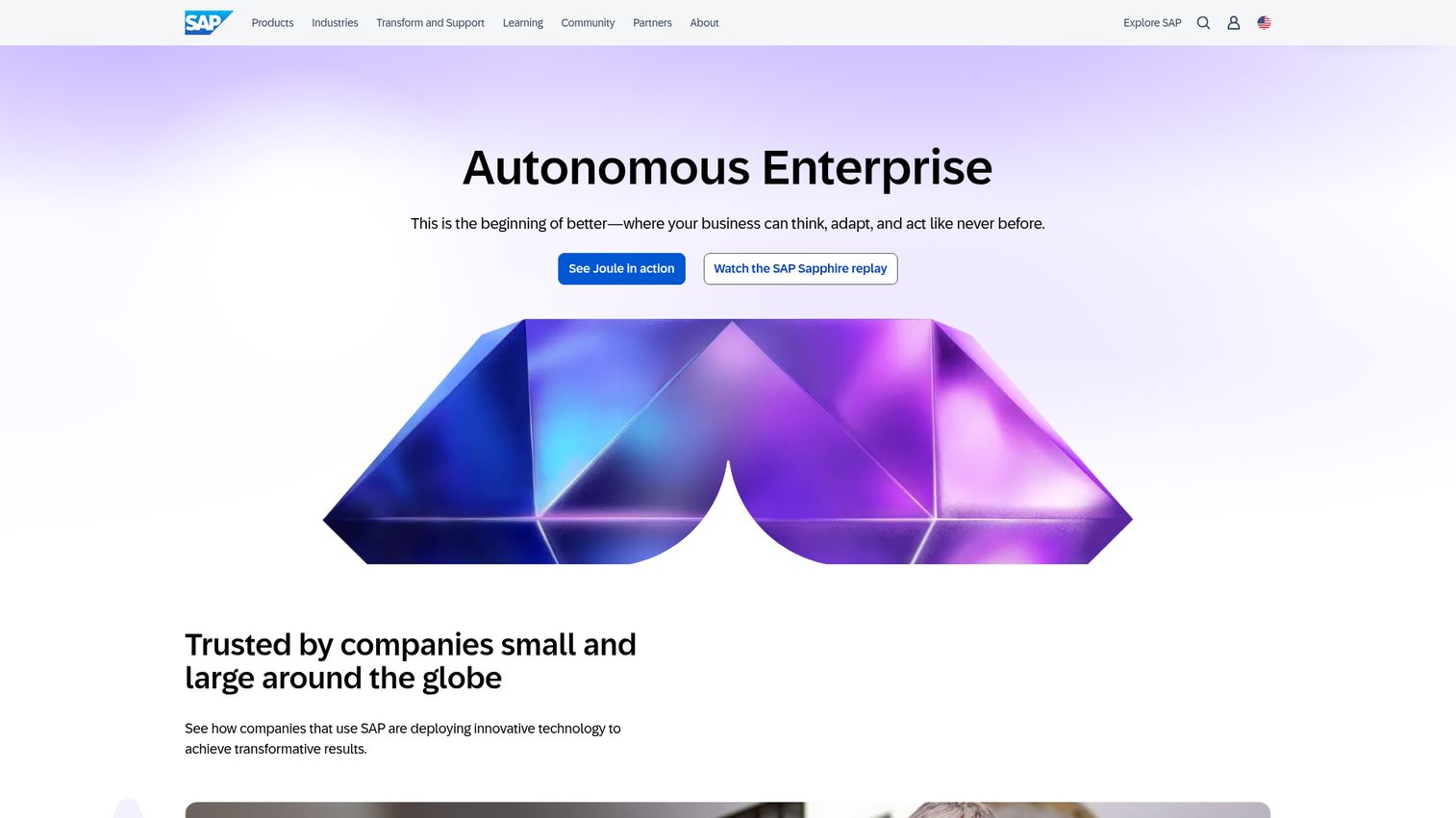
SAP Sustainability Control Tower is a sustainability management solution for centralizing ESG data and performance, supporting auditable compliance, and embedding sustainability into business operations. Its biggest advantage is data harmonization across SAP and non-SAP systems with guided workflows and traceability. For organizations already running SAP, the ESG data is closer to the operational data that produces it, which shortens the path from source to disclosure.
Best for: Large SAP-centric enterprises that need auditable ESG data management, sustainability performance steering, and regulatory reporting support.
Key strengths
- ESRS-aligned reporting foundation: Granular data models, custom metrics, calculations, and reporting scopes.
- Data sourcing across systems: Collection from SAP and non-SAP sources with reviewers, traceability, and open APIs.
- AI-assisted report generation: Dashboards, templates, and AI-generated draft reports for ESG disclosures.
Why choose SAP Sustainability Control Tower: If your enterprise already runs SAP S/4HANA, this is the most natural ERP-native fit, with CSRD and ESRS alignment built in. The pull is integration depth, not standalone flexibility. Companies outside the SAP ecosystem will find the value harder to justify, since a valid SAP S/4HANA Cloud license is required.
SAP Sustainability Control Tower pricing: SAP lists the base plan as priced by active user per month, with a minimum of 10 active users, and shows "Price upon request" rather than a public figure. A cloud test and demo option is offered. SAP Sustainability Control Tower holds a 4.3/5 rating on G2 across 54 reviews.
4. Diligent One Platform
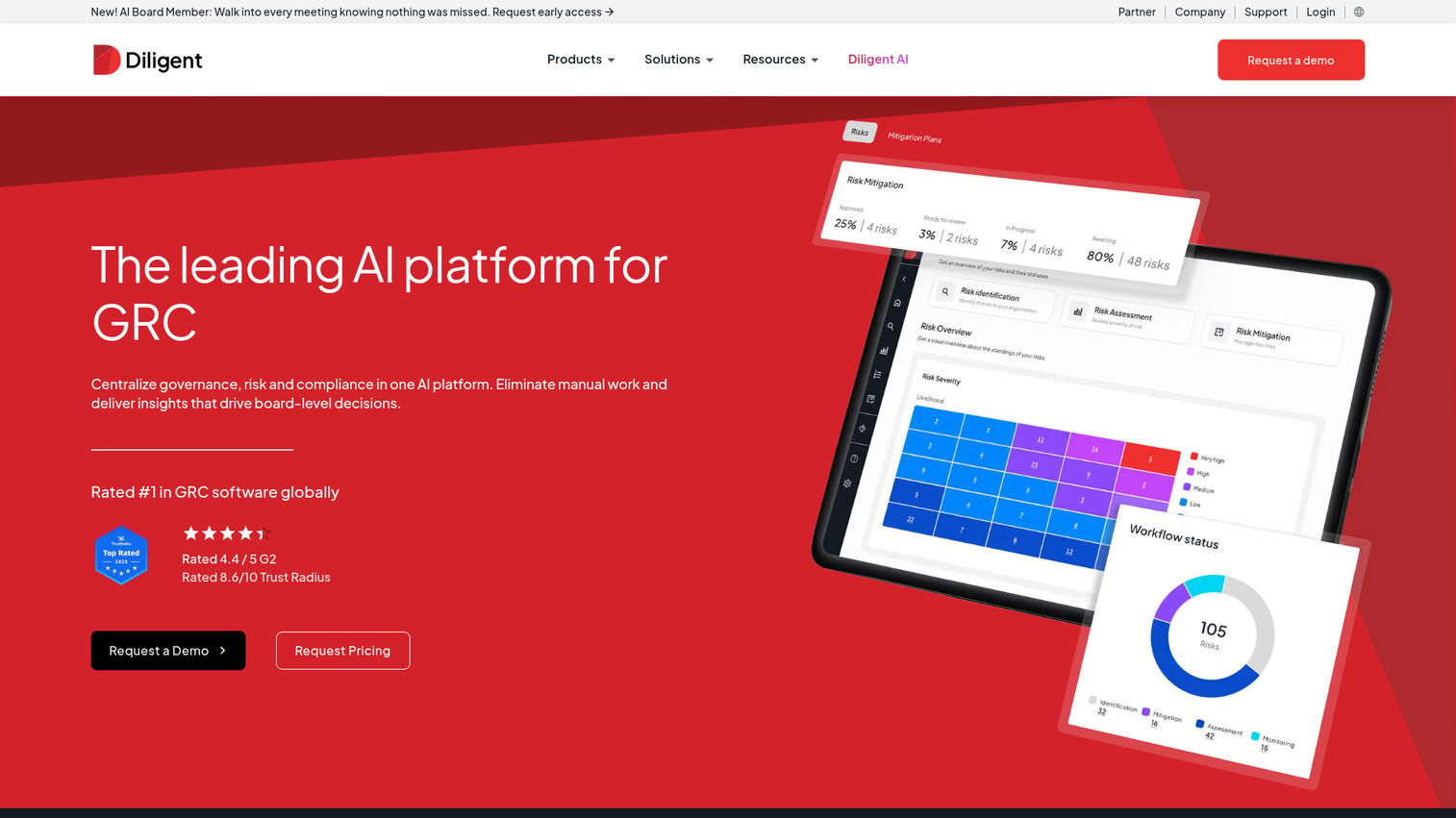
Diligent One Platform is a unified governance, risk and compliance platform for centralizing board management and GRC activities. ESG sits inside that GRC and board context, which is its distinct angle. For teams where sustainability is owned alongside risk, audit, and board reporting, ESG data lives in the same place as the oversight it informs, rather than in a separate sustainability silo.
Best for: Organizations that need a unified platform for board governance, risk, compliance, audit, and executive risk reporting.
Key strengths
- Centralized governance and GRC: Board management and GRC activities in one platform.
- AI-powered risk tooling: Risk data, analytics, templates, and dashboards.
- Broad workflow coverage: Governance, risk, compliance, audit, controls, and board reporting.
Why choose Diligent One Platform: If your ESG mandate is governance-led, with the board and audit committee as primary audiences, Diligent puts sustainability where those conversations already happen. It is the strongest fit for risk-centric teams. A sustainability team focused purely on carbon accounting and emissions data may find the GRC framing broader than they need.
Diligent One Platform pricing: Diligent does not publish public pricing. Its pricing page is a request-pricing form with no listed figures or plan names, so engage their team for a quote. Diligent One Platform holds a 4.3/5 rating on G2.
5. Benchmark Gensuite
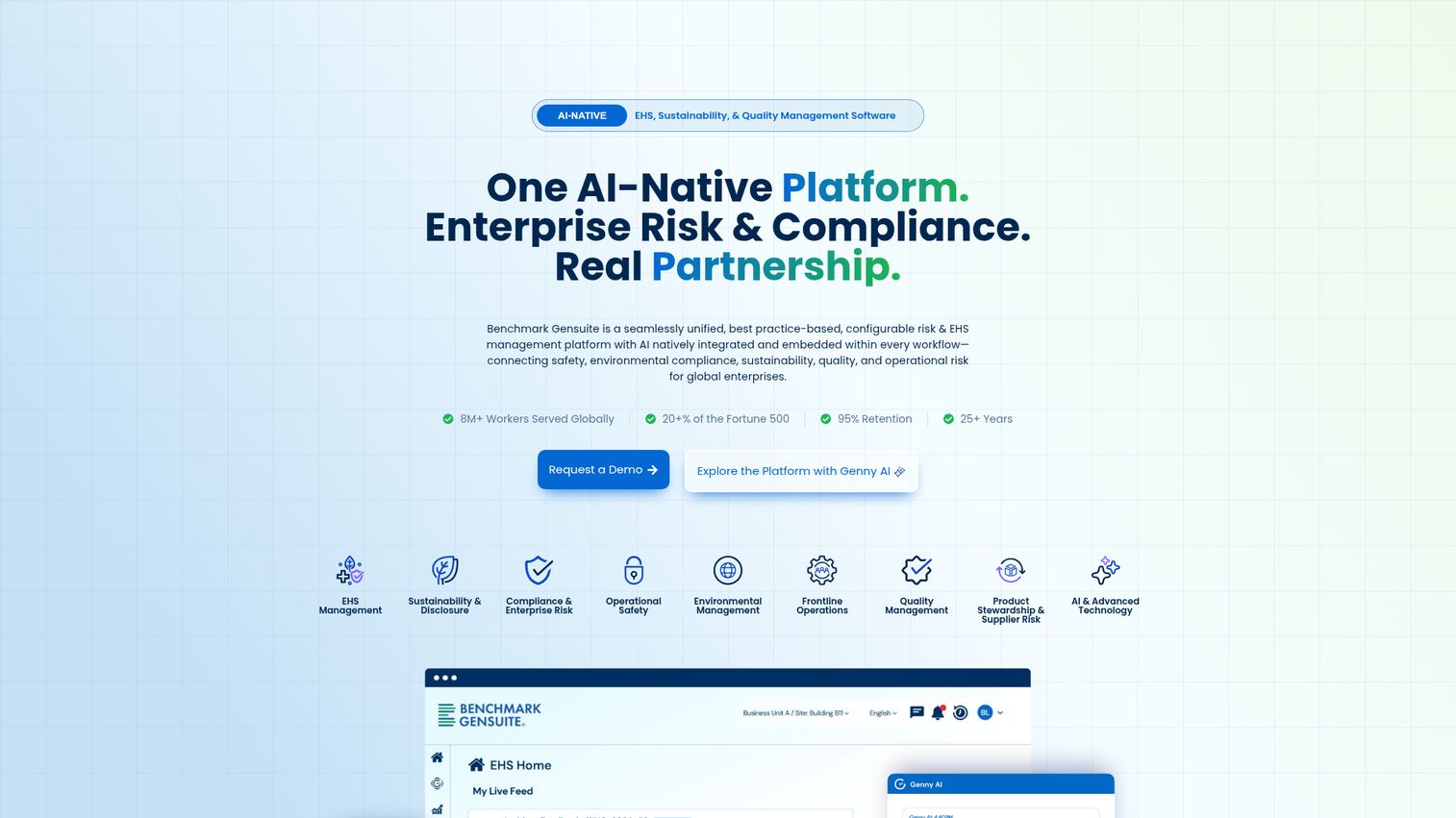
Benchmark Gensuite is an AI-native EHS, sustainability, quality, risk, and compliance management software platform for global enterprises. Its ESG capabilities extend from a strong EHS and operational backbone, so environmental metrics, emissions, and audits connect to the frontline work that generates them. For operations-heavy organizations, that link between shop-floor data and ESG reporting is the appeal.
Best for: Global, multi-site enterprises that need a unified EHS, ESG, sustainability, quality, and operational risk platform with embedded AI and frontline workflows.
Key strengths
- Unified EHS platform: Safety, environmental performance, compliance, operational risk, and sustainability in one system.
- Embedded Genny AI: Domain-trained AI tools and agents across EHS workflows.
- Mobile and frontline operations: Inspections, audits, concern and near-miss reporting, contractor safety, and job safety analysis.
Why choose Benchmark Gensuite: For ops-heavy and EHS-driven organizations, Benchmark Gensuite ties sustainability data to the operational reality behind it. It suits multi-site enterprises that want one platform across safety and ESG. Teams wanting a pure financial-grade disclosure tool may prefer a reporting-first platform like Workiva.
Benchmark Gensuite pricing: The pricing page lists Ready, Quick Start, and Enterprise plans, but shows no public price figures or billing periods. Plan to request a quote. Benchmark Gensuite holds a 4.0/5 rating on G2.
6. Enablon
Enablon is Wolters Kluwer's integrated risk-management platform for EHSQ, operational risk, ESG, sustainability, and safety management. It is built for large, complex, asset-intensive operations where emissions, sustainability performance, and regulatory reporting sit alongside process safety and operational risk. For regulated industrials, that breadth means ESG is one part of a single risk-management fabric rather than a standalone tool.
Best for: Large enterprises needing integrated EHS, ESG, process safety, and operational risk management across complex operations.
Key strengths
- Integrated EHSQ and ESG: Operational risk and sustainability managed together.
- Control of Work: Safe work permits, risk assessments, and isolation management.
- Process Safety Management: Process hazard analysis, barrier management, and bowtie-based risk analysis.
Why choose Enablon: For large industrials and heavily regulated enterprises, Enablon's depth in process safety and operational risk makes ESG part of a broader, audited system. It is the right call when sustainability cannot be separated from plant-level risk. Mid-market teams will likely find it heavier than their needs require.
Enablon pricing: Enablon does not publish public pricing. Its pages direct buyers to request a demo or quote, with no visible price figures or plan names. The Enablon ESG Excellence listing holds a 4.0/5 rating on G2 across 12 reviews.
7. EcoOnline
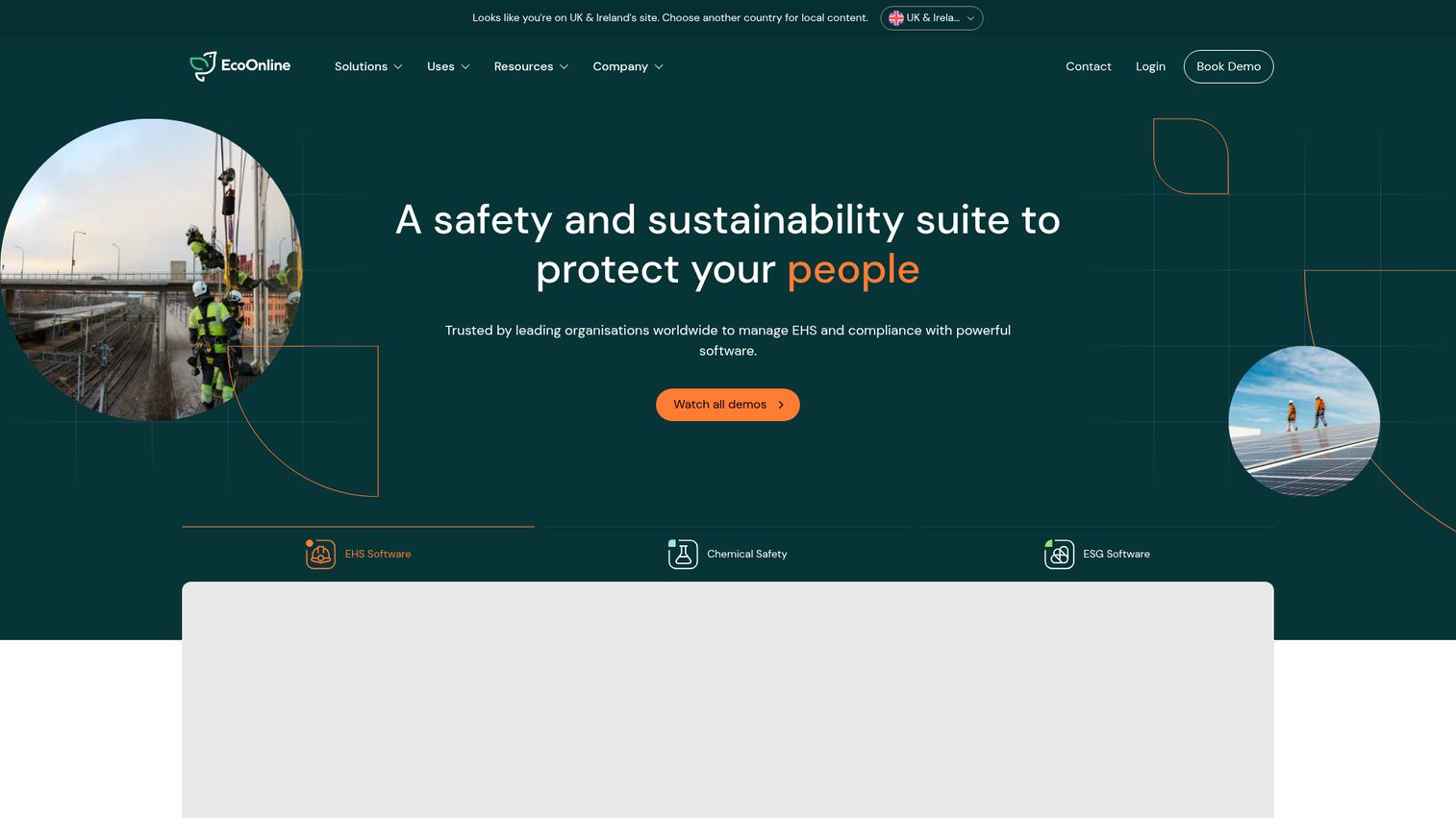
EcoOnline provides EHS, chemical safety, ESG and sustainability, and training software for managing risk, compliance, workplace safety, and environmental impact. Its sustainability and emissions tracking sit within an accessible EHS platform, which makes it a practical entry point for teams that are not buying at SAP or Enablon scale. The mid-market positioning is the differentiator here.
Best for: Multi-site, high-risk organizations that need EHS, chemical safety, incident management, audits, and compliance data in one platform.
Key strengths
- Incident and hazard management: Investigations and corrective actions in one workflow.
- Audits and compliance: Inspections, risk assessments, and compliance workflows.
- Chemical management: SDS documentation, chemical inventory, and chemical risk analysis.
Why choose EcoOnline: For mid-market sustainability teams, EcoOnline pairs EHS and sustainability reporting without enterprise-scale complexity. It suits organizations that want capable reporting at an accessible footprint. Teams whose primary need is investor-grade, multi-framework ESG disclosure may want a reporting-first specialist alongside it.
EcoOnline pricing: EcoOnline does not publish public pricing. Its master service agreement sets fees in an order form, and product pages direct users to book a demo, so plan to request a quote. EcoOnline holds a 4.3/5 rating on G2.
8. APLANET
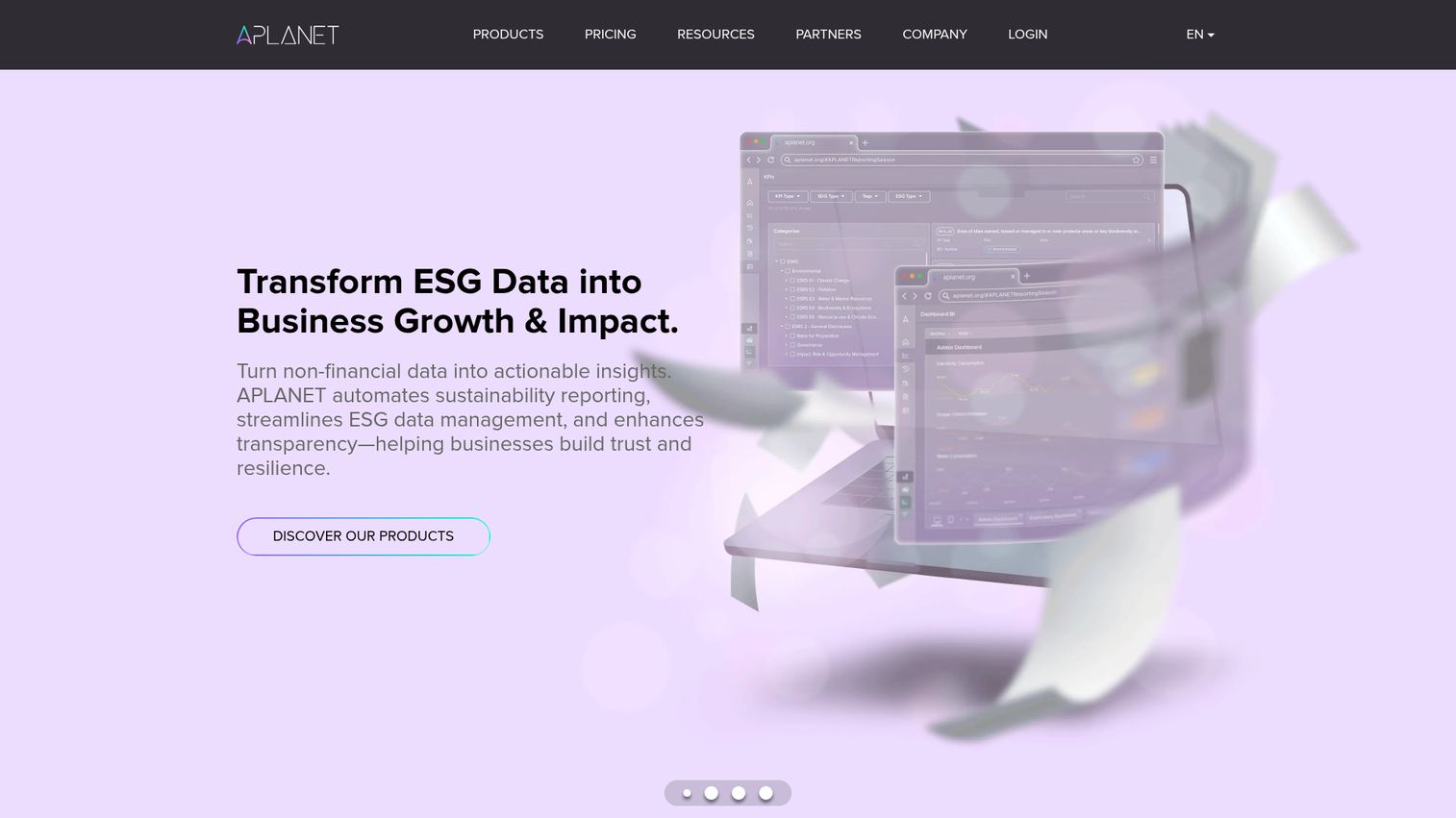
APLANET is ESG management and reporting software for collecting, organizing, measuring, analyzing, and reporting sustainability data. It stands out for two reasons: strong automated data collection via API, and one of the few public pricing pages in this category. For globally distributed sustainability teams that want transparent costs before a sales call, that combination is rare and welcome.
Best for: Organizations needing ESG data management, sustainability reporting, and carbon footprint management workflows.
Key strengths
- Automatic ESG data collection: API pulls from ERP, financial accounting, HR systems, and MS Office.
- Standard and custom KPIs: A centralized repository with automated validation checks.
- Framework reporting support: Coverage for standards including GRI, ESRS, and SASB.
Why choose APLANET: For globally distributed teams, APLANET's automated data collection and published pricing make budgeting and scoping straightforward from day one. It is a strong fit when transparency and multi-entity data gathering matter. Very large enterprises with deep ERP-native needs may still lean toward SAP.
APLANET pricing: APLANET publishes Neutrality subscription tiers. The SME plan, for organizations below 250 employees, starts at 649 EUR per month, and the Medium plan, for over 250 employees, at 899 EUR per month, both with 20% off on a three-year plan. Large organizations over 1,000 employees are quoted. A public G2 rating was not available at the time of writing.
9. FigBytes (AMCS ESG Solution)
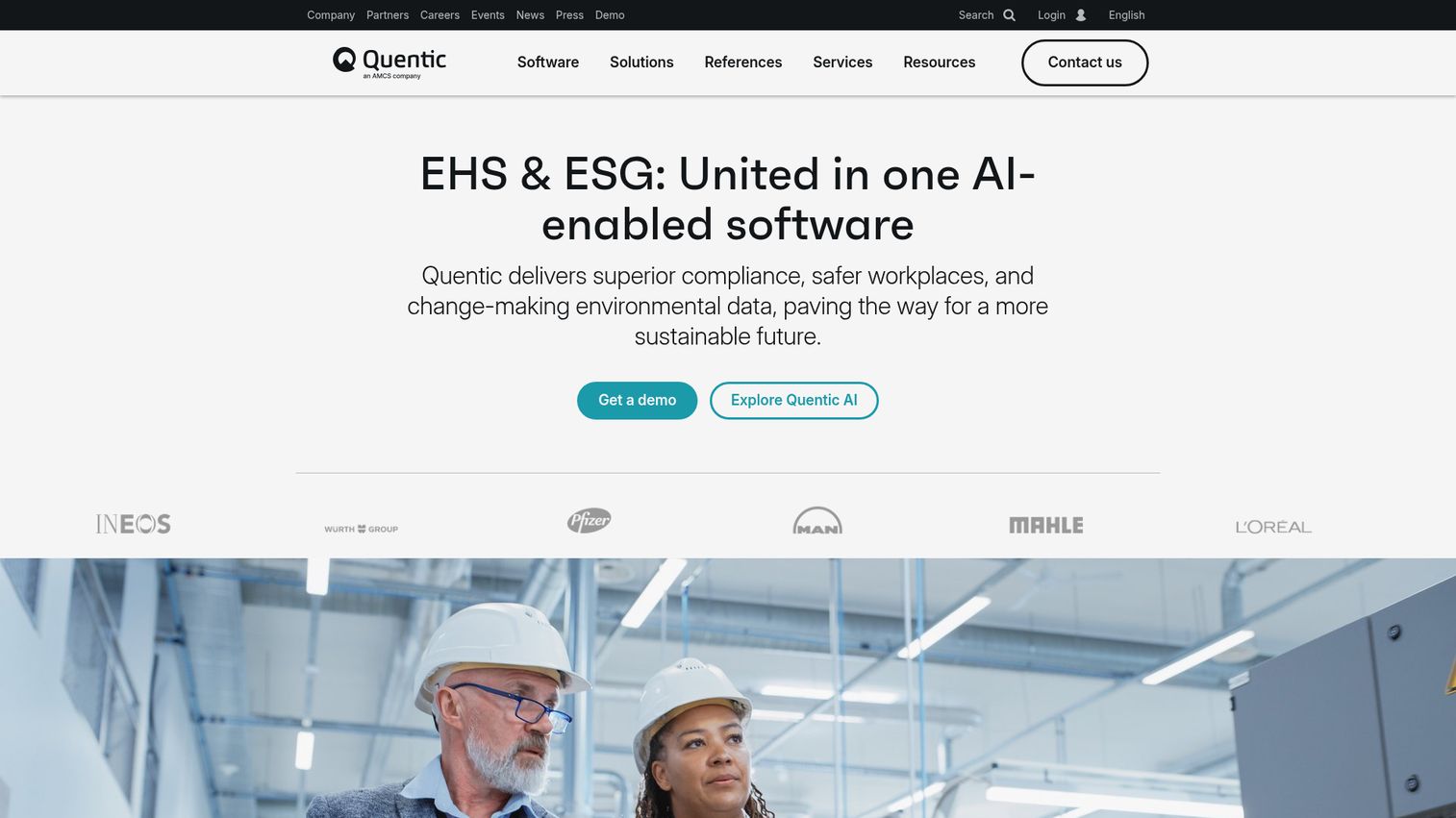
FigBytes is an ESG and sustainability management software platform, now rebranded as AMCS ESG Solution following the AMCS acquisition, for capturing operational and supplier data, managing strategy, automating framework reporting, and simplifying stakeholder engagement. Its emphasis on strategy plus reporting, with strong carbon and Scope 3 coverage, sets it apart. Note the rebrand when you evaluate it, since FigBytes pages now redirect to AMCS or Quentic.
Best for: Organizations needing enterprise ESG, climate, water, and sustainability reporting management.
Key strengths
- Carbon accounting: GHG inventory data collection and calculation.
- Climate disclosure: Sustainability reporting with audit-ready data.
- Scope 3 management: Supplier engagement and data-gap tools.
Why choose FigBytes: For teams that want sustainability strategy linked to reporting, FigBytes connects targets and disclosures with strong carbon and supplier data tooling. It fits organizations treating ESG as a strategic program, not just a compliance task. Confirm the current AMCS branding and product roadmap during evaluation, given the acquisition.
FigBytes pricing: No public first-party pricing page with figures or plan names was available, in part because of the AMCS rebrand. Plan to request a quote through AMCS. FigBytes holds a 4.0/5 rating on G2.
10. CorityOne
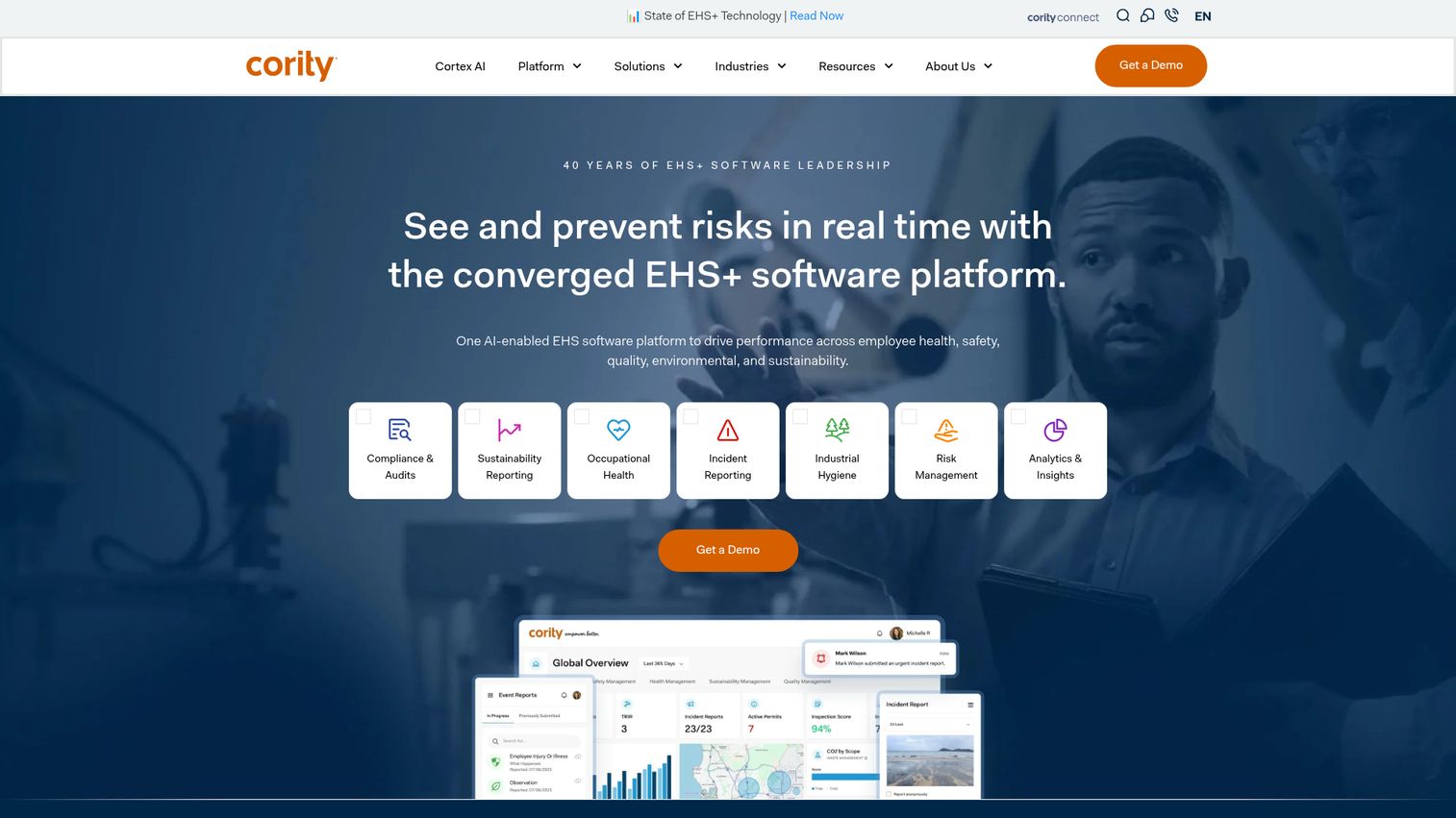
CorityOne is Cority's converged EHS+ software platform for managing safety, health, environmental, quality, sustainability, risk, compliance, workflows, data, and AI-enabled insights. Its value is consolidation: ESG and sustainability live inside the same suite as EHS, quality, and compliance. For enterprises trying to reduce tool sprawl across these functions, that single converged platform is the reason to look.
Best for: Enterprise and complex organizations needing a unified EHS+ platform across health, safety, environmental, quality, sustainability, and compliance programs.
Key strengths
- Full EHS+ solution sets: Environmental, workforce health, safety, ESG and sustainability, and product quality.
- Broad management capabilities: Compliance, incident management, audits, analytics, document control, learning management, and management of change.
- Cortex AI: Embedded AI for EHS+ data collection, workflows, and insights.
Why choose CorityOne: For enterprises consolidating EHS and ESG, CorityOne reduces the number of systems your teams maintain by converging them. It is the pick when sustainability reporting is one workstream among many EHS+ programs. Teams whose sole focus is investor-grade financial disclosure may want a reporting-first specialist instead.
CorityOne pricing: Cority does not publish numeric pricing or plan tiers. Its site directs users to demo and contact flows, and its pricing content discusses ROI rather than subscription figures, so request a quote. CorityOne holds a 3.9/5 rating on G2.
Considerations: how to choose ESG reporting software
The shortlist is only useful once you weigh it against your own requirements. Use these five criteria before you book demos.
Framework and standards coverage
Confirm the platform supports the frameworks your jurisdiction and investors actually require: GRI, SASB, ISSB, CSRD and ESRS, SEC, and TCFD. Multiple ESG guides stress framework fit as the top evaluation factor. Coverage claims change often, so verify the current mapping on the vendor's own pages, not a third-party list.
Audit readiness and data governance
DFIN highlights audit-ready documentation, internal controls, and assurance-level reviews as central ESG trends. Check for source-linked evidence, version control, defined approval workflows, and explicit assurance support. If a number cannot be traced to its origin, it will not survive an audit.
Data automation and integrations
The whole point is to stop typing data into spreadsheets. Look for API sync with ERP, HRIS, utility, and emissions data sources. Vendors like APLANET and Workiva publish broad connector lists. Strong integration capabilities are what separate governed esg compliance software from a prettier spreadsheet.
Scalability and total cost
Map pricing to what you replace. Most enterprise platforms use custom, quote-based pricing, while a few like APLANET publish tiers. Ask what the tool consolidates in your current reporting stack, because the real cost comparison includes the manual hours and overlapping tools it removes.
Disclosure output
Finally, check the output. XBRL tagging, formatted reports, and stakeholder dashboards are what your auditors, regulators, and investors consume. A platform that manages data well but produces weak disclosure output leaves you stitching the last mile by hand.
For the marketers and operators building the business case, it also pays to study how each vendor runs its own buyer journey. The way ESG platforms package demos and self-serve evaluation, much like the patterns covered in other software category comparisons, often signals how mature and usable the product actually is. Vendors that invest in strong product tour software and digital adoption platforms tend to make their reporting workflows far easier to learn, and a polished live demo is often the clearest signal of a usable product. It is also worth comparing how each tool handles user onboarding, since a complex ESG platform lives or dies on how quickly your team can actually adopt it.
Conclusion
The right ESG reporting software depends on which problem dominates your purchase.
- Enterprise, audit-ready disclosure: Workiva, for source-linked evidence and SEC-ready XBRL.
- Complex multi-framework data management: Novisto, for governed ESG data across many standards.
- ERP-native, CSRD-aligned reporting: SAP Sustainability Control Tower, for SAP-centric enterprises.
- Governance and risk-led ESG: Diligent One Platform, where the board is the audience.
- Operations and EHS-driven sustainability: Benchmark Gensuite, Enablon, or CorityOne.
- Mid-market and transparent pricing: EcoOnline or APLANET.
The honest next step is small. Pick the two or three tools that match your framework requirements and budget, then book demos and ask each vendor to walk through a real disclosure with your kind of data. Verify framework coverage, audit trail, and integrations live, since those are the claims that decide whether the platform survives your first assurance cycle. Start with the tool whose intent column matches your buyer, and let the demo prove the rest.
FAQ
ESG reporting software is a platform that collects, manages, and discloses environmental, social, and governance data so companies can produce audit-ready sustainability reports aligned to recognized frameworks. It automates data collection, maps your metrics to standards like GRI and CSRD, and generates disclosure outputs such as XBRL filings and formatted reports.
Most enterprise ESG platforms use custom, quote-based pricing rather than public figures. Workiva, SAP, Diligent, Enablon, and Cority all direct buyers to request a quote. A few vendors publish pricing: APLANET lists subscription tiers starting at 649 EUR per month for smaller organizations. Mid-market tools like EcoOnline typically scope pricing through an order form after a demo.
Look at SAP Sustainability Control Tower, which is built around ESRS-aligned metrics and suits SAP-centric enterprises reporting under CSRD. Novisto and Workiva are also strong, with framework libraries that map to CSRD and adapt as standards change. The right fit depends on whether you prioritize ERP-native data, multi-framework management, or audit-grade disclosure.
ESG software is broader, covering environmental, social, and governance data together. Sustainability reporting software often emphasizes environmental and carbon data, such as Scope 1 through 3 emissions and energy use. In practice the categories overlap heavily, and many carbon-first tools have expanded into full ESG coverage over time.
At minimum, check for GRI, SASB, ISSB, CSRD and ESRS, SEC climate disclosure, and TCFD. These are the recognized frameworks and disclosure regimes for 2025 and 2026. Coverage matters because reporting against a standard your software does not map to means manual rework and higher audit risk. Confirm current support on the vendor's own pages.
Yes, when the platform supports source-linked evidence, version control, internal controls, and assurance workflows. DFIN identifies XBRL tagging and assurance-ready documentation as central to modern ESG reporting. Tools with a financial reporting heritage, such as Workiva, are built specifically to produce SEC-ready, XBRL-tagged disclosures that withstand audit scrutiny.
Most platforms use API connections to sync data from ERP, HRIS, utility, and emissions data sources. APLANET, for example, pulls automatically from ERP, financial accounting, and HR systems, while Workiva offers connectors to platforms like Oracle, Salesforce, and Workday. This automation replaces manual spreadsheet entry and reduces the data errors that break audits.
Work through four criteria: framework and standards coverage for your jurisdiction, audit readiness and data governance, the depth of data automation and integrations, and pricing fit for your company size. Then shortlist two or three tools that match your requirements, book demos, and have each vendor walk through a real disclosure using your kind of data.