You read the resume. You liked the candidate. Six weeks later, the hire is not working out, and you cannot say exactly why the interview missed it.
That gap is expensive. Resumes and gut feel are weak signals when you need hiring to scale beyond the founder being in every loop. The global talent assessment software market is forecast to reach USD 2.0 to 6.0 billion in 2025, growing at a 15 to 30 percent CAGR through 2030, according to Research and Markets (2025). Buyers are moving toward structured, measurable signal for a reason: it holds up under board scrutiny and it reduces the odds of a mis-hire eating a quarter of runway.
Talent assessment software gives you that signal. It measures skills, behavior, and potential before you extend an offer, so hiring decisions rest on data instead of the loudest opinion in the debrief. For a Series B founder trying to build a repeatable hiring system, that matters. A good talent assessment platform lets a new VP run a defensible process on day one, without you re-reviewing every candidate.
If you are already thinking about the wider data stack around hiring, it helps to understand how analytics platforms drive ROI and how lead scoring logic mirrors candidate scoring. The same discipline that cleans up your funnel cleans up your hiring pipeline. This guide covers eight candidate assessment software options, what each does well, and how to match one to your actual hiring bottleneck.
What's inside
This guide is for founders, hiring leaders, and HR operators building a hiring process that scales without constant founder involvement. We reviewed eight recruitment assessment tools and ranked them on four things that matter when you are choosing software for the long term.
- Assessment depth: the range and quality of tests, from cognitive to skills to behavioral.
- Validation and fairness: scientific backing, bias mitigation, and transparent scoring.
- Candidate experience: completion rates, mobile access, and time burden on applicants.
- Workflow fit and ROI: ATS integrations, reporting, and practical cost per hire.
We skip the feature-list padding and focus on where each tool actually earns its place in your stack.
TL;DR
Short on time? Here is the fast version to help you shortlist recruitment assessment tools.
- Best overall for science-led hiring: Criteria Corp pairs validated cognitive, personality, and skills tests with candidate-friendly design and structured interviewing.
- Best for high-volume, skills-based hiring: TestGorilla offers a large test library, a free tier, and credit-based scaling.
- Best for enterprise validation and standardized evaluation: HireVue combines assessments, job simulations, and AI-scored interviews at scale.
- Best for pre-hire plus post-hire use cases: The Predictive Index connects validated hiring with coaching, development, and engagement.
- Best for high-volume hiring and retention: Harver focuses on validated assessments and automated workflows for large applicant flows.
- Best for flat-rate screening plus assessment: Truffle bundles resume screening, one-way video interviews, and assessments without per-seat pricing.
What is talent assessment software?
Talent assessment software is a category of hiring tools that measure a candidate's skills, cognitive ability, behavior, and job fit before a hire or promotion, using structured tests instead of resumes or unstructured interviews alone.
It is not the same as an applicant tracking system. An ATS manages applicants and workflow: it stores resumes, tracks stages, and schedules interviews. Talent assessment tools measure the actual signal: can this person do the job, and how will they behave in it. Most teams run both together, feeding assessment scores back into the ATS to rank candidates. Understanding that split is one of the most common gaps buyers miss, and it mirrors how a customer data platform sits alongside your CRM rather than replacing it.
Modern candidate evaluation software supports a range of assessment modalities. The right mix depends on the role.
- Cognitive assessments: measure reasoning, problem-solving, and learning speed.
- Psychometric assessments: measure personality traits and work style.
- Situational judgment tests: present realistic scenarios and score decision quality.
- Behavioral assessments: measure how a person tends to act at work.
- Skills tests: measure concrete abilities like coding, writing, or data analysis.
- Game-based assessments: capture cognitive and behavioral signal through interactive tasks.
- Job simulations: replicate day-in-the-life tasks to preview real performance.
- Video interviews: including one-way video interviews, capture communication and structured responses.
- Language assessments: measure fluency and comprehension for customer-facing roles.
AI scoring and predictive analytics help by ranking candidates and surfacing patterns faster than a human reviewer can. Where AI touches scoring, transparency matters. You want to know how a score is produced, what data trained it, and whether the vendor checks for adverse impact. That is the difference between defensible hiring and a black box.
When to use talent assessment software
Not every team needs assessment software on day one. These three scenarios are where it pays for itself.
Screen at scale without relying on resumes alone
When applicant volume is high, reading every resume is not a filter, it is a bottleneck. Assessment tools give you early signal on skills and fit before a human spends time on a call. This is about the quality of the filter, not just speed. You are catching strong candidates who write weak resumes, and screening out confident interviewers who cannot do the work. For roles with hundreds of applicants, this is where the time-to-hire savings compound.
Improve quality of hire in hard-to-fill roles
For senior or specialized roles, interview intuition alone is thin. A structured mix of skills tests and behavioral assessments gives you data you can compare across candidates and defend in a debrief. When one bad hire in a small team costs months, role-fit data earns its keep. It also reduces the founder-as-final-filter problem, because the process produces a defensible recommendation without you in the room.
Support internal mobility and retention planning
Assessment data is not only for hiring. Post-hire, the same behavioral and cognitive data supports internal mobility, leadership development, and workforce planning. You can spot people ready for bigger roles, coach managers using real behavioral insight, and plan team composition with talent analytics instead of guesswork. This is where assessment software shifts from a screening checkbox to a system that improves retention.
Comparison table
This table helps you compare the eight tools at a glance: what each is built for, its standout strength, pricing, and G2 rating. Use it to narrow to two or three, then read the full sections below.
| # | Product | Intent | Key differentiation | Pricing | G2 rating |
|---|---|---|---|---|---|
| 1 | Criteria Corp | Science-led hiring and development | Validated cognitive, personality, skills tests plus interviews | Request pricing, free trial | 4.5/5 |
| 2 | TestGorilla | High-volume skills screening | Large test library, free tier, credit-based | Free; Core from $142/mo | 4.7/5 |
| 3 | HireVue | Enterprise standardized evaluation | Assessments, job simulations, AI-scored interviews | Request pricing | 4.1/5 |
| 4 | The Predictive Index | Pre-hire plus post-hire talent optimization | Behavioral science across hiring and development | From $7,550/yr | 4.7/5 |
| 5 | Harver | High-volume hiring and retention | Validated assessments, automated workflows | Request pricing | 4.6/5 |
| 6 | Testlify | Broad, usage-based skills assessment | 3,500+ tests, AI interviews, proctoring | Credit-based, free trial | 4.7/5 |
| 7 | Skillrobo | Clear-packaged pre-employment testing | Transparent monthly and yearly plans | From $49/mo | 4.9/5 |
| 8 | Truffle | Screening plus assessment, flat-rate | Resume screening, video, assessments bundled | From $99/mo annual | 5.0/5 |
1. Criteria Corp
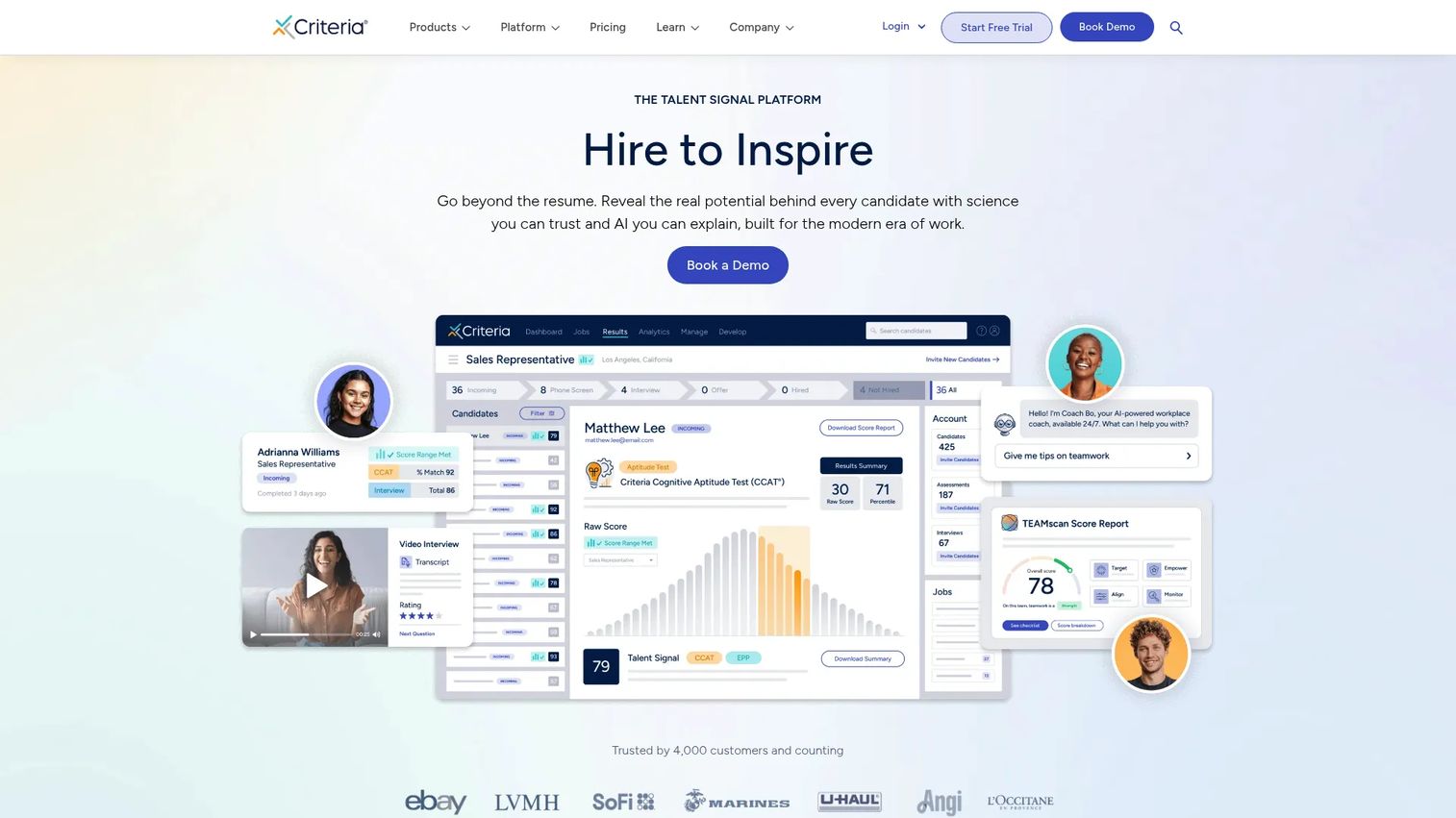
Criteria Corp is a science-led talent assessment platform built around pre-employment testing, structured interviewing, and employee development. It covers cognitive aptitude, personality, emotional intelligence, risk, and skills assessments in one system, with a strong emphasis on validation and candidate-friendly design. For teams that want defensible hiring decisions backed by real methodology, it is a mature choice.
Best for: organizations that want science-based hiring assessments plus structured interviews and development tools in one platform.
Key strengths
- Broad validated portfolio: cognitive, personality, emotional intelligence, risk, and skills tests, all backed by scientific validation.
- Structured interviewing: video and live interviewing tools that keep evaluation consistent across candidates.
- Development beyond hiring: coaching and team feedback tools extend assessment data into internal mobility and growth.
Why choose Criteria Corp: if fairness and validation depth are non-negotiable, Criteria Corp is built for you. The candidate-friendly design supports completion rates, and the same data that filters applicants supports post-hire coaching. It fits founders who want a hiring process that survives due diligence and scales past the founder as final reviewer.
Criteria Corp pricing: pricing is quote-based, with Professional, Professional+, and Talent Success Suite plans all shown behind request-pricing CTAs. Plans run on a 12-month minimum contract. A free trial is available, so you can test candidate flow before committing.
2. TestGorilla
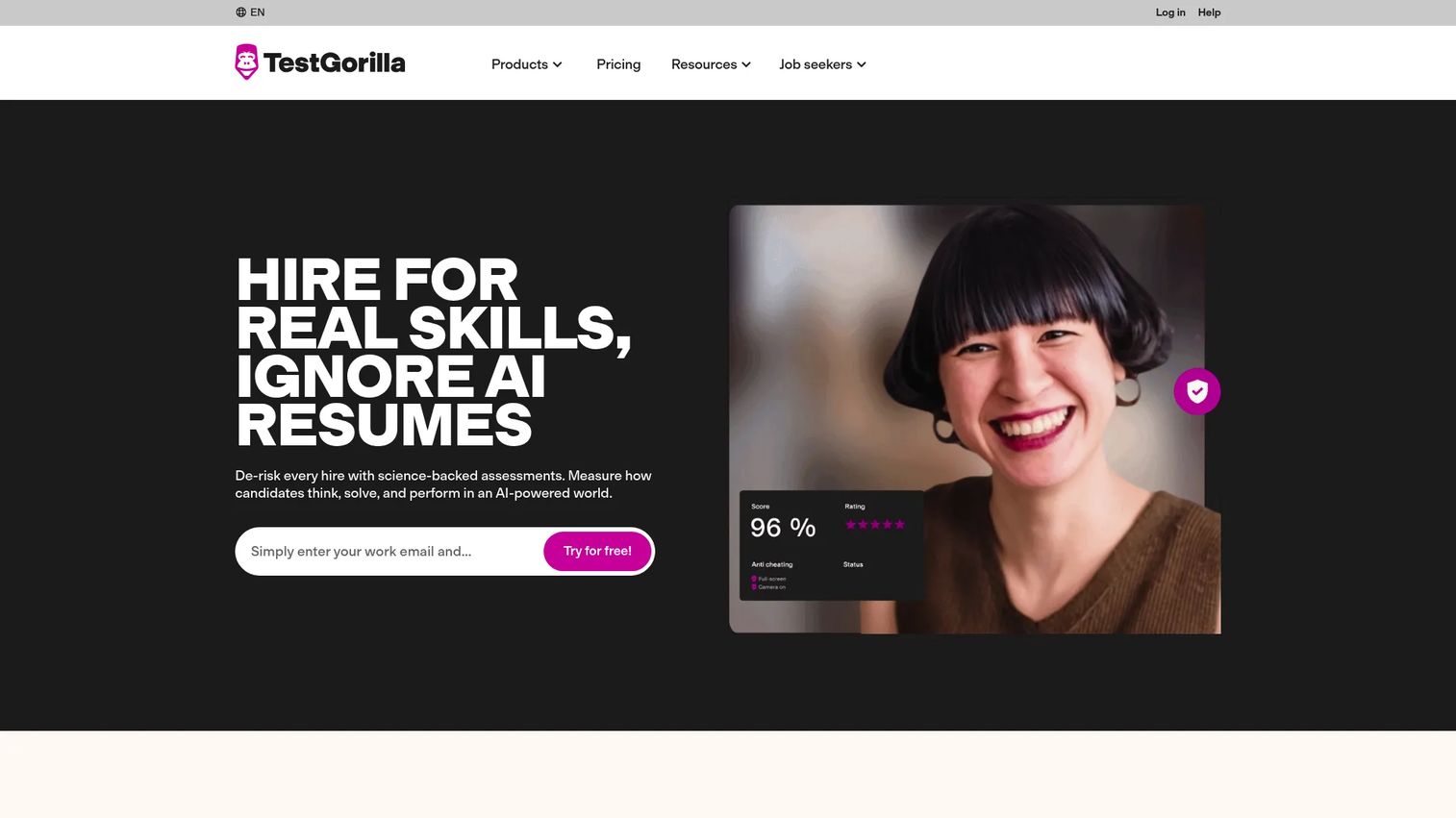
TestGorilla is an AI-powered hiring platform built for skills-based screening at scale. It centers on a large library of skills tests and assessments, AI resume scoring, and AI video interviews. The free tier and credit-based model make it easy to launch, which matters when you want broad coverage without a heavy procurement cycle.
Best for: teams hiring at scale that want skills-based screening and assessment workflows they can stand up quickly.
Key strengths
- Large test library: hundreds of skills tests and assessments you combine into role-specific assessment sets.
- AI resume scoring: ranks applicants automatically to cut early screening time.
- AI video interviews: structured, async video responses scored consistently across candidates.
Why choose TestGorilla: the free tier and predictable credit-based scaling make it a low-risk starting point for a founder who wants to prove the value of assessment before a bigger spend. It leans skills-first, which fits engineering, support, and operations roles where you want to see the work, not just talk about it. ATS integrations keep candidate flow clean.
TestGorilla pricing: the Free plan is $0/mo. The Core plan starts at $142/mo on an annual commitment, and the Plus plan starts from $400/mo, with annual commitment starting at $4,800. Screening tools are available on the free tier, so you can test the workflow before scaling.
3. HireVue
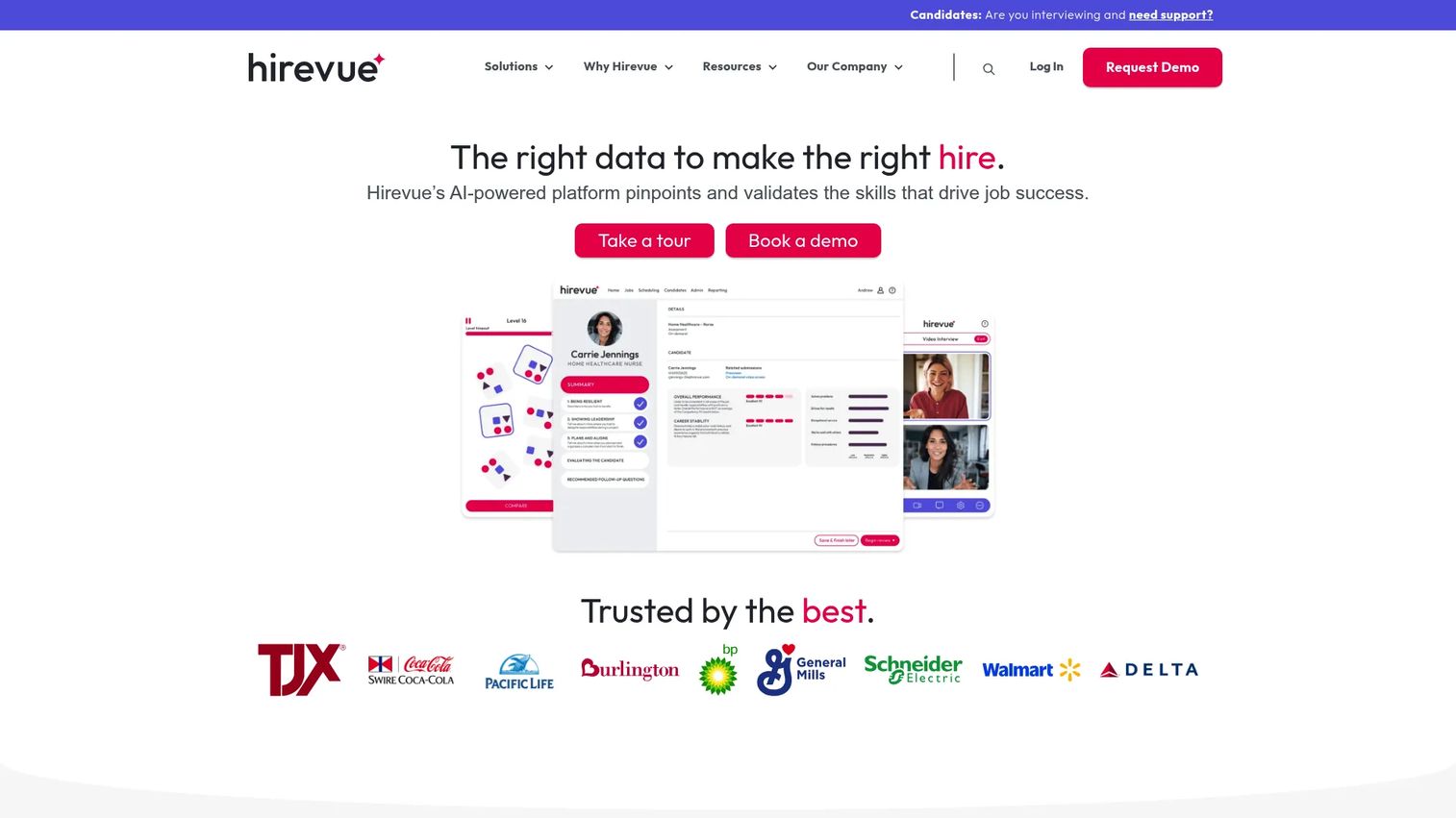
HireVue is an enterprise hiring platform built around automated video interviewing, assessments, and conversational AI. Its assessment builder covers game-based assessments, the Virtual Job Tryout, AI-scored interviews, technical assessments, and language tests. For high-volume or standardized evaluation, it is designed to keep the process consistent across thousands of candidates.
Best for: enterprise hiring teams that need structured interviewing and assessment workflows at scale.
Key strengths
- Job simulations: Virtual Job Tryout previews real performance instead of self-reported traits.
- AI-scored interviews: automated video interviewing with consistent scoring across large applicant pools.
- Broad assessment builder: game-based, technical, and language assessments configured per role.
Why choose HireVue: if you are standardizing evaluation across a large or distributed hiring team, HireVue's workflow automation and validation focus keep quality consistent. It shines where volume and repeatability matter, and where a standardized candidate experience protects your employer brand. The simulation-based approach gives you performance signal, not just personality data.
HireVue pricing: HireVue offers packages from Essential to Premium, but no public price is shown on its pricing page. You will need to contact sales for a quote based on hiring volume and features.
4. The Predictive Index
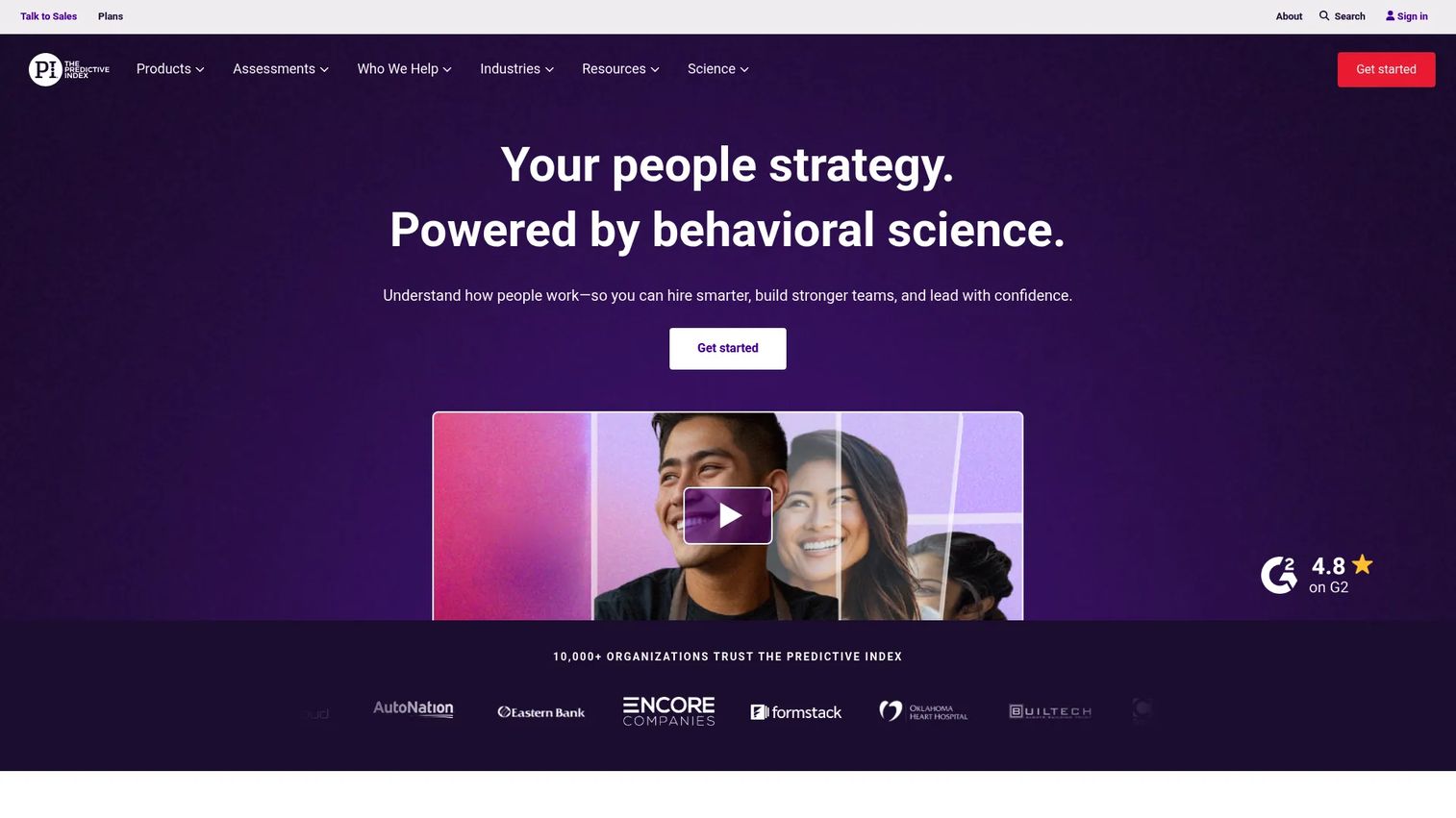
The Predictive Index is science-backed talent optimization software that spans hiring, managing, and developing employees. It combines validated hiring assessments with team development, leadership coaching, and employee engagement surveys. The behavioral science underneath helps you forecast fit and understand team dynamics, not just screen a single candidate.
Best for: teams that want behavioral assessments and talent optimization across hiring, leadership, and engagement in one system.
Key strengths
- Validated hiring: unlimited candidate assessments built on behavioral science.
- PI Essentials: team development and leadership coaching tools for post-hire use.
- Employee engagement: science-backed surveys with actionable insight for retention.
Why choose The Predictive Index: it is strong for organizations that want pre-hire and post-hire value from one platform. You assess candidates for fit, then use the same behavioral data to coach managers, build teams, and support internal mobility. For a founder building leadership as the company scales, that continuity is the draw.
The Predictive Index pricing: public annual plans start at $7,550 for Validated Hiring and $8,500 for PI Essentials. Team Development and Employee Engagement are quote-based add-ons available on request. There is no free tier, though a trial exists.
5. Harver
Harver is a talent assessment and automated hiring platform built for high-volume recruiting. It combines predictive assessments, automated hiring workflows, and video interviewing, with breadth across situational judgment tests, cognitive and behavioral assessments, and interactive video. The scientific backing and automation focus make it well suited to enterprises processing large applicant flows.
Best for: enterprises hiring at scale that need validated assessments and automation to manage volume.
Key strengths
- Predictive assessments: validated tests designed to forecast on-the-job performance and retention.
- Automated hiring workflows: automation that keeps high-volume pipelines moving without manual bottlenecks.
- Video interviewing: structured video assessment integrated into the hiring flow.
Why choose Harver: when you are hiring hundreds or thousands and want to improve both quality of hire and retention, Harver's automation plus validated assessments handle the volume. The candidate experience focus helps completion rates hold up under scale, which protects your pipeline. It is an enterprise-grade option for teams where hiring volume is the defining constraint.
Harver pricing: Harver does not display public pricing on its site. The site uses request-a-demo CTAs, so you will need to contact sales for a quote scoped to your hiring volume.
6. Testlify
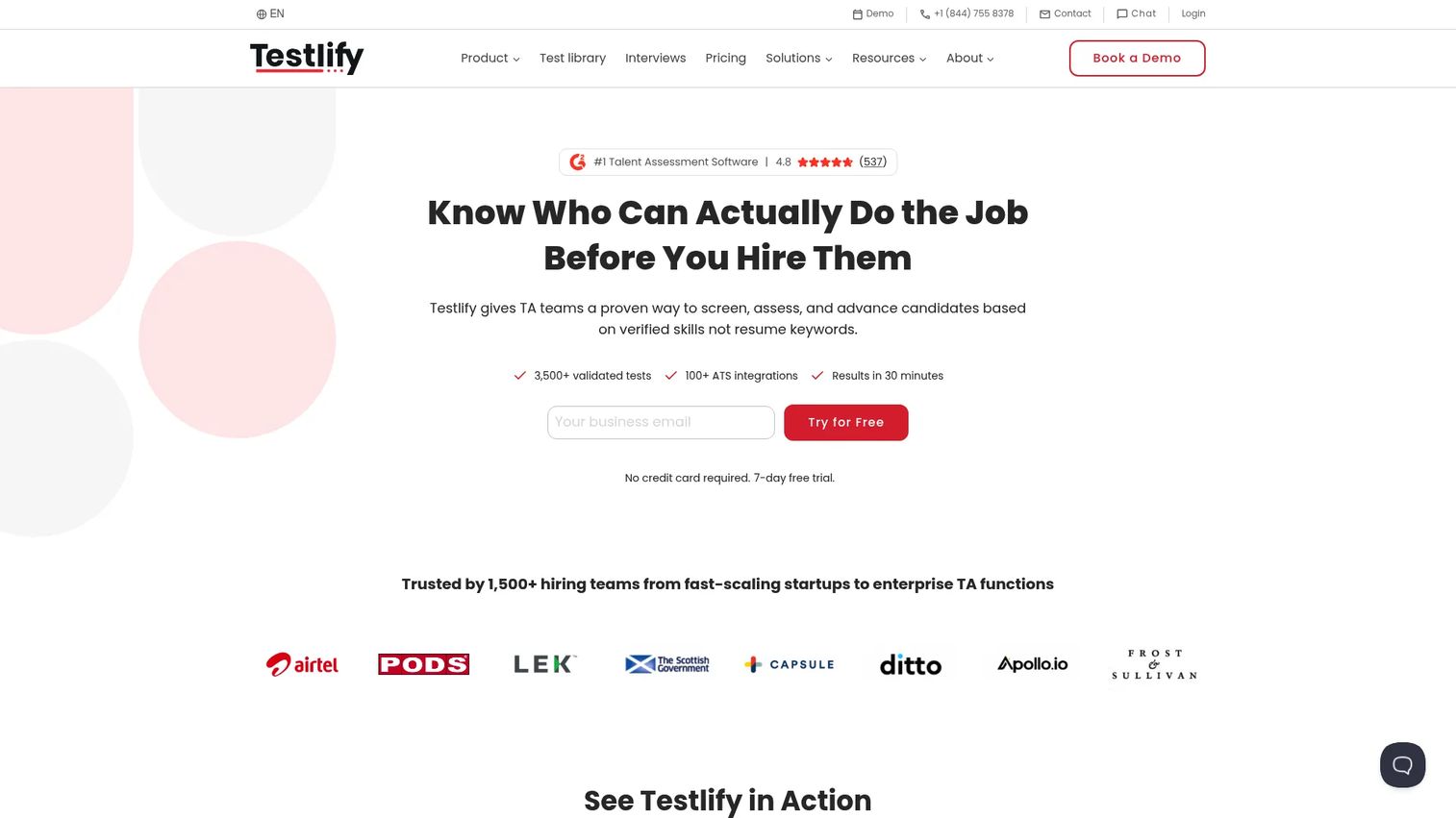
Testlify is an AI-native talent assessment and interview platform for skills-based hiring. It offers more than 3,500 ready-to-use assessments, conversational AI interviews, and advanced proctoring and anti-cheating controls. The breadth of tests plus usage-based pricing make it a flexible fit for teams that want wide coverage without committing to a fixed seat count.
Best for: hiring teams that want skills assessments plus AI interviews and proctoring in one platform.
Key strengths
- 3,500+ assessments: a deep, ready-to-use library covering skills, cognitive, and situational tests.
- Conversational AI interviews: AI-driven video, audio, and phone interviews for scalable screening.
- Advanced proctoring: anti-cheating controls that protect the integrity of remote assessments.
Why choose Testlify: the combination of a large library, AI interviews, and proctoring makes it a strong all-in-one for teams scaling remote hiring. Usage-based pricing means cost tracks with hiring activity rather than headcount, which suits a growing team with uneven volume. Customization and add-ons let you tailor the candidate flow as you scale.
Testlify pricing: Testlify runs on credit-based and unlimited plans, with Standard and Custom tiers billed monthly or annually. Base plan pricing is not shown publicly on the pricing page, but a 7-day free trial is available, and add-ons like white-labeling and integrations are priced separately.
7. Skillrobo
Skillrobo is AI-powered pre-employment skills assessment software for screening and hiring candidates. It offers customizable skill assessments, SEYARC AI test generation, and an analytics dashboard for results reporting, all with clear, published pricing. For smaller or scaling teams that want straightforward packaging without a sales cycle, the transparency is a real advantage.
Best for: hiring teams that need online pre-employment testing and candidate screening with clear cost structure.
Key strengths
- Customizable assessments: build skill tests tailored to each role.
- SEYARC AI test generation: generate assessments quickly with AI assistance.
- Analytics dashboard: results reporting and talent analytics to compare candidates.
Why choose Skillrobo: transparent, published pricing makes budgeting easy, which matters when you are protecting cash at Series B and do not want a drawn-out procurement process. The tiered plans map cleanly to invite volume and active test needs, so you buy what you use. It is a practical mid-market option for teams that value clarity over enterprise complexity.
Skillrobo pricing: three plans are published. Happy is $49/mo or $490/year, Joy is $99/mo or $990/year, and Pro is $299/mo or $2,990/year. Yearly plans include two months free, and a 14-day free trial is available across plans.
8. Truffle
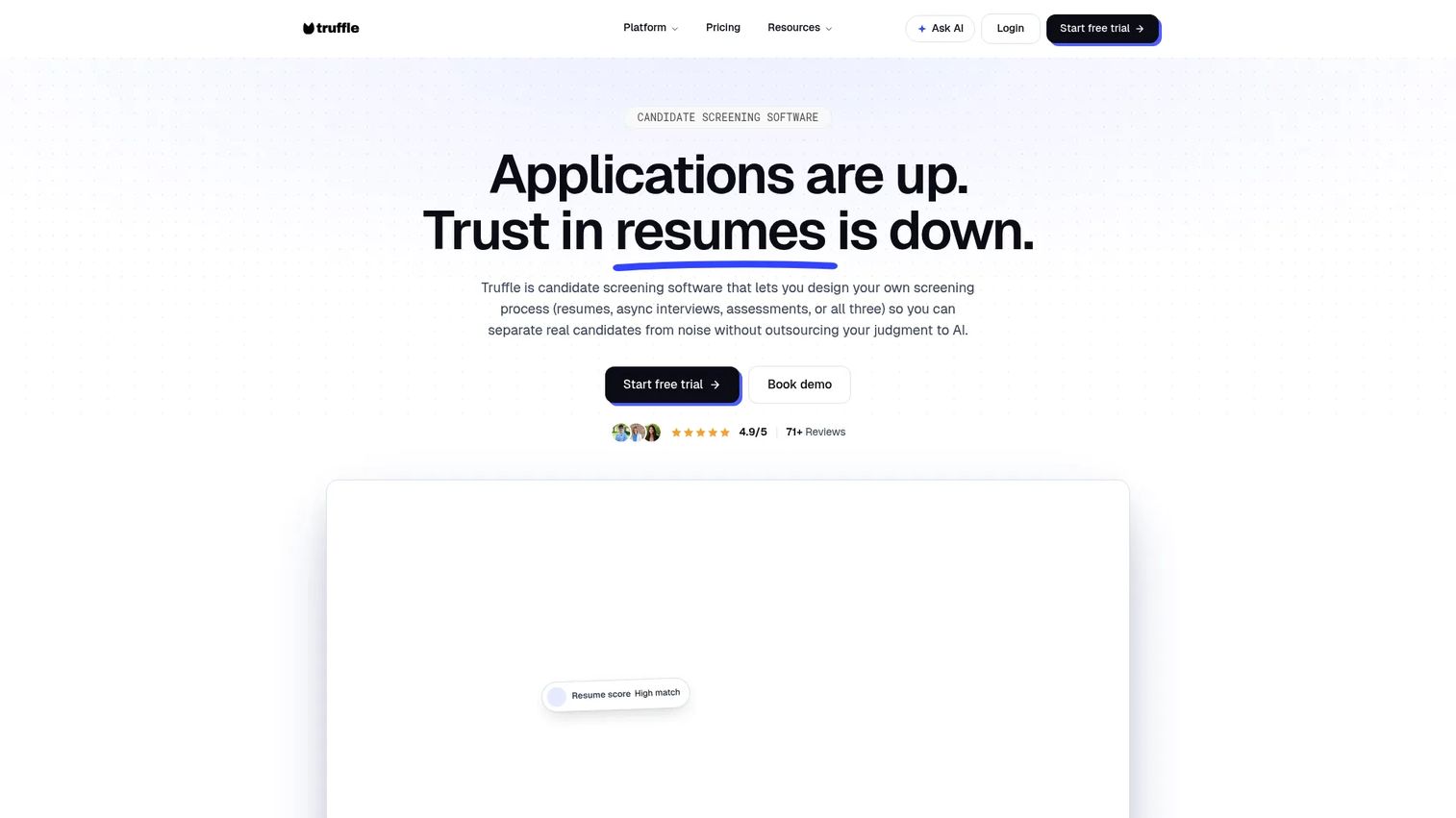
Truffle is candidate screening software that combines resume screening, one-way video interviews, and talent assessments in one flat-rate platform. It layers on AI Match and ATS integrations, taking a bottleneck-first approach: it puts screening and assessment together so you handle the top of the funnel in one place. The transparent, flat-rate pricing is a clean fit for teams that dislike per-seat complexity.
Best for: in-house recruiting teams that want flat-rate candidate screening across video, assessments, and resume review.
Key strengths
- Resume screening: automated resume review to filter early volume fast.
- One-way video interviews: async video that captures communication signal without scheduling.
- Talent assessments: structured assessments and AI Match to rank candidates against the role.
Why choose Truffle: the flat-rate pricing removes the per-seat math that makes budgeting painful as your team grows, so a new recruiting hire does not add cost per seat. Bundling screening and assessment together addresses the real bottleneck, which is the volume of candidates at the top of the funnel. For a founder who wants one predictable line item that covers screening end to end, it is a strong fit.
Truffle pricing: the Self-Serve plan is $149/mo, or $99/mo billed annually. A Custom volume plan covers hiring above 150 candidates per month. There is a 7-day free trial with no credit card required.
Considerations before you buy
Choosing a candidate evaluation software is not only about the test library. Here is what to check before you sign.
Time to implement and ATS integrations
Ask how long setup takes and which ATS and HRIS integrations are supported. A tool that plugs into your existing stack adds signal without adding operational drag. If your team has to manually move candidate data between systems, the tool is costing you the time it was meant to save.
Scoring methodology and validation
Ask how scores are produced and whether the vendor publishes validation studies. Real validation means the assessment predicts job performance, checked against outcomes. Ask about adverse impact, norms, and scoring methodology. This is the difference between defensible hiring and a legal exposure.
Fairness and bias mitigation
Any tool that scores people needs a clear answer on fairness and bias mitigation. Ask what the vendor does to reduce adverse impact across groups, and whether AI scoring is audited. Transparent methodology protects both your candidates and your company.
Candidate experience and drop-off
A long, confusing assessment kills completion rates and damages your employer brand. Check mobile access, time burden, and clarity. Better candidate experience means less candidate drop-off, which means you keep strong applicants in the funnel instead of losing them to a clunky test.
Reporting, cost per hire, and ROI
Look at reporting depth and how the tool ties to cost per hire. The goal is a hiring system that scales without founder involvement, so reporting that a new VP can read on day one matters. Weigh pricing against the cost of a bad hire, and the ROI usually becomes obvious.
Conclusion
The right talent assessment platform depends on your hiring volume, how much validation depth you need, and how cleanly it fits your workflow. There is no single best tool, only the best fit for your bottleneck.
If you want science-led hiring with strong fairness framing and post-hire development, Criteria Corp is the mature pick. For high-volume, skills-based screening you can launch fast, TestGorilla and its free tier are hard to beat. Enterprise teams standardizing evaluation at scale should look at HireVue and Harver. If you want pre-hire and post-hire value in one system to support internal mobility and retention, The Predictive Index earns the look. And if you want screening and assessment bundled at a flat rate, Truffle keeps budgeting simple.
Start by naming your bottleneck: volume, quality, or fairness. Then shortlist the two tools that solve it, run the free trials, and watch completion rates and hiring quality before you commit. That is how you build a hiring system that scales without routing every decision through you.
FAQs
Talent assessment software is a category of hiring tools that measure a candidate's skills, behavior, cognitive ability, and job fit before a hire or promotion. It uses structured tests instead of resumes and gut feel alone, giving you comparable, defensible data on each candidate. Many teams use it for both hiring and post-hire development.
An ATS manages applicants and workflow: it stores resumes, tracks stages, and schedules interviews. Talent assessment software measures the actual candidate signal, whether the person can do the job and how they will behave in it. Most teams run both together, feeding assessment scores back into the ATS to rank candidates.
It depends on the role. Skills tests and job simulations work best when you need proof of ability, while psychometric assessments, cognitive assessments, and situational judgment tests help predict behavior and reasoning. The strongest processes combine a skills test with a behavioral measure so you see both capability and fit.
Completion rates track directly to how the assessment feels. Mobile access, a reasonable time burden, and clear instructions keep candidates engaged, while long or confusing tests cause candidate drop-off. A better experience improves completion and protects your employer brand, so it is worth checking before you buy.
The good ones are, but validation varies by vendor. Validation means the assessment actually predicts job performance, checked against real outcomes. Ask any vendor about adverse impact, norms, and scoring methodology, and confirm they audit AI scoring for bias mitigation before you trust the results.
Focus on time to implement, ATS and HRIS integrations, reporting depth, and cost per hire. The goal is a hiring system that scales without adding operational drag or routing every decision through you. Weigh the price against the cost of a bad hire, and the ROI usually becomes clear.
For high applicant volume, Harver and HireVue are built for scale, with automated workflows and validated assessments that keep quality consistent across thousands of candidates. TestGorilla and Testlify also handle volume well and let you launch faster with lighter procurement. The best fit depends on whether you need enterprise validation or speed to stand up.
Yes. Post-hire, the same behavioral and cognitive data supports internal mobility, leadership development, and workforce planning. Tools like The Predictive Index and Criteria Corp extend assessment into coaching and team development, so you can spot people ready for bigger roles and plan team composition with talent analytics instead of guesswork.