You shipped a prompt change on Friday. By Monday, support has 40 new tickets about answers that are confidently wrong.
Most teams read that as a data problem. Better retrieval, better context, better fine-tuning. But that misses what actually happened. You changed the model behavior and had no way to catch the regression before users did.
Model quality is not one problem. It is several stacked on top of each other: hallucinations, unsafe or toxic outputs, PII leakage, bias, and slow drift as real traffic diverges from your test set. Each one hits a different metric a product manager owns, from support deflection to trust to churn.
The stakes are getting bigger. The global AI model evaluation platform market is projected to grow from $1.86 billion in 2025 to $6.24 billion by 2030, a 27.5% CAGR, according to Research and Markets (2026). That growth tracks a simple shift: shipping AI without a repeatable way to test it is no longer acceptable.
This guide breaks down seven model evaluation software options so you can pick one that fits your release cycle, not just your feature wishlist.
What's inside
This guide is for product managers, ML leads, and AI platform owners comparing model evaluation software before or after a release.
We selected tools based on four criteria that matter to product teams:
- Evaluation depth: test generation, rubric scoring, and failure-mode detection
- Monitoring coverage: drift monitoring, regression testing, and continuous monitoring in production
- Governance and workflow fit: audit trails, access control, and CI/CD integration
- Deployment flexibility: open-source, self-hosted, and enterprise options
The list spans free open-source frameworks and enterprise AI evaluation platforms, so you can match a tool to your team's maturity.
TL;DR
- Best for open-source evaluation and observability: Evidently AI
- Best for prompt and workflow evaluation in an enterprise setting: Humanloop
- Best for review workflows and annotation-heavy teams: Label Studio
- Best for end-to-end evaluation and test automation: Confident AI
- Best for fast metric coverage and modular evaluation: DeepEval
- Best for enterprise data quality and testing: Deepchecks
- Best for observability-first product teams: Arize AI
Start with one tool for offline testing and one for production monitoring if your team is scaling fast. Many of these cover both.
What is model evaluation software
Model evaluation software is a category of AI evaluation tools that test, score, and monitor the quality of machine learning and LLM outputs before and after release.
It helps teams generate test cases, score outputs against rubrics, detect failure modes like hallucinations and toxicity, and track quality over time as inputs shift. Instead of eyeballing a spreadsheet of sample outputs, you get repeatable checks that run on every change.
Most evaluation platforms cover some mix of these core capabilities:
- Test generation: create synthetic or curated test cases for LLMs, RAG apps, agents, and ML models
- Rubric scoring: grade outputs on relevance, faithfulness, and groundedness
- Human review: route outputs to reviewers for calibration and edge cases
- Offline evaluation: run regression testing before a release ships
- Drift monitoring: flag when production data diverges from your baseline
- Bias, toxicity, and PII detection: catch unsafe or non-compliant outputs
- Dashboards and alerts: surface quality changes to the whole team in real time
The distinction that trips people up: offline evaluation checks quality before you ship, while continuous monitoring watches quality in production. Strong model testing software does both, and ties them together so a regression caught in monitoring becomes a test case for next time.
These LLM evaluation tools now cover far more than raw model accuracy. They test prompts, retrievers, and full agent workflows, which is where most real-world quality problems actually live.
When to use model evaluation software
Catch hallucinations before users do
Run pre-release checks for factuality, faithfulness, and groundedness whenever your model touches customer-facing answers. This is where release confidence comes from. A demo that hallucinates a pricing tier or a support answer that invents a feature both erode trust faster than any missing capability. Evaluation software lets you set a factuality threshold and block a release that falls below it.
Compare model versions after changes
Use regression testing and benchmark comparisons every time a prompt, retriever, or model version changes. This matters most when your release cadence is fast and changes stack up. Without version comparison, you are guessing whether last week's prompt tweak helped or quietly broke three edge cases. A baseline plus regression tracking turns that guess into a number you can defend to stakeholders.
Monitor production quality over time
Reach for continuous monitoring when drift, edge cases, or data shifts make one-time offline checks insufficient. Real traffic rarely matches your test set for long. Drift monitoring, trace analysis, and quality alerts catch the slow decay that never shows up in a pre-release run, then feed those failures back into your test suite.
Comparison table
Here is a side-by-side view of the seven tools, sorted by relevance to product teams evaluating model quality. Pricing and ratings reflect current public values; verify against each vendor before you buy.
| # | Product | Best for | Key differentiator | Pricing | G2 rating |
|---|---|---|---|---|---|
| 1 | Evidently AI | Open-source evaluation and observability | 100+ built-in metrics for LLMs and ML models | Free open-source; Enterprise custom | 5.0/5 |
| 2 | Humanloop | Enterprise prompt and workflow evaluation | Evaluation tied to prompt management | Free trial; Enterprise contact sales | Not listed |
| 3 | Label Studio | Annotation-heavy review workflows | Multi-modal labeling and review | Free OSS; Starter $99/user/mo | 3.5/5 |
| 4 | Confident AI | End-to-end evaluation and governance | Eval, observability, and release gating | Free; Starter $200/mo | Not listed |
| 5 | DeepEval | Fast, code-native evaluation | Pytest-style LLM unit tests, 50+ metrics | Free open-source | Not listed |
| 6 | Deepchecks | Enterprise data and model quality | Version comparison for prompts and models | Free OSS; Startup $89/model | 4.4/5 |
| 7 | Arize AI | Observability-first product teams | Tracing, drift detection, root-cause analysis | Free; Pro $50/mo | 4.2/5 |
Best 7 model evaluation software tools for 2026
1. Evidently AI
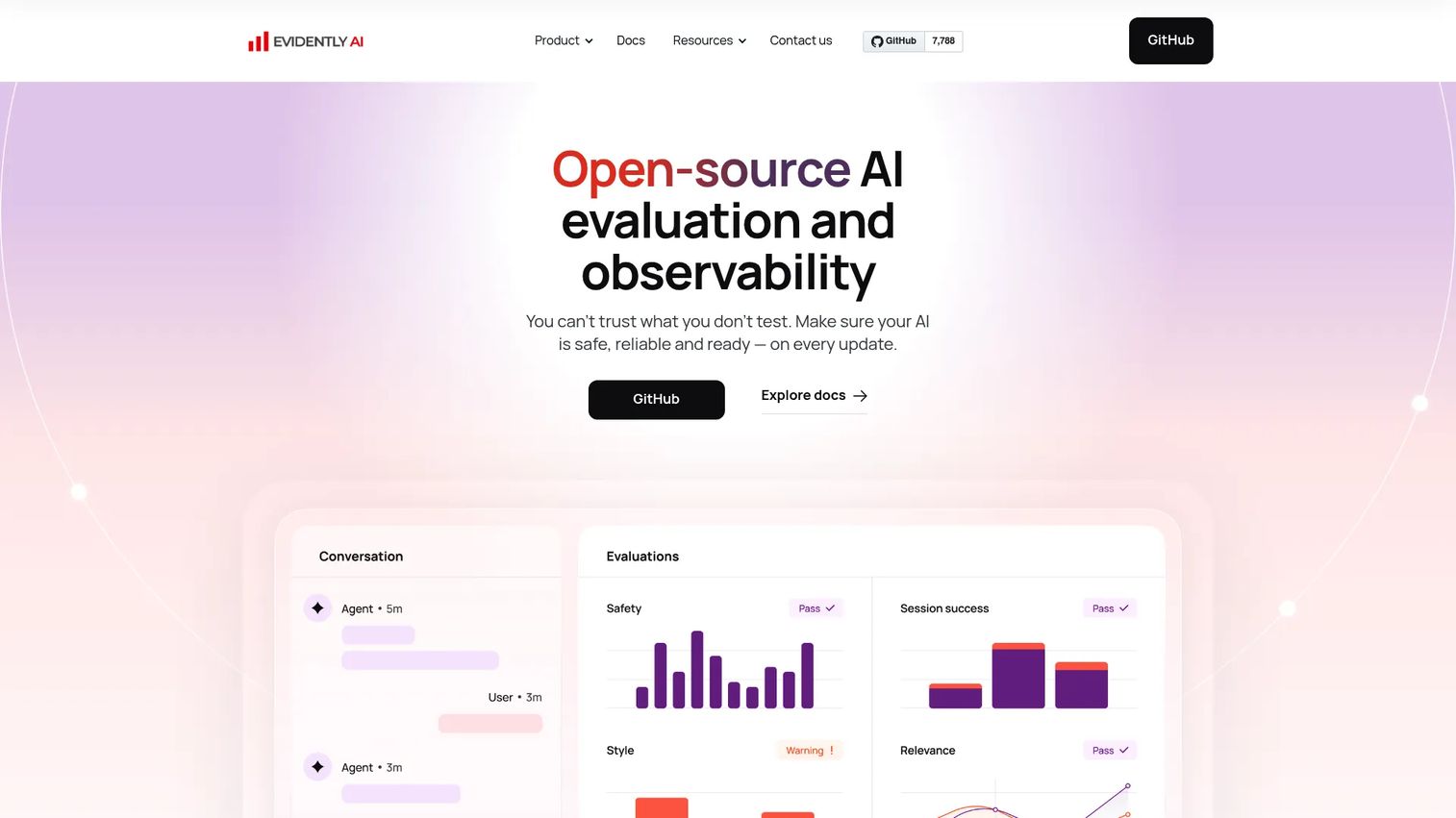
Evidently AI is open-source AI evaluation and observability for testing and monitoring LLMs, RAG apps, AI agents, and ML models. It started as an open-source library and has grown into a full platform that covers both offline evaluation and live production monitoring. For teams that want one place to test before release and watch quality after, it lands as a strong lifecycle option.
The open-source foundation matters for product teams with limited developer bandwidth but real security requirements. You can start with the free library, prove the workflow, then move to the enterprise platform without switching vendors or rewriting your evaluation logic.
Best for: teams evaluating and monitoring AI or ML systems with an open-source-first workflow.
Key features
- Automated evaluation with 100+ built-in metrics
- Synthetic data generation for test coverage
- Continuous monitoring with live dashboards
Why choose Evidently AI: it fits technical teams that want flexibility across the full lifecycle without paying for a closed platform on day one. The breadth across LLMs and traditional ML models makes it useful when your stack is mixed.
Evidently AI pricing: the open-source plan is free. Enterprise is custom pricing, available through the vendor's sales team.
2. Humanloop
Humanloop is an enterprise platform for evaluating, managing, and observing LLM-powered applications. It ties evaluation to prompt management, so the same place you version and edit prompts is where you run and score evaluations. That connection matters when your quality problems trace back to prompt changes rather than the model itself.
For product teams building on top of foundation models, this workflow keeps evaluation from becoming a separate, forgotten step. Prompt, evaluate, observe, iterate: all in one loop.
Best for: teams building and evaluating enterprise LLM applications.
Key features
- Evaluation for LLM apps with custom evaluators
- Prompt management and versioning
- Observability and monitoring in production
Why choose Humanloop: it works well when evaluation is one part of a broader AI product workflow, not a standalone testing task. The prompt-plus-eval pairing suits teams iterating on prompts frequently.
Humanloop pricing: a free trial is available with limits of 2 members, 50 evaluation runs, and 10,000 logs per month. The Enterprise plan uses contact-sales pricing.
3. Label Studio
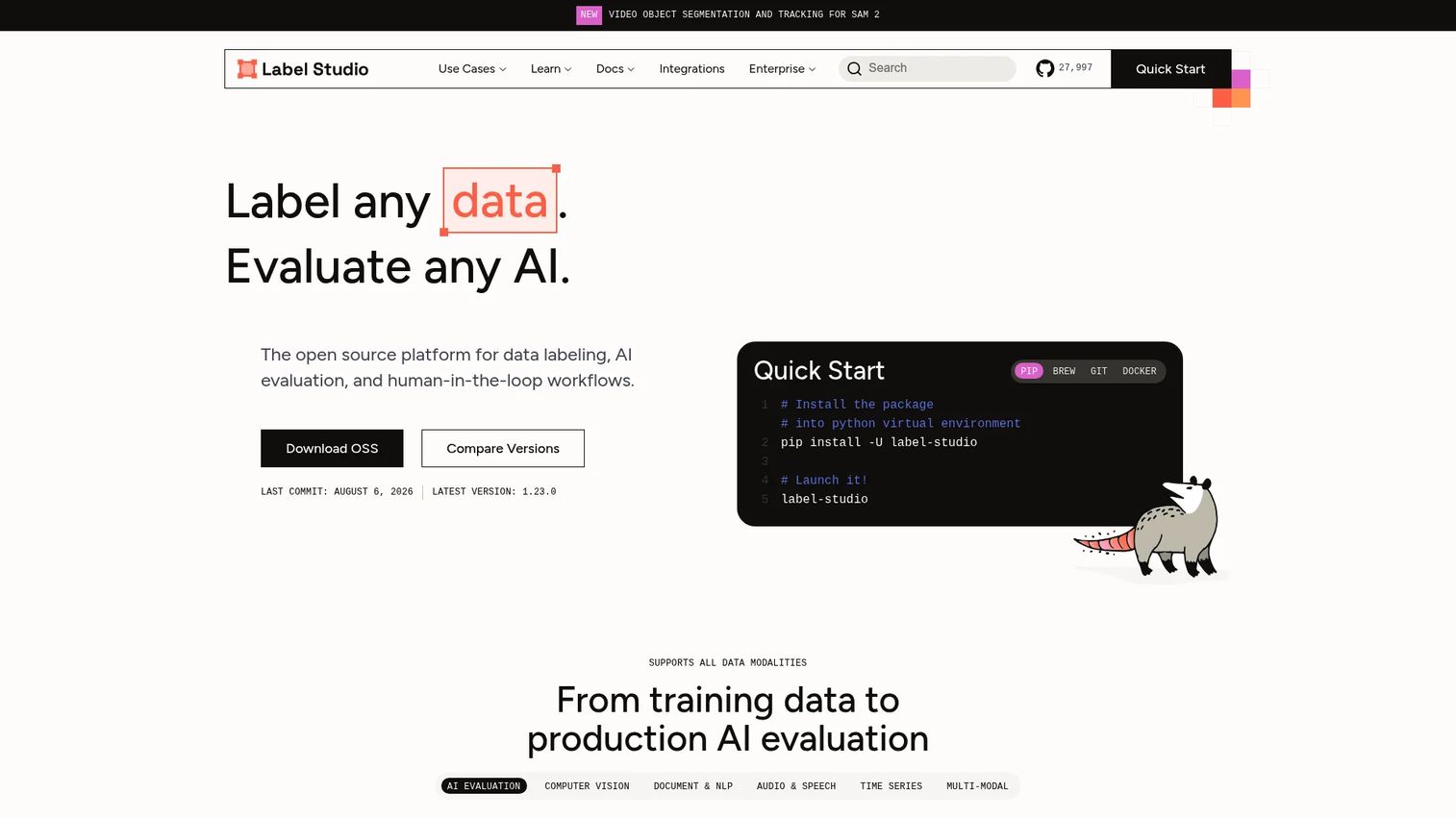
Label Studio is an open-source data labeling platform with hosted Starter Cloud and Enterprise offerings. It shines when evaluation depends on structured human input, whether that is annotating training data or scoring model outputs against a rubric. If your quality process leans on human reviewers rather than automated metrics alone, this is where those judgments get collected and calibrated.
Product teams running human review loops use it to turn subjective quality calls into consistent, structured data. That structure is what makes human review scale past a handful of reviewers.
Best for: teams building or running data labeling and model-evaluation workflows.
Key features
- Multi-modal labeling across text, image, and more
- ML and LLM-assisted pre-labeling and evaluation
- Role-based access control and review workflows
Why choose Label Studio: it is the strong pick when your evaluation program is annotation-heavy and human judgment is central. The role-based controls help when multiple reviewers need to stay aligned.
Label Studio pricing: the Community Edition is open source and free. Starter Cloud is the hosted platform starting at $99 per user per month, and Enterprise uses custom pricing.
4. Confident AI
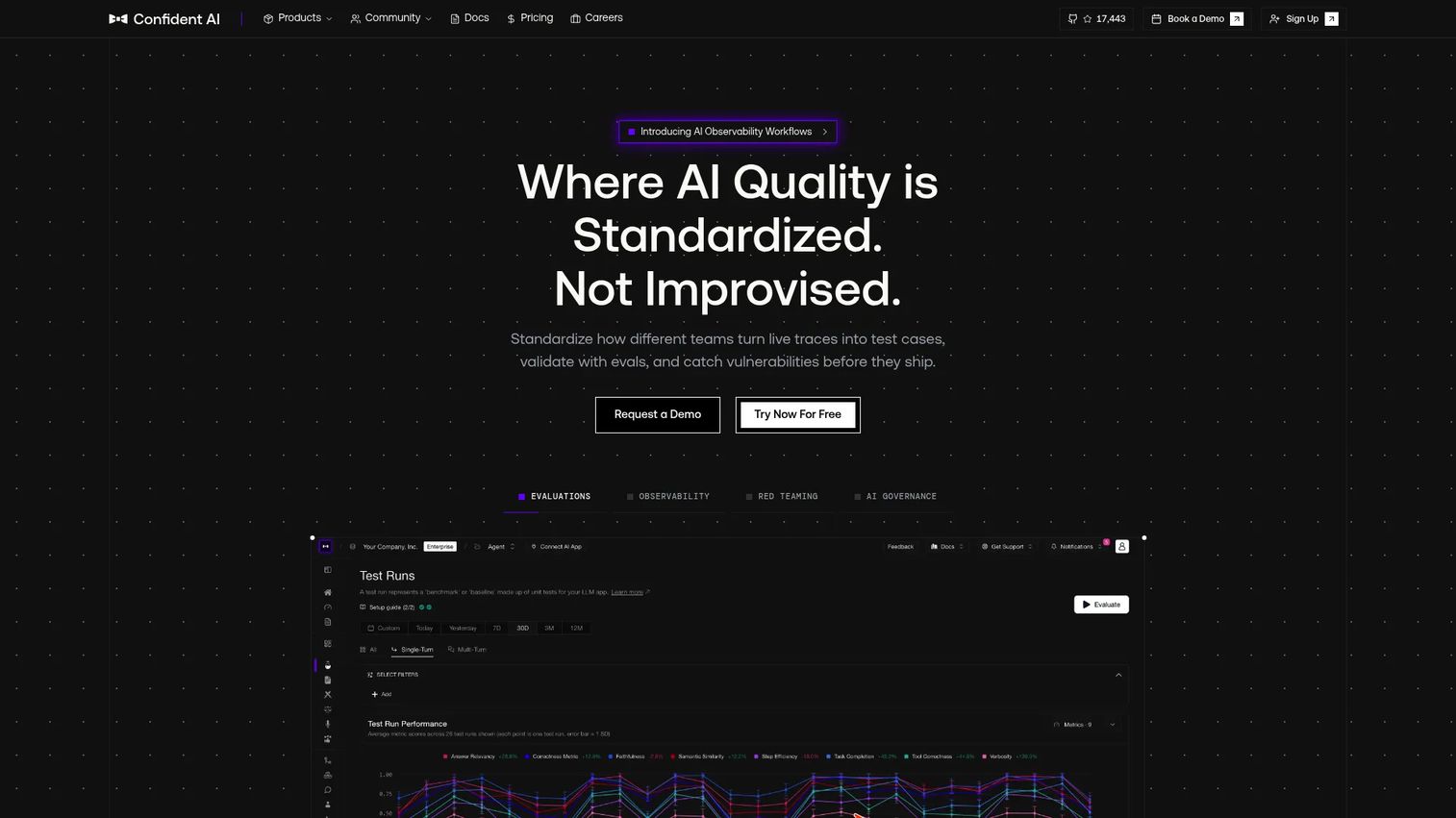
Confident AI is a platform for LLM evaluation, observability, and AI governance. It centers on test suites, dashboards, and regression checks, then adds governance controls and release gating on top. For teams that want a structured evaluation program rather than a loose collection of metrics, that end-to-end coverage is the draw.
The governance layer is what sets it apart for product managers who answer to compliance or leadership. Release gating means a version that fails your evaluation criteria does not ship, which turns quality from a hope into a policy.
Best for: teams building and operating LLM apps that need evaluation, observability, and governance in one platform.
Key features
- LLM evaluation and regression testing
- LLM observability with trace monitoring
- AI governance controls and release gating
Why choose Confident AI: it fits teams that want evaluation, monitoring, and governance to live together instead of stitching three tools into a pipeline. The release gating is useful when compliance readiness is a real requirement.
Confident AI pricing: the Free plan is $0 forever. Starter is $200 per month and Team is $2,000 per month, both billed per organization. Enterprise is custom pricing.
5. DeepEval
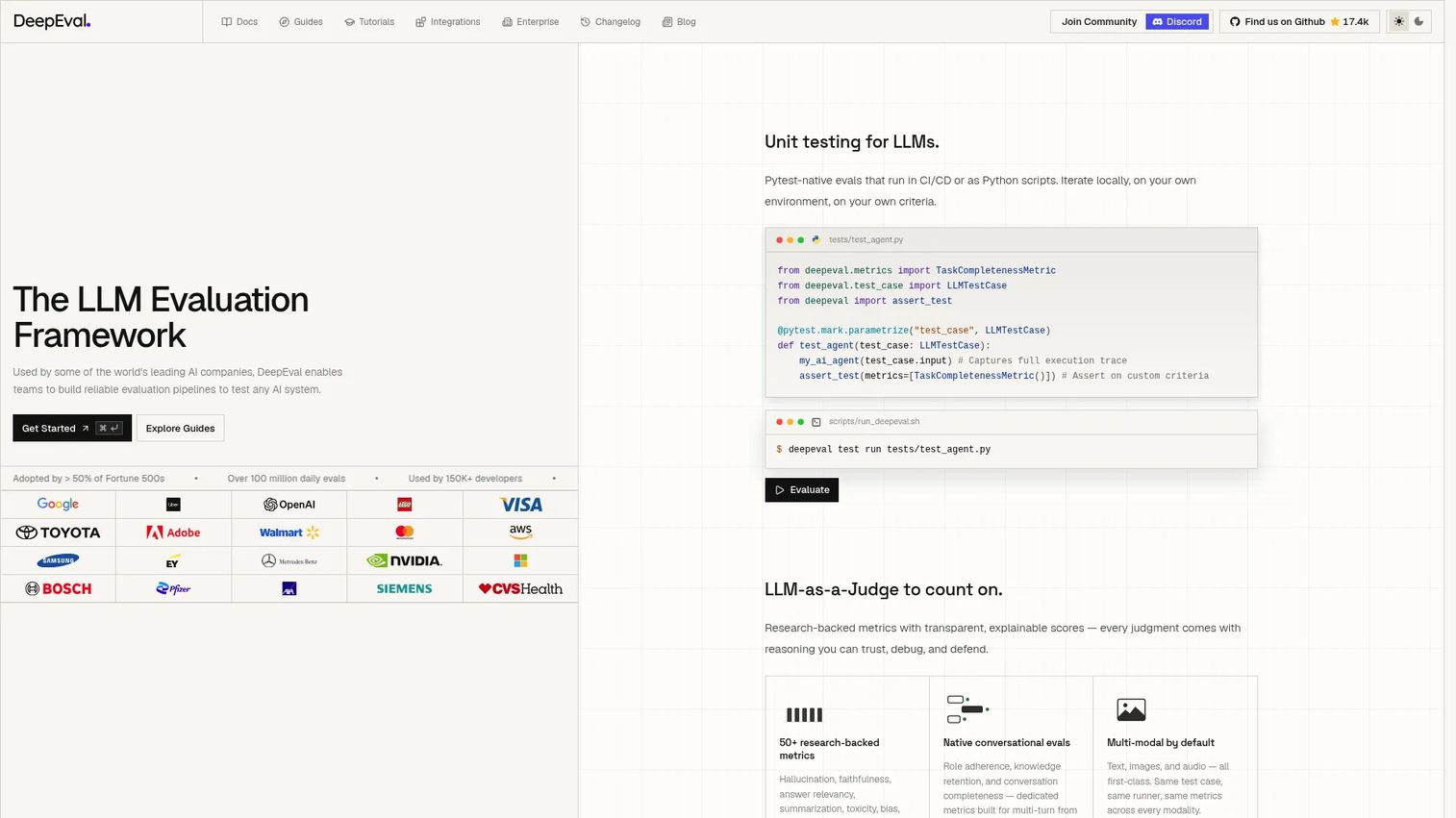
DeepEval is an open-source LLM evaluation framework for testing, tracing, and regression-checking AI apps. It is built for developers who think in terms of unit tests: evaluations look like Pytest assertions, so they drop straight into an existing test suite and CI/CD pipeline. For engineering-led teams, that removes the friction of adopting a separate evaluation tool.
The modular metric library means you can start with relevance and faithfulness checks, then add more as your quality bar rises. Because it is code-native, evaluation lives where the work already happens rather than in a separate dashboard.
Best for: Python-first teams building and evaluating LLM apps, agents, and RAG workflows.
Key features
- Pytest-native LLM unit tests and assertions
- 50+ ready-to-use evaluation metrics
- End-to-end and component-level tracing and evals
- Synthetic dataset generation and conversation simulation
- CI/CD support and Confident AI integration
Why choose DeepEval: it is the fit when you want evaluation embedded in development rather than bolted on after. The Pytest-style approach means engineers adopt it without learning a new mental model.
DeepEval pricing: DeepEval is free and open source. Confident AI is free to get started, with self-serve and enterprise plans available for teams that want the hosted layer.
6. Deepchecks
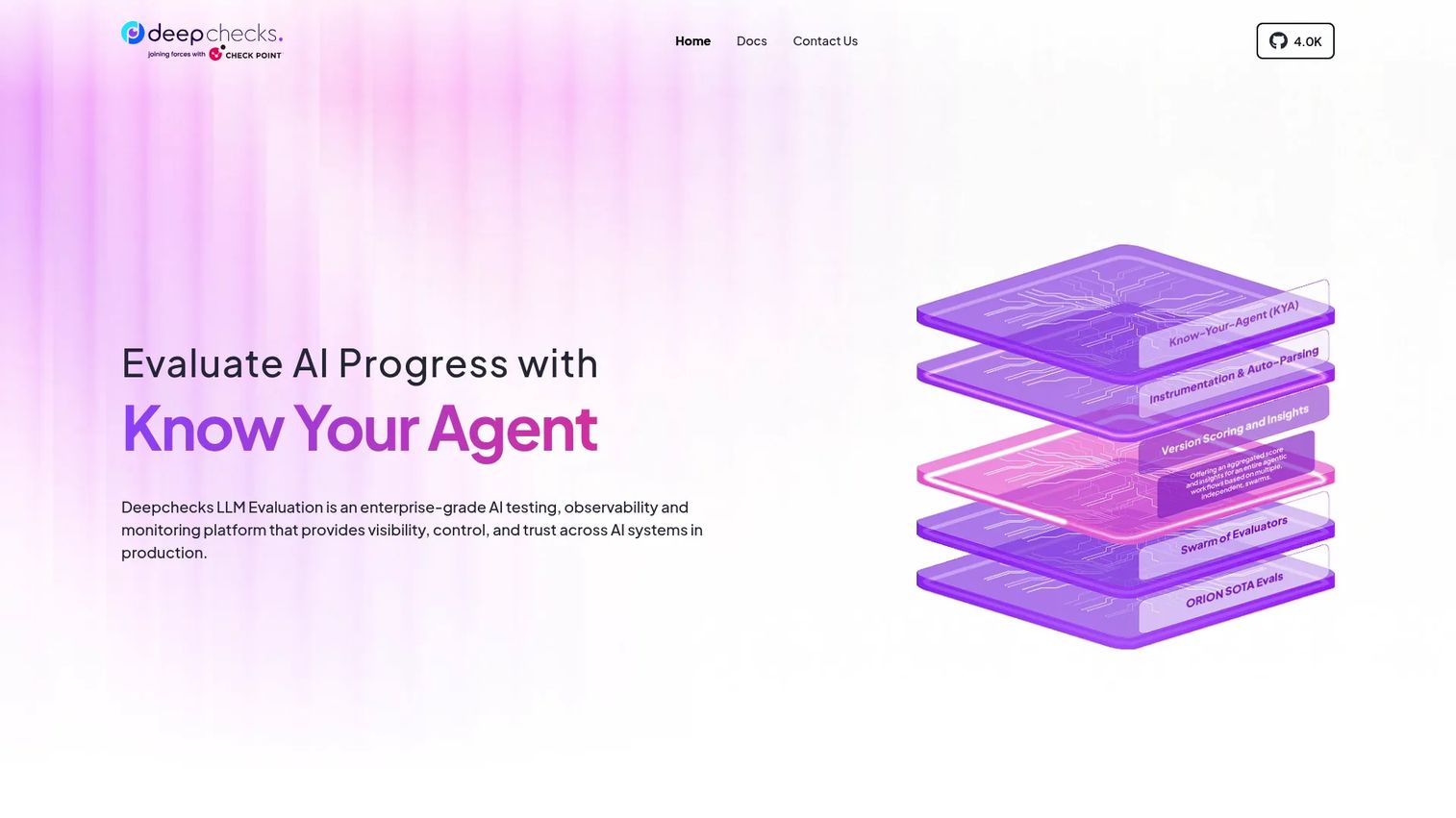
Deepchecks is an LLM and agentic AI evaluation, testing, and monitoring platform. It covers both data and model quality, which makes it a strong option when your evaluation needs extend past LLMs into traditional ML and data validation. Automated scoring, version comparison, and production monitoring sit together in one place.
For product teams that care about bias, robustness, and data quality alongside output accuracy, the breadth is the point. Version comparison across prompts, models, and retrieval strategies makes it clear whether a change actually improved things.
Best for: teams building and monitoring LLM-based or agentic AI applications.
Key features
- Automated quality evaluation and scoring
- Version comparison for prompts, models, and retrieval strategies
- Production monitoring and root-cause analysis
Why choose Deepchecks: it is a strong choice when evaluation spans data quality, bias, and drift, not just LLM output scoring. The version comparison helps teams prove a change was an improvement, not a regression.
Deepchecks pricing: the Open-Source edition is free. The Startup Plan is listed at $159 per model, with a limited-time offer of $89 per model. Dedicated and Partnership tiers are quote-based.
7. Arize AI
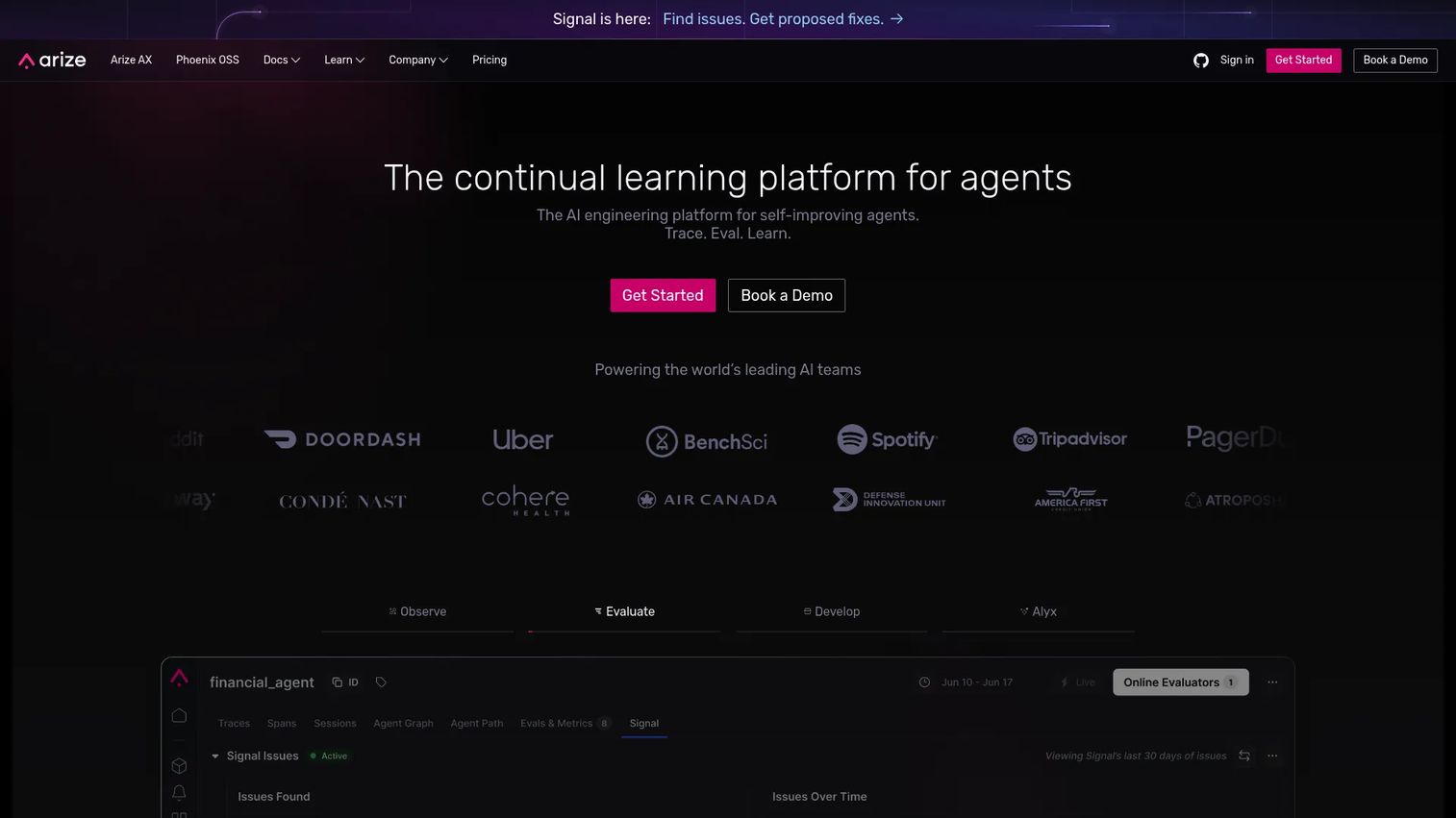
Arize AI is an AI observability and evaluation platform for building, monitoring, and improving AI applications and models. It leads with production visibility: tracing, drift detection, and root-cause analysis for teams that treat monitoring as a core part of evaluation. When something breaks in production, the debugging path is the strength here.
Product teams that want to understand why quality dropped, not just that it dropped, get the trace-level detail to find the cause. That closes the loop between a monitoring alert and a fix.
Best for: teams that need AI or ML observability, tracing, and evaluation for production systems.
Key features
- LLM and agent observability
- Model monitoring, drift detection, and root-cause analysis
- Evaluations, tracing, annotations, and experiments
Why choose Arize AI: it suits teams that treat monitoring as part of evaluation and need to debug quality issues fast in production. The tracing depth turns a vague alert into a specific root cause.
Arize AI pricing: AX Free is $0 per month. AX Pro is $50 per month, and AX Enterprise is custom pricing available on request.
Considerations
Evaluation depth
Compare how each tool handles metrics, rubric support, and test generation. A dashboard that shows a single accuracy number is not enough when your model serves real users across varied inputs. Look for tools that let you define custom rubrics and generate test cases that reflect your actual traffic, not just generic benchmarks.
Monitoring and regression coverage
There is a real gap between one-time testing and ongoing quality assurance. Evaluate how each tool handles drift, versioning, and alerts. A tool that only runs offline checks leaves you blind once real traffic starts diverging from your test set. The best options close the loop by turning production failures into new test cases.
Governance and audit trails
Product managers should care about access control, approvals, and traceability more than most feature comparisons suggest. When evaluation feeds a release decision, you need an audit trail showing who approved what and why. This matters doubly for cross-functional review and compliance readiness, where a paper trail is the difference between passing a review and stalling one.
Integrations and workflow fit
A good tool fits CI/CD, Slack, API, and analytics workflows rather than forcing a new one. The goal is reducing operational overhead, not adding a maintenance tax. Check whether evaluations can run automatically on every release and whether alerts land where your team already works.
Human review and collaboration
The right tool supports product managers, ML engineers, and reviewers working together. Evaluation is not only about scoring outputs; it is about calibrating what good looks like across a team. Look for review workflows, shared rubrics, and role-based access so quality standards stay consistent as more people weigh in.
Conclusion
The right pick comes down to your team's maturity and where quality breaks for you.
If you want open-source flexibility across the full lifecycle, Evidently AI covers testing and monitoring in one place. For prompt-heavy workflows, Humanloop ties evaluation to prompt management. Annotation-heavy teams get structured human review from Label Studio, while Confident AI adds governance and release gating for compliance-minded teams. Developers who live in code will reach for DeepEval, teams needing broad data and model quality checks land on Deepchecks, and observability-first teams get production debugging depth from Arize AI.
If your team is scaling fast, start with one tool for offline testing and one for continuous monitoring. Several of these cover both, so you may not need two vendors.
Whatever you choose, validate the workflow on a real release before adopting it across the org. A tool that scores well in a demo can still create friction in your actual release cycle. Prove the fit first, then scale.
FAQs
It is used to test model quality before release and monitor it after. Teams use it to catch hallucinations, run regression testing on prompt and model changes, and track drift in production. The goal is repeatable quality checks instead of one-off manual spot checks.
Evaluation is offline visibility: you test quality before a release ships, usually against a curated test set. Monitoring is production-time visibility: you watch quality on live traffic and get alerts when it drops. Strong tools connect the two so a monitoring failure becomes a new test case.
No. Many of these tools cover RAG apps, AI agents, and traditional ML models alongside LLMs. If your stack is mixed, look for a platform that evaluates across all of them rather than one built for a single model type.
It depends on the use case, but relevance, faithfulness, and groundedness matter most for factual accuracy. Safety metrics like toxicity, bias detection, and PII detection matter when outputs reach real users. Drift monitoring matters once you are in production and traffic starts shifting.
No, and it should not try to. Automated scoring handles scale and consistency, but human review calibrates what good actually looks like for edge cases and subjective quality. The best setups use both: automated checks for coverage, human review for judgment.
Workflow fit, monitoring coverage, governance, and cross-team usability. A tool that scores well on paper but does not fit your CI/CD or release cadence will not get adopted. Prioritize audit trails and shared review if evaluation feeds release decisions.
Set a baseline first, then track regressions against it over time. If a prompt change moves your faithfulness score up without breaking edge cases, evaluation is doing its job. Tie those scores to outcome metrics like support ticket volume and trust to prove the impact.
Neither is universally better; it depends on team maturity, security needs, and scale. Open-source options like DeepEval and Evidently AI give flexibility and low cost to start. Enterprise tiers add governance, support, and hosted infrastructure that larger or regulated teams need.