You sent the NPS survey. A number came back. Leadership nodded. And then nothing changed.
That is how most net promoter score programs stall. The survey goes out once a quarter, a score lands in a deck, and the actual feedback, the reason someone gave you a 3 or a 9, evaporates before anyone routes it to a person who can act. The score becomes a vanity metric instead of a signal.
The global average NPS survey response rate is only 12.4%, according to Ringly (2026), which means the feedback you do collect is precious. Wasting it on a static scorecard is the real problem. NPS software exists to fix that gap. It is the difference between measuring loyalty once and running an operating system for customer feedback, one that collects across channels, routes detractor responses to owners, and turns raw text into something a product marketing manager can act on.
The NPS software market reflects that shift. It was valued at $1.8 billion in 2025 and is projected to reach $4.6 billion by 2034 at a 13.2% CAGR, per MarketIntelo (2025). Customer experience management is the top application at 42.7% of usage. Buyers are not shopping for a survey tool anymore. They are shopping for feedback infrastructure.
What's inside
This guide is for product marketing managers, CX owners, and customer success leaders who need to choose an NPS platform that scales past a single survey send. We looked at 13 tools and evaluated each on the things that actually decide whether a program works.
We selected and ranked platforms based on four criteria:
- Collection breadth: how many channels the tool can survey across (email, in-app, SMS, website, and more).
- Automation and routing: whether detractor responses can trigger workflows and reach the right owner without manual sorting.
- Analytics depth: sentiment analysis, text analysis, benchmarking, and real-time reporting quality.
- Integrations and ease of rollout: CRM and helpdesk connections, plus how fast a lean team can launch and maintain the program.
After reading this, you will be able to build a shortlist that matches your operational maturity, not just your survey design taste.
TL;DR
- Best for in-context web and app feedback: Qualaroo, with targeted Nudge surveys and sentiment analysis.
- Best for enterprise governance: Qualtrics, for research-grade analytics and complex program management.
- Best for omnichannel collection and closed-loop workflows: Zonka Feedback, with AI feedback analysis and a response inbox.
- Best for simple, fast survey programs: ProProfs Survey Maker and Delighted for lean teams that want quick launches.
- Best for product teams that want feedback in the workflow: Userpilot, with in-app NPS tied to adoption data.
- Best for support and CS feedback loops: Nicereply and AskNicely, built around service and action.
What NPS software is
NPS software is a platform that collects net promoter score survey responses, calculates and tracks the score over time, and routes and analyzes the underlying feedback so teams can act on it. That last part is what separates a one-time survey from an ongoing program and a broader customer feedback platform.
Here is the distinction that matters when you buy:
- A one-time NPS survey gives you a snapshot. You send it, you get a number, and you interpret it once.
- An ongoing NPS program measures the same signal continuously, tracks trend lines, and compares relational and transactional scores across the customer lifecycle.
- A broader customer feedback system layers routing, closed-loop feedback, and analytics on top so the score becomes an input to product, support, and retention decisions.
The score itself comes from one question: how likely are you to recommend us, on a 0 to 10 scale. Responses split into three groups:
- Promoters (9 to 10): loyal advocates who drive referrals and expansion.
- Passives (7 to 8): satisfied but unenthusiastic, and vulnerable to a competitor.
- Detractors (0 to 6): unhappy customers who signal churn risk.
You subtract the percentage of detractors from the percentage of promoters to get a score between -100 and +100. That is the whole nps calculator logic. The hard part is not the math.
Two common program types shape how you deploy. Relational NPS measures overall sentiment on a recurring cadence, quarterly or biannually. Transactional NPS fires after a specific event, like a support ticket close or an onboarding milestone, and typically earns higher response rates, in the 25 to 40% range per Ringly (2026). Collection alone does not create value. Dashboards, response routing, and survey automation are what turn a number into a decision.
When to use NPS software
Measure customer loyalty over time
The trigger here is simple: leadership wants a defensible loyalty trend, not a one-off number. Relational NPS tracked quarter over quarter shows whether messaging, product changes, and support quality are moving sentiment in the right direction. A PMM validating a repositioning launch will watch relational NPS by segment to see if the new narrative landed with the accounts it targeted. Teams building a voice of customer program usually start here.
Close the loop on detractor feedback
When a detractor submits a 4 and a comment, the clock starts. Closed-loop feedback means that response reaches an owner fast enough to save the account. This matters most for customer success and support teams carrying churn targets. The trigger is usually a rising detractor rate or a churn spike no one can explain. Software that routes responses automatically, alerts an owner in Slack, and tracks follow-up is doing the heavy lifting a manual process cannot.
Add product, support, or account context to feedback
A raw score tells you little. A score tied to plan tier, feature usage, support history, and account value tells you everything. Product and lifecycle teams need this when they want to know which cohort is unhappy and why. The trigger is often a request from product or leadership for feedback segmented by persona or product line, which requires crm integrations and clean data piping.
NPS software comparison
The list below is ranked by relevance to NPS buying intent and usefulness for a PMM or CX owner building a real feedback program. The Intent column tells you what each tool is built around, so you can match a shortlist to your operational reality. Pricing and G2 ratings reflect values verified at the time of writing and can change.
| # | Product | Intent | Key use case | Pricing | G2 rating |
|---|---|---|---|---|---|
| 1 | Qualaroo | In-context feedback | Website and in-product Nudge surveys with sentiment analysis | Free; paid from $19.99/mo | 4.3/5 |
| 2 | ProProfs Survey Maker | Lightweight surveys | Fast NPS survey creation with AI assistance | Free; paid from $19.99/mo | Not listed |
| 3 | Zonka Feedback | Omnichannel + closed-loop | Multichannel collection with AI analysis and routing | Custom / quote-based | 4.7/5 |
| 4 | SurveySensum | Operational CX | AI-assisted CX surveys and text analysis | From $3,600/yr | 4.6/5 |
| 5 | Delighted | Simple deployment | Fast, customer-friendly NPS collection | Free; paid from $19/mo | 4.7/5 |
| 6 | Hotjar | Behavior + feedback | NPS alongside heatmaps and session recordings | Free; paid from $47/mo | 4.3/5 |
| 7 | HubSpot | CRM-native | NPS inside a full customer platform | Free; paid from $7/mo/seat | 4.4/5 |
| 8 | Nicereply | Support and CS | Branded CSAT, NPS, and CES with helpdesk integrations | From $59/mo | 4.5/5 |
| 9 | AskNicely | Action-oriented CX | Real-time NPS with workflows and coaching | Response-based | 4.7/5 |
| 10 | Qualtrics | Enterprise governance | Research-grade CX and experience management | Free; paid from $420/mo | 4.4/5 |
| 11 | SurveyMonkey | Flexible surveys | Broad survey creation with NPS templates | Free; paid from $46/mo | 4.4/5 |
| 12 | Typeform | Branded experience | Conversational, high-completion NPS surveys | Free; paid from $29/mo | 4.5/5 |
| 13 | Userpilot | Product feedback | In-app NPS tied to product adoption | From $299/mo | Not listed |
1. Qualaroo
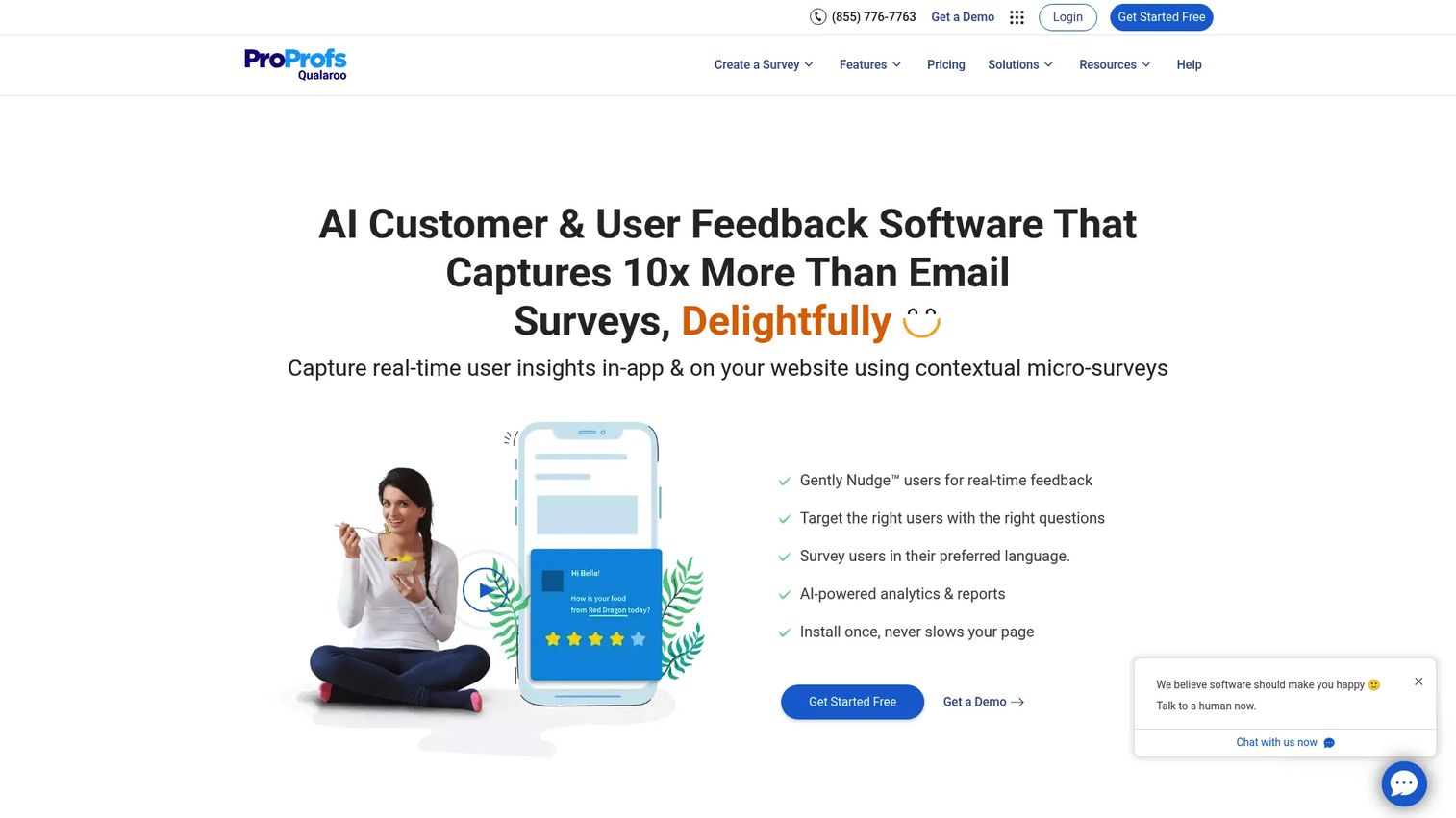
Qualaroo is customer and user feedback software built around in-context surveys, the kind that appear on your website or inside your app at the moment a visitor is engaged. Its signature Nudge surveys let you catch NPS responses without pulling a customer into a separate email flow, which is why teams that care about response quality and context tend to reach for it.
Best for: Teams that want in-context website and in-product NPS feedback with strong targeting.
Key strengths
- In-context Nudge surveys: Trigger NPS prompts on specific pages or after specific actions, so feedback arrives with context attached.
- Advanced targeting and segmentation: Show surveys to the right audience based on behavior, URL, or user attributes.
- Sentiment analysis and analytics: Turn open-ended detractor comments into readable themes rather than a wall of text.
Why choose Qualaroo: If your NPS program lives where your users actually are, on the site or in the product, Qualaroo fits. The targeting depth means a PMM can isolate feedback from a specific segment, like trial users on a new pricing page, without exporting and filtering later. It leans toward digital collection rather than broad multichannel distribution.
Qualaroo pricing: Qualaroo offers a forever-free plan. Paid tiers start with Essentials at $19.99 per month and Business at $49.99 per month. Enterprise starts at $149.99 on annual plans only. The free tier makes it easy to pilot before committing.
2. ProProfs Survey Maker
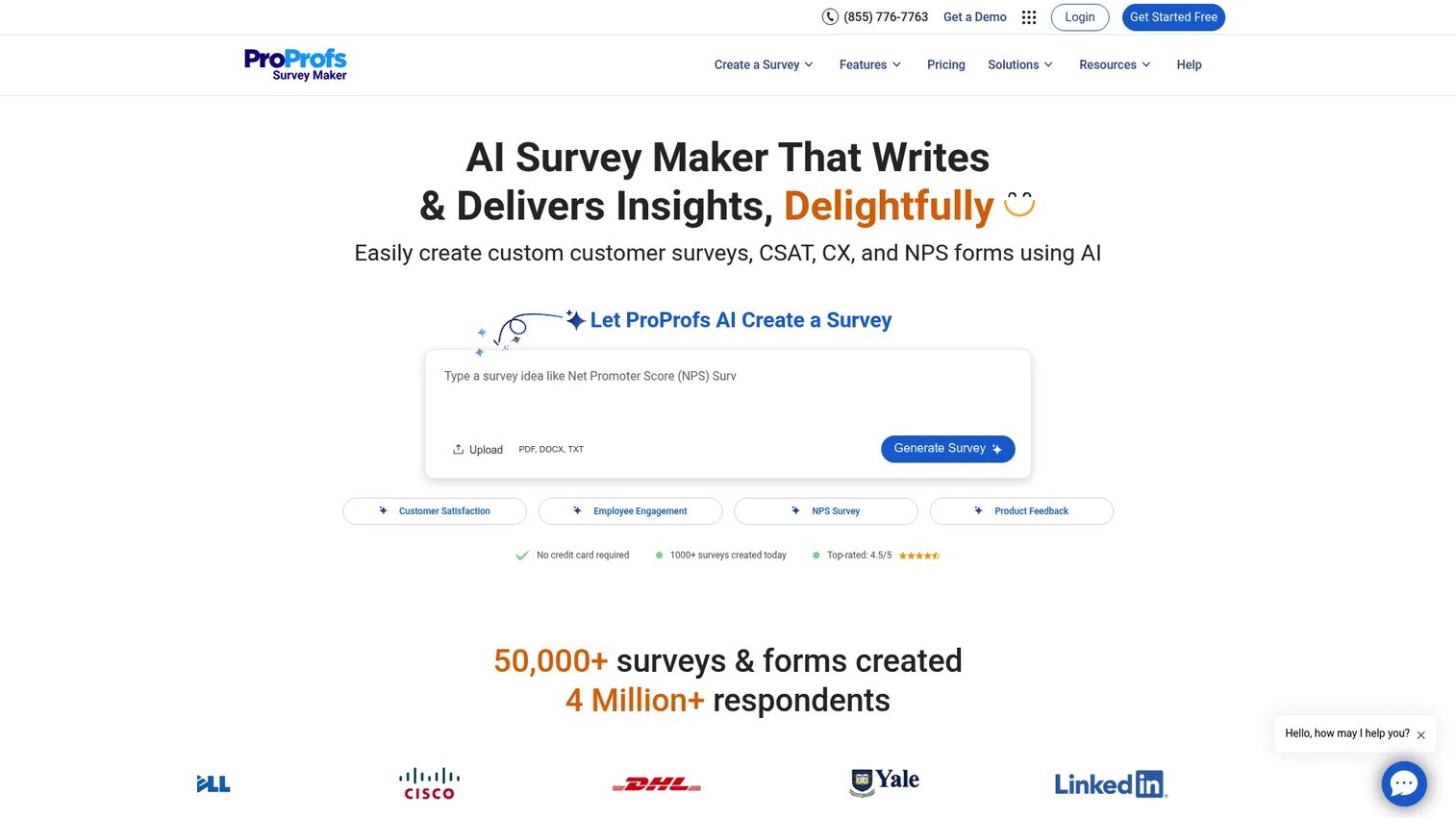
ProProfs Survey Maker is AI-powered survey software for building, sending, and analyzing surveys, including NPS and feedback forms. It leans toward speed and simplicity, which makes it a practical pick for smaller teams that want to launch a survey this afternoon rather than scope a multi-quarter CX platform rollout.
Best for: Teams that want a simple survey builder with AI-assisted creation and basic feedback analytics.
Key strengths
- AI survey creation: Generate an NPS survey and related questions quickly instead of building from a blank page.
- 20+ question types: Mix the core NPS question with follow-ups to capture the reason behind a score.
- Advanced survey logic, sharing, and reporting: Add branching and distribute across channels without a heavy learning curve.
Why choose ProProfs Survey Maker: This is where a lightweight program can move faster than a full CX suite. For a lean PMM team running periodic relational NPS, the low setup cost and template-driven creation get you to a first send fast. It is more useful for straightforward survey programs than for deep, always-on closed-loop workflows.
ProProfs Survey Maker pricing: A free plan covers up to 50 responses with unlimited surveys. Paid plans, including Essentials, Business, and Enterprise, start at $19.99 per month, with monthly or discounted annual billing. The free tier is enough to validate the workflow before you pay.
3. Zonka Feedback
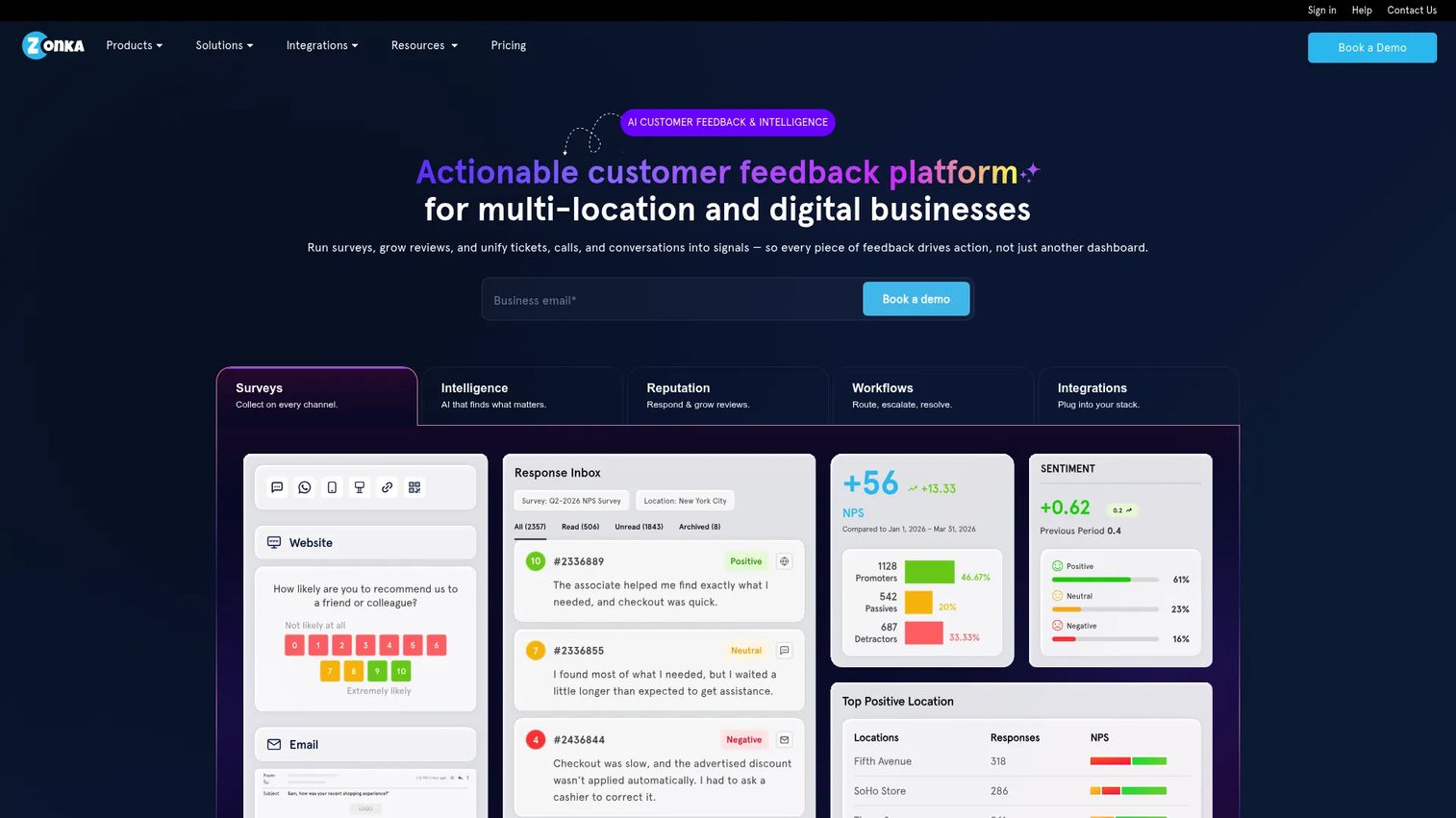
Zonka Feedback is an AI-powered customer feedback and survey platform built for collecting, analyzing, and acting on feedback across channels. Where lighter tools stop at collection, Zonka is designed around actionability: a response inbox, routing, and AI analysis that make it a strong fit for teams treating NPS as an ongoing system.
Best for: Businesses that need omnichannel customer or employee feedback with AI-assisted analysis and closed-loop workflows.
Key strengths
- Multichannel surveys: Collect NPS across email, SMS, WhatsApp, and offline, so you meet customers on the channel they use.
- Digital feedback capture: Trigger surveys on your website, in-product, or through an in-app SDK.
- AI-powered feedback analysis and closing the loop: Surface themes automatically and route detractor responses to owners for follow-up.
Why choose Zonka Feedback: This is the tool for teams that refuse to let a detractor comment sit unread. The response inbox and routing turn NPS into a workflow, not a report, and the omnichannel reach suits organizations collecting across digital and physical touchpoints. It scales toward enterprise readiness without forcing you to start there.
Zonka Feedback pricing: Pricing is quote-based and split across Feedback Management and AI Feedback Intelligence, priced on responses and data credits. A 14-day free trial is available to test the platform before committing.
4. SurveySensum
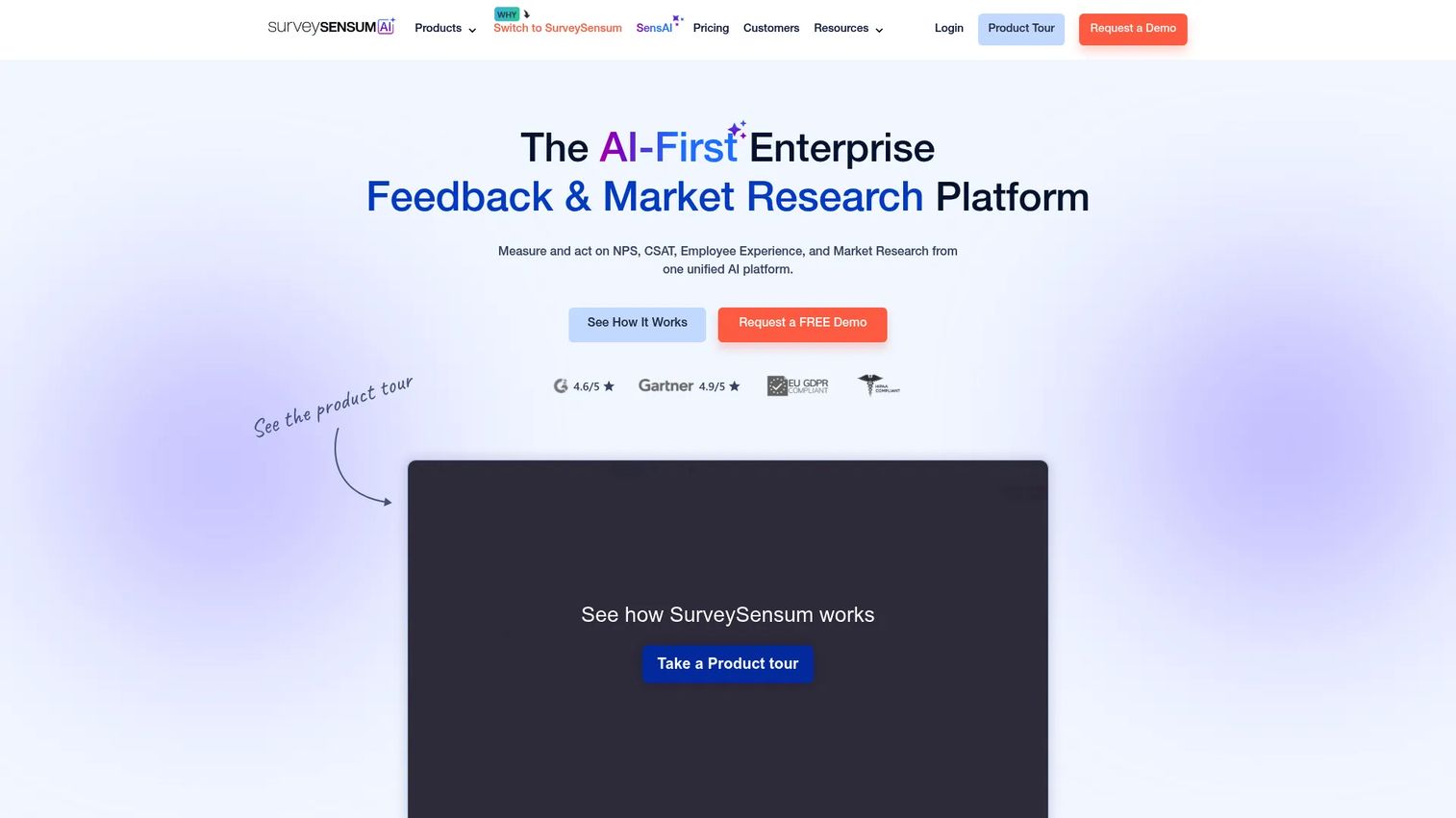
SurveySensum is an AI-powered survey and feedback platform spanning CX, employee experience, market research, and conversation analytics. It sits comfortably in the hands of operational CX teams that want AI-assisted analysis rather than a raw score export, with its SensAI engine handling text and sentiment analysis at scale.
Best for: Teams that want an AI-assisted survey platform for CX and feedback analytics.
Key strengths
- AI-powered dashboards and drilldowns: Move from the headline score into the drivers behind it without building reports manually.
- Multi-channel survey distribution: Reach customers through email, WhatsApp, in-app, SMS, and CRM.
- Text and sentiment analysis with SensAI: Convert open-ended feedback into themes and sentiment signals automatically.
Why choose SurveySensum: For CX teams that live in the analytics, the drilldown and text analysis depth pays off. A PMM using it can tie sentiment shifts to specific launches or segments and hand product a clear read on why a cohort is unhappy. Pricing is oriented toward committed annual programs rather than casual one-off sends.
SurveySensum pricing: Public annual pricing starts with Starter CX at $3,600 per year and Self-Driven CX at $6,000 per year, plus a custom Managed CX option. A one-month free trial with 25 free responses is offered.
5. Delighted
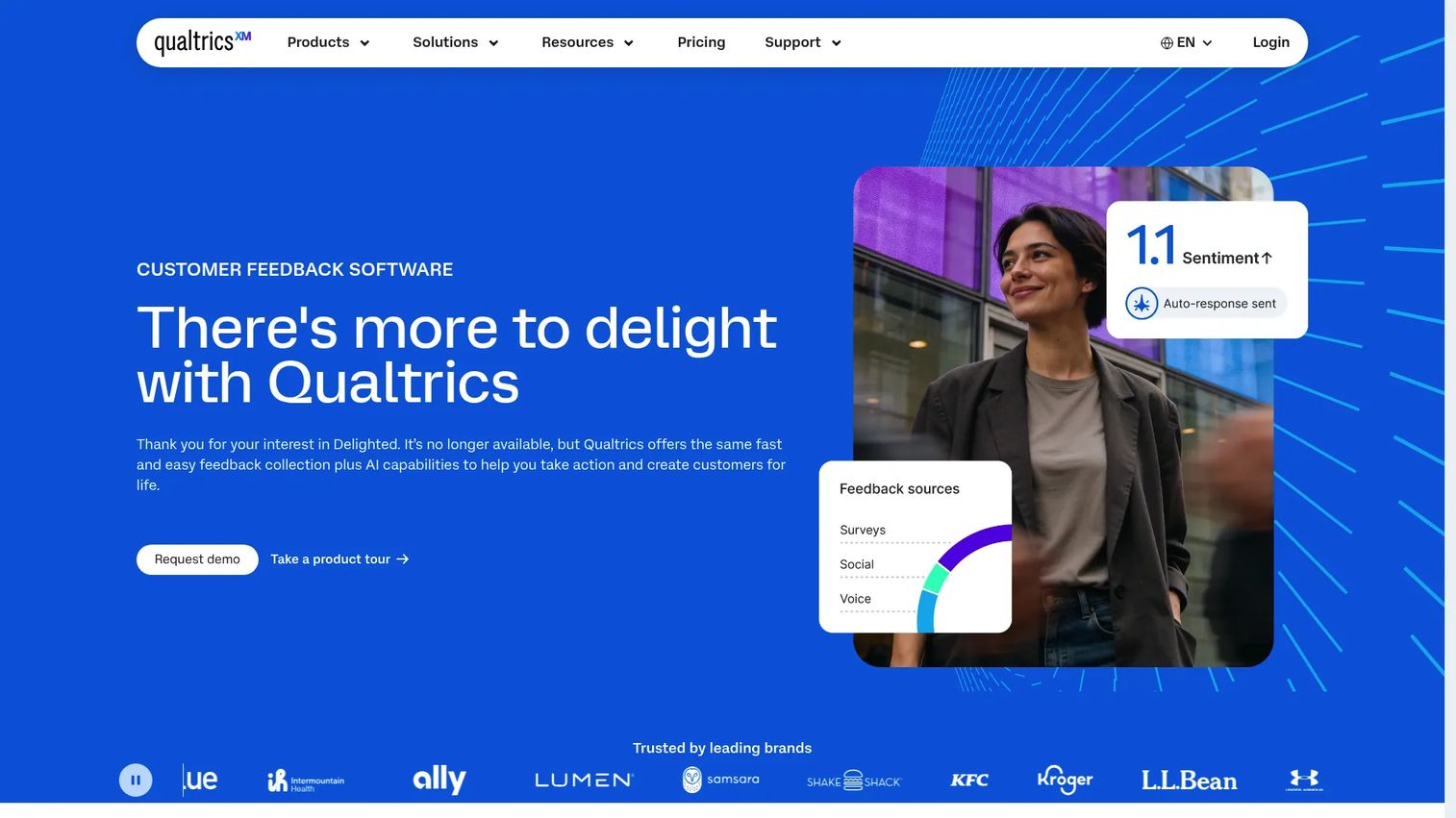
Delighted is customer feedback software known for simple, fast NPS collection and a clean, customer-friendly survey experience. It has long been a favorite of teams that want to stand up an NPS program with minimal configuration. Note that Delighted's official site now points to Qualtrics and indicates the standalone product is no longer available, so confirm current availability before you plan around it.
Best for: Lean teams that want a lightweight, fast-to-deploy customer feedback tool.
Key strengths
- Survey branding customization: Match the survey to your brand so responses feel native, not bolted on.
- Unlimited survey sends: Run recurring NPS without worrying about volume caps on higher tiers.
- Question logic and integrations: Add follow-up logic and pipe results into your existing stack.
Why choose Delighted: The appeal is speed and simplicity. A small team can launch a relational NPS program in an afternoon and get clean, branded responses back. It is lighter on deep routing and analytics than a full CX suite, which is exactly the point for teams that want the score and the comment without the overhead. Given the availability note above, treat it as a pick to verify first.
Delighted pricing: The published pricing page shows a Free plan, Starter at $19 per month, Growth at $39 per month, Advanced at $149 per month, and Premium at $249 per month, with custom pricing for additional responses or users.
6. Hotjar
Hotjar is a product experience insights platform combining heatmaps, session recordings, surveys, and interviews. Its NPS capability shines because it sits next to behavioral data, letting product and growth teams read a score alongside what a user actually did on the page. That context is hard to reconstruct from a standalone survey tool.
Best for: Teams that want lightweight behavior analytics plus user feedback in one tool.
Key strengths
- Heatmaps: See where users click, scroll, and stall, then connect that to survey sentiment.
- Session recordings: Watch the exact path a detractor took before submitting a low score.
- Surveys and feedback: Run NPS and on-site feedback prompts inside the same platform as your behavior data.
Why choose Hotjar: For product and growth teams, the value is the pairing. When a detractor comment lands, you can watch the session that produced it instead of guessing. This complements a dedicated NPS platform rather than replacing a full closed-loop CX program, and it is strongest when UX signal matters as much as the score.
Hotjar pricing: Basic is free forever. Paid Ask plans start at $47 per month, with Business and Scale tiers above that. Pricing scales with session and response volume across its product families.
7. HubSpot
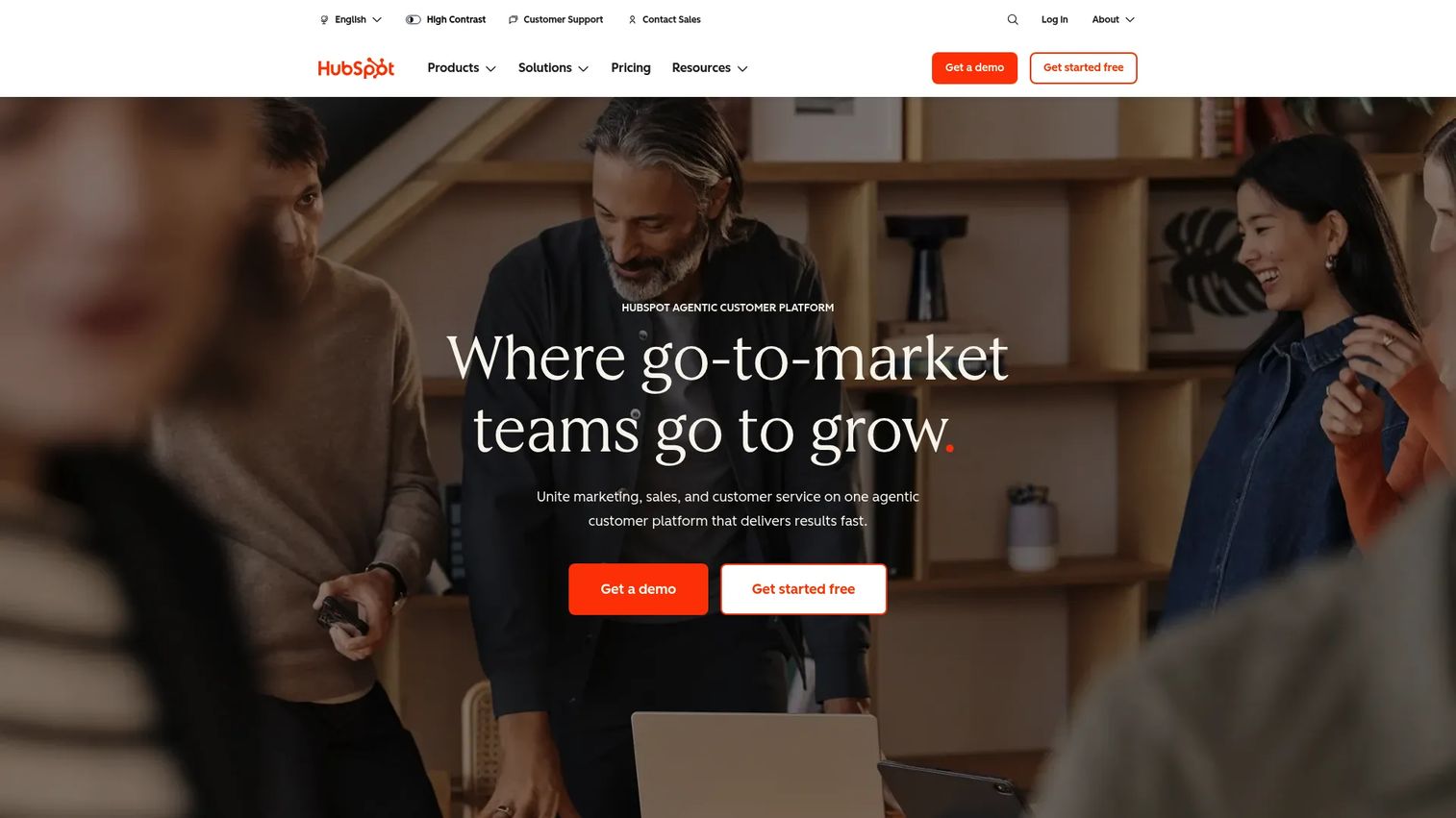
HubSpot is a customer platform spanning marketing, sales, service, content, data, and CRM, with NPS-style feedback surveys living inside its Service Hub. Its advantage is context: the score sits next to the full customer record, so feedback connects to lifecycle stage, deal history, and support tickets without any data plumbing.
Best for: Teams already standardized on HubSpot that want NPS next to their CRM data.
Key strengths
- Free Smart CRM: Anchor feedback to the same records your sales and marketing teams already use.
- Marketing, sales, service, content, and data hubs: Trigger and act on NPS inside the workflows you already run.
- AI-assisted tools and automation: Automate follow-up and routing based on survey responses.
Why choose HubSpot: If your team already lives in HubSpot, running NPS there means the score inherits every piece of context the CRM holds. The trade-off is buying breadth over specialized depth: you get lifecycle context and automation, and the NPS feature is one part of a much larger platform rather than a purpose-built feedback engine.
HubSpot pricing: Free Tools cost $0 per month for up to two users. Starter starts at $7 per month per seat. The customer platform Professional tier starts at $1,300 per month, and Enterprise is quote-based. Pricing varies by product and hub.
8. Nicereply
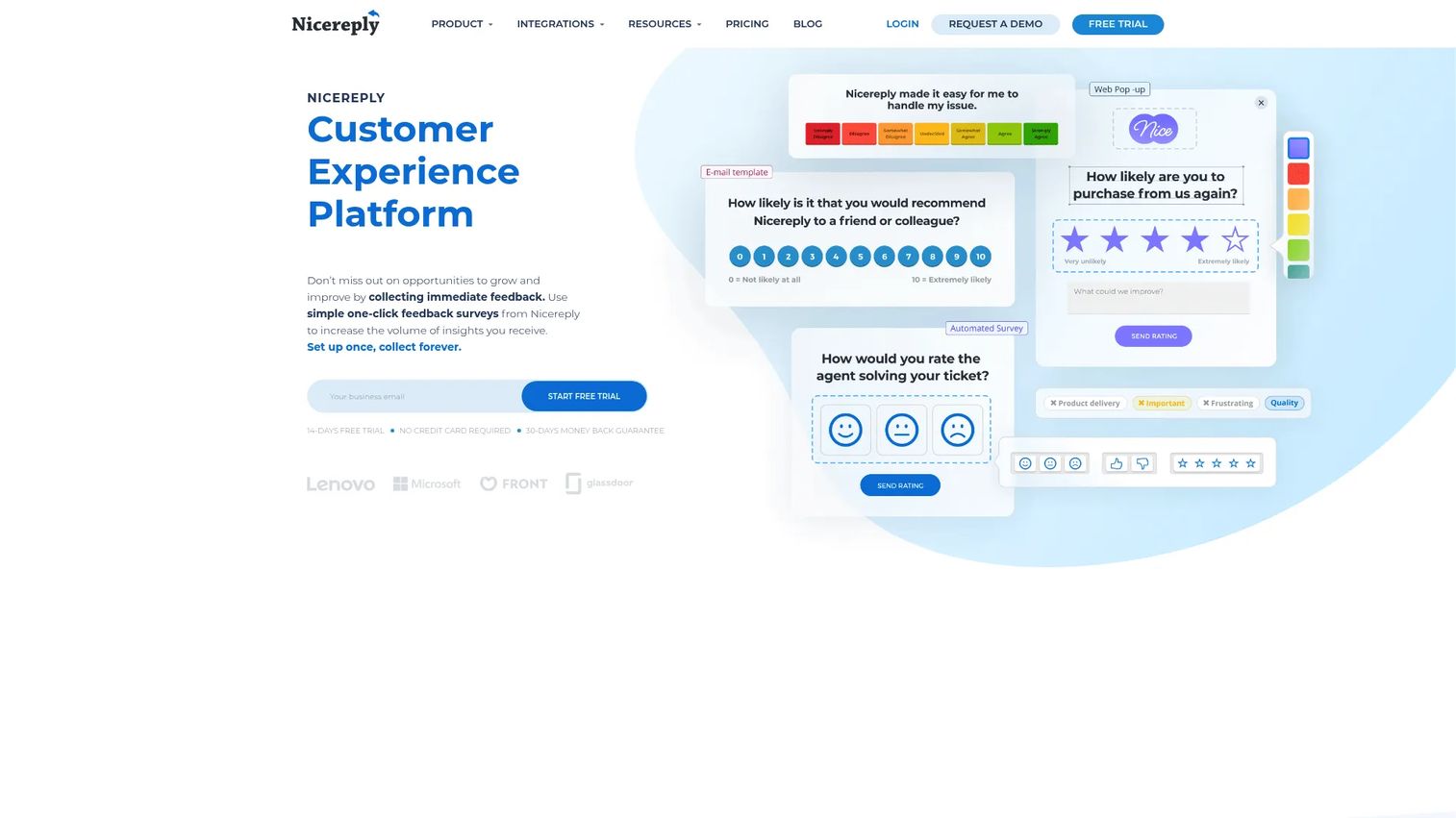
Nicereply is customer experience software for collecting CSAT, NPS, and CES feedback, built with support and CS teams in mind. It integrates tightly with help desks, so surveys can fire right after a ticket resolves, capturing transactional NPS at the moment the experience is fresh.
Best for: Support teams that want branded CSAT, NPS, and CES surveys with help desk integrations.
Key strengths
- CSAT, NPS, and CES surveys: Cover the three core service metrics in one tool.
- Helpdesk and workflow integrations: Trigger surveys from ticket events and route responses into your existing tools.
- Analytics dashboard and survey customization: Track scores by agent, team, or channel with branded surveys.
Why choose Nicereply: For a service-heavy team, this is a practical feedback loop without the weight of a full CX suite. Transactional NPS fired at ticket close gives you the higher response rates that event-based surveys tend to earn, and the helpdesk integrations keep support agents inside their workflow.
Nicereply pricing: Nicereply offers a 14-day free trial with no credit card required. Paid plans are usage-based: Starter at $59 per month billed annually, Essential at $119, Growth at $239, and Business at $359, each with higher monthly-billing rates.
9. AskNicely
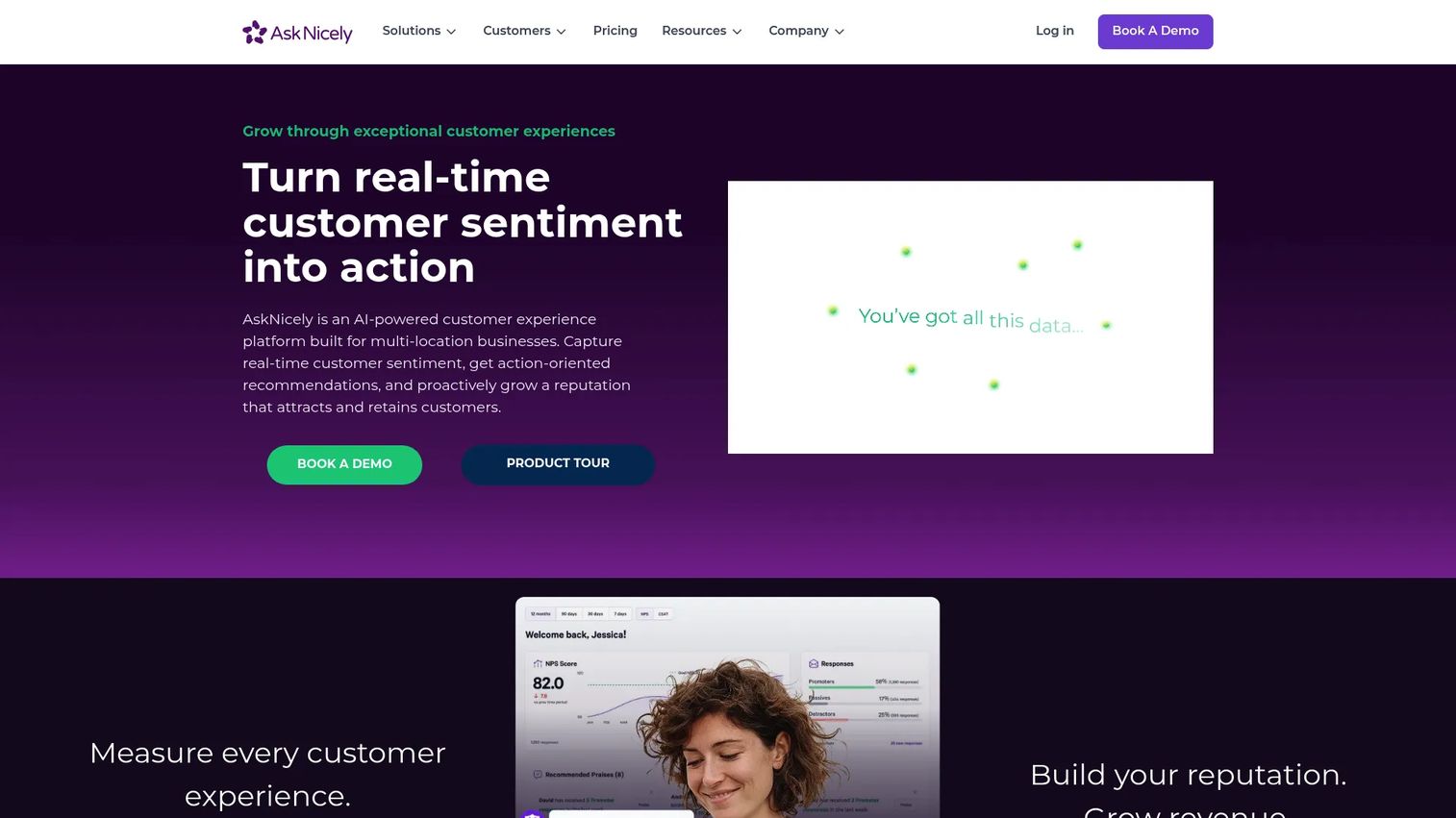
AskNicely is an AI-powered customer experience platform aimed at multi-location and service businesses. Its distinguishing angle is action: AskNicely is built to push NPS feedback into frontline workflows and coaching, so a low score drives a follow-up and a behavior change rather than a line on a dashboard.
Best for: Multi-location service businesses that need customer feedback plus CX coaching.
Key strengths
- Real-time customer sentiment capture: Collect feedback continuously and surface it while it still matters.
- AI-powered surveys and insights: Generate surveys and read sentiment without manual tagging.
- Feedback workflows, reporting, and reviews management: Route responses to owners and tie feedback to team accountability.
Why choose AskNicely: This is the pick when you want NPS to drive behavior. The workflow and coaching orientation suits field teams and CX operators who need every detractor response to trigger a named owner and a follow-up, not just a report. It is built around closing the loop as an operational habit.
AskNicely pricing: Public pricing is quoted as starting from 500 responses, with price scaling by response volume. Plans include Learn, Grow, Transform, Basic, Business, and Enterprise, though the page does not display public numeric prices, so request a quote for your volume.
10. Qualtrics
Qualtrics is experience management software for customer, employee, brand, and research programs. It is the enterprise end of this list: research-grade analytics, deep governance, and the ability to run complex, large-scale NPS programs across a global organization. For teams with mature research and CX requirements, that depth is the whole point.
Best for: Teams that need an enterprise-grade experience management platform for research, CX, and EX.
Key strengths
- Survey builder and distribution: Design sophisticated surveys and distribute across channels and regions.
- Dashboards, reporting, and branching logic: Build governed, role-based dashboards with advanced skip and branch logic.
- Multilingual surveys and employee pulse: Run relational and transactional NPS alongside EX programs at scale.
Why choose Qualtrics: When your program spans regions, languages, and stakeholder groups, and leadership expects research rigor, Qualtrics delivers the governance and analytics smaller tools do not target. For a team that just needs a quarterly relational NPS send, the platform's depth is more than the job requires, which is worth weighing against the cost.
Qualtrics pricing: A free account is available. Self-serve Strategic Research starts at $420 per month, billed as $5,040 annually for 1,000 responses. Enterprise Strategic Research is quote-only.
11. SurveyMonkey
SurveyMonkey is an online survey and feedback platform for creating, distributing, and analyzing surveys and forms. Its NPS use is flexible rather than specialized: you get a familiar interface, broad survey breadth, and ready NPS templates, which makes it a comfortable starting point for teams building their first program.
Best for: Teams and individuals who need a mature, flexible survey platform with AI-assisted creation.
Key strengths
- AI-powered survey creation and analysis: Build NPS surveys quickly and get assisted analysis of results.
- Multi-channel distribution: Send via web link, email, SMS, QR code, and social media.
- Advanced logic, analytics, and integrations: Add branching and connect results to your other tools.
Why choose SurveyMonkey: The strength is breadth and familiarity. If your team already knows the interface and needs a general survey tool that also handles NPS, this is a low-risk choice. It is less specialized than a dedicated NPS platform, so deep closed-loop routing and CX-specific analytics are lighter here than in purpose-built tools.
SurveyMonkey pricing: A free Basic plan is available. Individual paid plans include Standard Monthly at $99 per month and Advantage Annual at $46 per month billed annually. Team Advantage starts at $30 per user per month for three or more users, with Enterprise by demo.
12. Typeform
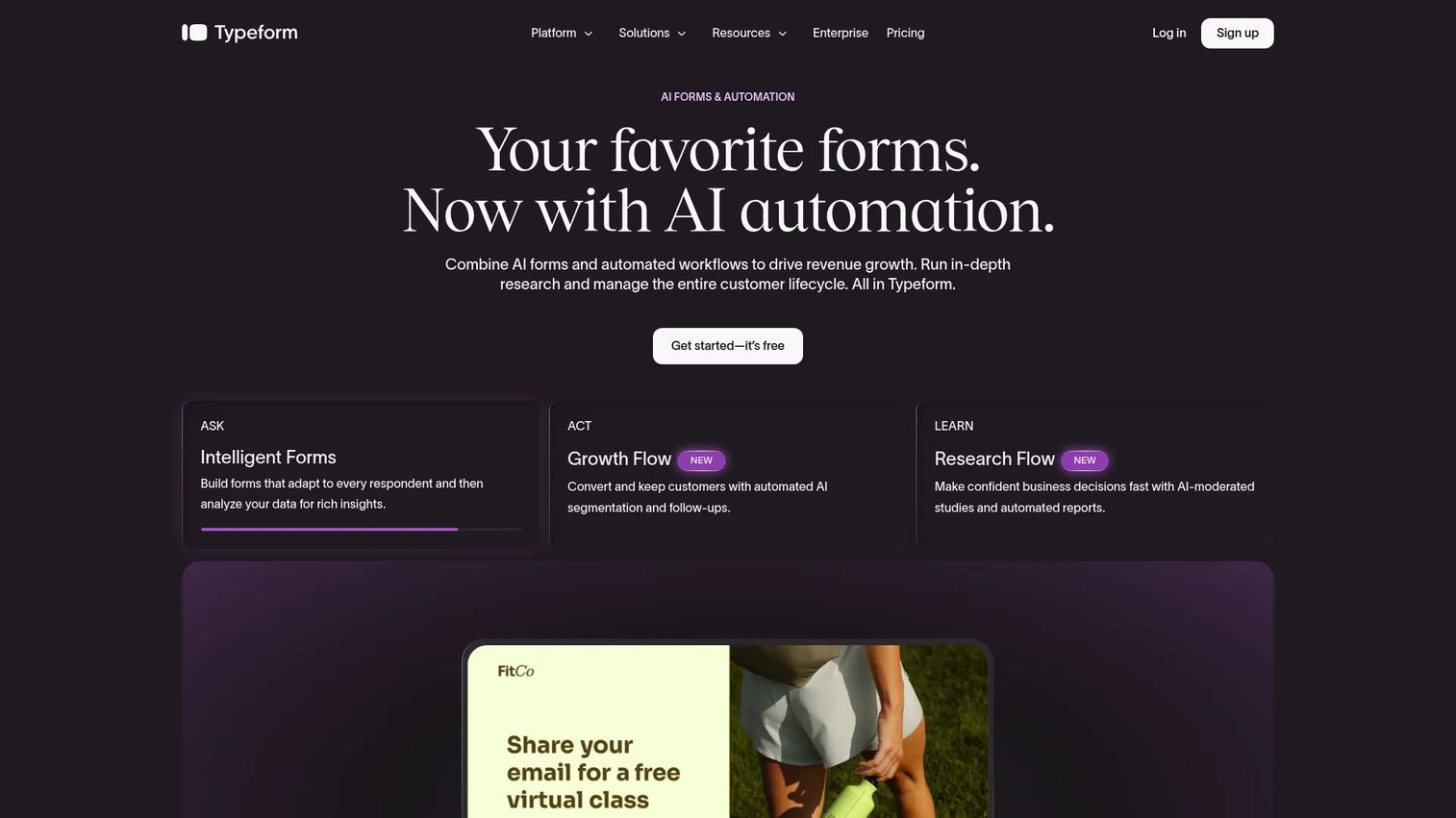
Typeform is known for conversational forms, surveys, and quizzes with a polished, one-question-at-a-time experience. For NPS, that presentation matters: a branded, engaging survey flow can lift completion, which is meaningful when response rates hover around 12%. It works best when the respondent experience is as important as the raw data.
Best for: Teams that want engaging, branded surveys with workflow integrations.
Key strengths
- AI-powered form creation: Build a conversational NPS flow quickly with assisted creation.
- Conditional logic and branching: Route respondents to relevant follow-ups based on their score.
- Custom branding and embeds: Match the survey to your brand and embed it anywhere.
Why choose Typeform: When completion quality and brand polish drive your decision, Typeform's conversational format earns its place. A PMM running a customer-facing NPS survey where the experience reflects on the brand will value the presentation. As a general form tool rather than a dedicated NPS platform, its strength is the experience and flexibility rather than deep CX-specific routing and benchmarking.
Typeform pricing: A free plan is available. Paid Core plans include Basic at $29 per month, Plus at $59 per month, and Business at $99 per month, plus Growth Flow, Talent, and Enterprise options. Yearly billing is available on several plans.
13. Userpilot
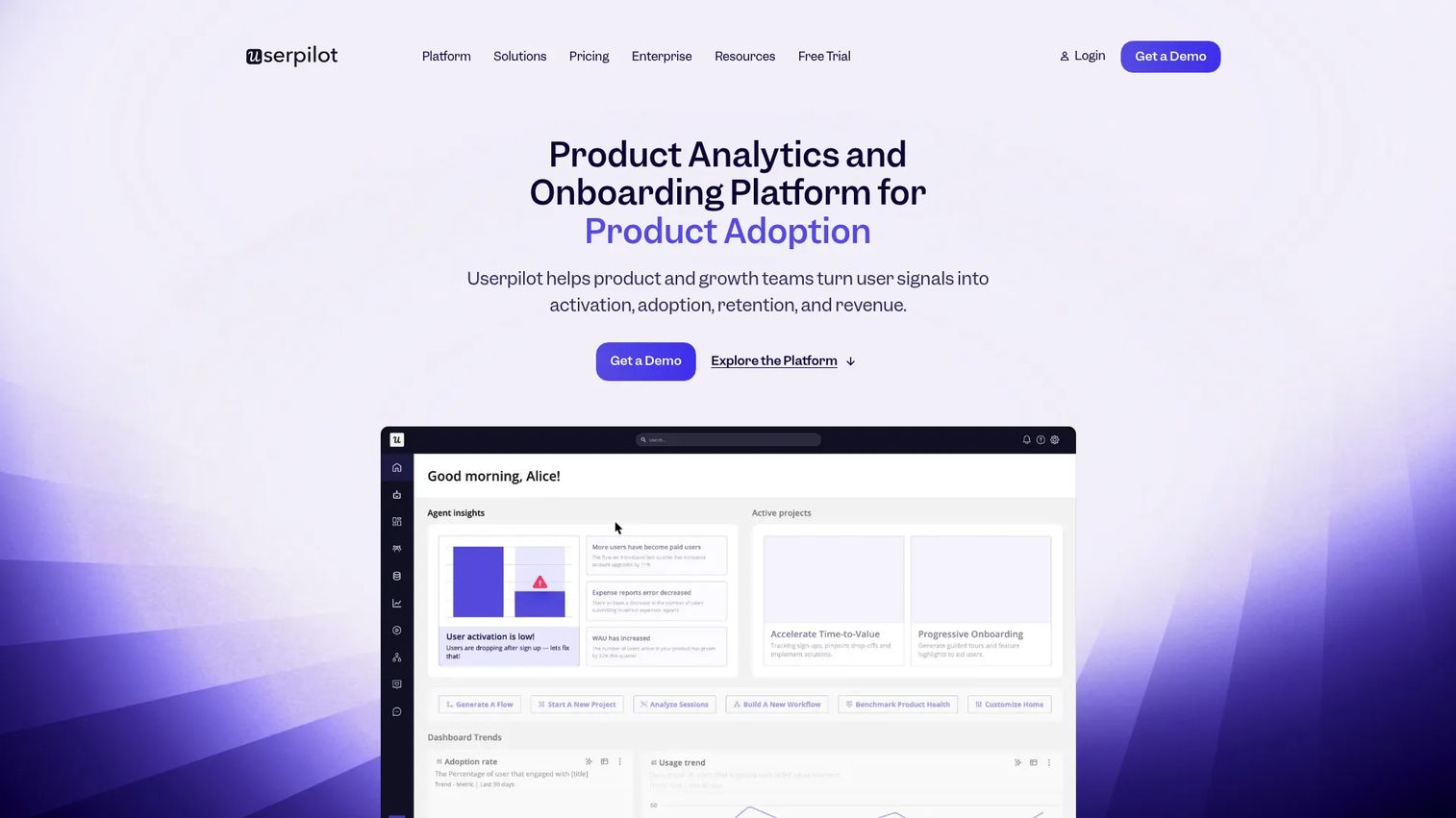
Userpilot is a no-code product growth platform for onboarding, engagement, analytics, and feedback, including in-app NPS surveys. Its value for a PMM or product team is placement: NPS collected inside the product, tied to feature usage and lifecycle stage, so the score sits inside adoption work rather than beside it.
Best for: SaaS product teams that want in-app NPS tied to product adoption and onboarding.
Key strengths
- Product analytics: Connect NPS responses to what users actually do in the product.
- In-app engagement: Trigger surveys at the right moment in the user journey.
- User feedback and NPS surveys: Collect NPS in-app and segment by behavior and lifecycle.
Why choose Userpilot: For product-led teams, in-app collection tied to usage data is the differentiator. When you want NPS segmented by feature adoption or onboarding stage, and you already run engagement flows in the product, Userpilot keeps feedback and adoption in one place. It positions NPS as one input to product growth rather than a standalone survey program.
Userpilot pricing: Pricing is based on monthly active users. Starter is $299 per month, Growth starts at $849 per month, and Enterprise is custom. There is no free plan, though the tiers are structured to grow with usage.
Considerations before you buy
Picking NPS software is less about the survey and more about the workflow around it. Run every shortlist candidate through these checks before you sign anything.
Survey channels
Confirm the tool collects on the channels your customers actually use. In-app and website surveys catch engaged users; email and SMS reach the rest; transactional triggers after events earn higher response rates. If your program is multichannel, verify the tool unifies responses rather than siloing them by source.
Automation and routing
A score is only useful if the feedback behind it reaches an owner. Check whether detractor responses can trigger workflows, alerts, and assignments automatically. Manual sorting breaks at scale, so response routing is the single feature that most separates a real closed-loop program from a scorecard.
Reporting and analysis depth
Look past the headline number. Verify the tool offers text analysis, sentiment analysis, and segmentation so you can explain why a score moved, not just that it did. For PMMs tying NPS to launches or messaging, benchmarking and real-time reporting turn the data into a defensible narrative.
Integrations with CRM and helpdesk tools
Feedback without context is noise. Confirm the platform connects to your CRM and helpdesk so responses inherit account, plan, and ticket history. Clean crm integrations and helpdesk integrations are what let you segment feedback by cohort and route it to the right team.
Governance and permissions
If multiple teams touch the program, check role-based access, data ownership, and permissions. Enterprise buyers should verify compliance and governance controls before rollout, especially when survey data includes customer PII.
Ease of rollout and maintenance
Be honest about your team's capacity. A lean PMM team wants fast setup and low ongoing maintenance; an enterprise CX org can absorb a heavier configuration for deeper control. Match the tool to your operational maturity, not to the longest feature list.
Conclusion
The right NPS software depends less on survey design and more on how far you need feedback to travel after it lands.
If you want the simplest, fastest setup, ProProfs Survey Maker and Delighted get a lean team to a first send quickly, and Qualaroo shines for in-context web and app collection. If you need omnichannel reach and genuine closed-loop workflows, Zonka Feedback and SurveySensum are built for that job. For enterprise governance and research-grade analytics, Qualtrics is the deep end of the pool. And for product-led teams that want NPS inside the product experience, Userpilot ties the score to adoption, while Nicereply and AskNicely anchor feedback in support and CS action.
Choose based on your operational maturity, not just how the survey looks. The tool that fits is the one whose routing, analytics, and integrations match the workflow your team can actually run every week.
FAQs
NPS software is a platform that collects net promoter score survey responses, calculates the score, and routes and analyzes the feedback behind it. Good nps survey software goes beyond the number, adding automation, segmentation, and closed-loop feedback so teams can act on responses rather than just report them.
A one-time survey gives you a single snapshot. NPS software runs an ongoing program: it tracks the score over time, fires relational and transactional surveys on a schedule or after events, and routes feedback to owners. The difference is measurement versus a system that turns feedback into action.
Prioritize multichannel collection, automated response routing, and analytics depth including text and sentiment analysis. Then check crm integrations, benchmarking, and real-time reporting. For a PMM, segmentation matters most, since it lets you tie score movement to specific launches, cohorts, or messaging.
Most modern net promoter score tools do. CRM integrations let responses inherit account, plan, and lifecycle context, while helpdesk integrations trigger transactional NPS after a ticket resolves. Confirm the specific connectors you need are supported before buying, since integration depth varies by tool and tier.
Route every detractor response to a named owner automatically, ideally with an alert in Slack or your CRM. Follow up fast while the experience is fresh, log the resolution, and track whether the score recovers. Closed-loop feedback works best when it is a workflow with accountability, not a manual review.
Use both. Relational NPS, sent quarterly or biannually, measures overall loyalty and trend. Transactional NPS fires after a specific event, like onboarding or a support ticket, and typically earns higher response rates in the 25 to 40% range. Relational shows the trend; transactional shows what is driving it.
Yes. Several tools on this list offer free tiers or trials, including Qualaroo, ProProfs Survey Maker, Delighted, Hotjar, HubSpot, SurveyMonkey, and Typeform, plus a free Qualtrics account. Free plans are ideal for piloting a program before committing to a paid tier with deeper routing and analytics.
Treat NPS as an operating system, not a scorecard. Segment responses to find which cohorts drive the score, close the loop on detractors consistently, and feed themes from text analysis back to product and support. Then track whether your interventions move the trend line, and adjust cadence and channels based on response quality.