
You approved a move three weeks ago. The employee still hasn't heard back on their temporary housing. Finance is asking why the reimbursement hasn't cleared. The relocation vendor emailed a status update to someone who left the team in Q2. Nobody has a single view of what's actually happening.
This is what relocation management looks like when it lives in spreadsheets and email threads. Every move has dozens of moving parts: approvals, budgets, vendor handoffs, tax and immigration paperwork, expense reimbursements, and a nervous employee who just wants to know when their stuff arrives. Miss one, and costs creep, timelines slip, and the employee experience takes the hit before anyone starts a new job.
The demand is real and growing. Nearly 15% of U.S. employers relocated employees in 2022, according to the U.S. Bureau of Labor Statistics cited by Verified Market Reports (2025). The relocation management software market reached USD 1.5 billion in 2024 and is projected to hit USD 3.2 billion by 2033 at a 9.2% CAGR, per Verified Market Reports (2025). Employers are moving people, and they need a system of record instead of a shared inbox.
Relocation software exists to fix exactly this. The right platform turns scattered updates into one auditable workflow, gives employees self-service visibility, and gives finance the cost control it keeps asking for. For teams thinking about operational systems more broadly, the same logic that drives investment in contract management or event management applies here: replace manual coordination with a repeatable process. This guide compares the 12 best relocation management software platforms for 2026 so you can shortlist with confidence.
What's inside
This guide is for HR leaders, global mobility managers, people ops teams, and the finance and procurement partners who share the relocation budget. It covers employee relocation management software for domestic moves, international assignments, and government-adjacent programs.
We selected and compared tools on the criteria that actually drive a buying decision: relocation workflow automation, cost visibility and expense tracking, employee self-service and experience, compliance and policy handling, reporting depth, and integrations with your HRIS and payroll stack. Where public pricing and ratings exist, we include them. Where a vendor keeps pricing behind a sales conversation, we say so plainly rather than guess.
TL;DR
- Best overall for end-to-end workflow automation: Equus Software, for unified mobility management, compliance tooling, and analytics across move types.
- Best for employee self-service and program visibility: UrbanBound, which pairs relocation software with candidate and intern move management.
- Best for global mobility and compliance-heavy programs: Topia, built for cross-border assignments, tax, and immigration compliance.
- Best for vendor coordination and analytics: ReloTalent, a centralized case management platform with published pricing.
- Best for government and cross-border scope: Relocation Management Worldwide, with FedRAMP-authorized infrastructure and broad relocation coverage.
- Best for lighter operational overhead: Skipr, a mobility management platform with cards, apps, and policy controls.
What is relocation management software?
Relocation management software is HR and global mobility technology that coordinates every step of an employee move in one system, from initial approval and budget through vendor handoffs, reimbursements, compliance, and final reporting. It replaces spreadsheets, email chains, and disconnected point tools with a single source of truth for each relocating employee.
At its core, the category exists to give three groups what they need at once: HR gets workflow control and auditability, finance gets relocation expense tracking and cost visibility, and the employee gets a clear, self-service view of their own move. Modern global mobility management software extends that same control across borders, where tax, immigration, and work-location rules multiply the complexity.
Most relocation management platforms include a common set of capabilities:
- Approvals and initiation: structured intake, policy-based eligibility, and automated approval routing.
- Budgets and relocation expense tracking: move-level cost estimation, reimbursement tracking, and spend controls.
- Vendor coordination: initiate, assign, and monitor third-party suppliers like movers, housing, and immigration counsel.
- Employee self-service relocation: portals and apps where employees track status, submit expenses, and access resources.
- Relocation policy management: codify tiers, benefits, and rules so every move follows the right playbook.
- Relocation reporting and analytics: dashboards for cost, cycle time, compliance status, and program health.
One distinction matters before you shortlist. Move management software and pure SaaS platforms give your team the system to run relocations in-house. Managed mobility services layer human coordination on top, handling moves on your behalf. Several vendors here blend both. Knowing which model you want shapes the entire evaluation.
When to use relocation management software
When manual move tracking starts breaking down
The tipping point is usually volume plus visibility. A handful of moves a year survives on a spreadsheet. Once you cross into dozens, the spreadsheet becomes the risk: no audit trail, no version control, and no single owner for status. A system of record fixes this by centralizing approvals, timestamps, and documents so anyone can answer "where is this move?" without a round of emails. Auditability alone justifies the switch for many compliance-conscious teams.
When employees need self-service and choice
Relocating employees generate a steady stream of "what's my status?" and "is this covered?" questions. Employee self-service relocation cuts that back-and-forth. Policy-based options let employees pick within approved boundaries, real-time status tracking shows them exactly where their move stands, and a self-serve portal turns a stressful process into a transparent one. Less inbox churn for your team, a better experience for the person moving.
When finance needs cost control
Relocation is one of the least-governed line items in many companies until someone runs the numbers. Move-level budgets, reimbursement tracking, and clear reporting give finance the cost control it wants. Instead of reconciling receipts after the fact, finance sees committed and actual spend per move in real time, which makes forecasting and policy adjustments far easier.
When global mobility has compliance complexity
Cross-border moves add tax residency, immigration timelines, and country-specific work rules. Government and public-sector relocations add another layer of security and policy requirements. When your program spans domestic and international relocation, or touches government use cases, compliance tracking stops being optional. Global mobility software that automates these checks reduces both risk and manual work.
Comparison table
Here is a neutral, decision-oriented view of the 12 relocation management platforms in this guide. Pricing and ratings reflect what each vendor publishes or what verified third-party sources show at the time of writing. Many vendors in this category use contact-based pricing, which is common for enterprise global mobility software.
| # | Product | Intent | Key use case | Pricing | G2 rating |
|---|---|---|---|---|---|
| 1 | Equus Software | Enterprise global mobility | Unified mobility, compliance, and analytics | Contact sales | Not available |
| 2 | ReloTalent | Provider and HR case management | Centralized relocation workflow | From 299 EUR/month | 4.6/5 |
| 3 | Topia | Global mobility and compliance | Cross-border assignments and tax | Contact sales | 4.5/5 |
| 4 | UrbanBound | Employee and candidate moves | Relocation plus recruiting experience | Per-relocation license | 3.7/5 |
| 5 | Relocity | Talent mobility and destination | Software plus destination services | Contact sales | Not available |
| 6 | Orion Mobility | Expense and tax mobility | Expense management and payments | Contact sales | Not available |
| 7 | Benivo | Policy-led mobility experience | Employee experience and self-service | Per relocating employee | Not available |
| 8 | NuCompass Mobility | Managed relocation programs | Relocation and home sale workflows | Contact sales | Not available |
| 9 | Cartus | Enterprise relocation services | Managed mobility at scale | Contact sales | 4.6/5 |
| 10 | Skipr | Corporate mobility management | Cards, apps, and policy control | From €2/week (Flex) | Not available |
| 11 | Relo-Global | Procurement-led relocation | RFQ quote comparison | Contact sales | Not available |
| 12 | Relocation Management Worldwide | Domestic, global, government | Cloud platform with FedRAMP scope | Contact sales | Not available |
Sort your own shortlist by the two or three columns that matter most to your program. For most HR and finance teams that means workflow depth, expense tracking, and compliance fit, not price alone.
The 12 best relocation management software platforms
1. Equus Software

Equus Software is global mobility software for managing employee relocations, international assignments, immigration, business travel, remote work, and the compliance workflows that surround them. It positions itself as a unified platform for mid-to-large enterprises that need to plan, track, and manage every move type in one place rather than stitching together separate tools.
Best for: Mid-to-large enterprises managing global mobility and compliance programs across multiple move types.
Key strengths
- Unified mobility management: Handle remote work, business travel, relocations, international new hires, project work, and assignments in one system.
- Analytics and dashboards: Interactive dashboards surface mobility insights for reporting and program decisions.
- Automation and compliance: Built-in tax and compliance engines automate the checks that cross-border programs depend on.
Why choose Equus Software: If your program spans more than straightforward domestic moves, Equus consolidates the full spectrum of employee mobility into a single platform. That breadth suits HR and global mobility teams who want one system of record for compliance-heavy, multi-country programs instead of managing relocation, immigration, and business travel separately.
Equus Software pricing: Equus does not publish public pricing. The site uses a contact and demo-based model, which is typical for enterprise global mobility platforms of this scope. Request a demo to get pricing scoped to your program size and move volume.
2. ReloTalent
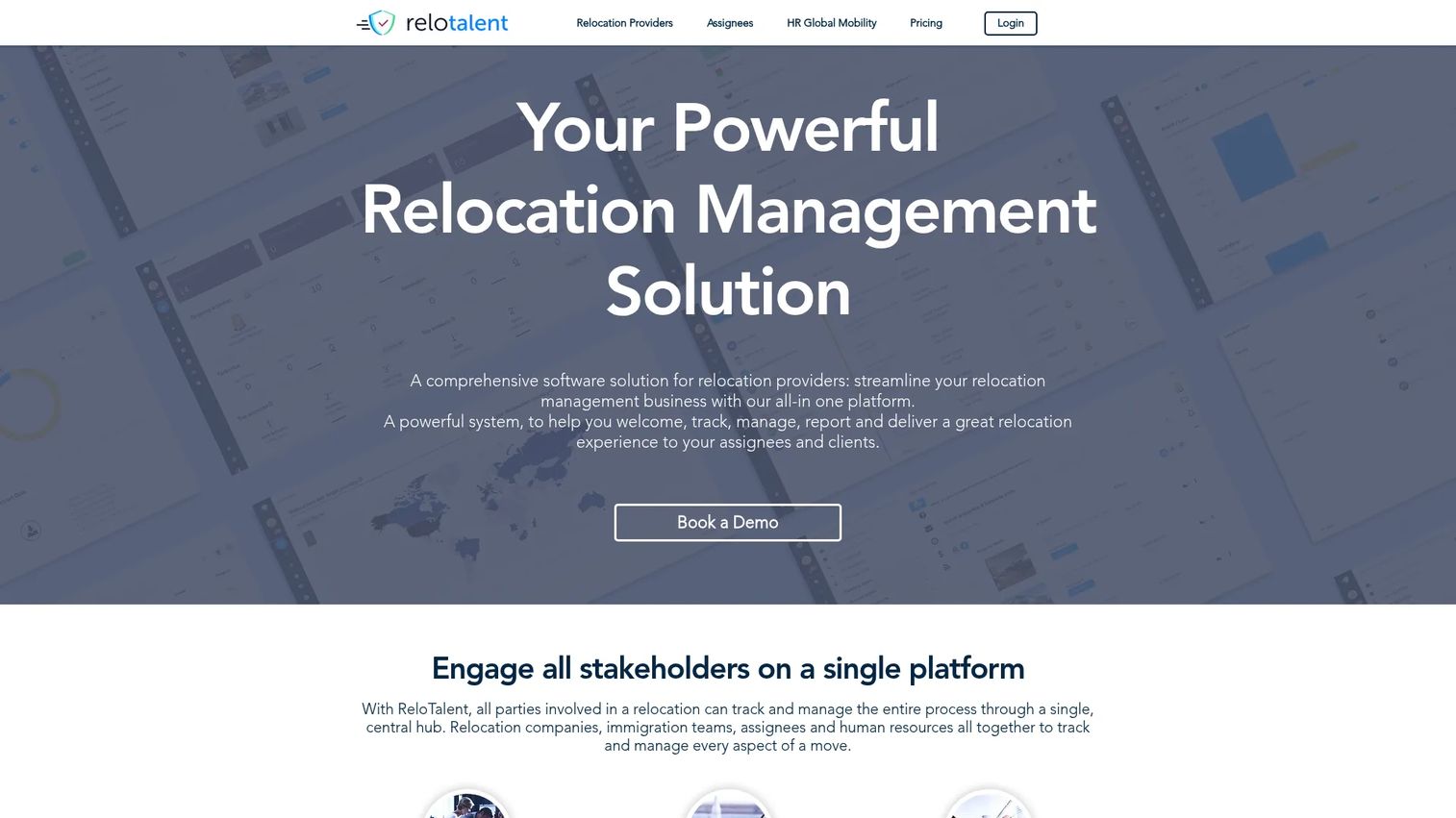
ReloTalent is relocation and global mobility management software built for both relocation providers and internal HR teams. It centralizes assignment and relocation case management, so program status, tasks, and documents live in one place rather than scattered across owners and inboxes.
Best for: Relocation and global mobility teams that need a centralized case management platform with transparent pricing.
Key strengths
- Assignment and relocation management: Create and manage moves with clear ownership and status.
- Workflow automation and documents: Automate tasks and share documents securely across stakeholders.
- Employee mobile experience and APIs: A mobile experience for employees, plus APIs and webhooks for integration.
Why choose ReloTalent: ReloTalent is one of the few vendors in this category with published pricing, which makes it easier to budget without a sales cycle. The centralized case management model fits provider-led workflows and internal mobility teams that want vendor coordination and accountability in a single view.
ReloTalent pricing: ReloTalent publishes tiered pricing starting at 299 EUR per month, with a 14-day free trial. Its Advanced plan is 1,599 EUR per month and Advanced Plus is 2,999 EUR per month, both billed annually. A pay-per-use option with volume discounts is also available. It holds a 4.6/5 rating on G2.
3. Topia
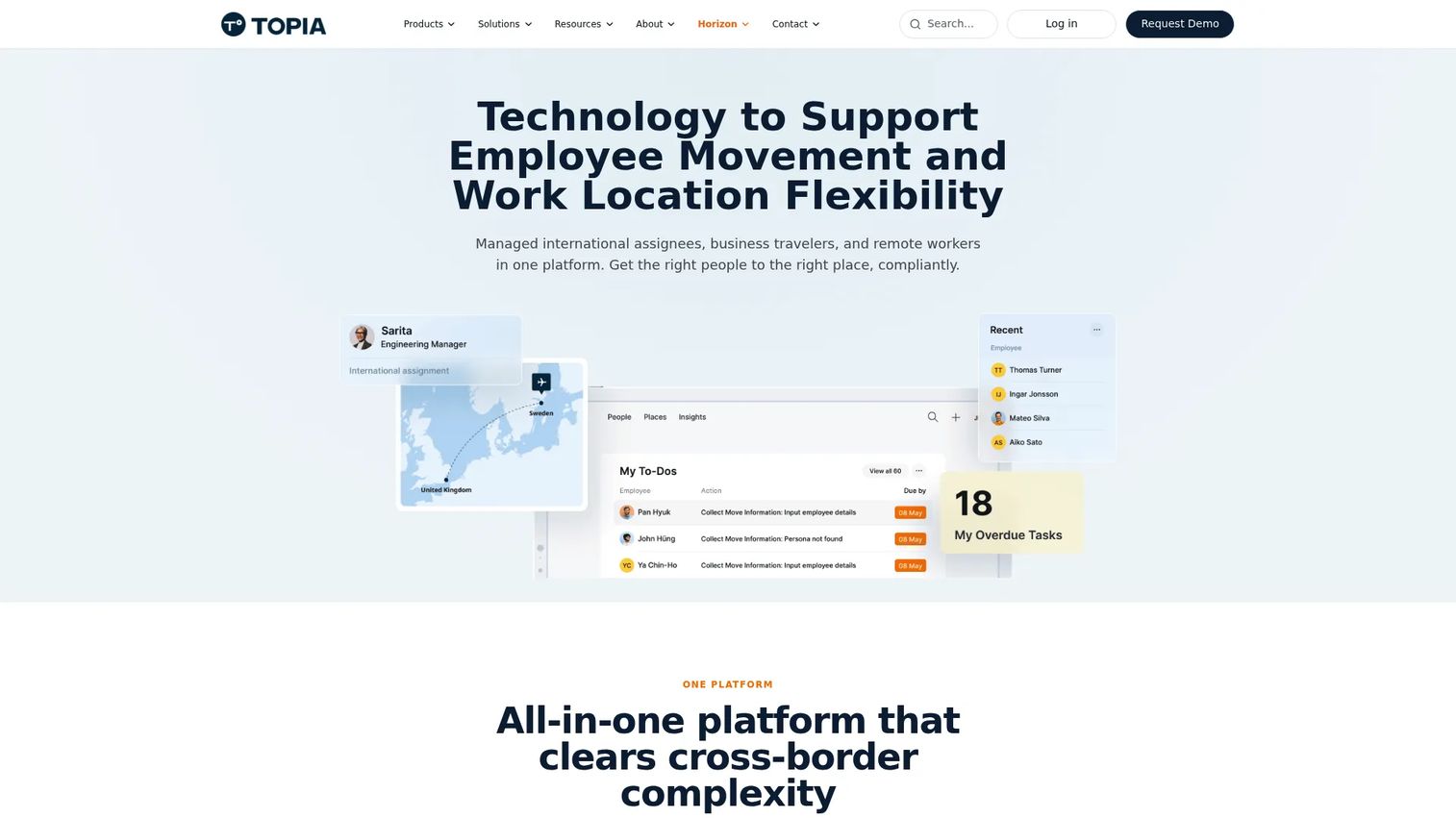
Topia is a global mobility platform built for distributed workforces, managing international assignments, business travel, remote work, and cross-border compliance from a single source of truth. It is aimed at enterprises whose mobility complexity goes well beyond basic domestic moves.
Best for: Enterprises needing global mobility and compliance software for international assignments and distributed teams.
Key strengths
- Automated compliance: Automates tax, immigration, and work-location compliance across borders.
- Assignment and workforce planning: Manages international assignments and broader workforce mobility planning.
- Integrations and reporting: Connects to HRIS, payroll, and travel systems and supports relocation reporting and analytics.
Why choose Topia: Topia is strongest for policy-heavy, multi-country programs where compliance is the hard part. If your team manages ongoing international assignments and needs tax and immigration handled inside the platform, Topia is built for that scale of complexity rather than one-off domestic relocations.
Topia pricing: Topia does not publish public pricing and directs prospects to request a demo. It holds a 4.5/5 rating on G2, based on a limited review volume. Expect enterprise-oriented, contact-based packaging scoped to your assignment volume.
4. UrbanBound
UrbanBound is employee relocation management software that covers employees, candidates, and interns, with a strong tilt toward the recruiting and experience side of relocation. It combines move management with candidate travel and expense handling, which makes it a fit for companies where relocation and talent attraction overlap.
Best for: Mid-market or enterprise employers managing employee relocations alongside candidate and intern moves.
Key strengths
- Employee relocation management: Coordinate full employee moves with self-service and status visibility.
- Candidate travel and expense management: Handle candidate travel and expenses inside the same platform.
- Intern relocation and housing: Manage intern relocation and temporary housing programs.
Why choose UrbanBound: UrbanBound fits teams that treat relocation as part of the talent experience, not just an operations line item. Covering candidates and interns in the same system reduces admin and gives recruiting and HR a shared view of every move that touches hiring.
UrbanBound pricing: UrbanBound uses a set license fee per relocating employee, candidate, or intern, with add-on options, and does not publish a public numeric price. It holds a 3.7/5 rating on G2. Contact UrbanBound to scope pricing to your expected move volume.
5. Relocity
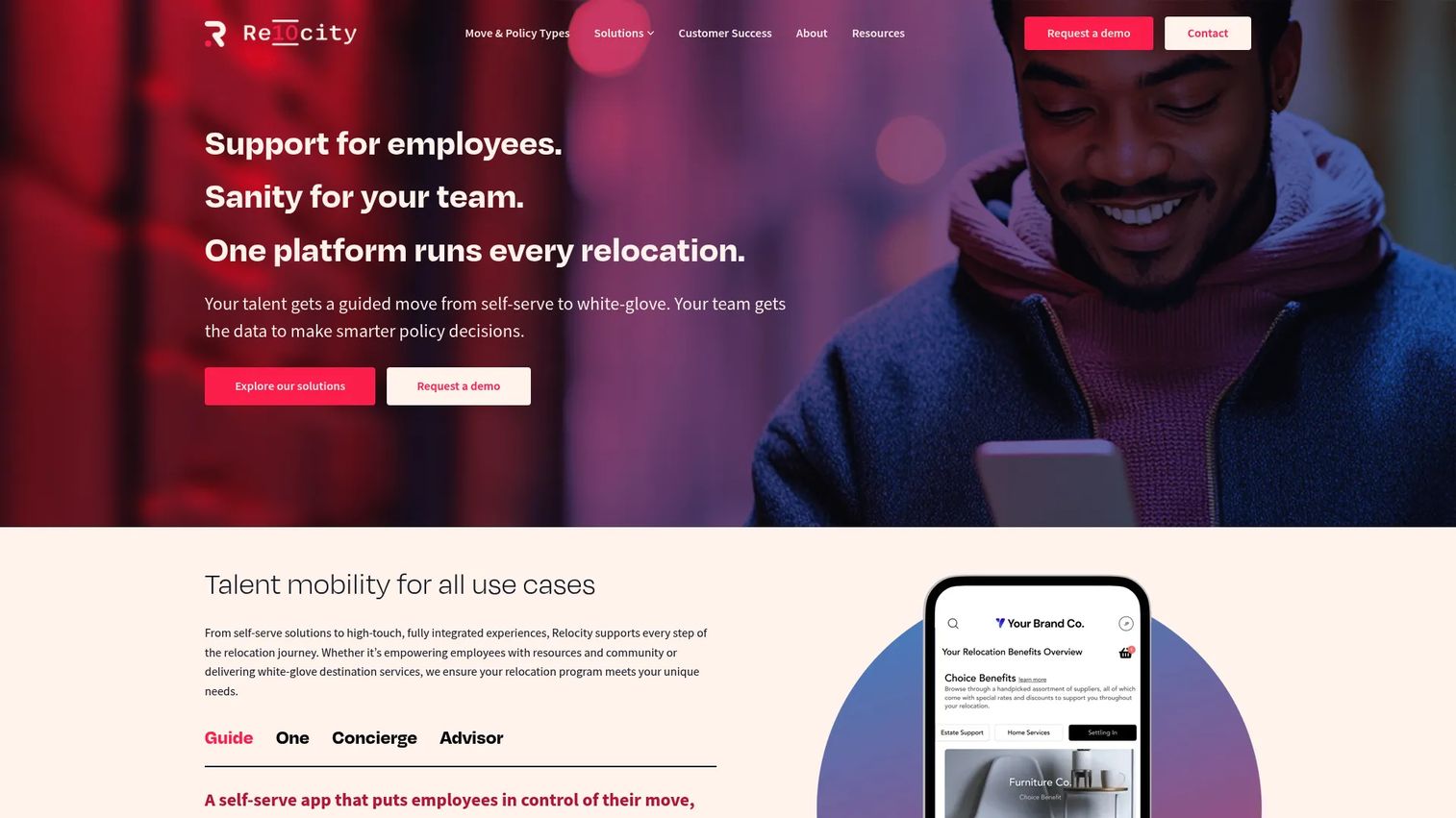
Relocity is a global talent mobility platform that pairs relocation software with destination services and hands-on employee relocation support. It runs the full move on one platform, from a self-serve app to local experts who help employees settle in, spanning everything from intern cohorts to executive assignments.
Best for: Enterprises and high-growth companies managing employee relocation and global mobility programs with a strong support component.
Key strengths
- Self-serve relocation app: Curated resources, checklists, and status for the relocating employee.
- Integrated platform: Suppliers, services, and milestones managed in one place.
- White-glove destination services: Local experts provide personalized on-the-ground support.
Why choose Relocity: Relocity suits programs where employee experience and destination support matter as much as workflow. If you want software plus a service layer that manages the employee journey end to end, Relocity blends both rather than leaving destination support to a separate vendor.
Relocity pricing: Relocity does not publish public pricing and routes prospects to request a demo or contact sales. Pricing is scoped through a conversation about program size and the level of destination service you need.
6. Orion Mobility
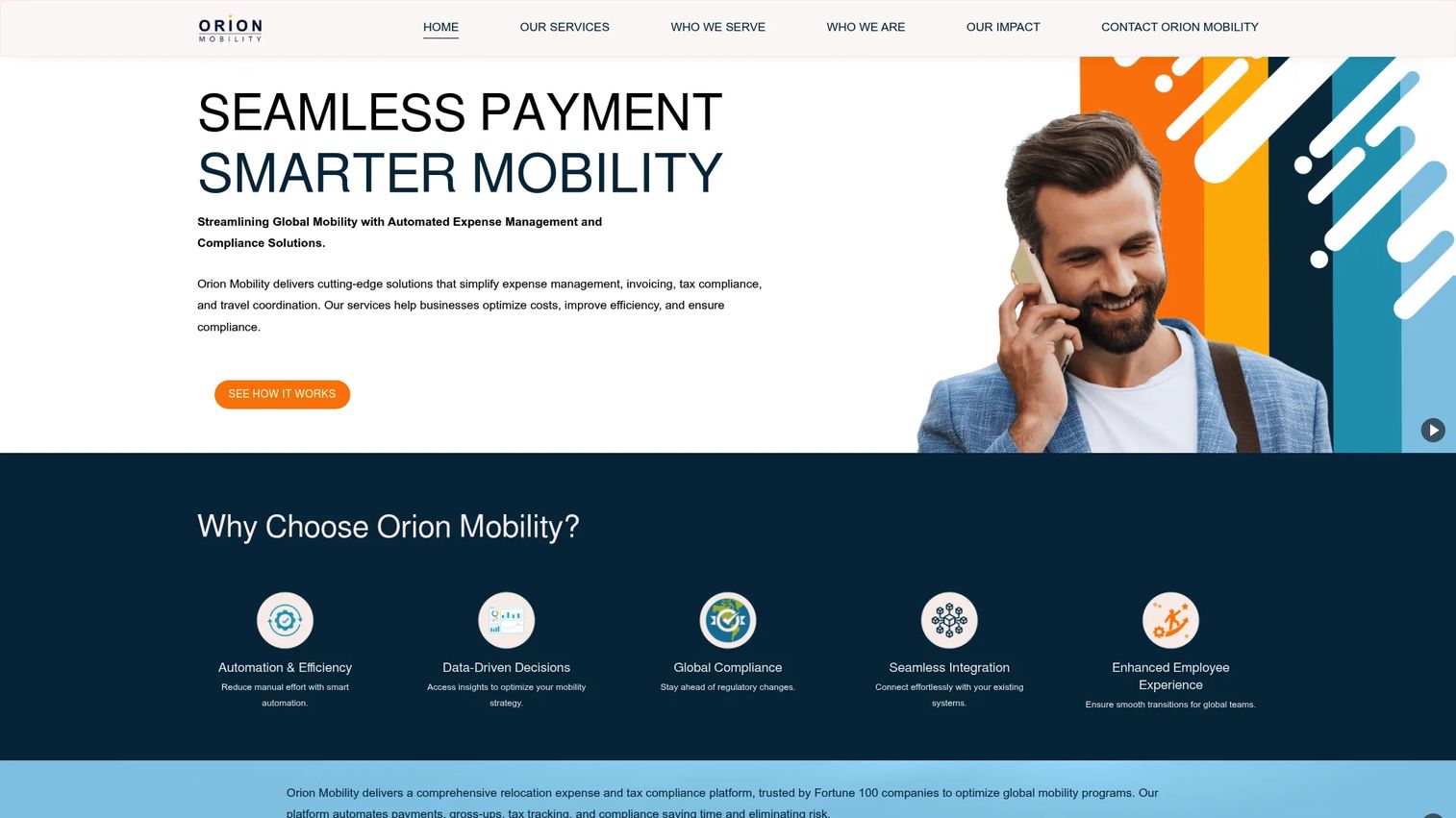
Orion Mobility is global mobility software and services focused on expense management, tax compliance, payments, and relocation support. Its center of gravity is the financial side of mobility, which makes it relevant when relocation expense tracking and reimbursement accuracy are top priorities.
Best for: Enterprise teams managing global mobility, relocation, and the payments and expenses that come with it.
Key strengths
- Employee expense processing: Process relocation and mobility expenses with accuracy and control.
- Candidate and intern reimbursements: Handle reimbursement tracking for candidates and interns.
- Global mobility management: Broader mobility management software wrapped around the financial workflows.
Why choose Orion Mobility: If your relocation pain is mostly financial, expenses, tax, and payments that never quite reconcile, Orion focuses on exactly that. It is a strong fit for finance and mobility teams that want tight cost control and clean reimbursement tracking as the backbone of the program.
Orion Mobility pricing: Orion does not publish public pricing and directs visitors to contact the company. Pricing is scoped to your program through a sales conversation.
7. Benivo
Benivo is a global mobility platform and relocation services provider built around employee experience and self-service. It combines a relocation workflow platform with digital destination support, giving employees a modern, transparent way to manage their move.
Best for: Enterprises managing global mobility and employee relocation programs where experience and self-service are priorities.
Key strengths
- Relocation workflow platform: Manage employee moves and mobility workflows in one system.
- Digital destination support: Employee self-service relocation with digital guidance and resources.
- Integrations and payments: Integrations, reporting, e-signatures, and payments built in.
Why choose Benivo: Benivo fits teams modernizing their global mobility operations around employee experience and program efficiency. The self-service focus reduces manual touchpoints while giving employees transparency into their own move, which lifts satisfaction without adding headcount.
Benivo pricing: Benivo prices per employee who relocates and does not publish a public numeric price; some pages direct visitors to contact the company for pricing. The per-move model scales with your actual relocation volume.
8. NuCompass Mobility
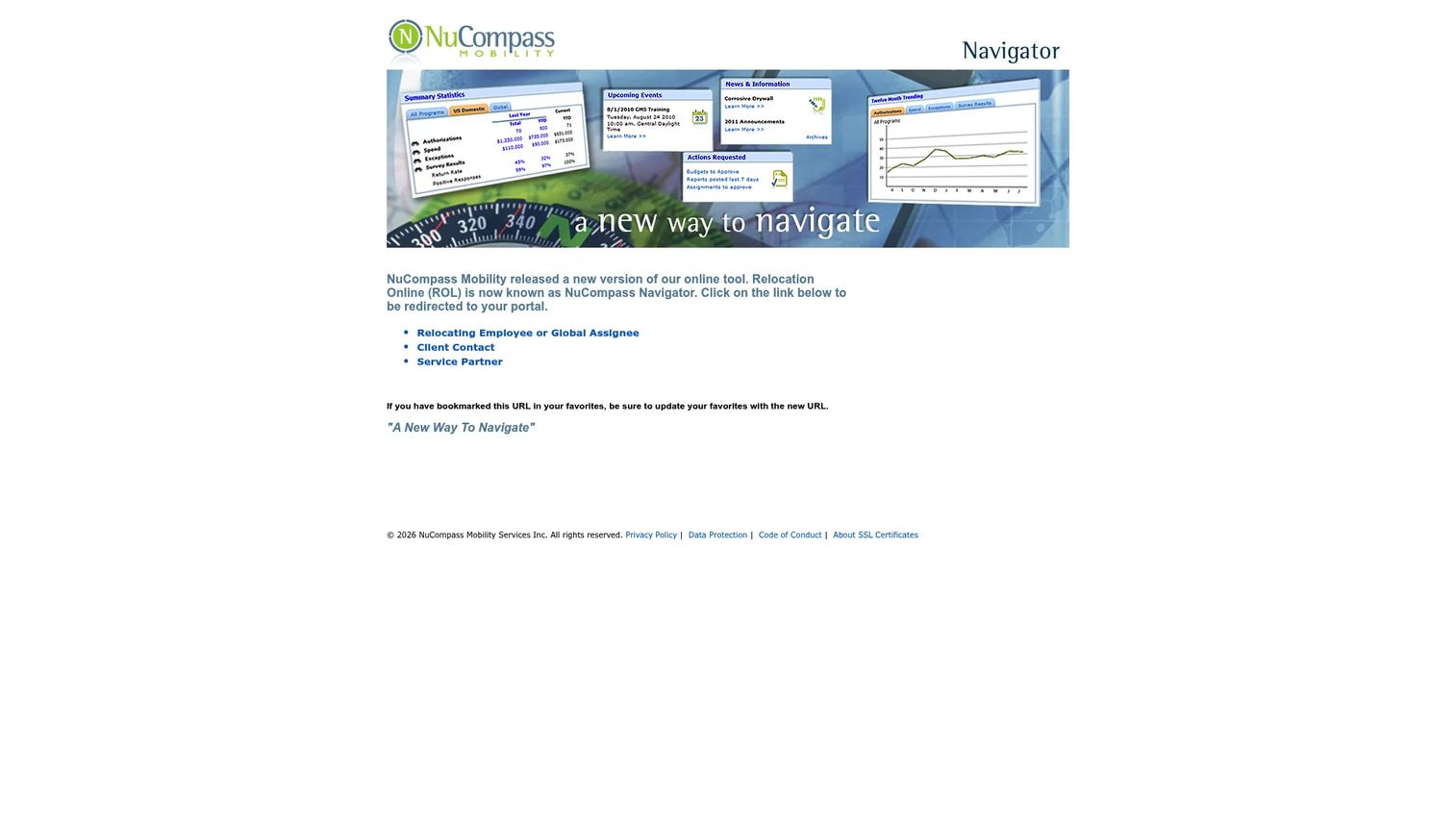
NuCompass Mobility is a relocation management platform and mobility services provider serving employees, client contacts, and service partners. Its NuCompass Navigator portal gives each group role-based access, and it supports relocation transactions including property-sale workflows.
Best for: Enterprises managing employee relocation and home sale programs with a services component.
Key strengths
- Relocation portal: The Navigator portal provides a self-service hub for employees and stakeholders.
- Role-based access: Employees, client contacts, and service partners each get appropriate access.
- Home sale workflows: Support for relocation transactions and property-sale processes.
Why choose NuCompass Mobility: NuCompass leans more service-led than pure software, which suits larger or more complex programs that want managed coordination alongside a portal. If home sale and complex relocation transactions are part of your program, the platform is built to handle them.
NuCompass Mobility pricing: NuCompass does not expose public pricing or plan tiers on its site. Pricing is handled through direct contact, scoped to program complexity and services required.
9. Cartus
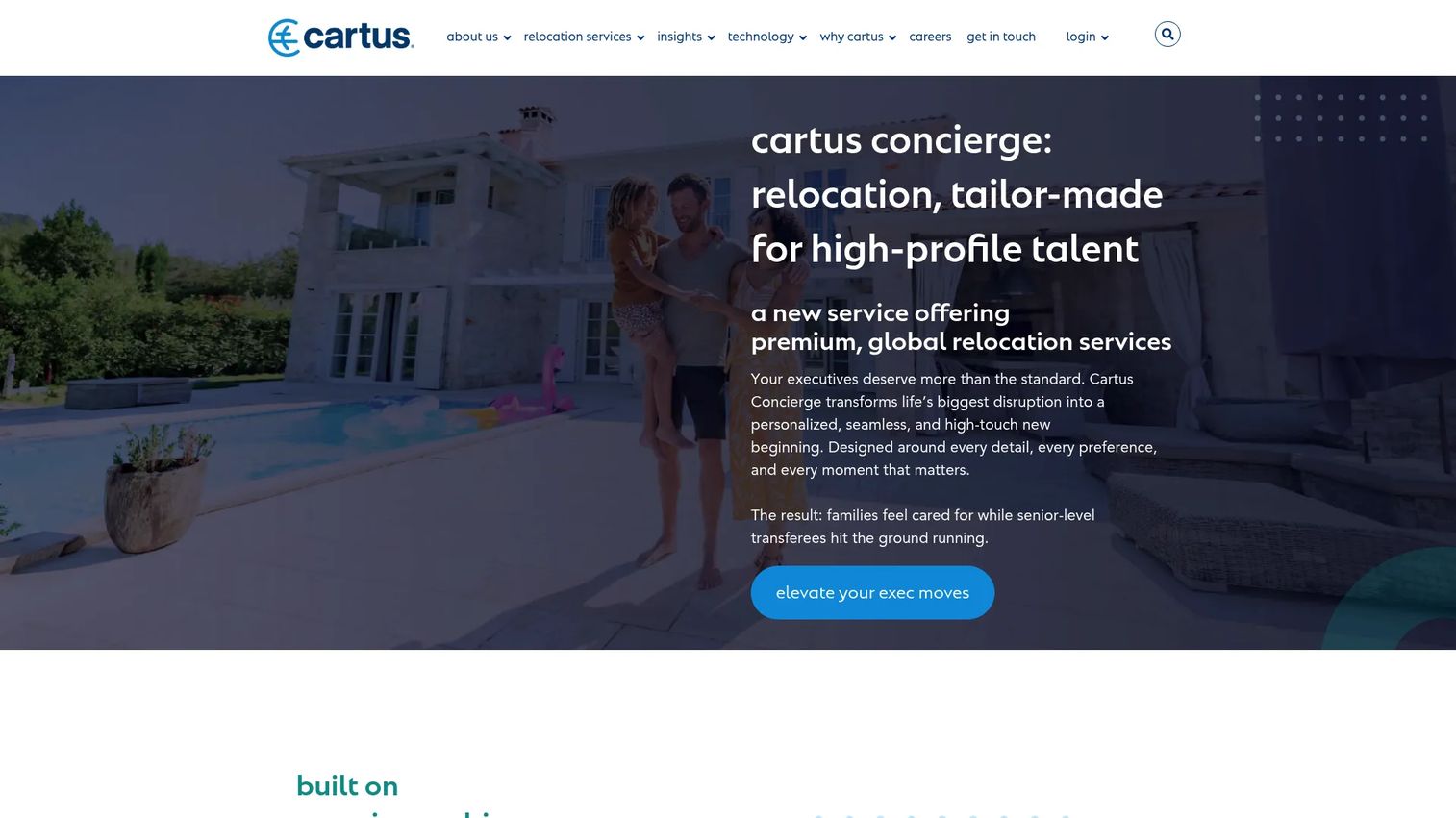
Cartus is a global relocation management and mobility provider that blends managed services with relocation technology. It is built for enterprises running corporate relocation and global mobility programs at scale, where program management depth often matters more than a self-serve tool.
Best for: Enterprises managing corporate relocation and global mobility programs at scale.
Key strengths
- Relocation technology: Relocation management software layered under a managed services model.
- Employee relocation services: Full-service relocation support for employees on the move.
- Core and flex benefits: Management of core and flexible relocation benefits programs.
Why choose Cartus: Cartus is a fit when you want a managed partner rather than software you run yourself. For large, complex, global programs, the combination of services and technology delivers program management depth that a lighter platform would leave to your internal team.
Cartus pricing: Cartus does not publish public pricing on its site. As an enterprise, services-led provider, pricing is scoped through direct engagement based on program size and service scope.
10. Skipr
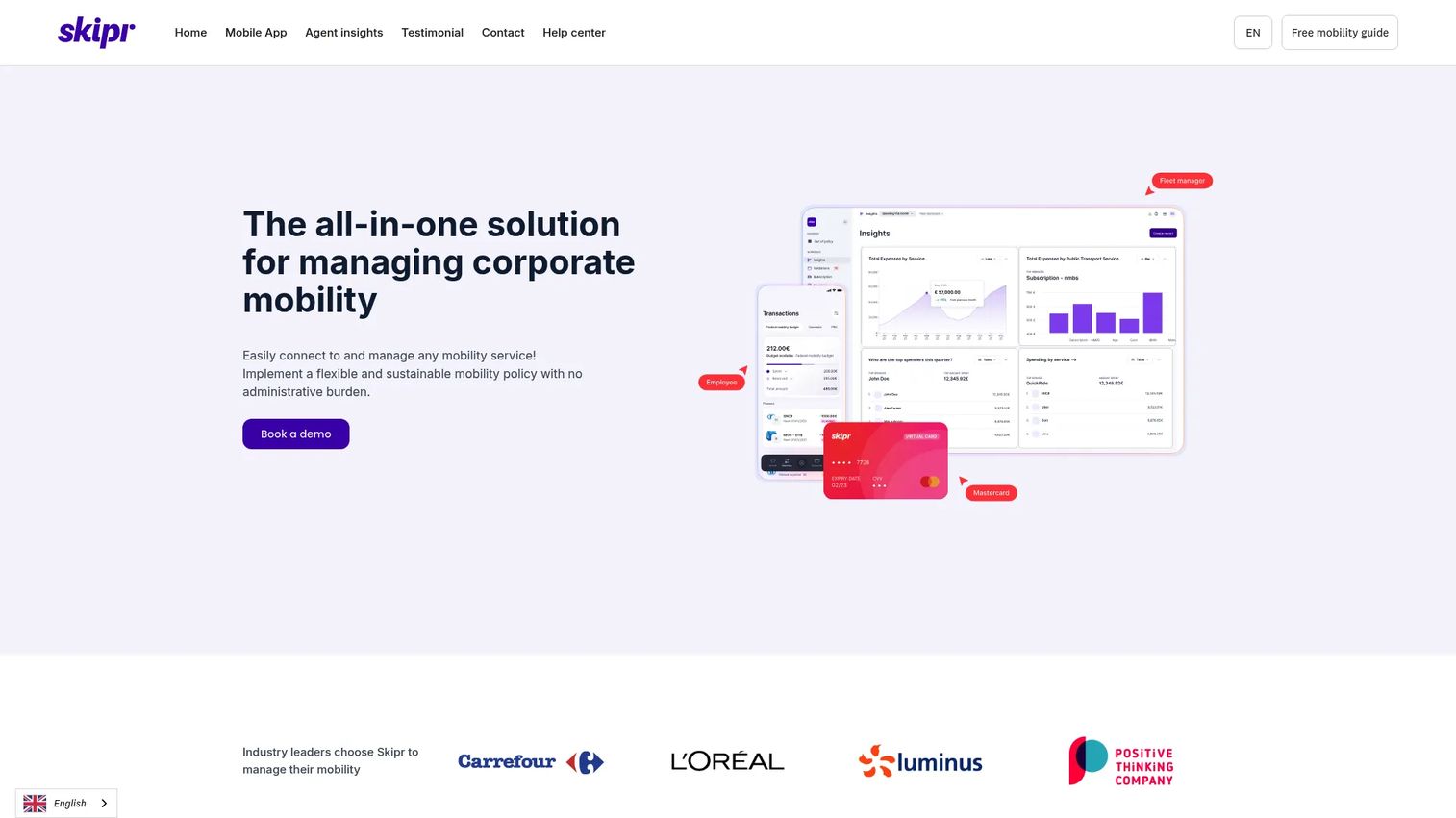
Skipr is a corporate mobility management platform combining a mobility app, a SaaS management platform, and a payment card. It is oriented toward digitalizing mobility management and cutting repetitive HR admin, with policy controls and reporting built in.
Best for: Companies managing employee mobility budgets, cards, and policy controls with lighter operational overhead.
Key strengths
- Centralized mobility management: Automated, centralized management of employee mobility.
- Payment card and app: A mobility payment card and mobile app for employees.
- Reporting and integrations: Reporting plus connections to HR tools and other integrations.
Why choose Skipr: Skipr fits teams that want lower operational overhead and a modern, card-and-app approach to mobility budgets and policy. The automation reduces repetitive HR admin, which frees people ops to focus on higher-value work rather than expense chasing.
Skipr pricing: Skipr publicly lists a Flex Plan for freelancers at €2 per week. Business pricing is not shown publicly on the corporate site and is handled through direct contact. The freelancer tier gives a sense of the model, but expect scoped business pricing for company programs.
11. Relo-Global
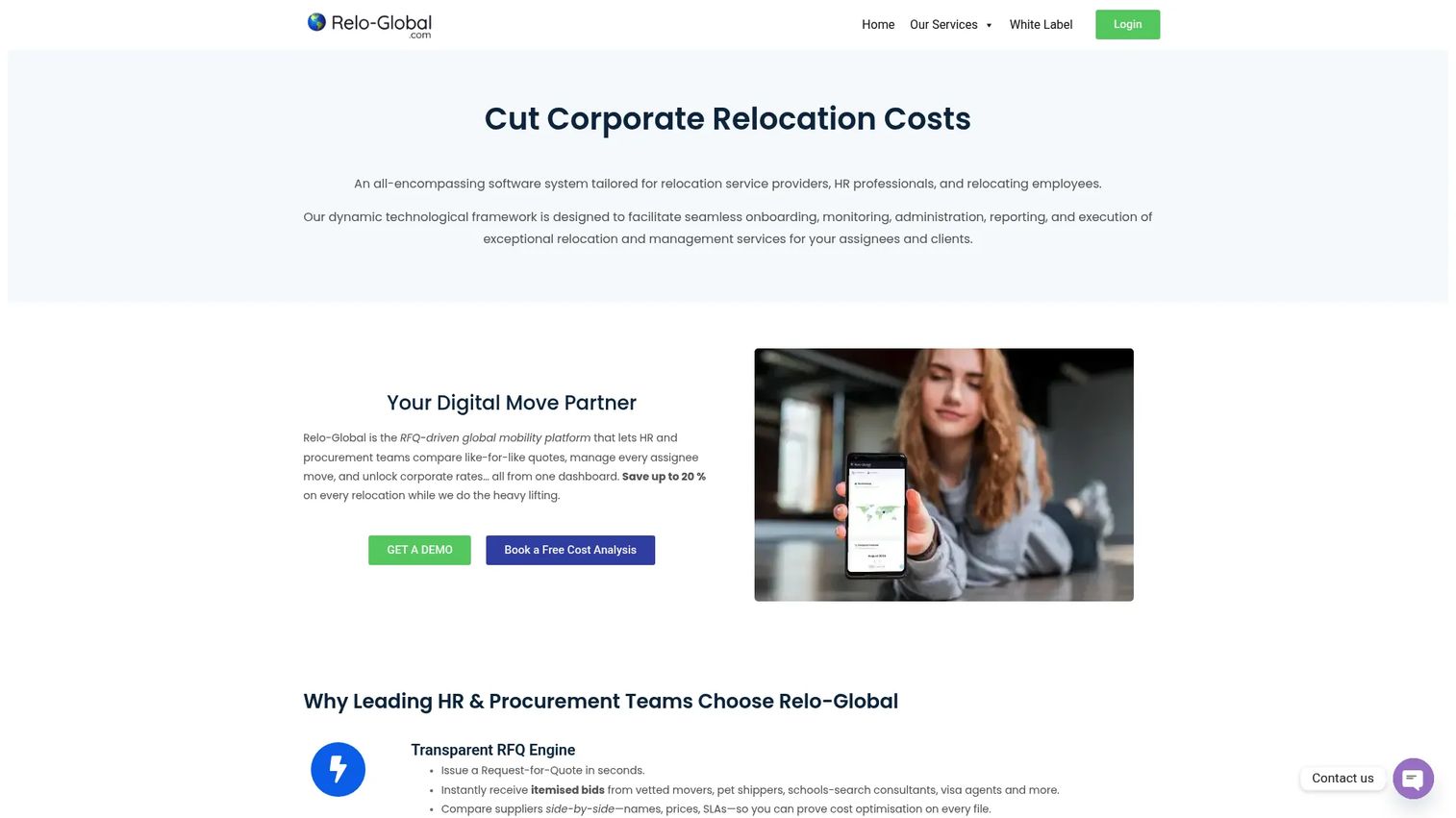
Relo-Global is an RFQ-driven global mobility and corporate relocation platform for HR, procurement, assignees, and vendors. Its differentiator is a transparent RFQ engine that lets teams compare like-for-like supplier quotes, which makes it a natural fit for procurement-oriented, cost-sensitive buyers.
Best for: Companies managing corporate relocations and global mobility workflows where quote comparison and cost control drive the decision.
Key strengths
- Transparent RFQ engine: Compare supplier quotes side by side for cost control.
- Unified mobility dashboard: Separate accounts for assignees, company, and vendors in one dashboard.
- White-label and automation: White-label branding and automated workflows for vendor coordination.
Why choose Relo-Global: Relo-Global fits teams where procurement sits at the center of relocation decisions. If comparing vendor quotes and controlling per-move cost is your priority, the RFQ engine turns a manual sourcing process into a structured, comparable one.
Relo-Global pricing: Relo-Global does not display a public price. Its white-label page describes a flexible, pay-per-use model, with white-label branding included at the Enterprise plan at no additional cost. Contact the company for pricing scoped to your program.
12. Relocation Management Worldwide
Relocation Management Worldwide (RMW) provides relocation management services alongside cloud-based mobility software for domestic and global employee relocations. Its Virtual Employee Network (VEN) platform covers budgeting, expense tracking, and policy management, and stands out for its government and federal scope.
Best for: Organizations needing managed relocation services and mobility software, including government and federal programs.
Key strengths
- VEN SaaS platform: A web-based relocation platform covering the full move lifecycle.
- Budget and cost tools: Relocation budget and cost estimators for planning and cost control.
- Move, expense, and policy management: Move management, relocation expense tracking, and policy and program management in one place.
Why choose Relocation Management Worldwide: RMW stands out for its broad relocation scope and federal use cases. Its VEN platform has been FedRAMP authorized and compliant since 2020, which makes it a strong fit for government and security-conscious programs that also need domestic and global relocation coverage with 24/7 access to move information.
Relocation Management Worldwide pricing: RMW does not publish public pricing and invites prospects to get started or request a demo. Pricing is scoped to program size, service level, and compliance requirements.
Considerations before you buy
Before you commit, run every shortlisted vendor through the same checklist. The goal is to compare on your reality, not the demo's happy path.
Workflow depth and automation
Map your actual move process, from intake to close, and check whether the platform automates the steps that eat your team's time. Relocation workflow automation is only useful if it matches how your program runs. Ask to see approvals, task routing, and vendor coordination in a live walkthrough, not a slide.
Cost visibility and expense tracking
Finance will ask about spend, so evaluate relocation expense tracking closely. Look for move-level budgets, reimbursement tracking, and reporting that shows committed versus actual cost in real time. If you cannot forecast per-move spend inside the tool, cost control stays a manual exercise.
Employee self-service and experience
The relocating employee is a user too. Test the employee self-service relocation experience directly: status visibility, expense submission, and access to resources. A strong self-service layer cuts your support load and improves satisfaction during a stressful life event.
Compliance and policy management
For any program touching international or government moves, confirm compliance tracking and relocation policy management fit your requirements. Ask about tax, immigration, work-location rules, and any security certifications like FedRAMP if you operate in the public sector.
Integrations and reporting
Check that the platform connects to your HRIS, payroll, and finance systems, and that relocation reporting and analytics export cleanly. Isolated data creates the same visibility gap you are trying to solve. The best relocation management platforms plug into your existing stack rather than becoming another silo.
Conclusion
The right relocation management software depends on three questions: how deep your workflow automation needs to be, how much compliance complexity you carry, and whether you want software you run or services you hand off.
For end-to-end, compliance-heavy global mobility, Equus Software and Topia lead. If employee experience and recruiting overlap, UrbanBound and Relocity fit well. When finance and expense control drive the decision, Orion Mobility is built for it, and Relo-Global suits procurement-led, quote-comparison buyers. For transparent pricing and centralized case management, ReloTalent stands out, while Skipr offers a lighter, card-and-app model. Cartus and NuCompass Mobility fit large, services-led programs, and Relocation Management Worldwide covers domestic, global, and government scope.
Your next step: shortlist two or three vendors that match your program's move volume and compliance needs, then compare them on policy handling, reporting depth, and employee self-service in a live walkthrough. The relocation ROI comes from cutting manual coordination, tightening cost control, and giving employees a move they do not have to chase.
FAQs
Relocation management software is HR and global mobility technology that coordinates employee moves in one system. It handles approvals, budgets, vendor coordination, employee self-service, reporting, and compliance, replacing spreadsheets and email with a single source of truth for each relocation.
Software gives your team the platform to run relocations in-house, while managed mobility services handle the moves on your behalf with human coordinators. Many vendors blend both. If you want internal control and auditability, lean toward software; if you want to offload the work, lean toward services.
Prioritize relocation workflow automation, move-level expense tracking, employee self-service, relocation policy management, and reporting. For international programs, add compliance tracking for tax, immigration, and work-location rules. Integrations with your HRIS and payroll are essential to avoid data silos.
Yes. Most relocation management platforms include relocation expense tracking, move-level budgets, and reimbursement tracking. This gives finance real-time visibility into committed and actual spend per move, which improves forecasting and cost control compared with reconciling receipts after the fact.
Yes. Global mobility software is built for domestic and international relocation, automating cross-border compliance like tax residency, immigration timelines, and country-specific work rules. Platforms such as Topia and Equus Software focus heavily on this multi-country complexity.
Ask how the platform handles tax, immigration, and work-location compliance tracking, and whether it supports any certifications you need, such as FedRAMP for government programs. On reporting, confirm you can export relocation reporting and analytics and see cost, cycle time, and compliance status per move.
It can be, especially once manual move management software workarounds like spreadsheets create real risk. Vendors with published or lighter pricing, such as ReloTalent and Skipr, make the category accessible to smaller programs. Weigh the cost against the hours saved and the errors avoided.
Shortlist two or three vendors, then compare them on workflow depth, expense tracking, employee self-service, compliance and vendor coordination, and integrations. Run each through a live walkthrough using your real move process, and confirm pricing fit for your volume before deciding.