Your VP People needs 40 qualified engineering screens this month. Your hiring managers have time for 12. That gap is not a sourcing problem. It is a capacity problem, and most teams solve it the wrong way: By asking senior leaders to do more first-round calls, or by cutting screening quality to hit throughput targets.
AI interview agents change the equation. Rather than routing every candidate to a human recruiter first, they conduct structured interviews autonomously, produce transcripts and scored reports, and hand the evidence to your team for review. According to iHire's 2025 employer survey, 25.9% of employers used AI in recruitment in 2025, up from 14.7% the year before. Adoption is accelerating because the alternative (more recruiter headcount for every hiring surge) doesn't scale.
The challenge is picking the right tool. The wrong AI interview agent can damage candidate trust, create compliance exposure, or produce scores so opaque that your team can't act on them. This guide cuts through the noise.
What's inside
This guide compares 9 AI interview agents for 2026, selected to give founders and operators a decision-ready shortlist. Each tool was evaluated on:
- Interview format: Voice, video, text, or coding
- Scoring evidence: Transcripts, rubrics, and reviewer workflows
- ATS and workflow fit: Integrations and recruiter handoff
- Candidate experience: Transparency, accessibility, and fairness controls
- Responsible AI controls: Bias testing, fraud detection, and compliance readiness
The guide is written for Series B teams that need hiring to scale without founder or executive bottlenecks in every screen.
TL;DR
- Best overall for structured AI screening: Crosschq combines interview evidence, integrity checks, and reference intelligence in one hiring workflow
- Best for high-volume enterprise hiring: HireVue handles large-scale video interviewing with assessment depth that enterprise TA teams need
- Best for technical developer hiring: HackerEarth offers scenario-based technical evaluation with identity verification and coding interviews
- Best for conversational text screening: Sapia.ai runs chat-based interviews with explainable competency scoring at scale
- Best free-to-start option for small teams: AI Interview Agents has a free tier that includes 10 interview credits and 30 screening calls
- Best for engineering interview calibration: interviewing.io provides anonymous AI and expert-led mock interviews to sharpen your technical hiring bar
What is ai interview agents?
AI interview agents are recruiting software tools that conduct, assist with, score, or summarize candidate interviews using structured prompts, machine-generated follow-ups, transcripts, rubrics, and recruiter review workflows. They automate the first-round screening conversation so human recruiters spend time on qualified candidates, not every applicant who submits a resume.
The category sits between applicant tracking systems (which manage the pipeline) and live human interviews (which consume leadership time). Most tools in this space offer some combination of the following:
- Automated first-round interview scheduling and delivery
- Structured interview plans generated from job descriptions
- Voice, video, text, or live coding interview formats
- Contextual follow-up questions based on candidate responses
- Transcript-backed scoring tied to competencies or rubrics
- Candidate ranking and shortlist reports for recruiter review
- ATS and calendar integrations for workflow automation
- Candidate transparency controls including opt-out and retake options
- Human-in-the-loop review before any hiring decision
- Bias auditing and privacy controls for responsible AI hiring
AI interview agents are distinct from general chatbots (which lack hiring-specific scoring), basic video recording tools (which capture responses but don't evaluate them), and standalone coding assessment platforms (unless they include interview automation).
One important boundary: These tools screen and produce evidence. They should not make hiring decisions. Final judgment should stay with a human recruiter or hiring manager. The best tools in this category are built around that principle from the ground up. Involve legal counsel before deploying AI in employment decisions, particularly in jurisdictions with specific employment AI regulations.
When to use
Screen high-volume roles without creating a recruiter bottleneck
When your team receives 300 applications for a customer success role and has capacity for 20 recruiter calls, an AI interview agent runs the first-round screen for every qualified applicant. The tool delivers a consistent structured interview, scores responses against a rubric, and surfaces the top candidates with transcripts attached. Your recruiter reviews evidence, not scheduling.
Standardize interviews across hiring managers
Interview quality varies by manager, and that variance becomes a hiring quality problem at scale. Structured rubrics and automated scoring reduce that variance. When multiple teams hire for similar roles across the company, a consistent AI interview layer means you can compare candidates across hiring managers rather than comparing interviews that asked different questions.
Expand interviewing across time zones and languages
Asynchronous AI interviews let candidates complete screens on their own schedule, which matters when hiring across time zones or for roles with multilingual requirements. Some tools in this list support 75 or more interview languages. Evaluate candidate experience carefully before deploying asynchronously: Unclear instructions and opaque scoring create employer brand risk that hiring velocity gains rarely justify.
Ai interview agents comparison
The table below reflects verified pricing and G2 ratings sourced from each vendor's official pricing page and live G2 listings. Where pricing requires a sales conversation, that is noted in the tool's entry below.
| # | Product | Best for | Key differentiator | Pricing | G2 rating |
|---|---|---|---|---|---|
| 1 | AI Interview Agents | Small recruiting teams | Resume screening plus automated voice and video interviews | Free / $99/mo | Not listed |
| 2 | HackerEarth AI Interview Platform | Technical hiring at scale | Scenario-based coding interviews with identity verification | Custom pricing | 4.5/5 |
| 3 | HireVue | Enterprise video interviewing | Large-scale structured video with assessments and competency mapping | Custom pricing | 4.1/5 |
| 4 | Sapia.ai | High-volume conversational screening | Untimed text interviews with explainable competency scoring | Custom pricing | 4.6/5 |
| 5 | Interviewer.AI | Asynchronous video screening | AI avatar interviews with adaptive follow-up questions | From $199/mo | 4.6/5 |
| 6 | interviewing.io | Engineering interview calibration | Anonymous AI and expert-led technical mock interviews | Free AI / from $179 | 3.5/5 |
| 7 | Crosschq | Candidate quality and fraud controls | AI interviews plus reference checks and integrity detection | Custom pricing | 4.6/5 |
| 8 | Talview Ivy | Enterprise autonomous interviewing | Voice, video, coding, and multilingual AI in one platform | Custom pricing | 4.4/5 |
| 9 | HackerRank | Developer assessment and hiring | AI-led screening plus live coding with 55+ languages | From $79/mo | 4.5/5 |
Best 9 ai interview agents for 2026
1. AI Interview Agents
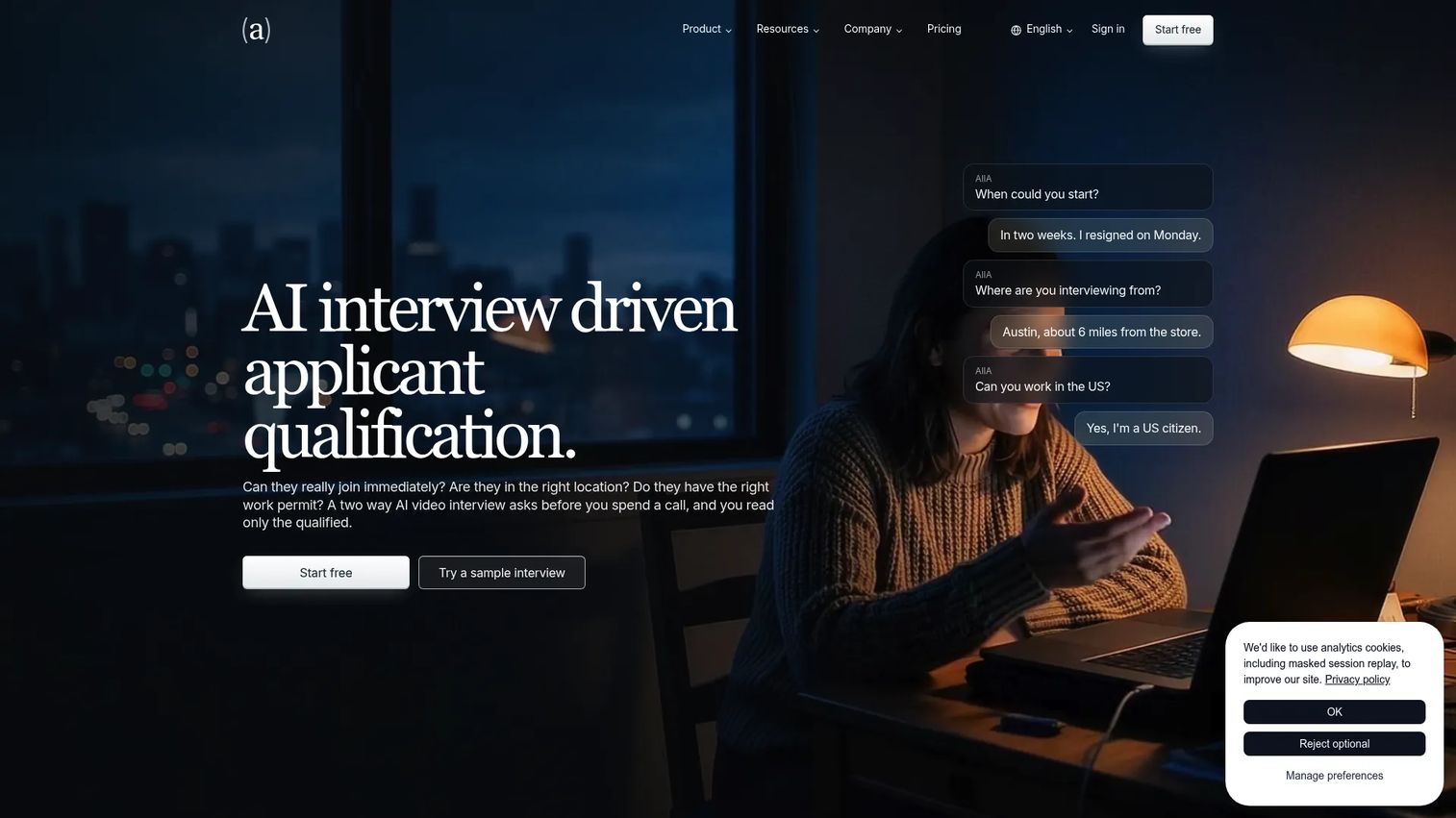
AI Interview Agents is a recruiting platform focused on automating the full first-round workflow: Resume screening, structured voice and video interviews, candidate scoring, and shortlist reports. The platform supports sourcing via shareable hiring links and built-in career page tools, making it practical for small teams without a dedicated ATS. Interviews run in the browser in 75 languages, so multilingual hiring is accessible without additional tooling.
Best for: Recruiters, staffing agencies, and early-to-mid-stage founders who want to screen candidates at volume without hiring more recruiters.
Key features
- Resume screening and AI role-match scoring
- Voice interviews with video recording, transcripts, and answer clips
- 75-language browser-based interviews
- Candidate location and joining-readiness checks
- Built-in career page with lightweight ATS
Why choose AI Interview Agents: The free tier offers a usable starting point (10 interview credits, 30 screening calls) so your team can test it on one role before committing. It's the most accessible entry point on this list for teams that haven't bought an enterprise HR platform yet.
AI Interview Agents pricing: A free plan is available. Pro costs $99 per month and includes 200 interview credits, 2,000 AI credits, and up to 5 recruiter seats.
2. HackerEarth AI Interview Platform
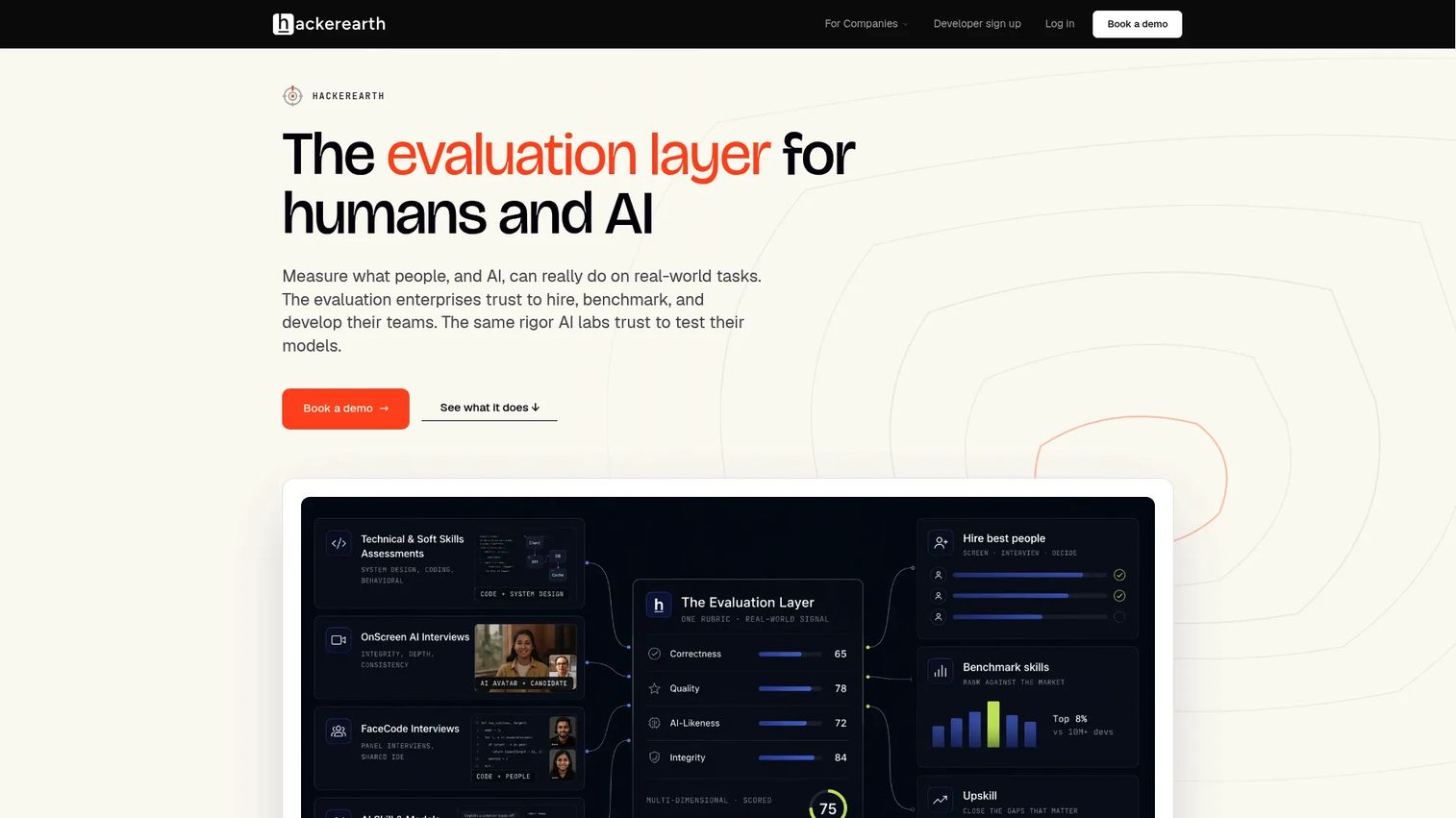
HackerEarth offers AI-powered technical interviewing with scenario-based evaluation, resume-driven dynamic questioning, and live coding interviews. The platform generates structured interview templates from job descriptions and includes identity verification and proctoring, which matters when hiring for roles where credential fraud is a concern. Interview recordings, transcripts, and analytics give hiring managers evidence to review before they commit to a live round.
Best for: SaaS companies hiring engineers at scale who need structured technical evaluation before spending engineering leader time on candidates.
Key features
- AI-generated interview templates from job descriptions
- Scenario-based technical competency evaluation
- Coding interviews with real-time code execution
- Identity verification and candidate integrity checks
- Interview recordings, transcripts, and scoring reports
Why choose HackerEarth: When technical hiring quality matters more than raw screening throughput, HackerEarth's coding interview layer gives engineering leaders pre-validated signal rather than a list of names to call. The proctoring and identity checks also reduce the proxy-interview risk that affects high-volume developer hiring.
HackerEarth AI Interview Platform pricing: HackerEarth prices the AI Interview Platform on a custom quote basis. Contact their sales team to get a figure tied to your interview volume and team size.
G2 rating: 4.5/5
3. HireVue
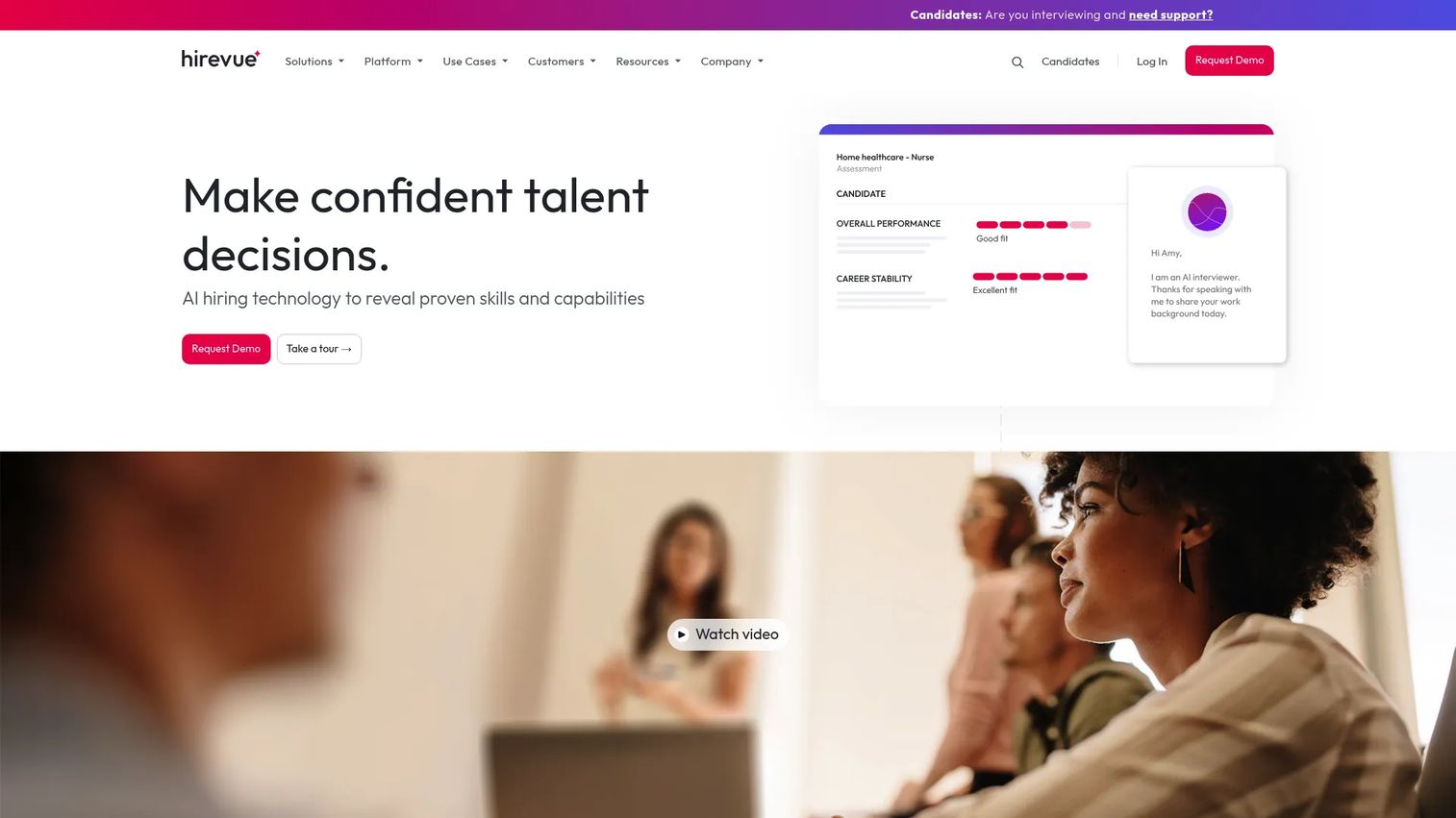
HireVue is a mature enterprise hiring platform built around structured video interviewing, assessments, and AI-assisted evaluation. It supports skills assessments including coding, language, game-based, and job simulations alongside video interviews. Competency mapping, searchable transcripts, and collaborative review workflows make it practical for large TA teams with multiple hiring managers reviewing the same candidate pool.
Best for: Enterprise HR teams running high-volume hiring programs who need a proven platform with deep ATS integrations and formal talent operations support.
Key features
- AI Interviewer and structured video interviews
- Skills assessments including coding, game-based, and job simulations
- Searchable transcripts with competency mapping
- Collaborative multi-reviewer workflows
- Interview summaries and candidate evaluation reports
Why choose HireVue: HireVue fits a mature organization with a formal TA function and existing enterprise tooling. It's the right call when your VP People needs a platform that integrates with the ATS you already own and can support hundreds of open roles simultaneously.
HireVue pricing: HireVue directs buyers to request a demo rather than displaying plans. Pricing varies by hiring volume, modules selected, and contract terms.
G2 rating: 4.1/5
4. Sapia.ai
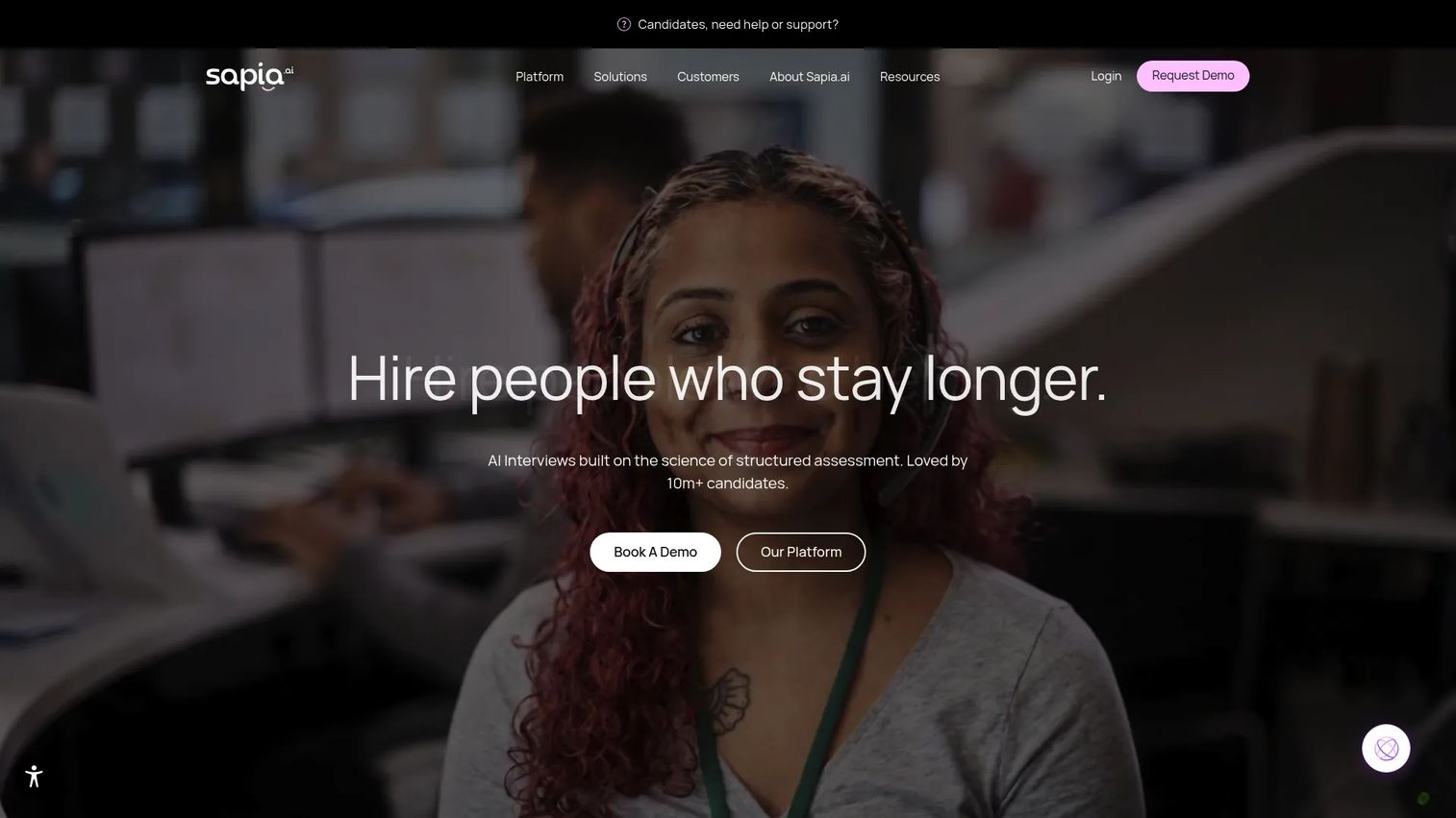
Sapia.ai is an enterprise AI hiring platform that uses untimed, text-based chat interviews to screen candidates at scale. Its Job Analysis Studio lets recruiting teams define role competencies and generate structured questions, and the Talent Intelligence Agent lets managers explore candidate scores and responses rather than just receiving a ranked list. Sapia charges per hire rather than per interview, which aligns cost directly to hiring outcomes.
Best for: Enterprise recruiting teams running high-volume screening for frontline, customer-facing, or early-career roles where accessibility and consistency are priorities.
Key features
- Structured, untimed text-based chat interviews
- Role-based competency assessment with explainable scoring
- Job Analysis Studio for defining competencies and questions
- Talent Intelligence Agent for exploring candidate responses
- ATS and HRIS integrations
Why choose Sapia.ai: Text-based screening removes barriers that video or phone interviews create for candidates with connectivity issues or disabilities. The explainable scoring means your team can defend every shortlist decision, which matters if hiring practices ever face regulatory scrutiny.
Sapia.ai pricing: Sapia operates on custom per-hire pricing. All candidates can be interviewed at no additional cost; you pay for candidates ultimately hired. Custom integration costs may apply. Contact sales for a quote tied to your expected hire volume.
G2 rating: 4.6/5
5. Interviewer.AI
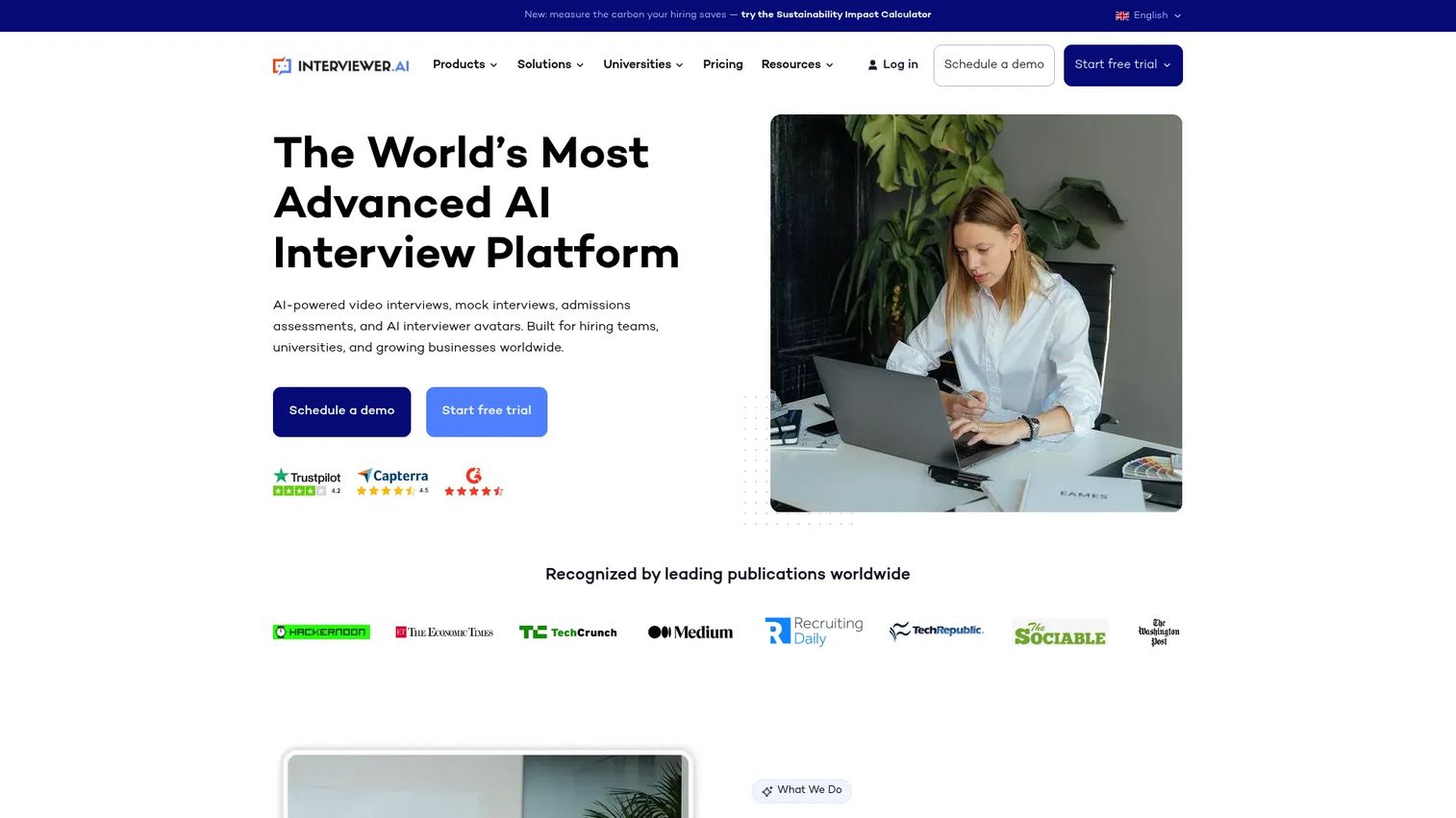
Interviewer.AI is a video-first AI screening platform that uses one-way asynchronous video interviews with AI-generated follow-up questions, resume scoring, and AI interview summaries. A conversational AI avatar interview mode is available for companies that want a more interactive screening format. The platform includes dynamic interview flows where follow-up questions adapt based on the candidate's responses, adding depth beyond fixed question sets.
Best for: Hiring teams, staffing agencies, and university admissions teams that need scalable asynchronous video screening with AI-assisted shortlisting.
Key features
- AI-powered one-way video interviews
- Conversational AI avatar interview mode
- Dynamic flows with adaptive follow-up questions
- AI response relevancy scoring and summaries
- Resume screening and candidate matching
Why choose Interviewer.AI: When hiring managers want to assess communication quality and role fit before committing live interview slots, asynchronous video gives them enough signal to cut the candidate list meaningfully. The avatar mode is worth evaluating if you're in a consumer-facing role category where on-camera presence matters.
Interviewer.AI pricing: Essential is $199 per month (50 interview credits). Professional is $399 per month (120 credits). Enterprise is custom pricing with volume-based credits. A 14-day free trial is available on paid plans.
G2 rating: 4.6/5
6. interviewing.io
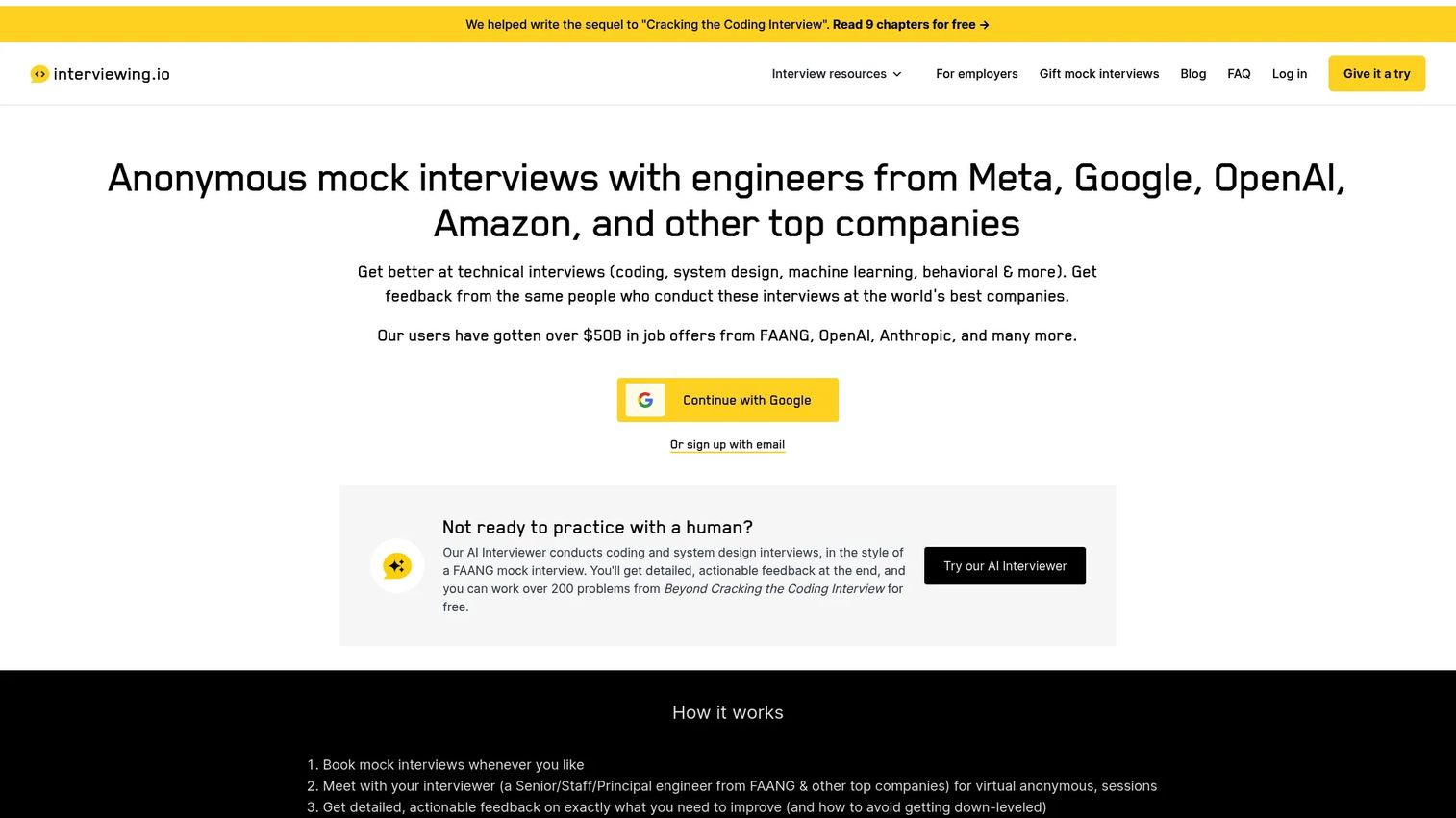
interviewing.io is a technical interview platform used by software engineers for anonymous AI and expert-led mock interviews. The AI Interviewer covers algorithms, coding, system design, machine learning, and behavioral interviews, with detailed feedback after each session. The expert-led side connects candidates with senior engineers from major technology companies for anonymous practice interviews, which gives hiring teams a way to understand what a calibrated technical interview looks like from the other side.
Best for: Software engineers preparing for technical interviews, and engineering leaders who want to understand and improve their own hiring bar by experiencing what rigorous technical screens look like.
Key features
- AI coding and system design interviewer with detailed feedback
- Anonymous expert-led mock interviews with senior engineers
- Practice across algorithms, system design, and behavioral interviews
- Engineering management and machine learning interview coverage
- Candidate performance feedback for improvement
Why choose interviewing.io: The platform's value for employers is calibration, not volume screening. If your engineering interview process feels inconsistent or your offer acceptance is weak because candidates don't trust the signal, interviewing.io helps engineering leaders understand what strong technical interviews actually require.
interviewing.io pricing: The AI Interviewer is free. Expert-led interviews start at $179 and vary by subject and whether a specific company interviewer is requested.
G2 rating: 3.5/5
7. Crosschq
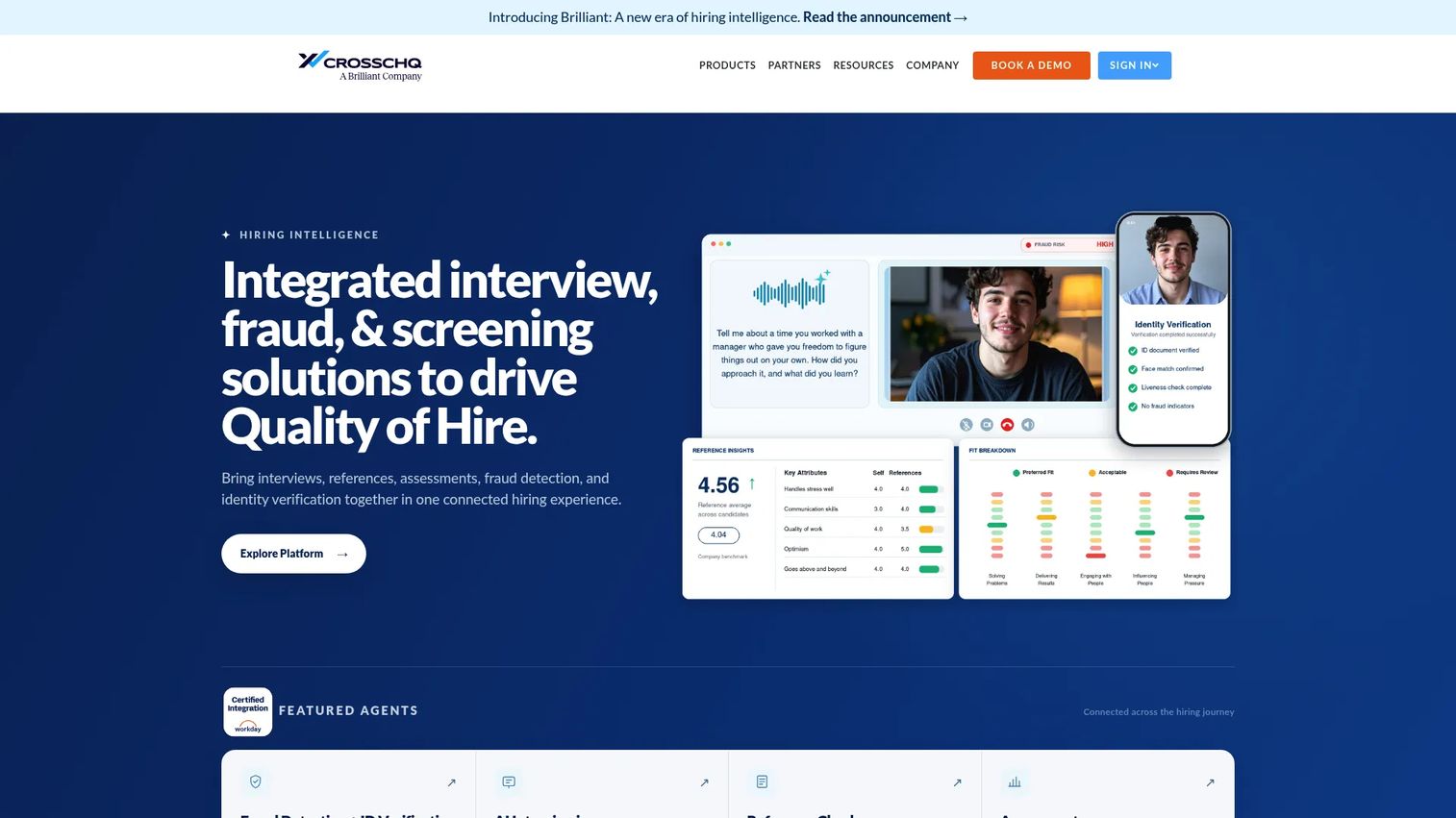
Crosschq is a hiring intelligence platform that combines AI screening interviews with digital reference checks, candidate fraud detection, identity verification, and Quality of Hire analytics. Its AI Interviewer generates structured interview plans from job descriptions, runs phone or video interviews, and produces transcript-backed competency reports. Candidate integrity controls include deepfake detection, proxy interview identification, and behavioral signals during the interview, which addresses one of the most underrated risks in AI hiring.
Best for: Talent acquisition teams that care equally about candidate quality and hiring risk, and want interview evidence, reference intelligence, and fraud controls in one integrated workflow.
Key features
- AI interviews with structured plans and transcript-backed reports
- Candidate fraud and proxy detection with identity verification
- Digital reference checks with candidate intelligence
- Quality of Hire analytics and recruiting metrics
- Integrations with existing hiring technology
Why choose Crosschq: The reference check and fraud detection combination is unique in this list. When you're hiring for roles where credential misrepresentation or proxy interviews are real risks, having integrity signals alongside interview evidence in one report makes the recruiter's decision significantly cleaner.
Crosschq pricing: Custom pricing. Contact Crosschq directly with your expected candidate volume and integration requirements to get a quote.
G2 rating: 4.6/5
8. Talview Ivy
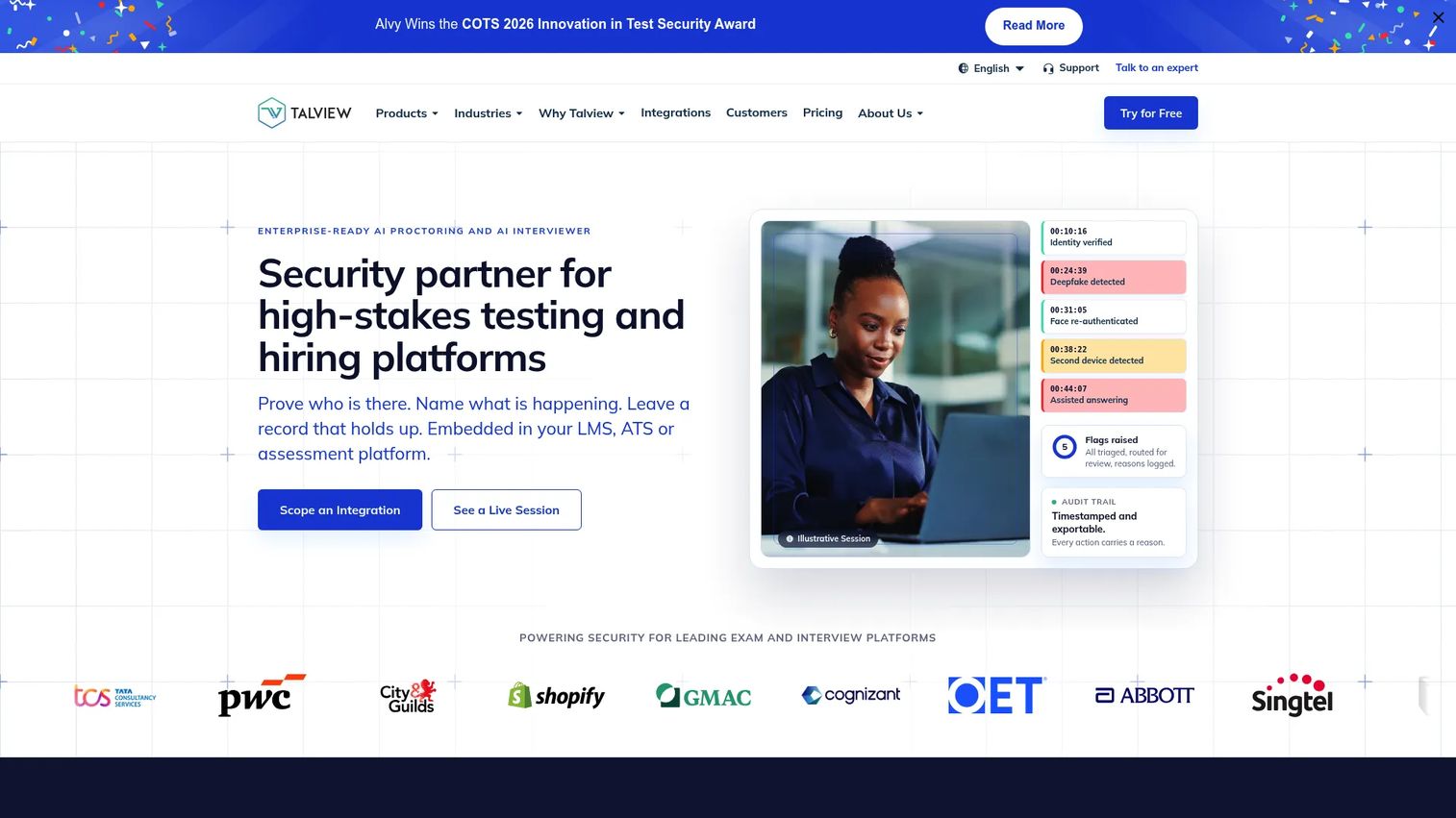
Talview Ivy is Talview's autonomous AI interviewer, built to run structured interviews at enterprise scale across voice, video, and live coding formats. Ivy generates contextual follow-up questions in real time based on candidate responses, supports multilingual interviews with customizable interviewer personas, and produces competency scores, behavioral insights, and full transcripts for recruiter review. Enterprise-grade security and ATS integrations make it suited for large hiring programs with formal IT governance requirements.
Best for: Enterprise and high-volume recruiting teams that need one AI interviewer to handle behavioral, competency-based, and technical interviews across multiple role types simultaneously.
Key features
- Structured conversational interviews with real-time contextual follow-ups
- Voice, video, and live coding interview formats
- Multilingual interviews with customizable interviewer personas
- Transcripts, competency scores, and behavioral insights
- ATS, calendar, and workflow integrations
Why choose Talview Ivy: When a Series B team hires across product, engineering, sales, and customer success simultaneously, managing separate screening tools per function creates coordination overhead. Ivy's ability to run behaviorally scored interviews and technical coding interviews from one platform reduces that overhead.
Talview Ivy pricing: Custom pricing tied to interview volume, feature bundle, and enterprise requirements. Talview's pricing page confirms the model is unit-based with individual-feature and bundled options.
G2 rating: 4.4/5
9. HackerRank
HackerRank is a developer skills platform that combines AI-led conversational screening with take-home assessments and live collaborative coding interviews. Its AI interviewer conducts structured candidate screening conversations, while the technical side covers 55 programming languages, thousands of coding and database questions, and proctoring controls including plagiarism detection, session replay, and identity matching. ATS, calendar, SSO, SCIM, and MCP integrations make it plug-and-play for most engineering hiring stacks.
Best for: Organizations hiring software developers who need standardized technical screening at scale before engineering leaders commit live interview time.
Key features
- AI-led conversational screening and interviewing
- Take-home assessments and live collaborative coding interviews
- 55+ programming languages and thousands of questions
- Plagiarism detection, proctoring, session replay, and identity matching
- ATS, calendar, SSO/SCIM, and MCP integrations
Why choose HackerRank: HackerRank is the most recognized name in developer assessment and the fastest tool to deploy against an engineering hiring bar that your team already understands. The AI screening layer adds conversational qualification on top of the assessment workflow your recruiters may already be familiar with from prior companies.
HackerRank pricing: Starter is $79 per month ($948 billed annually) with 60 candidate attempts per year. Pro is $419 per month ($5,028 billed annually) with 360 attempts. Enterprise is custom pricing with unlimited users and advanced integrations.
G2 rating: 4.5/5
Considerations
Before buying any AI interview agent, verify these five factors against your actual hiring workflow.
Evidence quality
A score without an explanation is not useful for hiring. Ask every vendor to show you a sample candidate report. Verify that it includes the transcript, the rubric used, the score per competency, and the follow-up questions asked. If you can't trace a score back to a specific candidate response, your recruiters can't defend shortlist decisions or catch scoring errors.
Candidate experience
73% of candidates reported a positive experience with an AI voice agent, according to Bullhorn's 2025 research, but that number depends heavily on how the tool is implemented. Candidates who receive unclear instructions, can't reach a human for help, or see no explanation of how they were scored often have the opposite reaction. Evaluate the candidate-facing flow yourself before deploying it on real applicants.
Human review and governance
Verify that the platform supports a reviewer workflow before the candidate is advanced or rejected. Look for score override capability, reviewer note fields, and audit logs. Final hiring decisions should require a human action, not an automatic ATS status update triggered by an AI score threshold.
ATS and workflow fit
An AI interview agent that doesn't sync to your ATS creates manual work that eliminates most of the efficiency gain. Ask each vendor which ATS integrations are native versus built on a middleware layer, what triggers the interview invitation, and how candidate scores map to your hiring stages.
Compliance and responsible AI hiring
Employment AI regulations vary by jurisdiction. Several cities and states have specific requirements around AI use in hiring decisions, including candidate disclosure, bias audits, and data retention. Do not deploy an AI interview agent in an employment context without involving your legal counsel first. Ask vendors specifically about their bias testing methodology, data residency options, and candidate consent workflows.
Conclusion
The right AI interview agent depends on where your hiring bottleneck actually sits.
For technical developer hiring, start with HackerEarth or HackerRank. Both offer structured coding evaluation and proctoring, and HackerRank's Starter plan at $79 per month gives you a low-risk way to test the workflow on one engineering role family.
For high-volume structured interviewing across multiple role types, compare HireVue, Crosschq, and Talview Ivy. All three are enterprise-grade with deep ATS integration, and Crosschq adds the fraud detection layer that Series B companies often overlook until a bad hire makes it obvious.
For conversational text screening at scale, Sapia.ai's per-hire model aligns cost to outcomes rather than interview volume, which suits companies with unpredictable hiring surges.
For small teams or early evaluation, AI Interview Agents' free tier covers enough to test the category before committing budget.
Pick two tools, pilot each on one role family, baseline your current recruiter time per screen and your interview-to-offer conversion rate, then compare 30 days later. That evidence will tell you which tool earns a spot in your hiring stack.
Start your journey with Guideflow today!
If your 2026 priority also includes helping buyers evaluate your own software product, Guideflow lets SaaS teams create interactive product demos and ai recruiting software articles on the blog explore adjacent tools your people team may be evaluating.
FAQs
No. AI interview agents conduct structured first-round screens and produce scored evidence, but final hiring decisions should stay with a human recruiter or hiring manager. The best tools in this category are explicitly designed around human-in-the-loop review before any candidate advance or rejection decision.
Fairness depends on the design of the interview, the scoring rubric, the data used to train or calibrate the model, and the bias auditing process the vendor applies. AI screening can improve consistency compared to unstructured human phone screens, but it can also scale biased criteria faster than human reviewers would. Ask every vendor about their bias testing methodology and whether they provide audit documentation before you deploy in employment decisions.
Technical hiring usually requires coding assessment capability, live coding evaluation, and developer-specific rubrics rather than generic behavioral scoring. HackerEarth and HackerRank are purpose-built for that job. interviewing.io is better suited to calibrating your engineering hiring bar than to volume screening.
Candidates often value the scheduling flexibility that asynchronous AI interviews provide. According to Bullhorn's 2025 research, 88% of candidates rated an AI interview equal to or better than a live interview experience. Candidates tend to report more negative experiences when scoring is opaque, there's no human contact option, or instructions are unclear. Build in a candidate support path and explain clearly how their responses are evaluated.
Focus on four things: The quality of the evidence the tool produces (transcripts, rubrics, scored reports), ATS integration depth, the candidate experience the tool delivers, and whether the vendor can answer your compliance questions in writing. Implementation time also matters. A tool that takes eight weeks to integrate with your ATS does not help the VP People you just hired this quarter.
Yes. Proxy interviews (where a third party completes the interview on the candidate's behalf) and AI-generated responses are both real risks, particularly in technical and remote hiring. Tools like Crosschq and HackerEarth include identity verification, behavioral signals, and deepfake detection to address this. HackerRank offers proctoring, session replay, and plagiarism detection specifically for technical screens.
AI interview agents can be used in hiring, but legality varies by jurisdiction and use case. Several US cities and states have enacted specific employment AI regulations requiring candidate notice, impact assessments, and bias audits. The EU AI Act also classifies certain HR AI applications as high-risk. This is not legal advice: Involve your legal counsel before deploying any AI tool that influences employment decisions, and ask vendors for their compliance documentation before signing.
Pick one role family where you currently have enough applicant volume to generate meaningful data. Define your success metrics before you start: Recruiter time per screen, interview completion rate, candidate feedback scores, and interview-to-offer conversion rate. Run the AI interview agent in parallel with your existing process for the first 30 days rather than replacing it immediately. After 30 days, compare the two sets of outcomes and use that data to decide whether to expand, adjust, or move on.