You posted the role three weeks ago. You have 140 applicants sitting in a spreadsheet, four of them are worth a call, and you found that out by reading every single one. Meanwhile, the candidate you actually wanted went cold because nobody followed up for nine days.
That is the real problem recruitment automation software solves. Not "hiring is hard" in the abstract. The specific, repeated, draining work: sourcing the same profiles by hand, sorting applications nobody screened, chasing interview slots across five calendars, and writing the same three follow-up emails forty times a week. The global recruitment software market is projected at roughly $3.62B in 2026 and growing near 9.6% annually through 2033, according to Coherent Market Insights. That growth is not hype. It is the market pricing in how much manual recruiting work is genuinely automatable now.
For a founder at Series B, this matters more than a generic productivity claim. Every week a key hire sits open is a week of revenue per employee you are not getting. And if your head of ops is personally coordinating every interview loop, that does not scale past the next ten hires. The same way you would consolidate your GTM stack before a fundraise, you want a recruiting stack that runs without heroics. The same logic applies whether you are evaluating ai recruiting software or a full ATS, or thinking through how your broader marketing automation tooling already removed manual work elsewhere.
So the question is not "what is the best tool." It is "what breaks in my hiring process, and which tool fixes that one thing without adding three more."
What's inside
This guide is a founder-and-operator shortlist of 11 recruitment automation tools, organized around the bottleneck each one actually solves: sourcing, screening, outreach, scheduling, or the full applicant tracking system. We selected each tool on four criteria: how much manual work it removes, how clean its ATS integration is, its pricing transparency, and its stack fit for a 30-to-150-person company. We verified pricing and ratings against each vendor's live pages. No tool earns a place here just for being well-known. It earns it by removing real work.
TL;DR
- Best all-in-one recruiting OS with deep analytics: Ashby, for teams that want ATS, scheduling, CRM, and reporting in one system.
- Best fast-to-deploy all-in-one: Workable, for teams that want broad coverage without a heavy implementation.
- Best structured pipeline with CRM-style nurture: Lever, for process-minded hiring teams.
- Best for hiring rigor at scale: Greenhouse, for companies building structured interviewing.
- Best for staffing and agency automation: Recruiterflow and Bullhorn.
- Best AI sourcing and rediscovery: hireEZ and Juicebox.
- Best single-bottleneck fix for interview scheduling: GoodTime.
What is recruitment automation software?
Recruitment automation software is a category of recruiting automation software that handles the repetitive, lower-judgment parts of hiring, including sourcing candidates, screening applications, sending outreach, scheduling interviews, and managing candidate communication, so recruiters spend their time on decisions instead of admin. Some tools cover the entire funnel as a full recruitment automation platform built around an applicant tracking system. Others specialize in one stage, like candidate sourcing automation or interview scheduling automation.
The category overlaps heavily with the modern ATS, AI recruiting software, and talent acquisition automation. The line between them keeps blurring. A recruitment automation platform in 2026 usually combines several of the following:
- Candidate sourcing automation: find and enrich profiles across the open web, job boards, and your existing database.
- AI screening: rank and filter applicants against role criteria so the strongest candidates surface first.
- Candidate outreach automation: send personalized, multi-step sequences instead of one-off emails.
- Interview scheduling automation: coordinate single, multi-day, and panel interviews across calendars without back-and-forth.
- Automated candidate communication: keep candidates updated at every stage without manual nudges.
- ATS workflow automation: move candidates through stages, trigger tasks, and update records automatically.
- Recruiting analytics: report on time to hire, pipeline health, source quality, and conversion by stage.
When to use recruitment automation software
Automate the high-volume, low-judgment work first
If your recruiters are spending hours scheduling interviews or copy-pasting outreach, that is the first thing to automate. These tasks repeat constantly and require almost no human judgment, so recruiting process automation here pays back fast. Scheduling, follow-up, and sourcing enrichment are the usual starting points.
Fix a specific bottleneck before buying a whole platform
You do not always need an all-in-one. If sourcing is your only real constraint, a dedicated sourcing tool solves it without a full ATS migration. Map your slowest stage, then buy for that stage. Founders waste budget buying suites to fix one broken step.
Consolidate when stack sprawl is the actual problem
If you are running a separate ATS, a sourcing tool, a scheduling tool, and a CRM that none of them talk to, the integration tax is your bottleneck. That is when a consolidated recruitment automation platform earns its place by replacing three tools and giving you one clean view of time to hire and pipeline health.
Comparison table
Here is the quick-scan view. Every tool is judged by the bottleneck it solves, its key use case, verified pricing, and its current G2 rating. Use this to shortlist two, then go deeper in the sections below.
| # | Product | Intent | Key use case | Pricing | G2 rating |
|---|---|---|---|---|---|
| 1 | Ashby | All-in-one ATS + analytics | Recruiting OS with deep reporting | From $400/month | 4.7/5 |
| 2 | Workable | Fast all-in-one ATS | Broad coverage, quick setup | From $299/month | Not listed |
| 3 | Lever | ATS + talent CRM | Structured pipeline with nurture | Custom quote | 4.3/5 |
| 4 | Greenhouse | Structured hiring ATS | Interview rigor at scale | Custom quote | 4.4/5 |
| 5 | Recruiterflow | Agency ATS + CRM | Staffing automation and sequences | From $149/user/month | 4.6/5 |
| 6 | SmartRecruiters | Enterprise recruiting suite | Multi-stakeholder hiring | From $14,995 | Not listed |
| 7 | iCIMS | Enterprise ATS | High-volume, complex hiring | Custom quote | 4.2/5 |
| 8 | Bullhorn | Staffing platform | Agency operations and CRM | From $99/user/month | 4.2/5 |
| 9 | hireEZ | AI sourcing and outreach | Candidate discovery and rediscovery | Custom quote | 4.6/5 |
| 10 | Juicebox | AI talent search | Natural-language sourcing | Free to start | 5.0/5 |
| 11 | GoodTime | Interview scheduling | Complex interview coordination | Custom quote | 4.4/5 |
1. Ashby
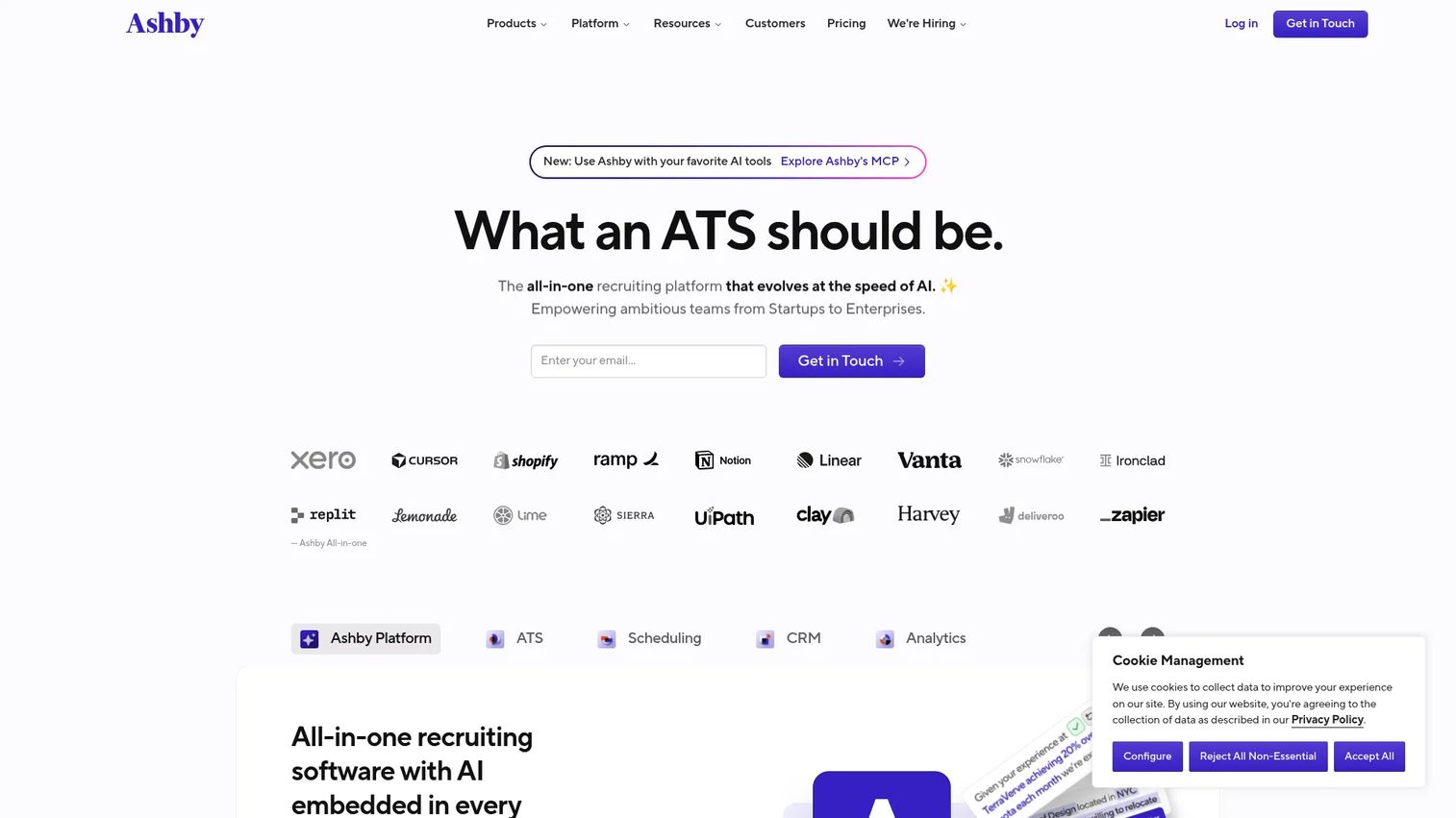
Ashby is the analytics-forward recruiting operating system. It folds the ATS, interview scheduling, sourcing CRM, and reporting into a single platform, so you are not stitching together five tools to answer a basic question like "why is our engineering pipeline stalling." For a founder who wants clean hiring metrics that survive board scrutiny, this is the closest thing to a single source of truth in the category.
The reason Ashby gets cited so often by data-driven teams is the depth of its reporting. Most ATS platforms bolt analytics on. Ashby was built around them. You can slice time to hire, pass-through rates, and source effectiveness without exporting anything to a spreadsheet, which directly addresses the fragmented-data pain most scaling teams feel.
Best for: High-growth teams that want an all-in-one recruiting system with serious reporting built in.
Key strengths
- Unified platform: ATS, scheduling, CRM, and sourcing in one place, which cuts stack sprawl and the integration tax.
- Native analytics: pipeline visibility, scorecards, and reporting that work out of the box, not as an add-on.
- AI recruiting features: an AI Notetaker and workflow automation that reduce manual logging and coordination.
Why choose Ashby: If your real problem is that hiring data lives in four disconnected tools and nobody trusts the time-to-hire number, Ashby consolidates that into one system you can actually report from. It suits teams that value data visibility and want recruiting workflow automation without buying separate analytics tooling.
Ashby pricing: The Foundations plan starts at $400 per month, billed monthly, with annual commitments earning a 10% discount and emerging-market pricing available. The Plus, Enterprise, and dedicated Ashby Analytics plans are quote-based. There is no free tier. For a 30-to-150-person company, the entry plan is priced to be reachable before you need the enterprise tier.
2. Workable
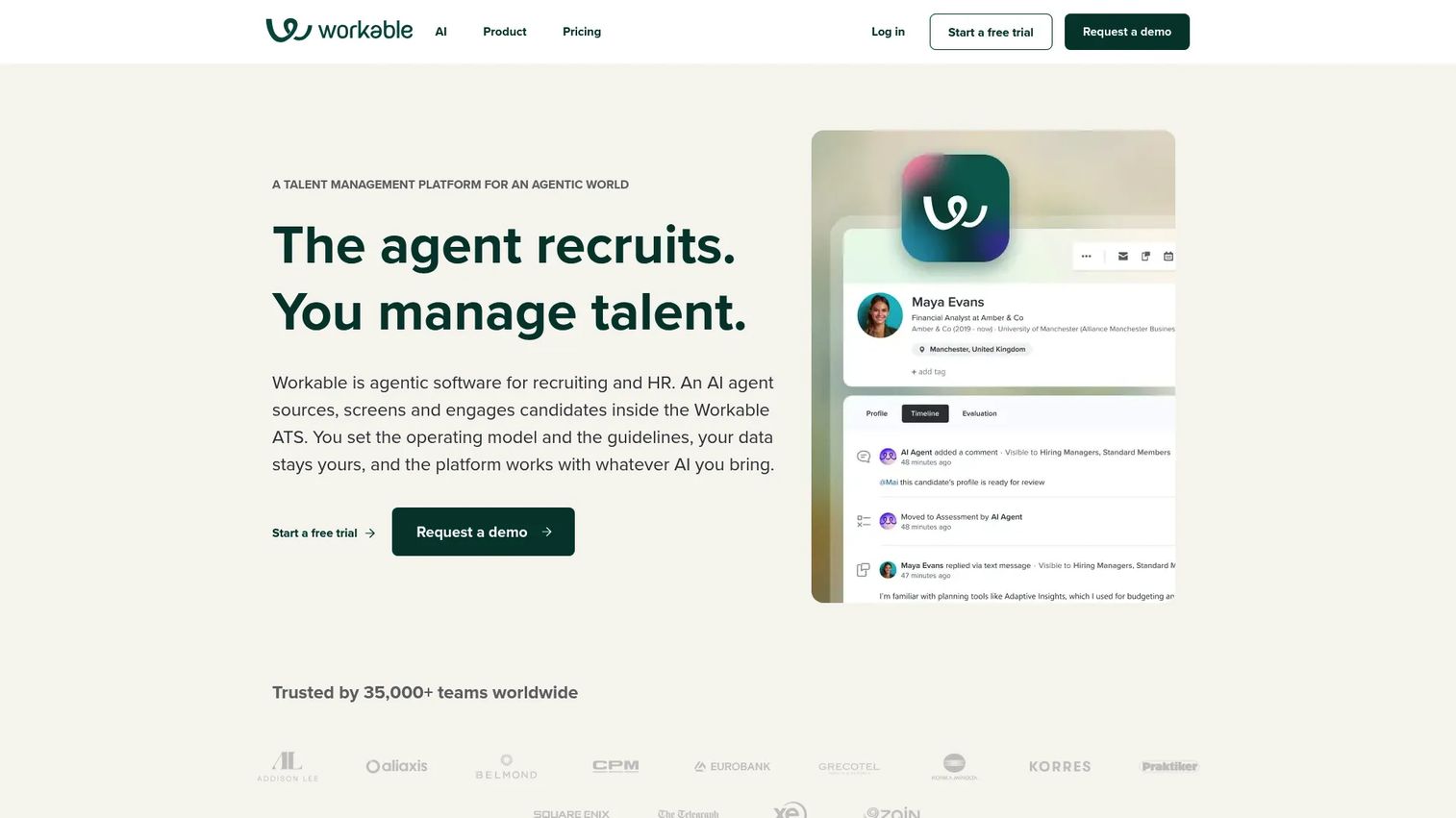
Workable is the broad all-in-one for teams that want hiring automation without a heavy implementation lift. It combines applicant tracking, job distribution to 200-plus boards, candidate management, and HR information system features, so a small team can run end-to-end hiring from one login. If you want coverage fast and do not have weeks for onboarding, this is a pragmatic pick.
What Workable handles well is breadth for fast-moving teams. You post once and distribute everywhere, manage the pipeline in one view, and move candidates through structured stages without configuring a complex system first. That speed-to-value matters when you are hiring across several roles at once and cannot afford a long setup cycle.
Best for: Teams that want a combined ATS and HR platform that is fast to stand up.
Key strengths
- Wide job distribution: push openings to 200-plus job boards from one place, expanding candidate sourcing without manual posting.
- End-to-end ATS: applicant tracking and candidate management that cover the full hiring pipeline.
- HRIS features: people-management tooling that extends beyond hiring into onboarding-adjacent work.
Why choose Workable: Choose Workable when you want broad coverage and quick deployment over deep customization. It fits teams that would rather get hiring running this week than configure a system for a month, and the HRIS layer means recruiting and early people-ops live together.
Workable pricing: The Standard plan is $299 per month billed monthly, or $3,588 per year. The Premier plan is $599 per month, or $7,188 per year. Workable Agent credits and add-ons are available on top. There is no free tier listed, though trials are typically offered.
3. Lever
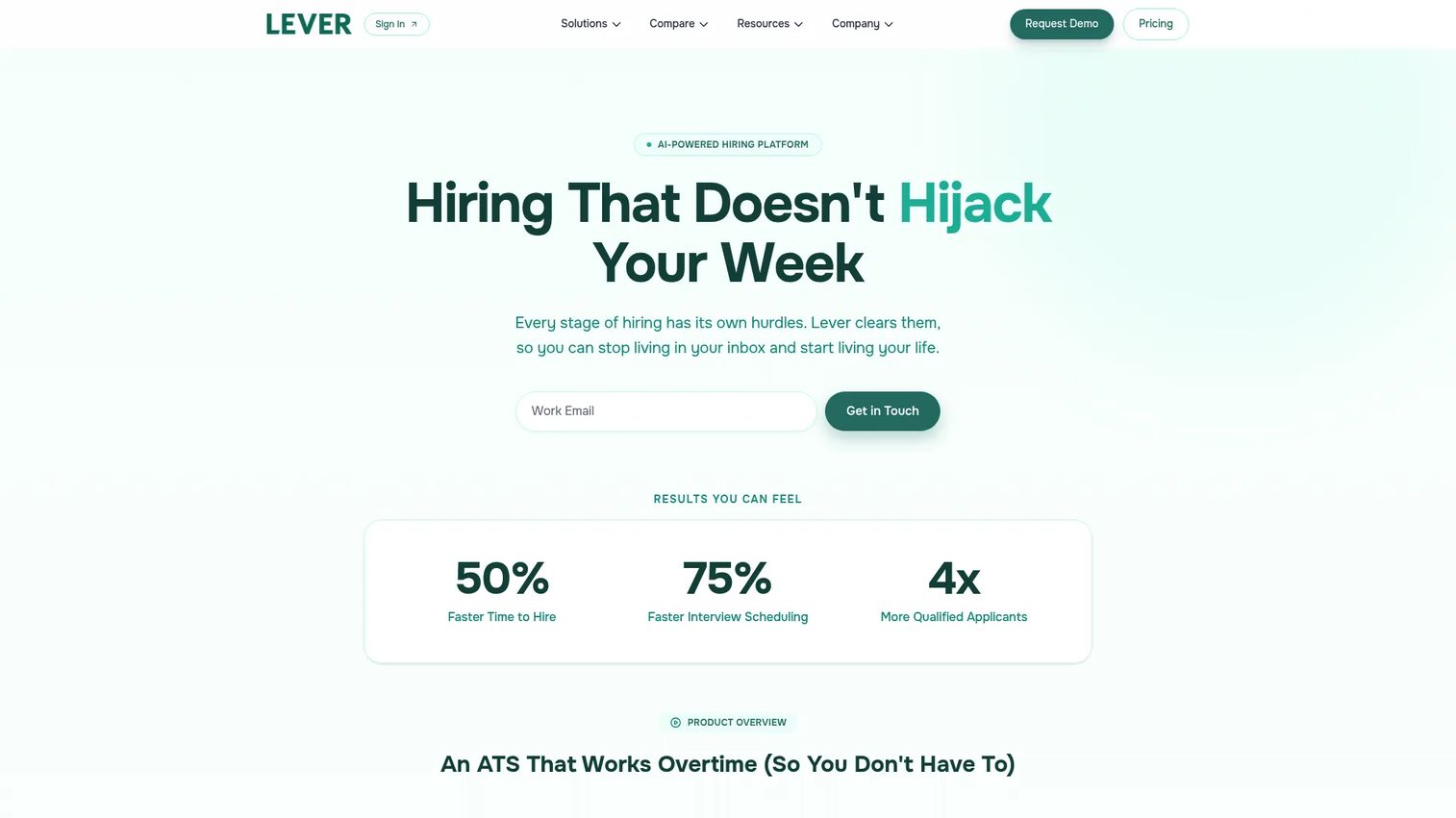
Lever is the ATS for teams that want structured hiring workflows with CRM-style candidate management baked in. It treats your candidate database as a relationship asset, not just a pipeline, which means past applicants and sourced leads stay nurtured instead of forgotten. For companies that care about process discipline, that combination of tracking and CRM in one platform is the draw.
Where Lever stands out is candidate nurture and team collaboration. You can run sequences to warm passive candidates, coordinate interviews, and keep the whole hiring team aligned in one place. The AI interview transcripts and summaries also cut the manual note-taking that usually slows down debriefs.
Best for: Teams that want an ATS with CRM and analytics in a single recruiting platform.
Key strengths
- ATS plus CRM: pipeline tracking and relationship management together, so sourced candidates do not fall through the cracks.
- Analytics and dashboards: recruiting analytics that show where candidates drop and how stages convert.
- AI interview summaries: automatic transcripts and summaries that speed up debriefs and reduce admin.
Why choose Lever: Pick Lever when process discipline and candidate nurture matter as much as raw tracking. It fits teams that source proactively and want every past candidate to stay reachable, with automated candidate communication keeping pipelines warm between roles.
Lever pricing: Lever uses custom, quote-based pricing and does not publish a public starting price. You request a quote based on team size and needs. That puts it in the same posture as most mid-market ATS platforms, so factor a sales conversation into your evaluation timeline.
4. Greenhouse
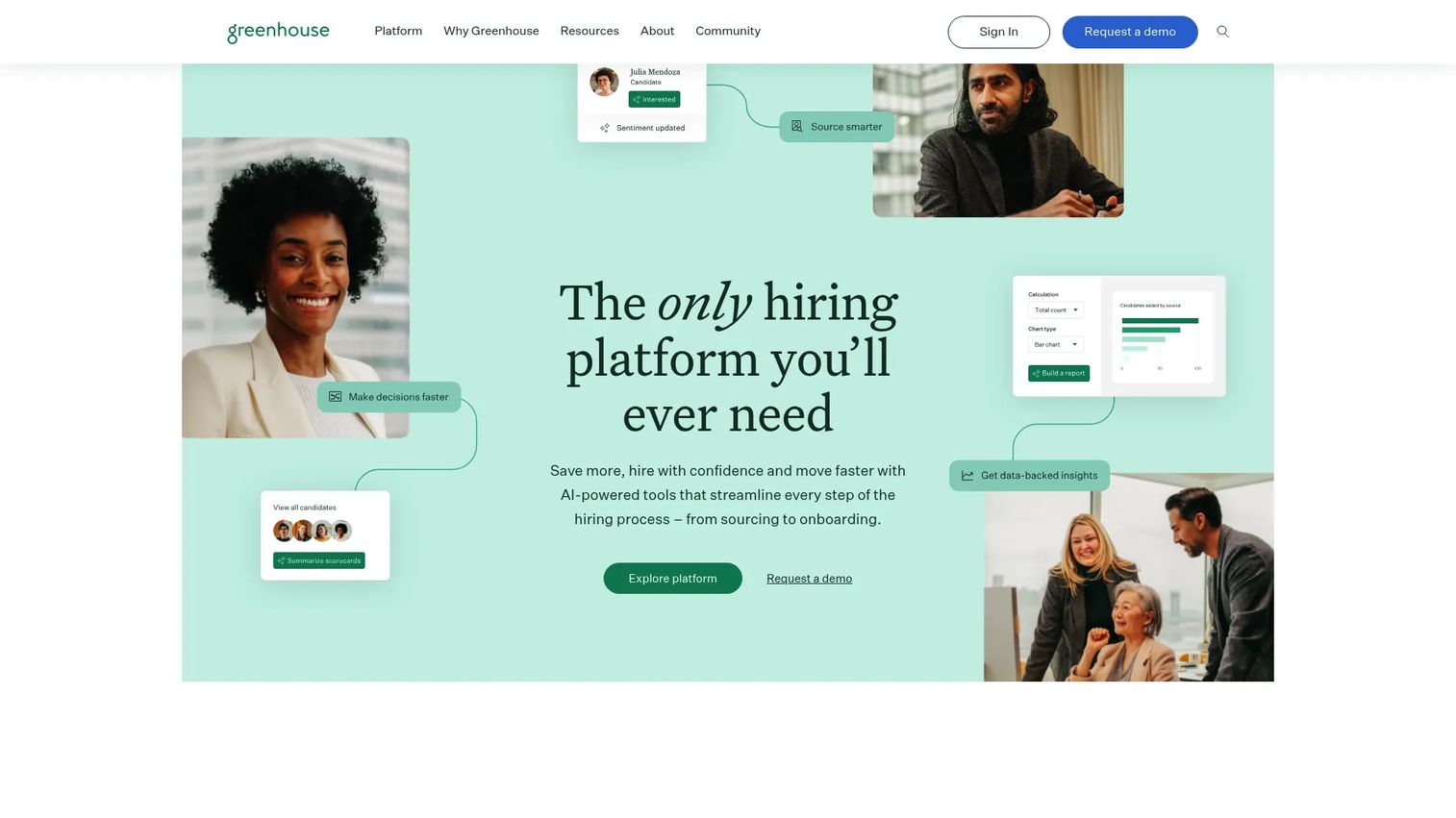
Greenhouse is the established ATS for process-driven recruiting teams that want hiring rigor as they scale. Its reputation is built on structured interviewing: interview kits, scorecards, and consistent stages that reduce bias and make hiring decisions defensible. If you are scaling headcount and need every hiring manager running the same disciplined process, this is the category benchmark.
The reason Greenhouse stays relevant is that structure compounds. As you grow from 30 to 150 people, ad hoc interviewing breaks down. Greenhouse enforces consistency through structured interview kits and scorecards, then layers scheduling, sourcing, CRM, and reporting on top, so the rigor does not come at the cost of speed.
Best for: Growing companies that need a structured, scalable hiring platform.
Key strengths
- Structured interviewing: interview kits and scorecards that standardize evaluation and reduce bias.
- Scheduling and reporting: interview scheduling automation paired with recruiting analytics.
- Sourcing and CRM: proactive sourcing and candidate relationship tools alongside the core ATS.
Why choose Greenhouse: Choose Greenhouse when building hiring rigor is the goal and you want a system that enforces consistency as you scale. It fits teams that have outgrown informal interviewing and need every loop to follow the same structured, reportable process.
Greenhouse pricing: Greenhouse offers Core, Plus, and Pro plans, all with customized pricing that requires a demo. No public numeric price is listed and no free tier is shown. Expect an annual contract and a sales-led evaluation, which is standard for ATS platforms at this tier.
5. Recruiterflow
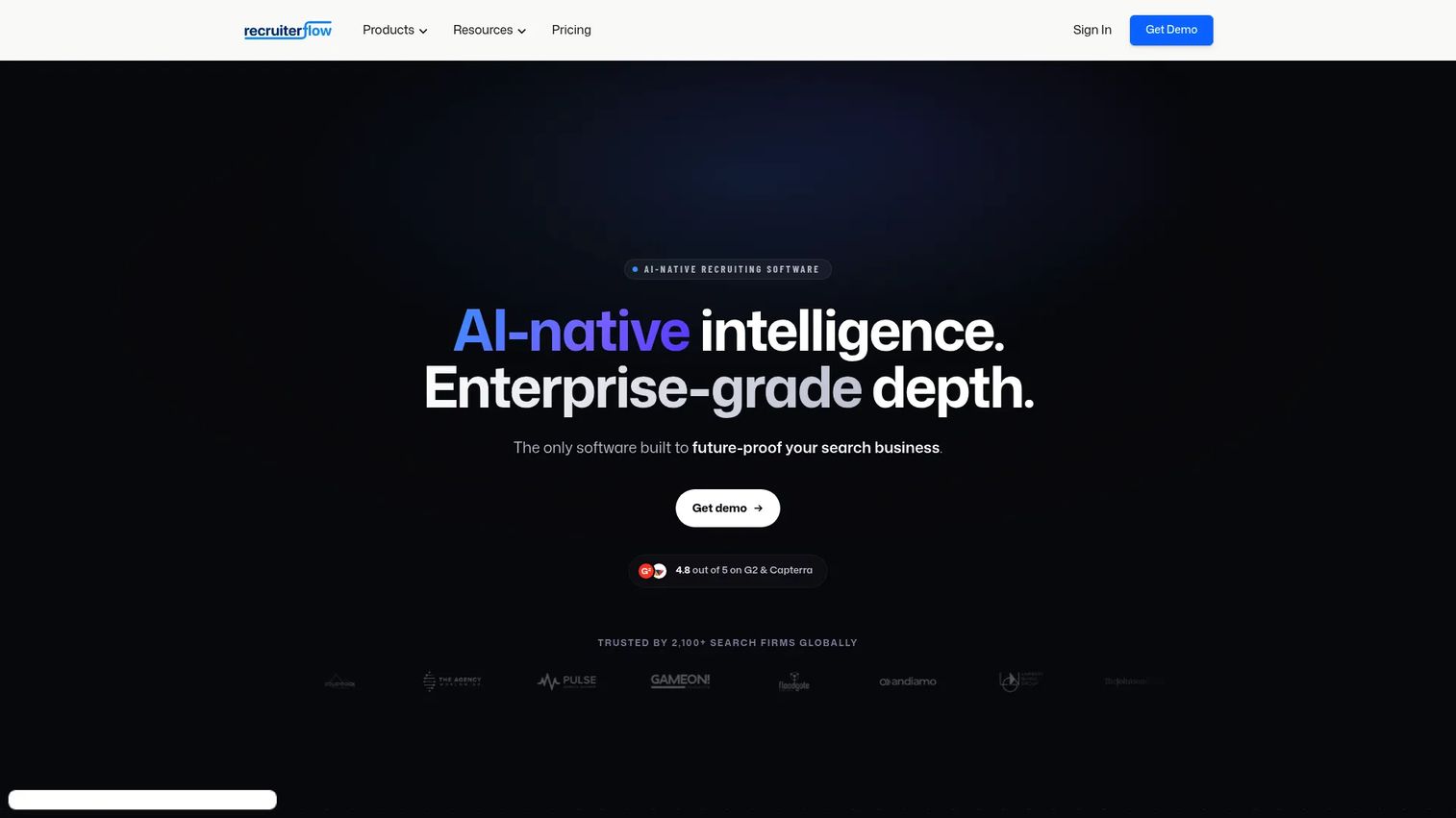
Recruiterflow is the agency-friendly recruiting automation stack, built for search firms and staffing agencies that live in both an ATS and a CRM all day. It combines applicant tracking, client and candidate CRM, multichannel sequences, and recruiting workflow automation in one AI-native platform. If your recruiting motion is high-volume and outbound, this is purpose-built for it.
The AI-native angle shows up in the automation. Recruiterflow runs multichannel sequences, automates repetitive workflow steps, and pulls sourcing and imports straight from a Chrome extension, so recruiters spend less time on data entry and more on placements. For agencies juggling many roles and clients at once, that automation is the difference between scaling and stalling.
Best for: Recruitment agencies and executive search firms needing ATS, CRM, and automation in one platform.
Key strengths
- Integrated ATS and CRM: candidates and clients managed together, built for agency workflows.
- Multichannel sequences: candidate outreach automation across email and other channels.
- Chrome extension sourcing: one-click sourcing and imports plus reporting.
Why choose Recruiterflow: Choose Recruiterflow when you run an agency or staffing motion and need outbound sequences, CRM, and an ATS in one system. It is rated 4.6 out of 5 on G2 and built around the high-volume reality of search work rather than internal corporate hiring.
Recruiterflow pricing: The Platform plan is $149 per user per month. The AIRA plan, which layers in more AI, uses custom pricing. There is no free tier, only demo and contact flows. The per-user model fits agencies that scale recruiter headcount with deal volume.
6. SmartRecruiters
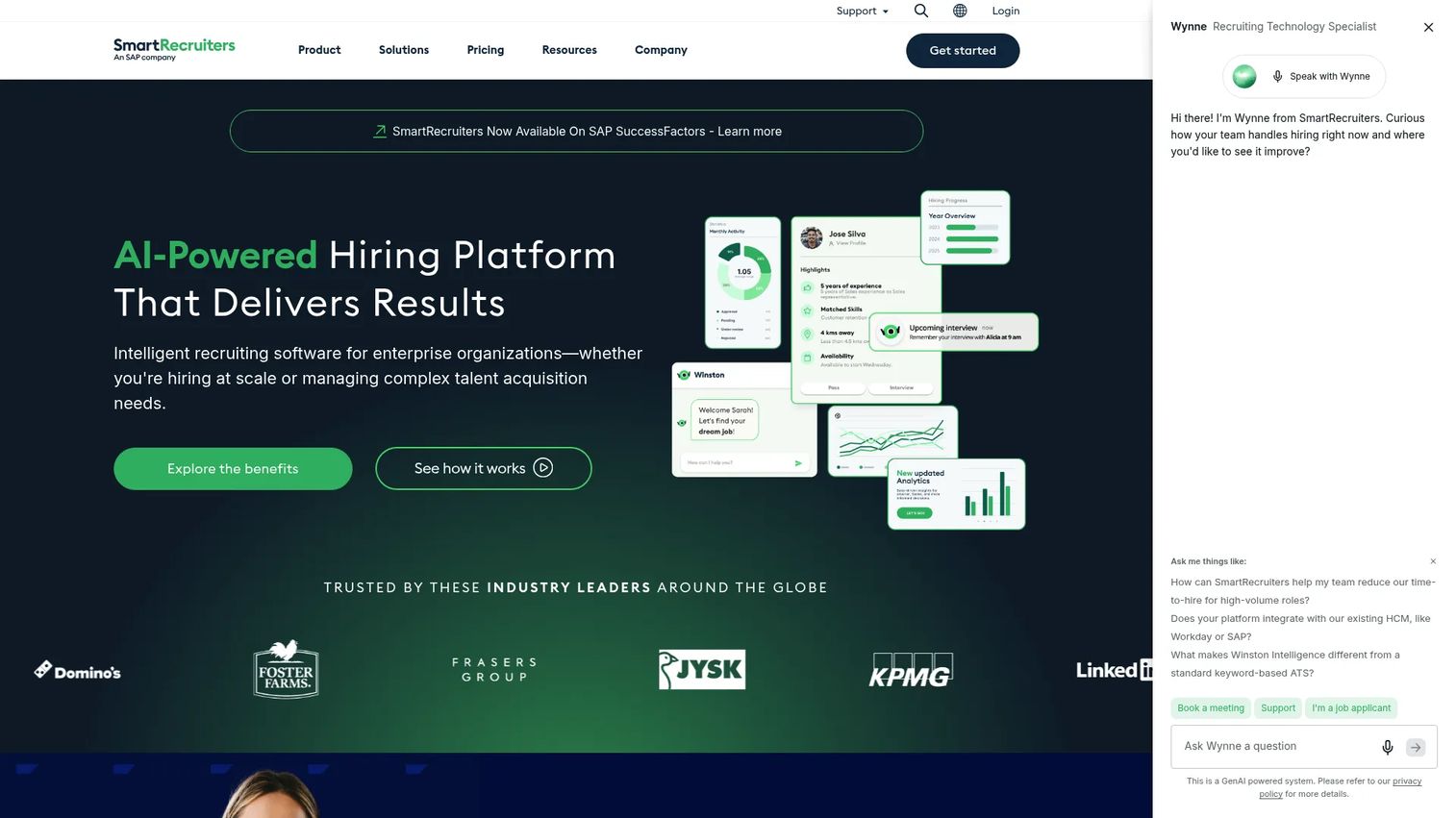
SmartRecruiters is the enterprise recruiting platform for multi-role, multi-stakeholder hiring. It pairs an ATS with candidate relationship management, AI-powered screening and talent matching, job distribution, SMS messaging, and onboarding, so larger teams can orchestrate complex hiring with governance built in. When many hands touch every requisition, this is built for that coordination.
The fit here is scale and control. SmartRecruiters reports outcomes like a 70% reduction in time-to-hire and a 97% reduction in scheduling administration work for some customers, alongside a 50% increase in hiring velocity in high-volume, high-turnover roles. Those numbers reflect what enterprise orchestration plus an AI hiring agent can do when hiring volume is the constraint.
Best for: Mid-market to enterprise teams needing an AI-enabled recruiting suite.
Key strengths
- ATS plus CRM: applicant tracking and candidate relationship management for complex pipelines.
- AI hiring agent: candidate screening and talent matching that speed up high-volume hiring.
- Distribution and messaging: job distribution, SMS messaging, scheduling, and onboarding in one suite.
Why choose SmartRecruiters: Choose SmartRecruiters when hiring spans many roles, regions, and stakeholders and you need enterprise governance. It fits teams where coordination and compliance matter as much as raw speed, and the AI screening layer keeps high-volume pipelines moving.
SmartRecruiters pricing: The Essential plan starts at $14,995. The Professional, High Volume, and Complete plans require contacting sales. There is no free tier. The pricing floor signals this is built for mid-market and enterprise budgets rather than early-stage teams making a first hire.
7. iCIMS
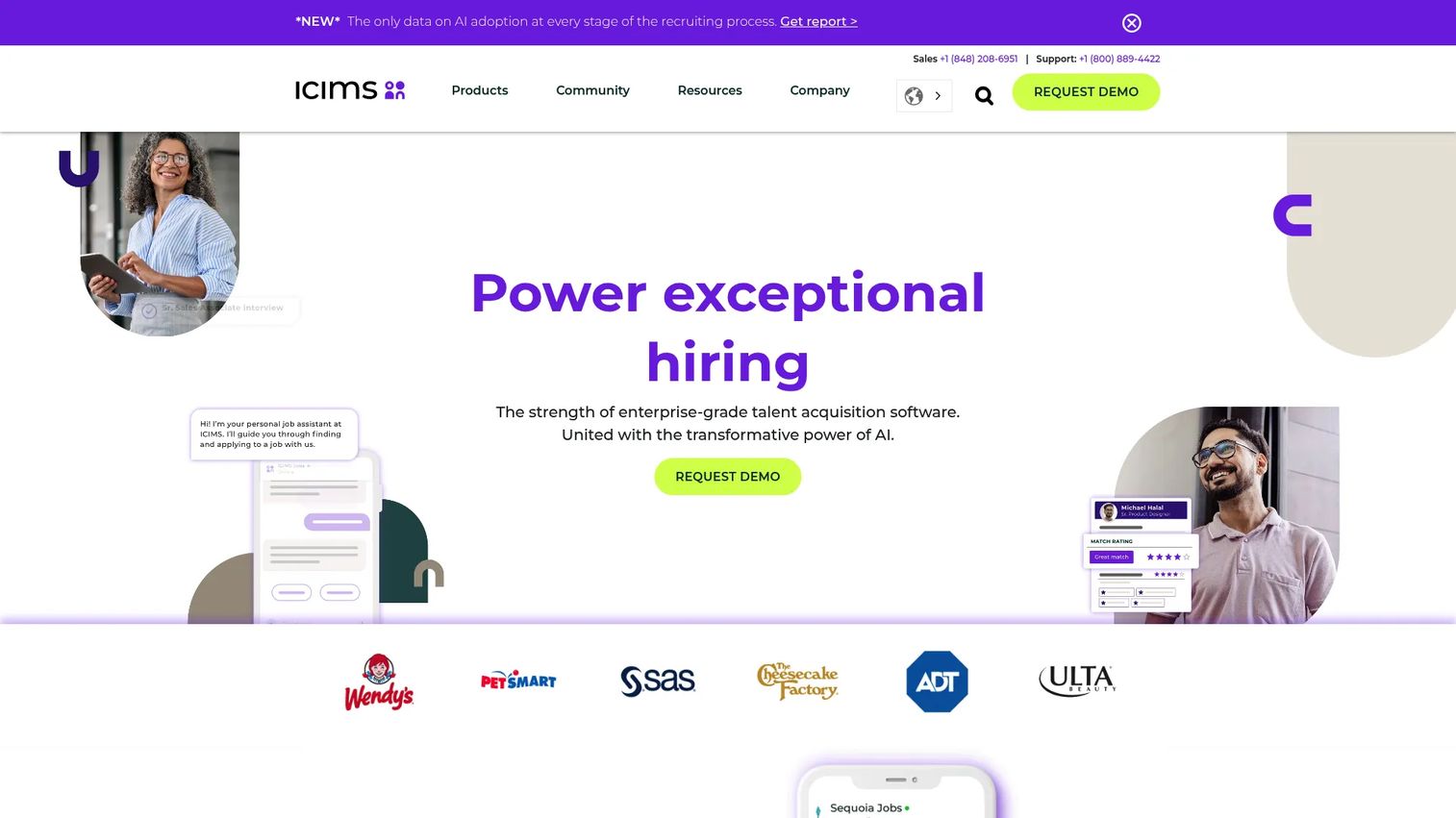
iCIMS is the enterprise ATS with AI-assisted recruiting automation, built for large and mid-market employers running high-volume, complex hiring. It combines applicant tracking, candidate relationship management, and employer branding with career sites, so the whole talent acquisition motion runs on one platform. For organizations hiring at serious scale, the breadth and governance are the point.
Where iCIMS helps is in volume and complexity. When you are processing thousands of applicants across many roles, candidate filtering, automation, scheduling, and communication need to run reliably and with proper controls. iCIMS is built around that enterprise reality, with employer branding and career sites that feed the top of the funnel.
Best for: Large and mid-market employers needing an enterprise ATS with CRM and employer branding.
Key strengths
- Enterprise ATS: applicant tracking built for high-volume, multi-role hiring.
- Candidate CRM: relationship management to nurture and re-engage talent pools.
- Employer branding: career sites and branding tools that strengthen top-of-funnel sourcing.
Why choose iCIMS: Choose iCIMS when hiring volume and governance needs are enterprise-grade and you want branding, CRM, and ATS in one platform. It fits organizations where compliance and scale outweigh the speed-to-deploy priorities of a smaller team.
iCIMS pricing: iCIMS does not publish public pricing. The site routes to demo and contact-sales flows, so pricing is quote-based and tailored to scale. Expect an enterprise sales process and an annual contract, consistent with platforms at this size.
8. Bullhorn
Bullhorn is the staffing and recruiting platform with deep automation and CRM roots, used by more than 10,000 staffing and recruitment companies worldwide. It combines an ATS and CRM with resume parsing, automation, AI, analytics, and email integration, so agencies can run recruiter workflows and client relationships from one system. For staffing operations, it is a long-standing category standard.
Bullhorn matters for agency and staffing use cases specifically. The CRM roots mean it tracks both candidates and clients, while automation and resume parsing cut the manual data entry that eats recruiter time. For high-volume placement work, that workflow automation and candidate tracking is the backbone of the operation.
Best for: Staffing agencies that need an all-in-one ATS and CRM platform.
Key strengths
- ATS plus CRM: candidate and client management together, built for staffing operations.
- Resume parsing and automation: automated data entry and recruiting workflow automation.
- Analytics and email integration: reporting and inbox integration that keep recruiters in one system.
Why choose Bullhorn: Choose Bullhorn when you run a staffing or recruitment agency and need a proven ATS and CRM with strong automation. It fits agency operations from startups to large enterprises, with candidate tracking built around placement volume rather than internal corporate hiring.
Bullhorn pricing: The Bullhorn Starter plan is $99 per user per month and the Core plan is $165 per user per month. The Pro plan and several product lines are quote-based. There is no free tier. The per-user pricing scales with recruiter headcount, which suits growing agencies.
9. hireEZ
hireEZ is the sourcing and outreach automation platform, designed to sit as an AI layer on top of your existing ATS. It handles AI-powered sourcing across the open web and your ATS, applicant screening and rediscovery, plus outreach automation and scheduling. If your bottleneck is finding and engaging candidates rather than tracking them, hireEZ solves that stage directly.
The funnel position is what makes hireEZ useful. It does not replace your ATS. It feeds it. By searching across hundreds of millions of profiles and rediscovering talent already in your database, it turns passive sourcing into an automated motion. That candidate sourcing automation and outreach is where lean teams get the most leverage.
Best for: Mid-market and enterprise recruiting teams needing an AI sourcing layer on top of an ATS.
Key strengths
- AI sourcing: candidate discovery across the open web and your existing ATS database.
- Talent rediscovery: re-engage past applicants and silver-medalists already in your system.
- Outreach and scheduling: candidate outreach automation paired with interview scheduling.
Why choose hireEZ: Choose hireEZ when sourcing is your constraint and you want an AI layer that enriches an ATS you already run. It fits teams that have tracking handled but need to fill the top of the funnel faster, and it is rated 4.6 out of 5 on G2.
hireEZ pricing: hireEZ uses quote-based, seat-based pricing and does not publish a public dollar amount. A free trial is available, and enterprise tiers include a dedicated CSM and custom integrations. Plan for a sales conversation to scope the seats and features you need.
10. Juicebox
Juicebox is the AI-native sourcing and candidate search tool built around natural-language search. Instead of building boolean strings, you describe the candidate you want in plain English and it searches across 800M-plus profiles, then runs automated outreach sequences and AI agents to engage them. For lean teams that need faster sourcing without a dedicated sourcer, that simplicity is the appeal.
The reason Juicebox is attractive to small teams is the low barrier. Natural-language search means a founder or generalist recruiter can source hard-to-find talent without sourcing expertise. The AI agents and outreach sequences then carry the engagement, so proactive sourcing does not require a full-time specialist. It holds a 5.0 out of 5 on its G2 seller page.
Best for: Recruiting teams sourcing and engaging hard-to-find talent without a dedicated sourcer.
Key strengths
- Natural-language search: describe candidates in plain English across 800M-plus profiles.
- Automated outreach: personalized sequences that engage sourced candidates at scale.
- AI agents: workflow agents that handle repetitive sourcing and outreach steps.
Why choose Juicebox: Choose Juicebox when sourcing speed matters and you do not have a dedicated sourcing function. It fits lean teams that need proactive candidate discovery without learning boolean search, and the AI agents reduce the manual outreach load. Note it specializes in sourcing, so pair it with an ATS for full-funnel tracking.
Juicebox pricing: Juicebox lets you try the product for free and book a demo, but it does not publish a public price on its site. Pricing is quote-based after the free entry point. For a sourcing-only tool, the free start makes it easy to test against your roles before committing.
11. GoodTime
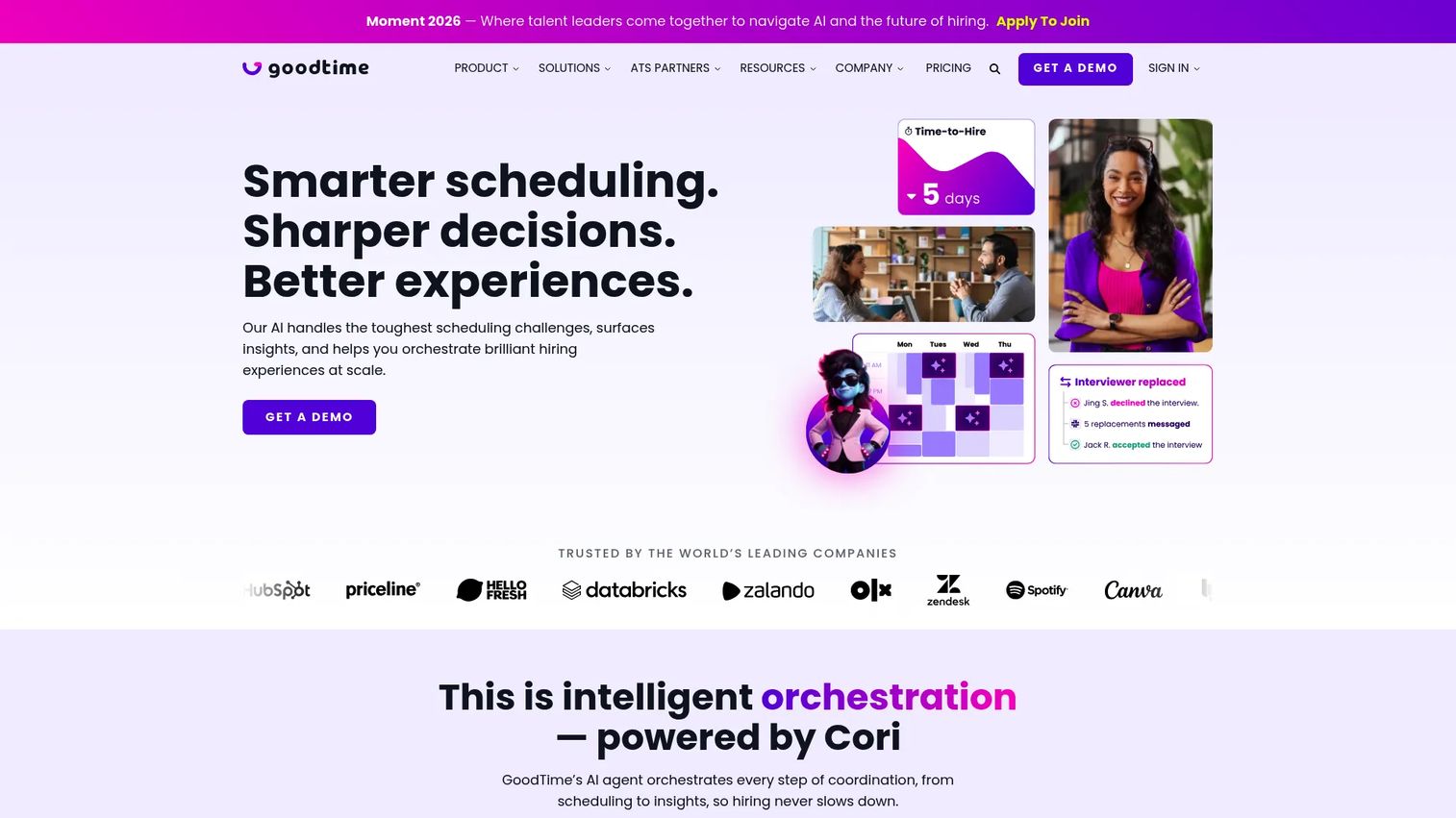
GoodTime is the interview scheduling automation tool, and it solves one bottleneck exceptionally well rather than trying to own the whole funnel. It automates scheduling for single-day, multi-day, and panel interviews, handles applicant screening and workflow automation, and adds SMS and WhatsApp messaging plus deep ATS integrations. If interview coordination is where your process breaks, this fixes exactly that.
GoodTime belongs in this list because scheduling is one of the highest-volume, lowest-judgment tasks in hiring, and it quietly burns recruiter hours. Coordinating a panel across five calendars by email is the kind of work that should never touch a human. GoodTime automates it end to end, improving both candidate experience and interviewer workflow, then syncs cleanly back to your ATS.
Best for: Enterprise talent acquisition teams automating complex interview scheduling.
Key strengths
- Complex scheduling: single-day, multi-day, and panel interview coordination automated.
- Workflow automation: applicant screening and scheduling workflows that remove manual steps.
- Messaging and ATS sync: SMS, WhatsApp, and deep ATS integrations for automated candidate communication.
Why choose GoodTime: Choose GoodTime when scheduling is your specific bottleneck and you want it solved without replacing your ATS. It fits teams running complex interview loops at volume, and the deep integrations mean it slots into your existing stack rather than competing with it.
GoodTime pricing: GoodTime uses customized pricing based on annual candidate volume and requires a proposal. No public price or free tier is listed. Because it solves one bottleneck, evaluate it against the recruiter hours you currently lose to scheduling to gauge payback.
How to choose the right recruitment automation tool
Recruitment process automation only pays off when it removes your biggest bottleneck without adding admin. Here is the checklist to run before you buy.
Funnel stage and bottleneck
Map where your process actually breaks. If sourcing is slow, a tool like hireEZ or Juicebox solves it. If scheduling burns hours, GoodTime fixes that one step. If everything is fragmented, a full platform like Ashby or Greenhouse consolidates it. Buy for the bottleneck, not the brochure.
ATS integration and stack fit
A new tool only helps if it talks to what you already run. Check ATS integration depth before anything else. A sourcing or scheduling tool that does not sync cleanly back to your ATS creates double entry, which is more admin, not less.
Hiring volume and scale
Match the tool to your volume. A 50-person company making 15 hires a year does not need the same platform as an enterprise processing thousands of applicants. Over-buying an enterprise suite to fix one step wastes budget and adds complexity.
Reporting and recruiting analytics
If you cannot measure time to hire, source quality, and stage conversion, you cannot improve them. Prioritize recruiting analytics that work without manual exports. Clean reporting is also what survives board scrutiny when a director asks why a key role is still open.
Recruiter adoption and ROI
The best tool is the one your recruiters actually use. Factor in setup time, learning curve, and whether it reduces cycle time or improves candidate quality. An all-in-one recruiting software suite that nobody adopts is worse than a focused tool that gets used daily.
Conclusion
The honest answer is that there is no single best recruitment automation software. There is the best tool for your bottleneck.
If you want one consolidated recruiting OS with deep analytics, Ashby is the strongest fit. For fast all-in-one coverage, Workable. For structured pipelines and nurture, Lever. For hiring rigor at scale, Greenhouse. For agency and staffing motions, Recruiterflow and Bullhorn. For enterprise orchestration, SmartRecruiters and iCIMS. For sourcing as your constraint, hireEZ and Juicebox. And for interview scheduling specifically, GoodTime.
The founder move is to resist buying overlap. Identify the one stage costing you the most time to hire, then run a live trial on the top two tools that match it. Measure recruiter productivity and cycle time over a real requisition, not a demo. Consolidate where it genuinely reduces stack sprawl, automate the repeated low-judgment steps, and keep human judgment on the decisions that actually matter. That is how recruiting process automation scales hiring without routing every loop through you.
Start your journey with Guideflow today!
FAQs
Recruitment automation software automates repetitive hiring tasks like sourcing, outreach, screening, scheduling, and candidate communication, so recruiters spend time on decisions instead of admin. Different tools cover different parts of the funnel. Some are full platforms built around an applicant tracking system, while others specialize in one stage like sourcing or scheduling.
Start with the highest-volume, lowest-judgment tasks, because they repeat constantly and need little human input. In practice that usually means interview scheduling, candidate follow-up, and sourcing enrichment. These three return the fastest payback and free up recruiter time without risking the parts of hiring that genuinely need human judgment.
An applicant tracking system manages your hiring pipeline: it stores candidates, moves them through stages, and keeps records. Recruitment automation software may sit on top of an ATS or replace parts of it, adding automation for sourcing, outreach, screening, or scheduling. Some tools, like Ashby and Greenhouse, combine both. Others, like hireEZ or GoodTime, specialize in one stage and integrate with your ATS.
Choose based on funnel stage, hiring volume, integration needs, and stack consolidation. Map your slowest hiring stage, then pick the tool that removes that bottleneck without adding admin. Verify it integrates cleanly with your existing ATS, and make sure recruiters will actually adopt it. The best tool reduces cycle time or improves candidate quality, not just feature count.
AI recruiting software can reduce manual sourcing, sorting, and follow-up work, but results depend on workflow design and human review. AI screening surfaces strong candidates faster, and outreach automation handles repetitive sequences, but a human still needs to review matches and make final calls. Treat it as a way to remove low-judgment work, not as a replacement for hiring decisions.
Watch ROI, recruiter adoption, integration tax, reporting quality, and compliance. An extra tool only helps if it shortens time to hire or improves candidate quality. Check that it integrates with your stack rather than creating double entry, that your team will actually use it, and that its analytics are clean enough to report to your board. If it does not reduce a real bottleneck, it adds cost, not value.