Your content lives in one tool. Personalization runs in another. Analytics sits in a third. None of them talk to each other.
So launches drag. Brand messaging drifts between your site, your emails, and your app. And when leadership asks how a campaign moved pipeline, you piece together an answer from four dashboards that disagree.
This is the daily reality for digital and growth marketers managing a stack that grew one tool at a time. Every new channel added a vendor. Every vendor added a silo. A digital experience platform (DXP) exists to collapse that sprawl into one connected system, so you can create, manage, personalize, and measure experiences across every channel without duct-taping six tools together.
The category is growing for a reason. According to Data Bridge Market Research, the global digital experience platform market was valued at USD 14.20 billion in 2024 and is forecast to reach USD 35.16 billion by 2032, growing at a CAGR of 12%. Companies are consolidating, and DXP software is where a lot of that consolidation lands.
Stat to know: The global DXP market was worth USD 14.20 billion in 2024 and is projected to hit USD 35.16 billion by 2032, a 12% CAGR (Data Bridge Market Research, 2024).
This guide breaks down 12 of the best digital experience platform software options for 2026, with verified pricing context, capability detail, and a buyer's checklist written for marketers, not analysts.
What's inside
This guide is for digital and growth marketers, demand gen leads, marketing ops, and web platform owners who are evaluating, replacing, or consolidating their experience stack. It is mid-funnel: you have accepted you need a DXP and now you are building a shortlist.
We chose the 12 tools below against four criteria that matter to a marketing buyer:
- Breadth of experience capabilities: content management, personalization, and omnichannel delivery in one place.
- Integration and composability: how cleanly it fits your CRM, MAP, analytics, and commerce stack.
- Analytics and optimization: native testing, segmentation, and reporting you can tie to conversion.
- Time-to-value and pricing transparency: implementation effort, dev dependency, and how clear the pricing is.
TL;DR
Short on time? Here are the decision shortcuts by segment:
- Best for enterprise omnichannel: Adobe Experience Manager, deep CMS plus DAM inside the Adobe ecosystem.
- Best for experimentation plus personalization: Optimizely One, native A/B testing and unified content.
- Best composable and headless: Contentful or Contentstack, API-first content for developer-led teams.
- Best open-source and flexible: Liferay for portals, Pimcore for data-heavy catalogs.
- Best for mid-market value: Progress Sitefinity or Magnolia, marketer-friendly with flexible deployment.
- Best for regulated enterprise: Acquia or OpenText, governed content at scale.
What is a digital experience platform?
A digital experience platform (DXP) is software that lets organizations create, manage, deliver, and optimize personalized content and experiences across every digital channel from a single connected system.
That definition lines up with how the category's own vendors describe it. Optimizely calls a DXP a platform that manages digital experience across a broad range of touchpoints, spanning content management, ecommerce, personalization, and experimentation. G2 frames DXPs as software that connects data and content with customers to deliver personalized digital experiences.
From CMS to DXP
The category evolved out of web content management. A traditional CMS published pages. Web experience management (WEM) added some personalization and targeting. A DXP goes further: it wraps content, customer data, commerce, and analytics into one operating layer that covers the full digital customer lifecycle, from creation through delivery, measurement, and iteration.
Key DXP features
Most modern digital experience platforms include some mix of these core components:
- CMS: create, manage, and publish content across web, mobile, and app.
- DAM: a central library to source, adapt, and deliver digital assets across channels.
- CDP: unify customer data, resolve identity, and build segments. For a deeper comparison, see the best customer data platform tools.
- Commerce: ecommerce capabilities or deep commerce integrations.
- Personalization and engagement: tailor content by segment, behavior, and intent. Explore the best personalization software to go deeper here.
- Analytics: measure journeys and tie experience changes to outcomes.
- AI: content generation, tagging, recommendations, and increasingly autonomous workflows.
One channel worth noting inside the experience layer is self-serve product content. Interactive demos are a high-engagement, self-serve experience format that pairs with a DXP's content delivery: where the DXP manages and routes the experience, an interactive demo lets a buyer click through the actual product at their own pace. It is a complementary capability that amplifies the content a DXP already delivers. You can personalize each demo by segment to match the same targeting logic your DXP runs.
Monolithic vs composable DXP
A monolithic DXP ships most capabilities as one integrated suite from a single vendor. A composable digital experience platform takes an API-first, modular approach: you assemble packaged business capabilities (PBCs) and swap components as needs change. Marketers care about composability because it means you can replace one piece, say personalization, without ripping out the whole stack.
When to use a digital experience platform
A DXP earns its cost when fragmentation starts taxing your team. Here are the three clearest triggers.
Deliver consistent experiences across every channel
When content lives in too many places, your message drifts. The headline on your landing page does not match the email, which does not match the in-app banner. A DXP gives you one source of truth, so brand and messaging stay aligned across web, mobile, email, and emerging channels. That consistency is harder to fake the more channels you run.
Personalize at scale without engineering bottlenecks
If every segment-based variation needs a dev ticket, personalization dies in the backlog. DXPs move targeting, segmentation, and content variation into marketer-controlled workflows. You ship tailored experiences without waiting on engineering, which is the difference between testing ten variations a quarter and testing ten a week. Pairing this with the best growth marketing tools keeps your experimentation cadence high.
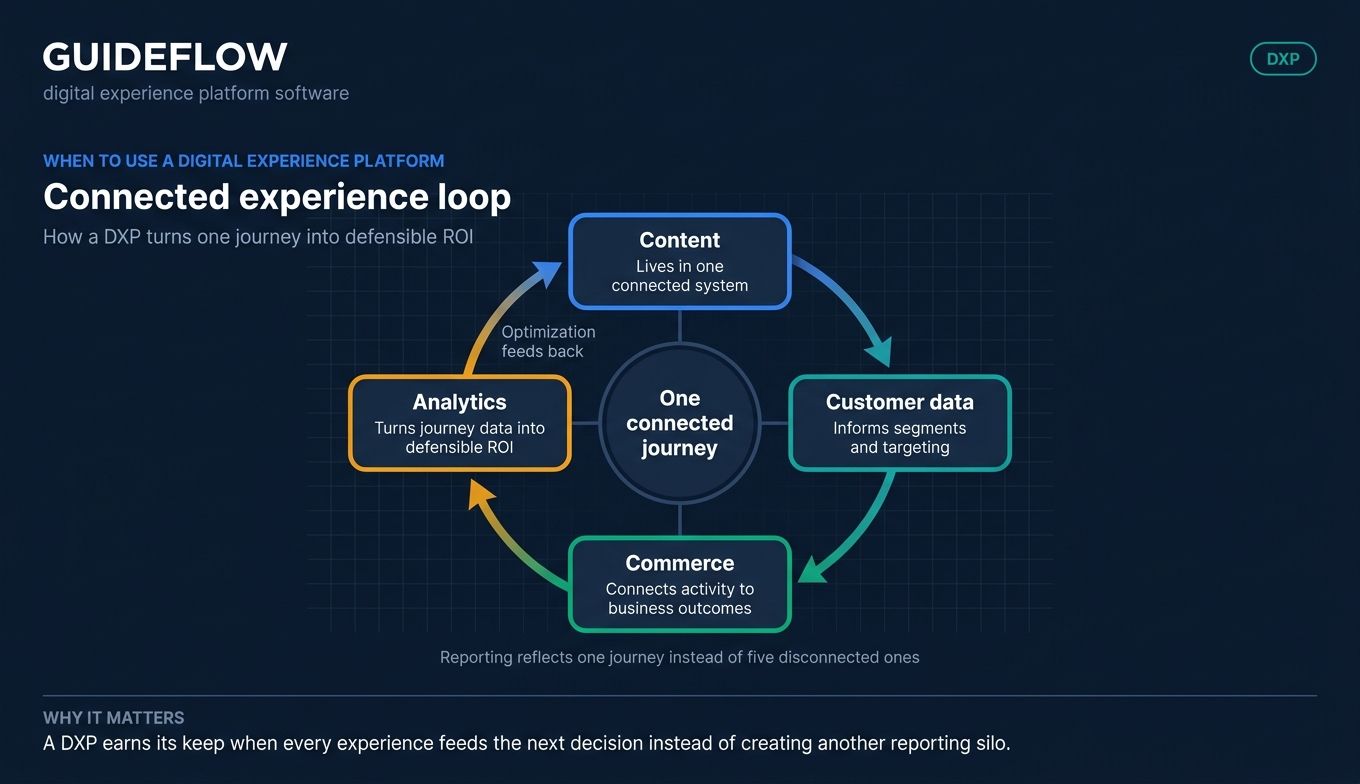
Connect content, data, and commerce in one system
Attribution breaks when your tools do not share data. A DXP connects content, customer data, and commerce so reporting reflects one journey instead of five disconnected ones. For a growth marketer under pressure to tie spend to pipeline, that connected data layer is the thing that makes ROI defensible. The right marketing analytics software closes the loop on attribution.
Digital experience platform software compared
Here is a side-by-side view of the 12 digital experience platform examples in this guide. Most enterprise DXPs use custom, quote-based pricing, so the table reflects that where public numbers are not disclosed. G2 ratings are pulled from each product's live G2 listing.
| # | Product | Intent | Key use case | Pricing | G2 rating |
|---|---|---|---|---|---|
| 1 | Adobe Experience Manager | Enterprise omnichannel | CMS plus DAM at scale | Custom | 4.2/5 |
| 2 | Sitecore | AI-assisted enterprise DXP | Content, personalization, automation | Custom | 4.1/5 |
| 3 | Optimizely One | Experimentation plus content | Unified content and testing | Custom | 4.2/5 |
| 4 | Acquia | Open, regulated enterprise | Drupal-based content plus CDP | Custom | 4.3/5 |
| 5 | Contentful | Composable headless | API-first content delivery | From $0 (Free); Lite $300/mo | 4.2/5 |
| 6 | Contentstack | Enterprise composable | Headless CMS plus automation | Custom | 4.4/5 |
| 7 | Liferay | Open-source portals | Customer and B2B portals | Custom (Free Tier available) | 4.3/5 |
| 8 | Pimcore | Data-heavy catalogs | PIM, DAM, CMS, commerce | From $9,900/yr | 4.5/5 |
| 9 | Magnolia | Mid-market to enterprise | Multi-site, multi-channel delivery | From $6,000/mo (DX Cloud) | Not listed |
| 10 | Progress Sitefinity | Mid-market marketing teams | Marketer-friendly CMS/DXP | Custom | 4.0/5 |
| 11 | OpenText Experience Cloud | Regulated enterprise | Communications plus content | Custom | Not listed |
| 12 | Ibexa DXP | B2B content plus commerce | Headless B2B experiences | From €39k/yr | 4.2/5 |
12 best digital experience platform software tools for 2026
Below are the 12 digital experience platform companies worth shortlisting in 2026, with verified capabilities, pricing context, and who each fits best.
1. Adobe Experience Manager
Adobe Experience Manager (AEM) is an enterprise content management platform that sits inside Adobe Experience Cloud. It manages content, digital assets, forms, documentation, and learning experiences across web, mobile, and apps. For large teams already invested in Adobe, AEM is the gravitational center of the experience stack.
Its strength is the combination of a deep CMS and digital asset management in one platform, plus tight integration with the rest of Adobe Experience Cloud (Analytics, Target, and more). AI features run across the suite to automate asset work and personalization.
Best for: large enterprises already standardized on Adobe tools.
Key strengths
- CMS plus DAM in one system: create, manage, optimize, and deliver content alongside automated asset workflows across audiences and channels.
- Adobe ecosystem depth: native connections to Analytics, Target, and the broader Experience Cloud so data flows between tools.
- Digital forms and structured docs: forms, structured documentation, and learning management capabilities for complex content operations.
Why choose Adobe Experience Manager: Choose AEM when you are an enterprise that already runs Adobe and needs scalable CMS plus DAM for omnichannel delivery. The payoff is consolidation inside an ecosystem you already use. The trade-off is that it rewards teams committed to Adobe rather than mixed stacks.
Adobe Experience Manager pricing: Adobe uses customized, quote-based pricing for AEM Sites and AEM Assets. The Assets line publishes Prime and Ultimate offerings, but both route through a "Get pricing" flow rather than showing public numbers. There is no confirmed public free tier. Expect an enterprise sales conversation to scope your deployment. AEM holds a 4.2/5 rating on G2.
2. Sitecore
Sitecore is an AI-enabled digital experience platform built for content management, digital asset management, personalization, audience insights, and conversion optimization. The Sitecore digital experience platform has shifted toward a composable model, letting enterprises adopt the pieces they need. If you search "sitecore dxp," this is the product.
It pairs governed content and assets with real-time personalization, experimentation, and conversion tooling, backed by AI-assisted search and tagging. That blend of marketing depth and content control is why it shows up on so many enterprise shortlists.
Best for: enterprise marketing and digital teams needing governed content plus personalization depth.
Key strengths
- Content management at scale: create, manage, and publish omnichannel digital experiences from one governed system.
- Digital asset management: centralized library with AI-powered search and tagging, plus rights, approvals, and governance.
- Conversion optimization: real-time personalization, A/B testing, experimentation, search, and recommendations.
Why choose Sitecore: Choose Sitecore when you want both content depth and marketing automation in a platform that can run governed at enterprise scale. It fits teams that treat personalization and experimentation as core, not bolt-ons. The consideration is that its breadth rewards teams ready to invest in setup and governance.
Sitecore pricing: Sitecore does not publish product subscription pricing on its site. The pages available describe capabilities and route to demo or contact-sales flows. Public prices that exist relate to learning and training subscriptions, not the core DXP product, so treat platform pricing as quote-based. Sitecore carries a 4.1/5 rating on G2.
3. Optimizely One
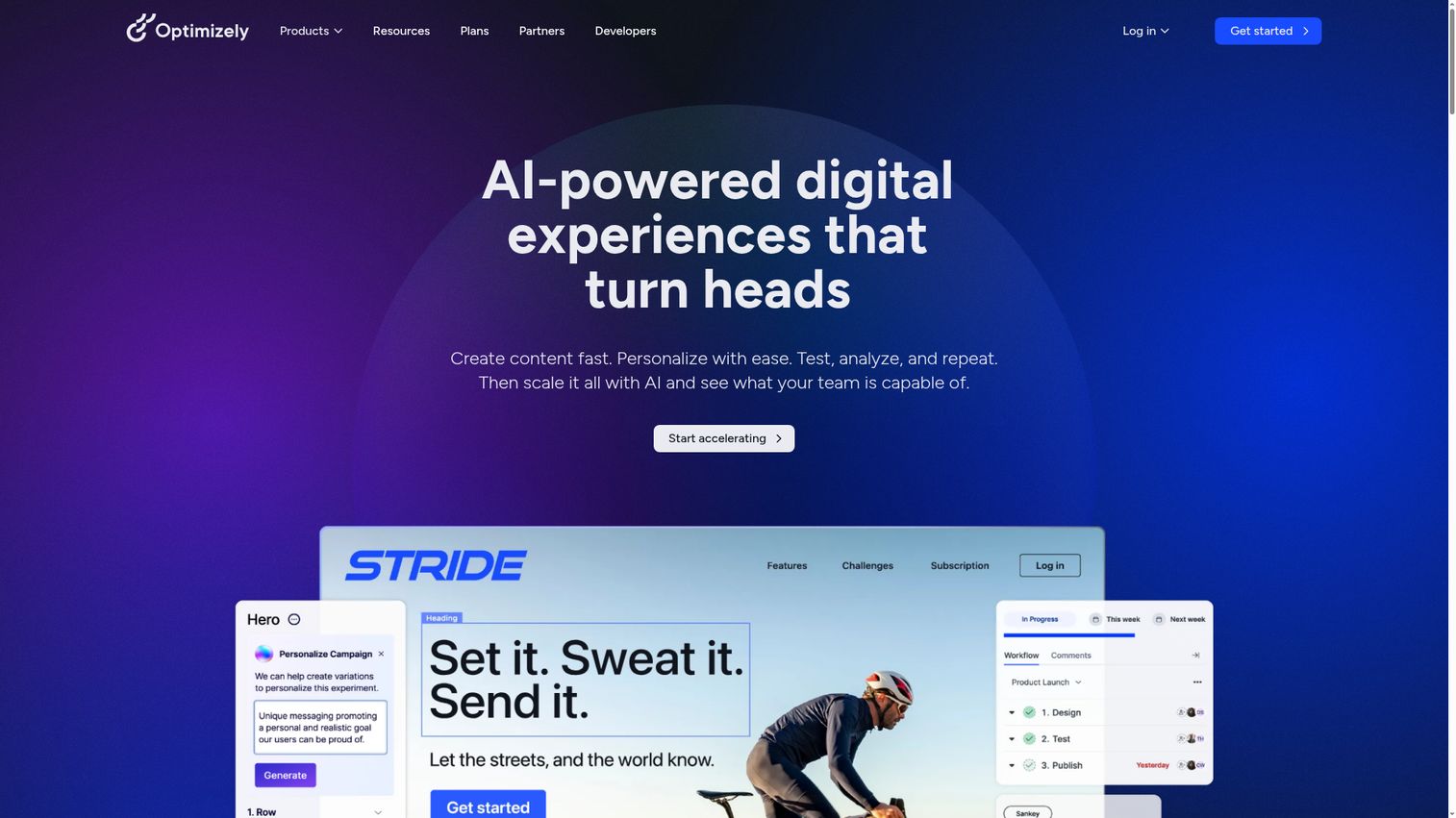
Optimizely One is a unified digital experience and marketing operating system spanning content, collaboration, personalization, experimentation, commerce, and analytics. Optimizely's heritage is in experimentation, so if your team runs continuous tests, this platform speaks your language. (Note: Episerver rebranded to Optimizely, so older references point here.)
It unifies marketing workflows end to end: intake, planning, content creation, asset storage, localization, delivery, personalization, experimentation, and analysis. AI assists with content generation, tagging, and predictive recommendations across the suite. If experimentation is your focus, the best A/B testing tools are worth a closer look.
Best for: teams that run continuous experiments and want testing native to their content workflow.
Key strengths
- Unified workflows: one system for intake, planning, content, assets, localization, delivery, personalization, experimentation, and analysis.
- AI-assisted content: AI content generation, AI-based tagging, predictive recommendations, and content intelligence.
- Omnichannel optimization: experimentation, personalization, content delivery, and unified reporting dashboards in one place.
Why choose Optimizely One: Choose Optimizely One when experimentation is central to how you grow and you want testing built into content operations rather than stapled on. It fits experimentation-driven growth teams especially well. The consideration is that its full breadth is most valuable when you actually run a high cadence of tests.
Optimizely One pricing: Optimizely lists product modules (CMS, Web Experimentation, Analytics, Configured Commerce, Data Platform, Feature Experimentation, Personalization, DAM) and each links to a request-pricing flow. Pricing is customized based on goals, usage, and scale, so there are no public numbers. Free-tier availability is not confirmed on the first-party pricing page. Optimizely One holds a 4.2/5 rating on G2.
4. Acquia Digital Experience Platform
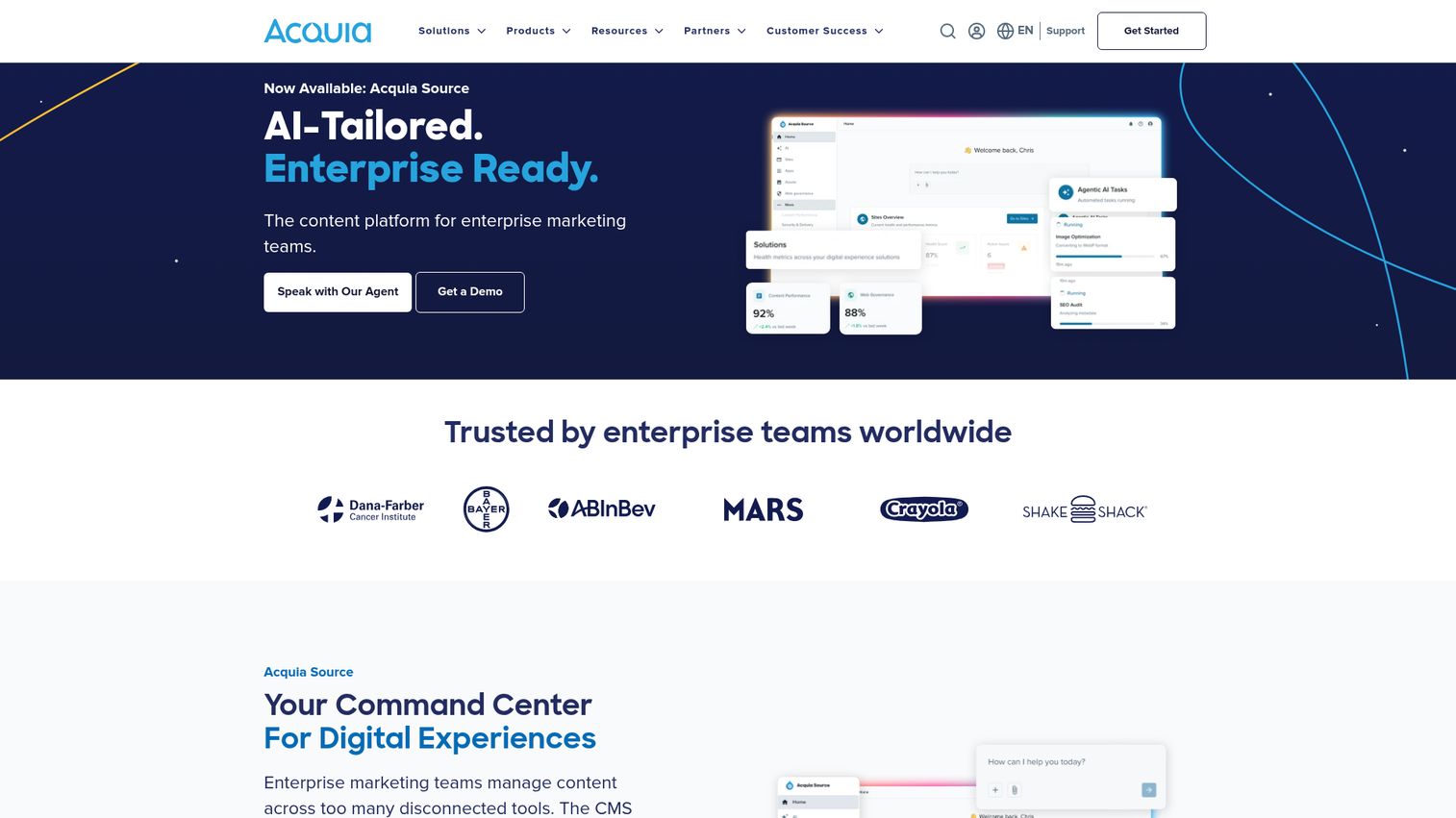
Acquia Digital Experience Platform is a composable, Drupal-based stack built to grow with business needs. It pairs open-source content management with Acquia CDP and is a strong fit for regulated and large organizations that lean open-source. If your team already runs Drupal, Acquia is the natural enterprise layer on top.
It combines governed content and assets with intelligent customer data, including 300-plus integrations, identity resolution, and segmentation, plus predictive marketing and personalization at scale.
Best for: Drupal shops and open-source-leaning enterprises, especially in regulated sectors.
Key strengths
- Governed content and assets: Drupal content models, page templates and design systems, omnichannel assets, and product information with product 360 views.
- Intelligent customer data: 300-plus integrations, identity resolution, segmentation, downstream feeds, and omnichannel campaign activation.
- Predictive experiences at scale: ML models, next-best-action insights, no-code and low-code experiences, hybrid/headless development, and governance oversight.
Why choose Acquia: Choose Acquia when you want an open, Drupal-based DXP with a built-in CDP and the governance enterprise and regulated teams need. It fits organizations that value open-source flexibility without giving up enterprise data tooling. The consideration is that it rewards teams comfortable in the Drupal ecosystem.
Acquia pricing: Acquia does not publish public dollar pricing for its DXP on its site. Pages either route to the homepage or describe package capabilities without listing prices, so expect a scoped quote. Acquia carries a 4.3/5 rating on G2.
5. Contentful Platform
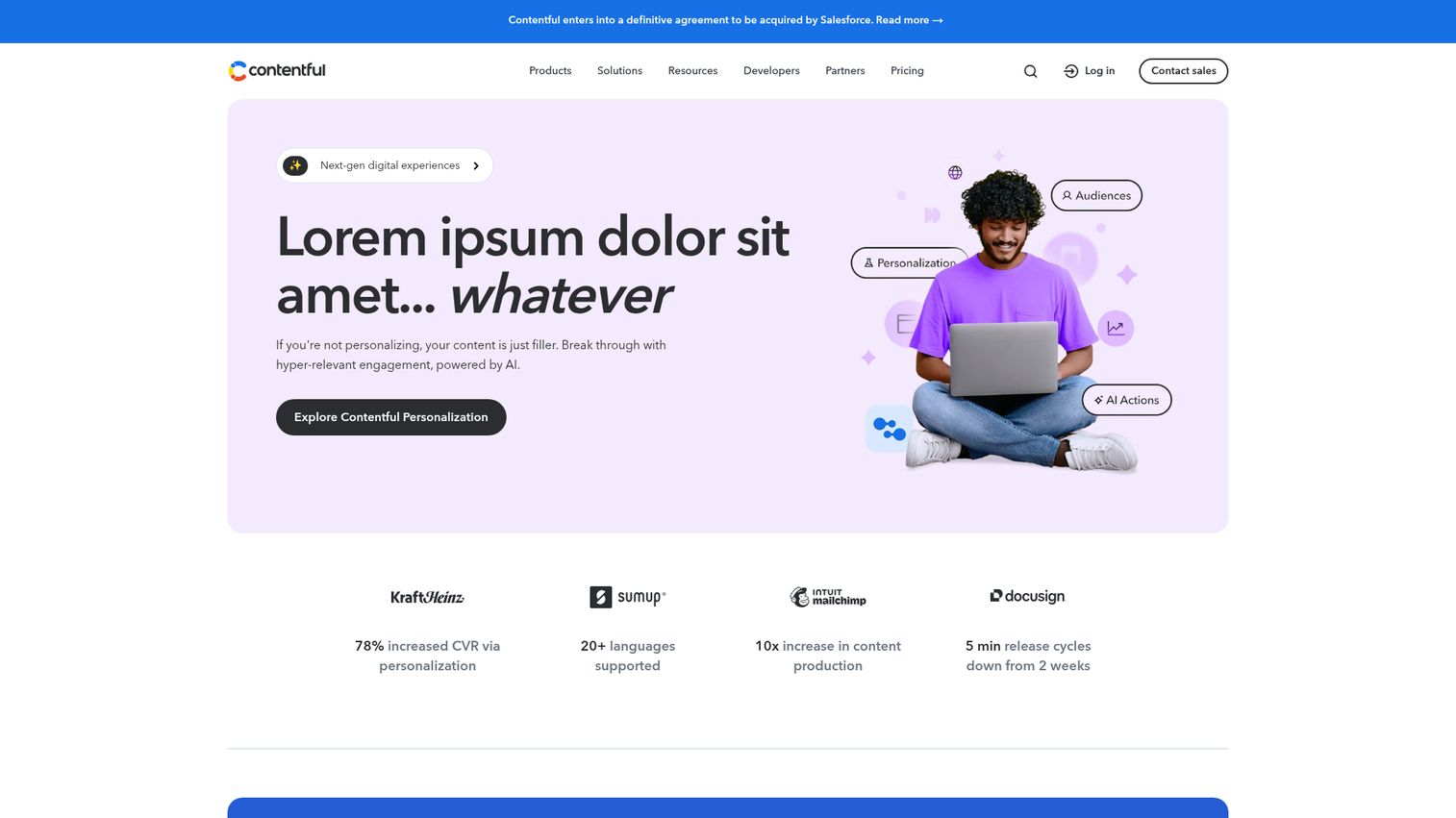
Contentful Platform is a composable, API-first digital experience platform for creating, managing, optimizing, and scaling structured content across channels. It is the go-to for developer-led teams building custom front ends who want content fully decoupled from presentation.
Its model centers on structured content, localization, and automation, which makes it a clean fit for composable stacks where content feeds many surfaces through APIs. For teams new to the model, this headless CMS architecture explained breaks down how content decouples from presentation.
Best for: developer-led teams building custom front ends in a composable architecture.
Key strengths
- Structured content models: define reusable content structures that feed web, mobile, and app from one source.
- Localization and translation: manage multi-language, multi-market content at scale.
- Automations and workflows: orchestrate content operations with automated, repeatable processes.
Why choose Contentful: Choose Contentful when your team builds custom experiences and wants headless, API-first content as the backbone of a composable stack. It fits engineering-forward teams and is one of the rare DXP examples with transparent, public pricing. The consideration is that it leans on developer involvement to assemble the front end.
Contentful pricing: Contentful publishes clear tiers. A Free plan ($0, forever) is built for learning and exploring. Lite runs $300 per month for smaller businesses managing a single project. Enterprise uses custom pricing for scaled experiences with advanced security and reliability. Contentful holds a 4.2/5 rating on G2.
6. Contentstack
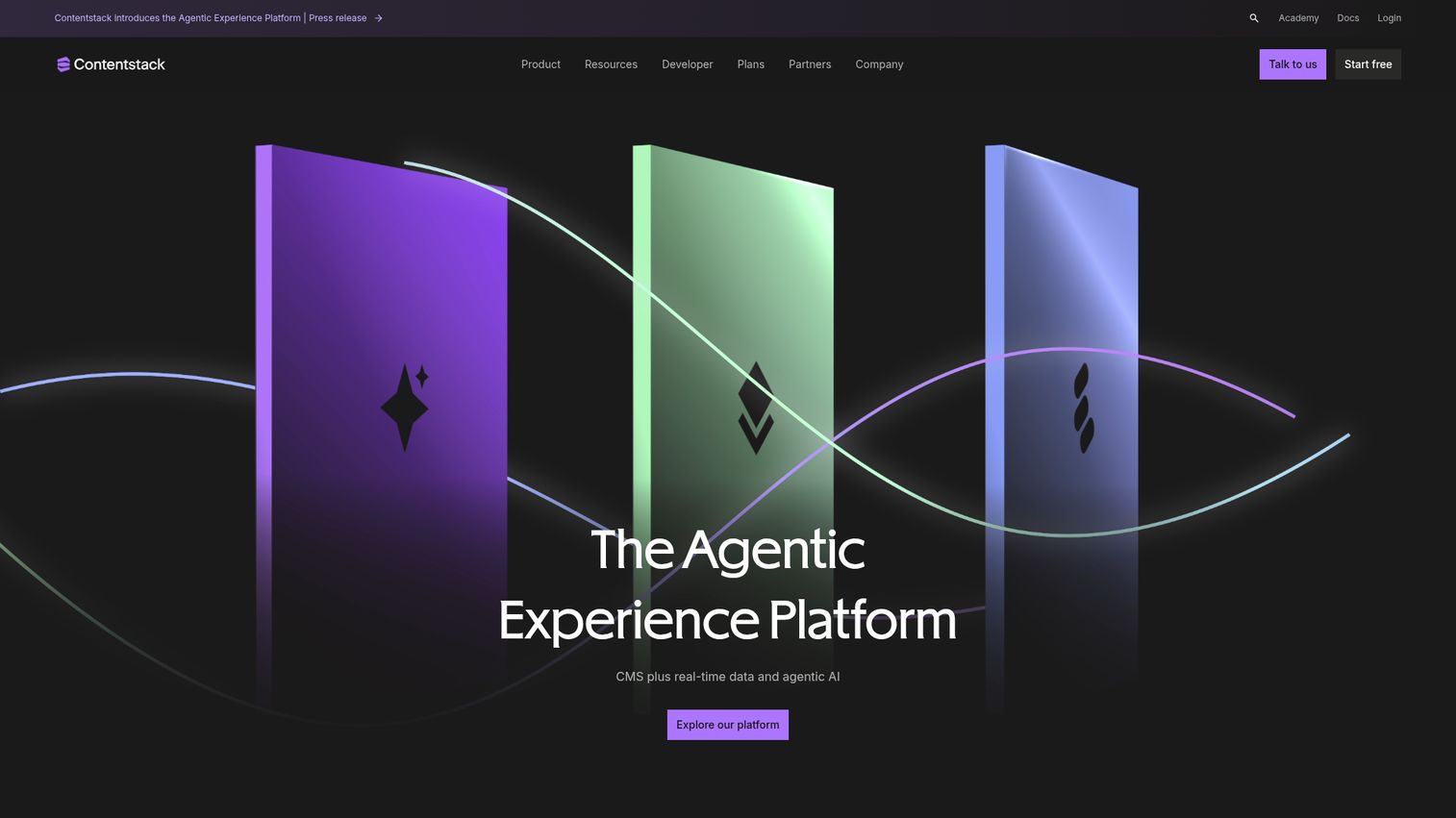
Contentstack is an Agentic Experience Platform centered on enterprise headless content management, personalization, real-time data activation, and AI-driven automation. It is built for enterprise composable strategies, with a strong marketplace and automation layer that lets teams extend the platform without heavy custom work.
It combines a headless CMS with visual building and editing, custom workflows, and AI automation, which positions it well for large organizations standardizing on composable.
Best for: enterprises pursuing a composable strategy who want headless content plus automation.
Key strengths
- Headless CMS: enterprise-grade content management that delivers to any channel through APIs.
- Visual building and editing: visual tools so content teams work without depending on developers for every change.
- Custom workflows: build and govern content workflows tailored to how your teams operate.
Why choose Contentstack: Choose Contentstack when you want enterprise headless content with a strong app marketplace and AI automation inside a composable architecture. It fits large teams that want flexibility without building everything from scratch. The consideration is that the full value lands once you commit to the composable model.
Contentstack pricing: Contentstack's pricing page lists its AXP CMS capabilities with "Request demo" and "Start free" CTAs but does not show public numbers. A free entry point exists via the "Start free" CTA, though the page does not clearly define a standing free tier, so confirm scope with sales. Contentstack carries a 4.4/5 rating on G2.
7. Liferay Digital Experience Platform
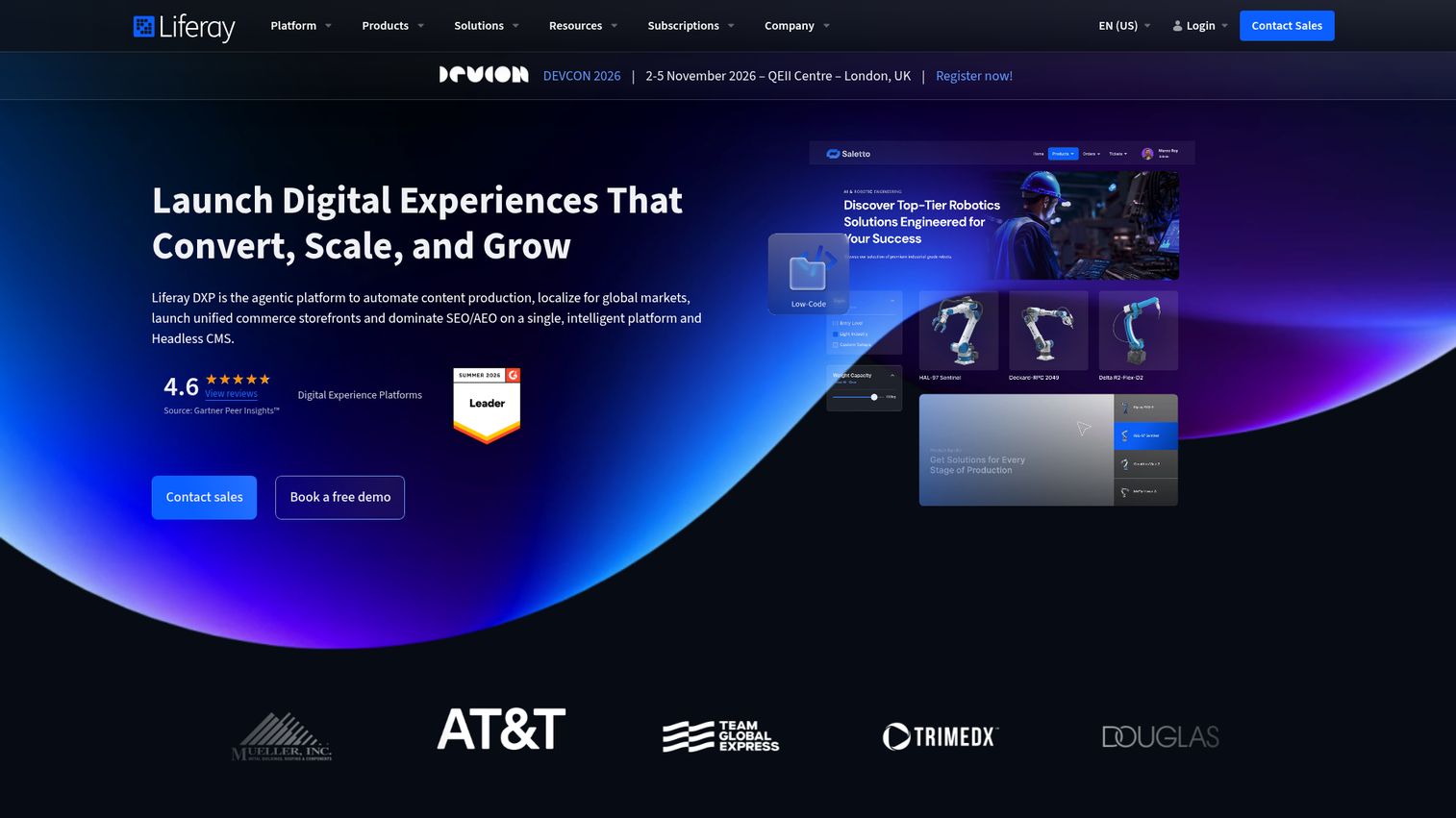
Liferay Digital Experience Platform is an enterprise DXP for building personalized, connected experiences such as customer portals, websites, intranets, mobile apps, and connected devices. Its sweet spot is portals: customer self-service, B2B, and intranet experiences where structured access and workflow matter. To make those portals more interactive, teams often build a self-service experience layered on top.
It combines content management, sites and pages, headless APIs, workflow, commerce, and low-code/no-code page building. For organizations whose primary need is a portal rather than a marketing site, Liferay is purpose-built.
Best for: portal and self-service experiences, including B2B and customer portals.
Key strengths
- Content, sites, and pages: build and manage web experiences with structured content and flexible page composition.
- Headless APIs and workflow: deliver content anywhere through APIs with built-in workflow management.
- Commerce and low-code building: commerce, personalization, custom objects, and no-code page building in one platform.
Why choose Liferay: Choose Liferay when your priority is portals, intranets, or B2B self-service rather than a pure marketing CMS. As an open-source DXP, it offers flexibility for teams that want to extend and customize. The consideration is that its portal focus is a strength for those use cases and a different fit than marketing-first platforms.
Liferay pricing: Liferay uses customized, quote-based pricing through a request-a-quote flow with a sales engineer, so no public paid figures are listed. Liferay's documentation confirms a Liferay DXP Free Tier for hands-on use without an initial subscription. Liferay holds a 4.3/5 rating on G2.
8. Pimcore
Pimcore is a data and experience management platform combining PIM, MDM, DAM, CDP, DXP/CMS, commerce, portals, and data syndication. It is the strongest fit on this list for data-heavy, product-catalog-driven organizations that need a single home for product, asset, and customer data.
Its breadth across data disciplines plus content and commerce makes it unusually consolidated for an open-source platform, and it publishes transparent annual pricing.
Best for: data-heavy, product-catalog-driven organizations consolidating product, asset, and customer data.
Key strengths
- PIM and MDM: centralize product information and master data across every channel.
- DAM and DXP/CMS: manage digital assets alongside content and experience delivery in one platform.
- Commerce and data syndication: a digital commerce framework plus data delivery via APIs.
Why choose Pimcore: Choose Pimcore when product data, assets, and content all need to live in one flexible, composable platform. It fits catalog-heavy and manufacturing or retail teams especially well, and the public pricing makes budgeting easier. The consideration is that its data-platform depth is most valuable when data complexity is the core problem.
Pimcore pricing: Pimcore publishes USD pricing. Professional starts at $9,900 per year (on-premises, commercial use). Enterprise is $29,900 per year for higher control, customization, and support. PaaS, a fully managed edition with 24/7 support, starts from $39,900 per year. A Community Edition is referenced as free for trying Pimcore. Pimcore carries a 4.5/5 rating on G2, the highest in this guide.
9. Magnolia DXP
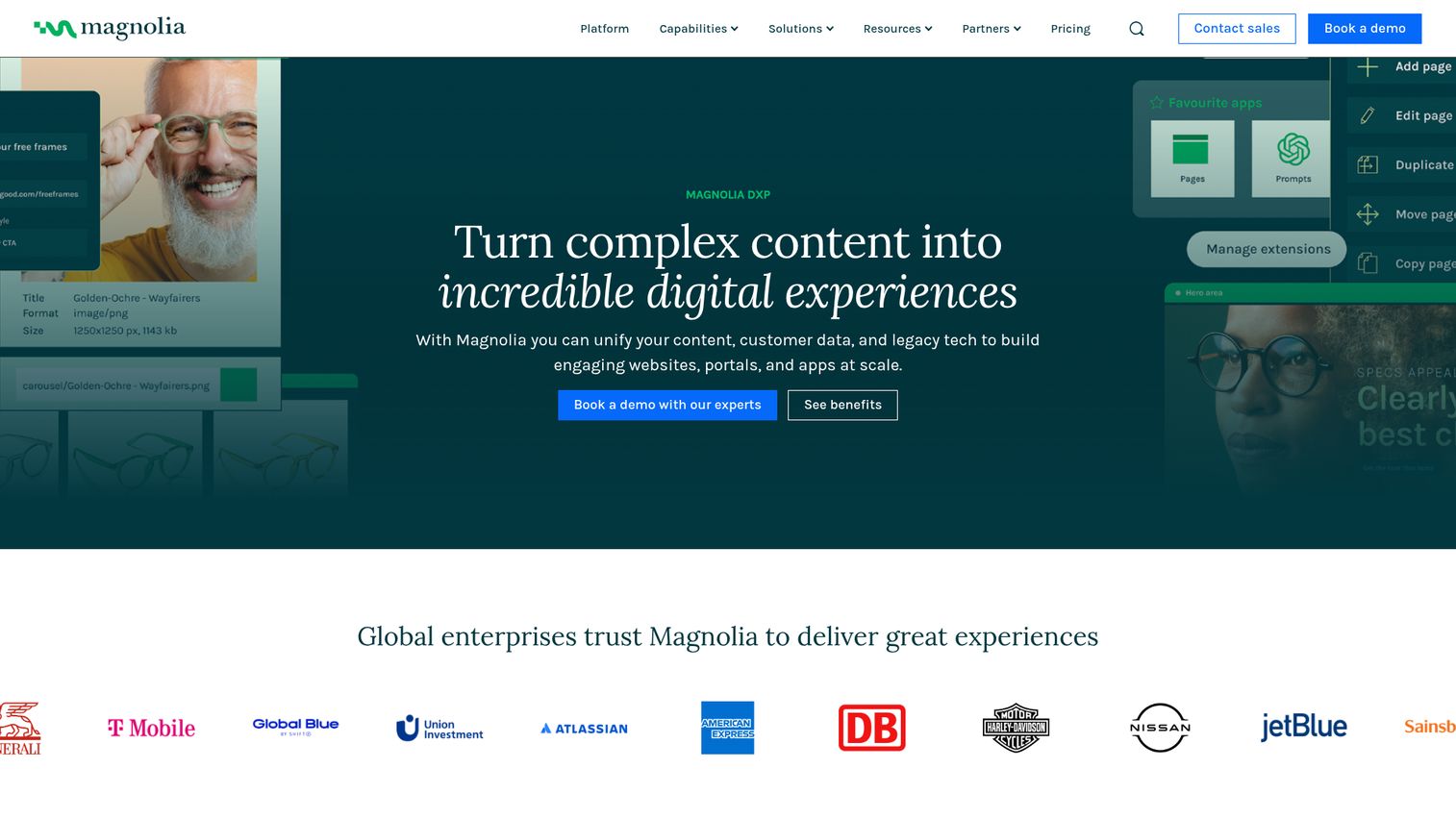
Magnolia DXP is an enterprise digital experience platform for creating, managing, optimizing, and delivering multi-channel experiences. It is composable and API-driven, with a reputation for being integration-friendly, which suits mid-market to enterprise teams that need to plug into an existing stack.
It pairs WYSIWYG and SPA editing with multi-site management, content reuse, workflows, personalization, and an AI Accelerator, supported by REST and GraphQL APIs.
Best for: mid-market to enterprise teams needing flexible, integration-friendly multi-channel delivery.
Key strengths
- WYSIWYG and SPA editing: visual editing for both traditional pages and single-page app experiences.
- Multi-site and multi-channel: multi-site management, content reuse, workflows, and omnichannel campaigns.
- Personalization plus APIs: personalization, SEO/GEO, analytics, an AI Accelerator, and REST plus GraphQL support.
Why choose Magnolia: Choose Magnolia when you need a composable DXP that integrates cleanly with the tools you already run and supports multi-site, multi-language delivery. It fits teams that value flexibility and a customizable architecture. The consideration is that its composable approach rewards teams ready to assemble around it.
Magnolia pricing: Magnolia offers two options. DX Cloud, a fully managed dedicated cloud deployment, starts from $6,000 per month. DX Core is a self-hosted option whose pricing is not publicly listed and requires a quote. A Community Edition download exists in Magnolia's docs but is not presented as a DXP pricing tier. Magnolia is rated 4.7/5 on Capterra; a G2 rating was not listed at the time of writing.
10. Progress Sitefinity
Progress Sitefinity is a composable digital experience platform and CMS for building, managing, personalizing, and optimizing experiences at scale. It earns its reputation as a marketer-friendly DXP, with usability and built-in personalization that mid-market marketing teams can run without heavy dev support.
It combines WYSIWYG content management, multilingual content, built-in SEO, headless delivery, multisite management, and low-code integration, plus personalization, persona analytics, and A/B testing.
Best for: mid-market marketing teams that want usability and value over enterprise complexity.
Key strengths
- Marketer-friendly CMS: WYSIWYG editing, page preview, version control, multilingual content, and built-in SEO tools.
- Headless and multisite: headless content delivery, multisite management, and low-code system integration.
- Personalization and testing: personalization, content and persona analytics, A/B testing, and enterprise connectivity add-ons.
Why choose Progress Sitefinity: Choose Sitefinity when your marketing team wants personalization and analytics built in without an enterprise-scale implementation. It fits mid-market and regulated-industry teams that need cloud or self-hosted deployment. The consideration is that pricing is quote-based, so budget clarity comes after a sales conversation.
Progress Sitefinity pricing: Progress lists Self-Hosted and Sitefinity Cloud deployment options, with Sitefinity DX and Sitefinity DX plus Enterprise packages. Pricing aligns to customer scope and scale and requires a quote, so no public numbers are shown. A trial link is available, though a standing free tier is not confirmed. Sitefinity holds a 4.0/5 rating on G2.
11. OpenText Experience Cloud
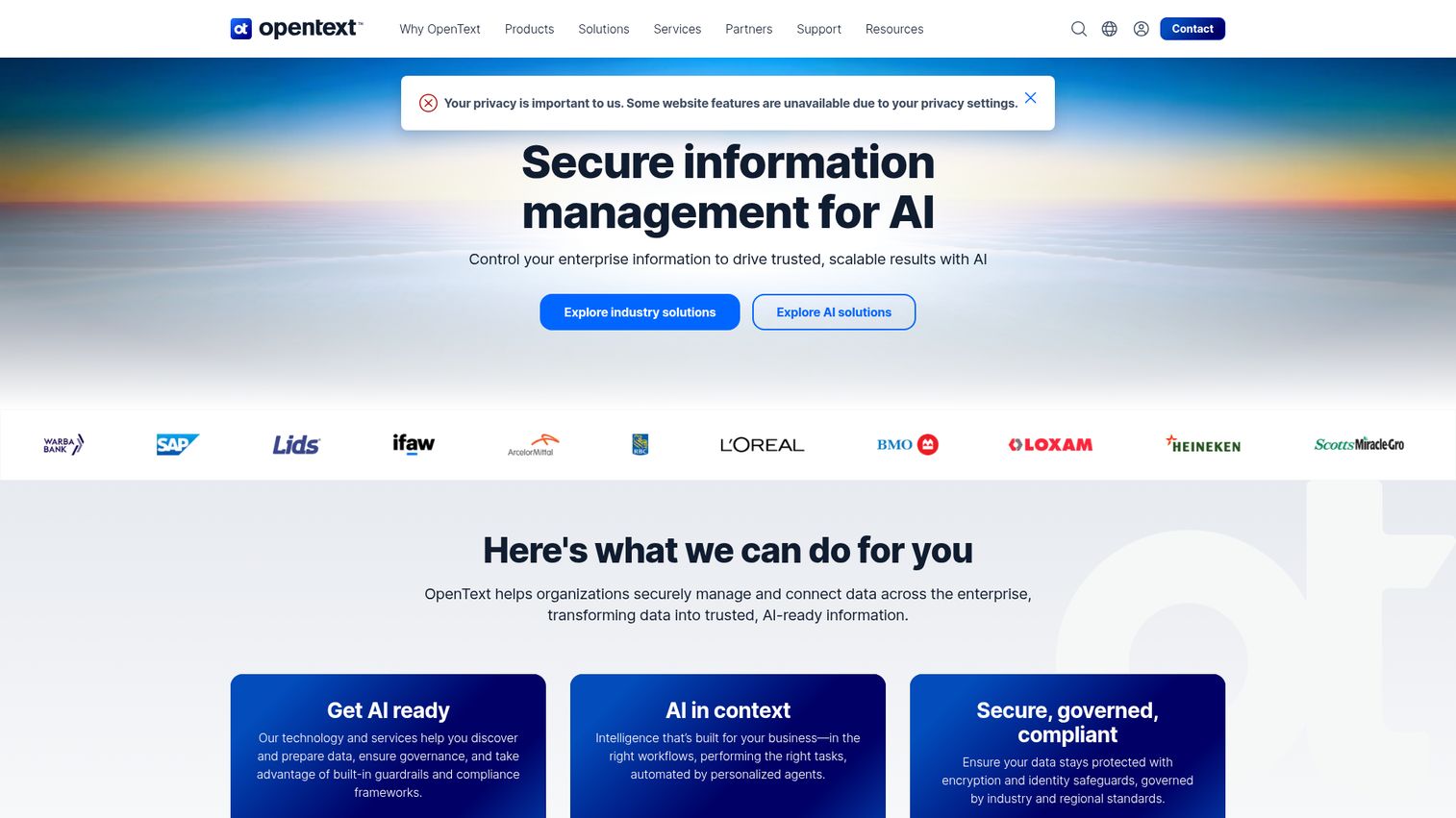
OpenText Experience Cloud is a digital and customer experience platform for connecting experiences, media, communications, messaging, and data across the customer lifecycle. It is strong in regulated industries and large enterprises with complex content governance needs, where communications and content services have to work together.
It is built as a composable platform to modernize and augment existing stacks, with customer communications, web and mobile delivery, and GenAI capabilities via OpenText Experience Aviator.
Best for: large enterprises with complex content governance and communications requirements.
Key strengths
- Composable DXP: modernize and augment existing technology stacks without a full rip-and-replace.
- Communications and delivery: customer communications, messaging, and web and mobile experience delivery across journeys.
- AI capabilities: AI and GenAI features through OpenText Experience Aviator.
Why choose OpenText Experience Cloud: Choose OpenText when you need a modular experience platform that spans communications, web, messaging, and data, especially in a governance-heavy enterprise. It fits organizations where content services and customer communications must be tightly connected. The consideration is that its enterprise breadth suits complex, large-scale deployments.
OpenText Experience Cloud pricing: OpenText does not publish public numeric pricing for Experience Cloud. The product page presents a "Contact us" path rather than plan pricing, so expect an enterprise sales conversation to scope the deployment. A product-specific current G2 rating was not available at the time of writing.
12. Ibexa DXP
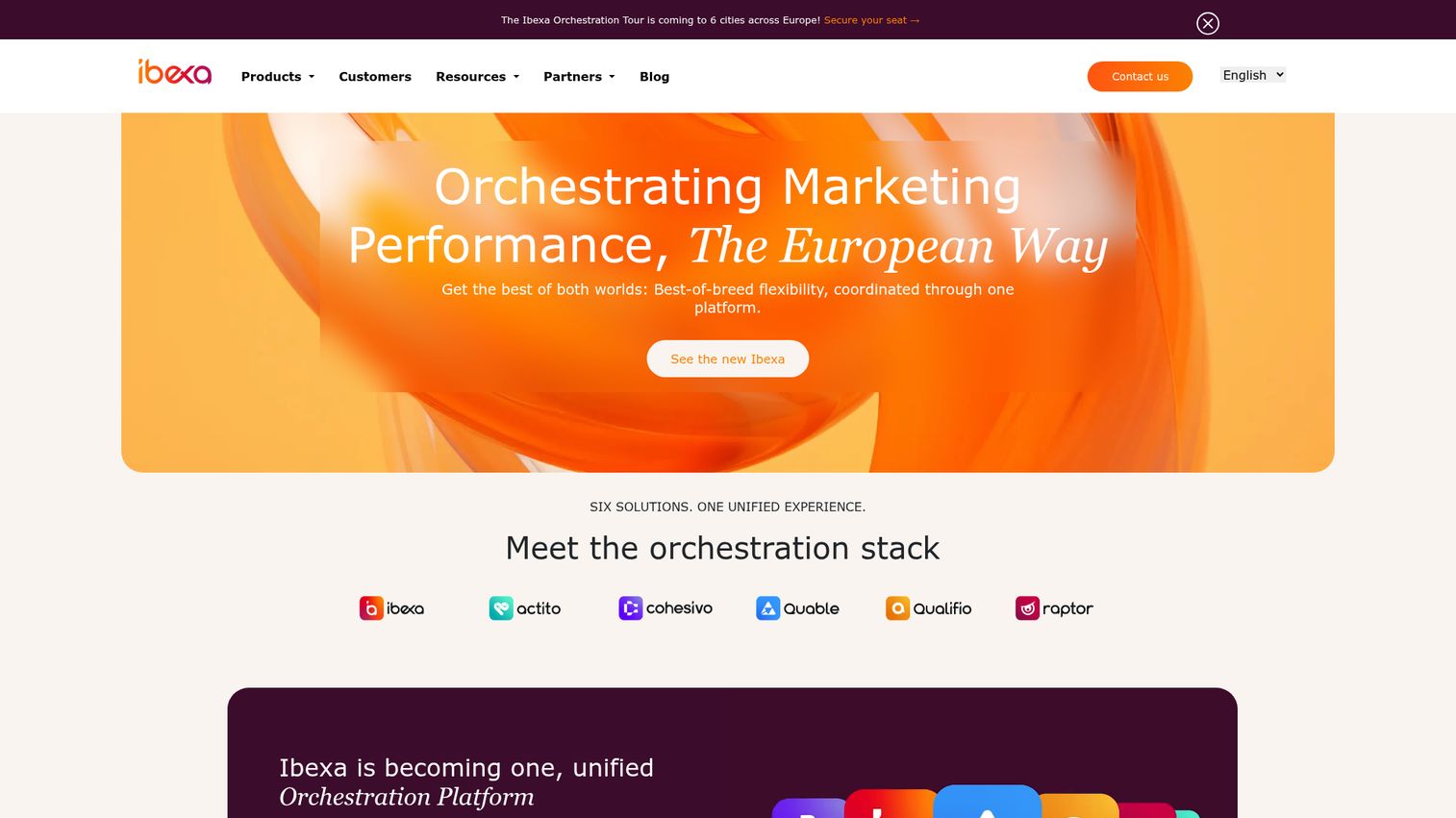
Ibexa DXP is a modular digital experience platform for headless content management, customer experiences, and B2B commerce. It is built for B2B sellers that need content and commerce in one place, with the headless flexibility to deliver across channels.
It combines headless and multichannel content management with personalization and segmentation, plus product catalog, multisite, localization, workflows, and asset management.
Best for: B2B sellers needing content plus commerce in a modular platform.
Key strengths
- Headless content management: manage and deliver content across multiple channels from a modular core.
- Personalization and segmentation: tailor experiences by segment to match B2B buyer needs.
- Catalog and multisite: product catalog, multisite, localization, workflows, and asset management.
Why choose Ibexa: Choose Ibexa when you are a medium to large B2B organization that needs content, multilingual and multisite experiences, and B2B commerce together. It fits sellers who want modular flexibility with commerce built in. The consideration is that its B2B focus is a clear strength for that use case and a different fit than consumer-marketing platforms.
Ibexa DXP pricing: Ibexa publishes EUR pricing across three product lines, each with Bronze, Silver, Gold, and Platinum tiers. Ibexa Headless starts from €39k per year. Ibexa Experience starts from €44k per year. Ibexa Commerce starts from €50k per year. Free-tier availability is not explicitly confirmed on the pricing page. Ibexa carries a 4.2/5 rating on G2.
How to choose digital experience platform software
A DXP is a multi-year commitment, so the shortlist matters more than the demo. Run each candidate against these five criteria.
Composability and integration depth
Does it fit the CRM, MAP, analytics, and commerce tools you already run? A composable, API-first platform lets you swap one component without disrupting the rest. Check the integration list against your actual stack, not the vendor's marketing list. Tight integrations are what keep a composable stack from drifting back into silos.
Personalization and experimentation
Look for native A/B testing, segmentation, and AI-driven personalization. The question is whether marketers can build and run variations without filing engineering tickets. If personalization lives in dev, it will not scale.
Analytics and measurable ROI
Can the platform tie experience changes to conversion and pipeline? Connected analytics across content, data, and commerce is what makes attribution defensible. Without it, you are back to stitching dashboards together.
Time-to-value and total cost
Weigh implementation effort, required dev resources, and pricing transparency. Some composable and mid-market options publish clear tiers, while most enterprise DXPs use custom quotes. Factor in how long it takes to ship your first real experience, not just to sign.
Governance, security, and scalability
Enterprise readiness means SSO, compliance, and multi-team workflows. If multiple teams will share the platform, role-based governance and approval flows are not optional. Verify these before procurement, not after.
Conclusion
The right digital experience platform depends on your stack and your team, not on a leaderboard. For enterprise omnichannel inside an existing Adobe footprint, Adobe Experience Manager is the anchor. If experimentation drives your growth, Optimizely One puts testing at the center. For composable, headless builds, Contentful and Contentstack give developer-led teams API-first content, while Acquia and OpenText suit governed, regulated enterprises. Open-source flexibility points to Liferay for portals and Pimcore for data-heavy catalogs. And for mid-market marketing teams chasing value and usability, Progress Sitefinity and Magnolia earn a look.
The pattern that matters most is consolidation with measurable ROI. The best digital experience platforms collapse tool sprawl into one connected system where content, data, and analytics finally talk to each other. Layering interactive demos on top gives buyers a self-serve, high-engagement experience that the DXP delivers and routes.
Your next step: shortlist two or three based on how cleanly they fit your current CRM, MAP, and commerce tools, then run a scoped trial against one real use case. Score them on time-to-value and how confidently you can tie experience changes to pipeline. Let the trial, not the sales deck, make the call.
FAQ
Digital experience platform software lets organizations create, manage, deliver, and optimize personalized experiences across every digital channel from one connected system. It combines content management, customer data, personalization, omnichannel delivery, and analytics, and often commerce, so teams stop stitching separate tools together.
A CMS manages and publishes content. A DXP wraps personalization, customer data, omnichannel delivery, analytics, and often commerce around that content. Put simply, a CMS handles the page, while a DXP handles the full customer experience across channels and ties it to data.
Common digital experience platform examples include Adobe Experience Manager, Sitecore, Optimizely One, Acquia, Contentful, Contentstack, Liferay, Pimcore, and OpenText Experience Cloud. They range from enterprise suites to composable, headless, and open-source options, so the right fit depends on your stack and use case.
Most enterprise DXPs use custom, quote-based pricing, so you scope cost with the vendor (Adobe Experience Manager, Sitecore, Acquia, and OpenText all work this way). Some composable and mid-market options publish more transparent pricing: Contentful starts at $0 with a Lite tier at $300 per month, Pimcore from $9,900 per year, Magnolia DX Cloud from $6,000 per month, and Ibexa from €39k per year.
A composable DXP uses an API-first, modular architecture built from packaged business capabilities (PBCs) rather than one monolithic suite. Marketers care because you can swap or upgrade one component, like personalization or commerce, without replacing the whole stack. It trades all-in-one simplicity for flexibility.
Core digital experience platform features include a CMS, digital asset management (DAM), a customer data platform (CDP), personalization and engagement, omnichannel delivery, analytics, AI capabilities, and strong integrations. Commerce is common too. The mix you need depends on whether content, data, or commerce is your primary challenge.
Score candidates on five things: composability and integration depth, native personalization and experimentation, analytics that tie to ROI, time-to-value and total cost, and governance, security, and scalability. Shortlist two or three that fit your existing stack, then run a scoped trial against one real use case before committing.
The big digital experience platform trends for 2026 center on AI and composability. Expect more AI-driven and increasingly autonomous experiences, continued movement toward composable, API-first architecture, and greater emphasis on governance and auditability as AI takes on more of the workflow. Discovery across AI-powered search and feeds is also reshaping how experiences need to be structured.