You decided a job board could be a real revenue line. A niche audience, recurring employer subscriptions, maybe some backfilled listings to keep the page full while you grow. Then you priced out building it yourself, and the math fell apart. Payments, moderation, SEO, ATS feeds, Google for Jobs structured data, hosting that doesn't fall over during a traffic spike. None of that is your core product, and all of it eats engineering time you don't have.
The market is telling you the same thing. The global job board software market was valued at $611.4M in 2025 and is projected to reach $1.29B by 2035, growing at a 7.78% CAGR, according to Global Growth Insights (2025). SMEs drive 56% of that adoption, leaning on budget-friendly SaaS tools instead of custom builds. The reason is simple. A job board is only a business if it earns more than it costs to run, and that ratio breaks the moment you treat it as a software project instead of a content-and-revenue asset.
So the real question is not which platform has the longest feature list. It is which one becomes a durable, monetizable, branded asset with the least operational drag. The same instinct that drives modern buyers toward interactive product experiences over static brochures applies here: you want something prospects and employers can use, not just look at. This guide ranks seven options on the criteria that actually decide whether your board pays for itself.
If you are also evaluating adjacent revenue tooling, it is worth skimming our breakdowns of community management software, loyalty management software, and local SEO software, since a job board rarely lives in isolation from those motions.
What's inside
This guide is for founders, operators, association managers, and niche community builders who want to launch and monetize a job board without writing the software from scratch. We selected the seven platforms below on four criteria that matter most for a revenue asset: monetization depth (paywalls, employer subscriptions, featured listings), launch speed and white-label control, job board SEO including Google for Jobs structured data, and integration breadth across ATS systems, XML import, and API access. We also weighed pricing transparency and analytics, since you cannot run a board you cannot measure.
TL;DR
- Best for built-in monetization and aggregation: JBoard pairs a no-code builder with subscriptions, paywalls, and AI-powered backfill.
- Best for clean branding and pricing transparency: Niceboard gives you a custom domain, Stripe payments, and published tiers.
- Best for managing multiple boards: JobBoard.io is built around a structured admin panel and multi-board management.
- Best for fast niche launch: Job Boardly starts at $50/month with pay-as-you-go backfill credits.
- Best for self-hosted control: eJobSiteSoftware ships a one-time-payment platform with a built-in ATS.
- Best for associations and career centers: Smart Job Board focuses on nonprofits, schools, and economic development orgs.
What is job board software?
Job board software is a platform that lets you create, host, monetize, and manage a branded job board without building the underlying application yourself. It handles the moving parts a working board needs: job posting and approval workflows, employer and candidate accounts, payments, search, SEO, and distribution to channels like Google for Jobs.
Most modern job board platforms are no-code and white-label, meaning you launch under your own brand and domain rather than the vendor's. The strongest options treat the board as a business, not just a listings page, so monetization and analytics are first-class rather than bolted on.
Core features to expect:
- White-label job board builder: A drag-and-drop or visual editor to brand the board, customize pages, and control layout without code.
- Job board monetization: Employer subscriptions, single-post checkout, featured or sponsored listings, and candidate paywalls.
- Job aggregation and backfill: XML import and AI-driven backfillers that pull external jobs to keep the board full before you have organic supply.
- Job board SEO: Structured data, clean URLs, sitemaps, and a Google for Jobs integration so listings surface in search.
- Integrations: ATS integration, API access, and payment processors like Stripe.
- Job board analytics: Reporting on traffic, applications, revenue, and listing performance.
This is the same self-serve, show-don't-tell shift reshaping how SaaS teams sell, where buyers expect to explore value directly rather than wait for a gated walkthrough.
When to use job board software
Launch a niche board fast
You have an audience (a community, a newsletter, an association) and want to turn it into a job marketplace this quarter, not next year. No-code job board software gets you live in days, with branding, payments, and SEO already wired in. This is the most common trigger, and the one where build-from-scratch math punishes you hardest.
Monetize an existing audience
You already have traffic or members and want a recurring revenue line. The right platform supports employer subscriptions, featured listings, and candidate paywalls so the board earns from day one instead of after a long content runway. Monetization depth is what separates a side project from an asset.
Replace a custom build you can't maintain
You built something internally, and now it is a maintenance tax: broken Google for Jobs markup, manual moderation, no analytics. Migrating to managed job board management software removes the operational drag and frees engineering for your actual product.
Comparison table
Here is how the seven platforms compare on intent, differentiation, pricing, and rating. Use it as a shortlist filter, then read the sections below for fit.
| # | Product | Intent | Key differentiation | Pricing | G2 rating |
|---|---|---|---|---|---|
| 1 | JBoard | Monetized white-label board with aggregation | No-code builder plus AI backfill and subscriptions | From $199/mo | 4.9/5 |
| 2 | Niceboard | Branded board with transparent pricing | Custom domain, Stripe, SEO and backfill | From $399/mo | 4.7/5 |
| 3 | JobBoard.io | Multiple boards, structured admin | Multi-board management and candidate database | From $449/mo | 4.3/5 |
| 4 | Job Boardly | Fast, low-cost niche launch | Pay-as-you-go backfill credits | From $50/mo | 5.0/5 |
| 5 | JobMount | Customizable board with distribution focus | Candidate experience and job wrapping | Not publicly listed | Not rated |
| 6 | eJobSiteSoftware | Self-hosted, one-time payment | Built-in ATS and resume parsing | From $600 one-time | Not rated |
| 7 | Smart Job Board | Association and career-center boards | AI matching for nonprofits and schools | Contact sales | Not rated |
1. JBoard
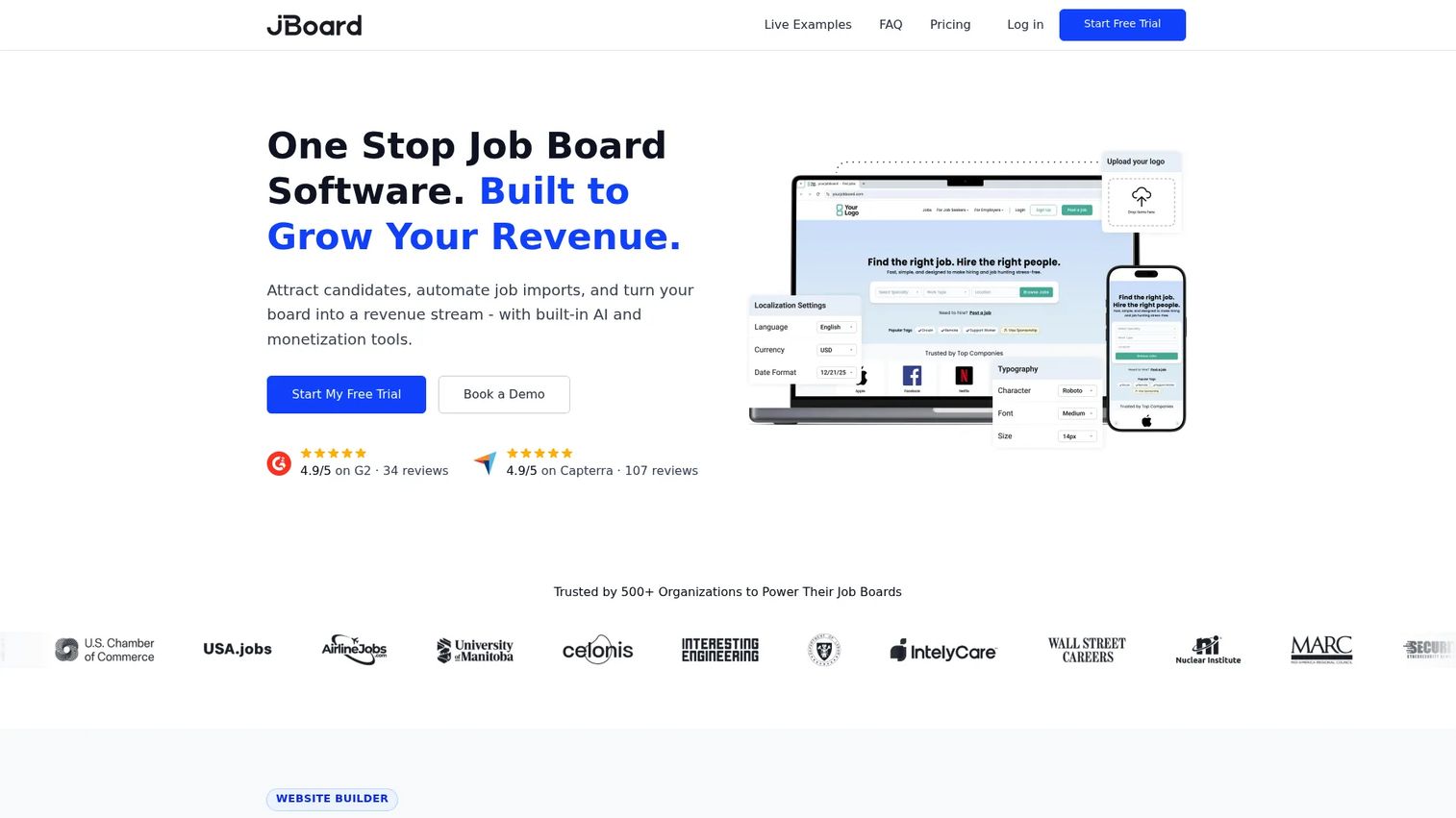
JBoard is white-label, no-code job board software built around two things founders care about most: getting live fast and getting paid. You assemble the board with a drag-and-drop website builder, brand it under your own domain, and turn on monetization without touching code. Where it pulls ahead for revenue-first operators is the combination of job aggregation and built-in subscription tools, so the board looks full and earns from launch.
Best for: Teams launching a branded job board with built-in monetization and job aggregation.
Key strengths
- Drag-and-drop website builder: Brand and structure the board without developers or design cycles.
- Job aggregation and import tools: Backfill listings so the board never looks empty during early growth.
- Monetization and subscription tools: Employer subscriptions and paid posting wired in from day one.
Why choose JBoard: If your priority is a managed, revenue-first board with the least operational drag, JBoard is the most complete fit on this list. The aggregation plus monetization pairing solves the two hardest early problems, an empty page and no income, at the same time. For a founder who wants to hand this to a small team and not babysit it, that combination earns its place in the stack.
JBoard pricing: Plans run Standard at $199/month, Advanced at $359/month, Scale at $679/month, and a custom Enterprise tier. Billing is monthly, with annual billing shown as a 20% discount. There is a 14-day free trial and no permanent free tier. On G2, JBoard holds a 4.9/5 rating.
2. Niceboard
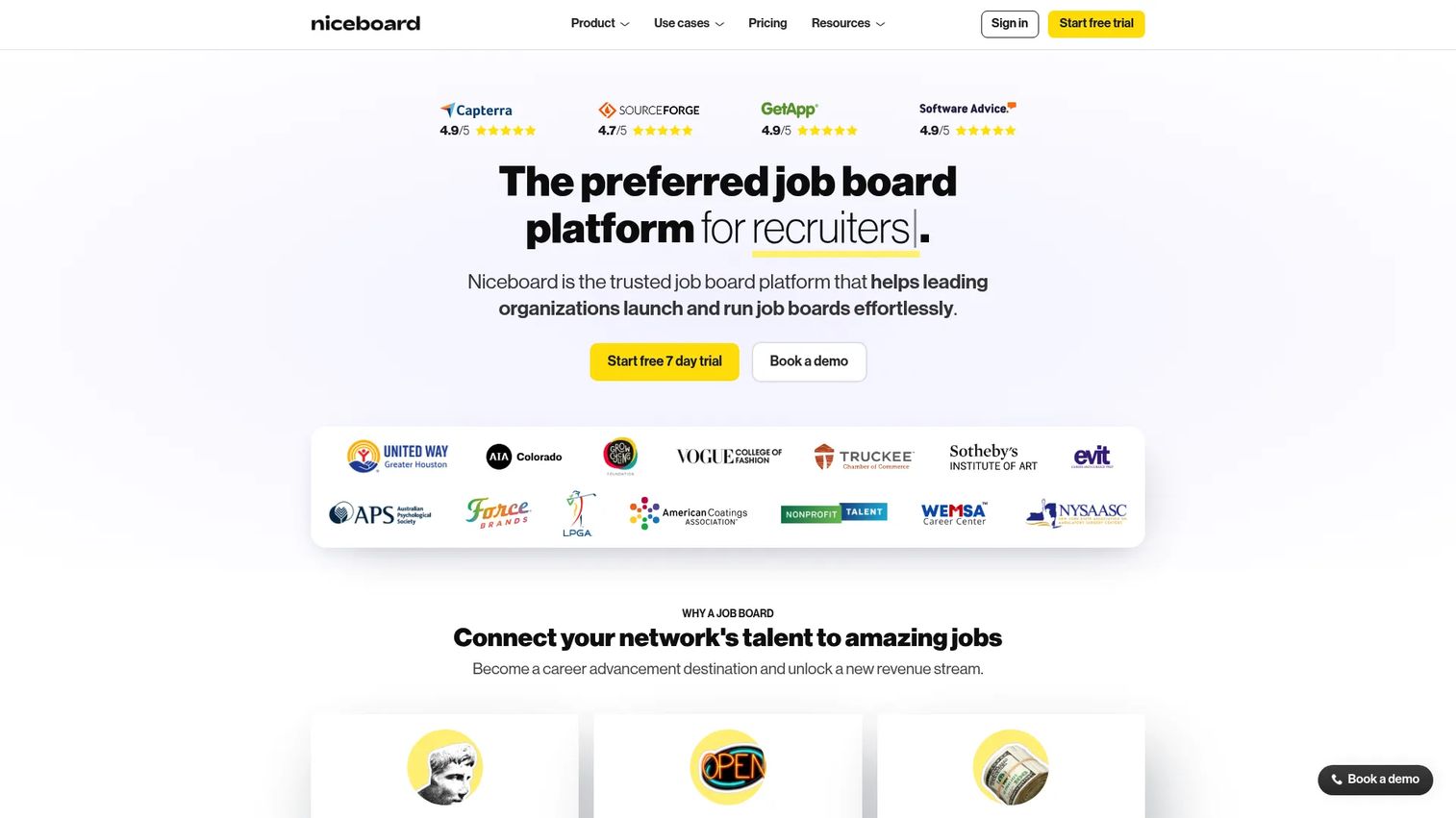
Niceboard is no-code job board software focused on clean branding and transparent pricing. You get a custom domain with free SSL, Stripe payments for monetization, and a set of job board SEO features that includes a blog, job alerts, and backfill to keep listings fresh. It is a strong pick for organizations that want a polished, branded board live quickly without negotiating for a price.
Best for: Organizations that want to launch a branded, monetized job board quickly.
Key strengths
- Custom domain plus free SSL: Run the board fully under your brand with secure hosting included.
- Stripe payments and monetization tools: Charge employers directly with a familiar payment processor.
- SEO features plus blog, alerts, and backfill: Drive organic traffic and keep the board populated.
Why choose Niceboard: Pricing is published, so you can model the payback period before you ever talk to sales, which matters when you are protecting cash at an early stage. The Stripe-native monetization and clean white-label setup make it easy to launch something that looks like a real product, not a template. For founders who value a defensible, branded board with no surprises on cost, it is a direct fit.
Niceboard pricing: Core is $399/month ($319/month billed annually), Advanced is $599/month ($479/month annually), and Ultimate is $899/month ($719/month annually). There is also an Enterprise and Associations option with contact-sales pricing, plus a 7-day free trial. No permanent free tier. On G2, Niceboard holds a 4.7/5 rating.
3. JobBoard.io
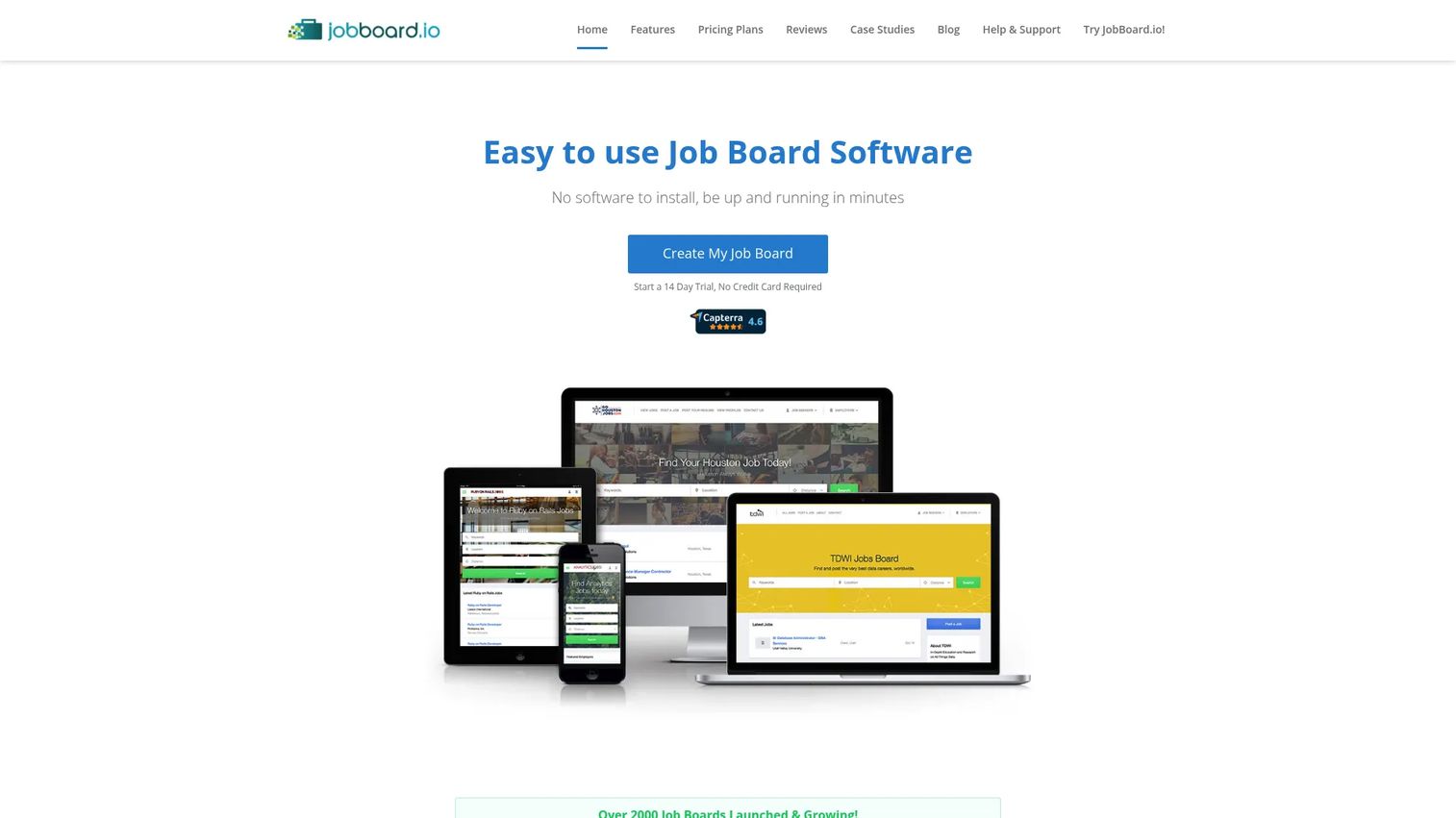
JobBoard.io is hosted job board software built for teams that want structured admin workflows and the ability to run more than one board. The intuitive admin panel, responsive mobile design, and a candidate profile database give operators the control to manage listings, employers, and applicants at scale. Custom products and packages let you shape monetization around your audience.
Best for: Teams that want to launch and monetize a custom job board without building the software themselves.
Key strengths
- Intuitive admin panel and multiple job boards: Run and manage several branded boards from one place.
- Candidate profile and employer database: Keep applicant and employer data structured and searchable.
- Blogging, SEO, and frictionless apply: Drive organic traffic and reduce drop-off at application.
Why choose JobBoard.io: If you expect to operate multiple boards or need a tidy admin layer for a team to work in, JobBoard.io is built for that operational reality. The custom products and packages give you room to design employer subscriptions and one-off postings around how your market actually buys. It suits operators who treat the board as infrastructure, not a one-off page.
JobBoard.io pricing: Basic is $449/month and Professional is $649/month, with an Enterprise tier available on request. A 14-day trial is offered and there is no free tier. On G2, JobBoard.io holds a 4.3/5 rating.
4. Job Boardly
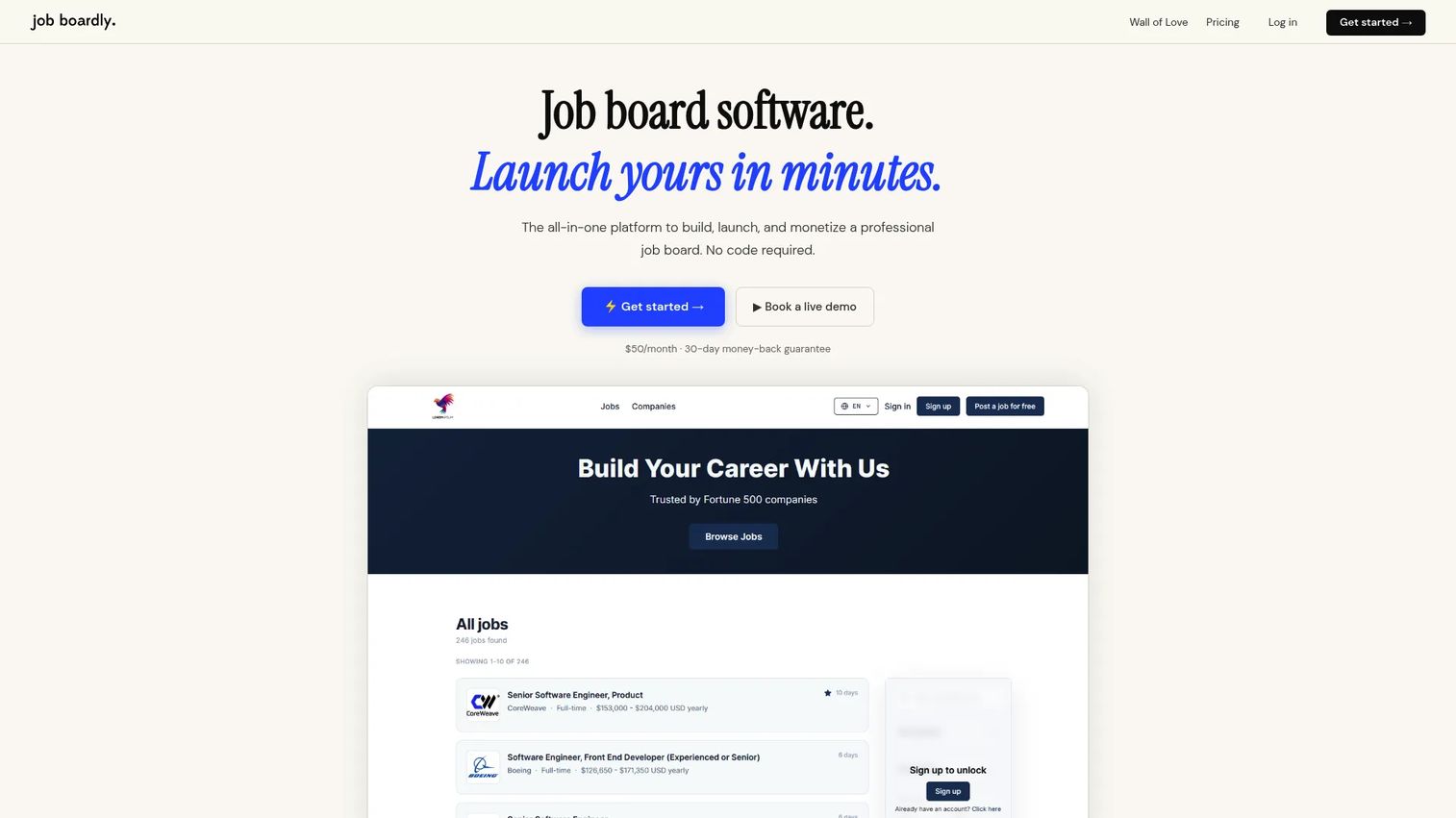
Job Boardly is no-code software for creating, managing, and monetizing niche job boards, and it is the lowest-cost entry point on this list. You build with a visual editor, populate the board through job aggregation and backfilling, and monetize with paywalls, featured listings, and employer subscriptions. The pay-as-you-go credit model for backfill and aggregation keeps early costs predictable while you find supply.
Best for: Teams launching a niche job board without code.
Key strengths
- Visual job board builder: Launch a branded niche board fast without developers.
- Job aggregation and backfilling: Use usage credits to fill the board only as you need to.
- Paywalls, featured listings, and subscriptions: Stack multiple monetization paths from day one.
Why choose Job Boardly: For a community builder or solo operator testing whether a niche will pay, the low monthly floor plus metered backfill credits removes the financial risk of launching. You are not committing hundreds a month before you know there is demand. That makes Job Boardly the natural fit for monetizing a niche board you want to validate quickly.
Job Boardly pricing: The Standard plan is $50/month and Pro is $100/month, both billed monthly. Backfill and aggregator credits are pay-as-you-go: 1,000 credits for $12, 5,000 for $55, and 10,000 for $100. There is no free tier, but a 30-day money-back guarantee is offered. On G2, Job Boardly holds a 5.0/5 rating.
5. JobMount
JobMount is customizable job board software with a focus on candidate experience and job distribution. It positions around presentation and job wrapping, the practice of pulling and reformatting external listings so the board stays full and consistent. For operators who care most about how the board looks and feels to job seekers, that emphasis on candidate experience is the draw.
Best for: Operators who prioritize candidate experience and distribution.
Key strengths
- Candidate-experience focus: Presentation and usability aimed at job seekers.
- Job wrapping and distribution: Reformat and surface external listings to keep the board active.
- Customization: Shape the board's look to match your brand and audience.
Why choose JobMount: If your differentiation is a cleaner, more usable job-seeker experience than the generic boards in your niche, JobMount's presentation focus aligns with that goal. It is worth a direct evaluation when candidate experience and distribution rank above pricing transparency in your decision.
JobMount pricing: Pricing is not publicly listed on the site, so request a quote directly to confirm tiers and what each includes before committing. Verify current monetization and integration support during that conversation, since those details are not published.
6. eJobSiteSoftware
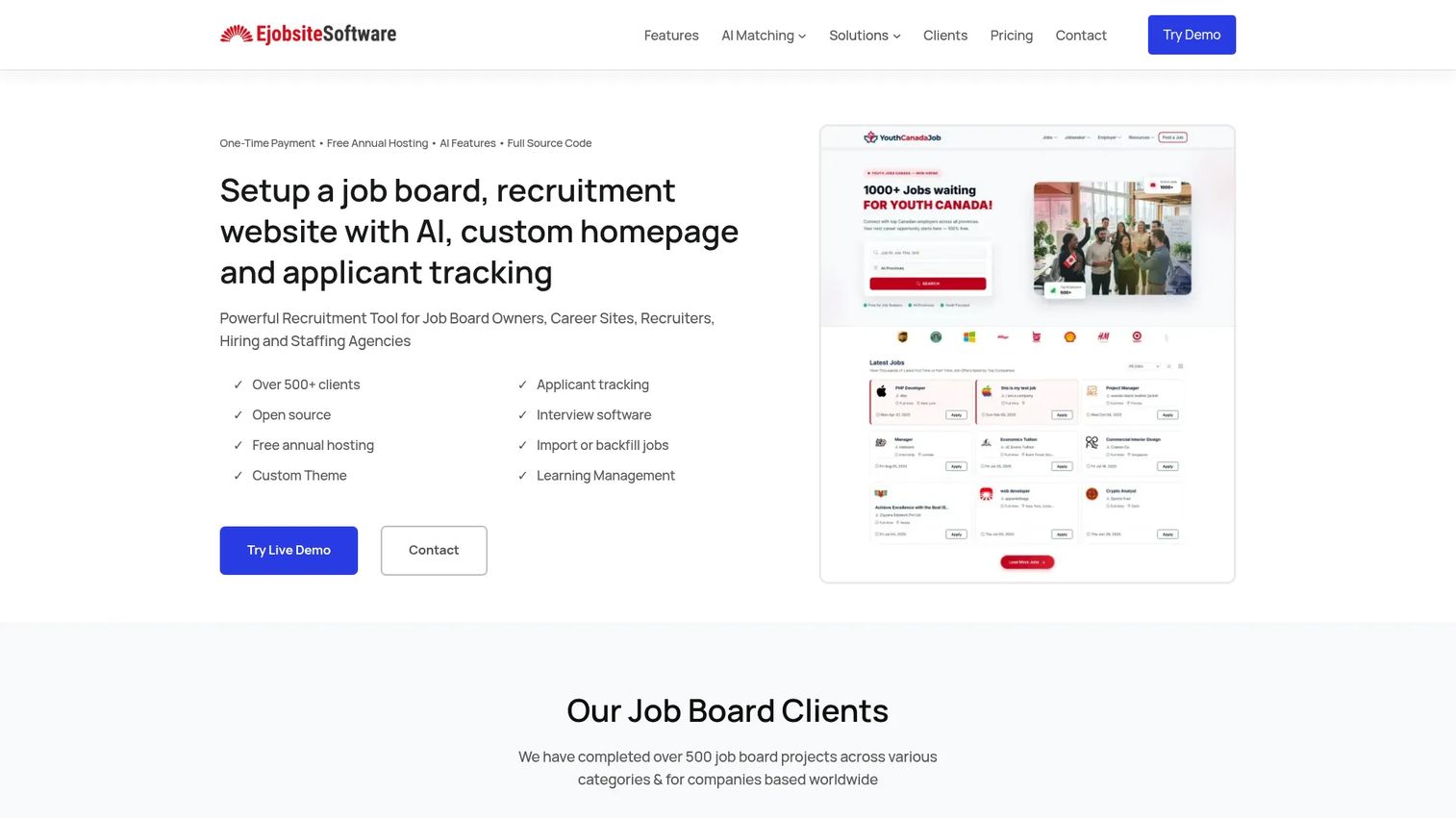
eJobSiteSoftware is job board and recruitment software for teams that want a self-hosted portal with a one-time payment instead of a recurring subscription. Beyond the board itself, it ships employer and candidate modules, a built-in ATS, and resume parsing, which pushes it closer to a full recruitment platform than a listings page. For operators who want maximum control over hosting and data, this is the more technical option on the list.
Best for: Teams wanting a self-hosted job board and recruitment platform with one-time pricing.
Key strengths
- Employer and candidate modules: Manage both sides of the marketplace in one system.
- Built-in ATS: Track and process applicants without a separate tool.
- Resume parsing: Structure incoming candidate data automatically.
Why choose eJobSiteSoftware: The one-time payment model appeals to founders who would rather own the software outright than pay monthly, and the built-in ATS adds recruitment workflow on top of the board. If you want control over hosting, data ownership, and a platform you can extend, the self-hosted model fits. It rewards teams with the technical appetite to run their own stack.
eJobSiteSoftware pricing: The platform uses a one-time payment model starting at $600, with no monthly fees. Annual hosting is listed as optional and first-year hosting is included in the standard offering per the site's FAQ. There is no free tier. A current G2 rating was not available at the time of writing.
7. Smart Job Board

Smart Job Board is AI-powered job board software aimed at associations, nonprofits, schools, and economic development organizations. It pairs AI-driven matching with employer and job-seeker portals plus SEO and marketing tools, so member-driven organizations can launch and monetize a branded career center. For associations evaluating mainstream job board builders, it is a relevant comparison point.
Best for: Organizations launching or monetizing a branded career center or job board.
Key strengths
- AI-driven matching: Connect candidates and roles automatically to improve relevance.
- Employer and job-seeker portals: Serve both sides of a member community.
- SEO and marketing tools: Drive organic traffic to listings and the career center.
Why choose Smart Job Board: If you run an association or nonprofit and the board is really a member career center, Smart Job Board's positioning is built for that context rather than retrofitted from a general builder. The AI matching and marketing tools support member engagement alongside monetization. It fits organizations where the audience is a membership, not an open market.
Smart Job Board pricing: Pricing is presented as either a revenue-share or flat-fee subscription model, but no public numeric price is shown. The pricing page directs you to contact sales or request a demo, so confirm the model and figures directly before committing.
Considerations before you buy
Monetization model
Decide how the board will earn before you pick a tool. Employer subscriptions favor recurring revenue, single-post checkout suits low-volume markets, and candidate paywalls work when your audience values access. Confirm the platform supports the model your market actually buys, not just the one it markets hardest.
White-label and data ownership
Check whether the board runs fully under your brand and domain, and who owns the candidate and employer data. White-label job board software protects your brand equity, and data ownership protects your ability to migrate or build on top of the board later. Read the fine print on both.
Launch speed and operational drag
A board you cannot launch this quarter or cannot run without engineering is a liability. Weigh no-code setup, managed hosting, and how much ongoing moderation and maintenance the platform offloads. The goal is an asset a small team can run, not a project that routes back through you.
SEO and distribution
Organic traffic is the cheapest acquisition you will get. Verify the platform handles job board SEO properly: structured data, clean URLs, sitemaps, and a working Google for Jobs integration. Backfill and job wrapping matter too, since an empty board ranks for nothing.
Integrations and pricing transparency
Confirm the ATS integration, XML import, and API access you need are supported on the tier you can afford. Published pricing lets you model payback before you commit, while quote-only pricing means budgeting around an unknown. Both are workable, but know which one you are signing up for.
Conclusion
Pick the platform that turns your job board into a durable revenue asset with the least operational drag, not the one with the longest feature list. JBoard is the strongest overall for revenue-first operators who want fast launch, monetization, and AI backfill in one managed package. Niceboard wins on clean branding and published pricing. JobBoard.io fits teams running multiple boards. Job Boardly is the lowest-risk way to validate a niche, eJobSiteSoftware suits self-hosted control with a built-in ATS, and Smart Job Board is built for associations and career centers.
Your next step is simple: shortlist two based on your monetization model and launch timeline, then run the free trials side by side. Test how fast you can brand the board, wire payments, and confirm Google for Jobs markup works. The platform that gets you to a live, monetizable board fastest, with the least drag, is the one that earns its place in your stack.
If your broader goal is showing buyers and employers what your product can do without a live walkthrough, Guideflow lets you build self-serve interactive demos in minutes. Start your journey with Guideflow today!
FAQs
Job board software is a platform for creating, hosting, monetizing, and managing a branded job board without building the application yourself. It handles job posting, employer and candidate accounts, payments, search, SEO, and distribution to channels like Google for Jobs. You configure the board through a no-code builder, set your monetization model, and the platform manages hosting and infrastructure.
JBoard and Job Boardly both lead on built-in monetization. JBoard pairs employer subscriptions and paid posting with AI backfill in a managed package, while Job Boardly stacks paywalls, featured listings, and subscriptions at a low entry price. The best fit depends on whether you want recurring employer revenue, candidate paywalls, or single-post checkout for your market.
Prioritize monetization depth, job board SEO including Google for Jobs structured data, launch speed, and integrations like ATS, XML import, and API access. Job board analytics matter too, since you cannot improve revenue or traffic you cannot measure. Match the feature set to your revenue model rather than chasing the longest list.
Yes. Most modern job board platforms include a Google for Jobs integration through structured data markup, so listings surface in search. Many also support ATS integration, XML import, and API access to pull and push jobs between systems. Confirm the specific integrations you need are available on the pricing tier you plan to buy.
With no-code job board software, you can launch a branded board in days rather than months. Platforms like JBoard, Niceboard, and Job Boardly handle hosting, payments, and SEO out of the box, so most of your time goes to branding and content. Backfill and job wrapping let you populate the board before you have organic employer supply.
For most operators, yes. White-label job board software runs the board under your own brand and domain, which builds equity and trust with employers and candidates. It also protects your ability to grow the board into a standalone asset rather than a page that visibly belongs to a vendor. The alternative, an unbranded or vendor-marked board, undercuts the business you are trying to build.
Job boards monetize through employer subscriptions, single-post checkout, featured or sponsored listings, and candidate paywalls. Many also use backfilled or aggregated jobs to keep the board full and drive traffic that supports those revenue streams. The strongest platforms let you combine several models so the board earns from multiple sources.
Look at monetization depth, white-label control, data ownership, launch speed, job board SEO, and integration breadth. Favor published pricing so you can model payback, and confirm the platform offloads enough hosting and moderation that a small team can run it. The goal is a board that becomes a durable revenue asset, not a maintenance tax routed back through you.