You launched the product. The site is live. Then someone on legal, or worse, an app store reviewer, asks where your privacy policy is. Now you are staring at a blank page, trying to translate GDPR, CCPA, and a handful of other acronyms into language that holds up.
This is the exact friction privacy policy generator software is built to remove. Instead of paying a lawyer four figures for a one-off document or copying a competitor's policy that does not match your data practices, you answer a structured questionnaire and the tool assembles a policy tailored to your business, platform, and the laws you fall under. The category is growing for a reason. The global privacy policy generator software market was valued at USD 1.16 billion in 2024 and is projected to reach USD 3.5 billion by 2035 at a 10.6% CAGR, according to WiseGuy Reports (2024).
But not every generator is equal. Free tools are everywhere, and most can produce a serviceable draft in minutes. What separates a good privacy policy maker from a risky one is trust, customization depth, and how the tool handles updates when the law shifts or your stack changes. A policy that is accurate the day you publish it can quietly fall out of compliance six months later if nothing keeps it current.
So how do you create a privacy policy you can actually defend, without rebuilding it every quarter? That is what this guide is for. We evaluated the leading tools on the criteria that matter to teams shipping fast: compliance coverage, ease of use, customization, output formats, hosting, and the trust signals that tell you the document was vetted, not just templated.
What's inside
This guide covers privacy policy generator software for websites, mobile apps, ecommerce stores, and SaaS products. Whether you are a solo developer pushing an app to the App Store or a product marketing manager who needs consistent, credible compliance language across every customer touchpoint, the goal is the same: generate a compliant privacy policy fast, then keep it current without manual rework.
We selected tools based on four criteria. Ease of use and speed to a finished policy. Compliance breadth across GDPR, CCPA, and other major laws. Customization and output flexibility, including hosting, embed, and multi-format export. And trust signals, whether that means lawyer review, named experts, or open-source transparency.
TL;DR
- Best for broad authority and use-case coverage: Termly pairs a free generator with lawyer-vetted positioning, automatic updates, and support for websites, apps, ecommerce, and SaaS.
- Best for free hosting and flexible export: TermsFeed lets you generate without an account, host your policy for free, and export to HTML, DOCX, plain text, and Markdown.
- Best for speed plus a wider policy suite: PrivacyPolicies.com produces a free policy fast and extends to Terms & Conditions, EULA, disclaimers, and cookie policies.
- Best for indie app developers: App Privacy Policy Generator is a free, open-source-friendly tool built specifically for mobile apps and the SDKs they rely on.
- For most small teams: start free, verify the law coverage you need, and confirm the tool keeps the policy updated automatically.
What is privacy policy generator software?
Privacy policy generator software is a tool that produces a customized, legally structured privacy policy by collecting details about how your business collects, uses, shares, and stores personal data. Instead of writing legal text from scratch, you answer questions about your platform and data practices, and the software assembles clauses tailored to your situation and the jurisdictions you operate in.
The strongest tools share a common set of capabilities. Here is what to look for when you generate a privacy policy:
- Compliance coverage: Support for major data protection laws, including GDPR, UK GDPR, CCPA and CPRA, CalOPPA, and PIPEDA. The best tools map your inputs to the right clauses automatically.
- Platform support: Tailored language for websites, mobile apps, ecommerce stores, and SaaS products, because each collects and processes data differently.
- Customization: Business-type tailoring so the policy reflects your actual third-party services, analytics tools, payment processors, and data flows.
- Export and hosting: Multi-format export (HTML, DOCX, plain text, Markdown) plus free hosting and an embeddable policy URL so the document lives where users can find it.
- Update handling: Automatic updates that adjust the policy when laws change, plus policy update notifications so you are not manually rewriting clauses every time a regulation shifts.
A generator automates the drafting and structure. It does not replace a lawyer's judgment on edge cases, and it does not absorb your responsibility to keep the policy accurate as your data practices evolve. Think of it as a fast, structured starting point that gets most businesses to a compliant privacy policy in minutes rather than weeks.
When to use a privacy policy generator
Different businesses need different things from a generator. Here is how to pattern-match your situation before you pick a tool.
Generate a policy for a website
Almost every website that collects data needs a privacy policy, even if that data is just cookies, contact form submissions, or analytics. A website privacy policy generator should ask what you collect, which third-party services you run (analytics, ads, embeds), and where your visitors are located. Once generated, the policy belongs in your footer as a persistent link, referenced anywhere you collect data, and updated whenever you add a new tool or tracker. Look for a generator that gives you a hosted privacy policy URL or lets you embed the policy directly.
Create a policy for a mobile app
Apps face stricter scrutiny. Both the Apple App Store and Google Play require a privacy policy URL before you can publish, and they expect the policy to reflect the SDKs and permissions your app actually uses. A mobile app privacy policy generator should account for device identifiers, location data, push notifications, and third-party SDKs like analytics and ad networks. Place the policy link in your app store listing, your in-app settings, and any account or onboarding screen where users hand over data. For iOS and Android, accuracy here is not optional, it gates your release.
Launch a SaaS or ecommerce product
SaaS and ecommerce businesses process more sensitive data and rely on more third parties, which means their policies need tailored data-processing clauses. A SaaS privacy policy generator should handle subprocessors, data retention, international transfers, and user rights requests. An ecommerce privacy policy generator needs to cover payment processors, shipping providers, and order data. For both, custom inputs and integration-aware wording matter, because a generic template will miss the specific vendors and flows that define your risk surface.
Comparison table
Here is how the four leading privacy policy generator software tools compare on intent, use case, pricing, and user rating. We sorted by relevance to the broad commercial keyword, with Termly first because it best matches what most buyers searching for a privacy policy maker actually need.
| # | Product | Intent | Key use case | Pricing | G2 rating |
|---|---|---|---|---|---|
| 1 | Termly | All-in-one privacy compliance | Lawyer-vetted policies for sites and apps with automatic updates | Free; paid from $10/site/mo billed annually | 4.3/5 |
| 2 | TermsFeed | Generate and host legal docs | Free hosting and multi-format export with no account required | Free policy; Privacy Consent from $10/mo | 4.5/5 |
| 3 | PrivacyPolicies.com | Fast policy plus wider suite | Quick free policy with optional one-time premium clauses | Free; premium one-time add-ons | 3.9/5 |
| 4 | App Privacy Policy Generator | App-specific generation | Free policies for mobile apps and their SDKs | Free | 4.4/5 |
The right pick depends on your priority. Termly leads for teams that want authority and breadth. TermsFeed wins on hosting and export flexibility. PrivacyPolicies.com is the speed play with a broader policy library. App Privacy Policy Generator is purpose-built for app developers who want something free and lightweight.
1. Termly
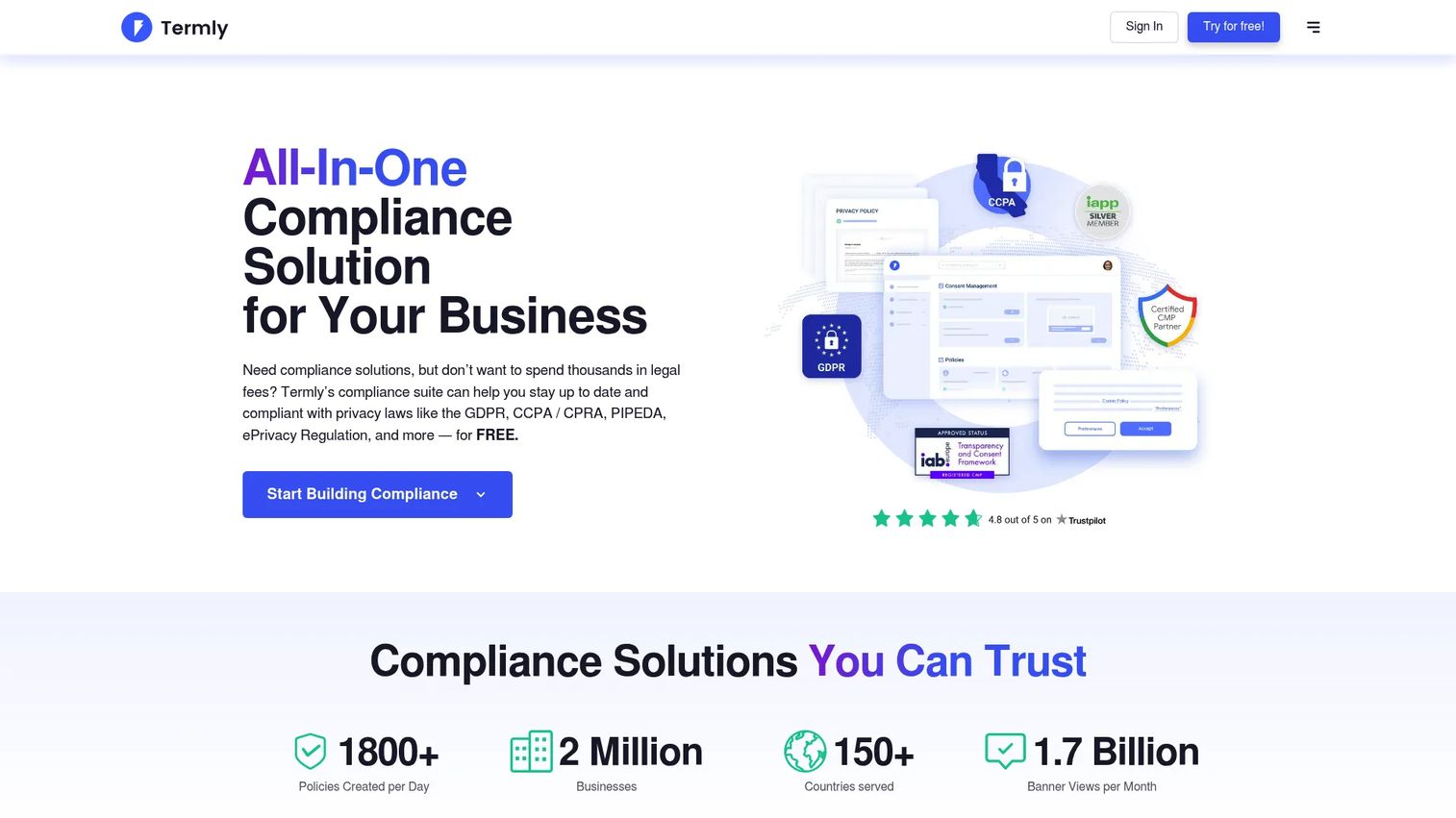
Termly is an all-in-one privacy compliance platform that pairs a free privacy policy generator with a cookie consent manager, DSAR forms, and consent logs. It is built for businesses that want more than a one-off document, positioning itself as a lawyer-vetted source that keeps policies current as laws change. The generator walks you through a structured questionnaire, then assembles a policy tailored to your website, app, ecommerce store, or SaaS product, with a live preview before you publish.
Best for: Businesses that want lawyer-vetted compliance tooling and broad coverage across websites and apps in one platform.
Key strengths
- Lawyer-vetted policies: Clauses are reviewed for legal soundness, giving you a compliant privacy policy you can defend rather than a generic template.
- Automatic updates: When data protection laws shift, Termly updates the underlying policy language, so your document does not quietly fall out of compliance.
- Multi-platform coverage: One tool generates tailored policies for websites, apps, ecommerce, SaaS, and small business use cases.
Why choose Termly: If you care about credibility and want compliance handled as an ongoing system rather than a single download, Termly fits. The automatic updates and lawyer-vetted positioning make it a strong choice for teams who cannot afford to monitor regulatory changes themselves. The broader suite, including cookie consent and DSAR handling, means you can consolidate several compliance needs in one place rather than stitching together separate tools.
Termly pricing: Termly offers a free tier at $0, which covers basic privacy policy generation. Paid plans start with Starter at $10 per website per month billed annually, or $14 billed monthly. The Pro+ tier runs $15 per website per month billed annually, or $20 monthly, adding more advanced consent and compliance features. An Agency tier is available with custom pricing for teams managing multiple sites. Pricing is shown in USD on Termly's pricing page and was verified as of June 2026.
2. TermsFeed
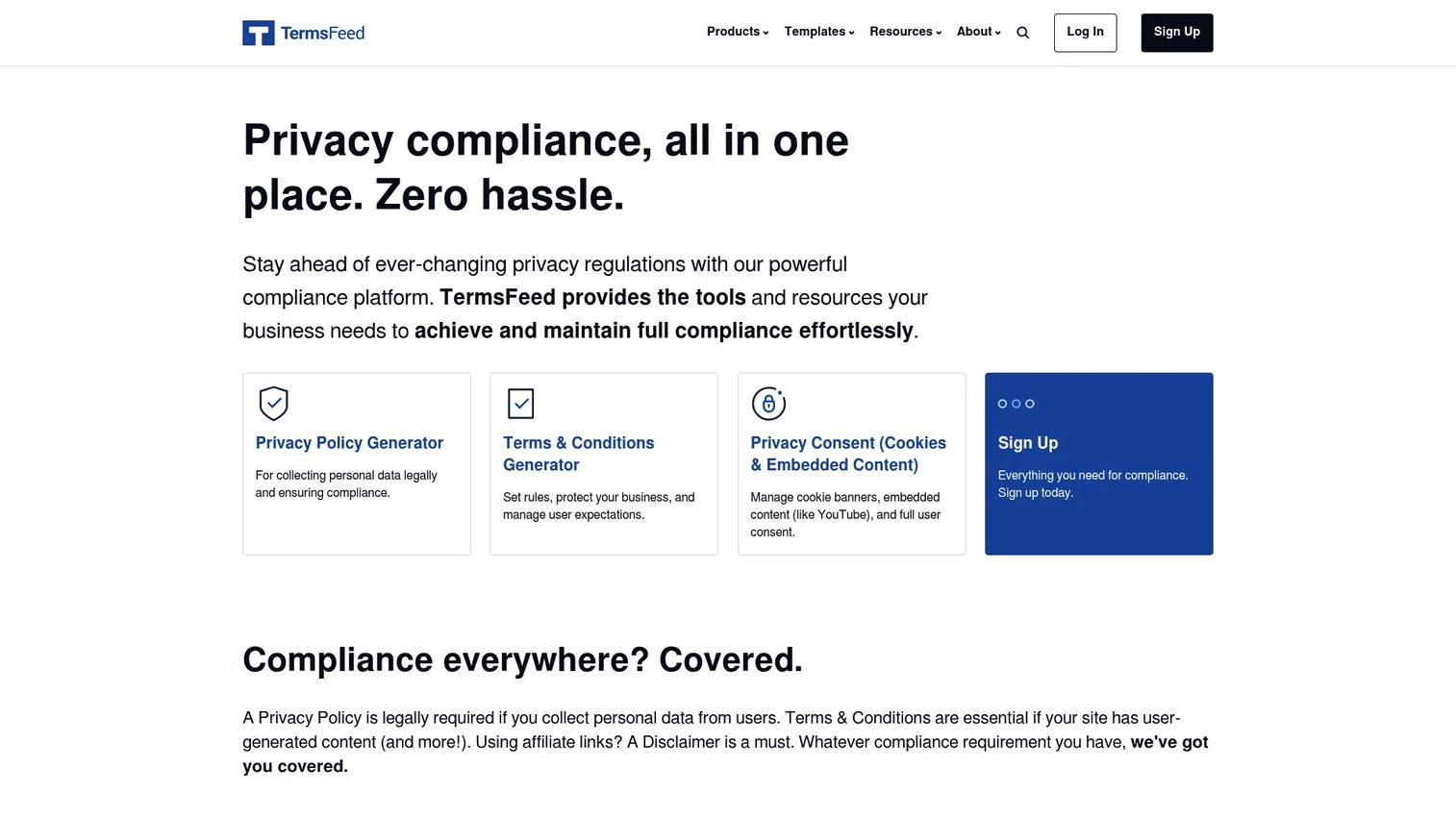
TermsFeed is compliance software for generating and hosting legal agreements, privacy policies, and cookie consent tools. It has helped businesses since 2012, and its standout feature is convenience: you can generate a policy without creating an account, host it on TermsFeed for free, and download it in multiple formats. Beyond privacy policies, it generates Terms & Conditions, EULAs, disclaimers, and return policies, making it a practical hub for the full set of legal documents a business needs.
Best for: Teams that want flexible output, free hosting, and a no-account workflow for generating multiple legal documents fast.
Key strengths
- Free hosting and multi-format export: Host your policy on TermsFeed for free, or download it as HTML, DOCX, plain text, or Markdown to publish wherever you want.
- No-account convenience: Generators that create a custom policy can be used without signing up, which removes friction when you just need a document quickly.
- Privacy Consent platform: Beyond static policies, the Privacy Consent product manages cookies, scripts, and embeds while staying compliant with GDPR, CCPA, CPRA, and other laws.
Why choose TermsFeed: TermsFeed fits teams that value flexibility and a simple publishing flow. The combination of free hosting and multi-format export means you are never locked into one way of using your policy, whether you embed the privacy policy on your site or paste the Markdown into a docs repository. The wider generator suite makes it efficient for businesses that need several agreements covered in one place.
TermsFeed pricing: The Free Policy option is 100% free for generating a privacy policy. TermsFeed's Privacy Consent product is offered at $10.00 per month or $100.00 per year. Individual agreements and policies are described as one-time payments only, with specific premium document add-ons listed on the pricing page rather than a single bundled subscription. Pricing was verified from TermsFeed's own pricing page as of June 2026.
3. PrivacyPolicies.com
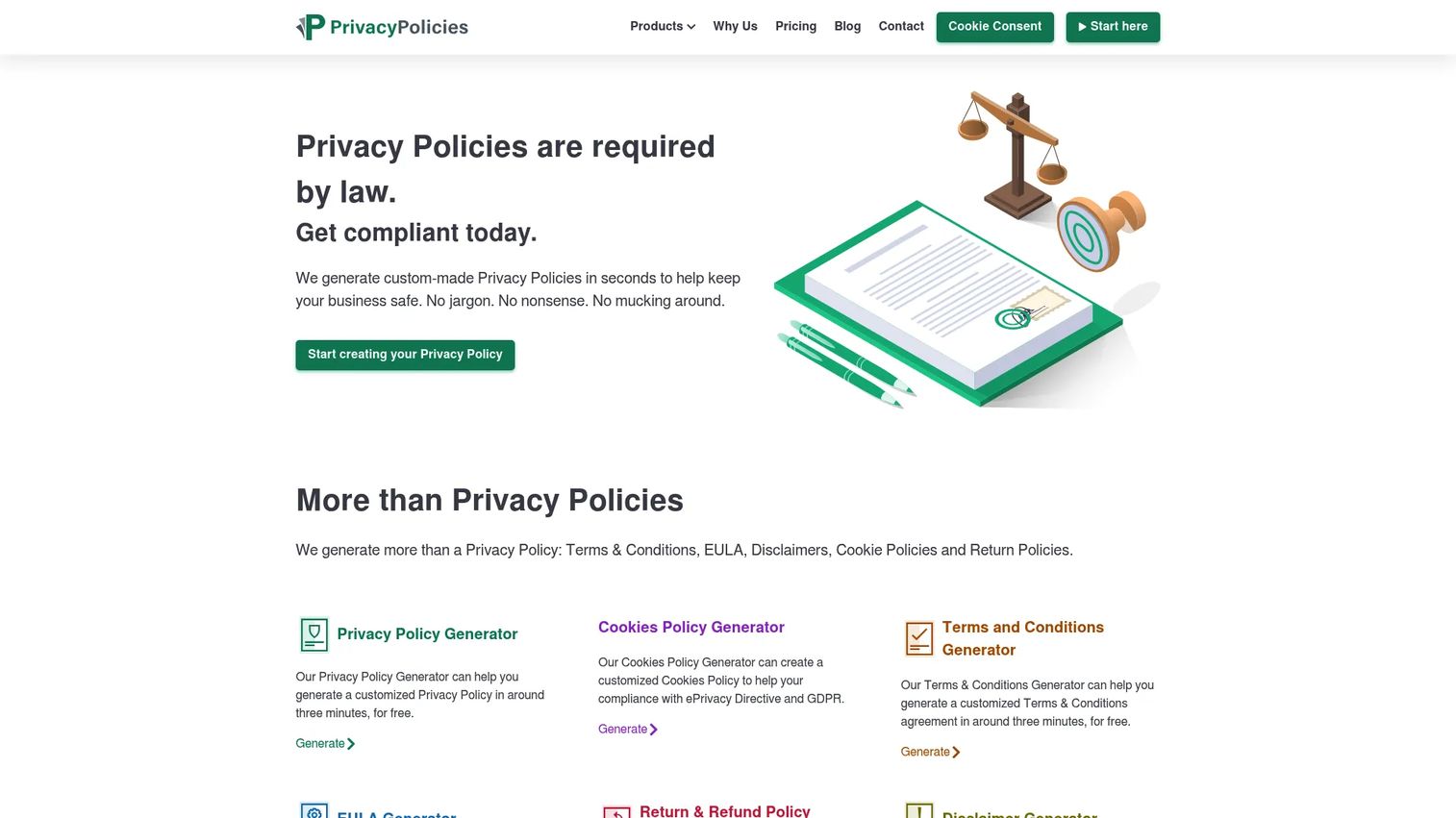
PrivacyPolicies.com is an online legal-document generator focused on speed and breadth. It produces a free privacy policy quickly, then extends well beyond it, generating Terms & Conditions, EULAs, disclaimers, cookie policies, and return policies. For businesses that want to cover multiple legal bases from one place without overthinking the process, the speed-first positioning is the draw.
Best for: Businesses that need a quick, free privacy policy generator with the option to add more legal documents as they grow.
Key strengths
- Speed-first generation: The questionnaire is short and the output is fast, getting you from start to published policy with minimal steps.
- Compliance breadth: Generated policies are built to address major privacy laws, so the output covers the core requirements most businesses face.
- Wider policy suite: Beyond privacy policies, the tool generates Terms & Conditions, EULAs, disclaimers, cookie policies, and return policies from one place.
Why choose PrivacyPolicies.com: This is the pick when speed and simplicity rank above deep customization. If you want a free policy live today and the option to layer on additional documents later, the broader suite makes it a convenient one-stop generator. It works well for small businesses and side projects that need credible coverage without a heavy setup process.
PrivacyPolicies.com pricing: The core privacy policy generator is free, with free hosted pages and downloads available. Premium clauses and add-ons are sold as one-time fees rather than a recurring subscription, with the specific charges listed on the pricing page. There are no recurring fees stated for the premium documents. Pricing was verified from the brand's own pricing page as of June 2026.
4. App Privacy Policy Generator
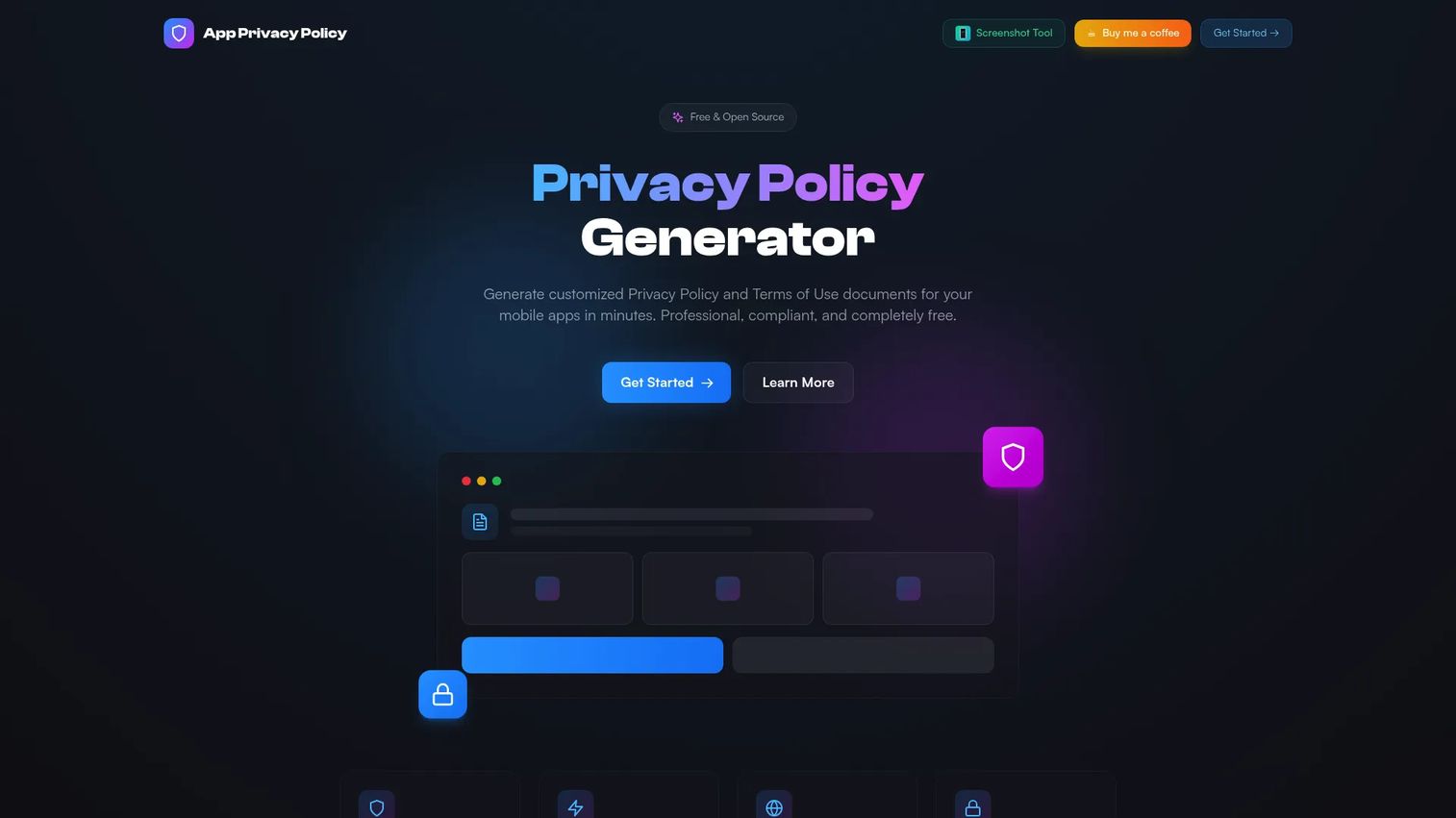
App Privacy Policy Generator is a free web tool built specifically for generating privacy policies and terms of use for mobile apps. It is lightweight, community-trusted, and aimed squarely at developers who want something fast and free without an account or a sales process. The tool supports more than 30 services and SDKs, including Firebase, AdMob, and Facebook, which is exactly what app developers need when their data collection runs through third-party libraries.
Best for: Indie app developers who need a free, fast privacy policy generator that understands mobile SDKs.
Key strengths
- App-specific generation: Built for mobile apps, it accounts for the SDKs and services apps actually depend on rather than treating an app like a website.
- Broad SDK support: Covers 30-plus services such as Firebase, AdMob, and Facebook, so policies reflect the third parties in your build.
- Free and open: The tool is 100% free with no hidden costs or subscriptions, with open-source provenance that appeals to developers who value transparency.
Why choose App Privacy Policy Generator: For developers shipping to the App Store or Google Play, this tool removes the friction of getting a compliant privacy policy URL without paying or signing up. It claims GDPR and CCPA compliance and is purpose-built for the app use case, which makes it a clean fit for indie projects and small app teams. It is a lightweight generator, so businesses with complex data-processing needs or governance requirements may eventually outgrow it, but for getting an app published it does the job.
App Privacy Policy Generator pricing: The tool is 100% free with no hidden costs or subscriptions, according to its homepage. There is no paid tier or numeric price listed. Pricing was verified on the first-party site as of June 2026.
How to choose the right privacy policy generator
The tools above all generate a privacy policy, but they optimize for different priorities. Use this checklist to match a generator to your situation.
Compliance coverage
Confirm the tool covers the laws you actually fall under. If you serve EU users, you need GDPR and likely UK GDPR. If you have California customers, CCPA and CPRA matter. Canadian users bring PIPEDA into scope. Do not assume a generic policy covers everything, check the specific jurisdictions before you commit.
Update handling
A privacy policy is not a one-time artifact. Laws change, you add new vendors, and your data practices evolve. Look for automatic updates and policy update notifications so your document stays current without manual rewriting. This is the single biggest difference between a tool you set once and a policy that quietly drifts out of compliance.
Output and hosting
Decide how you want to publish. Free hosting and a ready-made privacy policy URL save time if you do not want to manage the file yourself. Multi-format export gives you control if you prefer to embed the privacy policy directly or host it on your own domain. Match the export and hosting options to how your stack actually works.
Customization depth
A policy that does not reflect your real data practices is a liability, not protection. Verify the generator asks about your specific third-party services, analytics tools, and payment processors, and that business-type tailoring exists for your platform, whether that is a website, app, ecommerce store, or SaaS product.
Trust signals
For a document with legal weight, provenance matters. Lawyer-vetted clauses, named legal experts, or open-source transparency all signal that the output was built with care rather than scraped from a template. Weigh these signals heavily when the policy will face app store review or regulatory scrutiny.
Conclusion
The best privacy policy generator depends on what you are protecting and how fast you need it. Termly is the strongest all-around pick for teams that want lawyer-vetted policies, automatic updates, and coverage across websites, apps, ecommerce, and SaaS in one platform. TermsFeed is the choice when free hosting and multi-format export matter most, especially with its no-account workflow. PrivacyPolicies.com wins on speed and a broader document suite for businesses that want to cover several legal bases quickly. And App Privacy Policy Generator is the clean, free fit for indie developers shipping a mobile app.
Your next step depends on urgency. If you need a policy live today, start with the free tier of whichever tool matches your platform, answer the questionnaire honestly about your data practices, and publish the hosted URL or embed the policy where users can find it. Then set a reminder to revisit it whenever your stack or the law changes, or pick a tool whose automatic updates handle that for you. A compliant privacy policy is not a one-time task, it is something you keep current, and the right privacy compliance tool makes that maintenance close to invisible.
FAQs
Privacy policy generator software is a tool that produces a customized privacy policy by asking structured questions about how your business collects, uses, and shares personal data. It automates the drafting and legal structure, mapping your answers to the right clauses for your platform and jurisdictions. It does not replace a lawyer's judgment on complex edge cases, and it does not remove your responsibility to keep the policy accurate as your practices change.
For many small businesses, a free privacy policy generator is enough to produce a compliant starting point, especially if your data collection is straightforward and limited to common tools like analytics and contact forms. Free is acceptable when the generator covers your jurisdictions and lets you customize for your actual third-party services. Legal review is still wise if you handle sensitive data, operate across multiple regions, or have complex data-sharing arrangements that a template may not capture.
For GDPR, the policy should cover what personal data you collect, your legal basis for processing, how long you retain it, who you share it with, and the rights users have to access, correct, and delete their data. For CCPA and CPRA, it should disclose the categories of data collected, the purposes, any sale or sharing of data, and the right to opt out. A strong generator maps these jurisdiction-specific clauses automatically based on where your users are located.
On a website, the privacy policy belongs in the footer as a persistent link, plus anywhere you collect data such as signup forms, checkout, and account screens. On a mobile app, place the privacy policy URL in your App Store or Google Play listing, your in-app settings, and any onboarding or account screen where users share data. Accessible placement is both a legal expectation and a trust signal, so make it easy to find on every surface.
You can use one policy if your website and app collect and process the same data in the same ways, but most businesses need tailored language for each. Apps collect data websites do not, such as device identifiers, location, and SDK-driven analytics, and app stores expect the policy to reflect those specifics. The safest approach is a single policy with clearly separated sections for web and app data practices, or two distinct policies if the differences are significant.
Update your privacy policy whenever your data practices change, you add or remove a third-party vendor, or a relevant law is enacted or amended. At a minimum, review it once a year even if nothing obvious has changed. Tools with automatic updates and policy update notifications handle much of this for you by adjusting the underlying clauses when regulations shift, which is why update handling is one of the most valuable features to look for in a generator.