

A borrower fills out your application on a Tuesday. By Friday, three people have re-keyed the same data into three systems. The credit pull is stuck in someone's inbox. The compliance check is a spreadsheet that one person owns. And the borrower has already applied somewhere else.
That is what manual loan origination looks like at volume. It works when you close ten loans a month. It breaks the moment you try to close a hundred, add a second product line, or open a new branch.
The category exists to fix this. And the money is following it. The global loan origination software market was valued at $4.8 billion in 2022 and is projected to reach $12.2 billion by 2032 at a 10.2% CAGR, according to Allied Market Research (2023). Banks alone are projected to hold over 43% of that market by 2030, per ResearchAndMarkets (2024).
If you run a lending operation, or you are a founder evaluating whether lending infrastructure can scale without your involvement in every deal, the platform you pick decides how repeatable your process becomes. This guide compares seven options so you can shortlist fast.
What's inside
This guide compares seven loan origination software platforms built for banks, credit unions, mortgage lenders, and multi-loan lending teams. It is a neutral comparison, not a vendor pitch.
We selected and ranked tools on four criteria that matter when lending has to scale:
- Workflow coverage: intake through underwriting, approval, closing, and funding
- Compliance and audit controls: traceable steps, permissions, identity and fraud checks
- Integrations: core banking, credit bureaus, e-signature, identity, and document services
- Scalability and configurability: how easily the system flexes across products and volume
You will see which platforms suit consumer lending, mortgage, business lending, and multi-loan environments, plus a comparison table and pricing where it is public.
TL;DR
- Best for banks and credit unions with credit-risk needs: Abrigo, which pairs lending with risk, CECL, and financial-crime tooling
- Best for full credit-lifecycle workflow: CGI Credit Studio, a cloud-native platform covering origination through collections
- Best for configurable, transparent pricing: DigiFi, with a published monthly platform fee and modular add-ons
- Best for mortgage-first lenders: Encompass, the long-standing standard for end-to-end mortgage origination
- Best for unified digital lending: Blend, focused on account opening and borrower experience
- Best for broad platform coverage: Finastra, spanning lending, payments, and core banking
- Best for no-code lending startups: LendAPI, with published tiers and a free trial
What is loan origination software?
Loan origination software is the system that manages a loan from application intake through underwriting, approval, closing, and funding. It is the operational backbone that replaces spreadsheets, email threads, and manual re-keying with a single tracked workflow.
A loan origination system, sometimes shortened to LOS, coordinates the people, documents, and decisions involved in getting a loan approved and funded. A loan origination platform typically bundles this with decisioning, integrations, and borrower-facing tools.
Core capabilities of loan origination software include:
- Application capture: digital intake for consumer, mortgage, or business loans
- Decisioning: rules, scoring, and automated or assisted underwriting
- Document collection: requesting, storing, and verifying borrower files
- Compliance checks: identity verification, fraud screening, and disclosures
- Task routing: assigning work across teams, branches, and roles
- Integrations: connectors to core banking, credit bureaus, and e-signature
- Borrower communications: status updates, requests, and closing coordination
Loan underwriting software often sits inside the LOS as the decisioning layer, applying credit policy and verification rules to each application. Loan application software refers to the borrower-facing front end where the process begins.
One distinction matters. Loan origination software handles everything up to and including funding. Loan servicing software takes over after the loan is booked, managing payments, statements, escrow, and the ongoing life of the loan. A few vendors span both, but most specialize in one side.
When to use loan origination software
Replace spreadsheets and email chains
Manual handoffs work at low volume. They fall apart when loan volume rises or you add product complexity. Every re-keyed field is a chance for error, and every email thread is a task that can go missing.
A loan origination system puts intake, documents, and approvals in one place. It reduces processing friction, cuts duplicate data entry, and makes missed tasks visible before they become stalled applications.
Standardize multi-step underwriting
When rules, verification, and approvals need to be consistent across teams, branches, or product lines, a manual process cannot hold the line. One reviewer applies the policy one way, another applies it differently, and audit exposure grows.
Automated loan origination systems enforce consistent decisioning and task orchestration. Underwriting rules run the same way every time, verification steps are logged, and approvals follow a defined path regardless of who touches the file.
Improve borrower experience
Digital applications and mobile-first flows reduce abandonment. A borrower who can start on their phone, upload documents without a branch visit, and see status in real time is a borrower who finishes.
The digital borrower experience connects directly to conversion. Application completion rates rise when the process is clear and fast. That is not a soft benefit. The global digital lending platform market was $10.55 billion in 2024 and is projected to reach $44.49 billion by 2030 at a 27.7% CAGR, per Grand View Research (2024).
Support compliance and audit readiness
Regulated lenders need traceable workflows. Auditors want logs, identity checks, and evidence that every application followed policy. A cloud-based loan origination system that records every step turns audit prep from a fire drill into a report you can pull on demand.
Identity verification, fraud screening, and role-based permissioning are not optional for bank loan origination software. They are the difference between operational confidence and a compliance finding.
Comparison table
This table compares the seven loan origination software vendors by fit, differentiation, pricing, and G2 rating. Pricing is shown where it is public on the vendor's own site. Where a vendor uses quote-based or success-based pricing, that is noted.
| # | Product | Best for | Key differentiator | Pricing | G2 rating |
|---|---|---|---|---|---|
| 1 | Abrigo | Banks and credit unions needing risk plus lending | AI-powered lending with integrated credit risk, CECL, and financial-crime tooling | Quote-based | 4.6/5 |
| 2 | CGI Credit Studio | Lenders modernizing the full credit lifecycle | Cloud-native credit management from origination to recovery | Quote-based (SaaS model) | Not rated on G2 |
| 3 | DigiFi | Configurable origination and account opening | Published monthly platform fee with modular AI add-ons | From $3,995/month | 4.8/5 |
| 4 | Encompass | Mortgage-first lenders | End-to-end mortgage origination on a single system of record | Success-based pricing | 4.2/5 |
| 5 | Blend | Unified digital account opening and lending | Digital origination with a borrower-experience focus | Quote-based | Not verified |
| 6 | Finastra | Institutions spanning multiple lending segments | Universal banking, lending, and payments in one ecosystem | Quote-based | 3.2/5 |
| 7 | LendAPI | No-code lending and onboarding for startups | No-code product builder with published tiers and a free trial | From $999/month | 5.0/5 |
Best loan origination software for 2026
1. Abrigo
Abrigo is a software provider for banks and credit unions focused on lending, financial crime, risk, and analytics. Where many origination tools stop at intake and decisioning, Abrigo ties the loan workflow directly to credit risk and compliance tooling. That makes it a strong fit for institutions that treat lending and risk as one problem, not two.
The platform covers commercial and consumer lending with automation that reduces manual work across the credit workflow. Because the same vendor also handles AML/BSA, fraud prevention, portfolio risk, and CECL, teams get a connected view of lending decisions and their downstream risk exposure.
Best for: Banks and credit unions that need integrated risk, compliance, and lending software in one place.
Key strengths
- AI-powered lending and credit risk workflows
- AML/BSA and fraud prevention software
- Portfolio risk, CECL, and banking intelligence tools
Why choose Abrigo: If your institution already owns credit risk and financial-crime obligations, running origination inside the same vendor reduces the number of systems your compliance team has to reconcile. It fits credit-risk-led lenders more naturally than a front-end-only tool.
Abrigo pricing: Abrigo does not publish pricing on its site. Pricing appears to be quote-based, so plan to request a scoped proposal.
2. CGI Credit Studio
CGI Credit Studio is cloud-native credit management software covering origination, decisioning, collections, and recovery. It targets banks and lenders modernizing credit operations across the full credit lifecycle, not just the front end. If your pain is a legacy origination process bolted to separate collections and recovery systems, a single lifecycle platform changes the math.
The product includes loan origination and onboarding, a real-time decision engine, and pre-collections, collections, and recovery workflows. CGI describes it as a cloud-based SaaS model with predictable pricing and pay-as-you-go flexibility, which suits institutions that want a modern deployment posture without heavy on-premise overhead.
Best for: Banks and direct lenders modernizing credit operations across the entire lifecycle.
Key strengths
- Loan origination and onboarding
- Real-time decision engine
- Pre-collections, collections, and recovery
Why choose CGI Credit Studio: The full-lifecycle coverage is the differentiator. Teams that want origination, decisioning, and recovery under one cloud-native platform reduce the number of handoffs between separate systems. It fits enterprise-grade workflow orchestration.
CGI Credit Studio pricing: CGI describes a cloud-based SaaS model with predictable pricing and pay-as-you-go flexibility, but does not publish specific numbers. Request a quote for your volume and lifecycle scope.
3. DigiFi
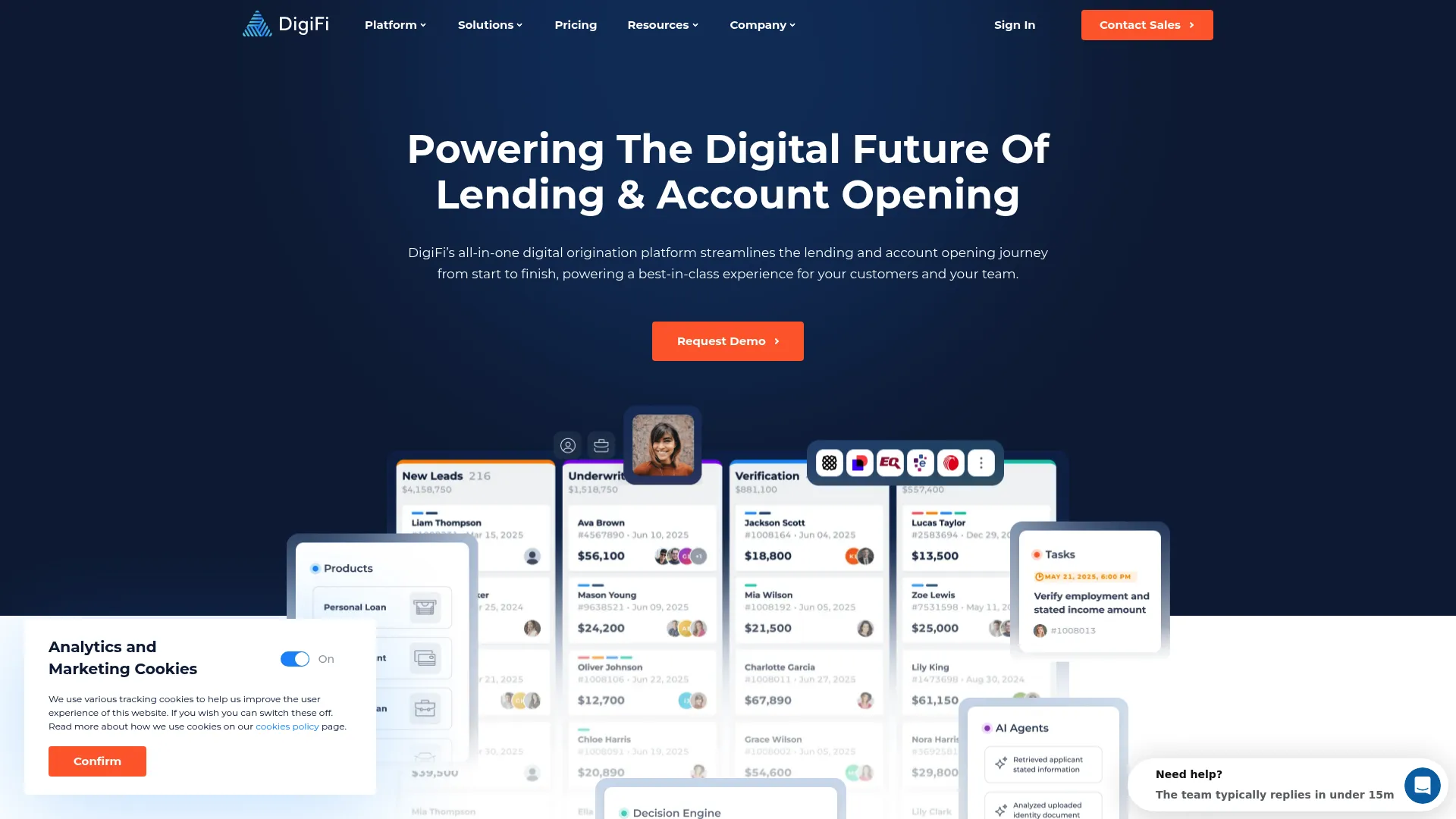
DigiFi is an all-in-one digital origination platform for lending and account opening. It is built for banks, credit unions, and lenders that want configurable workflows without building a system from scratch. The appeal for a founder or ops leader is straightforward: published pricing and a modular architecture make it easy to model cost and scope before committing.
The platform bundles a loan origination system, an account opening system, and a decision engine. That combination lets teams configure lending paths, apply decisioning rules, and open accounts inside one product. AI add-ons handle actions and chat-based assistance on a usage basis, so decisioning and routing can be extended without a rebuild.
Best for: Banks, credit unions, and lenders needing configurable loan origination and account opening software.
Key strengths
- Loan origination system
- Account opening system
- Decision engine
Why choose DigiFi: DigiFi is the pick when transparent, configurable pricing matters as much as the workflow. You get a published monthly platform fee and clear usage-based add-ons, which is rare in this category. It fits teams that want flexibility without a long custom build.
DigiFi pricing: Platform pricing starts at $3,995/month. AI Agent actions are $0.10 each, AI Assistant chat sessions are $1 each, private hosting is $3,995/month, and professional services are $95/hour. There is no free tier, and custom pricing is available for high-volume originators.
4. Encompass
Encompass, from ICE Mortgage Technology, is an end-to-end digital mortgage loan origination platform. It runs mortgage origination on a single system of record, which is why it remains a standard for mortgage-first organizations with mature, established processes. For a lender whose entire book is mortgage, depth matters more than breadth, and Encompass has depth.
The platform provides borrower, TPO, and loan officer workflow tools, plus eClose and integrated data and connectivity. That coverage handles the full mortgage lifecycle from application through closing on one platform, which reduces the reconciliation overhead of stitching mortgage-specific point tools together.
Best for: Mortgage lenders needing a configurable LOS and digital mortgage workflow platform.
Key strengths
- End-to-end mortgage loan origination on a single system of record
- Borrower, TPO, and loan officer workflow tools
- eClose and integrated data and connectivity solutions
Why choose Encompass: If mortgage is your primary or only product, Encompass is the mortgage loan origination software with the deepest workflow maturity and ecosystem. It is built for organizations that already have established mortgage processes and want to run them on a proven single system.
Encompass pricing: ICE references a success-based, pay-per-closed-loan pricing model rather than a public per-seat price. There is no published price on the site, so request a proposal tied to your loan volume.
5. Blend
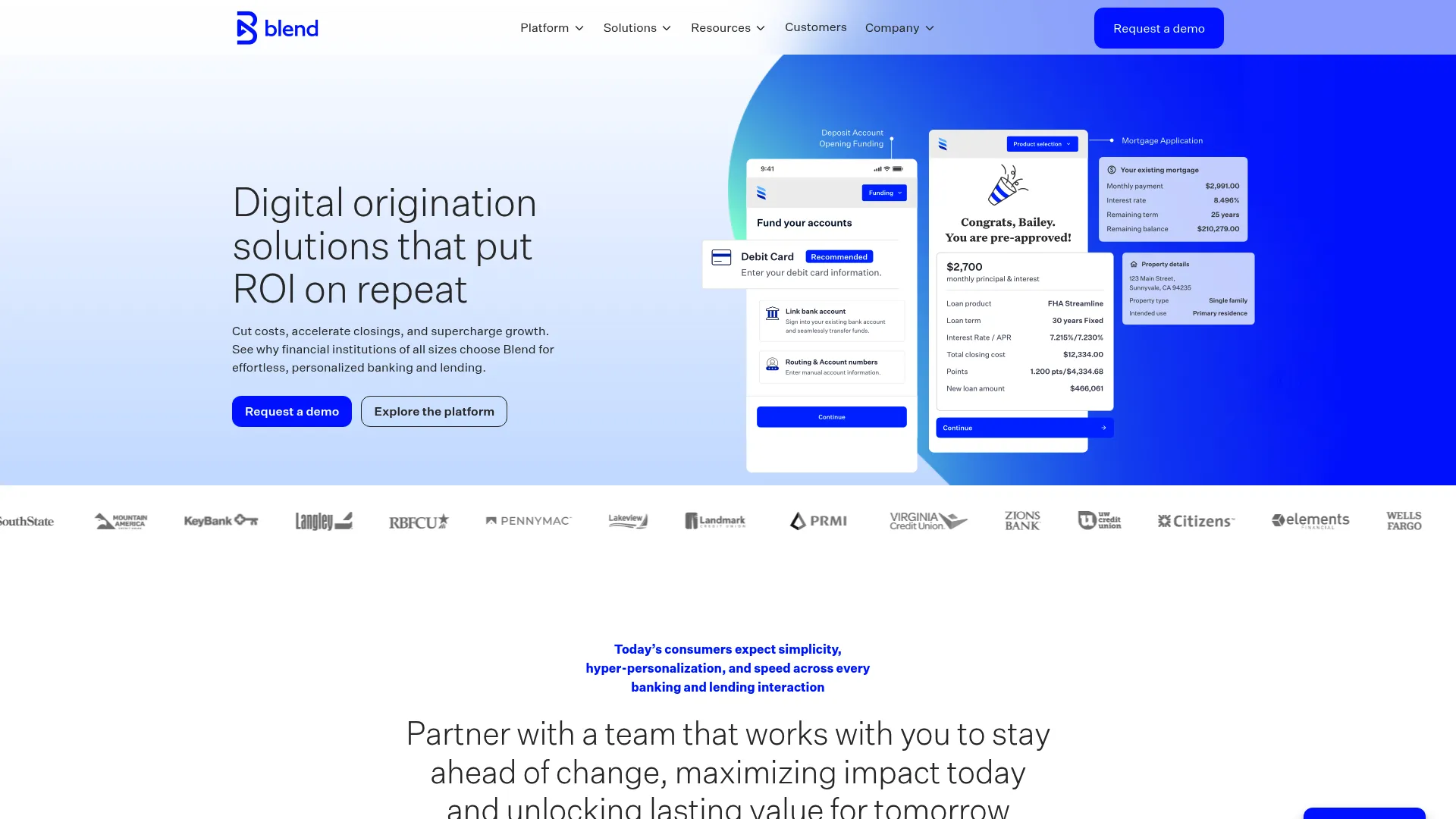
Blend is digital origination software for banks, credit unions, mortgage lenders, and servicers, with a strong focus on the borrower-facing front end. If application abandonment is your problem, Blend is built around the digital account opening and origination experience that keeps borrowers moving through the flow.
The platform covers digital account opening, mortgage origination and closing workflows, and AI-powered intelligent origination. That mix suits teams prioritizing a clean, unified front-end experience across deposit and lending products, where reducing friction at intake translates directly into higher completion.
Best for: Financial institutions that need a digital banking and lending platform with a strong borrower experience.
Key strengths
- Digital account opening
- Mortgage origination and closing workflows
- AI-powered intelligent origination
Why choose Blend: Blend fits when the front-end experience is the priority. Teams that want to reduce application abandonment across account opening and lending get a unified digital layer. Plan for a scoped implementation, since deployment depends on your product mix and integrations.
Blend pricing: Blend does not publish pricing on its site and directs prospects to request a demo. Expect quote-based pricing scoped to your institution and product lines.
6. Finastra

Finastra is a global financial software provider covering banking, lending, payments, and financial messaging. It fits institutions that want multiple lending segments and adjacent capabilities inside one broad ecosystem rather than a single-purpose origination tool. When your roadmap spans lending, payments, and core banking, platform breadth becomes a selection criterion in itself.
The platform includes universal banking software, lending and origination solutions, and payments and financial messaging. That breadth, plus a Solution Store for extending functionality, gives larger institutions room to consolidate several systems with one vendor and build on top of a common architecture.
Best for: Banks and financial institutions modernizing core banking, lending, and payments systems together.
Key strengths
- Universal banking software
- Lending and origination solutions
- Payments and financial messaging
Why choose Finastra: Finastra fits when you are buying platform architecture, not just origination. Institutions that need several lending segments and payments under one ecosystem get extensibility and consolidation. It is a broader bet than a focused LOS, suited to multi-segment operations.
Finastra pricing: Finastra does not publish public pricing on its site. Pricing is quote-based and scoped to the products and modules you deploy.
7. LendAPI
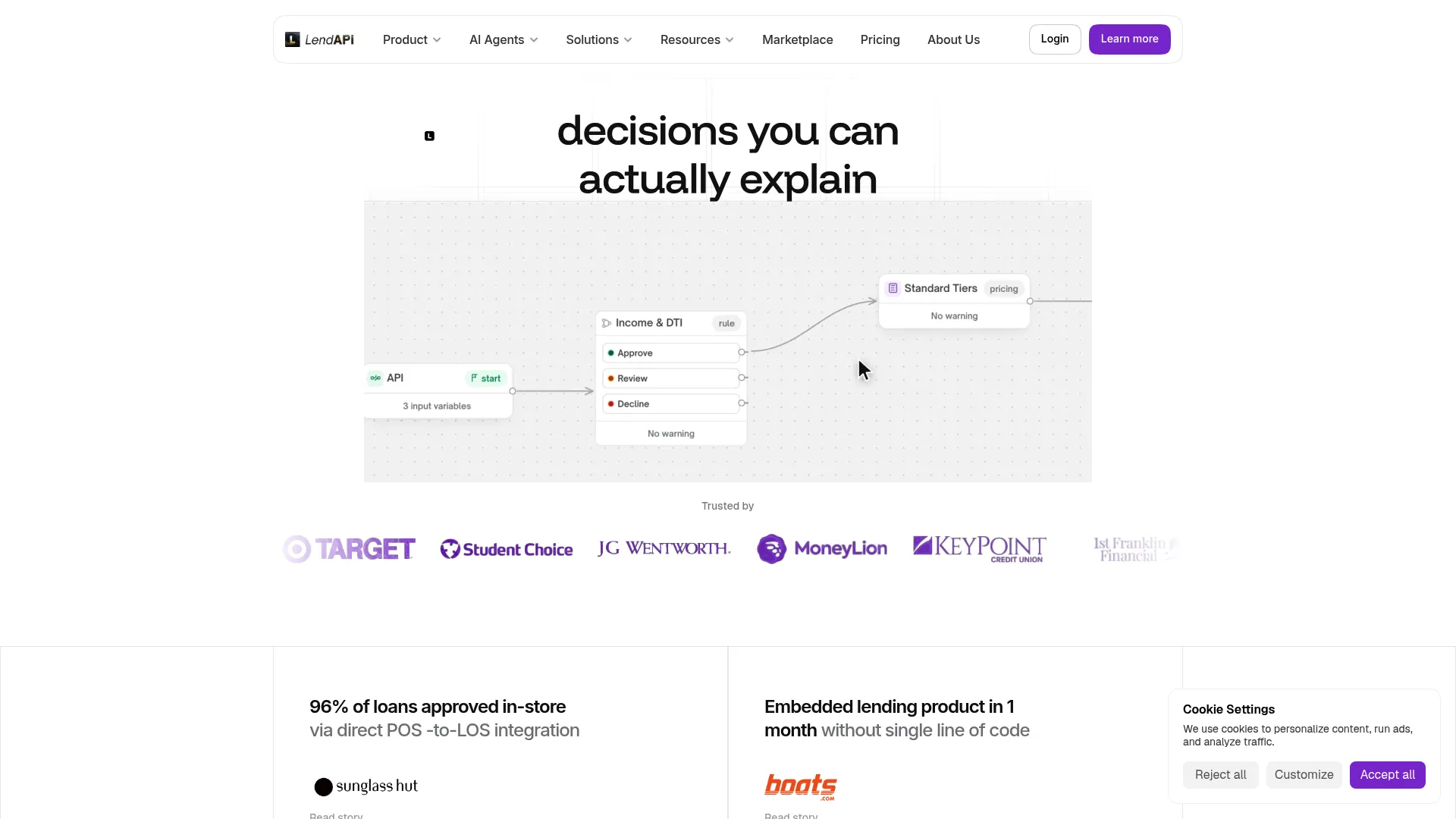
LendAPI is a no-code digital onboarding and lending platform for banks and fintechs. It is built for teams composing modern digital lending experiences without heavy engineering, which makes it a natural fit for startups and product-led lenders. Published tiers and a free trial mean you can start small and prove the workflow before scaling.
The platform centers on a Product Builder (Product Studio), a Decision Engine, and Workflow Orchestration. That toolkit lets teams configure lending products, set decisioning logic, and orchestrate the origination flow through a no-code interface, which shortens the path from idea to a live lending workflow.
Best for: Banks and fintechs launching configurable loan origination and digital onboarding workflows.
Key strengths
- Product Builder / Product Studio
- Decision Engine
- Workflow Orchestration
Why choose LendAPI: LendAPI is the pick for teams that want to build and iterate on lending products without code. The no-code composition, published pricing, and free trial suit startups and product-led lenders testing new digital lending experiences.
LendAPI pricing: Plans are Silver at $999/month, Gold at $1,999/month, and Platinum at $2,499/month, with a custom quote option. A free trial is available.
Considerations
Shortlisting is faster when you evaluate against the same criteria across every vendor. Use this checklist before you sign.
Architecture and deployment model
Decide whether you need cloud-native, cloud-based, or hosted. Cloud-native platforms like CGI Credit Studio tend to update faster and carry lighter IT burden. Deployment model affects how quickly you get new features and how much your team maintains.
Compliance and audit controls
Check for audit trails, identity verification hooks, fraud screening, and role-based permissioning. Regulated lenders need workflow traceability that survives an exam. If a vendor cannot show you the audit log, that is your answer.
Configurability and workflow control
Assess how easily your team changes rules, tasks, and lending paths. Ask whether business users can adjust workflows or whether every change routes through engineering. No-code builders like LendAPI put that control in the hands of the team that owns the process.
Integration depth
Verify connectors and APIs for core banking, credit bureaus, e-signature, identity, and document services. Shallow integration becomes a bottleneck the moment a manual export creeps back into your process. Core banking integration in particular is where deals stall, so pressure-test it early.
Vendor expertise and support
Look for implementation help, lending domain knowledge, customer proof, and responsive support. Software quality is only part of the purchase. A platform that fits your workflow but ships with thin support will cost you more in the first quarter than the license does.
Conclusion
The right loan origination software depends on your lending segment, workflow complexity, and integration strategy. There is no single winner, only the best fit for how you lend.
For banks and credit unions that treat lending and risk as one problem, Abrigo is the strongest fit. For full credit-lifecycle coverage, CGI Credit Studio. If mortgage is your book, Encompass has the deepest workflow maturity. For configurable origination with transparent pricing, DigiFi. For a borrower-first digital front end, Blend. For broad platform architecture across lending and payments, Finastra. And for no-code lending built for startups, LendAPI.
Your next step is simple. Shortlist two or three vendors that match your segment, then compare them head-to-head on workflow fit, compliance depth, and implementation effort. Ask each for a scoped proposal and a deployment plan. The platform that earns its place in your stack in the first quarter is the one that removes manual coordination without adding it back somewhere else.
FAQs
Prioritize workflow coverage from intake through funding, compliance and audit controls, integrations with your core systems, borrower experience, configurability, and vendor support. The right weighting depends on your lending model. A mortgage lender weights workflow depth heavily, while a fintech startup weights configurability and speed to launch.
Loan origination covers everything from the loan application through underwriting, approval, closing, and funding. Loan servicing takes over after the loan is booked, handling payments, statements, escrow, and the ongoing life of the loan. Some vendors span both, but most specialize in one side of that line.
Many modern platforms are cloud-based or cloud-native, which speeds up updates and reduces IT burden. CGI Credit Studio, for example, runs on a cloud-based SaaS model. Deployment models still vary by vendor and by institution requirements, so confirm the posture that fits your security and compliance needs.
Yes, and core banking integration is one of the most important buying criteria. Integration usually relies on APIs, prebuilt connectors, or a partner ecosystem. Because shallow integration becomes a bottleneck fast, verify support for your specific core banking, credit bureau, e-signature, and identity providers before you commit.
Encompass, from ICE Mortgage Technology, is the standard for mortgage-first lenders. It runs end-to-end mortgage origination on a single system of record with borrower, TPO, and loan officer tools plus eClose. Blend is also worth evaluating for mortgage lenders that prioritize the digital borrower experience.
Banks and credit unions typically prioritize compliance, credit risk, and integration depth. Abrigo fits institutions that want lending tied to credit risk and financial-crime tooling. CGI Credit Studio fits those modernizing the full credit lifecycle on a cloud-native platform. Both are built for regulated environments.
AI supports decisioning, underwriting review, document analysis, and workflow acceleration. AI-enabled underwriting can flag risk signals and speed routing, while assistants handle repetitive tasks. Several platforms here, including Abrigo, Blend, and DigiFi, offer AI features. Treat AI as support for your credit policy, not a replacement for it.
Timelines depend on scope, the number of integrations, and how much change management your team needs. A no-code platform with published tiers can go live faster than a multi-segment enterprise deployment. Ask every vendor for a written deployment plan with milestones so you can compare implementation effort before you buy.