Most teams don't have a feedback problem. They have a follow-through problem.
You run the annual survey. Response rates look fine. A slide deck circulates. Then nothing changes, and next year participation drops because employees learned the truth: nobody acted on what they said. The data was collected. The loop stayed open.
That gap is expensive. The global employee feedback and continuous listening market is projected to grow from USD 1.22B in 2026 to USD 2.41B by 2031 at a 14.59% CAGR, according to Mordor Intelligence (2026). Companies are spending more on listening precisely because collecting input is easy and acting on it is hard.
The right employee feedback software narrows that gap. It moves you from one big survey a year to continuous feedback, keeps responses anonymous where trust demands it, and puts insight in front of the managers who actually own the change. This guide compares 15 platforms so you can pick one that turns responses into action, not another dashboard nobody opens.
What's inside
This guide is for HR leaders, people ops teams, and enablement managers building or replacing a feedback stack in 2026. We selected platforms based on four criteria that matter most for programs that actually change behavior:
- Continuous feedback: pulse surveys and always-on listening, not just annual cycles
- Anonymity and trust: anonymous feedback controls that protect participation
- Feedback analytics: sentiment analysis, segmentation, and trend reporting
- Manager follow-up: action plans, prompts, and one-on-one workflows that close the loop
Every tool below solves at least one of these well. Most solve several.
TL;DR
- Best for continuous feedback: Eletive, for science-based pulse surveys, heatmaps, and predictive signals
- Best for enterprise governance: Workday Peakon Employee Voice and Qualtrics, for listening at scale
- Best for AI-assisted writing and coaching: Quantum Workplace and Workleap Officevibe
- Best for performance-connected workflows: Lattice, Leapsome, 15Five, and Engagedly
- Best for simple pulse surveys: TinyPulse, SurveyMonkey, and ThriveSparrow
- Best for recognition-led engagement: Vantage Circle and Motivosity
Pick one continuous-feedback tool, one performance-connected tool, and one lightweight pulse option, then narrow from there.
What is employee feedback software?
Employee feedback software is a category of HR technology used to collect, analyze, and act on employee sentiment through surveys, pulses, and structured feedback workflows. It replaces scattered spreadsheets and one-off annual surveys with a continuous system for measuring engagement and turning responses into decisions.
The category overlaps with employee engagement software and broader employee survey software, but the focus is specific: capture input, surface patterns, and route insight to the people who can act on it.
Core capabilities to expect:
- Anonymous surveys: employee pulse survey software with configurable anonymity so people answer honestly
- Continuous listening: recurring pulses and always-on channels instead of a single yearly cycle
- Analytics and sentiment analysis: heatmaps, trends, benchmarks, and natural language processing on open text
- Action planning and manager follow-up: prompts, development plans, and one-on-one tools that close the loop
- Templates and automation: survey templates, scheduling, and reminders that keep programs consistent
The best platforms treat 360 feedback, pulse surveys, and employee voice workflows as one connected system rather than separate tools. That connection is what moves you from feedback to action.
When to use employee feedback software
Collect feedback continuously
Annual surveys give you one snapshot a year. By the time you read the results, the context has changed and the moment to act has passed. Continuous feedback fixes the lag. Pulse surveys and always-on listening catch shifts in sentiment while you can still respond. About 80% of companies now report that digital feedback tools are a core component of their engagement strategy, according to MarketGrowthReports (2026). The shift toward real-time feedback is already the norm.
Close the loop with managers
Feedback that never reaches a manager changes nothing. The best tools route insight to frontline managers with clear next steps: recommended actions, development plans, and one-on-one prompts tied to what employees actually said. Manager follow-up is where a survey stops being a report and becomes a change. Look for platforms that make the manager the owner of the action, not just the recipient of a dashboard.
Build a feedback culture
Participation is a trust signal. When employees see that feedback leads to visible change, they respond more openly next time. That is a feedback culture: consistent cadence, honest anonymous channels, and a track record of action. It takes change management and clear communication, not just a tool. But the tool makes the cadence and follow-through repeatable instead of dependent on one motivated HR lead.
Comparison table
Read this table top to bottom by fit, not rank. The "Best for" column tells you the primary job each tool is built for. Pricing reflects publicly listed starting points where available; several enterprise platforms are quote-based and list "Contact sales." Use the G2 rating as a directional signal on satisfaction, then verify against your own shortlist.
| # | Product | Best for | Key differentiator | Pricing | G2 rating |
|---|---|---|---|---|---|
| 1 | Eletive | Continuous feedback | Science-based pulses with predictive signals | Contact sales | 4.5/5 |
| 2 | Quantum Workplace | AI-assisted feedback | Continuous feedback plus AI writing support | From $4/employee/mo | 4.3/5 |
| 3 | Workleap Officevibe | Manager follow-up | Pulse surveys with anonymous replies | From $5/user/mo | 4.3/5 |
| 4 | Culture Amp | Enterprise analytics | Employee listening at scale | Request a quote | 4.5/5 |
| 5 | Lattice | Performance-connected feedback | Feedback tied to goals and reviews | From $13/seat/mo | 4.7/5 |
| 6 | Leapsome | Performance plus development | Surveys, reviews, and learning in one | Quote-based | 4.8/5 |
| 7 | Workday Peakon Employee Voice | Enterprise voice programs | Listening at scale with AI theme analysis | Contact sales | - |
| 8 | 15Five | Manager check-ins | Weekly check-ins plus coaching | From $4/user/mo | 4.6/5 |
| 9 | TinyPulse | Simple anonymous feedback | Lightweight anonymous pulses | Contact sales | - |
| 10 | Qualtrics | Advanced research | Deep survey and experience management | Request pricing | 4.4/5 |
| 11 | SurveyMonkey | Flexible survey creation | Templates and distribution at any scale | Free / from $46/mo | 4.4/5 |
| 12 | Engagedly | All-in-one talent | Performance plus engagement plus feedback | From $2/user/mo | 4.3/5 |
| 13 | ThriveSparrow | Pulse plus performance | Modular engagement and feedback | From $2/employee/mo | - |
| 14 | Vantage Circle | Recognition-led engagement | Recognition with pulse surveys | Custom | 4.7/5 |
| 15 | Motivosity | Recognition plus feedback | Peer recognition and culture tools | From $0–$2 PEPM | 4.7/5 |
Best 15 employee feedback software for 2026
1. Eletive
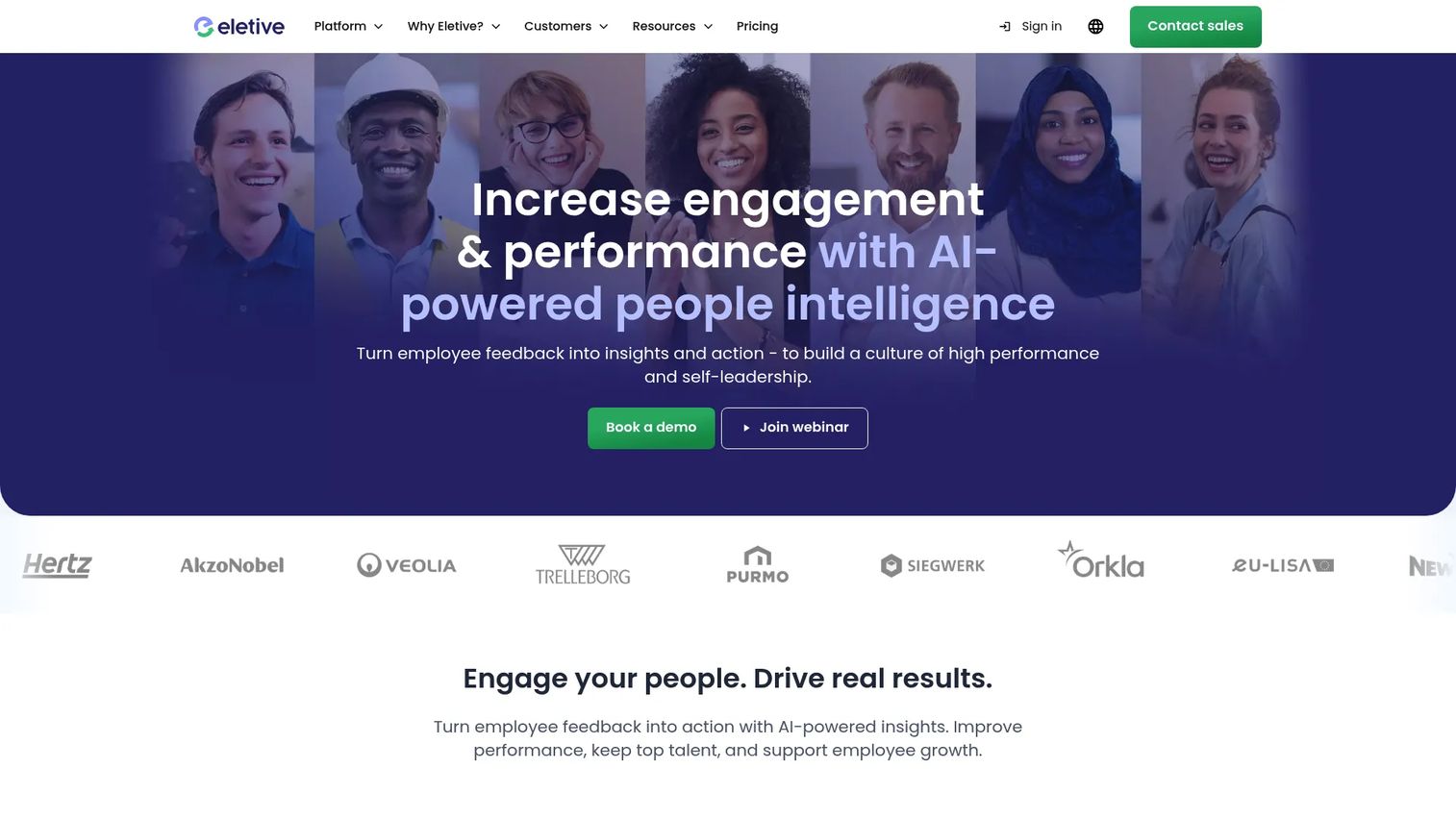
Eletive is an AI-powered people success platform that combines employee engagement, pulse surveys, and performance management in one system. It leans hard into science-based survey design and predictive signals, so people teams see not just where sentiment sits today but where attrition risk is building. Real-time heatmaps and sentiment analysis let you segment by team, location, or role without exporting anything.
Best for: Mid-market and enterprise teams that want continuous feedback and performance management in a single platform.
Key strengths
- Engagement and pulse surveys with science-based templates
- AI-powered analytics, recommendations, and action plans
- Performance and goal management alongside listening
Why choose Eletive: If you want predictive attrition signals and manager-facing action plans in the same place you run pulses, Eletive fits. It suits people teams who treat feedback as an early-warning system, not a yearly report.
Eletive pricing: Three plans are offered: Essential, Standard, and Professional. Pricing is not published publicly; each plan is quote-based through Contact sales.
2. Quantum Workplace
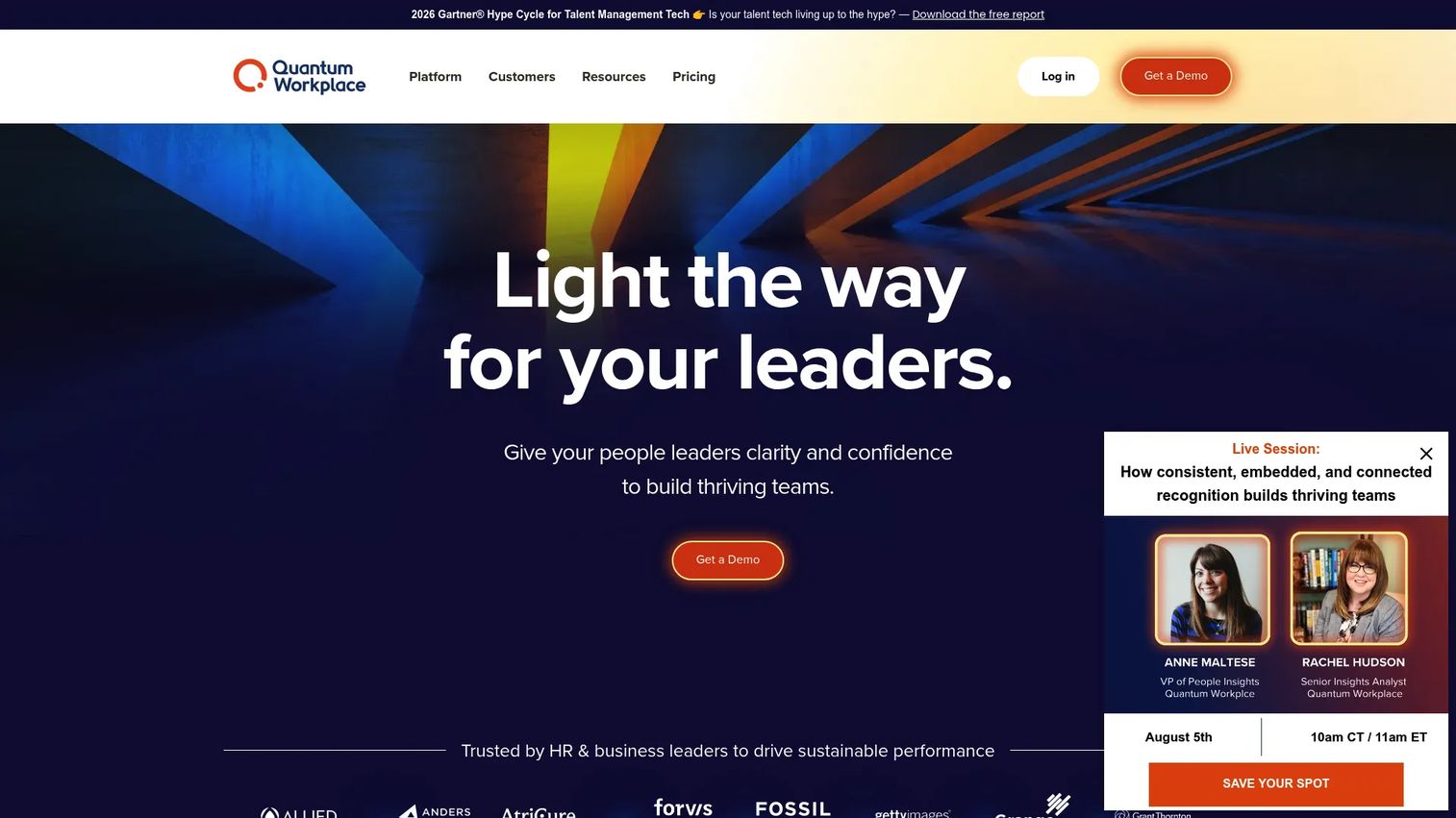
Quantum Workplace is an HR platform spanning engagement, performance, development, and recognition. Its feedback tooling stands out for continuous feedback backed by AI writing assistance, so managers get help drafting responses and action items instead of staring at a blank comment box. Anonymity and attribution controls let you choose when input stays anonymous and when it feeds directly into development conversations.
Best for: Mid-market and enterprise HR teams that want an integrated people insights platform.
Key strengths
- Engagement surveys with AI-supported analytics
- Performance management with goals, feedback, and reviews
- Development and recognition tools in one system
Why choose Quantum Workplace: The AI writing support removes the friction managers hit when they know what employees said but struggle to respond. That is often where follow-through stalls, so this addresses a real bottleneck.
Quantum Workplace pricing: Engagement starts at $4.00 per employee per month and Performance at $5.00 per employee per month. A combined Engagement and Performance bundle is quote-based, and the vendor notes packages start around $15,000 depending on employee count and product mix.
3. Workleap Officevibe
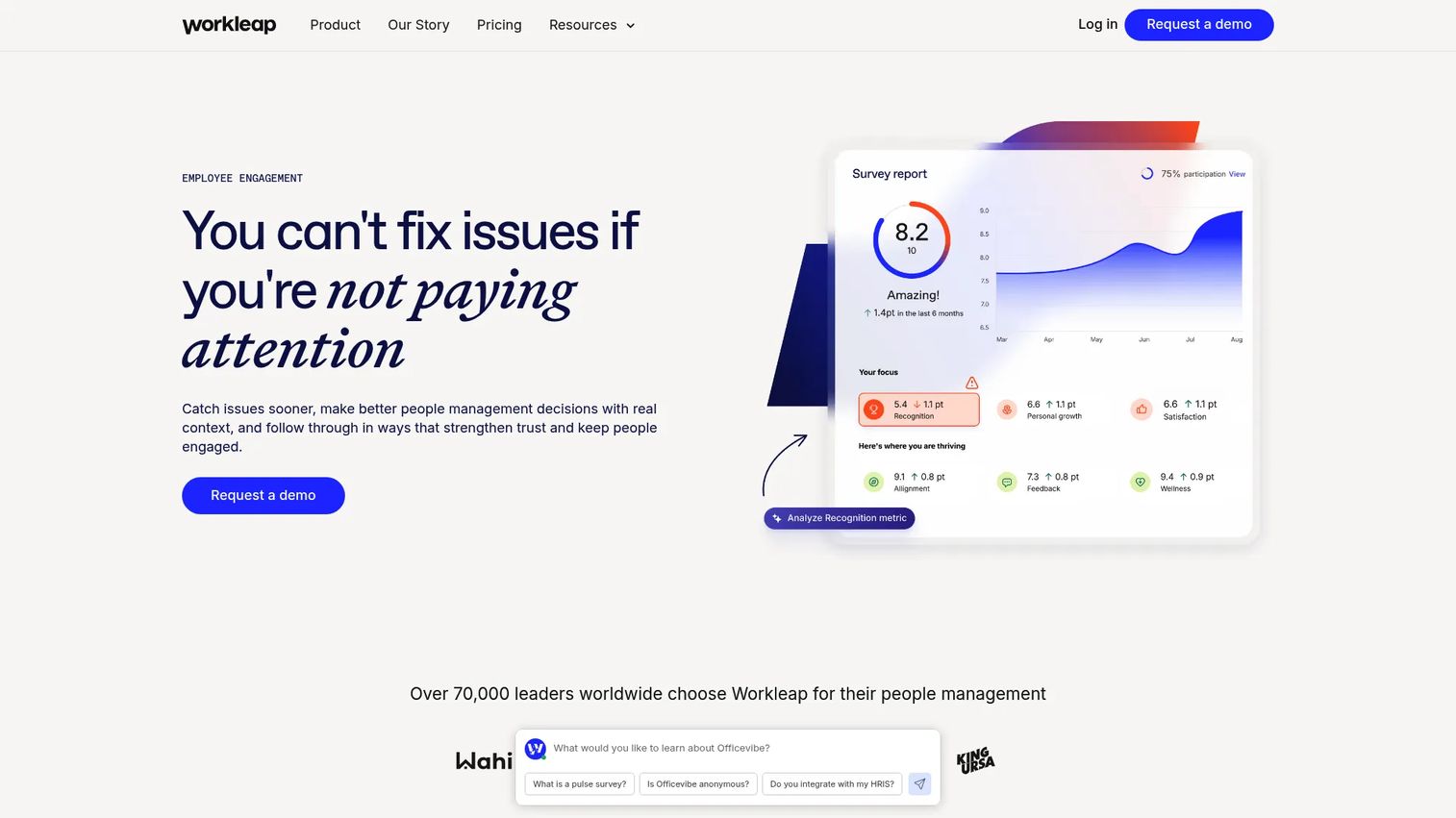
Workleap Officevibe focuses on ongoing employee sentiment tracking with strong anonymous feedback and manager follow-up. Managers get weekly pulse results, can reply to anonymous comments without breaking anonymity, and receive team reports that surface what to act on next. The Good Vibes recognition layer and one-on-one tools keep the cadence human rather than purely analytical.
Best for: HR teams and managers who want continuous sentiment tracking with anonymous feedback and action-oriented reporting.
Key strengths
- Pulse surveys with anonymous feedback
- Anonymous reply threads that protect identity
- Team reports, recognition, and one-on-ones
Why choose Workleap Officevibe: The anonymous reply feature solves a hard problem: how a manager responds to a candid comment without exposing who wrote it. That single capability keeps trust intact while still closing the loop.
Workleap Officevibe pricing: Officevibe starts at $5 per user per month. An Officevibe plus Performance bundle is listed at $9 per user per month, and a free trial is available.
4. Culture Amp
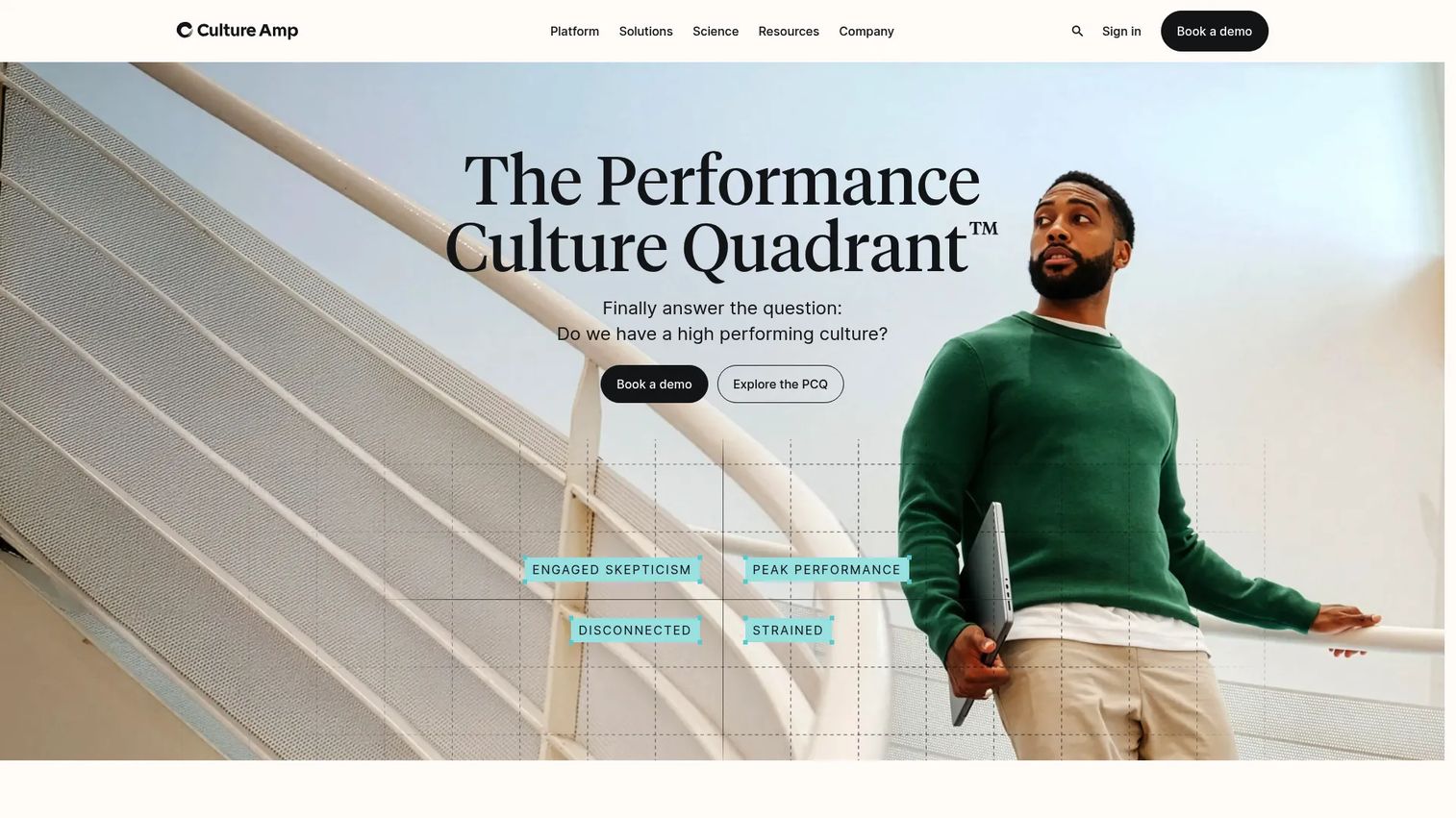
Culture Amp is an employee experience platform built for analytics-heavy programs at mid-market and enterprise scale. Its survey design, benchmarking, and employee listening are the draw for people teams that want depth: calibration, comment analysis, and an AI Coach that helps managers interpret and act on results. Action planning is built in, so insight moves toward follow-up rather than sitting in a report.
Best for: Mid-market and enterprise teams needing engagement and performance management with serious analytics.
Key strengths
- Engagement and pulse surveys with benchmarking
- Performance reviews, feedback, goals, and calibration
- AI Coach and sentiment analysis on open comments
Why choose Culture Amp: If your program lives or dies on analytical credibility, Culture Amp's benchmarking and comment analysis give people teams the evidence to defend recommendations to leadership.
Culture Amp pricing: Plans include Engage, Perform, Develop, and Enterprise, all billed annually. Pricing is quote-based and depends on employee count, product chosen, and service tier.
5. Lattice
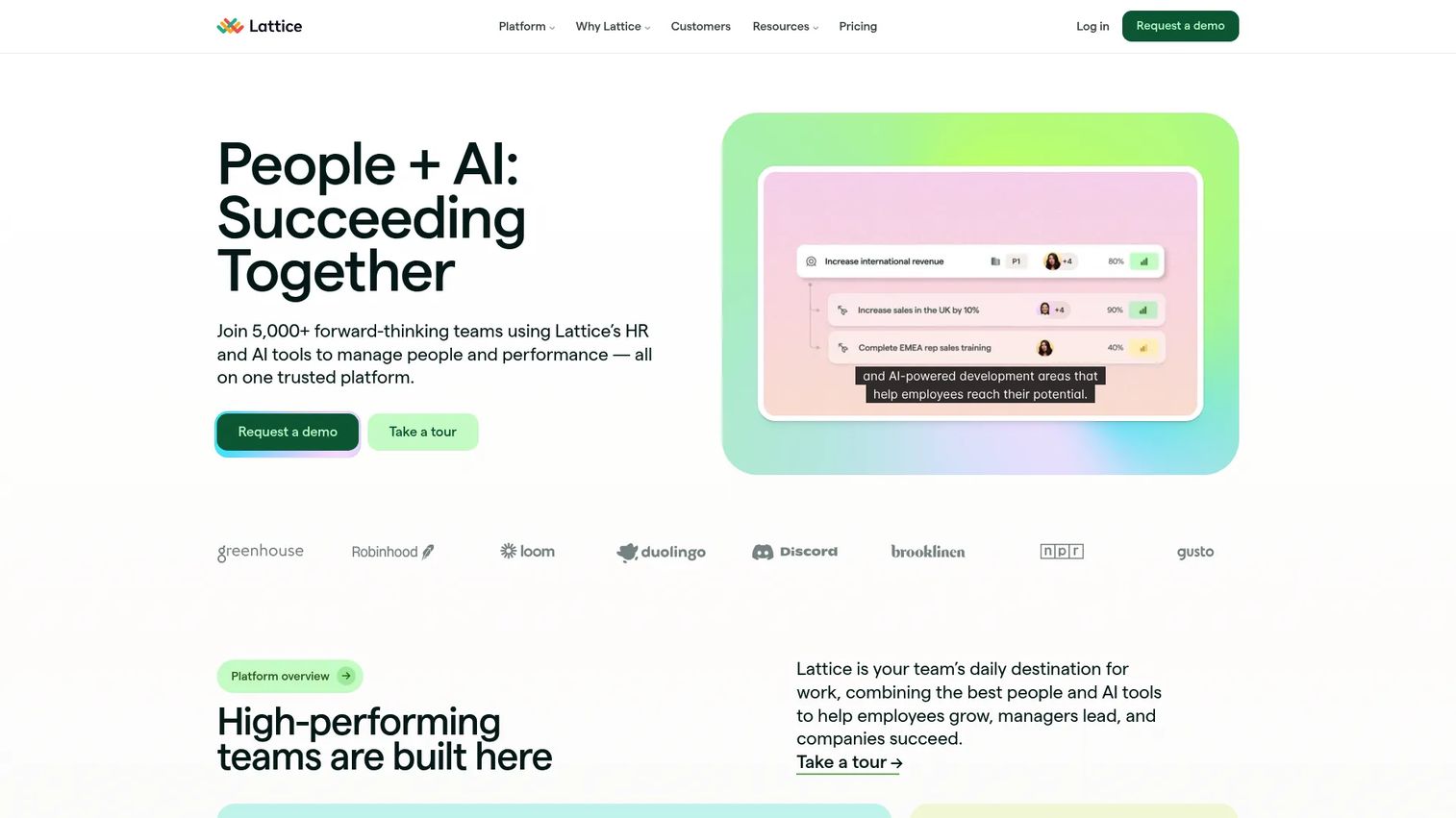
Lattice ties feedback directly to performance, goals, and manager workflows. Continuous feedback lives next to reviews, one-on-ones, and OKRs, so what an employee says in a pulse connects to what a manager coaches on in a review. That adjacency is the point: feedback stops being a standalone HR exercise and becomes part of how managers run their teams.
Best for: Mid-market and enterprise HR teams managing performance and growth alongside engagement.
Key strengths
- Performance reviews and calibration
- Goals, OKRs, and weekly updates
- One-on-ones and continuous feedback
Why choose Lattice: For teams that already run performance in Lattice, adding engagement keeps feedback and follow-up in one workflow instead of forcing managers into a separate survey tool.
Lattice pricing: The Foundations plan starts at $13 per seat per month, billed annually. Individual products are also priced separately: Performance at $10, Goals and OKRs at $8, and Engagement at $4 per seat per month, with Compensation and Grow add-ons available.
6. Leapsome
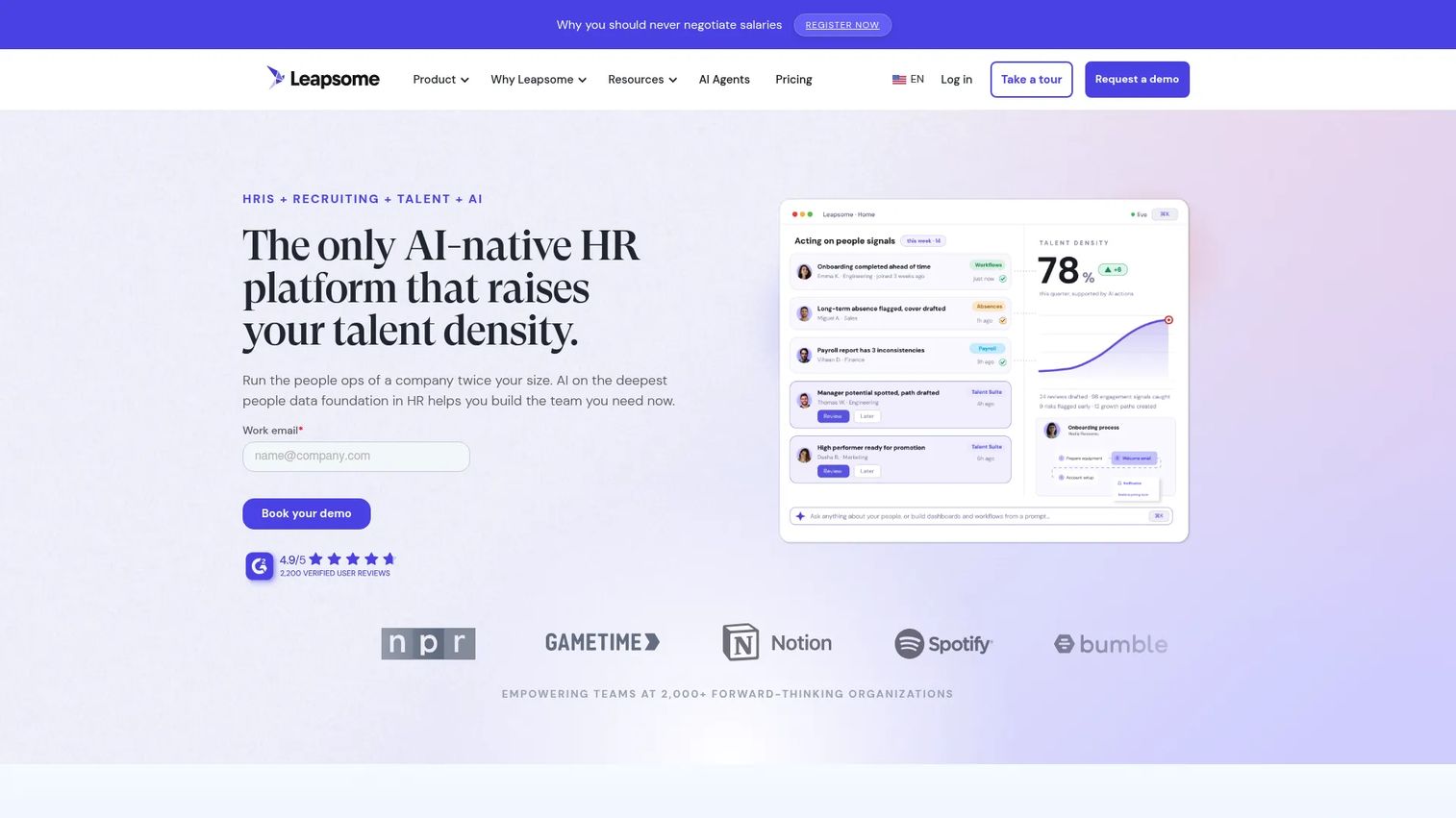
Leapsome is an AI-powered people platform spanning performance, engagement, learning, and HRIS. Its feedback tooling connects surveys to goals, reviews, and learning paths, so a signal from an engagement survey can trigger a development action rather than stopping at a chart. The AI-powered feedback and analytics help managers move from reading results to running the next conversation.
Best for: Mid-market and enterprise people teams wanting performance, engagement, learning, and HRIS in one platform.
Key strengths
- HRIS with onboarding, records, and workflows
- Automated reviews with AI feedback and analytics
- Talent suite across goals, surveys, and learning
Why choose Leapsome: The tie between surveys and learning modules is unusual. If your feedback program is meant to drive development, not just measure mood, that connection matters.
Leapsome pricing: Pricing is modular and per-employee, quote-based depending on modules, employee count, and contract length. Leapsome offers a 14-day free trial with no setup fee and a one-year minimum term.
7. Workday Peakon Employee Voice
Workday Peakon Employee Voice is AI-powered employee listening built for large enterprise voice-of-employee programs. It captures real-time feedback, applies NLP theme analysis to open comments, and surfaces recommended actions for both managers and employees. Benchmarking and predictive analytics make it a fit for organizations running listening across thousands of people who need consistent action management at scale.
Best for: Large organizations that want continuous employee listening and engagement analytics.
Key strengths
- Real-time feedback and sentiment insights
- Manager and employee dashboards with recommended actions
- Benchmarking, predictive analytics, and AI theme analysis
Why choose Workday Peakon Employee Voice: For enterprises already in the Workday ecosystem, listening data connects to the broader HR system of record. The recommended-action layer keeps managers focused on follow-up rather than interpretation.
Workday Peakon Employee Voice pricing: Public pricing is not listed; the product is sold through a demo and sales conversation. Pricing depends on organization size and scope.
8. 15Five
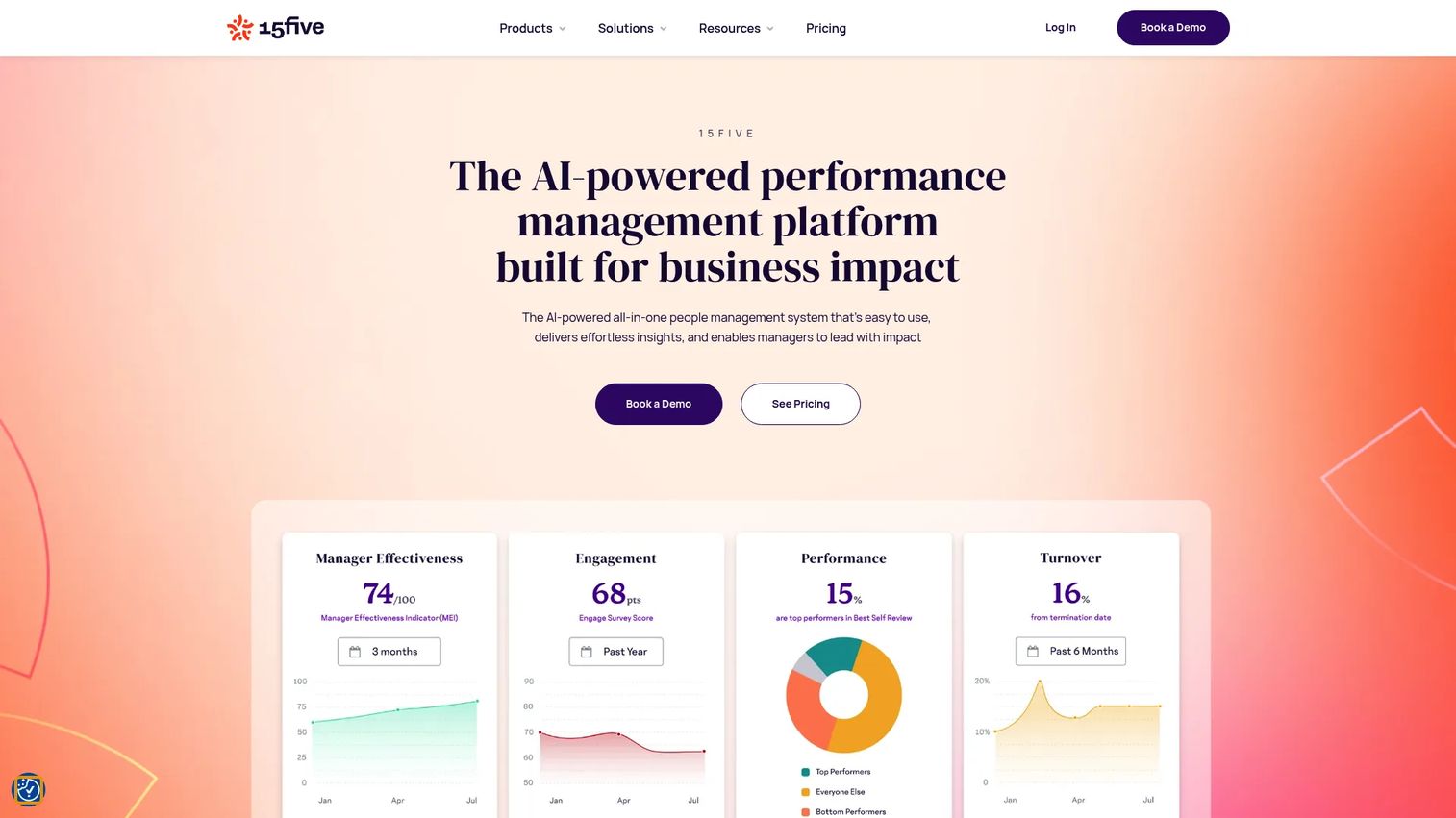
15Five built its reputation on weekly manager check-ins and a cadence of continuous feedback. Employees answer short weekly questions, managers see patterns, and coaching tools help turn signals into conversations. Engagement surveys, performance reviews, and OKRs round out a platform aimed at manager effectiveness rather than just measurement.
Best for: Mid-market teams wanting engagement, performance, and manager-effectiveness tools in one place.
Key strengths
- Employee engagement surveys
- Performance reviews and continuous feedback
- OKRs, goals, and talent reviews
Why choose 15Five: The weekly check-in rhythm creates a habit of feedback rather than a periodic event. For teams that want managers actively coaching, that cadence is the differentiator.
15Five pricing: Engage starts at $4 per user per month, Perform at $11, and Total Platform at $16, all billed annually. Manager products and compensation add-ons are available.
9. TinyPulse
TinyPulse, now part of WebMD Health Services, keeps things deliberately simple: anonymous pulse surveys, peer recognition, and a low-friction way to gather honest input. For teams that want quick adoption without a heavy rollout, the lightweight design is the appeal. Cheers for Peers recognition and suggestion tools give employees an easy channel to speak up.
Best for: Organizations that want straightforward anonymous employee feedback and engagement tools.
Key strengths
- Anonymous employee pulse surveys
- Peer-to-peer recognition (Cheers for Peers)
- Suggestions and feedback tools
Why choose TinyPulse: If a full engagement suite feels like overkill, TinyPulse gives you anonymous surveys and recognition without the setup weight of a larger platform. It suits teams optimizing for participation over depth.
TinyPulse pricing: Public first-party pricing is not listed on the brand site. Capterra reviewers report a 4.6/5 rating across 48 reviews.
10. Qualtrics
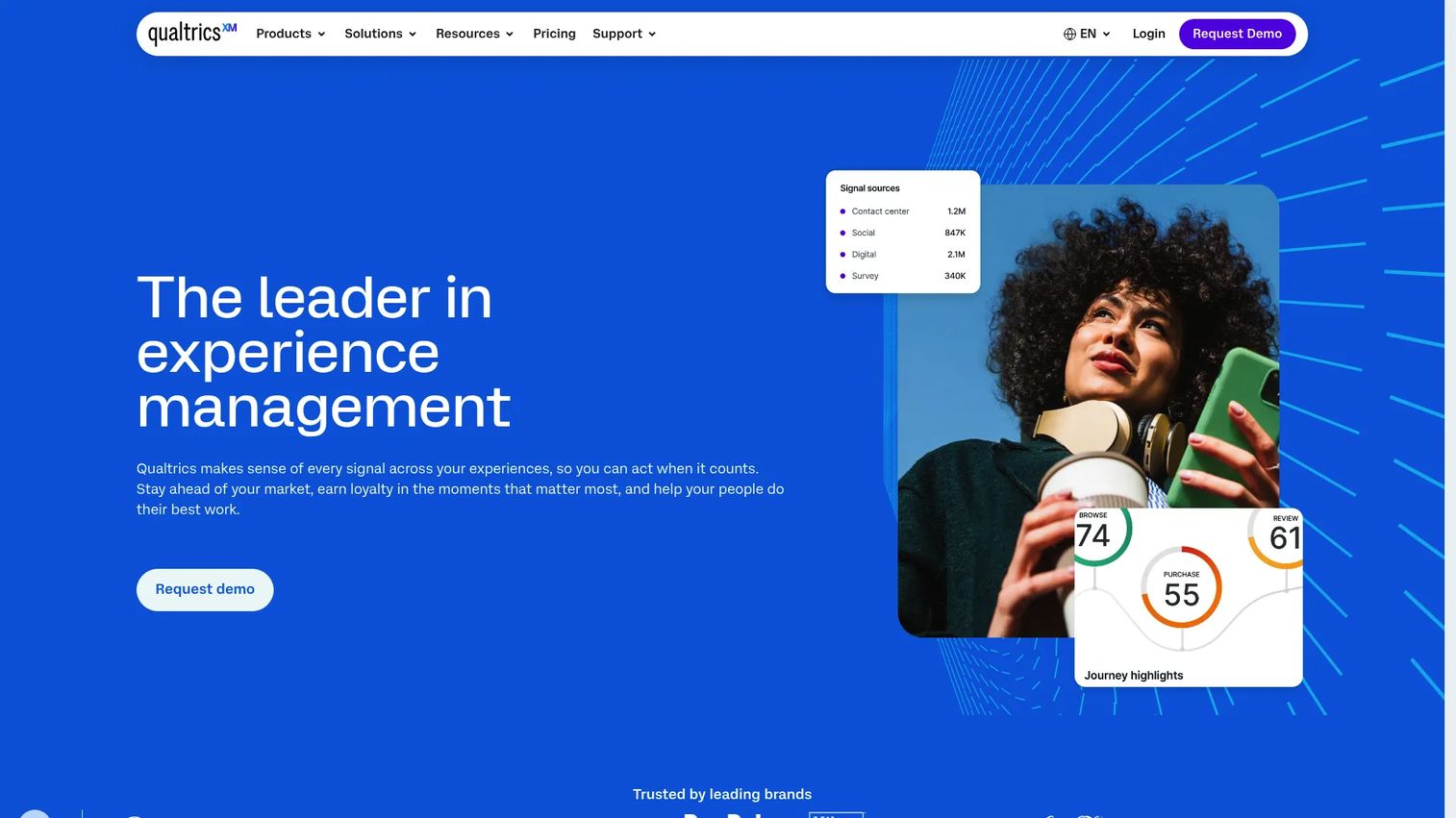
Qualtrics is an experience management platform covering customer, employee, and research programs. For employee feedback, its strength is depth: advanced survey logic, granular segmentation, and analytics built for organizations that treat listening as a research discipline. People Engage and People Lifecycle products cover engagement and the full employee journey with the same rigor Qualtrics applies to market research.
Best for: Organizations needing enterprise-grade experience management across employee and research workflows.
Key strengths
- Deep survey design and logic
- Granular segmentation and analytics
- Employee lifecycle and engagement products
Why choose Qualtrics: When you need research-grade survey depth and cross-program analytics, Qualtrics gives analysts room to work. It suits teams with dedicated people analytics capacity.
Qualtrics pricing: Suites cover Customer Experience, Employee Experience, and Strategy and Research, with products like People Engage and People Lifecycle. Public pricing is request-based rather than listed numerically.
11. SurveyMonkey
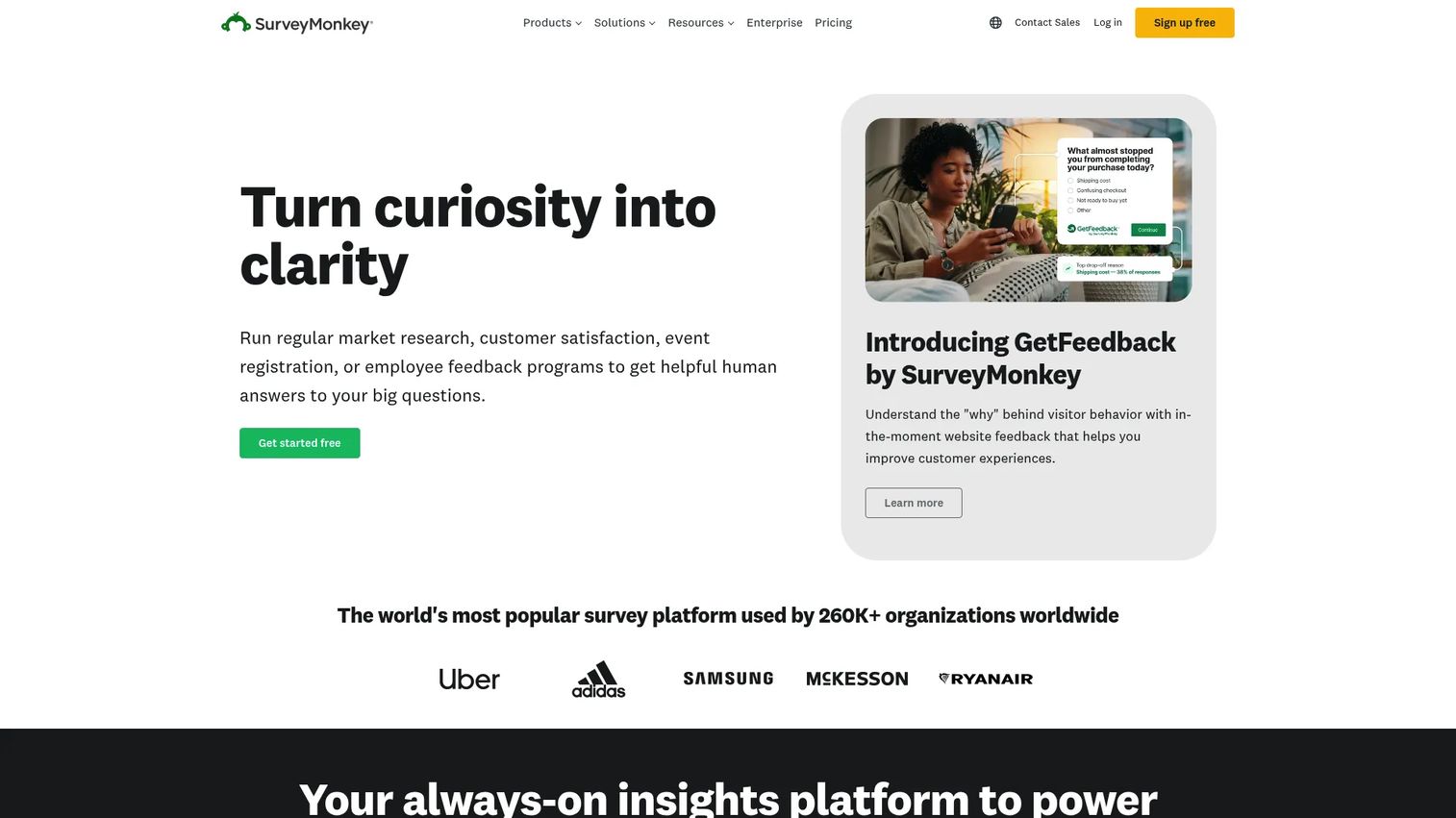
SurveyMonkey is the flexible generalist. It is not a dedicated engagement suite, but for teams that need to spin up anonymous surveys, employee pulses, or ad hoc feedback fast, its templates and distribution are hard to beat. AI-assisted survey creation and analysis speed up the build, and a free Basic tier lowers the barrier to getting started.
Best for: Teams needing a mature, flexible survey platform for feedback collection and analysis.
Key strengths
- AI survey creation and analysis
- Survey customization and logic
- Templates, distribution, and reporting
Why choose SurveyMonkey: If your needs are broad and occasional rather than a structured engagement program, SurveyMonkey's flexibility and free tier make it a low-commitment starting point. Dedicated suites pull ahead when you need built-in action planning.
SurveyMonkey pricing: A free Basic plan is available. Paid individual plans include Standard Monthly at $99 per month, Advantage Annual at $46 per month billed annually, and Premier Annual at $139 per month billed annually.
12. Engagedly
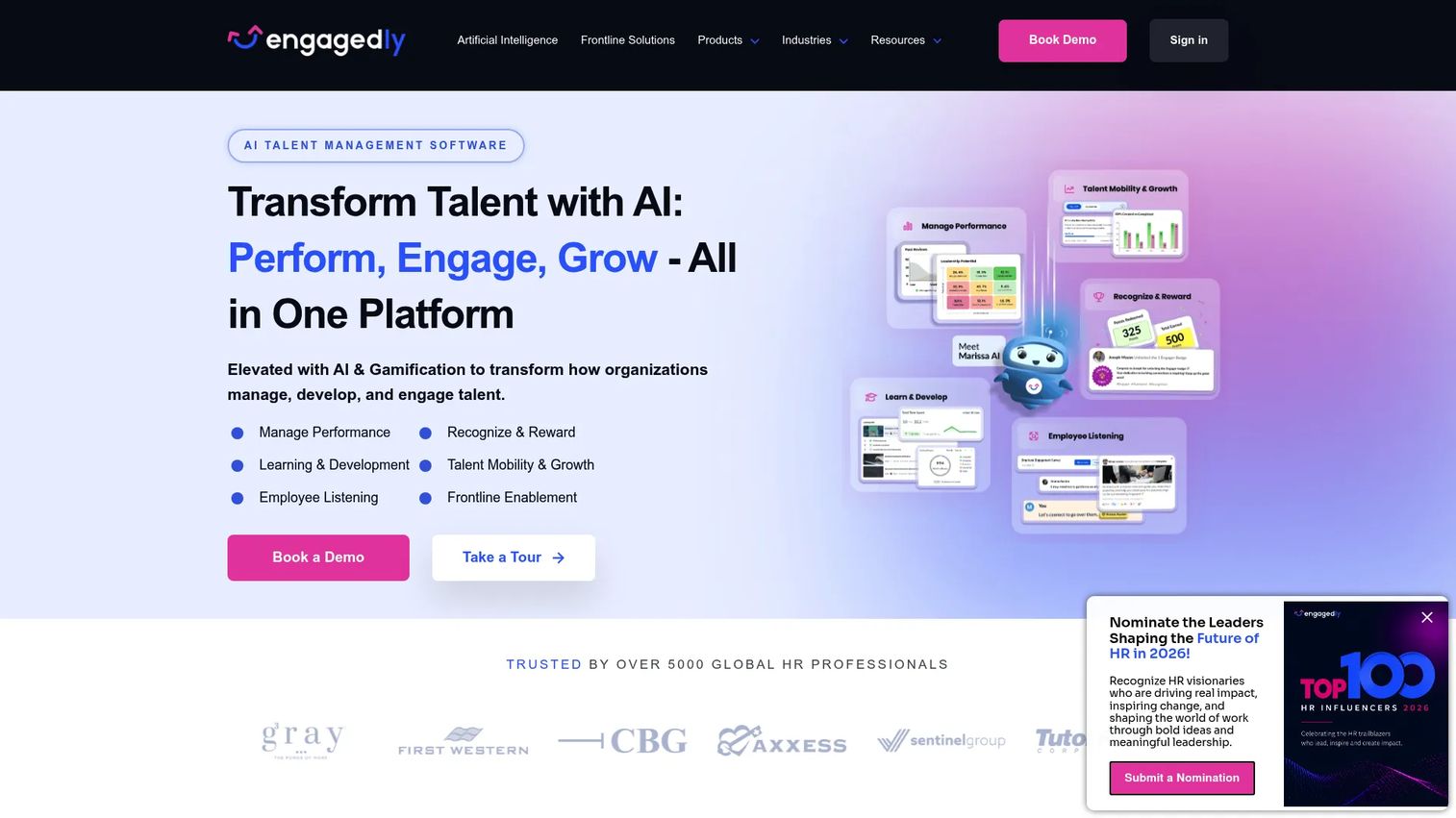
Engagedly is an AI talent management platform that puts performance, learning, engagement, and feedback in one system. Its engagement module covers surveys, team pulses, and social feedback, while 360 feedback and IDPs tie insight to development. For teams that want a single vendor across the talent lifecycle, Engagedly consolidates a lot.
Best for: Mid-size to enterprise teams wanting all-in-one talent management with engagement built in.
Key strengths
- Reviews, goals, OKRs, 1:1s, and check-ins
- Learning platform, IDPs, and 360 feedback
- Engagement surveys, team pulse, and social feedback
Why choose Engagedly: The breadth is the selling point. If you are consolidating vendors, having engagement feedback live next to performance and learning reduces the number of tools managers touch.
Engagedly pricing: Modular per-user pricing billed annually. Engage and Listen starts at $2 per user per month, Learn and Grow at $3, and Manage Performance at $5, with a $7,500 per year minimum and custom enterprise pricing.
13. ThriveSparrow
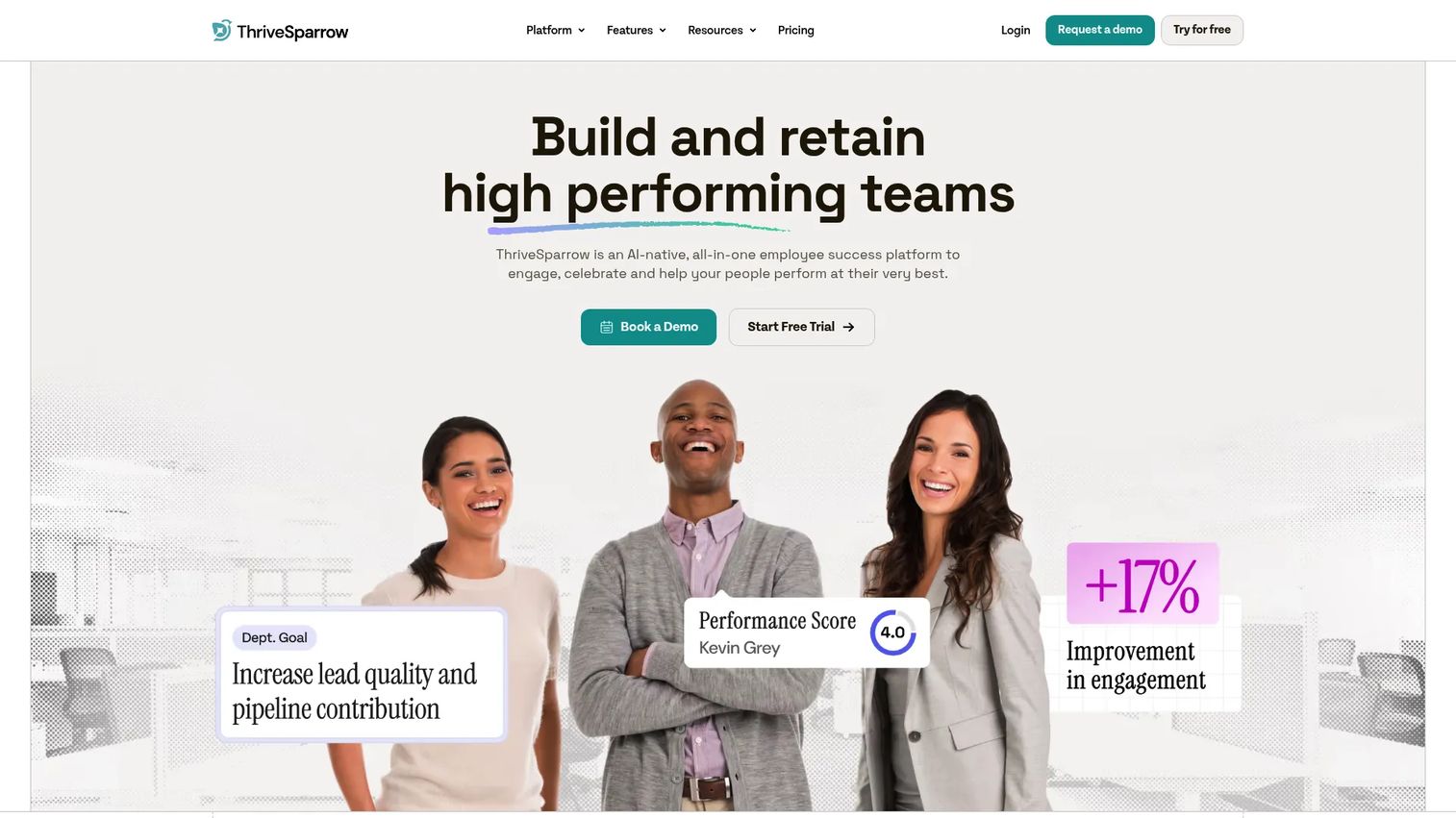
ThriveSparrow is a modular engagement and performance platform built around pulse surveys, action plans, and manager-facing insights. Its Engage module handles pulse and lifecycle surveys with benchmarks and AI action plans, while Performance adds 360 feedback and calibration. The modular pricing lets teams start with what they need and add capabilities as the program matures.
Best for: Mid-market teams wanting modular employee engagement and performance tooling.
Key strengths
- Engage module: pulse and lifecycle surveys with AI action plans
- Performance: 360 feedback and calibration
- Goals, Kudos, and one-on-ones modules
Why choose ThriveSparrow: The free One-on-Ones and Feedback modules make it easy to pilot before committing budget. The modular structure suits teams that want to grow the program in stages.
ThriveSparrow pricing: One-on-Ones and Feedback modules are free. Paid modules include Kudos at $2 and Engage at $3 per employee per month. Bundles start at $4 per employee per month billed annually, with a Full Platform plan at $9.
14. Vantage Circle
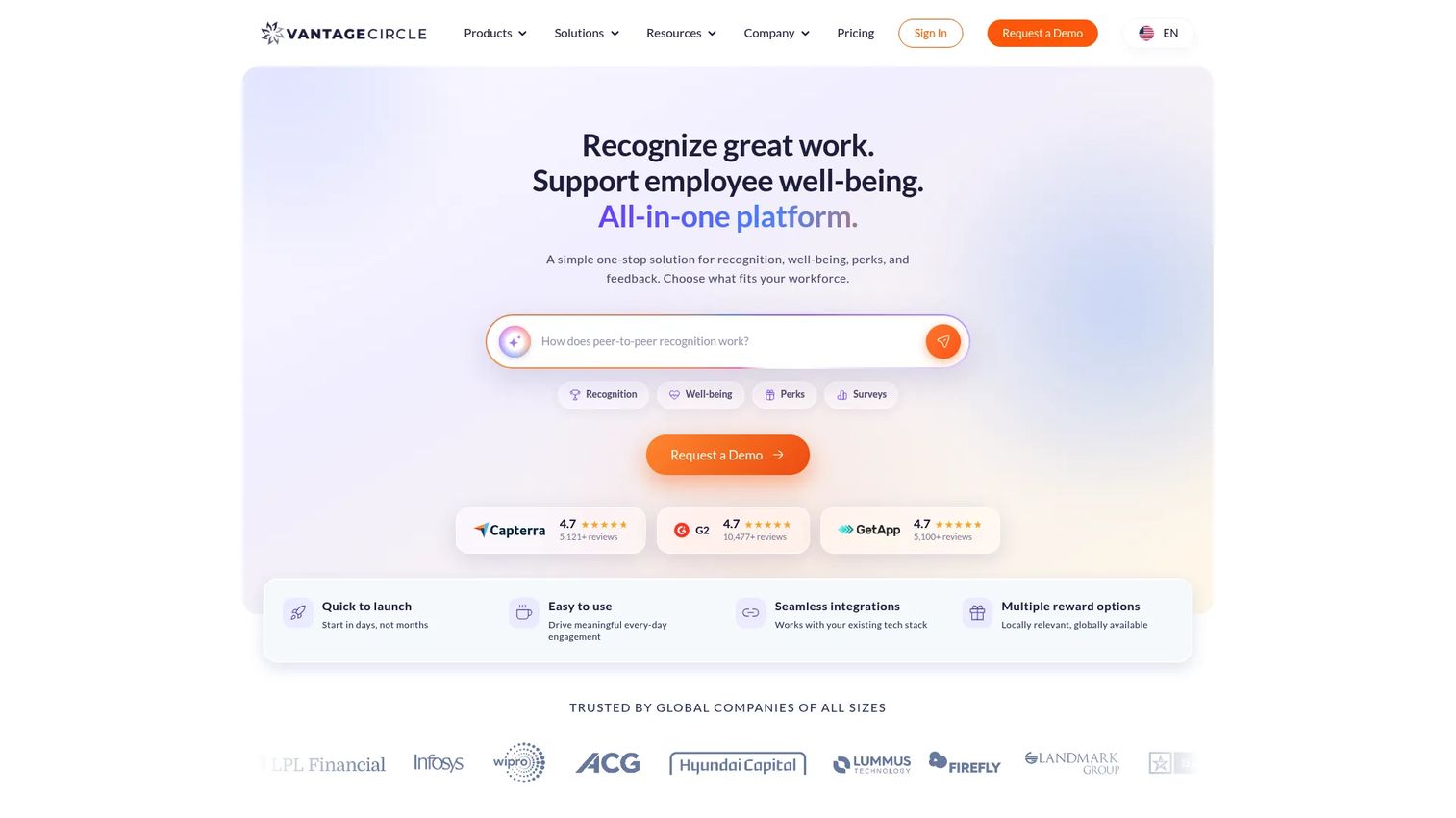
Vantage Circle leads with recognition and rewards, then layers pulse surveys and feedback on top. For organizations that see engagement through the lens of appreciation and perks, its combination of recognition, wellness challenges, and pulse feedback fits naturally. The feedback components sit inside a broader engagement suite rather than standing alone.
Best for: Mid-market to enterprise teams wanting a bundled engagement suite anchored in recognition.
Key strengths
- Employee recognition and rewards
- Wellness challenges and corporate perks
- Pulse surveys and feedback
Why choose Vantage Circle: If recognition is already central to your culture strategy, adding pulse feedback in the same platform keeps the employee experience unified rather than fragmented across tools.
Vantage Circle pricing: Plans are Grow, Transform, and Enterprise, all custom-priced based on organization size, selected products, and integrations.
15. Motivosity
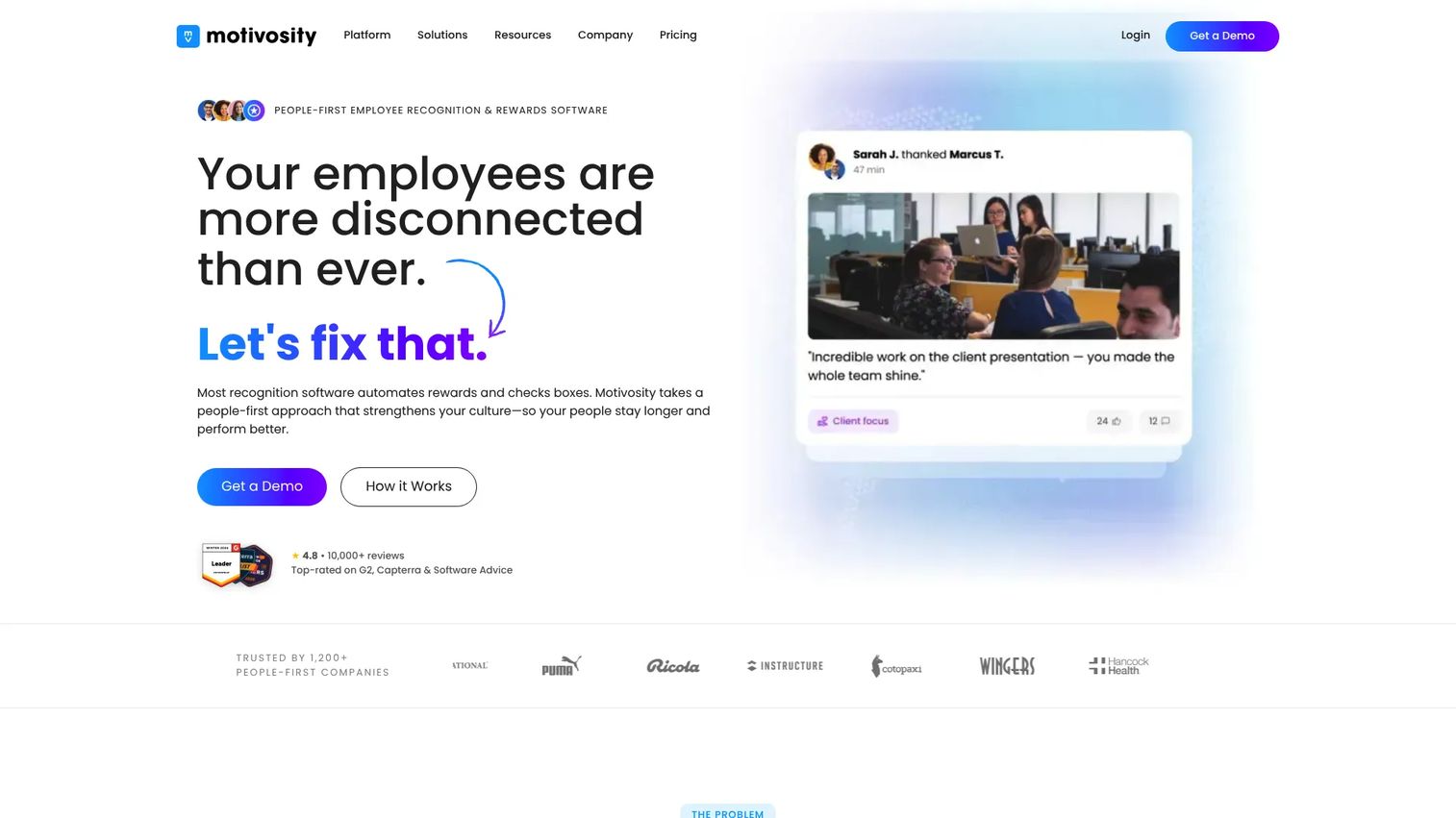
Motivosity pairs peer recognition with feedback, which works well for smaller and distributed teams that want culture and voice in one place. Peer-to-peer appreciation, manager-to-team recognition, and company-wide culture tools give employees a steady channel to be heard and to hear from each other. Feedback rides alongside recognition rather than sitting in a separate survey tool.
Best for: Mid-market and enterprise teams needing recognition, rewards, and culture tools with a feedback layer.
Key strengths
- Peer-to-peer appreciation
- Manager-to-team recognition
- Company-wide culture and engagement tools
Why choose Motivosity: For distributed teams, the combination of recognition and feedback keeps people connected. It suits organizations that want engagement to feel social rather than administrative.
Motivosity pricing: Pricing is custom, with a platform fee of roughly $0 to $2 per employee per month and additional modules starting around $1 per employee per month. The minimum annual investment is $3,000.
Considerations
Anonymous feedback and trust
Anonymity settings shape participation directly. When employees trust that responses cannot be traced, they answer honestly, and the data gets more useful. Evaluate how each platform handles anonymous surveys, minimum group sizes before results display, and whether managers can reply to anonymous comments without breaking cover. There is a real balance to strike between full anonymity and the attribution needed for direct development conversations, so decide which matters more for each survey type.
Actionability and manager follow-through
A tool that only collects data leaves the hardest work undone. Check whether the platform gives managers prompts, action plans, and one-on-one workflows tied to results. The question is not "does it survey" but "does it help someone act." Manager follow-up is the difference between a program employees trust and one they quietly abandon.
Analytics and segmentation
Aggregate scores hide the story. Confirm you can segment by team, location, tenure, or role, and that the platform surfaces heatmaps, trends over time, and sentiment analysis on open text. Segmentation is what turns a company-wide number into a specific action for a specific manager.
Integrations and workflow fit
Feedback lands better when it lives where people already work. Evaluate HRIS, Slack, Teams, and performance-stack connections. The easier a tool is to reach inside daily workflow, the higher the adoption and the lower the maintenance burden on your people ops team.
Governance and template control
Ask who can create survey templates, who approves them, and how stale surveys get retired. Governance keeps a program consistent as it scales and prevents the survey sprawl that erodes response rates. For enablement and people teams alike, template ownership and versioning are what keep a growing program coherent.
Conclusion
Collecting feedback is the easy part. Acting on it is the whole game.
If you want continuous feedback with predictive signals, start with Eletive. For enterprise governance and listening at scale, Workday Peakon Employee Voice and Qualtrics are built for it. Teams tying feedback to performance should look at Lattice, Leapsome, 15Five, and Engagedly. For AI-assisted writing and coaching, Quantum Workplace and Workleap Officevibe stand out. And when you want simple, high-participation pulse surveys, TinyPulse, SurveyMonkey, and ThriveSparrow keep it light.
Here is the practical move: shortlist one continuous-feedback tool, one performance-connected tool, and one lightweight pulse option. Run each against your real anonymity, analytics, and manager follow-up needs. Then pick the one that makes acting on feedback the default, not the exception. That is how a survey turns into a feedback culture instead of another open loop.
FAQs
Prioritize four things: continuous feedback through pulse surveys, anonymous feedback controls that protect trust, analytics with segmentation and sentiment analysis, and manager follow-up tools like action plans and one-on-ones. The last one matters most. A tool that collects input but does not help managers act on it leaves you with data and no change.
The categories overlap heavily. Employee feedback software centers on collecting and acting on input through surveys and pulses. Employee engagement software is broader, often bundling recognition, performance, and analytics around the goal of improving overall engagement. Many platforms in this guide do both, so the line is more about emphasis than a hard boundary.
Anonymous feedback tools strip identifying information from responses and typically enforce a minimum group size before showing results, so individuals cannot be reverse-engineered from the data. Some platforms add anonymous reply threads, letting a manager respond to a candid comment without learning who wrote it. Anonymity raises honesty and participation, which is why it is central to employee pulse survey software.
Look for recommended actions, action plans, development-plan templates, and one-on-one prompts tied to survey results. The best tools push insight to the manager with a clear next step rather than leaving them to interpret a dashboard. Manager follow-up features are what move a program from feedback to action.
Pulse surveys are a feature, not a whole category. If you only need quick, recurring sentiment checks, a lightweight employee pulse survey software works. If you want continuous feedback connected to analytics, action planning, and performance workflows, a broader employee feedback platform fits better. Match the tool to how far you intend to take the program.
Small and distributed teams often do well with lightweight, fast-to-adopt tools. TinyPulse offers simple anonymous surveys and recognition, Motivosity pairs recognition with feedback for distributed teams, and SurveyMonkey's free tier lets you start with no commitment. Prioritize participation and ease of use over analytical depth at small scale.
Enterprise programs need listening at scale, deep analytics, and governance. Workday Peakon Employee Voice and Qualtrics are built for large voice-of-employee and research-grade programs, while Culture Amp offers strong benchmarking and analytics for mid-market and enterprise people teams. Weigh integration with your existing HR system of record heavily.
Participation follows trust. Keep surveys short, protect anonymity, and, most importantly, show visible action on what employees said last time. When people see that feedback led to a real change, response rates climb. Add clear communication, a consistent cadence, and manager follow-up, and you build the feedback culture that keeps participation high year over year.