A vendor's SOC 2 report expired three months ago. Nobody noticed. Then a customer audit landed, and your team spent two weeks reconstructing who approved that vendor, what evidence you collected at onboarding, and whether anything changed since. That scramble is not rare. It is the default operating mode for teams tracking vendor compliance in spreadsheets and shared inboxes.
The stakes keep climbing. The global vendor compliance management software market was valued at $3.2 billion in 2025 and is projected to reach $7.8 billion by 2034, growing at an 11.4% CAGR, according to MarketIntelo (2025). That spend reflects a real operational shift: static annual reviews cannot keep pace with vendors whose security posture, certifications, and risk profile change month to month. Large enterprises now account for 64.2% of vendor compliance software revenue, per the same MarketIntelo (2025) data, because complex supplier ecosystems break manual tracking first.
For a product manager who owns compliance as a constraint alongside activation and retention, the question is not whether to buy. It is which platform fits the existing stack, scales across vendor segments, and produces a defensible record without adding a maintenance burden the team cannot sustain. This guide breaks down seven platforms so you can shortlist based on monitoring depth, integration fit, and audit readiness rather than marketing claims.
What's inside
This guide is for teams evaluating vendor compliance management software to handle continuous oversight, evidence collection, approval workflows, and audit preparation. We selected platforms based on four criteria that matter to operational buyers:
- Continuous monitoring rather than point-in-time snapshots
- Evidence and document verification with a clear chain of record
- Workflow automation for onboarding, task routing, and approvals
- Integration depth and reporting that plugs into procurement, CRM, ticketing, or GRC systems
Each entry covers what the platform does well, who it fits, pricing where public, and a G2 rating where one exists. Rankings reflect relevance to vendor compliance specifically, not general popularity.
TL;DR
- Best for continuous vendor assurance: Auditive, with a trust exchange model and a free starting tier that scales into enterprise workflows.
- Best for property and operations-heavy teams: NetVendor, built around compliance-led vendor management for real estate portfolios.
- Best for contractor and facilities workflows: ContractorOS, with document control, expiration reminders, and site-access approvals.
- Best for document-verification-heavy operations: ComplyVendor, focused on gathering, verifying, and scoring vendor information.
- Best for enterprise risk integration: OneTrust, for teams that need privacy, governance, and third-party risk in one platform.
- Best for trust-program-native teams: Vanta and Drata, if you already run compliance automation and want vendor risk inside the same system.
What is vendor compliance software?
Vendor compliance software is a platform that centralizes how an organization onboards, monitors, verifies, and audits its third-party vendors against security, regulatory, and contractual requirements. It replaces scattered spreadsheets and email threads with a single system of record for vendor risk.
Core capabilities most buyers evaluate:
- Real-time monitoring of vendor certifications, security posture, and risk signals so lapses surface before they become audit findings
- Evidence verification and document management, including collection, validation, and expiration tracking
- Onboarding and approval workflows that route tasks to the right owners and gate procurement until requirements are met
- Compliance dashboards and reporting that give leadership a live view of vendor status by segment, tier, or risk level
- Audit-ready record keeping that preserves a defensible audit trail of who approved what, when, and on what evidence
- Integrations with procurement, CRM, ticketing, and GRC systems so compliance data flows into the tools teams already use
The category overlaps with broader vendor risk management software and supplier compliance management software, but the defining job is verifiable, ongoing compliance oversight rather than sourcing or spend management alone. For product managers, the practical lens is instrumentation and maintainability: can the system track the right events, segment vendors by risk, and stay accurate as your vendor base grows without constant manual upkeep?
When to use vendor compliance software
Monitor vendors continuously
Periodic reviews miss what happens between checkpoints. A vendor passes an annual assessment in January, lets a certification lapse in April, and suffers a breach in July that nobody flagged because the next review is not until the following year. Continuous monitoring closes that gap by tracking certification expiry, posture changes, and risk signals as they happen.
This matters most when you have vendors touching sensitive data, when contracts include compliance clauses you must enforce, or when your own customers audit your supply chain. The more vendors you manage, the faster point-in-time reviews break down.
Automate onboarding and approvals
Manual vendor onboarding turns into a chase. Someone emails the vendor for a certificate, waits, forwards it to security, waits again, then tries to remember whether legal signed off. Workflow automation replaces that with defined routing: intake form, evidence request, parallel review by the right owners, and a recorded approval.
The payoff is fewer stalled onboardings and a cleaner record. Task routing and automated evidence collection cut the manual chasing that eats operational time and leaves gaps in your compliance data.
Prepare for audits and procurement controls
Audit readiness is not a project you start when the auditor emails. It is a byproduct of good record keeping the rest of the year. The right platform gives you a defensible audit trail, live compliance dashboards, and approval histories you can export on demand.
Use this checklist to judge audit fit:
- Can you show who approved each vendor and on what evidence?
- Is every document timestamped and version-controlled?
- Can procurement be gated until compliance requirements are met?
- Can you produce a segment-level compliance report in minutes, not days?
Comparison table
Ranked by relevance to vendor compliance software specifically. Pricing and ratings reflect verified public sources as of mid-2026; where a vendor gates pricing behind a sales conversation, that is noted.
| # | Product | Intent | Key use case | Pricing | G2 rating |
|---|---|---|---|---|---|
| 1 | Auditive | Continuous vendor assurance | Third-party risk assessment and trust exchange | Free tier; Plus is contact sales | Not yet rated |
| 2 | NetVendor | Lifecycle vendor management | Compliance-led vendor management for real estate | Not public | Not listed |
| 3 | ContractorOS | Contractor and facilities compliance | Contractor document control and site access | From $199/month | 4.5/5 |
| 4 | ComplyVendor | Document verification | Vendor document collection and scoring | Not public | 4.1/5 |
| 5 | OneTrust | Enterprise risk integration | Privacy, governance, and third-party risk | Custom / package-based | 4.4/5 |
| 6 | Vanta | Trust-program vendor risk | Compliance automation with vendor workflows | Personalized quote | 4.6/5 |
| 7 | Drata | Trust-program vendor risk | Continuous compliance and third-party risk | Personalized quote | 4.7/5 |
1. Auditive
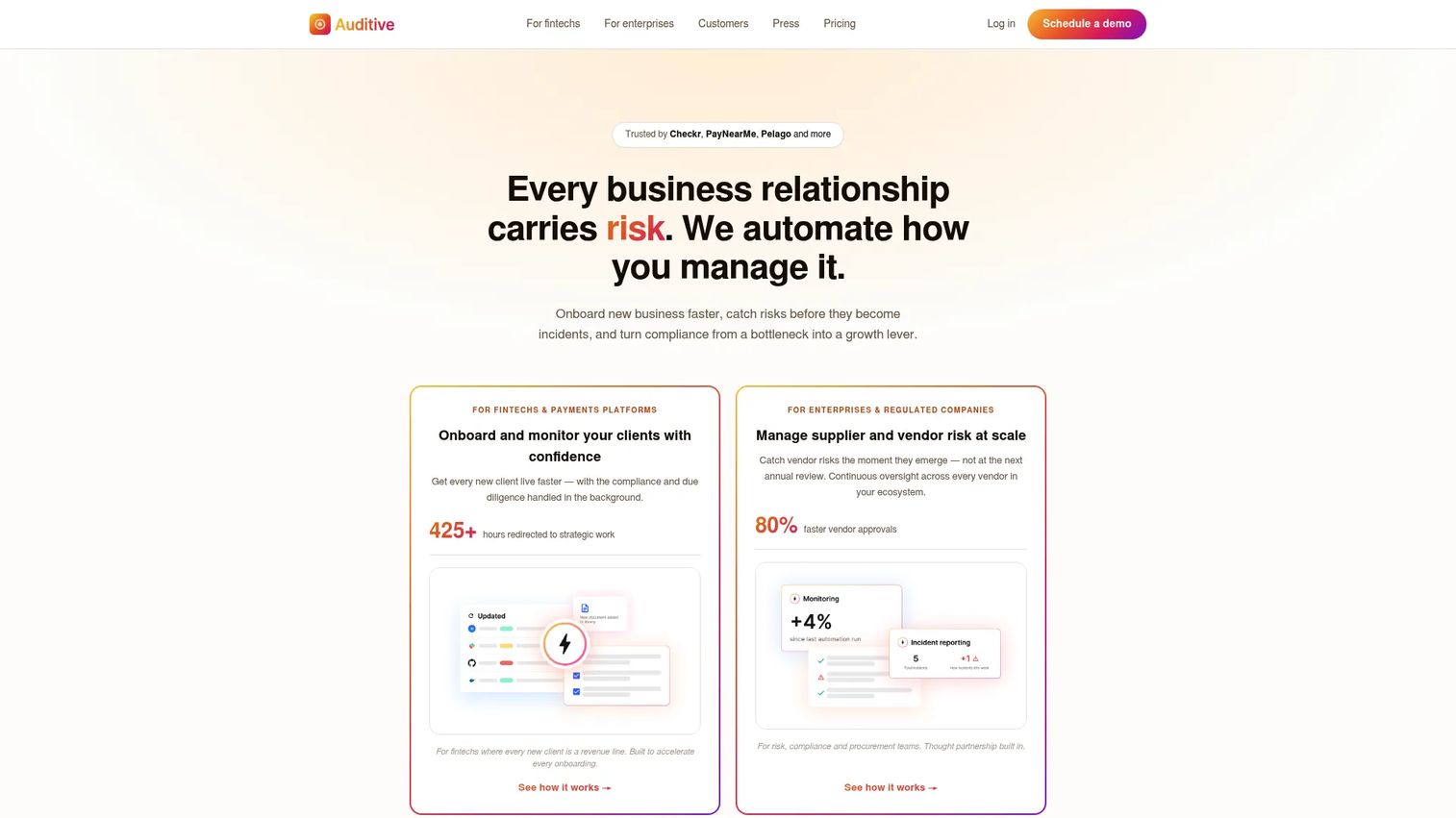
Auditive is vendor risk management and trust exchange software built for assessing, monitoring, and sharing third-party security and compliance information. Its distinguishing idea is a trust network: vendors maintain a Trust Profile that buyers can access, which cuts the back-and-forth of requesting the same evidence every vendor already produces for someone else. That model leans toward continuous vendor assurance rather than static annual checks.
The platform combines intake and contract management with partner risk assessments and inherent risk analysis, so you can size a vendor's risk before you spend review cycles on it. AI-powered document summaries speed up the read of long security reports, and workflow and activity logs give you the defensible trail auditors ask for.
Best for: Teams managing third-party risk who want a free starting tier and a clear upgrade path into enterprise workflows.
Key strengths
- Trust Profiles and network access: Reduces repeat evidence requests by letting vendors share verified compliance information once.
- Inherent risk analysis: Scores vendor risk up front so review effort matches actual exposure.
- AI document summaries: Condenses lengthy security and audit reports into reviewable summaries.
Why choose Auditive: If you want to move from periodic assessments toward ongoing monitoring without a heavy enterprise commitment on day one, Auditive's free tier lets you validate the workflow before you scale. The trust exchange angle is genuinely different from platforms that only manage documents you collect yourself.
Auditive pricing: Auditive publishes two editions. AuditiveX Free is available at no cost, and AuditiveX Plus is contact-sales pricing. That free entry point is rare in this category and makes Auditive easy to trial before committing budget. G2 currently shows no meaningful review volume, so there is no established third-party user rating to weigh yet.
2. NetVendor
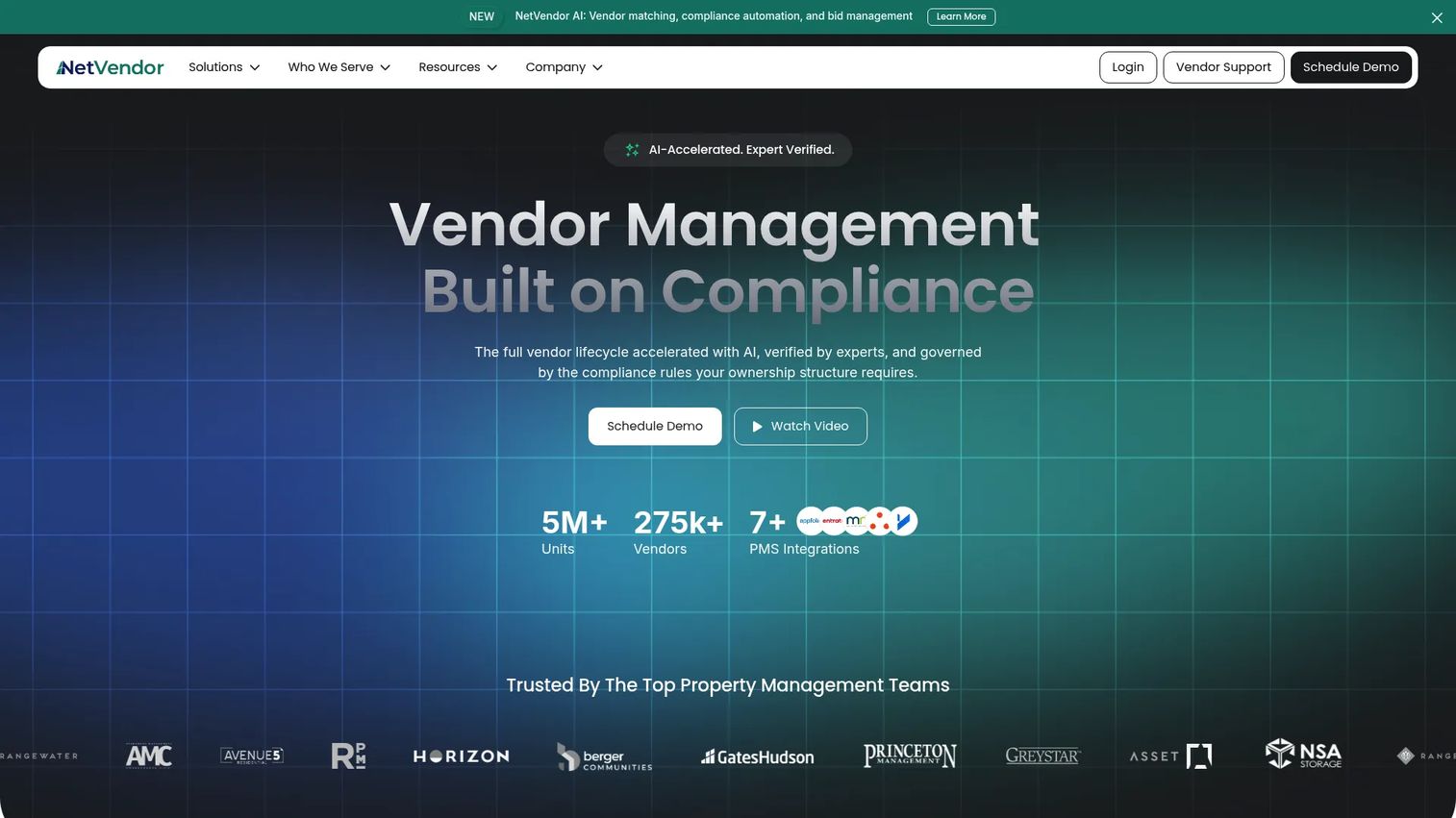
NetVendor is compliance-led vendor management software built for real estate and property teams. It treats compliance as the connective tissue across the full vendor lifecycle, from sourcing and competitive bidding through contracts and ongoing work management. That lifecycle framing suits operations-heavy organizations where vendors are also active contractors doing physical work on properties.
The platform pairs AI-powered credentialing with human review, so vendor documents get validated rather than just stored. Compliance rules can be configured by owner, property, and vendor type, which matters when a portfolio spans different jurisdictions and requirement sets. Competitive bidding and contract management round out the vendor operations picture.
Best for: Property managers and real estate operators who need vendor compliance, sourcing, and bidding in one workflow.
Key strengths
- AI credentialing with human review: Balances automation speed with verification accuracy on vendor documents.
- Configurable compliance by property and vendor type: Adapts requirements to portfolios with varied jurisdictions.
- Integrated sourcing and bidding: Connects competitive bidding and contracts to the same compliance record.
Why choose NetVendor: For teams where vendor compliance and vendor operations are the same job, NetVendor keeps sourcing, credentialing, and work management in one place instead of splitting them across tools. The property and real estate focus means the workflows fit that world out of the box.
NetVendor pricing: NetVendor does not publish pricing on its site, so expect a sales-led quote based on portfolio size and requirements. Third-party review coverage on G2 is limited, so lean on a hands-on evaluation to judge workflow fit for your specific vendor mix.
3. ContractorOS
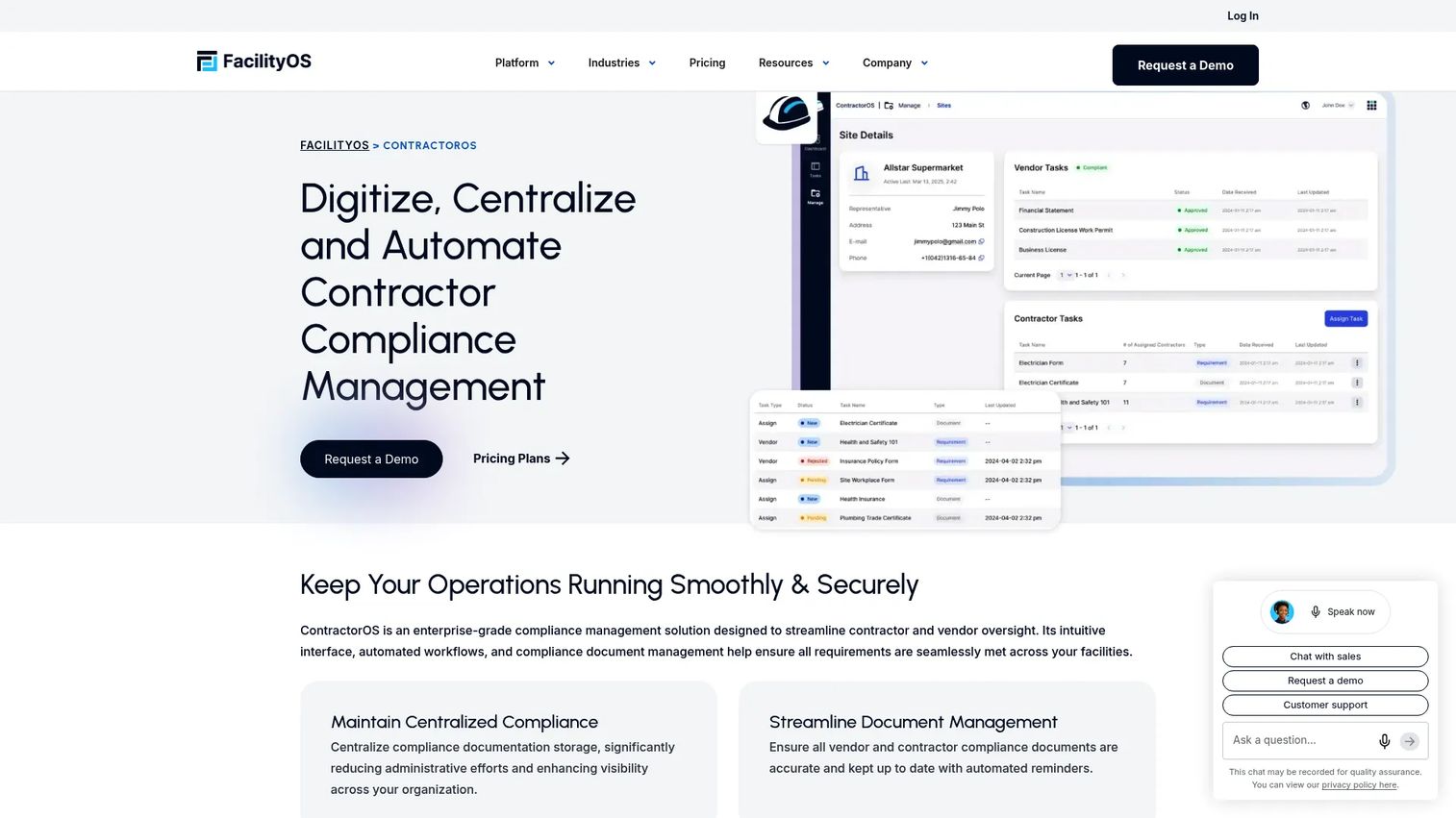
ContractorOS is FacilityOS's contractor compliance module for managing contractor and vendor documents, approvals, and site access. It centers on a compliance dashboard that gives facilities and operations teams a single view of which contractors are cleared to work and which are missing documents. The design target is contractor and facilities readiness rather than SaaS vendor security.
Centralized document management holds contractor and vendor compliance records in one place, and automated expiration reminders push notifications before certificates lapse. Approval workflows route sign-offs to the right owners, and integration with VisitorOS extends compliance into compliant on-site check-ins, so a contractor cannot badge in without meeting requirements.
Best for: Organizations that need contractor compliance tracking, document control, and facility access workflows in one module.
Key strengths
- Centralized compliance document management: Keeps contractor and vendor records in a single controlled repository.
- Automated expiration reminders: Surfaces lapsing documents before they create a gap or a safety issue.
- VisitorOS integration for compliant check-ins: Ties site access directly to compliance status.
Why choose ContractorOS: If your compliance risk lives at the physical site level, contractors with lapsed insurance or missing safety certs, ContractorOS connects the document record to actual access control. That link between compliance status and site entry is the practical differentiator.
ContractorOS pricing: ContractorOS is priced through FacilityOS with an Essentials tier starting at $199 per month and an Advanced tier at $499 per month, both billed monthly. Purchase runs through a demo and sales flow. It holds a 4.5/5 rating on G2, though on limited review volume, so read the reviews rather than the number alone.
4. ComplyVendor
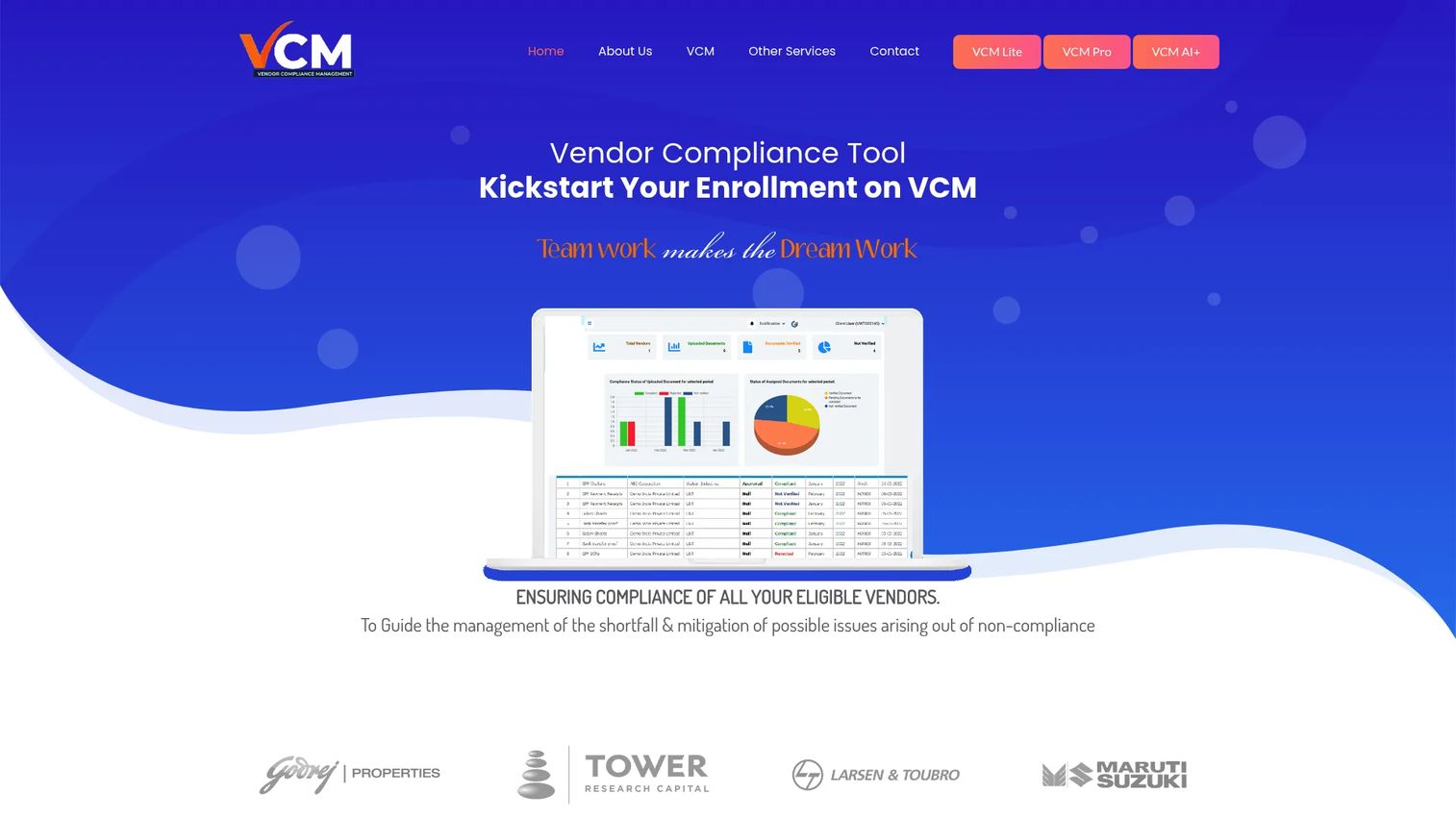
ComplyVendor is vendor compliance management software focused on gathering, verifying, and monitoring vendor information. It frames vendor compliance as document verification plus reporting, with performance scores that track how each vendor is progressing against requirements. The emphasis on statutory and labor-law compliance context suits operational teams with heavy regulatory obligations toward their vendors and their vendors' workers.
Document verification is the core: the platform collects vendor documents and validates them rather than acting as a passive filing cabinet. Dynamic reporting with MIS dashboards gives leadership a live compliance view, and performance scores let you rank vendors by compliance health so attention flows to the riskiest first.
Best for: Organizations needing vendor compliance tracking and document verification in regulation-heavy operations.
Key strengths
- Document verification: Validates vendor submissions instead of only storing them.
- Dynamic reporting with MIS dashboards: Turns compliance status into live, shareable views.
- Performance scores: Ranks vendors by compliance progress so teams triage by risk.
Why choose ComplyVendor: For teams whose compliance obligations center on statutory and labor-law requirements across a vendor base, ComplyVendor's verification-and-scoring model keeps the highest-risk vendors visible. The reporting layer makes it straightforward to show leadership where compliance stands.
ComplyVendor pricing: ComplyVendor does not publish pricing on its site, so pricing comes through direct contact. It carries a 4.1/5 rating in G2's associated product profile. As with any unpriced platform, scope your vendor volume and verification needs before the sales conversation so the quote maps to real usage.
5. OneTrust
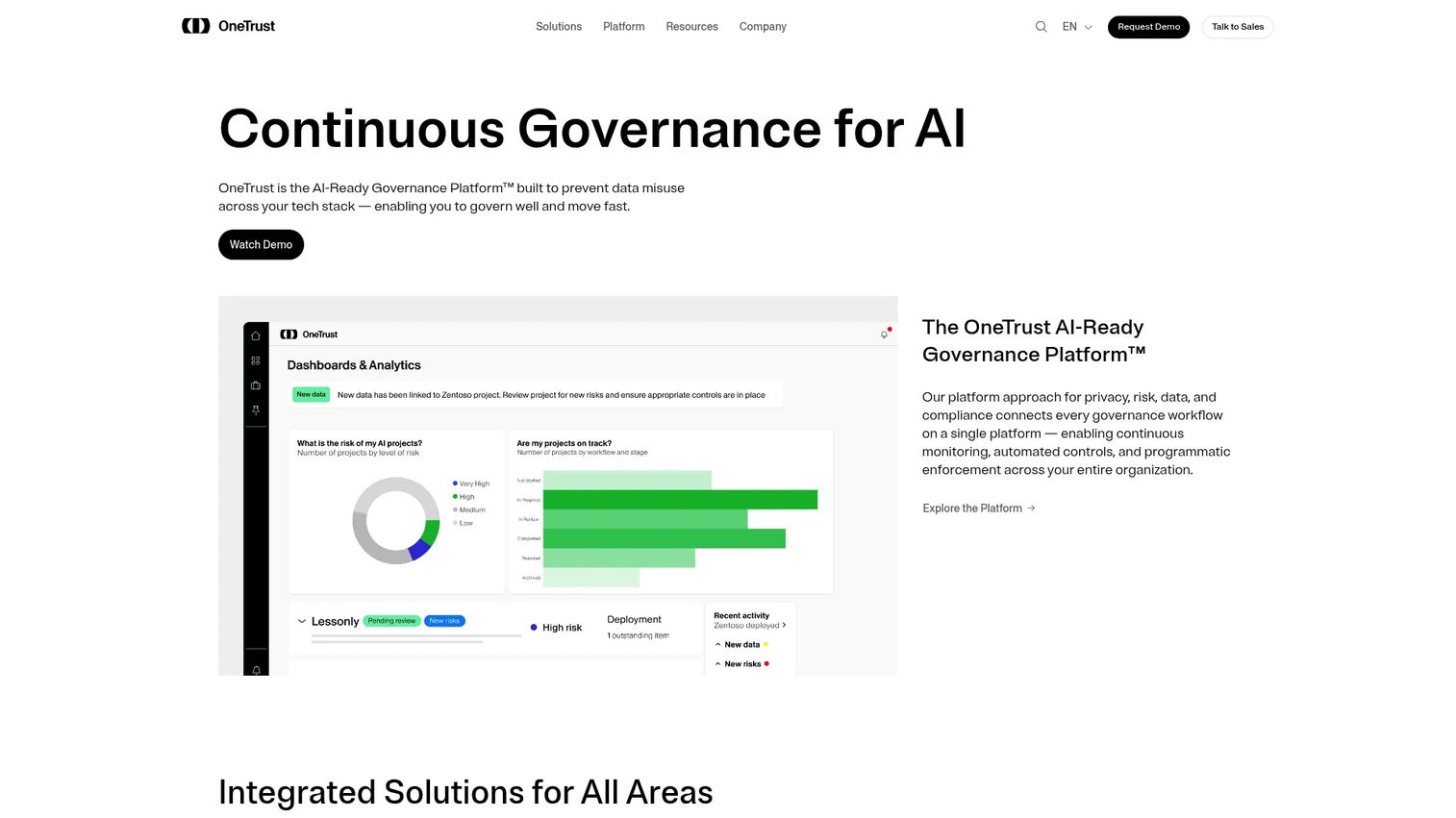
OneTrust is an enterprise privacy, governance, risk, and compliance platform where vendor and third-party risk is one module inside a much broader system. For teams that need more than vendor records alone, OneTrust connects third-party management to consent, privacy automation, and tech risk in a single platform. That breadth is the reason large organizations pick it: vendor compliance stops being a standalone tool and becomes part of enterprise risk integration.
Third-party risk management handles vendor assessments and monitoring, while consent and preferences management and privacy automation cover the regulatory obligations that often sit adjacent to vendor risk. The trade-off for that scope is that OneTrust is built for complexity, not quick self-serve setup.
Best for: Large organizations needing privacy, consent, and vendor risk workflows coordinated in one governance platform.
Key strengths
- Third-party risk management: Assesses and monitors vendors inside a broader risk program.
- Privacy automation: Handles regulatory obligations that overlap with vendor data handling.
- Consent and preferences management: Centralizes consent alongside vendor and risk governance.
Why choose OneTrust: If your organization already treats privacy, governance, and risk as one program, running vendor compliance in the same platform avoids a data silo and a separate audit trail. OneTrust fits when vendor risk is one thread in a larger enterprise risk mandate.
OneTrust pricing: OneTrust uses solution packages with usage-based pricing meters; most packages require a custom quote rather than a published list price. It holds a 4.4/5 rating on G2 at the seller level. Because pricing is package-based, map the specific modules you need before requesting a quote so you are not paying for governance breadth you will not use.
6. Vanta
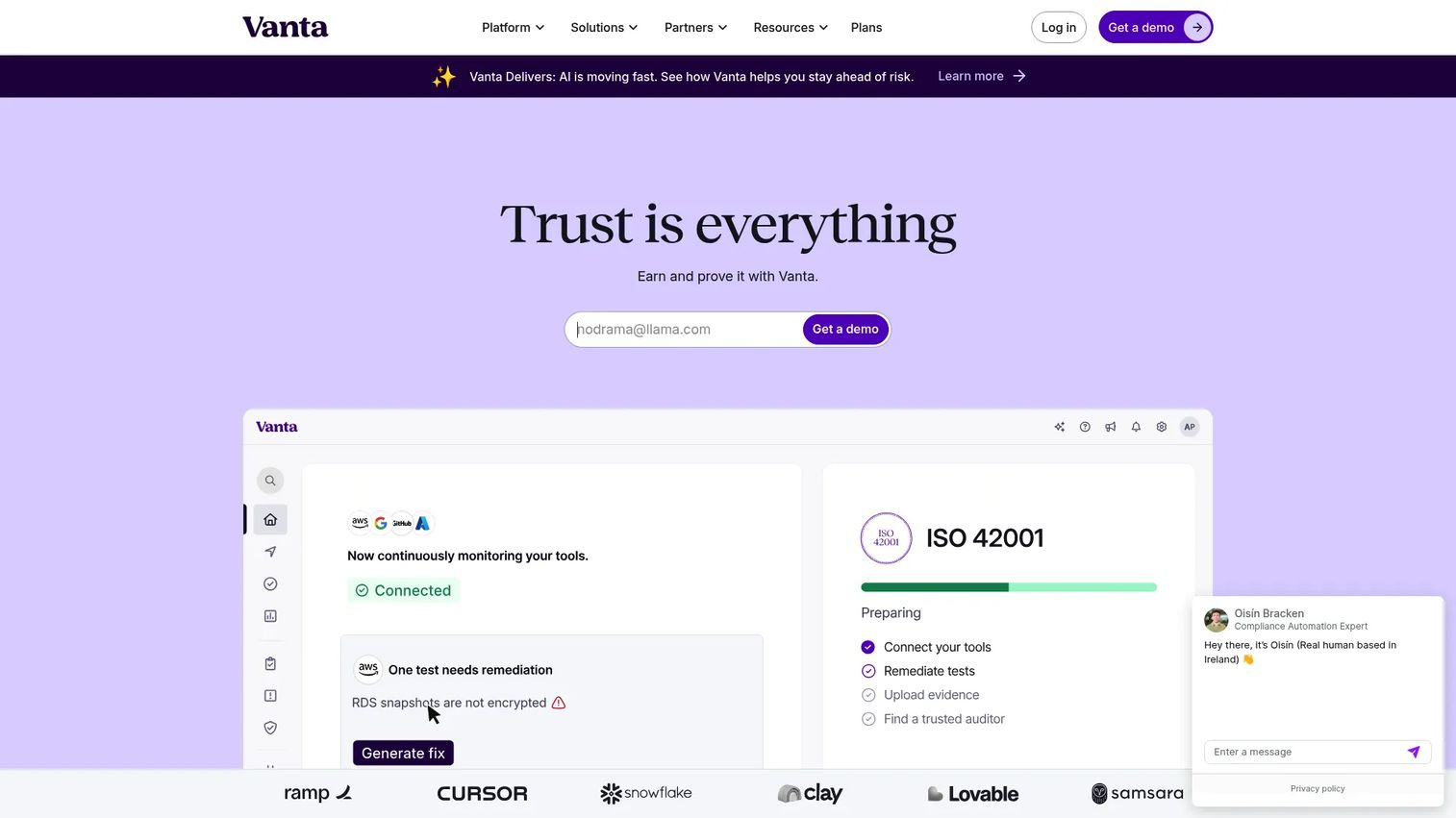
Vanta is a trust platform that automates compliance, risk, and vendor workflows. Its vendor risk capabilities sit inside a broader trust program, so it fits teams that already use Vanta for continuous compliance monitoring on frameworks like SOC 2 and want vendor risk managed in the same place. Continuous monitoring, questionnaire automation, and a Trust Center are the backbone.
Vendor risk workflows let you assess and monitor third parties without a separate tool, and continuous compliance monitoring keeps evidence current rather than reconstructed at audit time. The Trust Center and questionnaire automation cut the manual effort of both answering and sending security questionnaires, which is often where vendor review time disappears.
Best for: Teams that already automate security and compliance with Vanta and want vendor risk inside the same system.
Key strengths
- Continuous compliance monitoring: Keeps evidence current across frameworks rather than point-in-time.
- Vendor risk workflows: Assesses and monitors third parties without a standalone tool.
- Trust Center and questionnaire automation: Reduces manual work on both sending and answering security questionnaires.
Why choose Vanta: The strongest case for Vanta's vendor module is consolidation. If your team already runs its trust program on Vanta, keeping vendor risk there means one system of record, one integration set, and one audit trail. It holds a 4.6/5 rating on G2, reflecting broad satisfaction with the automation approach.
Vanta pricing: Vanta lists four plans, Essentials, Plus, Professional, and Enterprise, but pricing is personalized and requires a demo rather than showing a public number. Scope the frameworks and vendor volume you need up front so the quote reflects your actual program, not the maximum package.
7. Drata
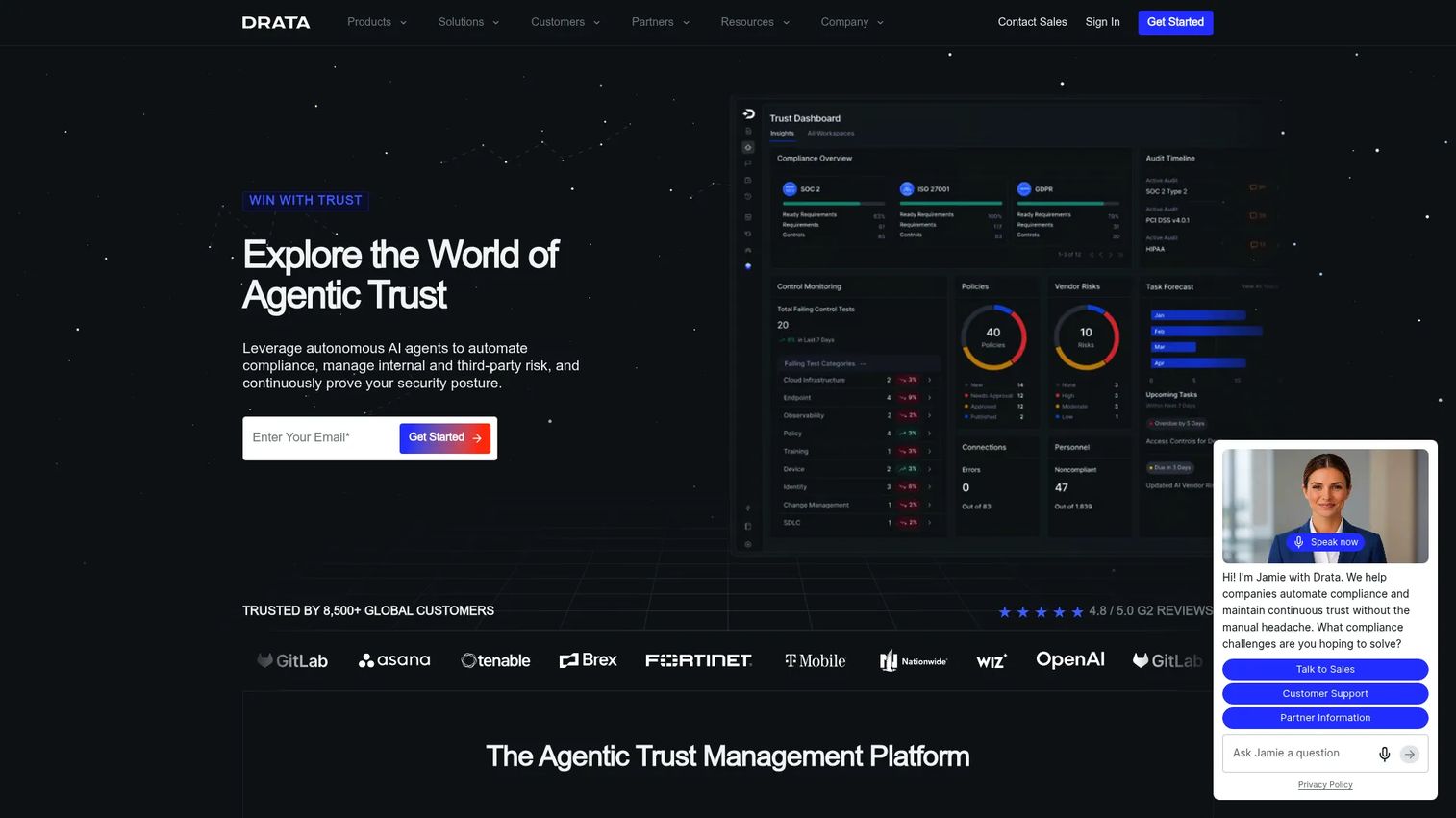
Drata is a trust management platform for continuous compliance, risk management, and customer assurance, with vendor-related oversight built into a broader trust program. Like Vanta, it works best for teams that want vendor risk tied to a compliance system rather than managed in isolation. Continuous compliance automation, integrated third-party risk management, and a Trust Center define the platform.
Continuous compliance automation keeps controls monitored and evidence collected without manual gathering, which is the mechanism behind audit readiness. Integrated risk management includes third-party risk, so vendor oversight lives alongside your own control monitoring. AI questionnaire assistance speeds up the security questionnaire workflow that often bottlenecks vendor review.
Best for: Companies that need automated compliance and trust operations at scale, with vendor risk in the same program.
Key strengths
- Continuous compliance automation: Monitors controls and collects evidence without manual effort.
- Integrated third-party risk management: Places vendor oversight inside the broader risk program.
- Trust Center and AI questionnaire assistance: Speeds the security questionnaire workflow both directions.
Why choose Drata: Drata's pitch is a compliance system where audit workflows and vendor oversight share one record. For teams that want continuous evidence collection tied directly to audit preparation, that integration removes the reconciliation work of stitching separate tools together. It carries a 4.7/5 rating on G2, the highest in this list.
Drata pricing: Drata publishes plan names, Foundation, Advanced, and Enterprise, with included features, but no public price; pricing is personalized through a sales conversation. Define your framework scope and vendor count before the call so the quote maps to your program rather than a broad enterprise bundle.
Considerations before you buy
Shortlisting is where most of the value gets created or lost. Use these criteria to pressure-test any platform before it reaches a contract.
Monitoring depth
Decide whether you need true continuous monitoring or whether scheduled reviews are enough for your risk profile. Ask how the platform detects certification expiry and posture changes, and how quickly those signals surface. A dashboard that updates once a quarter is a different product from one that flags a lapse the day it happens.
Integration fit
The platform has to plug into what you already run. Confirm which procurement, CRM, ticketing, and GRC systems it integrates with, and how deep those integrations go. A shallow one-way sync creates reconciliation work; a real integration lets compliance data flow both directions without manual export.
Evidence and audit trail quality
Every compliance decision should be reconstructable. Verify that documents are timestamped and version-controlled, that approvals are logged with who and when, and that you can export a defensible audit trail on demand. This is the difference between passing an audit calmly and scrambling for two weeks.
Maintenance burden
For a product manager, a tool that decays is worse than no tool. Ask what keeps the system accurate as your vendor base grows: automated evidence collection, expiration reminders, and segmentation by risk tier. If keeping the data clean requires constant manual upkeep, the ROI erodes fast.
Reporting and segmentation
Leadership wants a live compliance view, not a data dump. Check that you can segment vendors by risk, tier, or business unit and produce a report in minutes. Strong instrumentation here is what turns compliance from a cost center into a signal you can act on.
Conclusion
The right vendor compliance software depends less on feature checklists and more on where your risk actually lives. For continuous vendor assurance with a low-commitment start, Auditive's trust exchange and free tier stand out. For lifecycle vendor management in property and operations, NetVendor keeps sourcing, credentialing, and compliance in one workflow. For contractor and facilities readiness, ContractorOS ties document status to site access, and ComplyVendor suits document-verification-heavy, regulation-driven operations.
For enterprise risk integration, OneTrust folds vendor risk into a broader governance program, while Vanta and Drata make the strongest case for teams that already run a trust program and want vendor oversight inside the same system with a defensible audit trail.
Shortlist based on two questions: how deep does your monitoring need to be, and how well does the platform fit your existing stack. Run a hands-on evaluation against your real vendor mix before you sign, because the workflow fit you can only see in practice is what determines whether the tool sticks.
FAQs
It centralizes onboarding, monitoring, evidence collection, approvals, and audit preparation for third-party vendors. Instead of tracking certificates and approvals across spreadsheets and inboxes, teams get one system of record with a defensible audit trail. The goal is verifiable, ongoing compliance oversight rather than a once-a-year assessment.
Vendor management software covers the full vendor relationship, including sourcing, contracts, spend, and performance. Vendor compliance software zeroes in on the compliance thread: verifying documents, monitoring certifications and risk, and producing audit-ready records. Some platforms do both, but the compliance job is oversight and evidence, not procurement.
Prioritize continuous monitoring, evidence and document verification, workflow automation for onboarding and approvals, and integrations with your procurement, CRM, ticketing, or GRC stack. Reporting and segmentation matter too, since leadership needs a live view by risk tier. For a product manager, low maintenance burden is the criterion that determines whether the system stays accurate over time.
Yes, that is one of its core jobs. Timestamped documents, version control, and logged approvals produce a defensible audit trail you can export on demand. Continuous evidence collection means audit readiness is a byproduct of daily operation rather than a two-week fire drill when an auditor emails.
Focus on instrumentation, integration depth, and maintainability. The tool should track the right compliance events, segment vendors cleanly, integrate with your existing data and analytics stack, and stay accurate without constant manual upkeep. Also weigh clear impact measurement, since you will need to justify the tool against feature work as opportunity cost.
Annual assessments capture a vendor's status at one moment, then go stale as certifications lapse and posture shifts. Continuous monitoring tracks expiry, security changes, and risk signals as they happen, so lapses surface immediately instead of at the next scheduled review. The larger your vendor base, the more that gap matters.
Most do, though depth varies widely. Enterprise platforms like OneTrust are built to coordinate with broader governance and risk systems, while trust platforms like Vanta and Drata integrate vendor risk into their own compliance monitoring. Always confirm which specific procurement, CRM, ticketing, and GRC systems are supported and whether the integration is one-way or bidirectional before you commit.
Ownership varies by organization. Security, GRC, and compliance teams commonly own it, with procurement and legal as heavy stakeholders in approval workflows and procurement gating. In smaller companies, a product or operations leader often owns it as a constraint alongside other responsibilities, which is why low maintenance burden and clean integrations weigh so heavily in the buying decision.