

A filing deadline is Friday. Three analysts are stitching numbers across four spreadsheets, two data warehouses, and an inbox thread that goes back six weeks. One number moved on Wednesday, and nobody is sure which report already used the old value.
That is the real problem regulatory reporting software solves. Not "compliance" in the abstract. The specific, recurring panic of reconciling fragmented data under a deadline, then proving to an auditor that every figure traces back to a source you can defend.
The stakes keep rising. The global regulatory reporting software market was valued at USD 7.2 billion in 2025 and is projected to reach USD 17.8 billion by 2034 at an 11.4% CAGR, according to MarketIntelo (2025). That growth reflects a simple pressure: more regimes, more jurisdictions, more scrutiny, and no appetite to add headcount for every new rule.
For banks and financial services teams, the choice is not whether to automate. It is which platform gives you an audit trail that holds up, data lineage you can point to in a review, and a single source of truth that survives the next expansion into a new jurisdiction.
What's inside
This guide is a buyer's field guide for finance, risk, and compliance leaders choosing a regulatory reporting platform.
We selected tools based on four criteria that matter most in regulated financial workflows:
- Regime and jurisdiction coverage: depth across the reports you actually file
- Audit trail and data lineage: traceability from source data to signed-off submission
- Automation and workflow: validation, approvals, exception handling, and filing
- Integration fit: connections to core banking, ERPs, data warehouses, and submission systems
We include platforms built specifically for banking and financial services, plus broader compliance tools that fit adjacent operational and documentation needs.
TL;DR
- Best for unified banking reporting workflows: Workiva, for connected financial, risk, and sustainability reporting under one governed platform
- Best for data foundation and multi-regime scale: Gresham Technologies, for reconciliation and regulatory reporting on a strong data layer
- Best for deep financial services accounting and regulatory modules: Oracle Financial Services, for IFRS 17, CECL, FRTB, and climate reporting depth
- Best for broad compliance plus reporting depth: Adenza, for trade and transaction reporting across capital markets and banking
- Best for mixed compliance and operational use cases: SafetyCulture, for inspections, training, and compliance workflows
- Best for documentation-heavy regulatory offices: RegEd, for SEC and FINRA compliance, licensing, and regulatory change management
- Best for compliance evidence and process control: ComplianceQuest, for audit-ready quality, risk, and compliance workflows
What is regulatory reporting software?
Regulatory reporting software is a platform that centralizes the data, validation, sign-off, submission, and auditability required to file reports to financial regulators accurately and on time.
It differs from generic GRC tools, spreadsheet workflows, and document management in one way that matters: it treats the report as a traceable data product, not a document. Every figure connects back to a source system, every change is logged, and every approval is recorded.
Core capabilities
A strong regulatory reporting platform for banks and financial services usually covers:
- Data ingestion and validation: pull from source systems and check quality before anything reaches a report
- Workflow orchestration and approvals: route figures through preparers, reviewers, and sign-off
- Audit trail and data lineage: show who changed what, when, and where each number originated
- Multi-regime and multi-jurisdiction support: handle different obligations, deadlines, and formats
- Integration with source systems: connect core banking, ERPs, and data warehouses
- Exception handling and reconciliation: surface breaks and manage them to resolution
- Submission formatting and filing support: produce the exact format a regulator expects
- Reporting and analytics: monitor the reporting process itself, not just the output
Why it matters now
Manual reporting is expensive in ways that do not show up on one invoice. It burns senior analyst time. It creates key-person risk. It slows the close. And it leaves you exposed when an auditor asks a question your spreadsheet cannot answer.
Around 72% of organizations are shifting toward automated reporting tools, and 68% are improving compliance processes through digital systems, according to Global Growth Insights (2025). The pattern is clear: teams want defensible, fast, single source of truth reporting that does not depend on one person remembering how the workbook fits together.
When to use regulatory reporting software
When you manage multiple regulatory regimes
Different regimes mean different data models, deadlines, and submission formats. Reconciling them by hand is where errors and late filings live. A platform that supports multi-regime reporting lets you map one governed dataset to many obligations, so a change flows through every report instead of getting missed in one.
When manual spreadsheets are breaking controls
Spreadsheets are flexible, which is exactly the problem under audit. Versions drift. Formulas break silently. Nobody can prove who touched what. When manual work starts slowing your close or creating control gaps, software that enforces workflow and logs every change removes the risk without removing the people.
When auditability and transparency are non-negotiable
If a regulator or auditor can ask "where did this number come from?" and you cannot answer in minutes, you have a lineage problem. Audit-ready reporting means traceable data, recorded sign-off, and evidence attached to every figure. That is the difference between a clean review and a long one.
Comparison table
Here is how the seven platforms compare on intent, differentiator, pricing, and rating. Pricing for most enterprise financial software is quote-based, so we note that where public figures are not published.
| # | Product | Best for | Key differentiator | Pricing | G2 rating |
|---|---|---|---|---|---|
| 1 | Workiva | Unified banking reporting workflows | Connected financial, risk, and sustainability reporting with traceable assurance | Quote-based | 4.5/5 |
| 2 | Gresham Technologies | Data foundation and multi-regime scale | Reconciliation and regulatory reporting on an enterprise data layer | Quote-based | 4.5/5 |
| 3 | Oracle Financial Services | Deep FS accounting and regulatory modules | IFRS 17, CECL, FRTB, and climate reporting depth | Quote-based | 4.1/5 |
| 4 | Adenza | Broad compliance plus reporting depth | Trade and transaction reporting across capital markets and banking | Quote-based | 4.5/5 |
| 5 | SafetyCulture | Mixed compliance and operational use cases | Inspections, training, and compliance workflows | Free; Premium from $24/seat/mo | Not listed |
| 6 | RegEd | Documentation-heavy regulatory offices | SEC and FINRA compliance, licensing, and regulatory change | Quote-based | Not listed |
| 7 | ComplianceQuest | Compliance evidence and process control | AI-powered quality, risk, and compliance on Salesforce | Quote-based | 4.3/5 |
Best 7 regulatory reporting software for 2026
1. Workiva
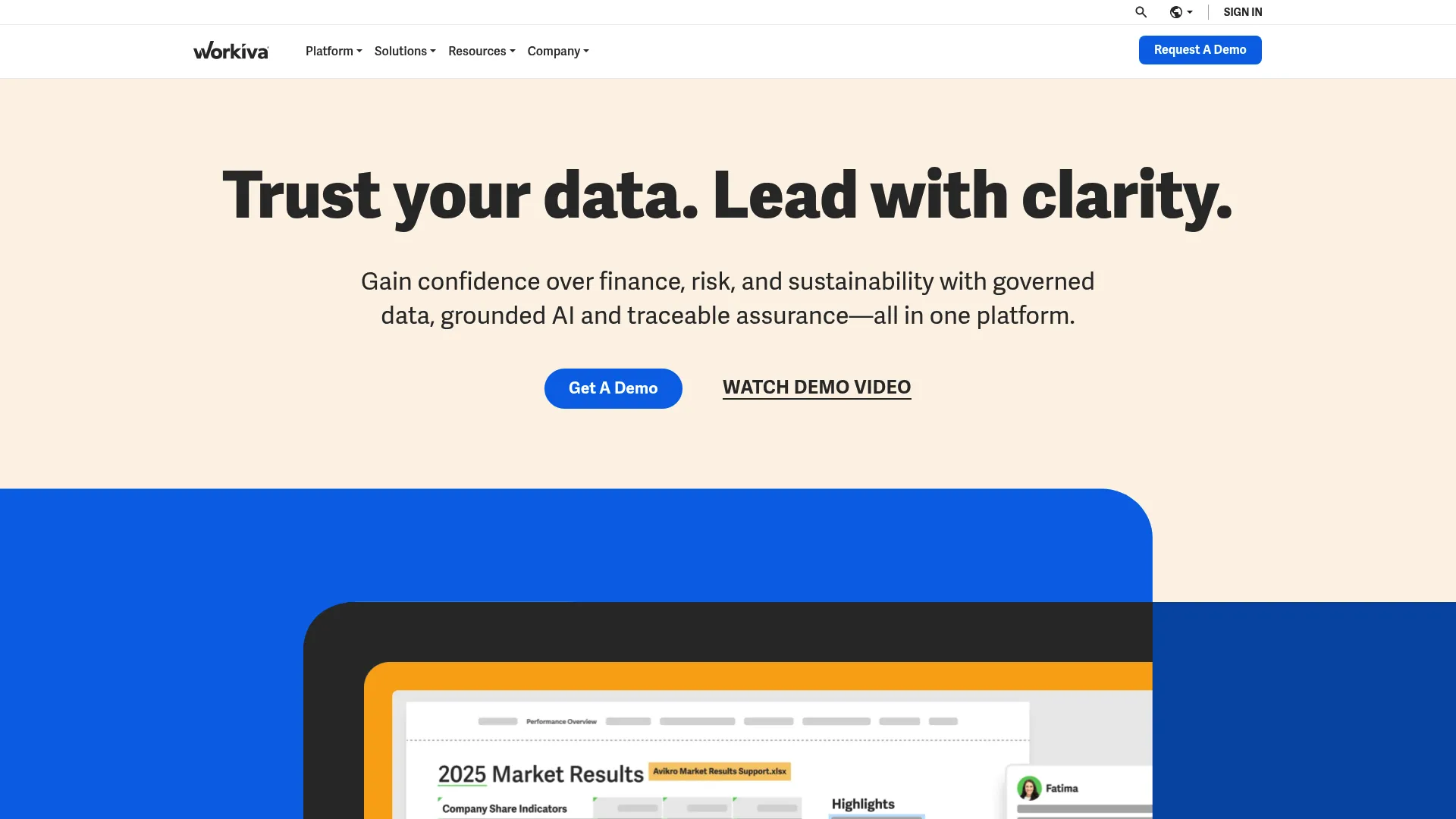
Workiva is an AI-powered platform for finance, risk, sustainability, and legal reporting, built around governed data and traceable assurance. For banks, its appeal is the source-to-sign-off workflow: figures move from source data through review to submission, with every step logged. That connected model is what makes it strong for teams juggling financial, risk, and ESG reporting in one place.
The platform is known for SEC reporting and XBRL/iXBRL workflows, which matters if you file structured disclosures. It also handles risk, audit, SOX, and controls management, so the same governed dataset supports more than one obligation.
Best for: Enterprises needing connected financial, risk, and sustainability reporting in one governed platform.
Key strengths
- SEC reporting and XBRL/iXBRL workflows
- Risk, audit, SOX, and controls management
- Sustainability reporting, carbon accounting, and disclosures
- Source-to-sign-off workflow with a full audit trail
- Governed data with human-in-the-loop review
Why choose Workiva: If your reporting spans finance, risk, and sustainability and you want one platform where every number is traceable and every approval is recorded, Workiva fits. It suits collaboration-heavy teams that need many contributors working on the same governed source without losing control.
Workiva pricing: Workiva uses a solution-based licensing model with annual and multi-year subscription contracts. No public list price is published; pricing is quote-based.
2. Gresham Technologies
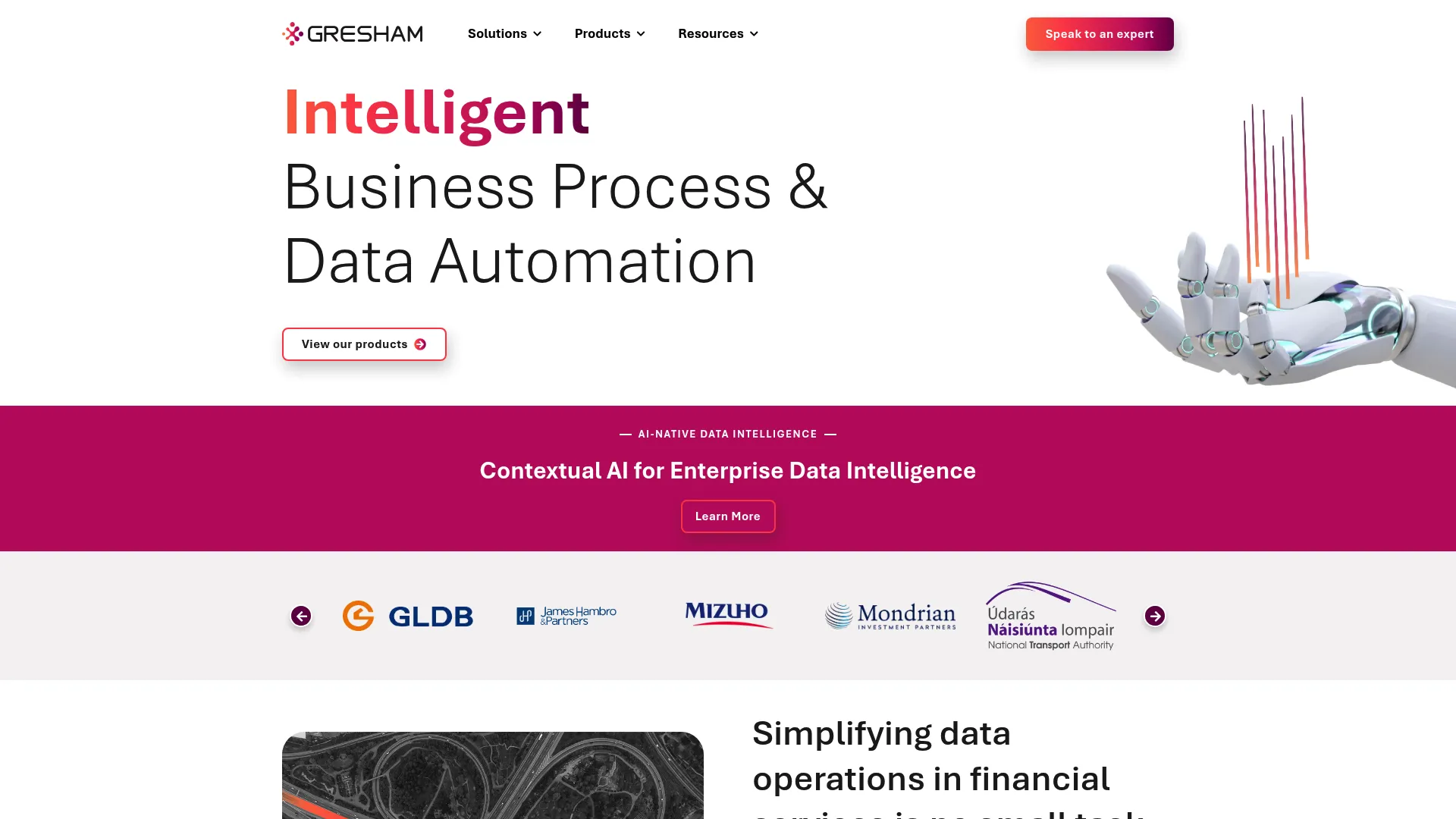
Gresham Technologies builds financial software for enterprise data management, reconciliation, regulatory reporting, and related workflow automation. Its strength is the data layer underneath the reports. When your reconciliation and data quality are solid, your regulatory reporting platform has something dependable to draw from, which is where many reporting problems actually start.
The platform offers pre-built connectivity for broker-dealers and low-code automation for reconciliation workflows. First-party materials cite 350+ connectors and sub-minute TRACE reporting, which speaks to its focus on transaction reporting speed and breadth.
Best for: Financial institutions needing reconciliation, compliance reporting, and enterprise data management.
Key strengths
- Enterprise reconciliation workflows with low-code automation
- Regulatory reporting and pre-built connectivity for broker-dealers
- Enterprise data management with data quality and validation tooling
- 350+ connectors across source systems
- Cloud, on-prem, and hybrid deployment
Why choose Gresham Technologies: Choose Gresham if your reporting pain traces back to messy data and reconciliation breaks rather than the reports themselves. It fits broker-dealers and institutions that want a strong data foundation feeding multi-jurisdiction reporting.
Gresham Technologies pricing: No public price is published on the vendor site. Pricing is quote-based and scales with deployment and connectivity needs.
3. Oracle Financial Services
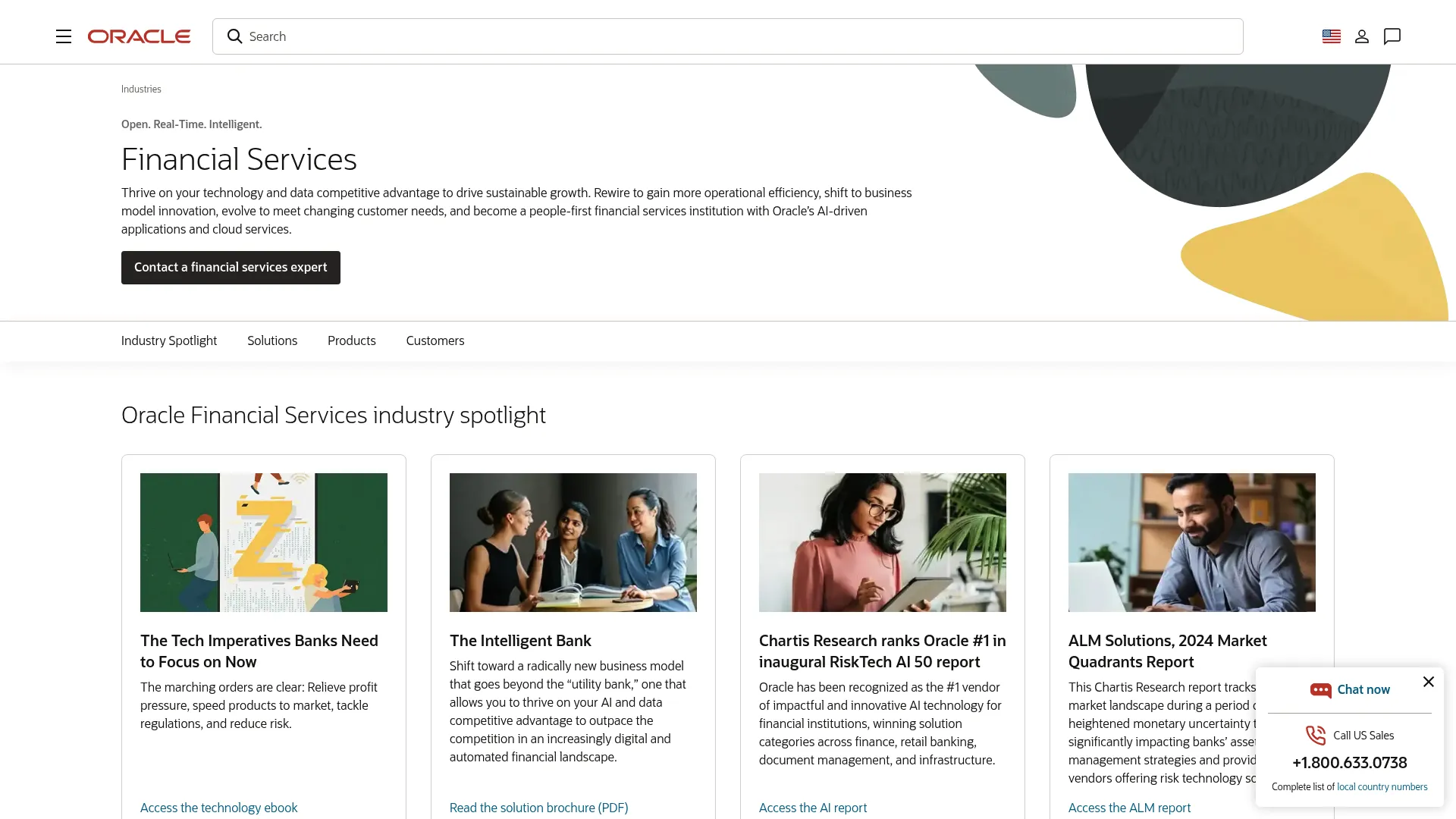
Oracle Financial Services is Oracle's software portfolio for banking, risk, compliance, and finance operations. Its depth in accounting and regulatory modules is the draw for large institutions. If your obligations include IFRS 17, LDTI, CECL, FRTB, and climate analytics, Oracle covers a wide standards footprint on a common data and analytics foundation with strong data lineage.
The portfolio spans risk management analytics, AML and financial crime compliance, and core banking applications. That vertical depth suits firms that want accounting, risk, and regulatory reporting sitting on one integrated stack rather than stitched across vendors.
Best for: Large financial institutions seeking Oracle's banking, risk, and compliance software suite.
Key strengths
- Risk management analytics
- AML and financial crime compliance
- Core banking and financial services applications
- Multi-standard coverage: IFRS 17, CECL, FRTB, CRS
- Climate and sustainability reporting with data lineage
Why choose Oracle Financial Services: Choose Oracle when your reporting spans many accounting standards and you want them on one analytics foundation. It fits large banks and insurers with complex, multi-standard obligations and the appetite for a broad platform.
Oracle Financial Services pricing: Oracle does not publish public pricing for these solutions and directs buyers to request a demo or contact sales. Pricing is quote-based.
4. Adenza
Adenza is a financial technology software brand for capital markets and banking operations. Its regulatory reporting depth centers on trade and transaction reporting, submissions, and the controls around them. For firms filing across multiple regimes and asset classes, that specialization is the point: the reports are complex, and the platform is built for that complexity.
Adenza's positioning covers banking and regulatory reporting alongside data lineage and controls, which supports audit-ready reporting for capital markets participants. It fits firms where trade reporting volume and jurisdictional breadth are the defining challenge.
Best for: Banks and capital markets firms needing regulated finance software.
Key strengths
- Trade and transaction reporting depth
- Multi-regime submissions and controls
- Data lineage for audit-ready reporting
- Coverage across capital markets and banking operations
- Regulatory reporting built for complex asset classes
Why choose Adenza: Choose Adenza when trade and transaction reporting volume across multiple jurisdictions is your core challenge. It suits capital markets firms and banks that need depth in regulated reporting rather than a general compliance tool.
Adenza pricing: No public pricing is published. Pricing is quote-based and arranged through sales for banking and capital markets deployments.
5. SafetyCulture
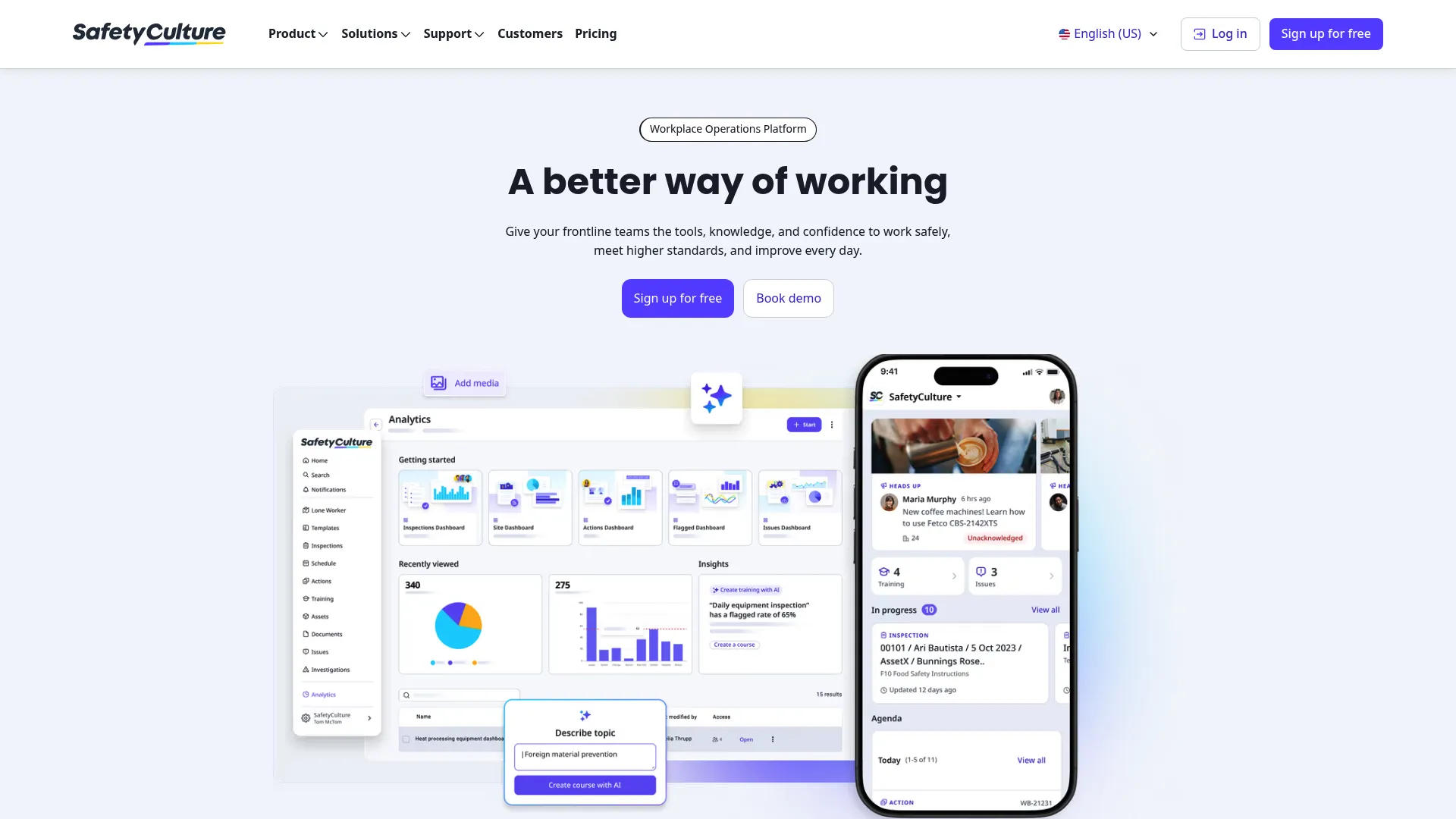
SafetyCulture is a workplace operations platform for inspections, training, tasks, documents, assets, and frontline communications. It is not a core financial regulatory reporting engine, but it fits the broader compliance and operational reporting work that surrounds it. If your team needs practical templates, forms, and workflows that people actually adopt, this is where it earns its place.
The platform covers inspections and checklists, training and course management, and tasks, issues, and investigations. For financial services teams with operational compliance obligations alongside their filing workflows, it handles the day-to-day evidence and process side.
Best for: Teams that need a single platform for inspections, training, operational tasks, and compliance workflows.
Key strengths
- Inspections and checklists
- Training and course management
- Tasks, issues, and investigations
- Advanced analytics on Premium
- Integrations, permissions, and SSO/SCIM
Why choose SafetyCulture: Choose SafetyCulture for operational compliance, training, and inspection workflows rather than core regulatory filings. It fits teams that want fast adoption and practical forms, paired with a separate financial reporting platform.
SafetyCulture pricing: Free plan for small teams up to 10 seats. Premium is $24 per seat per month billed annually, or $29 per seat per month billed monthly. Enterprise is custom pricing.
6. RegEd
RegEd is an enterprise compliance and regtech provider for financial services firms. Its strength is documentation-heavy compliance: producer management, advertising review, regulatory change management, and CE and training programs. For a regulatory office that lives in SEC and FINRA obligations, this is the workflow layer that keeps the paperwork defensible.
RegEd covers compliance management, licensing and onboarding, and regulatory change education. That makes it a fit for firms whose main challenge is keeping people, disclosures, and training aligned with changing rules rather than filing quantitative reports.
Best for: Large financial services firms needing enterprise compliance, licensing, and training workflows.
Key strengths
- Producer management and onboarding
- Compliance management and advertising review
- Regulatory change management
- Education and training / CE programs
- SEC and FINRA documentation workflows
Why choose RegEd: Choose RegEd when your reporting burden is documentation, licensing, and regulatory change rather than quantitative filings. It fits broker-dealers and advisory firms managing large populations of licensed people.
RegEd pricing: No public pricing is published. Pricing is quote-based and arranged through sales.
7. ComplianceQuest

ComplianceQuest is an AI-powered quality, risk, and compliance platform built on Salesforce. Its value for regulated firms is evidence of compliance: audit trail, e-signature, nonconformance, and process control in one place. If you need to prove that a process ran the way it should have, this covers the documentation and workflow side of that story.
The platform includes audit trail and e-signature, real-time data analytics, and training and LMS. For financial services teams focused on risk review, nonconformance, and audit support, it centralizes the evidence that reviewers ask for.
Best for: Regulated enterprises needing an AI-powered QMS/QRC platform on Salesforce.
Key strengths
- Audit trail and e-signature
- Data privacy and security
- Integration with the Salesforce platform
- Real-time data analytics
- Training and LMS
Why choose ComplianceQuest: Choose ComplianceQuest when your priority is documented evidence, process control, and audit support across quality, risk, and compliance. It fits teams already on Salesforce that want compliance workflows in the same environment.
ComplianceQuest pricing: No public fixed pricing is published. Pricing is quote-based and varies by users, modules, sites, integrations, and compliance scope.
Considerations
Choose by regime coverage
Start with the exact reports you file, not a feature list. Map your obligations by regime and jurisdiction, then check depth against that map. A platform that covers your primary regimes deeply beats one that covers everything shallowly. Multi-regime reporting is only useful if the regimes you actually file are covered well.
Choose by data model and lineage needs
Ask how the platform represents your data and how it traces a number back to source. Strong data lineage is what turns a stressful audit into a short one. If you cannot see the path from a filed figure to its origin, you will pay for that gap later. Central data is the foundation for a real single source of truth.
Choose by workflow and approvals
Look at how sign-off, exception management, and ownership work in practice. Who prepares, who reviews, who approves, and how are exceptions surfaced and resolved? Good workflow removes ambiguity about who owns each number and makes the audit trail a byproduct of doing the work.
Choose by integration fit
Your reporting is only as good as the systems feeding it. Check connections to core banking, ERPs, data warehouses, and submission systems. SWIFT integration and pre-built connectors matter when transaction and trade reporting depend on clean, timely feeds. Fewer manual handoffs means fewer places for errors to enter.
Choose by scale and support model
Enterprise regulatory reporting is a long-term relationship. Evaluate implementation, professional services, and ongoing maintenance, not just the software. Ask how upgrades, new regime support, and vendor support work over years. The right long-term fit depends as much on the support model as the feature set.
Conclusion
The right regulatory reporting platform depends on your reporting complexity, jurisdictions, and governance requirements, not on a single "best" label.
For unified banking reporting across finance, risk, and sustainability, Workiva stands out. If your challenge starts with data and reconciliation, Gresham Technologies gives you a strong foundation. For deep, multi-standard accounting and regulatory modules, Oracle Financial Services covers the widest footprint. Adenza fits capital markets firms where trade and transaction reporting depth is the defining need.
For operational compliance and training alongside your filings, SafetyCulture earns a place. For documentation-heavy SEC and FINRA offices, RegEd fits. And for audit-ready evidence and process control on Salesforce, ComplianceQuest works.
Start where the pain is sharpest. Map your regimes, test lineage and workflow against a real filing, and pressure-test integration and support before you commit. The platform that survives that test is the one worth choosing among these regulatory reporting solutions.
Start your journey with Guideflow today!
FAQs
It centralizes the data, validation, sign-off, submission, and auditability needed to file reports to financial regulators. It pulls figures from source systems, checks quality, routes them through approvals, formats them for each regulator, and logs every step so the whole process is traceable and audit-ready.
GRC software manages governance, risk, and compliance broadly, often across policies, risk registers, and controls. Regulatory reporting software is narrower and deeper: it focuses on producing accurate, traceable filings for specific regimes, with data lineage and submission formatting that generic GRC tools usually do not match.
Prioritize regime and jurisdiction coverage for the reports you actually file, a strong audit trail, and data lineage from source to submission. Then check workflow and approvals, exception management, and integration with core banking and data warehouses. Depth in your specific obligations matters more than a long generic feature list.
Yes, several platforms handle ESG reporting alongside financial and risk reporting. Workiva covers sustainability reporting, carbon accounting, and disclosures, and Oracle Financial Services includes climate and sustainability reporting. The advantage of a single platform is that ESG data sits under the same governance and lineage as your financial figures.
Data lineage shows where each reported number came from and how it changed along the way. When an auditor or regulator asks "where did this figure come from?", lineage lets you answer in minutes instead of days. It is the backbone of a defensible, single source of truth and audit-ready reporting.
Connections to your systems of record: core banking, ERPs, data warehouses, and submission systems. For transaction and trade reporting, SWIFT integration and pre-built connectors keep feeds clean and timely. Fewer manual handoffs mean fewer places for errors to enter the report.
No. Large institutions often need the deepest, multi-standard platforms, but smaller firms benefit too. SMEs' share of the market is projected to rise from 23.6% in 2025 to 28.2% by 2034, driven by cloud-based adoption, according to MarketIntelo (2025). Right-sizing coverage and support to your obligations matters more than size.
Treat it as a multi-year relationship, not a one-time purchase. Ask how implementation runs, what professional services cost, and how upgrades and new regime support are delivered over time. Test the support model with a real filing scenario, since long-term fit depends as much on service as on features.