You launched a 64-team bracket last month. Registrations lived in a Google Form. Check-in ran through Discord. Match results came back over DM, half of them disputed. Payouts happened by hand. And when a sponsor asked for engagement numbers, you had nothing clean to hand them.
That is the real cost of running esports tournaments without purpose-built software. The work is not the competition. The work is the operational sprawl around it: registration, seeding, brackets, communications, scheduling, results, payments, and reporting all living in different tabs. Every event you run, you rebuild the same chaos.
The market has caught up to that pain. The worldwide esports tournament management platform market reached $882.15 million in 2025 and is forecast to grow to $2.33 billion by 2032 at a 14.8% CAGR, according to PMarketResearch (2025). Cloud-based deployment already accounts for 81.5% of that market, roughly $718.83 million in 2025. Organizers are consolidating their stacks onto dedicated platforms, and the tooling has matured to match.
For an organizer, a game studio, or a marketing lead running branded competitions, the question is not whether to use tournament management software. It is which platform matches your event model, your monetization plans, and the scale you are trying to reach. Get that decision right and you stop rebuilding spreadsheets. Get it wrong and you inherit a tool that fights your workflow every season.
What's inside
This guide compares seven esports tournament software platforms for 2026, built for organizers, game studios, agencies, and community operators. We evaluated each on tournament management depth, organizer experience, pricing clarity, integrations, monetization support, and fit for different audiences.
The list spans three shapes of tool: organizer-first platforms that handle brackets and league play end to end, marketplace and discovery tools that connect events to players, and platforms with streaming, sponsorship, or funding workflows built in. No single tool wins on every axis, so we flag exactly who each one fits.
TL;DR
- Best overall organizer platform: Toornament, for its depth across tournament and league management, community tools, and white-label publishing.
- Best for discovery and community reach: Battlefy, which pairs organizer workflows with player-facing event pages.
- Best for engineered depth and monetization: GammaStack, when you need a custom-built platform with payment gateways and compliance.
- Best for streaming and production: eGame Studio, for browser-based broadcast and multistreaming to Twitch, YouTube, and Kick.
- Best for prize pools and sponsorship funding: Matcherino, purpose-built for crowdfunding and payouts.
- Best lightweight bracket tool: Challonge, for fast, simple bracket generation with a free tier.
What is esports tournament software?
Esports tournament software is a platform that lets organizers create, run, and manage competitive gaming tournaments, including registration, brackets, scheduling, results, and often payments and streaming, from one place.
Instead of stitching together forms, spreadsheets, chat apps, and manual payouts, these platforms centralize the entire event lifecycle. That matters because tournament operations scale badly by hand. A 16-player single-elimination bracket is manageable in a spreadsheet. A recurring 256-team league across multiple games is not.
Common capabilities across the category include:
- Bracket and match management: single elimination, double elimination, round robin, Swiss, and multi-stage formats.
- Registration and check-in: signup pages, team rosters, seeding, and match check-in.
- Scheduling and result tracking: match scheduling, score reporting, and dispute handling.
- Player and team discovery: public event pages that surface tournaments to competitors.
- Leaderboards and rankings: standings, stats, and ratings that persist across events.
- Payments and sponsorship workflows: paid registrations, entry fees, prize pool distribution, and sponsor placements.
- Streaming and fan engagement integrations: overlays, broadcast tools, and multistreaming to major platforms.
The strongest platforms treat these not as separate features but as one connected workflow, so a registration flows into a bracket, a result updates a leaderboard, and a payout triggers without manual reconciliation.
When to use esports tournament software
Not every competition needs a platform. A one-off eight-player bracket among friends runs fine on paper. The decision changes the moment recurrence, scale, or money enters the picture.
Run recurring community tournaments
Once you are running the same event weekly or monthly, spreadsheets and Discord stop scaling. You spend more time chasing scores and rebuilding brackets than growing the community. A dedicated platform stores your formats, automates seeding, and lets returning players self-register. If you host repeatedly, the setup time pays back within a season.
Manage branded league play
Structured seasons with standings, playoffs, and checkpoints demand persistent data. League management software tracks results across weeks, updates rankings automatically, and keeps a single source of truth for every match. This is where organizer-first platforms with community and circuit tooling separate from simple bracket generators.
Add monetization or sponsor visibility
When payments, entry fees, or sponsored prize pools enter your events, manual handling becomes a liability. Platforms with built-in payment gateways, crowdfunding, and sponsor placement give you clean records and reporting. That reporting is what a partner actually wants to see before renewing a sponsorship.
Support discovery and player acquisition
If growing your player base matters as much as running the event, discovery-oriented tools help. Public event pages, searchable tournament listings, and player-facing UX turn a single competition into a recruitment channel. This matters most for open community events and marketplace-style programs.
Comparison table
Scan this table for the fastest read on fit. The Intent column tells you the primary job each tool is built for. Key differentiation shows what sets it apart. Pricing reflects verified entry points, and G2 ratings are included where a meaningful review sample exists.
| # | Product | Intent | Key differentiation | Pricing | G2 rating |
|---|---|---|---|---|---|
| 1 | Toornament | Organizer and studio tournament management | Deep tournament plus league tools with white-label publishing | Free; paid from 19€ | Insufficient reviews |
| 2 | Battlefy | Organizer platform with player discovery | Event pages that surface tournaments to players | Not publicly listed | 5.0/5 (1 review) |
| 3 | GammaStack | Custom-engineered tournament platform | Bespoke build with payment gateways and compliance | Custom quote | Insufficient reviews |
| 4 | eGame Studio | Streaming-first tournament production | Browser-based broadcast and multistreaming | $85/month | Not listed |
| 5 | Matcherino | Prize pool crowdfunding and payouts | Sponsor activation and community-funded prize pools | Not publicly listed | Not listed |
| 6 | Challonge | Lightweight bracket management | Fast bracket generation with a free tier | Free; Premier from $6.99/mo | Not listed |
| 7 | FACEIT | Competitive matchmaking and community | Anti-cheat matchmaking with a large player base | Free; Premium from $7.99/mo | Not listed |
1. Toornament
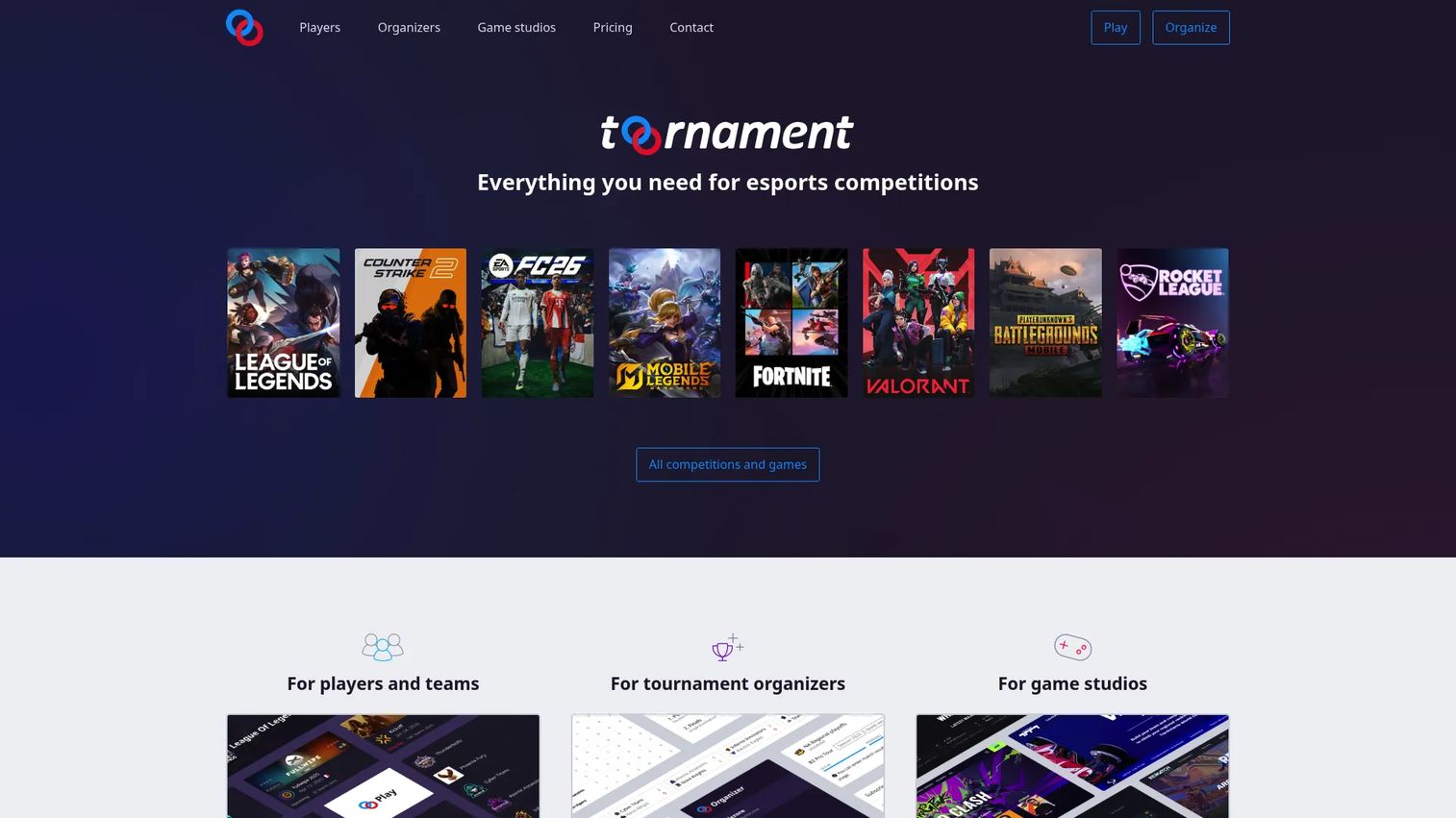
Toornament is an esports tournament and competition management platform built for organizers and game studios. It covers the full lifecycle, from tournament and league management to community tools and white-label publishing, and it scales from a single bracket up to branded circuits that run all season. If your goal is one platform that grows with your program rather than a tool you outgrow, Toornament is the strongest default.
The platform's depth shows up in how it handles recurring competition. You can manage gaming communities, run branded large-scale competitions, and publish white-label tournament experiences under your own brand. Paid registrations and API access round out the toolkit for organizers who need money movement and integrations, not just brackets.
Best for: Esports teams, organizers, and game studios running tournaments or competitive communities at scale.
Key strengths
- Tournament and league management: Handle single events and full seasons with persistent standings and structured playoffs.
- Community and circuit tools: Run recurring competitions and branded circuits with returning-player workflows.
- White-label publishing and API: Publish under your own brand and connect Toornament to your existing stack.
Why choose Toornament: It fits organizers and studios who need range, not a single trick. The tiered organizer plans mean a hobbyist can start free and a studio can graduate to custom publishing tools without switching platforms. That continuity is rare in this category.
Toornament pricing: Organizer plans start Free for small-scale events. Boost is 19€ per tournament. Community runs 19€ per month billed annually, or 29€ monthly, for managing gaming communities. Circuit is 69€ per month billed annually, or 89€ monthly, for branded large-scale competitions. Arena starts from 229€ per month billed annually, or 299€ monthly, for custom publishing tools, and Custom pricing is available on demand. G2 currently shows an insufficient review sample rather than a substantive buyer rating.
2. Battlefy
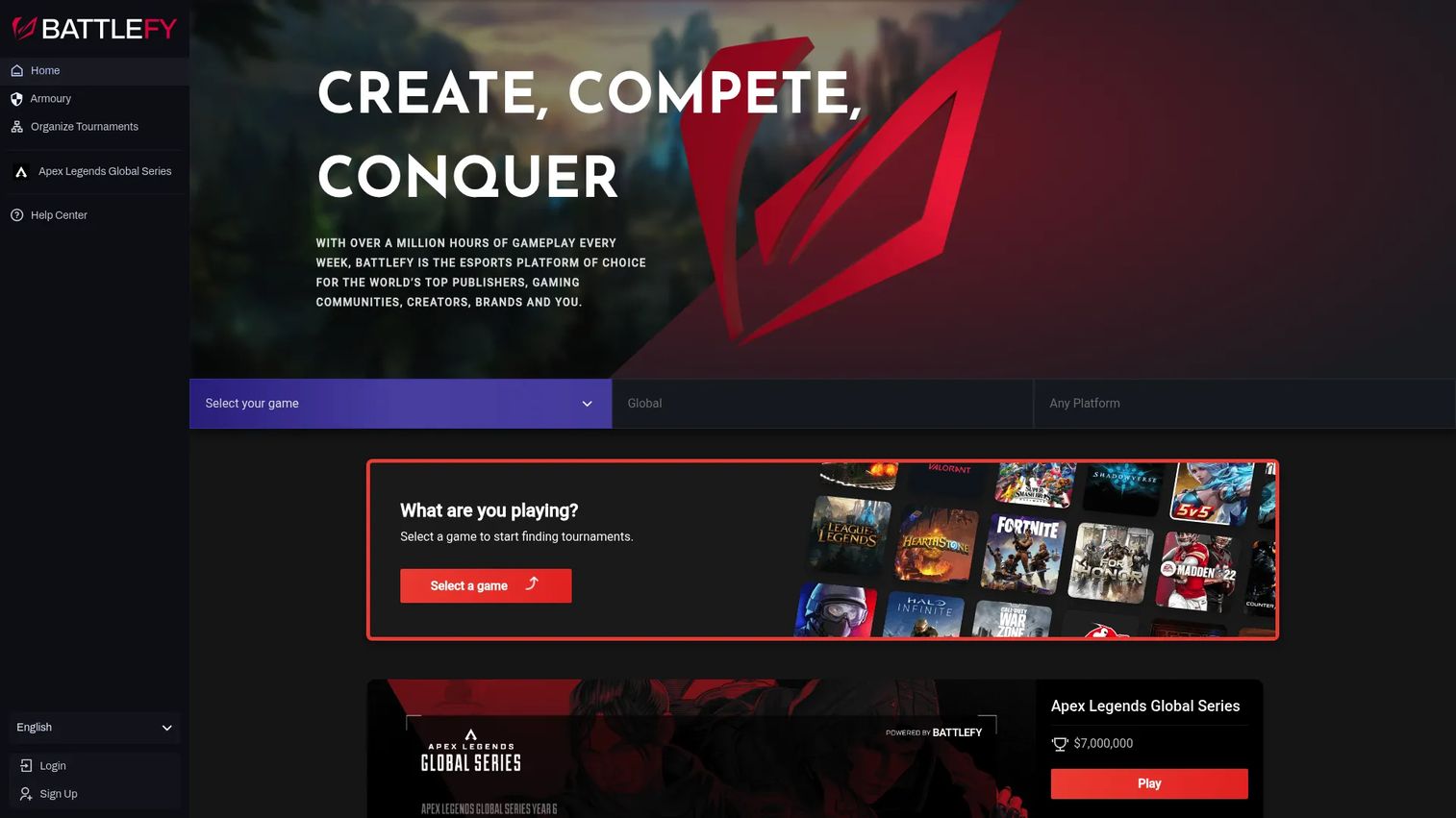
Battlefy is an esports tournament platform for finding, organizing, and managing competitions. It pairs organizer workflows with a player-facing layer, so the same event you run also gets surfaced to competitors looking for tournaments to join. That discovery angle is what sets it apart from pure back-office bracket tools.
The organizer toolkit covers check-in and seeding, bracket management with match check-in, and tournament pages that carry rules, schedule, contact details, and prizes. For an organizer who cares as much about growing participation as about running the event cleanly, that combination of workflow plus reach is the draw.
Best for: Esports organizers and communities running online tournaments who want built-in player discovery.
Key strengths
- Bracket and check-in management: Seed, run, and check in matches without leaving the platform.
- Tournament pages: Publish rules, schedules, prizes, and contact info on a shareable event page.
- Player discovery: Surface your events to a community of players searching for competitions.
Why choose Battlefy: It fits organizers whose growth depends on new players finding their events, not just on serving an existing roster. The event pages double as recruitment surfaces, which matters for open community programs and game-community visibility.
Battlefy pricing: Battlefy's pricing details were not publicly readable at the time of writing, so confirm current plans and any free tier directly on its pricing page before committing. G2 shows a 5.0/5 seller rating, though from a single review, which is too small a sample to generalize.
3. GammaStack
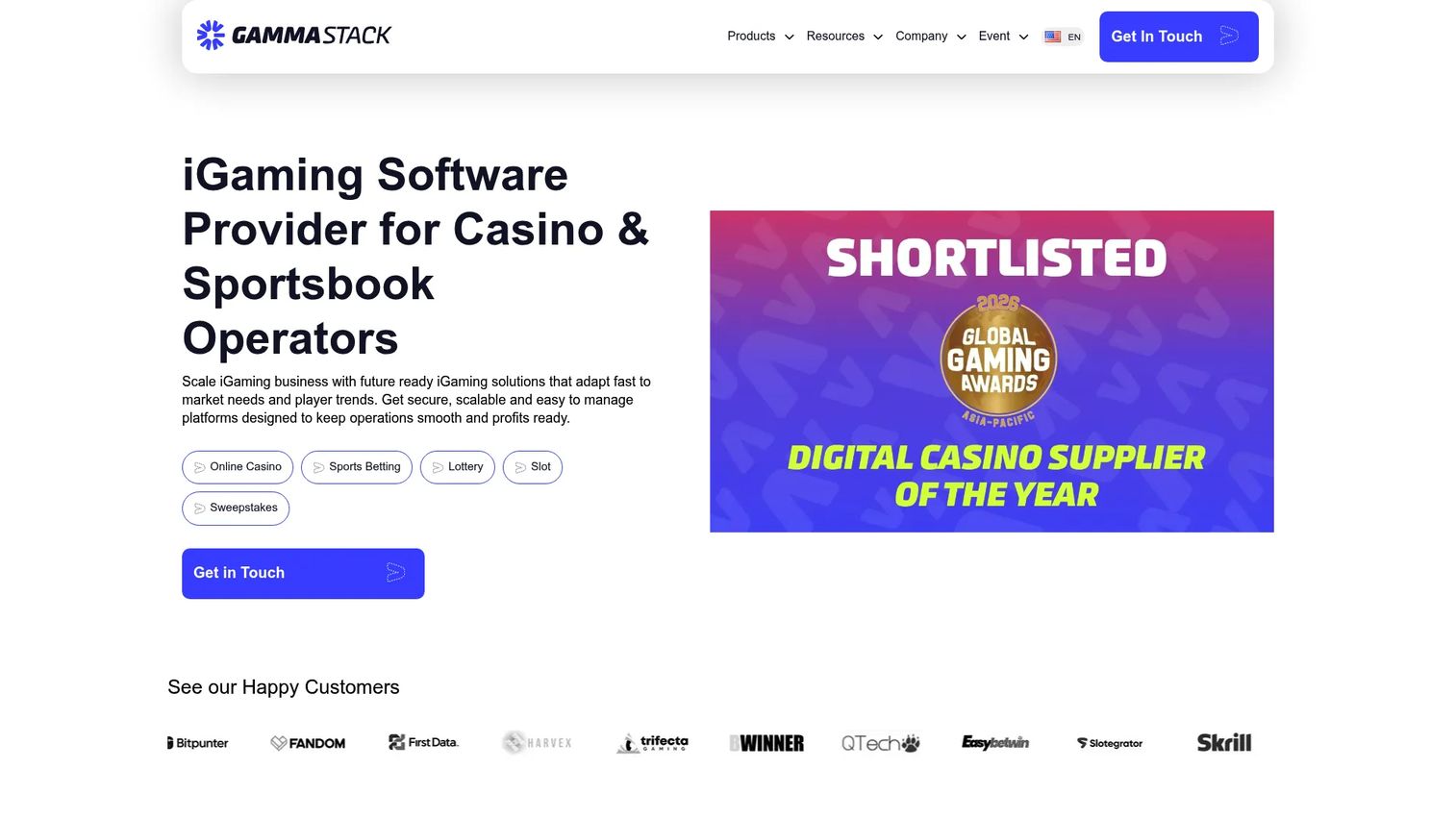
GammaStack is a software provider that builds bespoke platforms across iGaming and esports, including tournament engines with payment gateways and compliance baked in. Where the other tools on this list are ready-made products you configure, GammaStack is closer to a development partner that engineers a platform around your requirements. That is the right model when off-the-shelf software cannot cover your feature set.
Its scope leans toward operators who need full ownership and control. GammaStack emphasizes bespoke platform development, ready-to-launch white-label and turnkey options, and zero revenue sharing with full IP ownership. For a team building a branded tournament product rather than just hosting events, that ownership model is the core appeal.
Best for: Operators seeking custom-engineered tournament software with payments, compliance, and full IP ownership.
Key strengths
- Bespoke platform development: Get a tournament engine engineered to your exact requirements.
- White-label and turnkey options: Launch faster with ready-to-deploy branded solutions.
- Full IP ownership, zero revenue sharing: Own the platform outright without ongoing revenue cuts.
Why choose GammaStack: It fits teams that have outgrown configurable products and need engineered depth, especially where payment gateways, leaderboards, chat, and compliance must be built to spec. This is a heavier commitment than a subscription tool, and it suits organizations treating the platform as owned infrastructure.
GammaStack pricing: GammaStack does not publish numeric pricing. Its site describes flexible, custom, quote-based engagement, so you request a proposal scoped to your build. G2 shows no meaningful review sample. Treat this as a custom-development relationship rather than a self-serve subscription, and budget accordingly for scope and timeline.
4. eGame Studio
eGame Studio is esports and streaming software with a production-first angle, including Game Lens tools built for school esports coaches. Where bracket-centric platforms end at results, eGame Studio starts at the broadcast: remote player access, custom branding, multi-webcam PlayerCam, and browser-based streaming. If your events live or die on the broadcast experience, this is where a production-oriented tool earns its place.
The streaming reach is the standout. eGame Studio supports multistreaming to Twitch, YouTube, and Kick simultaneously, which matters for organizers trying to grow fan engagement across platforms without running separate encoders. Fast custom branding keeps the broadcast on-brand for sponsors and partners.
Best for: School esports coaches and small team-based esports programs that prioritize broadcast quality.
Key strengths
- Browser-based streaming with PlayerCam: Run multi-webcam broadcasts without heavy local software.
- Multistreaming to Twitch, YouTube, and Kick: Reach fans across platforms from one stream.
- Fast custom branding and remote player access: Keep broadcasts on-brand and let players join remotely.
Why choose eGame Studio: It fits organizers and coaches for whom the broadcast is the product, not an afterthought. The remote player access and pooled hours model suits distributed team programs that stream regularly rather than one-off large events.
eGame Studio pricing: Game Lens is $85 per month, billed monthly, for a team of five players and a coach, with 96 pooled hours per month. Custom packages are available for programs that need more hours. There is no free tier. A public G2 or Capterra rating was not verifiable at the time of writing.
5. Matcherino
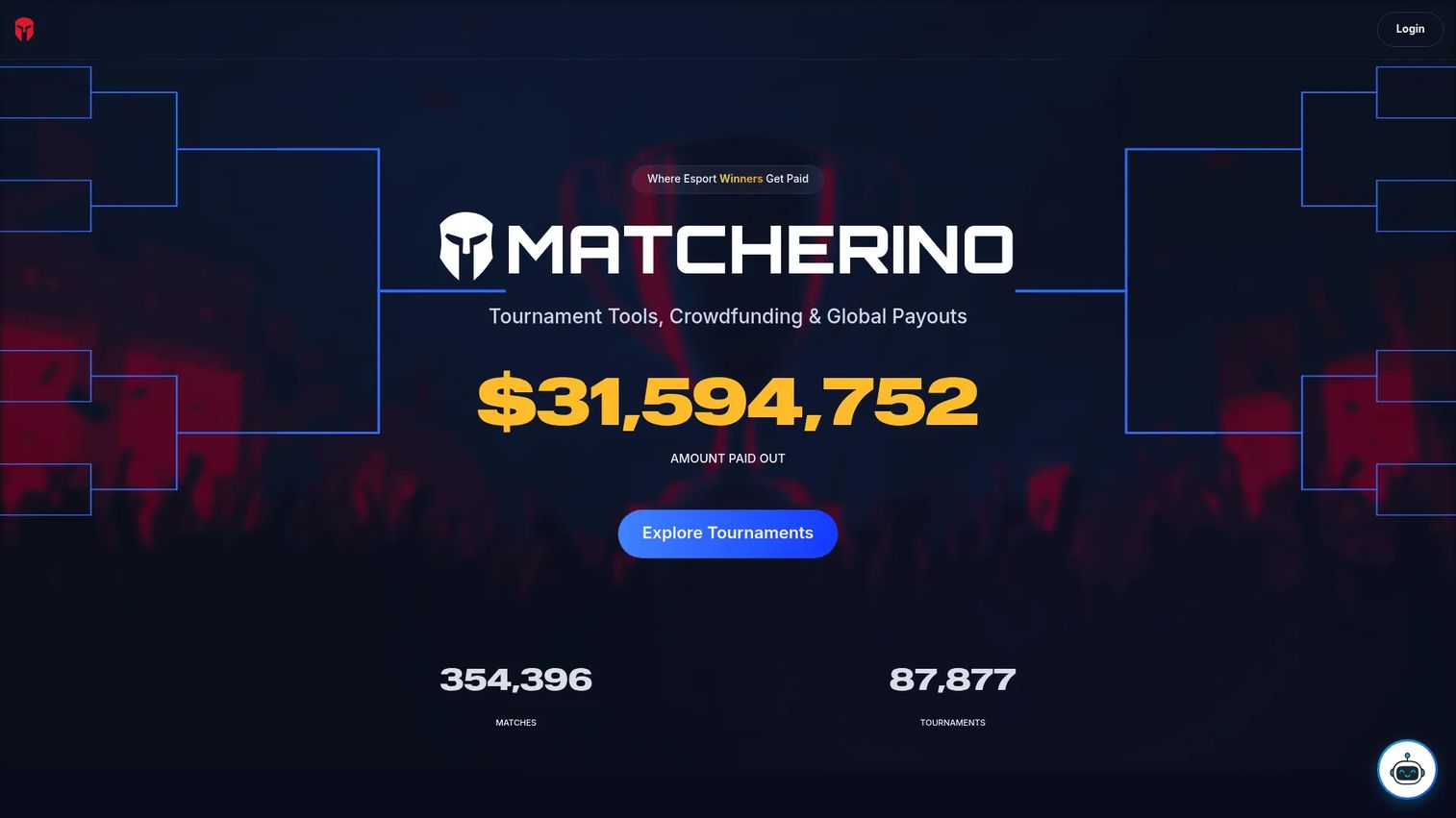
Matcherino is a platform for esports tournament tools, crowdfunding, and payout infrastructure, built for organizers, publishers, and brands. Its differentiator is money movement: where most tools treat prize pools as an afterthought, Matcherino makes crowdfunded prize pools, sponsor activation, and payouts the center of the product. If monetization is the point of your event, this is the specialist to evaluate.
The feature set reflects that focus. Matcherino covers tournament tech like brackets, signups, streaming overlays, ticketing, and entry fees, plus a publisher dashboard for distributing cash and in-game prizes. Sponsor activation includes dedicated placements, engagement quests, and post-final overlays that give partners measurable visibility.
Best for: Esports organizers and publishers running tournaments funded by crowdfunding, entry fees, or sponsorships.
Key strengths
- Crowdfunding and payout infrastructure: Fund prize pools from the community and distribute payouts cleanly.
- Sponsor activation tools: Give partners dedicated placements, engagement quests, and overlay visibility.
- Tournament tech with ticketing and entry fees: Run brackets and signups with monetization built in.
Why choose Matcherino: It fits organizers whose events depend on prize pools and sponsor dollars. The publisher dashboard and sponsor activation tooling turn monetization from a manual headache into a reportable workflow, which is exactly what a returning sponsor wants to see.
Matcherino pricing: Matcherino does not publish a plan-based pricing page with visible amounts, so confirm current terms, entry-fee cuts, and any platform fees directly with Matcherino before running a funded event. A public G2 or Capterra product rating was not verifiable at the time of writing.
6. Challonge
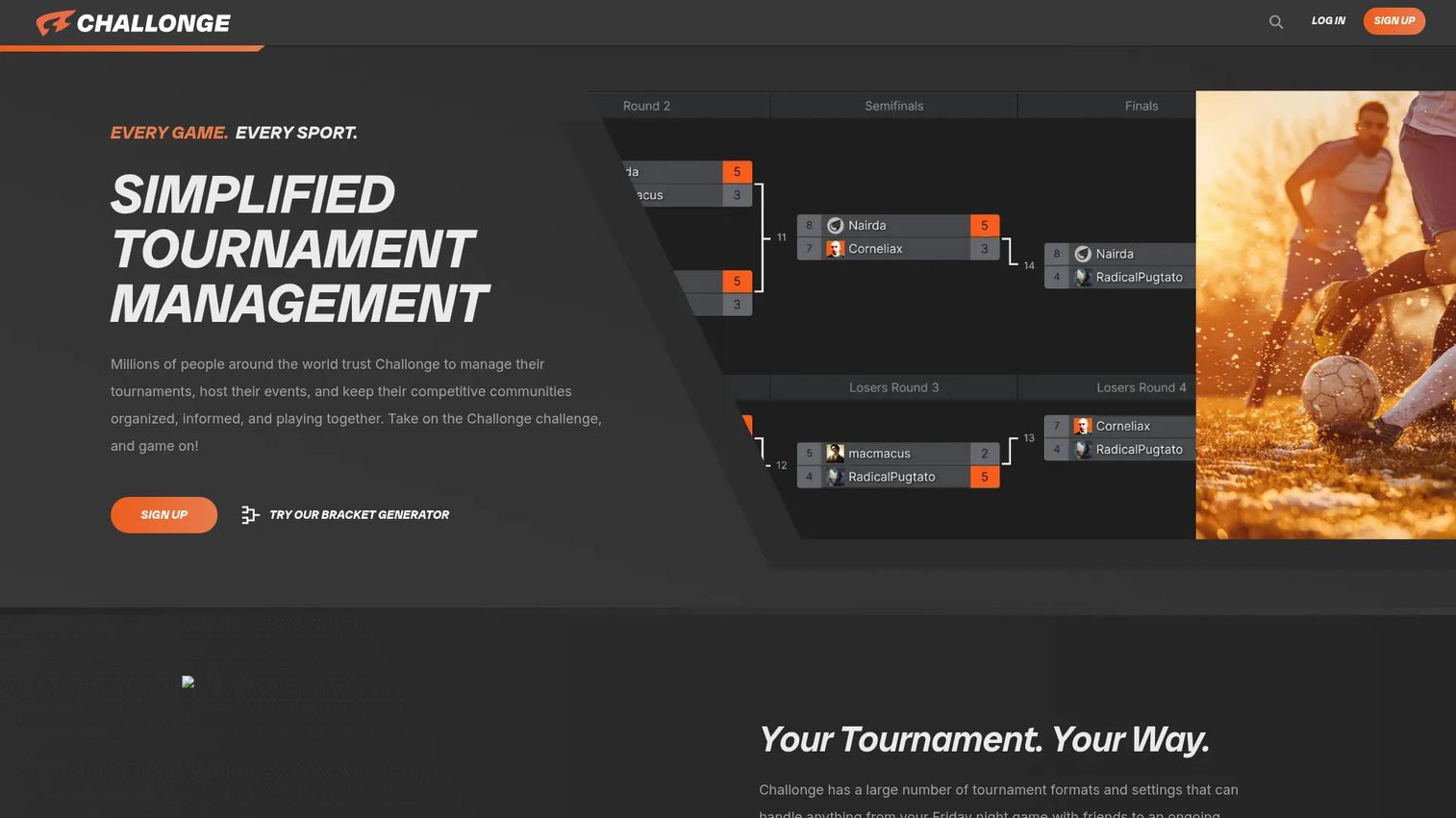
Challonge is a web-based tournament, events, and community management platform known for fast, simple bracket generation. When you need a bracket live in minutes without configuring an entire platform, Challonge is the lightweight choice that gets you there. It handles the essentials cleanly and stays out of your way.
Despite the simplicity, the format support is broad. Challonge offers single elimination, double elimination, round robin, Swiss, and two-stage brackets, plus communities for hosting recurring competitions. Events, contests, ratings, stats, signup pages, and match chat cover the practical needs of most organizers without the weight of an enterprise platform.
Best for: Organizers running brackets, tournaments, and community competitions who want speed and simplicity.
Key strengths
- Fast bracket generation: Spin up single elimination, double elimination, round robin, or Swiss brackets in minutes.
- Communities for recurring events: Host and organize repeat competitions under one community.
- Practical event tools: Use signup pages, ratings, stats, and match chat without heavy setup.
Why choose Challonge: It fits smaller organizers and anyone running straightforward brackets who does not need payments, streaming production, or engineered depth. The free tier makes it a natural starting point, and the paid tier removes ads and raises limits when you scale.
Challonge pricing: The Standard plan is free and ad-supported. Premier is $6.99 per month billed yearly, or $12 per month billed monthly, and adds no ads, a free Pro Community license, custom themes, priority support, and higher participant limits. A current G2 or Capterra rating was not verifiable at the time of writing.
7. FACEIT
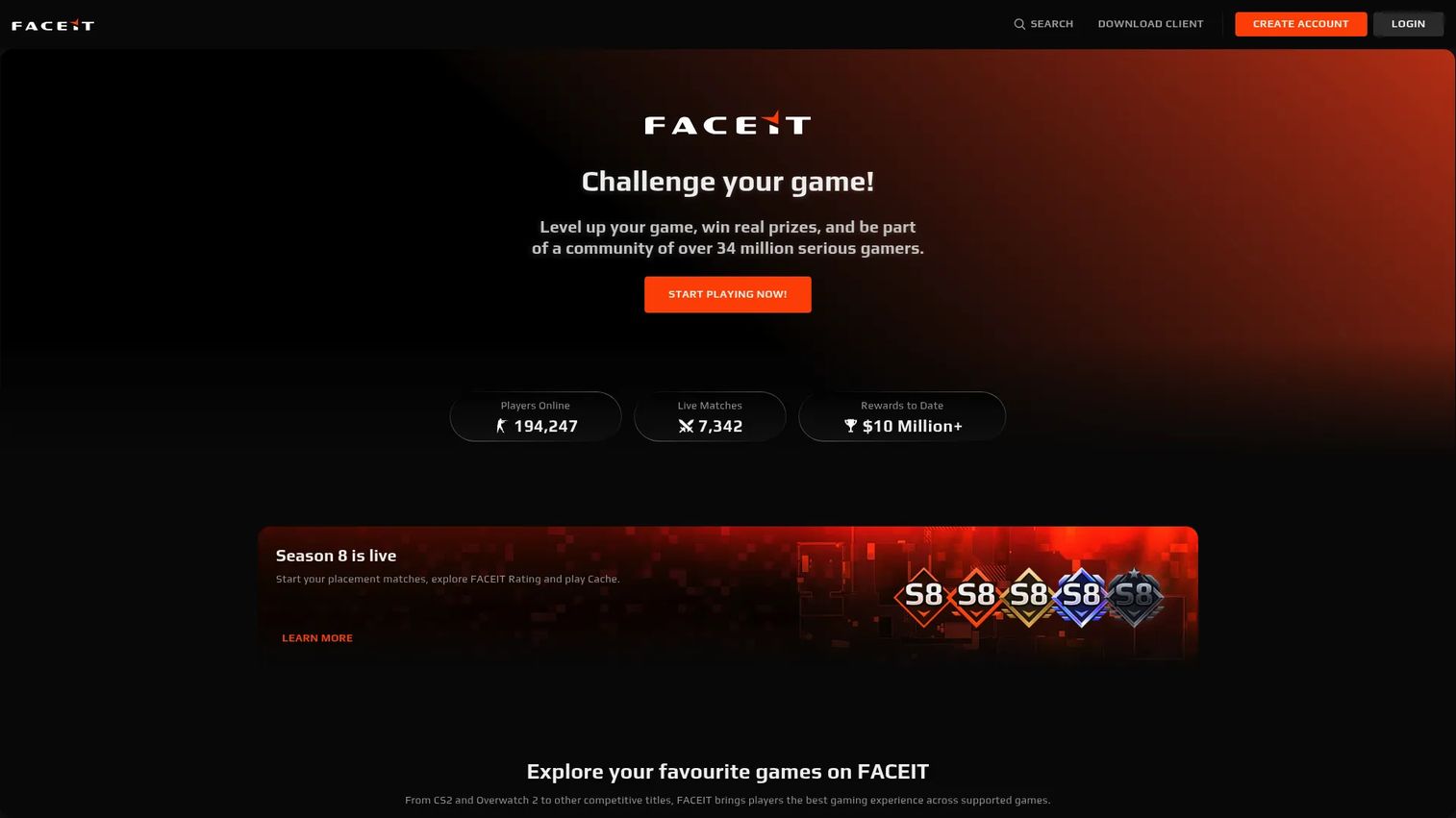
FACEIT is a competitive gaming platform for matchmaking, anti-cheat, tournaments, and community play. It differs from pure organizer tools in that its center of gravity is the player. FACEIT brings a large, active community, ranked matchmaking, and anti-cheat infrastructure, which makes it less a back-office bracket builder and more a destination where competition happens.
That player-first model shapes what it does best. FACEIT offers matchmaking for supported games, FACEIT Anti-Cheat, and clubs, stats, and mobile app access. For organizers, the value is scale and reach: running events on a platform where players already are, rather than recruiting an audience from scratch.
Best for: Gamers and organizers who want competitive matchmaking with anti-cheat and a built-in ranked community.
Key strengths
- Matchmaking with anti-cheat: Run ranked competition backed by FACEIT Anti-Cheat.
- Large active community: Tap into an existing player base rather than building one.
- Clubs, stats, and mobile access: Organize communities and track performance across devices.
Why choose FACEIT: It fits organizers who want to run competition where a competitive community already lives, and players who want ranked matchmaking with integrity protections. It is a different animal from a bracket generator, so weigh whether you want a platform or a community.
FACEIT pricing: Free access is available for registered members. FACEIT Premium starts at $7.99 per month billed annually. Other regional or tiered prices were not fully verifiable in this run, so confirm current options on the subscription page for your game. A product-specific G2 rating was not verifiable at the time of writing.
Considerations before choosing a platform
The right tool depends on your event model, not on a feature count. Run through these before you commit.
Match the tool to your event shape
A weekly community bracket, a season-long branded league, and a sponsor-funded championship are three different jobs. Simple bracket tools excel at the first, organizer-first platforms at the second, and monetization or engineered platforms at the third. Name your primary event type before you shortlist.
Verify monetization and payment support
If entry fees, prize pools, or sponsorships touch your events, confirm the platform handles payments and payouts natively. Check what cut the platform takes, how payouts are distributed, and what reporting sponsors receive. Manual money movement is where tournaments create the most risk.
Check pricing structure against your cadence
Per-tournament pricing suits occasional organizers. Monthly or annual plans suit anyone running recurring events. Custom-built platforms suit teams treating the software as owned infrastructure. Map the pricing model to how often you actually run events, not to a headline number.
Confirm integrations and streaming fit
If broadcast matters, verify streaming and multistreaming support and how overlays work. If you rely on other tools, confirm API access and integrations so results and registrations flow without manual re-entry. A platform that fights your existing stack costs you every event.
Conclusion
There is no single best esports tournament software, only the best fit for your event model. Toornament is the strongest all-around organizer platform, with the depth to grow from a single bracket to branded league circuits. Battlefy leads on discovery and community reach, pairing organizer workflows with player-facing event pages. GammaStack fits teams needing engineered depth and monetization built to spec, while Matcherino specializes in crowdfunded prize pools and sponsor activation. eGame Studio owns the production and streaming layer, and Challonge stays the fastest, simplest choice for straightforward brackets.
Start by naming your event shape: recurring community play, structured league seasons, or monetized championships. Then shortlist the two platforms that match that shape and run a single real event through each before committing to a season. The tool that disappears into your workflow, rather than fighting it, is the one worth keeping.
FAQs
At minimum, look for bracket management across formats, registration and check-in, match scheduling, and result tracking. Beyond that, the features that matter depend on your model: payments and payouts for monetized events, streaming integrations for broadcast-heavy programs, and leaderboards plus community tools for recurring league play.
For a one-off small bracket, a free tool like Challonge is often enough, and its Standard plan costs nothing. The value grows with recurrence. Once you run the same event weekly or monthly, a dedicated platform saves hours of manual seeding, scoring, and communication every cycle.
Tournament software focuses on individual events: brackets, check-in, and results for a single competition. League management software handles persistent, multi-week structures with standings, playoffs, and rankings that carry across matches. Organizer-first platforms like Toornament combine both, so you can run one-off events and full seasons on the same system.
Matcherino is purpose-built for crowdfunded prize pools, entry fees, payouts, and sponsor activation. Toornament supports paid registrations, and GammaStack can engineer payment gateways into a custom build. If monetization is central to your events, confirm exactly how each platform handles payouts and what reporting sponsors receive before committing.
Yes. Bracket management and match scheduling are core to the category. Most platforms support single elimination, double elimination, round robin, and Swiss formats, automate seeding, and let players check in per match. This is exactly the manual work that spreadsheets and Discord handle badly at scale.
Match the tool to your primary event type, verify monetization and payment support if money is involved, and check that pricing fits your event cadence. Then confirm integrations and streaming fit so results, registrations, and broadcasts flow without manual re-entry. Run one real event through your top two options before committing to a full season.
Some do. Battlefy surfaces tournaments to a community of players searching for events, and FACEIT brings a large existing player base and ranked matchmaking. If growing participation matters as much as running events cleanly, prioritize platforms with player-facing event pages and discovery over pure back-office bracket tools.