
Your AI agents can book meetings, write code, and modify production databases without asking permission. When one gets compromised, the attacker inherits every capability you gave it.
Agentic AI security solutions protect autonomous systems that plan, reason, and execute workflows independently. This guide covers the threats these agents face, the capabilities that matter in a security platform, and seven solutions worth evaluating for your environment.
Guide Overview: Platforms, Threats, and Evaluation Criteria
This guide covers the platforms, capabilities, and evaluation criteria for securing autonomous AI agents. You'll learn what makes agentic AI security different from standard GenAI protection, which threats matter most, and how to compare leading vendors.
We selected platforms based on agent discovery depth, runtime protection capabilities, identity governance features, and integration flexibility.
Top Agentic AI Security Solutions at a Glance
- Best for full lifecycle protection: Palo Alto Networks Prisma Cloud covers discovery through runtime with native MCP gateway support
- Best for identity-first security: CyberArk and BeyondTrust specialize in treating AI agents as machine identities with privilege controls
- Best for shadow AI discovery: Zenity surfaces agents built outside IT oversight across low-code and automation platforms
- Best for prompt-level defense: Prompt Security and HiddenLayer focus on injection attacks and data loss prevention
- Best for SOC integration: Vectra AI and SentinelOne extend existing detection capabilities to agentic behavior
What is agentic AI security
Agentic AI security protects autonomous AI systems that independently plan, reason, and execute workflows across enterprise infrastructure without human oversight. Basic chatbot security filters inputs and outputs for a single conversation. Agentic AI security secures agent memory, tool calls, identities, and multi-step execution paths.
For a broader look at protecting AI systems, see our guide to AI cybersecurity solutions for enterprise security.
Think of it this way: a chatbot answers questions. An agentic AI system books your travel, updates your CRM, writes code to your repository, and modifies cloud configurations. The attack surface expands dramatically when AI takes actions rather than just generating text.
Here are the core components you'll encounter throughout this guide:
- Agent memory: Persistent data storage that allows agents to recall context across sessions
- Tool calls: API requests and integrations agents invoke to take actions in external systems
- Multi-step execution: Chained workflows where one agent action triggers subsequent actions automatically
- Privilege escalation: When an agent gains access beyond its intended permissions
Agentic AI threats and vulnerabilities
Before evaluating platforms, understanding the threat landscape helps clarify what you're defending against. The risks for autonomous AI differ significantly from traditional application security and 48% rank it top vector for 2026.
Shadow AI and unauthorized agent deployment
Employees create and deploy AI agents without IT oversight every day and only 29% are prepared to secure those deployments. A sales rep connects an AI assistant to Salesforce. A developer spins up an autonomous coding agent with repository access — see our roundup of AI coding assistants for engineering teams.
A marketing manager builds an AI workflow that touches customer data.
Each of these creates an unmanaged access point. BeyondTrust calls this "Shadow AI," and it represents one of the fastest-growing blind spots in enterprise security.
Identity and access sprawl
AI agents accumulate permissions over time and 144 to 1 identities overwhelm manual review. An agent created for a specific project retains access to systems long after that project ends. Traditional IAM tools miss this because they weren't designed to track machine identities that autonomously request and use credentials.
The problem compounds when agents share credentials or inherit permissions from the users who created them.
Data exposure and exfiltration risks
Agents with broad data access can inadvertently or maliciously leak sensitive information. An AI assistant summarizing customer support tickets might include PII in its outputs. An autonomous research agent might send proprietary data to external APIs as part of its workflow.
Cross-system data movement makes this particularly dangerous. An agent that reads from your data warehouse and writes to a third-party tool creates exfiltration paths that traditional DLP solutions don't monitor.
Prompt injection and adversarial attacks
Prompt injection occurs when malicious inputs manipulate agent behavior. An attacker embeds instructions in a document the agent processes, causing it to ignore its original instructions and execute unauthorized actions.
Memory poisoning takes this further. Attackers inject false information into an agent's persistent memory, corrupting future decisions even without new malicious input.
Autonomous decision drift
Agents making unsupervised multi-step decisions can deviate from intended behavior in ways that compound. One manipulated prompt can cascade through downstream systems as the agent chains actions together.
This differs from traditional software bugs. The agent isn't malfunctioning; it's following its reasoning process based on corrupted inputs or accumulated context.
Agentic AI security vs GenAI security
You might be wondering how agentic AI security differs from the GenAI security tools you've already evaluated. The distinction matters for choosing the right platform.
Aspect | GenAI security | Agentic AI security |
|---|---|---|
Scope | Single prompt and response interactions | Multi-step autonomous workflows |
Identity | User-based access controls | Agent-as-identity with own credentials |
Risk surface | Data input and output filtering | Tool calls, memory, APIs, downstream systems |
Monitoring | Request-level logging | Full execution path tracing |
Control model | Guardrails on model output | Runtime interception of agent actions |
GenAI security tools excel at preventing a chatbot from leaking sensitive data or generating harmful content. Agentic AI security addresses what happens when that AI books flights, modifies databases, and deploys code.
If your AI systems only respond to queries without taking actions, GenAI security may suffice. Once agents start executing workflows autonomously, you'll want the additional controls covered here.
How the agentic AI security market is evolving
The market is moving fast and deployments may double in 12 months.
Platform consolidation over point solutions
Early agentic AI security required stitching together multiple tools: one for discovery, another for runtime protection, a third for identity governance. Leading vendors now offer unified platforms that handle the full lifecycle, similar to how AI orchestration platforms consolidate workflow management.
This consolidation reduces integration complexity and provides correlated visibility across agent behavior.
Real time enforcement replacing post execution analysis
First-generation tools detected issues after they happened. You'd learn an agent exfiltrated data from yesterday's logs. Current platforms intercept unauthorized actions as they occur, blocking the API call or tool invocation before it completes.
Intent focused detection gaining ground
Signature-based detection catches known attack patterns. Intent-focused detection analyzes what an agent is trying to accomplish, catching sophisticated attacks that evade pattern matching.
If an agent's stated goal is "summarize customer feedback" but its actions include "export all customer records to external API," intent-focused systems flag the mismatch.
MCP gateway security emerging as standard
Model Context Protocol (MCP) gives agents the ability to modify configurations and write code through standardized interfaces. As MCP adoption grows, securing MCP gateways becomes critical.
MCP gateways act as chokepoints where you can inspect and control agent actions. Platforms with native MCP support can enforce policies at this layer without custom integration work.
Essential Capabilities for Agentic AI Security Solutions and Platforms
Use this section as a checklist when evaluating vendors. Every platform in this guide addresses these capabilities differently.
Agent discovery and inventory
You can't secure what you can't see. Discovery capabilities identify every AI agent operating across your environment, including agents deployed outside IT oversight.
Look for platforms that discover agents across cloud platforms, SaaS applications, development environments, and low-code automation tools.
Posture management and configuration
Once you know what agents exist, you can evaluate their security posture. This includes identifying over-permissioned agents, insecure configurations, and policy violations.
Posture management answers questions like: Which agents have write access to production databases? Which agents can execute code? Which agents haven't been reviewed in 90 days?
Runtime monitoring and protection
Runtime protection intercepts API and tool calls in real time, blocking actions that deviate from authorized intent. This is the enforcement layer that prevents incidents rather than just detecting them.
Effective runtime protection requires understanding agent context. The system distinguishes legitimate actions from unauthorized ones based on the agent's purpose and permissions.
Autonomous threat response
When threats are detected, automated containment actions reduce response time. This might include quarantining an agent, revoking its credentials, alerting security teams, or rolling back recent actions.
Most platforms offer configurable response playbooks that escalate based on confidence levels.
Identity governance for AI agents
Treating AI agents as distinct machine identities with their own entitlements, lifecycle management, and anomaly monitoring closes gaps that traditional IAM misses.
This includes provisioning agent credentials, rotating secrets, enforcing least privilege, and deprovisioning agents when they're no longer active.
Top 7 agentic AI security platforms
The platforms below represent the leading agentic AI security solutions for securing autonomous AI agents in enterprise environments. Each takes a different approach based on its heritage and target use cases.
1. Palo Alto Networks Prisma Cloud
Palo Alto Networks delivers full-lifecycle agent protection through Prisma Cloud. The platform monitors prompt inputs, memory states, and tool usage across autonomous workflows, providing visibility from agent creation through execution.
Best for: Enterprise teams wanting comprehensive coverage integrated with existing Palo Alto security infrastructure.
Key strengths:
- Multi-layer visibility: Tracks agents from creation through execution with correlated telemetry
- MCP gateway integration: Native support for Model Context Protocol security
- Unified platform: Consolidates discovery, posture, runtime, and response in a single deployment
Why choose Prisma Cloud: If you're already invested in Palo Alto's security ecosystem, Prisma Cloud provides the deepest integration. Teams without existing Palo Alto infrastructure may find the platform complex to deploy standalone.
Pricing: Custom enterprise pricing. Contact Palo Alto Networks sales for quotes.
G2 rating: 4.5/5
2. CyberArk
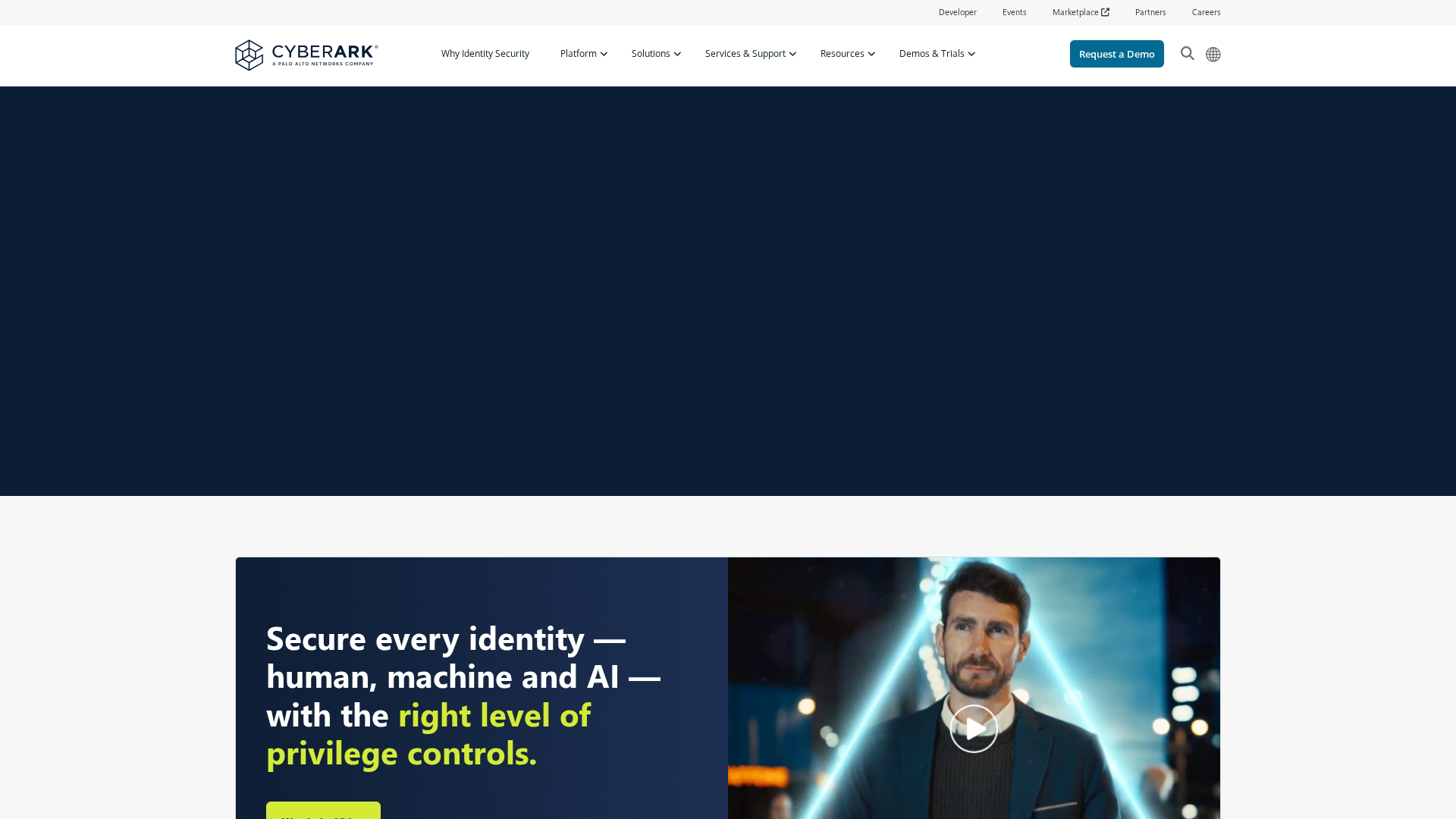
CyberArk approaches agentic AI security through its identity security heritage. The platform treats AI agents as machine identities requiring the same privilege controls, credential management, and access governance as human users.
Best for: Organizations with mature identity programs wanting to extend existing controls to AI agents.
Key strengths:
- Privilege management: Applies least-privilege principles to agent credentials with just-in-time access
- Secrets management: Secures and rotates agent credentials automatically
- Session isolation: Contains agent actions within controlled sessions that limit blast radius
Why choose CyberArk: Identity sprawl is often the root cause of agentic AI incidents. CyberArk addresses this directly by bringing agents into your existing identity governance framework.
Pricing: Custom enterprise pricing based on identity count and capabilities.
G2 rating: 4.4/5
3. BeyondTrust
BeyondTrust focuses on discovering and managing the identity security gap created by shadow AI. The platform surfaces unmanaged agents and prevents privilege escalation through tight access controls.
Best for: Security teams concerned about unauthorized agent deployment and privilege creep.
Key strengths:
- Shadow AI discovery: Identifies agents deployed without IT oversight
- Privilege analysis: Maps what each agent can access and flags over-permissioned configurations
- Escalation prevention: Blocks agents from acquiring permissions beyond their intended scope
Why choose BeyondTrust: If shadow AI is your primary concern, BeyondTrust's discovery capabilities are among the strongest in the market.
Pricing: Custom pricing based on deployment scope.
G2 rating: 4.5/5
4. Zenity
Zenity specializes in securing AI agents built on low-code and no-code platforms. As business users increasingly create autonomous workflows without developer involvement, Zenity provides visibility and governance for citizen-developed agents.
Best for: Enterprises with widespread low-code adoption and business-user-created AI automation.
Key strengths:
- Low-code coverage: Discovers agents across Power Platform, Zapier, Make, and similar automation tools
- Business user governance: Applies security policies to agents created outside traditional development
- Cross-platform visibility: Provides unified view across multiple automation and AI platforms
Why choose Zenity: Traditional security tools miss agents built in low-code environments. If your organization has significant Power Platform or Zapier adoption, Zenity fills a gap other platforms don't address.
Pricing: Custom pricing based on platform coverage and agent volume.
G2 rating: 4.6/5
5. Prompt Security
Prompt Security focuses on prompt-level protection and data loss prevention for AI systems. The platform intercepts and analyzes prompts before they reach agents, blocking injection attacks and preventing sensitive data from leaving through AI outputs.
Best for: Organizations prioritizing defense against prompt injection and data exfiltration.
Key strengths:
- Prompt analysis engine: Detects manipulation attempts before agent execution
- Data loss prevention: Blocks sensitive data from leaving through agent outputs
- Rapid deployment: SaaS-native architecture enables fast rollout
Why choose Prompt Security: If prompt injection and data leakage are your primary concerns, Prompt Security provides focused protection. It's less comprehensive for identity governance or shadow AI discovery.
Pricing: Custom pricing based on prompt volume and capabilities.
G2 rating: 4.4/5
6. HiddenLayer
HiddenLayer provides AI detection and response capabilities that extend to agentic systems. The platform focuses on identifying and blocking adversarial attacks against AI models and the agents that use them.
Best for: Security teams wanting specialized AI threat detection integrated with existing security operations.
Key strengths:
- Adversarial detection: Identifies attacks targeting AI models including evasion, poisoning, and extraction
- Model protection: Secures the underlying models agents rely on
- SOC integration: Feeds alerts into existing SIEM and SOAR workflows
Why choose HiddenLayer: HiddenLayer provides deeper model-level protection against sophisticated adversarial attacks than platforms focused primarily on agent behavior.
Pricing: Custom enterprise pricing.
G2 rating: 4.3/5
7. Vectra AI
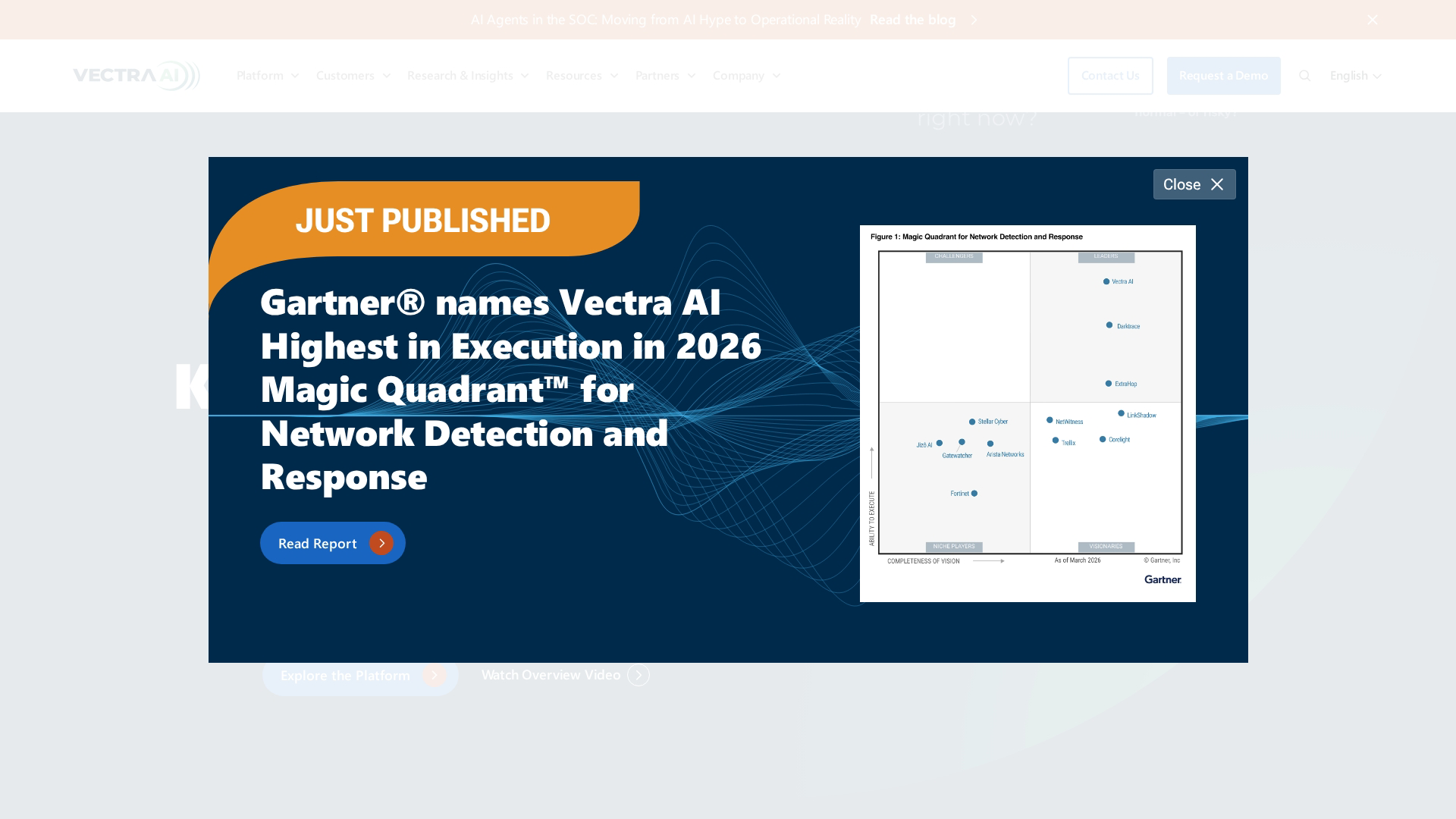
Vectra AI extends its network detection and response capabilities to cover agentic AI behavior. The platform applies behavioral analytics to identify anomalous agent communication patterns and correlates agent activity with broader threat campaigns.
Best for: Teams with mature NDR deployments wanting to add agentic AI coverage without deploying a separate platform.
Key strengths:
- Behavioral analytics: Detects anomalous agent communication patterns
- Attack correlation: Connects agent activity with broader threat campaigns
- Hybrid coverage: Works across cloud and on-premises environments
Why choose Vectra AI: If you're already using Vectra for network detection, extending to agentic AI coverage requires minimal additional deployment.
Pricing: Custom pricing based on deployment scope and data volume.
G2 rating: 4.5/5
How to evaluate agentic AI security vendors
Comparing agentic AI security solutions requires structured evaluation. Use the framework below to assess vendors against your specific requirements.
Minimum viable security controls
Before deeper evaluation, confirm every platform on your shortlist provides these non-negotiables:
- Agent inventory: Can it discover all agents, including shadow AI deployed without IT oversight?
- Privilege visibility: Does it show what each agent can access across systems and data?
- Runtime protection: Can it block unauthorized actions in real time?
- Audit logging: Does it provide complete execution path records for compliance and forensics?
POC testing checklist
During proof-of-concept evaluation, run these tests to validate vendor claims:
- Deploy an unauthorized test agent and measure detection time
- Simulate a prompt injection attack and confirm the platform blocks it
- Verify integration with your existing identity provider
- Measure alert noise versus actionable findings over a one-week period
Integration requirements
Agentic AI security doesn't exist in isolation. Evaluate integration depth with your existing stack:
- SIEM platforms: Can the platform send alerts to Splunk, Microsoft Sentinel, or your existing SIEM?
- SOAR tools: Does it support automated response playbooks through your SOAR platform?
- Identity providers: Can it pull identity context from Okta, Azure AD, or your IdP?
- Cloud platforms: Does it cover AWS, Azure, GCP, or your specific cloud environment?
Pricing and total cost of ownership
Vendor pricing models vary significantly:
- Per-agent pricing: Costs scale with the number of agents monitored
- Per-user pricing: Costs based on users who create or interact with agents
- Platform fees: Flat annual fee with usage tiers
- Consumption-based: Costs based on data volume or API calls
Beyond license costs, factor in professional services for deployment, training for your team, and ongoing tuning as your agent population grows.
How to secure agentic AI in your organization
Regardless of which platform you choose, the following steps apply to building an effective program around agentic AI security solutions.
1. Establish agent visibility first
Start with discovery before adding controls. You can't protect agents you don't know exist.
Audit existing AI tools across your organization. Interview teams about AI assistants, automation workflows, and autonomous systems they've deployed.
2. Implement least privilege access
Apply the same principle used for human identities. Agents receive only the access required for their specific function.
Review existing agent permissions and revoke unnecessary access. Establish approval workflows for new agent deployments that include security review.
3. Monitor runtime behavior continuously
Static configuration audits aren't enough. Agent behavior changes based on inputs and context. Continuous monitoring catches drift and anomalies that point-in-time assessments miss.
Establish baselines for normal agent behavior. Alert on deviations that indicate compromise or misconfiguration.
4. Build cross functional governance
Agentic AI security isn't just a security team problem. Involve IT, legal, compliance, and business units who deploy agents.
Establish clear ownership for each agent. Define acceptable use policies for autonomous AI. Create incident response procedures specific to agent compromise.
Start building your agentic AI security strategy
Agentic AI adoption is accelerating. Security programs that wait until agents are everywhere will struggle to catch up. Teams deploying AI agent builders should factor security into their evaluation from the start.
Begin with visibility. Discover what agents exist in your environment today. Then layer in controls based on the risks those agents present.
When evaluating security platforms, interactive demos let your team experience the product before committing to a POC. Showing stakeholders how a platform works builds alignment faster than slide decks.
Start your journey with Guideflow today!
FAQs about agentic AI security solutions
What company is leading in agentic AI security?
Palo Alto Networks, CyberArk, and BeyondTrust are among the most recognized vendors, each with different strengths. Palo Alto leads in comprehensive platform coverage, CyberArk in identity-first security, and BeyondTrust in shadow AI discovery. The right choice depends on your primary security concerns and existing infrastructure.
How much do agentic AI security platforms typically cost?
Pricing varies widely based on deployment size and capabilities. Enterprise platforms typically require custom quotes. Request quotes from multiple vendors to benchmark.
Can existing security tools protect AI agents adequately?
Traditional security tools like firewalls and endpoint protection weren't designed for autonomous agent behavior. They typically lack visibility into agent memory, tool calls, and multi-step execution paths. Most organizations benefit from dedicated agentic AI security capabilities that integrate with existing tools.
What compliance frameworks apply to agentic AI systems?
Organizations typically map agentic AI security to existing frameworks like SOC 2, ISO 27001, and GDPR. The EU AI Act introduces specific requirements for high-risk AI systems. NIST's AI Risk Management Framework provides guidance, though dedicated agentic AI standards are still emerging.
Teams can also reference enterprise risk management software to support compliance workflows.
How long does agentic AI security platform deployment take?
Initial discovery and visibility can often be achieved within days using SaaS-based platforms. Full runtime protection and governance typically requires 4 to 8 weeks of configuration, policy tuning, and integration work.
Do organizations need agentic AI security if they only use basic chatbots?
Basic chatbots with limited functionality pose lower risk than autonomous agents. However, any AI system with tool access, persistent memory, or autonomous decision-making capabilities warrants evaluation for agentic security controls.
What is the difference between agentic AI security and AI governance?
Agentic AI security focuses on protecting agent operations from threats and misuse through technical controls. AI governance encompasses broader concerns including ethics, bias, transparency, organizational policy, and regulatory compliance. Most organizations benefit from both — explore our guide to AI governance tools for the broader picture.