

You know personalization matters. Your leadership knows it too. Yet the storefront still shows every visitor the same three "featured" products, and the email still opens with "Dear valued customer."
That gap costs money. Generic experiences leave clicks, average order value, and repeat visits on the table.
The market has noticed. The global recommendation engine software market is projected to grow from USD 6.32 billion in 2024 to USD 72.62 billion by 2033, a 29.62% CAGR, according to Research and Markets (2024). Buyers are spending because relevance moves revenue.
But spending on a recommendation engine and getting return from one are different problems. The tool you pick decides whether you ship real-time, relevant suggestions that lift conversion, or another dashboard nobody trusts. This guide breaks down seven platforms so you can match one to your stack, your data, and the number you actually own.
What's inside
This guide is built for marketers, ecommerce teams, and product owners evaluating recommendation engine software in 2026. Here is how we chose and compared the tools.
- Who it's for: growth marketers, ecommerce leads, and product teams who care about conversion, AOV, retention, and engagement
- How we selected: real-time serving, personalization depth, integration quality, and scalability into production
- How we compared: buyer fit and revenue impact, not algorithm buzzwords alone
- What we skipped: academic recommender concepts with no path to a live storefront or campaign
TL;DR
Short on time? Here are the fast picks.
- Best overall for scalable real-time personalization: Recombee
- Best for enterprise commerce teams: Adobe Commerce
- Best for Salesforce-aligned commerce: Salesforce Commerce Cloud
- Best for on-site personalization and merchandising: Dynamic Yield
- Best for content and commerce personalization together: Bloomreach
- Best for Shopify-oriented product recommendations: Nosto
- Best for flexible recommendation rules and affordability: Clerk.io
Match the tool to your data maturity and stack first. Feature depth matters less than whether the engine fits how your team already works.
What is recommendation engine software
Recommendation engine software is a system that uses behavioral, item, and contextual data to generate personalized suggestions, such as products, content, or next-best actions, for each user in real time.
Think of it as the layer between your raw data and the experiences your customers see. It reads what people browse, buy, watch, or click, then scores which items each person is most likely to want next. Modern platforms serve those suggestions in milliseconds so the carousel updates before the page finishes loading.
How recommendation engines work
Recommendation engines ingest event and catalog data, build a model of user and item relationships, then score candidates for each request. The recommendation engine algorithms rank items by predicted relevance and return the top matches. Good platforms retrain continuously so recommendations reflect the last click, not last week's behavior.
Main data inputs
- Behavioral data: clicks, views, add-to-carts, purchases, watch time
- Item data: catalog metadata, price, category, tags, content attributes
- Contextual data: device, location, session, time of day
- Identity data: logged-in profiles, anonymous session IDs, CRM records
Core recommendation types
Most recommendation systems use one of three recommendation system algorithms, or a blend of them.
- Collaborative filtering: recommends items based on what similar users liked. If shoppers like you bought X, you probably want X.
- Content-based filtering: recommends items similar to what a user already engaged with, based on item attributes.
- Hybrid recommendation systems: combine both, plus real-time signals, to cover cold starts and improve accuracy.
Common outputs
- Product recommendations (also called product recommendation software output): "you may also like," "frequently bought together"
- Content recommendations: a content recommendation engine powering "up next" or "recommended reading"
- Next-best-action suggestions in lifecycle and campaign flows
- Personalized collections, carousels, and search results
When to use
Recommendation engine software earns its keep in three situations. Match your context to one before you shortlist.
Personalize ecommerce storefronts
Retailers use a product recommendation engine to lift AOV, cross-sell, and speed up product discovery. When a catalog runs into thousands of SKUs, manual merchandising cannot keep up. An ai recommendation engine surfaces the right item on the product page, cart, and homepage without a merchandiser touching every rule.
Improve media and content engagement
Publishers and streaming teams use a media recommendation engine to keep users browsing, watching, and reading. The goal is session depth and return visits. Relevant "up next" suggestions turn one article or episode into a longer session, which is the metric these teams live and die by.
Reduce friction in campaigns and lifecycle journeys
Marketers deploy recommendation engines inside email, landing pages, and onsite experiences to make offers relevant. A generic promo converts far below a personalized block that reflects real intent. Real-time recommendations tied to CRM and behavioral data let you send the right product to the right person at the right moment.
Comparison table
We compared each platform on who it fits best, its standout differentiator, published pricing, and its current G2 rating. Pricing for enterprise commerce platforms is largely quote-based, so we noted that where it applies. Ratings reflect each tool's live G2 listing.
| # | Product | Best for | Key differentiator | Pricing | G2 rating |
|---|---|---|---|---|---|
| 1 | Recombee | Real-time personalization at scale | Configurable API-first engine with search and analytics | Free tier; paid from $99/mo | 4.6/5 |
| 2 | Adobe Commerce | Enterprise B2B/B2C retail | Native commerce recommendations in the Adobe stack | Custom pricing | 4.0/5 |
| 3 | Salesforce Commerce Cloud | Salesforce-aligned enterprises | Commerce personalization tied to Salesforce data | Custom pricing | 4.3/5 |
| 4 | Dynamic Yield | Experimentation-heavy teams | Personalization plus built-in A/B testing | Custom pricing | 4.5/5 |
| 5 | Bloomreach | Content and commerce together | Search relevance plus marketing automation | Custom pricing | Not listed |
| 6 | Nosto | Shopify and ecommerce growth | Modular onsite personalization and merchandising | Quote-based | 4.6/5 |
| 7 | Clerk.io | Fast setup and affordability | Modular AI search and recommendations | Free tier; usage-based | 4.8/5 |
Best 7 recommendation engine software tools for 2026
Here is the detailed breakdown. Each section covers who the tool fits, what it does well, and what you will actually pay.
1. Recombee
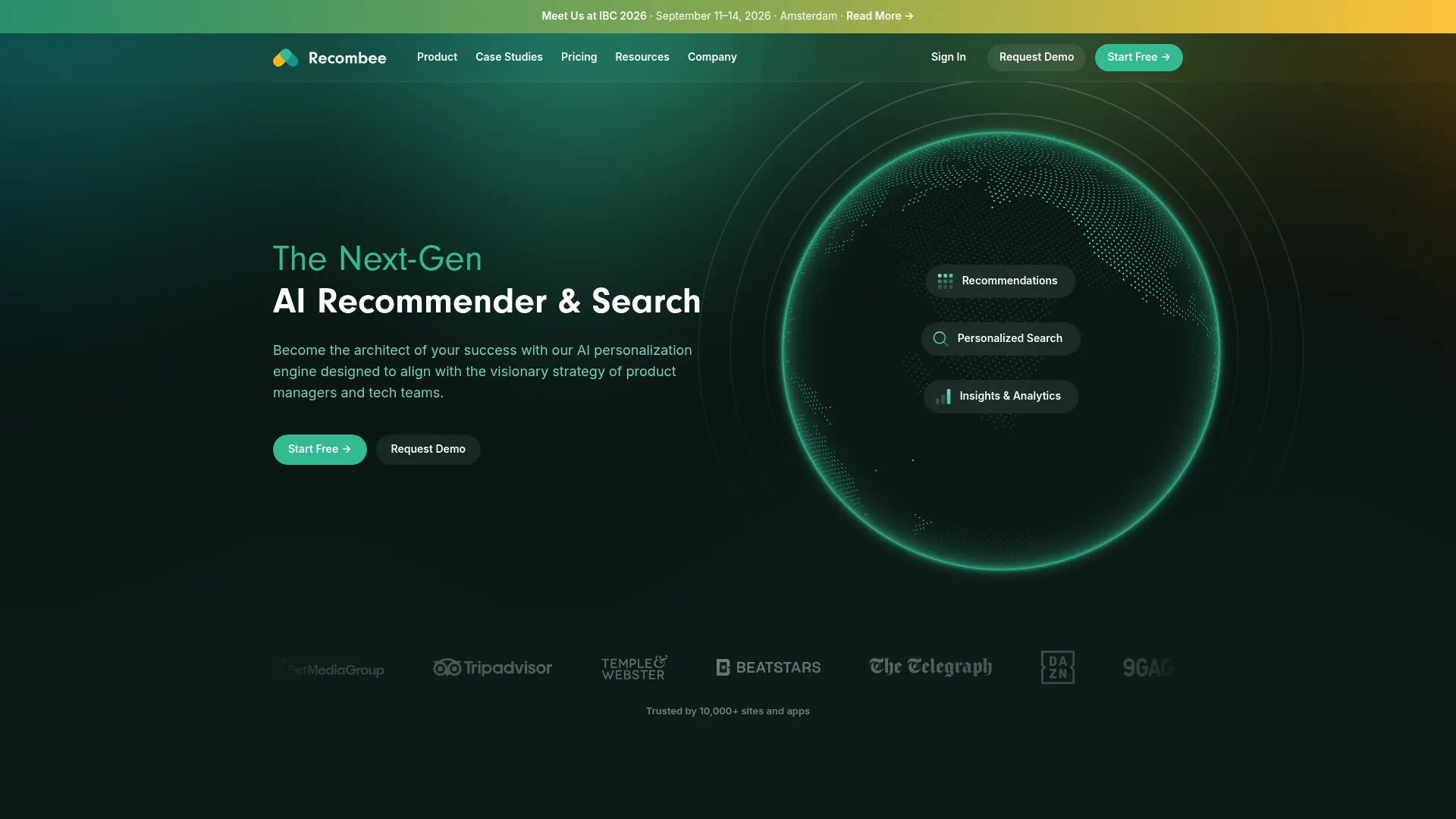
Recombee is an AI-powered real-time recommendation and search engine delivered as a service. It sits behind an API, so your team feeds it events and catalog data, then requests scored recommendations for any surface: web, app, email, or in-store screen. Teams that want control over how recommendations are built, without running their own machine learning recommendations infrastructure, tend to land here first.
Best for: teams that want a configurable, real-time recommendation engine with search and analytics under their own control.
Key strengths
- Real-time recommendations that update with the latest user signal
- Personalized search alongside recommendations in one engine
- Real-time analytics and insights on recommendation performance
- API-first design that fits custom stacks and headless setups
- Hybrid recommendation logic to handle cold starts
Why choose Recombee: if your team has developer bandwidth and wants to tune the engine rather than accept a fixed merchandising UI, Recombee gives you that control. It fits product and growth teams who treat recommendations as infrastructure, not a widget.
Recombee pricing: a Free plan is available at $0 forever. Paid plans are usage-based: Standard at $99/mo, Pro at $1,699/mo, and Premium at $4,499/mo. A Platinum tier is available with custom pricing through sales.
2. Adobe Commerce
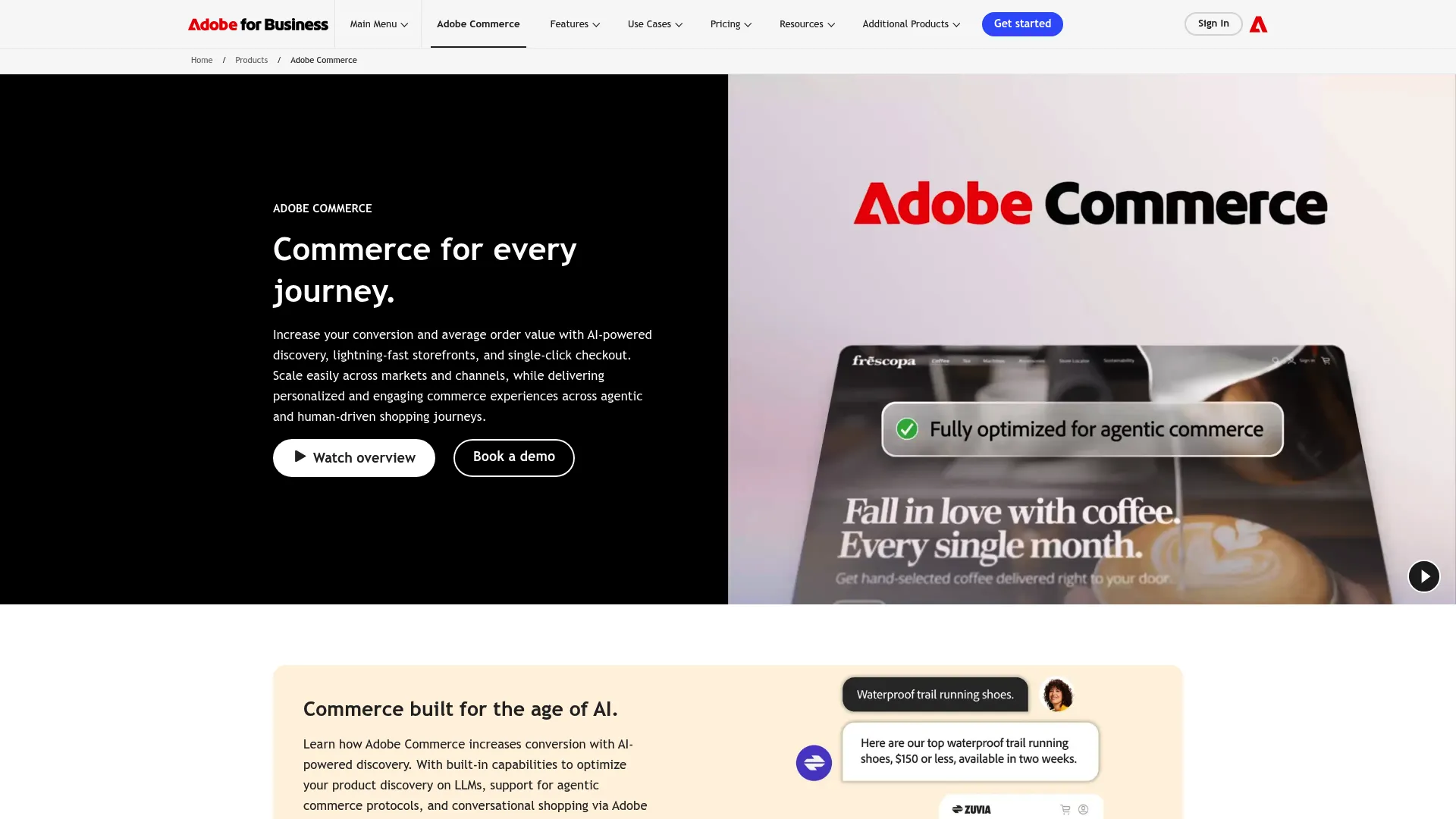
Adobe Commerce, formerly Magento Commerce, is an enterprise ecommerce platform with AI-driven product discovery built in. Recommendations are native to the storefront, so merchandising, catalog, and personalization live in the same system your team already runs commerce on. It handles both B2B and B2C selling at scale.
Best for: large brands and enterprise retail teams that need scalable, customizable B2B/B2C ecommerce with recommendations included.
Key strengths
- AI-driven commerce recommendations native to the storefront
- Digital storefront experiences across B2B and B2C
- B2B commerce optimization for complex catalogs
- Deep catalog and merchandising control
- Fit for teams already invested in the Adobe stack
Why choose Adobe Commerce: if you run a large catalog and want recommendations inside your commerce platform rather than bolted on, Adobe Commerce keeps everything in one place. It suits retailers with the technical resources to customize a full platform.
Adobe Commerce pricing: Adobe does not publish pricing publicly. The product page directs you to contact sales or book a demo for a quote based on your business.
3. Salesforce Commerce Cloud
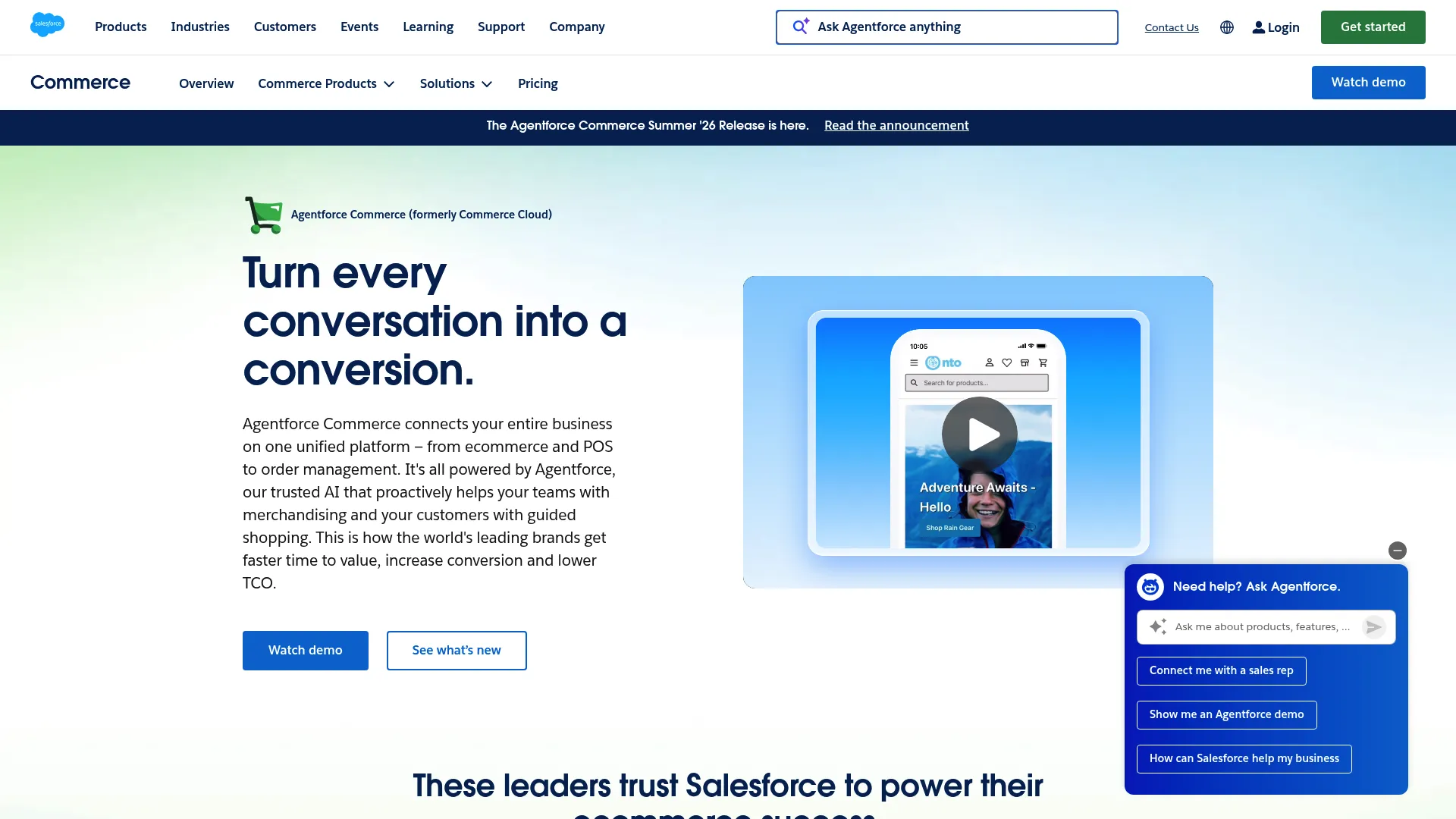
Salesforce Commerce Cloud is an enterprise commerce platform for B2B, B2C, and D2C selling, built on the Salesforce ecosystem. Its recommendations draw on commerce and customer data already living in Salesforce, which appeals to teams that want personalization tied to a unified customer view across channels.
Best for: large businesses that need enterprise ecommerce and personalization tied to the Salesforce ecosystem.
Key strengths
- AI-powered commerce experiences across the funnel
- Headless and composable commerce architecture
- Order management and payments in one platform
- Recommendations informed by Salesforce customer data
- Cross-channel personalization for unified journeys
Why choose Salesforce Commerce Cloud: if your organization already runs on Salesforce, keeping commerce and personalization in the same ecosystem reduces data silos. It fits enterprises that value one customer record across sales, service, and commerce.
Salesforce Commerce Cloud pricing: Salesforce lists B2C Commerce editions (Growth, Plus, and Premium) as contact-for-pricing, billed annually. There is no free tier, and you request a quote for your edition.
4. Dynamic Yield
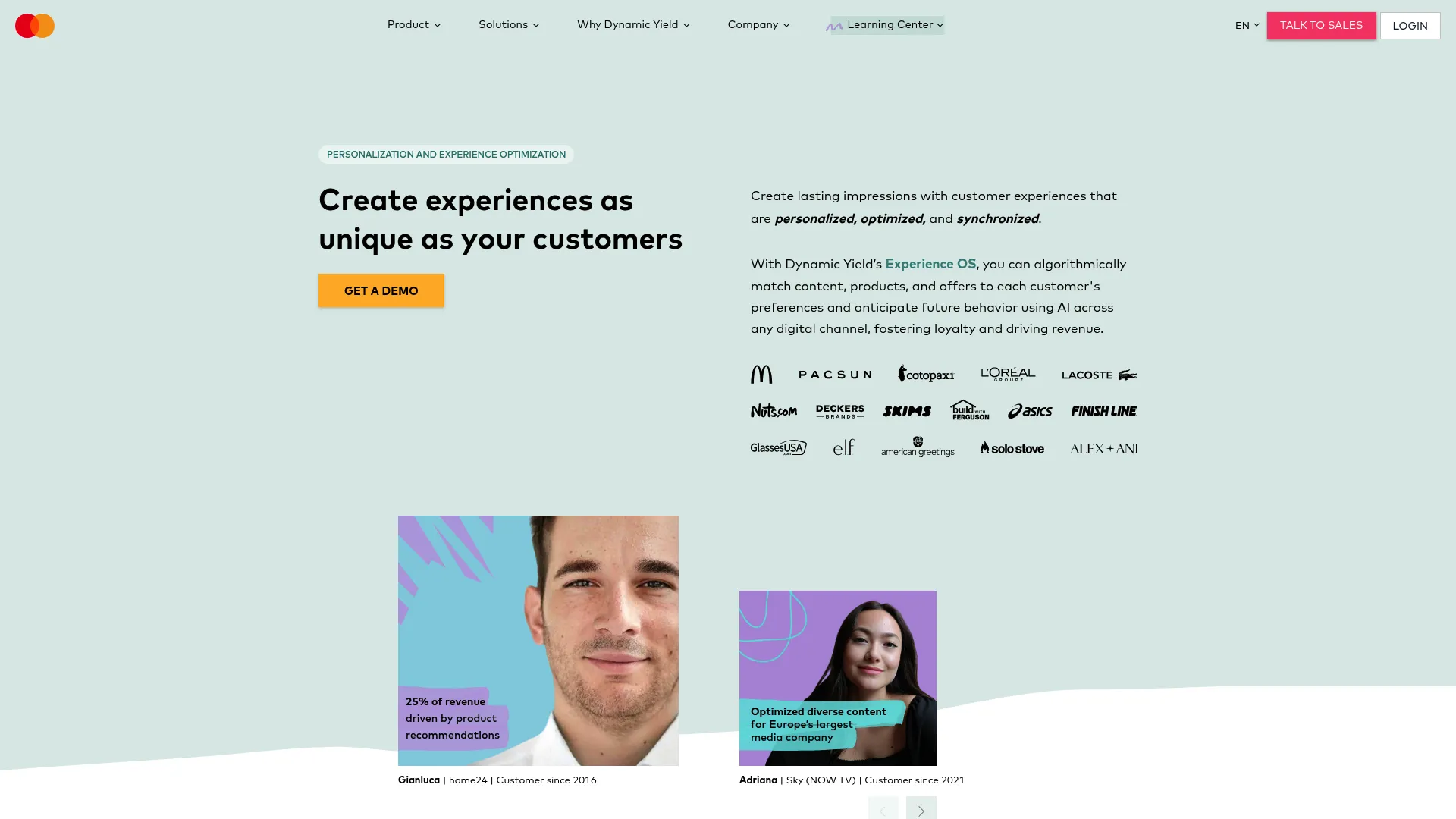
Dynamic Yield is an AI-powered personalization platform spanning web, mobile, email, and other digital experiences. It pairs product recommendations with built-in experimentation, so teams can test which personalization strategy actually moves the metric before rolling it out everywhere.
Best for: enterprise teams running experimentation-heavy customer journeys across channels.
Key strengths
- Personalization and targeting across channels
- Product recommendations tied to behavioral signals
- A/B testing and optimization built in
- Merchandising control over recommendation output
- Cross-channel delivery from one platform
Why choose Dynamic Yield: if your growth culture runs on experiments, the built-in testing means you can prove lift instead of assuming it. It suits conversion optimization teams that want personalization and experimentation in the same tool.
Dynamic Yield pricing: Dynamic Yield does not publish public pricing. The site directs you to contact sales for a quote based on your requirements.
5. Bloomreach
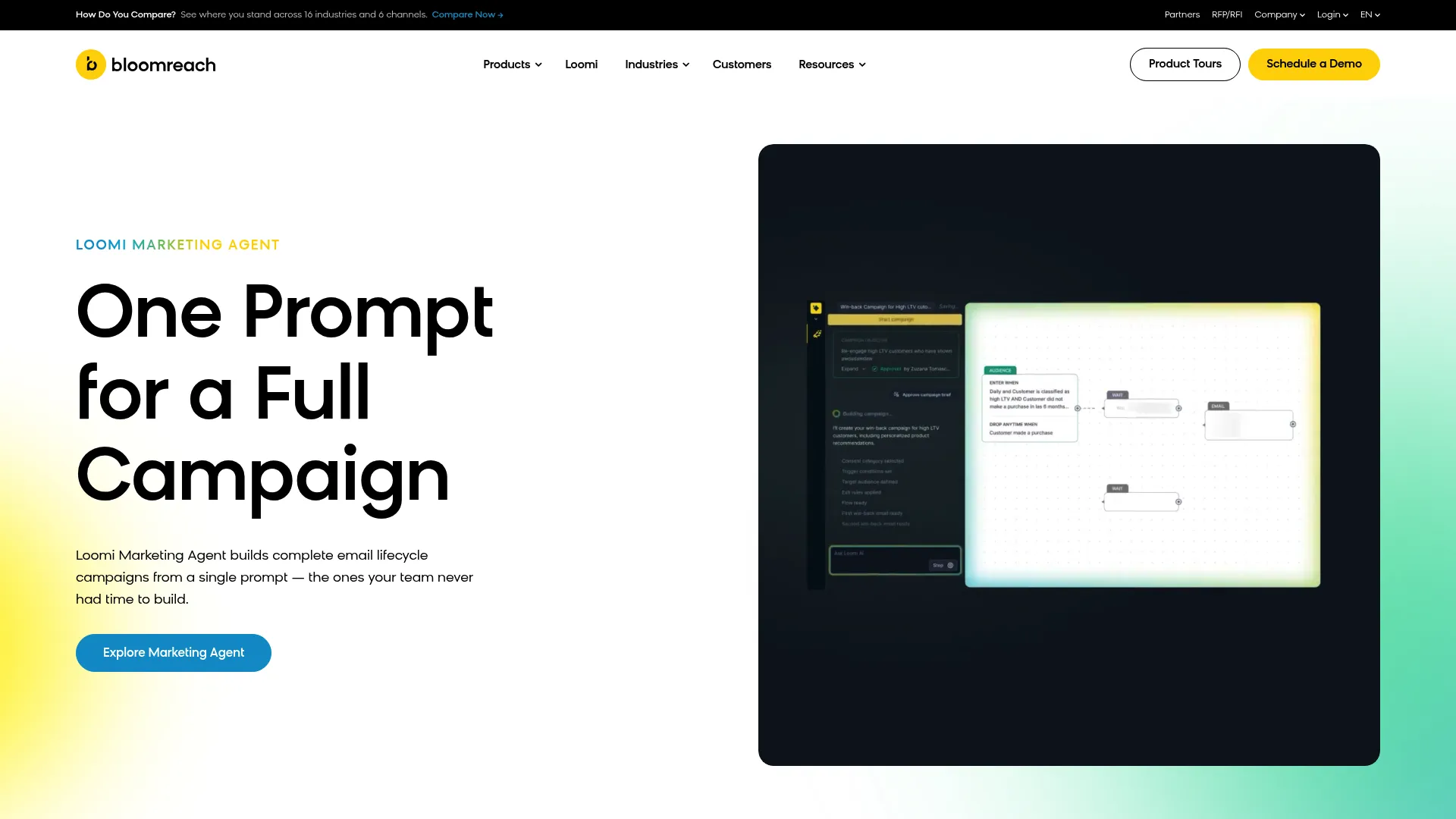
Bloomreach is an AI platform for ecommerce personalization across marketing, search, and shopping. It combines search relevance, merchandising, and marketing automation, which makes it a fit for teams that want to personalize discovery and revenue in one system rather than stitching a search tool to a separate campaign tool.
Best for: mid-market and enterprise ecommerce teams needing personalization, search, and marketing automation together.
Key strengths
- AI-driven marketing automation and omnichannel campaigns
- Autonomous Search and merchandising
- Conversational shopping with an AI shopping agent
- Segmentation for targeted recommendations
- Experience orchestration across discovery and revenue
Why choose Bloomreach: if you want search relevance and marketing automation working from the same customer data, Bloomreach avoids gluing separate tools together. It fits marketers balancing product discovery with lifecycle revenue.
Bloomreach pricing: pricing is customized and usage-based, with a module fee plus a usage fee, billed annually. Modules such as Autonomous Marketing, Autonomous Search, and Conversational Shopping are priced on request. There is no free tier.
6. Nosto
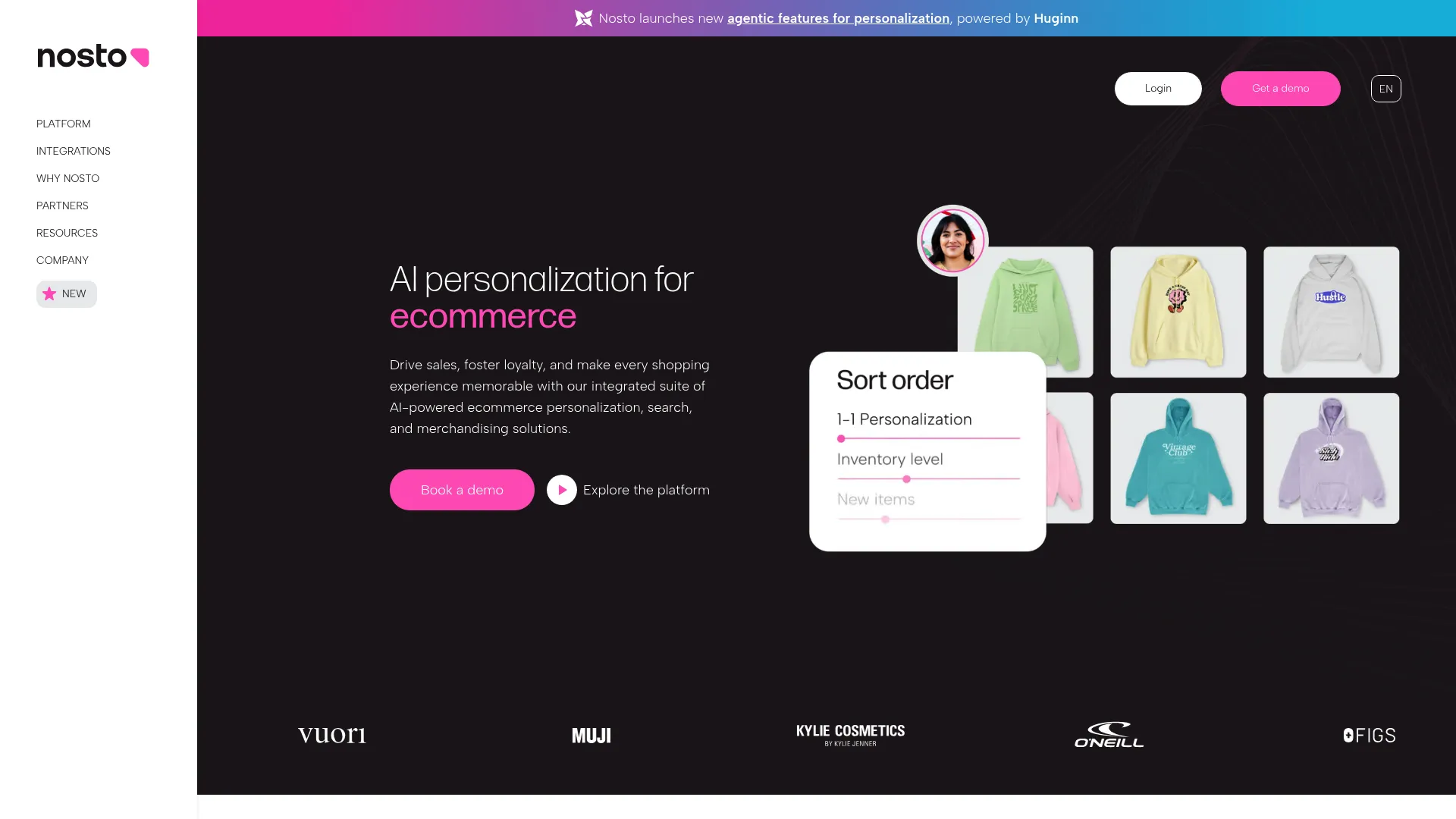
Nosto is a commerce experience platform for personalization, search, merchandising, recommendations, and content experiences. Its modular design lets ecommerce teams turn on the pieces they need, which makes it a common pick for Shopify and mid-market brands that want onsite personalization without a full replatform.
Best for: ecommerce brands, especially Shopify growth teams, needing modular onsite personalization and merchandising.
Key strengths
- Personalized search across the storefront
- Category merchandising control
- Product recommendations tuned by segment
- Modular setup so you adopt what you need
- Conversion-focused onsite personalization
Why choose Nosto: if you run a Shopify or mid-market store and want product discovery and merchandising you can configure without heavy engineering, Nosto's modules fit that workflow. It suits growth teams optimizing conversion on an existing storefront.
Nosto pricing: Nosto uses modular, quote-based pricing rather than fixed public tiers. Cost depends on business volume, the modules you select, and your support and scalability needs. There is no free tier, so request a quote.
7. Clerk.io
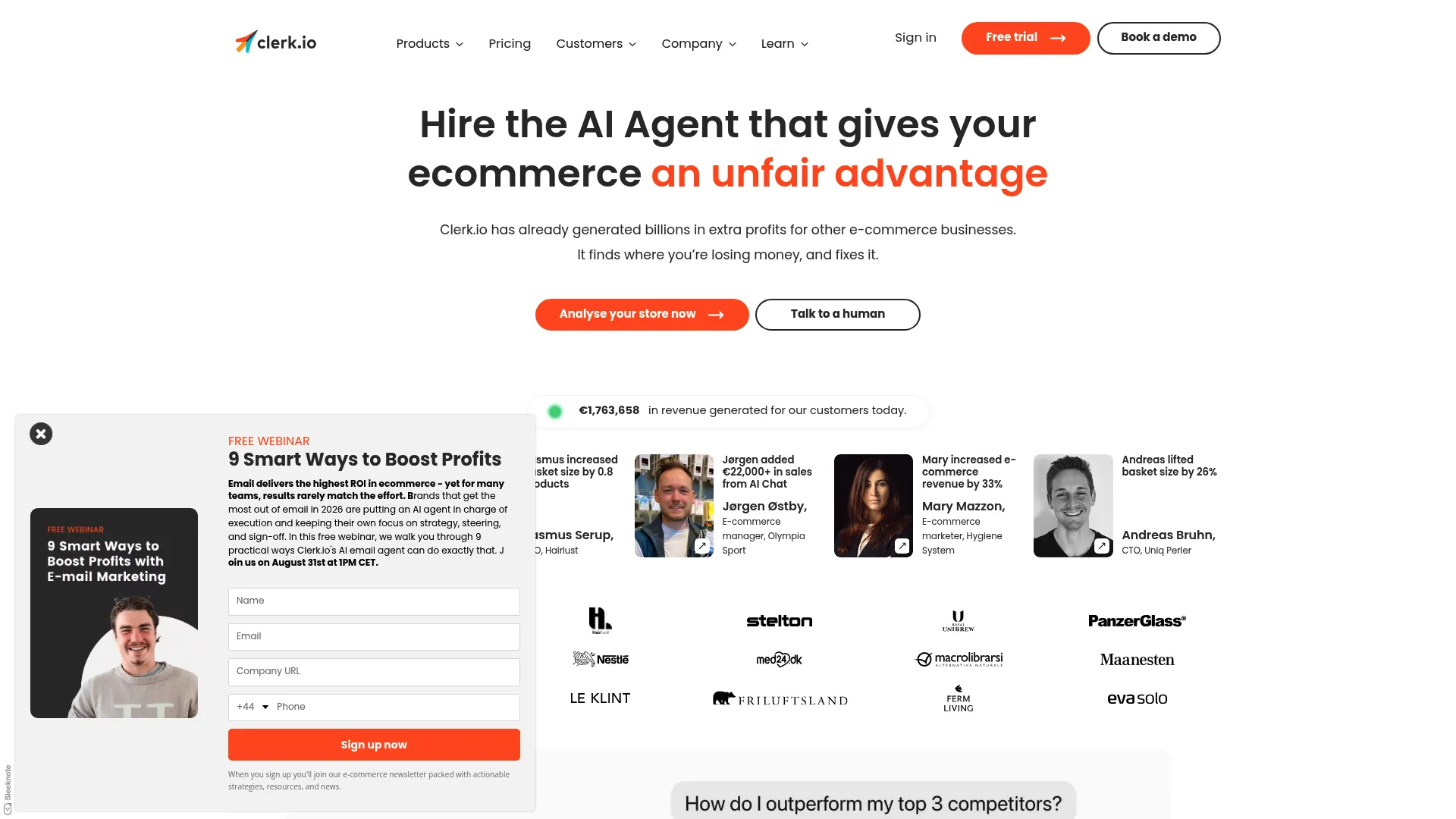
Clerk.io is an AI-powered ecommerce personalization platform covering search, recommendations, chat, email, and audience segmentation. Its modular, usage-based model makes it approachable for smaller teams and fast-moving retailers that want recommendation blocks and search live quickly without enterprise-scale commitment.
Best for: ecommerce teams needing modular AI search, recommendations, chat, and lifecycle personalization.
Key strengths
- AI search with typo and vague-query handling
- Product recommendations across key touchpoints
- AI chat to guide shoppers
- Email and audience segmentation for lifecycle
- Modular pricing so you start small
Why choose Clerk.io: if you want straightforward setup, automation, and recommendation blocks without a long implementation, Clerk.io fits smaller teams and retailers moving fast. It gives you search and recommendations in one modular package.
Clerk.io pricing: Clerk.io uses modular, usage-based pricing with a free entry point (€0/mo per module at default usage). Modules include Search, Recommendations, Chat, Email, and Audience. B2B and enterprise pricing is quote-based, and actual cost scales with usage.
Considerations
Feature lists blur together fast. Before you sign, work through this checklist against your own reality.
Data quality and signal depth
A recommendation engine is only as good as the data feeding it. Verify your event tracking captures clicks, add-to-carts, and purchases cleanly. Check that catalog metadata and content attributes are complete and current. Confirm the platform handles identity resolution across logged-in and anonymous sessions, or your personalization fragments.
Real-time serving and latency
Speed decides whether a recommendation lands. If the carousel loads after the shopper scrolls past, the suggestion is wasted. Ask about low-latency serving and how fast the engine reflects the last click. Real-time recommendations that lag behind behavior underperform against static blocks that at least load instantly.
Personalization control
You want segmentation, rules, exclusions, and merchandising control, not a black box. Confirm you can boost or bury items, exclude out-of-stock SKUs, and layer business rules over algorithmic output. Marketers need to steer recommendations toward margin and strategy, not just predicted clicks.
Integrations and stack fit
The engine has to plug into what you already run. Check for native connections to your ecommerce platform, CRM, CMS, CDP, analytics, and warehouse. A tool that fits your stack ships faster and needs less engineering. A tool that fights it becomes a project that never ends.
Measurement and experimentation
If you cannot measure lift, you cannot defend the spend. Confirm the platform supports A/B testing, clean attribution, and reporting your CFO will trust. Look for holdout groups and lift measurement, not just vanity click counts. The number you own is conversion or AOV, so tie the tool to it.
Conclusion
Match the platform to your stack and data maturity, not to the longest feature list.
For scalable, real-time personalization with API control, Recombee is the strongest overall pick. Enterprise retail teams should look at Adobe Commerce for native commerce recommendations, or Salesforce Commerce Cloud if you already run on Salesforce. Dynamic Yield fits experimentation-heavy growth teams, and Bloomreach suits marketers who want search and marketing automation in one system.
If you run Shopify or a mid-market store, Nosto delivers modular onsite personalization without a replatform. For fast setup and affordability, Clerk.io gives smaller teams recommendations and search in one package.
Your next step: shortlist two tools that fit your ecommerce platform and CRM, then run a scoped test on a single high-traffic surface. Measure conversion or AOV against a holdout before you commit budget. Personalization only counts when the lift shows up in the number you own.
FAQs
Recommendation engine software is used to generate personalized product, content, or action suggestions for each user based on their behavior and context. Retailers use it to lift AOV and cross-sell, publishers use it to increase session depth, and marketers use it to personalize campaigns. The goal is relevance that moves conversion, engagement, or retention.
Recommendation engines ingest behavioral, item, and contextual data, build a model of user and item relationships, then score candidate items for each request. The recommendation engine algorithms rank items by predicted relevance and return the top matches in real time. Strong platforms retrain continuously so suggestions reflect the latest behavior.
At minimum, a recommendation engine needs behavioral data (clicks, views, purchases), item data (catalog metadata and attributes), and identity signals to tie sessions to users. Contextual data like device, location, and time sharpens accuracy. Clean, complete event tracking matters more than any single algorithm.
Collaborative filtering recommends items based on what similar users liked, so it learns from crowd behavior. Content-based filtering recommends items similar to what a user already engaged with, based on item attributes. Hybrid recommendation systems combine both to handle cold starts and improve accuracy, which is why most production tools use a blend.
It depends on your stack. Recombee fits teams wanting a configurable real-time engine, Nosto suits Shopify and mid-market brands, and Clerk.io works for smaller teams needing fast setup. Enterprise retailers on Adobe or Salesforce often choose Adobe Commerce or Salesforce Commerce Cloud for native ecommerce recommendations.
Yes, when the recommendations are relevant and served in real time. Personalized product recommendations typically outperform static merchandising because they reflect actual intent. The lift depends on data quality and placement, so run an A/B test with a holdout group to measure the real impact on your storefront.
It depends on the platform and your data. API-first tools like Recombee suit teams with developer bandwidth, while modular platforms like Clerk.io and Nosto get recommendation blocks live faster on existing storefronts. The heaviest lift is usually clean event tracking and catalog data, not the engine itself.
Measure it against the business metric you own: conversion rate, AOV, session depth, or retention. Use A/B tests with holdout groups so you can attribute lift to the recommendations, not to seasonality. Avoid judging on click counts alone, since clicks do not always translate to revenue.